Showing posts with label bisexual female representation. Show all posts

Wednesday, May 20, 2026

VILLAIN (Hench #2) is Author NATALIE ZINA WALSCHOTS long-awaited and worth the wait sequel


VILLAIN (Hench #2)
NATALIE ZINA WALSCHOTS

Watch the inimitable Nancy Pearl interview Author Walschots here!
William Morrow (non-affiliate Bookshop.org link)
$14.99 ebook, available now

Rating: 4.75* of five

The Publisher Says: The Boys meets Starter Villain and Assistant to the Villain in Natalie Zina Walschots’s electrifying, sharp, violent, and hilarious sequel to the highly acclaimed novel, Hench, in which the Auditor must confront the near-impossible in order to right the many wrongs in the superhuman industry…or cause more of them. She’s not picky.

Anna, better known to superheroes as the Auditor, has carved out a name for herself. Any hero unlucky enough to cross her path knows her potential and powers. Surely, success should taste she has an incredible job with lots of perks, and her boss will literally annihilate anyone who crosses her, and her greatest enemy, the former hero Supercollider, has been utterly defeated and literally ground to a pulp.

But Anna still has her sights set on a greater destroying the Draft, the organization that makes, trains, and manages the world’s most powerful superheroes. These “heroes” have shown time and time again that they do more harm than good, and now is the time to stop the damage at its source.

Yet all is not well for the Auditor and her fellow evildoers. Her employer, Leviathan—the world’s most feared supervillain—is not coping well with Supercollider’s defeat at someone else’s hands. Moreover, her unlikely ally and unexpected friend, Quantum Entanglement, has vanished without a trace, leaving Anna to examine all the ways they deceived each other. Tension and uncertainty fill the air, and fear that this moment of triumph is about to crumble looms over all of them.

Anna soon finds herself facing down an opponent unlike any she’s taken on before—not another superhero, but someone like her…someone much more the Draft’s Chief Marketing Officer. This isn’t a test of physical prowess, but ideas, and as the fight spirals deeper and deeper, with new foes popping up every day—she’ll need more than just her superpower—data research—to keep ascending through the supervillain ranks.

It’s guerrilla ad warfare, and the Auditor might have finally met her match.

I RECEIVED A DRC FROM THE PUBLISHER VIA NETGALLEY. THANK YOU.

My Review
: It took five years, but the sequel I've quietly pined for has arrived. I downloaded the DRC in February, started reading it in late March, and finished a final pre-review skim last night. I treated this read as a reward, an experience to be savored, because Hench was such a completely fresh experience that it made me rethink the messaging of superhero crap, made me consider how subversion can in fact look like participation or even celebration. I liked The Boys because it's taken that idea to its logical end-point; but it came after Hench had prepared me psychologically for its storytelling mode.

The Department of Superheroic Affairs, aka "the Draft," is the organization that's responsible for everything involving superheroes. They do the recruiting, training, and funding...who ever stops to think about the accounting and expenditures that enable superheroes to blow apart entire city blocks? can you even imagine the insurance bills?!...and they create the most compelling backstories for them that they can. It means only certain tropes survive time-testing as superheroes wreak havoc in order to "save" people from supervillains.

Who also have an organizational structure centered around Leviathan, for whom our dear Anna...formerly Electric Eel's hench, now known as the supervillain "The Auditor" (if that yclepture doesn't provoke horripilation you've never filled out an accounting reimbursement justification)...serves as right-hand person. Leviathan, after the end of Hench sees the biggest rival he has (Supercollider) fall to richly deserved intimate betrayal orchestrated by Anna/The Auditor, is too depressed by the newly unchallenging world he lives in to be effective in supervillainy. Anna/The Auditor needs to snap him out of it but, in a truly tropey twist, The Draft hires a new marketing manager. One who is Anna/The Auditor's equal or possibly superior in data analytics and statistical modeling...the secret superpowers that brought Supercollider down. Now Supercollider is permanently damaged, and dies as the Draft's medics are trying to "untangle him from himself," and the Draft's new marketer finds enough dirt to plausibly, if inaccurately, pin responsibility for his death on Leviathan.

Hijinks ensue.

To look into this only-slightly-distorted mirror world is to see 2026 explained without didactic shouting, blaming, and finger-pointing. It's all here, all the guilty parties are lined up for our scorn and contumely to be unloaded on them, and exactly like real life they are everywhere not just on one side. False dichotomies like hero-v-villain aren't allowed to stand; the acts perpetrated are equally awful, are not discernably different in their results. They're not different in their motivations, either; each "side" is only out to do down the other side and then justify the carnage for everyone else later.

It is here that I come fully into my love of Author Natalie's storytelling. The battling sides are not contesting opposing ideas, arguing through competing society-wide organizational plans, they're solely and entirely focused on hurting each other in increasingly horrifying ways. What that means for non-combatants is (yet again) not part of the calculus except insofar as the optics can be used against the other side.

As Leviathan re-awakens to his supervillainous purpose, Anna/The Auditor and her scoobygroup are stretched on practical and emotional levels to achieve Leviathan's purpose and counteract the Draft's new, high-powered team that uses Anna/The Auditor's innovative techniques against them. As in Hench, the emotional costs of violence, loss, betrayal, and fanaticism are personalized while the impersonal systems grind on propelled by the suffering people behind the major players.

I think Author Natalie took her time...I understand she re-wrote this book four times...to very good effect. I got invested again immediately despite the long interval between reads. I was deftly reminded of things necessary to remember instead of infodumped on; I was also shown how time has passed in the storyverse and the changes that has wrought on significant relationships. It's a fine achievement in storytelling craft. The ending is not A Conclusion. There is openness in its action to either another sequel (yes please!) or simply room for you-the-reader to headcanon something you'd like for the characters. It works for soap operas and comic book series, why not for a supervillain's difficult choices and incomplete emotional development?

I recommend the read; it's not utterly necessary to read Hench first, but why wouldn't you want to? It's a series with a lot to say about the world we live in, and what it says I agree with, so I'm recommending it to all y'all, even the superhero/comic book averse.

After all, that described me before this series came my way.

Wednesday, March 25, 2026

ALMOST LIFE, the ghostly sound of unrung bells in unlived lives


ALMOST LIFE
KIRAN MILLWOOD HARGRAVE

Summit Books (non-affiliate Bookshop.org link)
$14.99 ebook, available now

Rating: 4* of five

The Publisher Says: Two young women meet in Paris in this decades-spanning tour de force about the enduring power of young love and the poignant heartbreak of missed chances—perfect for fans of One Day and Normal People.

Erica and Laure meet on the steps of the Sacré-Coeur in Paris, 1978. Erica is a student, relishing her first summer abroad before beginning university at home in England. Laure is studying for her PhD at the Sorbonne, drinking and smoking far too much, and sleeping with a married woman. The moment the two women meet, the spark is undeniable, but their encounter turns into far more than a summer of love. It is the beginning of a relationship that will define their lives and every decision they have yet to make…

Erica and Laure’s love story spans decades, marriage, children, secret trysts, and the agonizing changes—both personal and political—that might mean they can be together, after all. But when life brings them within touching distance again, will they be brave enough to seize a future together?

Beautifully capturing young love and all its complexities, Almost Life is a story of longing for the paths not taken, and the almost lives we live.

I RECEIVED A DRC FROM THE PUBLISHER VIA EDELWEISS+. THANK YOU.

My Review
: Messy lives are so much more interesting than tidy, orderly ones. Messy for the right reasons...like being in love with two people for the usual complex, complicated reasons we humans fall in love...make for even better, more involving reading. Then there's the ultimate messiness of not being able to decide what to do about any of it. That is the most relatable thing of them all.

Of course, the emotional cost of being in two equally important relationships...well, grief and guilt and anger are spread around pretty thickly, pretty widely, and really heavily. Erica and Laure are connected but in ways that are demanding, requiring choices to be made. Erica is the one with A Plan (children, career as a novelist), so she chooses her Plan over the loose, freeing love of Laure (that will never get her one step closer to fulfilling her Plan).

Laure. Her plan for life is to love, to make love, to build around her loving chosen family of outsider misfit gay folk a nexus of happiness and support. As this story begins in 1978, I needn't tell older readers what was about to ram into the walls of the world...suffice, for those who were not there, to say that COVID was not the first deadly plague that came out of nowhere your elders faced. Laure being in the gay world of Paris feels it, bears it, as it scythes through her circle of loved ones. Erica, insulated in marriage and children, feels it less, but she feels love for Laure and the deeply conflicted happy delights and miserable lows of being a human in a family.

Author Hargrave is not going to trudge through the lives of Laure and Erica, taking us into bedrooms and kitchens and school meetings; we hop and bounce and move through their worlds, seldom seeing them together, but always connecting, and always dreaming of what might have been if....

It's a technique whose use means that a reader wanting a saga, a densely woven tapestry of emotional connections explored and explained, is not going to be satisfied. This story explores how the truly, intensely important loves in our lives crystallize us. Shaping the futire is not all that often a deliberate act, despite the mountains of books and stories that tell us we can take charge, we can direct our own life-movie. Erica meeting Laure awoke to her bisexuality, and I am here on this Earth to tell you that sexual awakening is not under the awakened's conscious control and is seldom a force for good until lots of painful lessons about emotions and plans gone awry are learned. Erica and Laure set in motion changes and processes of healing and cycles of misery and destruction in their lives. Lives lived, of course, but more interestingly roads not taken. These are the strands of Author Hargrave's story that sang and shimmered in my mind's eye.

I must say that this technique militates against deeper explorations of the women's relationship to each other. There is an inevitable sense of unsettledness, of being in motion without being headed in any particular direction, as a price exacted for seeing into the "almost lives" that pepper every person's experience—without most of us being aware of them, aware of their ghosts anyway.

I'm sure this story would ignite terrific book club discussions. It's tailor-made for the present moment of multiple inflection points converging on unknowable futures that preclude each other. Well worth your time and treasure.

Monday, July 28, 2025

THE MEMORY HUNTERS, Tsai's first fantasy novel in The Consecrated series of anti-colonialist sapphic tales


THE MEMORY HUNTERS (The Consecrated #1)
MIA TSAI

Erewhon Books (non-affiliate Bookshop.org link)
$23.80 ebook, available now

Rating: 4* of five

The Publisher Says: Inception meets Indiana Jones in this propulsive fungal science fantasy following a headstrong academic and her equally stubborn bodyguard as they unearth an ancient secret that rocks the foundations of their society—and challenges their unspoken love for one another.

Kiana Strade can dive deeper into blood memories than anyone alive. But instead of devoting her talents to the temple she’s meant to lead, Key wants to do research for the Museum of Human Memory. . . and to avoid the public eye.

Valerian IV's twin swords protect Key from murderous rivals and her own enthusiasm alike. Vale cares about Key as a friend—and maybe more—but most of all, she needs to keep her job so she can support her parents and siblings in the storm-torn south.

But when Key collects a memory that diverges from official history, only Vale sees the fallout. Key’s mentor suspiciously dismisses the finding; her powerful mother demands she stop research altogether. And Key, unusually affected by the memory, begins to lose moments, then minutes, then days.

As Vale becomes increasingly entangled in Key’s obsessive drive for answers, the women uncover a shattering discovery—and a devastating betrayal. Key and Vale can remain complicit, or they can jeopardize everything for the truth.

Either way, Key is becoming consumed by the past in more ways than one, and time is running out.

I RECEIVED A DRC FROM THE PUBLISHER VIA EDELWEISS+. THANK YOU.

My Review
: Memorycelium? Mycelium accumbens? We're gonna need a bigger vocabulary for brain stuff. After this apocalypse, there's now a fungal component to our species, in the form of a mycelial memory-sharing capability.

I'm shuddering convulsively, yet really intrigued; this is not the first fungal horror-tinged sci-fantasy of this millennium. Amatka, T. Kingfisher's What Moves the Dead; decades ago, Anne McCaffrey's Pern novels featured "Thread," the mycorrhizal threat to all Pernese life; the pop-culture phenomenon that is The Last of Us...all using the fungi to bring the scares, to reduce humanity to something fungal's prey or at the least its dependent.

I was also really impressed that Author Tsai didn't use her bullhorn to blare romantasy at me. The women are, um, entwined (it's only now occurring to me how very fungal a lot of romantic metaphors can sound) but are learning to trust instead of falling in lust/love. That comes(!) afterwards, and after a great deal of personal discovery. Vale, solid guardian and uberpractical peasant, learns more than skill with weapons is needed to keep Key, highly pressurized and stressed entitled solipsist that she is, from coming to greater harm. Vale has to learn that Key's social heritage is more than a gilded footstool to climb over everyone else; it requires Key to adhere to certain modes of being that both of them are discovering have costs to their benefits. It's a slow-burn bi awakening, not instaluuuv, and it requires some deep reflection on both their parts, to fully *get* how they fit together.

What else it requires for these women to accept their love bond is Vale's conventional, clearly queer boyfriend's response to the situation. As they become A Couple, Vale and Key aren't frictionlessly gliding into place at each other's side. The family that Vale is supporting with her guardian job over Key has to have precedence over all as she's their support; Key's position in the social, quasi-religious (my take is it really isn't religious in terms I understand, it's more like academic orthodoxy on steroids) order of memory hunters is intensely important and demanding; it's all threatened by multiple axes of the events in the story.

Key's latest memory extraction is such that its details really put the burner on high under the stewpot. This is one strong indicator that this is a series-starting tale. There's a received wisdom about why this world that Key works to uphold through her memory extraction is how it is. Key accidentally makes a discovery that flies in the face of the received wisdom. Hijinks ensue.

And how! Vale has some awful blowback, Key learns (begins to learn anyway) that not everyone is protected by talent and position, they both start pulling on loose threads...we all know how much authoritarians love people asking questions! especially impertinent ones with the word "why" at their core...and, well, there's A Lot going to happen here pretty quick. Just not in this book.

Key's not a bundle of joy to read about. Her entitlement shines bright. It makes her insensitive to Vale's practical needs. Jing, Vale's "boyfriend," just needs to come out already, he's so hot for his own guardian Cal. Vale needs to step up her boundary-setting game big time. She might want to look in a mirror once in a while to see why she's getting attention. But honestly I forgave them all because this is clearly book one in a series. Most all these are scene-setting issues for future resolution.

I was also willing to put the hazy world-building on hold for the same reason. "But WHY" becomes less urgent when you know there will be another book. I'm eager for it. Though if Jing and Cal don't end up together, and if Key's mother the high priestess doesn't get unalived early in the next story, I'm kicking off big time.

Thursday, June 1, 2023

THE KELLY ANN JACOBSON PAGE for the DISCERNING YA reader: ROBIN AND HER MISFITS, & TINK AND WENDY


ROBIN AND HER MISFITS
KELLY ANN JACOBSON

Three Rooms Press
$14.00 trade paper, available now

Rating: 4.5* of five

The Publisher Says: A roving female gang of fun-loving rebel bikers, street racers, and bandits led by Robin agree to give back to queer girls in need of help in this stunning modern reimagining of the Robin Hood legend.

Robin and her four Misfits—Little John, White Rabbit, Daisy Chain, and Skillet—have run away from their families in order to live off the grid on their own terms. For a while, they’re hidden, safe, and happy as they commit petty crimes that provide enough to get by. All that matters is keeping their small clan alive. Then, one mission proposed by an unfriendly associate from their past reminds them of their former lives and motivates the group to a new purpose. The five Misfits develop into a league of strong individuals united by a fresh goal: do whatever it takes to help queer girls rise above oppressive laws and attitudes.

Kelly Ann Jacobson, the author of the award-winning LGBTQ+ young adult novel Tink and Wendy, is back with another diverse twist on a popular legend.

I RECEIVED A DRC FROM THE PUBLISHER VIA EDELWEISS+. THANK YOU.

My Review
: I love Daisy Chain the best because her sibylline utterings aren't remotely clear to her listeners, fellow very young women, except by accident; or, I suspect, by her deeply sneaky inner sibyl wishing to make clear messages only occasionally.

The Prologue, by its nature, is a giant spoiler. Even I, deeply indifferent to spoilers, thought as we then moved back in time for the bulk of the novel, "what's suspenseful now that I know what I know?"

"There is nothing either good or bad, but thinking makes it so."

In that Daisy Chain-uttered Shakespearean truism, laddies and gentlewomen, lies the essential truth of this book. Every runaway runs out of steam at last. All lies are signposts aimed directly at the truth. And when eternal runaway Daisy Chain at long last finds herself, she then finds the greatly belovèd carved-granite mass that is Robin right where she left her.

So that Prologue? What does it spoil? Does knowing where mean how has no value? Or is "Don't waste your love on somebody who doesn't value it" more than one lie told in one sentence? That hand is always pointing its curled fingers directly at the truth of love never being wasted because it is valued...if, perhaps, differently than one would ask for it to be...but still valued.

What's on offer here is this: A story designed to be eaten up by young, questioning women in search of Identities in a world awash with given, never chosen, names. It's going to offer those young women snow chains for the tires on the unchosen, unsuitable dune-buggy that in their ill-suited design keep slipping on the glaciers where they inexplicably find themselves. This story can be their Nottingham of the spirit while their bodies work out how to steer their unstable, utterly unreliable transportation on to as-yet-unseen safer paths.

Highly recommended for those young women among your graduating family who could use a nudge to become Robin Hood not the Pretty, prized-but-powerless Maid Marian.

++++++++++++++++++++++++++++++++++++++++++++++++++++++++++++++++


TINK AND WENDY
KELLY ANN JACOBSON

Three Rooms Press
$14.00 trade paper, available now

Rating: 4.5* of five

The Publisher Says: What happens when Tinker Bell is in love with both Peter Pan and Wendy? In this sparkling re-imagining of Peter Pan, Peter and Wendy’s granddaughter Hope Darling finds the reclusive Tinker Bell squatting at the Darling mansion in order to care for the graves of her two lost friends after a love triangle gone awry. As Hope wins the fairy’s trust, Tink tells her the truth about Wendy and Peter—and her own role in their ultimate fate. Told in three alternating perspectives—past, present, and excerpts from a book called Neverland: A History written by Tink’s own fairy godmother—this queer adaptation is for anyone who has ever wondered if there might have been more to the story of Tinker Bell and the rest of the Peter Pan legend.

I RECEIVED AN ARC FROM THE PUBLISHER. THANK YOU.

My Review
: Never for a moment have I believed that the story of Peter Pan and Wendy and the Lost Boys was sweet and Innocent and all on the up-and-up. There is a seedy adult-mediated sexuality in the whole concept of the story. The Lost Boys and Peter trapped in that eternal tween-age: where parents can comfortably if mendaciously Not Know that their kids are steadily, stealthily beginning the sad journey into adolescent sexual awakening. They're busily putting together hints and clues, and feeling weird new things without possessing words to explain them yet. Wendy, here as always the odd creature out, has a body the Boy and his boys don't know inside out already. She has a mind they can't fathom and she can't explain, because who can explain how they are built different from you? And because no one really talks to kids about what they want to know regarding sex and sexuality, parents keep giving kids the original deeply subversive story about the tragedy that befalls the innocent when Innocence is finally and forever lost. Never mind that the kids don't want this Innocence we're determined to protect in them. Having no idea of what Innocence means, the Innocent can't wait to get rid of it.

"It's harmless," goes the reassuring hiss of the lying snake within the well-meaning adult. "After all, it's got a tiny fairy standing between them, so Nothing Can Happen."

That's what this book is about: what happens when the tiny fairy, sick of being Between too many things and having no ground of her own, takes her rightful place in the action. As seasoned readers we know that's the starting gun for tragedy to unfold. This book is about the price that loving one, being in love with the other, exacts on the lover. Also what terrors there lurk within the armor-plated ignorance of being the belovèd. This story rips the dishonesty off the older story of wanting to keep your cake but eat it too...that evergreen source of unhappy resolutions to love triangles. Teach them young that there is no frictionless way to be in love: If you care enough to make it count, like Tink does, you will suffer most when your belovèd suffers. Teach them before they create disaster by refusing to choose, by declining to believe they can, they truly can! have happiness if they bravely reach out for it. It's better done like this than the Innocence-celebrating original.

These readers come away clear about what prolonging Innocence costs. What they probably don't—maybe eevn shouldn't yet— see is the pale and semi-conscious illness-ridden compromised and dishonest simulacrum that will, like here in this story, become the best you can have if you waver betwixt and between, refusing to make a choice.

As stories for youths go, this one is honest, well-told, and contains what looks like a happy ending that is, in fact, a dire warning. I'd time-travel to give this morally complex, intellectually serious retelling of a deeply problematic story told by a very sketchy source I wouldn't let near anyone under twenty-five to every teen I knew when I was one myself.

Thursday, June 30, 2022

THIS CLEAVING AND THIS BURNING, what gay men coped with a century ago & DISORIENTAL, Lammy Award-winning bisexual fiction


DISORIENTAL
NÉGAR DJAVADI
(tr. Tina Kover)
Europa Editions
$18.00 trade paper, available now

Rating: 4.5* of five

WINNER OF THE 31st Lambda Literary Award—BEST BISEXUAL FICTION!

The Publisher Says: Kimiâ Sadr fled Iran at the age of ten in the company of her mother and sisters to join her father in France. Now twenty-five and facing the future she has built for herself as well as the prospect of a new generation, Kimiâ is inundated by her own memories and the stories of her ancestors, which come to her in unstoppable, uncontainable waves. In the waiting room of a Parisian fertility clinic, generations of flamboyant Sadrs return to her, including her formidable great-grandfather Montazemolmolk, with his harem of fifty-two wives, and her parents, Darius and Sara, stalwart opponents of each regime that befalls them.

In this high-spirited, kaleidoscopic story, key moments of Iranian history, politics, and culture punctuate stories of family drama and triumph. Yet it is Kimiâ herself––punk-rock aficionado, storyteller extraordinaire, a Scheherazade of our time, and above all a modern woman divided between family traditions and her own “disorientalization”—who forms the heart of this bestselling and beloved novel.

I CHECKED THIS BOOK OUT OF AMAZON'S PRIME READING PROGRAM. USE THIS BENEFITS! WE'RE HOW THEY LIVE, SO TAKE ALL ADVANTAGES.

My Review
: From the off, this is a very musical, music-like story, told in the form of "Side A" and "Side B." This alerts us "...old enough to remember 45 rpm vinyl records know that the B-side is usually less interesting that the A-side. Side B is the failed side, the weak side", that we should expect the whole read to be inflected by this frame of reference. And lo and behold, it is!

Kimiâ, or "alchemy" as the word has come to us in English, is a magical confabulation of stories and ideas and history. She is in a fertility clinic when we meet her...she is making the future, deliberately and calculatedly, in other words...and she begins with many skips and backtrackings and forward-lurchings to relate to us the recent history of Iran. ("Recent" is relative, of course, since Iran's history dates back to the invention of the idea of civilization so dwarfs silly Western concepts like "history" and the yet-more-modern "prehistory.") Kimiâ's family, the whole huge swath of them...six uncles, a grandfather who had a wife for ever week of the year...are in their different ways shaping the world's as well as their own world's history.

Sara and Darius, her mom and dad, are revolutionaries against the Shah, though very much antithetical to the theocratic horrors of the Islamic state that replaced one cruel oppressor with another. Their exile to France doesn't dim their ardor for and connection to an Iran free and liberated from repression and tyranny. For Kimiâ that includes her sex's oppression and reduction to the role of housewives. She's a bisexual woman and very much anathema to the present regime. They don't acknowlege the existence of gay or bi identities in Iran.

It gives special poignance to the read to realize that Home, when it doesn't want you, isn't home anymore; and France, the land they're living in if not part of, is in the awful, wrenching process of a rightward shift that rejects foreigners like her. It's a miserable truth that Négar Djavadi, the author of the work, is living in that same France, writing in French, and unable to conceptualize a safe return to the land of her birth.
Sleep isn't about resting, it's about letting yourself settle, like the sediment at the bottom of a wine barrel. I'm nowhere near trusting this world that much.

It is, in the end, the birth, "that dark hyphen between the past and the future which, once crossed, closes again and condemns you to wander"...her own, your own, the one Kimiâ is going to endure soon enough...that provides Kimiâ's final reckoning with the subject of exile:
With the passage of time, the flesh of events decomposes, leaving only a skeleton of impressions on which to embroider. Undoubtedly there will come a day when even the impressions will only be a memory. And then there won’t be anything left to tell.

She is compelled "to let myself be guided by the flow of images and free associations, the natural fits and starts, the hollows and bumps carved into my memories by time." She is the witness, the one whose between-state of emigrant/immigrant is definitional; her responsibility equally to the parents and family whose worlds are so different from hers, and the life she's making whose exostence will continue a line of existences that partake in many beautiful, braided strands of the bread we eat with our every act, that we call History.

++++++++++++++++++++++++++++++++++++++++++++++++++++++++++++++++


THIS CLEAVING AND THIS BURNING
J.A. WAINWRIGHT

Guernica Editions
$17.95 trade paper, available now

Rating: 4.5* of five

The Publisher Says: Two unrelated, aspiring writers, born on the same day in the same year to parents with the same first names, grow up together and eventually gain national prominence as authors. As the years pass, the complex sexual identities of Miller Sark and Hal Pierce undermine their intense private relationship, inflicting damage that cannot be undone by the distinction of their fiction and poetry. Inspired by the lives and works of American literary giants Ernest Hemingway and Hart Crane, This Cleaving and This Burning reveals the passion and purpose behind masks of public reputation and creative expression.

I RECEIVED A DRC FROM THE PUBLISHER VIA NETGALLEY. THANK YOU.

My Review
: The bones of this story are based on Hemingway and Hart Crane, a sadly now-forgotten poet popular in the 1920s for his exaggeratedly obscurantist poetry. He was much on the model of T.S. Eliot, though far more, um, impressionistic in his vocabulary and stylistic affectations. For all that, he had a spark of some beautiful thing, a light that shone from his lines (as oddly heard as they were:
The willows carried a slow sound,
A sarabande the wind mowed on the mead.
I could never remember
That seething, steady leveling of the marshes
Till age had brought me to the sea.

These lines are from "Repose of Rivers" which is from his seminal collection White Buildings. Modern Queer Theory proponents like the late Thomas E. Yingling and Tim Dean have pushed back against heteronormative readings of Crane's poetry, arguing that his gayness was central to his sense of himself, and his sense of being a social pariah for his queerness was central to his poet's identity.

Any road, the friendship between Hemingway (a hugely overpraised writer in my never-remotely humble opinion) and Crane is not factual; it's factual that, had it happened, this is the way it would've ended given Hemingway's homophobia.

The thing that drew me ever deeper into this read was the beautiful creative world these two inhabited, the joyous freedom of childhood and adolescence spent with light supervision allowing them to muse and think and just *be*. The way the words knit and tat and crochet the strands of character and story together was magical. There's really very little said, apart from a seriously climactic scene, about their natural world...and even that scene is far more about Hal's thoughts and feelings. The characters, based on real men, are themselves and not merely mouthpieces for a plot full of contrivances. It hews as closely to the known life-events of the men as it's possible to do within the confines of writing one's own story.

While the ending was a saddening thing to read, it was factual in its results and outlines. What I'd recommend to readers is that they come to this tale of the valences of long-term friendships, especially same-gender ones, with a spirit of discovery. The novel is about the transformative nature of Love in its many, many, bizarre and unhappy and joyful forms. The love between men-friends is one of the toughest to show in fiction unless one resorts to sports as a central metaphor. In the case of Miller and Hal, the center of their long and loving friendship is Miller's appreciation of the adornments of Hal's poetical imagination and Hal's appreciation of Miller's grounded, practical masculinity. The tragedy of an ending is always there in the rapture of a beginning, isn't it.

It's actually a bit of a surprise to me how much I ended up enjoying this read. I don't generally like tragic endings to queer stories but this one's both factual and handled with a real sensitivity to the story that's led up to it. The characters, always forefronted in Author Wainwright's hands, are very clearly heading into inevitability. Their hidden selves and their public presentations of self collide and fragment on the rocks of Love. It has happened forever; it will happen myriad times again. It's a testament to that reality's careful construction in This Cleaving and This Burning that it failed for once to trigger my knee-jerk hostility to this kind of ending.

I'll say this for Author Wainwright. Decades of writing, both poetry and novels, has led him into a beautiful green pasture of story that only he could inhabit with the lightness and rightness of touch to sell my resistant soul on such a painful, sad to read, finale for two fascinating characters.

Wednesday, April 13, 2022

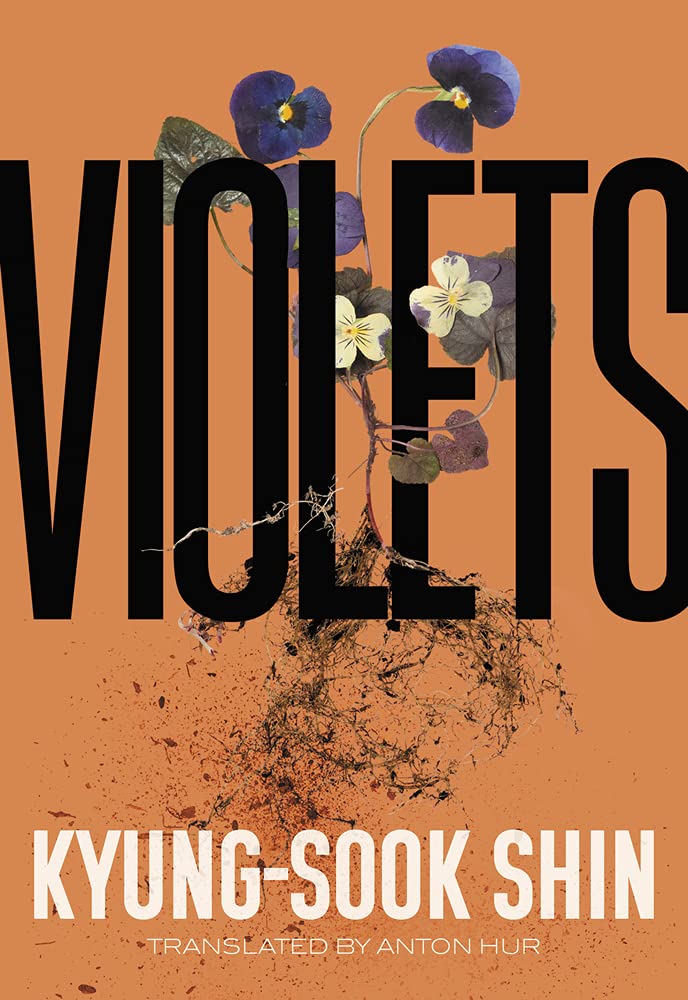
VIOLETS, a brutally sad and deeply poignant story of being Other in your homeland


VIOLETS
SHIN KYUNG-SOOK
(tr. Anton Hur)
The Feminist Press
$15.95 trade paper, available now

One of NPR's Best Books of 2022!

Rating: 4.5* of five

The Publisher Says: We join San in 1970s rural South Korea, a young girl ostracised from her community. She meets a girl called Namae, and they become friends until one afternoon changes everything. Following a moment of physical intimacy in a minari field, Namae violently rejects San, setting her on a troubling path of quashed desire and isolation.

We next meet San, aged twenty-two, as she starts a job in a flower shop. There, we are introduced to a colourful cast of characters, including the shop's mute owner, the other florist Su-ae, and the customers that include a sexually aggressive businessman and a photographer, who San develops an obsession for. Throughout, San's moment with Namae lingers in the back of her mind.

A story of desire and violence about a young woman who everyone forgot, VIOLETS is a captivating and sensual read, full of tragedy and beauty.

I RECEIVED MY DRC FROM THE PUBLISHER VIA EDELWEISS+. THANK YOU.

My Review
: This translation from the Korean joins a widening stream of Korean-culture transplants...Squid Game, Minari, this author's previously translated novel Please Look After Mom...making their roots into American pop-cultural soil.

If you've yet to explore the trickle, start now before it's a flood. I think it's wonderful because English-language monoglot culture gets stale and boring and all alike if we don't seek out fresh infusions of talent and stories. And, like all the best translations, this story's timelessness is rendered in prose that could very easily have been first created in English...none of the occasional signals of awkwardly trying to explicate something that one word in the translated language would convey whole and entire. That is a fine achievement indeed, probably helped along by the fact that things like "minari" aren't quite as furrin as they would've been in 2011, when Please Look After Mom was published.

What happens in this story is not particularly new or unusual. A girl is born to unfit parents:
In a house with shut doors, a mother closes her eyes as the baby’s grandmother offers her the newborn. The mother knows what will happen now. An uncelebrated girl. The infant accepts her mother’s closed eyes in lieu of a loving caress, perhaps having intuited her fate from the womb, and does not bother crying. The sound of the monsoon fills the house. Underneath the porch, a dog curls its legs into itself. Can the baby hear the sound of the rain? She’s about to fall asleep in her grandmother’s hands. That same night, her father gives his daughter’s face only a cursory glance.

Thus does another unwanted girl enter the world that won't ever bother to see her, really even to look at her. She's just...there. Her father never bothers to return; her mother never bothers with her at all, constantly seeking a man to care for her. (To be fair, an ordinary Korean woman's opportunities a generation ago weren't plentiful, and San's mother wasn't exceptional.)
Her mother. San thinks about her from time to time.

If she had begged her to stay, in front of that carefully prepared food, would she have listened? Why had San never once tried to hold her back? Wherever it was that her mother went, she never forgot to send her daughter money for school until San graduated.

The last time San had seen her mother was when she was a freshman in high school.

Children of addicts, the world over, tell versions of this same story. In this case, San's mother is addicted to men. She can't live without a man taking care of her, and she sacrifices the daughter she didn't want to get what she does want.

Author Shin isn't solely criticizing the mother. She is critiquing the social organization, the patriarchy, that privileges men and their desires over women and their needs so completely, so thoroughly, that the women are hollow and meaningless without a man. It is repulsive and it is reprehensible, and much abuse and violence simply are borne by the women because what option do they have? What other choice can they make? In San's case, she is so hollowed out by the complete absence of love from her mother (or anyone else) that she enacts the form of love she knows: rejection follows violence, as it must.

There is nothing forgiving in San. She forgives nothing, she is forgiven nothing, throughout the book. She is alone, she feels lonely of it (or so we infer...I don't know that she would be able to articulate the unmoored, disconnected reality that lonely people all share). For this, among other, reasons, this is a hard story to read. If you have ever been truly, down-to-the-bone lonely, this might be a triggering read for you. I haven't run across too many reads with this hyperconcentrated focus on loneliness, or too many with more success in rendering an emotional state into prose.
A stranger to every single person in the crowd, San finds herself blocking the sidewalk as people swerve to avoid her. Even if a carnival were to break out around her, the vacant expression on her face looks entrenched enough to persist.

Because she knows nothing of love, loving, being loved, San sees nothing except the one moment when everything changed, when the one love she thought she had was denied and made nothing. Not even attempting to find her former home nets San anything, she sees not the fields of minari she grew up among, where her life irrevocably emptied out and flowed away from her, but careful rectilinear plots of...something not minari. She has no roots. She feels no kinship.
Nothing happened this past summer. Only that, in the hot sun from time to time, a brief thought would appear and disappear around me. That thought was closer to me than any of the flowers in the shop. Even as I tried to capture the thought on paper, the heat would exhaust me and I'd give up. There were plenty of things I gave up, using the heat as an excuse. Which means I spent this past summer repeatedly deciding to do things and then giving up on them. As if my life were an exhibition of how good I am at giving up. It was that kind of summer.

It was that kind of life. It won't end well, it didn't begin well or go on well; that much we know. There's nothing hopeful in this story. Women like San aren't ever anyone's focus...her job in the flower shop working with and for Su-ae notwithstanding. She receives the desperate, genuine love of Su-ae as...nothing. San is fixated on emptiness...her only friend abandoned her!...and on men she does not want. She needs their love. She doesn't want it. She decided long ago that love wasn't something she could have, feel, receive, give. And so when it's offered to her she...doesn't see it. She does see the want of one man, she feels the desperate pull of another man on her attention, and gets nothing but unwanted results.
Every attempt to resist is met with his greater strength. In a moment, her head begins to droop.

She's released onto the street.
Her mind is completely taken over, her body a husk. No one seems to take note of the loneliness she carries. Just some woman in the crowd, unaware that her top is undone. A more observant person might have noticed her cheek slightly swollen from having been punched, the thin lines of her face a touch asymmetrical because of it. Someone might see her pale face and think, How could anyone ever look so pale....

A life of being unwanted, invisible, and it comes down to a final indignity. San is raped. Her hollowness filled at last with the violence that is all she can accept. It isn't in her to accept the reality of her situation, being unloved and unwanted, then seek out change. That's simply impossible. She leaves safety, courts rejection, and seeks oblivion.

Leaving behind only the tiniest of wakes...the end of the story of Oh San is a poignant piece of mythologizing that fit so poorly onto the rest of the story that I was forced by honest anger and sincere disdain for its sentimentality to whack a star off my rating. After a night's sleep where I dreamed of the photographer and San:
Violets. They bloom everywhere, making them seem more like weeds than proper flowers. San takes a closer look at them. Their little green leaves are small, their purple blossoms tiny. Before she came to the flower shop, she knew them as swallow flowers. Memories of entangling two swallow flower stems together and pulling them apart— one side was bound to snap. Whoever’s stem didn’t was the winner. She forgot what the prizes were, but she’d played the game many times. They did it with broadleaf plantains; they did it with foxtails.

The man keeps pressing the shutter and mumbling something discontentedly. “What’s so pretty about these flowers? Such nonsense.” His disappointment is so palpable, it makes her apologetic.

...I realized that his arc needed an end, too. I might not like that end, but I would've felt cheated (if not right away, then after my irritation with the whole ending subsided) had it not been there. So back came a half-star, though I confess with some grumbling on my part.

I think this small, powerful story deserves your eyeblinks. I think we should all resolve to notice the Oh Sans of this world, to extend a welcome to the table of them, to recognize their living presence instead of making them ghosts before they die.

Friday, May 7, 2021

HENCH, or let's take "What the HELL Happened Here?!" to the next level

HENCH
NATALIE ZINA WALSCHOTS

Watch the inimitable Nancy Pearl interview Author Walschots here!
William Morrow
$27.99 hardcover, available now

Rating: 4.5* of five

The Publisher Says: A smart, imaginative, and evocative novel of love, betrayal, revenge, and redemption, told with razor-sharp wit and affection, in which a young woman discovers the greatest superpower—for good or ill—is a properly executed spreadsheet.

Anna does boring things for terrible people because even criminals need office help and she needs a job. Working for a monster lurking beneath the surface of the world isn’t glamorous. But is it really worse than working for an oil conglomerate or an insurance company? In this economy?

As a temp, she’s just a cog in the machine. But when she finally gets a promising assignment, everything goes very wrong, and an encounter with the so-called “hero” leaves her badly injured. And, to her horror, compared to the other bodies strewn about, she’s the lucky one.

So, of course, then she gets laid off.

With no money and no mobility, with only her anger and internet research acumen, she discovers her suffering at the hands of a hero is far from unique. When people start listening to the story that her data tells, she realizes she might not be as powerless as she thinks.

Because the key to everything is data: knowing how to collate it, how to manipulate it, and how to weaponize it. By tallying up the human cost these caped forces of nature wreak upon the world, she discovers that the line between good and evil is mostly marketing. And with social media and viral videos, she can control that appearance.

It’s not too long before she’s employed once more, this time by one of the worst villains on earth. As she becomes an increasingly valuable lieutenant, she might just save the world.

A sharp, witty, modern debut, Hench explores the individual cost of justice through a fascinating mix of Millennial office politics, heroism measured through data science, body horror, and a profound misunderstanding of quantum mechanics.

I CHECKED THIS BOOK OUT OF MY LOCAL LIBRARY. SUPPORT YOUR LIBRARY, FOLKS! USE THEM OFTEN!

My Review
: Several book ideas later, Author Walschots realized they all fit into one if she used a different frame...

I will make no bones about or apologies for my complete disdain for superhero crap. It's a bad social message. It's worse storytelling. The violence it does to physics and reality is incalculable.

Hey wait! I found *another* level of this book!

That this is a first novel is astonishing. That it is an assured and deft flensing of Western fascism and capitalism is a joy. That I am finding it now, nine months after William Morrow unleashed it on the US, is shocking. This should've flown at me, beating my head with its hard covers, demanding that it enter my consciousness long before now. Alas, the library wait-list was deep. I'm both glad and irked, because that means a lot more people have read it than might otherwise have been able to.

So, two reads in two weeks, and what I take away from it is: Love sucks.

Superhero stories are about loving someone who doesn't, can't, love you back. Part of the joke in Hench is that they cause such horrendous collateral damage because they're unmoored by love, unable to imagine the reality of other people that love demands of us. Superheros, by anyone's definition, are psychopaths. Supervillains, on the other hand, are sociopaths. The definitions aren't hard to grasp, and the conclusions are inescapable. Here we are in the world, the gig economy, that supports the supervillains...the henches, not the Meat, the bastards whose bodies are ripped and torn in the myriad of comic pages, bits flung here and there as X battles Y:
Our own tactical team members, Leviathan’s grade-A Meat (they tended to refer to themselves as Filet Mignon)...

Amusing, no? The Meat willingly serves the purpose, offers their flesh to the mills of the gods. Make jokes about how they're a better grade of Meat.

But think about that. Really, for once, think about that: this is what it costs to be alive but average, or less, in this world. To have unlucky parentage. To be lower than the lowest edge of the 1%:
I was beginning to nurse a feeble hope that maybe, just maybe, that gratitude he was feeling might blossom into a full-time position. Maybe one day I would be able to visit a dentist again.
–and–
Every day, the cost added up. Every day I couldn’t work, or move; every day that passed in a haze of pain and obsessive misery-making added to the total.
–and–
Maybe a lot of those years wouldn’t have been terribly good, and would have involved a lot of busting heads and driving recklessly and working for villains. But they were our shitty years, and they’d been taken from us by an asshole in a cape playing judge and executioner.

This is the thing I've always known but never articulated: The reason I loathe comic books and superhero movies is that I am bitterly opposed to the presumptious and wrongheaded notion that one asshole in a stupid outfit knows better than centuries of legal checks and balances. Yes, indeed, the Law fails; "The law often allows what honor forbids" said Bernard-Joseph Saurin, and his Ancien Régime ass knew what he was talkin' about. But someone needs to explain to me why vigilantism is in any way superior to letting the law do its slow, imperfect, maddeningly unjust work.

Apologizing to corpses is pointless.

But I digress. Hench gave me many moments such as this, the ones that led me down well-worn mental paths of outrage and indignation at the Way Things Are because it's manifestly rigged against ordinary people. The Henches and the Kicks (superheroes's sidekicks) aren't ever going to come out whole and will never entirely accept that they are not part of any future the supers concoct.

Women reading this screed: Yes, I know this is the lived experience of almost all of you.
“You know what’s more criminal than anything I have ever done? That you’ve been overshadowed by that lantern-jawed cock-wit when you’re obviously better than him in every imaginable way.”

Pain crossed her face. “Well. No one is willing to make some bitch the head of the greatest superhero team in the world.”
–and–
Her face was extraordinary. She was Grendel’s mother; she was vengeance incarnate. If she’d had any doubt about what she was doing haunting the edges of her actions, all of that was burned up now.

And there it is. The simplest reduction of male privilege there can be. She's better, smarter, more capable? Get her on the team and make sure she knows she's a girl, a second-class version of a Man. I have always known women were stronger than men; birth proves it. Watch a woman in labor for twelve, fourteen endless, hard-working, rest-less hours. Then tell me she's weak. Watch a woman whose body is hemorrhaging do her job anyway, despite the painful contractions and loss of blood. Roll your eyes, puny man, accuse her of being lesser; but you damn sure couldn't do what she does.

So that said, Hench's women are all about moving around the obstacles that Male Ego presents them; and doing it with purpose, and focus, and dogged determination. (Make a woman hate you at your peril.) The battles are quite revoltingly realistic in their description. There is very significant body horror. There is a lot of screaming, from all concerned, and there is a deeply felt accusation underpinning it all:
Supercollider had a great deal in common with a diamond: aesthetically tacky; value artificially ascribed by corporate greed; cultural significance vastly overinflated; and incredibly hard to damage. I’d theorized that the only thing really capable of hurting him would be himself, the way that diamond was used to cut diamond.

A bit on-the-nose, but valid. The Superheroes are diamonds, tacky brummagem things, capable of being synthesized in labs by the gross but sold to the hoi polloi as the Greatest! Thing!! EVER!!! and they accept it.

We accept it.

It isn't in us to refuse. The System has wound itself tightly about our every single neuron:
Not only were heroes responsible for all of the damage and injury they caused, they were even responsible for creating the villains they fought.

Fighting free involves losing one's sense of purpose, as The Auditor (our PoV character, Anna) discovers:
I wondered if I was jealous. I wished suddenly that I could see my own feelings with as much clarity as I now saw the ultraviolet spectrum.
–and–
"...My husband didn’t give a damn whether the work I was doing was noble as long as it appeared to be. When I killed someone then—something I did a lot more than I do now—it was for the greater good. It was such bullshit. So the second the pretense was gone, so was he. I didn’t need that.”
–and–
“He didn’t try and hide it.” He closed his eyes when he spoke this line, grabbed the podium for support.

“He didn’t care enough.”

This was the clip they played, over and over, the force of his misery making him sway.

The problem this fucked-up system we all acquiesce to is best at producing in bulk is just this, a misery so porfound that it's actually soul-destroying. This sense that we are all being cheated, denied, made fools of by the things we're told to value and given no way to engage with from a place of wholeness.

There was a lovely call-out to Mae West's famous line about diamonds that made me laugh out loud; there was a very sly reference to the MCU in all its acronymic glory; and there was, at the end of the read, a sense in this particularly old reader that there is indeed a reason to hope the future will not happen without witnesses to its glorious excesses.

I'll now take a brief personal moment to screech in revulsion about the two w-bombs dropped by Author Walschots at 9% and 50%. Only cost her half a star, though, because so much else was so delicious.

Tuesday, January 12, 2021

SUMMER OF THE CICADAS, a moody cli fi novel of self-discovery and healing

SUMMER OF THE CICADAS
CHELSEA CATHERINE

Red Hen Press
$14.95 trade paper, available now

Rating: 4* of five

The Publisher Says: Summer of the Cicadas is about a West Virginian town where a brood of Magicicadas emerges for the first time in seventeen years. The cicadas damage crops and trees, and swarm locals. Jessica, a former cop whose entire family was killed in a car crash two years earlier, is deputized during the crisis. Throughout the book, Jessica must deal with her feelings for her sister's best friend, Natasha, who is a town council member. After Fish and Wildlife removes the swarm, Jessica must also confront the two-year anniversary of her family's death, Natasha's budding romance with a local editor, as well as a sudden but devastating loss that changes everything.

I RECEIVED A DRC OF THIS BOOK FROM RED HEN PRESS VIA EDELWEISS+. THANK YOU.

My Review
: A book of eerie, unnatural-nature events pushing one lone and lonely lesbian, returned to small-town West Virginia from a law-enforcement career, to deal with Life. After many years' effort to Fit In (as she sees it), a personal tragedy derails her attempts to build an authentic life in Washington, DC. Coming home makes her fall into old, rejected-by-all patterns of thought. Jessica, whose first-person close PoV we're in for the entire book, is a past mistress of negative self-talk. The habit was established early, despite her close and accepting family...she relives a moment where her country-farmer father has The Talk with her, emphasizing that he loves his daughter and supports her exactly how she is (!!–this is how we know it's fiction)...but living among people who smell, sense in some way anyway, your Otherness and make your life a living hell can undo even the best parenting.

It does go a long way, this 'tude: "Fine," I say to Mason. "But no handcuffs this time." She's speaking to the sheriff, her ex-boss, and referring to the time he had to arrest her at a local strip club and then, because she was coked to the tits and causing a disturbance, fire her. There's a real risk to making your PoV character a smartass in a first-person present-tense novel. Author Catherine, for the most part, stays on the correct side of the line, but it's always an uncomfortable slip away from unpleasantness. It wouldn't ever take much to slide into "oh FFS get ***OVER*** yourself" territory in a story about a woman coming to terms with the boundaries and limitations and unhappinesses of an isolated rural lesbian life. Her crush object for half her life is Natasha, whose best-frienddom with Jess's dead sister keeps the two orbiting each other. Their flirtatious dance is sexual on Jess's part; Natasha is a tease, totally aware of what Jess is feeling and always dancing a bit ahead, to the side, never quite letting her have the prize.

The strange thing is that Jess, dopey lovesick girl that she was for Natasha, doesn't rush in and demand the whole package. But, then she'd have to act; action comes with consequences; and possibility, even at the price of a tease, is easier accept when you're about 99% sure that the real answer is NO. And then there's the whole "everybody hates me, nobody loves me, I'm gonna go eat worms" issue that Jess has with her fellow Mayberryans. (Yes, like THAT Mayberry. Roll with it.) The first third of the book is spent setting the stakes; now it's go time.

This summer is the one where the seventeen-year periodical Magicicadas endemic to deciduous forests in the Eastern US are expected. No one who's experienced it will forget the noise these damned things make. They're black and orange, have red eyes, and fly sluggishly.

Most of the time.

Not this year: Jess's pity party is trumped by the weirdness of the new hatching. These are brightly blue or green with red eyes, bodies as much as five inches long (!!), and whose normal sap-feeding habits are having strange, lethal effects on the trees around the crops already blighted by a hotter-than-usual summer. They're also swarming oddly...and attacking people with some regularity. No one appears to be more than injured by the sharp mouth-parts for a while, but the sheer weirdness of cicadas flying voluntarily and swarming humans, ordinarily pretty much invisible to them, makes the rural farming community scared as hell.

Jess and Mason, who's rehired her for the duration of this weirdness, are propelled into action; the actions are taken, the problem subsides, and Jess and Natasha are forced into ever-closer proximity. Events, as they do, take their course and, as the cicada problem reaches crisis proportions, all of the public and private abscesses in Mayberry burst in Jess's face.

To every birth its blood.

By the end of the book, I was satisfied that Jess's trajectory was altered; that's what I look for in a satisfying read. Up or down, good or bad, not stasis, or I lose my shit and shout mean things at my Kindle. Like it has magical powers to transmute my unkindness and frustration into pain for the offending creator (or Creator, depending). I can hope.

There are lapses in story logic...Mason's injury prevents him from walking but later he's clomping into a meeting? the deputy who's a meathead is also a good kid but is scared of a confrontation?...but honestly, I won't make a fuss about them because the characters are plenty enough to be going on with. The science part's harder to forget, though; there is nothing made of the parts of the story concerning the cicadas beyond a quick fix that works, A star vanished for that application of handwavium creme. Yes, fine, give me the first-person propulsiveness of Jess's PoV and her obsessions, but have the science folk part of her orbit! Tell me that they're acting scared, or shifty, or something to explain why what happened happened; and how they had canisters of handwavium creme handily tested and everything, though this is a seventeen-year periodical species?! That needs some questions from Jess that the science folk must answer somehow.

I liked Jess, though I wanted to shake her sometimes. I liked the self-knowledge she won her way through a miasma of misery to use to take herself off the hamster-wheel of self-loathing. But I wasn't *completely* satisfied, so here we are at a four-star ending.