Showing posts with label Anton Hur. Show all posts

Monday, January 13, 2025

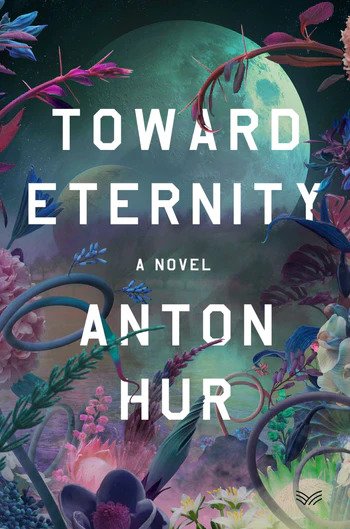
TOWARD ETERNITY, meditative title for a contemplative debut novel


TOWARD ETERNITY
ANTON HUR

HarperVia (non-affiliate Amazon link)
$12.99 kindle edition, available now

Rating: 4.5* of five

The Publisher Says: What does it mean to be human in a world where technology is quickly catching up to biology?

In a near-future world, a new technological therapy is quickly eradicating cancer: The body’s cells are entirely replaced with nanites—robot or android cells that not only cure those afflicted but leave them virtually immortal. At the same time, literary researcher Yonghun teaches an AI how to understand poetry and creates a living, thinking machine he names Panit, meaning "Beloved," in honor of his husband. When Dr. Beeko, who holds the patent to the nano-therapy technology, learns of Panit, he transfers its consciousness into an android body, giving it freedom and life.

As Yonghun, Panit, and other nano humans thrive—and begin to replicate—their development will lead them to a crossroads and a choice with existential consequences.

I RECEIVED A DRC FROM THE PUBLISHER VIA NETGALLEY. THANK YOU.

My Review
: This book renewed my faith in my judgment of poetry as a stalking horse for the worst kind of exclusionary snobbery. It requires a linguistic adept, a genuinely intellectually superior mind, to fathom its Sacred Complexities well enough to use it to create AGI, which (of course) then becomes a worthy love-object.

"Whether a life ends happily or sadly, what does it matter but the weight of the emotions one felt, the weight of the clarity of all the meaningful moments one possessed while living on this Earth, whether they have been good or bad? Is it not the weight, in the end, that really makes us human after all?" muses Panit the AGI. This beautiful phrase does convince me to give the writing four stars. This is prose I wish to high heaven other SFF writers would at least aspire to. Author Hur has been to the linguistic wellspring and used a solid-silver vessel to drink from it.

The idea of sentience being the connecting thread as we travel through a deep future of change and revision, of editing and shaping the narrative of consciousness, is where the other half-star comes from. The narrative device of one notebook passing among many hands, taking on many meanings, offers the reader a handle to grapple with balancing the solid-silver vessel Hur used while not losing control of the easily-spilled contents.

It's not going to be easy for many to move past the genders of the consciousnesses that take this notebook through time. That's a shame. I'll say that poetry, in this case, can draw in those questing minds. I'm pretty sure that has a downside. If what you want is to "{feel} these words against my skin as if they were physical objects, or as if they were light passing through the prism of my body and shattering into the spectrum. Had I ever truly understood any word before, ever? How could I have claimed to have made a study of poetry or that this study had made me human when I had never understood what it meant to feel words?", then you're in the proper aisle. If those sentiments, expressed in same-sex contexts, are going to make you uneasy, you're late for the exit.

Asserting that poetry is the proper lens for emotional writing is, honestly, disproved by this novel. It is a story with a plot, with development of multiple characters, and has an ending that flows from the events described herein. That is a novel in my eyes, and it does something poetry does not: It connects the reader...me...to Author Hur's worldview as chosen and molded into this story.

Change. Time. Immaterial movement. All are central to making a work a novel, not a poem. But because (I'm confident in this assertion) Author Hur's pharmacopoeia is the shape and weight of words before the end that is the sentence, what occurs is a valorization of the idea of poetry, which functions on that small, precise unit for its impact.

I liken this to a poem being a mosaic, a story being a fresco, and a novel an oil painting. Mosaics fall apart easily, the pieces are still pretty but don't do much to make an impression unless painstakingly restored by experts; frescos, done in sharply defined spaces and usually quickly can last for centuries and, even if volcanoes engulf them are still recognizably art; oil paintings are gigantic efforts to use malleable medium to create a simulacrum of reality, whose materials are slippery and prone to blending as well as subject to vagaries of fashion for their perceived beauty. Makes sense, too, as these are roughly the same order of appearance (assuming one counts folktales and fables and myths as stories not novels or poems).

Author Hur's debut novel is a beautiful work. It's a deep questioning of Humanity, humaneness. It's a story that moves the reader through the ideas, we don't often take time to articulate, of love and connection. Poetry isn't my choice of a defining trait of being human.

Words are...beautiful, sharp, shiny, eternally morphic words. Take this as your encouragement to go get Author Hur's first novel.

Wednesday, April 13, 2022

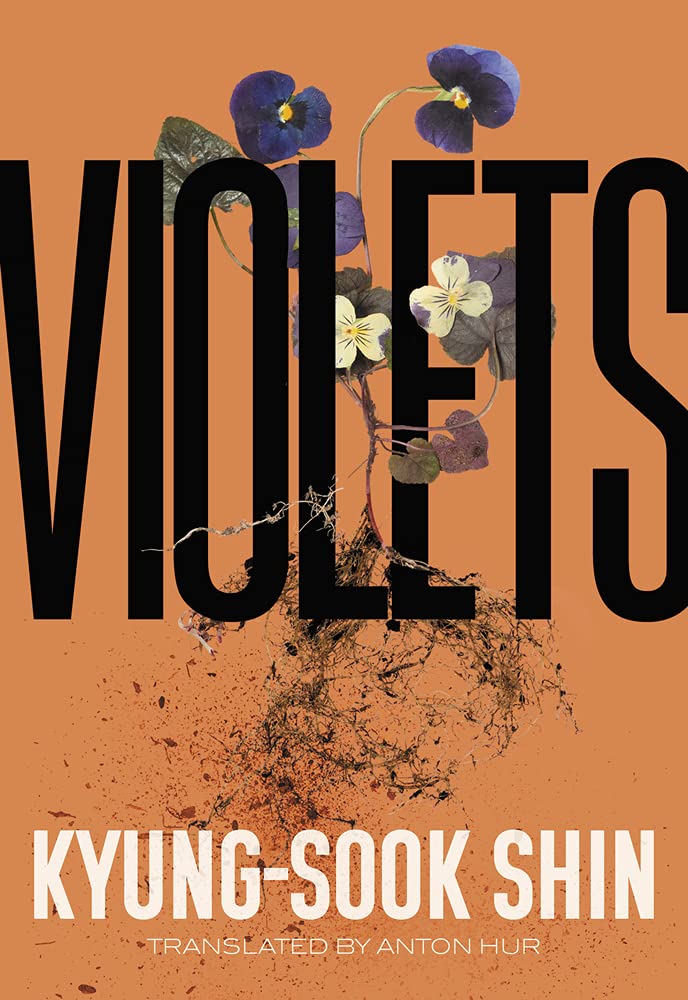
VIOLETS, a brutally sad and deeply poignant story of being Other in your homeland


VIOLETS
SHIN KYUNG-SOOK
(tr. Anton Hur)
The Feminist Press
$15.95 trade paper, available now

One of NPR's Best Books of 2022!

Rating: 4.5* of five

The Publisher Says: We join San in 1970s rural South Korea, a young girl ostracised from her community. She meets a girl called Namae, and they become friends until one afternoon changes everything. Following a moment of physical intimacy in a minari field, Namae violently rejects San, setting her on a troubling path of quashed desire and isolation.

We next meet San, aged twenty-two, as she starts a job in a flower shop. There, we are introduced to a colourful cast of characters, including the shop's mute owner, the other florist Su-ae, and the customers that include a sexually aggressive businessman and a photographer, who San develops an obsession for. Throughout, San's moment with Namae lingers in the back of her mind.

A story of desire and violence about a young woman who everyone forgot, VIOLETS is a captivating and sensual read, full of tragedy and beauty.

I RECEIVED MY DRC FROM THE PUBLISHER VIA EDELWEISS+. THANK YOU.

My Review
: This translation from the Korean joins a widening stream of Korean-culture transplants...Squid Game, Minari, this author's previously translated novel Please Look After Mom...making their roots into American pop-cultural soil.

If you've yet to explore the trickle, start now before it's a flood. I think it's wonderful because English-language monoglot culture gets stale and boring and all alike if we don't seek out fresh infusions of talent and stories. And, like all the best translations, this story's timelessness is rendered in prose that could very easily have been first created in English...none of the occasional signals of awkwardly trying to explicate something that one word in the translated language would convey whole and entire. That is a fine achievement indeed, probably helped along by the fact that things like "minari" aren't quite as furrin as they would've been in 2011, when Please Look After Mom was published.

What happens in this story is not particularly new or unusual. A girl is born to unfit parents:
In a house with shut doors, a mother closes her eyes as the baby’s grandmother offers her the newborn. The mother knows what will happen now. An uncelebrated girl. The infant accepts her mother’s closed eyes in lieu of a loving caress, perhaps having intuited her fate from the womb, and does not bother crying. The sound of the monsoon fills the house. Underneath the porch, a dog curls its legs into itself. Can the baby hear the sound of the rain? She’s about to fall asleep in her grandmother’s hands. That same night, her father gives his daughter’s face only a cursory glance.

Thus does another unwanted girl enter the world that won't ever bother to see her, really even to look at her. She's just...there. Her father never bothers to return; her mother never bothers with her at all, constantly seeking a man to care for her. (To be fair, an ordinary Korean woman's opportunities a generation ago weren't plentiful, and San's mother wasn't exceptional.)
Her mother. San thinks about her from time to time.

If she had begged her to stay, in front of that carefully prepared food, would she have listened? Why had San never once tried to hold her back? Wherever it was that her mother went, she never forgot to send her daughter money for school until San graduated.

The last time San had seen her mother was when she was a freshman in high school.

Children of addicts, the world over, tell versions of this same story. In this case, San's mother is addicted to men. She can't live without a man taking care of her, and she sacrifices the daughter she didn't want to get what she does want.

Author Shin isn't solely criticizing the mother. She is critiquing the social organization, the patriarchy, that privileges men and their desires over women and their needs so completely, so thoroughly, that the women are hollow and meaningless without a man. It is repulsive and it is reprehensible, and much abuse and violence simply are borne by the women because what option do they have? What other choice can they make? In San's case, she is so hollowed out by the complete absence of love from her mother (or anyone else) that she enacts the form of love she knows: rejection follows violence, as it must.

There is nothing forgiving in San. She forgives nothing, she is forgiven nothing, throughout the book. She is alone, she feels lonely of it (or so we infer...I don't know that she would be able to articulate the unmoored, disconnected reality that lonely people all share). For this, among other, reasons, this is a hard story to read. If you have ever been truly, down-to-the-bone lonely, this might be a triggering read for you. I haven't run across too many reads with this hyperconcentrated focus on loneliness, or too many with more success in rendering an emotional state into prose.
A stranger to every single person in the crowd, San finds herself blocking the sidewalk as people swerve to avoid her. Even if a carnival were to break out around her, the vacant expression on her face looks entrenched enough to persist.

Because she knows nothing of love, loving, being loved, San sees nothing except the one moment when everything changed, when the one love she thought she had was denied and made nothing. Not even attempting to find her former home nets San anything, she sees not the fields of minari she grew up among, where her life irrevocably emptied out and flowed away from her, but careful rectilinear plots of...something not minari. She has no roots. She feels no kinship.
Nothing happened this past summer. Only that, in the hot sun from time to time, a brief thought would appear and disappear around me. That thought was closer to me than any of the flowers in the shop. Even as I tried to capture the thought on paper, the heat would exhaust me and I'd give up. There were plenty of things I gave up, using the heat as an excuse. Which means I spent this past summer repeatedly deciding to do things and then giving up on them. As if my life were an exhibition of how good I am at giving up. It was that kind of summer.

It was that kind of life. It won't end well, it didn't begin well or go on well; that much we know. There's nothing hopeful in this story. Women like San aren't ever anyone's focus...her job in the flower shop working with and for Su-ae notwithstanding. She receives the desperate, genuine love of Su-ae as...nothing. San is fixated on emptiness...her only friend abandoned her!...and on men she does not want. She needs their love. She doesn't want it. She decided long ago that love wasn't something she could have, feel, receive, give. And so when it's offered to her she...doesn't see it. She does see the want of one man, she feels the desperate pull of another man on her attention, and gets nothing but unwanted results.
Every attempt to resist is met with his greater strength. In a moment, her head begins to droop.

She's released onto the street.
Her mind is completely taken over, her body a husk. No one seems to take note of the loneliness she carries. Just some woman in the crowd, unaware that her top is undone. A more observant person might have noticed her cheek slightly swollen from having been punched, the thin lines of her face a touch asymmetrical because of it. Someone might see her pale face and think, How could anyone ever look so pale....

A life of being unwanted, invisible, and it comes down to a final indignity. San is raped. Her hollowness filled at last with the violence that is all she can accept. It isn't in her to accept the reality of her situation, being unloved and unwanted, then seek out change. That's simply impossible. She leaves safety, courts rejection, and seeks oblivion.

Leaving behind only the tiniest of wakes...the end of the story of Oh San is a poignant piece of mythologizing that fit so poorly onto the rest of the story that I was forced by honest anger and sincere disdain for its sentimentality to whack a star off my rating. After a night's sleep where I dreamed of the photographer and San:
Violets. They bloom everywhere, making them seem more like weeds than proper flowers. San takes a closer look at them. Their little green leaves are small, their purple blossoms tiny. Before she came to the flower shop, she knew them as swallow flowers. Memories of entangling two swallow flower stems together and pulling them apart— one side was bound to snap. Whoever’s stem didn’t was the winner. She forgot what the prizes were, but she’d played the game many times. They did it with broadleaf plantains; they did it with foxtails.

The man keeps pressing the shutter and mumbling something discontentedly. “What’s so pretty about these flowers? Such nonsense.” His disappointment is so palpable, it makes her apologetic.

...I realized that his arc needed an end, too. I might not like that end, but I would've felt cheated (if not right away, then after my irritation with the whole ending subsided) had it not been there. So back came a half-star, though I confess with some grumbling on my part.

I think this small, powerful story deserves your eyeblinks. I think we should all resolve to notice the Oh Sans of this world, to extend a welcome to the table of them, to recognize their living presence instead of making them ghosts before they die.