Showing posts with label low self-esteem. Show all posts

Sunday, December 7, 2025

DEAR BI MEN: A Black Man's Perspective on Power, Consent, Breaking Down Binaries, and Combating Erasure


DEAR BI MEN: A Black Man's Perspective on Power, Consent, Breaking Down Binaries, and Combating Erasure
J.R. YUSSUF

North Atlantic Books (non-affiliate Bookshop.org link)
$11.99 ebook, available now

Rating: 5* of five

The Publisher Says: An unapologetic guide for readers who are Black, masc, and bi—unlearning biphobia, coming out, combatting erasure, and embodying your whole self

Through cutting social analysis, personal stories, and need-to-know advice, Dear Bi Men reclaims bi+ visibility in a culture of erasure—and unapologetically centers Blackness in a practical and deeply researched guide to navigating life, work, and relationships as a Black bi+ man.

Popular representation of bi and pansexual men is growing, but we’re not there It’s mostly white. It collapses bisexual identity into tired, hypersexualized tropes. And it fails to interrogate the deeply entrenched stereotypes that You’re confused. You just don’t know you’re gay. You’re greedy. You must be great in bed.

Author, peer counselor, and creator of #bisexualmenspeak J.R. Yussuf pushes back against these stigmas and misconceptions, exploring how white supremacy reinforces biphobia and dictates what society thinks it means to “be a man.” He contextualizes discourse around queerness and bisexuality within a larger framework that honors readers’ intersecting identities. And he offers deeply practical advice, sharing how to:
  • Unlearn internalized biphobia and homophobia
  • Navigate an increasingly hostile digital landscape
  • Think about coming out: who to tell, why to tell them, and how to do it
  • Fight back against erasure and stigma
  • Navigate sex, dating, partnerships, marriage, friendship, and work
  • Understand your bi+ sexuality through a political lens
  • Process Black bi+ representation
  • Rich with personal narratives, insightful analysis, and practical advice, this book is a powerful resource for Black bi+ men to reclaim their identity, counter biphobia, and get empowered—and an offering to all readers looking to fight back against the erasure and dehumanization wrought by patriarchy.

    I RECEIVED A DRC FROM THE PUBLISHER VIA NETGALLEY. THANK YOU.

    My Review
    : Remember the giant internet kerfuffle that ended up in Kit Connor, of Heartstopper fame, being forced to come out as bi, or be outed? He was really young at the time, but he also stood on a giant mountain of white privilege.

    Now imagine all that intrusive noisy chatter, all that nasty probing questioning of your sincerity, your motives, your sense of yourself suddenly, unpleasantly open for free debate...while in the hole that anti-Black racism carries in its shot pouch. Add in a hefty amount of religious, cultural, gendered homophobia.

    Man needs help. Here it is.

    A lot of what Author Yussuf says is applicable to other bi men in the process of figuring out what to say, to do, to present to the world; but the added levels of Black support, uniquely insightful areas of discourse tied in with the author's long experience among Black bisexual men from an insider's PoV, and this resource is definitely uniquely valuable to those men. It does not, as a result, exclude other men.

    There is no room for any of the -phobias in Author Yussuf's book. A thing I see A LOT in queer spaces is more, or less, polite transphobia directed at transmasc men. It gets the same treatment in here as other Othered identities: "you're good, come in and let's talk, what's eatin' away at you?" Author Yussuf genuinely presents all maleness with guidance on inner and outer self-presentation. Because in the end that's also self-preservation. A strong core belief in one's worth and identity as good and capable of offering and receiving good, healthy interactions predicts success in life lived inside heteronormative society.

    It's hard for me not to say this is a great gift for every male, regardless of sexual identity. I can't tell you what to do about your giftees, but for any but the most removed from self-reflective spheres of influence, this is no bad idea for Yule.

    Friday, February 21, 2025

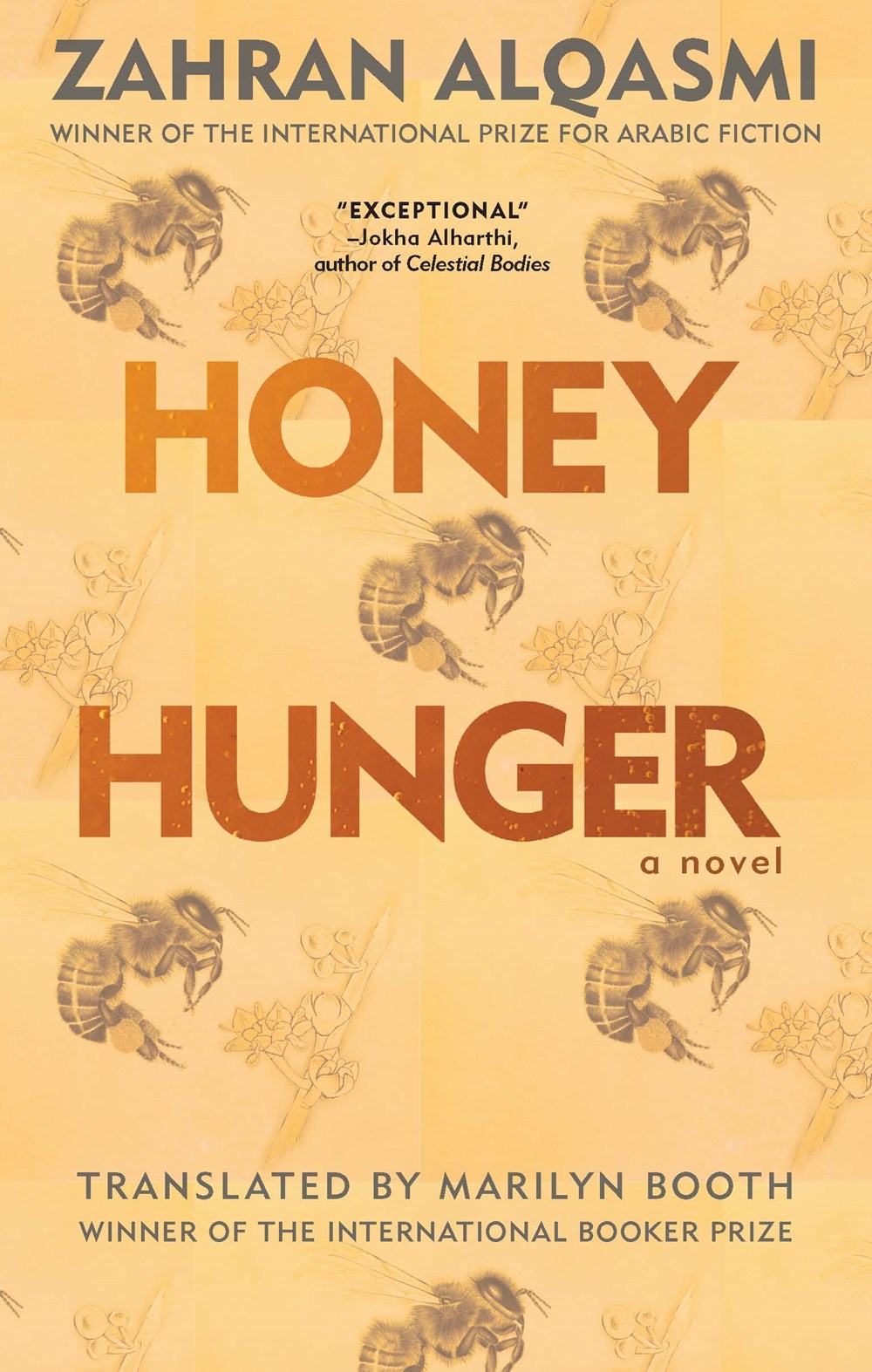
    HONEY HUNGER: A Novel, Marilyn Booth's excellent translation of Zahran Alqasmi's novel of Oman


    HONEY HUNGER: A Novel
    ZAHRAN ALQASIMI
    (tr. Marilyn Booth)
    Hoopoe Books|American University in Cairo Press (non-affiliate Amazon link)
    $18.95 ebook edition, available now

    Rating: 4.75* of five

    The Publisher Says: A breathtaking novel of longing, uncertainty, and ultimately of hope, written by an International Prize for Arabic Fiction-winning author and an International Booker-prize winning translator

    Azzan is a beekeeper in a rural community in Oman. Devoted to tending his bees and searching for wild hives, he encounters Thamna, a lone shepherd woman, on a mountain slope and is captivated by her and her honey-colored eyes. Across the breathtaking vistas of Oman’s remote mountains and plains, Azzan’s troubled past and present unfold. A disappointment to his family, he turns to drink, and ultimately discovers the healing power of his beekeeping, before an accident in which he loses all.

    Zahran Alqasmi’s masterful novel thrums forward with a subtle momentum. His lucid, poetic writing conveys a visceral sense of time and place, of the fragile ecologies inhabited by both bees and humans alike, in this intense and compelling novel of loss and hope.

    I RECEIVED A DRC FROM THE PUBLISHER VIA EDELWEISS+. THANK YOU.

    My Review
    : Does the old nostrum, "still waters run deep," ring a bell in your cultural education? Azzan is the personification of it. He's quiet on these pages. He's still physically and psychically until summoned into action in service to some need. Author Alqasmi uses his stillness to carefully, incrementally, accustom you to the reality of Oman, of a place he seems to assume you will want to know feel and smell and hear, without intrusive human-ness. Gradually, Azzan's eyes...our cameras onto this sparely furnished landscape...show us more, bring us to the places—in the company that hearken to the quiet sounds that we call "silence" in technology's noisy embrace. Azzan's not a beekeeper by happenstance, either as a character or a PoV.

    These are the choices that lead you the audience into the creation of an author whose poetry output outweighs his prose, ten to four; but whose prose garnered him the 2023 International Prize for Arabic Fiction (IPAF) for The Water Diviner; I believe this is the immediate predecessor to this novel in Arabic. It is obvious to me that the quality of the vision here is not a chance sport, an artifact of a talented translator's vision alone. That disappointment has befallen me before when a multiple translation career has yielded...inconsistent...results. Being the first of his works translated into English, I could still be disappointed; it just *feels* like a good bet to make, after reading this story.

    I'm sure the idea of beekeeping in a landscape as arid as Arabia is overall seems odd. It is an ancient reality though. Deserts bloom, even if sparingly. Beekeepers are not hugely wealthy anywhere bit seldom lack for work for very long. It is a surprisingly mobile task in this story, one that enables Azzan to be see, hear, participate in, a lot of lives in making his life with bees. The honey they make is the life he leads; but it's also large in the life of the people. The product that makes life just enough less harsh to be fun at times for the people Azzan's belovèd bees serve. His knowledge of the lies, cheats, and kindnesses others never even think they don't know about all revolve around his deep and unwavering interest in and commitment to his charges the bees.

    It gives the author a free rein to point up character traits in the narrator's orbit and beyond, for good and for ill; is Thamna, the herdswoman he encounters so fleetingly, an object of obsessive lust, actual love, or simply a fixation because of her novelty in his mostly male world? Does his thinking about bees, those matriarchal marvels without a permanent male presence, and their coveted honey drive or lead his itinerancy? If he's led by it, it makes his questing for wild honey that much more about the world he observes so intently; if driven instead, that condition of needing the honey makes his sharply observant eye that of the exploiter, the taker of all the work of others he is not entitled to have. All of these are within this novel's possible meanings.

    Azzan's obsession with bees and their care is, while unusual to the US-fiction reader, an outgrowth of his blighted past. He is a recovering alcoholic in a society that frowns on alcohol use. He has never been a success, felt as though he was enough for or even wanted by those who raised him. It is this strange selfness, this sense of himself as needing and wanting but never receiving unless he takes (as from the bees, his compatriots), that is reinforced by the lyrical language of description that never devolves into possession; rather it settles on taking the product without "owning" the producer, on caring for and feeling committed to the bees, the goats, the donkeys and living among them in place of being their "owner."

    Is that the place held by the exploiter, the user, the rentier? Azzan does not give off that vibe; I can still see it in the flow of his honeyed words of praise and appreciation and admiration for the bees. It comes down to the sense the author gives all these people who live among the animals they use; they take on the risks and protect their charges from harms they will all suffer from. In return they exert a right to practical rewards of sustenance.

    A man who longs for love he is sure he does not deserve and whose object is safely always independent of his custodial care and capable of being just fine without him sounds to me like a man in need of a perspective check; he's fine how he is, too, just busily denying himself the peace of contentment to punish his perceived failings as received from the eyes and ideas of others.

    So with all this praise why not five whole stars? Because these ideas and words of beauty and layers of meaning come with a labor tax of non-Western-standard punctuation and dialogue tags. I don't think that's a bad thing myownself. It does mean I can't five-star flag it for all y'all to pick up and devour ASAP. So many won't work this hard. Heck, even *I* had to read some things over twice to choose meanings that would change depending on to whom I attributed the words.

    For me that's fun, for most it's work, so four and three-quarter stars seems fair.

    Sunday, April 7, 2024

    THE MISSION HOUSE, Carys Davies tells the tale of a post-colonial colonizer's Finding Himself ::eye roll::


    THE MISSION HOUSE
    CARYS DAVIES

    Scribner
    $16.99 trade paper, available now

    Rating: 4* of five

    The Publisher Says: In The Mission House, Hilary Byrd flees his demons and the dark undercurrents of contemporary life in England for a former British hill station in south India. Charmed by the foreignness of his new surroundings and by the familiarity of everything the British have left behind, he finds solace in life’s simple pleasures, travelling by rickshaw around the small town with his driver Jamshed and staying in a mission house beside the local presbytery where, after a chance meeting, the Padre and his adoptive daughter Priscilla take Hilary under their wing.

    The Padre is concerned for Priscilla’s future, and as Hilary’s friendship with the young woman grows, he begins to wonder whether his purpose lies in this new relationship. But religious tensions are brewing and the mission house may not be the safe haven it seems

    I RECEIVED A DRC FROM THE PUBLISHER VIA NETGALLEY. THANK YOU.

    My Review
    : Hilary Byrd is coming unglued. He's in the early stages of a mental breakdown, he's fast departing the middle-aged years with their gradual loss of the pleasant illusion of a limitless future, and he's at odds with modern England at every turn. His rock of a sister can't seem to save him from this sense of being cut off, so for once in his life he takes a decision. He decides, about his own life's direction, that he will go Find Himself in India.

    She disapproves of this, really for quite sensible reasons, but the time to be sensible is past.

    I was ready, at that point, to stop reading for good. After all, I liked—a lot—but didn't love Author Carys's novella West, with its gorgeous sentences and its superbly concentrated plotting. I thought this read would be a similar exercise. So I put it down at this rather mundane point, and didn't pick it up until I read this year's glorious paean to Love, and lovingkindness, Clear.

    This turbocharged my willingness to look further into this take on self-discovery through travel to "exotic" locale...a drearily bourgeois genre that I really, really do not like. Elizabeth Gilbert and Peter Mayles ruined it for me with their icky Othering search for "Authenticity" which comes across to me in this elder stage of my life as "authentoxicity." I am shocked at anyone, in the twenty-first century, who can make it all the way through a story like those without thinking, "interrogate your privilege, or at the very least recognize it!" That is, of course, the person of the Twenties talking to people of the Nineties...societal advances do not travel against time's arrow.

    But this story isn't of its time...its time is now...nor is it about another time, it's set now. Just not here. Ooty, the old British "hill station" where the book is set, is in South India. Are your feelies itching as much as mine right now? I mean...hill station! That really übercolonial concept of "place the colonizers go to escape the commonfolk when it gets too hot." And a British guy rents a mission house, where the imperialists of the spirit retired from their efforts to screw up the indigenous population's relationship to their own souls with the caustic bleach of christiainty!

    The icks are building steadily.

    This, then, was not the most satifying of follow-up reads to my joyously absorbed Clear. I'm not revealing my dark corners when I say that all things christian leave me coldly hostile. Hilary isn't much of a christian, demonstrating a glancing awareness of but no familiarity with the mythos. His occupancy of a younger colonialist man's living quarters that were built as, and still serve as, a locus for slopping this terrible blighting thought pollution all over poor India (which, not coincidentally, has its own history of exporting religious intolerance). That young man's rush home to Canada is, permaybehaps, intended to serve as a kind of Divine Will's invitation for void-of-course Hilary to come be a white savior. I got that vibe as his relationship with Priscilla deepened, mostly because of "the Padre," who I took against from giddy-up to whoa.

    Nonetheless, I can say that my tonal twangs where I was likely meant to thrum instead, were idiosyncratic to me. I think a person less repulsed by christian overtones might not even see them in this story. My discomfort with the ableist misogyny, the colonialist-Finding-Himself in the former colony, and that really terrible Padre, means all my stars are for the beautiful sentences, unfolded with the inevitability of flower petals obeying Bernoulli's spiral.

    Not my most resounding recommendation, I fear.

    Sunday, June 4, 2023

    SOMETIMES YOU JUST KNOW, age-gap found-family gay male romance


    SOMETIMES YOU JUST KNOW
    BILL VAN PATTEN

    Self-published (non-affiliate Amazon link)
    $4.99 Kindle edition, available now

    Rating: 3.5* of five

    The Publisher Says: Can a thirty-year-old man overcome his fears and find love? Arnie Violet is the son of an alcoholic mother and a father who abandoned him at the age of ten. Believing himself unlovable, he lacks self-confidence in everything from work to romance. Then, Arnie meets eighteen-year-old Peter Jordan. Peter is the opposite of Arnie: self-assured, frank, and assertive.

    There is an instant attraction between them, but warning bells sound in Arnie’s head. His relationships never last long, there is a major age difference between the two men, and most importantly, Peter is his boss’s nephew. With the help of a new friend, Arnie embarks on a journey of self-discovery and learns to let go of the past and lean into life.

    I RECEIVED A DRC FROM THE PUBLISHER VIA NETGALLEY. THANK YOU.

    My Review
    : The synopsis is very precise and on-point, so we go into this read with a clear roadmap of the journey. It's not suspenseful...it is compelling to me, whose experiences of life are very close to Arnie's minus the maternal alcoholism. Abandoned by a father whose selfishness was complete? Check! Emotionally abused by a codependent mentally ill mother? Check! Involved in an age-gap romance? Check!

    I know from reading the author's bio that he's telling us a story rooted in his own gay-male experience. This comes through in many facets of Arnie's story, and none more clearly than the opening scene where Arnie is raked over the coals by his supervisor, Rachel, not for the first or even tenth time, in the cruelest and most belittling way. This sets the tone for the read: Arnie in an awful and humiliating position, painfully unable to defend or extract himself from it.

    As the narration is all third-person limited, we're privy to all the ways the action mirrors his past abuse. It can feel a bit repetitive, but it definitely sets the stakes. This is a man with a huge hill to climb just to get up to "bad." When glimmerings of good things come to him, if he even recognizes them, he's immediately on the alert for the fuckening. This being a romantic story, we know this is what we're here to watch him triumph over.

    And do that he does...he's handed a dinner invitation by his boss hot on the heels of his very public humiliation by Rachel, and of course is all set for it to turn into a fiasco...especially when he meets the boss's handsome, sparkling dominant nephew. Who is all of eighteen. And beautiful.

    And interested in thirty-year-old Arnie.

    That CAN'T be right.

    What follows is the journey to self-acceptance and to learning about accepting acceptance. Arnie is, at long last, among people who want to be with him. That's an intoxicating feeling to someone not accustomed to it. Arnie blossoms into a happy, still-nebbishy middle-aged guy. I'd've been a lot less kind if he'd suddenly changed completely, but he's a better-adjusted version of himself at the end of the book—not someone suddenly tured into a confident, self-motivated dudebro.

    I liked this read just fine, and appreciated its positive resolution that stayed within realistic outcomes. A lot of guys could identify with nebbishy Arnie Violet. His trajectory, while pat (as expected in this genre), is never incredible. It's a warm comforting thing to see this ordinary no one much get to live out his happy dream.

    No matter how banal the dream may be.