Showing posts with label 1960s setting. Show all posts

Sunday, April 19, 2026

WHERE THE GIRLS WERE, if you're not a worried feminist at the end of the read you didn't read carefully enough


WHERE THE GIRLS WERE
KATE SCHATZ

The Dial Press (non-affiliate Bookshop.org link)
$13.99 ebook, available now

Rating: 4.25* of five

The Publisher Says: In this electrifying and heartfelt historical coming-of-age novel, set against the tumultuous backdrop of 1960s San Francisco, a pregnant teenager reckons with womanhood and agency after being sent to a home for unwed mothers.

It’s 1968, and the future is bright for seventeen-year-old Elizabeth Phillips is called by her middle name “Baker” by everyone. She’s the valedictorian of her high school, with a place at Stanford in the fall and big dreams of becoming a journalist. But the seductive free-spirited San Francisco atmosphere seeps into her carefully-planned, strait-laced life in the form of a hippie named Wiley. At first, letting loose and letting herself fall in love for the first time feels incredible. But then, everything changes.

Pregnancy hits Baker with the force of whiplash—in the blink of an eye, she goes from good girl to fallen woman, from her family’s shining star to their embarrassing secret. Sent to a home for unwed mothers, Baker finds herself trapped in an old Victorian house packed with a group of pregnant girls who share her shame and fear. As she reckons with her changing body, lack of choice, and uncertain future, Baker finds unexpected community and empowerment among the “girls who went away.”

Where the Girls Were is a timely unearthing of a little-known moment in American history, when the sexual revolution and feminist movement collided with the limits of reproductive rights—and society's expectations of women. As Baker finds her strength and her voice, she shows us how to step into your power, even when the world is determined to keep you silent.

I RECEIVED A DRC FROM THE PUBLISHER VIA NETGALLEY. THANK YOU.

My Review
: I remember my much-older sister having a friend who was sent away to "nature camp" for a few months. Is that transparent or what? It was part of the culture, though, so while there were significant looks and quiet changes of subject, it wasn't treated as stunning or weird. The Pill was very newly available in the US, though I think it wasn't legal for unmarried women in California at that time. The battles of the Second-Wave Feminists for full adulthood and, crucially for Baker's story, bodily autonomy, were still unfolding.

Baker, poor lamb, didn't come from sophisticated people who didn't approve of her accidental pregnancy but didn't freak out. I wished she'd been among my family's orbit as we were there at the relevant time. Alas. Baker's trip to the maternity "home" as it was so wrongly called is designed to cast shadows over her family's star as she falls from grace so she can still be useful to them:
They love her, they're proud of her—and they need her. And that's why no one can know what is really going on. Brilliant young Baker is their ticket, the proof to everyone that their little family has made it, will make it. The future is bright, because their daughter is bright. No one else in this family has gone to college. Baker is going to life them to a new level. This has always been the plan.
The emotional register of the entire novel is in that passage. This extraordinary, exceptional young woman isn't allowed any autonomy, any agency, afforded any support for expressing her own desires or needs. It was a different time, though, right?

How different remains to be seen.

The condescending (at best), judgmental (more usually), shame-dealing (always) hierarchy of Baker's "home" atmosphere keeps all its inmates uninformed as to their own body's workings by doctors refusing to discuss the progress of the pregnancies they're all undergoing, to discuss the realities of giving birth; of course, they're also misinformed and misled about their legal rights as a matter of course. What use instructing these girls in the illusion of legal rights when they all disappear as soon as she marries? No sense giving girls who already showed "poor judgment" by getting pregnant...clearly placing all blame on her, none on the male who was of necessity there at the time...in "rights" she might try to exercise against her husband's will.

It makes me angry even typing it. It made me panther-screechingly furious as I was reading the book. At least the abuse Baker has to endure is not physical as well as psychological. Undermining her confidence and booby-trapping her self-esteem with real, unexaggerated Hitchcockian gaslighting were not compounded by Dickensian-poorhouse deprivational cruelty. Small mercies, I suppose, loom large when the injustice of a situation is so star and so terrible.

As her due date approaches, Baker begins to use her reporting skills to keep herself sane in a place that isn't sane. She discovers there are darker patches than hers in her family's past. It's a well-handled side quest that reveals the seemingly immutable law that no surface is a real gauge of how the structure underneath is supported. It's almost always a lot more ramshackle and surprisingly at variance with appearances. A story at once familiar to me on generational axes while being at wild variance with my own privileged-male upbringing, Author Schatz's adaptation of a common story was inspired by her own mother's life story. I found the read engaging, enraging, and enlightening, as Baker brought home to me the personal and emotional realities of the absence of agency women are being forced back into.

No one with a daughter, a niece, a sister, or a mother should fail to engage with this story's emotional underpinnings. In Author Schatz's telling, the story of an unlucky young woman's odyssey through a cruel, indifferent-to-her system paying alone for a "sin" she did not commit alone, is edifying and devastating by turns. It is a must-read.

Friday, February 13, 2026

THE FINAL PROBLEM, "Sherlock" and "The Woman" go head-to-head


THE FINAL PROBLEM
ARTURO PÉREZ-REVERTE
(tr. Frances Riddle)
Mulholland Books (non-affiliate Bookshop.org link)
$29.00 hardcover, available now

Rating: 4* of five

The Publisher Says: In this locked-room mystery set in 1960, a washed-up actor puts his on-camera detective skills to the test when a suspicious death shatters the quiet peace for a group of strangers staying at an isolated Greek island resort. Perfect for fans of Knives Out, Benjamin Stevenson, and Anthony Horowitz.

June, 1960. Rough weather at sea leaves a group of strangers stranded on the idyllic Greek island of Utakos, all guests of the only local hotel. Nothing could prepare them for what happens next: Edith Mander, a quiet British tourist, is found dead inside a beach cabana. What appears at first glance to be a clear suicide reveals possible signs of foul play to Ormond Basil, an out-of-work but still well-known actor who in his glory days portrayed the most celebrated detective of all time. Accustomed to seeing him display Sherlock Holmes' amazing powers of deduction on the big screen, the other guests believe that the actor is the best equipped to uncover the truth.

But when a second body is discovered, there is not a doubt in Basil's mind: a murderer walks among them. What's more, the killer is staging each crime as a performance, leaving complex clues that bear an eerie resemblance to those found in the pages of Conan Doyle stories. This is a criminal who knows every trick in the book and is playing a deadly literary game. As the storm rages, Basil must become the genius detective he has only pretended to be.

This clever, whip-smart, locked-room mystery from internationally bestselling author Arturo Pérez-Reverte is a love letter to golden-age detective novels. The Final Problem delights in exploring the tension between an investigator and his suspects, as well as a writer and his reader, delivering a revelatory twist that will shock even the sharpest of mystery fans.

I RECEIVED A DRC FROM THE PUBLISHER VIA NETGALLEY. THANK YOU.

My Review
: There is an old-fashioned expression for the story at the heart of this book: "hoist with his own petard." It's meant to convey the sense that there are unfortunate consequences to making yourself the object of your own expertise.Imagine being famous for playing Sherlock Holmes, then investigating a real crime.

Despite being long past the fame. Despite having no training. It's feeding his need for the adrenaline rush of fame, it's reinforcing his bruised ego's sense that he couldn't have been *just* a guy playing a part, speaking lines scripted for him and looking fabulous on camera. He's an actor, sure, but he found that character inside himself. All of this, the mash-up of knowing self-analysis and willing self-delusion, is where this locked-room mystery shines. I knew from the moment "Ormond" (legally and distinctively different from another famous actor or two who played Sherlock Holmes as a career) was introduced that he would be conducting an investigation. It seemed to me his dithering about doing it, in circumstances that could plausibly be used to justify the act in fiction (though in fact nothing like this would result in anything like what happens here), went on too long; what I didn't care for about that was the long, whiny self-evaluation it elicited.

What happens after we get going is a fun locked-room mystery like Dame Agatha so enjoyed creating (many times I thought of Ten Little Indians to give it the period-appropriate title). I'm glad that I wasn't coming to the read expecting more than an entertaining read. After our overlong dithering came our period-appropriate-name dropping, a fourth wall break or twenty, many call outs to literary lights of yesterday and today, and some fairly heavy-handed moralizing during The Big Reveal, all conspired to extinguish the fifth star. Even chunks of the fourth. The truth is the verve and the bravado of the performance of writing was enough to sweeten me back up to a full four stars.

It's not profound. It's nit brilliant. It's good fun, it's got tons of cleverness as its foundations, it's told in stylish sentences. By glory, that is enough...a gracious plenty...in the world of 2026.

Thursday, January 2, 2025

THE SAFEKEEP, debut novel of lesbian awakening and compulsive, possessive desires


THE SAFEKEEP
YAEL VAN DER WOUDEN

Avid Reader Press (non-affiliate Bookshop.org link)
$13.99 ebook, available now

WINNER OF THE 37TH Lambda Literary Awards for Lesbian Fiction!

WINNER OF THE 2025 WOMEN'S PRIZE FOR FICTION! Read about it, and the author's heartfelr thank-you speech, at The Guardian (no paywall; please support them.)

Rating: 4* of five

The Publisher Says: An exhilarating, twisted tale of desire, suspicion, and obsession between two women staying in the same house in the Dutch countryside during the summer of 1961—a powerful exploration of the legacy of WWII and the darker parts of our collective past.

A house is a precious thing...

It is 1961 and the rural Dutch province of Overijssel is quiet. Bomb craters have been filled, buildings reconstructed, and the war is truly over. Living alone in her late mother’s country home, Isabel knows her life is as it should be—led by routine and discipline. But all is upended when her brother Louis brings his graceless new girlfriend Eva, leaving her at Isabel’s doorstep as a guest, to stay for the season.

Eva is Isabel’s antithesis: she sleeps late, walks loudly through the house, and touches things she shouldn’t. In response, Isabel develops a fury-fueled obsession, and when things start disappearing around the house—a spoon, a knife, a bowl—Isabel’s suspicions begin to spiral. In the sweltering peak of summer, Isabel’s paranoia gives way to infatuation—leading to a discovery that unravels all Isabel has ever known. The war might not be well and truly over after all, and neither Eva—nor the house in which they live—are what they seem.

Mysterious, sophisticated, sensual, and infused with intrigue, atmosphere, and sex, The Safekeep is a brilliantly plotted and provocative debut novel you won’t soon forget.

I RECEIVED A DRC FROM THE PUBLISHER VIA NETGALLEY. THANK YOU.

My Review
: Opposites attract. Hard to argue with that for most grown folks; but it's also hard to see what these women see in each other. Their oppositeness is deep-rooted, identity-forming stuff. That level and degree of oppositeness is hard to overcome; one partner's ordinary life is an existential rejection of the other.

Isabel takes the idea of the houseproud Dutch woman very much to an extreme. Eva presages women's liberation's rejection of housewife as an identiry; she's free-spirited and unmaterialistic. That comes across to Isabel as outrageous disrespect to herself and her poor, abused house.

What caused these radically ill-suited women to fall for each other? Forced proximity? I don't rightly know. They manage to have sex. I won't call it making love; and honestly how did pissy, controlling Isabel ever let herself get involved in something as inherently dirty, messy, and collaborative as sex in the first place?

I have questions about this. None are answered.

I read most of the book thinking I'd be stretching to three stars. The events at the end of the book...the way their romance does what Love really does to the Lover and the Beloved...got me a fractional hair over the four-star line. It's a first novel and there are some ways events are presented that do not help the reader invest in the plot. It's a strain to do some of the emotional heavy lifting because Isabel and Eva are so weirdly assorted as partners for more than a one-night fling that I kept needing to remind myself to tamp my eyebrows back down out of my hairline.

But Isabel says a line that shoved me there, one I can't repeat because the Spoiler Stasi has its truncheons and tasers ever at the ready...grow the fuck up, y'all...but its delicate evocation of the awareness od the inportance of the persona in intimacy that explained a lot of the book to me.

It's a big risk to leave something so important so late. I'm glad I didn't bail before I got there. I hope Author van der Wouden does something new soon.

Thursday, August 8, 2024

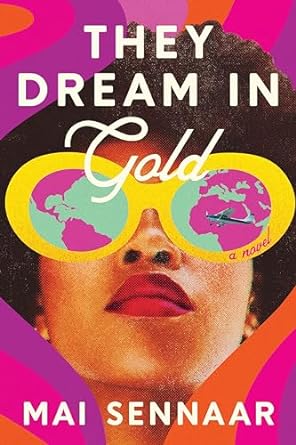
THEY DREAM IN GOLD, debut novel from tyro publisher SJP Lit...both worth watching


THEY DREAM IN GOLD
MAI SENNAAR

Zando/SJP Lit
$28.00 hardcover, available now

Rating: 4* of five

The Publisher Says: A “luminous” (Tara Conklin) literary debut following two dreamers, one intercultural family, and the diasporic pursuit of home.

When Bonnie and Mansour meet in New York in 1968―his piercing gaze in a downtown jazz club threatening to carry her away―their connection is undeniable. Both from fractured homes, with childhoods spent crossing the Atlantic, they quickly find peace with each other. And as Mansour’s soaring Senegalese melodies continue to break new ground, keeping time with the sound of revolution and taking him and Bonnie from Paris to Rio and Switzerland, it seems as though happiness might finally be around the corner for them both.

Then Mansour goes missing. His Spanish tour was only meant to last three weeks, but three months later, he and his band have not returned. In his absence, Bonnie reckons with her memories of him, and comes to understand that the hopes of so many women―her mother and grandmother; his mother, aunt, childhood friend―rest on her perseverance. Stirred by the life growing inside her, Bonnie puts a plan in action to find him.

Spanning two decades and moving through the hotbeds of the African diaspora, They Dream in Gold is an epic yet intimate exploration of the migrant hunger for belonging and a powerful, intergenerational testament to our shared humanity, for lovers of Tara Stringfellow’s Memphis and Abi Daré’s The Girl with the Louding Voice.

I RECEIVED A DRC FROM THE PUBLISHER VIA NETGALLEY. THANK YOU.

My Review
: Buckle up...this is a complicated read. Long at over four hundred pages, complex in its interrelated cast of characters, difficult to summarize as a result. Senegal, Paris, New York...the Twenties, the Sixties...familys seen in passing, a family being formed...this novel's a web.

It's a debut novel for the storyteller and close to a debut for the publisher. Sarah Jessica Parker's SJP Lit is part of a company called Zando Projects (Zando's website). SJP Lit's mission statement is:
Sarah Jessica Parker’s SJP Lit publishes sweeping, expansive, thought-provoking, and discussion-driven stories that are inclusive of international and underrepresented voices. SJP Lit books capture the contemporary imagination and reflect a wide range of ideas and experiences.

So someone famous decided not to start a book club, or an imprint in the Corporate World, but a company publishing books she curates and pays for and edits for us to see what she wants to read and offers us as worth it to read, too. As I would expect from Parker's résumé, the story told here is very much focused on character development. Bonnie and Mansour are not, despite what you could reasonably expect from the synopsis, the only or even the best developed characters. Because the story does not conform to linear time's slightly tedious constraints, we get the family polyphonics as well as the dynamics. This is a fancy way for me to say, if you're expecting a straightforward family saga, you're going to be left wanting. If you really want a book you can inhabit, one that feels more like a series (I mean this in the good way!) than a standalone, here's a great summertime immersion.

The way we move from time to time, from place to place, demands of the reader a level of participation, of code-switching, that might be off-putting for some. I think you'll twig quite quickly to the cues that indicate we're going to shift, though they are not the same from one instance to the next. What I like about that is the mood of the read never stagnates, a danger that family sagas can fall into readily. After a time many of them feel like trauma porn, or a weird triumphalism celebrating a character's Strength, Nobility, and Fortitude. Yeeeccchhh

Author Mai Sennaar doesn't succumb to that too-easy, too-incredible stuff. Her women are beset by worries and doubts. They wonder if things are worth it if they hurt this much, demand this much of them. They stumble, fall, and fail. But they never stay down for good.

It is a distinction, not a difference, but it is a consequential one that speaks to the author's intent. She is not going for the facile road to storytelling success. That is clear from the start. For this old white man, that made the read all the more interesting and involving. Some of that could be down to the slightly more...distant...way the narration is deployed, it gets an overview feeling across. Back to that polyphony of PoVs. This is a natural outgrowth of it. I found it enhanced my reading experience, in part because it enabled Author Sennaar to put me more firmly into the time and place the different strands of her story-web flow through.

I found I was disgruntled by one big, star-losing thing: Like Sweet, Soft, Plenty Rhythm (whose author flatteringly blurbed this book), every one of these women is circling a man. The story's center is a man (absent though he be). Is it that hard to make these women interrelate around themselves and each other?

A crotchet of mine. The Bechdel test still matters to me because the queer equivalent is abysmal still...gay characters feature more than ever, less than reality says is fair. So, no fifth star for you, debut novel. Author Sennaar is deeply talented and should be supported, make no mistake.

Maybe she's got more to say, soon. Let's show we're listening.

Monday, May 6, 2024

YOU SHOULD BE SO LUCKY, and so he should...and what fun getting him there


YOU SHOULD BE SO LUCKY
CAT SEBASTIAN

Avon Books
$18.99 trade paper, available tomorrow

Rating: 4.5* of five

The Publisher Says: An emotional, slow-burn, grumpy/sunshine, queer mid-century romance for fans of Evvie Drake Starts Over, about grief and found family, between the new star shortstop stuck in a batting slump and the reporter assigned to (reluctantly) cover his first season—set in the same universe as We Could Be So Good.

The 1960 baseball season is shaping up to be the worst year of Eddie O’Leary’s life. He can’t manage to hit the ball, his new teammates hate him, he’s living out of a suitcase, and he’s homesick. When the team’s owner orders him to give a bunch of interviews to some snobby reporter, he’s ready to call it quits. He can barely manage to behave himself for the length of a game, let alone an entire season. But he’s already on thin ice, so he has no choice but to agree.

Mark Bailey is not a sports reporter. He writes for the arts page, and these days he’s barely even managing to do that much. He’s had a rough year and just wants to be left alone in his too-empty apartment, mourning a partner he’d never been able to be public about. The last thing he needs is to spend a season writing about New York’s obnoxious new shortstop in a stunt to get the struggling newspaper more readers.

Isolated together within the crush of an anonymous city, these two lonely souls orbit each other as they slowly give in to the inevitable gravity of their attraction. But Mark has vowed that he’ll never be someone’s secret ever again, and Eddie can’t be out as a professional athlete. It’s just them against the world, and they’ll both have to decide if that’s enough.

I RECEIVED A DRC FROM THE PUBLISHER VIA NETGALLEY. THANK YOU.

My Review
: I'm a Cat Sebastian stan. Her writing chops, her eye for a story, her politics...all *chef's kiss* in my experience. This derfinitely is, please note, a slow-burn love story. I don't think this is a bug, rather a feature; I'm pretty au fait with what happens between men in bed. I'm as interested in how they got there, and why, as in what it is they're gettin' up to.

The fun in this read is that, once the guys get their bodily freak on, I believe that they'll be able, and willing to stay there! These relationships, the ones you can actually picture as real and lasting, are all too rare in fiction...let alone in romantic fiction. It is not, I hurry to reassure the bodyloathers, a meaty, intimately observed intimacy; more of a noises-off kind of affair, where we know what happened and now we see what that brought to Mark and Eddie. One-handed reading is not really Author Cat's stock-in-trade, she hasn't started now.

That being my expectation, and it being met, next point of tension for many readers (including me) is the elephant in the room of any midcentury m/m story: Outing. A reporter and a baseball phenom in physical intimacy would've had a lot of anxiety about being seen to be...a little too close, a bit off in the macho world of baseball...because it would uneash the horrors of public, untrammelled homophobia on the men. This was, after all, the time of The Lavender Scare.

So this backdrop means, in my reading, the HEAs and even HFNs many writers engineer for two men being publicly together in this time-period ring hollow. "That could not happen!" I think, all suspension of disbelief flying away on noisy bat-wings of knowledge. As always, Author Cat spares me the discomfort by making these two behave circumspectly. Mark, a reporter, knows the Power of the Press, and respects the cultural norms to avoid awakening it. He's also just lost his longtime love, and so isn't exactly in a huggy-smoochy frame of mind; Eddie's in his first-ever existential crisis..."I can't do this thing I get praise and an identity from anymore! Help!"...so he's, well, not gonna rock the boat. Such a good way to ensure there's layers of meaning behind their period-appropriate decorous public demeanor.

What makes any story centered around grief readable is hope. The men here don't have a path forward, can't see through the fog of the present into a brighter, better-defined future. Only as they learn to trust each other's love and support as real, solid stones capable of being made into a foundation do they find the ease they're seeking. That was the payoff I needed from this unlikely duo's coming-together: The sense that, to their mutual surprise, they had found together the path that neither had been able to see alone.

In the end, these two find their happiness in their connection. They are, it felt to me, solidly, enduringly connected and will weather their future storms better for being together. Now, how often do fictional people draw out that level of thought and that depth of interest? For anyone who hasn't read Author Cat's earlier work, it might sound surprising that this has happened. I assure you who haven't had the pleasure that this is a long-term feature of all her stories.

Lastly, I hope you'll read this, and resonate to it. It is a very clear statement of a deep, abiding truth of the experience of being Other:
It’s not just the burden of continually lying, it’s keeping your existence a secret. When the world has decided that people are supposed to be a certain way, but you’re living proof to the contrary, then hiding your differences is just helping everybody else erase who you are.

This book, in a period-appropriate way, presents two loving souls whose socially unacceptable love and connection truly prevent them from being erased.

Sunday, February 25, 2024

SEARCHING FOR VAN GOGH, coming-of-age novel set in 1960s Michigan


SEARCHING FOR VAN GOGH
DONALD LYSTRA

Omena Hills Press
$5.99 Kindle edition, available now

Rating: 4* of five

The Publisher Says: Set in Michigan during the tumultuous closing weeks of 1963, "Searching for Van Gogh" is a heart-wrenching story of two young souls bravely navigating life's challenges.

A young woman is inspired by a cinematic heroine to find meaning in a world that has cast her aside.

A teenage math and science prodigy turns to art as he struggles with the pain of losing his beloved elder brother.

Their unlikely friendship is a beacon of hope, reminding us that in tough times the best defense is the help we can give to one another.

Reminiscent of timeless classics like Ordinary People and To Kill a Mockingbird, this story celebrates the power of friendship and understanding in an often unforgiving world.

I RECEIVED A DRC FROM THE PUBLISHER VIA NETGALLEY. THANK YOU.

My Review
: Do you need a break from the nastiness and unapologetic hatemongering of the world outside your door? Do you want to take a trip back to a world still slowly moving into full awareness of how cruel it has become?

Here's you a read.

Two people carrying a lot of sadness find each other at very vulnerable moments in each one's life. Their entire worlds have narrowed into coping with loss and loneliness. Then...they meet, they connect, and they tentatively learn to communicate.

What on Earth is happening to this old man, I can hear you wondering. This kind of story never appeals to him! Quite true, it is not my native land, well-trodden paths to and fro everywhere one looks in my catalog of reads. I was pleased to read something with the personal stakes of this story...grief, loss, coming to terms with the way the world works, how families fail each other at crucial times. The prose is direct and unpretentious, the voices of the characters distinct, and that plus the storyline and setting gave me what I craved most: Investment and involvement with neither anger nor outrage, just the pleasant sense that this time the world handed these two hurting souls the balm instead of the liniment.

I needed an emotionally real story, uncomplicatedly told, with people in believable emotional pain that was not going to cause Disaster. I needed that story to end believably well without absurd, over-the-top machinations, like it does in the happier passages of Real Life. And I got what I needed. I am glad I read this direct, involving, kind story.

So, kindness seekers, come to Donald Lystra's doorstep and be fed.

Tuesday, November 1, 2022

DEAD LETTERS FROM PARADISE, lesbian sleuth in 1960s North Carolina & MY POLICEMAN, well-matched book and film...you can find both at Amazon!


DEAD LETTERS FROM PARADISE
ANN McMAN

Bywater Books
$19.95 trade paper, available now

Rating: 4.75* of five

The Publisher Says: April 1960.

Gunsmoke is the most popular show on TV. Elvis Presley tops the Billboard charts. A charismatic young senator named John F. Kennedy is running for president. And, in North Carolina, four young Black men sit down at a Woolworth’s lunch counter and demand service. Enter Esther Jane (EJ) Cloud, a forty-something spinster who manages the Dead Letter Office at the Winston-Salem post office. EJ leads a quiet life in her Old Salem ancestral home and spends her free time volunteering in the town’s 18th-century hortus medicus.

One sunny Spring morning, EJ’s simple life is turned upside down when the town’s master gardener unceremoniously hands her a packet of handwritten letters that have all been addressed to a nonexistent person at the garden and expects EJ to “tend to them.” This simple act sets in motion a chain of events that will lead EJ on a life-altering quest to uncover the identity of the mysterious letter writer—and into a surprising head-on confrontation with the harsh realities of the racial injustice that is as deeply rooted in the life of her community as the ancient herbs cultivated in the Moravian garden.

When EJ is forced to read the letters to look for clues about the anonymous sender, what she discovers are lyrical tales of a forbidden passion that threaten to unravel the simple contours of her unexamined life. EJ’s official quest soon morphs into a journey of self-discovery as she becomes more deeply enmeshed in the fate of the mysterious letter writer, “Dorothea.” Her surprising accomplice in solving the mystery of the letters becomes one, Harrie Hart: a savvy, street smart ten-year-old, wielding an eye patch and a limitless supply of aphorisms. Together, Harrie and EJ make seminal pilgrimages to the tiny town of Paradise to try and uncover the identity of the mercurial sender and, ultimately, learn a better way to navigate the changing world around them.

I RECEIVED A DRC FROM THE PUBLISHER VIA EDELWEISS+. THANK YOU.

My Review
: I love Ann McMan's way of approaching a story. I understood I was reading about a closeted-even-from-herself lesbian instantly, from the moment EJ was introduced to me. I had a lesbian couple as "grandmothers" of a sort, best friends of my mother's for decades. They were Southern ladies, they were clearly a couple, and it...just didn't matter. They came to our house for Thanksgiving. They were constantly in our conversations about family, and had one name between them: "Sara-Lucy" since their names were Sara and Lucy; we just didn't need to say "and" because they were always a unit to all of us.

EJ and her friends were the kind of people, then, that I grew up knowing and loving. I strongly suspect Author McMan had someone(s) similar to my belovèd Sara-Lucy in her young queer life. She loves EJ as much as the child Harrie, EJ's shadow-cum-sidekick, does. Fay Marian is my nominee for that treasured role...the Moravian Herb Garden is such a perfectly chosen project for a group of lesbians to choose as a social hub.

What made the story itself, the dead letters that EJ receives to unite with their intended recipient or reunite with their sender (both unknown at the start), so beautifully chosen was the way Author McMan used these artifacts of thwarted love and strangled passion to bring EJ into a fuller understanding of Life as she *could* live it. She is living, no really she's just spending her one life unsatisfyingly, incompletely, almost entirely in the Dead Letter Office. As great a contrast as you can imagine is the child Harrie, so curious and open, so wise and still so innocent. She is a character I simply wanted to hug every time she came on the page.

I'd've rated the book a full five stars had I not felt that the period-appropriate race relations issues been less integral to the story than it was used as a grace note within the story. The issue isn't meant to be foregrounded...so the smart money says don't use it. In the present moment, the in-between handling of it comes across more as a detraction from than a point in favor of the read.

Still leads me straight (!) to Ann McMan's extensive backlist. I want more and I mean to have it. Thanks to my dear old reading buddy whose nudge pointed me in this direction. You're the best, Sister Woman.

++++++++++++++++++++++++++++++++++++++++++++++++++++++++++++++++


MY POLICEMAN
BETHAN ROBERTS

Penguin Books
$17.00 trade paper, if Mr. Styles's face from the film being on the book is an added bonus

Rating: 3.75* of five

The Publisher Says: Now a motion picture starring Harry Styles and Emma Corrin, an exquisitely told, tragic tale of thwarted love.

It is in 1950's Brighton that Marion first catches sight of Tom. He teaches her to swim, gently guiding her through the water in the shadow of the city's famous pier and Marion is smitten—determined her love alone will be enough for them both. A few years later near the Brighton Museum, Patrick meets Tom. Patrick is besotted, and opens Tom's eyes to a glamorous, sophisticated new world of art, travel, and beauty. Tom is their policeman, and in this age it is safer for him to marry Marion and meet Patrick in secret. The two lovers must share him, until one of them breaks and three lives are destroyed.

In this evocative portrait of midcentury England, Bethan Roberts reimagines the real life relationship the novelist E. M. Forster had with a policeman, Bob Buckingham, and his wife. My Policeman is a deeply heartfelt story of love's passionate endurance, and the devastation wrought by a repressive society.

I CHECKED THIS BOOK OUT FROM THE LIBRARY. USE THEM OFTEN, THEY LIVE AND DIE ON OUR PATRONAGE.

My Review
: This is a fictionalized version of the actual lived life of EM Forster, his policeman lover Robert Buckingham, and his lover's wife May.

This is also gay trauma porn, a film starring a straight(ish) actor in a gay(ish) role AGAIN, and an accurate presentation of the ways and means used by gay men in the past to muddle through this rough thing we call Life. I had a gay uncle in Buckingham's generation, so I've heard the stories firsthand.

I'm not going to tiptoe around the fact that this book was written more than a decade ago, which means the cultural landscape was quite different. This true story, only lightly fictionalized, has lost none of its power to move someone whose desire is to be let in on the hard, terrible work of loving someone more than they love you back, and the horrible, disfiguring things that jealousy can lead a person to do. I was appalled by Marion's actions in the book, which were NOT the actions of May Buckingham. I truly understand why Author Roberts chose to make this shift, though. The story's drama would've been more literary fiction-lite without it. As it is, this read is much more like sudsy, beautiful Ethan Frome in its impact.

I'm also not going to tiptoe around the fact that Mr. Styles, whose public presentation of self leads me to think this story's lineaments resonated on a deeply personal level with him, is still publicly straight and playing a role where the character's only assuming the mask of straightness where his heart and his cock are engaged elsewhere. Same old, same old...but let me say this now: He does a damned fine job of playing Tom, and he deserves credit for doing the job at all. We're sliding into another darker age for QUILTBAG people, it seems, after some modest gains were made. Mr. Styles's metrosexual-shading-into-heteroflexible persona is very risky, and he doesn't seem to shy away from it as hard as, say, Tom Hanks did after Philadelphia thirty years ago.

The book will be overshadowed by the film for many reasons. Not the least of them is that the film has pretty people who enacted simulated sex for our collective titillation. (Something Mr. Styles does with, erm, style and verve.) That is not, to be blunt, a terrible loss. This book is nicely written, tells an involving story, but it disappeared for most of a decade without leaving a ripple...for a reason.
Because when you're in love with someone for the first time, their name is enough. Just seeing my hand form Tom's name was enough. Almost.

–and–

In those days it was rare, wasn't it, Patrick, for Tom's voice to become what you might call serious; there was always a lot of up-and-down in it, a delicacy, almost a musicality (no doubt that's how you heard it), as thought you couldn't quite believe anything he said. Over the years, his voice lost some of its musicality, partly, I think, in reaction to what happened to you; but even now, occasionally, it's like there's a laugh behind his words, just waiting to sneak out.

–and–

I'd almost forgotten the joy of waking up and, before you've even opened your eyes, knowing by the shape of the mattress beneath you, by the warmth of the sheets, that he's still there.

Nice lines, precise observations, a deft touch in siting them within the storyverse. Nothing at all wrong, or even clumsy, in any of it; take my word for it, were Bethan Roberts to have dropped a clanger I'd've gleefully snipped it out and plopped it here, dripping venom and blood, for your (oh okay, my) delectation. I'm a grouchy old curmudgeon who wanted to dislike this book, and couldn't. I also wanted to dislike Mr. Styles playing Tom, and couldn't. I'm in the nasty, frustrating position of needing to praise, however grudgingly, the film and the book, the actor and the characters, that I wanted to bash.

The film, out on 4 November 2022 via Prime Video, is very much worth your time. The book is as well...buy it if the Kindle edition is on sale, or borrow it from your library if not. Reading the book first will not damage your appreciation for the film nor will seeing the film first make you wonder where the hell they dug that story out of the book from in the first place.

I just wanted excellent, not very good, so I'm out of sorts. That is, however, my issue and not the book or its film's problem.

Friday, September 16, 2022

MISS ICELAND, exploring the reality of how much society has changed ***SPOILERS***


MISS ICELAND
AUÐUR AVA ÓLAFSDÓTTIR
(tr. Brian FitzGibbon)
Black Cat (non-affiliate Amazon link)
$10.99 Kindle edition, available now

Rating: 4.5* of five

The Publisher Says: Iceland in the 1960s. Hekla is a budding female novelist who was born in the remote district of Dalir. After packing her few belongings, including James Joyces's Ulysses and a Remington typewriter, she heads for Reykjavik with a manuscript buried in her bags. There, she intends to become a writer. Sharing an apartment with her childhood and queer friend Jón John, Hekla comes to learn that she will have to stand alone in a small male dominated community that would rather see her win a pageant than be a professional artist. As the two friends find themselves increasingly on the outside, their bond shapes and strengthens them artistically in the most moving of ways.

I RECEIVED A DRC FROM THE PUBLISHER VIA NETGALLEY. THANK YOU.

My Review
: It's always been true that, to be a success, a woman must do twice as much and can expect half the reward a man would get for the same labor. Hekla, cursed with both attractiveness and intelligence in a smugly patriarchal culture, learns that to be a writer who is taken seriously while also being a pretty female is a Sisyphean task. The 1960s were not yet times of change in Iceland....

Hekla's ambitions lure her away from her rural home and, when she arrives in Reykjavík, her efforts are...Herculean. Yes, lots of mythology referred to here, and honestly it's only down to the fact that there isn't a better metaphor for what she is required to expend. Jón John, her gay BFF, preceded her to Reykjavík because if there's a worse thing to be in rural Iceland than a smart, ambitious, pretty woman, it's a queer man. They take up residence together while he does the kind of labor he can find, gets laid when someone's horny and their wife isn't willing, and ponders with her why they should be reduced to such crummy exigencies for getting mere crumbs of what they really want.

I was ready to give the book five stars until I got to the ending. What happened there, I fear, was me smacking my nose on the sad, true realization that Jón John's deeply ingrained homophobia will, in fact, be the death of him; and that Hekla, in accepting a very terrible and unfair life for herself, has resigned herself to the way the world is. Is this how the book should end? Yes, I can certainly see that it would make the most sense for it to end as it has. I still wanted, on an emotional level, to feel the striving I'd seen the characters enact pay off. I expected Surtsey to come roaring up faster than it did and give the characters new, hot, fire-powered land to live their new, hot, fire-powered lives on.
“Men are born poets. By the time of their confirmation, they’ve taken on the inescapable role of being geniuses. It doesn’t matter whether they write books or not. Women, on the other hand, grapple with puberty and have babies, which prevents them from being able to write.”

No, not for humans as fully, honestly drawn as these humans were, to be given a fairy-tale ending. They got reality. It felt like a cheat; it wasn't, of course, but it felt like one. I will say that the emotional core of the book is sadness and that was not the source of my half-star docking. It was the changes Jón John and Hekla made not amounting to an improvement of their lives. It could have; it seemed to me that, once the Faustian bargain of marriage was struck between them, they could've used that energy to propel themselves to happier endings. But the core of sadness was too powerful. The end of the story is, in this book, really and truly an end. Hekla's book being published? A major achievement! And it's all her ex-boyfriend Starkadur's because otherwise, without his man's name on it, the book won't *get* published. Miss Iceland was beautifully, poignantly sad all the way through. But when a story has one note, it's hard to maintain one's taste for that, and only that, note.
The skylight has misted up in the night, a white patina of snow has formed on the windowsill. I drape {Starkadur}'s sweater over me, move into the kitchen to get a cloth to wipe it up. A trail of sleet streams down the glass, I traced it with my finger. Apart from the squawk of seagulls, a desolate stillness reigns over Skolavordustigur.

Understand your journey, don't undertake it if you're not in the mood for exactly that journey. If you are, this will repay your attention with exquisitely lovely, painfully honest images and you'll be honestly unable to see for sad tears that won't quite fall.

Tuesday, June 14, 2022

BORN TO BE POSTHUMOUS, as mordantly amusing as it sounds


BORN TO BE POSTHUMOUS: The Eccentric Life and Mysterious Genius of Edward Gorey
MARK DERY

Little, Brown
$35.00 hardcover, available now

Rating: 4* of five

The Publisher Says: From The Gashlycrumb Tinies to The Doubtful Guest, Edward Gorey's wickedly funny and deliciously sinister little books have influenced our culture in innumerable ways, from the works of Tim Burton and Neil Gaiman to Lemony Snicket. Some even call him the Grandfather of Goth.

But who was this man, who lived with over twenty thousand books and six cats, who roomed with Frank O'Hara at Harvard, and was known—in the late 1940s, no less—to traipse around in full-length fur coats, clanking bracelets, and an Edwardian beard? An eccentric, a gregarious recluse, an enigmatic auteur of whimsically morbid masterpieces, yes but who was the real Edward Gorey behind the Oscar Wildean pose?

He published over a hundred books and illustrated works by Samuel Beckett, T.S. Eliot, Edward Lear, John Updike, Charles Dickens, Hilaire Belloc, Muriel Spark, Bram Stoker, Gilbert & Sullivan, and others. At the same time, he was a deeply complicated and conflicted individual, a man whose art reflected his obsessions with the disquieting and the darkly hilarious.

Based on newly uncovered correspondence and interviews with personalities as diverse as John Ashbery, Donald Hall, Lemony Snicket, Neil Gaiman, and Anna Sui, Born to be Posthumous draws back the curtain on the eccentric genius and mysterious life of Edward Gorey.

I CHECKED THIS BOOK OUT OF THE LIBRARY. SIX TIMES. ULTIMATELY A LIBRARIAN BOUGHT ME A SALE KINDLEBOOK. (True story!)

My Review
: There are few things my elder sister and I agree on. One of them is that Edward Gorey's a bloody genius, and about as hilarious as it's possible to be. (We also both love Jo Walton, so it's not as though she's a waste of space. Entirely, anyway.)

That's what Edward Gorey's superpower is, though. He speaks to a certain inner weirdo in some people, a rebellious streak that demands the sheer nonsensical pointlessness of Life be acknowledged and celebrated. Poor Xerxes...a Gashlycrumb Tiny I truly felt for.

Now that Gorey's safely dead, what's the skinny on his narrow gay ass? Welllll...not that fascinating, if I'm honest. He was exactly as you'd expect someone who could think up a child called "Xerxes" would be. Strange, a misfit, completely and utterly himself because he *designed* himself with great care. His artwork was justly celebrated for its technical merit...by three or four people. Weirdness exacts costs from the weirdo. Gorey was famous...if you know who he is. I'm never sad or sorry that I know who he is, unlike many famous people. But Gorey's talent as an artist was never the subject of major retrospectives at the Museum of Snooty Stuff or the Obscene Wealth Collection.

Unlike most of the art you'll see in those cultural institutions, you've seen a Gorey image. (If you're reading this blog, you have.) The Mystery! series opening sequence? Gorey. The 1950s Anchor Books images? Gorey. Over 100 of his own books, popular culture objects. He was a niche force, but a force nonetheless.

However, Dery's exhaustively researched biography goes into some detail about the skinny on Gorey's sexual nature. I think, like Greta Garbo, he wanted to be left alone. He never, ever once said he was gay. He lived through Stonewall...long after it was entirely okay with most people to come out as gay, he didn't.

Because he wasn't.

He said, in an interview collected in Ascending Peculiarity, "I'm neither one thing nor the other particularly. I am fortunate in that I am apparently reasonably undersexed or something ... I've never said that I was gay and I've never said that I wasn't ... what I'm trying to say is that I am a person before I am anything else ... " That, mes amis, is a clear statement of being. He was what we, in 2022, call "asexual." That doesn't prevent him from presenting himself in a striking and deeply queer-coded manner. But if the twenty-first century has taught me anything, it's that people are who and what they say they are. Gorey? Asexual, and presenting himself as a strange misfit. And that is all there is to it.

I wasn't pleased by Author Dery's claiming of him for the gay men of the world solely because we have his own words on the subject and they are not, despite the fact they could easily and safely have been, "I am gay." So. He wasn't. Yes, let's claim him as an ikon of the QUILTBAG spectrum! Yes, let's celebrate his Otherness, his determined design of his Otherness, and the glorious art that came out of it..."There's so little heartless work around," said Gorey. "So I feel I am filling a small but necessary gap."

But let's not posthumously (!) reassign his stripe on the flag for our own need to possess him. Let's celebrate the way he said he was with the gratitude and laughter and little frisson of unnerved nerves that he designed it to evoke in his viewers.

Saturday, February 19, 2022

HOWARD ZINN'S SOUTHERN DIARY: Sit-Ins, Civil Rights, and Black Women's Student Activism...what it says outside you get inside


HOWARD ZINN'S SOUTHERN DIARY: Sit-Ins, Civil Rights, and Black Women's Student Activism
HOWARD ZINN, ROBERT COHEN
(editor)
Foreword by Alice Walker
University of Georgia Press
$24.95 trade paper, available now

Rating: 4.25* of five

The Publisher Says: How young black women fought paternalism on campus and Jim Crow downtown, and how Howard Zinn was fired for supporting them

In the 1960s, students of Spelman College, a black liberal arts college for women, were drawn into historic civil rights protests occurring across Atlanta, leading to the arrest of some for participating in sit-ins in the local community. A young Howard Zinn (future author of the worldwide best seller A People’s History of the United States) was a professor of history at Spelman during this era and served as an adviser to the Atlanta sit-in movement and the Student Nonviolent Coordinating Committee (SNCC). Zinn mentored many of Spelman’s students fighting for civil rights at the time, including Alice Walker and Marian Wright Edelman.

As a key facilitator of the Spelman student movement, Zinn supported students who challenged and criticized the campus’s paternalistic social restrictions, even when this led to conflicts with the Spelman administration. Zinn’s involvement with the Atlanta student movement and his closeness to Spelman’s leading student and faculty activists gave him an insider’s view of that movement and of the political and intellectual world of Spelman, Atlanta University, and the SNCC.

Robert Cohen presents a thorough historical overview as well as an entrée to Zinn’s diary. One of the most extensive records of the political climate on a historically black college in 1960s America, Zinn’s diary offers an in-depth view. It is a fascinating historical document of the free speech, academic freedom, and student rights battles that rocked Spelman and led to Zinn’s dismissal from the college in 1963 for supporting the student movement.

I RECEIVED A DRC FROM THE PUBLISHER VIA EDELWEISS+. THANK YOU.

My Review
: There is no quisling like a race quisling. Spelman College, an institution of higher education for wealthy Black families, operated "in loco parentis" and, in typical midcentury overreach, became the controlling patriarch of its woman students' every single act. They were aiming for a complete absence of any breath of scandal. A Spelman alumna was Caesar's wife, blameless in all ways, and President Albert Manley (don't think that name didn't suit him to a "T") was going to make sure the women at 1960s Spelman were perfectly prepared to be housewives and helpmeets for Black executives, free of radical notions about race equality and gender parity.

Along comes new History professor Howard Zinn, radical New York Jew....

What makes this a good read is what makes any personal story a good read. The diary of a very interesting person, a person who's entire being is dedicated to breaking bad stuff and gluing it back together into better shapes, is going to be of interest to at least a few of us. When that person is someone whose way with words is demonstrably snappy, merging erudition with sarcasm and bypassing facetiousness to jab sharp elbows of truth-telling into the soft midriffs of the Status Quovians, chances are you're in for a good read.

Robert Cohen had access to Zinn's diaries before others in order to annotate and analyze the source material aided by a grant from New York University's Steinhardt School of Culture, Education, and Human Development. The purpose of the grant was to support research that could illuminate previously unknown connections and bring to light buried facts in Cohen's area of scholarship, social movements in higher education. This project combines the diaries of a major cultural figure with interviews of some women whose lives he touched (eg, Alice Walker) and the profound changes he catalyzed in some of them. It is hard to overstate Zinn's personal charisma. It is hard to overestimate the role contact with such a live wire has on a person beginning to form an identity. And Zinn's desire to assist the USA in birthing a fairer, more inclusive culture in all ways should've found friends in Spelman's hierarchy.

It very much did not.

Zinn was harassed and abused by senior colleagues, going so far as Spelman President Manley threatening him with an entirely fabricated sex scandal, for having the audacity to try to prepare his charges for the world of equal rights that Dr. Martin Luther King, Jr., was advocating across the street at Morehouse College. Ultimately, Zinn was forced to leave Spelman after seven years without tenure and was handed over to Boston University for a twenty-four year career of pushing aside the nostrums and asininities of US "education" in the History and Social Studies fields.

What makes this book fun to read is Editor Cohen's trenchant annotations and explications of the diary herein. The thing about a diary is that it's not usually meant for other eyes...but there's a hint that Zinn was slyly glancing over his shoulder at us from beyond the grave. What I enjoyed most were the moments that Cohen asks Zinn's former students about events in the diary. The putative subject of Zinn's "sexual harassment" was floored that this had ever been mooted! Manley, the President, was so desperate to protect what he saw as Spelman's selling point to wealthy parents...the oppressive in-loco-parentis system, the focus on high-brow, low-conflict education...that he would stoop to telling a lie that (had Zinn not caved and left the school) would've destroyed both lives.

This is not an unusual thing for a boss to have done, or even to do still. But the proof that it was being fired UP is what wonderful and important stuff happened at Boston University afterwards.

The problem with reading a book like this is the inevitable overage. Overexplaining. Overreaching to grasp a conclusion. Overdoing the support of a point of view. In the case of this book's subject, this book's timing, these were inevitable and expected. I was left wishing for less not more. But I appreciated the Catch-22 the simple existence of this book represents. Scholars need more, more proof more sources more citations, in order to survive as scholars. You can bet you'll see this book cited a great deal. The primary sources it relies on are brand new to scholarship. The interviews Editor Cohen conducted will, within a depressingly short time, be impossible to repeat due to aging and mortality. Luckily for the reader, this is not a painful overabundance of blah, bland, beige verbiage. I would caution not-scholarly readers to use the Oystercatcher Method: Fly in, skim catch crunch, swallow and move on; then wade through, dig, scuff up lower levels of tasty morsel, repeat later.

I won't give it five stars simply because there's so much information that requires additional effort to contextualize, but I will give it four-and-a-quarter because it's lively, trenchant, and conversational when it matters most to be those things for the story being told.

Monday, February 7, 2022

LOVE & SAFFRON: A Novel of Friendship, Food, and Love, a one-sitting buffet of reading goodness


LOVE & SAFFRON: A Novel of Friendship, Food, and Love
KIM FAY

G.P. Putnam's Sons
$24.00 hardcover, available TODAY!

Rating: 3.75* of five

The Publisher Says: When twenty-seven-year-old Joan Bergstrom sends a fan letter—as well as a gift of saffron—to fifty-nine-year-old Imogen Fortier, a life-changing friendship begins. Joan lives in Los Angeles and is just starting out as a writer for the newspaper food pages. Imogen lives on Camano Island outside Seattle, writing a monthly column for a Pacific Northwest magazine, and while she can hunt elk and dig for clams, she’s never tasted fresh garlic—exotic fare in the Northwest of the sixties. As the two women commune through their letters, they build a closeness that sustains them through the Cuban Missile Crisis, the assassination of President Kennedy, and the unexpected in their own lives.

Food and a good life—they can’t be separated. It is a discovery the women share, not only with each other, but with the men in their lives. Because of her correspondence with Joan, Imogen’s decades-long marriage blossoms into something new and exciting, and in turn, Joan learns that true love does not always come in the form we expect it to. Into this beautiful, intimate world comes the ultimate test of Joan and Imogen’s friendship—a test that summons their unconditional trust in each other.

A brief respite from our chaotic world, Love & Saffron is a gem of a novel, a reminder that food and friendship are the antidote to most any heartache, and that human connection will always be worth creating.

I RECEIVED A DRC FROM THE PUBLISHER VIA NETGALLEY. THANK YOU.

My Review
: First, read this:
We’ve never had mussels before. I’ve always thought of them as freeloaders clinging where they’re not wanted, and you must agree, their beards are unappetizing.
–and–
Our ten days in Paris felt like the blink of an eye. Or a dream. An elegant, buttery, wine-soaked dream.
–and–
When a new experience comes into my life, it doesn’t feel real anymore until I share it with you.

I'll be honest: I asked for this DRC because the subtitle uses the series (or Oxford) comma correctly, which is as promising a start as I can conjure in these degenerate punctuation-heretical times, and the tale is told in epistolary format. I am in the mood for a story of friendship. I am always gruntled by the effective use of epistolary storytelling. And I deeply love reading about people sharing their love of food.

You'll be looking up at that not-quite-four-star rating about now. I can explain.

All of my initial conditions were met, and met fully. I got the epistolary format used well: These are friends by post. There are gaps, lacunae in communicating with each other, and that enables the author to move the pace along in a more natural way. The fact that each letter was a crafted document, a thing one sat down to make and to serve a purpose...evoking in the friend an emotional response...that requires thought. Attention. Serious choice-making. That was evident in the prose (see above).

In Part I, the friendship developed from an initial fan letter that touched Imogen, the recipient, because of its inclusion of a packet of saffron. Now's the time to talk about the 1960s in the USA. As the world is now, a packet of saffron is a welcome gift because it's not cheap. As the world was then, a gift of a narwhal tusk would have about the same impact as saffron. "Whatinahell's that?" Imogen, who can dig clams or hunt an elk, hasn't tasted fresh garlic. In her life. Imagine the impact of SAFFRON! And no, those under 50, this wasn't in the least bit unusual.

I grew up in a household that had WAY more in the way of culinary adventurousness than the average. My parents were older when I was born, we lived near San Francisco, California, which had Chinese, Italian, Mexican, Japanese cuisines and ingredients all over, and my mother loved to experiment with weird, Gourmet-magazine type dishes. (Tuesday dinner, not so much. Feasts, though....) Then my mother and I moved to South Texas, where she hailed from, and I found the goddesses' natural food: Tex-Mex. BUT no one in 1967 Mercedes, Texas, had ever seen a fresh apricot or tasted General Tso's chicken. And that is where I can relate to this story: Joan is possessed of knowledge that Imogen simply doesn't have, or have any way to know she lacks.

So this cultural exchange is one I loved reading about. The historical moment...Cuban Missile Crisis, JFK assassination, the Beatles on Ed Sullivan ("a rrrrrrilllllly big shew!")...was the background of my childhood. They write to each other about it all. They write to each other about their cooking adventures. Single Joan has a lot to offer long-married Imogen because she (figuratively) listens and isn't invested in a particular outcome. What Imogen offers Joan is the simple, invaluable resource of being older, and experienced, and generous with her time, too. In a long novella/short novel, the two forge a perfectly balanced and genuinely moving friendship.

And now about those missing stars.

I am not nit-picking when I say that a book with the delicious recipes in it that this book has (the carne asada!!) needs to hyperlink them somewhere. I don't have a final copy, of course, but the paper copies don't appear to have an index either. (This is as of 6 February 2022, 6pm EST, when I went trolling for reviews last.) Yes yes yes, one can highlight them on the Kindle, but this is an oversight that would make the book even better if it were addressed. There's one quarter star.

Francis, Imongen's husband, blossoming into a passionate foodie during the course of the correspondence is a pleasure, insofar as it's presented to us...but Imogen is reporting it, of course, as it's an epistolary novel between Joan and herself. It's a feature, not a bug; but it left me feeling distanced from Imogen's lived life. I don't think this was a deal-breaker because epistolary...it's in the description...but I do think its impact on Imogen wasn't able to be explored quite as well as would've served the tale told. A quarter-star, and a sigh of regret for a too-short third-person catch-up in Part II.

Joan's life as a secretary at Rexall Drugs was, of course, the kind of job a girl (in the lingo of the time) could expect to get. Imogen encouraging her, boosting her, being there for her as she worked through anxiety and internalized misogyny and pursued her dreams of life in the newspaper world, was just a balm.

But then what? I didn't feel Joan got the spotlight enough as time went by...and that is down, again, to the format chosen to tell the story. But it felt unfinished as it was, with a too-short third-person wrap-up for Joan, too. Not because it wasn't a complete story! Because there was more story I wanted. Another quarter star forgone for expectations raised but not quite met.

When we return to epistolary format in Part III, the magic's worn off...the sweet, nostalgic sense of familiarity at a safe remove isn't there any more. But that isn't a deal-breaker so much as the force of the narrative doesn't have a chance to recover, so the half-star goes because, for the very first time, I noticed myself noticing I wasn't as ensorcelled as I started the read being. (Maybe if the third-person narratives had been diary entries...? I am Monday-morning quarterbacking here, so I'll stop.)

What I'll end on is the sheer pleasure of reading that this one-sitting tale offered. I think any book group that needs to lighten the tone and pick up the pace after a tough read should get this book onto their lists ASAP. I think pandemic-weary people whose lives have shifted into a new configuration through discovering food and cooking would like this for a February Sunday afternoon's pleasure. Most of all, I want to assure anyone thinking "this old man's a nutbar for pushing the read at me with this 3-3/4-star rating" is correct. This old man is, in fact, a nutbar. And one whose purpose it is to tell you what's worth reading.

This is worth reading.

Friday, January 28, 2022

RED MILK, weird title (so what else is new) for Sjón's latest & best


RED MILK
SJÓN
(tr. Victoria Cribb)
MCDxFSG
$12.99 ebook editions, available now

Rating: 4.75* of five

The Publisher Says: A timely and provocative novel about a mysterious Icelandic neo-Nazi and the enduring global allure of fascism.

In England in 1962, an Icelandic man is found dead on a train bound for Cheltenham Spa. In his possession, policemen find a map on which a swastika has been drawn with a red pen. Who was he, and where was he going?

In a novel that reads as both biography and mystery, the internationally celebrated novelist Sjón tells the story of Gunnar Kampen, the founder of Iceland's anti-Semitic nationalist party, with ties to a burgeoning network of neo-Nazi groups across the globe. Told in a series of scenes and letters spanning Kampen's lifetime—from his childhood in Reyjavík during the Second World War, in a household strongly opposed to Hitler and his views, through his education, political radicalization, and his final clandestine mission to England—Red Milk urges readers to confront the international legacy of twentieth-century fascism and the often unknowable forces that drive some people to extremism.

Based on one of the ringleaders of a little-known neo-Nazi group that operated in Reykjavík in the late 1950s and early 1960s, this taut and potent novel explores what shapes a young man and the enduring, disturbing allure of Nazi ideology.

I RECEIVED A DRC FROM THE PUBLISHER VIA NETGALLEY. THANK YOU.

My Review
: There is so much that goes into making a person's life. So many moments of seeming ordinariness, so many times unremembered but never forgotten.

Author Sjón absolutely understands this, relies on it, makes me aware of how unaware I am in my life. Living it day-to-day it's unremarkable. After it's over, as it's ending...those are the times reflection becomes available to the average person. Author Sjón takes that truth and makes it the structure of the novel.

We're reading the life of Gunnar after it's over, after it's been picked apart and examined...this book reads like an evidence box would, pick up this letter, what did this key open...and that lets us contextualize the story as the tragedy it really is.

I was gobsmacked to learn this is a based-in-fact story, this was a real person, the ending is factual. How Gunnar came to hold beliefs so horrible to me was all in the oblique and the sidewise and the interstitial parts of the text. Lest that sound Arty and pretentious, I hasten to say that there is no better way I evoke an honest emotional response than this. Author Sjón trusts you to Get It. He allows you not to know.

I'll take that sense of being allowed to find the truth in the fiction over being spoonfed any day.

What I hope you'll enjoy, resonate with, in this read is that quality of discovering the meat of the life Gunnar led, and placing the pieces in order for yourself. While you're never left in doubt about your position in time, you're not going to get everything there is simply by that means.

I think it was a real, living person that I found in this novel. Would I have "liked" him? I don't think so. But I wouldn't have known him the way I do because Author Sjón showed him to me in this simple, elegant piece-by-piece fashion. I like novel-Gunnar a little bit. He was so very empty. He found something to fill what a human can't live without having full. AND it was something awful. Something vile, foul...but it filled the void.

I understand the souls whose quest to be Whole leads them in dark, ugly, despicable places that one fraction better.

Thank you, Author Sjón. I can get better at being a good version of me after this read.

Friday, January 14, 2022

FADEOUT, fifty-two years of Brandstetter in the world but no films?!


FADEOUT
JOSEPH HANSEN

Soho Syndicate (non-affiliate Amazon link)
$9.99 Kindle edition, available now

Rating: 5* of five

The Re-Publisher Says: Published fifty years ago, a time when being gay was illegal in 49 out of 50 states, Joseph Hansen’s first Dave Brandstetter novel shattered stereotypes and redefined the Private Eye novel as we know it.

Five decades after its original landmark publication, Joseph Hansen’s Fadeout is as fresh and important as ever. Preceded only by a handful of gay protagonists in crime fiction, Hansen’s Dave Brandstetter, a ruggedly handsome World War II vet with a quick wit, faultless moral compass, and endless confidence, shattered stereotypes and won over a large reading audience, a feat previously considered impossible for queer fiction.

Set in the mid-1960s, Fadeout centers on the disappearance of a southern California radio personality named Fox Olson. A failed writer, Olson finally found success as a beloved folksinger and wholesome country raconteur with a growing national audience. The community is therefore shocked when Olson’s car is found wrecked, having been driven off a bridge and swept away in a fast-moving arroyo on a rainy night. A life insurance claim is filed by Olson’s widow and the company holding the policy sends their best man to investigate. The problem is that Olson’s body was never found. Not in the car. Not further down the river. As Dave Brandstetter begins his investigation he quickly finds that none of it adds up.

I RECEIVED A DRC FROM THE PUBLISHER VIA EDELWEISS+. THANK YOU.

My Reviews
: First, a 2013 rumination:
I've recently completed a re-read of all twelve Brandstetter books. Why the heck not, it beats writing a new ending for my own book, right? Especially a book I thought of as done, but...oh heck, never mind.

My crazy mother bought this book when it came out because she liked mysteries. It was a little too hard-boiled for her, but she got the next three or so because she just loved the writing. When I was about 12, she handed this one to me when I expressed my joy at reading The Maltese Falcon with the offhand remark, "oh well then, this one'll slay ya."

Wow. A gay OLD man! People like me before there was a me!!

That really mattered to me, since there was such a lack of public and accepted gayness in the Austin of 1971. I remember knowing there were gay guys at the University because the sister who went there complained about it. I remember knowing the term "gay" from a friend of that same sister's who used it, and explained it when asked. The sister in question said, "oh geez he means queers, Rich, the faggots who mince around yelling about rights."

My mother is not the only judgmental and nasty woman I grew up with.

Well, that sort of interchange made Brandstetter all the more pleasurable for me to read! I loved him for being himself, despite his own father's disapproval, and for being a widower...a relationship ends before the series begins, and it was a revelation to me that such a relationship was *possible*. What a wonderful man Joseph Hansen must be, I thought, to create this unicorn of a character.

As the mystery unfolds, Dave Brandstetter does too. He learns so much about the victim, and so much of that resonates with him...Dave just can't stop the grieving he's going through for his dead love from connecting him to the people in his life, even as he makes the honorable choice not to take comfort that's offered to him by someone even more vulnerable than he is.

What I know now as someone older than the old man I thought Dave was in the book...Hansen knew what he was talking about when the subject is grief and grieving. Dave's pain made me weep as a kid. It does so much more to the grief-veteran old-man me...makes me sit, shocked, as I'm taken in to this most personal and intimate of places. Sex is less intimate than a person sharing this passage with you. As a re-reader, I had my initial youthful response in mind. Then the reality hit, and the impact was profound.

When there's writing like this, storytelling like this, out there in the world, why are so many people gobbling down so much crap?

My present-day response to re-reading this glory of a noir story:
Revisiting this read still more decades later, I am much more impressed with Author Hansen's feat of derring-do in writing the absolutely ordinary Dave as a queer gent of a certain age. These are excellent California Noir novels, as Michael Nava says in his Introduction, and it is homophobia and nothing else that keeps Hansen off the lists of the great practitioners of this art.

I thank you, Soho Syndicate, for republishing the series. Thanks, Edelweiss+, for the DRC. Most of all, and most heartfelt indeed, are the thanks I offer to my forerunner Joseph Hansen for holding the spiky branches back and showing my ever-searching eyes the safest path to being a good man was the honest one.


When all is said and done, when this mystery is...not solved, exactly...resolved, let's say, one feels that Justice has been served and the world's wicked, awful ways aren't triumphant when it really mattered. This time.

Thursday, May 27, 2021

RUNAWAY, Peter May's trenchant novel of growing old's many indignities

RUNAWAY
PETER MAY

Quercus (non-affiliate Amazon link)
$6.99 ebook editions, available now

Rating: 3.75* of five

The Publisher Says: "Five of us had run away that fateful night just over a month before. Only three of us would be going home. And nothing, nothing would ever be the same again."

Glasgow, 1965. Headstrong teenager Jack Mackay has just one destination on his mind--London--and successfully convinces his four friends, and fellow bandmates, to join him in abandoning their homes to pursue a goal of musical stardom.

Glasgow, 2015. Jack Mackay, heavy-hearted sixty-seven-year-old is still haunted by what might have been. His recollections of the terrible events that befell him and his friends some fifty years earlier, and how he did not act when it mattered most is a memory he has tried to escape his entire adult life.

London, 2015. A man lies dead in a one-room flat. His killer looks on, remorseless.

What started with five teenagers following a dream five decades before has been transformed over the intervening decades into a waking nightmare that might just consume them all.

I RECEIVED AN ARC FROM THE PUBLISHER. IN 2015. AM I EMBARRASSED OR WHAT.

My Review
: Aging. Yuck. No one really likes it...prostate pees for men, hot flashes for women, a general sense of "oh why bother" when confronted with la crise du jour...suddenly all those Godard films you watched to impress that cute guy make sense, ennui is one's default state.

But there are a few who, for whatever (usually external) reason, decide that this just Will Not Do. They put on their velcro-close "running shoes" (ha! like they're ever gonna run absent a fire alarm or a closing buffet) and say, "fuck this I'm outta here." In fact there's quite a little subgenre of books about old folk running away: those Swedish ones by that boring man, what was his name, anyway you know the ones I mean; long ago, Paul Gallico wrote one, Mrs. 'Arris Goes to Paris, and then M from the Bond movies was in that English one set in India...Marigold Something.

We are decidedly not, however, in any of those cute-old-folk entertainments here.

There are secrets in all our pasts. We don't tell others because they're too personal, or too painful, or too embarrassing...rare is the secret, though, that has cost lives in two centuries. Jack Mackay has one of those.

In 1965, Jack and four friends were about to defy the odds and Be Someone. Rise to their personal heights! They had to get the hell away from the dank chains of family, of course, and the mildewy environs of Glasgow. London! Music was happenin' in 1965 London! And they had what it takes, they were going there to build better than their small-time successes.

Tragedy. Humiliation. Homegoing, for some anyway. Jack spends fifty years being, well, nobody and everybody. Mediocre, an almost-was whose life has dragged on and on. Now more changes are being forced on Jack, his awful absence of success is revisiting him with its wet shroudlike envelopment. And suddenly, from the depths of 1965, the Jack of 2015 takes off back to London, his grandson at the wheel, because the siren call of unfinished business is LOUD.

The awful part is that finishing up that business could get people killed. Jack wouldn't be arsed if it was him whose "life" was the only one in danger, but the threat includes his old friends. And his grandson.

I must say that the indentity of the perpetrator of the coercive and criminal scenarios made all the sense in the world to me, and the nature of the disaster in the past was very deeply sad if not terribly unusual. The pure-D unadulterated Peter-May-ness of the resolution to the disasters past and present stems from his utter, abject inability to leave a thread to dangle. Every last end is tightly bound up.

Since Author May is a veteran of the TV mills and decades of thriller- and mystery-writing, he's developed that habit of story-telling and be damned if you, reviewer, wish for something a bit more textured, true to life. As this particular novel is a standalone and is based in part on some of the author's own lived experience, well...maybe it's all down to that specialty of the old, the tidying-up of the past.

I *do* know that, in spite of taking a thoroughly humiliating six years to write this review, I approve of the story, polished and tidied into fiction though it may be.

Saturday, July 18, 2020

CALM SEA AND PROSPEROUS VOYAGE, collected stories of a neglected Chicago woman author


CALM SEA AND PROSPEROUS VOYAGE: The Selected Stories of Bette Howland
BETTE HOWLAND

A Public Space Books
$26.00 hardcover, available now

Rating:

The Publisher Says: A Booklist Best New Book
A Vogue.com Best Book
A Chicago Public Library Best Book of 2019 so far

"Loving, lacerating sketches." --Harper's

"This story collection reinstates a long-overlooked artist of live-wire incisiveness, shredding wit, and improbable beauty." —Kirkus, starred review

Calm Sea and Prosperous Voyage
restores to the literary canon an extraordinarily gifted writer, who was recognized as a major talent before all but disappearing from public view for decades, until nearly the end of her life. Bette Howland herself was an outsider―an intellectual from a working-class neighborhood in Chicago; a divorcée and single mother, to the disapproval of her family; an artist chipped away at by poverty and perfection. Each of these facets plays a central role in her work. Mining her deepest emotions for her art, she chronicles the tension of her generation. Calm Sea and Prosperous Voyage introduces a new generation of readers to a wry, brilliant observer and a writer of great empathy and sly, joyous humor.

My Review:

As is my wont, I will use the time-honored and very efficient Bryce Method to view the stories as they come.

A Visit is about that one thing, "visit" having many levels of meaning here.
"Then the door swung open, the man stepped quickly down the planks, and I saw he wasn't as big as I had thought...he had the manner of a man with a badge on his chest. A lot of shirtfront, thrusting buttons."

Blue in Chicago
"The job was at Zenith Radio, where Sylvia herself used to work during the war years when my uncle Fred was in the service. ... {Cousin} Gary will have an executive position: fourteen thousand to start. A lot more than Fred makes as a printer."
A boatload of money in the 1960s! Now it's a middling monthly salary.

To the Country

Twenty-Sixth and California

Public Facilities

Golden Age

How We Got the Old Woman to Go

Aronesti

Power Failure

German Lessons

Calm Sea and Prosperous Voyage

Saturday, May 4, 2019

SOMETHING TO WRITE HOME ABOUT, a story collection you'll have to work to find

Jacket of Harvard Common Press's 1988 hardcover edition

SOMETHING TO WRITE HOME ABOUT
RACHEL INGALLS

Out of print (non-affiliate Amazon link)
Various prices

Rating: 4.5* of five

TAKE NOTE This Longreads piece describing Ingalls as "recently re-appreciated".

The Publisher Says: Devoted readers of this perceptive writer will recognize her subtle ability to reveal the most profound observations through seemingly small and ordinary happenings. Those not yet familiar wit her work will find themselves inspired by her magical craftsmanship to closely examine their own experience as they seek answers about the world around them.

My Review: Ms. Ingalls died on March 5th, 2019. I had this collection of her short stories out of the library for what felt like too short a while. I want to absorb a bit more of what the inspired author left us, and this was the first book I found that I didn't have to get from a different library system. But my story-by-story reporting system, aka the Bryce Method, remains intact.

Theft retells the crucifixion story from one of the thieves' point of view. Horrifying. The details of his dying, the cruelty of the world, all mashed up with the expectation that I was reading about the Jim Crow South suddenly morphing into clarity about the actual subject...the sheer, gut-churning *awfulness* of realizing this story's timelessness has many, many facets and not all of them are facile...the hideous way the world in its unchanging indifference crushes the already fallen and, uncaring, grinds on.

This Easter is a notable one. I've read something about the subject that has instructed me and edified me. All it took was a talented writer telling a coherent story!
2019 UPDATE I learned from the April 2019 Longreads piece that this was published as a novella and "{i}n 1970, Theft won the Authors’ Club First Novel Award in Britain." 3.5 stars

The Man Who Was Left Behind follows Mackenzie, a WWI vet whose life was derailed by tragedies. I so empathized with him, I live among people like him, I am myself like him; a man whose life changed stations without warning or explanation or consultation, who carries on without a whole lot of interest in the proceedings and who, in the end, disconnects from the world so he can get on with living his span out.

It was poignant to me that Mackenzie left everything behind to be in the present which, for him, consisted of scraping off the detritus of his past. I liked Mackenzie, but I suspect lots of readers wouldn't and didn't. People who still have a lot to lose don't like people who don't, as a rule; the gulf is wide and the bridges few and far between. I liked that he read old books from the library to use his brain. But of course I would. 4 stars

Early Morning Sightseer led me to ponder several things...I hated Tilney, and Barney was a bore; England really soaked into Author Ingalls ("pyjamas" and "moving house" from an Indiana boy? Never); and there are so many ways I felt Patricia Highsmith's fingers on this piece it was unnerving. None of those detracted from the essence of Ingalls's fiction: finely observed and beautifully crafted unhappiness in relationships. I loved several turns of phrase, though; it is, after all, a Rachel Ingalls piece.
How fast everything had seemed, and how special and different and sophisticated and rich. All the things that had struck me at first—the odd formality that would have been unfriendliness at home, the attitudinizing, the orgies of talk, the tension and snobbery—seemed to make life so complicated. But then you acquire a taste for complicated things, nothing simpler will satisfy you. Go back home, and it's a let-down, there's something missing, everything is slower, duller, the conversation makes you want to bang your head against the wall.

There's an easter egg for the previous story, The Man Who Was Left Behind, in a minor character's name; it made me smile. 4 stars

St. George and the Nightclub endings are as awkward and full of mistakes and fearful silences and babbling idiocies as beginnings are; the end of a marriage never, ever comes easy. Don cheated, some sleazeball told; Jeanie hurt, then hurt him; no one does it right all the time.

Forgiveness? What's that? A Rhodes nightclub evening with fools and lushes? No. Abandon hope. Just...breathe. And be damned grateful you still can. 3.5 stars

Something to Write Home About details the final moments of self-delusion in John's two-year marriage to Amy, whose increasing mental illness is no longer avoidable and ignorable. Their Greek holiday just bashes his nose into the trouble Amy is in, makes him wretched then hopeful then numb; he breaks and stays broken, but fronts so Amy can't tell. Saddest of the sad stories. 5 stars

All in all, a collection of mournful reflections on the nature and perils of intimacy; to my knowledge, Ingalls was not married nor romantically linked to any one person. I wonder if her father, an academic at Harvard, and mother the homemaker were unhappy. I read these without the great pleasure I read Mrs. Caliban with, but still with a huge sense of their honesty. Ingalls does not seem, in my current experience of her writing, to be able to write a dishonest or malformed sentence or use a superfluous or ill-chosen image. Whence came this deep and fearless knowledge of intimate unhappiness? I'm of the school that says only one who knows can tell with such limpidity. Wherever she came by it, Ingalls understood and empathized with the unhappy. She bounded that experience with walls of words, fences of imagery, and made a dry, hot, bitter art out of unhappiness.