Showing posts with label Natasha Pulley. Show all posts

Monday, March 17, 2025

THE HYMN TO DIONYSUS, Natasha Pulley does the Greek thang...very well, too


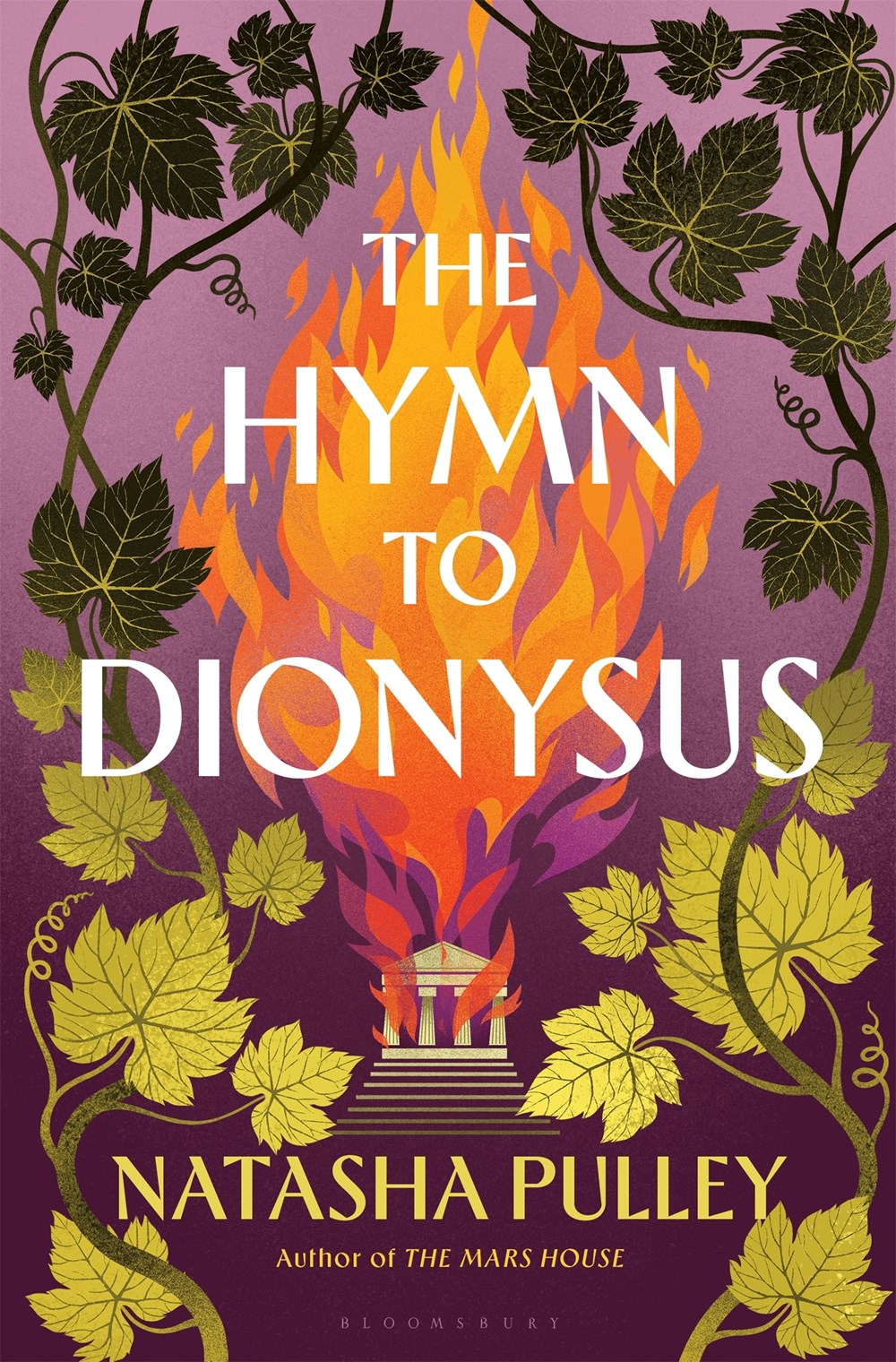
THE HYMN TO DIONYSUS
NATASHA PULLEY

Bloomsbury USA (non-affiliate Amazon link)
$9.99 ebook, available now

Rating: 4.5* of five

The Publisher Says: A timely and timeless reimagining of the story of Dionysus, Greek God of ecstasy and madness, revelry and ruin, for readers of The Song of Achilles and Elektra.

Raised in a Greek legion, Phaidros has been taught to fight for the homeland he’s never seen and to follow his commander’s orders at all costs. But when he rescues a baby from a fire at Thebes’s palace, his commander’s orders cease to make sense: Phaidros is forced to abandon the blue-eyed boy at a temple, and to keep the baby’s existence a secret.

Years later, after a strange encounter that led to the death of his battalion, Phaidros has become a training master for young soldiers. He struggles with panic attacks and flashbacks, and he is not the only one: all around him, his fellow veterans are losing their minds.

Phaidros’s risk of madness is not his only problem: his life has become entangled with Thebes’s young crown prince, who wishes to escape the marriage his mother, the Queen, has chosen for him. When the prince vanishes, Phaidros is drawn into the search for him—a search that leads him to a blue-eyed witch named Dionysus, whose guidance is as wise as the events that surround him are strange. In Dionysus’s company, Phaidros witnesses sudden outbursts of riots and unrest, and everywhere Dionysus goes, rumors follow about a new god, one sired by Zeus but lost in a fire.

In The Hymn to Dionysus, bestselling author Natasha Pulley transports us to an ancient empire on the edge of ruin to tell an utterly captivating story about a man needing a god to remind him how to be a human.

I RECEIVED A DRC FROM THE PUBLISHER VIA NETGALLEY. THANK YOU.

My Review
: Phaidros saves an infant god, fights in an unjust war, gets PTSD from it, and...in later years...gives his skills thus acquired to saving his home city of Thebes (the one in Greece, not the one the Egyptians now call Luxor) and calls in his massive debt from Dionysus the god to...address things.

Now go buy one. Seriously...you've heard the good bits. It's Natasha Pulley's latest book (notably and annoyingly not the apparently-written sequel to The Half-Life of Valery K.)! What more do you need to know?

Plot? Already told you. Action? Read the blurb!

Fine. Spoiled brats. This is not a myth retelling. It's the story of two men a generation apart who truly fall in love, after the whole "he's so dreamy phase ends, and embark on that scariest of things to do, a mature relationship. One's a badly fucked up veteran, the other's...um...maybe divine, certainly an old soul. It bears a solid resemblance to Phaedrus, in that it is a solid and thorough examination of love in its guises, morality, and the intersection of emotion and morality that is Greek spirituality's idea of reincarnation. (Their word for it freaks people in the US right out, so I'm skipping it.) Phaidros is not partcularly like the historical Phaedrus, an Athenian aristocrat who did naughty things against the Mysteries...y'all don't much care, I get it, so the important part of using his name for our Theban hero is his name: It means "Shining" or "Brightening" as in to shine light on or brighten a room.

Greek names are so cool. They MEAN stuff. Like Plato..."flatface" or, as the Mexicans I knew in childhood used the same idea, "Chato." No big arching nose on you, sir, so you must be lower class! Yet that put-down is the most famous name in Greek philosophy. And Phaidros! Well, no one loves the one who rips the wizard's curtain down, do they? Dionysus the...god? demigod?...beautiful wild creature does, because he is also a force of opposing chaos. Nature is all shadows and shades and spectra. Dionysus is the perfect foil to light-shining Phaidros.

As a reimagining of Bacchae by Euripides, it's a loose one. It's also, tonally, a bit off. Why do these men speak to each other as modern middle-class Brits? The spark that illuminated Glorious Exploits as it used Dublin-Irish English for ancient Syracusan Greek came from its sly, side-eye commentary on the role of Ireland-v-England as replicated in the colonial war waged by Athens on Syracuse. The characters in this book do not have any comment to make on Thebes by their use of British vernacular, at least not one I can suss out. (That was deliberate.) So off came that half-star.

Still and all, as a fantastical meditation on Love, love, and their intersection points with morality, responsibility, and the eternal human desire to connect to others, I liked the story a lot. Pulley's trademark men-who-love subplot is again, and expectedly, rendered with all the grace a writer can bring, and deepened by the careful and unobtrusive use of the reincarnation-like connective tissue.

I hope, though, that this will remain her foray into Classical mundane-meets-magical worlds. It's better left in The Watchmaker of Filigree Street stories. This iteration is just that indefinable bit...off.

Wednesday, March 20, 2024

THE MARS HOUSE, latest Natasha Pulley exploration of the costs of Othering


THE MARS HOUSE
NATASHA PULLEY

Bloomsbury USA
$32.99 hardcover, available now

Rating: 4.8* of five

The Publisher Says: From the author of The Watchmaker of Filigree Street, a queer sci-fi novel about an Earth refugee and a Mars politician who fake marry to save their reputations—and their planet.

In the wake of environmental catastrophe, January, once a principal in London’s Royal Ballet, has become a refugee on Tharsis, the terraformed colony on Mars. In Tharsis, January’s life is dictated by his status as an Earthstronger—a person whose body is not adjusted to Mars’s lower gravity and so poses a danger to those born on, or naturalized to, Mars. January’s job choices, housing, and even transportation options are dictated by this second-class status, and now a xenophobic politician named Aubrey Gale is running on a platform that would make it all worse: Gale wants all Earthstrongers to be surgically naturalized, a process that can be anything from disabling to deadly.

When Gale chooses January for an on-the-spot press junket interview that goes horribly awry, January’s life is thrown into chaos, but Gale’s political fortunes are damaged, too. Gale proposes a solution to both their problems: a five-year made-for-the-press marriage that would secure January’s financial future without naturalization and ensure Gale’s political future. But when January accepts the offer, he discovers that Gale is not at all like they appear in the press. And worse, soon, January finds himself entangled in political and personal events well beyond his imagining. Gale has an enemy, someone willing to destroy all of Tharsis to make them pay—and January may be the only person standing in the way.

I RECEIVED A DRC FROM THE PUBLISHER VIA NETGALLEY. THANK YOU.

My Review
: Comme d'habitude, Author Pulley has taken multiple strands of today's hellscape and woven them into a clever, involving story. January is a ballet dancer...lean, lithe, and muscular even by Earth standards...and a refugee from the sinking of his home, London, due to climate change. No worries, it isn't a big deal in the story, just the way he gets to colonial Mars.

Where he, because he grew up on a high-gravity planet, is an "Earthstronger" and a terrible threat to the naturalized Martians. This condemns him to a life of menial labor where his freakish strength is an actual advantage not a threat.

Does this anti-immigrant rhetoric sound familiar? Start from actual differences, create threats, and stigmatize the Other with the largely imaginary threats and violent rhetoric?

The story is about all that and more. January is the only one who is referred to by the masculine pronoun. All the Martians are "they." No more information is given than that...and Gale, the senator whose careless seeking for a soundbite in their campaign to forcibly "naturalize" the Earthstrongers...a procedure with a horrific death rate, and ugly medical side-effects for those it does not kill...as the external suits that cause the Earthstrongers not to be able to exert themselves to capacity are defeatable. Gale's effort to get a political advantage blows up badly and causes them, as well as January, terrible problems.

Their solution is to offer January a five-year fake marriage contract that will give them good political optics, and him a way out of the endless drudgery and second-class citizenship of being in a suit or, far worse, beinf forcibly "naturalized." So, as always in Author Pulley's work, there is a slow...slooow...burn into True Love. That the relationship is so suitable is weird. January had to travel to another planet to find True Love...and the balance of power, also as always in Author Pulley's work, is even but in a completely unexpected way.

What makes me happy when I know there is a new book coming from Author Pulley is that I know what I will get...musings on interpersonal dynamics, commentary on injustices that clearly cause her outrage and pain, the somewhat unrealistic Love Conquers All resolutions...but have not clue the first how she will take me where I already know we're going.

*happy sigh*

So, I hear you wonder, since you got exactly what you wanted, and enjoyed the trip to get it, where's that fifth star? The one thing I was a lot less than thrilled with was the bizarre and offputting de-extinction of wooly mammoths as part of the Martian terraforming because it felt uncharacteristically gee-whiz neato-keeno it's my book and I'll do it because I can legerdemain. It did not make any sense to me, though clearly there is a narrative srand to explain it. I just did not buy it. I was also not entirely convinced by the time it was set in...the kinds of changes on Earth seemed to be unusually late, for what I expect to happen based on current trends and on Mars way too soon. So, not quite able to ignore and go on with my suspension of disbelief.

These were not terrible sins...this is a novel, not a counterfactual scientific paper...and they are in service of telling a cracking good story. Very much a good place to start reading Natasha Pulley's work if you haven't already; and a great treat for your season of reading if you have.

Tuesday, February 20, 2024

THE MARS HOUSE, latest from the ever-delightful Natasha Pulley


THE MARS HOUSE
NATASHA PULLEY

Bloomsbury USA
$15.99 ebook, available now

Rating: 4.8* of five

The Publisher Says: From the author of The Watchmaker of Filigree Street, a queer sci-fi novel about an Earth refugee and a Mars politician who fake marry to save their reputations—and their planet.

In the wake of environmental catastrophe, January, once a principal in London’s Royal Ballet, has become a refugee on Tharsis, the terraformed colony on Mars. In Tharsis, January’s life is dictated by his status as an Earthstronger—a person whose body is not adjusted to Mars’s lower gravity and so poses a danger to those born on, or naturalized to, Mars. January’s job choices, housing, and even transportation options are dictated by this second-class status, and now a xenophobic politician named Aubrey Gale is running on a platform that would make it all worse: Gale wants all Earthstrongers to be surgically naturalized, a process that can be anything from disabling to deadly.

When Gale chooses January for an on-the-spot press junket interview that goes horribly awry, January’s life is thrown into chaos, but Gale’s political fortunes are damaged, too. Gale proposes a solution to both their problems: a five-year made-for-the-press marriage that would secure January’s financial future without naturalization and ensure Gale’s political future. But when January accepts the offer, he discovers that Gale is not at all like they appear in the press. And worse, soon, January finds himself entangled in political and personal events well beyond his imagining. Gale has an enemy, someone willing to destroy all of Tharsis to make them pay—and January may be the only person standing in the way.

I RECEIVED A DRC FROM THE PUBLISHER VIA NETGALLEY. THANK YOU.

My Review
: This has a very "ripped-from-the-headlines" feel, like a big issues-driven Movie of the Week in the 1980s. The playfulness that the author, comme d'habitude, uses to frame her presentation of the Issues made me smile. I am particularly fond of the way she plays with the MM romance trope of a fake marriage that leads to a real relationship, in the context of a serious contemplation of the refugee crisis and the ever-increasing backlash againt gender minorities.

No one ever accused Author Pulley of lacking ambition.

Even inclusivity excludes, when it is a mandate...I am not a they, I am a he, and will resist being "they"d because of the same reasons I ask people what their not-always-obvious pronoun preference is. Like any overarching solution, it will not work for everyone...like absurd wealth disparities don't, like hypercompetition won't. And, as I expect from the author of The Kingdoms and The Secret Life of Valery K., that is the point. She invites us in to have a good, solid storytelling, then the real purpose sort of creeps up behind your chair and slaps some ropes around your wrists so you *need* to know what happens while also getting yor mind wedged open a bit.

Like the surgical "naturalization" of the Earthstrong immigrants that will artificially weaken them to make the like "real" Martians instead of merely imprisoning them in tightly binding suits...oh my goodness, the unpleasant parallels to our culture war over transness and the nature of being a "real" something. "We must PROTECT our weakest from these interlopers!" The eternal cry of the high-control fascist-leaning cultural bully. The Earthstrong immigrants have a terrible social ostracism as threats to the adapted Martians, confined to menial labor that renders their actual physical power differential a big advantage.

January, our main character, is the only character referred to by a masculine pronoun. As a former dancer, he is strong and lithe even by Earth standards. This makes him a scary monster of a beast to the adapted Martians, much less gravity having attenuated their strength and stamina. This is quite a come-down for him since he was once a principal dancer at the Royal Ballet. It does make his masculine pronoun feel simultaneously othering and fetshizing...like all perceived-stronger minorities his gender is hyperemphasized. This makes his union with Martian nativist Senator Gale, whose impromptu soundbite caused January tremendous social trouble, all the more trenchant in its commentary on the social construction of gender and the fetishization of, especially the visible, Others in a society.

Like we do with highly intentionally muscular men, heavy-breasted women whose endowments are clearly artificially augmented, and those whose skin and/or eye colors are not like the resident majority's are.

This, then, is Author Pulley at her tendentious best. The invitation to think through the role of fetishization, or simply enjoyed as the slow, rocky coming-together of two people from opposite sides of an ideological divide, is there. It is up to you which one you wish to foreground as you read the book. The interpersonal stakes are not shorted, or allowed to dominate; they are, as always in this author's œuvre, balanced carefully thus enriching each strand.

What makes the read just less than five stars for me is my rather less than enjoyment experienced by the inclusion of resurrected wooly mammoths. The entire ecological commentary is, for my money, twee and forgettable, though of course well-crafted...I just do not buy the animals' PoV bits, which thankfully are confined to footnotes. This is a facet that will delight some but did not me.

A worldbuilding tour de force, a meet-cute/fake marriage queer love story, a takedown of high-control ideology, and most of all a chance to fall in love alongside two wounded souls who had to travel from literal different planets to find their happiness.

Thursday, August 25, 2022

NATASHA PULLEY'S PAGE: THE WATCHMAKER OF FILIGREE STREET; THE KINGDOMS; THE HALF LIFE OF VALERY K


THE HALF LIFE OF VALERY K
NATASHA PULLEY

Bloomsbury USA
$28.00 hardcover, available now

Rating: 4.75* of five

The Publisher Says: In 1963, in a Siberian gulag, former nuclear specialist Valery Kolkhanov has mastered what it takes to survive: the right connections to the guards for access to food and cigarettes, the right pair of warm boots to avoid frostbite, and the right attitude toward the small pleasures of life so he won’t go insane. But on one ordinary day, all that changes: Valery’s university mentor steps in and sweeps Valery from the frozen prison camp to a mysterious unnamed town that houses a set of nuclear reactors and is surrounded by a forest so damaged it looks like the trees have rusted from within.

In City 40, Valery is Dr. Kolkhanov once more, and he’s expected to serve out his prison term studying the effect of radiation on local animals. But as Valery begins his work, he is struck by the questions his research raises: why is there so much radiation in this area? What, exactly, is being hidden from the thousands who live in the town? And if he keeps looking for answers, will he live to serve out his sentence?

Based on real events in a surreal Soviet city, and told with bestselling author Natasha Pulley’s inimitable style, The Half Life of Valery K is a sweeping new adventure for readers of Stuart Turton and Sarah Gailey.

I RECEIVED A DRC FROM THE PUBLISHER VIA NETGALLEY. THANK YOU.

My Review
: There is nothing one Earth more appalling to me than the attitude "My ignorance is better than your education, training, and expertise." It's not just wrong-headed. It is dangerous. It leads to very, very deleterious results for the people who have no say in...often no awareness of...the risks they are being subjected to by the wilfully ignorant. The Yucca Flats, Nevada, nuclear-bomb testing disaster that People magazine broke the story of in 1980...the 1956 filming of The Conqueror ring any bells, fellow oldsters?...wasn't the only such official-denial event in the world. In the USSR, there was the Ozyorsk disaster, outed to the world in the New Scientist magazine in 1976 by a brave scientist called Medvedev. (I have to say that Siberia has a very unlucky past. This disaster occurred in 1957; the Tunguska event in 1908 was a holocaust; and sixty miles away from Ozyorsk is Chelyabinsk, of 2013 meteorite explosion fame!)

The story of the many "closed cities" in the USSR, and in today's Russia, is similarly grim, similarly marked by denial and obfuscation and outright lying. The Chernobyl disaster in 1986 was going to be treated that way, only it was far too big to tamp down and deny. So, Author Pulley has me by the nose-hairs again. Again! I am putty in this wicked writer's hands. She tells stories that make my ears perk up, the hair on the back of my neck do its wolfman imitation, and my breathing to become labored in eagerness.

Valery K. the nuclear scientist, exiled to a colder and less hospitable part of Siberia than City 40/Ozyorsk is in, is suddenly ripped from his wretched routine without explanation or preparation. He's in the gulag...this is terrifying. But his worst fears...interrogation? execution?...aren't realized. He's sent to this comparative demi-Paradise of a place to study field mice. To assess them for effects of radiation exposure.

So, all is explained. He's a criminal, but also a thorough scientist trained in matters nuclear. Trained, talented, expendable.

What follows is a litany of nuclear-waste exposure nightmares. The effects on people, on the environment, are grisly. In the one plot strand I am absolutely sure is fiction (it says here) the authorities conduct radiation-exposure experiments on the people of City 40. The other plot strands, the environmental disaster, the carelessness and mismanagement that led to and characterized the ongoing handling of the disaster, are real. (Follow the links!) And gosh golly gee, wowee zowie, those sorts of things don't *ever* happen now. Especially the official lying and misleading! That could never happen in any authoritarian state in the twenty-first century, we have satellites and technology to sniff out problems, and scientists who would *never* lie to us here in the West.

So, the timing of the title's publication is now explained.

As one expects from Author Pulley, there are two men falling in love with each other amid the chaos and carnage that they are powerless to stop. Also as one would expect, there are events that occur that cause them trouble personally and interpersonally. I've said it before, the curse of adulthood is one never, ever has an unmixed emotion. Valery tries, in his what-got-him-gulaged way, to force officialdom to face up to the scale of the disaster. He wants to help people, to save them. Shenkov, his belovèd, is a married father, is in the game because it's the way to get ahead. And stay out of the gulag. The story, in other words, of generations of gay and bisexual men. Hide! They won't kill you if they don't have to notice your deviance.

But like calls to like. Valery knows that Shenkov loves him; he knows he loves Shenkov; things won't go well for City 40, but can things go well for them as men, as people, as...a couple? Fortune, as always, favors the brave. There must always be blood sacrificed before one gets one's rewards.

Morally grey characters, men past pretty on life's curve, the necessity of moving the world's blockages to make room for your authentic life: boxes all checked. The life you want, well...what do you know about how much it will cost, about what it will extract from you. You'll find out, if you're lucky. Or maybe unlucky. Most likely both. Consider, after reading the book, the title and its layers of meaning.

The right kind of read for me, right now, and it went down like the oldest, smoothest, most deceptively sweet tequila there is.

++++++++++++++++++++++++++++++++++++++++++++++++++++++++++++++++


THE KINGDOMS
NATASHA PULLEY

Bloomsbury USA
$28.00 hardcover, available now

Rating: 5* of five

The Publisher Says: A time twisting alternative history that asks whether it's worth changing the past to save the future, even if it costs you everyone you've ever loved.

Joe Tournier has a bad case of amnesia. His first memory is of stepping off a train in the nineteenth-century French colony of England. The only clue Joe has about his identity is a century-old postcard of a Scottish lighthouse that arrives in London the same month he does. Written in illegal English—instead of French—the postcard is signed only with the letter “M,” but Joe is certain whoever wrote it knows him far better than he currently knows himself, and he's determined to find the writer.

The search for M, though, will drive Joe from French-ruled London to rebel-owned Scotland and finally onto the battle ships of a lost empire's Royal Navy. In the process, Joe will remake history, and himself.

I RECEIVED A DRC FROM THE PUBLISHER VIA NETGALLEY. THANK YOU.

My Review
: An exciting visit to the Aetherverse, to which we were introduced in The Watchmaker of Filigree Street (below)...or so it seemed to me.

It cost me so much to read this book, with its star-crossed lovers, its perception of time as layered and mutable, and its grotesque unfairness, the first time. It wasn't easy a second one, either, even though I knew what was coming.

Yes. I, testy oldster with less than two decades left to him, read a book twice.

There is that much to unpack. There is that much to process. There is that kind of thought put into the structure of the story. All that makes an investment of eyeblinks that big both desirable and at some level necessary.

The nature of Time (as the Tenth Doctor called it, "wibbly-wobbly timey-wimey...stuff") and the nature of family feature heavily in this tale. Two men whose fates...whose lives entangle across timelines of startling "points of divergence" or "PoDs" but never forget each other. Imagine loving someone enough, with so much of yourself, that you remember them when you don't remember yourself.

That is the definition of the stakes in this alternate history/time travel novel. There's a weird place, in Scotland for once, where time doesn't behave as we think it should. This remains a weird, slightly underexplained, phenomenon throughout the iterations of the story. In every timeline, Man A meets Man B, falls in love with him, then for Reasons leaves him. Man B doesn't change much, if at all. His name is Kite. His past isn't fixed, though it's the little things that change. For Man A, the one who does the leaving, the past, the present, and the nature of each is...mutable. The world is, oddly, full of people like him who come to themselves in a place where they have no memories and no trauma to explain that lack.

We, readers, know what it is. We know because there is a man, red hair, terrible burn scars, and Man A...call him Joe, call him Jem, what you will...recalls him with love. He doesn't really know why. He isn't happy anywhere. He can't find connection to anyone around him. He floats, unanchored, when away from Kite. Who is a Napoleonic-Wars naval officer with a bad past. He's building a better future, he hopes, by letting Jem/Joe go through the Scottish time gate. But it's at his own expense. He's too used to that, to doing hard and painful things, as a result of his bad past.

What came through to me most strongly was the nature of Love. There is a scene early in the book where Joe, as he was at that time, was raped. By his wife. Who should've been his sister-in-law. And she gives birth to his daughter Lily, whom he adores. He struggles against his love for Kite for several years to stay with her. In the end, he can't fight it and they reunite...and Lily is never born. Yet always alive to Joe, Jem, Man A. A truly Torquemadan torment, losing your child.

What the hell! A man getting raped by a woman?! What's the old lunatic talking about? My own life: It's happened to me, perpetrated by my mother. And that is how I know that Author Pulley got the sensation, the misery of that kind of coercion, exactly and precisely correct. It was shattering to read. It was the very first time in my over-sixty years on this planet that I have read anywhere my private and unshareable truth. It healed and soothed me in a way I didn't anticipate ever experiencing.

If that is not enough to convince you to read the book, then how's this? These men are very dishonest with themselves. They can't afford not to be. But neither man has ever, for a single moment, lost his love for the other.

Come for the wibbly-wobbly timey-wimey...stuff. Stay for the family that only love can form. Revel in the struggles of true lovers to live their truth.

++++++++++++++++++++++++++++++++++++++++++++++++++++++++++++++++


THE WATCHMAKER OF FILIGREE STREET
NATASHA PULLEY
(The Watchmaker of Filigree Street #1)
Bloomsbury USA
$26.00 hardcover, available now

Rating: 4* of five

The Publisher Says: 1883. Thaniel Steepleton returns home to his tiny London apartment to find a gold pocket watch on his pillow. Six months later, the mysterious timepiece saves his life, drawing him away from a blast that destroys Scotland Yard. At last, he goes in search of its maker, Keita Mori, a kind, lonely immigrant from Japan. Although Mori seems harmless, a chain of unexplainable events soon suggests he must be hiding something. When Grace Carrow, an Oxford physicist, unwittingly interferes, Thaniel is torn between opposing loyalties.

The Watchmaker of Filigree Street is a sweeping, atmospheric narrative that takes the reader on an unexpected journey through Victorian London, Japan as its civil war crumbles long-standing traditions, and beyond. Blending historical events with dazzling flights of fancy, it opens doors to a strange and magical past.

I CHECKED THIS ONE OUT FROM THE LIBRARY. USE THIS FREE SERVICE OFTEN. THEY'RE ALREADY PAID FOR.

My Review
: I was hoping this would be a five-star read. I hope that every time I open a book, albeit often with a forlorn sense of the hopelessness of such a thing. But this one, with Queer desire and relationship on offer? Yes please! Gimme!

Mori and Thaniel, the men in question, are indeed heading down Relationship Road. In no kind or sort of hurry, mind you. They live in *London, *Victorian times, with...magic? sort-of kind-of magic...that involves seeing the multiverse and manipulating your present to bring about a future you like the best from the possibilities. I love this idea, and the use of this trope alone would've gotten the book four stars!

The way it's handled is also really compelling to me, with Mori making his odd little machines to nudge reality into new shapes. I was also fascinated by Thaniel's kinesthesia...D# is yellow, for example...but too little was made of this for my taste, more of a small grace note. In particular I was sad that Thaniel didn't twig to something he heard being the proof he needed of what was happening around him...but he was simply too stressed out, I think was the reasoning behind that failure.

Quite a lot that I missed first time round.

I was sure I recalled this read pretty accurately, and was mildly taken aback by the amount of information I glided past before...for example, the way Thaniel says things to his, um, er, to Grace that, um, kind-of unhappen as the ending approaches...and now, on a years-later re-read seem *hugely*significant* and almost spoilery.

But that's because I really already knew them, and how they'd play out.

So what would I call this read, a re-read or a new read? It's kind of both. I've read The Kingdoms (see above) between that initial experience and this one, I'm hip to the author's tricks in a way I wasn't before; I was revisiting the story because I'm reviewing The Half Life of Valery K (see above) now, as well. It's clear as crystal that any author develops stylistic tropes, won't call them tics unless they irk me somehow, and Author Pulley's a one for hiding relationship signals in plain sight. It's a bit disappointing that Grace, after her *horrible* behavior, isn't made to suffer any consequences. Given that there's a second book with Thaniel and Mori at its center, which I haven't read, that could still be possible.

I've got the best of both worlds, then, revisiting an older read that's altered in interesting ways in light of later reads by the same author. It made this meditation on the etheric reality of chance and destiny intertwining so much richer than it was at first.