Showing posts with label Sam Taylor. Show all posts

Wednesday, July 15, 2026

HAPPY LIFE, not a buck-up-bucko book despite the title


HAPPY LIFE
DAVID FOENKINOS
(tr. Sam Taylor)
Pushkin Press (non-affiliate Bookshop.org link)
$13.99 ebook, available now

Rating: 4* of five

The Publisher Says: A tender and wistfully satirical novel about the desire to change your life by bestselling French author David Foenkinos

"Foenkinos's surreal yet relatable novel…considers life in our age of anxiety, when other people's picture-perfect lives make our own seem drab in comparison." —Washington Post

Everyone, at some point in their lives, wants to be someone else.

Eric Kherson—40, divorced, distracted—is spiraling. He has devoted his life to a successful career as the marketing director of a leading sports brand. But when family disaster rocks him to his core, he finds himself adrift from his family and questioning all his choices.

That is, until an acquaintance from his schooldays offers him a high-powered government position. Desperate for escape, he throws himself into her enigmatic world of high-risk deals and endless networking, doing anything it takes to get a contract signed.

But on a business trip to Seoul, Eric starts feeling worse than ever. Wandering the city's streets, he comes across Happy Life, a store that offers its customers something that could change their lives: a fake funeral. Happy Life will write your eulogy, arrange the flowers, and allow you to lie inside your own coffin. Why? They believe the experience will help you reinvent yourself.

But above all for Eric, Happy Life sparks a business venture of his own that might do just that…

A celebrated French bestseller, Happy Life is a life-affirming story of hope and recovery, perfect for fans of Matt Haig and Nathan Hill.

I RECEIVED A DRC FROM THE PUBLISHER VIA EDELWEISS+. THANK YOU.

My Review
: I am on record as a David Foenkinos fanboy. I have not (yet, anyway) rated any of his books I've read under four stars. I'm pickin' up what he's puttin' down because he's willing to take a classically realist setting and stitch some strangeness onto it. It's never a huge dissonance, it doesn't feel as though some clumsy editor from a different decade bookhorned a bad idea into the story...it's happened to other authors. I'm always *sure* this story of his I'm reading right then will be Foenkinos' breakout hit, and all y'all will see how Right I am about his humor, delicate honesty, and how very deftly Sam Taylor captures it in English!

To date, not so much. I persevere. I'm shocked that y'all read Solvej Balle's riff on Groundhog Day in your tens of thousands and shun a more fun version of the "things fall apart, emotions have entropy, no one gets outta here alive" story. There are over a thousand reviews of this book on Goodreads, average high three stars. Given the quotidian subject matter...there must be more than this...that strikes me as decent.

Happy Life, the business, is a very interesting conceit. Pretend you're dead. Read your obituary. Lie in your future coffin. Now, when you get up, think "is this good enough?" I'll bet most people look at life without depth until confronted with Death, the Reaper, the dirt nap, whatever euphemism tickles your fancy, whose cold grasp is very strongly focusing to everyone who feels it. Eric, our PoV character, is middle-aged, mid-career, peaking in power. He's miserable in the depressed person's way, shrouded in grey fog and honestly unable to see why that's even a problem anymore.

That's the true danger point, when a new challenge (his new job as a trade representative for France in this case) only points up the essential sameness of Life and futility of hope. On a mission to Seoul, Eric discovers Happy Life and its weird conceit of fake-deathing yourself to shed the fog, pull off the shroud of sameness, rise from the coffin renewed and revitalized. It works. And if it worked for Eric, unhappy and unable to think *why* he should be when he's got money, power, and purpose, then it probably will for other wealthy French people.

Can money buy happiness after all?

A mean little stereotype says literary fiction needs to be depressing. A cultural insult says French fiction's full ashtrays and empty lives must end stories in ennui. Both might've been true in the 1970s or 1980s but even then it was books written for the haute bourgeoisie, the people who had too much of everything so did not need anything; that's a soul-killer, that is, any era or country. Look at the billionaires today, they're purposeless and useless so they frivol away their substance on useless stuff while real problems need solving.

Eric brings Happy Life to France in order to jolt people into the same sense of purpose, of wanting something more important and rewarding than "more." Spoiler: Eric is a helluva salesman, as his entire career has shown.

Author Foenkinos is not writing for Literati. He's writing to tell people who like stories a story about a man who faces endings by casting about until he finds a new beginning. I like that story; it's not one we see in upper-echelon-aimed books but it's honestly all the better for it. It doesn't do that American thing of chirping five easy steps at you, just do *this* and you're all set MLM happy-clappy horseshit. It's a story that starts from "sad man doesn't want to be sad" and moves on from there through the steps of doing whatever comes his way to setting out with intention and purpose when one shows up worth his while.

It's not experimental literary or boundary-pushing shenanigans. It's a French guy writing a story he figures will resonate with French people of the 2020s. Is it also critiquing the PTB and their greed? Yeah, that's in there, but it's not what thee and me will see first. It's not yelling at you. It's on the next barstool over talking on the phone to someone who needs the same commonsensical splash of water you need.

I liked it, didn't fall madly in love with it, and think we need more like it from countries all over the world to show us how common this malaise really is. Better than floundering in the dark foggy corners wondering if we're alone in our befuddlement.

Monday, May 25, 2026

THE SUMMER BOY, Philippe Besson's récit of coming of age during tragedy's aftermath


THE SUMMER BOY
PHILIPPE BESSON
(tr. Sam Taylor)
Scribner (non-affiliate Bookshop.org link)
$13.99, available now

Rating: 4.5* of five

The Publisher Says: On an island off the coast of France, six teenagers come together for a summer of desire and discovery until one of them vanishes forever, leaving the rest with an enduring mystery.

Tell me, do you know why the most beautiful love stories must always end badly?

In the summer of 1985, on a scruffy resort island off the coast of France, six teenagers—five boys and one girl—band together for a final golden season before adulthood. Their days are drenched in sun and freedom, and their nights simmer with secrets, jealousy, and longing. Philippe is drawn to Nicolas, the quiet new boy who sees him in a way that no one else does. As their bond deepens, part of Nicolas remains unreachable—until a sudden tragedy brings their summer to a brutal end.

The Summer Boy is a lush and unforgettable autobiographical tale, capturing the ineffable summers of youth in amber. Celebrated novelist Philippe Besson has shaped his memories into an aching meditation on how one summer night—and one fierce connection—can echo across a lifetime.

I RECEIVED A DRC FROM THE PUBLISHER VIA NETGALLEY. THANK YOU.

My Review
: Author Besson, a mere stripling of fifty-nine, recalls That One Summer. We've all had it: the moment when all the boundaries and all the relationships change, whether at eighteen or forty-two or in winter, in Louisville, Kentucky, on vacation, or waiting for your bus to come. Falling in love often does the trick. Getting a crush can, too, but so can the ordinary murkiness of passing time in good company. It's a defining moment. It can, usually does in my own lived experience, change you and your thinking about the whole rest of your life.

Where Lie With Me was a récit about Philippe's very first true love, this is a récit about how love is not plot armor and no matter how it ends, love is always going to wind bonds and webs and fetters around among between the people in your life. Philippe, as in Lie With Me, is both author and character in equal measure. Here he is eighteen and having that magical last summer of childhood freedom before adulthood tightens around him. François is a close friend whom Philippe is a rival of without being in any way deliberate about it; Alice, a new friend of both boys, is enamored of Phillipe and by François, in that eternal tangle that (depressingly enough) persists in happening over and over during one's lifetime. Nicolas, a friend of François', is fascinating to Philippe, but he's sexually interested by Alice's brother Marc. And that soap opera is where we stay all story long as events unfold.

That sounds more kinetic than this story is. Events are, in this context, mostly off-screen/page; we're here for the feels or else we're in the wrong book. As it's Philippe's récit the feelings are all his but he's astute so he reports on others' lives and feelings with acuity and compassion. Of course Author Philippe is discussing the past so it's the adult who evokes those feelings for his long-ago companions, but I felt as though character-Philippe was empathetic enough to have experienced his friends' feelings with interest and compassion.

Regret for things ill-done or, worse, un-done is one of the most maturing experiences in a person's life. It's truly a before-and-after moment to realize you have seen signs of a looming disaster but done nothing to affect its outcome. Philippe did not understand that he *could* impact Nicolas' fate. He, as Author Philippe, is coming to terms with the emotional scars and the unbearably sad realization that we possess the power to alter history...if we choose to.

It sobers a person up to know for certain that another person has their life altered because of our own in/action. No wonder Author Philippe is working this seam in the story-mine of gay coming-of-age stories. He does it beautifully and with palpable emotional honesty. In under two hundred pages he brings we-the-reader into full contact with the summer everything changed for him. It was a wrenching thing that changed his life. It's not sensationalized but it's not like there was room to do that in this page count...yet I got the impression there was little self-protecting editing of his personal memories. He was honest, our author, and gave us true biz about his life.

It made for a very good story to start my #PrideMonth reviewing with.

Thursday, October 30, 2025

DAVID FOENKINOS'S PAGE: THE MARTINS, his latest; & SECOND BEST, a very interior story of "missing out"


THE MARTINS
DAVID FOENKINOS
(tr. Sam Taylor)
Pushkin Press (non-affiliate Bookshop.org link)
$13.99 ebook, available now

Rating: 4.5* of five

The Publisher Says: ‘Go out into the street and the first person you see will be the subject of your next book.’

This is the challenge a struggling Parisian writer sets himself, imagining his next heroine might be the mysterious young woman who often stands smoking near his apartment...instead it’s octogenarian Madeleine. She’s happy to become the subject of his book—but first she needs to put away her shopping.

Is it really true, the writer wonders, that every life is the stuff of novels, or is his story doomed to be hopelessly banal? As he gets to know Madeleine and her family, he’ll be privy to their secrets: lost loves, marital problems and workplace worries. And he’ll soon realise he is not the impartial bystander he intended to be, but a catalyst for major changes in the lives of his characters.

Told with Foenkinos’s characteristic irony and self-deprecating humour, yet filled with warmth, The Martins is a compelling tale of the family next door which raises questions about what it means to be ‘ordinary’, and about the blurred lines between truth and fiction.

I RECEIVED A DRC FROM THE PUBLISHER VIA EDELWEISS+. THANK YOU.

My Review
: I don't think most Anglophone readers are aware that "Martin" is the most common surname in France. In the US, the equivalent title would be "The Johnsons," our commonest surname. The joke being established, let's look at these bog-standard, government-issue, salt of the earth just folks. (I could probably pack a few more epithets onto that sentence, but I'll resist.)

Does everyone have a novel in them? As a former literary agent who read endless forests of murdered trees invested in the attempted proof of this nostrum, I'd say, "sorta...kinda...it depends...".

In attempting to prove this is a truth not merely a truism, an author sets himself the challenge in the first paragraph of the synopsis. He tricks himself into believing today will be the day he gets to talk to the alluring woman who smokes in front of the travel agency on her breaks.

"Ha ha ha," says Melpomene, reaching past her laurel wreath for the Mask of Tragedy. Following his self-imposed rule, he must interview an old woman pushing her shopping home. As any seasoned reader knows, here comes the punchline: Mme Madeline Tricot ("Mrs. Cotton") was once in the fashion industry in a small position thus has stories about Lagerfeld et alii being horrible to each other and everyone else.

Score! Or...is it? See, Mme Tricot is sliding into dementia. Her daughter, whom he meets immediately upon going home with Mme Tricot,is naturally very protective of her mother. Thus we're launched into an exploration of modernity, celebrity "culture," and the absurdities of aging...why extend the lives of the old relentlessly and pointlessly if all you're going to do with them is ignore and/or belittle them?...through the lens of The Martins, France's any/every/body family.

Why I enjoyed the read was that Author Foenkinos commits to the bit. He keeps our narrator saying he's reporting alone while, in fact, he's embroiled with the Martins. As a nod to his disingenuous self deletion while in fact performing self insertion, Foenkinos peppers the text with authorial footnotes explaining, justifying, in short intellectualizing, our narrator's many choices. Foenkinos treats us to the narrator's rocky relationships with the people he's trying to make into The Martins, his characters; we read the narrator's account of being termed a con man and an emotional vampire, accusations he, reluctantly, acknowledges carry some truth in their hurtful rejection.

Changing from novel, to non-fiction, to memoir, to metafiction in turns, The Martins is a charming and entertaining exploration of the overlooked, the unconsidered, the devalued, as full and satisfying subjects for our attention. It thus shines a searchlight on the tendency of modern storytelling to ignore simpleness in favor of simplicity. Making their own lives easier by inventing Big!Important!Amazing! people whose lives and doings have only the depth of a narrative purpose, Foenkinos implicitly accuses himself and other authors of avoiding the incredible richness with its immense labor of La Comédie humaine, to cite an ancient example. We're ever less likely to get to know, really know, the people around us, even our own family members as this novel quite clearly demonstrates.

It lends this entertaining read a special poignance, and makes the only slightly veiled warning to our distracted selves sting a good bit more. Multilayered meditation on storytelling, stories, the tragedy and comedy of ordinariness, and the need to attend the moment you're in: A very twenty-first century kind of a read. One I recommend to almost everyone except those in the throes of divorce or breakup, or the recently bereaved.

+++++++++++++++++++++++++++++++++++++++++++++++++++++++++++++++


SECOND BEST
DAVID FOENKINOS (tr. Megan Jones)

Pushkin Press (non-affiliate Bookshop.org link)
$13.99 ebook, available now

Rating: 4* of five

The Publisher Says: A witty, moving international bestseller about a 10-year boy whose life is shaped forever when he loses out on the role of Harry Potter.

It's 1999. Martin Hill is 10 years old, crazy about football and has a minor crush on a girl named Betty. Then he makes it to the final 2 in the casting for Harry Potter and the Sorcerer’s Stone.

In the end, the other boy is picked for the role of a lifetime. A devastated Martin tries to move on with his life. But how can he escape his failure, especially when it's the most famous film series in the world? As Martin grows up, he finds every aspect of his life is invaded with a sense of failure and missed opportunity, and he struggles under the weight of the life he isn’t living.

This bittersweet comedy is full of surprising truths and touching moments, as its unforgettable character discovers that sometimes, the lives we wish we’d led might not be all they’re cracked up to be.

An international publishing sensation, Second Best has been adapted for stage and won the hearts of hundreds of thousands of readers.

I RECEIVED A DRC FROM THE PUBLISHER VIA EDELWEISS+. THANK YOU.

My Review
: Published in 2022 in its original French and brought out this week by Pushkin Press after their acqusition of Gallic Books, this is a wonderful meditation on the idea of "almost" as it defines us. Our Western culture valorizes "winning," defined as gaining an objective, fulfilling a need to see ourselves in those who exceed or transcend averageness, mediocrity; this is invidious. By definition, there are more who do not "succeed" or "excel" than those who do; the bar moves ever farther from the mass in the middle, and we are subtextually told we're not as good as, as deserving as, as successful as the few that excel.

Capitalism 101 there...create scarcity from abundance, then keep the abundance away from the maximum number of people.

Being on the outside of the circle, then being uprooted from the normalcy of his life before tragedy of s familial sort scars him further, Martin is a kid who's asked to bear social burdens way above his paygrade. Similar circumstances have crushed adults (famously Pete Best, though the comparison is unfair and inexact) into tailspins more intense than Martin's. Adolescence is hard enough...putting this on top...well, it's no wonder Martin begins to fanatically and fearfully avoid the cultural juggernaut that was Pottermania.

Not terribly successful, that. With the expected consequences.

Watching a talented, not exceptional, adolescent fall into psychosis was uncomfortable to read. Martin imagines...carefully note verb choice...people are laughing at him, judging him, thinking of him as second best, because this epic piece of bad luck befell him. This is, to an adult, clearly imaginary; also clearly missing that most painful of adolescent lacks: Perspective. Watching Martin stumble and bumble his way through what could have been a very good career indeed turned into a prison of self-doubt and fantasy...well...it's rough for me as a reader to soldier on, resonating as I do to his terrible, ongoing struggle. Reading the rumination, by definition repetitive, of someone caught in their mind's cruelest trap...what might have been...is, no matter how brief (only 200-ish pages), quite an ask for entertainment.

Author Foenkinos was inspired to write this story by an interview with the film in question's casting director who recounted the process of anointing Daniel Radcliffe as Potter in contrast to another boy who didn't have some quality Radcliffe did. I do not know if that other child was ever named in any other venue. I certainly hope not. Bad enough to lose out; worse to be known as the loser. The story moves at a slow pace because rumination is not susceptible to the plot drivers that keep us flipping pages. It is an interior novel, this, one that says "here we are in this head and here we stay" which isn't quite the same thing as a récit, but really closely related. In both there is a relentless inward gaze. It gets wearing.

That this would make a very interesting French film is undeniable; it's purported to have been adapted to the stage, though I can't find any official source that mentions this. I can barely imagine how Foenkinos is getting away with mentioning Potter at all without The Lawyers℠ being all over him like vultures on a gut-cart for not paying Warner Bros. a cut. (Maybe he is; I kinda doubt it.)

What I found troubling is the way this examination of fame culture was presented in its downside was pointed but never pointed out. I'm not sanguine about the readers attracted to the story getting a sense of resolution from the ending. It's why I'm only offering four stars for a five-star idea.

Wednesday, October 15, 2025

THE MYSTERY OF HENRI PICK, clever and fun, entertaining and sly


THE MYSTERY OF HENRI PICK
DAVID FOENKINOS
(tr. Sam Taylor)
Pushkin Press (non-affiliate Bookshop.org link)
$13.99 ebook, available now

Rating: 4.25* of five

The Publisher Says: The delightful first title in a new collaboration with Channel 4's Walter Presents: a fast-paced comic mystery enriched by a deep love of books

In the small town of Crozon in Brittany, a library houses manuscripts that were rejected for publication: the faded dreams of aspiring writers. Visiting while on holiday, young editor Delphine Despero is thrilled to discover a novel so powerful that she feels compelled to bring it back to Paris to publish it. The book is a sensation, prompting fevered interest in the identity of its author—apparently one Henri Pick, a now-deceased pizza chef from Crozon. Sceptics cry that the whole thing is a hoax: how could this man have written such a masterpiece? An obstinate journalist, Jean-Michel Rouche, heads to Brittany to investigate.

By turns farcical and moving, The Mystery of Henri Pick is a fast-paced comic mystery enriched by a deep love of books—and of the authors who write them.

I RECEIVED A DRC FROM THE PUBLISHER VIA EDELWEISS+. THANK YOU.

My Review
: I'm guessin' a majority of y'all don't know about Walter Presents (link above). It's presented on PBS in the US, which means it's hidden from most people most of the time. Hard to create a breakout hit in the media landscape we have; harder still to do it with subtitles.

Damn shame, that. I haven't seen the film of this story...ain't paying for Prime Video when they shove ads at me (now it's the US streamer as of 2025)...but as a very French story that isn't overtly snobby or très precieuse in its roots and branches, I'd like to see it have success commensurate with its quality.

Plus it's set in Brittany, one of the more anti-Parisian-hegemony parts of France. Imagine Oregon versus California, or upstate New York versus NYC. That kind of underdog struggle ethos suffuses this entire story.

It's really a fascinating story about books that only exist as created by their authors...much in the spirit of The Brautigan Library, follow the link for their introduction and mission statement...and housed in a special collection located as far from the cultural hegemon that is Publishing in France. That alone would've made my ears prick up. Author Foenkinos has a couple books coming out at the end of October 2025 which I've written happy reviews for; this book has, I'm sad to say, languished unread and unreviewed because Reasons. Not good ones, but Reasons.

Fixing it now has been a real pleasure. Author Foenkinos via translator Sam Taylor has built a good take-down machine, skewering our need to see behind the scenes and dig up the dirt on every single damn thing in the world...no sense of "happy to have {thing}" survives the compulsion to find out what's wrong with it. When nothing's wrong with it, something wrong with that. Being pathologically in the know is not entirely new but has hit the gas hard this decade. As our journalist character Jean-Michel Rouche exemplifies, we want the stones turned and the tea spilled, and we want it NOW.

Using all of literary culture as his sources, Author Foenkinos has probably made a lot of us more aware than ever that the world of publishing, the world of literature, and the world of us readers who lap it all up aren't the same, but are all chock-a-block with the best, the most fun, the most amusing stories, and they're all served up on demand...what a glorious time to be alive! That is the light side to the darker one enumerated above. One necessitates the other at this moment in technological societal development.

The knowing nudges and the sly side-eye moments are all well thought out. I appreciated The author's explicit acknowledgment of midcentury monadnock Brautigan, whose work has maybe not aged that well; thinking of In Watermelon Sugar in particular. Nothing ages faster than Utopia...though it would've been nicer than the world we got. (Nineteen sixty-four, the one in that book, never felt as far away as it does now.) Reminders of the very French attitude of affection and respect for literature in A Novel Bookstore by Laurence Cossé abounded for me. It's the same playfully exaggerated attitude of piss-taking that unites them.

Plot developments aren't going to surprise anyone. You're reading this story to savor the soufflé not fill up on the steak. Everyone, Delphine the editor, Frédéric the novelist manqué, Jean-Michel mentioned above...all raise their piece of the froth high for you to delight in. It's light on suspense and filled with thousands of bubbles effervescing from the sense of fun underlying the project.

You know your own humor best. read a sample; if it doesn't hit, don't commit. It hit me just right, and right when I could use it most.

Wednesday, April 9, 2025

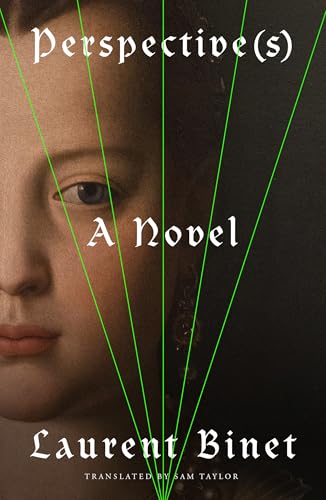
PERSPECTIVE(S): A Novel, Laurent Binet being his most sibylline self


PERSPECTIVE(S): A Novel
LAURENT BINET (tr. Sam Taylor)
FSG (non-affiliate Bookshop.org link)
$18.00 paperback, available now

Rating: 4.5* of five

LONGLISTED for the 2026 Dublin Literary Award...the shortlist of six will be announced on 7 April 2026, the winner(s) in May's festival.

The Publisher Says: A pulse-quickening murder mystery set in Renaissance Florence by the renowned author of HHhH.

As dawn breaks over the city of Florence on New Year’s Day 1557, Jacopo da Pontormo is discovered lying on the floor of a church, stabbed through the heart. Above him are the frescoes he labored over for more than a decade—masterpieces all, rivaling the works of Michelangelo in the Sistine Chapel. When guards search his quarters, they find an obscene painting of Venus and Cupid—with the face of Venus replaced by that of Maria de’ Medici, the Duke of Florence’s oldest daughter. The city erupts in chaos.

Who could have committed these crimes: murder and lèse-majesté? Giorgio Vasari, the great art historian, is picked to lead the investigation. Letters start to fly back and forth—between Maria and her aunt Catherine de’ Medici, the queen of France; between Catherine and the scheming Piero Strozzi; and between Vasari and Michelangelo—carrying news of political plots and speculations about the identity of Pontormo’s killer. The truth, when it comes to light, is as shocking as the bold new artworks that have made Florence the red-hot center of European art and intrigue.

Bursting with characters and historical color, Laurent Binet’s Perspective(s) is a whodunit like no other—a labyrinthine murder mystery that shows us Renaissance Florence as we’ve never seen it before. This is a dark, dazzling, unforgettable read.

I RECEIVED A DRC FROM THE PUBLISHER VIA NETGALLEY. THANK YOU.

My Review
: From the framing device of a trove of discovered letters forward, this book represents the kind of games I most enjoy authors playing. Binet's the son of an historian, and it shows...for good and ill. The good is the playfulness of his choices to focus narrative attention on; the ill is his necessary fictionalizing of real figures of the well-studied past at times slipping into...absurdity, silliness, OTT recherche Proustian locutionary excess?...well, too-muchness, anyhow.

It is, I'll say clearly and now, well worth the effort to accept without engaging too much critical overdrive. (My worst readerly failing.)

Sort out fact from fiction exactly as much as suits you; nothing in your pleasure will change knowing more than you're told on the pages of the story about the people (note I did not say characters) on these pages. The murdered man emerges as we all do from the memories of those around us, as a blurry-edged shadow. It is unclear to me if he was actually guilty of lèse-majesté—and I do not care to establish this. Or any other of the many interesting side-lights Author Binet shines onto Savonarola's Florence. (I'd be a really bad puritan. I've always got a question they don't like, and am absolutely guaranteed to perform every sex act they abominate...in public, to show how they can't tell *me* what to do!)

The character Vasari is, in a word, adroit. No matter what he's asked to do, or be, or fix, he's got it, understands the assignment and the subtext, has a guy who knows a guy on his side. It's always good to know a Vasari because he might be oily but he's effective. People in power love Vasari-type guys. If you're the guy he knows who's got the connections he can use, you will never get public credit—that's all his—but he won't forget you. Until he does.

No, not a bestie to rely on, but a great guy to read about, and a top-notch sleuth.

As the pages flew by I realized I was in that reading flow state that's ever elusive. I was deep into Author Binet's imagination (Michelangelo as gossipy old queen, Marie de'Medici as old queen in political hot water) and unaware of the ever-advancing hour. When I closed the cover at two-thirty, I was sad to see it all end. I'm not sure why the very slightly repetitious recaps Binet's Vasari offers the reader to explain the resolution of the killing didn't weigh more heavily on my pleasure in the read...my conclusion is that I like Vasari's very natural-feeling shifts in tone. These do, however, slow the story's roll a but more than I myownself would prefer (that missing half-star above). Vasari is, as mentioned before, an operator, so he's bound to have different conversational registers for different people. In an epistolary novel that's both easy to present and easy to explain. No one in this collection of invented letters has an overview of the situation, just one corner of the composition, so everyone's responding to events as honestly as they feel safe doing; but they're all watching their tone because this was a dangerous time (see link to Savonarola above). It's similar to the effect of my doted-on The Case of Cem.

I'm delighted with this read. I'm recommending it to most all y'all because it's fun to see an author summon the attitudes of people long-dead in this honest, ambivalent way. I don't think the readers averse to history will be that tempted, though I hope one or two will try it out.