Showing posts with label gay coming-of-age. Show all posts

Sunday, March 15, 2026

WITHIN THESE COUNTY LINES, New Adult coming-of-age novel


WITHIN THESE COUNTY LINES
BRIAN ZEPKA

Pennor Books (non-affiliate Bookshop.org link)
99¢ ebook, available now

Rating: 3.5* of five

The Publisher Says: Eighteen-year-old Stetson Delancey never thought breaking up with his boyfriend would turn him invisible.

In Penango County, Pennsylvania, high school couples carve their names into the legendary Ardor Tree, a rite of passage said to grant love that lasts. Stetson and his boyfriend were no exception. But a bitter breakup just before college splinters their future, and in a moment of anger, Stetson does the unthinkable: he hacks their names from the tree.

That’s when everything in his rural hometown goes from boring to bizarre. Shadows flicker where they shouldn’t. Strangers pass by like he’s not even there. And some people stop seeing him altogether.

With just two months left in Penango and his college dream slipping away, Stetson races to uncover the tree’s secrets before he vanishes for good. But when he meets a boy only he can see—a boy who may have secrets of his own—Stetson begins to wonder if breaking free from his hometown means letting go of everything or learning to hold on to what matters.

WITHIN THESE COUNTY LINES is a queer coming-of-age novel about the unraveling of first love, hometown magic, and how sometimes we can’t uncover the truth about others without confronting the truth about ourselves.

I RECEIVED A DRC FROM THE PUBLISHER VIA NETGALLEY. THANK YOU.

My Review
: Stetson's a queer kid at the inflection point between ending the perspectiveless wasteland of adolescence and taking on the habituation to and of emotional regulation that we call "young adulthood." At eighteen, he knows when he fucks up there'll be consequences; sometimes he just doesn't much care. This is where we meet him.

What happens to start Stetson on his path to maturity is not revealed until about two-thirds of the way into the story...bye now, fifth star...while he very thoroughly trashes his now-ex boyfriend (of two years, at eighteen) in the vaguest most undefendable terms. It's clear Precious is a Major Drama Queen. He's got his BFF Whitley (I mentally called her the most patient girl in the world because she never snapped on this inconsiderate chud despite how often he simply ghosted her, used her as ears to whine into, etc.) as his captive audience for obsessively overthinking all the weird stuff that's happening to him. It's not 100% clear to me the supernatural implications of Stetson becoming invisible to Murray, the ex, and his sudden ability to "see" the long-missing Xander were real or simply the intense fantastical overdescriptions of Stetson's wounded spirit.

What I want to praise is the evocation of how domestic violence becomes normalized within a relationship. If you screw up, like Stetson did with his big dramatic announcement to Murray, and your partner's response is what Murray's was, you're going to need to consider an exit strategy. Props to Author Zepka for making this a point, though why wait so long to bring it up?

I'm generally positive about the read, though more for teens than readers in my age bracket. As the author's already in the YA market, I'm supposing this is more aimed at "New Adults" (a kind of reader I characterize as "YA with pubic hair"). It's still not on my top-ten list but I'm not the marketed-to reader. I'd prefer a story with much better female representation, the sweet, patient BFF is in short supply in the real world; but that's me being an old guy with multiple axes that need grinding. I'd buy it for my grandkid who's navigating a new relationship territory. If they asked for it.

Monday, April 14, 2025

OPEN, HEAVEN is poet Seán Hewitt debut coming-of-age novel, sad and beautiful


OPEN, HEAVEN
SEÁN HEWITT

Alfred A. Knopf (non-affiliate Bookshop.org link)
$13.99 ebook, available now

One of The Guardian's The best fiction of 2025 list!

Rating: 4* of five

The Publisher Says: A stunning debut novel from the acclaimed young Irish poet Seán Hewitt, reminiscent of Garth Greenwell and Douglas Stuart in the intensity of its evocation of sexual awakening.

Set in a remote village in the North of England, Open, Heaven unfolds over the course of one year in which two sixteen year old boys meet and transform each other’s lives.

James—a sheltered, shy sixteen-year-old—is alone in his newly discovered sexuality, full of an unruly desire but entirely inexperienced. As he is beginning to understand himself and his longings, he also realizes how his feelings threaten to separate him from his family and the rural community he has grown up in. He dreams of another life, fantasizing about what lies beyond the village’s leaf-ribboned boundaries, beyond his autonomy, tenderness, sex. Then, in the autumn of 2002, he meets Luke, a slightly older boy, handsome, unkempt, who comes with a reputation for danger. Abandoned by his parents—his father imprisoned, and his mother having moved to France for another man—Luke has been sent to live with his aunt and uncle at their farm just outside the village. James is immediately drawn to him, like the pull a fire makes on the air, dragging things into it and blazing them into its hot, white centre, drawn to this boy who is beautiful and impulsive, charismatic, troubled. But underneath Luke’s bravado is a deep wound—a longing for the love of his father and for the stability of family life.

Open, Heaven is a novel about desire, yearning, and the terror of first love. With the striking economy and lyricism that animate his work as a poet, Hewitt has written a mesmerizing hymn to boyhood, sensuality, and love in all its forms. A truly exceptional debut.

I RECEIVED A DRC FROM THE PUBLISHER VIA NETGALLEY. THANK YOU.

My Review
: Daddy issues are powerful among men. (Probably women too, but I have no direct information about that.) People never love you the way you think they do, or should. Teenage is bloody awful to live through, and golden gorgeous once you know what the rest of life is.
Time runs faster backwards. The years–long, arduous, and uncertain when taken one by one–unspool quickly, turning liquid, so one summer becomes a shimmering light that, almost as soon as it appears in the mind, is subsumed into a dark winter, a relapse of blackness that flashes to reveal a face, a fireside, a snow-encrusted garden. And then the garden sends its snow upwards, into the sky, gathers back its fallen leaves, and blooms again in reverse.
This, my olds, is the way reading this book progresses. Imagery, metaphor, simile, all deployed in gorgeous swathes of lushness. Does anything *happen*? ask my Plotters. Does anyone get fucked? ask the Smutleys. What about character growth? wonder the odd (very odd, frankly) straights who accidentally stumble across things I write. (Howdy, both of y'all!)

If you are reading this story with An Agenda (eg, what happens to Daddy, does the kid get his cherry popped), put it down and read something not by a poet. One of those Seán Hewitt decidedly is. I am not a poetry reader. Let go of your pearls, that's far from the first time I've said it. Then I read a line like, "It was like walking through a folk song that afternoon—the blackbirds and the thrushes, the sweetness if the flowers, the boy who I loved, and who might even love me, waiting for me between the trees," and I get all swoony and wander around smiling (scared my roommate to death, he thought I was having another stroke) and vow to read more poetry.

I'm better now.

So we're clear: You're here for the writing, not the first-love-coming-of-age story. It is lovely writing indeed. I honestly never once thought about how rural north-of-England boys in the Aughties found out how absolutely mind-blowingly amazing it is to fall in love with another boy. I'm closer to knowing that now, and whaddaya know it's a lot like the ways city boys in Seventies Texas did. Hence the evergreenness of that plot. It's never going to be all that dissimilar to other times and places. Plotters, you've read it before, and nothing unusual happens here. Very slowly. Described in words and images designed to make your tear ducts open like stopcocks on a clepsydra. Until the ending, when it's more like the outflow channels through the Three Gorges Dam.

As to why, you'll find out.

What makes this journey down a well-worn cart track, jolts and ruts and huge potholes of Emotional Discovery℠ and all, worth my while is that I'm really there with young James. A poet who understands the power of leaving something unsaid, unheard, and all there in the spaces between the words—the boys—can make an old cynical great-grandpa think about how it happened, how it felt, who to hide from and how to cover it up. Things that hurt, that warped me in the moment, that felt like having my skin ripped off and salted vinegar poured on the wounds, are visible now in a gentler light, more importantly a context that makes them Meaningful Developments towards adulthood.

Is that good? Dunno, but it makes me feel good and likely will you, as well.

Sunday, October 20, 2024

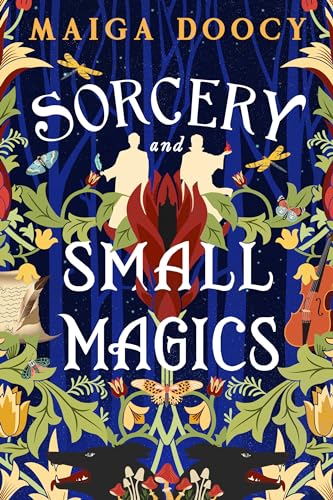
SORCERY & SMALL MAGICS, charming queer love story in a magical fantasy world


SORCERY & SMALL MAGICS
MAIGA DOOCY
(The Wildersongs Trilogy #1)
Orbit Books
$19.99 trade paper, available now

Rating: 4* of five

The Publisher Says: Desperate to undo the curse binding them to each other, an impulsive sorcerer and his curmudgeonly rival venture deep into a magical forest in search of a counterspell—only to discover that magic might not be the only thing pulling them together.

Leovander Loveage is a master of small magics.

He can summon butterflies with a song, or turn someone’s hair pink by snapping his fingers. Such minor charms don’t earn him much admiration from other sorcerers (or his father), but anything more elaborate always blows up in his face. Which is why Leo vowed years ago to never again write powerful magic.

That is, until a mix-up involving a forbidden spell binds Leo to obey the commands of his longtime nemesis, Sebastian Grimm. Grimm is Leo’s complete opposite—respected, exceptionally talented, and an absolutely insufferable curmudgeon. The only thing they agree on is that getting caught using forbidden magic would mean the end of their careers. They need a counterspell, and fast. But Grimm casts spells, he doesn’t undo them, and Leo doesn’t mess with powerful magic.

Chasing rumors of a powerful sorcerer with a knack for undoing curses, Leo and Grimm enter the Unquiet Wood, a forest infested with murderous monsters and dangerous outlaws alike. To dissolve the curse, they’ll have to uncover the true depths of Leo’s magic, set aside their long-standing rivalry, and—much to their horror—work together.

Even as an odd spark of attraction flares between them.

I RECEIVED A DRC FROM THE PUBLISHER VIA NETGALLEY. THANK YOU.

My Review
: Forced proximity/mismatched temperaments/social class disparity stories are almost always going to frustrate me. No exception here.

The young men are in that magic bubble of time where all the world's new, fresh, and exciting, the education you're receiving in class is only part of what you're learning, and everything is still possible. Great start, then. Add onto the plus side being queer isn't any kind of issue in this milieu. I'm going to say the quiet part out loud: Magic curses are as good an explanation as any for the reality of human desire. (Which, incidentally, is not consummated...a lot like Lynn Flewelling's Nightrunners series, you're not getting a HEA or even HFN in this story.)

If that's a dealbreaker for you, this isn't your best investment of eyeblinks. I was on the bubble about that aspect of the story, but I'm willing to go with it because I like these boys. Carping, whiny brats that they are, they're also tentatively figuring out the limits of their magical powers (a stand-in for real-life capabilities and drive for success, with the same drawbacks and problems we all face) as they each need the other's innate skill to complete any magical aim. If there's a better metaphor for a successful love relationship, I don't know of it.

Leo, our PoV character, is privileged and gifted beyond his comfort zone in his branch of magic. He's a chatterbox and uses words beautifully. It's a great way for him to distract others from the huge depths of his talent. Grimm is aptly named, as he's learned from a hardscrabble beginning that resolute focus on results is The Way To Succeed. They're excellent complements for each other's strengths.

Why, then, was I frustrated by the story I'm clearly enjoying? I don't like the implications of forced proximity. "Forced" is always going to trouble me. The feelings developed in forced proximity are, well, forced. Like forcing a plant, the result is at best an attenuated version of the unforced thing. I mistrust the trope because life has taught me not to trust forced feelings for long.

I'm sure, though, that others feel differently. I'm also sure that the book's ending is not placed where it is for no reason or simply by chance. Author Doocy understands the material she's working with. Her skills are very much congruent with the material's focus on the communication these young men are learning to give and receive. So I will set aside my unease in the face of my trust in her storytelling skill.

Again I remind romance readers that this is fantasy first, romantic fantasy to be sure, but romance-novel endings are not included. Much to be praised, and much to enjoy, so recommended reading.

Thursday, February 1, 2024

HOW WE NAMED THE STARS, sweet first novel about first love


HOW WE NAMED THE STARS
ANDRÉS ORDORICA

Tin House
$17.95 trade paper, available now

Rating: 3.75* of five

The Publisher Says: Set between the United States and México, Andrés N. Ordorica’s debut novel is a tender and lyrical exploration of belonging, grief, and first love―a love story for those so often written off the page.

When Daniel de La Luna arrives as a scholarship student at an elite East Coast university, he bears the weight of his family’s hopes and dreams, and the burden of sharing his late uncle’s name. Daniel flounders at first―but then Sam, his roommate, changes everything. As their relationship evolves from brotherly banter to something more intimate, Daniel soon finds himself in love with a man who helps him see himself in a new light.

But just as their relationship takes flight, Daniel is pulled away, first by Sam’s hesitation and then by a brutal turn of events that changes Daniel’s life forever. As he grapples with profound loss, Daniel finds himself in his family’s ancestral homeland in México for the summer, finding joy in this setting even as he struggles to come to terms with what’s happened and faces a host of new

How does the person he is connect with this place his family comes from? How is his own story connected to his late uncle’s? And how might he reconcile the many parts of himself as he learns to move forward? Equal parts tender and triumphant, Andrés N. Ordorica’s How We Named the Stars is a debut novel of love, heartache, redemption, and learning to honor the dead; a story of finding the strength to figure out who you are―and who you could be―if only the world would let you.

I RECEIVED A DRC FROM THE PUBLISHER VIA NETGALLEY. THANK YOU.

My Review
: Books about first love are, I think we can all agree, among the most relatable stories there are. Everyone not a sociopath has had a First Love. We can all recall the feelings, the sensations, the sheer exhilaration of falling in love for the first time, and I suspect most of us not sociopaths also recall the returned love from the one we just fell in love with, even if not the first time. So, when choosing a story to tell, a debut novelist really starts out on a higher slope if they choose first...and for added charm forbidden...love.

What a shame I was not utterly ensorcelled by this iteration of the story.

I suspect some of this is due to the author's use of the character's journal as a narrative frame. This necessitates alternating first- and second-person narratives, sometimes in the same sentence; I assume this was an attempt to create a sense of immediacy unavailable in third-person omniscient narration. What happened instead was a sense of muddledness, a lack of clear character-building through different, or just differentiated, voices. The result was that I felt like this was an audiobook. Someone reading to me, unless I am in love with him, makes me utterly fuddled, and sends me into a defensive coma. It took me two weeks to read this not-very-long book.

My last critical comments are about the use of description: I am a lot less interested in rocks than the author appears to be. Is the color green talismanic for some reason? Why? If I am not given a hook to hang my response on, all it does, when a motif is repeated like the use of green is here, is start feeling like I am missing something. That is never a good thing.

So, for the sin of writing a first novel without some very firm editorial guidance, I docked stars. But that said, there are things I loved about this tale. I was particularly pleased that Spanish appeared throughout the read. The chapter titles being in Spanish when Daniel is in Mexico was a lovely touch, and offered me a distinctively culture-specific frame for those chapters. Daniel feeling his way through the bewildering maze of the US culture, through the school's culture, and through his forbidden love for another man, was absolutely terrific. It was, at times, unfocused due to the issues I mentioned above, but never so much so that I was unaware that Daniel...and Sam...were enmeshed in their emotional growth into love. Self-love, as always, has to precede lasting love for others. That is the universal agony of first gay loves, I fear.

Speaking of which...Sam being seen in all his waffling glory only through Daniel's eyes was, at first, odd...back the narrative framework issue...but ended up feeling so exactly like the first-love malaise that I quickly began to warm to it. First love is, of necessity, solipsistic. We can never really get out of that self-referential stage of being in love with love until, and unless, we go all the way through it. Daniel going home to stay with his abuelo and delve into his namesake uncle's life and times was a really suitable way to guide him through the thicket of his self-absorption. His emotional flowering struck me as both truthful and effective...I believed it, and I believed he was changed in the ways shown, by the discoveries he made.

While I am on the subject, I feel the necessity to address a critique of the author's handling of societal homophobia that I have seen brought up several times. It can seem as though the inevitable experience of others’ hateful judgments of himself and of Sam were lightly brushed off. I did not read them this way. As the novel is framed as a journal, the lack of sustained responses to and obsessions with homopohbia struck me as Daniel having, developing, and imparting to the more-affected Sam, a sense of homophobia being an external not internal problem...something imposed from outside. That is exactly how I think homophobia *should* be perceived. It is only a problem for one when one is interacting with the homohobes. That is a major positive in my opinion of the read because it shows the need to decenter the hate.

A mixed reading experience, one with major positives and a bunch of small negatives. A first novel, I hope not an only novel, from a man whose emotional journey is, quite clearly, only beginning, and which I am glad I can share.

Tuesday, June 27, 2023

SPRING IN SIBERIA, a well-honed spear of a story is thrust into one's readerly guts


SPRING IN SIBERIA
ARTEM MOZGOVOY

Red Hen Press
$18.95 trade paper, available now

Rating: 4* of five

The Publisher Says: 1985. Russia. As the Soviet Union disintegrates and Western capitalism spreads its grip across their land, the Morozov family finds itself consigned to the remote, icy wastes of Siberia. It is here that their only child, Alexey, is born.

A sweet and gentle schoolboy, Alexey discovers that reciting poetry learnt by heart calms his fears. That winter gales can be battled with self-invented games, and solace found through his grandmother’s rituals and potions. But when Alexey’s classmate, the son of KGB agents, confesses his love, the desire of two boys to be together clashes violently with the mad world around them.

Exploring the healing power of literature, the magic of first love, and the ways our family and homeland can save (or shatter) us, Spring in Siberia is a coming-of-age novel that, in the darkest of times, glows with hope and the yearning for freedom to be oneself—completely.

I RECEIVED A DRC FROM THE PUBLISHER VIA EDELWEISS+. THANK YOU.

My Review
: A sweet, gentle childhood spent among adults who love him doesn't mean Alexey/Artem wasn't always made aware of how different he was from other boys. His father's mother, whose earthy peasant lifeway he came to root inside, never made anything easy but always taught him that he, and he alone, was responsible for his life by never excusing him from the work of wrestig food for his supper from the unforgiving Earth of Siberia. She taught him to accept the gift of belonging where you plant yourself with her stories of her own early life spent in the Russian west before she was sent to Siberia to care for her brother and then made her life there.

This lesson, above all, would serve the young man well: Make your own life, and thus your own happiness.

The entirety of Artem's...do pardon, Alexey's...life was spent in upheaval and dislocation as the old Soviet Union collapsed and a new old country Russia was (re)born. Being a child with a firm grounding in self-reliance, he takes the new world in his stride. I found his mother's transformation from a depressed, moping lump into a purposeful and energetic capitalist very interesting...and Alexey's trotting right along behind her, using the first money he ever earns by selling flower arrangements on a set of beautifully bound Pushkin books he sees in the local post office. It challenges this planned-economy-raised kid's willpower to save his money instead of spend it well beyond its breaking point, which everyone here should probably relate to. He sees his very first TV commercials and nothing on this wide green Earth will do but he must have some vile, neon-colored sludge to drink...much to his grandmother's appalled confusion, as he's been working with her to pick and preserve wild berries his whole life. What is suddenly so appealing about this new stuff?

In this quiet little moment in a boy's life, the entire tragedy-to-come of Russia: An old, bad system ends with nothing to replace it and a new on with inscrutable rules that aren't like the old rules confuses the bejabbers out of most people who aren't like Alexey's freshly liberated mother.

Her love for her son isn't smooth...he's mistaken for a girl a lot, is clearly a femboy, and is bullied mercilessly. Alexey's father, less successfully capitalist than his wife, is repulsed by the growing strangeness of his only child; the family disintegrates under the many stresses of the world. As Alexey enters adolescence, his isolation from his peers is ameliorated by the love of Anton, expressed in a sweet, sweet, strange and menacing scene on a balcony. Things for th young lovers go poorly, as one would expect them to, given the world's homophobia. Anton and Alexey, eventually, are driven apart by adult cruelty and hatred. How that plays out is so deeply sad, and so universally relatable, that I wanted to jump into the story and shepherd them through the hateful nastiness of small-souled bigots.

Alexey, smart as a whip and hell-bent on not being like Them, goes to university on a "red diploma"—a free pass into the higher education system. He chooses, as did Artem the Author, to train as a journalist in a country about to lose even its unfree statee-supported press. He's trained to observe from birth by being Other, so he has a clear vision of how unfair the new system is to the old system's relicts. Here, then, is the main pleasure I got from reading this sad, oft-told tale of growing up Other in a world that genuinely and utterly, in a bone-deep way, hates you for being yourself.

It's not just gay people, it's not just smart people, it's Them...whoever it is that isn't like the one hating with all their tiny soul's capacty...and every living one of us is Them to someone. Alexey realizes this in a blinding, road-to-Damascus moment in a school hallway.

Life is cruel to Others. This well-honed spear of a story is thrust into one's readerly guts. You'e never again going to look at that butch girl or that femme of a boy and think "Other" after reading this story. Artem/Alexey is a human being and, as we follow him through a rough and turbulent upbringing in a hostile world without a safety net of any material, social, or spiritual sort, we can no longer pretend that we're not all guilty of glossing over the costs of our own quiet little prejudices. Emma Goldman, social activist and poet whose lines are on the Statue of Liberty in New York's front door to the USA, said:
There is no greater fallacy than the belief that aims and purposes are one thing, while methods and tactics are another.

Friday, December 30, 2022

A FRACTURED INFINITY, the depths and lengths a man will travel for his true love & OTHER NAMES FOR LOVE, Pakistani gay coming-of-age family saga


OTHER NAMES FOR LOVE
TAYMOUR SOOMRO

Farrar, Straus & Giroux
$26.00 hardcover, available now

Rating: 4* of five

The Publisher Says: A charged, hypnotic debut novel about a boy's life-changing summer in rural Pakistan: a story of fathers, sons, and the consequences of desire.

At age sixteen, Fahad hopes to spend the summer with his mother in London. His father, Rafik, has other plans: hauling his son to Abad, the family's feudal estate in upcountry, Pakistan. Rafik wants to toughen up his sensitive boy, to teach him about power, duty, family—to make him a man. He enlists Ali, a local teenager, in this project, hoping his presence will prove instructive.

Instead, over the course of one hot, indolent season, attraction blooms between the two boys, and Fahad finds himself seduced by the wildness of the land and its inhabitants: the people, who revere and revile his father in turn; cousin Mousey, who lives alone with a man he calls his manager; and most of all, Ali, who threatens to unearth all that is hidden.

Decades later, Fahad is living abroad when he receives a call from his mother summoning him home. His return will force him to face the past. Taymour Soomro's Other Names for Love is a tale of masculinity, inheritance, and desire set against the backdrop of a country's troubled history, told with uncommon urgency and beauty.

I RECEIVED A DRC FROM THE PUBLISHER VIA NETGALLEY. THANK YOU.

My Review
: What there is to say about fathers and their gay sons...well, that's just an ocean of story without any limits that I'm aware of. Fathers and sons...disappointments...sadness and silence, rage and screaming...all and none and more. It's a relationship most sons have, even if sometimes it's a relationship with an absence or a cipher. It's always going to resonate with fathers because of the terror of being inadequate, as their own fathers were, and with sons for the same reason.

This short, powerful read is the kind of take on the evergreen that leaves the reader not sure where his sympathies lie. Rafik is not really sure what the hell to do with Fahad; and equally, Fahad is not sure how to take Rafik's overbearing attempts to induct him into a life and lifestyle inimical to him. Not solely heterosexuality...the powerful political and economic family that Rafik comes from and wants to perpetuate.

I don't suppose anyone reading this is surprised that this is the crux of the story.

What transpires, and how we respond to it, is all down to the manner in which this eternal and evergreen tale is told. I wasn't always sure I liked the third-person narrator's abrupt shifts from Rafik's to Fahad's point of view. It's effective, in the sense that it conveys the broken relationship and poor communication between father and son. It's not always pleasant, though. It can feel jarring, and while I accept that was Author Soomro's intent, it's not always a positive service to the story.

What the family saga, no matter how compact one makes it, always does is spread the emotional focus of a story. Mousey, Rafik's cousin and rival for control over their feudal family estate, is limned deftly in relatively few words. His presence is more air than flesh...and then Ali, the local of Rafik's family estate, the one whom he entrusts with manning-up his fey son, is from the moment he appears a fleshly figure, outlined in the light of young love and intense desire. And, like those things, as fleetingly there but always, always part of one's mind, heart, body.

The beautiful as well as beastly problems of family, then, are our roadmap. And their inevitable end. There's no one gets out of this family alive, my father once said to me; I've never been sure if it was humor, threat, or sad truth he spoke. And so it is with all families. I'm totally sure the events of this novel...and its multivarious progenitors, from Lawrence's Sons and Lovers back to Balzac's Sarrasine...took place in slightly different form somewhere, sometime. The gift Author Soomro offers us is that he found the uniquely, specifically Pakistani iteration of this deviant's tale, and deftly turned it into the Platonic solid of the story.

While the son never has a father he can relate to, he never gives his father any kind of solidity by denying him a future. A lot of what Rafik can't reconcile himself to is the way the world changes, has changed. It's a grandparent's trick, to turn that terror of loss into an anchor of immanence. Rafik and Fahad don't ever see the world through the same lenses. (Where did those glasses come from?) They, like real fathers and sons, never wonder "what can I do?" but bemoan "what could I have done?"

A story of great affecting power, told elegantly, with honest sadness and truthful anger. Sounds like a great way to spend a winter's afternoon reading.

++++++++++++++++++++++++++++++++++++++++++++++++++++++++++++++++


A FRACTURED INFINITY
NATHAN TAVARES

Titan Books (non-affiliate Bookshop.org link; any website that will not even allow you to search for its products without enabling cookies is not going to get redirects from me)
$15.95 trade paper, available now

Rating: 4* of five

The Publisher Says: A thrilling race across the multiverse to save the infinite Earths—and the love of your life—from total destruction for fans of The First Fifteen Lives of Harry August, The Time Traveller's Wife and Rick and Morty.

Film-maker Hayes Figueiredo is struggling to finish the documentary of his heart when handsome physicist Yusuf Hassan shows up, claiming Hayes is the key to understanding the Envisioner—a mysterious device that can predict the future.

Hayes is taken to a top-secret research facility where he discovers his alternate self from an alternate universe created the Envisioner and sent it to his reality. Hayes studies footage of the other him, he discovers a self he doesn’t recognize, angry and obsessive, and footage of Yusuf...as his husband.

As Hayes finds himself falling for Yusuf, he studies the parallel universe and imagines the perfect life they will live together. But their lives are inextricably linked to the other reality, and when that couple's story ends in tragedy Hayes realises he must do anything he can to save Yusuf's life. Because there are infinite realities, but only one Yusuf.

With the fate of countless realities and his heart in his hands, Hayes leads Yusuf on the run, tumbling through a kaleidoscope of universes trying to save it all. But even escaping into infinity, Hayes is running out of space—soon he will have to decide how much he’s willing to pay to save the love of his life.

I RECEIVED A DRC FROM THE PUBLISHER VIA NETGALLEY. THANK YOU.

My Review
: Likeable people can be reprehensible. Gay men who will do literally...literally...anything for the men they love can be villains. Because, you realize as Hayes perpetrates some truly terrible actions while retaining the same charm and winning ways as led you to invest in him from the beginning, the world doesn't have that many univalent monsters.

What I love best about stories with flawed protagonists is how relatable they are. We're all flawed. And Hayes, he's flawed enough to make him a menace, what he does...causes...to be the engine of this exciting and action-heavy multiverse thriller. Being awakened to an undreamt-of reality, to be chucked into a world that one never once thought might be real, to have the shocking and sudden revelation that someone until now a stranger is, in fact, The One...that's just the first few pages! This script is gonna keep the butts in the seats with no popcirn trips for sure!

Well...okay, that's a small exaggeration. It's not quite that action-packed but it sure as hell feels as though it is. The strangeness of a filmmaker being the one and only person who could resolve the problem of how to use, whether to believe, a fortune-telling device was, honestly, short-changed. It's a point raised, dealt with by saying, "yep that's how it is" and we're off to the races! In fact, there is a lot of the world-building that is treated in this "just the facts, ma'am" laconic way and then it's Gospel.

You did notice the absence of a fifth star...now you know (most of) why.

The merry chase that Hayes and Yusuf, the inamorato, go on across the dimensions is like reading a spec script from a super-excitable young person with not clue one what "budget" means. What makes that fun is the budget is your mind's dopamine-reward system. What makes that sometimes wearing is the film metaphor is the spine of the book...it is literally holding every scene in the story up, leading them together, and the casting of the characters is exactly that: Casting. It's going to be a rough ride for some. I am one. But the roughnss of the ride isn't a deal-breaker because the way this sled handles is *chef's kiss*

Think of Boston. English people, think of Oxford. Got the picture set? Now...change the color of the streetlights and make the roofs green. That's the experience of traveling in Hayes's multiverse...it really is his, he (one of him) is the inventor of the device that enables all this traveling that we're here talking about. And that Hayes, whom the characters we're following most closely refer to as "Figueiredo" to be clear that they mean the evil SOB who wants (for perfectly understandable reasons) to blow the multiverse up one strand at a time, even he isn't a caricature. Insane. Lost to Humanity. But not ever a risible over-the-top cartoon villain.

But those green-roofed mercury-vapor-lit alt-timelines are real, and he's made it impossible for "our" Hayes and Yusuf not to know, and deal with knowing, what it costs to stay alive in a truly random quantumverse. It changes a person to realize what carnage they've left in their wake through this one "wild and precious life" that Mary Oliver so beautifully committed poetry to describe. Now...think about this...there's a lot more than one, and you now know because you can't not know exactly what carnage you've left behind in it all.

It's damned hard to believe this is Author Tavares's first novel. The economy with which he built the pyre of stakes for each strand of the multiverse...and the aplomb with which he lights the stakes into an inferno of loss and rage and gut-hollowing sadness...usually come to a later-career novelist. It takes time to build faith and willingness to go all in and all out at the looming obstacles armed only with one's talent. Yet here he is, attempting and succeeding first time out.

So maybe a few details fell under the table. A last serving of your favorite dish disappeared and you don't have a dog to blame. Big fat deal! You're in great hands as a truth gets told you: Gay men love hard, care deeply, and fight dirty to protect their man.

Even when it's not pretty.

This is what I look for. It's what I want more of. And it's only his first novel! What a great way to celebrate a new year: Read a high-delivery first novel.

Monday, June 13, 2022

GAY GIANT, a graphic memoir from Chile about being Different in a place at a time where that was Bad


GAY GIANT
GABRIEL EBENSPERGER

Street Noise Books
$19.99 trade paper, available now

Rating: 4* of five

The Publisher Says: A child who feels like an outsider in a world that’s set against him. A boy who sings on the playground instead of playing soccer, who likes Barbies, and whose secretly favorite car is the one called Tutti Frutti. Gabriel Ebensperger shares with us his struggles with his own inadequacy, his feelings of guilt, and above all, his fear that his “difference” will be discovered. The vibrant bright pink pages of Gay Giant paint a picture of what it was like to grow up being gay in the ’90s, through the voice of an endearing character, who on the way to becoming an adult realizes that the rejection of the world is never over, and that true acceptance comes from within yourself.

A gay giant can't hide. This charming coming-of-age and coming-to-terms with oneself story shows us what it feels like to grow up queer in a heteronormative society in the 1990s.

Filled with pop culture touchstones from Cher to Steven Tyler, from Jurassic Park to Grey's Anatomy, this book navigates both the joy and the pain of puberty surrounded by ignorance and homophobia. How do you love yourself if you've learned so well to hate yourself? For all of us who've ever felt bizarre, damaged, or strange, we are shown that all is full of love, and that true acceptance must come from within yourself.

I RECEIVED A DRC FROM THE PUBLISHER VIA EDELWEISS+. THANK YOU.

My Review
: Chile isn't exactly famous for its history of QUILTBAG rights protections. The country legalized same-sex, um, relations in 1999. But like everywhere else on Earth, at every time since there have been humans on Earth, people been usin' what they got to get their groove on since forever.

What Author Ebensperger experienced, then, as a youth in a macho culture, wasn't external affirmation or even acceptance. He was, well, weird. And weird kids suffer at the hands of their peers. It's the hands of their parents that do the most damage, though it looks like Author Ebensperger's parents were either remarkably chill, if significantly out of their depth, or he glossed over some stuff. Frankly I don't think that is the case because he and I share a favorite car: The godlike Citroën CX. He prefers the first year, 1974; where I idolize the 1978 Pallas model. Probably because I drove one and had A Crisis. *shiver*
How do I know this about him? He draws all of his cars very carefully, so I can see them vividly. (I confess I don't understand why his parents' 1967 Peugeot was evil; but I totally support his assessment of the W114 Mercedes-Benz as the Vehicle of the Antichrist.) And at a crucial moment, the aforementioned Citroën CX does a Back-to-the-Future-esque cameo. And that explains why I rated this graphic memoir a full four stars when 1) I HATE PINK and b) I ain't wild about sequential-art storytelling in general.

Look:


Under normal circumstances, I'd struggle to find something polite to say about the pinkness of the exercise, despite the really wonderfully clear message of self-acceptance and a dropping of one's internalized homophobia about "nelly queens" or "femmes" or, generally, men who don't fit the masculine stereotype. I mean, no one's asking you to marry the guy! Just don't sneer at him, or belittle him, or even (if you simply can not keep your heteronormative judgments to yourself) pollute his air with your breath. (Pink was the only color my mother could really love so I was surrounded by it. I hate it for that reason.)

But let me say again for the rare newcomer to my ambit: I am always looking for ways to challenge my habits and patterns and prejudices because I am hell-bent on not dying above the neck before I do below it. I get lovely rewards, like reading this charming essay in knowing your true self and working until you're in a love relationship with that self. I get to look at people from countries so very far away from my own perch in the Northestern US tell stories that were true for me, thirty years before these stories took place. I am not alone; neither is the author; we are connected in an experience of the world as outsider other unwanted and, as a result, damaged in ways no one should be.

Here we are, in a new century, in a world that keeps trending towards a better, brighter future (if you ignore climate change) and yet there are always people who don't fit and whose pain is crippling. Yes, Our Flag Means Death was renewed, and there's a lovely clap-back against the vile racism recrudescing in the Star Wars stewpot, and still we hear the lunatic right-wing idiots braying their teeth out about pedophile faggots (almost exclusively a heterosexual crime, pedophilia, but we all know how much that crowd respects facts). I am still gruntled and kempt as I contemplate Street Noise Books's list in all its truth-telling glory. I am still wreathed in happy smiles as I leaf again through this 256-page bath of pinkness, because it tells me that my story is shared...right down to the survival and thriving of its main character.

Who has awesome taste in cars.