Monday, March 10, 2014


AMERICAN HIPPOPOTAMUS
JON MOOALLEM

The Atavist
Kindle Single, $2.99

Rating: 3.75* of five

The Publisher Says: In 1910, the United States—its population exploding, its frontier all but exhausted—was in the throes of a serious meat shortage. But a small and industrious group of thinkers stepped forward with an answer, a bold idea being endorsed by the likes of Theodore Roosevelt and The New York Times. Their plan: to import hippopotamuses to the swamps of Louisiana and convince Americans to eat them.

The only thing stranger than the hippo idea itself was the partnership promoting it. At its center were two hard-bitten spies: Frederick Russell Burnham, a superhumanly competent frontiersman, freelance adventurer, and fervent optimist about America’s future—Burnham would be the inspiration for the Boy Scouts—and Fritz Duquesne, a.k.a. the Black Panther, a virtuoso con man and cynical saboteur who believed only in his own glorification and revenge. Burnham and Duquesne had very recently been sworn enemies under orders to assassinate each other. They’d soon be enemies again. But for one brief and shining moment they joined behind a common cause: transforming America into a nation of hippopotamus ranchers.

In American Hippopotamus, Jon Mooallem brings to life a historical saga too preposterous to be fiction—a bracing and eccentric epic of espionage and hippos, but also of a conflicted nation on the threshold of a bewildering new century, deciding what kind of country it would be, and what beasts it would eat.

My Review: This Kindle Single, produced by The Atavist...which company creates quite a few of these not-quite-enough-to-make-a-regular-book very long articles...was a whimsical purchase. American HIPPOPOTAMUS and Teddy Roosevelt and the Original Boy Scout?! It's like they mapped my brain and found all the crannies that need filling before putting this, and many of their other, projects out.

Mooallem (great name, don't you think?) found this weird little footnote in history heaven-knows-how, but I am glad he did. The more-or-less 70pp of the story don't give him all that much latitude to develop the sheer blinding weirdness of his tale into tedious show-your-work detail. He hits the high points and moves on, following the two central characters of Burnham and Duquesne from sketchily traced origins to endings. The men are documented fully in other books, as they deserve to be. This isn't intended to be a dissertation on either of them, or of their weird plot to introduce hippos to the swamps of the Gulf Coast...HIPPOS! they kill more people every year than sharks!...to solve something I'd only very glancingly heard tell of, "The Great Meat Crisis" that was afflicting the US a hundred years ago.

I know for a fact that the water hyacinth problem the hippos...hippos! can't get over that...were meant to help solve is ongoing, and the importation of exotic animals to help solve it is still bandied about. Austin, Texas, was all gung-ho to introduce sterilized Asian carp into one of its lakes to eat the damned weeds. A scary, scary prospect. Those are some very nasty fish with no local predators and no food value that I know of.

Anyway. Mooallem was obviously struck by the audacity of such a plan, and by the world that could imagine such a thing working well. He sums up the appeal of this read quite well and succinctly:
I'm not arguing that America would be a better or more beautiful place if it had imported hippopotamuses in 1910. But there is something beautiful about the America that considered importing them--an America so intent on facing down its problems, and solving them, that even an idea like this could get a fair hearing; where the political system and the culture felt so alive with possibility, and so confident of its own virtue and ingenuity, that elected officials could sit around and contemplate the merits of hippo ranching without worrying too much how it sounded; where people felt free and bold enough to imagine putting hippopotamuses in places where there were no hippopotamuses.

Somewhere along the way, our politics, and maybe our psyches, too, became stunted by a certain insecurity--by the fear that someone is quietly sneering at us, just waiting to skewer and betray us if we take a bold chance.
Well, well, well. Someone other than me noticed! Of course, the advantage to that timorousness is the guarantee of the supine acquiescence of our potentially rich populace to the damnable and insufferable rule of the banksters and plutocrats. Know what finally killed the hippos-in-Dixie plan? (Other than good fortune, can you even imagine the horrors of hippos charging through New Orleans?!) The nature of harvesting the meat (don't get that image too stuck in your heads) meant that the gigantic meat-packers couldn't use their huge slaughter houses and assembly-line methods to cut and pack the meat.

That, obviously, cannot be allowed. No more than could the egg farmers afford to acquiesce to the proposal, made around the same time, to replace fragile, quick-to-spoil hen's eggs with turkey eggs that have a larger volume of albumen, more yolk, thicker shells, and a vastly longer unrefrigerated shelf life.

Such, laddies and gentlewomen, is the nature of life in a "democracy" that's run for the benefit of the few against the interests of the many: pay more for less, and be grateful you're allowed to have it at all.

Ahem. The cost of this good evening's read is $2.99, and it's a darn good investment in an amusing side-light onto American history and human nature.

Creative Commons License
This work is licensed under a Creative Commons Attribution-NonCommercial-ShareAlike 3.0 Unported License.

Sunday, March 9, 2014

JUSTICE: Stories, the Haydens of Bentrock, Montana, before 1948


JUSTICE: Stories
LARRY WATSON

Milkweed Editions
$9.99 ebook, available now

Rating: 4* of five

The Publisher Says: Larry Watson's bestselling novel Montana 1948 was acclaimed as "a work of art" (Susan Petro, San Francisco Chronicle), a prize-winning evocation of a time, a place, and a family. Now Watson returns to Montana 1948's vast landscape with a stunning prequel that illuminates the Hayden clan's early years and the circumstances that led to the events of Montana 1948.

In Montana, the Hayden name is law. For the Hayden boys, Wesley and Frank, their legacy carries an aura of privilege and power that doesn't stop at the Montana border, even when an ill-fated hunting trip makes them temporary outlaws. But what it means to bear the name is something each generation must discover for itself. From Julian, the hard-bitten and blustery patriarch, to Gail, Sheriff Wesley Hayden's spirited wife and moral compass, Larry Watson gives breath and blood to a remarkable family's struggles and rewards, and opens an evocative window on the very heart of the American West.

I CHECKED THIS BOOK OUT FROM THE LIBRARY. USE THEM OFTEN, THEY LIVE AND DIE ON OUR PATRONAGE.

My Review
: A collection of previously published short pieces, Justice tells the backstory of the Haydens of Bentrock, Montana, the family at the center of Watson's first bestselling novel Montana 1948. We meet patriarch Julian Hayden in 1899, barely dry behind the ears and ready to take on the world; his shy, retiring, high-strung wife Enid on the day she married him; his two sons on the day childhood ended for both, in which the seeds of Montana 1948 are explicitly sown; Wesley's short, abortive run for freedom from the weight of expectations sparks at a terrible family Thanksgiving dinner; Julian's and Wesley's deputy and general sad-sack, Len McAuley, comes in from the pointlessness of secondary characterization in unexpected and poignant ways; and then the marriage and parenthood of North Dakotan steel magnolia Gail and Wesley, a life started in, and blighted by, the shadows of the Hayden family legacy.

This is decidedly not Montana 1948. It's perfectly good read on its own, actually, just as character sketches of a family and its effects on the world at large, and its costs to the members thereof. I can't complain about anything here, because Dr. Watson is a prose stylist whose direct, pared down artistry is very appealing to me. I can't urge all and sundry to rush out and buy a copy, either, because the book is a collection of short stories with all the cultural freight implicit in that description. Tastes and hints and pieces are the stuff of short stories, and that is both a strength and a weakness. Here, it's perfect, because the novel they prequelize (a rather lumpish and ungainly neologism, but "prefigure" is so stuffily snooty) is in itself a marvel of tight, concise storytelling that leaves acres of room to wonder about the people in it. But on its own, under its own steam, it's very good but not great. Good writing, interesting characters, but nothing...well, nothing to launch it to that next level, say like American Salvage or Everything Ravaged, Everything Burned.

Still. You have definitely done worse by yourself than reading these seven stories. I'm glad I finally made room for them on the nightstand. Recommended.

Saturday, March 8, 2014

Peter Pan's tale told, at last, with truth and guts: THE CHILD THIEF by Brom


THE CHILD THIEF
BROM

EOS
$15.99 trade paper, available now

Rating: 5* of five

The Publisher Says: Peter is quick, daring, and full of mischief—and like all boys, he loves to play, though his games often end in blood. His eyes are sparkling gold, and when he graces you with his smile you are his friend for life, but his promised land is not Neverland.

Fourteen-year-old Nick would have been murdered by the drug dealers preying on his family had Peter not saved him. Now the irresistibly charismatic wild boy wants Nick to follow him to a secret place of great adventure, where magic is alive and you never grow old. Even though he is wary of Peter's crazy talk of faeries and monsters, Nick agrees. After all, New York City is no longer safe for him, and what more could he possibly lose?

There is always more to lose.

Accompanying Peter to a gray and ravished island that was once a lush, enchanted paradise, Nick finds himself unwittingly recruited for a war that has raged for centuries—one where he must learn to fight or die among the "Devils," Peter's savage tribe of lost and stolen children.

There, Peter's dark past is revealed: left to wolves as an infant, despised and hunted, Peter moves restlessly between the worlds of faerie and man. The Child Thief is a leader of bloodthirsty children, a brave friend, and a creature driven to do whatever he must to stop the "Flesh-eaters" and save the last, wild magic in this dying land.

My Review: Retelling the Peter Pan legend with heaping helpings of Celtic myth, genuine teenage angst, and surprisingly scary-to-me horror. I think the huge majority of people remember the basics of the story, Peter enticing kids off to Neverland to fight Captain Hook and never, ever grow up, right? Well, same here, only Neverland is one emm-effin' SCARY-ASS place, the kids are society's fallen-through-the-cracks abusees, runaways, and misfits, and the reason they never grow up is they mostly die in their first few minutes there.

Peter himself, the Happy Sociopath, well, his backstory is one of the revelations of the book...he's a changeling child, an apparently immortal and certainly immoral survivor of pagan Ireland. The author delved deeply into the Celtic myths, and has gifted us with a reconstruction of the actual, underlying story, trimmed of repetition, variations among the versions smoothed out, selectively applied, and a new, vibrant, and compelling tale made from the old, raggedy myths.

It's superb. It's 480pp long. It's *beautifully* illustrated. It's enormous, at 7 x 10. I adore it, book and content both. No one may borrow my copy, a gift from a ridiculously generous friend, because if a corner gets bent or a page gets food-baptized, There Will Be Blood.

I wasn't much of a child. I thought about stuff kids just don't, like why it was okay for girls to have different names after they got married, but not boys; why the Bible said it was okay to fuck your daughters like Lot did, but not other boys; and that all those yahoos clappin' for Tinkerbelle, clearly the *lamest* fairy ever in the history of fairies, should oughta just go straight to the milk and cookies and leave me alone with the gin. Disney shit made me gaseous, as I said to my mother, who paused, laughed, and never inflicted anything Disney on me again. So it was with great and well-founded trepidation that, after reading a gushsome review of this book, I decided to move out of my comfort zone and give it a whirl.

Oh my heck.

I had to put it down every so often because the pain in my gouty wrists and fingers got so nasty, and no book-holding device I possess was up to this tome's heft (lost that Levenger reading desk, dammit!). And a darn good thing, too, since I was rather often scared poopless by some action or another. It's a real story, this Child Thief...a real, balls-out, the-world's-a-meanass-place Matterhorn of a journey, made in excellent company and told in truthsome, sparklingly grim prose.

I want Tim Burton to make this mini-series, starring Johnny Depp as Peter, don't care how old he is he's the *perfect* beautiful sociopath with no fear for scare...animate it, do the thing they did with The Polar Express whatever that's called, and BTW that's one of the all-time great Xmas stories isn't it?, but let's get this fucker made (to quote Bela Lugosi from Ed Wood, another Depp masterpiece) and not shilly-shally!

In case you can't tell, this book is Recommended with Joy.

Friday, March 7, 2014

Deeply Uninteresting and Hugely Overpraised: THE BOOK OF ILLUSIONS by Paul Auster


THE BOOK OF ILLUSIONS
PAUL AUSTER

Picador USA
$16.00 trade paper, available now

Book Circle Reads 3 Sorry I read it, and what a slog.

Another one where I stand by my one-liner. Ye gods and little fishes, what a snore!

Rating: one furious, disgusted star of however many stars there are in a galaxy

The Publisher Says: Six months after losing his wife and two young sons, Vermont Professor David Zimmer spends his waking hours mired in a blur of alcoholic grief and self-pity. One night, he stumbles upon a clip from a lost film by silent comedian Hector Mann. His interest is piqued, and he soon finds himself embarking on a journey around the world to research a book on this mysterious figure, who vanished from sight in 1929.

When the book is published the following year, a letter turns up in Zimmer’s mailbox bearing a return address from a small town in New Mexico inviting him to meet Hector. Zimmer hesitates, until one night a strange woman appears on his doorstep and makes the decision for him, changing his life forever.

My Review: Protagonist loses family, isolates self from world to plumb solipsistic depths of grief and depression, discovers obsessive interest in an artist now of no great interest, sets out to rediscover and rehabilitate said artist, succeeds, and through a miracle of identification with the vanished artist's sufferings which mirror his own, protagonist resumes living in the real world again.

Does that sound familiar? It ought to...it's also the plot of the over-praised and underwhelming "New York Trilogy." Every writer, every artist, rides their hobbyhorses. Nothing new there. The question is, do you want to go along for the ride? In Auster's case, I do not.

But why not? Because I experienced a lot lot lot of grieving very early in life, when the AIDS epidemic was at its height. I lost every gay friend I'd made. I volunteered as a helper in the hospital...just showed up and did stuff, no training, no pay, and lots of nurses and porters would teach me what to do so they wouldn't risk getting the disease.

I held a lot of hands as men died. I saw a few mothers come to their sons' bedsides to excoriate them one last time for being queer and so embarrassing the church, the family, god. I had no idea what to say to their terrified faces as they died at 23...27...31.

But I fuckin' got up every morning and I went and DID SOMETHING.

I have ZERO tolerance for these a-holes who think their teensy little selves are so important that their pain is all that matters in the world. SHUT THE FUCK UP and get out of your own asshole and DO SOMETHING.

Okay, unsympathetic much? Yes. I lost the love of my life to AIDS in 1992. He died at 35. I do not want to hear crap from anyone about depression 'cause I been there too, and didn't treat it like it was All Important. I went to the doctor, I got help, I gave up some very unpleasant addictions, and I got on with life the whole time.

And I would give anything I have ever had to have my man back. Anything. I miss him fiercely even now, 20 years later.

So Mr. Auster can keep his wet-mouthed wet-eyed puling to his damn self.

Creative Commons License
This work is licensed under a Creative Commons Attribution-NonCommercial-ShareAlike 3.0 Unported License.

Thursday, March 6, 2014

The two latest trolls on Goodreads pissed me off, so here's my response

A good critic is trying to tell you what she has learned about herself from the reading of a particular piece of literature. A bad reviewer is often trying to tell you how smart he is by declaring whether or not he liked a particular book. If he liked the book, then this is the kind of book a superior person likes, and vice versa. He might try to explain why he didn’t like it, but the review is really just a tautology. “I didn’t like this book because it is bad,” is equivalent to “This book is bad because I didn’t like it.”
Kevin Guilfoyle, The Tournament of Books 2014

So this is something I found at the Tournament of Books site, and with which I agree completely. I've had a lot of private and public snark on several fora about the fact that I write reader-response reviews. "Who cares" is the general tenor of these snorts of derision, with an undercurrent of "how dare you" for additional smugness.

Here's the thing: I don't much care if you liked a book or not. That's nice, either way, ohhh mmmm ah-hah. So? I like BLTs. So you go out and get yourself a BLT because Richard said he liked them. It's a soggy mess, with undercooked bacon and watery tomatoes and limp, wilted iceberg lettuce on untoasted white bread. "Ick ptui," you say, "that Richard steered me wrong! I'll never trust his recommendations again."

And you'd be right.

I **love** crispy bacon. When you put crispy, just-on-the-edge-of-burned bacon on a toasted piece of seeded rye bread, and add fresh, home-grown Green Zebra tomatoes that have been slightly salted to accent their sweetness...well, the only thing that makes it better is an inner leaf of butter lettuce, one of the yellowy ones with a crunchy-thick rib and that snap-in-the-tooth texture. Being a fat-o-holic, I need mayo on my bread, but honestly who would be a stickler and whine about the lack with these ingredients?

And please, oh please, give me a good bock beer, a Dos XX or a Shiner, cold cold cold, so I can sluice my mouth clean with carbonated richness! Could any sandwich anywhere ever say "summer" more loudly than this?

Now you hate the sound of that because you're some sort of stupid veggie nutball, or you're a religious nut who won't eat pigmeat, or maybe beer makes you cringe. Maybe you don't like tomatoes. But what you are not is in any doubt about what I'm saying I like. Based on your take on the elements presented, you have a clear picture of whether I'm speakin' your language or I might as well be speaking in tongues.

That's what I'm trying to get across, both positively and negatively, in my reviews. If you disagree with me, fine. But I don't care. It's not important to me that you "validate" me with praise each and every time I utter a pronunciamento, as more than one of the arrogant assholes who've publicly or privately told me to belt up have said.

If you don't like what I've written, go on about your day. I don't care to know why, or that, you are Offended or Bored or Contemptuous. Go feel your feelings the way you feel your bits: Privately.

Wednesday, March 5, 2014

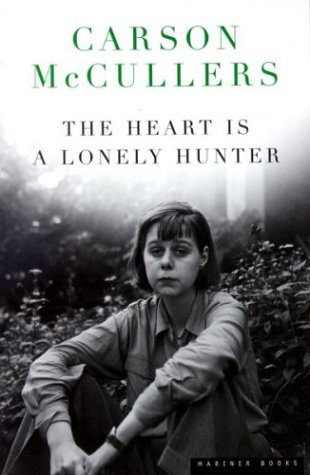
THE HEART IS A LONELY HUNTER by Carson McCullers...Amazing. Beautiful. Necessary.


THE HEART IS A LONELY HUNTER
CARSON McCULLERS

Mariner Books
$13.95 trade paper, available now

Rating: 4.99* of five

The Publisher Says: With the publication of her first novel, The Heart Is a Lonely Hunter, Carson McCullers, all of twenty-three, became a literary sensation. With its profound sense of moral isolation and its compassionate glimpses into its characters' inner lives, the novel is considered McCullers' finest work, and an enduring masterpiece.

At its center is the deaf-mute John Singer, who becomes the confidant for various types of misfits in a Georgia mill town during the 1930s. Each one yearns for escape from small-town life. When Singer's mute companion goes insane, Singer moves into the Kelly house, where Mick Kelly, the book's heroine (loosely based on McCullers), finds solace in her music. Brilliantly attuned to the spiritual isolation that underlies the human condition, and with a deft sense for racial tensions in the South, McCullers spins a haunting, unforgettable story that gives voice to the rejected, the forgotten, and the mistreated--and, through Mick Kelly, to the quiet, intensely personal search for beauty.

My Review: Oh, how I loved reading The Heart is a Lonely Hunter. Oh how very beautiful the writing in this book is! How much intense and careful observation went into the creation of these characters, each of whom...especially the Kelly family...I felt I could look up in the phone book and call for a chat.

The author was a whopping *twenty-two* when this book was published. TWENTY-TWO!! A person should barely be able to find a rathole and figure out how to pound sand down it at that age! And here McCullers is, creating archetypal characters that define a certain cultural space.

I feel like such a schmuck. Until I contemplate the extremely high cost of her genius...alcoholism, suicide attempts, relationships that ker-flooey-ed in spectacular ways...I am envious of her gift. But I am deeply grateful that she left as much work behind as she did in a short fifty years.

Well, that's all, really. It's amazing and it's beautiful and it's necessary, the way all fine, fine art is.

Tuesday, March 4, 2014

BRUNO, CHIEF OF POLICE, a series-starting delight


BRUNO, CHIEF OF POLICE (Bruno, Chief of Police #1)
MARTIN WALKER

Vintage Books
$16.95 trade paper, available now

Rating: 3.75* of five

The Publisher Says: The first installment in a wonderful new series that follows the exploits of Benoît Courrèges, a policeman in a small French village where the rituals of the café still rule. Bruno—as he is affectionately nicknamed—may be the town’s only municipal policeman, but in the hearts and minds of its denizens, he is chief of police.

Bruno is a former soldier who has embraced the pleasures and slow rhythms of country life–living in his restored shepherd’s cottage; patronizing the weekly market; sparring with, and basically ignoring, the European Union bureaucrats from Brussels. He has a gun but never wears it; he has the power to arrest but never uses it. But then the murder of an elderly North African who fought in the French army changes everything and galvanizes Bruno’s attention: the man was found with a swastika carved into his chest.

Because of the case’s potential political ramifications, a young policewoman is sent from Paris to aid Bruno with his investigation. The two immediately suspect militants from the anti-immigrant National Front, but when a visiting scholar helps to untangle the dead man’s past, Bruno’s suspicions turn toward a more complex motive. His investigation draws him into one of the darkest chapters of French history—World War II, a time of terror and betrayal that set brother against brother. Bruno soon discovers that even his seemingly perfect corner of la belle France is not exempt from that period’s sinister legacy.

Bruno, Chief of Police is deftly dark, mesmerizing, and totally engaging.

My Review: First in a series! Words to gladden a satisfied mystery reader’s heart. First in a cozy series set in a French village. First in a series featuring a male lead who loves kids, works his land and his job, has lovers (women, boringly enough), and commands the respect of his entire territory by being unflashily committed to justice, even when the law is in conflict with it.

Bruno is a very good man, one who did everything he could to save the life of the woman he loved in the Bosnian war, and still failed; he’s a damaged man, and he would be the first to say so; but he never once puts a foot wrong in dealing with the souls in his care. We meet him, in fact, helping the local farmers evade the stifling EU bureaucrats bent on enforcing health codes that simply don’t apply to the ancient market town of St-Denis. Any wonder everyone loves him?

So a murder occurs, one that Bruno can’t hope to handle solo: An elderly Algerian immigrant, veteran of the French Army and holder of the Croix de Guerre, appears to be the victim of a far-right racist hate crime. Things don’t look good for the town’s small Algerian community’s peace of mind, but the trail of evidence developed by Bruno with his colleagues from the various and confusingly similar French policing agencies lead them to an unexpected resolution to the crime. What makes that so satisfying isn’t that it was a surprise, which it was not about halfway into the book, but that it was handled with the tact, grace, and dedication to justice that make cozy mysteries satisfying.

There is food, there is wine, there is a dog, there are no cats...it is as if Walker went over my personal checklist and gave me all but one thing on it (Bruno’s straight). I’m okay with that. But most of all, Walker gave Bruno wonderful people to work with, people whose deep and dense roots are charmingly intertwined and wonderfully deftly worked into the narrative. Infodumps are rarely this good. It is a major plus for the series, always assuming it continues.

I can’t quite get to four stars for the book, though, because it’s atmospheric and delightful, but not quite suspenseful enough. The author tips his hand more than forty pages before the end of the book. Okay, yes, it’s a first mystery, but I think a little more care could have gone into the Big Reveal. It’s only a quarter star knockdown because the Big Reveal is a very very surprising facet of French history I hadn’t so much as heard tell of before, and that’s worth a lot of pleasure points. The red herring wasn’t quite all I’d hoped for either, leading nowhere a lot sooner than I would have expected. Again it was interesting, and it cast a bit of light on my idea of the EU’s cultural landscape from a new angle. But it was just this side of perfunctory in its use.

All the cavils aside, the book is a pleasure to read, and the series will be one I follow for at least a few more outings, possibly much longer.