Thursday, August 13, 2020

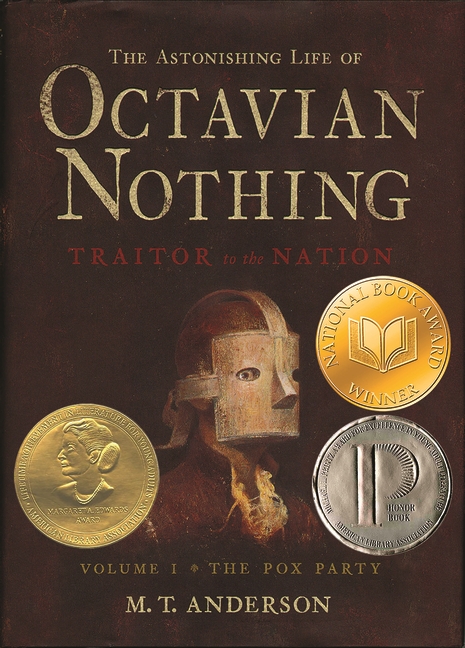
THE ASTONISHING LIFE OF OCTAVIAN NOTHING, two YA novels dealing with the morality of slavery beautifully

THE POX PARTY (The Astonishing Life of Octavian Nothing, Traitor to the Nation #1)
M.T. Anderson
Candlewick Press
$17.99 hardcover, available now

Rating: 4.5* of five

The Publisher Says: It sounds like a fairy tale. He is a boy dressed in silks and white wigs and given the finest of classical educations. Raised by a group of rational philosophers known only by numbers, the boy and his mother — a princess in exile from a faraway land — are the only persons in their household assigned names. As the boy's regal mother, Cassiopeia, entertains the house scholars with her beauty and wit, young Octavian begins to question the purpose behind his guardians' fanatical studies. Only after he dares to open a forbidden door does he learn the hideous nature of their experiments — and his own chilling role in them.

Set against the disquiet of Revolutionary Boston, M. T. Anderson's extraordinary novel takes place at a time when American Patriots rioted and battled to win liberty while African slaves were entreated to risk their lives for a freedom they would never claim. The first of two parts, this deeply provocative novel reimagines the past as an eerie place that has startling resonance for readers today.

My Review: I am always up for history, especially if it's presented from an unusual viewpoint or in a fresh manner. I thought this would be a fairly conventional and thus mildly tedious slave-comes-of-age, resists-tyranny thing. But there was that raver...surely someone who bothers to come to LT won't be that impressed by the usual thing....

So I got it, and I am so glad I did. The author recapitulates the bizarre upbringing of Octavian in a place called "The College of Lucidity" which is located in Boston (which is how you know it's fiction, Boston being the least lucid place I've ever been) in the faintly modernized voice of the youth himself looking back on the experience.

It's troubling, to put it mildly. It's flat creepy. But it's all he knew as a childhood, though life has taught him it's not what others knew as a childhood. He even quotes his mother saying he's never been a child. (He, Octavian, our narrator...these are interchangeable references in this review.) His very...well, ummm, inputs and throughputs are weighed and measured and logged for reference. His education is that of the most privileged, enlighted prince of his age. He stresses in presenting us with these facts that he felt no strangeness or otherness to his life. He was, so far as he knew, the object of no untoward interference or unusual interest.

The object speaks. It is a very unsettling reading experience.

As the story progresses and our narrator recalls his budding awareness and emotional growth as regards self and others, it becomes evident that Octvian and his mother are gilded captives. It's a realization that doesn't gall...yet...on him, but the author's subtlety with his emotional flensing knife is such that the older narrator's awareness of his feelings presages quietly the events at the end of the book. (No spoilers...but look carefully at the disturbing jacket illustration.)

Anderson's stated aim in writing this book is that he wished it had been around when he was a young reader. I wish it had, too. It's wonderful writing, no matter it's supposed to be "for" YAs. From p96 of the hardcover edition:

Shortly after two o'clock on June 3rd, 1769, Venus descended into the plane of the ecliptic and came between the Earth and the sun. It is with awe that I treat of the event -- so minute, so silent here upon the Earth -- but there -- one can scarce imagine the roaring of that vast orb through those frigid depths, tumbling, flung through the plane of our orbit; the glaring heat, the searing glare of Sol -- and the gargantuan prodigiality of that body, consuming its own substance ceaselessly while planets whirled like houris, veiled and ecstatic around the throne of some blast-turbaned, light-drunken king.

Our narrator...a youth, a stripling...so beautifully educated that he can create sentences like these! Such a huge bar is set for the youth reading this, but not one that's so far above and beyond comprehension that it's discouragingly impossible to meet. It's a nice sight to see the lack of condescenscion in this type of writing.

So how do the adults fare? Not too well, from the foolish and clueless Mr. Gitney to the aptly named and evil Mr. Sharpe, whose words from p338 (hardcover) I reproduce here that he may damn himself from his own lips:

We have labored too long under a government that has sought to curtail exchange; such interference is unnatural. We shall see a brave new day, Octavian, when the rights of liberty and property are exercised, and when all men are free to operate in their own self-interest. And as each individual expresses his self-interested will, so does the democratical voice speak, the will of the common people, not kings and ministers; and when the self-interest of every citizen speaks together, then and only then does benevolence arise.

So sayeth the free man to the slave. The prosecution rests. Recommended, and most highly.

+++++++++++++++++++++++++++++++++++++++++++++++++++++++++++++++++

THE KINGDOM OF THE WAVES (The Astonishing Life of Octavian Nothing, Traitor to the Nation #2)
Candlewick Press
$14.00 trade paper, available now

Rating: 3.5* of five

The Publisher Says: Fearing a death sentence, Octavian and his tutor, Dr. Trefusis, escape through rising tides and pouring rain to find shelter in British-occupied Boston. Sundered from all he knows — the College of Lucidity, the rebel cause — Octavian hopes to find safe harbor. Instead, he is soon to learn of Lord Dunmore's proclamation offering freedom to slaves who join the counterrevolutionary forces.

In Volume II of his unparalleled masterwork, M. T. Anderson recounts Octavian's experiences as the Revolutionary War explodes around him, thrusting him into intense battles and tantalizing him with elusive visions of liberty. Ultimately, this astonishing narrative escalates to a startling, deeply satisfying climax, while reexamining our national origins in a singularly provocative light.

My Review: Well, second books often don't rise to the level of the first in inventiveness and freshness. This one is typical of the syndrome.

Beginning where the extraordinary and original The Pox Party left off, The Kingdom on the Waves makes the adventures of Octavian Nothing complete. His best efforts are thwarted, his noblest desires unfulfilled, his quest for justice failed. All very true to history, but all very easy to predict. It's not that this is a bad book; it's a very good book. It's not clear to me why Anderson took 561pp to tell this story. I think the book sags a bit under the weight of its tale. It could easily have clocked in under 400pp and led us the same place.

I *love* that this is a YA book, written in so challenging and uncondescending a voice. Octavian is a very erudite narrator. I loved the structure of the book as a reader; it's in tasty-morsel-sized chapters. It's a very good book, and I recommend it.

I am firmly on record in many places as disliking the obesity of modern literary production. It's not that all books should be short in my opinion; it's that there is no reason for many, if not most, books to be as bloated with redundant and sometimes pointless verbiage as they are *stares pointedly at the Outlander books*. This book takes as its canvas a richly colored (no slur intended) part of American history. It's trying to fit a giant Technicolor extravagaza into a TV show. I think the editor would have done better to focus the author's obvious familiarity with the period on fewer episodes and left it at that.

But still, better a flawed and oversized story than none at all. The pleasures of the tale are many and savory, and I really hope you'll venture into YAdom to find this book soon.

Wednesday, August 12, 2020

EROMENOS, the love/hate of Antinous for Hadrian told at last

EROMENOS
MELANIE J. MCDONALD

Seriously Good Books (non-affiliate Amazon link)
$3.99 Kindle edition, available now

Rating: 4* of five

The Publisher Says: Eros and Thanatos converge in the story of a glorious youth, an untimely death, and an imperial love affair that gives rise to the last pagan god of antiquity. In this coming-of-age novel set in the second century AD, Antinous of Bithynia, a Greek youth from Asia Minor, recounts his seven-year affair with Hadrian, fourteenth emperor of Rome. In a partnership more intimate than Hadrian's sanctioned political marriage to Sabina, Antinous captivates the most powerful ruler on earth both in life and after death. This version of the affair between the emperor and his beloved ephebe vindicates the youth scorned by early Christian church fathers as a "shameless and scandalous boy" and "sordid and loathsome instrument of his master's lust." EROMENOS envisions the personal history of the young man who achieved apotheosis as a pagan god of antiquity, whose cult of worship lasted for hundreds of years far longer than the cult of the emperor Hadrian.

In EROMENOS, the young man Antinous, whose beautiful image still may be found in works of art in museums around the world, finds a voice of his own at last.

I RECEIVED A REVIEW COPY FROM THE AUTHOR. THANK YOU.

My Review
: There have been books aplenty about, and even in the voice of, Hadrian the Emperor of Rome, but so far as I know none in the voice of his beloved Antinous of Bithynia. Antinous is portrayed in this book as he reflects on his life at its end. How and why his life is ending, if one isn't familiar with the story, is a question still of some interest to scholars, who don't have a solid consensus about causes and motivations. Hey, it's almost 2,000 years ago! No one knows *any*thing for sure at that distance in time. But Melanie McDonald creates a composed, mature voice for this important and vital character in her novel, titled after the Greek word describing Antinous's relationship to Hadrian. The course of Antinous's life, the exciting events in it, and the reasons for his long tenure as Hadrian's eromenos, are presented in swift, sure prose; the inevitable, it would seem, conclusion is very nicely handled; and the narrative frame, the temple offering of a manuscript in Serapis's sacrificial fire, gives the book a very agreeable frisson of the supernatural.

This is a first novel for both author and publisher. The degree to which this surprises me is a testament to the very high design, production, and editorial standards the publisher adhered to. I think the book is very, very well-conceived, but I know that it owes a great deal to the vision of a small, new publishing venture that it came out at all, and that it looks and feels so good in its present form.

Experiencing the joy, pain, humiliation, love, lust, and hate that Antinous feels for his old-man lover is extraordinary. That the author is a married straight lady (among other things, she was a Hawthornden Fellow in 2008 to work on this very book) makes me think she's channeling a past life! (That was a joke, Ms. McD, should you chance to read this review...I think it is, anyway....)

The book posits a reason for the mysterious death of Antinous, an event that caused Hadrian such acute agony that his final eight years were spent in a kind of mourning haze for his lost love, that had not occurred to me...an explanation that accounts for some of the strangeness of the timing of his death, which has always made me think that the hints and rumors of murder were just off. It's a valid reason, or complex of reasons, and it rings true enough that I wish it were possible to research it. (Absent time travel to the past, an unlikely development, it isn't. Drat you, Albert Einstein! I bitterly resent being poked in the back by Time's Arrow!)

My quibbles are few, the largest being that I find references made by Antinous to Christianity to be extremely unlikely to be accurate; a minor Jewish cult would not have made the radar screens of a person at such a rareified remove from ancient Palestine's nasty, squabbling inhabitants; the Christians hadn't made it big enough yet for someone not Palestinian to know the things Antinous is portrayed as knowing.

It didn't ruin the book for me, though, and I certainly hope you'll all zip right out to Amazon or somewhere and get a copy of this beautiful, well-written, and very engrossing story.

Tuesday, August 11, 2020

WIDOW: Stories, a voyage through one talented writer's grieving through time

WIDOW: Stories
MICHELLE LATIOLAIS

Bellevue Literary Press
$16.99 trade paper, available now

Rating: 4.5* of five

The Publisher Says: BELIEVER BOOK AWARD FINALIST
�In prose shimmering with intelligence and compassion, Michelle Latiolais dissects the essentials of everyday life to find the heartbeat within.—Alice Sebold, author of The Lovely Bones

Widow is a hymn to reverence, simultaneously heartbroken and celebratory. Michelle Latiolais has given us the rarest item, a splendidly articulated masterpiece. —William Kittredge

�In this luminous collection of stories, the gifted Michelle Latiolais writes of loss in all its surprising manifestations. Widow is a devastation and a wonder.—Christine Schutt

�There is something mysterious about this book, as there always is in the writing that matters most. It eludes explanation. It illumines terrifying realities. Only because these pages seem nakedly willing to take the imprint of every emotion, no matter how ugly, do they possess this great beauty. —Elizabeth Tallent

The stories of Widow conjure the nuances of inner sensations as if hitting the notes of a song, deftly played across human memory. These meditations bravely explore the physiology of grief through a masterful interweaving of tender insight and unflinching detail—reminding us that the inner life is best understood through the medium of storytelling. Among these stories of loss are interwoven other tales, creating a bridge to the ineffable pleasures and follies of life before the catastrophe. Throughout this collection, Latiolais captures the longing, humor, and strange grace that accompany life’s most transformative chapters.

Like the memoirs of Joan Didion and Joyce Carol Oates, Widow was largely written after the tragic death of Latiolais’ husband, and her stories bravely explore the physiology of grief through a masterful interweaving of tender insight and unflinching detail—reminding us that the inner life is best understood through the medium of storytelling. Among these stories of loss are interwoven other tales, creating a bridge to the ineffable pleasures and follies of life before the catastrophe. Throughout this collection, Latiolais captures the longing, humor, and strange grace that accompany life’s most transformative chapters.

My Review: “The Bryce Method”, used in virtually all my story-collection reviews, is named in honor of an online friend who introduced me to the technique, is a summary opinion, plus a short line or a quote from each story, together with a rating for the story.

It's a hard thing to write about grief and the grieving process. It's not a blank, featureless, trackless waste as is depression (in my own experience of it). Grief is a living thing, a changing thing, as the death-in-life of depression is not. Latiolais observes the grief of her characters as they cannot: from the end, the outside, the culmination of a process. Nothing is the same, no one gets better, and no punches are pulled; but the blank and purposeless state of living through grief is, indirectly, shown from its end and thus from a place of hope. No. You will never be the same person. Yes, you will (after the pointless suffering of grieving) have to work hard to invent a new self. But you can, you can indeed...and that's the best message to give someone in this heap of pain and pile of misery.

Widow is first up, the title story, and a beautiful expression of the utterly disorienting loss of a mate:
Wandering is better than place sometimes, than home, than destination. Sometimes she can eke out the idea that wandering is possibility, chance, serendipity--he might be there, that place she didn't think to look, hadn't worked hard enough to find....
–and–
She has been surprised by grief, its constancy, its immediacy, its unrelenting physical pain.
I am stunned by the honesty and terrifying clarity of these observations. Unless you look for it, though, there's no humor to be found in grieving. Luckily Author Latiolais looked for it:
Marianne Wiggins says it best in a novel of hers: To love someone is to agree to die twice in a lifetime, to outlive nothing. What happens when one outlives a spouse is a shelf-life, gourd-like existence, dumb fleshy pumps...
Beautiful. True, speaking from my own experience as an AIDS widower of some 28 years. And yet marvelously unassuming and unshrill. I love it more for that. 5 stars

The Long Table examines the wreckage that an unhappy life flounders through to get to the simplest and most ordinary pleasures. 3.5 stars

Boys takes a grown-up couple to a male strip club, the man's idea of a treat for his lady-love; she experiences the last thing she expected, a meditative trip over the territory of motherhood. 3.5 stars

Tattoo packs a lot into a page and a half. A daughter remembers cruel words, a woman examines a man while he's unaware, two people communicate from glass-divided spaces. Gulfs that engulf...3 stars

Pink takes a woman who has lost a man into the strange world of a teacup and saucer exhibit, where she meditates on vaginas, labia, churches, and death. Very odd, and oddly affecting. 4 stars

Place accompanies a middle-aged widow early in her grieving to a church service for and by revolting little rich dweebs, a place she has come to feel something, anything, a mite of a bit of a corner of connection to people.
...she imagines her body curled in the narrow monk's bed, knees to chin, her own irrefutable geography, but she sees the blood of her futile heart seeping out over her chest and arms and legs, flooding across the rough wooden floor, down the narrow wooden stairs and out into the old soil of the garden. No roses, no, she does not even ask to make roses, just dissolution; most any night she asks just for that.
–and–
For all her culture's attention to the physical, it seemingly has little to salve the creatural anguish of losing someone else's body, their touch, their heat, their oceanic heart...she doesn't want another body, she wants the body she loved, the forceps scar across his cheek that she traced with her hand, his penis, its elegant sweep to the side, the preternaturally soft skin. One wants what one has loved, not the idea of love.
After contemplating the "moral" lesson of the story of Job, she leaves the church without speaking to or connecting with anyone save a fellow lost soul who looks longingly on her departure from the company of fools. 4.5 stars

The Moon is a strobe-lit vision of the solitary future of a young woman in a featureless present. 3.5 stars

Crazy limns the searing moment when one knows that one's dear and beloved spouse is being unfaithful. 4 stars

Involutio accompanies a young woman to the chocolatier where she buys marzipan angels. Why, I don't know, and what's more I don't care. 2.5 stars

Caduceus is best summed up in this quote:
She wished it were evening now, wished for the great relief of the calendar inking itself out, of day done and night coming, of ice cubes knocking about in a glass beneath the whisky spilling in, that fine brown affirmation of need.
Yuh-huh. 3.5 stars

Thorns takes an awkward, intelligent woman on a coffee date with a very average man, and leaves her there. Nuclear waste is vitrified, and Dale Chihuly invoked. In most collections this would be a stand-out; here, 3 stars

Gut made me laugh out loud several times. It's the only self-narrated story, and it's not about grief or loss but rather about the odd and chancy ways life offers us bliss. A biological anthropologist marries an artist and printmaker, develops some daring ideas about how the human brain evolved after we learned to cook our food, and whisks her--despite her deep misgivings and repeated attempts to foist the gift onto someone else--to the jungles of Uganda to eat a chimpanzee diet for 8 hours a day. Straight. No breaks.
Let me put it this way: Constipation was not a problem, but pooping while you ate was just not the kind of multitasking I was up to.
After an attack of wind at being overfed on fruit leads to an amorous escapade and a subsequent request from her husband that she eat living termites off a stick he fetches from under their cot:
...I looked into his blue eyes and they seemed as kind and loving and serious as ever. The acid came into my throat and I started to cry, deep throbs coming up out of my chest--the thought of divorce was so painful.
Fortunately for their marriage, it's a gag, and this marriage is saved. A lark, a pleasure, a light and airy trip into Before instead of a voyage into After as the others are. 4 stars

Hoarding plumbs the depths of frustration at being the unfunny partner of the dead life of the party. Bargaining with the gods to bring people to her door, preparing for ungiven parties and unreceived invitations with cupboards and pantries stuffed with goodies, falling flat in pursuit of connections outside her reach, she knows how much was taken from her but can't stop grabbing something, anything, the next thing, to fill the hole. 4.5 stars

The Legal Case brings a horrible, horrifying truth about law into sharp focus: You can't legislate decency or goodness, and human depravity finds a way to escape boundaries every time. 3.5 stars

Breathe is a riff on "I Stand Here Ironing" by Tillie Olsen, a young woman ironing the table linens and doing the laundry and thinking of the man sleeping in her bed, the grandmother burned in a forest fire, the revolting source of nylon, and then going to a bed she's too tired to care about. 3.5 stars

Burqa thinks of invisibility, of being just that bit too old and too over it to be relevant, even to one's child; a divorced woman living in a one-bedroom California apartment, how grisly a thought is that. Slight, in the end. 3 stars

Damned Spot doesn't feel like a story, so I don't class it as such. The author tells of her dear Bull Terrier named Damned Spot (she and her husband are bookish people, the joke appealed), and his journey through her marriage to its end, and his own death shortly afterwards. It's a moving story to a dog-lover, and a very sad end-of-life tale; but more than any other thing, it's a simple and direct and very clear statement of life's greatest need: To give and receive love. Absent that, there is no life, merely existence, and that is not and will never be enough. 5 stars

Hunt it up. Spend the seventeen bucks, less from giant soul-killing corporations. This is some excellent story-telling.

Monday, August 10, 2020

THE MAN IN THE GREY FLANNEL SUIT, a truly excellent book about conformity's immense costs

THE MAN IN THE GRAY FLANNEL SUIT
Sloan Wilson

Da Capo Press
$10.99 Kindle edition, available now

Rating: 4* of five

The Publisher Says: Universally acclaimed when first published in 1955, The Man in the Gray Flannel Suit captured the mood of a generation. Its title—like Catch-22 and Fahrenheit 451—has become a part of America's cultural vocabulary. Tom Rath doesn't want anything extraordinary out of life: just a decent home, enough money to support his family, and a career that won't crush his spirit. After returning from World War II, he takes a PR job at a television network. It is inane, dehumanizing work. But when a series of personal crises force him to reexamine his priorities—and take responsibility for his past—he is finally moved to carve out an identity for himself.

This is Sloan Wilson's searing indictment of a society that had just begun to lose touch with its citizens. The Man in the Gray Flannel Suit is a classic of American literature and the basis of the award-winning film starring Gregory Peck.

My Review: 1955. That is, if you're math-challenged, 65 years ago, and the year that Simon & Schuster published this book. So Wilson was writing it in, it's safe to say, 1953 (67 years ago). And this is what Sloan Wilson said:
Money, I need money, {Tom} thought. If they don't build a new public school, I should be able to afford a private school. I should get everything but money out of my head and really do a job for Hopkins. I ought to be at work now....
Money, Tom thought. The housing project could make money, but it depends on re-zoning, and Bernstein says we shouldn't ask for that until they vote on a new school.
A new school, he thought—so much depends on that! ... I should work for a new school, and I should work harder for Hopkins, and I should be making plans for our housing project. Where did I ever get the idea that life is supposed to be anything but work? A man's work should be his pleasure—I shouldn't expect anything more.
Tom Rath has just been to see the overcrowded public school his daughters have to attend because, unlike his own father, he can't afford to put them in a private school. He muses on these thoughts while waiting for a late commuter train into the city, where he will take on a lowly personal assistant's position and, in the process, displace a number of female employees from their physical space.

Sixty-seven years...eleven legitimate Presidencies...since Author Wilson was penning these words, and not that much has changed. Now, of course, it could easily be a mom having these platform reveries, because we've been sold the bill of goods that nannies and au pairs are plenty good enough to raise the kids we've had but don't feel like raising even if it means NOT having a home theater, six DVR-equipped TVs, and each kid with an unshared Xbox. If mom's better at business, dad, YOU stay home and raise those people you engendered. Read to them, make them a snack after carpool, help with their homework. Hiring out parenthood sorta makes it pointless, doesn't it?

Ahem.

Me and my rants.

Author Wilson's book analyzes the sources of Tom's inner discontent as disconnection and materialism. I agree. The alarm bell sounded by this, and by the 1956 movie, went unheeded despite the fact that both were hugely popular and successful in their own spheres. (The movie was popularly supposed to be as good as the book, for once.)

At every turn, MONEY the getting and spending of, obsesses and defines Tom. His wealthy grandmother is being cared for by a greedy granny-nanny, and the hijinks appertaining thereto are most instructive for today's audience. Tom's boss, the venal and piggish Hopkins, plays out before Tom's increasingly revolted gaze his own probable future of alienated kid (extra probable because his three are TV obsessed brats), estranged wife, and grasping mistress(es). Then things get complicated when a wartime indiscretion with an Italian lass provides a surprise to Tom's unsuspecting wife.

Sloan Wilson wrote of his own time. Change the props, update the clothes, and make it about Betsy the wife, and nothing much has changed.

I'm sad about that. So much needless hurt caused in this world from sheer, wasteful greed for MORE when there's more than enough right in front of these hungry-souled people.

About the 1956 film, well...I can only offer as my not-inexperienced opinion that it was turgid, slow-moving, and in the end not up to the bar set by the novel. Gregory Peck was damned good and dull as Tom; Jennifer Jones was much better as Betsy. And can you *even* with the way this went through the studio system! A bit less than a year between publishing on 18 July 1955 to Nunnally Johnson's writer/director's chair for release 12 April 1956! I really want to know the story behind that one.

Sunday, August 9, 2020

CHASING GOLDMAN SACHS, a ten-year-old alarm bell that we all ignored

CHASING GOLDMAN SACHS: How the Masters of the Universe Melted Wall Street Down... and Why They'll Take Us to the Brink Again
SUZANNE McGEE

Currency
$4.99 ebook platforms, available now

Rating: 4* of five

The Publisher Says: You know "what" happened during the financial crisis ... now it is time to understand why the financial system came so close to falling over the edge of the abyss and "why 'it could happen again.'" Wall Street has been saved, but it hasn't been reformed. What is the problem? Suzanne McGee provides a penetrating look at the forces that transformed Wall Street from its traditional role as a capital-generating and economy-boosting engine into a behemoth operating with only its own short-term interests in mind and with reckless disregard for the broader financial system and those who relied on that system for their well being and prosperity.

Primary among these influences was "Goldman Sachs envy" the self-delusion on the part of Richard Fuld of Lehman Brothers, Stanley O'Neil of Merrill Lynch, and other power brokers (egged on by their shareholders) that taking more risk would enable their companies to make even more money than Goldman Sachs. That hubris–and that narrow-minded focus on maximizing their short-term profits–led them to take extraordinary risks that they couldn't manage and that later severely damaged, and in some cases destroyed, their businesses, wreaking havoc on the nation's economy and millions of 401(k)s in the process.

In a world that boasted more hedge funds than Taco Bell outlets, McGee demonstrates how it became ever harder for Wall Street to fulfill its function as the financial system's version of a power grid, with capital, rather than electricity, flowing through it. But just as a power grid can be strained beyond its capacity, so too can a financial grid collapse if its functions are distorted, as happened with Wall Street as it became increasingly self-serving and motivated solely by short-term profits.

Through probing analysis, meticulous research, and dozens of interviews with the bankers, traders, research analysts, and investment managers who have been on the front lines of financial booms and busts, McGee provides a practical understanding of our financial "utility," and how it touches everyone directly as an investor and indirectly through the power–capital–that makes the economy work.

Wall Street is as important to the economy and the overall functioning of our society as our electric and water utilities. But it doesn't act that way. The financial system has been saved from destruction but as long as the mind-set of "chasing Goldman Sachs" lingers, it will not have been reformed. As banking undergoes its biggest transformation since the 1929 crash and the Great Depression, McGee shows where it stands today and points to where it needs to go next, examining the future of those financial institutions supposedly "too big to fail."

I RECEIVED A REVIEW COPY FROM THE AUTHOR. THANK YOU.

My Review
: My 2010 review stands as written. It's not like Author McGee didn't warn us.

Not to put too fine a point on it, but does the world *really* need another book about The Meltdown That Ate Our Jobs? Do we *really* have anything left to learn about these greedy so-and-sos whose pursuit of their own profits gifted us with a huge expansion of the Federal debt?

In a word, yes.

Suzanne McGee (a good friend of mine) assumes that her readers are smart, savvy, and plugged in, so she hits only the highlights of the WHAT about the crisis. Her brief, as the subtitle of the book "How the Masters of the Universe Melted Down Wall Street...and Why They'll Take Us to the Brink Again" makes clear, is analyzing and explaining WHY.

She does this in as honest and non-judgmental a way as anyone could. She's not pointing fingers at one person per chapter, she's pointing up the systemic and cultural failings that, quite naturally and seemingly inevitably, led to a culture of no-risk gambling that permeated late twentieth century business. It took until the end of the Aughties for the chickens to come home to roost, but as they always do, they did. And who pays? All of us peons, that's who, which is exactly how the system is set up and remains set up to this day.

Her style is spare, unfussy, and dryly witty. Her story provides its own plot, so I can't say whether she's good at plotting. She knows how to give a telling detail!
"When {the New York Stock} Exchange is public, when people are willing to own it, it's a sign of a stable financial system, argues {a Canadian investment-firm billionaire}," who also owns stakes in publicly traded stock exchanges worldwide, from Europe to Latin America...The kind of push that come from shareholder-investors to become more competitive and efficient is the best way to make sure an organization is as effective as possible, he adds."
This comes in a book that traces "efficiency" as the principal author of the megadisaster of 2008...and does anyone remember May 2010, when the "efficient" robo-trading powerslide of the Exchange caused further systemic fantods?

McGee states, makes, and supports her points throughout this book with a lifetime's reportorial experience and a skeptic's "prove it" attitude. She's done the financially semi-literate a huge and signal service in writing this book. It's a good, involving, and deeply frightening read. Recommended to all who still think deregulation of any industry is a good idea.

Saturday, August 8, 2020

LONDON'S OVERTHROW, polemical barely-fiction from 2011 as timely now as then. Dammit.

LONDON'S OVERTHROW
CHINA MIÉVILLE

Saqui Press
Free online, available now

Rating: 5* of five

The Publisher Says: London’s Overthrow is a potent polemic describing the capital in a time of austerity at the beginning of the twenty-first century. Award-winning author and essayist China Miéville cuts through the hyperbole of our politicians to present a view from ordinary London – of the inequality, oppression and indignity and the hidden, subversive sentiment pervading throughout our streets.

My Review: An essay on economic justice, on political reality, and on a leftist's fears for a world slowly being strangled and dismembered by corporate efforts to change the game to phase out all control over and opposition to their eternal pursuit of more more more more more more more. Illustrated with Mr. M's own photos of London at night, the essay makes for some damned good and grim reading, though as always with His Chinaness, the sonority and especially the ubiety of his word choices and similes and metaphors makes the experience of reading the essay much like paying a visit to London yourownself.

There is a major sea-change happening in the world today. The corporate interests are making it ever more difficult for ordinary people to survive, still less make their own worlds better. There is some backlash from the tiny remnants of the left. What there is not is any assurance that the outcome will favor the majority. Read this:

London, buffeted by economic catastrophe, vastly reconfigured by a sporting jamboree of militarised corporate banality, jostling with social unrest, still reeling from riots. Apocalypse is less a cliché than a truism. This place is pre-something.

The Olympics are slated to cost taxpayers £9.3bn. In this time of ‘austerity’, youth clubs and libraries are expendable fripperies; this expenditure, though, is not negotiable. The uprisen young of London, participants in extraordinary riots that shook the country last summer, do the maths. ‘[B]ecause you want to host the Olympics, yeah,’ one participant told researchers, ‘so your country can look better and be there, we should suffer’.

Her Majesty Queen Elizabeth II will celebrate her 60th year on the throne this year, and the Conservative government is making sure that the world she leaves for William to reign over (does anyone believe Charles will say yes to being king if his wife can't be queen?) is vastly worse for the average Briton than it was when Her Majesty ascended the throne:

The pay gap between the highest and lowest paid in the UK has grown faster than in any other developed country, spiking since 2005. In 2008, average income of the top 10 percent was 12 times that of the lowest. Their riches grow. We others are told to tighten belts. Tax rates for the wealthiest have dropped, even as the gap between the merely rich and the utterly wealthy has grown.

One of capitalism’s defences is the outrage-fatigue it engenders.

We’re approaching Victorian levels of inequality, and London’s more unequal than anywhere else in the country. Here, the richest 10 percent hold two thirds of all wealth, the poorest half, one 20th.

It isn't that there are no alternatives, it isn't that no one has another idea, it isn't that there are no voices crying shenanigans out there in the public sphere. Far from it. What there is most decidedly not is any ear turned even slightly away from the more more more more more me me me me me greed that finances government officials' elections and their cushy retirements:

We slump under sado-monetarism. There are other ways. For years Alan Freeman was an economist with the Greater London Authority, working with both mayors. He leans forward in his chair, explaining what’s wrong with London’s still-massive economy, and how to fix it. He bullet points. ‘Build two million homes ... Edufare in the place of workfare ... Invest in innovation. Quintuple government funding of R&D, extend R&D to the arts. ... Put growth back and (it’s easy to show) the tax coffers will overflow.’

But perish forbid that the tax coffers overflow, because then the Scum of the Earth might think they should get some of the swag. Can't have that! Those saggy-pantsed loud-music-listenin' dark skinned creeps better not get the idea that they're as good as old white men:

In 1998, Tony Blair ushered into being ASBOs, Antisocial Behaviour Orders. Sharp laws, the better for society, like Cronus, like a traumatised hamster, to eat its children. These startling civil orders criminalise legalbehaviour, individually, tailor-making offences. A 17-year-old is banned from swearing. Another told he could go to jail if he drops his trousers. A 19-year-old barred by law from playing football in the street.

Catastrophe generates the beasts it needs. In London, in the UK, the term ’feral youth’ is absolutely routine. Media and politicians deploy it without much controversy. As if such a spiteful, shocking, bestialising phrase does not disgrace every mouth from which it spills. Its utterance is not a diagnosis, but a symptom.

And this is how it is in London. It's worse in New York. As for the real America, the mind boggles and the spirit quails upon considering how clueless, how apathetic, and how pusillanimous the typical American is; he sees no need to protest, because 1) won't do any good, 2) things're fine like they are, we have enough to eat, still have the house, leave me in peace, and 3) goddam commie pinko fags from Jew York who needs them tellin' decent folks how to live.

This last is a quote. A quote, mind you. Someone I once thought of as a friendly acquaintance said this to me. She is not alone in her thoughts, though I'd hope others are less thoughtless in expressing them.

Then I watched Fox News, and that hope died. I wonder if my country's ideals will too.

Friday, August 7, 2020

DESTINY OF THE REPUBLIC, an excellent and unexplored alternate-history point of departure, a great President killed too soon

DESTINY OF THE REPUBLIC: A Tale of Madness, Medicine, and the Murder of a President
CANDICE MILLARD

Anchor Books
$17.00 trade paper, available now

Rating: 4* of five

The Publisher Says: James A. Garfield was one of the most extraordinary men ever elected president. Born into abject poverty, he rose to become a wunderkind scholar, a Civil War hero, and a renowned and admired reformist congressman. Nominated for president against his will, he engaged in a fierce battle with the corrupt political establishment. But four months after his inauguration, a deranged office seeker tracked Garfield down and shot him in the back. 

But the shot didn’t kill Garfield. The drama of what hap­pened subsequently is a powerful story of a nation in tur­moil. The unhinged assassin’s half-delivered strike shattered the fragile national mood of a country so recently fractured by civil war, and left the wounded president as the object of a bitter behind-the-scenes struggle for power—over his administration, over the nation’s future, and, hauntingly, over his medical care. A team of physicians administered shockingly archaic treatments, to disastrous effect. As his con­dition worsened, Garfield received help: Alexander Graham Bell, the inventor of the telephone, worked around the clock to invent a new device capable of finding the bullet. 

Meticulously researched, epic in scope, and pulsating with an intimate human focus and high-velocity narrative drive, The Destiny of the Republic will stand alongside The Devil in the White City and The Professor and the Madman as a classic of narrative history.

My Review: I knew next to nothing about this president. I'd sort-of known he was assassinated, but not much about why. “Oh, the one in the 1880s? Didn't some nut kill him?”

What a story this is. What a gargantuan loss to the USA his non-Presidency was. What an interesting, interesting man! We hear reams about presidents significantly less interesting than Garfield was. It's not right. But it makes sense...all he did as president was get killed a couple months after he was sworn in.

Garfield was a self-made man, from a poor family, with a troubled marriage. (Ring any more recent bells?) His wife was a chilly intellectual on whom he cheated once. (PLEASE tell me you've got it now.) And even more like the C-man, Garfield entered the race for the White House with powerful people strongly opposed to his winning. He was thwarted and stymied and made to do battle over things that were deeply entrenched and very wrong with the political culture of the day, and he only sort of won.

I trust my parallel is made.

So I was surprised to learn that Garfield was a Republican, and a populist progressive reforming one. (That sentence gave me vertigo to type. I'm not used to saying nice things about Republicans.) My, how things have changed! And the system he fought against actually, literally ended up costing him his life. In that time, presidents controlled all government jobs, and so the people who wanted to get security got in good with the party and made their case for a job to one harassed man, with maybe a secretary or two to assist him...good people got jobs, I'm sure, but more bad ones got good jobs than the other way around. In denying a very bad applicant a “spoils” job, Garfield signed his own death warrant.

Charles Guiteau, who shot Garfield in the back as he was to board a train in order to visit his recuperating wife, isn't his murderer. That person is the doctor who cared for him in the most backward possible way, Dr. D. Willard Bliss. Of evil memory ptooptoo. Despite Dr, James Lister's empirical proof of the germ theory's truth by means of reducing post-surgical mortality via sterilization of instruments and rooms, Bliss held to the old-fashioned view that it was falderol to say something you couldn't see could kill a man. Bliss, if you can believe this, stuck his finger in the bullet hole in Garfield's back in the train station, on the floor, with no washing!

It's a wonder he didn't die a lot sooner, with this kind of “care,” isn't it? As it is, the almost obnoxiously healthy and virile Garfield was shot on 2 July and didn't die until 19 September. Months of infections, months of idiot Bliss being wrong about everything (he said categorically that the bullet was lodged on the right side...it was on the left, it turned out...and he refused to even investigate the left side), and the potential great president died in agony. His vice-president was Chester Alan Arthur, that monadnock of probity and intellect. Oh dear, I fear my sarcasm gland is dripping again.

Well, okay, so it's clear I liked the story. I also liked the book. The author also wrote a book on Teddy Roosevelt, another Republican progressive and all-around fascinating man, called The River of Doubt. It's a really good story, and a very good read. She has an affinity for real-life drama, Madame Millard, and she has an excellent ear for the phrase that will illuminate it. In Chapter 14, entitled “All Evil Consequences,” this phrase in particular wrung my withers:

Had Garfiled been shot just fifteen years later, the bullet in his back would have been quickly found by X-ray images, and the wound treated with antiseptic surgery. Had he been able to receive modern medical care, he likely would have spent no more than a few nights in the hospital.

Such are the vagaries of history...the good wand worthy die, the evil and vile get new hearts at taxpayer expense.

Candice Millard writes a good yarn. If all you want is an exciting and interesting story, this book will satisfy you. If you're interested in history, it will enrich you. If you're excited by the odd pathways of fate, this could be the best of 2012 for you. I'm all of the above. I was sucked in from the get-go, and came out a happy, happy angry man.