Pages
- Home
- Mystery Series
- Bizarro, Fantasy & SF
- QUILTBAG...all genres
- Kindle Originals...all genres
- Politics & Social Issues
- Thrillers & True Crime
- Young Adult Books
- Poetry, Classics, Essays, Non-Fiction
- Science, Dinosaurs & Environmental Issues
- Literary Fiction & Short Story Collections
- Sookie Stackhouse/Southern Vampire Books & True Blood
- Books About Books, Authors & Biblioholism
Showing posts with label #LibrariesAreAwesome. Show all posts
Monday, December 27, 2021
THE UNTOLD STORY, eighth Invisible Library YA adventure story...unqualified hit of a read
THE UNTOLD STORY
GENEVIEVE COGMAN (The Invisible Library #8)
Ace Books (non-affiliate Amazon link)
$16.00 trade paper, available 28 December 2021
Rating: 4.5* of five, because 92%
The Publisher Says: In this thrilling historical fantasy, time-traveling Librarian spy Irene will need to delve deep into a tangled web of loyalty and power to keep her friends safe.
Irene is trying to learn the truth about Alberich-and the possibility that he's her father. But when the Library orders her to kill him, and then Alberich himself offers to sign a truce, she has to discover why he originally betrayed the Library.
With her allies endangered and her strongest loyalties under threat, she'll have to trace his past across multiple worlds and into the depths of mythology and folklore, to find the truth at the heart of the Library, and why the Library was first created.
The Invisible Library review–The Masked City review–The Burning Page review–The Lost Plot review–The Mortal Word review–The Secret Chapter review–The Dark Archive review
I RECEIVED MY DRC FROM THE PUBLISHER VIA NETGALLEY. THANK YOU.
My Review: The entire purpose of a long-running series is to entice the reader back to its (hopefully) inexhaustible wells of Story. That the story in question is about the origin of stories and storytelling, about how Storytelling is the balance point between Order and Chaos, makes it all the more impossible to resist following. (And it isn’t like I’m famous for my ability to resist storytelling in almost any of its forms.)
There is something that happens, at 92% into the story, that made me put down my Kindle for a full weekend. I simply couldn’t process it, and I didn’t want to process it; I was shocked, hurt, appalled, and enraged. Obviously I picked up my Kindle again, but it was a close-fought battle between going on and simply causing all sorts of havoc and ruin to collapse onto a certain wicked Authoress. She knows Authorial Privilege…I know voodoo.
It’s a sign of how deeply invested I am in Irene, in Kai, even in Vale and Catherine, that I was able to stop percolating my fury through the ground-up outrage and betrayal.
I’m a little bit shell-shocked even yet.
I’ll stay within the bounds of propriety, though, and not discuss it in spoilery detail. Let’s say that, at this point in an ongoing series, things need to shake up and people need to bring their analytical A-game to bear on the underpinnings of the tale. Some very obvious issues have never been so much as gestured at in the first seven books, like “who exactly founded the Library, where’s the Language from, and what the Devil is up with this treaty idea anyway?!” This book is both gesture and resolution.
And this book is the point where everything, I mean everything, changes for the Scooby-group: Vale, Catherine, Kai, and Irene are never going to be the same within or without. Their entire gestalt is altered and, in my never-remotely humble opinion, for the better. They go through more testing fires in this installment than in previous ones, only this time it’s not the faintly repetitive “we’ll climb that hill when we come to it” task-oriented slog that it can feel as though they are by now. I mean…I’ve been here for seven books, I’m reading book eight, I know what to expect…and I still want to know what happens. So Author Cogman does what a smart Dungeon Master does and explains why we’ve gone round the houses this many times and uses that pent-up energy to propel the series onto a different orbitt around the same story.
There are things that I question about the Language still, so I’m primed to pick up book nine. There are ways the Big Burning Questions got answered in this book that leave me wondering what exactly it was that I saw…and that’s exactly what I want in a series read! So hasten to the bookery of your choice and pre-order this latest adventure from the Multiverse’s coolest Librarian-cum-Ninja-via-Bond private story hoard…I mean collection!...and let Irene “Winters” and Kai the Dragon Prince and their brood ring in 2022 with you.
Wednesday, July 28, 2021
THE LIBRARY OF THE UNWRITTEN, first Hell's Library novel
THE LIBRARY OF THE UNWRITTEN
A.J. HACKWITH
Ace Books
$17.00 trade paper, available now
Rating: 4.9* of five
The Publisher Says: In the first book in a brilliant new fantasy series, books that aren't finished by their authors reside in the Library of the Unwritten in Hell, and it is up to the Librarian to track down any restless characters who emerge from those unfinished stories.
Many years ago, Claire was named Head Librarian of the Unwritten Wing—a neutral space in Hell where all the stories unfinished by their authors reside. Her job consists mainly of repairing and organizing books, but also of keeping an eye on restless stories that risk materializing as characters and escaping the library. When a Hero escapes from his book and goes in search of his author, Claire must track and capture him with the help of former muse and current assistant Brevity and nervous demon courier Leto.
But what should have been a simple retrieval goes horrifyingly wrong when the terrifyingly angelic Ramiel attacks them, convinced that they hold the Devil's Bible. The text of the Devil's Bible is a powerful weapon in the power struggle between Heaven and Hell, so it falls to the librarians to find a book with the power to reshape the boundaries between Heaven, Hell...and Earth.
I CHECKED THIS BOOK OUT OF MY LOCAL LIBRARY. SUPPORT YOUR LIBRARIES...USE THEM OFTEN!
My Review: First, read this:
"...There’s nothing stronger than an unwritten book’s fascination with its author. But a book that finds its author often comes back damaged, and the author comes out . . . worse.”
–and–
“You surely didn’t think I got duty in the Unwritten Wing by random chance?”
Claire’s voice was hollow. She glanced at Leto with a paper-thin smile.
“You know how they say ‘Never meet your heroes’? For authors most of all, never meet your heroes. Ruins everything.”
Hell's Library is a multivalent torment to its creators, denizens, and those unlucky enough to be possessed by Story. Claire, our Librarian and an Unwritten Story author many times over, has reason to know the bitterest dregs of self-loathing and the self-knowledge it springs from. Our story, this one, the one we can actually read, is about the misery of knowing yourself as you are without knowing the way others know you. A motley band of adventurers is assembled to cope with a character's escape from his book in an ill-fated attempt to get his author to write him, to finish his story at last. Not only has he left the Unwritten Library, difficult enough to get a book out of there without a Librarian's approval, but he's taken his book with him.
And showed part of it, the beginning, to his author.
Thereby hangs this tale of rebellion, embattled souls, entrenched positions that must fall, and the startling void that you sense every time you fall, fail, flounder under a burden you don't entirely understand. When Claire brings the (self-)damned Muse Brevity, her librarian-in-training, on this wild goose chase, she wonders if it's all worth it:
In a constant war of immortal forces, ancient demigods, good and evil, the most powerful piece on the board is the fragile pawn of a human soul.
Even if stories and muses aren't given human souls, they originate from and build the stuff of those very souls.
She was walking on his ending, and for that, she walked lightly, calmly. For Claire was not one to throw away her life rashly for vengeance. She respected vengeance. Vengeance deserved time.
There is nothing in this book that is easy. Least of all the demands it makes of the damned beings in its story's ever-tightening coils.
But there is so very much to learn, to absorb, to revel in in the words that create it. I'm so delighted by this story. A library in a hell made up of the self-judged, the exiles by their own hands and hearts...well, what's not going to be delicious about that? I'm already a vocal fan of The Invisible Library series of YA novels, a lot less shady and unhappy than this story is but equally delicious. Dragons and Librarians who're out to save worlds? Yes please! In this story, the dragons are demons, and a lot more morally grey, but the point still is to protect, to defend, to prevent harm from coming to those who can't defend themselves. Except for that one story's Hero. Which is a ratty little thread left untrimmed into tidy story-logic....
There is so much pleasure in reading a story that layers in its concepts, like story logic, and leaves you to get on with picking the reasons you want to follow up for yourself. The main current of the story flows right on to the ending, the inevitability of which kept me turning pages past the moments I thought my heart would break. But there are dreamy little pockets of reality to poke around...vellum, parchment, leather being all the *skins* of dead things? the role of Malta in the Nuragic civilization, Mdina the Silent City, waitaminnit these bread crumbs are really tasty!...there are characters whose sibylline utterances and dulcet blandishments are not the red herrings you'd be forgiven for taking them to be, and there are deeper emotional resonances than you're going to want to look for.
This is A Story. Let it unfold and do your part by fixing its fractal reality as loosely as you can. Revel a bit, while you're immersed, in the explicit acceptance and celebration of #LoveIsLove as no one with a sexual nature trammels it into just one box. Letting the roles of the dramatis personae explain the characters to you is a good strategy when you're in these kinds of very deep waters:
We seek to preserve the books, of course. But we forget the flip side of that duty: treasure what we have. Honor the stories that speak to you, that give you something you need to keep going. Cherish stories while they are here.
It's very, very good advice from a character we have reason, in front of us, in this story, to trust.
What else this is, this carefully carved serving of a soul's prime rib, is a *perfect* film. A two-hour movie of quite stunning opulence awaits this book. Gloriously meaty roles for Mark Ruffalo, Glenn Close, Henry Golding, a number of talents old and young await within. The scenes in Valhalla, well, does that need expansion? And the gorgeousness of the Unwritten Library itself, the Arcane Wing and Andras the Arcanist...no question but what there is a delight for the ages to be created from these bones. I hope someone will see and lust after the fame that would accrue to a big spectacle made from this.
But readers, those obsessive little producer/director/screenwriters of the mind, are the luckiest ones. We get to experience the catharsis of emotional devastation and despair of loss and humiliation without actual risk.
“The voice of the book. The music—the song of the tale. ... Every book has it—you know, the book’s way of talking, the words it uses, the rhythm of the speaker in your head as you read. Its voice. Each one a bit unique to the author and the tale. Before the written word, it was even more important. Every storyteller worth their salt knew how to create their own voice, mimic others, and find the beat that wove it.”
That is what Author Hackwith gives us with both hands in this gorgeous story, this vital and living piece of the stuff we humans have created the Hereafter from. A gift I hope you'll get into your readerly being and mull over, turn this way and that, study for its subtleties and complexities.
As investments of your eyeblinks go, there are few from which you'll derive more sustenance and fuller pleasure than this one. (Those three w-bombs aside.)
Tuesday, June 1, 2021
IT TAKES TWO TO TUMBLE & A GENTLEMAN NEVER KEEPS SCORE, the first two "Seducing the Sedgwicks" queer Regency romances
IT TAKES TWO TO TUMBLE
CAT SEBASTIAN (Seducing the Sedgwicks #1)
Avon Impulse
$3.99 ebook platforms, available now
Rating: 4.25* of five
The Publisher Says: Some of Ben Sedgwick’s favorite things:
Helping his poor parishioners
Baby animals
Shamelessly flirting with the handsome Captain Phillip Dacre
After an unconventional upbringing, Ben is perfectly content with the quiet, predictable life of a country vicar, free of strife or turmoil. When he’s asked to look after an absent naval captain’s three wild children, he reluctantly agrees, but instantly falls for the hellions. And when their stern but gloriously handsome father arrives, Ben is tempted in ways that make him doubt everything.
Some of Phillip Dacre’s favorite things:
His ship
People doing precisely as they're told
Touching the irresistible vicar at every opportunity
Phillip can’t wait to leave England’s shores and be back on his ship, away from the grief that haunts him. But his children have driven off a succession of governesses and tutors and he must set things right. The unexpected presence of the cheerful, adorable vicar sets his world on its head and now he can’t seem to live without Ben’s winning smiles or devastating kisses.
LIBRARIES ARE AWESOME! SUPPORT THEM! USE THEM!
My Review: First, read this:
He didn’t even stop himself from thinking about the man, the taut muscles of his arms and the habit he had of biting back a smile as if smiles cost extra and he was saving up for an especially big one.
–and–
He wanted to watch the trees lose their leaves. He wanted to watch his children and the changes each day wrought in them. He wanted to belong here, to belong to his children and to Ben.
–and–
“This is all new to me. I’m in a new world without a map or a chart, but you’re my compass, Ben, and I know we’ll find a way.”
What a pleasure to escape into a late Regency world where two men grab their happiness instead of allowing the world to order them around. I think this happened, then as now, more often than They thought/think it does.
Several things got under my saddle and rubbed me wrong, but as they were reasonably minor and mostly ignorable, I flowed on past them with mere surface ripples in the stream of my enjoyment.
This mixing metaphors thing is fun. I'm gonna do it more often.
Some just lovely phrase-making, isn't it. There's humor and there's a bit of sentiment and then there's Author Sebastian's way with writing about horny men without making it crude. I'm becoming a Sebastianista. On to volume two!
+++++++++++++++++++++++++++++++++++++++++++++++++++++++++++++++++
A GENTLEMAN NEVER KEEPS SCORE
CAT SEBASTIAN (Seducing the Sedgwicks #2)
Avon Impulse
$3.99 ebook platforms, available now
Rating: 4* of five
The Publisher Says: Once beloved by London's fashionable elite, Hartley Sedgwick has become a recluse after a spate of salacious gossip exposed his most-private secrets. Rarely venturing from the house whose inheritance is a daily reminder of his downfall, he’s captivated by the exceedingly handsome man who seeks to rob him.
Since retiring from the boxing ring, Sam Fox has made his pub, The Bell, into a haven for those in his Free Black community. But when his best friend Kate implores him to find and destroy a scandalously revealing painting of her, he agrees. Sam would do anything to protect those he loves, even if it means stealing from a wealthy gentleman. But when he encounters Hartley, he soon finds himself wanting to steal more than just a painting from the lovely, lonely man—he wants to steal his heart.
Content Warning from Author: This book includes a main character who was sexually abused in the past; abuse happens off page but is alluded to.
LIBRARIES...MAN, JUST CAN'T SAY ENOUGH ABOUT THEIR AMAZINGNESS!
My Review: First, read this:
“Oh, to hell with decent people. They’re exhausting. Make one feel so evil, when really one simply has one’s own concerns.”
–and–
“Let me make this equally clear to you, because I think I've failed you on this score. I want to be with you, in rooms above a pub or anywhere you happen to be. A cave, a pirate ship, a desert island, doesn't matter.”
–and–
“Maybe you need to get rid of your idea of better. Your boots are better than mine, but they won’t fit my feet.”
I seriously love a pithy aperçu!
I quite like all the interconnectedness of these stories, and was gratified that Ben showed up despite being happily hooked up with his Phillip.
Not quite as easy for me was the nature of Hartley's problem barring him from easy intimacy with Sam. Saintly Sam got a smidge saccharine if you want to know the truth. The big problem separating them was, in the end, less resolved than treated with a massive injection of handwavium. I was in the fullness of my go-with-the-flow mood from Ben and Phillip's tale so I bobbed past that rock.
Right into the one that holed my boat and resulted in that missing star: Martin. I gather that Martin and Will are next in the series, so I will say nothing except: "Really."
My review of the third Seducing the Sedgwicks series, TWO ROGUES MAKE A RIGHT,
Tuesday, August 25, 2020
REWIRED, a data-driven look at the Digital Divide
REWIRED: Understanding the iGeneration and the Way They Learn
LARRY D. ROSEN, Ph.D.
St. Martin's Press
$11.99 ebook editions, available now
Rating: 3.5* of five
The Publisher Says: Look around at today’s youth and you can see how technology has changed their lives. They lie on their beds and study while listening to mp3 players, texting and chatting online with friends, and reading and posting Facebook messages. How does the new, charged-up, multitasking generation respond to traditional textbooks and lectures? Are we effectively reaching today’s technologically advanced youth? Rewired is the first book to help educators and parents teach to this new generation’s radically different learning styles and needs. This book will also help parents learn what to expect from their “techie” children concerning school, homework, and even socialization. In short, it is a book that exposes the impact of generational differences on learning while providing strategies for engaging students at school and at home.
I RECEIVED THIS BOOK FROM THE PUBLISHER AT MY REQUEST. THANK YOU.
My Review: The subject of this book...the way the texting generation is being failed by teachers, schools, and bureaucracies that don't know, don't want to know, and can't imagine how these youngsters *actually* absorb information...is one of un-overstatable importance.
You and I, fellow oldster, are not the ones who should be making the educational decisions of this generation. Why not? Because, on average, we're about as likely to say "g'wan, skip the textbooks, don't make 'em buy a copy of To Kill A Mockingbird, do it all on their iPhones!" as we are to suggest Fahrenheit 451 as a model for the future society we want to see.
But let's be realistic: Do we want books qua books to survive? If yes, we'd best make sure that there are people willing to read them. And that means getting the texters to read, probably via KindlNooReadPad. School has always been the biggest breeding ground for accidental readers, the ones whose families have no books, don't read, and don't care. This will still be true as the texting generation gets their American History textbook via KindlNooReadPad. Some few of them will get the idea: Reading gives me a better picture of my world! Maybe if I read other things....
Larry Rosen makes an excellent case for delivering the traditional educational topics in this new, potentially enhanced way. He takes on the issue of trustworthy content on the Net, and offers some ideas as to how to teach critical thinking about what's out there. (I know some adults who could use his training.)
Frankly, I hate the Brave New World. It's out of sync with the lifetime of conditioning that I've got, in some very uncomfortable ways. There were things about that world I absorbed that I think this Brave New World would do well to incorporate, but I am not kidding myself: They probably won't.
But it's here. And even *I* can see the bold Helvetica signs on the walls: Change or become more irrelevant. So I tweet, and I have a Facebook presence, and I'm on here (sort of like the Old World That Passeth on the Internet, this is), and I even have a cellphone with unlimited texting because that way I actually *hear* from my grandkids. Am I happy about it? Not specially. But here it is, and I for one am not willing to sink quietly into invisibility.
Now why in the holy hell can't the SCHOOL BOARD see this, and do even what little I've done to get with the program?!?!
LARRY D. ROSEN, Ph.D.
St. Martin's Press
$11.99 ebook editions, available now
Rating: 3.5* of five
The Publisher Says: Look around at today’s youth and you can see how technology has changed their lives. They lie on their beds and study while listening to mp3 players, texting and chatting online with friends, and reading and posting Facebook messages. How does the new, charged-up, multitasking generation respond to traditional textbooks and lectures? Are we effectively reaching today’s technologically advanced youth? Rewired is the first book to help educators and parents teach to this new generation’s radically different learning styles and needs. This book will also help parents learn what to expect from their “techie” children concerning school, homework, and even socialization. In short, it is a book that exposes the impact of generational differences on learning while providing strategies for engaging students at school and at home.
I RECEIVED THIS BOOK FROM THE PUBLISHER AT MY REQUEST. THANK YOU.
My Review: The subject of this book...the way the texting generation is being failed by teachers, schools, and bureaucracies that don't know, don't want to know, and can't imagine how these youngsters *actually* absorb information...is one of un-overstatable importance.
You and I, fellow oldster, are not the ones who should be making the educational decisions of this generation. Why not? Because, on average, we're about as likely to say "g'wan, skip the textbooks, don't make 'em buy a copy of To Kill A Mockingbird, do it all on their iPhones!" as we are to suggest Fahrenheit 451 as a model for the future society we want to see.
But let's be realistic: Do we want books qua books to survive? If yes, we'd best make sure that there are people willing to read them. And that means getting the texters to read, probably via KindlNooReadPad. School has always been the biggest breeding ground for accidental readers, the ones whose families have no books, don't read, and don't care. This will still be true as the texting generation gets their American History textbook via KindlNooReadPad. Some few of them will get the idea: Reading gives me a better picture of my world! Maybe if I read other things....
Larry Rosen makes an excellent case for delivering the traditional educational topics in this new, potentially enhanced way. He takes on the issue of trustworthy content on the Net, and offers some ideas as to how to teach critical thinking about what's out there. (I know some adults who could use his training.)
Frankly, I hate the Brave New World. It's out of sync with the lifetime of conditioning that I've got, in some very uncomfortable ways. There were things about that world I absorbed that I think this Brave New World would do well to incorporate, but I am not kidding myself: They probably won't.
But it's here. And even *I* can see the bold Helvetica signs on the walls: Change or become more irrelevant. So I tweet, and I have a Facebook presence, and I'm on here (sort of like the Old World That Passeth on the Internet, this is), and I even have a cellphone with unlimited texting because that way I actually *hear* from my grandkids. Am I happy about it? Not specially. But here it is, and I for one am not willing to sink quietly into invisibility.
Now why in the holy hell can't the SCHOOL BOARD see this, and do even what little I've done to get with the program?!?!
Monday, August 17, 2020
TOO MUCH AND NEVER ENOUGH, a fair and balanced view of a deeply dysfunctional family
TOO MUCH AND NEVER ENOUGH: How My Family Created the World's Most Dangerous Man
MARY L. TRUMP PhD
Simon & Schuster
$28.00 hardcover, $14.99 ebook editions, available now
Rating: 4* of five
The Publisher Says: In this revelatory, authoritative portrait of Donald J. Trump and the toxic family that made him, Mary L. Trump, a trained clinical psychologist and Donald’s only niece, shines a bright light on the dark history of their family in order to explain how her uncle became the man who now threatens the world’s health, economic security, and social fabric.
Mary Trump spent much of her childhood in her grandparents’ large, imposing house in the heart of Queens, where Donald and his four siblings grew up. She describes a nightmare of traumas, destructive relationships, and a tragic combination of neglect and abuse. She explains how specific events and general family patterns created the damaged man who currently occupies the Oval Office, including the strange and harmful relationship between Fred Trump and his two oldest sons, Fred Jr. and Donald.
A first-hand witness to countless holiday meals and family interactions, Mary brings an incisive wit and unexpected humor to sometimes grim, often confounding family events. She recounts in unsparing detail everything from her uncle Donald’s place in the family spotlight and Ivana’s penchant for re-gifting to her grandmother’s frequent injuries and illnesses and the appalling way Donald, Fred Trump’s favorite son, dismissed and derided him when he began to succumb to Alzheimer’s.
Numerous pundits, armchair psychologists, and journalists have sought to parse Donald J. Trump’s lethal flaws. Mary L. Trump has the education, insight, and intimate familiarity needed to reveal what makes Donald, and the rest of her clan, tick. She alone can recount this fascinating, unnerving saga, not just because of her insider’s perspective but also because she is the only Trump willing to tell the truth about one of the world’s most powerful and dysfunctional families.
I CHECKED THIS EBOOK OUT OF MY LOCAL LIBRARY. USE YOUR PUBLIC LIBRARIES, FOLKS!
My Review: First and foremost, this book is *NOT* a takedown of 45. It is *NOT* a cash-grab by an angry, estranged niece whose greed was stoked by envy. Sorry haters, Dr. Mary Trump outflanked you and wrote her own family's story.
It is the story of Fred Trump's family from the viewpoint of someone who, despite not being welcomed within it because her father needed to be himself, still was there inside the bunker until her father's death. A childhood spent among people like the Trumps is not a healthy childhood, and Dr. Trump clearly felt the miasma of wrongness that permeated The House (as her grandparents' monumentally ugly Queens home was referred to in the family).
Trumpshack in all its straight-from-the-factory glory.
These are formative memories, even though the occupants can't see the wrongness from within they leave their scars. Freddy Trump, Mary's father, wasn't someone who did a lot of sharing with his youngest child. But that did not prevent her from making memories, with or without him in them, that included all the extended family, aunts and uncles all.
It is the memory of a person whose entire life was formed by bad parents, her own as well as each of theirs. It is the analytical conclusions of a trained psychologist whose degree is from a highly regarded school. It is also chilling, infuriating, and deeply, deeply saddening to read.
Freddy Trump never got a break; he died before his life developed meaning and long after he stopped caring about it. Fred, father of the Devil's Brood, was a tyrannical, withholding man without a shred of empathy or a trace of capacity to experience, still less express, emotion. Mary Anne Trump, illegal Scottish immigrant, was useless and indifferent as a mother or grandmother.
And there is no doubt that 45 was formed in this nuclear reactor to be exactly who he is. Mary Trump, future psychologist, had a balcony seat to the process and tells us exactly what happened on the occasions she was present. This is not sensationalized or presented as a bid for pity. Dr. Trump made a concerted effort to tell us what happened *then* contextualize it on a psychological level.
I didn't want to read another hatchet job on 45. Of course I despise him. I don't need more fuel for that binfire (started as a typo...became what I really meant!). I do, however, need to have some context, some sense of *why* this catastrophe is unfolding. Dr. Mary Trump told me what I wanted to know.
The seeds of the present are always in the past.
MARY L. TRUMP PhD
Simon & Schuster
$28.00 hardcover, $14.99 ebook editions, available now
Rating: 4* of five
The Publisher Says: In this revelatory, authoritative portrait of Donald J. Trump and the toxic family that made him, Mary L. Trump, a trained clinical psychologist and Donald’s only niece, shines a bright light on the dark history of their family in order to explain how her uncle became the man who now threatens the world’s health, economic security, and social fabric.
Mary Trump spent much of her childhood in her grandparents’ large, imposing house in the heart of Queens, where Donald and his four siblings grew up. She describes a nightmare of traumas, destructive relationships, and a tragic combination of neglect and abuse. She explains how specific events and general family patterns created the damaged man who currently occupies the Oval Office, including the strange and harmful relationship between Fred Trump and his two oldest sons, Fred Jr. and Donald.
A first-hand witness to countless holiday meals and family interactions, Mary brings an incisive wit and unexpected humor to sometimes grim, often confounding family events. She recounts in unsparing detail everything from her uncle Donald’s place in the family spotlight and Ivana’s penchant for re-gifting to her grandmother’s frequent injuries and illnesses and the appalling way Donald, Fred Trump’s favorite son, dismissed and derided him when he began to succumb to Alzheimer’s.
Numerous pundits, armchair psychologists, and journalists have sought to parse Donald J. Trump’s lethal flaws. Mary L. Trump has the education, insight, and intimate familiarity needed to reveal what makes Donald, and the rest of her clan, tick. She alone can recount this fascinating, unnerving saga, not just because of her insider’s perspective but also because she is the only Trump willing to tell the truth about one of the world’s most powerful and dysfunctional families.
I CHECKED THIS EBOOK OUT OF MY LOCAL LIBRARY. USE YOUR PUBLIC LIBRARIES, FOLKS!
My Review: First and foremost, this book is *NOT* a takedown of 45. It is *NOT* a cash-grab by an angry, estranged niece whose greed was stoked by envy. Sorry haters, Dr. Mary Trump outflanked you and wrote her own family's story.
It is the story of Fred Trump's family from the viewpoint of someone who, despite not being welcomed within it because her father needed to be himself, still was there inside the bunker until her father's death. A childhood spent among people like the Trumps is not a healthy childhood, and Dr. Trump clearly felt the miasma of wrongness that permeated The House (as her grandparents' monumentally ugly Queens home was referred to in the family).
Trumpshack in all its straight-from-the-factory glory.
These are formative memories, even though the occupants can't see the wrongness from within they leave their scars. Freddy Trump, Mary's father, wasn't someone who did a lot of sharing with his youngest child. But that did not prevent her from making memories, with or without him in them, that included all the extended family, aunts and uncles all.
It is the memory of a person whose entire life was formed by bad parents, her own as well as each of theirs. It is the analytical conclusions of a trained psychologist whose degree is from a highly regarded school. It is also chilling, infuriating, and deeply, deeply saddening to read.
Freddy Trump never got a break; he died before his life developed meaning and long after he stopped caring about it. Fred, father of the Devil's Brood, was a tyrannical, withholding man without a shred of empathy or a trace of capacity to experience, still less express, emotion. Mary Anne Trump, illegal Scottish immigrant, was useless and indifferent as a mother or grandmother.
And there is no doubt that 45 was formed in this nuclear reactor to be exactly who he is. Mary Trump, future psychologist, had a balcony seat to the process and tells us exactly what happened on the occasions she was present. This is not sensationalized or presented as a bid for pity. Dr. Trump made a concerted effort to tell us what happened *then* contextualize it on a psychological level.
I didn't want to read another hatchet job on 45. Of course I despise him. I don't need more fuel for that binfire (started as a typo...became what I really meant!). I do, however, need to have some context, some sense of *why* this catastrophe is unfolding. Dr. Mary Trump told me what I wanted to know.
The seeds of the present are always in the past.
Friday, August 14, 2020
#TIL: Today I Learned, an acronym you've probably pondered but were afraid to ask your (grand)kids to define
#TIL: Today I Learned: Hilarious, Entertaining, and Educational Trivia
Stephen J. Spignesi
Skyhorse
$10.99 Kindle only, available now
The Publisher Says: From Abraham Lincoln to Babe Ruth, movies and music to politics and biology, New York Times bestselling author Stephen Spignesi compiles five hundred facts in this addictive bathroom reader trivia book.
From history and science to sports and literature, Spignesi offers eye-opening trivia in 500 facts inspired by the viral social media acronym TIL used on Twitter, Reddit, Instagram, and Facebook. #TIL: Today I Learned is sure to intrigue even the most jaded know-it-alls and walking encyclopedias, including little-known anecdotes and stories involving some of history’s most famous people, places, and things.
My Review: It's Friday, it's been a craptastic week, and I don't feel like being serious.
Consider:
There are approximately 100 million acts of sexual intercourse around the world each day.
Then:
Three billion pizzas are sold in America every year. Americans eat 350 slices of pizza a second.
And these represent the damnedest, weirdest, least likely statistics I've ever imagined someone collecting. I mean, *everyone* lies about sex, so who asked whom and then decided to trust the answer given? I'd respond to someone's nosy sex-questions with some tart observations on the need for some people to get themselves a less intrusive hobby; but how many would resist the chance to fuck with the poor grad student or bureaucrat and hand 'em a line of nonsense? And the pizza one, well, again we run across the "...according to whom?" issue. The pizza companies no doubt collect statistics. Then, depending on whether the puritanical fear-your-food idiots, the meddlesome make-healthier-choices crumb-bums, or the investors' earnings committee is asking, they can slice and dice the data to present the desired picture to make them go away.
So I'm a cynical, skeptical old fart. Big shock, right? Yes, stats are the best lens we have for viewing the world and its multivarious multitudes on a macro level. We need them to model data to help predict and (if they're given to actual decent human beings with souls) prevent things like pandemics. They're also famously fungible. Mark Twain said of them, "Figures often beguile me, particularly when I have the arranging of them myself; in which case the remark attributed to Disraeli would often apply with justice and force: 'There are three kinds of lies: lies, damned lies, and statistics.'"
But the bizarre statistics in this book, many of them so extremely strange that I want sources that Stephen Spignesi doesn't give, are leavening for my reading pleasure. The bread that's rising is trivia, the weird-but-true little flour particles ground so fine from the cereal grains of the world's astounding supply of facts and yeasted with those damned statistics. For instance:
Then: WHY IS THERE CAFFEINE IN MARSHMALLOWS?!
What's it doing there? How'd it get there? Why do they leave it in/put it there? Is there really, not just ing Ghostbusters, a Stay-Puft Marshmallow Company? (As a matter of fact...)
Things we never knew (or cared to know) about famous people are the evergreens of the trivia world. No one who's ever played Trivial Pursuit can escape the realization that we're a nosy bunch when it comes to what others do/think/feel.
I will leave the butt of my joke unnamed. I hope it's crystal clear.
Stephen J. Spignesi
Skyhorse
$10.99 Kindle only, available now
The Publisher Says: From Abraham Lincoln to Babe Ruth, movies and music to politics and biology, New York Times bestselling author Stephen Spignesi compiles five hundred facts in this addictive bathroom reader trivia book.
From history and science to sports and literature, Spignesi offers eye-opening trivia in 500 facts inspired by the viral social media acronym TIL used on Twitter, Reddit, Instagram, and Facebook. #TIL: Today I Learned is sure to intrigue even the most jaded know-it-alls and walking encyclopedias, including little-known anecdotes and stories involving some of history’s most famous people, places, and things.
My Review: It's Friday, it's been a craptastic week, and I don't feel like being serious.
Consider:
There are approximately 100 million acts of sexual intercourse around the world each day.
Then:
Three billion pizzas are sold in America every year. Americans eat 350 slices of pizza a second.
And these represent the damnedest, weirdest, least likely statistics I've ever imagined someone collecting. I mean, *everyone* lies about sex, so who asked whom and then decided to trust the answer given? I'd respond to someone's nosy sex-questions with some tart observations on the need for some people to get themselves a less intrusive hobby; but how many would resist the chance to fuck with the poor grad student or bureaucrat and hand 'em a line of nonsense? And the pizza one, well, again we run across the "...according to whom?" issue. The pizza companies no doubt collect statistics. Then, depending on whether the puritanical fear-your-food idiots, the meddlesome make-healthier-choices crumb-bums, or the investors' earnings committee is asking, they can slice and dice the data to present the desired picture to make them go away.
So I'm a cynical, skeptical old fart. Big shock, right? Yes, stats are the best lens we have for viewing the world and its multivarious multitudes on a macro level. We need them to model data to help predict and (if they're given to actual decent human beings with souls) prevent things like pandemics. They're also famously fungible. Mark Twain said of them, "Figures often beguile me, particularly when I have the arranging of them myself; in which case the remark attributed to Disraeli would often apply with justice and force: 'There are three kinds of lies: lies, damned lies, and statistics.'"
But the bizarre statistics in this book, many of them so extremely strange that I want sources that Stephen Spignesi doesn't give, are leavening for my reading pleasure. The bread that's rising is trivia, the weird-but-true little flour particles ground so fine from the cereal grains of the world's astounding supply of facts and yeasted with those damned statistics. For instance:
The name of the zipper was created by the B.F. Goodrich company in 1923 when they started using the fastener in their rubber boots. They wanted something catchy or their promotional material, so they created a name based on the sound the clasp made when it was opened and closed: Zip!First: Oh my gawd that makes total sense, followed by "...and what'd they call 'em before 1923?" They were apparently first marketed as "hookless fasteners" starting in 1891 (see Wikipedia) but a more bloodless name I've never heard. Good on y'all, BF Goodrich, for giving the world an *excellent* new word.
–and–
Stay Puft Marshmallows have 100 mg. of caffeine in each marshmallow.
Then: WHY IS THERE CAFFEINE IN MARSHMALLOWS?!
What's it doing there? How'd it get there? Why do they leave it in/put it there? Is there really, not just ing Ghostbusters, a Stay-Puft Marshmallow Company? (As a matter of fact...)
Things we never knew (or cared to know) about famous people are the evergreens of the trivia world. No one who's ever played Trivial Pursuit can escape the realization that we're a nosy bunch when it comes to what others do/think/feel.
U.S. President James Garfield could simultaneously write Greek with one hand and Latin with the other.What a tragedy that Garfield was assassinated so early in his term! And Lincoln, well, he was an amazing person. Spignesi has a little tendresse for Presidential trivia, you see, so we get a lot of it. I'm not mad. They're always interesting people, presidents, even if not always for positive reasons. Although the positive reasons certainly exist:
–and–
One of Abraham Lincoln’s most memorable quotes on slavery was, “Whenever I hear anyone arguing for slavery, I feel a strong impulse to have it tried on him personally.”
So far, Franklin Delano Roosevelt, who served twice as long as any other president, has been the only United States president who did not lose a single staff member or member of his administration due to a scandal or an indictment.How perfectly astonishing. Especially given the virulence with which FDR was *loathed* by the right-wing reactionary segment of the US population! And the business community! Well, she who laughs last, laughs best, I suppose, and now we're existing in the opposite end of the pendulum's swing. While Spignesi doesn't make the claim that this is a political, let alone presidential, piece of trivia, I offer it here in the spirit of spite and unkind laughter that this moment in political history elicits in me:
In the pre-politically correct era of the late nineteenth, early twentieth century, the bottom three categories for IQ measurement were “Idiot” (<70 IQ); “Imbecile” (70-80 IQ); and “Moron” (80-90 IQ).
I will leave the butt of my joke unnamed. I hope it's crystal clear.
Thursday, August 13, 2020
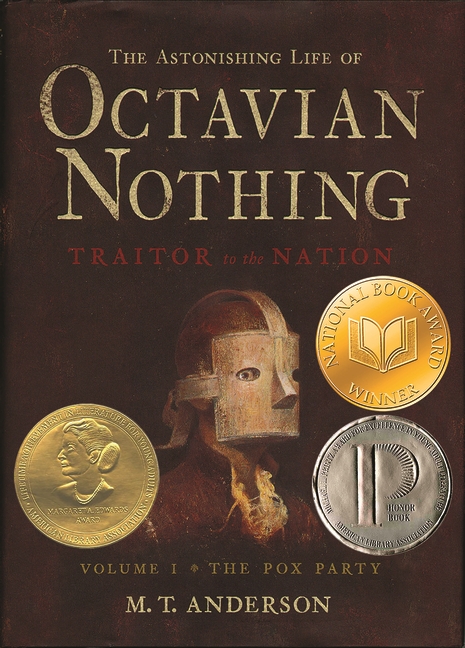
THE ASTONISHING LIFE OF OCTAVIAN NOTHING, two YA novels dealing with the morality of slavery beautifully
THE POX PARTY (The Astonishing Life of Octavian Nothing, Traitor to the Nation #1)
M.T. Anderson
Candlewick Press
$17.99 hardcover, available now
Rating: 4.5* of five
The Publisher Says: It sounds like a fairy tale. He is a boy dressed in silks and white wigs and given the finest of classical educations. Raised by a group of rational philosophers known only by numbers, the boy and his mother — a princess in exile from a faraway land — are the only persons in their household assigned names. As the boy's regal mother, Cassiopeia, entertains the house scholars with her beauty and wit, young Octavian begins to question the purpose behind his guardians' fanatical studies. Only after he dares to open a forbidden door does he learn the hideous nature of their experiments — and his own chilling role in them.
Set against the disquiet of Revolutionary Boston, M. T. Anderson's extraordinary novel takes place at a time when American Patriots rioted and battled to win liberty while African slaves were entreated to risk their lives for a freedom they would never claim. The first of two parts, this deeply provocative novel reimagines the past as an eerie place that has startling resonance for readers today.
My Review: I am always up for history, especially if it's presented from an unusual viewpoint or in a fresh manner. I thought this would be a fairly conventional and thus mildly tedious slave-comes-of-age, resists-tyranny thing. But there was that raver...surely someone who bothers to come to LT won't be that impressed by the usual thing....
So I got it, and I am so glad I did. The author recapitulates the bizarre upbringing of Octavian in a place called "The College of Lucidity" which is located in Boston (which is how you know it's fiction, Boston being the least lucid place I've ever been) in the faintly modernized voice of the youth himself looking back on the experience.
It's troubling, to put it mildly. It's flat creepy. But it's all he knew as a childhood, though life has taught him it's not what others knew as a childhood. He even quotes his mother saying he's never been a child. (He, Octavian, our narrator...these are interchangeable references in this review.) His very...well, ummm, inputs and throughputs are weighed and measured and logged for reference. His education is that of the most privileged, enlighted prince of his age. He stresses in presenting us with these facts that he felt no strangeness or otherness to his life. He was, so far as he knew, the object of no untoward interference or unusual interest.
The object speaks. It is a very unsettling reading experience.
As the story progresses and our narrator recalls his budding awareness and emotional growth as regards self and others, it becomes evident that Octvian and his mother are gilded captives. It's a realization that doesn't gall...yet...on him, but the author's subtlety with his emotional flensing knife is such that the older narrator's awareness of his feelings presages quietly the events at the end of the book. (No spoilers...but look carefully at the disturbing jacket illustration.)
Anderson's stated aim in writing this book is that he wished it had been around when he was a young reader. I wish it had, too. It's wonderful writing, no matter it's supposed to be "for" YAs. From p96 of the hardcover edition:
Our narrator...a youth, a stripling...so beautifully educated that he can create sentences like these! Such a huge bar is set for the youth reading this, but not one that's so far above and beyond comprehension that it's discouragingly impossible to meet. It's a nice sight to see the lack of condescenscion in this type of writing.
So how do the adults fare? Not too well, from the foolish and clueless Mr. Gitney to the aptly named and evil Mr. Sharpe, whose words from p338 (hardcover) I reproduce here that he may damn himself from his own lips:
So sayeth the free man to the slave. The prosecution rests. Recommended, and most highly.
+++++++++++++++++++++++++++++++++++++++++++++++++++++++++++++++++
THE KINGDOM OF THE WAVES (The Astonishing Life of Octavian Nothing, Traitor to the Nation #2)
Candlewick Press
$14.00 trade paper, available now
Rating: 3.5* of five
The Publisher Says: Fearing a death sentence, Octavian and his tutor, Dr. Trefusis, escape through rising tides and pouring rain to find shelter in British-occupied Boston. Sundered from all he knows — the College of Lucidity, the rebel cause — Octavian hopes to find safe harbor. Instead, he is soon to learn of Lord Dunmore's proclamation offering freedom to slaves who join the counterrevolutionary forces.
In Volume II of his unparalleled masterwork, M. T. Anderson recounts Octavian's experiences as the Revolutionary War explodes around him, thrusting him into intense battles and tantalizing him with elusive visions of liberty. Ultimately, this astonishing narrative escalates to a startling, deeply satisfying climax, while reexamining our national origins in a singularly provocative light.
My Review: Well, second books often don't rise to the level of the first in inventiveness and freshness. This one is typical of the syndrome.
Beginning where the extraordinary and original The Pox Party left off, The Kingdom on the Waves makes the adventures of Octavian Nothing complete. His best efforts are thwarted, his noblest desires unfulfilled, his quest for justice failed. All very true to history, but all very easy to predict. It's not that this is a bad book; it's a very good book. It's not clear to me why Anderson took 561pp to tell this story. I think the book sags a bit under the weight of its tale. It could easily have clocked in under 400pp and led us the same place.
I *love* that this is a YA book, written in so challenging and uncondescending a voice. Octavian is a very erudite narrator. I loved the structure of the book as a reader; it's in tasty-morsel-sized chapters. It's a very good book, and I recommend it.
I am firmly on record in many places as disliking the obesity of modern literary production. It's not that all books should be short in my opinion; it's that there is no reason for many, if not most, books to be as bloated with redundant and sometimes pointless verbiage as they are *stares pointedly at the Outlander books*. This book takes as its canvas a richly colored (no slur intended) part of American history. It's trying to fit a giant Technicolor extravagaza into a TV show. I think the editor would have done better to focus the author's obvious familiarity with the period on fewer episodes and left it at that.
But still, better a flawed and oversized story than none at all. The pleasures of the tale are many and savory, and I really hope you'll venture into YAdom to find this book soon.
M.T. Anderson
Candlewick Press
$17.99 hardcover, available now
Rating: 4.5* of five
The Publisher Says: It sounds like a fairy tale. He is a boy dressed in silks and white wigs and given the finest of classical educations. Raised by a group of rational philosophers known only by numbers, the boy and his mother — a princess in exile from a faraway land — are the only persons in their household assigned names. As the boy's regal mother, Cassiopeia, entertains the house scholars with her beauty and wit, young Octavian begins to question the purpose behind his guardians' fanatical studies. Only after he dares to open a forbidden door does he learn the hideous nature of their experiments — and his own chilling role in them.
Set against the disquiet of Revolutionary Boston, M. T. Anderson's extraordinary novel takes place at a time when American Patriots rioted and battled to win liberty while African slaves were entreated to risk their lives for a freedom they would never claim. The first of two parts, this deeply provocative novel reimagines the past as an eerie place that has startling resonance for readers today.
My Review: I am always up for history, especially if it's presented from an unusual viewpoint or in a fresh manner. I thought this would be a fairly conventional and thus mildly tedious slave-comes-of-age, resists-tyranny thing. But there was that raver...surely someone who bothers to come to LT won't be that impressed by the usual thing....
So I got it, and I am so glad I did. The author recapitulates the bizarre upbringing of Octavian in a place called "The College of Lucidity" which is located in Boston (which is how you know it's fiction, Boston being the least lucid place I've ever been) in the faintly modernized voice of the youth himself looking back on the experience.
It's troubling, to put it mildly. It's flat creepy. But it's all he knew as a childhood, though life has taught him it's not what others knew as a childhood. He even quotes his mother saying he's never been a child. (He, Octavian, our narrator...these are interchangeable references in this review.) His very...well, ummm, inputs and throughputs are weighed and measured and logged for reference. His education is that of the most privileged, enlighted prince of his age. He stresses in presenting us with these facts that he felt no strangeness or otherness to his life. He was, so far as he knew, the object of no untoward interference or unusual interest.
The object speaks. It is a very unsettling reading experience.
As the story progresses and our narrator recalls his budding awareness and emotional growth as regards self and others, it becomes evident that Octvian and his mother are gilded captives. It's a realization that doesn't gall...yet...on him, but the author's subtlety with his emotional flensing knife is such that the older narrator's awareness of his feelings presages quietly the events at the end of the book. (No spoilers...but look carefully at the disturbing jacket illustration.)
Anderson's stated aim in writing this book is that he wished it had been around when he was a young reader. I wish it had, too. It's wonderful writing, no matter it's supposed to be "for" YAs. From p96 of the hardcover edition:
Shortly after two o'clock on June 3rd, 1769, Venus descended into the plane of the ecliptic and came between the Earth and the sun. It is with awe that I treat of the event -- so minute, so silent here upon the Earth -- but there -- one can scarce imagine the roaring of that vast orb through those frigid depths, tumbling, flung through the plane of our orbit; the glaring heat, the searing glare of Sol -- and the gargantuan prodigiality of that body, consuming its own substance ceaselessly while planets whirled like houris, veiled and ecstatic around the throne of some blast-turbaned, light-drunken king.
Our narrator...a youth, a stripling...so beautifully educated that he can create sentences like these! Such a huge bar is set for the youth reading this, but not one that's so far above and beyond comprehension that it's discouragingly impossible to meet. It's a nice sight to see the lack of condescenscion in this type of writing.
So how do the adults fare? Not too well, from the foolish and clueless Mr. Gitney to the aptly named and evil Mr. Sharpe, whose words from p338 (hardcover) I reproduce here that he may damn himself from his own lips:
We have labored too long under a government that has sought to curtail exchange; such interference is unnatural. We shall see a brave new day, Octavian, when the rights of liberty and property are exercised, and when all men are free to operate in their own self-interest. And as each individual expresses his self-interested will, so does the democratical voice speak, the will of the common people, not kings and ministers; and when the self-interest of every citizen speaks together, then and only then does benevolence arise.
So sayeth the free man to the slave. The prosecution rests. Recommended, and most highly.
+++++++++++++++++++++++++++++++++++++++++++++++++++++++++++++++++
THE KINGDOM OF THE WAVES (The Astonishing Life of Octavian Nothing, Traitor to the Nation #2)
Candlewick Press
$14.00 trade paper, available now
Rating: 3.5* of five
The Publisher Says: Fearing a death sentence, Octavian and his tutor, Dr. Trefusis, escape through rising tides and pouring rain to find shelter in British-occupied Boston. Sundered from all he knows — the College of Lucidity, the rebel cause — Octavian hopes to find safe harbor. Instead, he is soon to learn of Lord Dunmore's proclamation offering freedom to slaves who join the counterrevolutionary forces.
In Volume II of his unparalleled masterwork, M. T. Anderson recounts Octavian's experiences as the Revolutionary War explodes around him, thrusting him into intense battles and tantalizing him with elusive visions of liberty. Ultimately, this astonishing narrative escalates to a startling, deeply satisfying climax, while reexamining our national origins in a singularly provocative light.
My Review: Well, second books often don't rise to the level of the first in inventiveness and freshness. This one is typical of the syndrome.
Beginning where the extraordinary and original The Pox Party left off, The Kingdom on the Waves makes the adventures of Octavian Nothing complete. His best efforts are thwarted, his noblest desires unfulfilled, his quest for justice failed. All very true to history, but all very easy to predict. It's not that this is a bad book; it's a very good book. It's not clear to me why Anderson took 561pp to tell this story. I think the book sags a bit under the weight of its tale. It could easily have clocked in under 400pp and led us the same place.
I *love* that this is a YA book, written in so challenging and uncondescending a voice. Octavian is a very erudite narrator. I loved the structure of the book as a reader; it's in tasty-morsel-sized chapters. It's a very good book, and I recommend it.
I am firmly on record in many places as disliking the obesity of modern literary production. It's not that all books should be short in my opinion; it's that there is no reason for many, if not most, books to be as bloated with redundant and sometimes pointless verbiage as they are *stares pointedly at the Outlander books*. This book takes as its canvas a richly colored (no slur intended) part of American history. It's trying to fit a giant Technicolor extravagaza into a TV show. I think the editor would have done better to focus the author's obvious familiarity with the period on fewer episodes and left it at that.
But still, better a flawed and oversized story than none at all. The pleasures of the tale are many and savory, and I really hope you'll venture into YAdom to find this book soon.
Wednesday, August 5, 2020
A FINE LINE, fifth Guido Guerrieri procedural set in Bari, Italy
A FINE LINE
GIANRICO CAROFIGLIO (Guido Gerrieri #5) {tr. Howard Curtis}
Bitter Lemon Press
$9.99 Kindle edition, available now
Rating: 4.25* of five
The Publisher Says: The fifth in the best-selling Guido Guerrieri series.
When Judge Larocca is accused of corruption, Guerrieri goes against his better instincts and takes the case. Helped by Annapaola Doria, a motorbike-riding bisexual private detective who keeps a baseball bat on hand for sticky situations, he discovers that the judge has links to the mafia. Larocca is blind to the immorality of his actions but Annapaola makes sure that justice is done, perhaps not in the most orthodox way. Of course Guerrieri cannot stop himself from falling for Annapaola's exotic charms.
The novel is a suspenseful legal thriller but it is also much more. It is the story of a judge who, to quote Dostoevsky, "lies to himself and listens to his own lies, so gets to the point where he can no longer distinguish the truth, either in himself or around himself."
Book One review — Book Two review — Book Three review — Book Four review
THIS BOOK WAS BORROWED VIA INTERLIBRARY LOAN. SUPPORT YOUR LIBRARY!
My Review: As you know by now, this is not the usual legal thriller. I found it just lovely to read, and for someone who's closer to 70 than to 40 I think that will hold true; but I'm sorry to say I do not think it will be of very wide appeal. The author's Italian-Mafia-prosecutor background has given us lots of good moments in the Italian legal system. Believe me, US citizens, it needs the kind of explication that will bore Grisham readers stupid.
Even I wanted things to get moving already, in fact several times flipped ahead two pages to get away from verbosity. So not my highest recommendation...but the pleasures of reading the book are there for the patient and the curious. Whatever you do, do NOT start here! Start at the beginning with Involuntary Witness and get to know Guido. He ages more or less in real time, unlike many (if not most) US series-mystery leads. This makes the Guido of this novel significantly more seasoned, and less approachable if you will, than his earlier self. Don't waver because of that...he's not surly! He's simply...feeling Time's Arrow nudging between his shoulder-blades.
But the pleasures of reading these stories are quite clear, very evident, eg:
Jurists, with rare exceptions, are unconsciously and tenaciously averse to clarity and brevity.It is worth remembering what the author's career is...trial lawyer...when reading that quote. He's got the insider dope, alrighty all right, and is sharing it with us. In more ways than one, and some are unconscious and unintentional....
This quote should be engraved on the rocks we throw at 45 after he's impeached, convicted, and is being transported to his forever home in prison:
Power – any form of power – is acceptable only if it’s transparent and clean, if it’s exercised in a way that is equal for everybody.Don't guess that needs belaboring.
Occasionally Author Carofiglio lapses into some sort of brain seizure, a strange and sad misalignment of synapses that produces these odd statements of unnecessary-to-refute error:
The situation had got out of hand, particularly because of the books. Apart from those on the shelves, there were books everywhere. On the floor, on the tables, on the sofas, in the bathroom, in the kitchen—and let's be honest, not all of them were indispensable.Poor man. So sad, those delusions of...of...well, beats me what you call it, but it's the syndrome when some Satanic imp uses your brain to bring *shudder* book-desacralization disorder into the world. Imagine thinking some books are dispensible! It is to laugh!
TEMPORARY PERFECTIONS, fourth Guido Guerrieri procedural set in Bari, Italy
TEMPORARY PERFECTIONS
GIANRICO CAROFIGLIO (Guido Guerrieri #4) {tr. Anthony Shugaar}
Rizzoli USA
$11.99 Kindle edition, available now
Rating: 4.5* of five
The Publisher Says: The electrifying best-selling crime thriller from Italy, available for the first time in English. An instant sensation and number-one best seller since its publication, Temporary Perfections is the fourth crime novel by former Italian prosecutor Gianrico Carofiglio to feature Guido Guerrieri. A lawyer practicing in Bari, in southwest Italy, Guido Guerrieri is hired by an old colleague to work a missing-persons case that the police have failed to solve. Manuela Ferraro disappeared six months ago after spending a September weekend at a beach resort; as Guerrieri digs deep into her life and activities, he stumbles into a sinister drug ring and the real truth about why Ferraro vanished.
Simultaneously thoughtful and suspenseful, this is crime fiction at its best.
Book One review — Book Two review — Book Three review — Book Five review
THIS BOOK WAS BORROWED VIA INTERLIBRARY LOAN. SUPPORT YOUR LIBRARY!
My Review: Fourth in the Guido Guerrieri series of Italian legal thrillers, this entry is not a procedural but a traditional private eye investigation. It is a true noir, set in Bari...a weirdly San Franciscan venue, and my how well its noirness is invoked.
Counselor Guerrieri, as the new translator calls him, is mid-flow on one of his usual if not terribly interesting workdays. He's had to move his law practice into new, American-ish offices because his former secretary has passed the bar and is now of counsel, and the adopted Peruvian daughter of some old friends is in there with him too. Plus a new secretary inherited from a deceased colleague. What was once snug became claustrophobic. So now Guido looks around himself, hating the slickness and the newness, and feeling all at sixes and sevens with his solitary life.
In walks an old colleague, with the zombified parents of a six-months-missing daughter. The Carabinieri, sort of a cross between the sheriffs and the FBI, must have missed something, Guido; you find people, you solve cases, Guido; please, my clients will pay you just to look over the file, Guido, please help them, look at them, they can't function, help them!
What co-dependent with a savior complex could resist such a plea? Not our Guido! No matter that he's a lawyer, not a PI, and no matter that the cop min charge of the case when it was opened is a friend of his, a man he respects, whose investigatory talents he trusts. Someone Needs Guido! And we're off, talking to the friends of vanished Manuela already interviewed, chasing down leads that have grown cold, being seduced and boinked by gorgeous, curvaceous young suspects...all the noir PI tropes are here, and well deployed.
In the end, Counselor Guerrieri solves the tawdry case, as everyone knows he will, but the fact that a Sherlock Holmes short story is the trigger that presents the solution to him is a touch I treasure. That the crime is solved and the guilty punished is a reason to read any fictional mystery, since real life seldom offers such order and satisfaction.
But then there are the dissatisfactions of this outing in the series. It is not a legal procedural thriller. There is no doubt in the mind of anyone at all that the vanished girl is dead from the get-go, so the suspense is only moderate. I am no fan of the sudden sea change in the direction, for all that I like noirs. I want my legal procedural fix!
And then there's the weirdness of the book being published by Rizzoli. ..!!.. That's right, the pretty-pictures people! It's a nice job, and it's not like they printed the book on 100-pound glossy paper and used overly ornamental dingbats on every page, but it's...unsettling...sort of like finding gay porn in your mama's nightstand. Error 404: File Not Found.
So why give it 4.5 stars, if I hate it? I don't hate it, it's quite well written, if translated in a way I'm less happy with that the previous two-book translator Howard Curtis did the job. But the main reason I've rated the book so highly is the portrayal of the bereaved parents.
Recommended.
Tuesday, August 4, 2020
INVOLUNTARY WITNESS, first Guido Guerrieri procedural set in Bari, Italy
INVOLUNTARY WITNESS
GIANRICO CAROFIGLIO (Guido Guerrieri #1) {tr. Patrick Creagh}
Bitter Lemon Press
$13.95, available now
Rating: 4.9* of five
The Publisher Says: The first in the Guido Guerrieri series.
A nine-year-old boy is found murdered at the bottom of a well near a popular beach resort in southern Italy. In what looks like a hopeless case for Guido Guerrieri, counsel for the defense, a Senegalese peddler is accused of the crime. Faced with small-town racism fuelled by the recent immigration from Africa, Guido attempts to exploit the esoteric workings of the Italian courts.
More than a perfectly paced legal thriller, this relentless suspense novel transcends the genre. A powerful attack on racism and a fascinating insight into the Italian judicial process, it is also an affectionate portrait of a deeply humane hero.
"Carofiglio writes crisp, ironical novels that are as much love stories and philosophical treatises as they are legal thrillers."—The New Yorker
"Raises the standard for crime fiction. Carofiglio's deft touch has given us a story that is both literary and gritty—and one that speeds along like the best legal thrillers. His insights into human nature—good and bad—are breathtaking." —Jeffery Deaver
Book Two review — Book Three review — Book Four review — Book Five review
THIS BOOK WAS BORROWED VIA INTERLIBRARY LOAN. SUPPORT YOUR LIBRARY!
My Review: Avvocato Guido Guerrieri, lawyer of Bari on Italy's southeastern coast, is fast approaching forty, newly separated from his wife of ten lost, bored years, and in the grips of the worst constellation of anxiety symptoms since Mr. Monk on the TV. He's moved into an apartment that he couldn't describe if you held a gun to his head, and he's absolutely unable to muster even a fake interest in his clients' problems. He sits, smiles, nods, files paperwork by rote, and in short lives on autopilot.
And then in walks a woman with a case. No money, but a case.
Non-European citizen Abajaje, Egyptian by birth, wants Guido to defend her...her...co-continental? boyfriend? fellow sufferer from race bias?...Abdou, a Senegalese immigrant and fake handbag selling beach vendor, against charges that he, a multilingual schoolteacher in Africa, with a love for children, did willfully restrain and cause harm to a child. The police are sure he did it; the few witnesses are sure it was him they saw acting strangely and cruising around the beach at the relevant time; what's the big deal here, anyway, he's just a black dude who talked to the kid, must be him who killed little Ciccio.
Except he was in Naples at the time. Guerrieri, in spite of himself, is intrigued by what the case doesn't have, proof, and what it does have, the defendant's improbable, unprovable, but true, alibi. Is truth capable of beating out prejudice in an Italian justice system not known for its love of Veracity, but more for her sister Verisimilitude?
Hmmm.
For 137pp, Carofiglio sets the stage with Guerrieri's craziness, his lackadaisical work habits, his depressed past and anxious present. It's all very nicely written, eg:
"You are intelligent, Avvocato. I have always thought of myself as more intelligent than other people. This is not a lucky thing, but it is hard to understand that.If you think yourself more intelligent than others, you fail to understand a lot of things, until they are suddenly brought home to you. And then it's too late."Thus Abdou the Non-European citizen to his lawyer in the prison's meeting room. I was regularly able to pause and appreciate the euphony and the accuracy of Carofiglio's writing. It shines through the book that he was a judge, in fact one of the judges who very bravely brought in guilty verdicts against Mafia defendants in the 90s trials that revolutionized the Mezzogiorno (Italy's southern region)'s social structure.
So it's no surprise to anyone that, in the last ~130pp, Carofiglio delivers the best, most complete, court trial I've read between book covers. It's a gem. It's pitch-perfect, and it's so nicely built that I hate to reveal it in detail. It's different than the standard American courtroom drama, because it's about the words, not the deeds, of the players. It's like listening to a fine old radio drama after watching an episode of "Starsky and Hutch" on AntennaTV.
It's a pleasure. I'm delighted to have found Sig. Carofiglio and Avv. Guerrieri at last.
Thursday, April 2, 2020
And now about these reviews....
In an older piece from The Atlantic, Maria Popova meditated on the ease of making, and finding, criticism of the arts in an online world. As someone whose opinions, strongly held, are often enough mistaken for and attacked for being Statements Of Inerrant Fact, I was struck by midcentury monadnock John Updike's reasonable requests of reviewers as quoted in Popova's article:
My rules, drawn up inwardly when l embarked on this craft, and shaped intaglio–fashion by youthful traumas at the receiving end of critical opinion, were and are:While I will never at all understand the spoilerphobia of so very many people, I will do my best to honor it. Someone, I promise you, will *al*ways* find fault and screech "spoiler" at the most innocuous-to-my-eyes things. They, being Gravely Injured, feel free to vent copious spleen upon the perp of the heinous crime. I'm tired of hearing their collective mouth, so I am making ever more serious efforts not to give away important points. I accept that I will, from time to time, fail in someone vocal's eyes. C'est la guerre.
1. Try to understand what the author wished to do, and do not blame him for not achieving what he did not attempt.
2. Give him enough direct quotation—at least one extended passage—of the book's prose so the review's reader can form his own impression, can get his own taste.
3. Confirm your description of the book with quotation from the book, if only phrase-long, rather than proceeding by fuzzy precis.
4. Go easy on plot summary, and do not give away the ending. (How astounded and indignant was I, when innocent, to find reviewers blabbing, and with the sublime inaccuracy of drunken lords reporting on a peasants' revolt, all the turns of my suspenseful and surpriseful narrative! Most ironically, the only readers who approach a book as the author intends, unpolluted by pre-knowledge of the plot, are the detested reviewers themselves. And then, years later, the blessed fool who picks the volume at random from a library shelf.)
5. If the book is judged deficient, cite a successful example along the same lines, from the author's ouevre or elsewhere. Try to understand the failure. Sure it's his and not yours?
To these concrete five might be added a vaguer sixth, having to do with maintaining a chemical purity in the reaction between product and appraiser. Do not accept for review a book you are predisposed to dislike, or committed by friendship to like. (emphasis added because damn, this is important!) Do not imagine yourself a caretaker of any tradition, an enforcer of any party standards, a warrior in an ideological battle, a corrections officer of any kind. Never, never (John Aldridge, Norman Podhoretz) try to put the author 'in his place,' making him a pawn in a contest with other reviewers. Review the book, not the reputation. Submit to whatever spell, weak or strong, is being cast. Better to praise and share than blame and ban. The communion between reviewer and his public is based upon the presumption of certain possible joys in reading, and all our discriminations should curve toward that end.
Here's a funny thing about writing about someone else's writing: Who cares? Why read reviews? Who asked you, as a former friend snarled at me once. I am not an academically trained critic; I follow no school of literary theory in writing about the books authors, publishers, and librarians give me, or that I buy with my very own United States dollars. What I do is called "reader response" criticism, a school of thought that has at its heart the silly idea that the reader, as opposed to the writer or the writer's intent, or the writer's execution, of the work is central to understanding the value of it.
I think of the reader as the source of the value a book has, not the writer or her unknowable (in my eyes) "intent." So I tell you what I felt about the book. I almost always use extended passages of the author's own prose in making my points. In short works that is sometimes impractical; in some cases it's simply impossible, like the extremely long single sentence that is Ducks, Newburyport (which I adored five stars'-worth but was unable to figure out how to review). I judge a book's success or failure based on how well it did the job of involving me, entertaining me, educating me; sometimes all of those things (and more) at the same time. Why is that valuable, I've been asked ("Who asked you" as mentioned above); yeah, so? seems to be the sneering tone I'm meant to hear.
There are, without exaggeration, hundreds of thousands of new, newly translated, newly re-translated, revised editions of books made available each and every year. I don't mean to alarm you, but the inescapable conclusion one must reach from that datum is that there are a whole helluva lotta books you will never hear about, let alone read. So let my biblioholism and seven-decade and counting lifetime of eclectic reading help you identify one or two you really shouldn't miss. I don't use affiliate links; I am unpaid by anyone; there's no advertising here. You'll get my opinion of a book's success or failure at its job, which is to impact me positively in the manner I procured it to do.
That opinion, being mine, is only of value to you if you know what it is; thereafter you can judge for yourself if your taste is close to mine, far from mine, on a different plane of existence from mine, and weigh your purchases or library holds accordingly. Hey, it's free! No ads to ignore, no secret commissions to cynically smirk about, zip zero nada rien requested or required from you. I hope you'll find my writing amusing as well as informative. I always love blog members leaving notes about what they agree or disagree with, but it's not required since you don't need to join up in order to read up.
So take what I'm freely offering with whatever sized salt measure suits you, strap on your anti-sarcasm armor, sharpen your Fork of Facetiousness, and ride!
Wednesday, February 26, 2020
A quick note.
I've been gone for a while, some nasty health challenges are at last clearing up...goddesses please bless the drug industry for its many successes!...but one thing, or more precisely two things, happened in December and January that reduced my desire to do this unpaid and non-commercial blog thing.
I got snarked at by A Famous Author on Facebook for calling out authors on what he was pleased to call "your mediocre reviews" (his had four stars lest you think I was making a point of being rude to him) and two weeks later on Twitter another Famous SF Author snapped about the way people "who think they're being helpful" by highlighting typos and the like, when all it does is cause Amazon to list that product as problematic.
Well, gents, a giant "fuck you" to reviewing your books, and the crappy, badly edited, typo-ridden books of indie authors. As to whom I'm intending to help, it ain't the author who can't or won't or doesn't think she needs to hire a copyeditor and a proofreader. They're different, equally important jobs; neither should be loaded onto a developmental editor, whose art is making your story better, not your book salable.
Can't afford it? Don't publish until you can. Publish anyway? Fix the errors your readers have alerted you to.
And belt the fuck up about how anyone who's paid for your book "owes" or "should" review it at all, still less only positively. No one owes you dick. You wrote the best book you could? Gold star, muffin, now put it in a drawer and glow with pleasure at this not inconsiderable achievement. Enter it into the commercial world and you're going to have to play by that world's rules.
Among those is the golden one: Value for dollars. An ebook is about as much as a fast-food burger. A paperback is about as much as an entrée at Applebee's. A hardcover's about what an entrée costs at a hotel restaurant. You'd better give me at least that much value or I am gonna tell the world you didn't.
I want to be clear: I do not have any income stream from book reviewing by my choice. When I've written reviews for other venues, they are and will be unpaid. I can't afford to make money because the US disability system says I must be in abject, unending poverty to have access to my Social Security payments (at less than half of what they would be if I'd retired on time). I ***hate*** advertising, so I'm not going to attempt to monetize this little tiny blog. So there's no reason for me try for huge readership, or to seek out the rare paying gigs that career writers BADLY NEED. I review books because I'm a tsundoku-suffering biblioholic without the slightest will or desire to be "cured" of my addiction. So here I am, asking you to read my reader-response reviews of books I've liked, loved, or (infrequently) loathed. There's no need for me to trim my cloth to the needs of others, and I won't, but the sheer noxious idiocy of saying in public that readers owe anything except the purchase price of the book to the author, or that a reviewer shouldn't say to a writer "I liked your book!" by mentioning that they've written a review of it, is something I won't let pass unchallenged.
Happier topics: 2019 was a *stellar* reading year! For the first time ever, I had two six-stars-of-five reads: Black Light: Stories, a debut story collection that gave me so much pleasure I read it twice (ever rarer occurance that), and the wrenching, gutting agony of Heart Berries, a memoir of such honesty and such vulnerability that I was a wreck after I finished it. I went back and forth a dozen times, first Author Parsons was the sixer, then Author Mailhot; neither book could possibly "win" for long because I couldn't get either book out of my mind.
I handed out 34 5- or damn-near-5-star reviews out of 155 reviewed books on LibraryThing and/or Goodreads; that's 22% of the total and that is a LOT. Many, even most of these (10+) were for short stories, for end-of-beloved-series novels, or for story collections. But hold on to something heavy: TWO, yes that's t-w-o dos due deux zwei два were...POETRY COLLECTIONS. Sarah Tolmie's The Art of Dying and the late Frank Stanford's collected poems, What About This: Collected Poems of Frank Stanford. Both were peak reading experiences. Another was cultural monadnock George Takei's graphic memoir They Called Us Enemy, which could not be more important for young people today to absorb.
What a beautiful year it was, to bring so many delights to my door. I hope, greedy thing that I am, that 2020 will repeat this performance. For all of us, really...honest! I didn't just add that on the end of this summing-up to make it sound less solipsistic.
In 2020, I wanted to post 10 book reviews a month on my blog. As of 26 February, I haven't posted a-one! The mitigating factors, some anyway, are listed above; but I need to get this train rollin' or the deficit will become daunting quickly. Even so, I still read a story every other day, as 2019's total of 155 (a lot of individual stories don't have entries in the sites' databases so I didn't post them individually; guess I should do more to sync the data this year) reads shows; so it's doable, and I've done better than that in the past.
I will Pearl Rule books I'm not enjoying with notes on Goodreads & LibraryThing about why I'm abandoning the read.
...and that's me done. My reports will continue to be quarterly here, the day after the end of the quarter.
Thursday, October 3, 2019
NIGHT BOAT TO TANGIER, apples never fall far from trees now do they? Longlisted for the 2019 Booker Prize
NIGHT BOAT TO TANGIER
KEVIN BARRY
Doubleday
$16.00 trade paper, available now
Rating: 4.5* of five
The Publisher Says: In the dark waiting room of the ferry terminal in the sketchy Spanish port of Algeciras, two aging Irishmen — Maurice Hearne and Charlie Redmond, longtime partners in the lucrative and dangerous enterprise of smuggling drugs — sit at night, none too patiently. It is October 23, 2018, and they are expecting Maurice’s estranged daughter (or is she?), Dilly, to either arrive on a boat coming from Tangier or depart on one heading there. This nocturnal vigil will initiate an extraordinary journey back in time to excavate their shared history of violence, romance, mutual betrayals and serial exiles, rendered with the dark humor and the hardboiled Hibernian lyricism that have made Kevin Barry one of the most striking and admired fiction writers at work today.
THIS CAME TO ME VIA MY LIBRARY'S I.L.L. PROGRAM. THANKS Y'ALL!
My Review: Sunsets are biblical, nighttime flowers are dull amethysts, quiet rubies...a tiny, sultana-faced man in lilac slacks and a blazer beneath a pompadour appears, to no story affect...London's bones limned against weak and apologetic light...this is a beautiful read.
The story is horrible, two men...Maurice and Charlie...whose love of their loucheness and their criminality and their addictions, their love for each other that excludes all the women they adore so helplessly and whose lives they casually, violently ruin, seek their daughter.
No. They aren't gay. The woman they both adored for a time had a baby and, well, who knows whose she really is.
Their awfulness is, in their fiftysomething selves, incredible and unforgivable. Their time in the Bughouse... smoky-grey brick Victoriana carrying the misery of three centuries...detoxing from heroin addiction is not enough to make the difference in their shared past. Their shared room, twin beds, no hint of physical intimacy they're Irish fagawdsake. No one in this book touches except for fucking or killing. People die, have died rather; these men haven't but they know they will. Soonish.
But they are themselves to the end. Does one wonder that Dilly, the desperately sought daughter, left and doesn't wish to be found? One does not. But neither does one feel their hunger to see her again, their desperate desire to connect to Life, is out of character. The way they seek to accomplish that connection is both toxic and perfect. They only know each other in this world. They came to do this desperate thing together. They'll leave together, they'll make whatever there is to be made of breathing after life is over.
I will be a bit let down if this book does not win the 2019 Booker in twelve days. No, strike that, I'll be jawdroppingly stunned and not a little pissed off. Beautiful, poetic, smooth phrases telling hideous, deforming agonies in stertorously breathed oxygen-poor oceans of wreckage aren't common and neither should they be. A diet of these stories would put me in the Bughouse to breathe the smoky-grey brickdust of bygone agonies.
But when they appear these highly luminescent scimitars, curved to the reader's psychic throat, should get the fearful praise and nervous acknowledgment that Charlie and Maurice have always commanded.
Tuesday, September 24, 2019
FRIDAY BLACK by a brave new voice in speculative fiction, Nana Kwame Adjei-Brenyah
FRIDAY BLACK: Stories
NANA KWAME ADJEI-BRENYAH
Mariner Books
$14.99 trade paper, available now
Rating: 4.75* of five
The Publisher Says: In the stories of Adjei-Brenyah’s debut, an amusement park lets players enter augmented reality to hunt terrorists or shoot intruders played by minority actors, a school shooting results in both the victim and gunman stuck in a shared purgatory, and an author sells his soul to a many-tongued god.
Adjei-Brenyah's writing will grab you, haunt you, enrage, and invigorate you. By placing ordinary characters in extraordinary situations, Adjei-Brenyah reveals the violence, injustice, and painful absurdities that black men and women contend with every day. These stories tackle urgent instances of racism and cultural unrest and explore the many ways we fight for humanity in an unforgiving world.
I CHECKED THIS BOOK OUT OF MY LOCAL LIBRARY, SAVING $10 BY NOT PURCHASING A KINDLE BOOK. THANKS, Y'ALL!
My Review: A young African American man writes speculative fiction about the alt-present/near-term future from the point of view of the deeply disadvantaged, the ones whose American Dream is a nightmare. An editor sees it, is probably appalled but is certainly moved, and for a minor miracle of a wonder, buys this amazingly assured debut collection of stories by first-generation American Author Adjei-Brenyah. Wherever he saw an odd, he beat it, did the young author. Syracuse University MFA? Now, with this man's debut, that means something to me, where before I'd never have so much as fluttered an eyelid as the words crossed my field of vision.
And speaking of vision, this cover is something special, isn't it? (He's no slouch in the handsome derby either!)

A statement of the powerful reading contained within. This detail image is so pretty I can't resist sharing it:

Author Adjei-Brenyah says, "I do bad at school because sometimes I think when I should be learning." (p29) I nod. I totally understand this kid who's speaking. As the school day unfolds over the next four pages, the Long Big War and HowItWas class, and not only am I clear on how we got here, I'm pretty darn sure that somehow he's come back from the future to warn us what's coming. And man is he pissed off. You won't blame him when you read the collection. Note absence of conditional in previous sentence. Not if, when. These are stories you need.
As is my habit, I'll offer some impressions of each story a la my quondam pal Bryce in his inimitable Method. (He did it better than I do, I'm only aping the form.)
The Finkelstein 5 made me want to vomit. I had to google it to be sure it wasn't reportage. Emmanuel's chant of "Fela St. John, Fela St. John" will haunt my nightmares. How we can look at ourselves as we shave and titivate in our sparkly mirrors is beyond my emotional comprehension. There is a slow-motion genocide against African Americans and this story shouts, "they released the brakes! and the hounds!" at the top of its paper lungs. 4 stars
Things My Mother Said is, in 500 or so words, a complete and compelling worldbuilding sketch. This man has the chops. 3 stars
The Era is an updated Brave New World/This Perfect Day tale about industrial mood management; its effects on high schoolers, families, hierarchies; it packs one helluva wallop as deeply undesirable "shoelookers" claim another "dumb/slow" clear-born, someone whose parents didn't use OptiLife™. Chilled me more than a martini in a shaker. Haunting for its deep anger. No one should ever think for a second that the Millennials' kids are safe.
She steps to me. I stretch my neck out for her and close my eyes. She puts one hand on one side of my neck. Her hand is warm plus strong. She stabs the injector needle in. My head feels the way an orange tastes. I open my eyes and look at her. She waits. I look at her more. She frowns, then gives me another shot. And then I feel the Good.Soma, anyone? Extra treatments? Yes, Author Ira Levin, I see your vision refuses to die as it steadily approaches. 5 stars
Lark Street is one fucked-up fever dream of guilt, loneliness, bad decisions, the crushing weight of morality grinding a boy into his mortality's disease vector.
An impossible hand punched my earlobe. An unborn fetus, aborted the day before, was standing at my bedside. His name was Jackie Gunner.There is no hiding from consequences in Author Adjei-Brenyah's world. 4.5 stars for some frankly unworthy-of-him gender stereotyping.
"So, I guess you didn't have the balls?" Jackie Gunner said. His voice was a stern squeak. My eyelids rolled open. He was a tiny silhouette on the end of my pillow. Smaller than a field mouse.
"Well, say something, Dad." He said Dad the way some people say cunt. "Do you even feel bad?"
"Yeah," I said. "I feel real bad."
"I feel real bad," Jackie Gunner repeated. "Is real bad a hole big enough to fit our lives in?"
"Our?" I said.
"It's a metaphor, Daddy," said a new voice, this one shy, charming even. A second tiny fetus climbed up my comforter onto my bed. Her name, I knew, was Jamie Lou.
The Hospital Where brings us on a w-verb-filled journey through a young writer's bargaining with the Twelve-Tongued God (I love this concept!), who promises him Everything in return for his abject servitude to Story. It's gloriously weird; it contains multitudes (of winks); it resonates with the agonized scream of an abandoned boy demanding his daddy not leave. What, indeed, have you done.
Soon I was staring at a small entryway sign that read RADIOLOGY I. In the hall there was an extremely old man in a wheelchair. He groaned steadily. His white skin looked stretched and spotty. It seemed someone had forgotten him or maybe was using him to prop open the door. There were so many tubes going in and coming out of him that I couldn't imagine where they began or ended. I walked past quickly. Farther down the same hall, a black guy in a wheelchair stared in my direction with eyes so empty I thought they might suck something out of me.Shivery horripilatingly pure prose telling of a son's psychotic break...or possibly apotheosis...as his father succumbs by degrees to cancer in an uncaring, unfeeling system with classist assumptions informing its death-care. 5 stars
Zimmer Land felt so real to me that, again, I had to google it to be sure it wasn't. It's what I feel about the oddly innocuous-sounding "first-person shooter" games that scare me, disgusting visceral violence as the perp sees it, made more revoltingly real. Living, breathing Black men get shot (but not harmed...physically) for a living. In a world where George Zimmer is free but Trayvon Martin is dead, it's almost pornographic. No, it isn't. Scratch the "almost."
The first day of Zay's new job in Zimmer Land's Creative department, a job his ex landed for him thus dragging him up from a mere black body in a safe place for a white "patron" to enact his violent racist fantasies on, is moved an hour earlier; his boss "forgot" to tell him, one senses because his boss was nudged that way by the company founder...a Zardoz-like holographic head whose body is in Cabo schmoozing the banksters for R&D money...since the founder is dating Zay's ex. Corporate politics, racism, end-stage capitalism (the park is about to allow minors in to experience the thrill of murdering a black man). What a piece of work is Man, man. 5 stars
Friday Black reminds me of why I don't do shopping during the xmas rush. I'm not all the way sure it's fiction. The insane stuff-lust that I've seen on news broadcasts as hordes violently rush displays of useless brummagem objects in a desperate race to Buy to Have to Possess the Latest...! Deaths are still rare on Black Friday...for now.... 3 stars
The Lion & The Spider interweaves the Trickster Anansi outwitting the boastful Lion with a son's fear, rage, betrayal as he learns his father is a human being without losing his need to be a son. A well-made story, if not precisely to my taste. 3.5 stars
Light Spitter takes us inside the void created when the world shovels its shit into a kid who has no way to say "no, NO, it hurts, NO" so the weight piles in-on-up until a gun answers the taunts. Horrible, horrible cruelty answered by the sneer of ballistic ammunition. Added bonus: Author uses homophobic slur! Lovely. 4 stars
How to Sell A Jacket As Told by IceKing is the continuation of "Friday Black" told by the same narrator a few years down the line. IceKing's still at the top of his game pushing crap onto people who probably don't need it, but time's ticktickticking. No one wants to be trapped in retail forever. It's not my favorite setting or PoV plus it's got a w-bomb in it, so...well...like that. 3 stars
In Retail is the other side of the rivalry from IceKing...not gonna lie, even six pages of it was no fun, I don't think this is the place Author Adjei-Brenyah needs to be setting his focus. Maybe it's all out of his system now? I for one sure hope so. 3 stars because it's not like it's poorly written, I just don't like it
Through the Flash is the hell of Eternity, the unceasing wretched quotidian repetition of one then another then another cycle of waking, eating, dying...world without end. A future bleaker than any dystopia you've ever read, packed into 27 pages full of the bile of human cruelty, the scalding freeze of knowledge without wisdom, the immutability of lives meant to be impermanent frozen into a rictus of deathlife.
So now we come to the hardest thing for Humanity to bear: Boredom. Not hunger, not violence, not anger. Boredom is the thing that will kill a human being from the inside out. A human will resort to violence and will court anger to escape from the misery, the unending loss, lack, void that is Boredom:
It's very hard at first for some people. But then if you figure that you are infinite, you are supreme and therefore the master of all things, and it's silly to be sad about things like how much your hip is always going to hurt or how you're so old that the flu means a life in bed or how gone forever your mother is.The 1993 film Groundhog Day always seemed to me to be a singularly vicious and cruel torture-porn exercise. But hey, I never thought Don Rickles was funny even as a kid. If I laugh at someone's misfortunes or disabilities, it's because I hate 'em personally. In general it's just not fun or funny to watch someone suffer, especially of boredom.
How did the world come to be so small? How does Ama, our narrator, come to be the sole possessor of life and death in her eternally renewed Inferno? Ama tells us the Water Wars wrought some awful changes on the world we thoughtlessly squandered:
I don't know much about other grids in our state block, because way before the Flash came, the soldier-police—the state-sponsored war-coordination authorities—took away everyone's cars. Their slogan—"For us to serve and protect, you must conserve and respect"—is emblazoned on posters in the school, on the windows of some people's homes. ... Back before the Flash ever came, a lot of people actually loved the SPs. They thought they were keeping us safe. People believe lies, believe anything when they are afraid. That's another thing. Aren't we lucky that before the Flash all the soldier-police were deployed elsewhere?So the Flash comes, the anomalous great horror of eternal and changeless repetition, and there is absolutely no one to stop the predators from consuming their fill of the prey's agonies.
Author Adjei-Brenyah understands cruelty and despair and the viciousness of the indifferent physics of the Universe far too well for someone who hasn't hit middle age. I'm sad for him. I'm grateful he chose to make his horror into art. I want to read more of his unnervingly precise images and his unpretentious prose before I shuffle off to, well, whatever it is that's next.
Thursday, September 19, 2019
LIE WITH ME, a récit about the formative powers of love translated by Molly Ringwald
LIE WITH ME: A Novel
PHILIPPE BESSON translated by Molly Ringwald
Scribner
$25.00 hardcover, available now
Rating: 5* of five
2023 UPDATE A French-language film of the novel got a decent review in The Guardian. Maybe coming to a North American arthouse near you?
The Publisher Says: The award-winning, bestselling French novel by Philippe Besson about an affair between two teenage boys in 1984 France, translated with subtle beauty and haunting lyricism by the iconic and internationally acclaimed actress/writer Molly Ringwald.
We drive at high speed along back roads, through woods, vineyards, and oat fields. The bike smells like gasoline and makes a lot of noise, and sometimes I’m frightened when the wheels slip on the gravel on the dirt road, but the only thing that matters is that I’m holding on to him, that I’m holding on to him outside.
Just outside a hotel in Bordeaux, Philippe chances upon a young man who bears a striking resemblance to his first love. What follows is a look back at the relationship he’s never forgotten, a hidden affair with a gorgeous boy named Thomas during their last year of high school. Without ever acknowledging they know each other in the halls, they steal time to meet in secret, carrying on a passionate, world-altering affair.
Dazzlingly rendered in English by Ringwald in her first-ever translation, Besson’s powerfully moving coming-of-age story captures the eroticism and tenderness of first love—and the heartbreaking passage of time.
My Review: I've spoken in previous reviews about the power of the (mostly) French art form, the récit, an ill-defined, "you'll know it when you see it" form of literary tale-telling. And all those ambiguous layers of the latter phrase, from straightforward "telling a story" to "tattling on someone" to "inventing a lie" are each present in the récit itself. The qualities I can suss out as being sine qua non for a work to be a récit are length—brevity is the soul of wit, lingerie, and récits—and interiority. Nothing describable as a récit can take place in "real time" or include voices not mediated by the narrator and/or author through a single tightly focused lens. If you've read Camus's The Fall, you've read a peak-experience récit. If you didn't like reading it, I venture to suggest that you not pay a lot of attention to the genre.
Brevity this book has: In 148pp, Besson tells the oldest gay love story there is: Boy meets boy; boy loves boy, is loved by boy; neither one says the right "wrong" thing to his belovèd to make the "forbidden" connection happen; and they go their separate, unequal, always intertwined ways. Interiority it simply is: All the words we read are Philippe's or Philippe's reports of conversations recently or distantly past. Philippe-the-narrator tells us several times that, as a novelist, he makes stuff up; he implies that he's done that habitually; so we're left to our own devices to decide about his honesty, his accuracy, and his intentions in telling us this tale.
I'm going to let you read Philippe-the-author and Philippe-the-narrator's words unmediated by my own commentary on them. In my own way, I want to honor the form of the récit as a review. The book is beautiful for many reasons. Translator Ringwald has made a beautiful thing in this book. I haven't read the French text, but I know enough from previous Besson encounters to believe this is a deft and charming rendering of his original. As to Besson's tale told...well..."is it autobiographical" is the first line of defense against immersion into the unreliability of Memory that this, a beautiful and moving and elegiac récit, invites its readers to experience. I recommend reading it, experiencing it, absorbing its beauties and funnies and rawnesses, without any additional removes from immediacy. Don't, then, place harsh lights on it or look for factual details in it; let it become the limpid waters of Monet's water-lily pond for your inner reader's delight and refreshment.
Chapter One (1984)
I'm not beautiful, but I get attention; that I know. Not because of my appearance, but because of my {good} grades. "He is brilliant," they whisper, "much more advanced than the others, he will go far, like his brother, this family is one to be reckoned with." We are in a place, in a moment, where nearly everyone goes nowhere; it garners me equal parts sympathy and antipathy.pp8–9
Upstairs, after climbing a makeshift staircase, you would enter a room full of anything and everything. There was even a mattress. It was on this mattress where I rolled around in {his first love}'s embrace for the first time. We had not gone through puberty yet, but we were curious about each other's bodies. His was the first male sex I held in my hand, other than my own. My first kiss was the one he gave me. My first embrace, skin against skin, was with him. ... Today I'm struck by our creativity because at the time, there was no internet, not even videocassettes or cable TV. We had never seen any porn, and yet we still knew how to do it. There are things one knows how to do even as a child. By puberty, we would be even more imaginative. That would come fast(p13)
A million questions flash through my mind: How did it begin for him? How and at what age did it reveal itself? How is it that no one can see it on him? Yes, how can it be so undetectable? And then: Is it about suffering? Only suffering? And again: Will I be the first? Or were there others before me? Others who were also secret? And: What does he imagine exactly? I don't ask any of these questions, of course. I follow his lead, accepting the rules of the game.(p28)
He says: I know a place.
I discover that absence has a consistency, like the dark water of a river, like oil, some kind of sticky dirty liquid that you can struggle and perhaps drown in. It has a thickness like night, an indefinite space with no landmarks, nothing to bang against, where you search for a light, some small glimmer, something to hang on to and guide you. But absence is, first and foremost, silence. A vast, enveloping silence that weighs you down and puts you in a state where any unforeseeable, unidentifiable sound can make you jump.(p37)
He says that for me things are simple, that everything will be fine, that I will get out of it, it's already written, that there's nothing to worry about, the world will greet me with open arms. Whereas for him there's a barrier, an impenetrable wall, forbidding him to deviate from what has been predetermined.(pp46–47)
Whenever he mentions this question of the forbidden I will try in vain to show him that he's wrong.
A few weeks later he'll take me for a ride. He'll pick me up at the edge of town, with a helmet this time. I don't know if it's as a precaution, to respect the law, or so that we won't be recognized, but I get on the back of the bike and hold on to him. We drive at high speed along back roads, through woods, vineyards, and oat fields. The bike smells like gasoline and makes a lot of noise, and sometimes I'm frightened when the wheels slip on the gravel on the dirt road, but the only thing that matters is that I'm holding on to him, that I'm holding on to him outside.(p65)
...there is often a staggering intimacy between us, a closeness beyond imagining, but the rest of the time our separateness is absolute. Such schizophrenia could bring even those with the strongest equilibrium to the edge of reason, and let's admit it, I didn't have much equilibrium to begin with.(p77)
There is the insanity of not being able to be seen together. An insanity that is aggravated in this case by the unprecedented situation of finding ourselves in the middle of a crowd and having to act like strangers. It seems crazy not to be able to show our happiness. Such an impoverished word. Others have this right, and they exercise it freely. Sharing their happiness makes them even more happy, makes them expand with joy. But we're left stunted, compromised, by the burden of having to always lie and censor ourselves.
This passion that can't be talked about, that has to be concealed, gives way to the terrible question: if it isn't talked about, how can one know that it really exists? One day, when it's over, when it finally comes to an end, no one will be able to attest to what took place.
...I hurry to get what I want before he changes his mind. I take the picture. In it, he's wearing jeans, a plaid shirt with rolled-up sleeves. He has the blade of grass between his fingers and he's smiling, a slight, complicit smile, almost tender. This smile devastated me for a long time after, whenever I happened to look at this photograph. It upsets me even now as I write these lines and contemplate the image, resting on my desk, right next to my keyboard. Because now I know. I know that {he} consented to this single picture only because he knew (had decided) that it was our last moment together. He smiled so that I could take his smile with me.(pp89–90)
Chapter Two (2007)
I know that there are those who will object to my refusal to accept that he changed course, switched orientation, simply succumbed to a feeling that was previously unknown to him. I could be seen as upset, jealous, or even obtuse, and yet I persist in thinking that he put the same stubborn application into this as he did to his work. The same desire to forget himself, to return to the righteous path set out by his mother, the only one permissible. Does he end up believing it himself? That's the fundamental question. If the answer is yes, then moving forward in life would be possible. If the answer is no, then it is a life condemned to interminable misery.(p106)
(I correct myself because I've just been lying. Of course, it took time, a lot of time, before I admitted that everything was lost, before I decided to say goodbye forever. I kept hoping for a sign. I thought of initiating another meeting, I started letters that I never sent. Desire does not go out like a match, it extinguishes slowly as it burns into ash. In the end I gave up on all possibility of a reunion.)(p112)
...I live with a man with a man who is fifteen years younger than me and doesn't like boys but loves me. Who knows why? It's a vulnerable relationship, and I will be scared to disturb this precarious equilibrium. Calling {him}, talking to him, asking to see him again, would be anything but innocuous. I cannot say: This is only a phone call. I know it's more than that. Even if I were granted immunity, the act of calling him has the allure of betrayal (we come back to that, always we come back to it) or without going to that extreme, a gesture toward {him} would be a gesture of mistrust toward the man I live with—a decision to put distance between us, to admit to a love that is not enough.(p120)
Chapter Three (2016)
In that first moment, when he heard me say that I had seen you, he didn't move, but I swear he lost his balance. At that exact moment I was certain that he had been in love with you. That such a thing had existed—my father in love with a boy. I didn't need to ask him the question. I couldn't have found the courage anyway. Afterward, I said to myself: Maybe it was just a phase. Okay, yes, it existed, but it ended. He moved on to something else—to a life, a woman, a child...that must happen often, these things. I told myself: when he saw you on TV, it brought back the memory, but it was just nostalgia. A secret from the past...everyone has secrets; besides, it's good to have things that belong only to you. I could have stayed there. It should have stayed there. Except that two days after our conversation, my father brought us together to announce he was leaving.(p142–143)
Subscribe to:
Posts (Atom)