Showing posts with label Atlantic Monthly Press. Show all posts

Friday, January 16, 2026

WINTER: The Story of a Season, seasonal celebration of hygge...in tartan


WINTER: The Story of a Season
VAL McDERMID
(illus. Philip Harris)
Atlantic Monthly Press (non-affiliate Bookshop.org link)
$22.00 all editions, available now

The Independent Press Top 40 Bestsellers: Non-Fiction For the week ending January 25, 2026

Rating: 4* of five

The Publisher Says: In this radiant work of creative nonfiction, internationally beloved novelist Val McDermid delivers a dazzling ode to a lost world, ruminating on a single winter in her life as she journeys into the heart of the season’s ever-evolving community-based traditions

Val McDermid has always had a soft spot for the bitter clarity of a crisp cold day, the crunch of frost on fallen leaves, and the chance to be enveloped in big jumpers and thick socks.

In Winter, McDermid takes us on an adventure through the season, from the frosty streets of Edinburgh to the windblown Scottish coast, from Bonfire Night and Christmas to Burns Night and Up Helly Aa. Recalling in parallel memories from her own childhood—of skating over frozen lakes and carving a “neep” (rutabaga) for Halloween to being taken to see her first real Christmas tree in the town square—McDermid offers a wise and enchanting meditation on winter and its ever-changing, sometimes ephemeral, traditions.

A hygge-filled journey through winter nights, McDermid reminds us that it is a time of rest, retreat and creativity, for scribbling in notebooks and settling in beside the fire. A treat for the hunkering-down, post-holiday reading season, Winter is a charming and cozy celebration of the year’s idle months from one of Scotland’s best-loved writers.

I RECEIVED A DRC FROM THE PUBLISHER VIA EDELWEISS+. THANK YOU.

My Review
: See, that's the thing about "traditions"...they start, and change, and then vanish. They're human-made decisions, all of them. Collective loss of interest is killing awards shows on TV, which were a staple of my own TV-blighted childhood. It felt immutable: Watching the Oscars was a ritual. It might've been the only time our TV was tuned to ABC until the late 1960s. It was a ritual in my teens, too, among the theatre kids I hung out with. Now Disney's taken it away from ABC to go onto Hulu, the corporate streaming service for things they don't think will earn much money.

A tradition of fifty years shifting?! Whaaat? Traditions shouldn't change! They make the framework of our lives!

They do indeed do that. As Val McDermid's compact essay on the rituals she's made and those she's inherited from her family (her mother's improvised soup a good example) of the cold season discusses, how exactly they do that is a matter of decision and choice. Her wintertime activities growing up in freezyfrosty cold Scotland could not've taken place in my contemporaneous Sun-Belt childhood...I've only seen frozen-over ponds maybe three times since moving to New York's heat island in the 1980s, but that's three more than I ever saw in Texas...my own winter rituals of shuffling up wet live-oak leaves to see what was living under them, and putting out the toad house, wouldn't've made her radar.

In remembering her own place in the march of the seasons, Author McDermid offers us many fresh bits and bobs to incorporate into our own seasonal traditions, appreciations of reading she's done while cozied away from cold and wind, foods that warm and comfort, poems she's written and read (nothing is allowed to be poetry-free in this decade, to my disgust) all offer the reader delights to consider adding to their own lives.

What a wonderful read, what a wonderful gift to (self-)gift to the resistant cold-hater and the delighted snugness addict alike. The illustration, not provided to reviewers for reproduction, are charming and atmospheric, though what I'd call pedestrian. I can't offer a fifth star to something that contains this much poetry. I'd probably knock a bit off even absent the poetry because the illustrations aren't that interesting to me, but I know many will enjoy them.

Author McDermid's fiction readers are strongly urged to pick the book up because it is so interestingly in tension with her very noir crime novels. It might very well have been my most enjoyable moment trying to put Karen Pirie into the time young Val sees her first xmas tree in the public square!

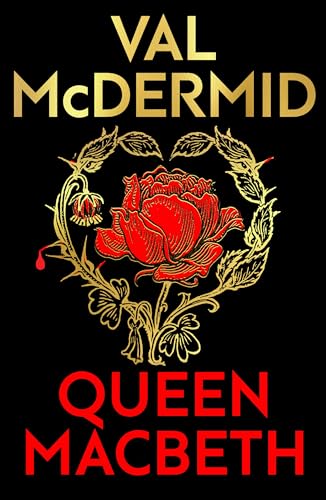
Monday, September 23, 2024

QUEEN MACBETH, feminist thriller set in medieval Scotland starring a reimagined Lady Macbeth


QUEEN MACBETH
VAL McDERMID

Atlantic Monthly Press
$22.00 hardcover, available tomorrow

Rating: 4* of five

The Publisher Says: Shakespeare fed us the myth of the Macbeths as murderous conspirators. But now Val McDermid drags the truth out of the shadows, exposing the patriarchal prejudices of history. Expect the unexpected . . .

A thousand years ago in an ancient Scottish landscape, a woman is on the run with her three companions—a healer, a weaver and a seer. The men hunting her will kill her—because she is the only one who stands between them and their violent ambition. She is no lady: she is the first queen of Scotland, married to a king called Macbeth.

As the net closes in, we discover a tale of passion, forced marriage, bloody massacre and the harsh realities of medieval Scotland. At the heart of it is one strong, charismatic woman, who survived loss and jeopardy to outwit the endless plotting of a string of ruthless and power-hungry men. Her struggle won her a country. But now it could cost her life.

I RECEIVED A DRC FROM THE PUBLISHER VIA NETGALLEY. THANK YOU.

My Review
: I'm a man. An old, white one.

I'm sorry to disappoint those who now expect me to whine about "ruining Shakespeare" and "making up feminism ahistorically" and suchlike nonsense, but I myownself think this novella is telling not only a cracking good story, but bringing a long-ignored reality to light. Women, modern, medieval, or ancient, were and are not passive, pointless victims or tiresome termagants. They are, were, and always have been people with agency, possessed of skills and ideas that motivate and support changing their world.

Every story that supports this reality, presents it without a dingy scum of patriarchal judgment of those women for exercising their power, gets my enthusiastic support. Queen Macbeth is no exception.

Riffing on the great stories of history and mythology is currently very much à la mode. The trend picked up steam most recently after The Song of Achilles appeared early in the teens. It was never exactly ignored, after all...John Erskine wrote Arthurian retelling Tristan and Isolde: Restoring Palamede in 1932; Thorne Smith wrote modern satires with horny, drunken Greek Gods until his death in 1934; Tolkien remixed Anglo-Saxon epic poetry to some modest success in the 1950s. The urge to put one's own stamp onto the greatest stories of the culture is never absent. Imagine all the lost Iliads wrought by bards before writing was reinvented! (Side note: why has Jodi Taylor not sent the disaster magnets back to record some of those?) The great plays of Athens's Golden Age retold the myths, too, and that was six hundred years before the common era is reckoned to have begun.

So a Scottish crime writer revisiting Lady Macbeth's truly awful characterization at Shakespeare's hands is unsurprising. Make that Scot an outspoken feminist lesbian and, well, go figure that she would find this retelling irresistible. I wish I'd loved it instead of simply, and inevitably, admiring it. Using her widely lauded storytelling chops to re-center the Bechdel-test failing character as a powerful ruler in her own right is delightful; the way she contextualizes her choice in her Author's note made me almost giddy with anticipation.

Then came reality swinging her mace of office.

Choosing to use Scottish words...well, okay, you're Scottish, the story's Scottish, but the huge majority of the world's readers have never seen, and don't care to see, those words. Climbing the hill with a Glossary is fine; putting said glossary at the end of an ebook is a worse idea than in a tree book. In the ebook, a hyperlink to the entry with that word is possible; links that take you there and back are possible; neither was made. I did not use the glossary once during the read and lost not only fine nuance but faith that I was being considered as a guest in this world. It feels very much like the divisive, arrogant attitude regrettably common...in every sense of the word...in internet discourse about cultural identity: "I don't owe you an explanation of my culture/language/art/thing under discussion!"

Then you do nor care if I, or any "outsider," understand you? Okay. Then you'll mostly get ignored.

Author McDermid and/or publisher(s) just put a hard limit on how many people will slug it out with unhelpfully untranslated Scottishness. The tree book might be a better choice than an ebook for those who can't or won't simply skip past wotds they don't know.

Pity, that; Gruoch as reimagined is a kickass character. Her struggles matter.

Monday, January 2, 2023

DEEP RIVER, what you'd expect from Karl Marlantes...yes, it's that good


DEEP RIVER
KARL MARLANTES

Atlantic Monthly Press (non-affiliate Amazon link)
$1.99 on Kindlesale! Get it now!

Rating: 4.5* of five

The Publisher Says: Karl Marlantes's debut novel Matterhorn has been hailed as a modern classic of war literature. In his new novel, Deep River, Marlantes turns to another mode of storytelling—the family epic—to craft a stunningly expansive narrative of human suffering, courage, and reinvention.

In the early 1900s, as the oppression of Russia's imperial rule takes its toll on Finland, the three Koski siblings—Ilmari, Matti, and the politicized young Aino—are forced to flee to the United States. Not far from the majestic Columbia River, the siblings settle among other Finns in a logging community in southern Washington, where the first harvesting of the colossal old-growth forests begets rapid development, and radical labor movements begin to catch fire.

The brothers face the excitement and danger of pioneering this frontier wilderness—climbing and felling trees one-hundred meters high—while Aino, foremost of the book's many strong, independent women, devotes herself to organizing the industry's first unions. As the Koski siblings strive to rebuild lives and families in an America in flux, they also try to hold fast to the traditions of a home they left behind.

Layered with fascinating historical detail, this is a novel that breathes deeply of the sun-dappled forest and bears witness to the stump-ridden fields the loggers, and the first waves of modernity, leave behind. At its heart, Deep River is an ambitious and timely exploration of the place of the individual, and of the immigrant, in an America still in the process of defining its own identity.

I RECEIVED A DRC FROM THE PUBLISHER VIA EDELWEISS+. THANK YOU.

My Review
: Remember when I warbled my fool lungs out about how awful, painful, and enraging Matterhorn was, and then gave it my annual 6-stars-of-five nod? And told y'all to move quick and get the book? No?! What do you mean, "no"?! You don't commit all my reviews to memory?! Ingrates....

The wattage of warbling is lower this time, but then again I'm ten years older. Everything is lower. (I hate you, Gravity.) What is not lower is Karl Marlantes' level of writing:
Then, like a seaborne Sisyphus, the ship clawed to the top of the next towering wave, as the sailors fought gravity and slippery decks to maintain their balance and their lives.
–and–
With those you love, you accept that there are only two ways you will not get hurt when you lose them. You stop loving them or you die first.

It's to your taste, or it's not; but it is not describable as bad. I've heard the "purple prose" calumny tossed lightly about in reference to Marlantes's work; I am not on board with this. What might seem purple to some readers is, in my way of looking at it, period-appropriate formality. And the lush sensory world is a feature, not a bug, to me...in historical fiction it adds a layer of depth to the world I spend time and effort creating in my reading eye.

What is, I fear, describable as "bad" is Author Marlantes's gender politics. Women, I am here to tell you, do not think about their breasts unless a man is ogling them, or they've chosen that man's attention to attract. (I listen when women talk instead of staring at their boobs. Try it sometime! Fascinating what women know.) I fear that the author's cishet maleness rears its head here. Fly over it (my solution, since I care nothing about boobs) or pass on by. Similarly I Rose Above a character's christian beliefs. Mostly because she's an actual, not a religious, christian. Icky, but endurable since she's not all gawd and church and suchlike bullshit.

So all that dealt with, let me say that I think the lushness and enfolding sensual reality of the work is worth the things I don't find to my personal taste. I won't say I'll give it all the stars, I've mentioned places that take away from that level of enjoyment, but the story of the Koskis leaving oppressed-by-colonialism Finland to become the colonial despoilers of the Pacific Northwest's glorious rainforests struck me as very interesting and quite moving.

Their fates are, as one can intuit from early on, set in the Old Country. Who you are, at your core, is set early in life. All the Koskis are Finns to the bone. What they do, as immigrants ever have, is try on the identity of "American" over their Finnishness. This is a process that I've always found deeply, profoundly moving. To leave the place that formed you because it has no room for you is painful. But the fact is that when Home doesn't want you, it ain't home anymore.

There is no part of this read that I was not able to enjoy. Realizing I am not a woman, I offer the caution above; and I am old, so many anti-colonial younger persons aren't going to resonate as I did to the theme of discovering the identity "American" and trying it on for size. A few of the queer young folk (especially my trans friends) might find the enforced emigration from Home familiar.

But I encourage all y'all to get it on your Kindles while it's only $1.99.

Saturday, February 4, 2017

THE BLACK CALHOUNS, proof that history is fluid when more voices join the conversation


THE BLACK CALHOUNS: From Civil War to Civil Rights with One African American Family
GAIL LUMET BUCKLEY

Grove Press
$17.00 trade paper, available now

Rating: 3.5* of five

The Publisher Says: In The Black Calhouns, Gail Lumet Buckley—daughter of actress Lena Horne—delves deep into her family history, detailing the experiences of an extraordinary African-American family from Civil War to Civil Rights.

Beginning with her great-great grandfather Moses Calhoun, a house slave who used the rare advantage of his education to become a successful businessman in post-war Atlanta, Buckley follows her family’s two branches: one that stayed in the South, and the other that settled in Brooklyn. Through the lens of her relatives’ momentous lives, Buckley examines major events throughout American history. From Atlanta during Reconstruction and the rise of Jim Crow, to New York City during the Harlem Renaissance, and then from World War II to the Civil Rights Movement, this ambitious, brilliant family witnessed and participated in the most crucial events of the 19th and 20th centuries. Combining personal and national history, The Black Calhouns is a unique and vibrant portrait of six generations during dynamic times of struggle and triumph.

ATLANTIC MONTHLY PRESS SENT ME A REVIEW COPY AT MY REQUEST. THANK YOU!

My Review: There is a television miniseries on its way via ABC Studios. Here's to hoping they do it justice.

My goddesses. There is so much I personally don't know about the African American history of my own country. The saga of the Calhouns is epic, and an instructive look at the roots of white nationalism in the demagoguery of politicos hoping to be elected to office. Vile, disappointing, unsurprising given today's terrors.

The author understandably focuses on her famous mother, Lena Horne, for specifics and anecdotes to enliven her historical thesis about the existence and condition of an African American elite in each decade following the American Civil War. That's inevitable, I suppose; had she done otherwise, assuming she possessed the information to do so, this book would've been as thick as a Bible and about as interesting. Gadzooks were there a lot of Calhouns and cousins and families and friends and husbands and...well, let's just say that a four-line summary of the huge majority of the dramatis personae still pumps us to over 300pp of relatively dry material.

It's the relatively dry part that bothers me the most. I am entirely sure that Author Buckley possesses the chops to do more with even cursory mentions than is done here. I am even more sure that fewer names and more anecdotes/reminiscences/stories would've made for a deliciously readable, dare I say it novelistic, book.

Not that there is a single thing *wrong* with this book. There's a slightly slippery slope in the alternating north/south chapter format; it starts to feel forced. Believe me when I tell you that this isn't anything more than a quibble. I don't at all want to give you the impression that the book isn't a terrific investment of your eyeblinks, especially my fellow white folks who are earnestly seeking some road signs in this complicated minefield that is race relations. It helps that Author Buckley has a background in history. Her potted course in American race relations is richer for it.

Don't miss this chance to learn about race-related issues in a relatively painless way, from the "other" side of the issue.

Tuesday, March 18, 2014

MATTERHORN by Karl Marlantes, a 6-star must-read novel

MATTERHORN
KARL MARLANTES

Atlantic Monthly Press
$17.00 trade paper, available now

Rating: 5* of five, but it deserves six

The Publisher Says: Intense, powerful, and compelling, Matterhorn is an epic war novel in the tradition of Norman Mailer's The Naked and the Dead and James Jones's The Thin Red Line. It is the timeless story of a young Marine lieutenant, Waino Mellas, and his comrades in Bravo Company, who are dropped into the mountain jungle of Vietnam as boys and forced to fight their way into manhood. Standing in their way are not merely the North Vietnamese but also monsoon rain and mud, leeches and tigers, disease and malnutrition. Almost as daunting, it turns out, are the obstacles they discover between each other: racial tension, competing ambitions, and duplicitous superior officers. But when the company finds itself surrounded and outnumbered by a massive enemy regiment, the Marines are thrust into the raw and all-consuming terror of combat. The experience will change them forever.

My Review: Waino Mellas, newly minted Marine infantry lieutenant, arrives in the tender embrace of Bravo Company a scared, green, awkward, scared, stupid, scared kid and, after a huge amount of pain, loss, and hellish enraging waste of life and liberty, becomes a man.

No, really.

Marlantes was a Marine in Vietnam. He took thirty years...longer than most of this planet's people have been alive...to bring forth this horrifying, harrowing, agonizing artwork. I expect we will not see another book from him, or if we do, it will be so radically different from this one as to be unrecognizable as created in the same brain.

The pain and the horror are obviously not going to let him go. He's exorcised them as best a man can in writing this book. But I don't feel a sense of relief at the end of this book. I don't finish up when he stops writing. I think that's because the experience of reading this book is so shattering. OBVIOUSLY! OBVIOUSLY!! it's no smallest patch on actually living this book, but it's a rare experience to read something so complete, so clearly delineated in its scope and its purpose, and that has power...ask a demolitions person about the power of an explosion contained in a box...but more than that, it has purpose. I don't know Marlantes. I don't know that I want to. I know enough about him after reading this book to hate the idea of sending kids across oceans to kill other human beings before I think they're even ready to *love* other human beings, because so many of them won't live to become the man he has.

I hate that fact so much that I hurt inside. I want to scream and cry and rage and mourn and weep with the mothers and fathers whose souls are now scarred and deformed by the pain of losing a child. It won't help, they're launched on a horrible personal journey, but GODDAM IT they're people whose lives changed forever because of some stupid slogan like "national interest."

Ahem. The book.

So, what has Marlantes wrought? A long, hard journey of a book that millions will read some of, and back away scared...be one of the few who go the distance, and you will never, ever forget the journey or the guide. Worth it.