Thursday, June 2, 2016

INFIDELS, Author Abdellah Taïa's deeply felt & extremely unpopular among Muslims short novel


INFIDELS: A Novel
ABDELLAH TAÏA
(tr. Alison L. Strayer)
Seven Stories Press
$23.95 hardcover, available now

25% OFF DIRECT PURCHASES OF #WITMONTH TITLES HERE: https://sevenstories.com/blogs/385-celebrate-women-in-translation-month-2025

Rating: 4* of five

The Publisher Says: Set in Salé, Morocco—the hometown Abdellah Taïa fled but to which he returns again and again in his acclaimed fiction and films—Infidels follows the life of Jallal, the son of a prostitute witch doctor—"a woman who knew men, humanity, better than anyone. In sex. Beyond sex." As a ten-year-old sidekick to his mother, Jallal spits in the face of her enemies both real and imagined.

The cast of characters that rush into their lives are unforgettable for their dreams of love and belonging that unravel in turn. Built as a series of monologues that are emotionally relentless—a mix of confession, heart's murmuring, and shouting match—the book follows Jallal out of boyhood on the path to Jihad. It's a path that surprises even him.

I RECEIVED AN ARC FROM THE PUBLISHER. THANK YOU.

My Review
: Stellar, stellar read. I was sent to the online translation-dictionary at least 10 times, which is a good thing for me. It's a genuine pleasure to look at and hold, as you'd expect from a Seven Stories book. The story only makes the aesthetic pleasure better, as well-crafted as such a concentrated fiction can possibly be.

As with all of Taïa's writing, this is a spectacularly beautiful-sounding text.
War was declared from the very first note. This woman...was not afraid of repeating herself, of saying the same words over and over, fighting a solitary battle. The battle of love, of course.
You whose love gave my life flavor, color
I'll never give you up, whatever happens
Whatever happens
And if a word was said in anger
And injured our hearts
We forget our sadness
And which of us spoke,
It's through the soul that we love
We'll always be together
All our lives, together
Whatever happens
I loved you
When I found you
Before my eyes a distant dream
Was in my eyes
Out of reach
The next moment it was in my hand
Who chooses to leave paradise?
Why destroy our own hopes
And spend the rest of our lives regretting
What happened?
You whose love gave my life flavor, color
I'll never give you up, whatever happens
Whatever happens
Never
Never
Give you up
Whatever happens.

It took our breath away.
The song lasted almost seven minutes. It was so powerful. And the voice...rang out from the heart of the war. War to the bitter end, the final breath. ...
"The man she's talking about in that song doesn't exist. No man can be worthy of such love and sacrifice."

You will never know how much the moment costs while you're in it, but that is the precise inflection point where a youth becomes a warrior.

It is Part III that seems to cause Muslims the most outrage, the betrayed hurt of being misunderstood from within; Taïa is one of their own! He sends young Jallal into such pain and loneliness that not even a god could endure; a mother murdered before her body dies and all for what? What justifies the torture of another soul? (Nothing, of course, but there's always a reason even when there can be no excuse.) And here is Mouad, a stranger, a Belgian whose heart heard the Prophet's call; he has parts of Jallal's mother that her son can't see or hear, so naturally he hates the man who usurped his child's place beside his mother.

But it is Mouad who, indirectly, leads Jallal to Mathis-Mahmoud; leads him to a death that is Resurrection and completion.

Yes, the horror happens.

But God is beyond mere human hates and judgments. Mathis-Mahmoud and Jallal are, in a soliloquy of God's, united and blessed and made whole together.
You see, I'm like you. In misfortune and in power. Divine and orphaned. I'm made of the same stuff as you. I'm in you. In every body. Every night. Every dream.
Don't cry, Jallal.
Take his hand, Mathis.
Go. Go. As brothers of the heart. There, behind that door, life has not even begun for you.
Go. On the way you'll pass a beautiful pomegranate tree. Pick two pomegranates. And later, before you go to sleep, take a moment to eat them.

Saturday, May 28, 2016

AMERICAN METEOR by Norman Lock, 4 stars for Manifest Destiny taking one in the chops


AMERICAN METEOR: A Novel
NORMAN LOCK

Bellevue Literary Press
$15.95 trade paperback, available now

Rating: 4* of five

The Publisher Says: In this panoramic tale of Manifest Destiny, Stephen Moran comes of age with the young country that he crosses on the Union Pacific, just as the railroad unites the continent. Propelled westward from his Brooklyn neighborhood and the killing fields of the Civil War to the Battle of Little Big Horn, he befriends Walt Whitman, receives a medal from General Grant, becomes a bugler on President Lincoln’s funeral train, goes to work for railroad mogul Thomas Durant, apprentices with frontier photographer William Henry Jackson, and stalks General George Custer. When he comes face-to-face with Crazy Horse, his life will be spared but his dreams haunted for the rest of his days.

By turns elegiac and comic, American Meteor is a novel of adventure, ideas, and mourning: a unique vision of America’s fabulous and murderous history.

My Review: At some point in this brief, pithy book, I caught myself wondering why I was turning pages so fast, why I couldn’t wait to find the next golden moment described in lovely, burnished prose, when I knew how the story ended already. It’s not a mystery, it’s not a puzzle novel, it’s a meditation on the Manifest Destiny era. The myth of the poor lad who comes from nothing and nowhere to make a fortune is an oft-told tale. Lock’s spin on that is to have the traditional humble lad, this on named Stephen Moran, as protagonist:
While my father was out boozing, she'd read to me by the stub of a candle, a thread of soot twisting upwards from its pinched, meager flame. By her voice alone, she could raise up the old stories from the bones of their words and--lilting between shades of comedy and melodrama--turn the dreary space around me into a stage for my wildest imaginings.
And while she’s creating the world anew for her son, she’s also priming the pump for his life-long belief that there is fate even if there isn’t a god to be found, since all the old fairy tales involve come-uppances and just deserts.

Growing up in antebellum Brooklyn, harvesting oysters to sell for his own food, and working all the hours it’s possible to work leaves the narrator with a clear-sighted picture of his future. His childhood, if you can stretch a point and call it that, ended with mother’s death. Hard work, little pay, no future:
I had sucked on the tit of disillusionment and teethed on the bitter root of cynicism. I was on the way to the misanthropy that would sour me.
Intervention in this soul-killing, life-shortening grind is the cataclysm of the Civil War. Young Stephen Moran takes an escape route from worthless labor and attaches himself (at thirteen, he can’t really be said to join) to the Army. He becomes a bugler and loses an eye, but these events aren’t dwelt upon. Moran is more interested in analyzing “the sickness of the degenerate age in which I lie at night, listening to the boasts and grievances of the dead” for his audience, interested in the powerful figures of the age for their benign or malign impact on creating the age he’s lived though.

Looking back, reminiscing, nostalgically reliving moments of pleasure, momentous and public or quiet and quotidian, isn’t in Moran’s nature. He is leaching the poison of a life into his listener’s ears. He has seen but never made a difference to events that form the national mythology:
Even now, when I have time to consider what I've been and what I am, I doubt I comprehend my humanity, if I can claim so grand a word for my own morsel of life. I might as well be a meteor of a man, for all the difference I've made on earth.
The perspective of the aging on the course of life isn’t always so searingly honest, but it serves the narrative needs of the story for it to be so. I hope for all our sakes that such unflinching clarity becomes pandemic in our own degenerate, I’d even say diseased, age.

Back to the Civil War...Moran’s lost eye lands him in the hospital, where he’s visited by a familiar figure from his life in Brooklyn and Manhattan, Walt Whitman. As Whitman pauses beside the bed of our sixteen-year-old hero, they share a moment that will stay with Moran his whole subsequent life:
‘How old are you, son?' Whitman asked.
'Going on seventeen.'
'So young,' he said, stroking the back of my hand with his poem-stained fingers. 'How did you come to lose your eye?'
I told him the story of my heroism, with embellishments--told it so well, I was nearly persuaded of my exceptional character.
'You sacrificed what little you had to call your own for democracy, freedom, and human dignity. You gave an eye, half of man's greatest blessing, when rich men up north paid a small price to keep themselves and their sons from harm.'
With those few words, accompanied by a glance that seemed to measure the dimensions of my meager existence, Whitman made me see myself as a sacrifice on the altar of wealth, but a hero notwithstanding.
Receiving such a benediction from the “poem-stained fingers” (isn’t that a lovely phrase?) of America’s most revered poet? Oh my! And the effect of Moran’s story on Whitman leads to a momentous change in the fortunes of a no-longer-needed bugler from an ended war. Whitman remembers Moran, and mentions the tale of his heroism to General Grant. Grant summons the lad, gives him a Medal of Honor for sacrificing his eye, and gives him one of the signal honors available to any American soldier at the time: he is to be the bugler playing “Taps” at each stop of Lincoln’s funeral train as it wends its way from Washington to Springfield, Illinois, for the assassinated president’s ceremonial burial.
Moran has plenty of time to accustom himself to the smell of death, from battlefields to the decomposing president. He sleeps in the funeral car, an ostentatious gift from the railroad interests to the living president for his use in meeting with his generals in the field. (Lincoln scorned it, never used it, while alive.) It is usual to meditate on the dead princes of our world, and Moran is no exception:
What is a good man if not one who does not believe in himself to the exclusion of others? ... He was asked to bear what cannot be borne--what should not be borne. I hope never to be so tested, for I have it on the best authority that I will not bear it.
No ordinary person can bear the extreme pressure of the Presidency; Lincoln bore it in time of civil war. Moran is far from alone in his realization that his ordinariness is also an advantage. His life after the brief flash of fame will go on, unlike Lincoln’s. He will go on, traveling and meeting remarkable men, running from all women, all of which confirms his core belief:
For all my wanderings, I'm ordinary. I came to terms long ago with my littleness. A man is what he is--he can't rise so much as an inch above his shortcomings--Horatio Alger be damned!
It doesn’t matter that one rubs shoulders with the world’s history-makers, alive or dead. You are what you are, and that’s all there is to it. Heresy to think, still less speak aloud, in that time of Manifest Destiny’s ascendency. Moran rides in the Lincoln Parlor car as a steward to the paladins of the day. He watches the slaughter of buffalo in their millions. He sees mile-long swaths of prairie grass torched to amuse the grandees.
As horrible as he thinks all of that is, it brings Moran his life’s purpose: He becomes a photographer as the largesse of his railroad tycoon employer. He documents the progress of the railroad through the Indian country his government swore would be theirs in perpetuity. His mentor, famous wilderness photographer William Henry Jackson, makes photographs for the railroad tycoon as a means of financing the his true passion: recording the end of the people called the Ute, starved, shot, and left for disease to finish off. Jackson chose Moran as his assistant when Moran was learning basic photography from Jackson’s portrait-taking brother in Omaha. Jackson scorned this as much as he scorned the documentary whitewash he splashed on the railroad, an attitude that well suited Moran. It was Moran’s gift to watch genius work:
What was not possessed of the 'fat light'--an immanence that shed radiance over the world of gross matter--should be left to the portraitists of sausage-shaped ladies and their rich consorts.
It was also Moran’s fate to travel, in the teeth of the oncoming winter, with Jackson to photograph the Ute in their last days. As reluctant as Moran was, it provided him with the agreeable experience of first love with a Ute girl. What makes his experience endurable, though, and allows him to cling to the edge of life:
The negatives he did manage were made in the hour or two when the sun seemed to rally with a yellowy light reminiscent of an egg yolk; usually, it looked pale as a pearl on the steely blue or leaden sky above the snow-scrubbed lake. That's a purple passage fit for a novel but hardly descriptive of the actuality of that winter, which was almost past enduring.
Jackson’s art, his astonishing eye and precise technique, set a bar that Moran knows he can never reach, still less surpass. He is, however, urged on by the brush with greatness.

As Jackson heads off deeper into the wilderness, Moran heads to Fort Abraham Lincoln, there to attach himself to General George Armstrong Custer as personal photographer. He is mesmerized by the aura of Manifest Destiny shining from Custer’s brilliant golden locks. As he observes Custer more and more, and from an intimate viewpoint, Moran comes to loathe the man, as he already loathed the philosophy that he embodies:
At his request--a Custer request was a command impossible to refuse--I produced a series of prints for the Centennial Exposition at Philadelphia: the general with Bloody Knife, his favorite Indian scout; with the Custers' pack of eighty dogs; with his junior officers, planning the destruction of the Lakota Sioux; with Libbie in the parlor of their quarters at the fort; and the general striking a pose that would become as recognizable as Napoléon's; arms folded across his chest, looking forward and slightly upward at his magnificent destiny.
The repugnance of the images makes my skin crawl. Lock’s clarity and transparency of prose has a way of allowing the underlying emotional state to reach me before I’m aware that what I’m reading is horrible, vicious, evil, full of the darkest smoke from hellfire. Moran, in whose mouth these utterances are placed, is himself invisible. He feels, as he’s said, his own smallness, and this is what makes him the perfect mouthpiece for Lock’s excoriation of our founding Western myths.

Moran makes his most life-changing decision while preparing to photograph the slaughter at Little Big Horn. In the run-up to this national tragedy Moran determines that it will be he who kills Custer, he who will stop this particular monster from causing more horrendous suffering, win or lose. The hubris of which Custer was guilty in his pursuit of the battle made Moran’s task, oddly, more difficult, as it led directly to the almost immediate destruction of his forces. Yet Moran manages to carry his self-imposed duty to its end: He shoots Custer in the temple, destroying the seat of his evil thoughts.

And at this moment, Moran (the only white survivor of the massacre) has the single most important meeting and takes the single most important photograph of his life. A figure bends over him, he thinks to finish him off. Instead Moran will lose the autonomy of his soul.

It is Crazy Horse who seeks Moran out. Crazy Horse, the seer whose prophecies began this branch of the war that will end at Wounded Knee, in bitterest defeat for the Native Americans. Crazy Horse gives Moran the “gift” of prophecy. Moran, in his turn, gives Crazy Horse the Medal of Honor he has come to despise. Prophecy is a gift that Crazy Horse gives him by the simple expedient of living on after his body dies in Moran’s mind. Crazy Horse as an intimate roommate? Sounds horrible, knowing the future and seeing its inevitability as Fate unfolds before your eyes:
A sour view of things, I grant you; but one borne out by the history of our age and of the age to come, when Trinity--not the Christians' but Oppenheimer's--will turn Alamogordo sand to glass. In the future, dead cities will molder behind rusting thorns no prince can ever penetrate; dirty bombs will engender tribes of lepers--not by germs, but by deadly atoms; and radioactive isotopes will be left to cool for an age or more, sealed in burial chambers with a pharaoh's curse.
As the reader shudders with the sense of doom, Moran’s listener is finally revealed to be his own doctor house-calling on him at the end of his life. All the years of his small life after the last brush with Manifest Destiny, Moran has never so much as whispered of his extraordinary dual nature and his fellow passenger.
He also tells the doctor that he has the only image of Crazy Horse on earth. His camera had fallen with him during battle and, against all odds, the glass plate did not break and the lens exposed Crazy Horse’s image. The doctor asks why wouldn’t you sell such an incredibly valuable image, the price would be astronomical. Sell?
Crazy Horse said, ‘Remember this moment well.’
‘I will,’ I said solemnly…
‘I’m going to spare your life so that you’ll never be free of me.’

Thursday, May 26, 2016

5 Georges Simenon "romans durs" (tough books) from NYRB Classics

5 Noir Reads by Georges Simenon Short Enough for the Train, Plane, or Automobile Ride

Most really serious mystery readers are familiar with Georges Simenon’s Inspector Maigret. The series ran for 75 books, after all, and from my experience with it you can pick up any one of them and go from there, with no loss of understanding. Mysteries are the traditional beach reads, and with Memorial Day fast approaching we’re all packing, packing, packing for that first taste of summer somewhere else.

But what about the ride, the flight, the train trip to Paradise? Beach books are already in the suitcase, and are generally too fat to be comfortable short-to-medium travel companions. Ereaders increase your options, of course, and this is the moment of escape! Start something vacation-y, something new, something really fresh.

Simenon was a really prolific writer--those 75 Maigret novels alone would guarantee that--of books in many genres. Among the least remembered of his output are his noir-tinged romans durs, or strong novels. The books are tight, compact, laser focused on an event that guarantees to blow the assumptions, the positions, even the lives of the characters sky-western crooked. There the reader sits, ordinarily with a dazed or even shocked expression, as the story unfolds in all its violent, sexy glory.

There was a lot of dismissive rhetoric around Simenon in critical circles largely because of his amazing rate of word production. Thankfully, all those critics are dead and New York Review Books has the good taste to reprint many of these short, intense novels. They’re great choices for the trip to summer’s pleasures, whether tree book or ebook.

The Widow, first published in 1942 during the German Occupation, was overshadowed by Albert Camus’ near-simultaneous publication of The Stranger. A young drifter, newly released from prison, moves in with a middle-aged widow for lack in either of them of a better idea. The farm that the widow inhabits is coveted by all and sundry, and the young drifter’s murderous past is held up to the widow as reason enough she should leave, move to town, go somewhere that others can see she doesn’t do dangerous and foolish things. Their familial worries are justified by the relationship quickly turning physical, and the inevitable young rival, her niece no less, for the young hired hand’s attention sets in motion a train of jealousy, lust, and rage that cracks open an entire village’s life. In 176 pages. Masterful.
$12.95 trade paper

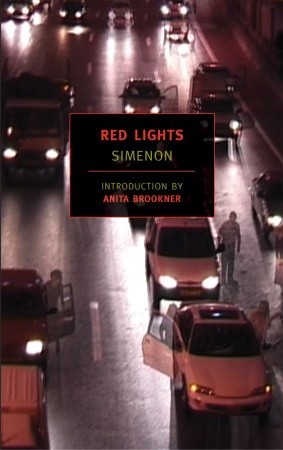
Red Lights, first published in 1953 as American post-war consumer culture was really picking up speed. Simenon was inspired to write this indictment of the anomie inherent in an uncentered world. Steve is driving his wife Nancy from broiling New York City to much cooler Maine, where they will pick up their children from camp. The roads of 1953 were nothing like as direct as today’s (albeit overcrowded) interstates. The frustrations of the drive make Steve’s growing alcoholism act up, and Nancy’s angry contempt for Steve boil over to the point she walks away from the car, from Steve, from her life. When Steve gets them back on the road to Maine, he’s accompanied by Sid, an escaped convict. Steve expounds on his feelings about Nancy, forgetting that a criminal isn’t a good choice of confidant. A price must be paid for being a fool, and it only takes Simenon 160 pages to make Steve, Nancy, and probably Sid wish they’d never met. Looking away isn’t an option. But you’ll never be more grateful to be you than when Red Lights is over.
$14.00 trade paper

Monsieur Monde Vanishes was first published in 1945. The title is the story: An upper middle class man wakes one morning as usual, dresses, breakfasts, and is never seen again by his family. Word of him seeps back to Paris. He is debauching himself in the company of the lowest rank of people he can find, drinking, whoring, and giving himself the “good time” others have in earlier years. M Monde has been both sober and sober-sided too long, his obsession with venery--in French the phrase for this is nostalgie de la boue, or longing for the mud--must be released, rewarded, submerged in. The 192 pages of this book are loaded with a tension and a frustration that is gripping. And exhausting. And oddly rewarding, considering we’re watching someone a lot like us set out to rip his public face up.
$14.00 trade paper

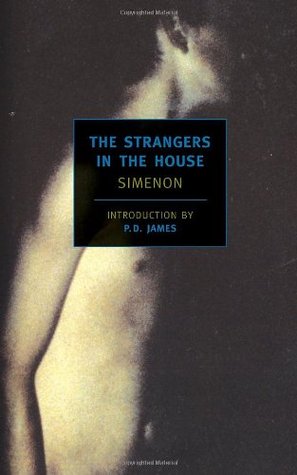
The Strangers in the House, published in 1940, peculiarly predicts the development and tragedy of affluenza, or possibly shows the disorder’s constant appearance in history. Hector’s wife abandoned him eighteen years ago for another man. She left behind the couple’s only child, an infant daughter. It is the daughter, Nicole, who provides the strangers to inhabit the decaying manor that her sot of a father, mired in self-pitying self-inflicted misery, has paid no attention to. Apart from the study where he drinks, of course. His completely narcissistic existence is only and at last interrupted by the muffled sound of a gunshot somewhere inside. The events that follow in these 194 pages both startled and repelled me; the novel as a whole feels depressingly au courant.
$14.95 trade paper

Tropic Moon, first published in 1933, is one of Simenon’s trademark deep psychological novels. Joseph, a young, aimless well-to-do man decides he needs to tour France’s African colonies as a way to escape the anomie of being rich and privileged. His uncle, powerful and influential, gives him an introductory letter to the manager of his timber concession in Gabon. He also warns Joseph to beware of getting involved in any kind of partnership. Fatefully, Joseph meets Adèle, the native wife of a hotel owner.

Love will find a way to destroy you, as many have discovered, when you’re not ready for its demands. Joseph sinks into the colonial white “elite” crowd, indulging in their various revolting practices while sinking deep into an obsessive love for married, manipulative Adèle. When lethal crimes begin to happen, Joseph slips down deeper into the world’s most horrible criminal system: colonialism. His escape will never happen, we’re sure, and it seems less and less desirable as his character changes. Another book that makes vacation all the sweeter by comparison.
$12.95 trade paper

As you’re finishing your two hours (or more) of travel, any one of these novels should be finishing or just finished. Each has its own strange pleasures, and could only come from the pen of Belgium’s best-loved literary export. Don’t let the fact that they’re translated put you off. You’ll barely notice at first what will be transparent to you by journey’s end.

Wednesday, May 25, 2016

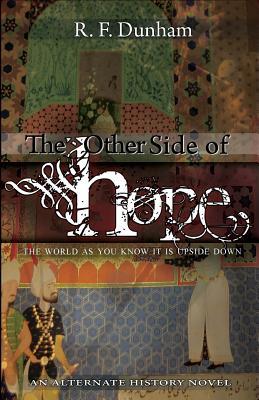
THE OTHER SIDE OF HOPE by R.F. Dunham, a reverse/mirror version of our modern world


THE OTHER SIDE OF HOPE
R.F. DUNHAM

Kindle Edition
99¢s;, available now

Rating: 3.5* of five

The Publisher Says: In 732 A.D., the Frankish and Burgundian forces led by Charles Martel defeated an army of the Umayyad Caliphate led by Abdul Rahman Al Ghafiqi and halted the Muslim advance into Christian Europe. At least, that's what happened in the world as you know it. Step into the world of The Other Side of Hope, where the world as you know it is turned on its head.

In this world, Martel was defeated and the Caliphate continued to spread across Europe until the entire continent was under its control. Christianity was eventually forced to flee west to a distant and dangerous new land. Without the support of European powers, these settlers found only conflict, poverty, and hardship. In the modern day, this world remains divided. The wealthy Muslim East and the poverty-stricken Christian West are constantly at odds. A single spark is all it takes to ignite fresh conflict and the cycle seems never-ending.

Ethan Lewis is a proud young Christian living in Tioga, the poorest district of the developing nation Lachlond. All he wants is to marry his fiancee and provide for his mother and younger siblings. The only problem is that his mother insists he can't do both. Not until his sister is married off and out of the house. Hamid Damir is an ambitious Muslim businessman from Istanbul, the financial center of the world. He's trying to build a prosperous and happy future for his family. But, after five years of marriage, his wife is beginning to realize that she has different ideas about what that future should look like.

Everything changes for both young men when the Brotherhood of the Sword, a Christian terrorist organization, launches a devastating attack on Istanbul. As the wrath of Turkey descends on Lachlond, Hamid and Ethan are pulled into a war that sets them on a collision course with the other side and may cost them everything. Will they find hope for a brighter future or be lost in the despair of intractable conflict?

My Review: As an alternative history lover, I was very excited when I was offered this title for review. A Muslim-dominated world and European Christians forced to flee ever westward? Yes, please!

As I read along, I found myself ticking off the factual basis for the fictional world's current story. As the checkmarks multiplied, I found I was losing enthusiasm for the read itself. (Given the nature of the plot, anything specific I say will be a spoiler.) Add into that some very pet-peevy copy-editing errors (eg, currier for courier in all but one reference) and I was becoming disheartened.

What saved this read for me was the ending. Considering how often I whinge about endings that fail or disappoint, that's pretty astounding. A very common first-novelist flub is to tie up the end of the story with a pretty little bow on its bottom, however incongruous that might be given what's come before. Dunham avoids this trap handily. There are consequences, dark and painful ones, for the actions the characters take. There are no winners, and all the way around, the book ends on a hopeful note that manages not to feel forced or fake or tacked on.

It's a very good bargain in the Kindle edition, as it will most certainly keep you tapping left to see who will "get it" (not in the Peckinpah sense!) next. This writer has promise, and with time and experience, will be a must-read one day soon.

Tuesday, May 24, 2016

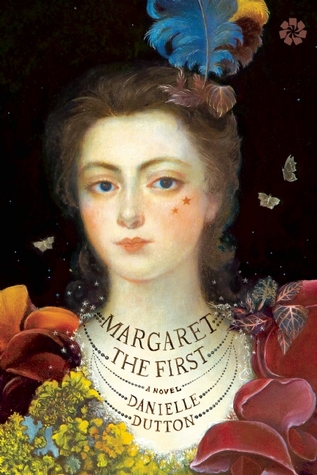
MARGARET THE FIRST by Danielle Dutton, 2016's six-stars-of-five read


MARGARET THE FIRST
DANIELLE DUTTON

Catapult
$15.95 trade paper, available now

Rating: 6* of five

The Publisher Says: Margaret the First dramatizes the life of Margaret Cavendish, the shy, gifted, and wildly unconventional 17th-century Duchess. The eccentric Margaret wrote and published volumes of poems, philosophy, feminist plays, and utopian science fiction at a time when “being a writer” was not an option open to women. As one of the Queen’s attendants and the daughter of prominent Royalists, she was exiled to France when King Charles I was overthrown. As the English Civil War raged on, Margaret met and married William Cavendish, who encouraged her writing and her desire for a career. After the War, her work earned her both fame and infamy in England: at the dawn of daily newspapers, she was “Mad Madge,” an original tabloid celebrity. Yet Margaret was also the first woman to be invited to the Royal Society of London—a mainstay of the Scientific Revolution—and the last for another two hundred years.

Margaret the First is very much a contemporary novel set in the past, rather than “historical fiction.” Written with lucid precision and sharp cuts through narrative time, it is a gorgeous and wholly new narrative approach to imagining the life of a historical woman.

My Review: Every year, there is one book...rarely are there two...that moves me so profoundly and give me so much reading joy that I need to give it the highest, best accolade I possess: This book broke the scale. This is the bar I'll be judging many other books by. We're pretty much done with the first half of 2016 and I was getting a bit restless for a sighting of the six-star book. I've read some excellent books this year, but until Danielle Dutton's publisher, Catapult, sent me this book at my request, none that would come close to the six stars level.
He tapped his hat for shade. A crow pecked near his feet. He was about to give it up, and then: 'Mad Madge!' someone cried in the street. 'Mad Madge!' someone repeated, as her black-and-silver carriage came roaring down the path. But the horses were forced to a stop, for the crowd had grown to a mob. 'I see her,' someone shouted. He saw her then, through the window glass--black stars, white cheeks. That night in his diary he wrote: 'The whole story of this lady is a romance, and everything she does.'
Pepys, on page four. Okay then, thinks I, we're on the way up from five stars on page four! The golden apple is Ms. Dutton's to lose.

She never lost it. Never came close.

The early days of Margaret Lucas's life were fairly typical of those for a girl of her station. She was from minor nobility, the county set as it would come to be called. She was odd even to her family, she was not meant to fit in anywhere, and she honestly seems never to have tried. It was her bad luck to be born at the time of the Civil War, and to a Royalist family. Her entire life she would deal with, be circumscribed by, defined by the Civil War and its long, long aftermath. Her youth was spent in various exiles, for example Paris, where the English Queen Henrietta Maria had Margaret as a very junior and unpopular lady-in-waiting:
"'I had rather be a meteor, single, alone.'

Plus Paris itself was noisome. Even with its glittering bridges and orangeries, even if the birthplace of ballet.

'I had rather been a meteor, than a star in a crowd.'"
How did a teenaged girl, in an era that discouraged all non-conformity and frequently punished female "rebelliousness," reach the strength of mind to think such thoughts and the strength of character to live her life according to that simple principle, so hard to do? It has to be something inborn. Anyone who has ever parented an infant knows that they arrive with personalities (blank slates my lily-white patootie!). What must Margaret's beloved mother have gone through, worrying about her willful young daughter so far away from her almost all their lives?

Mother needn't have worried too much. While at Queen Henrietta Maria's court, Margaret meets the widowed, exiled Marquess of Newcastle, a man more than twice her age with adult children. Ordinarily this would be unremarkable; Margaret isn't considered marriageable. The Marquess, however, disagrees; he falls in love with her very oddness and originality of mind. This is one amazingly lucky woman. The Queen, whose consent to such an alliance is necessary, doesn't stand in the way but expresses her amazement that such a bizarre match could take place.

Life as an aristocratic exile is precarious. Money is tight, sources of income lost, and only the Queen repaying a loan let the newlyweds enjoy a modestly comfortable exile in Antwerp (much cheaper than Paris!). All of Holland was then and is now quite cosmopolitan, so the new Marchioness is exposed to many, many new ideas, people she would never meet in Paris or London (Jews!), and she revels in it all with her loving and supportive husband:
One night, the Duarte girl sang poems set to music in a voice so clear I felt my soul rise up inside my ear. In a garden of clematis, with servants dressed like Gypsies placing candles in the trees, we assembled on the grass, between a Belgian wood and {the Duchess of Lorraine}'s glassy pond. In a pale orange gown I read two pieces I'd prepared...When the ladies clapped their approval in the dark, everything, to me, was suddenly bright and near.
How amazing for the shy Marchioness to read in public, how delicious to be applauded, how very different from any life she could reasonably have expected to have. And how perfect Dutton's prose is, representing such a magical moment. I was starry-eyed myownself when I read that passage.

Margaret's response to such an extraordinary life is to become even more extraordinary herself. She writes a book published under her own name, with her husband William's complete and excited support; encouraged by that and the kerfuffle she has caused in the educated world, she publishes a second and then third book. Writing has become a way of life, an addiction, a refuge and a podium both:
Still, Antwerp, the parties, my husband's talks--all of it fed my mind. I'd hardly set down my quill before I took it up again, writing stories unconnected--of a pimp, a virgin, a rogue--strung up like pearls on a thread. ... 'I am very ambitious, yet 'tis neither for Beauty, Wit, Titles, Wealth, or Power, but as they are steps to raise me to Fames Tower.'

O minor victory! O small delight! My star began to rise.
Anyone whose writing has caused others to respond strongly will know how the Marchioness feels.

And of course, this being the world ruled by evil-tempered gods, all good things come to an end. William and Margaret, in need of money to live and desiring the return of estates confiscated by the ended Republic, cash in on the Marchioness's fame and the restored King's interest in her outrageous persona. A fête in His Majesty's honor is held:
'An utter success,' her stepdaughters confided to Margaret as they prepared to take their leave. 'The handsome king! That spoof!' Still the rain persisted, and the bishop had lost his hat. Maids danced in and out. Where was the bishop's hat? Alone at the window, Margaret didn't hear. The reflection of the parlor was yellow and warm. She watched it empty out. Then, an interruption. A voice came at her side: 'What do you look at with such interest, Lady Cavendish?' What did she see in the glass? She saw the Marchioness of Newcastle. She saw the aging wife of an aged marquess, without even any children to dignify her life.
The Marchioness's interlocutor is one Richard Flecknoe, a young man barely known to her in Holland, and who becomes her playmate and teacher and arm-candy. William, bless him, voices faith in and approval of Margaret's friendship, canceling any scandal.

And then (you know what's coming, right?) William and Margaret leave their precarious London existence for the newly returned Cavendish estates near Colchester. As soon as things begin to go smoothly.... But the most wonderful thing happens while they are there: Margaret's long-missing crates of writings, her "modest closet plays," arrive and are printed at last:
She was reading Francis Godwin's Man in the Moone--its man was borne into space in a carriage drawn by swans--when she heard the sound of wheels upon the gravel. Two boxes from Martin & Allestyre were set down on the drive. 'My modest closet plays,' she said. She nearly ran down the stairs--for the recovery of her wayward crates that spring and the preparation of her plays for publication had rekindled inside Margaret a flame she'd feared had gone out. ... But now, in turning the pages, she grew concerned and then incensed: 'reins' where she had written 'veins,' 'exterior' when she had clearly meant 'interior.' The sun went down. The room grew dim. ... 'Before the printer ruined it,' she cried, 'my book was good!'

'Could it be,' {her husband} asked, soaking his bread in {lamb's} blood, 'that you were yourself the cause of this misfortune?'
An autodidact, Margaret's spelling is, ummm, idiosyncratic; a passionate writing addict, she's always rushing through her work to begin something new. In spite of her resentment of William's criticism, she goes to work to fix the book's problems as he advises.

As life goes on, as she grows older in body, she grows more and more powerful in her mind and fearless in her imagination:
On the fifth night of this solitude, she falls asleep with a candle burning and dreams herself a mermaid with a thick and golden tail, a crown of shimmering conch shells, then awakens with a start. Whether the ship hit something or something hit the ship, another change has come. The ship is dying; she can feel it slipping away. She waits beneath the blanket for icy water to greet her. But instead of the sea, it's a bear that opens the door.

A great white bear up on its hind legs steps across the threshold.

'Good morning,' he says, and reaches out a paw.
The writing of a seventeenth-century woman, elderly by the standards of the day. This is simply glorious imagination, simply astonishing to realize it is over 350 years old. This childless woman, forgotten by our modern world and only "famous if you know who she is," would be delighted to be brought to vivid life again by Danielle Dutton. How can I be sure of that?
Off come her skirts and petticoats, her lace cuffs and collar, her shoes and whalebone stay, until she lies on her side in nothing but a cotton shift and endless strands of pearls. Dust hangs in a crack of light between red velvet drapes, like stars.

Her dreams are glimpses, bewildered--celestial charts, oceanic swells, massive, moving bodies of water, the heavens as heavenly liquid, familiar whirlpools, the universe as a ship lost at sea--but the ship she imagines arrived safely, years ago, loaded with their possessions.
Show me a writer, past or present, who would not beam joyfully at being so unclothed, so beautifully described, so wonderfully and comprehensively understood.

It is Dutton's gift to write beautifully. It is also her gift to find the perfect publisher for her work. The cover is glorious; the design of the book is lovely, and completely transparent to anyone not looking for it; it is, in short, an author's dream of a book. Equally it is a publisher's dream to publish a novel about a now-obscure woman dead for centuries about which a jaded old reviewer (ie, me) can, completely without reservation or reluctance, say that this book is:
Yet how hard it is to point to a moment. To say: there, in that moment, I changed.

Monday, May 23, 2016

IF OUR WEALTH IS CRIMINAL THEN LET'S LIVE WITH THE CRIMINAL JOY OF PIRATES: Small book with *really* long title


IF OUR WEALTH IS CRIMINAL THEN LET'S LIVE WITH THE CRIMINAL JOY OF PIRATES
JACOB WREN

Book*hug/A Boondoggle Book
$10.00 trade paper, available now

Rating: 4.5* of five

The Publisher Says: From multidisciplinary artist and author Jacob Wren comes a small book of big ideas. Originally produced as a 'Boondoggle Book' limited edition specifically for the first Authors for Indies Day in Toronto, this small and delightful book is a must-have for fans of the author of POLYAMOROUS LOVE SONG (named one of the top 100 books of 2014 by The Globe and Mail). IF OUR WEALTH IS CRIMINAL THEN LET'S LIVE WITH THE CRIMINAL JOY OF PIRATES collects two short stories and an essay by Jacob Wren. In the first story, 'The Infiltrator, ' certain ongoing, rarely mentioned, difficulties for the activist Left are explored with unlikely candour. In 'Four Letters from an Ongoing Series, ' the postal service becomes an unwitting accomplice to the gatekeepers of potential culture. Finally, in the essay 'Like a Priest Who Has Lost Faith, ' questions of art and emptiness shift focus in relation to the agency that at all times surrounds us.

My Review: As always with story collections, I'll offer specific comments on the stories themselves and finish up with some wise (or wise-ass) summing up. Without further ado, I deploy the Bryce Method's time-tested techniques:

The Infiltrator is either the shortest récit I've ever seen or it's a short story with the same intimate effect as a récit because we never get out of our nameless narrator's head. It's more effective at greater length, in my opinion, but there is nothing wrong with the story's story. It's fascinating to look at an agent provocateur's strange mental state. The money? The cause? I can't imagine. The narrator's account of his actions are without emotional responses; the narrator records the emotions of the people she or he is manipulating without attempting to respond to them personally. Curiously, I found this more telling of the narrator's character than any more noisy declaration could have. This is an amoral person. This is the bad seed your mother warned you about. 4 stars

Four Letters from an Ongoing Series details the dreary, pointless existence (it's not in any way describable as a life) of an aspiring writer. From information within the frame of the story, he sounds like a white, middling-aged bore who has never escaped the analysis paralysis that a liberal arts education can put some people in:
I hate it when I feel like a man. It is probably even worse when I don't, since those are times when I am coasting through territory where my privilege is even more invisible to me than usual.
Self awareness? Or narcissistic navel-gazing? Both in some degree?

His manuscript, one assumes the same one each time, is rejected by four presses. Each letter he receives is more explicit about why they aren't publishing it. Midway through this painful process of absorbing so much rejection, he ruminates on the very business he's trying to enter:
Will literature last forever or is it practically already a thing of the past? And how do we even define literature, since without some definition it is barely possible to judge the field's relative health or disrepair. Are my overly refined tastes--predelictions and preferences I've spent most of a lifetime overly refining--the most useful criteria or do they pertain only to my personal idiosyncrasies? Would it be better to have something more generalized, a canon most might agree upon, or would this very canon simply be a dampening force, pushing down the lid, creating conventions through consensus both more consensual and more conventional?
If he writes the way he thinks, no wonder his manuscript bounces back to him so often. Yeah, all of that blahblahblah is true and valid. But outside an academic journal or a classroom this is some seriously dreary verbiage.

The last rejection letter is a rant of epic proportions, ordering the narrator to go out and live, to get his head out of his butt and maybe then he'd have something other than his pathetic life to write about. However good this order is, what a difference it might have made...human nature wins. 3.5 stars

Like a Priest Who Has Lost Faith: Notes on art, meaning, emptiness and spirituality really doesn't need more explanation than the instruction "read that title again and reflect carefully on how it can relate to the subtitle" and this paragraph from the text:
I wonder if the framework within which most contemporary art attempts to generate meaning is analogous to the 'never been modern' framework that {Bruno} Latour criticizes {in his major work, We Have Never Been Modern}. Art is a world that separates, continuously playing the divisions against one another in ways that are often contradictory: good art against bad art, art against everything else, political art against commerce, etc. The gallery is the place for art, but it is also a way of removing art from the rest of life.

Has Wren lost faith in the idea of modernity? The art exhibition that elicited this essay from him was called 'Animism,' a group of works in multiple media by artist Anselm Francke. Wren tells us he didn't actually see the exhibition, only read the catalogue; how amazing must this show have been to make a very intelligent man dig so deeply into his psyche and gift us with this revealing, delicious meditation on humanity and our endless search for meaning.

I read this book, slim but deep, in an hour of happy immersion. It's been my introduction to Jacob Wren, and to BookThug's very, very interesting publishing program. Apart from two pet peeves (stationAry instead of stationEry; it's instead of its), this is a tight and involving package of words. It's going to be even more fun for me to read Wren's novels now. I am looking forward to it, and I suspect many other readers will be right there with me. 5 stars

Saturday, May 21, 2016

THE CHESSMEN, third Lewis Trilogy mystery from Peter May

THE CHESSMEN
PETER MAY
(Lewis Trilogy #3)
Quercus (non-affiliate Amazon link)
$6.99 Kindle edition, available now

Rating: 3.5* of five

The Publisher Says: PETER MAY: THE MAN WHO BROUGHT MURDER TO THE OUTER HEBRIDES

THE NEW START


Fin Macleod, now head of security on a privately owned Lewis estate, is charged with investigating a spate of illegal game-hunting taking place on the island.

THE OLD FRIEND

This mission reunites him with Whistler Macaskill - a local poacher, Fin's teenage intimate, and possessor of a long-buried secret.

THE FINAL CHAPTER

But when this reunion takes a violent, sinister turn and Fin puts together the fractured pieces of the past, he realizes that revealing the truth could destroy the future.

My Review: The series is complete. My relief is genuine.

I'll find something to say in due course.

**DUE COURSE HAVING ELAPSED**

Peter May cut his storytelling teeth in Scottish television, creating two prime time drama series and script-editing a third. He is very clearly Scottish, choosing an unfamiliar and unforgiving setting for this series: The Hebrides, no less than Ann Cleeves's more famous Shetland TV and book series, is globally known for its distilled essence of Scottishness. No smart author who wasn't Scottish would dare to do this.

But the problem is that the Hebrides form an atmospheric backdrop for a personal saga of surpassing ordinariness. The gross-out food-gathering antics of the Hebrideans in The Blackhouse aren't integral to the murder, they're the handy means for it. The Lewis Man came off better than The Blackhouse because it was a universal plot far more compelling than the first one, but again the Hebrides could as easily have been the Balearics or the Cyclades.

Now, at the end of the trail, we're confronted with a murder that frankly makes no sense, a murder that makes all the sense in the world, a death that's explained in as bloodless (in the bad sense) a way as any in detective fiction, and a hit that my shoulders have been hunched in anticipation of since the middle of The Lewis Man.

I'm not one for book reports, so go read the synopsis and some more spoilery reviews to glean some insights into which might be what. I'm here to tell you that this wasn't a satisfying three-book read. But, the Gotcha! Gang is now crouched above their keyboards waiting to snort in derision, you read them! Yep. I did. I got the series from Quercus and, even though it takes me forever to get around to reviews these days, I still honor my commitments.

The end result of my reading isn't the sense of time wasted so much as time misused. The author has storytelling chops. He deploys the expected tropes in the usual order and does so against the background of a culturally unique place without, as Cleeves does, allowing us a deeper-than-guidebook sense of the ways and means of these isolated folks. I would be howling to the stars about these books if I'd felt the crimes had originated organically in Hebridean soil. The author's ability to make a story one wants to follow isn't in question. The main character is a homecoming middle-aged ball of grief and rage, so that's familiar. He isn't anyone we haven't met before, but he's well developed enough for that not to be a major concern.

In the end, I'm not sure what to tell you. If Scotland is a fascination of yours and you're a murder-mystery addict, ie if you're me, yeah sure read away. Don't expect a peak experience. If you're a tartan noir person, and why the hell wouldn't you be?, these will occupy summer beach hours adequately. Even refreshingly, given that there isn't a single warm day in any of the texts.