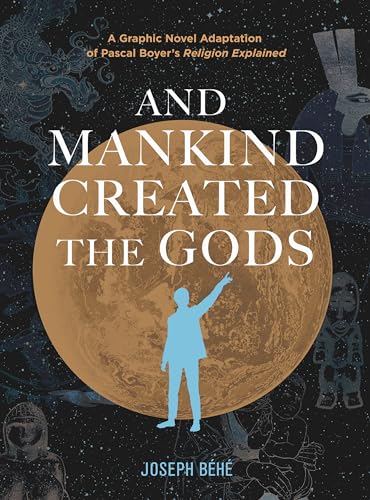
AND MANKIND CREATED THE GODS: A Graphic Novel Adaptation of Pascal Boyer’s Religion Explained
JOSEPH BÉHÉ (tr. Edward Gauvin)
Graphic Mundi
$39.95 hardcover, available now
Rating: 5* of five
The Publisher Says: These are some of the most fundamental and enduring questions we have about the mysteries of religion, and they may well hold the key to humankind’s future on this earth.
In this adaptation of Pascal Boyer’s classic work exploring these concepts, Religion Explained, artist Joseph Béhé harnesses the power of comics to provide clear answers to the basic questions about why religion exists and why people believe.
A distinguished scholar, Boyer drew from research in cognitive science, anthropology, psychology, and evolutionary biology to explore why religion exists and why the strength of human beliefs can drive us to be selfless sometimes and, at other times, to be fanatical and intolerant. His erudite book is rich with insight into the endless jumble of ideas that inform religious beliefs and practices across cultures. With detailed, illustrative drawings and carefully adapted prose, Béhé’s graphic novel brings a new perspective to Boyer’s work.
An eminently accessible approach to the notoriously thorny topics of belief, cognition, humanity, and religion, And Mankind Created the Gods is a thoughtful, inspiring graphic novel that will further and broaden the conversation with which Boyer’s book engages.
I RECEIVED A DRC FROM THE PUBLISHER VIA EDELWEISS+. THANK YOU.
My Review: I feel very sad about this book. It needs explaining all the way from the subtitle, on to the purpose of the project. Plus this is a disaster of time to present something that is not a rah-rah Rasputin-style cheerleadin' on the subject of religion. Even if you've never heard of Religion Explained, you who are not first-timers to my reviews know that there is no way at all (no way in Hell!) I'd review something pro-religion even to dunk on it. Then we come to its length...over 350 pages...and its price...forty dollars. I do not foresee this wonderful, trenchant, tendentious read burning up the sales charts.
Damned shame, that. Look at this stareable art:

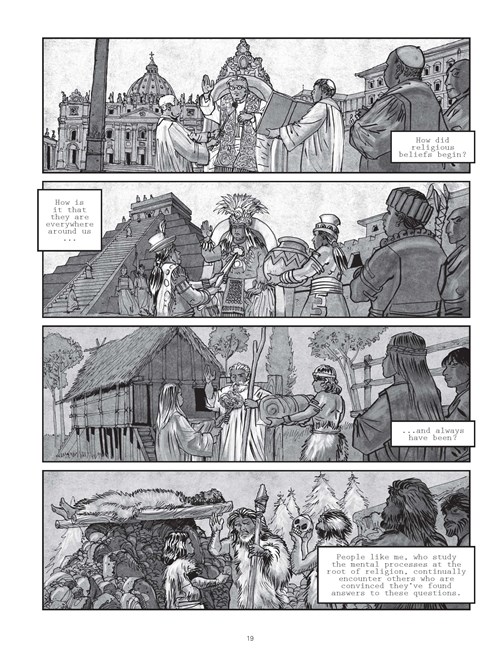
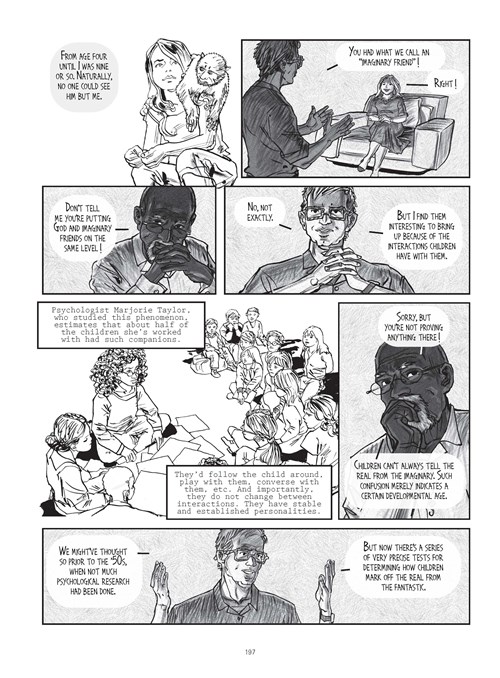
I'll happily do my bit here, trying for some interested sympathetic eyeblinks from among my smarter-than-average readers. Y'all give me hope, the numbers who come here to read about worthy, important books about subjects most polite people bury in order not to risk offending some ignorant little twidgee with a keyboard and a grudge against smart people.
So, Religion Explained: its subtitle is "The Evolutionary Origins of Religious Thought", and that is what it explores. Unlike the idea you'd get from my fondness for the book, it is not a screed against religion. It is a scholarly examination of Belief, as a phenomenon, not as a disorder. (I'm sure someone religious has used its facts to argue that it proves y'all's gawd designed Belief into humanity.) Like all things touching the cultural third rail that is Belief, this book has attracted both support and anger, as its surprisingly unpolemical Wikipedia page shows. It has existed this entire century. It is still in print via Basic Books. I myownself recommend you read it.
Why you should read *this* book, this sequential-art story about its concepts, comes down to the reasons anyone should read a story when seeking knowledge: A spoonful of sugar makes the medicine go down, to quote the Sherman Brothers. I'm so old that I remember hearing Julie Andrews sing it to me in a dark, enormous theater.
So please take this in. Despite swimming against the prevailing social current, despite having one of the most unpleasantly good-for-you subtitles in all of history, despite being in a medium I am not fond of, this story about a book I read almost a quarter-century ago told me something new about Belief. It did it without taking my side. It is a very clear-eyed evocation in story form of the source material's information.
And I still gave it five stars.

