Showing posts with label Scholastic Press. Show all posts

Tuesday, February 27, 2018

THE INKER'S SHADOW, Allen Say's memoir-in-pictures of life as a Japanese boy in 1950s California


THE INKER'S SHADOW
ALLEN SAY

Scholastic Press
$19.99 hardcover, available now

The Publisher Says: Caldecott Medalist, Allen Say, presents a companion to his award-wining DRAWING FROM MEMORY - the story of his coming-of-age at a military academy and the discovery of what it means to be American.

For Allen Say, life as teen in Southern California was a cold existence. His father, one of the leading hamburger salesmen in Japan, ran a booming burger business, much like McDonald's, and sent Allen to an American military academy, so that his son could learn English and "become a success in life."

As the school's first and only Japanese student, he experienced immediate racism among his fellow cadets and his teachers. The other kids' parents complained about Allen's presence at the all-white school. As a result, he was relegated to a tool shed behind the mess hall. Determined to free himself from this oppression, Allen saved enough money to buy a 1946 Ford for $50 - then escaped to find the America of his dreams!

In this follow-up to DRAWING FROM MEMORY, Allen continues to reinvent himself as an author and illustrator. Melding his paintings with cartoon images and archival photos, Allen Say delivers an accessible book that will appeal to any reader in search of himself.

My Review: I don't think this book's full import will come home to you if you don't read Drawing from Memory first.

But I think I'm safe in saying that, once you've read that, you'll more than likely be ready for this one. Author Say came to the US shortly after WWII ended, and to California no less; the country that suffered a major and terrible defeat wasn't exactly the place most Californians were looking to get fresh immigrants from. The racism Author Say suffered was depicted very realistically.
My origins are in California. My father's a native of Venice, the location of that famous Beach, and I was born in Palo Alto. My mother, a Texan to her bones, paid exactly no attention to California's prejudice against Asians, called in those days "Orientals." Our housekeeper was Nisei Japanese, her husband Issei gardened. They were fixtures. We were, I was told by my mother, sharply criticized for suchlike goins-on by the racist neighbors. All of this meant nothing to me at the time, since Mitzi was a giant bundle of hugging and loving which made me happy so I wasn't interested in anything else.

It stuck in my mind, though, and seemed so weird to me. Seeing the realities of the situation presented from the sufferer's point of view was disturbing to my old-man self. All the casual dismissive racism. All the actively cruel racism. All of that hate stewing in the hearts of people. Why ever use so much strength to wish hurt and harm on those who've done nothing to you?
Author Say doesn't give any answer to this conundrum; instead, he makes it deeper as he shows the lovingkindness of the people who helped him. Not including his father. And somehow, in reading this story of events sixty years gone, I'm left knowing that he made good and also that good people made his path easier than many others' paths, and it makes no difference that I can tell in how outraged I feel. How illogical!

I'm human, I don't have to make sense.
As the story of Author Say's life in California continues to unfold, the many and various loves of his teenaged years come to mean more and more to the course of his life. The girls he adores from afar, the women he is so generously assisted by, the teachers whose unstinting generosity was fueled by the intense young artist's obvious promise. The story covers three years, but how extremely important those years are! At the end of that time, Author Say is all of eighteen. We know, those of us lucky enough to have encountered Author Say's work at least, what astoundingly valuable dividends those people's kindness has paid. Since 1972's Dr. Smith's Safari, there has been a new Allen Say-illustrated book available about every other year.

How lucky for us all that Author Allen Say left home as a teenaged boy. Japan's treasure became ours.
I only hope that the saga will continue before the inevitable loss occurs and Author Say leaves us forever.

Sunday, February 25, 2018

DRAWING FROM MEMORY, Allen Say's gorgeous graphic memoir, full five stars


DRAWING FROM MEMORY
ALLEN SAY

Scholastic Press
$17.99 hardcover, available now

Rating: 5* of five

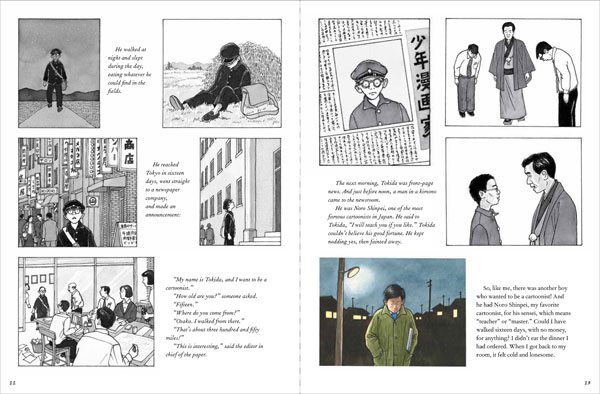
The Publisher Says: Caldecott Medalist Allen Say presents a stunning graphic novel chronicling his journey as an artist during WWII, when he apprenticed under Noro Shinpei, Japan’s premier cartoonist.

DRAWING FROM MEMORY is Allen Say's own story of his path to becoming the renowned artist he is today. Shunned by his father, who didn't understand his son's artistic leanings, Allen was embraced by Noro Shinpei, Japan's leading cartoonist and the man he came to love as his "spiritual father." As WWII raged, Allen was further inspired to consider questions of his own heritage and the motivations of those around him. He worked hard in rigorous drawing classes, studied, trained--and ultimately came to understand who he really is.

Part memoir, part graphic novel, part narrative history, DRAWING FROM MEMORY presents a complex look at the real-life relationship between a mentor and his student. With watercolor paintings, original cartoons, vintage photographs, and maps, Allen Say has created a book that will inspire the artist in all of us.

My Review: Allen Say's world doesn't exist anymore. This is the roughest part of getting truly old. The kind of universe where a twelve-year-old boy could be thought capable of living on his own is long gone. The kind of world where the famous cartoonist could be reached by the simple expedient of showing up at his place of work and saying, "I'd like to work for you," well! Need I belabor the point? Say wrote this book in a world that could be on a different planet than the one he grew up on. But from such foreign stones he built an exciting life, a life of art and creation and replete with stories that need telling.

This book, a graphic memoir I suppose, though it's less thoroughgoing than is Lynda Barry's work (eg Syllabus: Notes from an Accidental Professor), is no whit less sophisticated.

I recently read Artist Say's magisterial Silent Days, Silent Dreams. It was such a gorgeous visual feast and so deeply affecting a tale that I couldn't bear to leave his world for long. Look above, look below...do you blame me?

Look at the great simplicity of the lines you're tricked into believing are real, three-dimensional objects:

Look at the care and attention you're not smacked with, look at the invisible framing of each image that makes it the perfect size and the perfect space for exactly that moment of storytelling to be within.

See the colors? See the volume of each object, each space between objects?

See the texture of matte-coated paper, the way that it creates the same effect as a gallery's neutral wall color does? See the fruit of more than seventy years practicing what a master, a cicerone, a sensei was wise, prescient, generous enough to give the boy artist? We receive the gift's fruit.

There was never a truer aperçu proverbialized than, "A society grows great when old men plant trees whose shade they know they shall never sit in." To your private orchard you bring trees whose shade soothes you, yet almost never will you stop to regard still less thank the long-gone hands and long-past rains that made the tree into what it is now.

Take that moment now, be grateful to Noro Shinpei for himself and for the soothing shadows of Allen Say's talented evocation of a world we can never see any other way but through his eyes and by his hands. Let him plant you a tree.