Showing posts with label Southern France setting. Show all posts

Wednesday, November 3, 2021

TRAP FOR CINDERELLA, psychological suspense and unnerving truth-telling


TRAP FOR CINDERELLA
SÉBASTIEN JAPRISOT
(tr. Helen Weaver)
Gallic Books (non-affiliate Amazon link)
$15.95 trade paper, available now

Rating: 4* of five

The Publisher Says: From the author of A Very Long Engagement, comes an ingenious psychological thriller.

A young woman wakes in a hospital room. What happened to her and why is a mystery. Is she victim or murderer?

The young woman has been badly injured in a fire and has amnesia. But what happened to her? Is she Mi, Micky or Michèle, or Do, Dominique? As she struggles to rebuild her identity, she starts to recall the crime that was committed and the house on the French Riviera. She remembers the rich heiress and the faithful friend – but which is she?

I RECEIVED THIS DRC FROM THE PUBLISHER VIA EDELWEISS+. THANK YOU. STRONG CONTENT WARNING FOR ENCAVMAPHOBIA

My Review: As ever with this author, do not expect the usual, simple setting down of sentences to form beautiful images and sanguine characters, but the unsettling reversals of point of view and the sheer variety of events as told by people with different viewpoints.

Even when those people are in the same body. And no, there are no external markers of the changes. You have to work for your pleasures!

Pleasures there are, and aplenty, in this twisty tale of utterly unreliable narrators. Mi, Michèle, or Do, Domenica, or whoever she might be, is unreliable because her trauma...caught in a fire, either the perpetratrix or the intended victim of it, makes little difference after simply being trapped in a fire...has robbed her of her memory. Those around her are, to put it mildly, motivated by pecuniary gain and thus aren't entirely to be trusted. The doctor is no help to her in recovering her true self. But the more questions the narrator asks, the more she realizes that it's very, very possible that she simply does not want the answers to those questions.

What's wrong with simply...existing. Allowing the tidal wave of love and sympathy to sustain her. Whether or not she "deserves" it.

The concept of merit, of being worthy, of having one's just deserts, is a huge issue in this story. While there is no way that such a tale would be possible in the twenty-first century, when a simple DNA test would establish instantly and once and for all who she was, the way the plastic surgeon worked miracles for her is the primary obstacle to believability in this psychological horror story. I have seen a truly badly burned person and let me assure you they would not be passable in social settings. For the amnesia plot to work, however, there is a need to suspend this level of disbelief.

The sense of dread, of not knowing where one is in the life one is living, is a palpable horror. The idea of surviving a fire is traumatic enough...but to then realize that everyone around one is lying by omission, or directly...? How can that possibly be anything but a waking nightmare?

It is at this Rebecca-meets-Gaslight level that the book works best. Let go of the practical knowledge you possess as a 21st-century reader and travel back to 1963 (when the book first appeared in French) to allow this fearsome reality to submerge your sense of the firmess of your own foundations. Be there with Michèle...Domenica...whatever her name is.

Be there. That might very well be the epitaph of each of the people who die in this book, especially the ones sentenced to prison for crimes they might have, or did, commit. The crimes that, in the end, meant nothing...caused nothing that had not already happened. And isn't that just the awful way of crime? It's really, in the end, pointless.

Agonizing pain for pointless goals. How very, very noir.

TWO FRENCH THRILLERS IN GRAND OLD STYLE, The Sleeping Car Murders & Rider on the Rain


RIDER ON THE RAIN
SÉBASTIEN JAPRISOT
(tr. Linda Coverdale)
Gallic Books (non-affiliate Amazon link)
$15.95 trade paper, available now

Rating: 3.5* of five

The Publisher Says: When a young woman takes justice into her own hands after a horrific attack on the French Riviera, she thinks she has got away with it. But a mysterious stranger at a wedding has other ideas...

The bus never stops in Le Cap-des-Pins. Not in autumn, when the small Riviera resort is deserted. Except today, when a man with a red bag and a disconcerting stare steps out into the rain.

His arrival will throw the life of young housewife Mellie Mau into disarray. After surviving a horrific attack, she has a dark secret to hide. But a stranger at a wedding, the enigmatic American Harry Dobbs, is determined to get the truth out of her, leading her into a game of cat and mouse with dangerous consequences...

A cool, stylish and twisty thriller from cult French noir writer Sébastien Japrisot.

I RECEIVED A DRC FROM THE PUBLISHER VIA EDELWEISS+. THANK YOU.

My Review
: CONTENT WARNING FOR SEXUAL VIOLENCE—STIGMATIZING MENTAL ILLNESS

This is a more or less unusual project...it's a novelization of a film script that Author Japrisot wrote for a wildly successful French film. The DNA of the script is still here, in the copious dialogue tags; quite a few stage directions have survived the trip to novella-ization, too. What also shows is the very, very dated sexual politics of the day...far more horrifying than in the older Japrisot novel reviewed below.

Consider that Charles Bronson plays the male lead in the film. That the film was made in 1969, and came out in 1970. I don't think I need to get too deeply into the, um, action.

So with that warning in place, to the plot. Again its film-script DNA is on display. It is taut; it is not in the least bit deep. Its surfaces are glossy and its politics aren't particularly liberal. It has a lovely woman being abused by damned near everyone who spends even a few seconds onscreen. Americans are violent, nasty brutes; Italians are shouty abusive men; French people are supine and ineffectual.

Author Japrisot wasn't any kind of a patriot....

What's on offer here is a deeply angry story of revenge and of the toll an abusive world can extract. It's never going to be easy to read something written over fifty years ago by a bitter, outraged man without coming away from the experience a little less sure that the world's a good place filled with kind people. But in this story, the woman who exacts a condign revenge on that world is allowed a degree of freedom that would've been unthinkable even a decade earlier. Look at Janet Leigh's character in Psycho....

While it isn't an easy read, due to subject matter, it is formally interesting for its far-from-usual direct lifting of script elements in novelizing the work. It has all of Author Japrisot's strengths, the terse and pointed language and the stunningly easy to visualize settings. Because it's not a simple story, in the sense of having great resonance with dark and ugly parts of human psyches, I don't think it'll appeal to all audiences. Because it's novella length, I don't think it'll necessarily fit well into today's crime-fiction universe...the crime trend is towards bloat as much as the rest of literature is. But it's a bracing, bitter draft of revenge fantasy and devictimized womanhood.

Only not in a salubrious way.

+++++++++++++++++++++++++++++++++++++++++++++++++++++++++++++++++


THE SLEEPING CAR MURDERS
SÉBASTIEN JAPRISOT
(tr. Francis Price)
Gallic Books (non-affiliate Amazon link)
$14.95 trade paper, available now

Rating: 4* of five

The Publisher Says: A beautiful young woman lies sprawled on her berth in the sleeping car of the night train from Marseilles to Paris. She is not in the embrace of sleep, or even in the arms of one of her many lovers. She is dead. And the unpleasant task of finding her killer is handed to an overworked, crime-weary police detective named Pierre Emile Grazziano, nicknamed Grazzi, who would rather play hide-and-seek with his little son than cat and mouse with a diabolically cunning, savage murderer.

I RECEIVED A DRC FROM THE PUBLISHER VIA EDELWEISS+. THANK YOU.

My Review
: This is the first published crime novel from the late monadnock of French thriller writers, seeing the light of day in 1962...sixty years ago! I'd expected to be eye-rollingly impatient with the sexual politics...I was...and to find the motive for the title crime absurd...I sort-of did...and generally to find the read a pleasant time capsule but not one I could recommend.

Wrong on that score.

What Author Japrisot, ably served by Translator Price, achieved was a smartly paced and charmingly observed crime novel. I want to be clear, though, that the attitude towards women and their sexuality isn't within 21st-century best practices. I don't have a positive thing to say about that, and no, I don't want to shrug it off by saying "it's of its time." I think the way to frame the attitudes that makes me least irritably impatient is to think of this as a cautionary tale...a dead, or at least dying, set of stupid and wrong-headed ways of seeing people that has very directly contributed to terrible crimes.

What sticks with me the most is the sheer, idiotic nihilism of the crimes committed, and for such idiotic reasons. There are no excuses, of course, but the reason someone deprives another person of life...the one and only thing that can't be made good or replaced when it's taken...should always at least make some twisted kind of sense. Here, though, there is nothing, not a grain of a comprehensible motive. Like those thrill-killing boys, Leopold and Loeb.

I was utterly unable to put this debut crime novel, first published in 1962, down. It's not like a modern crime novel. There's no bloat; there's very little dialogue. The whole story's narrated, in a kind of distancing tactic, a lot like the voiceover narration of Double Indemnity, albeit it isn't the same narrator. Just the strategy, the way of telling that makes it feel like showing. And, in the end, the framing device works very, very well for the final summation of the crime.

Japrisot wasn't a hugely productive writer, having written a dozen fiction works of different lengths between 1950 and 1999. He translated works by Salinger, among others, into French; he worked in the advertising industry; he was, in short, a jobbing writer with a gift for economical storytelling. His strength lay in constructing the angle of repose for his story; he knew the slightest shift in perspective would destroy the equilibrium that a work of fiction relies on. When the shift inevitably occurs, the entire story flows out of its resting state and becomes something entirely other, a new resting state that doesn't resemble the constructed story but is all the same colors and most of the same shapes.

It is a pure pleasure to read this level of craftsmanship. By all means procure it and enjoy it for all its afternoon-filling worth.

Monday, July 28, 2014

BLACK DIAMOND by Martin Walker...excellent third mystery


BLACK DIAMOND (Bruno, Chief of Police #3)
MARTIN WALKER

Alfred A. Knopf
$16.95 trade paper, available now

Rating: 4.5* of five

The Publisher Says: The third installment in Martin Walker's delightful, internationally acclaimed series featuring Chief of Police Bruno.

Something dangerous is afoot in St. Denis. In the space of a few weeks, the normally sleepy village sees attacks on Vietnamese vendors, arson at a local Asian restaurant, subpar truffles from China smuggled into outgoing shipments at a nearby market—all of it threatening the Dordogne’s truffle trade, worth millions of dollars each year, and all of it spelling trouble for Benoît “Bruno” Courrèges, master chef, devoted oenophile, and, most important, beloved chief of police. When one of his hunting partners, a noted truffle expert, is murdered, Bruno’s investigation into the murky events unfolding around St. Denis becomes infinitely more complicated. His friend wasn’t just a connoisseur of French delicacies, he was a former high-profile intelligence agent—and someone wanted him dead.

As the strange crimes continue, Bruno’s detective work takes him from sunlit markets to dim cafés, from luxurious feasts to tense negotiations—from all of the paradisial pleasures of the region to its shadowy underworld—and reunites him with a lost love, an ambitious policewoman also assigned to the case. Filled with an abundance of food and wine (including, bien sûr, many, many truffles) and a soupçon of romance, Black Diamond is a deliciously entertaining concoction that delivers all the complexity and delights of the Dordogne itself.

My Review: I'd like to be clear about one thing up front: No one pays me to write my reviews, and I got no free copy of this book to review it. Save your nastygrams.

What I did get from this third outing in the Bruno, Chief of Police, series was a serious jones for truffes cendrillons (or cendrées, as I knew the dish), the coal-baked tarts filled with truffled foie gras that are outstandingly rich and almost incredibly expensive. They're also the only way I actually *like* truffles.

*pause for near-lethal drooling*

So. Anyway. Truffles are obscenely expensive fungi, and the Périgord (where fictional St-Denis is located) is one of Earth's best places to find the highest quality variety of them. Naturally, this being a Bruno story, the initial push into crime and dishonesty comes from shenanigans at the truffle market. Naturally, this being a Bruno story, the malfeasance and wrong-doing stretch farther and wider than that. Naturally, this being a Bruno story, there is loving and glorious detail lavished upon the preparation and eating of meals. A very great deal less attention is paid to Bruno's rugby-playing, fire-fighting physique in action amoureuse.

I'm down with that. Sex I can get anywhere. A series of mysteries where Pomerol *drool* is fleetingly mentioned and Dom Pérignon is casually served at a public function (!!!), where the meals are...so listen, I don't need to belabor this, it's effin' para-bloody-dise that Walker's describing. A hot rugby-playing 40-year-old cop who can cook and knows his wines. Yes please.

By the end of this entry in the series, it's clear that our lad is as always the bestest Boy Scout in all France and he's got not a single problem with doing the Right Thing even if it's political suicide, even when it costs him dearly and personally, and then refusing to dodge, bob, and weave when shady souls want him to trim his sails expediently.

For this very reason, Bruno ends this installment with a vastly better material life, and a very greatly enlarged circle of influence. Hobnobbing with royalty, even minor royalty, grants a man access to things previously not available. Very useful in a sleuth's development; and as done by Walker in this book, perfectly logical and in fact sort of inevitable.

I'll cut to the chase: For a series-mystery fan, this procedural-cum-cozy-via-thriller series is catnip and should not be resisted. For a foodie, it's madness to pass up. For one who fancies gentlemen of a certain interesting age, it's damn near mandatory reading. (My Gentleman Caller has a serious book-crush on Bruno, for example. I'm not jealous it says here because so do I.) And if wine interests you, for heavens' sake go NOW and buy them all!

Sunday, April 6, 2014

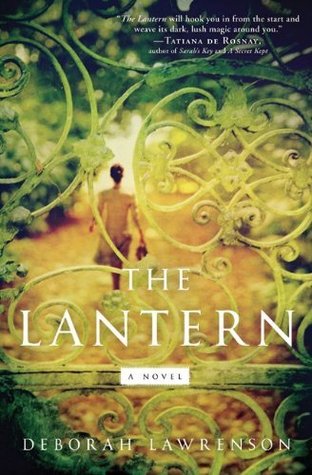
THE LANTERN by Deborah Lawrenson, lovely but not spooky


THE LANTERN
DEBORAH LAWRENSON

HarperPerennial
$17.99 trade paper, available now

Rating: 3.875* of five

The Publisher Says: A modern gothic novel of love, secrets, and murder—set against the lush backdrop of Provence.

Meeting Dom was the most incredible thing that had ever happened to me. When Eve falls for the secretive, charming Dom in Switzerland, their whirlwind relationship leads them to Les Genévriers, an abandoned house set among the fragrant lavender fields of the South of France. Each enchanting day delivers happy discoveries: hidden chambers, secret vaults, a beautiful wrought-iron lantern. Deeply in love and surrounded by music, books, and the heady summer scents of the French countryside, Eve has never felt more alive.

But with autumn’s arrival the days begin to cool, and so, too, does Dom. Though Eve knows he bears the emotional scars of a failed marriage—one he refuses to talk about—his silence arouses suspicion and uncertainty. The more reticent Dom is to explain, the more Eve becomes obsessed with finding answers—and with unraveling the mystery of his absent, beautiful ex-wife, Rachel.

Like its owner, Les Genévriers is also changing. Bright, warm rooms have turned cold and uninviting; shadows now fall unexpectedly; and Eve senses a presence moving through the garden. Is it a ghost from the past or a manifestation of her current troubles with Dom? Can she trust Dom, or could her life be in danger?

Eve does not know that Les Genévriers has been haunted before. Bénédicte Lincel, the house’s former owner, thrived as a young girl within the rich elements of the landscape: the violets hidden in the woodland, the warm wind through the almond trees. She knew the bitter taste of heartbreak and tragedy—long-buried family secrets and evil deeds that, once unearthed, will hold shocking and unexpected consequences for Eve.

My Review: Nameless Narratrix tells us the tale of woe of loving a man who did Something Awful. She tells us this while living in his Provencal hameau, which is haunted by some dead French people as well as a few living ones. The hameau is crumbling, with plaster and masonry all falling at random times and in random places. The house gives the new couple a gift or two, including an old iron lantern that figures into the sad life story of the last French proprietrix of the hameau. (Have you gone and looked up hameau yet, so I can stop typing the itals?)

There's an absent, though not known to be dead, wife; there's a tale of Love Gone Wrong; there's a lot of carryins-on about people disappearin' right left and through the middle for at least 40 years; there's misunderstanding piled onto miscommunication via idiotic refusals to ask or answer simple, direct, interrogative English-language sentences.

It's Rebecca meets The Horseman on the Roof set in modern times. I found it unspooky in the extreme. I also found it lushly beautifully crafted, line by line. It's gloriously good at evoking Provence, its people, and its tourist-based economy that replaced actual work producing actual, tangible objects. And it should be read with a glass of young and hearty red wine, a plate of orange-butter-herbes-de-Provence Christmas cookies, and a lover of one's preferred configuration at the ready to sate the appetites the book will awake.

Creative Commons License
This work is licensed under a Creative Commons Attribution-NonCommercial-ShareAlike 3.0 Unported License.