Pages
- Home
- Mystery Series
- Bizarro, Fantasy & SF
- QUILTBAG...all genres
- Kindle Originals...all genres
- Politics & Social Issues
- Thrillers & True Crime
- Young Adult Books
- Poetry, Classics, Essays, Non-Fiction
- Science, Dinosaurs & Environmental Issues
- Literary Fiction & Short Story Collections
- Sookie Stackhouse/Southern Vampire Books & True Blood
- Books About Books, Authors & Biblioholism
Showing posts with label physical anthropology. Show all posts
Thursday, May 22, 2025
WHACK JOB: A History of Axe Murder, does more than just titillate with true-crime gore
WHACK JOB: A History of Axe Murder
RACHEL McCARTHY JAMES
St. Martin's Press (non-affiliate Amazon link)
$14.99 ebook, available now
Rating: 4.5* of five
The Publisher Says: A brilliant and bloody examination of the axe's foundational role in human history, from prehistoric violence, to war and executions, to newspaper headlines and popular culture.
For as long as the axe has been in our hands, we have used it to kill.
Much like the wheel, the boat, and the telephone, the axe is a transformative piece of technology—one that has been with us since prehistory. And just as early humans used the axe to chop down trees, hunt for food, and whittle tools, they also used it to murder. Over time, this particular use has as the axe evolved over centuries to fit the needs of new agricultural, architectural, and social development, so have our lethal uses for it.
Whack Job is the story of the axe, first as a convenient danger and then an anachronism, as told through the murders it has been employed in throughout from the first axe murder nearly half a million years ago, to the brutal harnessing of the axe in warfare, to its use in King Henry VIII's favorite method of execution, to Lizzie Borden and the birth of modern pop culture. Whack Job sheds brilliant light on this familiar implement, this most human of weapons. This is a critical examination of violence, an exploration of how technology shapes human conflict, the cruel and sacred rituals of execution and battle, and the ways humanity fits even the most savage impulses into narratives of the past and present.
I RECEIVED A DRC FROM THE PUBLISHER VIA NETGALLEY. THANK YOU.
My Review: End-noted to a fare-thee-well, this rollicking romp through axes as historical objects isn't academic and dry, or deeply in-depth; it's a mountaintop view into the foothills and valleys of human material culture. Using the axe as our viewpoint stand-in makes a lot of sense. In anthropology classes I took in the 1980s, stone tools came in varieties like flakes, blades, and scrapers, all discovered by the carloads; a hand axe was treasure indeed. The knack of flintknapping is easier to acquire for smaller objects. An axe was high tech indeed.
There's a reason an axe centers the fasces in Roman art; there's a reason the axe was buried as often as a sword in Viking graves. They're not just useful, they're mightily impressive and have always been difficult to fashion until fairly recently. A sharp axe is a supremely useful tool for the agricultural way of life. Splitting logs to burn for warmth, making fenceposts to contain cattle and demarcate property, etc etc, are all made trivially easy with ownership of a good, sharp axe.
Splitting wood is, of course, not the only splitting an axe does with effectiveness and relative ease. Author Rachel starts us with split skulls in Neanderthal prehistory, when possession of an axe was a major symbol of power. As the reasons humans kill each other really haven't changed over the millennia (spoiler alert: we enjoy it), the means we choose to do it with haven't either. Whatever is handy, be it rock, knife, or axe. What we don't know in any detail is why the owner of a particular skeleton was deprived of the ghost driving it, though the remains are clearly damaged in specific, tell-tale ways. So Author Rachel talks about axes more in the first third of the book than murders. (Seriously, stop at 30%...chapter six...if details of what happens are not to your taste.)
In historical times, as details become available, they are vouchsafed you.I do not find this particularly bothersome, but if you do, understand this is not going to be an easy book for you to read. We're still focusing on the axes, though, which is what enabled me not to feel queasy. The weapon of choice is contextualized to the extent possible based on the records surviving, be they legal, social, or religious in nature. And has Author Rachel done her archive diving! Literal hundreds of endnotes could probably result in a visit from the spooks if I followed them all up on Google. The thing I appreciate most in a history like this one, focused on a reasonably narrow bit of human behavior, is that sense the author's done a lot more than the minimum. That is definitely the case here.
I don't classify this as a microhistory to myself. It has a narrow focus. It doesn't, however, confine itself to just one bit of History like The Forger's Spell or Cod: A Biography of the Fish that Changed the World, both estimable books. I suppose when your topic is something as universal or as ancient as an axe, one can't feasibly stay in the micro.
Speaking of micro, Author Rachel does not spare us Y-chromosome-havers in her analysis of why axes represent authority. There's a good bit about male insecurity as it relates to symbols of power and status. If I felt she was factually incorrect, or grinding an academic axe (!) too finely to make her point, I'd say so. Instead I shrank a little more every time the topic arose. Well done, madam, point well made. Dealing with how the labrys became a feminist/matriarchal symbol was fascinating.
The structural elements of the book are largely thematic. We're in chapters called things like "In Truth, An Enemy and a Man of Violence" (chapter four, the 500s BCE) and "Five Axes in the Cellar, One Axe on the roof" (chapter nine, Lizzie Borden). Author Rachel's style lends itself to hooks, positioned carefully at the ends of chapters. It makes the read hard to portion out; I usually read a chapter of a book, take a few notes, move to a different book; not here. I read through five chapters in a long afternoon. That's not common for me. I simply didn't want to stop, and the hook-y chapter ends (can't quote them, the Spoiler Stasi will trade their hoses and chains for axes) were designed to keep the reader engaged.
So what happened to the fifth star? It's half there, and deserves to be. I can't offer the full five only because the way Author Rachel mixes it up felt at times as though there were topics she could not go into that she wanted to. That left me wishing for an extra hundred pages and more ridden hobbyhorses.
No matter about cavils so minor as that. If you're interested in anthropology and history through a narrow but deep time-lens, have a good tolerance for murderous acts, and enjoy sly witticisms, this is a solid read for you.
Thursday, January 30, 2025
SUE BLACK'S PAGE: WRITTEN IN BONE: Hidden Stories in What We Leave Behind, & ALL THAT REMAINS: A Renowned Forensic Scientist on Death, Mortality, and Solving Crimes
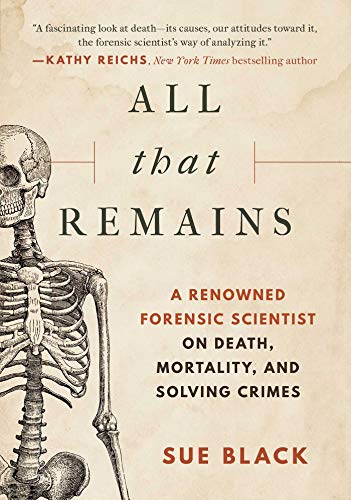
ALL THAT REMAINS: A Renowned Forensic Scientist on Death, Mortality, and Solving Crimes
SUE BLACK
Arcade Publishing (non-affiliate Amazon link)
$18.99 ebook, available now
Rating: 4* of five
The Publisher Says: For fans of Caitlin Doughty, Mary Roach, Kathy Reichs, and CSI shows, a renowned forensic scientist on death and mortality.
Dame Sue Black is an internationally renowned forensic anthropologist and human anatomist. She has lived her life eye to eye with the Grim Reaper, and she writes vividly about it in this book, which is part primer on the basics of identifying human remains, part frank memoir of a woman whose first paying job as a schoolgirl was to apprentice in a butcher shop, and part no-nonsense but deeply humane introduction to the reality of death in our lives. It is a treat for CSI junkies, murder mystery and thriller readers, and anyone seeking a clear-eyed guide to a subject that touches us all.
Cutting through hype, romanticism, and cliché, she recounts her first dissection; her own first acquaintance with a loved one’s death; the mortal remains in her lab and at burial sites as well as scenes of violence, murder, and criminal dismemberment; and about investigating mass fatalities due to war, accident, or natural disaster, such as the 2004 Indian Ocean tsunami. She uses key cases to reveal how forensic science has developed and what her work has taught her about human nature.
Acclaimed by bestselling crime writers and fellow scientists alike, All That Remains is neither sad nor macabre. While Professor Black tells of tragedy, she also infuses her stories with a wicked sense of humor and much common sense.
I RECEIVED A DRC FROM THE PUBLISHER VIA EDELWEISS+. THANK YOU.
My Review: Professor Dame Sue Black has spent a long lifetime giving those deprived of life and their families the closure she has learned how to give them, their families, and the Body Politic. This book is a report of how she has done this important task that offers communities and survivors a (sometimes partial) restoration of ma'at. She presented a TV show in the teens called History Cold Case. I've watched those shows with great interest, several times, and honestly never understood why there were only two seasons of it. There can be no end of distant-enough ancient cases to investigate. I suppose the ratings weren't up to more...yet our cultural moment is full to bursting with forensics-based fiction. Why this isn't still running, then, is deeply mysterious to me.
The facts that Author Black works with in her job are often only described in jargon; looking them up, that seems like a means she uses to buffer her readers from the full weight of the horrifying things humans do to each other.
Starting off easy, we're led through her early life at a spanking pace. Her decision to become a firensic scientist was oddly inevitable, though she was not and is not a gloomy goth type. I get the strong impression she'd be a right hoot to sit down with down the pub. Surprisingly she's been a lead investigator at the sites of multiple human-rights violations, like Kosovo. One would imagine this would rob a person of the will, even ability, to find perspective in her job's inescapable conclusions.
Not so. This is a rugged, centered, practical and skilled person. Spending three hundred-plus pages with her was interesting, informative, and...oddly...a lot of fun. Given the deeply unhappy subject matter, a fifth star wasn't likely to materialize, but all four that were available shine bright on this very well-made book.
I recommend it to y'all legions of CSI, NCIS etc. etc. shows, the many thousands of us who read Jimmy Perez and Jackson Brodie mystery procedurals, and to anyone who just likes to know weird stuff.
+++++++++++++++++++++++++++++++++++++++++++++++++++++++++++++++
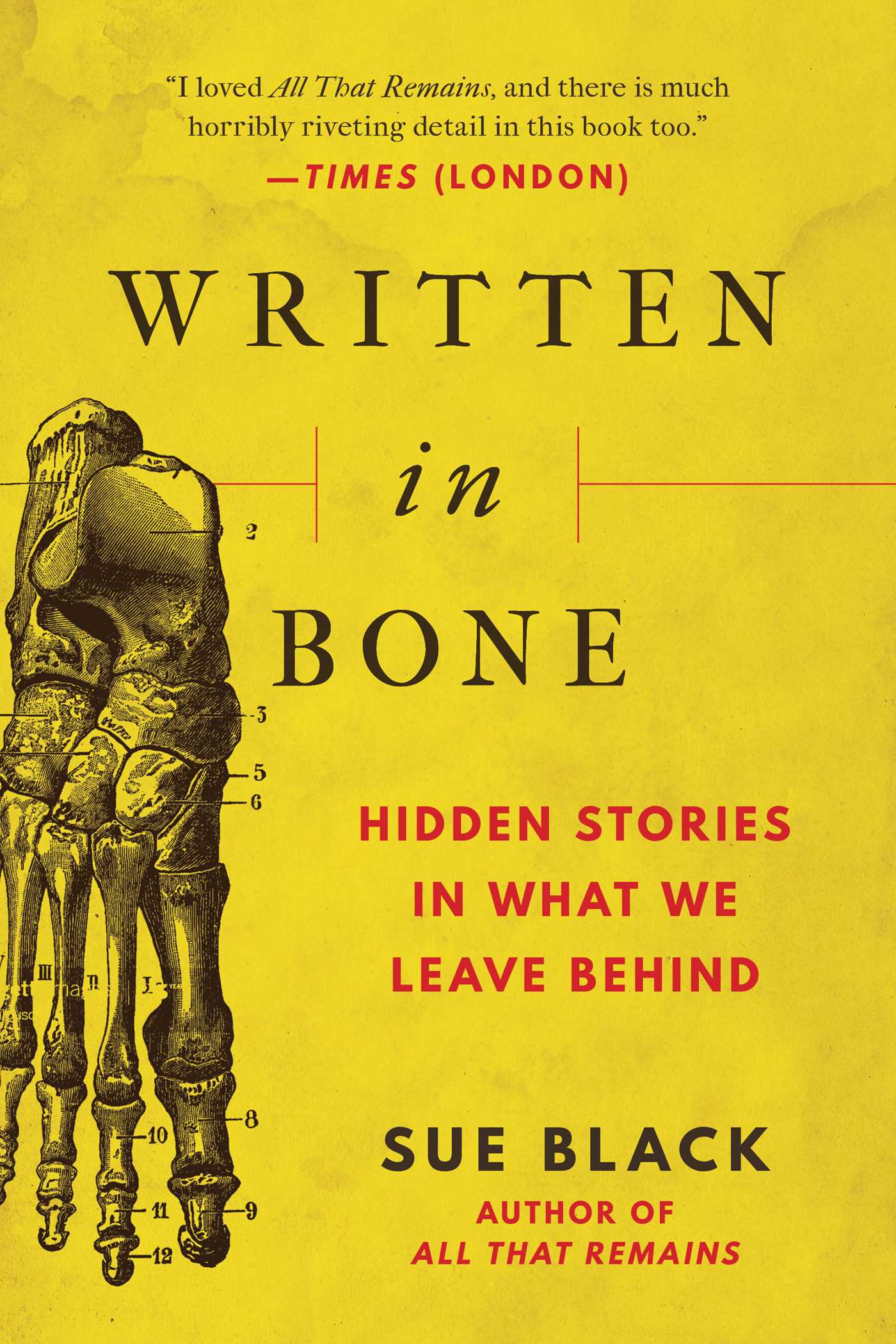
WRITTEN IN BONE: Hidden Stories in What We Leave Behind
SUE BLACK
Arcade Publishing (non-affiliate Amazon link)
$13.99 ebook edition, available now
Rating: 4* of five
The Publisher Says: Winner of the Crime Writers’ Association ALCS Gold Dagger for Nonfiction— A tour through the human skeleton and the secrets our bones reveal, from the author of All That Remains
In her memoir All That Remains, internationally renowned forensic anthropologist and human anatomist Dame Sue Black recounted her life lived eye to eye with the Grim Reaper. During the course of it, she offered a primer on the basics of identifying human remains, plenty of insights into the fascinating processes of death, and a sober, compassionate understanding of its inescapable presence in our existence, all leavened with her wicked sense of humor.
In her new book, Sue Black builds on the first, taking us on a guided tour of the human skeleton and explaining how each person's life history is revealed in their bones, which she calls "the last sentinels of our mortal life to bear witness to the way we lived it." Her narrative follows the skeleton from the top of the skull to the small bones in the foot. Each step of the journey includes an explanation of the biology—how the bone is formed in a person's development, how it changes as we age, the secrets it may hold—and is illustrated with anecdotes from the author's career helping solve crimes and identifying human remains, whether recent or historical. Written in Bone is full of entertaining stories that read like scenes from a true-life CSI drama, infused with humor and no-nonsense practicality about the realities of corpses and death.
I RECEIVED A DRC FROM THE PUBLISHER VIA EDELWEISS+. THANK YOU.
My Review: A step back from the storytelling done in her first book, this book goes through the human skeleton to consider the way a life...and a death...affects the bone in question. I'm very involved as she discusses the ways we unthinkingly abuse our very skeletons, and the way that story is memorialized in the bones we leave behind.
Often enough the things that happen to us after we're born leave the most horrific traces. DO NOT READ THIS BOOK IF REPORTS OF CHILD HARM CAUSES YOU DISTRESS.
I was revolted in this book, more than the first, by the reports of the reasons people's skeletons show enduring damage. The harm we do, or tolerate being done to others, disgusts me. Author Sue Black has seen, understood, and reported on so much more than I will ever see or learn about...and yet she has maintained perspective, has developed immensely valuable skills, has made a positive difference in the social fabric of many communities and families. I am deeply impressed by her. I am awed at how much good a person whose career has led her down very, very dark paths following horrifyingly evil actors has and can do.
It is not for everyone, but if you can endure the child-harm descriptions, this is a weirdly hopeful story. Author Sue Black is facing horrors to restore the rents people have torn in ma'at.
Fred Rogers taught me, "look for the helpers," whenever there's a tragedy. Sue Black is who he meant. At this moment in time, I appreciate knowing there are still helpers out in the world.
Subscribe to:
Posts (Atom)