Showing posts with label queer society. Show all posts

Thursday, July 2, 2026

HOW QUEER BOOKSHOPS CHANGED THE WORLD, worthy thesis defended with passion


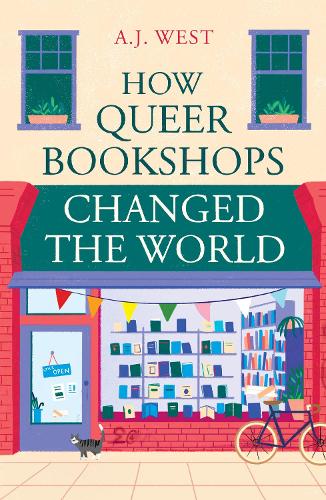
HOW QUEER BOOKSHOPS CHANGED THE WORLD
A.J. WEST

Oneworld Publications (non-affiliate Bookshop.org link)
$14.99 ebook, available now

The Independent Press Top 40 Bestsellers: Non-Fiction For the week ending June 30, 2026

Rating: 4.75* of five

The Publisher Says: For over a century, LGBTQ+ bookshops have been the unsung heroes of queer liberation

Home not only to books but chaotic community noticeboards, vicious rescue cats and countless meet cutes, queer bookshops have always been more than just bookshops, offering friendship, solidarity and sanctuary.

Traveling the world—Shakespeare and Company in Paris, Gay’s the Word in London, the Oscar Wilde Bookshop in New York—A. J. West explores the remarkable history of these bookstores. Tracing their evolution from under-the-counter operations to beloved out-and-proud institutions, West reveals how the queer bookshop stood at the vanguard of LGBTQ+ rights, offering support and vital information through the AIDS crisis and bringing the fight to Section 28 and book bans.

A powerful testament not only to bookshops but to the courage of queer booksellers, from Sylvia Beach hiding books from the Nazis in laundry baskets to Craig Rodwell facing off against the police at the Stonewall riots, A. J. West celebrates the shops and booksellers that brought queer literature and lives into the mainstream.

I RECEIVED A DRC FROM THE PUBLISHER VIA EDELWEISS+. THANK YOU.

My Review
: I'd give it a perfect rating if I hadn't felt so put-upon with the opening chapters speed-lining queer history.

It was my emotional reaction. I'm not wrong; I literally cannot be wrong about my feelings.

It's necessary to put not-queer, or new to their history queer, readers in the picture of what these trailblazing heroically brave people did and what they risked for us all to have access to queer stories. It is breathtaking, and eye-opening, and quite honestly shaming for those of us not willing or able to stand up against Authority for the good of all.

It is more clear to me than ever before that the urgent project of the authoritarians trying to ban queer books, the tech scum trying to make all knowledge available only on their say-so and the seeker's ability to pay any vig "They" choose to demand, and the ruling class's desire to keep you as stupid as possible intertwine like snakes on Medusa's head. The underknown prophet of this future we now live in, Sinclair Lewis, wrote: "When fascism comes to America, it will be wrapped in a flag and carrying the cross."

Look around you...that was prophecy, not fiction.

Author AJ writes about the past in this book. It could, one day soon, feel like an elegy for les jadis if you and I are not very careful and very intentional in our actions in November 2026. It's fragile, this thing called Liberty, and it's always been very, very unpopular with with the ruling class. We-the-people have already seen how much control "They" want after women's bodily autonomy was stripped away from them in the US. Revoltingly it was enabled by a quisling woman. All of these struggles, legal battles, and societal shifts are under long-term and well-funded attack. How I wish more people had listened when Hilary Clinton spoke that truth.

Author AJ details the harms this determined regressive minority causes with seeming impunity in his chapters on the role of AIDS amelioration and drag-queen story hour bannings. Restraining the flow of often life-saving information to those in desperate need of it, and excluding people "They" don't like such as gender-nonconforming people, are terrible actions on their face. The true evil doesn't announce itself. It unfolds as Author AJ shows us consequences.


The best kind of non-fiction writing tells you a story that evokes emotional responses from the reader. I've seldom been more emotional in my response to a true story that does not involve a murder. Author AJ deserves all the kudos there are for bringing a storyteller's constructive attention to this crisis in our body politic.

Thursday, June 27, 2024

QUEER AS CAMP: Essays on Summer, Style, and Sexuality, preaching to the choir...but charismatically


QUEER AS CAMP: Essays on Summer, Style, and Sexuality
KENNETH B. KIDD
(ed.) & DERRITT MASON (ed.)
Fordham University Press
$33.00 trade paper, available now

Rating: 4* of five

The Publisher Says: To camp means to occupy a place and/or time provisionally or under special circumstances. To camp can also mean to queer. And for many children and young adults, summer camp is a formative experience mixed with homosocial structure and homoerotic longing. In Queer as Camp, editors Kenneth B. Kidd and Derritt Mason curate a collection of essays and critical memoirs exploring the intersections of "queer" and "camp," focusing especially on camp as an alternative and potentially nonnormative place and/or time.

Exploring questions of identity, desire, and social formation, Queer as Camp delves into the diverse and queer-enabling dimensions of particular camp/sites, from traditional iterations of camp to camp-like ventures, literary and filmic texts about camp across a range of genres (fantasy, horror, realistic fiction, graphic novels), as well as the notorious appropriation of Indigenous life and the consequences of "playing Indian."

These accessible, engaging essays examine, variously, camp as a queer place and/or the experiences of queers at camp, including Vermont's Indian Brook, a single-sex girls' camp that has struggled with the inclusion of nonbinary and transgender campers and staff; the role of Jewish summer camp as a complicated site of sexuality, social bonding, and citizen-making as well as a potentially if not routinely queer-affirming place. They also attend to cinematic and literary representations of camp, such as the Eisner award-winning comic series Lumberjanes, which revitalizes and revises the century-old Girl Scout story; Disney's Paul Bunyan, a short film that plays up male homosociality and cross-species bonding while inviting queer identification in the process; Sleepaway Camp, a horror film that exposes and deconstructs anxieties about the gendered body; and Wes Anderson's critically acclaimed Moonrise Kingdom, which evokes dreams of escape, transformation, and other ways of being in the world.

Highly interdisciplinary in scope, Queer as Camp reflects on camp and Camp with candor, insight, and often humor.

Contributors: Kyle Eveleth, D. Gilson, Charlie Hailey, Ana M. Jimenez-Moreno, Kathryn R. Kent, Mark Lipton, Kerry Mallan, Chris McGee, Roderick McGillis, Tammy Mielke, Alexis Mitchell, Flavia Musinsky, Daniel Mallory Ortberg, Annebella Pollen, Andrew J. Trevarrow, Paul Venzo, Joshua Whitehead

I RECEIVED A DRC FROM THE PUBLISHER VIA EDELWEISS+. THANK YOU.

My Review
: Camp. One set of four letters, widely divergent meanings to different groups. Don't think these essays, from the queer-studies, and mostly queer, people listed above are in any way insensible of this dichotomy. It gets played with a lot.

One note I'll give you before you even think about reading the collection: Read Sontag's Notes on Camp before you get into these weeds. Everyone herein reproduced has, says so, and/or refers to that work. Besides it's well worth reading just because.

Academocs are famous for writing at each other, Essays and articles in their specialist subjects used a shared vocabulary that most of us do not share. That's certainly true of this collection's contents. Yet I've given it four stars. That's all down to the fact that the essayists have all tied their thoughts either to pop-cultural texts like Mielke and Trevarrow's engrossing"Camping with Walt Disney’s Paul Bunyan: An Essay Short" and Kyle Eveleth's "Striking Camp: Empowerment and Re-Presentation in Lumberjanes", which might be my favorite essay in the whole thing; or to experiences of going to summer camp that I could relate to, like D. Gilson's "Notes on Church Camp" which was a tough read for me.

What I got from this assemblage of academic thought about youthful queerness was the striking, clarifying bolt of insight that I was supposed to feel the exclusion and rejection of camp. It was meant to, designed to, cause this Otherness I knew I had to be thrown (verb not chosen lightly) into high relief. I was *intended* to feel the hostility of my peers so I would buckle down and try to be like them.

Fat chance.

The other reason for a boy like me to go to camp, to be a camper, was to show to the other boys that I was fair game. As long as I failed at their tasks, it was okay to be cruel...it was expected. "Letting the kids sort themselves out" was the way the appalling cruelty of ut was sold to parents.

That has never been clearer than after reading these stories of queer camping experiences. I don't know who among the readers of my blog will most likely want to spend the high price of the collection; I hope that, for anyone interested in the subject, their local library will step in and add this to the extant sociology texts, or if you live in an enlightened place, their queer studies collection.

Wednesday, October 26, 2022

THE GAUTAM BHATIA PAGE: THE WALL, an apt title for a claustrophobic tale & THE HORIZON, the consequences of trading agoraphobia for claustrophobia


THE WALL
GAUTAM BHATIA
(Sumer #1)
HarperCollins India (non-affiliate Amazon link)
$9.99 Kindle edition, available now

Rating: 4* of five

The Publisher Says: Mithila’s world is bound by a Wall enclosing the city of Sumer—nobody goes out, nothing comes in. The days pass as they have for two thousand years: just enough to eat for just enough people, living by the rules. Within the city, everyone knows their place.

But when Mithila tries to cross the Wall, every power in Sumer comes together to stop her. To break the rules is to risk all of civilization collapsing. But to follow them is to never know: who built the Wall? Why? And what would the world look like if it didn’t exist?

As Mithila and her friends search for the truth, they must risk losing their families, the ones they love, and even their lives. Is a world they can’t imagine worth the only world they have?

For fans of Isaac Asimov’s Nightfall and Ursula Le Guin’s The Dispossessed comes an astonishingly powerful voice in speculative fiction that explores what it means to truly be free.

I RECEIVED A DRC FROM THE AUTHOR. THANK YOU.

My Review
: The author is a social-media acquaintance of mine, one whose work in the world of Indian Constitutional law I admire unreservedly. He is also among those who run Strange Horizons magazine, which work I admire immoderately as well. I think it's fair to say I approached this read with the dread of a fan...

...who then became a stan. The pace of this book probably puts a lot of sci-fi fans off but, for me, it was a perfect and langourous introduction to a two-thousand-year-old utopia whose principles hadn't changed but whose use of them had. The oppressive weight of a society that is sure that it's Right can not be overdramatized. What Author Gautam did, choosing a pace for its affect on the reader, was evoke a deep and abiding dread, a building sense of wrongness, that worked so much better than a more whiz-bang approach would have done. I found the legal sections, pertaining to Sumer's laws, to be the grace notes I've always enjoyed in my speculative fiction. They set the stakes of the rebellion against the status quo better than any other choice...rebelling against a government, after all, is rebelling against its laws.

Mithila, our PoV character, is a woman on a mission: GET OUT OF SUMER. Her rebellion isn't against intolerable and burdensome living conditions, there's enough food and plenty of stuff that one actually needs. It's a deeper rebellion: Mithila needs to be free, to have the chance to make her own choices and decisions. It's simply too much for her spirit to bear to conform.

Young people have ever felt thus, it's true. In a utopian society where you simply can not speak your mind or ask questions that deserve and require answers, it really becomes a Hell for the Mithilas of the world. She and some like-minded friends aren't glad to be safe inside the walls of Sumer. They want OUT, and the ever-threatened consequences seem like small potatoes to them.

The Powers That Be can't take that challenge lying down...and don't...but the end of the story sees Mithila and her faction winning the war because, once you introduce doubt into the world, things fall apart pretty quickly. The eternal verity that monoliths aren't stable and can fall with a well-placed shove is demonstrable using physics (Stonehenge hasn't always been the way it is now). People's hearts and minds, once engaged on a project of destruction, are very powerfully motivated to see the project through. (There's a recent example of this in the US.)

But in the end, even a novel of ideas needs to bring its concerns to a personal level or it fails to entertain...a novel's first duty. The concepts of Wallrise and Wallset, exactly what you are thinking they are, break a seaside-dwelling ocean lover's heart. The concept of a horizon is so utterly beyond the ken of people who have always lived inside encircling walls...Imagine water extending from your feet, buildings and fields receding and disappearing, imagine the water filling the empty space elicits exhilaration in a few, terror in many...and doesn't that just scare you! And, lest you wonder if the world-building is dry and flavorless, I present you the concept of the Towers of Rebirth...remembering that Sumer is a closed society, with limited resources, imagine what "rebirth" might entail for a *real* scare....

Enough to move on to the sequel, it did, and procure same with my very own United States dollars.

++++++++++++++++++++++++++++++++++++++++++++++++++++++++++++++++


THE HORIZON
GAUTAM BHATIA

HarperCollins India (non-affiliate Amazon link)
$20.00 trade paper, available now

Rating: 4* of five

The Publisher Says: ‘Did we not once promise that we would always be honest with each other?’

‘I no longer ask for honesty. Just tell me a lie that I can forgive.’

After 2000 years, the Wall has been breached. As Mithila steps into a world unknown, her sister Minakshi tightens her grasp on a city bracing for chaos and violence under a red sky. The ghost of an old Revolution stalks the streets, while the shadow of a new one threatens to tear Sumer apart.

Spreading word about this historical transgression, Alvar and Mankala find themselves facing new perils in a City they can barely recognise—one torn between old fears and new desires, while caught in a deadly power struggle. But soon, they will know that the crossing of the Wall has consequences not just for the City, but for the world.

My Review: Be careful what you ask the gods for, lest the answer be "Yes."

Mithila's prayers were assented to; now she must live in the aftermath. The Walls of Sumer are no more; this doesn't mean Sumer is no more, of course, any more than the ending of Constantinople's play-Roman society meant it didn't exist anymore. (What do you imagine sparked the Renaissance if not the sudden outflow of people and books that had been behind Constantinople's walls?) The discovery that there is...stuff, people, a whole Universe...outside Sumer's walls doens't mean that Mithila and her peeps just win because Mithila has a sister. Sibling rivalry will do more than a little to prevent things from moving too fast, and Minakshi (Author Gautam! These names, so many are so similar! NOT COOL, DUDE) is a sibling in the throes of serious rivalry. She uses Mithila's discovery of the outside to force a confrontation with Powers That Be who previously defeated *her* attempt to take over Sumer and she is ripe and ready for revenge against them. And if Mithila suffers too, well, omelettes, eggs....

Writing about chaotic change in a society whose stasis was thoroughly established earlier should feel, I don't know, complicated. It does here. I was also very pleased that the read was propulsive, violent where necessary and exciting throughout, and driven from the real-feeling needs and desires of characters unafraid to throw their hearts and bodies into the future. There is no landing in safety, there is no landing even, visible to them. But Mithila and Rama (her lesbian lover) do it anyway, commit themselves and their people to a brave new world. (Arrogant, of course, as one must be to be a rebel.) What became difficult for me as I read this book is my sense that I am empathizing with people who aren't in sympathy with the world they were born into so they...tear it all down...? That's a very big step to take with no plan for the future. I understand that Author Gautam has said he's done with this storyverse. I'm really not sure if the characters agree with him. I predict sleepless nights flipping the pillow, looking for some way to cool their anger as they struggle to get out of his brain.

There is an appendix where Author Gautam goes through the sources and inspirations for Sumer, and it by itself should be required reading for aspiring fantasy/speculative fiction writers. It is thorough without feeling like a course syllabus.

All in all, two books telling one story in a deeply, empathetically imagined alternate reality to our own. Spending time in this place poised on the brink of rebellion is, strange to say, a great escape from a darkening world.