Showing posts with label queer history. Show all posts

Thursday, July 2, 2026

HOW QUEER BOOKSHOPS CHANGED THE WORLD, worthy thesis defended with passion


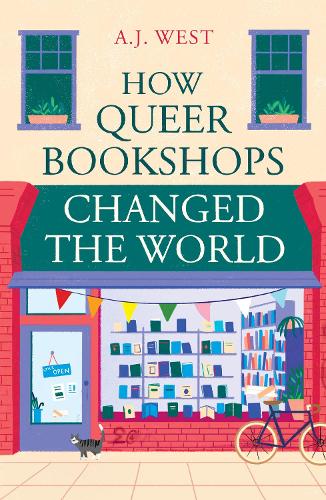
HOW QUEER BOOKSHOPS CHANGED THE WORLD
A.J. WEST

Oneworld Publications (non-affiliate Bookshop.org link)
$14.99 ebook, available now

The Independent Press Top 40 Bestsellers: Non-Fiction For the week ending June 30, 2026

Rating: 4.75* of five

The Publisher Says: For over a century, LGBTQ+ bookshops have been the unsung heroes of queer liberation

Home not only to books but chaotic community noticeboards, vicious rescue cats and countless meet cutes, queer bookshops have always been more than just bookshops, offering friendship, solidarity and sanctuary.

Traveling the world—Shakespeare and Company in Paris, Gay’s the Word in London, the Oscar Wilde Bookshop in New York—A. J. West explores the remarkable history of these bookstores. Tracing their evolution from under-the-counter operations to beloved out-and-proud institutions, West reveals how the queer bookshop stood at the vanguard of LGBTQ+ rights, offering support and vital information through the AIDS crisis and bringing the fight to Section 28 and book bans.

A powerful testament not only to bookshops but to the courage of queer booksellers, from Sylvia Beach hiding books from the Nazis in laundry baskets to Craig Rodwell facing off against the police at the Stonewall riots, A. J. West celebrates the shops and booksellers that brought queer literature and lives into the mainstream.

I RECEIVED A DRC FROM THE PUBLISHER VIA EDELWEISS+. THANK YOU.

My Review
: I'd give it a perfect rating if I hadn't felt so put-upon with the opening chapters speed-lining queer history.

It was my emotional reaction. I'm not wrong; I literally cannot be wrong about my feelings.

It's necessary to put not-queer, or new to their history queer, readers in the picture of what these trailblazing heroically brave people did and what they risked for us all to have access to queer stories. It is breathtaking, and eye-opening, and quite honestly shaming for those of us not willing or able to stand up against Authority for the good of all.

It is more clear to me than ever before that the urgent project of the authoritarians trying to ban queer books, the tech scum trying to make all knowledge available only on their say-so and the seeker's ability to pay any vig "They" choose to demand, and the ruling class's desire to keep you as stupid as possible intertwine like snakes on Medusa's head. The underknown prophet of this future we now live in, Sinclair Lewis, wrote: "When fascism comes to America, it will be wrapped in a flag and carrying the cross."

Look around you...that was prophecy, not fiction.

Author AJ writes about the past in this book. It could, one day soon, feel like an elegy for les jadis if you and I are not very careful and very intentional in our actions in November 2026. It's fragile, this thing called Liberty, and it's always been very, very unpopular with with the ruling class. We-the-people have already seen how much control "They" want after women's bodily autonomy was stripped away from them in the US. Revoltingly it was enabled by a quisling woman. All of these struggles, legal battles, and societal shifts are under long-term and well-funded attack. How I wish more people had listened when Hilary Clinton spoke that truth.

Author AJ details the harms this determined regressive minority causes with seeming impunity in his chapters on the role of AIDS amelioration and drag-queen story hour bannings. Restraining the flow of often life-saving information to those in desperate need of it, and excluding people "They" don't like such as gender-nonconforming people, are terrible actions on their face. The true evil doesn't announce itself. It unfolds as Author AJ shows us consequences.


The best kind of non-fiction writing tells you a story that evokes emotional responses from the reader. I've seldom been more emotional in my response to a true story that does not involve a murder. Author AJ deserves all the kudos there are for bringing a storyteller's constructive attention to this crisis in our body politic.

Sunday, December 21, 2025

TO THE STARS: The Autobiography of George Takei, Star Trek's Mr. Sulu


TO THE STARS: The Autobiography of George Takei, Star Trek's Mr. Sulu
GEORGE TAKEI

Pocket Books
$8.99 ebook, available now

Rating: 5* of five

The Publisher Says: Best known as Mr. Sulu, helmsman of the Starship Enterprise™ and captain of the Starship Excelsior, George Takei is beloved by millions as part of the command team that has taken audiences to new vistas of adventure in Star Trek®—the unprecedented television and feature film phenomenon.

From the program’s birth in the changing world of the 1960s and death at the hands of the network to its rebirth in the hearts and minds of loyal fans, the Star Trek story has blazed its own path into our recent cultural history, leading to a series of blockbuster feature films and three new versions of Star Trek for television.

The Star Trek story is one of boundless hope and crushing disappointment, wrenching rivalries and incredible achievements. It is also the story of how, after nearly thirty years, the cast of characters from a unique but poorly rated television show have come to be known to millions of Americans and people around the world as family.

For George Takei, the Star Trek adventure is intertwined with his personal odyssey through adversity in which four-year-old George and his family were forced by the United States government into internment camps during World War II.

Star Trek means much more to George Takei than an extraordinary career that has spanned thirty years. For an American whose ideals faced such a severe test, Star Trek represents a shining embodiment of the American Dream—the promise of an optimistic future in which people from all over the world contribute to a common destiny.

I RECEIVED THIS BOOK FROM THE GOODREADS M/M GIFT EXCHANGE. THANKS!

My Review
: The fascistic turn new Trek has taken has a hard job erasing the original series' legacy, as there are still some dollars to be extracted from the nostalgia for those bygone, halcyon days of TOS (The Original Series in Trekspeak), of inclusion and celebration of human decency over disgusting, primitive violence and hatred of Others.

Thirty years ago, this book stood out. Nowadays, it's a bloody unicorn. See my review of They Called Us Enemy for the expanded and more self-focused story of Takei's childhood experiences with US racism and exclusion.

This is the story of Takei the man, the actor, the ground-breaking Asian role model. What it isn't, to the moaning of superfans of TOS, is a gossipy tea-spilling tell-all about the shenanigans behind the scenes of TOS. I was mildly miffed by this on my 1990s read; but this is a re-read, and it's been an entire generation for news to have filtered out about this fact, so no pearl-clutching from me.

Takei does not shy away from discussing his on-set conflicts with Shatner, of course, because they're part of his ground-breaking for actors who aren't white. He stood up for the integrity of his vision of Sulu. That would've been unthinkable even ten years earlier. Better contracts for actors! Imagine! The entertainment industry, like all capitalist enterprises, demands workers sacrifice for the profits of the owners. Takei stood against that; his actions might be small, but they were in concert with others, and had a real impact on the well-being of those across the industry who were also not white.

I mostly reveled, if I'm honest, in the opportunity to hear Takei's voice in my head as I read his conversational writing style. Of course, in the 1990s, the conversation didn't include even a whisper of his now-public gayness. He came out when the legalization of "gay marriage" was vetoed by Arnie the Terminator; around the was when Proposition 8 began being mooted. Never think, babyqueers, that straight people are your friends. Anything "granted" to you by their charity is something they can, and will, take away. May take them a long time, may take them a week, but anything they can take away they will eventually.

Would his very open (in fandom, anyway) secret have caused a stir had he discussed it in 1994? You bet! Remember how very different the landscape was then: AIDS was still a death sentence, though it was now deferrable to those who could afford the meds. There was the travesty of "Don't Ask, Don't Tell" that the inexperience and indifference of the Clintons gifted us with wreaking havoc; also the indefensible "Defense of Marriage" Act. The social landscape was not such that the revelation to the normies that George was a big ol' 'mo would've done more good than harm...to the book, to the franchise, to his inclusion in the Star Trek/industrial complex of convention appearances and tat-sales.

I understood that then, I'm more clear than ever about it now, and I urge those unhappy with this decision made by a stranger they do not know personally to accept a perspective check from one who was there, who knew that landscape intimately.

He had our backs when the chips were down and his voice really counted. Let go of judgment, let the past be the past, accept that now things are different in part because of a brave man who's lost it all more than once in his life.

Saturday, July 5, 2025

THE BETRAYAL OF THOMAS TRUE, good plot, better idea, decent execution


THE BETRAYAL OF THOMAS TRUE
A.J. WEST

Orenda Books (non-affiliate Bookshop.org link)
$26.99 hardcover, available now

Rating: 4* of five

The Publisher Says: It is the year 1710, and Thomas True has arrived on old London Bridge with a dangerous secret. One night, lost amongst the squalor of London's hidden back streets, he finds himself drawn into the outrageous underworld of the molly houses.

Meanwhile, carpenter Gabriel Griffin struggles to hide his double life as Lotty, the molly's silent guard. When the queen of all 'he-harlots', Mother Clap, confides in him about a deadly threat, he realises his friends are facing imminent execution.

To the horror of all mollies, there is a rat amongst them, betraying their secrets to a pair of murderous Justices, hell-bent on punishing sinners with the noose.

Can Gabriel unmask the traitor before it's too late? Can he save hapless Thomas from peril, and their own impossible love?

Set amidst the hidden world of Georgian London’s gay scene, The Betrayal of Thomas True is a brutal and devastating thriller, where love must overcome evil, and the only true sin is betrayal…

I RECEIVED A DRC FROM THE PUBLISHER VIA EDELWEISS+. THANK YOU.

My Review
: I came out of my seat when I read "...love must overcome evil, and the only true sin is betrayal..." in the book's synopsis. It could not have been more directly aimed at my sweet spot, and timed more exactly as needed.

I still think that. I'm not one bit taking away from the author's acumen or clarity of vision. I only wish I'd had more...fun. It's a good plot, it's executed competently, but there is a lack of that indefinable *something* in the characterizations that gets me to invest in them and their plight.

After thinking and thinking about this issue, after probing my experience of the read for a solid while, I've come to the only logical conclusion. I was introduced to the stakes before I'd invested in the people. I knew what was going on but did not yet care that it was going to happen to these men. This same issue arose for me in the Shardlake historical mysteries.

I'm delighted by the evocative insults...discover them yourselves, they are priceless nuggets of invective...and engrossed in the setting of London's "molly houses" as reconstructed here. Honestly, having been immersed in this story's world, I think I'd know how to comport myself unobtrusively in this arcane, hidden world's manners and speech.

Because the stakes, the heinous betrayal of men like me by one of our own to the vile, revolting scum enforcing their distorted "morality" on pain of death, were instantly relatable to me, I found myself unwilling to put the book down. I think it was a single five-hour session that finished it off for me. That's pretty good going for three-hundred-ish pages! And blessings on the publisher for opening the proceedings with a Dramatis Personae list of real and molly-names!

I hope that makes clear the real pleasure of the story for me. I did not just slog through the pages. I finished the book because it was not one I could imagine leaving unfinished. That's praise indeed from a seasoned old campaigner like me. I think anyone who would like to see just what it costs to live your own truth in a way that satisfies your human need to give and receive love, amid a world full of messages threatening you with harm up to and including death for doing it, would like it.

History buffs eagerly flagged down to come into this authorial spiderweb of facts and research gems. Gay men over fifty sought especially vigorously...you'll see why. Believe me...learning the dreadful fate of our kind in a time only slightly less hateful than now will energize your resistance.

Saturday, June 7, 2025

FORBIDDEN DESIRE IN EARLY MODERN EUROPE: Male-Male Sexual Relations, 1400-1750, scholarly work needed to read for queer-identity students


FORBIDDEN DESIRE IN EARLY MODERN EUROPE: Male-Male Sexual Relations, 1400-1750
NOEL MALCOLM

Oxford University Press (non-affiliate Amazon link)
$24.99 ebook, available now

Rating: 4.25* of five

The Publisher Says: A landmark study of the history of male-male sex in early modern Europe, including the European colonies and the Ottoman world.

Until quite recently, the history of male-male sexual relations was a taboo topic. But when historians eventually explored the archives of Florence, Venice and elsewhere, they brought to light an extraordinary world of early modern sexual activity, extending from city streets and gardens to taverns, monasteries and Mediterranean galleys. Typically, the sodomites (as they were called) were adult men seeking sex with teenage boys. This was something intriguingly different from modern the boys ceased to be desired when they became fully masculine. And the desire for them was seen as natural; no special sexual orientation was assumed.

The rich evidence from Southern Europe in the Renaissance period was not matched in the Northern lands; historians struggled to apply this new knowledge to countries such as England or its North American colonies. And when good Northern evidence did appear, from after 1700, it presented a very different picture. So the theory was formed—and it has dominated most standard accounts until now—that the 'emergence of modern homosexuality' happened suddenly, but inexplicably, at the beginning of the eighteenth century.

Noel Malcolm's masterly study solves this and many other problems, by doing something which no previous scholar has giving a truly pan-European account of the whole phenomenon of male-male sexual relations in the early modern period. It includes the Ottoman Empire, as well as the European colonies in the Americas and Asia; it describes the religious and legal norms, both Christian and Muslim; it discusses the literary representations in both Western Europe and the Ottoman world; and it presents a mass of individual human stories, from New England to North Africa, from Scandinavia to Peru. Original, critical, lucidly written and deeply researched, this work will change the way we think about the history of homosexuality in early modern Europe.

I RECEIVED A DRC FROM THE PUBLISHER VIA EDELWEISS+. THANK YOU.

My Review
: Deeply researched, plentifully sourced and attributed...and as that would lead you to understand, it's an academic work. It isn't a browsing book, it's a studying book. I took over a year to read it. I wanted to do it justice, to focus on its theses, so I took my time.

I ended up surprised at some of Malcolm's conclusions, as one would hope to be the case in a scholarly work. His firm opinion that English buggery was simply not as common as the Mediterranean practice was specifically stated to include James I of England. He contends that the social conventions of male friendship then prevailing adequately explain His Majesty's somewhat fervent correspondence with his favorites. This is carefully hedged by explaining that, absent proof, it's reasonable to accept that we simply do not know with certainty what occurred at this distance in time.

How useful is it to go looking for ancestors of modern queer identities in the past? Where there are records, they are almost always legal ones, of prosecutions for offenses. Can that in any useful way be extrapolated to indicate broader trends of sexual activity? Is sexual activity actually a useful measure of a person's emotional inner life? What do we mean by "queer" or "gay" or "bisexual?" I know of my own personal knowledge men who have sex with other men exclusively, who reject any "queer" identity.

It's the identity, you'll note, that's being rejected. Malcolm contends that it's "the Mediterranean model" of pederastic sodomy that was absent in northern climes, not men having sex with other men. It's a contention that I think bears very serious consideration. If many men in the Mediterranean committed sodomy as their legitimate access to sexual release, given how late (compared to more northerly climes) they married, are they in any meaningful way "queer?" Or just horny, and unwilling to risk syphilis (fatal then) by using a female sex worker?

A book that treats its topic with bracing and refreshing unwillingness to bow to fashion while still refusing to stray far from its evidentiary base is a rare thing indeed. One that is carefully analytical of the terms used in the past and their intersection, or lack of intersection, with modern understandings of identity, is rare and precious.

Not a casual read but a profoundly informative and essential one for gay men, or those who wish to comprehend history's limits in identity politics.

Saturday, May 31, 2025

NO NAMES, a #PrideMonth debut novel from a poet via Minneapolis's estimable Coffee House Press


NO NAMES
GREG HEWETT

Coffee House Press (non-affiliate Amazon link)
$17.99 ebook, available now

Rating: 3.75* of five

The Publisher Says: Inspired by the iconic punk scene of the late '70s, No Names blurs the lines of affection and sexuality in a haunting tale of desire, hope, and loss.

Mike and Pete were "no names," two working-class boys lost in the shuffle of their stratified town, brought together by their love of music. By 1978, their punk band was blazing across the underground scene. Now, in 1993, Mike is a hermit living alone on a dot of an island in the North Atlantic. When a mysterious letter from an unlikely fan named Isaac arrives, he's pulled right back into the pain he’s spent over a decade running from.

Isaac longs for an escape from his lonely teenage life. A chance discovery of the No Names’ only album catapults him into an obsession with the godlike rockers and the tantalizing possibility of connection.

As their stories collide, mistakes breed consequences that echo through the decades like the furious reverberations of a power chord.

I RECEIVED A DRC FROM THE PUBLISHER VIA EDELWEISS+. THANK YOU.

My Review
: Two-thirds of an excellent novel...after the twist, it's not excellent anymore. It's good, and as a contrast to almost two hundred pages of really outstanding build-up, I felt really let down by the ending. It was a messy trailing-off of several conversations, between characters and us, as well as each other. Multiple PoV novels are always...baggy...but this one's excitement and intensity came from the sense I had in the first part of the book that each person was picking up the thread of a narrative, was the response part in a call-and-response composition.

Much of that energy came from the way the voices wove around each other as they spoke of the times and events that the narrator before had no way of knowing. By the two-thirds mark, they were not telling the same story. They were following their own strands into a future not shared; it's like life, you meet, connect, intertwine for a time, then the time is over. The problem I had with that in this context is that it takes me from one kind of book...close harmony call-and-response...into another, the oratorio going chapter-and-verse through the wind-up of the stories I'd previously experienced directly.

What started as a five-star read ended at three and three-quarters because the narrative drive leaked right out, becoming severe with Mike's relating with the reader how Isaac fits in with the story. I began to nit-pick characters' word choices, their manner of addressing the facts they presented. That is never a good sign. I was disinvesting before the book ended.

But my goddesses, that first bit! A true joy of reading time spent well, and in the presence of a talented voice in storytelling. So not-quite four stars to celebrate the first novel of a writer whose next novel I want to read as soon as he writes it.

Monday, April 21, 2025

SEPARATE ROOMS, classic Italian novel of grief and loss in the AIDS plague's early years


SEPARATE ROOMS
PIER VITTORIO TONDELLI
(tr. Simon Pleasance)
Zando (non-affiliate Amazon link)
$14.99 ebook, available tomorrow

Rating: 5* of five

The Publisher Says: Thomas, a young German musician, is dying. His older boyfriend, a renowned Italian writer named Leo, finds it impossible to watch the slow and inevitable demise of his lover; he condemns himself to moving cities every few weeks instead, in the hope of finding a semblance of peace.

He travels through Europe where past and present overlap, years merge and faces emerge—and where reminders of the life he and Thomas shared are on every corner. Leo's memories become clearer with every road he takes, much as he wishes he could simply forget. While alive, and wanting to preserve the passion of their relationship, Leo had forced Thomas to live separately: in separate rooms, separate towns, with separate lives. But now, face to face with true solitude, Leo must finally reckon with the impossible striving of memory to recreate life and, ultimately, cross an ocean to find the strength to go on.

André Aciman's Call Me by Your Name meets Ocean Vuong's On Earth We're Briefly Gorgeous: Separate Rooms is a singular and unforgettable meditation on almost-ideal love, told in three musical movements, by a fiery and unforgettable literary talent.

I RECEIVED A DRC FROM THE PUBLISHER VIA NETGALLEY. THANK YOU.

My Review
: This book came out in Italian in 1989. I assume most of y'all remember something about 1989, but probably not the sheer awfulness of the AIDS epidemic eating the gay-men's communities around the world at that time.

I was there. I loved and lost more than once in the hell of the times. It happened like Tondelli, dead a year and a half after this book appeared, said it did:
In his last moments, Thomas is back in the family fold, with the same people who brought him into the world. Now, with their hearts torn asunder by suffering, they are helping Thomas to die. There is no room for Leo in this parental reconciliation. Leo is not married to Thomas. He has not had children with him. Neither of them bears the other's name at the registry office, and there is not a single legal record on the face of the earth that carries the signatures of witnesses to their union. Yet for more than three years they have been passionately in love with one another. They have lived together in Paris and Milan, and they have travelled together, played music together and danced together. They have quarrelled and abused each other, and even hated each other. They have been in love. But it is as if, without warning, beside that deathbed, Leo realised that he had experienced not a great love story, but rather some little school crush. As if they were telling him: You've both had a good time, and that's okay, too. But here we're fighting a life and death struggle. Here a life is at stake. And we—a father, a mother and a son—are what really matters.
That made Thomas one of the lucky ones, the ones whose families did not reject him, refuse to see him, or came to his deathbed simply to reject him one final time. Leo? Oh please, like anyone not gay thought a thing of the feelings and needs of the ones left behind!

The book is a series of leaps and hops in space...around the cities Thomas and Leo occupied for moments in time...and time, either spent together or remembered in the loss of love, or remembered in the moment of being there as one of the spaces Thomas wasn't with Leo. I think this fracturing into the three acts of an operetta, as Tondelli said he aimed to do, this absence of cohesion in the third-person narrative awareness, pretty perfectly explains grief's effects on the grieving mind.

In the grief of losing one's belovèd partner there's a profound silence. Leo's early response of lurching heedlessly from pillar to post is a way many people have of trying to escape that horrific, entombing silence. In looking at places he saw with Thomas, there's a sense that the existence of the places he saw with his love somehow, in some small corner of their physicality, contain an Akashic record of the emotional bond they shared. It's as though Leo, seeing this place or that, gets his love now vanished without a record, memorialized. If people still living don't see Thomas and Leo's love as valid, the squares of Paris or Milan recorded and validated it by holding them as their moments ran steadily out. In Leo's still-prevalent idea of what makes a couple worthy of acknowledgment, these places are the best substitutes he can identify for external validation.

By the third movement Leo feels, as he did in their life, that he and Thomas are meant to live in separate rooms. There is no more separate room than the tomb. Leo, permaybehaps too late, thinks his way through his actions in light of the ending of the love story he so possessed, the love object he so powerfully cherished. It is not a story about Leo's resolution of his regrets. It is Leo's reckoning with his (now alienated from their proper object) feelings. It is Leo's possibly impermanent realization that he, and Thomas, simply were not going to be able to invent for themselves and each other a way to accept they could live in anything but separate rooms.

I don't think it will speak to everyone. It spoke to me because my "Thomas" is ever with me, as Leo's is in this récit. The reckoning Leo is doing, I have done, and expect I'll do many years to come.

It's very beautiful. It is the last work Tondelli ever completed. It might mean a lot to people like me who lived it; but the experience of intense grief for what one has experienced the tearing, severing, bloody viciousness of death ripping away will speak to you all.

Maybe not today, but it will.

Thursday, June 27, 2024

QUEER AS CAMP: Essays on Summer, Style, and Sexuality, preaching to the choir...but charismatically


QUEER AS CAMP: Essays on Summer, Style, and Sexuality
KENNETH B. KIDD
(ed.) & DERRITT MASON (ed.)
Fordham University Press
$33.00 trade paper, available now

Rating: 4* of five

The Publisher Says: To camp means to occupy a place and/or time provisionally or under special circumstances. To camp can also mean to queer. And for many children and young adults, summer camp is a formative experience mixed with homosocial structure and homoerotic longing. In Queer as Camp, editors Kenneth B. Kidd and Derritt Mason curate a collection of essays and critical memoirs exploring the intersections of "queer" and "camp," focusing especially on camp as an alternative and potentially nonnormative place and/or time.

Exploring questions of identity, desire, and social formation, Queer as Camp delves into the diverse and queer-enabling dimensions of particular camp/sites, from traditional iterations of camp to camp-like ventures, literary and filmic texts about camp across a range of genres (fantasy, horror, realistic fiction, graphic novels), as well as the notorious appropriation of Indigenous life and the consequences of "playing Indian."

These accessible, engaging essays examine, variously, camp as a queer place and/or the experiences of queers at camp, including Vermont's Indian Brook, a single-sex girls' camp that has struggled with the inclusion of nonbinary and transgender campers and staff; the role of Jewish summer camp as a complicated site of sexuality, social bonding, and citizen-making as well as a potentially if not routinely queer-affirming place. They also attend to cinematic and literary representations of camp, such as the Eisner award-winning comic series Lumberjanes, which revitalizes and revises the century-old Girl Scout story; Disney's Paul Bunyan, a short film that plays up male homosociality and cross-species bonding while inviting queer identification in the process; Sleepaway Camp, a horror film that exposes and deconstructs anxieties about the gendered body; and Wes Anderson's critically acclaimed Moonrise Kingdom, which evokes dreams of escape, transformation, and other ways of being in the world.

Highly interdisciplinary in scope, Queer as Camp reflects on camp and Camp with candor, insight, and often humor.

Contributors: Kyle Eveleth, D. Gilson, Charlie Hailey, Ana M. Jimenez-Moreno, Kathryn R. Kent, Mark Lipton, Kerry Mallan, Chris McGee, Roderick McGillis, Tammy Mielke, Alexis Mitchell, Flavia Musinsky, Daniel Mallory Ortberg, Annebella Pollen, Andrew J. Trevarrow, Paul Venzo, Joshua Whitehead

I RECEIVED A DRC FROM THE PUBLISHER VIA EDELWEISS+. THANK YOU.

My Review
: Camp. One set of four letters, widely divergent meanings to different groups. Don't think these essays, from the queer-studies, and mostly queer, people listed above are in any way insensible of this dichotomy. It gets played with a lot.

One note I'll give you before you even think about reading the collection: Read Sontag's Notes on Camp before you get into these weeds. Everyone herein reproduced has, says so, and/or refers to that work. Besides it's well worth reading just because.

Academocs are famous for writing at each other, Essays and articles in their specialist subjects used a shared vocabulary that most of us do not share. That's certainly true of this collection's contents. Yet I've given it four stars. That's all down to the fact that the essayists have all tied their thoughts either to pop-cultural texts like Mielke and Trevarrow's engrossing"Camping with Walt Disney’s Paul Bunyan: An Essay Short" and Kyle Eveleth's "Striking Camp: Empowerment and Re-Presentation in Lumberjanes", which might be my favorite essay in the whole thing; or to experiences of going to summer camp that I could relate to, like D. Gilson's "Notes on Church Camp" which was a tough read for me.

What I got from this assemblage of academic thought about youthful queerness was the striking, clarifying bolt of insight that I was supposed to feel the exclusion and rejection of camp. It was meant to, designed to, cause this Otherness I knew I had to be thrown (verb not chosen lightly) into high relief. I was *intended* to feel the hostility of my peers so I would buckle down and try to be like them.

Fat chance.

The other reason for a boy like me to go to camp, to be a camper, was to show to the other boys that I was fair game. As long as I failed at their tasks, it was okay to be cruel...it was expected. "Letting the kids sort themselves out" was the way the appalling cruelty of ut was sold to parents.

That has never been clearer than after reading these stories of queer camping experiences. I don't know who among the readers of my blog will most likely want to spend the high price of the collection; I hope that, for anyone interested in the subject, their local library will step in and add this to the extant sociology texts, or if you live in an enlightened place, their queer studies collection.

Tuesday, May 28, 2024

#PrideMonth launches!


#PrideMonth launches! Yes, in the US Pride Month is a June celebration, but lag times must be built into all holiday seasons. I'll be reviewing mostly stuff from, by, about those people somewhere on the QUILTBAG rainbow of identities.
My intention is to get as close as my corpus callosum will support to a full-on review posted five times a week. Burgoines and Pearl-Rules aren't subject to my numerical targeting at any time...though that could happen depending on my capacities. Goodness knows I have the most amazing pile of raw review material, and a number of current-year requests for DRCs are pending. I have, as usual, a few reviews in the queue ready to go, so I like my chances of success.

Click here to see an entire blog's worth of #PrideMonth reviews.

I wish you all a wonderful June, and a grand old party of a #PrideMonth, filled with lazy days of reading in your favorite places.

Sunday, December 17, 2023

BOY WITH THE BULLHORN: A Memoir and History of ACT UP New York, clarion call to the quiet youth


BOY WITH THE BULLHORN: A Memoir and History of ACT UP New York
RON GOLDBERG

Empire State Editions/Fordham University Press
$36.95 hardcover, available now

TRADE PAPER AVAILABLE NOW FOR $22.95

Rating: 4.5* of five

The Publisher Says: A coming-of-age memoir of life on the front lines of the AIDS crisis with ACT UP New York.

From the moment Ron Goldberg stumbled into his first ACT UP meeting in June 1987, the AIDS activist organization became his life. For the next eight years, he chaired committees, planned protests, led teach-ins, and facilitated their Monday night meetings. He cruised and celebrated at ACT UP parties, attended far too many AIDS memorials, and participated in more than a hundred zaps and demonstrations, becoming the group’s unofficial “Chant Queen,” writing and leading chants for many of their major actions. Boy with the Bullhorn is both a memoir and an immersive history of the original New York chapter of ACT UP, the AIDS Coalition to Unleash Power, from 1987 to 1995, told with great humor, heart, and insight.

Using the author’s own story, “the activist education of a well-intentioned, if somewhat naïve nice gay Jewish theater queen,” Boy with the Bullhorn intertwines Goldberg’s experiences with the larger chronological history of ACT UP, the grassroots AIDS activist organization that confronted politicians, scientists, drug companies, religious leaders, the media, and an often uncaring public to successfully change the course of the AIDS epidemic.

Diligently sourced and researched, Boy with the Bullhorn provides both an intimate look into how activist strategies are developed and deployed and a snapshot of life in New York City during the darkest days of the AIDS epidemic. On the occasions where Goldberg writes outside his personal experience, he relies on his extensive archive of original ACT UP documents, news articles, and other published material, as well as activist videos and oral histories, to help flesh out actions, events, and the background stories of key activists. Writing with great candor, Goldberg examines the group’s triumphs and failures, as well as the pressures and bad behaviors that eventually tore ACT UP apart.

A story of ordinary people doing extraordinary things, from engaging in outrageous, media-savvy demonstrations, to navigating the intricacies of drug research and the byzantine bureaucracies of the FDA, NIH, and CDC, Boy with the Bullhorn captures the passion, smarts, and evanescent spirit of ACT UP—the anger, grief, and desperation, but also the joy, camaraderie, and sexy, campy playfulness—and the exhilarating adrenaline rush of activism.

I RECEIVED A DRC FROM THE PUBLISHER VIA EDELWEISS+. THANK YOU.

My Review
: After reading Peter Staley's memoir of the ACT UP days during the AIDS crisis, I was too emotionally fatigued to give this memoir of the same time my full attention. I still find it astounding that this book came out thirty-five years after ACT UP appeared.
Early, noisy days
I have to admit that I am still very tender on the subject of this epidemic because of my own losses during that time. There is no sense hiding away from the terrible, always-there pain of losing someone in this awful way, though. It was quite theraputic to recall that the world might not have cared much, but the world could not just ignore the issue after ACT UP got the noisemakers and angry young folk organized.
My personal favorite demonstration–combining my hatred for the catholic church and outrage at the inaction of the medical establishment
Whatever else has happened to me since AIDS took my first friend in 1984, I have carried the clear and unforgiving certainty that my life mattered less than a straight person's life on a policy level. This is brutal, evil, capitalist greed...costs too much to get those drugs, coverage denied...the Government can't afford this medication, coverage denied...and, while that is nothing new to Black or Indigenous people, or even to women, it was a wake-up call to a privileged white boy.
There is one thing that makes me recommend this as a #Booksgiving idea...your young, gay friend who is doing little, or nothing at all, to protest the inaction on climate change...that is reaching crisis stage earlier than we thought...needs a reminder that PrEP did not come about because the elites thought it was a good idea, but because there was a history of loud, angry agitation among the folk who needed it, a bunch of scientists whose careers were able to focus on AIDS because ACT UP acted, and the way to pay it forward is to start shouting along with Greta Thunberg. Or along with David Hogg abour gun control. Whatever! Read this memoir of the joys of acting up and yelling about important matters, about the crises we face. Goldberg has led a happy, fulfilling life being very disobedient. Encourage your young gay friend to do the same.
Being flamboyant in a good cause is no crime.

Monday, November 22, 2021

QUEER AS ALL GET OUT: 10 People Who've Inspired Me, inspired me in my turn


QUEER AS ALL GET OUT: 10 People Who've Inspired Me
SHELBY CRISWELL

Street Noise Books
$18.99 trade paper, available 23 November 2021

Rating: 5 shining, proud, delighted stars of five

The Publisher Says: Take a walk with one queer artist from Texas and explore the lives of ten LGBTQ+ people from history.

What does it take to live your truth? And how do we each navigate the struggle for personal acceptance within a society that is so often intolerant? In this galvanizing story of resilience, Shelby Criswell takes us by the hand and leads us through the lived experiences of ten inspiring people. Each an example of how to find your way as your own authentic self.

I RECEIVED A DRC FROM THE PUBLISHER VIA EDELWEISS+. THANK YOU.

My Review
: This US Thanksgiving, or "Happy Holocaust of the Native Americans" Holiday as I am prone to call it, I wanted to offer something I am truly thankful for: Young Queer creators telling their authentic stories from the places they live. It's not a luxury I had; it's not a luxury to be taken for granted anywhere, if you listen to Scholastique Mukasonga; and so it should be celebrated as much as we're able to do so.

This is a strong open, the simple act of getting one's order in a coffee shop made without awkwardness or fuss or hostility. The kindness of simply not assuming anything and still making the effort to be polite is, sad to say, still revolutionary and worthy of comment and praise. But it's a fruitful moment: It gives birth to the concept, "who came before me? who else struggled with the world's pig-headedness and intolerance?" As the marketing material offers this list of people profiled in the book, I can do no better than to offer it to you in my turn:
  • Mary Jones (mid 1800’s);
  • We’wha (1849-1896);
  • Magnus Hirschfeld (1868-1935);
  • Dr. Pauli Murray (1910-1985);
  • Wilmer “Little Axe” M. Broadnax (1916-1994);
  • Sister Rosetta Tharpe (1915-1973);
  • Carlett Brown (1927-?);
  • Nancy Cárdenas (1934-1994);
  • Ifti Nasim (1946-2011);
  • and Simon Nkoli (1957-1998)

  • Comprehensive! Impressive! I loved the profiles, as brief as they were by necessity, because they were handsomely illustrated and clearly selected for Author & Artist Creswell's personal connection to their message(s). First up is late-life out lesbian Nancy Cárdenas:
    I found the story of Cárdenas's coming out so touching, that she was inspired to do it by the horrors of the AIDS plague (Beauty Salon came out the same year she died of breast cancer). It is an ongoing tragedy that breast cancer's ravages deprive so many of us of people we love, and the world of so many bright and shining stars. Cárdenas led an exemplary life and I'm delighted to meet her here.

    The other nine protagonists are equally well-chosen, equally share their space with the everyday bravery of a trans person living in Texas well. The idea of being openly anything in Texas is something that slightly stuns me. Yes, I grew up in Austin; I wasn't ever really *in* so coming *out* wasn't very necessary; but it was always, always clear to me in 1970s Texas that I was suffered to exist and that sufferance was revocable at any time.

    That young Shelby Criswell isn't as threatened in their environment thrills and delights me. This lovely book exists because they made it; they made it because it spoke to a need in them; and that need, as is so often the case, is the normal human need to see yourself in the world, past and present.

    Anyone out there who needs to hear this, here's the message in lovely images and direct words without fear or judgment. If you know someone who's got a tablet who needs to hear this message of being seen, being valued and valuable, being the heir to a lineage of ancestors, here's a #Booksgiving treat to gift to them.