Pages
- Home
- Mystery Series
- Bizarro, Fantasy & SF
- QUILTBAG...all genres
- Kindle Originals...all genres
- Politics & Social Issues
- Thrillers & True Crime
- Young Adult Books
- Poetry, Classics, Essays, Non-Fiction
- Science, Dinosaurs & Environmental Issues
- Literary Fiction & Short Story Collections
- Sookie Stackhouse/Southern Vampire Books & True Blood
- Books About Books, Authors & Biblioholism
Showing posts with label lyrical prose. Show all posts
Saturday, May 31, 2025
NO NAMES, a #PrideMonth debut novel from a poet via Minneapolis's estimable Coffee House Press
NO NAMES
GREG HEWETT
Coffee House Press (non-affiliate Amazon link)
$17.99 ebook, available now
Rating: 3.75* of five
The Publisher Says: Inspired by the iconic punk scene of the late '70s, No Names blurs the lines of affection and sexuality in a haunting tale of desire, hope, and loss.
Mike and Pete were "no names," two working-class boys lost in the shuffle of their stratified town, brought together by their love of music. By 1978, their punk band was blazing across the underground scene. Now, in 1993, Mike is a hermit living alone on a dot of an island in the North Atlantic. When a mysterious letter from an unlikely fan named Isaac arrives, he's pulled right back into the pain he’s spent over a decade running from.
Isaac longs for an escape from his lonely teenage life. A chance discovery of the No Names’ only album catapults him into an obsession with the godlike rockers and the tantalizing possibility of connection.
As their stories collide, mistakes breed consequences that echo through the decades like the furious reverberations of a power chord.
I RECEIVED A DRC FROM THE PUBLISHER VIA EDELWEISS+. THANK YOU.
My Review: Two-thirds of an excellent novel...after the twist, it's not excellent anymore. It's good, and as a contrast to almost two hundred pages of really outstanding build-up, I felt really let down by the ending. It was a messy trailing-off of several conversations, between characters and us, as well as each other. Multiple PoV novels are always...baggy...but this one's excitement and intensity came from the sense I had in the first part of the book that each person was picking up the thread of a narrative, was the response part in a call-and-response composition.
Much of that energy came from the way the voices wove around each other as they spoke of the times and events that the narrator before had no way of knowing. By the two-thirds mark, they were not telling the same story. They were following their own strands into a future not shared; it's like life, you meet, connect, intertwine for a time, then the time is over. The problem I had with that in this context is that it takes me from one kind of book...close harmony call-and-response...into another, the oratorio going chapter-and-verse through the wind-up of the stories I'd previously experienced directly.
What started as a five-star read ended at three and three-quarters because the narrative drive leaked right out, becoming severe with Mike's relating with the reader how Isaac fits in with the story. I began to nit-pick characters' word choices, their manner of addressing the facts they presented. That is never a good sign. I was disinvesting before the book ended.
But my goddesses, that first bit! A true joy of reading time spent well, and in the presence of a talented voice in storytelling. So not-quite four stars to celebrate the first novel of a writer whose next novel I want to read as soon as he writes it.
Thursday, May 29, 2025
FOREST EUPHORIA: The Abounding Queerness of Nature offers a bracing dose of Reality to "gender essentialists"
FOREST EUPHORIA: The Abounding Queerness of Nature
PATRICIA ONONIWU KAISHIAN
Spiegel & Grau (non-affiliate Amazon link)
$14.99 ebook, available now
The Independent Press Top 40 Bestsellers: Non-Fiction For the week ending March 1, 2026
Time's The 100 Must-Read Books of 2025 selection
Rating: 4.75* of five
The Publisher Says: A thrilling book about the abounding queerness of the natural world that challenges our expectations of what is normal, beautiful, and possible.
Growing up, Patricia Ononiwu Kaishian felt most at home in the swamps and culverts near her house in the Hudson Valley. A child who frequently felt out of place, too much of one thing or not enough of another, she found acceptance in these settings, among other amphibious beings. In snakes, snails, and, above all, fungi, she saw her own developing identities as a queer, neurodivergent person reflected back at her—and in them, too, she found a personal path to a life of science.
In Forest Euphoria, Kaishian shows us this making of a scientist and introduces readers to the queerness of all the life around us. Fungal species, we learn, commonly encompass more than two biological sexes—and some as many as twenty-three thousand. Some intersex slugs mutually fire calcium carbonate “love darts” at each other during courtship. Glass eels are sexually undetermined until their last year of life, a mystery that scientists once dubbed “the eel question.” Nature, Kaishian shows us, is filled with the unusual, the overlooked, and the marginalized—and they have lessons for us all.
Wide-ranging, richly observant, and full of surprises, Forest Euphoria will open your eyes and change how you look at the world.
I RECEIVED A DRC FROM THE PUBLISHER VIA EDELWEISS+. THANK YOU.
My Review: Honestly, our very much elder siblings the fungi, part of a family we do not share but the most distant connection with, have more to teach us about Life than I expected. Author Kaishian is a very well qualified guide into their world, having several degrees in mycological subjects and being the New York State museum's curator of mycology. An unimpeachable fount of expert knowledge, then.
I've never really thought about the gender realities of fungi before now. I knew they were ubiquitous...the wood-wide web...and enormous (that several-square-mile honey fungus in Oregon), for two memorable examples...but how they got it on was hazy, limited to fruiting bodies producing spores in my infobase. I am of greatly expanded consciousness now.
Fungus is just the beginning of queerness, of "gender non-conformity" that culture-specific ungeneralizable concept, in Nature. The examples are weird...eels? what the hell my dudes?...slugs *shudder* doing unspeakable things to each other after sex...and the list isn't even fairly begun. Vertebrates, our fellow spine-havers, get themselves up to some wild shenanigans, like the fish harems where the physically largest female becomes male when the old one dies. How do they know? Who thought this was a good idea?
But, overall, the thing I loved about this read was not the fount of factfulness but the fountain of meditative, calm reflection that Author Patty (she refers to herself as such on her website so I'm presuming to do so too) uses to soothe away the hurts being queer in a hostile world has wrought. Her Irish-Armenian heritages, her neurodivergent presentation of self, her life experiences, all give her the invaluable, painful gift of Otherhood. It is a thing I've been grateful for in my older years of life. It takes Otherhood to see the absurdity of the prejudices most people use in place of learning, thinking, meditating. Author Patty gets this on such a core level that as she lets us in on her uncoverings it feels organic (!) instead of calculated as is so often the case. Even her coinage of "eco-spirituality" to describe this manner of being in the world feels uncondescending. It could easily have read brummagem and insulting. Instead it's all of a piece with her shared factual information as viewed through her lens of personal reflection. Like this:
I like blurring the line between human and nature because I believe we, as a species, have become profoundly lonely in our self-enforced isolation. And it’s because of this that the planet is spinning through a devastating loss in biodiversity. The species that have brought me the most companionship, assurance, and inspiration are those furthest banished from human society, those least associated with the “desirable” traits of being human—upright and logical, two-legged and binary-sexed. My personal connections to these organisms have brought me a sense of queer belonging and comfort in the heaviest of times. In exchange, I hope to do my small part by sharing their stories. And I hope that in sharing these stories, you too will feel the closeness of the earth, the lack of space between our cells, and the memory of each other.I think the last word has been had. I'm just that hair away from five stars because I still find slugs utterly repugnant and with a gardener's eye of loathing.
Friday, February 21, 2025
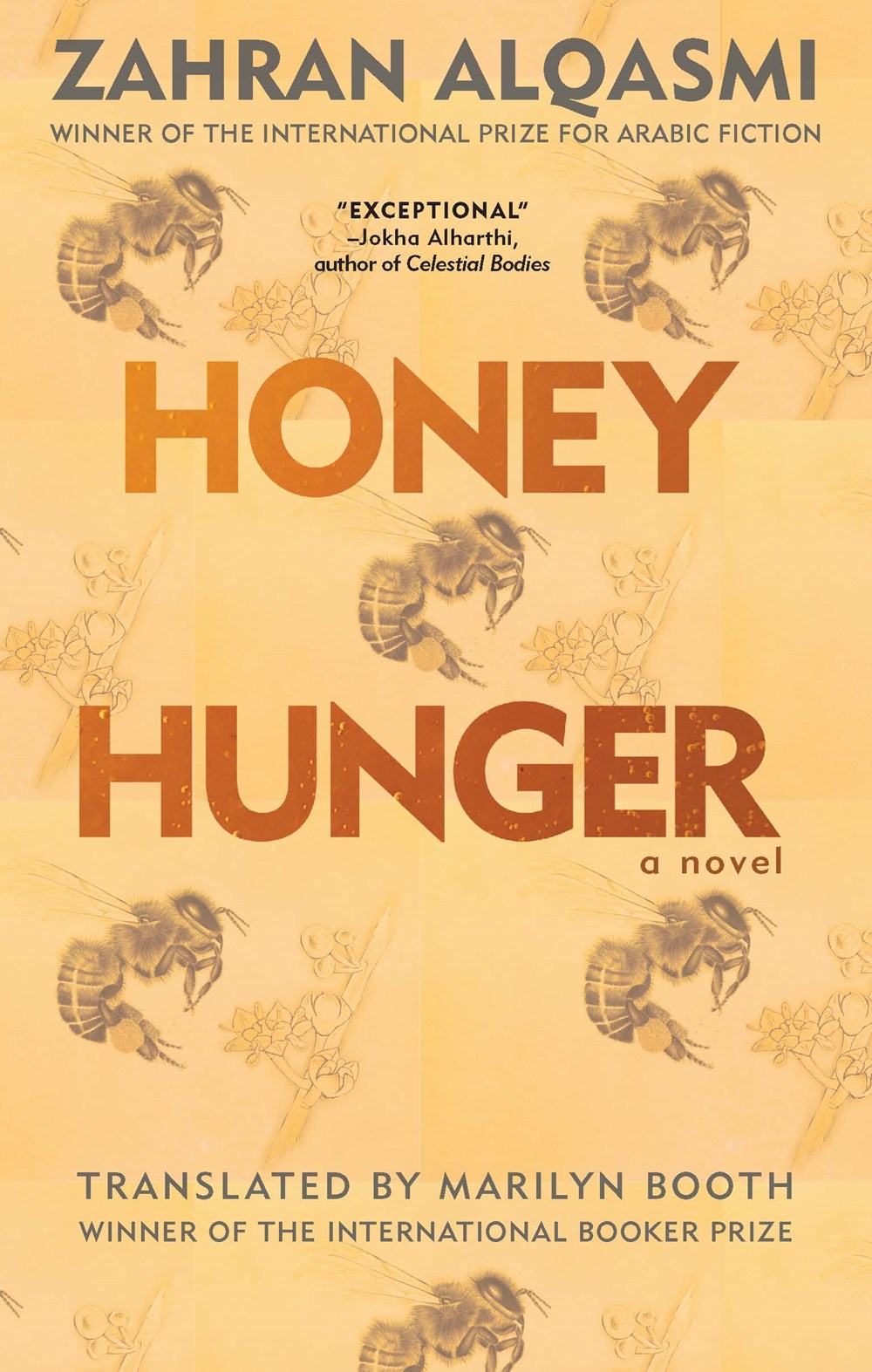
HONEY HUNGER: A Novel, Marilyn Booth's excellent translation of Zahran Alqasmi's novel of Oman
HONEY HUNGER: A Novel
ZAHRAN ALQASIMI (tr. Marilyn Booth)
Hoopoe Books|American University in Cairo Press (non-affiliate Amazon link)
$18.95 ebook edition, available now
Rating: 4.75* of five
The Publisher Says: A breathtaking novel of longing, uncertainty, and ultimately of hope, written by an International Prize for Arabic Fiction-winning author and an International Booker-prize winning translator
Azzan is a beekeeper in a rural community in Oman. Devoted to tending his bees and searching for wild hives, he encounters Thamna, a lone shepherd woman, on a mountain slope and is captivated by her and her honey-colored eyes. Across the breathtaking vistas of Oman’s remote mountains and plains, Azzan’s troubled past and present unfold. A disappointment to his family, he turns to drink, and ultimately discovers the healing power of his beekeeping, before an accident in which he loses all.
Zahran Alqasmi’s masterful novel thrums forward with a subtle momentum. His lucid, poetic writing conveys a visceral sense of time and place, of the fragile ecologies inhabited by both bees and humans alike, in this intense and compelling novel of loss and hope.
I RECEIVED A DRC FROM THE PUBLISHER VIA EDELWEISS+. THANK YOU.
My Review: Does the old nostrum, "still waters run deep," ring a bell in your cultural education? Azzan is the personification of it. He's quiet on these pages. He's still physically and psychically until summoned into action in service to some need. Author Alqasmi uses his stillness to carefully, incrementally, accustom you to the reality of Oman, of a place he seems to assume you will want to know feel and smell and hear, without intrusive human-ness. Gradually, Azzan's eyes...our cameras onto this sparely furnished landscape...show us more, bring us to the places—in the company that hearken to the quiet sounds that we call "silence" in technology's noisy embrace. Azzan's not a beekeeper by happenstance, either as a character or a PoV.
These are the choices that lead you the audience into the creation of an author whose poetry output outweighs his prose, ten to four; but whose prose garnered him the 2023 International Prize for Arabic Fiction (IPAF) for The Water Diviner; I believe this is the immediate predecessor to this novel in Arabic. It is obvious to me that the quality of the vision here is not a chance sport, an artifact of a talented translator's vision alone. That disappointment has befallen me before when a multiple translation career has yielded...inconsistent...results. Being the first of his works translated into English, I could still be disappointed; it just *feels* like a good bet to make, after reading this story.
I'm sure the idea of beekeeping in a landscape as arid as Arabia is overall seems odd. It is an ancient reality though. Deserts bloom, even if sparingly. Beekeepers are not hugely wealthy anywhere bit seldom lack for work for very long. It is a surprisingly mobile task in this story, one that enables Azzan to be see, hear, participate in, a lot of lives in making his life with bees. The honey they make is the life he leads; but it's also large in the life of the people. The product that makes life just enough less harsh to be fun at times for the people Azzan's belovèd bees serve. His knowledge of the lies, cheats, and kindnesses others never even think they don't know about all revolve around his deep and unwavering interest in and commitment to his charges the bees.
It gives the author a free rein to point up character traits in the narrator's orbit and beyond, for good and for ill; is Thamna, the herdswoman he encounters so fleetingly, an object of obsessive lust, actual love, or simply a fixation because of her novelty in his mostly male world? Does his thinking about bees, those matriarchal marvels without a permanent male presence, and their coveted honey drive or lead his itinerancy? If he's led by it, it makes his questing for wild honey that much more about the world he observes so intently; if driven instead, that condition of needing the honey makes his sharply observant eye that of the exploiter, the taker of all the work of others he is not entitled to have. All of these are within this novel's possible meanings.
Azzan's obsession with bees and their care is, while unusual to the US-fiction reader, an outgrowth of his blighted past. He is a recovering alcoholic in a society that frowns on alcohol use. He has never been a success, felt as though he was enough for or even wanted by those who raised him. It is this strange selfness, this sense of himself as needing and wanting but never receiving unless he takes (as from the bees, his compatriots), that is reinforced by the lyrical language of description that never devolves into possession; rather it settles on taking the product without "owning" the producer, on caring for and feeling committed to the bees, the goats, the donkeys and living among them in place of being their "owner."
Is that the place held by the exploiter, the user, the rentier? Azzan does not give off that vibe; I can still see it in the flow of his honeyed words of praise and appreciation and admiration for the bees. It comes down to the sense the author gives all these people who live among the animals they use; they take on the risks and protect their charges from harms they will all suffer from. In return they exert a right to practical rewards of sustenance.
A man who longs for love he is sure he does not deserve and whose object is safely always independent of his custodial care and capable of being just fine without him sounds to me like a man in need of a perspective check; he's fine how he is, too, just busily denying himself the peace of contentment to punish his perceived failings as received from the eyes and ideas of others.
So with all this praise why not five whole stars? Because these ideas and words of beauty and layers of meaning come with a labor tax of non-Western-standard punctuation and dialogue tags. I don't think that's a bad thing myownself. It does mean I can't five-star flag it for all y'all to pick up and devour ASAP. So many won't work this hard. Heck, even *I* had to read some things over twice to choose meanings that would change depending on to whom I attributed the words.
For me that's fun, for most it's work, so four and three-quarter stars seems fair.
Labels:
#WITMonth,
Arabic translation,
beekeeping,
bees,
coming to terms,
ecological awareness,
ecology,
Hoopoe Books,
low self-esteem,
lyrical prose,
Marilyn Booth,
novel,
Oman setting,
Zahran Alqasmi
Wednesday, July 9, 2014
Book-A-Day meme #9, a character you love to hate: DELTA WEDDING
DELTA WEDDING
EUDORA WELTY
Houghton Mifflin Harcourt
$15.99 trade paper, available now
Rating: 3.75* of five
The Publisher Says: A vivid and charming portrait of a large southern family, the Fairchilds, who live on a plantation in the Mississippi delta. The story, set in 1923, is exquisitely woven from the ordinary events of family life, centered around the visit of a young relative, Laura McRaven, and the family’s preparations for her cousin Dabney’s wedding.
My Review: The Doubleday UK meme, a book a day for July 2014, is the goad I'm using to get through my snit-based unwritten reviews. Today's prompt, the ninth, is to discuss your favorite character in a novel to hate.
Dabney. Hands down, Dabney. What a self-centered nightmare of a spoiled brat! She's marryin' 'neath her, that no-count Troy is just scramblin' for a place in the Fairchilds! But Dabney, she knows:
And in the end, that's where we end up in this novel, in the Family. Like every family, the Fairchilds have codes and shortcuts in their communication that seem designed to exclude others. That includes the reader of the novel, in fact. But it's not that the Fairchilds don't want you to understand them, or that Miss Eudora failed to give you the keys to a roman à clef. It's this very experience that's the point of the novel. Either you like that experience, or you don't, but this is the point:
In the end, as much as I loved to hate Dabney and her cut-rate Scarlett-ness, I was only slightly less appalled by the sheer feckless ridiculousness of George, Dabney's uncle and the Fairchild Golden Boy, and the cult surrounding him. His morganatic marriage to Robbie is summed up by Aunt Ellen, one of his groupies:
It's not hard for me to appreciate this novel for what it is, but it's not at all the beau ideal of a novelist's art. I like it, I understand why others don't, but goodness me give me the lush, rich, deeply felt beauty of Welty's prose any old way it comes.
EUDORA WELTY
Houghton Mifflin Harcourt
$15.99 trade paper, available now
Rating: 3.75* of five
The Publisher Says: A vivid and charming portrait of a large southern family, the Fairchilds, who live on a plantation in the Mississippi delta. The story, set in 1923, is exquisitely woven from the ordinary events of family life, centered around the visit of a young relative, Laura McRaven, and the family’s preparations for her cousin Dabney’s wedding.
My Review: The Doubleday UK meme, a book a day for July 2014, is the goad I'm using to get through my snit-based unwritten reviews. Today's prompt, the ninth, is to discuss your favorite character in a novel to hate.
Dabney. Hands down, Dabney. What a self-centered nightmare of a spoiled brat! She's marryin' 'neath her, that no-count Troy is just scramblin' for a place in the Fairchilds! But Dabney, she knows:
"I will never give up anything!" Dabney thought, bending forward and laying her head against the soft neck. "Never! Never! For I am happy, and to give up nothing will prove it. I will never give up anything, never give up Troy - or to Troy!" She thought smilingly of Troy, coming slowly, this was the last day, slowly plodding and figuring....And still, there's something deeply Southern in Dabney's greed, something that life in the lush heat of the land down by the water just puts in you, makes you part of it:
The eagerness with which she was now going to Marmion, entering her real life there with Troy, told her enough - all the cotton in the world was not worth one moment of life! It made her know that nothing could ever defy her enough to make her leave it. How sweet life was, and how well she could hold it, pluck it, eat it, lay her cheek to it - oh, no one else knew. The juice of life and the hot, delighting taste and the fragrance and warmth to the cheek, the mouth....Dabney's complete inability to see the other person as real makes her a monster, that familiar monster, The Southern Belle. She hasn't got room for anyone but herself in the movie of her life:
Life was not ever inviolate. Dabney, poor sister and bride, shed tears this morning (though belatedly) because she had broken the Fairchild night light the aunts had given her; it seemed so unavoidable to Dabney, that was why she cried, as if she had felt it was part of her being married that this cherished little bit of other peoples' lives should be shattered now.Things, the stuff that surrounds people like the Fairchilds from cradle to grave (and they'd take it on as grave goods if only people still did that), *those* evoke tears and memories. Not the people, not the little damn-near stranger in the Fairchild midst, little motherless Laura whose presence is unwished for but accepted because she is Family.
And in the end, that's where we end up in this novel, in the Family. Like every family, the Fairchilds have codes and shortcuts in their communication that seem designed to exclude others. That includes the reader of the novel, in fact. But it's not that the Fairchilds don't want you to understand them, or that Miss Eudora failed to give you the keys to a roman à clef. It's this very experience that's the point of the novel. Either you like that experience, or you don't, but this is the point:
Indeed the Fairchilds took you in circles, whirling delightedly about, she thought, stirring up confusions, hopefully working themselves up. But they did not really want anything they got - and nothing, really, nothing really so very much, happened!Now that said, what makes this book fall short of four stars for me, an ardent Eudoraist? Novels aren't like short stories in that the introduction of a character or inclusion of a detail must be part of the essential nature of the book. There are about a squillion voices in this chorus, and that's just way too many. WAY too many. So there isn't a long-term investment in the current carrying us to...to...wherever it is we're going and we don't quite get to. Miss Eudora could've pruned the voices to Dabney, Uncle George, and Laura, and been able to tell the same big, noisy story. But this is a novel, and writing novels was not Miss Eudora's métier. That was the short story, a form of which she was a mistress.
In the end, as much as I loved to hate Dabney and her cut-rate Scarlett-ness, I was only slightly less appalled by the sheer feckless ridiculousness of George, Dabney's uncle and the Fairchild Golden Boy, and the cult surrounding him. His morganatic marriage to Robbie is summed up by Aunt Ellen, one of his groupies:
t seemed to Ellen at moments that George regarded them, and regarded things - just things, in the outside world - with a passion which held him so still that it resembled indifference. Perhaps it was indifference - as though they, having given him this astonishing feeling, might for a time float away and he not care. It was not love or passion itself that stirred him, necessarily, she felt - for instance, Dabney's marriage seemed not to have affected him greatly, or Robbie's anguish. But little Ranny, a flower, a horse running, a color, a terrible story listened to in the store in Fairchilds, or a common song, and yes, shock, physical danger, as Robbie had discovered, roused something in him that was immense contemplation, motionless pity, indifference...Then, he would come forward all smiles as if in greeting - come out of his intensity and give some child a spank or a present. Ellen had always felt this about George and now there was something of surprising kinship in the feeling.That gets to the heart of my dislike and discomfort with George. He's so spoiled, so cossetted and babied, that only a severe adrenaline jolt (at someone else's expense) will do to fetch him up among the living.
It's not hard for me to appreciate this novel for what it is, but it's not at all the beau ideal of a novelist's art. I like it, I understand why others don't, but goodness me give me the lush, rich, deeply felt beauty of Welty's prose any old way it comes.
Subscribe to:
Comments (Atom)


