Showing posts with label Marilyn Booth. Show all posts

Friday, February 21, 2025

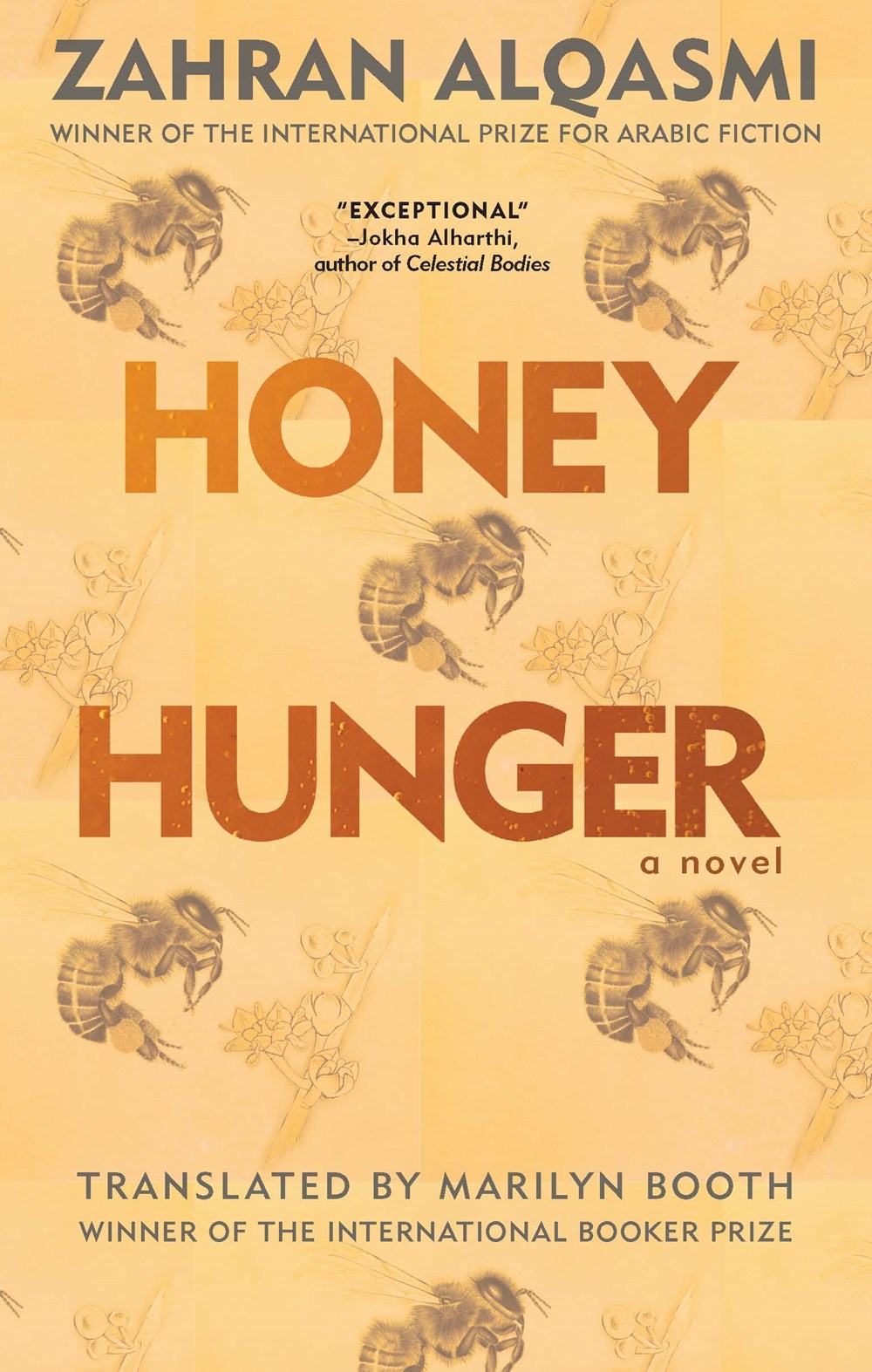
HONEY HUNGER: A Novel, Marilyn Booth's excellent translation of Zahran Alqasmi's novel of Oman


HONEY HUNGER: A Novel
ZAHRAN ALQASIMI
(tr. Marilyn Booth)
Hoopoe Books|American University in Cairo Press (non-affiliate Amazon link)
$18.95 ebook edition, available now

Rating: 4.75* of five

The Publisher Says: A breathtaking novel of longing, uncertainty, and ultimately of hope, written by an International Prize for Arabic Fiction-winning author and an International Booker-prize winning translator

Azzan is a beekeeper in a rural community in Oman. Devoted to tending his bees and searching for wild hives, he encounters Thamna, a lone shepherd woman, on a mountain slope and is captivated by her and her honey-colored eyes. Across the breathtaking vistas of Oman’s remote mountains and plains, Azzan’s troubled past and present unfold. A disappointment to his family, he turns to drink, and ultimately discovers the healing power of his beekeeping, before an accident in which he loses all.

Zahran Alqasmi’s masterful novel thrums forward with a subtle momentum. His lucid, poetic writing conveys a visceral sense of time and place, of the fragile ecologies inhabited by both bees and humans alike, in this intense and compelling novel of loss and hope.

I RECEIVED A DRC FROM THE PUBLISHER VIA EDELWEISS+. THANK YOU.

My Review
: Does the old nostrum, "still waters run deep," ring a bell in your cultural education? Azzan is the personification of it. He's quiet on these pages. He's still physically and psychically until summoned into action in service to some need. Author Alqasmi uses his stillness to carefully, incrementally, accustom you to the reality of Oman, of a place he seems to assume you will want to know feel and smell and hear, without intrusive human-ness. Gradually, Azzan's eyes...our cameras onto this sparely furnished landscape...show us more, bring us to the places—in the company that hearken to the quiet sounds that we call "silence" in technology's noisy embrace. Azzan's not a beekeeper by happenstance, either as a character or a PoV.

These are the choices that lead you the audience into the creation of an author whose poetry output outweighs his prose, ten to four; but whose prose garnered him the 2023 International Prize for Arabic Fiction (IPAF) for The Water Diviner; I believe this is the immediate predecessor to this novel in Arabic. It is obvious to me that the quality of the vision here is not a chance sport, an artifact of a talented translator's vision alone. That disappointment has befallen me before when a multiple translation career has yielded...inconsistent...results. Being the first of his works translated into English, I could still be disappointed; it just *feels* like a good bet to make, after reading this story.

I'm sure the idea of beekeeping in a landscape as arid as Arabia is overall seems odd. It is an ancient reality though. Deserts bloom, even if sparingly. Beekeepers are not hugely wealthy anywhere bit seldom lack for work for very long. It is a surprisingly mobile task in this story, one that enables Azzan to be see, hear, participate in, a lot of lives in making his life with bees. The honey they make is the life he leads; but it's also large in the life of the people. The product that makes life just enough less harsh to be fun at times for the people Azzan's belovèd bees serve. His knowledge of the lies, cheats, and kindnesses others never even think they don't know about all revolve around his deep and unwavering interest in and commitment to his charges the bees.

It gives the author a free rein to point up character traits in the narrator's orbit and beyond, for good and for ill; is Thamna, the herdswoman he encounters so fleetingly, an object of obsessive lust, actual love, or simply a fixation because of her novelty in his mostly male world? Does his thinking about bees, those matriarchal marvels without a permanent male presence, and their coveted honey drive or lead his itinerancy? If he's led by it, it makes his questing for wild honey that much more about the world he observes so intently; if driven instead, that condition of needing the honey makes his sharply observant eye that of the exploiter, the taker of all the work of others he is not entitled to have. All of these are within this novel's possible meanings.

Azzan's obsession with bees and their care is, while unusual to the US-fiction reader, an outgrowth of his blighted past. He is a recovering alcoholic in a society that frowns on alcohol use. He has never been a success, felt as though he was enough for or even wanted by those who raised him. It is this strange selfness, this sense of himself as needing and wanting but never receiving unless he takes (as from the bees, his compatriots), that is reinforced by the lyrical language of description that never devolves into possession; rather it settles on taking the product without "owning" the producer, on caring for and feeling committed to the bees, the goats, the donkeys and living among them in place of being their "owner."

Is that the place held by the exploiter, the user, the rentier? Azzan does not give off that vibe; I can still see it in the flow of his honeyed words of praise and appreciation and admiration for the bees. It comes down to the sense the author gives all these people who live among the animals they use; they take on the risks and protect their charges from harms they will all suffer from. In return they exert a right to practical rewards of sustenance.

A man who longs for love he is sure he does not deserve and whose object is safely always independent of his custodial care and capable of being just fine without him sounds to me like a man in need of a perspective check; he's fine how he is, too, just busily denying himself the peace of contentment to punish his perceived failings as received from the eyes and ideas of others.

So with all this praise why not five whole stars? Because these ideas and words of beauty and layers of meaning come with a labor tax of non-Western-standard punctuation and dialogue tags. I don't think that's a bad thing myownself. It does mean I can't five-star flag it for all y'all to pick up and devour ASAP. So many won't work this hard. Heck, even *I* had to read some things over twice to choose meanings that would change depending on to whom I attributed the words.

For me that's fun, for most it's work, so four and three-quarter stars seems fair.

Monday, May 16, 2022

BITTER ORANGE TREE, vibrant, passionate, *alive* woman's dark desires & MISTER N, a frank discussion of getting old and its price (not what it costs)


BITTER ORANGE TREE
JOKHA ALHARTHI
(tr. Marilyn Booth)
Catapult
$26.00 hardcover, available now

Trade Paper Edition On Sale: 07/11/2023 | $16.95

Read the Electric Literature mutual interview between Author Alharthi and Translator Booth!

One of Time Magazine's 100 Must-Read Books of 2022

Rating: 4* of five

The Publisher Says: From Man Booker International Prize–winning author Jokha Alharthi, Bitter Orange Tree is a profound exploration of social status, wealth, desire, and female agency. It presents a mosaic portrait of one young woman’s attempt to understand the roots she has grown from, and to envisage an adulthood in which her own power and happiness might find the freedom necessary to bear fruit and flourish.

Zuhour, an Omani student at a British university, is caught between the past and the present. As she attempts to form friendships and assimilate in Britain, she can’t help but ruminate on the relationships that have been central to her life. Most prominent is her strong emotional bond with Bint Amir, a woman she always thought of as her grandmother, who passed away just after Zuhour left the Arabian Peninsula.

As the historical narrative of Bint Amir’s challenged circumstances unfurls in captivating fragments, so too does Zuhour’s isolated and unfulfilled present, one narrative segueing into another as time slips and dreams mingle with memories.

I RECEIVED A DRC FROM THE PUBLISHER VIA EDELWEISS+. THANK YOU.

My Review
: Celestial Bodies, Author Alharthi and Translator Booth's previous literary collaboration, revolved around three women and their men...present, absent, loved, loathed, and longed for. It received the 2019 Man Booker International Prize, as it was called then. I myownself checked it out of the library and would've given it a three-star review had I bothered to review it at all...stories centering women organizing themselves and their worlds around men don't appeal to me. The prose was lyrical and pungent.

That last is what I love about this read:
I had gone. And then she had gone. And it wasn't possible to change anything. What the hand of fate had written could not be unwritten. That ancient line of poetry: All your tears, all your pleas, will erase not a line of that which is written. For I had gone, and I went away without smiling. I just went, in my cocky presumption that I could look the other way. That I didn't know; that I didn't need to know. And then remorse. Harsh, grating regret, making me more fragile than the brittle autumn leaves crumbling under the janitor's broom beneath my window.

–and–

"My grandmother would've given anything to be a peasant farmer," I said. And then immediately I regretted my abrupt reaction. Suroor raised her head. "Your grandmother?" Right. The words had come out and they couldn't be put back. I had said it: my grandmother. Why don't words come automatically with threads that we can yank to pull them back inside ourselves? But there are no threads attached. Those words had been said. What's done is done.

It's all there. Author Alharthi's style, the sentences not too terribly complex but the interrelationship of the words and images is dense, is active, is trellising the reader's vines of awareness into specific patterns that cast wildly distorting shadows on the life in the text.

It is exhilarating to read a simple story that reaches into shadows and under storage shelves and behind armoires in the reader. It means the writer and the translator have offered us everything they found when they rummaged through those spaces in themselves. If you, as I strongly suggest that you do, read the Electric Lit piece I've linked above, you'll come at this read with a vastly bigger experience of the intentionality of the writing. I think the best thing about that awareness, acquired before (in your case) or after (as in mine) finishing the novel, is its honing, its sharpening, of the decoding tools you have at your disposal to be in the read. I've chosen those two passages from the same early section of the story to illustrate that enriching quality.

What reading Bitter Orange Tree offered me was a stroll in a garden planted with almost-familiar-scented plants in service of a geometry slightly not what I am accustomed to (read: not centered so heavily on the women's men). The way the choices I've selected above interrelate and build on the character of Zuhour's perceptual world, the sensory and the eidetic, are the principal pleasure of this read. Like my stream-of-consciousness idol Virginia Woolf, the words build images and the images are shaped by the words as well as by the things the words evoke from us in their saying. Everything Zuhour senses is an image from her startlingly acute inner world...no fogs of forgetfulness (even when summoned, as above) cloud her quietly desperate longing for one more, once again, please just this single time.

Of course she gets none. No one does, and no depths of longing can break the iron arrow...crossbow quarrel, more like...of time. No matter how many times one says ignore, actually performing the act of ignoring is entirely different and often opposed by the metaphysical gravity of love. (I think it was this strange, off-kilter perceptual frame that reduced my rating from five to four stars, though....)

Because yes, this is a love story. Aren't they all. Yes, they all are but this love, Zuhour's love, is so tragically lacking self-love that it's the desperately sad kind of love-ungiven story that can reshape a life. Yours, o reader, if you will allow it; better or worse, as you use it.

++++++++++++++++++++++++++++++++++++++++++++++++++++++++++++++++


MISTER N
NAJWA BARAKAT
(tr. Luke Leafgreen)
And Other Stories
$17.95 trade paper, available now

Rating: 4* of five

The Publisher Says: Modern-day Beirut is seen through the eyes of a failed writer, the eponymous Mister N. He has left his comfortable apartment and checked himself into a hotel—he thinks. Certainly, they take good care of him there. Meanwhile, on the streets below, a grim pageant: poverty, violence and fear.

How is anyone supposed to write deathless prose in such circumstances? Let alone an old man like Mister N., whose life and memories have become scattered, whose family regards him as an embarrassment, and whose next-door neighbours torment him with their noise, dinner invitations, and inconvenient suicides. Comical and tragic by turns, his misadventures climax in the arrival in what Mister N. had supposed to be his “real life” of a character from one of his early novels – a vicious militiaman. Now, does the old writer need to arm himself…or just seek psychiatric help?

I RECEIVED A DRC FROM THE PUBLISHER VIA EDELWEISS+. THANK YOU.

My Review
: And Other Stories publishes unusual and often puzzling books. This one feels a little bit like someone found Kafka's Akashic records and channeled them through a Lebanese American writer's intense psychedelic dreams.
He liked precision and hated rough estimates. The approximate was arbitrary, the arbitrary was random, the random was chaotic, and chaos was a killer. Mr. N liked to cut away the imprecise, as he did with his pencils when he sharpened them, shaving their tips into points to make their lines clear and defined. Pens? Pens were unacceptable. Pens could leak, flooding pages with smothering ink. Ink behaved like a dictator: ordering, forbidding, controlling, brooking no dissent. Lead, meanwhile, was merciful, quick to forgive mistakes. Whatever your soul was brooding over, lead would let it speak. Ink soiled the white page; lead dissolved upon the surface, exactly as pain dissolved in the act of writing…

–and–

The human ability to adapt—to things positive and negative, to plenty and scarcity, to life and death—is terrifying. I watched {her} transform day by day. She contracted within the apartment; then she expanded to fill it. She feared her pimp would find her; then she relaxed into her new situation and her new identity. … …I felt her skin expanding, her limbs lengthening, her face settling into gladness. I saw her unwinding into something more tender, like dough when it relaxes.

Mister N is a guest in a swanky hotel. Mister N's a writer...published several novels, well-received ones...whose home is Beirut with all that implies. Mister N's...not feeling himself. Mister N's been through some stuff. Mister N's older brother is the last vestige of family he has, dead father, dead mother, in fact only his old, established nemesis, his Moriarty, a man called Luqman, is visiting Mister N despite his many vociferous complaints to Mr. Andrew, the, um, concierge or owner or someone like that, that these are unwelcome and invasive occasions of great upset.

The blows to Mister N's fragile peace of mind never really stop coming. There are so many old issues that need to be put to rest. There are absurdly youthful old people acting like hormonal kids! (Not Mister N...beta blockers, don't you know, those desire-slayers, are among his meds.) Mister N witnesses a...a...hanging, certainly, though not actually a murder as Mister N tells it. Mister N rides herd on the unruly voices in his head, the ones that enable Mister N to write their stories. As I've always said, being a writer is actually the socially acceptable face of schizophrenia. And sometimes just barely that.

The blows to Mister N's reality don't stop coming. Author Barakat is not kind. In memory, in fantasy, in reality...none of these states, and they all exist in the course of Mister N's time with us, are delineated. I don't think one gains a single, solitary thing trying to tease out the "different" frames of reference in this story. It won't make passages such as this:
Our mosquitoes and other local insects have developed quite the work ethic in recent years. They toil now not only to feed themselves, but from the pleasure of causing pain, which, having tasted once, they find impossible to relinquish. Rats, mosquitoes, flies, cockroaches, feral cats, pariah dogs: all of them are vicious now and liable to get drunk on the simple taste of killing, much as humans do.

...one whit more or less effective to think of them as belonging to "reality" or "fantasy" within the book's constructed world. Mister N, you see, is not in the least who he thinks he is; and, as we are all the sum of our memories, that simple fact makes Mister N a construct, a chimera of parts from we can never know where. More to the point, neither can Mister N:
My head is a train of many cars, each of them going in a different direction. All I need to do is put them back in line so they might travel in the correct direction. Is this my entire life that I have put on the wall? How old have I become now?

The only necessary answer to this question, directed from and/or to wherever one may, is "as old as my eyes, a little older than my teeth." (The Santa Claus response.) Mister N can not really answer it as phrased. Reality passes at different rates on different scales...the days drag, the years fly by...for us all, but most of all for those of disordered thinking. And to some degree, that's my beef with the read. I don't think the story itself comes out of the time-frame-hopping all the way intact. I grant that characters in this récit are all internal to Mister N, but they still jar with their sudden vanishings and dangling conversations. An itchy lack-of-closure feeling pervaded my reading experience.

Exactly how disordered Mister N's thinking is, for all that, is one of the pleasures of reading this short, powerful, frequently authorially self-referential récit all the way to the end. I recommend you do that soonest. Preorder it now!