Pages
- Home
- Mystery Series
- Bizarro, Fantasy & SF
- QUILTBAG...all genres
- Kindle Originals...all genres
- Politics & Social Issues
- Thrillers & True Crime
- Young Adult Books
- Poetry, Classics, Essays, Non-Fiction
- Science, Dinosaurs & Environmental Issues
- Literary Fiction & Short Story Collections
- Sookie Stackhouse/Southern Vampire Books & True Blood
- Books About Books, Authors & Biblioholism
Showing posts with label ecology. Show all posts
Monday, June 15, 2026
THE BEASTS OF THE EAST: The Fall and Rise of America's Eastern Wilderness, positive stories from the frontlines of ecological recovery
THE BEASTS OF THE EAST: The Fall and Rise of America's Eastern Wilderness
ANDREW MOORE
Mariner Books (non-affiliate Bookshop.org link)
$15.99 ebook, available now
Rating: 4.25* of five
The Publisher Says: A celebration of the extraordinary lost natural wonder of the eastern U.S.—once the center of American wildness before its despoliation—and a lively tour through recent efforts to return elk, bison, wolves, and other creatures to their verdant native landscapes.
Before skyscrapers and smokestacks rose across the eastern U.S., elk, bison, wolves, and cougars roamed. Typically imagined as icons of the West, these large mammals are in fact native to what was once a kind of Eden—towering forests in the Northeast, rolling prairies in the Midwest, and cypress swamps in the Deep South. But, in mere decades, industrialization and unregulated hunting brought these emblems of the East to the precipice of extinction; by the 1950s, squirrels were one of the few wild mammals an easterner was likely to encounter.
Now, even as the climate and biodiversity crises loom, eastern wildlife are staging an unlikely comeback. Herds of bison graze on Illinois prairies, red wolves lurk in North Carolina’s coastal marshes, and abandoned coal mines in Kentucky are now home to thousands of elk. Such rewilding promises to restore balance to eastern ecosystems and return one of the most biodiverse regions in the world to its former luster—but not without controversy.
In Beasts in the East, we follow environmental writer and James Beard Award finalist Andrew Moore as he meets conservationists, hunters, biologists, and nature lovers as they confront herculean How can we enable wildlife migration in the midst of suburban sprawl? Are these success stories viable in the long-term? When humans and wildlife come in close contact, how do we define wilderness?
I RECEIVED A DRC FROM THE PUBLISHER VIA NETGALLEY. THANK YOU.
My Review: As Fathers' Day looms, the eternal conundrum of what to get Dad or father-figure that is nit some wearable or technological frippery he'll forget he owns is pressing. If your Dad's like me, he reads or watches news and frets about you, your kids, or the world going directly to hell in his lifetime.
He/we ain't all the way wrong.
BUT! There is hope to be found. It's true we've screwed up the planet pretty hard and done too little to fix it. Some people have done more than most to ameliorate some of the worst, stupidest damage our (well my anyway) generation, the Boomers, have done. Their successes are underdiscussed generally, and likely do not reach far enough into awareness to combat the gloom that's so paralyzing.
Author Moore, whose delightful book Pawpaw: In Search of America’s Forgotten Fruit was nominated for a James Beard Foundation Award in 2016, writes capably and informatively about the successes and the failures of the US scientific and govermental bodies charged with mitigating disasters their predecessors either caused or failed to prevent. It's a chonky boi, weighing in at almost 450 pages, but that's how much room is needed to really do justice to the good and the bad news.
I don't know about the men in your gifting circle but I don't trust the happy-clappy "this is fine" dawgs who tell us good things and chirp relentlessly cheery stuff from their high perches. I guess they see different landscapes from up there, whereas I see and smell sewage while they're making noise meant to distract me. I trust Author Moore's presentation of the significant environmental gains all over the highly urbanized Eastern US *because* the failures aren't ignored or hurried past; they're not lingered over, either, which is the other untrustworthy pole: sticking into gloom and doom.
There are copious notes, sources that held up everywhere I stress-tested them, and a tone of honest and truthful pleasure in the impressive successes won. The battles going well, eg red wolves rewilded in North Carolina, truly heartened me. I was astonished to learn there were populations of bison as far East as Pennsylvania! Imagine looking out of your sod hut in Pittsburgh and seeing a six-foot tall bison wandering the streets! Less surprising was the story of the reclaimed tall-grass prairies of Illinois that now sustain smallish herds of bison, but keep expanding.
The many people Author Moore consulted in preparing the book all come across as guardedly optimistic...I've mentioned the absence of chirpiness...which, given their various fields of knowledge and work, makes me believe we're not Doomed!...Doooomed!...just yet.
Given how little celebratory noise I hear daily and how assiduously I seek it out, I think a book like this is a good gift idea for Dad, Uncle, father-figure who also gets tired of treading sewage not water, and still can't believe or trust the sunshine enema people to be fully truthful. It's evidently expertise-laden author does an admirable tightrope walk with his tone of delivery. Including so many sources is helpful too.
It's good to offer a counter-narrative to doom and gloom that's grounded in facts and data. A very good gift for anxious science nerds of every gender.
Friday, February 21, 2025
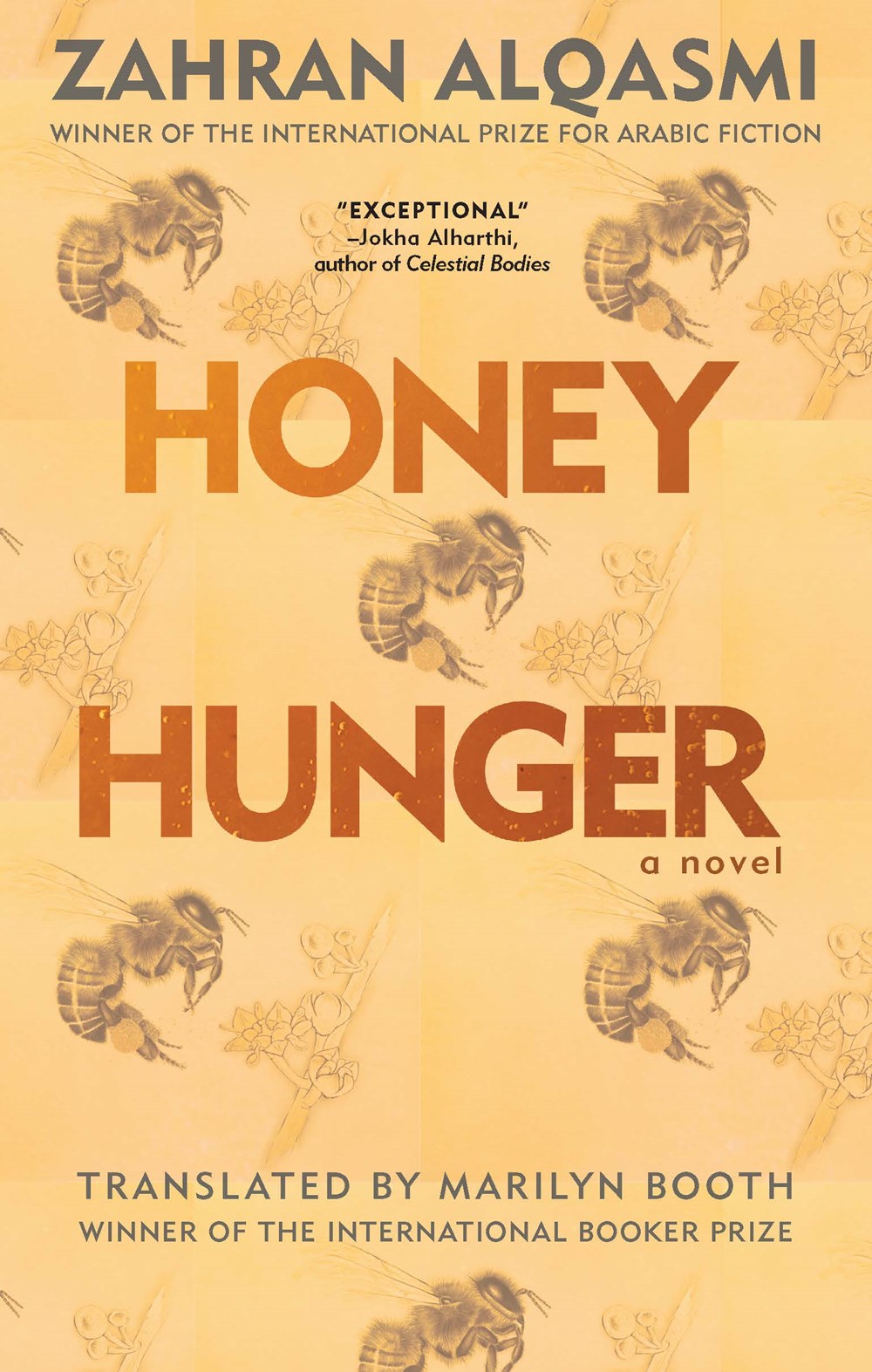
HONEY HUNGER: A Novel, Marilyn Booth's excellent translation of Zahran Alqasmi's novel of Oman
HONEY HUNGER: A Novel
ZAHRAN ALQASIMI (tr. Marilyn Booth)
Hoopoe Books|American University in Cairo Press (non-affiliate Amazon link)
$18.95 ebook edition, available now
Rating: 4.75* of five
The Publisher Says: A breathtaking novel of longing, uncertainty, and ultimately of hope, written by an International Prize for Arabic Fiction-winning author and an International Booker-prize winning translator
Azzan is a beekeeper in a rural community in Oman. Devoted to tending his bees and searching for wild hives, he encounters Thamna, a lone shepherd woman, on a mountain slope and is captivated by her and her honey-colored eyes. Across the breathtaking vistas of Oman’s remote mountains and plains, Azzan’s troubled past and present unfold. A disappointment to his family, he turns to drink, and ultimately discovers the healing power of his beekeeping, before an accident in which he loses all.
Zahran Alqasmi’s masterful novel thrums forward with a subtle momentum. His lucid, poetic writing conveys a visceral sense of time and place, of the fragile ecologies inhabited by both bees and humans alike, in this intense and compelling novel of loss and hope.
I RECEIVED A DRC FROM THE PUBLISHER VIA EDELWEISS+. THANK YOU.
My Review: Does the old nostrum, "still waters run deep," ring a bell in your cultural education? Azzan is the personification of it. He's quiet on these pages. He's still physically and psychically until summoned into action in service to some need. Author Alqasmi uses his stillness to carefully, incrementally, accustom you to the reality of Oman, of a place he seems to assume you will want to know feel and smell and hear, without intrusive human-ness. Gradually, Azzan's eyes...our cameras onto this sparely furnished landscape...show us more, bring us to the places—in the company that hearken to the quiet sounds that we call "silence" in technology's noisy embrace. Azzan's not a beekeeper by happenstance, either as a character or a PoV.
These are the choices that lead you the audience into the creation of an author whose poetry output outweighs his prose, ten to four; but whose prose garnered him the 2023 International Prize for Arabic Fiction (IPAF) for The Water Diviner; I believe this is the immediate predecessor to this novel in Arabic. It is obvious to me that the quality of the vision here is not a chance sport, an artifact of a talented translator's vision alone. That disappointment has befallen me before when a multiple translation career has yielded...inconsistent...results. Being the first of his works translated into English, I could still be disappointed; it just *feels* like a good bet to make, after reading this story.
I'm sure the idea of beekeeping in a landscape as arid as Arabia is overall seems odd. It is an ancient reality though. Deserts bloom, even if sparingly. Beekeepers are not hugely wealthy anywhere bit seldom lack for work for very long. It is a surprisingly mobile task in this story, one that enables Azzan to be see, hear, participate in, a lot of lives in making his life with bees. The honey they make is the life he leads; but it's also large in the life of the people. The product that makes life just enough less harsh to be fun at times for the people Azzan's belovèd bees serve. His knowledge of the lies, cheats, and kindnesses others never even think they don't know about all revolve around his deep and unwavering interest in and commitment to his charges the bees.
It gives the author a free rein to point up character traits in the narrator's orbit and beyond, for good and for ill; is Thamna, the herdswoman he encounters so fleetingly, an object of obsessive lust, actual love, or simply a fixation because of her novelty in his mostly male world? Does his thinking about bees, those matriarchal marvels without a permanent male presence, and their coveted honey drive or lead his itinerancy? If he's led by it, it makes his questing for wild honey that much more about the world he observes so intently; if driven instead, that condition of needing the honey makes his sharply observant eye that of the exploiter, the taker of all the work of others he is not entitled to have. All of these are within this novel's possible meanings.
Azzan's obsession with bees and their care is, while unusual to the US-fiction reader, an outgrowth of his blighted past. He is a recovering alcoholic in a society that frowns on alcohol use. He has never been a success, felt as though he was enough for or even wanted by those who raised him. It is this strange selfness, this sense of himself as needing and wanting but never receiving unless he takes (as from the bees, his compatriots), that is reinforced by the lyrical language of description that never devolves into possession; rather it settles on taking the product without "owning" the producer, on caring for and feeling committed to the bees, the goats, the donkeys and living among them in place of being their "owner."
Is that the place held by the exploiter, the user, the rentier? Azzan does not give off that vibe; I can still see it in the flow of his honeyed words of praise and appreciation and admiration for the bees. It comes down to the sense the author gives all these people who live among the animals they use; they take on the risks and protect their charges from harms they will all suffer from. In return they exert a right to practical rewards of sustenance.
A man who longs for love he is sure he does not deserve and whose object is safely always independent of his custodial care and capable of being just fine without him sounds to me like a man in need of a perspective check; he's fine how he is, too, just busily denying himself the peace of contentment to punish his perceived failings as received from the eyes and ideas of others.
So with all this praise why not five whole stars? Because these ideas and words of beauty and layers of meaning come with a labor tax of non-Western-standard punctuation and dialogue tags. I don't think that's a bad thing myownself. It does mean I can't five-star flag it for all y'all to pick up and devour ASAP. So many won't work this hard. Heck, even *I* had to read some things over twice to choose meanings that would change depending on to whom I attributed the words.
For me that's fun, for most it's work, so four and three-quarter stars seems fair.
Labels:
#WITMonth,
Arabic translation,
beekeeping,
bees,
coming to terms,
ecological awareness,
ecology,
Hoopoe Books,
low self-esteem,
lyrical prose,
Marilyn Booth,
novel,
Oman setting,
Zahran Alqasmi
Friday, December 15, 2023
PLANET OF THE ANTS: The Hidden Worlds and Extraordinary Lives of Earth's Tiny Conquerors, correction to the error tha Humankind rule the world
PLANET OF THE ANTS: The Hidden Worlds and Extraordinary Lives of Earth's Tiny Conquerors
SUSANNE FOITZIK & OLAF FRITSCHE (tr. Ayça Türkoglu)
The Experiment
$17.95 trade paper, available now
Rating: 4.75* of five
The Publisher Says: Shortlisted for the 2022 Helen and Kurt Wolff Translator’s Prize
This sweeping portrait of the world’s uncontested six-legged conquerors will open your eyes to the secret societies thriving right beneath your feet—and shift your perspective on humanity.
Publisher’s note: Planet of the Ants was previously published in hardcover as Empire of Ants.
Ants number in the ten quadrillions, and they have been here since the Jurassic era. Inside an anthill, you’ll find high drama worthy of a royal court; and between colonies, high-stakes geopolitical intrigue is afoot. Just like us, ants grow crops, raise livestock, tend their young and infirm, and make vaccines. And, just like us, ants have a dark side: They wage war, despoil environments, and enslave rivals—but also rebel against their oppressors.
Engineered by nature to fulfill their particular roles, ants flawlessly perform a complex symphony of tasks to sustain their colony—seemingly without a conductor—from fearsome army ants, who stage twelve-hour hunting raids where they devour thousands, to gentle leafcutters cooperatively gardening in their peaceful underground kingdoms.
Acclaimed biologist Susanne Foitzik has traveled the globe to study these master architects of Earth. Joined by journalist Olaf Fritsche, Foitzik invites readers deep into her world—in the field and in the lab. (How do you observe the behavior of ants just millimeters long—or dissect a brain the width of a needle?) With more than sixty black-and-white photographs and illustrations throughout, Planet of the Ants will inspire new respect for ants as a global superpower—and raise new questions about the very meaning of “civilization.”
I RECEIVED A DRC FROM THE PUBLISHER VIA EDELWEISS+. THANK YOU.
My Review: Decidedly a book for those seeking information about ants, and the unbelievably complex natural world they rule over, manage, and allow us...quite graciously, I think after reading this book...to exist on.
If not for antkind, humanity would struggle to exist briefly, then wink out. This is not a supposition, as reading this analysis of exactly what ants get up to, and how important it is they get up to it, will elucidate for you.
Eminent German myrmecologist Foitzik explains with a fortuitous eye for the *telling* detail the ecological role of the ant species we've learned of so far, and who really knows how many more there are awaiting discovery? We *think* there are over 22,000 species, and we've classified by niches and relationships about two-thirds of those. We think there are tens of quadrillions of individual ants on Earth today: that's over 10,000,000,000,000,000.
Is your mind blown yet? Does the sheer biomass that ants represent now begin to dawn on you?
Translator Ayça Türkoglu turns the erudite prose by the learnèd expert in ant studies into very readable English. Olaf Fritsche's eye for the journalistically important details (he was an editor at the German-language edition of Scientific American), and long experience as a German-language writer of books for children, means the text is crisp and clearly organized. The photos are quite good at illustrating the points made in the text:
Ants occupy a vital position in the entire planet's ecology. I think this is underappreciated, even among the nature-minded folk who read widely. It really should be required of us that we take more important information about the true rulers of the Earth on board.
Anything else I could tell you is just a bastardized version of the authors' far more educated prose. What I'm here to tell you is that this read is packed with important and interesting facts, presented in a very readable way (you noticed the fact that this book was shortlisted for a German-English translation award, right?), about a very underappreciated genus of animal. It is fine for the science-mad fourteen-year-old and up as a #Booksgiving gift. I would encourage you to gift it to every young woman with a fondness for life sciences of any kind: Susanne Foitzik is world-ranked in her field, and a very prolific scientist with an excellent reputation.
A message we can, I trust, agree is one we need to send to the generation being educated in the US these days.
Labels:
#Booksgiving,
#WITMonth,
age 14 and up,
ants,
Ayça Türkoglu,
ecology,
female biologist,
illustrated book,
myrmecology,
nature,
Olaf Fritsche,
popular science,
Susanne Foitzik,
The Experiment
JANE'S COUNTRY YEAR, another Handheld Classics reissued delight
JANE'S COUNTRY YEAR
MALCOLM SAVILLE
Handheld Classics
$19.99 trade paper, available now
Rating: 4.5* of five
The Publisher Says: The first edition since 1946, with full colour illustrations throughout.
'At last she reached the brow of the hill ... now the country opened out below her and she looked down into a wide and lovely valley ... Still patched with snow the little fields spread like a carpet below her and here and there a farmhouse with barns and golden ricks was clearly seen. Across the plain ran, straight as a ruler, a railway line and she saw a toy train puffing and crawling across the picture.'
Malcolm Saville's classic novel is about eleven-year old Jane's discovery of nature and country life during a year spent convalescing on her uncle's farm, after having been dangerously ill in post-war London. This deeply-felt novel was written while Saville was extending his range as a writer, alongside his very successful Lone Pine adventure series, and nature anthologies for children. Inspired by the experiences of Saville's own god-daughter, this marvellous novel is full of the wonder of discovery, as well the happiness of regaining health, making friends, and learning to love the natural world. The novel is also a record of rural England eighty years ago, written by one of the great twentieth century English nature writers.
The Introduction is written by Hazel Sheeky Bird of the University of Newcastle. The illustrations by Bernard Bowerman have been reproduced from the first edition.
I RECEIVED A DRC FROM THE PUBLISHER VIA EDELWEISS+. THANK YOU.
My Review: A quiet, gentle read for your tween-years reader. Beautiful reprint edition of a very prolific author for children's post-WWII novel. It follows Jane, a young girl recuperating from a serious illness at her aunt and uncle's farm in rural England. The framing device is, I know you'll know from the off, an excuse to write an elegy for the rural life that generations of people around the world were abandoning in increasing numbers as the world adjusted to new realities.
The text is, of course, not telling you this directly. It's a very sweet, very detailed love-letter to a vanishing time as it faded away. The reason it is interesting to read now is the world is rediscovering a need, once amply fulfilled, to recognize and relate our lives to the rhythms of the natural world. We do our descendants a service by giving them books of this sort. The way that urban outsider Jane comes to understand and treasure this world and its beauties and cycles is edifying without feeling condescending.
A kid today will read this with a sense of shock, I think, that this was ever a way of life that millions followed. It is clearly written and, while there are people winking in it, they are doing so from adult to child, so it's revoltingly condescending but not unexpected. The kind of folk who lived this life at that distant time:
...would have done the w-verb without thinking a thing of it. *shudder* The good old days, they were rotten.
The Introduction by Hazel Sheeky Bird is a wondeful overview of Saville's extended career as a writer for tweens and teens. It makes the book suitable for adults nostalgic for an earlier way of life by contextualizing it in its social milieu. I guess most of the people I'd gift it to, those between 11 and 14, will skip past that essay. If you were old enough to remember the Coronation, or the Rosenberg case, this book with Introduction will very likely hit every last nostalgia bump on your noggin.
Gifted to yourself or a younger reader, one who is beginning to wonder about the natural world around them, this novel of self-discovery, and family love, and the cycle of the seasons embedding them all, will hit a high note for #Booksgiving.
CHASING BATS AND TRACKING RATS Urban Ecology, Community Science, and How We Share Our Cities, great message for the 8-and-up crowd
CHASING BATS AND TRACKING RATS Urban Ecology, Community Science, and How We Share Our Cities
CYLITA GUY (illus. Cornelia Li)
Annick Press
$19.95 hardcover, available now
Rating: 5* of fiv
The Publisher Says: Gripping narrative non-fiction with STEM and social justice themes that proves cities can be surprisingly wild places—and why understanding urban nature matters.
What can city bees tell us about climate change? How are we changing coyote behavior? And what the heck is a science bike? Featuring the work of a diverse group of eleven scientists—herself included!—Dr. Cylita Guy shows how studying urban wildlife can help us make cities around the world healthier for all of their inhabitants.
In the process, Guy reveals how social injustices like racism can affect not only how scientists study city wildlife, but also where urban critters are likelier to thrive. Sidebars include intriguing animal facts and the often-wacky tools used by urban ecologists, from a ratmobile to a bug vacuum. Cornelia Li’s engaging illustrations bring the scientists’ fieldwork adventures to life, while urban ecology challenges encourage readers to look for signs of wildlife in their own neighborhoods.
I RECEIVED A DRC FROM THE PUBLISHER VIA EDELWEISS+. THANK YOU.
My Review: Another book whose worldview and frame of reference I share, so I strongly recommend to you. This is #Booksgiving. We need young people...grandkid age for most of us, from 8 on up...to reframe their relationship with the urban world they live in. The best way to do that is to say, "you know how rats are talked bad and mean about? Here are some facts that you need to know about rats:"
...and lo! There's a fact file in front of the hateful messaging that has led to vital ecological members being abused and eliminated, with all the problems that always brings. (Remember what happened when we slaughtered the wolves in Yellowstone? Let's learn from our mistakes and pass it on to the kids whose world this is.)
Dr. Guy doesn't stint on the role of social oppression and stigmatization in the urban environmental crisis. We should all be scared about the bees being in ill health. Urban areas have, and need, bees as well as the countryside. The ways to help bees navigate the urban landscape, and what to look for in a healthy urban ecology, could stand explaining:
A good book filled with the right kind of ideas about the world, its problems, and the best solutions we can think up to those problems. (In my opinion, of course.)
Great #Booksgiving gift for the still-single-digit aged budding scientist, or garden lover, or really anyone at all in that age range.
Friday, September 30, 2022
FEN, BOG and SWAMP: A Short History of Peatland Destruction and Its Role in the Climate Crisis, short not sweet & RUNAWAY: Notes on the Myths That Made Me, memoir that missed its moment
FEN, BOG and SWAMP: A Short History of Peatland Destruction and Its Role in the Climate Crisis
ANNIE PROULX
Scribner
$26.99 hardcover, available now
One of LitHub's 38 Favorite Books of 2022!
NOMINATED FOR A 2022 NBCC AWARD IN NON-FICTION! Winners will be announced on 23 March 2023. More information here.
Rating: 5* of five
The Publisher Says: From Pulitzer Prize winner Annie Proulx—whose novels are infused with her knowledge and deep concern for the earth—comes a riveting, revelatory history of our wetlands, their ecological role, and what their systematic destruction means for the planet.
A lifelong environmentalist, Annie Proulx brings her wide-ranging research and scholarship to the subject of wetlands and the vitally important yet little understood role they play in preserving the environment—by storing the carbon emissions that greatly contribute to climate change. Fens, bogs, swamps, and marine estuaries are the earth’s most desirable and dependable resources, and in four stunning parts, Proulx documents the long-misunderstood role of these wetlands in saving the planet.
Taking us on a fascinating journey through history, Proulx shows us the fens of 16th-century England to Canada’s Hudson Bay lowlands, Russia’s Great Vasyugan Mire, America’s Okeefenokee National Wildlife Refuge, and the 19th-century explorers who began the destruction of the Amazon rainforest. Along the way, she writes of the diseases spawned in the wetlands—the Ague, malaria, Marsh Fever—and the surprisingly significant role of peat in industrialization.
A sobering look at the degradation of wetlands over centuries and the serious ecological consequences, this is a stunningly important work and a rousing call to action by a writer whose passionate devotion to understanding and preserving the environment is on full and glorious display.
I RECEIVED A DRC FROM THE PUBLISHER VIA NETGALLEY. THANK YOU.
My Review: First things first: Those title words aren't synonyms, exactly, so much as a family tree of naturally occurring wet places on Earth.
This information is important to fully understanding the scale and cost of wetland losses we've inflicted on the planet. Author Proulx (whose use of "yclept" in this book I note here with a big smile, as it's a favorite underused word of mine) is an experienced campaigner when it comes to putting English through its paces to evoke a sense of place and a perception of mood:
The fen people of all periods knew the still water, infinite moods of cloud. They lived in reflections and moving reed shadows, poled through curtains of rain, gazed at the layered horizon, at curling waves that pummeled the land edge in storms.
–and–
It can take ten thousand years for a bog to convert to peat but in only a few weeks a human on a peat cutter machine can strip a large area down to the primordial gravel.
Nothing made by human minds is ever perfect. I'm glad the title gave Author Proulx, eighty-six at this writing, an opportunity to mourn publicly the fens of her Connecticut childhood. I was fascinated by the information about the vanished English fens. But the bogs came in for a cursory examination in comparison, seen mostly through the lens of bog bodies. I acknowledge the personal element of the fact that they're bodies probably gave more heft to the science of peat bogs that really needed to be presented. I found it a distraction, though, while others may think of it as an enhancement.
It is with the swamps and bayous of my erstwhile stomping grounds, Southern Texas and its adjacent lowlands, that the short shrift became apparent. Houston and its urban sprawl could, and should, form a book of damning indictments of greed and stupidity. New Orleans was, for reasons I simply can't understand, rescued as a human habitation after the death of the many bayous and wetlands south of it resulted in its near destruction...an expensive playground for rich people. Another book that should be written (again).
But take away from any read the best, accept that not all of it was made with your taste in mind, and Author Proulx's essential message shines a harsh lime-light onto the instrumentalist Judeo-Christian worldview that's landed us in this awful mess:
The attitude of looking at nature solely as something to be exploited—without cooperative thanks or appeasing sacrifices—is ingrained in western cultures.
Our addiction to Being Right, to understanding the uses but not the purposes of this, our one and only planet, is killing us. And the death sentence has fallen on our generation. Lucky, lucky us we have Author Proulx to bear witness: "The waters tremble at our chutzpah and it seems we will not change."
++++++++++++++++++++++++++++++++++++++++++++++++++++++++++++++++
RUNAWAY: Notes on the Myths That Made Me
ERIN KEANE
Belt Publishing
$29.00 hardcover, available now
One of NPR's Best Books of 2022!
Rating: 4* of five, all for the startlingly apt and pointed phrases about her mother
The Publisher Says: From Erin Keane, editor in chief at Salon, comes a touching memoir about the search for truths in the stories families tell.
In 1970, Erin Keane’s mother ran away from home for the first time. She was thirteen years old. Over the next several years, and under two assumed identities, she hitchhiked her way across America, experiencing freedom, hardship, and tragedy. At fifteen, she met a man in New York City and married him. He was thirty-six.
Though a deft balance of journalistic digging, cultural criticism, and poetic reimagining, Keane pieces together the true story of her mother’s teenage years, questioning almost everything she’s been told about her parents and their relationship. Along the way, she also considers how pop culture has kept similar narratives alive in her. At stake are some of the most profound questions we can ask ourselves: What’s true? What gets remembered? Who gets to tell the stories that make us who we are?
Whether it’s talking about painful family history, #MeToo, Star Wars, true crime forensics, or The Gilmore Girls, Runaway is an unforgettable look at all the different ways the stories we tell—both personal and pop cultural—create us.
I RECEIVED A DRC FROM THE PUBLISHER VIA EDELWEISS+. THANK YOU.
My Review: Memories are, by definition, the things that form us, the things we re-member our selves from. A memoir descends to us from French, mémoire, which can mean:
...as well as the sense Anglophones use it in; it's a word, in other words, for lots of things that mean "parts of a whole thing, or place to put those parts." Memories are like that, bits of a whole thing that often, when reassembled, aren't the thing itself. We can bless the French for allowing us the use of this multi-warheaded weapon of a word for reifying the brain's peculiar technology of making meaning from the electromagnetic stew we all swim in. Some of us more successfully than others, as Author Keane's researches into her family have vividly taught her.
Had Author Keane's memoir, in any of those senses, of her life in pop-cultural mythic tones appeared two or even three years ago, it would be a triumph. As it is, it's a beautifully written memoir in the "store" or "report" sense, in the "place I've put fragments and pieces of things I want to remember and keep in some meaningful context." What it isn't is a successful book.
You can take it from me that the author's chops as a phrase-smith are solid, impeccably pointed sentences darted into the hides of slow-moving shambolic man-things that ruined the lives of her mother, then her, with their thoughtless trampling solipsism. It's not the least bit arguable that this is a writer, and a journalist, of talent and training, of tenacity and fascinating insight.
When she's talking about her mother, and her seriously screwed-up life.
When she tries to connect this with her pop-culture fascinations, clearly re-evaluated in adulthood after #MeToo blew the blinders off the unwilling-to-see and forced them to look, look, at the cost their pretty little fantasy exacted. On everyone, really, since a damaged person does damage, too; but inarguably on women the most tellingly, the most vilely.
What I can't make work in reading the piercingly honest redefinition of the author's life is why the John Ford/Woody Allen/et alii men are there. Yes, we know, they were ghastly people and treated women as playthings, they baked that attitude into their art, but...we know this. It's part of your mental furniture? Mine too. I swallowed it whole (though I never warmed to Woody Allen, too nebbishy for me). So did a few billion others. But you're talking about these men as though the betrayal of trust is fresh, without telling me why it *is* fresh for you, or putting into a time-context that would explain your palpable sense of betrayal.
Some wounds aren't best explored too often because the sympathy of the audience goes from victim to monster. This is a tipping point to be avoided at all costs with the #MeToo men. Keep beating the drum, and it will reverberate on you more strongly than the intended audience.
Anyway...very much a book of halves, one half excellent and the other...not.
Subscribe to:
Posts (Atom)