Pages
- Home
- Mystery Series
- Bizarro, Fantasy & SF
- QUILTBAG...all genres
- Kindle Originals...all genres
- Politics & Social Issues
- Thrillers & True Crime
- Young Adult Books
- Poetry, Classics, Essays, Non-Fiction
- Science, Dinosaurs & Environmental Issues
- Literary Fiction & Short Story Collections
- Sookie Stackhouse/Southern Vampire Books & True Blood
- Books About Books, Authors & Biblioholism
Showing posts with label Belt Publishing. Show all posts
Thursday, May 14, 2026
FIDELTY, a Belt Revivals series story by forgotten feminist Susan Glaspell
FIDELTY
SUSAN GLASPELL (intro. Sarah Blackwood)
Belt Publishing (non-affiliate Bookshop.org link)
$11.99 ebook, available now
Rating: 4.5* of five
The Publisher Says: A classic feminist novel originally published in 1915, and set in Iowa in the early years of the 20th century, Susan Glaspell's Fidelity is a surprising, suspenseful work about the strictures that confine women, the risks those who want to flee them take, and the opportunities that await them if they do.
Ruth Holland, bored in her conventional small town, falls in love with a married man and runs off with him, shocking the community. A decade later she returns to cold shoulders and the disapproval of the town: she is seen as "a human being who selfishly—basely—took her own happiness, leaving misery for others. She outraged society as completely as a woman could outrage it ... One who defies it ... must be shut out from it."
What Ruth decides to do next will upend most readers' expectations, as will the cryptic scenes that take place in the doctor's office after Ruth becomes involved with her married lover. Ruth Holland deserves to be placed alongside other heroines such as Emma Bovary and Lily Bart, women who wanted "an enlarged experience" and were "zestful for new things from life." Fidelity will shock and fascinate readers today as its heroine did in her day.
I RECEIVED A DRC FROM THE PUBLISHER VIA EDELWEISS+. THANK YOU.
My Review: It will most certainly shock readers today, will this read; not for the same reasons and not to the same degree as the readers of 1915 were shocked. Nowadays we're watching, or y'all're watching because I sure as shootin' ain't, The Real Housewives of {Flyover Country} to get the equivalent shock value. (I sometimes long for the Hays Code when I read about the antics of these surgically altered weirdos that keep so many so entertained.) I too was shocked by Fidelity: How has Susan Glaspell disappeared from the awareness of 2026's readers?
Born on a rural Iowa homestead (this means something important, y'all follow the link) in 1876, by 1894 she was a paid journalist; she later became a college graduate (in philosophy!) at a time when the number of *men* who graduated college was a vanishingly small slice of the population; she was a staffer, full time and paid, at the Des Moines newspaper; then gave it all up...to become a bestselling novelist and short-story writer.
AFTER that, she fell in love with a married guy. He divorced whoever he was married to in order to put a ring on Susan's finger (and who can blame him?), and their union produced...more bestselling novels, as well as the Provincetown Players, Eugene O'Neill's career, several still-produced plays of her own...y'know, all the usual things a woman can expect to have happen to her when she's born into a nineteenth-century farming family. Her life as a radical socialist free-love advocate would shock and startle many in the US today, let alone then.
So Fidelity is probably more faction, or even a roman à clef if one knew the good folk of Davenport, Iowa, circa 1910 which I do not and, if this story is any guide, am delighted not to have done. I'm no small-town fancier in general, but the beady-eyed, small-minded and judgmental folk of the place evoked in this story made me panther-screechingly furious on the regular.
Equally irksome to my twenty-first century self is the lackluster critical reception of the time, doubtless symptomatic of the era's cultural unreadiness to examine its prudishness and misogyny. (I'm appalled to not these same objectively wrongheaded notions are being trumpeted as in the ascendant again. Well-timed, Belt Publishing!) I suspect some of the resistance then also stemmed from the multiple narrators whose ideas about "fidelity," that inherently coercive concept applied far more to women than men in marriage as we constitute it in the West, being rather transparently intended to counterpoint each other and reinforce the validity of protagonist Ruth's choice to elope with a married man.
Pace University Professor Sarah Blackwood's introduction alone might repay the cost of procuring the book. So much of Author Glaspell's life is footnoted in relation to the Provincetown Players' enduring legacy, despite her 1932 Pulitzer Prize for Drama meriting more than a simple "oh, by the way" footnote. Professor Blackwood makes a good case for why we should look for, and at, Susan Glaspell as a visionary life-liver and writer.
I don't really think this story of "infidelity" and sexual liberation despite its consequences will ever go out of relevance and ability to illuminate and elucidate how willful and calricious a thing the human heart is. It's more out of fashion in twenty-first century storytelling when its focus is not on the guilt and the transgression angles of attack. It might feel less minatory because there's no emphasis on punishment for the behavior, but to my mind this story is more honest about reality than modern salacious takes on the topic. There are consequences to the choices we make. They aren't always easy to endure. If you knowingly transgress your community's norms be ready to find a new community.
I think a lot of people, married or not, can relate to, resonate with, find fellowship in, that message.
Wednesday, March 5, 2025
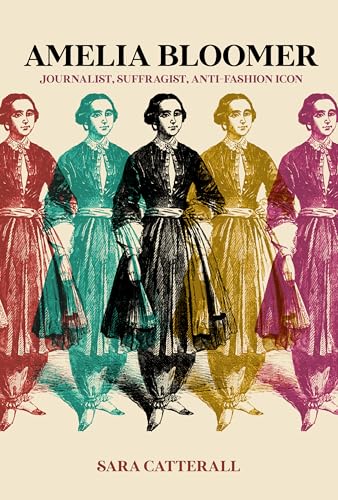
AMELIA BLOOMER: Journalist, Suffragist, Anti-Fashion Icon, a woman of moral certainty and impeccable rectitude who rebelled hard
AMELIA BLOOMER: Journalist, Suffragist, Anti-Fashion Icon
SARA CATTERALL
Belt Publishing (non-affiliate Bookshop.org link)
$11.99 ebook edition, available now
Rating: 5* of five
The Publisher Says: A fascinating look at an underappreciated woman in American history whose newspaper fostered a national conversation on women's issues.
Those who recognize the name Amelia Bloomer usually do so because of bloomers, the clothing item named after her. While she was a rational dress advocate for a time—calling on women to abandon rigid corsets and heavy petticoats and opt for long trousers, shorter skirts, and sensible boots—it was "but an incident" in the larger story of her life and impact.
Bloomer edited and published The Lily, the first newspaper for and by women. Much like Bloomer herself, it started as a temperance rag before broadening to include some of the most important issues to women in that day, including the right to vote, and included contributions from thinkers like Elizabeth Cady Stanton. The groundbreaking paper brought the conversation from Seneca Falls right to the doorsteps of women across the expanding nation.
Guided by a rigid sense of morality and a Puritan work ethic, Bloomer remained open-minded to new ideas. She refused to be swayed by social norms and wrote cutting responses to those who tried to intimidate or shame her and her friends, a group that included Stanton and Susan B. Anthony. This deeply researched biography by Sara Catterall follows the many chapters of her life: her humble upbringing in upstate New York, her role in the temperance movement (and its true legacy as a wellspring of the women's rights movement), her years at The Lily, her groundbreaking position as deputy postmaster in Seneca Falls, her troubled health, and her eventual move to Council Bluffs, Iowa, where she continued to move the needle on women's suffrage in the more flexible new governments of the West.
I RECEIVED A DRC FROM THE PUBLISHER VIA EDELWEISS+. THANK YOU.
My Review: It had never creased my cranium that Amelia Bloomer was a temperance crusader before I read this book. Given that my mother the abuser never drank, and I had one boyfriend in my life who ever raised a hand to me and that never happened while he was drunk, temperance just did not ever cause me to think "good idea". All my associations with Mrs. Bloomer were around her ideas regarding the idiotic way women were caged inside their clothing during this era. Corsets really are the bound feet of Western culture.
I was utterly unprepared to meet this wildly different Bloomer. She was a woman of her time, in many ways moreso than the more famous ladies like her friends Stanton and Anthony...both of whom she knew from living in Seneca Falls, New York, and each of whom influenced her increasingly radical thinking about women's suffrage...as she was married with children and required to earn her living alongside her husband as best she was able while still raising children. Dexter and she were co-workers, as he hired her to work alongside him as a postmaster after his stint as a Whig-supporting newspaper editor landed him the job. A government salary for a woman no less!
Her position as a temperance crusader led her to make the connection that the only way to stop the unregulated flow of alcohol was to exert political pressure to regulate it. That was impossible, on a practical level, absent votes for women. (She didn't live to see Prohibition and its horrifying unintended consequences.) So her rational dress and votes for women all owe their influence on US culture to her christian temperance-movement work. It was spread wider than Seneca Falls by her opening The Lily, a newspaper for and by women that she, despite raising children, suffering chronic illness, and a complete lack of training except by Dexter's example from his newspaperman days. I am *gobsmacked* by her rigidly moral outlook leading her so far in opposition to the stupid cultural norms of "appropriate" behavior for women in a time where they were so very much more entrenched and enforced than they are now.
At this moment in US, and more broadly Western, political history, the example of a woman who looks at the world as she finds it, judges it harshly for its failings, and—at considerable personal cost to herself and her family—sets about opposing that world continuing down its present path, is invaluable. I'd also like to point out her starchy morality was inspired by an upbringing conventionally religious yet her response to it was radically, vocally, and consistently to apply its moral precepts in full and without exceptions.
If more christians were like Amelia Bloomer, the world would be a better place.
I did indeed just say that. Her acerbic wit, another surprise this book held for me, was deployed against obtuse and obnoxious followers of orthodoxy. Yet Mrs. Bloomer's touch with connecting to people who genuinely did not understand the stakes she saw so clearly in the direction society was heading was exemplary. She met those people on their own ground, without preaching or hectoring. I can only envy that skill; I myownself climb onto my ever-present high horse because I'm Right, that ever-losing strategy. Mrs. Bloomer's tone was always respectful...until she sensed ill-will or disingenuousness.
I knew exactly nothing of the substance of her life until Belt Publishing brought out this book. (I also now know that Dexter Bloomer wrote a biography of her in 1896, so I'll Gutenberg that up here directly.) Author Catterall and her publisher are to be praised, and I hope supported with purchases, for telling this unjustly neglected monadnock of probity and moral clarity's story to a needy new generation of readers. All five stars for bringing modern attention to this person from our past with so much to teach us for our future. It's involving prose, built on solidly shown foundations of information.
Monday, February 5, 2024
BE NOT AFRAID OF MY BODY: A Lyrical Memoir gives us a view of life that is triple silenced, Black & queer & male
BE NOT AFRAID OF MY BODY: A Lyrical Memoir
DARIUS STEWART
Belt Publishing
$19.99 trade paper, available tomorrow
SHORTLISTED FOR THE 37TH Lambda Literary Awards for Gay Memoir.
Rating: 4.5* of five
The Publisher Says: From an exhilarating new voice, a breathtaking memoir about gay desire, Blackness, and growing up.
Darius Stewart spent his childhood in the Lonsdale projects of Knoxville, where he grew up navigating school, friendship, and his own family life in a context that often felt perilous. As we learn about his life in Tennessee—and eventually in Texas and Iowa, where he studies to become a poet—he details the obstacles to his most crucial hiding his earliest attraction to boys in his neighborhood, predatory stalkers, doomed affairs, his struggles with alcohol addiction, and his eventual diagnosis with HIV.
Through a mix of straightforward memoir, brilliantly surreal reveries, and moments of startling imagery and insight, Stewart’s explorations of love, illness, chemical dependency, desire, family, joy, shame, loneliness, and beauty coalesce into a wrenching, musical whole. A lyrical narrative reminiscent of Saeed Jones’s How We Fight for Our Lives and Kiese Laymon’s Heavy, Be Not Afraid of My Body stands as a compelling testament to growing up Black and gay in America, and to the drive in all of us to collect the fragments of our own experience and transform them into a story that does justice to all the multitudes we contain.
I RECEIVED A DRC FROM THE PUBLISHER. THANK YOU.
My Review: Honesty, the true and fully realized kind, is often not kind to the subject or the teller. Author Stewart is fully honest in this memoir of Black male gayness.
The light it shines on himself, and Black culture’s fraught relationship with masculinity, queerness of all sorts, and what we seem unable to stop calling "race" despite the term’s horrifying baggage and unscientific pallor, is unsparing. It does no one any flattering favors to be seen in a searchlight’s beam. What Author Stewart set out to accomplish, so it seemed to me, was to make the cost of Othering...to the Othered as well as those who do the othering...personally real. Memoir only accomplishes that when it is honest and not self-serving.
The honesty about his sexual nature is both refreshing and difficult to read. The author’s Blackness was a lure and a weapon in his sexual arsenal. He details his encounters with white men who fetishized his skin color and their perceptions of who and what that meant he was. He does not fail to address the reciprocal fetishization, and honestly, so it did not come across in the reading as a scolding or a condemnation. His great anxitey about being perceived by others as effeminate, which is perceived as unforgivable in hypermasculinized Black culture, informs his sexual behavior. Being penetrated is the Ultimate Awful Sin against masculinity in US culture in general. Being penetrated by white men is the Ultimate Taboo for Black gay men. So, of course, what could possibly be more thrilling and desirable?
It should be to no one’s pearl-clutching amazement that young Darius Stewart found himself in the demimonde of social and sexual transgressors; and that he began to address the pain and self-image issues of being Other among those culturally Othered with self-medication aka drug and alcohol abuse. As is so often the case, this came with the risky sexual behavior that, in the 1990s, was almost certain to result in HIV infection. It does for Author Stewart, and while he is of the generation where HIV infection is a treatable, manageable condition and not a death sentence, it still had..and has...consequences that are unpleasant to cope with.
No part of Author Stewart’s journey was spared in his remembering eyes. He is unflinching in telling us how horrified he was to realize his undeniable gayness would not go away no matter how hard his childhood self prayed for it to. He could not pass as straight no matter how hard his teen self tried to. He was always, irreducibly, himself.
It takes a long time for that realization to become okay. More especially when even the Others your skin color places you among then Other you for your essential self, and heap hatred and abuse on you for this other Othering. It feels like no small miracle that Author Stewart chose to survive instead of taking the high-speed exit of suicide.
A deep self-reckoning like this book is, is a rare reading pleasure. I encourage all y’all not to miss this one.
Friday, September 30, 2022
FEN, BOG and SWAMP: A Short History of Peatland Destruction and Its Role in the Climate Crisis, short not sweet & RUNAWAY: Notes on the Myths That Made Me, memoir that missed its moment
FEN, BOG and SWAMP: A Short History of Peatland Destruction and Its Role in the Climate Crisis
ANNIE PROULX
Scribner
$26.99 hardcover, available now
One of LitHub's 38 Favorite Books of 2022!
NOMINATED FOR A 2022 NBCC AWARD IN NON-FICTION! Winners will be announced on 23 March 2023. More information here.
Rating: 5* of five
The Publisher Says: From Pulitzer Prize winner Annie Proulx—whose novels are infused with her knowledge and deep concern for the earth—comes a riveting, revelatory history of our wetlands, their ecological role, and what their systematic destruction means for the planet.
A lifelong environmentalist, Annie Proulx brings her wide-ranging research and scholarship to the subject of wetlands and the vitally important yet little understood role they play in preserving the environment—by storing the carbon emissions that greatly contribute to climate change. Fens, bogs, swamps, and marine estuaries are the earth’s most desirable and dependable resources, and in four stunning parts, Proulx documents the long-misunderstood role of these wetlands in saving the planet.
Taking us on a fascinating journey through history, Proulx shows us the fens of 16th-century England to Canada’s Hudson Bay lowlands, Russia’s Great Vasyugan Mire, America’s Okeefenokee National Wildlife Refuge, and the 19th-century explorers who began the destruction of the Amazon rainforest. Along the way, she writes of the diseases spawned in the wetlands—the Ague, malaria, Marsh Fever—and the surprisingly significant role of peat in industrialization.
A sobering look at the degradation of wetlands over centuries and the serious ecological consequences, this is a stunningly important work and a rousing call to action by a writer whose passionate devotion to understanding and preserving the environment is on full and glorious display.
I RECEIVED A DRC FROM THE PUBLISHER VIA NETGALLEY. THANK YOU.
My Review: First things first: Those title words aren't synonyms, exactly, so much as a family tree of naturally occurring wet places on Earth.
This information is important to fully understanding the scale and cost of wetland losses we've inflicted on the planet. Author Proulx (whose use of "yclept" in this book I note here with a big smile, as it's a favorite underused word of mine) is an experienced campaigner when it comes to putting English through its paces to evoke a sense of place and a perception of mood:
The fen people of all periods knew the still water, infinite moods of cloud. They lived in reflections and moving reed shadows, poled through curtains of rain, gazed at the layered horizon, at curling waves that pummeled the land edge in storms.
–and–
It can take ten thousand years for a bog to convert to peat but in only a few weeks a human on a peat cutter machine can strip a large area down to the primordial gravel.
Nothing made by human minds is ever perfect. I'm glad the title gave Author Proulx, eighty-six at this writing, an opportunity to mourn publicly the fens of her Connecticut childhood. I was fascinated by the information about the vanished English fens. But the bogs came in for a cursory examination in comparison, seen mostly through the lens of bog bodies. I acknowledge the personal element of the fact that they're bodies probably gave more heft to the science of peat bogs that really needed to be presented. I found it a distraction, though, while others may think of it as an enhancement.
It is with the swamps and bayous of my erstwhile stomping grounds, Southern Texas and its adjacent lowlands, that the short shrift became apparent. Houston and its urban sprawl could, and should, form a book of damning indictments of greed and stupidity. New Orleans was, for reasons I simply can't understand, rescued as a human habitation after the death of the many bayous and wetlands south of it resulted in its near destruction...an expensive playground for rich people. Another book that should be written (again).
But take away from any read the best, accept that not all of it was made with your taste in mind, and Author Proulx's essential message shines a harsh lime-light onto the instrumentalist Judeo-Christian worldview that's landed us in this awful mess:
The attitude of looking at nature solely as something to be exploited—without cooperative thanks or appeasing sacrifices—is ingrained in western cultures.
Our addiction to Being Right, to understanding the uses but not the purposes of this, our one and only planet, is killing us. And the death sentence has fallen on our generation. Lucky, lucky us we have Author Proulx to bear witness: "The waters tremble at our chutzpah and it seems we will not change."
++++++++++++++++++++++++++++++++++++++++++++++++++++++++++++++++
RUNAWAY: Notes on the Myths That Made Me
ERIN KEANE
Belt Publishing
$29.00 hardcover, available now
One of NPR's Best Books of 2022!
Rating: 4* of five, all for the startlingly apt and pointed phrases about her mother
The Publisher Says: From Erin Keane, editor in chief at Salon, comes a touching memoir about the search for truths in the stories families tell.
In 1970, Erin Keane’s mother ran away from home for the first time. She was thirteen years old. Over the next several years, and under two assumed identities, she hitchhiked her way across America, experiencing freedom, hardship, and tragedy. At fifteen, she met a man in New York City and married him. He was thirty-six.
Though a deft balance of journalistic digging, cultural criticism, and poetic reimagining, Keane pieces together the true story of her mother’s teenage years, questioning almost everything she’s been told about her parents and their relationship. Along the way, she also considers how pop culture has kept similar narratives alive in her. At stake are some of the most profound questions we can ask ourselves: What’s true? What gets remembered? Who gets to tell the stories that make us who we are?
Whether it’s talking about painful family history, #MeToo, Star Wars, true crime forensics, or The Gilmore Girls, Runaway is an unforgettable look at all the different ways the stories we tell—both personal and pop cultural—create us.
I RECEIVED A DRC FROM THE PUBLISHER VIA EDELWEISS+. THANK YOU.
My Review: Memories are, by definition, the things that form us, the things we re-member our selves from. A memoir descends to us from French, mémoire, which can mean:
...as well as the sense Anglophones use it in; it's a word, in other words, for lots of things that mean "parts of a whole thing, or place to put those parts." Memories are like that, bits of a whole thing that often, when reassembled, aren't the thing itself. We can bless the French for allowing us the use of this multi-warheaded weapon of a word for reifying the brain's peculiar technology of making meaning from the electromagnetic stew we all swim in. Some of us more successfully than others, as Author Keane's researches into her family have vividly taught her.
Had Author Keane's memoir, in any of those senses, of her life in pop-cultural mythic tones appeared two or even three years ago, it would be a triumph. As it is, it's a beautifully written memoir in the "store" or "report" sense, in the "place I've put fragments and pieces of things I want to remember and keep in some meaningful context." What it isn't is a successful book.
You can take it from me that the author's chops as a phrase-smith are solid, impeccably pointed sentences darted into the hides of slow-moving shambolic man-things that ruined the lives of her mother, then her, with their thoughtless trampling solipsism. It's not the least bit arguable that this is a writer, and a journalist, of talent and training, of tenacity and fascinating insight.
When she's talking about her mother, and her seriously screwed-up life.
When she tries to connect this with her pop-culture fascinations, clearly re-evaluated in adulthood after #MeToo blew the blinders off the unwilling-to-see and forced them to look, look, at the cost their pretty little fantasy exacted. On everyone, really, since a damaged person does damage, too; but inarguably on women the most tellingly, the most vilely.
What I can't make work in reading the piercingly honest redefinition of the author's life is why the John Ford/Woody Allen/et alii men are there. Yes, we know, they were ghastly people and treated women as playthings, they baked that attitude into their art, but...we know this. It's part of your mental furniture? Mine too. I swallowed it whole (though I never warmed to Woody Allen, too nebbishy for me). So did a few billion others. But you're talking about these men as though the betrayal of trust is fresh, without telling me why it *is* fresh for you, or putting into a time-context that would explain your palpable sense of betrayal.
Some wounds aren't best explored too often because the sympathy of the audience goes from victim to monster. This is a tipping point to be avoided at all costs with the #MeToo men. Keep beating the drum, and it will reverberate on you more strongly than the intended audience.
Anyway...very much a book of halves, one half excellent and the other...not.
Monday, May 30, 2022
BOYS COME FIRST, indie publisher's first-ever novel...from a Black Queer debut novelist
BOYS COME FIRST
AARON FOLEY
Belt Publishing
$17.95 trade paper, available now
Rating: 4.5* of five
The Publisher Says: Suddenly jobless and single after a devastating layoff and a breakup with his cheating ex, advertising copywriter Dominick Gibson flees his life in Hell's Kitchen to try and get back on track in his hometown of Detroit. He’s got one objective — exit the shallow dating pool ASAP and get married by thirty-five—and the deadline’s approaching fast.
Meanwhile, Dom's best friend, Troy Clements, an idealistic teacher who never left Michigan, finds himself at odds with all the men in his life: a troubled boyfriend he's desperate to hold onto, a perpetually dissatisfied father, and his other friend, Remy Patton. Remy, a rags-to-riches real estate agent known as “Mr. Detroit,” has his own problems—namely choosing between making it work with a long-distance lover or settling for a local Mr. Right Now who’s not quite Mr. Right. And when a high-stakes real estate deal threatens to blow up his friendship with Troy, the three men have to figure out how to navigate the pitfalls of friendship and a city that seems to be changing overnight.
Full of unforgettable characters, Boys Come First is about the trials and tribulations of real friendship, but also about the highlights and hiccups—late nights at the wine bar, awkward Grindr hookups, workplace microaggressions, situationships, frenemies, family drama, and of course, the group chat—that define Black, gay, millennial life in today’s Detroit.
I RECEIVED A DRC FROM THE PUBLISHER VIA EDELWEISS+. THANK YOU.
My Review: There's no such thing as "reverse racism." There's just racism, with shifting targets. Dom, Troy, and Remy all say, and feel, really racist things. And guess what: Unlike white people, these Black men have reasons to feel angry and frustrated and dispossessed. Their skin color marks them out as targets for lunatic racist white scum.
And guess what else? Black folks ain't perfect. These are three gay men, in a social milieu that really, really does NOT want their men to be gay. At all. So can you see what leads these loving, flawed, hurting, sadder-looking-for-wiser guys to be mouthy? It's like women of all colors rolling their eyes so hard they see their brains when men of any color start legislating what they can and can't do with their own bodies. There's a lot of anger built up at a lot of groups. Most with reason and justice on their side.
A lot of that anger is faced up to in this story of hurt, betrayal, and abuse. Dom and Troy, in their different ways, are reeling from domestic drama that is instantly relatable. Remy, not part of the kidhood bond shared by Dom and Troy, is probably the most personally insulated from domestic drama since he's in a "situationship," a neologism (it was to me, at least) I really like for a long-distance, still love-based, relationship. Not like I understand that from the inside or anything....
Remy's job as a real-estate hustler leads to a major fracture in his friendship with Troy and, to an extent, Dom, because his work is threatening to repurpose Troy's employer, a school, into gentrification's profitable arms. Detroit's decades of economic woes are a huge part of this story's rage-fuel. Would Dom have left Detroit for New York (and by extension met his cheating ex) had Detroit been capable of sustaining his ambitious need for a media market commensurate? Troy's domestic woes are fed, at least in part, by the economic struggles inherent in pursuing a teaching career. And here's Remy about to make a bundle of cash off the city's redevelopment....
I think the major take-away from this story is that there's no room for racism's corrosive effects in any society we need to support the creation of; and the other hate-isms, like homophobia and colorism, have to go in the dumpster too. When these Black, gay men face so much trouble from outside, it makes their work to fix the problems inside so very much harder. And that stops them not at all, doesn't even slow them down much, as they fight and fuck and work themselves up to fever pitch. These men, messy lives and sad hearts and powerful spirits in them all, make every day count. They don't, by the end of the story, waste what they've got anymre in wanting what they can't have.
But that does not mean they take second best. Not for long, anyway. It makes them great companions for a summer laze on the beach.
Just...maybe skip ahead over the smexytimes. Until you get home, anyway.
Subscribe to:
Posts (Atom)