Pages
- Home
- Mystery Series
- Bizarro, Fantasy & SF
- QUILTBAG...all genres
- Kindle Originals...all genres
- Politics & Social Issues
- Thrillers & True Crime
- Young Adult Books
- Poetry, Classics, Essays, Non-Fiction
- Science, Dinosaurs & Environmental Issues
- Literary Fiction & Short Story Collections
- Sookie Stackhouse/Southern Vampire Books & True Blood
- Books About Books, Authors & Biblioholism
Showing posts with label #WomensHistoryMonth. Show all posts
Friday, March 6, 2026
THE BEGINNING COMES AFTER THE END: Notes on a World of Change, essays about the one true constant
THE BEGINNING COMES AFTER THE END: Notes on a World of Change
REBECCA SOLNIT
Haymarket Books (non-affiliate Bookshop.org link)
$9.99 ebook, available now
The Independent Press Top 40 Bestsellers: Non-Fiction For the week ending August 18, 2026
Rating: 4* of five
The Publisher Says: Rebecca Solnit offers a thrilling survey of the sheer breadth and scale of social, political, scientific, and cultural change over the past three quarters of a century.
In this sequel to her enduring bestseller Hope in the Dark, Solnit surveys a world that has changed dramatically since the year 1960. She argues that, despite the forces seeking to turn back the clock on history, change is not a possibility, it is an inevitability, and the nature of that change is determined by who participates and how.
The changes amount to nothing less than dismantling an old civilization and building a new one, whose newness is often the return of the old ways and wisdoms. In this rising worldview, interconnection is a core idea and value. But because the transformation has happened in so many disparate arenas, and within a longer arc of history, the scale of that change is seldom recognized.
While the backlash of white nationalist authoritarianism, Manosphere misogyny, and justifications for callousness, selfishness, economic inequality, and environmental destruction collectively drive individualism and isolation, the elements of this new world are related in their vision of more inclusion, equality, interconnection. This new vision embraces antiracism, feminism, a more expansive understanding of gender, environmental thinking, and indigenous and non-Western ideas, particularly Buddhism, as well as breakthroughs in the life sciences and neuroscience, pointing toward a more interconnected, relational world.
I RECEIVED A DRC FROM THE PUBLISHER VIA EDELWEISS+. THANK YOU.
My Review: Collections often draw from existing bodies of work. Author Solnit began drawing acclaim for her robust, tendentious writing in the early Aughts, and has never fallen out of the cultural conversation. She won't stop telling the truth, though, so her honesty wins her detractors and even enemies across the political spectrum.
One knows a thinker is doing it right when everybody is mad at them for something.
This essay collection breaks no new ground in her public thinking. It is, if I'm honest, a highlight reel with a bit more sameness than I wanted to read. It is also a collection drawn from decades of work. I found myself thinking, "I remember this, move on," and finding it necessary to recall in the moment that it's collected not commissioned to be written anew or afresh. Not every essay chosen was necessarily up to the highest standards in the book. Again, it's a function of a collection...it's not possible to be perfect, but it's possible, like Author Solnit, to be trenchant and to add value to the consideration of organizing theme of this particular project.
Progress is relative. In any consideration of the societal norms prevailing now that has even a modest degree of perspective, things are hugely better for women, queers, trans folk, and people of color. We're always being bombarded with messaging to the contrary, for reasons y'all need to read Paul Linebarger's book to really connect with. A collection of work like this one is a good corrective to the easy-to-internalize message of the world sucks always has always will. It's true; it's also wrong; both these things can and do coexist because, faithless to your entire life's training, almost nothing in the observable universe is a binary. All physical systems are spectrums and there's mounting evidence literally everything is in fact spectrum...look into quantum physics and certainty vanishes to be replaced by probabilities (aka spectra). Author Solnit stressing that each ending is also a beginning is very much in line with this mode of thinking.
It's new enough to most of her audience that repetition is probably a good idea to deploy in examining the topic. Like any new-to-you theory, perspective, or fact, it's going to need some hammering home to become part of one's mental structural supports. I'm ahead of this curve so it wore on my nerve a bit more than it will for others. I hope you'll pick it up and give it a try if you're sinking under the wight of the world's idiocies and evils.
We need the perspective of one who has been decades in the trenches, struggling against the dying order's loud and lousy distractions, to remind us we've come far. We need to keep moving ahead. It's easier to find the will to do that if we've got a stedy hand and an encouraging voice like Author solnit's telling us to remember it can be done.
Because it has been done. It's not finished, this work; it never really is. Now, get back to it!
Friday, November 7, 2025
WINNING THE EARTHQUAKE How Jeannette Rankin Defied All Odds to Become the First Woman in Congress, recovering the life of a great American
WINNING THE EARTHQUAKE How Jeannette Rankin Defied All Odds to Become the First Woman in Congress
LORISSA RINEHART
St. Martin's Press (non-affiliate Bookshop.org link)
$16.99 ebook, available now
A LIBRARY JOURNAL BEST BOOK OF 2025
Rating: 4.5* of five
The Publisher Says: The first major biography of Jeannette Rankin, a groundbreaking suffragist, activist, and the first American woman to hold federal office.
“Few members of Congress have ever stood more alone while being true to a higher honor and loyalty.” —President John F. Kennedy on Jeannette Rankin
Born on a Montana ranch in 1880, Jeannette Rankin knew how to drive a tractor, ride a horse, make a fire, and read the sky for weather. But most of all, she knew how to talk to people, how to convince them of her vision for America. It was this rare skill that led her, in 1916, to become the first woman ever elected to the House of Representatives.
As her first act, Rankin introduced the legislation that would become the 19th Amendment. Throughout her two terms in 1916 and 1940, she continued to introduce and pass legislation benefitting unions, protecting workers, and increasing aid for children in poverty. In 1941, she stood tall as the sole anti-war voice in Congress during WWII, advocating for pacifism in the face of tragedy and stating that you can no more win a war than you can win an earthquake.
A suffragist, feminist, peace activist, workers' rights advocate, progressive, and Republican, Rankin remained ever true to her beliefs—no matter the price she had to pay personally. Yet, despite the momentous steps she made for women in politics, overcoming the boys club of capitalists and career politicians who never wanted to see a woman in Congress, Jeannette Rankin’s story has been largely forgotten. In Winning the Earthquake, Lorissa Rinehart deftly uncovers the compelling history behind this singular American hero, bringing her story back to life
I RECEIVED A DRC FROM THE PUBLISHER VIA NETGALLEY. THANK YOU.
My Review: I was aware of Rankin as the lone voice against declaring war in 1941. My 1970s public school education in Austin taught me that fact in seventh grade; nothing positive was ever added to it in any class I ever took on History, on sociology, or any other discipline at any later stage of my education. This book, published fifty years after that initial mention of Rankin's name, is the first comprehensive biography of a very very important voice in US politics in the first half of the twentieth century. This proves a point Author Rinehart makes:
"Nowhere in her education or prolific reading had she learned that in 1848, three hundred women gathered in Seneca Falls to declare their sovereign right to the ballot. Nor had she heard that since then, women in every state of the nation had been fighting for their right to vote. To her even greater amazement, they had won it in Wyoming, Colorado, Utah, and Idaho, all before the turn of the twentieth century. She and all American women seemed to have been purposefully denied knowledge of their own struggle for liberation."My one cavil with this statement is the modifying presence of "seemed" since there is no better way to stop people from making change than to stop them from knowing about the changes that have already happened. If authoritarians do not want any changes either made again or expanded on, they simply erase the history that shows their way is not the only way from public discourse. Then the few places the awareness of the changes survives can be marginalized and shouted down.
Book banning is step one; book burning step two; reducing literacy overall is the final nail in the coffin the high-control society uses.
I was drawn in by the title of the book. It seemed so off-kilter, so self-evidently contradictory, that I wanted to know where it came from hence my desire to read a book about someone I knew nothing substantive about. It's from one of pacifist Rankin's well-known in her time sayings: "you can no more win a war than you can win an earthquake." Millennia of corroborative evidence has had no appreciable effect on war's prevalence.
I was impressed by the depth of Author Rinehart's scholarship. Her extensive notes and citations were all very enlightening and well-chosen from my layman's point of view. There are widely varying sources cited so this tells me how very much work it was to find all the factual crumbs she did. One major shock, though honestly it shouldn't've been, was that the representative from Montana was elected as a Republican. I'm so steeped in the post-LBJ empire of evil that is the modern GOP that I've lost sight of the entire progressive history of the Republicans. Go read about Robert La Follette and Teddy Roosevelt. Time was these were the progressive leaders, not the soulless evil bastards in the McConnell/Bush/Cheney ilk or the wild-eyed reactionary MAGAts.
How likely is the present base, let alone "leadership", of the party to embrace a pacifist follower of Gandhi, a campaigner for the abolition of the Electoral College, and vehement supporter of unions? Growing up in Montana in the 1880s (when their representatives were called "the gentlemen from Anaconda," the state's largest employer and main economic driver), Rankin recognized the evils of untrammeled capitalism. She emulated Jane Addams in her work for the betterment of ordinary folks. Rankin was, in short, the best kind of radical there is, a radical believer in people and their power to do good...when left to do it.
A role model for today who is finally getting her scholarly due, I hope the sudden awareness of Gen Z that things in the US do not have to be this way will lead some of them to discover this spirit-parent from our country's past.
Wednesday, May 7, 2025
THE LAST SECRET AGENT: My Life as a Spy Behind Nazi Lines, once there were Giants...very short ones
THE LAST SECRET AGENT: My Life as a Spy Behind Nazi Lines
PIPPA LATOUR with Jude Dobson
St. Martin's Press (non-affiliate Amazon link)
$14.99 ebook, available now
Rating: 4.75* of five
The Publisher Says: After decades of silence, the last surviving World War II British spy reveals the real, untold story of her time as a secret agent in the deadly world of Nazi France.
From a unique and singular voice comes the incredible true story of the last surviving undercover British female operative in WW2. Pippa Latour parachuted into occupied France in 1944 to conduct sabotage and subversion behind enemy lines. Selling soap to German soldiers and hiding codes on a piece of ribbon, she sent back crucial information about troop positions in the lead up to D-Day, and continued her work until Paris was liberated. From her childhood as an orphan in South Africa to her years as an undercover agent, Pippa's story is that of a woman determined to honor her principles and risk her life to fight against the greatest evil of the 20th century.
The Last Secret Agent is a posthumously published memoir, co-written with journalist Jude Dobson. Pippa was decorated highly for her actions, including being made a Member of the Order of the British Empire and receiving the Légion d’Honneur in France. For years, Pippa kept her involvement in the war effort secret from everyone, including her family, but for the first time, her story can now be told in full.
I RECEIVED A DRC FROM THE PUBLISHER VIA NETGALLEY. THANK YOU.
My Review: It makes me sad that Pippa Latour did not live to see her story told publicly at long last. Sh desreved to be here to hear, if not necessarily accept, our kudos. She was a modest person, and I suspect suffered from some terrible PTSD based on what I read in this book; that's not a person likely to want to stand in fromt of a room full of applauding people. Never mind she deserves the plaudits. Never mind she was angered by online misinformation about the realities of WWII. She did what she did, honored her Official Secrets Act duty, and lived the life she helped make safe for herseld and millions of others.
I salute you, Ma'am. (Royal address use deliberate.)
From her African colonial childhood, where she picked up practical and communication skills easily, to her European youth, where she put every skill she developed to use, hers was a life of intensities sought, mastered, and used for the purpose she chose to learn them for. This kind of mental toughness and goal-driven living is rare. People like Pippa Latour do not get born often. That she lived until she was 102 is astounding, yet utterly unsurprising. It's our good fortune that she decided to tell her story to a qualified journalist...who filled in gaps that inevitably appear in aging memories...in the trained researcher's best-practices way. (Her specialism is in creating WWII informational films and other materials.) There are reconstructed conversations, unsupported anecdotal statements of fact, and all of that must be okay with the story's best reader. It is, I feel sure, inevitable with the stories of any covert operative.
All the verifiable points check out. I'm not inclined to think someone who told this story at this late date, insisting it be brought to the world's attention after her impending death, would lie. I could be wrong. (It happens to the best of us.) But nothing in her account rings false, as happens with other memoirs. I trust her, I never met her, and isn't that just exactly what a truly skilled covert operative could do in her sleep?
A very powerful story...risking life and sanity to defend strangers' right to freedom of thought and of self-determination...told well. Why then do I dock a fractional star? Because sources aren't cited where they exist, and I'm not really sure which non-conversational (I take it as given that any conversation is the product of memory and imagination) parts aren't sourced or at least grounded in source materials. Much as I understand and accept the reality of a covert operator's limited access to documentation, if this story's appearing at all, the Official Secrets Act applies so it was approved in some fashion. What occurred to make that decision possible?
It's a cavil, but it niggled at me.
The effects of her wartime service on her family? Not delved into, though she explains that her reasons for not speaking of it to her ex-husband and children were grounded in the lingering trauma (my term, not hers) and the need not to breach her oath to keep it zipped up tight. makes perfect sense to me. I would say that, if you're looking for salacious stuff, you move on. Pippa is telling us a story her way. That is not going to be full of gossip.
It is a story we badly need to hear. A woman so small, so frail-looking she could pass as young teen chose to risk torture and death and live among the collaborators and the silently acquiescent to work against a great evil, is a role model to any...all...of us living in this ugly, ugly passage of the 21st century. I'm sorry the late, great lady can't tell me this: Did she see our awful present developing? Is that really what opened her mouth at long last?
It wouldn't surprise me one little bit. She was a shrewd observer and a good judge of character.
Monday, March 17, 2025
THE LATINA ANTI-DIET: A Dietitian's Guide to Authentic Health that Celebrates Culture and Full-Flavor Living, good, supportive guide to eating

THE LATINA ANTI-DIET: A Dietitian's Guide to Authentic Health that Celebrates Culture and Full-Flavor Living
DALINA SOTO
Ballantine Books (non-affiliate Amazon link)
$14.99 ebook, available now
Rating: 5* of five
The Publisher Says: Break away from diet culture while still honoring your body and incorporating cultural foods in this fresh, expansive guide from the registered dietitian and creator of Your Latina Nutritionist.
Diet culture is facing a reckoning, and intuitive eating has been leading the charge. The movement has taken the internet by storm, encouraging us to stop dieting and make food choices that feel good for our bodies rather than follow influencers and their shakes.
But intuitive eating is missing a key ingredient: culture. Like many movements, intuitive eating has become co-opted by a select few—placing the focus on “mainstream” food while discounting cultural cuisines. But how can we gain a healthy attitude towards food when our foods—our arroz, habichuelas, and plátanos—are left out of the conversation?
Dalina Soto is here to add them back to our plates.
As a registered dietitian, Soto understands the pros and cons of intuitive eating. As a first-generation Dominican American, she’s also seen firsthand how this movement has only catered to a certain demographic. With her easy-to-follow CHULA method, Soto teaches us how to:
Engaging and incisive, The Latina Anti-Diet is for everyone who’s been told to lay off the tortillas and swap their white rice for brown. Soto shows us that food is so much more than calories; it’s about celebrating our culture and living a life full of flavor.
I RECEIVED A DRC FROM THE PUBLISHER VIA NETGALLEY. THANK YOU.
My Review: Food, fat, and flavor start with the same letter for a reason. I'm deeply anti-diet. This book crystalizes my objections to the diet industry's be-afraid-of-your-food message, its relentless focus on women and the concomitant relentless bombardment of negativity about appearance, or more stealthily but with the same objective, relentless "health" messaging that is anything but healthy.
The author is a social-media Force. She's got followers in droves...legions...and she's been giving this very practical method to get yourself into a healthy, sustainable pattern of eating the food you enjoy for a while now. I hadn't heard of her because I'm not all that interested in diets except to belittle and insult the anti-food goblins that perpetrate and perpetuate the anti-food messaging that damages so many people.
What else can I say? If you think you need a diet book, you really need this book. Skip the "one weird trick" fads, spend your time and your treasure here. Author Soto is Cicero to the Br'er Rabbits that abound in this space. She spends a deal of her page-count telling stories about those who've used her method...CHULA, explained above...to mend their fractured relationship to food. There's a lot of informative and explanatory text, so it's not just a paper version of an infomercial; the aim was to recreate her social-media presence's warm, approachable presentation of self. I found it effective, and agreeable, where I expected to feel it was kinda cringe.
*I*, a certifiable curmudgeon with a long-standing hatred of the dietmongers, am rating this book 5 stars and recommending it to people who think they need to diet. Push a pin in that idea until you've read this book.
Wednesday, March 12, 2025
PROPAGANDA GIRLS: The Secret War of the Women in the OSS brings the underknown role women play in Intelligence to light

PROPAGANDA GIRLS: The Secret War of the Women in the OSS
LISA ROGAK
St. Martin's Press (non-affiliate Amazon link)
$14.99 ebook edition, available now
Rating: 4.25* of five
The Publisher Says: The incredible untold story of four women who helped win WWII by generating a wave of black propaganda.
Betty MacDonald was a 28-year-old reporter from Hawaii. Zuzka Lauwers grew up in a tiny Czechoslovakian village and knew five languages by the time she was 21. Jane Smith-Hutton was the wife of a naval attaché living in Tokyo. Marlene Dietrich, the German-American actress and singer, was of course one of the biggest stars of the 20th century. These four women, each fascinating in her own right, together contributed to one of the most covert and successful military campaigns in WWII.
As members of the OSS, their task was to create a secret brand of propaganda produced with the sole aim to break the morale of Axis soldiers. Working in the European theater, across enemy lines in occupied China, and in Washington, D.C., Betty, Zuzka, Jane, and Marlene forged letters and “official” military orders, wrote and produced entire newspapers, scripted radio broadcasts and songs, and even developed rumors for undercover spies and double agents to spread to the enemy. And outside of a small group of spies, no one knew they existed. Until now.
In Propaganda Girls, bestselling author Lisa Rogak brings to vivid life the incredible true story of four unsung heroes, whose spellbinding achievements would change the course of history.
I RECEIVED A DRC FROM THE PUBLISHER VIA NETGALLEY. THANK YOU.
My Review: I think most of us know who Marlene Dietrich was; I thought Betty MacDonald was the author of The Egg & I, but that's not the case; none of the others caused even a flicker of recognition.
This, my fellow Murrikans, is not an accident. As covert-operations experts, it was never likely that the four women here...with one obvious exception...would become household names. Even Dietrich's wartime service, though, is very much downplayed and undercredited in biographies of her remarkable life. The others...well...I know we'll all clutch our collective pearls when we learn that they were passed over for promotions given to men they trained. Shocking, no?
Lisa Rogak has set out to tell the details, insofar as available, of the women whose lives were offered in service during a huge global war. The aftermath was predictably enough not glorious. The women are, I'm afraid, not part of the broader public record; that makes keeping track of them in this narrative of their covert activities a matter of noting names. No archive of their careers exists (pace Marlene), so we have little personality development. From divergent beginnings, they converge on a bored, rebellious attitude they are all entitled to. It just does little to keep their characters separate in one's mind. It doesn't help my sense of them as people that, based on the title, I was expecting more or less a Bletchley Park kind of ethos for them to operate together, as more or less a unit, to develop. Nothing could be further from the truth...they barely ever crossed paths and were not in the same kind of circumstances within the propaganda operation.
It's not so much a flaw in my mind as an inevitable consequence of the manner in which these women were treated as fungible, expendable units where their male colleagues were noticed and promoted...often on the backs of the women's efforts. The effect of propaganda on one's enemies is, obviously, a subject of great national importance in today's online world. I shudder to think what a popular entertainer of Dietrich's stature could do with social media at her command. Any one of these rumormongers, these evidence-fakers, these insiders-turned-enemies could do astonishing amounts of damage given free rein on the internet.
Heaven knows their descendants are. We ignore the ways and means of the past at our peril. We're still seeing these techniques used, as refined, against us now.
Why I couldn't reach a fifth star was really down to niggles, like the sort-of-faceless grievance ball the women turned into as I read along. It wasn't avoidable, I understand that we're dealing with people who didn't leave huge divots in the lawn of History here. It was, however, a distraction, so that's why this well-written, researched, and obviously very personally meaningful to the author story doesn't get its optimal five full stars.
Wednesday, March 5, 2025
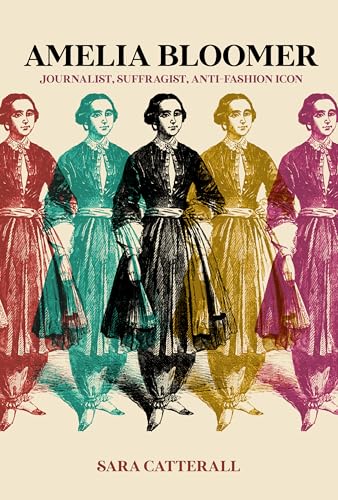
AMELIA BLOOMER: Journalist, Suffragist, Anti-Fashion Icon, a woman of moral certainty and impeccable rectitude who rebelled hard
AMELIA BLOOMER: Journalist, Suffragist, Anti-Fashion Icon
SARA CATTERALL
Belt Publishing (non-affiliate Bookshop.org link)
$11.99 ebook edition, available now
Rating: 5* of five
The Publisher Says: A fascinating look at an underappreciated woman in American history whose newspaper fostered a national conversation on women's issues.
Those who recognize the name Amelia Bloomer usually do so because of bloomers, the clothing item named after her. While she was a rational dress advocate for a time—calling on women to abandon rigid corsets and heavy petticoats and opt for long trousers, shorter skirts, and sensible boots—it was "but an incident" in the larger story of her life and impact.
Bloomer edited and published The Lily, the first newspaper for and by women. Much like Bloomer herself, it started as a temperance rag before broadening to include some of the most important issues to women in that day, including the right to vote, and included contributions from thinkers like Elizabeth Cady Stanton. The groundbreaking paper brought the conversation from Seneca Falls right to the doorsteps of women across the expanding nation.
Guided by a rigid sense of morality and a Puritan work ethic, Bloomer remained open-minded to new ideas. She refused to be swayed by social norms and wrote cutting responses to those who tried to intimidate or shame her and her friends, a group that included Stanton and Susan B. Anthony. This deeply researched biography by Sara Catterall follows the many chapters of her life: her humble upbringing in upstate New York, her role in the temperance movement (and its true legacy as a wellspring of the women's rights movement), her years at The Lily, her groundbreaking position as deputy postmaster in Seneca Falls, her troubled health, and her eventual move to Council Bluffs, Iowa, where she continued to move the needle on women's suffrage in the more flexible new governments of the West.
I RECEIVED A DRC FROM THE PUBLISHER VIA EDELWEISS+. THANK YOU.
My Review: It had never creased my cranium that Amelia Bloomer was a temperance crusader before I read this book. Given that my mother the abuser never drank, and I had one boyfriend in my life who ever raised a hand to me and that never happened while he was drunk, temperance just did not ever cause me to think "good idea". All my associations with Mrs. Bloomer were around her ideas regarding the idiotic way women were caged inside their clothing during this era. Corsets really are the bound feet of Western culture.
I was utterly unprepared to meet this wildly different Bloomer. She was a woman of her time, in many ways moreso than the more famous ladies like her friends Stanton and Anthony...both of whom she knew from living in Seneca Falls, New York, and each of whom influenced her increasingly radical thinking about women's suffrage...as she was married with children and required to earn her living alongside her husband as best she was able while still raising children. Dexter and she were co-workers, as he hired her to work alongside him as a postmaster after his stint as a Whig-supporting newspaper editor landed him the job. A government salary for a woman no less!
Her position as a temperance crusader led her to make the connection that the only way to stop the unregulated flow of alcohol was to exert political pressure to regulate it. That was impossible, on a practical level, absent votes for women. (She didn't live to see Prohibition and its horrifying unintended consequences.) So her rational dress and votes for women all owe their influence on US culture to her christian temperance-movement work. It was spread wider than Seneca Falls by her opening The Lily, a newspaper for and by women that she, despite raising children, suffering chronic illness, and a complete lack of training except by Dexter's example from his newspaperman days. I am *gobsmacked* by her rigidly moral outlook leading her so far in opposition to the stupid cultural norms of "appropriate" behavior for women in a time where they were so very much more entrenched and enforced than they are now.
At this moment in US, and more broadly Western, political history, the example of a woman who looks at the world as she finds it, judges it harshly for its failings, and—at considerable personal cost to herself and her family—sets about opposing that world continuing down its present path, is invaluable. I'd also like to point out her starchy morality was inspired by an upbringing conventionally religious yet her response to it was radically, vocally, and consistently to apply its moral precepts in full and without exceptions.
If more christians were like Amelia Bloomer, the world would be a better place.
I did indeed just say that. Her acerbic wit, another surprise this book held for me, was deployed against obtuse and obnoxious followers of orthodoxy. Yet Mrs. Bloomer's touch with connecting to people who genuinely did not understand the stakes she saw so clearly in the direction society was heading was exemplary. She met those people on their own ground, without preaching or hectoring. I can only envy that skill; I myownself climb onto my ever-present high horse because I'm Right, that ever-losing strategy. Mrs. Bloomer's tone was always respectful...until she sensed ill-will or disingenuousness.
I knew exactly nothing of the substance of her life until Belt Publishing brought out this book. (I also now know that Dexter Bloomer wrote a biography of her in 1896, so I'll Gutenberg that up here directly.) Author Catterall and her publisher are to be praised, and I hope supported with purchases, for telling this unjustly neglected monadnock of probity and moral clarity's story to a needy new generation of readers. All five stars for bringing modern attention to this person from our past with so much to teach us for our future. It's involving prose, built on solidly shown foundations of information.
Monday, March 3, 2025
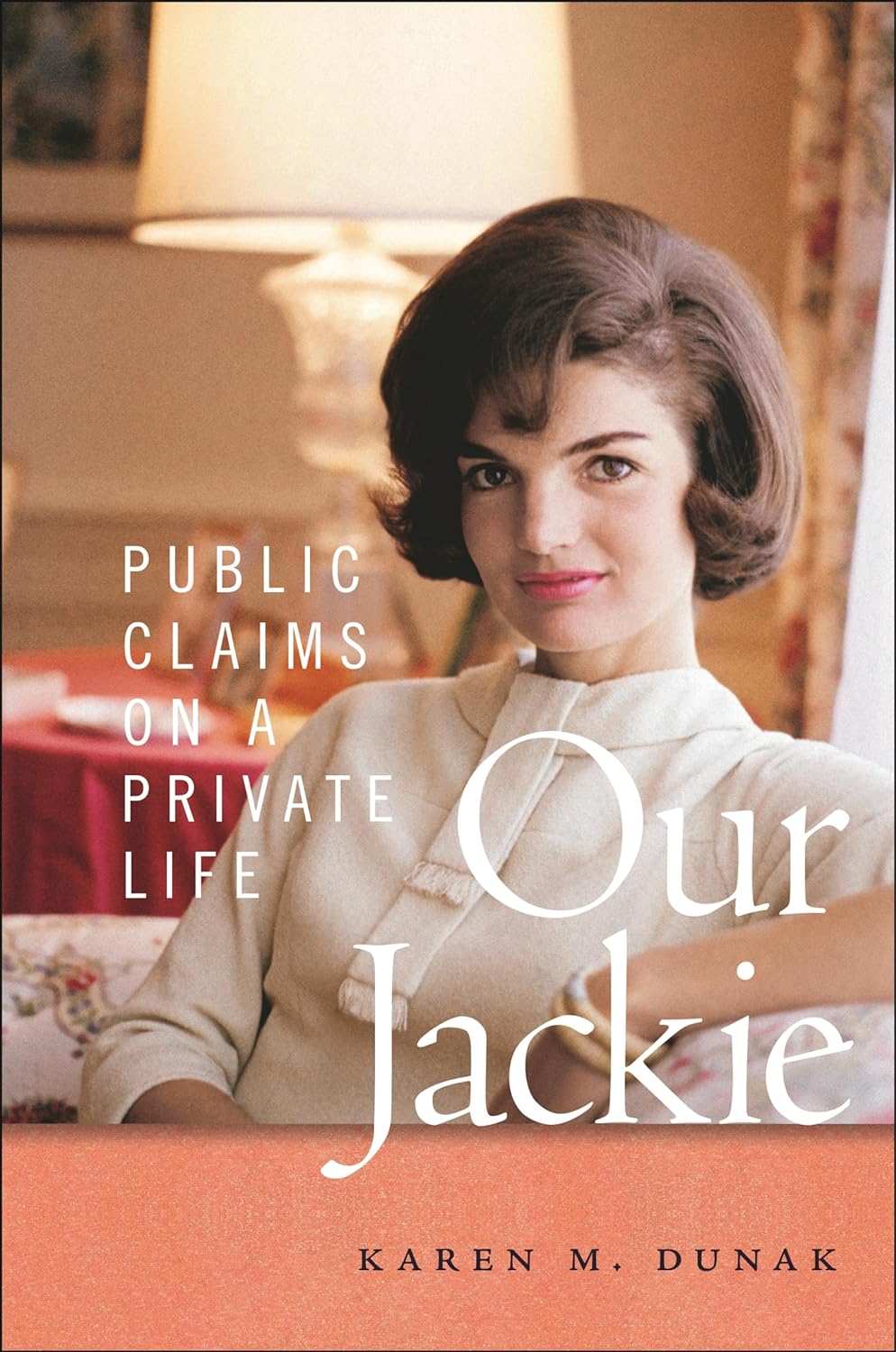
OUR JACKIE: Public Claims on a Private Life, stealth take-down of modern celebrity culture by looking deeply into its past
OUR JACKIE: Public Claims on a Private Life
KAREN M. DUNAK
NYU Press (non-affiliate Amazon link)
$30.00 ebook edition, available now
Rating: 4* of five
The Publisher Says: Tells the story of Jacqueline Kennedy Onassis through her evolving public persona, from campaign wife to First Lady to fallen idol to treasured national icon
When Jacqueline Kennedy Onassis became First Lady of the United States over sixty years ago, she stepped into the public spotlight. Although Jackie is perhaps best known for her two highly-publicized marriages, her legacy has endured beyond twentieth-century pop culture and she remains an object of public fascination today.Drawing on a range of sources—from articles penned for the women’s pages of local newspapers, to esteemed national periodicals, to fan magazines and film—Our Jackie evaluates how media coverage of Jacqueline Kennedy Onassis changed over the course of her very public life. Jackie’s interactions with and framing by the American media reflect the changing attitudes toward American womanhood.
Over the course of four decades, Jackie was alternatively praised for her service to others, and pilloried for her perceived self-interest. In Our Jackie, Karen M. Dunak argues that whether she was portrayed as a campaign wife, a loyal widow, a selfish jetsetter, or a mature career woman, the history of Jackie’s highly publicized life demonstrates the ways in which news, entertainment, politics, and celebrity evolved and intertwined over the second half of the twentieth century.
Examining the intimate chronicles of this famous First Lady’s life, Our Jackie suggests that media coverage of this enigmatic public figure revealed as much about the prevailing views of women in America– how they should behave and whom they should serve– as it did about Jacqueline Kennedy Onassis as an individual.
I RECEIVED A DRC FROM THE PUBLISHER VIA EDELWEISS+. THANK YOU.
My Review: How ghastly it must be to be famous. Nothing, not even your underwear preferences, is personal and private. Mrs. Kennedy was the first media celeb to experience this in the television age...though TV was most assuredly not the worst offender in depriving this upper-class woman of her private life (looking at you, recently-twitching corpse of The Saturday Evening Post).
The fact is, we never knew the elegant, cultured woman, comfortable in her own skin, that wore masks to keep the hoi polloi from knowing how very much of the haut ton she was. And the best thing about it all is, she knew what she was doing. She was a very careful curator of her, and her family's, image. She was a participant in this game, and a victim of it; the ways she worked to contain the access of an intrusive forcee of curiosity onto her private life were defensive, effective, and after a certain learning curve, collaborative.
Author Dunak has gone into what feels like every archive of 1960s media there is to find the scraps and bits that illuminate American ideas about this icon of our culture. I'm deeply impressed at the sources! It seems the author has synthesized the opinions of the entire spectrum of the US media landscape...what a grisly task that'd be, thank all the goddesses she didn't have social media to grapple with!...into several archetypes of sorts. Mrs. Kennedy as Grieving Widow-in-Chief. Jackie O. as selfish traitor who abandoned her country to run away with an ugly old rich Greek guy. Jackie Kennedy as aspirational American homemaker-cum-style icon. JKO, the book editor at Viking...until they published a book about the Kennedys that was a hatchet job, when she moved to Doubleday...the erudite, late-life Career Woman. None of them was the woman herself, though that's outside the scope of this book. We have here a chance to grapple with the essential issue of celebrity culture: These are people, and we as consumer-celebrity units, treat them as property. Our responses of pleasure, when the icons are well-behaved, to outrage when we think they are not, is not new, though the outrageous extreme of cancel culture is worse now than in, say, Ingrid Bergman's day, but it's still not new.
Author Dunak offers us a thorough and deftly presented categorization and analysis of this strain in US popular culture. It affords the reader the clarity in distance to think about the ways in which we individually play along with, support, and/or amplify the idea that we "own" those we admire. We're asserting control over women, particularly, but in fact over all those who dare to be tall poppies in our field of vision.
It was a sobering take-away but one that felt omnipresent if never shouted at me by Author Dunak.
It's not quite a five-star read, as it is definitely academic if more accessibly so than most.
Saturday, March 1, 2025
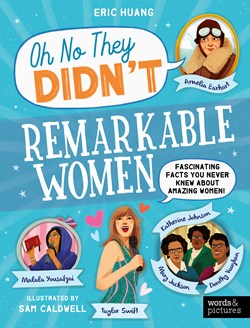
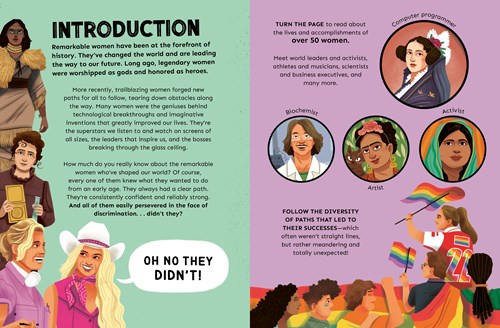
OH NO THEY DIDN'T! REMARKABLE WOMEN: Fascinating Facts You Never Knew About Amazing Women!, a juvenile book about women with power
OH NO THEY DIDN'T! REMARKABLE WOMEN: Fascinating Facts You Never Knew About Amazing Women!
ERIC HUANG (illus. Sam Caldwell)
words & pictures/Quarto Group (non-affiliate Amazon link)
$12.99 trade paper, available now
Rating: 4.5* of five
The Publisher Says: In this myth-busting guide to remarkable women past and present, everything you think you know will be proven wrong!
Remarkable women have been at the forefront of history. They’ve changed the world and are leading the way to our future. But how much do you really know about the remarkable women who’ve shaped our world? We all know that. . .
Misconceptions about women from the past and present are everywhere, but none of them are true! In Oh No They Didn't: Remarkable Women myths are busted about over 50 remarkable women from politicians to legends, performers, activists, scientists, mathematicians, creatives, and more.
In this fresh and funny guide learn about inspiring women from all over the world as well as their influence on history and popular culture. Stylishly designed and humorously illustrated by Sam Caldwell, Oh No They Didn't: Remarkable Women makes learning fun with unexpected facts and a playful, upbeat approach to non-fiction.
Oh No They Didn't: Remarkable Women is the perfect inspiring guide for ALL young people to learn about the influential women who may have been left out of traditional history books and deserve to be celebrated.
I RECEIVED A DRC FROM THE PUBLISHER VIA EDELWEISS+. THANK YOU.
My Review: My mother was my introduction to the waste of potential, and the weight of prejudice, that has plagued women since patriarchy took over the globe. Her (probably sexually, certainly emotionally) abusive father convinced her she was unable to understand math, science, or any other "male" stuff. He forbade her to accept a scholarship to study journalism, another to study acting, because she should get a husband and have babies.
Sadly for her she obeyed, hated her life, and "raised" children whom she neglected and abused...and she wasn't alone. May books like this one teach girls especially, and the boys they'll make lives with too (on current trends compulsory heterosexuality is on the way back, which this book quietly resists), that biology ≠ destiny.

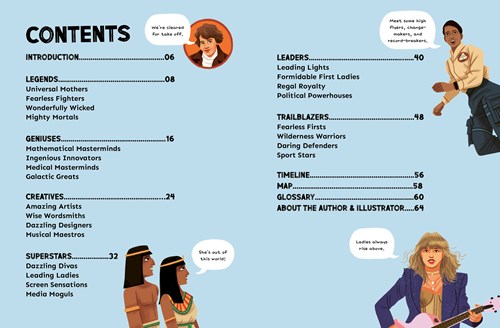
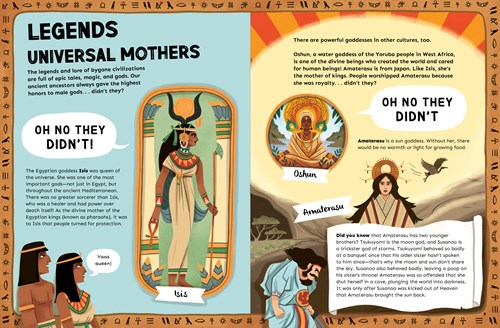
Where we're going; with whom we're going; and even here, note that Motherhood Comes First.

The statement of purpose is quite lively, colorful, and well-judged, IMO.

Okay, they're the universal mother archetypes; but really...?

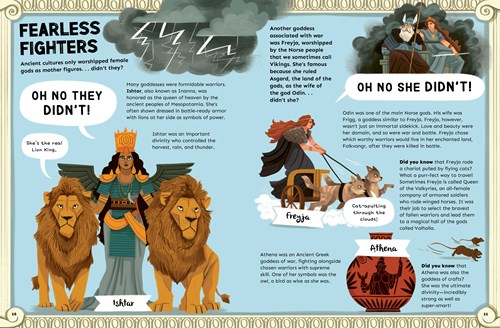
More to my taste, these are the women engaged in the USE of power...a message we can not afford to skimp on giving to the young.

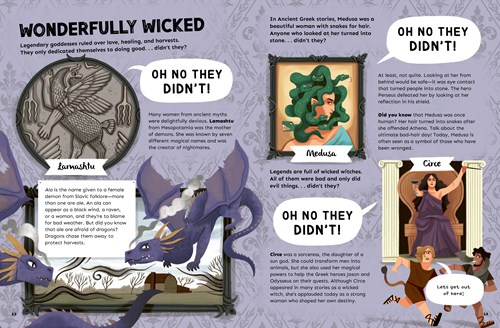
Lest those darker impulses feel shamed, here are the role models for being angry, and still getting shit done.
That's what the good people of the Quarto Group allow me to share with you in the way of illustrations. I think this subject, empowering girls and normalizing them having and using power, is one we are woefully poor at passing on...it's telling that, when adding this book to my database of books read, not one library of the dozen or so I searched had this book in its collection.
It's up to us, grands and aunts and mothers. We're (surprise, surprise, surprise! in your best Gomer Pyle mental voice) gettin' no help or support for this message from The PTB. This book is part of the Oh No They Didn't! series, and the author penned the mythbusting entry in this series on US Presidents, as well as Pride: A Seek-and-Find Celebration: Adventure Through the History of the Queer Community, aimed at the same age group. You'll clutch your pearls, I'm sure, when I tell you these aren't in my searched library databases, either.
Resist being shoved back into being subservient to a straight white man, and model it for all the youth.
Monday, March 21, 2022
ALREADY TOAST: Caregiving and Burnout in America, "startling, hard-hitting story of a family medical disaster made worse by cultural insensitivities to caregivers.”
ALREADY TOAST: Caregiving and Burnout in America
KATE WASHINGTON
Beacon Press
$16.95 trade paper, available now
Rating: 5* of five
The Publisher Says: The story of one woman’s struggle to care for her seriously ill husband—and a revealing look at the role unpaid family caregivers play in a society that fails to provide them with structural support.
Already Toast shows how all-consuming caregiving can be, how difficult it is to find support, and how the social and literary narratives that have long locked women into providing emotional labor also keep them in unpaid caregiving roles. When Kate Washington and her husband, Brad, learned that he had cancer, they were a young couple: professionals with ascending careers, parents to two small children. Brad’s diagnosis stripped those identities away: he became a patient and she his caregiver.
Brad’s cancer quickly turned aggressive, necessitating a stem-cell transplant that triggered a massive infection, robbing him of his eyesight and nearly of his life. Kate acted as his full-time aide to keep him alive, coordinating his treatments, making doctors’ appointments, calling insurance companies, filling dozens of prescriptions, cleaning commodes, administering IV drugs. She became so burned out that, when she took an online quiz on caregiver self-care, her result cheerily declared: “You’re already toast!”
Through it all, she felt profoundly alone, but, as she later learned, she was in fact one of millions: an invisible army of family caregivers working every day in America, their unpaid labor keeping our troubled healthcare system afloat. Because our culture both romanticizes and erases the realities of care work, few caregivers have shared their stories publicly.
As the baby-boom generation ages, the number of family caregivers will continue to grow. Readable, relatable, timely, and often raw, Already Toast—with its clear call for paying and supporting family caregivers—is a crucial intervention in that conversation, bringing together personal experience with deep research to give voice to those tasked with the overlooked, vital work of caring for the seriously ill.
I RECEIVED A DRC FROM THE PUBLISHER VIA EDELWEISS+. THANK YOU.
My Review: There's a slightly dystopian feel to reading this book. It's as though all the parts that were deemed too dark for fictional post-apocalyptic nightmares during the editorial process were snipped out then dumped into this tale. I mean, reading about a young wife and mother whose entire life was redefined by her fit young husband's horrific, aggressive cancer's near-success in driving him into the grave as she worked and raised their kids and managed his increasingly horrific treatments, all while fighting their insurance and medical providers? That's a bridge too far! It's too painful, it's too appalling!
Graft-versus-host disease (GvHD) is a confusing, uniquely modern ailment, like the inverse of rejection in a solid organ transplant. If you were to need and get a kidney donated from someone, for instance, there’s a good chance your immune system would identify it as a foreign body and attack it. Thus, organ transplant recipients are given immune suppressants. In a stem cell (or bone marrow) transplant, sometimes the new immune system (the graft), in its unfamiliar environment, looks around and sees the entire body around it (the host) as foreign. It then, in unscientific terms, freaks the fuck out. GvHD can pop up in the liver, skin, gut, eyes, and plenty of other spots; its attacks, as with many autoimmune responses, often seem random.9 The possibility of GvHD—which is termed “acute” when it arises within the first 100 days of transplant and “chronic” when it continues in the longer post-transplant period—is why stem cell transplant patients are kept on immunosuppressant medications even though the effectiveness of the transplant at fighting the cancer depends on the immune response. The medical team has a delicate balance to maintain: just enough immune response to keep the cancer from returning but not so much that GvHD gets out of control.
Yet it's completely factual.
On one bad day I ran into {her husband's} nurse coordinator from the Cancer Center in the elevator. I told her about how bad Brad seemed, and how much pain he was in, and how hard it was to watch. “The good news,” she said with gentle compassion, “is that he won’t remember much of it.” She was right; he doesn’t, at least not the worst of it. But I do. Part of the onus of caregiving is carrying memory.
But, as insurance-company "care managers" will constantly remind you, "your family will be there for you! After all, you'd do it for them." Newsflash: No, they aren't; and, knowing what I know, I would never, ever do this again.
The love of my life died of AIDS thirty years ago this May. I was in Kate's shoes, sans legal rights, as his bizarre diseases racked up their tolls on him...trying to find answers at that time wasn't the impossible task it was a decade earlier, but it wasn't easy and it's amazing to me how many people will ghost you when you're most in need of support.
I needed a human connection of some kind in order to face the next frightening day, which felt like a closing trap. So I called a suicide hotline—the thing we tell all people experiencing despair to do. There’s help out there, we’re assured. I called, nervous. The voice at the other end of the hotline asked if I was actively suicidal. I said I wasn’t planning anything right then but I was in despair. She asked if she could place me on hold to continue talking with someone in more serious crisis. I thanked her and hung up.
–and–
What chafed the most was not the private demands from my husband, but the public, official ones from nurses, doctors, and therapists, many of whom seemed to discount my personhood in any other realm than as a caregiver. I wanted them to recognize my humanity. I felt, on every level, unseen in my life, even as I was holding together the lives of four people. The longer I acted as a caregiver, the angrier I found myself at that erasure.
Oh yes...that rang a bell. The eternal demands, the unceasing needs, the fact that one simply needs...lunch. A shower. A half hour alone.
Burnout kills empathy and makes worse caregivers of all of us who suffer from it. More than that, it made me a worse person: less kind, less patient, less fun to be around. Being so depleted made me miserable and being miserable made me, frankly, a bitch. The trouble is that if you’re burned out you can’t take care of yourself very effectively, either. I was coping as best I could: going to the gym, trying to get enough sleep, maintaining a few supportive friendships—at least by text and online. But during the summer of 2016, often the only solution I found for my burnout was to leave home at every opportunity.
I was so very deep into caregiving that I cared not at all. And so was Kate. So are so many, so are the ones who (unlike Kate) can't pay for help and can't rely on anyone...it's a vicious and unforgiving system of "health"care" because it's neither interested in anyone's heath nor in the smallest degree caring.
For many caregivers, their duties end only with the death of their beloved, a fact that necessarily comes with loss and grief and sometimes a guilty, perhaps half-smothered relief.
–and–
Despite the obvious value of {caregiving} there is no remuneration for most American caregivers. The time spent helping a family member is typically uncompensated by public programs or insurance, though there are states with programs offering caregivers economic support. Some families arrange to pay a family member by pooling resources. But our healthcare system and government programs do little, and in most cases nothing, to support caregivers.
There is nothing, not one single thing, that I read in this book that did not feel as though it had been ripped out of my brain and splashed onto Kate Washington's computer screen in the mixed gall and bile of my outrage at the horrors of this "system" and the sheer overwhelm of the few who try, really try, to offer helping hands to those drowning in their pain. She clearly understands things now that aren't very fun to know about yourself...where one's limits are, how hard it is to be there, really be there for children...and has come to terms with them. She exists in a new reality. Kate Washington is a different human being now than she was before Brad, her husband, got cancer and became a chronically ill patient.
At times, feelings of profound loneliness within the marriage have brought me to the brink of ending it. A lot of things kept me from leaving: the thought of our girls, deep senses of guilt and responsibility, the thought of how hard people (even readers of this book, I imagined) would judge me, and—a painful truth—the presentiment that a separation or divorce would just be another hard project of emotional and logistical work I’d have to do.
–and–
We’ve both had to compromise our approaches to emotional labor and mental load in attempts to build a newly equitable marriage. The results have been mixed. I still feel put upon a lot of the time; Brad still feels defensive and like he’s trying his best a lot of the time. Maybe he is. Maybe I need to lower my expectations some more. Some days are fine. But other days I don’t know how much lower my expectations can get.
I encourage anyone who has not faced the worst health crises imaginable to read this book. I encourage you to see, from the inside, how much your fellow human beings are being asked to do. Then I hope I won't need to encourage you to do something, anything, to improve life for these suffering souls, be it spending time or giving money or even haunting GoFundMe and its siblings to do more than the nothing most people do.
Wednesday, March 2, 2022
DREAMING OF ROSE: A Biographer’s Journal, a deeper dive into the life of a pre-feminist ikon of independence
DREAMING OF ROSE: A Biographer’s Journal
SARAH LeFANU
Handheld Press
$9.99 Kindle edition, available now
Rating: 4* of five
The Publisher Said: The companion to Sarah LeFanu's biography of Dame Rose Macaulay.
Dreaming of Rose: A Biographer’s Journal is a fascinating account of a biographical quest and of a personal journey. While working on her biography of the writer and traveller Rose Macaulay, Sarah LeFanu kept a journal that charts the details of that quest: the people she met, the places she visited, and her strange dreamworld encounters with the very subject of her biographical pursuit.
Research trips to Varazze in Italy to look for Rose’s childhood, and to Trabzon in Turkey to find traces of The Towers of Trebizond, were remarkably intuitive ventures that found treasures in unexpected places.
Dreaming of Rose is also a memoir of a woman juggling the demands of teaching, research and writing while patching together a living. LeFanu’s work on Rose was squeezed in between many other commitments and responsibilities: she wrote for the BBC and taught creative writing and English literature. Suffused with the tensions and dramas of everyday life, and the necessity for intellectual integrity, this is an important memoir of women and writing.
I RECEIVED A DRC FROM THE PUBLISHER VIA EDELWEISS+. THANK YOU.
My Review: Do you watch the end-credits of films? Are you by nature (or nurture, can't be sure which) a completist? Is the world a maze of maddening omissions and lacunae that you *know* were worth including but simply got...left behind?
My friend, do I have a reading experience for you!
I'll begin my praise for this book with things that will cause Some Eyebrows to rise like theatre (note: misspelling intentional) curtains: 1) I am a man; 2) I am an American; and 3) I am utterly ignorant of Rose Macaulay as anything except the author of Towers of Trebizond and its utterly mesmerizing, loathsome Father Chantry-Pigg, that personification of Religion in all its malevolent, seductive self-righteousness. There was, I am now aware, a LOT more to Rose Macaulay than I ever knew.
And the weird part is that I never knew that I never knew this entire life existed. Macaulay doesn't get a lot of public mention, though goodness knows it seems she should. Author LeFanu wrote an entire biography of Macaulay (non-affiliate Kindle link), for heavens' sake! And how I wish I'd read it first....
What makes me say that about a read I'm rating four stars, you could reasonably ask. Well, it's this simple: While this is not a book about Rose Macaulay, it *is* about the author's quest for her life and doings. The fact is that Author LeFanu went down several rabbit-holes in her quest to comprehend the life of a very, in fact a notoriously, private person. Had I had a sense of Macaulay's trajectory (beyond reading a single, late work of fiction by her) I would've had a frame of reference to put the anecdotes into. The challenges of LeFanu's quest would've felt more immediate to me had I had the recent experience of learning Macaulay's life's details.
I liked the read a lot. I wanted to know what the heck was going on to cause Author LeFanu to have these specific collywobbles, so I would've benefited from reading her biography of the writer...and that is something I shall now do. I will, as I've only recently read this fascinating companion to the main book, have an even richer experience of the read.
I urge the read on anyone who thinks the conundrum of living life and making art has one correct answer.
Thursday, December 9, 2021
CHINA COURT, deeply satisfying read by a "snoozer biddy" extraordinaire
jacket of my mother's 1961 Viking Press edition
CHINA COURT
RUMER GODDEN
Open Road Media (non-affiliate Amazon link)
$1.99 sale price! Go get one!
Rating: 3.875* of five
The Publisher Says (flap copy of my mother's 1961 Viking Press edition): In this intricately plotted novel of a Cornish country house and the five generations who have peopled it, the story of American-reared Tracy Quin's homecoming is intertwined with the stories of her ancestors. Tracy comes home to visit her grandmother on the day after old Mrs. Quin dies, and becomes involved in the question of what will happen to China Court, the house she loves, which is hopelessly outdated and requires a great deal of repair—repair for which there is no money.
The old stories rise one by one as Tracy's unfolds—the story of lonely, brilliant Eliza; of Jared and Lady Patrick's fragile, bitter marriage; of Borowis and John Henry and old Mrs. Quin herself, when she was beautiful young Ripsie and an outsider to the family. As the lives of those who loved China Court are unfolded, the question of what will happen to the house becomes even more pressing, and soon only Tracy and Mrs. Quin's young tenant Peter St. Omer stand in the way of its destruction.
Serialized in the Ladies' Home Journal in 1960.
My Review: When I was a youngster, my mother had a lot of books from the 1930s to the 1960s on her shelves. I was allowed to roam freely among them, because she said that if I was old enough to want to read something, I should be able to do so.
As one can imagine, the large majority of a mother's bookshelf wasn't all that appealing to a young boy...Taylor Caldwell, Mary Lasswell, Anya Seton, Kathleen Winsor, and Rumer Godden were all well-represented. I called them, collectively, "snoozer biddies." Lots of long-face about loves lost, and noble sacrifices in the name of love, and mothers Doing Their All for Their Children, and blah blah blah blah.
Forty years later, I picked up China Court at the prompting of memory and the LT connection cloud bringing Rumer Godden's name back up to me. I half-remember some plot points, I do remember thinking that the rest of the snoozer biddies shoulda talked to this lady, she knew her onions comes to writin', and this was a good story.
It's a really good story! I think family sagas always appealed to me, and that's why this book snuck past the general opprobrium of youthful disdain heaped on the other books.
Not everyone in this book is likable, in fact most of them are pretty skeevy...motivated by greed, lust, vengeful meanness, thence to do some extraordinarily good things, and some cruel ones too. It reminded me then, and does also now, of my own family.
China Court is a house. It's not some Stately Manor, it's a big, old-fashioned family house. In the early 1960s, big places like this were in a serious period of desuetude in England. This book chronicles the house and the family's intertwined fates at this now-very-distant moment of crisis. It's structured in echo of the Book of Hours that Mrs. Quin, the last nineteenth-century native to live in the house, treasured and apparently read often. A Book of Hours, for the non-Catholic, divides the day into periods of prayer. Most of us have heard the terms "Lauds" and "Prime" (in the non-Amazon sense) and so forth, but these are just words...the idea of them, their purpose, is to give a reverential and spiritual cast to a person's every day and every act.
Speaking as a practicing anti-Christian, I think this is one of the best, most missed, ideas that modernity has rendered obsolete. I think, if this system of spiritual organization were to be reintroduced, the number of people who *actually* understood the religion they profess would rise exponentially, and I am just optimist enough to hope that there would be a corresponding reduction in the amount of loathsome hate-speech emanating from them.
As a narrative force in this novel, I think it's excellent and inspired. I think Rumer Godden deserves the attention of today's readers for her technical talent, her spiritual message, and her ahead-of-the-curve ideas. I recommend this to you.
CHINA COURT
RUMER GODDEN
Open Road Media (non-affiliate Amazon link)
$1.99 sale price! Go get one!
Rating: 3.875* of five
The Publisher Says (flap copy of my mother's 1961 Viking Press edition): In this intricately plotted novel of a Cornish country house and the five generations who have peopled it, the story of American-reared Tracy Quin's homecoming is intertwined with the stories of her ancestors. Tracy comes home to visit her grandmother on the day after old Mrs. Quin dies, and becomes involved in the question of what will happen to China Court, the house she loves, which is hopelessly outdated and requires a great deal of repair—repair for which there is no money.
The old stories rise one by one as Tracy's unfolds—the story of lonely, brilliant Eliza; of Jared and Lady Patrick's fragile, bitter marriage; of Borowis and John Henry and old Mrs. Quin herself, when she was beautiful young Ripsie and an outsider to the family. As the lives of those who loved China Court are unfolded, the question of what will happen to the house becomes even more pressing, and soon only Tracy and Mrs. Quin's young tenant Peter St. Omer stand in the way of its destruction.
Serialized in the Ladies' Home Journal in 1960.
My Review: When I was a youngster, my mother had a lot of books from the 1930s to the 1960s on her shelves. I was allowed to roam freely among them, because she said that if I was old enough to want to read something, I should be able to do so.
As one can imagine, the large majority of a mother's bookshelf wasn't all that appealing to a young boy...Taylor Caldwell, Mary Lasswell, Anya Seton, Kathleen Winsor, and Rumer Godden were all well-represented. I called them, collectively, "snoozer biddies." Lots of long-face about loves lost, and noble sacrifices in the name of love, and mothers Doing Their All for Their Children, and blah blah blah blah.
Forty years later, I picked up China Court at the prompting of memory and the LT connection cloud bringing Rumer Godden's name back up to me. I half-remember some plot points, I do remember thinking that the rest of the snoozer biddies shoulda talked to this lady, she knew her onions comes to writin', and this was a good story.
It's a really good story! I think family sagas always appealed to me, and that's why this book snuck past the general opprobrium of youthful disdain heaped on the other books.
Not everyone in this book is likable, in fact most of them are pretty skeevy...motivated by greed, lust, vengeful meanness, thence to do some extraordinarily good things, and some cruel ones too. It reminded me then, and does also now, of my own family.
China Court is a house. It's not some Stately Manor, it's a big, old-fashioned family house. In the early 1960s, big places like this were in a serious period of desuetude in England. This book chronicles the house and the family's intertwined fates at this now-very-distant moment of crisis. It's structured in echo of the Book of Hours that Mrs. Quin, the last nineteenth-century native to live in the house, treasured and apparently read often. A Book of Hours, for the non-Catholic, divides the day into periods of prayer. Most of us have heard the terms "Lauds" and "Prime" (in the non-Amazon sense) and so forth, but these are just words...the idea of them, their purpose, is to give a reverential and spiritual cast to a person's every day and every act.
Speaking as a practicing anti-Christian, I think this is one of the best, most missed, ideas that modernity has rendered obsolete. I think, if this system of spiritual organization were to be reintroduced, the number of people who *actually* understood the religion they profess would rise exponentially, and I am just optimist enough to hope that there would be a corresponding reduction in the amount of loathsome hate-speech emanating from them.
As a narrative force in this novel, I think it's excellent and inspired. I think Rumer Godden deserves the attention of today's readers for her technical talent, her spiritual message, and her ahead-of-the-curve ideas. I recommend this to you.
Saturday, March 27, 2021
THE DELICATE APE, an oddly SFnal thriller by Dorothy B. Hughes
The cover of the 1947 Pocket Books mmpb edition that belonged to my father
THE DELICATE APE
DOROTHY B. HUGHES
Open Road Media
$9.99 ebook editions, available now
Rating: 4* of five
The Publisher Says: The Terror of the Hunted
Piers Hunt was followed—by a rat-faced little man, by a detective named Cassidy, and by a dark, soundless shadow, felt rather than seen. But worse than the fear of his followers was Hunt's terror of a beautiful and passionate girl. With his emotions he loved her violently; with his mind he hated her. She was evil—a seductive force in evil hands. They all wanted what he had: information which no one but himself must know for a week. On Sunday he would tell it, not to a chosen few, but to the entire world.
This story by Dorothy B. Hughes, author of The Fallen Sparrow and Dread Journey, is more than just a whirlwind tale of spies and intrigue. As Will Cuppy said, "Miss Hughes offers an exciting story wrapped in an idea that is certainly on the side of the angels. Complete with murder, valuable papers, problems to solve, and not one scrap of nonsense. A necessity for Grade-A addicts."
(The above is the back-cover copy of the 1947 Pocket Books mmpb edition that belonged to my father. I think it's better than the modern editions' efforts, so here it is.)
My Review: Look at her Wikipedia entry linked above...you'd never know how much of a Thing she was back in the day. She was Miss Hughes by the "courtesy" of the times; she had three children with her husband, Lewis Allan Hughes, Junior. Her burst of creativity came in the 1940s, when twelve of her fifteen novels appeared. The last was published in 1963, The Expendable Man; it had been eleven years since the novel before it appeared and none would follow. (A far better condensation of Author Hughes's affect and effect is in the LA Review of Books, not paywalled.)
Hughes was, however, astonishingly prolific as a writer of criticism (winning an Edgar for it in 1951); she was awarded a Grand Mastership by the Mystery Writers of America in 1983 for her decades of critical work, and, I believe, in no small part for her 1978 biography, Erle Stanley Gardner: The Case of the Real Perry Mason. It remains my very favorite biography—it's really what we'd call today "a life" in that it's not full of footnotable "and on Wednesday the nineteenth came a surprise" stuff—of a mystery writer. It's got the insider-thriller-writer knowingness and the loving appreciation of a fan, coupled with a woman (who rejected the label "feminist" her entire life) who sees what he's doing there's tolerant tutting.
I decided that this book, an oddity in Author Hughes's career, needed a review. Most of Author Hughes's most popular works feature a woman lead. Here, not for the first time, she writes from a man's point of view, though honestly Piers doesn't feel like a man so much as a machine-part, a character without that much character. It's no one's favorite of her works, poor thing, though possibly for that reason. She wrote it in 1942-1943, set it in 1955, and made a lot of assumptions about how the post-war world would work. They are all completely wrong.That should surprise no one. After all, SF writers get *gleefully* bashed and pointed at when they get things wrong, so why exempt Author Hughes?
In a weird way, this 1947 printing is a near-future story about the US Secretary of Peace and his dealings with an about-to-be de-occupied Germany. And that, we're let in on, is a Very Bad Idea...one that even gets people killed for so much as conceptualizing. If there is to be a change in Germany's occupation, you see, it must be one that allows Germany to rise again or it will cause more wars! (If they're released from under the occupation, of course, there will be more wars...so, one might wonder, what the hell's the difference?)
Piers is in possession of evidence that will somehow derail the whole peace convocation. It isn't like anyone doesn't know he has it...the femme fatale Morgen, the love of Piers's life, is sent to violate her marriage vows to collect the information from him on her husband the German General's certainty that he is still besotted...but Piers isn't having it. The Germans must be kept down! Like the Chinese are keeping those losers the Japanese in their place!
See? She really got everything seriously wrong here.
But what she didn't get wrong is the pacing of the chases. As Piers dodges bullets and babes, as he does every-damn-thing in his power to prevent a murderous cabal of powerful profiteers from returning this peaceful 1955 to the charnel house-filling state of perma-war Author Hughes cynically posits they want, she never once takes her foot off the gas pedal. In under two hundred pages, she delivers a set-piece of an ending that wraps the speeding car of story around the lamp-post of inevitability.
It's a weirdo, a little misshapen bump in the road of her career. I think it's all the more fun for that. I also think that the pleasures of reading it are sharpened if one deals with it as alternate history of World War II's ending.
Don't be fooled by Dorothy B. Hughes's factually unsupported claims for her fictional 1955...she saw what was coming. She wasn't a fan of the Germans. She wasn't fooled by the industrialists' patriotic mouthings. She was limpidly clear about what a raw deal ordinary people will always get, especially when they're standing up to be counted for the Right Thing to be done (read The Expendable Man!!).
And she wrapped it all in clear, clean prose that ages like single-malt whisky.
THE DELICATE APE
DOROTHY B. HUGHES
Open Road Media
$9.99 ebook editions, available now
Rating: 4* of five
The Publisher Says: The Terror of the Hunted
Piers Hunt was followed—by a rat-faced little man, by a detective named Cassidy, and by a dark, soundless shadow, felt rather than seen. But worse than the fear of his followers was Hunt's terror of a beautiful and passionate girl. With his emotions he loved her violently; with his mind he hated her. She was evil—a seductive force in evil hands. They all wanted what he had: information which no one but himself must know for a week. On Sunday he would tell it, not to a chosen few, but to the entire world.
This story by Dorothy B. Hughes, author of The Fallen Sparrow and Dread Journey, is more than just a whirlwind tale of spies and intrigue. As Will Cuppy said, "Miss Hughes offers an exciting story wrapped in an idea that is certainly on the side of the angels. Complete with murder, valuable papers, problems to solve, and not one scrap of nonsense. A necessity for Grade-A addicts."
(The above is the back-cover copy of the 1947 Pocket Books mmpb edition that belonged to my father. I think it's better than the modern editions' efforts, so here it is.)
My Review: Look at her Wikipedia entry linked above...you'd never know how much of a Thing she was back in the day. She was Miss Hughes by the "courtesy" of the times; she had three children with her husband, Lewis Allan Hughes, Junior. Her burst of creativity came in the 1940s, when twelve of her fifteen novels appeared. The last was published in 1963, The Expendable Man; it had been eleven years since the novel before it appeared and none would follow. (A far better condensation of Author Hughes's affect and effect is in the LA Review of Books, not paywalled.)
Hughes was, however, astonishingly prolific as a writer of criticism (winning an Edgar for it in 1951); she was awarded a Grand Mastership by the Mystery Writers of America in 1983 for her decades of critical work, and, I believe, in no small part for her 1978 biography, Erle Stanley Gardner: The Case of the Real Perry Mason. It remains my very favorite biography—it's really what we'd call today "a life" in that it's not full of footnotable "and on Wednesday the nineteenth came a surprise" stuff—of a mystery writer. It's got the insider-thriller-writer knowingness and the loving appreciation of a fan, coupled with a woman (who rejected the label "feminist" her entire life) who sees what he's doing there's tolerant tutting.
I decided that this book, an oddity in Author Hughes's career, needed a review. Most of Author Hughes's most popular works feature a woman lead. Here, not for the first time, she writes from a man's point of view, though honestly Piers doesn't feel like a man so much as a machine-part, a character without that much character. It's no one's favorite of her works, poor thing, though possibly for that reason. She wrote it in 1942-1943, set it in 1955, and made a lot of assumptions about how the post-war world would work. They are all completely wrong.That should surprise no one. After all, SF writers get *gleefully* bashed and pointed at when they get things wrong, so why exempt Author Hughes?
In a weird way, this 1947 printing is a near-future story about the US Secretary of Peace and his dealings with an about-to-be de-occupied Germany. And that, we're let in on, is a Very Bad Idea...one that even gets people killed for so much as conceptualizing. If there is to be a change in Germany's occupation, you see, it must be one that allows Germany to rise again or it will cause more wars! (If they're released from under the occupation, of course, there will be more wars...so, one might wonder, what the hell's the difference?)
Piers is in possession of evidence that will somehow derail the whole peace convocation. It isn't like anyone doesn't know he has it...the femme fatale Morgen, the love of Piers's life, is sent to violate her marriage vows to collect the information from him on her husband the German General's certainty that he is still besotted...but Piers isn't having it. The Germans must be kept down! Like the Chinese are keeping those losers the Japanese in their place!
See? She really got everything seriously wrong here.
But what she didn't get wrong is the pacing of the chases. As Piers dodges bullets and babes, as he does every-damn-thing in his power to prevent a murderous cabal of powerful profiteers from returning this peaceful 1955 to the charnel house-filling state of perma-war Author Hughes cynically posits they want, she never once takes her foot off the gas pedal. In under two hundred pages, she delivers a set-piece of an ending that wraps the speeding car of story around the lamp-post of inevitability.
It's a weirdo, a little misshapen bump in the road of her career. I think it's all the more fun for that. I also think that the pleasures of reading it are sharpened if one deals with it as alternate history of World War II's ending.
Don't be fooled by Dorothy B. Hughes's factually unsupported claims for her fictional 1955...she saw what was coming. She wasn't a fan of the Germans. She wasn't fooled by the industrialists' patriotic mouthings. She was limpidly clear about what a raw deal ordinary people will always get, especially when they're standing up to be counted for the Right Thing to be done (read The Expendable Man!!).
And she wrapped it all in clear, clean prose that ages like single-malt whisky.
Thursday, March 25, 2021
CRY OF MURDER ON BROADWAY, a lost moment of Women's History
CRY OF MURDER ON BROADWAY: A Woman's Ruin and Revenge in Old New York
JULIE MILLER
Three Hills
$13.99 ebook editions or $28.95 hardcover, available now
Rating: 4* of five
The Publisher Says: In Cry of Murder on Broadway, Julie Miller shows how a woman's desperate attempt at murder came to momentarily embody the anger and anxiety felt by many people at a time of economic and social upheaval and expanding expectations for equal rights.
On the evening of November 1, 1843, a young household servant named Amelia Norman attacked Henry Ballard, a prosperous merchant, on the steps of the new and luxurious Astor House hotel. Agitated and distraught, Norman followed Ballard down Broadway before confronting him at the door to the Astor House. Taking out a folding knife, she stabbed him, just missing his heart.
Ballard survived the attack, and the trial that followed created a sensation. Newspapers in New York and beyond followed the case eagerly, and crowds filled the courtroom every day. Prominent author and abolitionist Lydia Maria Child, championed Norman and later included her story in her fiction and her writing on women's rights.
The would-be murderer also attracted the support of politicians, journalists, and legal and moral reformers who saw her story as a vehicle to change the law as it related to "seduction," and advocate for the rights of workers. Cry of Murder on Broadway describes how New Yorkers, besotted with the drama of the courtroom and the lurid stories of the penny press, followed the trial for sensation.
Miller deftly weaves together Norman's story to show how, in one violent moment, she expressed all the anger that the women of the emerging movement for women's rights would soon express in words.
I RECEIVED A DRC FROM THE PUBLISHER VIA NETGALLEY. THANK YOU.
My Review: The thing about writing books about illiterate people is that one has no direct access to their thoughts. While a diary, or a body of correspondence no matter how quotidian, might be suspect in it honesty, the lack of such a diary or correspondence makes the project feel removed, remote, untethered to the person in the crosshairs.
This is a built-in, and serious, structural flaw. I believe Author Miller chose Amelia Norman as a subject anyway because she was a woman who attempted to revenge herself on the man who callously and cruelly deprived her of a woman in her class's only possession: Her reputation. Her story attracted a great deal of attention from the press and the reality-TV-watchers' ancestors who went to trials expecting to be entertained by "...what amounted to a serial drama." Establishment pillar and publisher of the New York Herald, James Gordon Bennett, was among the media fanners-of-flames who, not coincidentally, are the only reason we have any idea who she was or what the heck Amelia Norman was thinking at all. He began his involvement in the case condemning Norman, Fallen Woman:
At that time, a woman seduced and despoiled could seek no redress against her seducer. A father or master (pre-Civil War days, there were slaves galore in, though not owned by citizens of, New York) could sue the seducer for depriving him, the father or master, of the value of the woman's labor of which her pregnancy and child-birth were responsible for. (Mere rape? No mention. And we're clearly told that Norman bore Ballard's child despite his insistence she abort it.) Norman's lead lawyer, one David Graham, Junior, "...attacked the seduction tort...seeking to make it possible for a woman to sue on her own behalf":
(Not coincidentally, Lawyer Graham was described by one judge whose court he had argued in as having "...eyes {that} are in their gaze as strong as affadavits"! Having the right counsel is very important; having the handsomest is crucial, as the modern media circus trials have proved.)
Which context makes the case of Amelia Norman, wronged woman, hugely important and explains why so many of the Great and the Good of the Abolition's heartland took up her cause. This last assured that the hoi polloi would remain riveted to the proceedings. Publisher Bennett's initial sympathy for Ballard, Norman's victim, softened over time; one senses that he was a bellwether and as famous popular writer, abolitionist, and national newspaper columnist Lydia Maria Child inserted herself into the proceedings, felt the wind of opinion changing direction. As a circulation-seeking businessman, he trimmed his sails to catch the new wind.
As the trial parts of the book get going, the pace of my reading picked up as well. The reason is as simple as the legions of reality-TV watchers goggling at The Bachelor and The Bachelorette as they go through their race-relations horrors, their allegations of many kinds of abuse, and the unexamined tawdriness of pruriently peering into the complicit cast's intimate moments. Frankly, #MeToo needs a big old perspective check because I hear nothing against these shows and triple-decibel shouting about porn. They are not different.
So, while I'm not entirely guiltless of titillation-seeking, the Herald's Bennett both purveyed the prurient details of the trial in his newspaper and tacitly supported the cause Lydia Maria Child and Lawyer Graham espoused in the Norman case, namely the criminalization of "seduction" and opening the path to women having the power to bring suit for themselves. Author Miller says that:
Clearly the Epsteins and Weinsteins of the world are not new monsters. The culture of toxic masculinity is just maybe starting to give up its primacy. We can hope, anyway. One hundred seventy-three years on from that stirring of revolution...nothing like taking one's time, not act in haste....
So we're moving through a trial that, in its well-analyzed in this text result, affected deep and abiding injustices in the law and society of the United States. A woman's right to bring a lawsuit on her own behalf in the circumstances Amelia Norman found herself in was immeasurably advanced by the "Not Guilty" verdict returned on that January day in 1844. The crowds were jubilant, having decided that ugly-souled narcissist and seducer Ballard brought this assassination attempt on himself by his callous actions. It helped shape the public sentiment of a time of great change, and of increasing progressive social activism. In 1848, a mere four years after this trial's conclusion, Lydia Maria Child took part in the Seneca Falls Convention, the pioneering women's rights convention. This was a moment of revolution, and its sparks would ignite much action for the rest of the century and much of the next. One of those sparks was the passage of New York's "Act to Punish Seduction as a Crime." That was the beginning of developments that Author Miller spends the last third of the book contextualizing and analyzing with what, to me, was deft and involving erudition of prose.
A brief mention must be made of Author Miller's characterization of Ballard, the miscreant's, lawyer Edward Sandford. He comes across as the 1840s ancestor of Rudy Giuliani, arguing in court that the Bible accuses Norman's entire gender because the first seducer was Eve, and "...women had been tempting and seducing men ever since. {Child wrote in response} This was putting the saddle on the wrong horse, with a vengeance!" This is from Sandford's address to the jury during closing arguments:
...where do I begin...I mean, leave aside the presumption that you're perfectly okay with your son exploiting a woman as a sex object. Ignore the barb about your daughter's "virtue." Home in on the tone-deafness of a man who's listened to a stellar case presented by one of the superstars of New York's legal world that the defendant was *not* a prostitute but a woman spurned and scorned by a man who simply didn't want to take responsibility for the baby he'd fathered on his mistress. Apply this standard to these notional sons...what kind of christ-awful crappy men are these that are being defended from the menacing sexual snares of Eve's Seductresses?! Subnormal intellingence clearly is a problem among men, to hear Sandford tell it. And absence of moral fiber. And total want of empathy. Poor things indeed, but not in the sympathetic sense; poor specimens of Humanity!
I'm quite certain you will all be shocked, shocked!, to learn that Norman wasn't just allowed to sink back into anonymity. She, her family, and in time the country riled themselves up about tawdry secrets carefully hushed during the trial itself. More ink was spilled when a woman resembling her was seen in, um, compromising circumstances for the day. But Child defended her in every forum against all charges and, in the end, it was her success that allowed Norman to vanish from the public records.
Which fact, in and of itself, tells me that the verdict of Not Guilty was indeed right and just. Absent her own words expressing her own thoughts on the subject, I believe her complete vanishing act...no arrests, no documentation of criminality...tells us she was just an ordinary woman who wanted, and ultimately was able to, live an ordinary life.
JULIE MILLER
Three Hills
$13.99 ebook editions or $28.95 hardcover, available now
Rating: 4* of five
The Publisher Says: In Cry of Murder on Broadway, Julie Miller shows how a woman's desperate attempt at murder came to momentarily embody the anger and anxiety felt by many people at a time of economic and social upheaval and expanding expectations for equal rights.
On the evening of November 1, 1843, a young household servant named Amelia Norman attacked Henry Ballard, a prosperous merchant, on the steps of the new and luxurious Astor House hotel. Agitated and distraught, Norman followed Ballard down Broadway before confronting him at the door to the Astor House. Taking out a folding knife, she stabbed him, just missing his heart.
Ballard survived the attack, and the trial that followed created a sensation. Newspapers in New York and beyond followed the case eagerly, and crowds filled the courtroom every day. Prominent author and abolitionist Lydia Maria Child, championed Norman and later included her story in her fiction and her writing on women's rights.
The would-be murderer also attracted the support of politicians, journalists, and legal and moral reformers who saw her story as a vehicle to change the law as it related to "seduction," and advocate for the rights of workers. Cry of Murder on Broadway describes how New Yorkers, besotted with the drama of the courtroom and the lurid stories of the penny press, followed the trial for sensation.
Miller deftly weaves together Norman's story to show how, in one violent moment, she expressed all the anger that the women of the emerging movement for women's rights would soon express in words.
I RECEIVED A DRC FROM THE PUBLISHER VIA NETGALLEY. THANK YOU.
My Review: The thing about writing books about illiterate people is that one has no direct access to their thoughts. While a diary, or a body of correspondence no matter how quotidian, might be suspect in it honesty, the lack of such a diary or correspondence makes the project feel removed, remote, untethered to the person in the crosshairs.
This is a built-in, and serious, structural flaw. I believe Author Miller chose Amelia Norman as a subject anyway because she was a woman who attempted to revenge herself on the man who callously and cruelly deprived her of a woman in her class's only possession: Her reputation. Her story attracted a great deal of attention from the press and the reality-TV-watchers' ancestors who went to trials expecting to be entertained by "...what amounted to a serial drama." Establishment pillar and publisher of the New York Herald, James Gordon Bennett, was among the media fanners-of-flames who, not coincidentally, are the only reason we have any idea who she was or what the heck Amelia Norman was thinking at all. He began his involvement in the case condemning Norman, Fallen Woman:
{T}he vengeance of a woman upon her despoiler cannot be checked, when jealousy and desertion goad her to its accomplishment."
At that time, a woman seduced and despoiled could seek no redress against her seducer. A father or master (pre-Civil War days, there were slaves galore in, though not owned by citizens of, New York) could sue the seducer for depriving him, the father or master, of the value of the woman's labor of which her pregnancy and child-birth were responsible for. (Mere rape? No mention. And we're clearly told that Norman bore Ballard's child despite his insistence she abort it.) Norman's lead lawyer, one David Graham, Junior, "...attacked the seduction tort...seeking to make it possible for a woman to sue on her own behalf":
In the age of the movements for abolition {of slavery} and women's rights, reformers, including legal reformers like Graham, were seeking to jettison the idea that anyone could own the labor of another.
(Not coincidentally, Lawyer Graham was described by one judge whose court he had argued in as having "...eyes {that} are in their gaze as strong as affadavits"! Having the right counsel is very important; having the handsomest is crucial, as the modern media circus trials have proved.)
Which context makes the case of Amelia Norman, wronged woman, hugely important and explains why so many of the Great and the Good of the Abolition's heartland took up her cause. This last assured that the hoi polloi would remain riveted to the proceedings. Publisher Bennett's initial sympathy for Ballard, Norman's victim, softened over time; one senses that he was a bellwether and as famous popular writer, abolitionist, and national newspaper columnist Lydia Maria Child inserted herself into the proceedings, felt the wind of opinion changing direction. As a circulation-seeking businessman, he trimmed his sails to catch the new wind.
As the trial parts of the book get going, the pace of my reading picked up as well. The reason is as simple as the legions of reality-TV watchers goggling at The Bachelor and The Bachelorette as they go through their race-relations horrors, their allegations of many kinds of abuse, and the unexamined tawdriness of pruriently peering into the complicit cast's intimate moments. Frankly, #MeToo needs a big old perspective check because I hear nothing against these shows and triple-decibel shouting about porn. They are not different.
So, while I'm not entirely guiltless of titillation-seeking, the Herald's Bennett both purveyed the prurient details of the trial in his newspaper and tacitly supported the cause Lydia Maria Child and Lawyer Graham espoused in the Norman case, namely the criminalization of "seduction" and opening the path to women having the power to bring suit for themselves. Author Miller says that:
{Bennett} suggested that the ruin spread by men like Ballard spread beyond women to everyone harmed by a society that was becoming increasingly impersonal, transactional, exploitative, and mystifying. Ballards are everywhere, he warned, "in Wall Street—in the warehouses down town—lounging about the hotels—at the club-rooms—behind the scenes at the theatres—even in the house of God..."
Clearly the Epsteins and Weinsteins of the world are not new monsters. The culture of toxic masculinity is just maybe starting to give up its primacy. We can hope, anyway. One hundred seventy-three years on from that stirring of revolution...nothing like taking one's time, not act in haste....
So we're moving through a trial that, in its well-analyzed in this text result, affected deep and abiding injustices in the law and society of the United States. A woman's right to bring a lawsuit on her own behalf in the circumstances Amelia Norman found herself in was immeasurably advanced by the "Not Guilty" verdict returned on that January day in 1844. The crowds were jubilant, having decided that ugly-souled narcissist and seducer Ballard brought this assassination attempt on himself by his callous actions. It helped shape the public sentiment of a time of great change, and of increasing progressive social activism. In 1848, a mere four years after this trial's conclusion, Lydia Maria Child took part in the Seneca Falls Convention, the pioneering women's rights convention. This was a moment of revolution, and its sparks would ignite much action for the rest of the century and much of the next. One of those sparks was the passage of New York's "Act to Punish Seduction as a Crime." That was the beginning of developments that Author Miller spends the last third of the book contextualizing and analyzing with what, to me, was deft and involving erudition of prose.
A brief mention must be made of Author Miller's characterization of Ballard, the miscreant's, lawyer Edward Sandford. He comes across as the 1840s ancestor of Rudy Giuliani, arguing in court that the Bible accuses Norman's entire gender because the first seducer was Eve, and "...women had been tempting and seducing men ever since. {Child wrote in response} This was putting the saddle on the wrong horse, with a vengeance!" This is from Sandford's address to the jury during closing arguments:
{If Norman is acquitted, prostitutes would be empowered to} go out into the public streets and kill their seducers. ... I would ask you if you have not sons as well as daughters, and will you not protect them against the dirk of the assassin. Who among you would not rather that your daughter loose (sic) her virtue than that your son should be stabbed in the streets by a prostitute."
...where do I begin...I mean, leave aside the presumption that you're perfectly okay with your son exploiting a woman as a sex object. Ignore the barb about your daughter's "virtue." Home in on the tone-deafness of a man who's listened to a stellar case presented by one of the superstars of New York's legal world that the defendant was *not* a prostitute but a woman spurned and scorned by a man who simply didn't want to take responsibility for the baby he'd fathered on his mistress. Apply this standard to these notional sons...what kind of christ-awful crappy men are these that are being defended from the menacing sexual snares of Eve's Seductresses?! Subnormal intellingence clearly is a problem among men, to hear Sandford tell it. And absence of moral fiber. And total want of empathy. Poor things indeed, but not in the sympathetic sense; poor specimens of Humanity!
I'm quite certain you will all be shocked, shocked!, to learn that Norman wasn't just allowed to sink back into anonymity. She, her family, and in time the country riled themselves up about tawdry secrets carefully hushed during the trial itself. More ink was spilled when a woman resembling her was seen in, um, compromising circumstances for the day. But Child defended her in every forum against all charges and, in the end, it was her success that allowed Norman to vanish from the public records.
Which fact, in and of itself, tells me that the verdict of Not Guilty was indeed right and just. Absent her own words expressing her own thoughts on the subject, I believe her complete vanishing act...no arrests, no documentation of criminality...tells us she was just an ordinary woman who wanted, and ultimately was able to, live an ordinary life.
Wednesday, March 24, 2021
THE QUEENS OF ANIMATION, very much a factual and tendentious read
THE QUEENS OF ANIMATION: The Untold Story of the Women Who Transformed the World of Disney and Made Cinematic History
NATHALIA HOLT
Little, Brown
$29.00 hardcover, available now
Rating: 4* of five
The Publisher Says: In The Queens of Animation, bestselling author Nathalia Holt recounts the dramatic stories of an incredibly influential group of women who have slipped under the radar for decades but have touched all our lives. These women infiltrated the all-male domain of Disney Studios and used early technologies to create the rich artwork and iconic storylines that would reach millions of viewers across generations. Over the decades—while battling sexism, domestic abuse, and workplace harassment—these women also fought to influence the way female characters are depicted to young audiences.
Based on extensive interviews and exclusive access to archival and personal documents, The Queens of Animation tells the story of their vital contribution to Disney's golden age and their continued impact on animated filmmaking, culminating in the record-shattering Frozen, Disney's first female-directed full-length feature film.
I RECEIVED THIS LOVELY HARDCOVER AS A GIFT FROM A LADY OF MY ACQUAINTANCE. THANKS, NORA!
My Review: I didn't start this book as a Walt Disney cultist. In fact, quite the opposite...I know about his obnoxious labor practices and frankly was unsurprised at his appalling gender politics, both generationally as well as personally...but WOW. The details of what happened to Bianca Majolie are, in a word, repugnant. (And it's really played to the hilt for nastiness in the book...there's no certainty that it happened as written because it's not from the horse's mouth, as it were.)
And yet he hired Mary Blair, an extraordinarily gifted artist; he hired Majolie (though apparently fired her so fast she figures in the bulk of the narrative not at all), and Grace Huntington, Retta Scott, Sylvia Holland...all of them who were guilty of Working While Woman in the Disney snakepit of the 1930s and 1940s, at least were working. Most wouldn't have been considered in other animation studios, and all needed the paychecks. Quite a lot of deadbeat dads through the generations. Single moms will work for less because "this is beneath me and you're not paying me enough" means nothing to a hungry kid.
One area where Author Holt did her subjects proud was the mind-bendingly complicated process of animating a feature-length film. She stints not in the telling and retelling, through memories of the women she's interviewed, the pre-computer days and the zillions of tiny steps required for the simplest movements to come to life; the brain-meltingly detail-oriented task of creating and assuring continuity of backgrounds; compositing, editing, oh my Muse of Painting, and Dance, and Epic Poetry, the lists and lists and it really is all necessary for you to know! It is! And not paying attention isn't gonna work because you will be so lost without it, this detailed information....
What the women who worked on Fantasia and Pinocchio and Bambi all did is quite incredible. These classics are what they are, and have the impact they all have, because all or most of the women Author Holt tells us of were doing the work of many men. The men who, when tasked with creating fairies or flowery bowers, whined that this was girls' work so give it to the girls. The upside to their childish idiocy is that the scenes are stunningly beautiful and now, at long last, we know who really did the hard, tedious, and ultimately gorgeous work of bringing sensitivity and glorious beauty to the screen.
There are moments when this "at last we know" technique gets used against one of the women. Mary Blair, a white lady, comes in for some finger-wagging because she failed to stop The Song of the South from being the appallingly racist and stereotype-churning horror that it is. Um...Author Holt...one lone woman, already fighting at home and at work to survive and get to the next paycheck, is kinda sorta gettin' a pass for not adding Civil Rights Campaigner to her resume. At least from me she is.
And what was the reward for this work, absent the credit they merited? A fat paycheck? Oh hell no, Disney was a cheap bastard (which is one big reason his labor force wanted to unionize and even forced a studio shutdown!) with everyone except himself. And the women were underpaid accordingly. Yeah, they had jobs; no, they had no respect or credit; and then, on payday, they got less than the men around them did. It's enough to make you into a wold-eyed revolutionary with a taste for capitalist-bastard blood!
It did me, anyway.
Author Holt has a Ph. D. You've read one of her other best-selling books, most likely: Cured: The People who Defeated HIV and Rise of the Rocket Girls: The Women Who Propelled Us from Missiles to the Moon to Mars. She's written for every major outlet for science news and popularizations of complicated non-fictional topics: The New York Times, The Atlantic, Time, Slate, Popular Science. This is one helluva resume to bring to the topic of women's lives and work. You'd be excused for expecting the organization of the material in this book to be faultless. But it isn't.
Bianca Majolie, mentioned above, gets one (possibly sensationalized) passage; some passing mentions for her music selections and their, um, responses; and a closing anecdote about how she found out she was fired. None of those things were close to each other, none were made much of, and now I'm left wondering who the lady was. I know the most about Mary Blair, because she had serious horsepower and a steely inner something that made it impossible for her to go unheard forever. She is, however, the character...the others are a collection of one-off stories and the occasional halftone photo. (There is a modest glossy photo insert. Given what these women did, surely there had to be some not-copyrighted-by-Disney something to show other than personal photos and an ID card issued by Disney! I think there were three artistic-ish photos. This is, however, pretty minor hence the parenthesis.)
I alluded above to the details Author Holt included about animation and its labor-intensive nature; the role of technology in creating animated films is astounding as a story of development. The 1930s labor movement wasn't wrong, in this case, to holler about machines taking people's jobs. And Author Holt, science popularizer that she is, does not downplay the personal consequences of automation in animation. Nor does she neglect the beauty that the animation freed artists to create, or the benefits to production schedules and thus to our childhoods' aesthetic development. You might not think of it, unless prompted, but a large part of what seems beautiful to you is probably down to one or more Disney films seen in childhood.
Honestly, I find that chilling...but Mary Blair and her fellow animators, while not paragons of socialist virtue, were at least fine artists and possessed of enough soul to make the worst of Disney's early excesses less awful than they could have been. Author Holt is a fair and reasonable guide to the ins and outs, the ups and downs, and the sheer astounding virtuosity and verve that Disney, at its height, gifted the world with. That the people involved in creating it were flawed is undeniable, despite decades of denial.
One of the most tendentious passages in the book is also one with which I am in complete agreement:
It's a bitter, nasty sentence. It's uttered with the unattributed authority of A Truism. And it is, by all that's unholy, inarguable on any evidence I am aware of.
NATHALIA HOLT
Little, Brown
$29.00 hardcover, available now
Rating: 4* of five
The Publisher Says: In The Queens of Animation, bestselling author Nathalia Holt recounts the dramatic stories of an incredibly influential group of women who have slipped under the radar for decades but have touched all our lives. These women infiltrated the all-male domain of Disney Studios and used early technologies to create the rich artwork and iconic storylines that would reach millions of viewers across generations. Over the decades—while battling sexism, domestic abuse, and workplace harassment—these women also fought to influence the way female characters are depicted to young audiences.
Based on extensive interviews and exclusive access to archival and personal documents, The Queens of Animation tells the story of their vital contribution to Disney's golden age and their continued impact on animated filmmaking, culminating in the record-shattering Frozen, Disney's first female-directed full-length feature film.
I RECEIVED THIS LOVELY HARDCOVER AS A GIFT FROM A LADY OF MY ACQUAINTANCE. THANKS, NORA!
My Review: I didn't start this book as a Walt Disney cultist. In fact, quite the opposite...I know about his obnoxious labor practices and frankly was unsurprised at his appalling gender politics, both generationally as well as personally...but WOW. The details of what happened to Bianca Majolie are, in a word, repugnant. (And it's really played to the hilt for nastiness in the book...there's no certainty that it happened as written because it's not from the horse's mouth, as it were.)
And yet he hired Mary Blair, an extraordinarily gifted artist; he hired Majolie (though apparently fired her so fast she figures in the bulk of the narrative not at all), and Grace Huntington, Retta Scott, Sylvia Holland...all of them who were guilty of Working While Woman in the Disney snakepit of the 1930s and 1940s, at least were working. Most wouldn't have been considered in other animation studios, and all needed the paychecks. Quite a lot of deadbeat dads through the generations. Single moms will work for less because "this is beneath me and you're not paying me enough" means nothing to a hungry kid.
One area where Author Holt did her subjects proud was the mind-bendingly complicated process of animating a feature-length film. She stints not in the telling and retelling, through memories of the women she's interviewed, the pre-computer days and the zillions of tiny steps required for the simplest movements to come to life; the brain-meltingly detail-oriented task of creating and assuring continuity of backgrounds; compositing, editing, oh my Muse of Painting, and Dance, and Epic Poetry, the lists and lists and it really is all necessary for you to know! It is! And not paying attention isn't gonna work because you will be so lost without it, this detailed information....
What the women who worked on Fantasia and Pinocchio and Bambi all did is quite incredible. These classics are what they are, and have the impact they all have, because all or most of the women Author Holt tells us of were doing the work of many men. The men who, when tasked with creating fairies or flowery bowers, whined that this was girls' work so give it to the girls. The upside to their childish idiocy is that the scenes are stunningly beautiful and now, at long last, we know who really did the hard, tedious, and ultimately gorgeous work of bringing sensitivity and glorious beauty to the screen.
There are moments when this "at last we know" technique gets used against one of the women. Mary Blair, a white lady, comes in for some finger-wagging because she failed to stop The Song of the South from being the appallingly racist and stereotype-churning horror that it is. Um...Author Holt...one lone woman, already fighting at home and at work to survive and get to the next paycheck, is kinda sorta gettin' a pass for not adding Civil Rights Campaigner to her resume. At least from me she is.
And what was the reward for this work, absent the credit they merited? A fat paycheck? Oh hell no, Disney was a cheap bastard (which is one big reason his labor force wanted to unionize and even forced a studio shutdown!) with everyone except himself. And the women were underpaid accordingly. Yeah, they had jobs; no, they had no respect or credit; and then, on payday, they got less than the men around them did. It's enough to make you into a wold-eyed revolutionary with a taste for capitalist-bastard blood!
It did me, anyway.
Author Holt has a Ph. D. You've read one of her other best-selling books, most likely: Cured: The People who Defeated HIV and Rise of the Rocket Girls: The Women Who Propelled Us from Missiles to the Moon to Mars. She's written for every major outlet for science news and popularizations of complicated non-fictional topics: The New York Times, The Atlantic, Time, Slate, Popular Science. This is one helluva resume to bring to the topic of women's lives and work. You'd be excused for expecting the organization of the material in this book to be faultless. But it isn't.
Bianca Majolie, mentioned above, gets one (possibly sensationalized) passage; some passing mentions for her music selections and their, um, responses; and a closing anecdote about how she found out she was fired. None of those things were close to each other, none were made much of, and now I'm left wondering who the lady was. I know the most about Mary Blair, because she had serious horsepower and a steely inner something that made it impossible for her to go unheard forever. She is, however, the character...the others are a collection of one-off stories and the occasional halftone photo. (There is a modest glossy photo insert. Given what these women did, surely there had to be some not-copyrighted-by-Disney something to show other than personal photos and an ID card issued by Disney! I think there were three artistic-ish photos. This is, however, pretty minor hence the parenthesis.)
I alluded above to the details Author Holt included about animation and its labor-intensive nature; the role of technology in creating animated films is astounding as a story of development. The 1930s labor movement wasn't wrong, in this case, to holler about machines taking people's jobs. And Author Holt, science popularizer that she is, does not downplay the personal consequences of automation in animation. Nor does she neglect the beauty that the animation freed artists to create, or the benefits to production schedules and thus to our childhoods' aesthetic development. You might not think of it, unless prompted, but a large part of what seems beautiful to you is probably down to one or more Disney films seen in childhood.
Honestly, I find that chilling...but Mary Blair and her fellow animators, while not paragons of socialist virtue, were at least fine artists and possessed of enough soul to make the worst of Disney's early excesses less awful than they could have been. Author Holt is a fair and reasonable guide to the ins and outs, the ups and downs, and the sheer astounding virtuosity and verve that Disney, at its height, gifted the world with. That the people involved in creating it were flawed is undeniable, despite decades of denial.
One of the most tendentious passages in the book is also one with which I am in complete agreement:
The rise of women in the workplace, no matter what side of the world it occurred on, was frightening to some men, and they approached the perceived threat much as toddlers would a monster under the bed—by crying about it.
It's a bitter, nasty sentence. It's uttered with the unattributed authority of A Truism. And it is, by all that's unholy, inarguable on any evidence I am aware of.
Sunday, April 1, 2018
MISS MORISON'S GHOSTS, proof yet again that women face higher hurdles than men

MISS MORISON'S GHOSTS; aka GHOSTS OF THE TRIANON: The Complete "An Adventure"
C.A.E. MOBERLY and ELEANOR F. JOURDAIN
Miss Morison's Ghosts
Internet Archive 1913 illustrated edition
The Book Description: This is the true story of two Englishwomen getting caught up in one of the most fascinating and inexplicable "time travel" experiences ever recorded. After travelling down to the grand French palaces of Versailles, they proceed to take a walk along the various pathways and gardens outside, only to lose their way and on top of that, get lost in a time warp, literally. It takes them back in time to the palace gardens at the time of the French Revolution and to a face-to-face confrontation with Marie Antoinette, among others. No, this is not fiction, it purports to be fact. The two women, both prominent academics, give us a very convincing and staggering account of their claims. This book is their clear and thought-provoking explanation of exactly what happened to them. Were they mistaken? Was it a hoax? Was the experience real? You decide. This is a truly fascinating book, which quickly sold 10, 000 copies when it was first published. Here it is back in print again at long last.
The Film Description: Two British women claim to have been thrown into a time warp where they saw Marie Antoinette as they were strolling through the gardens at Versailles Palace in France. After they tell their story to a psychic society, they find themselves the objects of derision and their jobs are threatened.
My Review:
Wednesday, March 29, 2017
WHAT BECOMES US, abusive relationship escapee lands in fascinating trouble

WHAT BECOMES US
MICAH PERKS
Outpost19
$16 trade paper, available now
Rating: 4* of five
The Publisher Says: A modern-day pioneer in search of a new life, pregnant Evie leaves her abusive husband and lands in a close-knit community divided by local colonial history a story that goes deep to the roots of the American conscience. Following a near fatal accident, Evie, a mild-mannered, pregnant school teacher, abandons her controlling husband and flees Santa Cruz, California for the wilds of western New York. She rents a farm house on a dead end road in a seemingly ideal, multi-cultural community. When she begins teaching at the local high school, she becomes obsessed with an assigned book, The Captivity and Restoration of Mary Rowlandson. This early American classic is the first book written by a woman in the Americas and details Rowlandson's harrowing captivity during King Philip's War in the seventeenth century. As Mary Rowlandson's insatiable hunger begins to fill Evie's dreams, Evie wonders if she may actually be haunted. At the same time, Evie becomes obsessed with her neighbor, a married Chilean immigrant. As she grows more pregnant, her desires/hunger grows out of control, and threaten to destroy her adopted community.
THE PUBLISHER SENT ME A REVIEW COPY AT MY REQUEST. THANKS Y'ALL!
My Review: Micah Perks has some big brass ones. It's not every novelist, even one whose previous novel received a lot of praise, who would choose to narrate her novel of a woman's decision to take her own power back from a controlling and very unempathetic man from the point of view of the couple's unborn twins.
I do believe we have a new narrative option for future writers: Multiple third-person unborn.
Add into this the author's tale within the novel, a factual historical account written by the captured and enslaved Mary Rowlandson (a white woman) during King Philip's War. A tale that's apparently also a portal, kind of a non-Potterverse Horcrux, as Evie (our uterus-bearer) travels (?--the "dreams" Evie has are, well, you decide when you read the book) into the time Mary Rowlandson suffers the torments of being prisoner to the Wampanoag people's powerful Queen Weetamoo.
But Evie isn't a stranger to the feeling of being a prisoner. Her husband, so strong, so handsome, so omnicompetent, had her completely under his iron sway. He is Right; she is wrong, incompetent, weak. She can't even wipe a kitchen counter properly. It started as a willing submission on Evie's part, a sense of being coddled and protected and, in the agricultural sense, husbanded. As is so often the case, relationships founder on the rocks once used as foundations. Evie realizes she and her unborn children must not live as her husband's captives...though in all honesty, I suspect an unpregnant Evie would simply have stayed. Just my thought on the matter since the text offers no speculation on the subject.
Running away from home in a scene that's a comic parody of the classic shin-down-the-tree trope, Evie leaves the beautiful anti-Paradise of Santa Cruz and lights out for the territory. In this case the territory is upstate New York, an obscure corner of same, populated by crazies, eccentrics, and people who probably shouldn't be given the vote. It's perfect for Evie. She even stumbles across the perfect house in the first minutes of her presence in Lonely Rincon Road:
She shuts the door and examines it, no lock, loose in the frame. She rests her hand on the crack between the door and the wall and feels that cool, moist, radon-breath on her palm. This basement is the only part of the house she dislikes. Californians don't have basements. She doesn't like the idea of the ground underneath a house hollowed out, destabilizing the whole structure. She duct tapes stiff old sponges she finds under the sink across the crack between the basement door and the floor in hopes of sopping up the radon before it enters the house. Then she pulls a strip of the duct tape across the door to the wall.Perfect! Across the street from an unsettlingly handsome Chilean immigrant, his felonious war-protester wife (this is set in the first Bush administration), their headstrong young daughter, his super-Christian brother and that family of wackos (the normal one ran away to New York City so they pretend she's dead), his wife's ne'er-do-well brother and sons (Juniper, their mom, is Not All There and wisps through the narrative like really good hash smoke); well, you get the drift. And the house, radon-filled basement and all, is Evie's dream. Her husband is a continent away and unlikely to think of looking for her where she is; she's left no clues she can avoid leaving to lead him there.
Add in Evie's job at the local high school and the elements are there for a darn fine life.
Stories wither and shrivel without conflict. The conflict on Lonely Rincon Road centers on Narrative of the captivity and Restoration of Mrs. Mary Rowlandson. Evie encounters the book for the first time as she prepares to teach high school history in place of a fired Evangelical friend of her nutty Christian neighbors. His take on the book was, shall we say, not to community standards. Evie has a much more disturbing relationship to the book.
She's possessed by Mrs. Mary Rowlandson. They're dreams, thinks Evie, who has developed perinatal somnambulism. They're dreams so vivid they come to life in her mind in ways the book she's reading and teaching cannot possibly record:
Then it's grey morning, and Sarah has disappeared.Remembering that the book is narrated by Evie's unborn twins explains the use of "Mother" and remembering that the dream being narrated is accompanied by sleepwalking and remembering...hell, don't remember anything, just read that passage and tell me you don't *get* in the depths of your guts the horror of a parent losing a child. That Evie is given this vision or transported to this moment in history, or however you choose to construct it in your reading, while pregnant with twins, tells the true story here. Evie is a terrified emotional cracked vessel. Evie, whose waking time teaching the teenagers of her neighbors is fraught with the usual angst and rage teens bring; whose nights are spent unkowingly wandering, possibly stealing but certainly taking others' belongings; whose undivorced ex looms in every thought she has about the men in her world; whose sanity just might be slipping away from her, is kept at just the right distance from the reader by the unborn twin narrators:
Mother rises up. She feels light, light in her body, light-headed, achingly stiff and run through with panic. She rushes hither and thither, asking everyone what have they done with her child, her papoose. Sarah, her baby? She rocks her arms to show who she means.
Finally, someone points to the ridge above the village and mother climbs up there and finds the grave. She places her hands on the fresh dirt. She thinks, Don't leave me here alone. She will dig Sarah up, and she even pulls up a fistful of dirt to begin, but then she stops.
When Mother rises this time, she is a hollow thing, a ghost thing, a thing filled with air. She can imagine herself a dandelio gone to fluff, blown by her little girl's last breath, dissolving into a thousand separate seeds each with its own wing to fly off the ridge and away.
Holding her belly with one hand she hurries down the stairs in her long nightgown, through the living room, bangs painfully into the table with her hip, pulls open the door, and rushes into the spindly woods. She stumble-runs for a while, then finally stops, leans against a smooth grey beech tree, trying to catch her ragged breath. She leans her head against the slim trunk. She can see a bit of moon through the trees. She presses into her belly again, and again she feels us, something that is not her inside her. She can't stop smiling and poking at us. It's a wild, satisfied animal smile. She thinks, How good not to be caught in Joan's bedroom, how good here in the woods. How good my babies are both alive, and they lived under my ribs. She begins to walk again, humming one of those songs she'd taught to her students in California. This land is your land, this land is my land, it was made for you and me. She sings off key, and fiercely.Like all the best ghost stories, this one is rife with funny moments...a Passover seder that's a hoot, a wardrobe malfunction whose hilarity leads to a sad and poignant moment with the religious family's denial and prudery; and the spooky but (to me, anyway) really hilarious ending of the novel, all meet in one moment which demonstrates that Micah Perks has big, big brass ones like I told you up top. Nothing is resolved, like in life, just gears shifted and four-wheel-drive mode engaged as all Perks' characters experience massive, painful, life-altering transformations in the circle of a fire on a beautiful night.
Welcome to the world, y'all. It doesn't get less screwed up outside Mother's womb. But y'all are in a world enviably rich and passionately alive. Most poor suckers don't get in a lifetime even half the fun of just y'all's gestational residence in Evie!
Buy, read, laugh; think; cry; you won't be sorry.
Subscribe to:
Posts (Atom)