Pages
- Home
- Mystery Series
- Bizarro, Fantasy & SF
- QUILTBAG...all genres
- Kindle Originals...all genres
- Politics & Social Issues
- Thrillers & True Crime
- Young Adult Books
- Poetry, Classics, Essays, Non-Fiction
- Science, Dinosaurs & Environmental Issues
- Literary Fiction & Short Story Collections
- Sookie Stackhouse/Southern Vampire Books & True Blood
- Books About Books, Authors & Biblioholism
Showing posts with label 20th century history. Show all posts
Saturday, October 11, 2025
A SILENT FURY: The El Bordo Mine Fire, in case you wondered why Mexicans do not love the US
A SILENT FURY: The El Bordo Mine Fire
YURI HERRERA (tr. Lisa Dillman)
And Other Stories (non-affiliate Bookshop.org link)
$13.95 paperback, available now
Rating: 3.5* of five
The Publisher Says: On March 10, 1920, in Pachuca, Mexico, the United States Smelting, Refining and Mining Company―the largest employer in the region, and known simply as the Company―may have been guilty of murder.
The alert was first raised at six in the morning: a fire was tearing through the El Bordo mine. After a short evacuation, the mouths of the shafts were sealed. Company representatives hastened to assert that “no more than ten” men remained in the shafts at the time of their closure, and Company doctors hastened to proclaim them dead. The El Bordo stayed shut for six days.
When the mine was opened there was a sea of charred bodies―men who had made it as far as the exit, only to find it shut. The final death toll was not ten, but eighty-seven. And there were seven survivors.
Now, a century later, acclaimed novelist Yuri Herrera has carefully reconstructed a worker’s tragedy at once globally resonant and deeply personal: Pachuca is his hometown. His sensitive and deeply humanizing work is an act of restitution for the victims and their families, bringing his full force of evocation to bear on the injustices that suffocated this horrific event into silence.
I RECEIVED A DRC FROM THE PUBLISHER VIA EDELWEISS+. THANK YOU.
My Review: Short, sharp bark of outrage at a century's remove. Corporate personhood was taking shape as this nightmarish dereliction of responsibility and duty of care took place; no punishment, no justice, not even the cold, uncaring offer of cash recompense was ever levied. Certainly none was offered.
Yuri Herrera's emotional recounting of these events is short, never easy to read, and quite possibly better in theory than practice. I agree with his points, and yet was feeling hectored by the read. Might better've been a novel, with the incandescent outrage presented from multiple PoVs.
As it is, this is an anticapitalist screed for those of us already on the pews.
Friday, August 15, 2025
THE GODS OF NEW YORK: Egotists, Idealists, Opportunists, and the Birth of the Modern City, 1986-1990, wasn't that a time?
THE GODS OF NEW YORK: Egotists, Idealists, Opportunists, and the Birth of the Modern City, 1986-1990
JONATHAN MAHLER
Random House (non-affiliate Bookshop.org link)
$13.99 ebook, available now
A New York Times 100 Notable Books of 2025 selection
Rating: ?5*?1*?
The Publisher Says: A sweeping chronicle of four years in 1980s New York, a crucible that would transform the city and leave it more divided than ever—a rollicking, real-life Bonfire of the Vanities featuring larger-than-life personalities of Donald Trump, Spike Lee, Ed Koch, Al Sharpton, Rudy Giuliani, and countless others
New York City entered 1986 as a city reborn, with record profits on Wall Street sending waves of money splashing across Manhattan and bringing a once-bankrupt, reeling city back to life.
But it also entered 1986 as a city divided. Nearly one-third of the city’s Black and Hispanic residents were living below the federal poverty line. Thousands of New Yorkers were sleeping in the streets—and in many cases addicted to drugs, dying of AIDS, or suffering from mental illness. The manufacturing jobs that had once sustained a thriving middle class had vanished. Long-simmering racial tensions threatened to boil over.
Over the next four years, a singular confluence of events—involving a cast of outsized, unforgettable characters—would widen those divisions into chasms. Ed Koch. Donald Trump. Al Sharpton. The Central Park Five. Spike Lee. Rudy Giuliani. Howard Beach. Tawana Brawley. The Preppy Murder. Jimmy Breslin. Do the Right Thing, Wall Street, crack, the AIDS epidemic, and, of course, ready to pour gasoline on every fire—the tabloids. In The Gods of New York, Jonathan Mahler tells the story of these convulsive, defining years.
The Gods of New York is an exuberant, kaleidoscopic, and deeply immersive portrait of a city in transformation, one whose long-held identity was suddenly up for Could it be both the great working-class city, lifting up immigrants from around the world and the money-soaked capital of global finance? Could it retain a civic culture—a common idea of what it meant to be a New Yorker—when the rich were building a city of their own and vast swaths of its citizens were losing faith in the very systems intended to protect them? New York City was one thing at the dawn of 1986; it would be something very different as 1989 came to a close. This book is the story of how that happened.
I RECEIVED A DRC FROM THE PUBLISHER VIA NETGALLEY. THANK YOU.
My Review: That was the Manhattan I fell in love with. Not the one where St. Vincent's is a yuppie hutch. I watched the enshittification happen then; I was apparently ineffective in resisting it; now it's the entire country it's happening to, and I still feel ineffective.
Still slugging, though.
Michael Stewart, he of The Man Nobody Killed, kicks us off on our journey through the world that grew Felonious Yam into a cultural icon (mostly spite-driven because we all laughed at him then). After Ed Koch's second term ended, Giuliani became mayor, and shit went downhill fast.
If you know, you know.
The times were a-changin' and the seeds of the political hellscape of today were there and scaring some of us. I still feel bad we didn't stop it. Reading this year-by-year, carefully non-partisan reminder of my generation's abject failures on stages large and small did not fill me with ebullient glee. Fauci's horrific inaction during the AIDS crisis, lack of empathy and flexibility, reminded me of how loud the haters got when he was doing a much better job during COVID. If they'd been around for the ACT UP years....
This isn't history to me, the way it will be to all y'all who didn't live it; it's my past retold. I'm glad I read it. I got closure-sobs for things I'd forgotten I'd forgotten. It's not fun to live in interesting times...but who ever does not? The way the world works is upheaval and change and rage and hate simmer, then boil, then simmer...eternal cycles of it.
I'm so sorry we did not do better when there was a chance to stop the scum from rising above their capacity to understand basic morality. Mea culpa.
Wednesday, March 12, 2025
PROPAGANDA GIRLS: The Secret War of the Women in the OSS brings the underknown role women play in Intelligence to light

PROPAGANDA GIRLS: The Secret War of the Women in the OSS
LISA ROGAK
St. Martin's Press (non-affiliate Amazon link)
$14.99 ebook edition, available now
Rating: 4.25* of five
The Publisher Says: The incredible untold story of four women who helped win WWII by generating a wave of black propaganda.
Betty MacDonald was a 28-year-old reporter from Hawaii. Zuzka Lauwers grew up in a tiny Czechoslovakian village and knew five languages by the time she was 21. Jane Smith-Hutton was the wife of a naval attaché living in Tokyo. Marlene Dietrich, the German-American actress and singer, was of course one of the biggest stars of the 20th century. These four women, each fascinating in her own right, together contributed to one of the most covert and successful military campaigns in WWII.
As members of the OSS, their task was to create a secret brand of propaganda produced with the sole aim to break the morale of Axis soldiers. Working in the European theater, across enemy lines in occupied China, and in Washington, D.C., Betty, Zuzka, Jane, and Marlene forged letters and “official” military orders, wrote and produced entire newspapers, scripted radio broadcasts and songs, and even developed rumors for undercover spies and double agents to spread to the enemy. And outside of a small group of spies, no one knew they existed. Until now.
In Propaganda Girls, bestselling author Lisa Rogak brings to vivid life the incredible true story of four unsung heroes, whose spellbinding achievements would change the course of history.
I RECEIVED A DRC FROM THE PUBLISHER VIA NETGALLEY. THANK YOU.
My Review: I think most of us know who Marlene Dietrich was; I thought Betty MacDonald was the author of The Egg & I, but that's not the case; none of the others caused even a flicker of recognition.
This, my fellow Murrikans, is not an accident. As covert-operations experts, it was never likely that the four women here...with one obvious exception...would become household names. Even Dietrich's wartime service, though, is very much downplayed and undercredited in biographies of her remarkable life. The others...well...I know we'll all clutch our collective pearls when we learn that they were passed over for promotions given to men they trained. Shocking, no?
Lisa Rogak has set out to tell the details, insofar as available, of the women whose lives were offered in service during a huge global war. The aftermath was predictably enough not glorious. The women are, I'm afraid, not part of the broader public record; that makes keeping track of them in this narrative of their covert activities a matter of noting names. No archive of their careers exists (pace Marlene), so we have little personality development. From divergent beginnings, they converge on a bored, rebellious attitude they are all entitled to. It just does little to keep their characters separate in one's mind. It doesn't help my sense of them as people that, based on the title, I was expecting more or less a Bletchley Park kind of ethos for them to operate together, as more or less a unit, to develop. Nothing could be further from the truth...they barely ever crossed paths and were not in the same kind of circumstances within the propaganda operation.
It's not so much a flaw in my mind as an inevitable consequence of the manner in which these women were treated as fungible, expendable units where their male colleagues were noticed and promoted...often on the backs of the women's efforts. The effect of propaganda on one's enemies is, obviously, a subject of great national importance in today's online world. I shudder to think what a popular entertainer of Dietrich's stature could do with social media at her command. Any one of these rumormongers, these evidence-fakers, these insiders-turned-enemies could do astonishing amounts of damage given free rein on the internet.
Heaven knows their descendants are. We ignore the ways and means of the past at our peril. We're still seeing these techniques used, as refined, against us now.
Why I couldn't reach a fifth star was really down to niggles, like the sort-of-faceless grievance ball the women turned into as I read along. It wasn't avoidable, I understand that we're dealing with people who didn't leave huge divots in the lawn of History here. It was, however, a distraction, so that's why this well-written, researched, and obviously very personally meaningful to the author story doesn't get its optimal five full stars.
Sunday, December 15, 2024
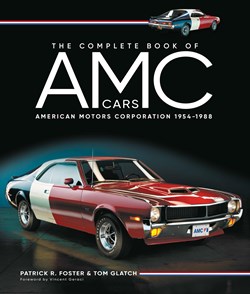
THE COMPLETE BOOK OF AMC CARS, gifting for the car guy on your list
THE COMPLETE BOOK OF AMC CARS: American Motors Corporation 1954-1988
TOM GLATCH & PATRICK R. FOSTER (foreword by Vincent Geraci)
Motorbooks International (non-affiliate Amazon link)
$50.00 hardcover, available now
Rating: 5* of five
The Publisher Says: The Complete Book of AMC Cars is a thorough reference covering all of the production cars offered by American Motors Corporation from its founding in 1954 to its demise in 1988.
Get an inside look at the American automaker that rose from the decline of a once-thriving independent auto industry to put up a valiant fight against Detroit’s Big Three automakers.
In The Complete Book of AMC Cars: American Motors Corporation 1954-1988, authors Patrick Foster and Tom Glatch provide a thorough and fully illustrated review of all the production cars offered by AMC from its founding in 1954 to its demise in 1988, including:
Born from the ashes of Hudson and Nash, AMC represented a last attempt at survival for an independent automobile company. Thanks to the capable leadership of CEO George Romney, the company not only survived but thrived, riding on the success of the firm’s small, economical cars like the Rambler. As the market began to shift more toward performance and luxury cars in the 1960s, AMC found itself challenged to compete with the output from Ford, Chrysler, and General Motors.
The fuel crisis of the 1970s positioned AMC’s smaller cars to refill corporate coffers. The firm’s purchase of the Jeep brand also generated profits, but ultimately it was too little, too late. Even a partnership with French automaker Renault and the introduction of the all-wheel-drive Eagle couldn’t save AMC. In 1987, Chrysler Corporation purchased AMC and the story of the last independent automaker came to an end.
Foster and Glatch’s engaging book covers all of the AMC models, as well as racing exploits, from its inception to its ultimate demise. Whether you are an AMC enthusiast or are simply intrigued by cars and the stories behind them, this volume is a must-have for your bookshelf.
I RECEIVED A DRC FROM THE PUBLISHER VIA EDELWEISS+. THANK YOU.
My Review: The first brand-new car I ever bought for myself was a 1977 Gremlin.
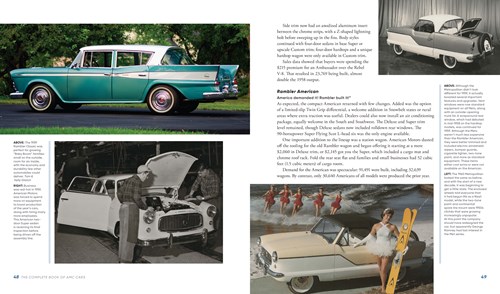
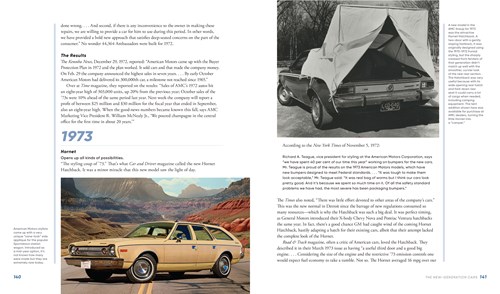
Yuk it up. I'll wait. It was small outside and big inside because it was the front two-thirds of the family sedan, the Hornet, with a teeny little shelf of a seat in back...and a big cargo area. It was fine for one person who took the occasional passenger, which after years of wagging huge loads of kids in my 1968 Bonneville felt *marvelous*. So, of course, being a typical male in at least a few regards, I developed a slightly proprietorial interest in the history of the idea of AMC. I expect there are a few car guys scattered among my acquaintance, so here's a handsomely designed, factually informative resource and pleasure-read for them.
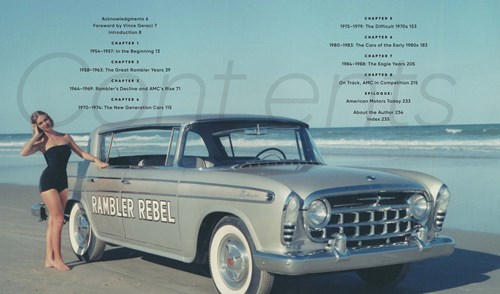
The table of contents, as always, starts us as we are meant to go on:

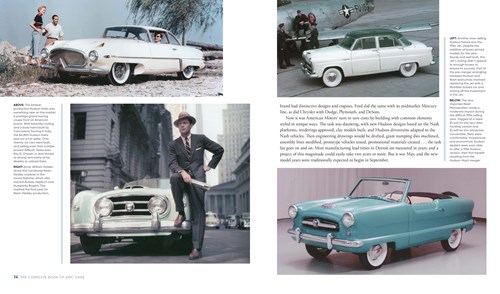
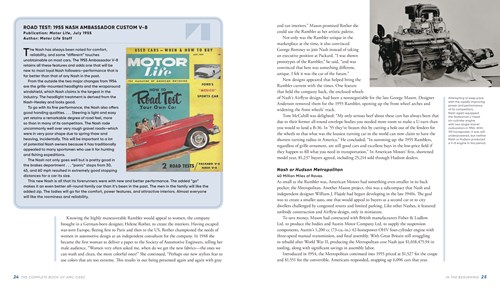
The remaining sample spreads will tell the giver little enough; but if he's said the words "Nash" or "Hornet" in your hearing, and likes looking at Collectible Automobile magazine, this will not be a high-risk gift.

Organized chronologically, this is an overview of an era-defining also-ran in the car market, that I'll wager a lot of us would prefer to have back instead of mourning another industry lost to the appalling greed of the banksters.
As a gift book, it's going to delight the well-targeted recipient. As a radicalization tool, I'm guessing its dreadful story of betrayal and extinguishment might work on some more resistant male minds.
Friday, May 10, 2024
BEASTS OF A LITTLE LAND, a beautiful read to disassemble one's complacency...its time come at last
BEASTS OF A LITTLE LAND
JUHEA KIM
Ecco (non-affiliate Bookshop.org link)
$14.49 ebook, available now
Rating: 5* of five
From BBC's World Book Club: Juhea Kim's...dazzling debut novel Beasts of a Little Land is a powerful historical novel that intertwines Korea’s fight for independence with deeply personal narratives of love, survival, and ambition. Spanning decades from the early 20th century...offers a richly detailed exploration of class struggles, colonialism, and shifting power dynamics, all centred on the tale of two friends who refuse to let one another go despite all the hardship they endure. We love this book because it’s an astonishing historical epic, dealing with love, war, the will to survive in any situation, written in beautiful, often dreamlike prose.
Harriett (the host) will be recording with Ottessa (Moshfegh) on Wednesday 2nd July (2025) so we need your questions for 26th June at the latest to be featured. Email to worldbookclub@bbc.co.uk
The Publisher Says: An epic story of love, war, and redemption set against the backdrop of the Korean independence movement, following the intertwined fates of a young girl sold to a courtesan school and the penniless son of a hunter
In 1917, deep in the snowy mountains of occupied Korea, an impoverished local hunter on the brink of starvation saves a young Japanese officer from an attacking tiger. In an instant, their fates are connected—and from this encounter unfolds a saga that spans half a century.
In the aftermath, a young girl named Jade is sold by her family to Miss Silver’s courtesan school, an act of desperation that will cement her place in the lowest social status. When she befriends an orphan boy named JungHo, who scrapes together a living begging on the streets of Seoul, they form a deep friendship. As they come of age, JungHo is swept up in the revolutionary fight for independence, and Jade becomes a sought-after performer with a new romantic prospect of noble birth. Soon Jade must decide whether she will risk everything for the one who would do the same for her.
From the perfumed chambers of a courtesan school in Pyongyang to the glamorous cafes of a modernizing Seoul and the boreal forests of Manchuria, where battles rage, Juhea Kim’s unforgettable characters forge their own destinies as they wager their nation’s. Immersive and elegant, Beasts of a Little Land unveils a world where friends become enemies, enemies become saviors, heroes are persecuted, and beasts take many shapes.
I RECEIVED A DRC FROM THE PUBLISHER VIA NETGALLEY. THANK YOU.
My Review: Starting an historical novel with a hunting scene is pretty much a statement of intent: We're heading into conflict! There's nothing about this going to be smooth and easy!
It isn't, for the characters at least. The value of self to family, to society; the value of individuation, personal or political; the value of loyalty, fidelity, honor: All strands in this novel's braid. What keeps these weighty themes from becoming burdensome to follow is the resonant writing.
It appeared to him that no matter how much he gave, he would always have more than enough. As he grew older, he even relished the struggles brought on by his sacrifices. There was a soaring awareness that illuminated his soul whenever he did the right thing, which also cost him something. This euphoria, however, was balanced by the utter terror he felt when he looked around and saw so many others to whom this consciousness was not only absent, but unknowable and abhorrent. Most people, MyungBo realized, were made of a different material than his, and it was not something that could shift, as from coldness to warmth, but an elemental and fundamental difference, like wood from metal.
This is, in my reading ear, the musing of a smart man on an immutable truth that does not ever appear the same way from person to person preceiving it; and, in his musing, retaining that awareness. I rang like a bell to this soft hammer striking me.
Current event make this read all the more trenchant. The world has never lacked people or peoples hard done by, consigned to lesser states of being than is their natural right by some standard or quality invented, "discovered," or detected without evidence of its relevance or importance. This passage in history, well, if I really need to spell it out for you I don't want to. This novel has a thriving culture that is suddenly deemed inferior, much to their mass outraged disbelief; this invented inferiority excuses a colonial oppression that has as its purpose eradicating a people's soul to be replaced with their oppressors' vision of perfect slaves.
And that, I expect you already know, is a hateful, criminal enterprise with many, many collaborators inside the edifice being created, as well as...much more terribly...many times more outside. When the day arrives that the false and ill-fitting, ramshackle and improvised, structure collapses, things brak and shatter and split and buckle in random-seeming shapes without patterns. Lives and loves and entire branches of family history jumble in lethal chaos, not every deat physical.
It might be the psychological ones that cause the most suffering.
What Juhea Kim has done for us is map that chaos onto one family of highly effective people who still can't save their lives, their loves, their lands without unthinkable suffering rippling out from the Korean nation's convulsive death-agonies, its multiplicity of death-agonies, and find in that chaos the undetected in the time of crisis pattern that supports random bits of the past just enough to provide the seeds for pearls to come, yet to come.
In 2024, this rread, beautiful for and in itself, means so much more than it did when it came out in 2021. It can speak its truth of betrayal and cruelty into a landscape more like itself; more like the one that needs to hear that truth said without rage or outrage or plangent pleading blame-shoving. I'd love for everyone I know, everyone I can reach, to at the least try this lovely flower's powerful fruit.
Please.
Tuesday, December 12, 2023
WOODY GUTHRIE: SONGS AND ART ⋅ WORDS AND WISDOM
ROBERT SANTELLI (foreword by Nora Guthrie)
Chronicle Books
$40.00 hardcover, available now
Rating: 4.5* of five
The Publisher Says: The timely, passionate, and humanely political work of America's greatest folk singer and songwriter is presented through his own words and art—curated by Woody's daughter—in this essential self-portrait, including never-before published lyrics and personal writing, and testimony from contemporary writers and musicians on his powerful relevance today.
Winner of the Deems Taylor/Virgil Thomson Book Award for Outstanding Pop Music Publication
Woody Guthrie and his passionate social politics are as crucial today as they have ever been. A powerful voice for justice, and the author of more than 3,000 songs (including "This Land is Your Land"), he was also a poet, painter, illustrator, novelist, journal keeper, and profuse letter writer. Curated by his daughter Nora and award-winning music historian Robert Santelli, this fresh, intimate, and beautifully designed book thematically reveals Woody's story through his own personal writings, lyrics, and artwork, urgently bringing his voice to life.
Featuring never-before-published lyrics to some of his greatest songs, personal diary entries, doodles, quips and jokes, and piercing insights on his politics and justice, this is an undeniable and important celebration of Woody's vibrant life's work. Created to be enjoyed by all – those interested in folk music or those interested in Woody's thoughts on Life in all its aspects, from Politics and Spirituality, to Love and Family – this book reflects Bob Dylan's thoughts on Woody Guthrie; "You can listen to his songs and learn how to live."
ONE OF THE MOST INFLUENTIAL SONGWRITERS IN AMERICAN MUSIC HISTORY: Woody Guthrie has had a profound impact on American musicians, writers, politicians (and the everyman who found solace and kinship in Guthrie's writings and political beliefs), who have been shaped by his music and activism—namely the great founding father of songwriting himself, Bob Dylan, for whom he was a mentor. Others who have named Guthrie as a major influence include Bruce Springsteen, Johnny Cash, Pete Seeger, John Mellencamp, Billy Bragg, Joe Strummer, and Jerry Garcia, just to name a few.
RARE ARCHIVAL MATERIAL: This is Woody's life told primarily in his own words, with never-before published handwritten lyrics, artwork, journals, and much more.
WORDS OF WISDOM RELEVANT TODAY: Woody Guthrie's lyrics and writings carry pointed relevance to our world today—he wrote powerfully about economic inequality, immigration reform, fascism, war, corruption from capitalism gone wild, patriotism, and environmentalism—not to mention spirituality of all kinds, love, and family.
EXCLUSIVE CONTRIBUTORS: Includes new writing about Woody and his music by Chuck D., Ani DiFranco, Douglas Brinkley, Jeff Daniels, Arlo Guthrie, and Rosanne Cash.
Perfect for:
I RECEIVED A DRC FROM THE PUBLISHER VIA EDELWEISS+. THANK YOU.
My Review: Famously a leftist, and a lifelong supporter of the dignity of the average working person, Woody Guthrie sang his beliefs into our ears. Everyone my age, regardless of your parents' politics, grew up with his music. Unless you ran away and hid, you got to know what it was he stood for, and what price he paid for standing up to a world even then being retaken by the least and the lowest after the giant reorganization of the New Deal.
Bright and beautiful.
The thrust of this book couldn't be more important than it is today: A reminder that a public personality, a musician no less, stood up against the craptastic capitalist excesses that have bedeviled the US since forever, wrote about it, never once shut up in pursuit of bringing his beliefs out into the public mind, no matter what the consequences.
A role model for today, for me, for so many younger and such few as are older than me.
We need many more Woody Guthrie-adjacent celebritries in today's world.
Absolutely great #Booksgiving gift for your sad, disheartened old uncle, your frustrated college student who follows David Hogg of the Marjorie Stoneman Douglas High School shooting, or your ownself, as you contend with the knowledge that forty percent of the world seems to be made up of unrecalcitrant jackasses.
Thursday, December 29, 2022
THE GAY IMMIGRANTS PAGE: AN ANGEL IN SODOM: Henry Gerber and the Birth of the Gay Rights Movement & WHEN THEY TELL YOU TO BE GOOD: A Memoir
WHEN THEY TELL YOU TO BE GOOD: A Memoir
PRINCE SHAKUR
Tin House
$27.95 hardcover, available now
Rating: 4.5* of five
The Publisher Says: After immigrating from Jamaica to the United States, Prince Shakur’s family is rocked by the murder of Prince’s biological father in 1995. Behind the murder is a sordid family truth, scripted in the lines of a diary by an outlawed uncle hell-bent on avenging the murder of Prince’s father. As Shakur begins to unravel his family’s secrets, he must navigate the strenuous terrain of conquering one’s inner self while confronting the steeped complexities of the Afro-diaspora.
When They Tell You to Be Good charts Prince Shakur’s political coming of age from closeted queer kid in a Jamaican family to radicalized adult traveler, writer, and anarchist in Obama and Trump’s America. Shakur journeys from France, the Philippines, South Korea, and more to discover the depths of the Black experience, and engages in deep political questions while participating in movements like Black Lives Matter and Standing Rock. By the end, Shakur reckons with his identity, his Jamaican family’s immigration to the US before his birth, and the intergenerational impacts of patriarchal and colonial violence.
A profoundly composed narrative parallel in identity to that of George M. Johnson’s All Boys Aren’t Blue and Eddie S. Glaude Jr.’s Begin Again: James Baldwin’s America and its Urgent Lessons for Our Own, Shakur compels the reader to consume the political world of young, Black, queer, and radical millennials today.
I RECEIVED A DRC FROM THE PUBLISHER VIA NETGALLEY. THANK YOU.
My Review: Introspection is part and parcel of getting old. But, and this is relatively new to my consciousness, that's because it's part and parcel of the Othering that US/capitalist society perpetuates, perpetrates even, daily. Old people are Othered, queer people are Othered, Black people, Asian people, female people: All are Othered by the depressing, repressive regime of normalizing cis-white male-straightness.
I'm sure that condition suits some people, but it gives me the shuddering horrors. Sounds more like something Cthulhu uses to torment victims than a desirable identity.
Author Shakur decides, early on, that "...if I was going to be lost and swallowed alive out in the world, then I’d at least get something for myself out of it," and he definitely makes good on that promise to himself. He is a generous soul and shares pieces of his journey to living authentically as an out, gay Jamaican-American man. He sees through structures at twenty-seven that took me another decade to understand as designed systems of repression, so of course I'm jealous as well as impressed. In about equal measure.
His mother, the one who chose his father, doesn't really know what to do about her wild, ungovernable son. Of course she sees his dad in him and, as the man was murdered for being his own resistant, wild self, she's got to be scared witless for her baby boy. His gayness seems to her an unnecessary provocation of the people who already hate her son for being. Being Black, being Jamaican, just (when you boil away the froth) being is his unatonable sin, his unwittingly committed crime.
The issues between mother and son don't stop; they are my own favorite moments in the book. After all, I'm old, and I'm thinking about the awful patterns of my own family that I've repeated ad infinitum. Reckoning with family damage will always command my attention. But Author Shakur, decades behind my age and out front of my life experience, is going through his travails for hisownself. That meant I got more of his politics than I, ideally, would've had. Not that I disagree with him! Just that I can already see where this truck is headed and am, therefore, not confident he'll get off voluntarily.
I realized that taking our history seriously and the fact that we are a part of shaping it is important. If we don’t engage with and protect our history, it will be mutilated or erased.
Very true, Author Shakur; but your mother's "don't be gay when you're here" is, in spite of being the antithesis of this truthful moment, excellent survival advice. While the two aren't from the same passage in the book, both represent the passage of Author Prince Shakur from angry kid to dangerously committed-to-action young adult.
What makes this first-ever book from Editor Hanif Abdurraqib less than a five-star read for me is the very thing that makes it a pleasure to read: The digressive and conversational writing of a talented young man. A bit of pruning of dangling participants, mentioned once and never again; a few smoothings of filler description when talking about places he's been to set a scene for us; minor, and understandable lapses from a tyro team. (Authors aren't always the most helpful editors...they already know where their fellow creator is headed, where we-the-readers don't always.)
I'll make a prediction: We will, if we are lucky, hear more from Author Prince Shakur. And it will get better and better. When it starts out this good, that's a wonderful future to look for.
++++++++++++++++++++++++++++++++++++++++++++++++++++++++++++++++
AN ANGEL IN SODOM: Henry Gerber and the Birth of the Gay Rights Movement
JIM ELLEDGE
Chicago Review Press
$30.00 hardcover, available now
Rating: 4.5* of five
The Publisher Says: Henry Gerber was the father of American gay liberation.
Born in 1892 in Germany, Henry Gerber was expelled from school as a boy and lost several jobs as a young man because of his homosexual activities. He emigrated to the United States and enlisted in the army for employment. After his release, he explored Chicago’s gay subculture: cruising Bughouse Square, getting arrested for “disorderly conduct,” and falling in love. He was institutionalized for being gay, branded an “enemy alien” at the end of World War I, and given a choice: to rejoin the army or be imprisoned in a federal penitentiary.
Gerber re-enlisted and was sent to Germany in 1920. In Berlin, he discovered a vibrant gay rights movement, which made him vow to advocate for the rights of gay men at home. He founded the Society for Human Rights, the first legally recognized US gay-rights organization, on December 10, 1924.
When police caught wind of it, he and two members were arrested. He lost his job, went to court three times, and went bankrupt. Released, he moved to New York, disheartened.
Later in life, he joined the DC chapter of the Mattachine Society, a gay-rights advocacy group founded by Harry Hay who had heard of Gerber’s group, leading him to found Mattachine.
An Angel in Sodom is the first and long overdue biography of the founder of the first US gay rights organization.
I RECEIVED A DRC FROM THE PUBLISHER VIA EDELWEISS+. THANK YOU.
My Review: A lifelong member of one or another sexual minority, I'm here to tell you that I've never once heard of Henry Gerber. Magnus Hirschfeld, the German sexologist and early campaigner for gay equality, I'm familiar with, I've even seen movies about him; Henry Gerber is terra incognita. And he lived in my own country!
This is why visibility matters, laddies and gentlewomen. This is why we need Jim Elledge and Hugh Ryan and Peter Staley and thousands of others who were there when things changed, whose voices are lifting the stories "They" would prefer to forget exist and are taking every action to be sure do not reach any wider an audience than "They" can prevent.
The publisher's synopsis above does a good recap of the outlines of the story being told here. I can add to it a few ideas I came away from the read sure I'd felt because I read Gerber's story: Some of us are born cranky and contrarian, prickly and often unpleasant to interact with. That was Josef Dettlef, as he was when he came to Chicago in 1913. He never changed...very few of us do.
The Germany he grew up in, not a privileged childhood by any means but not starving either, had a nascent gay-rights movement (follow the Hirschfeld link above) and was flirting with an unthinkable thought: Transgender people should be treated as the gender they identify, not simply in accordance to the sex organs the genetic lottery assigned them. The ethos, then, in young Dettlef's life wasn't like the one he found when he emigrated to Chicago (with a younger sister in tow) to find his future in Amerika. To be sure, Dettlef wasn't about to stop having sex with other men. Like every city everywhere ever, Chicago had such people in it who were amenable (often, for a price, the most surprising people become amenable to sex outside the ordinary) to handsome young Josef's advances.
What happens next is no surprise to any twenty-first century US citizen: entrapment and arrest, a stay in a mental institution being "cured". But young Josef, in World War One America, had a skill the US Armed Forces needed...he spoke fluent German. He was offered a fresh start if he'd go forth and sin no more, while working for a forces newspaper. What a mistake, a glorious, beautiful error of judgment that exposed Henry (as he now was) to organized, science-based, and well-led gay rights groups. A model, then, for Henry's future plans in Chicago where he returned in 1923.
I will say that, knowing what is to come, I felt desperately sad as Henry's legally constituted Society for Human Rights met its inevitable end at the hands of our very own Federal Government. Such a woke organization, what? Henry's energies being vast, he continued to work for the betterment of QUILTBAG people everywhere through multiple channels, including encouraging Robert Scully to finish A SCARLET PANSY, and during times when the risks were mortal. (One of his organizations, "Contacts," was one my own gay uncle belonged to in the 1930s!) It was part of Henry Gerber's life-long quest to make himself normal...not by changing himself, but by changing society.
What made this book so delightful to read was an accident of history. Henry Gerber would've faded into dust by now, dying as he did in 1972 before the American Psychiatric Association struck homosexuality off its list of mental disorders, but for a lovely surprise. His friend Manuel boyFrank started, and maintained, a correspondence with Henry Gerber that ranged over the rest of each of their lives. Since he kept all Henry's letters, we have the words of the man himself to tell us of his efforts, his feelings about them, and his life-long loneliness. (Cranky, spiky people often end up alone.)
That accident has delivered the twenty-first century a trove of real-life, real-time even, materials that aren't mediated in the way of most historical figures' life stories. There is, and make no mistake it is in this book!, a paper trail of some breadth behind Henry Gerber. It alone would give us none of the richness and texture of Author Jim Elledge's book. While that is greatly to the credit of the story-teller's art, it also tends to lead him into speculative reconstructions of things not necessarily on the source material's pages. This isn't a crime, however, and while I myownself would prefer not to have that much of it, the picture of Henry Gerber's life is deep and beautifully colored. It acts as a strong base and as a wide frame around gay life a century ago, when we weren't supposed to be here among you at all.
Thursday, July 14, 2022
THE DRAPER TOUCH: The High Life and High Style of Dorothy Draper, beautiful book and wonderful story of a groundbreaking lady
THE DRAPER TOUCH: The High Life and High Style of Dorothy Draper
CARLETON VARNEY
Shannongrove Press (non-affiliate Amazon link)
$100.00 hardcover, available now
Vale Carleton Varney. Little did I know, he died the day my review appeared.
Rating: 4* of five
The Publisher Says: A must have for those fascinated with the history of the interior design business as well as the history of New York City, where Draper lived and designed some of her most famous projects such as the Carlyle Hotel–Features personal and archival photographs by fashion and society photographers Edward Steichen, Cecil Beaton and André Kertész whose images were published in the 1920s in Vogue magazine–Insightful texts are based on interviews with Draper's family, former staff of the company and the author's personal memories of Dorothy Draper who was referred to as the 'Duchess of Decorating'–Extensive appendices that include never-before-seen Draper documents
Designer and interior decorator Dorothy Draper's color-filled life story is one of high society, money, gossip, and throughout it all, reinvention. Carleton Varney has owned and directed Dorothy Draper & Company, Inc., for almost 60 years. He worked with Mrs. Draper at the end of her illustrious career, and wrote the only biography of her life, The Draper Touch: The High Life and High Style of Dorothy Draper, in 1988. In the book, Varney sets the scene and defines the milieu that Draper was born into in 1889 and from which she escaped to become one of America's leaders in design—a true visionary entrepreneur.
Thirty-three years later, Shannongrove Press is releasing this deluxe edition of The Draper Touch. With a new foreword by Varney, newly found photographs, recently discovered historical documents from a private collection, and archival ephemera from Draper's family, this beautiful tome reveals Draper's fascinating journey and the real stories behind her ground-breaking work.
I RECEIVED A DRC FROM THE PUBLISHER VIA NETGALLEY. THANK YOU.
My Review: Carleton Varney's name is now more recognizable than Mrs. Draper's is. At an earlier time, Mrs. Draper was IT in the world of fashionable design.
What mostly matters in looking at this book isn't familiarity with Mrs. Draper but an openness to learning about the essential skills of design and, frankly, all of life: Decide what you want and go get it. So simple! Except when it comes to doing it. Mrs. Draper was born with every material advantage a person could have. Her doom, in the ancient Celtic sense, was to be a frivolous ornament to a man's life. That might be what Society had in mind, but Mrs. Draper begged to differ, and when circumstances forced her hand she strode forward (a very, very tall person for any era, over six feet!) to meet the world on her own terms.
The design of this book is, unsurprisingly, the reason it exists. It's lush and luxurious. Dorothy Draper lived in a time before color photography was common...she died in 1969 at almost 80...so most of what we see isn't twenty-first century Technicolor Architectural Digest stuff that we're so accustomed to. But to counterbalance that, look at that list of famous early-twentieth-century photographers! These are beautiful images...though there are not a lot of room portraits, so get that out of your expectations early. Instead we have something more intimate, more revealing than the lady's public aesthetic: Portraits, snapshots, items that truly reflect Mrs. Draper herself, not only her work but her world.
You might well have read something of Carleton Varney's work before, being as he's a columnist and an author of long standing. His style is breezily companionable and approachable. He doesn't pull his focus to show Mrs. Draper, or her clients, only in soft lights...but he soft-pedals that drama that no doubt occurred all too often, without ever ignoring it. Big personalities make big enemies, after all, so pretending she was universally loved...well. It's not like Author Varney isn't offering a bouquet of vintage cabbage roses and a box of pâtisserie from Fauchon, he simply does so without dishonest concealment.
I saw this book and was instantly transported to my past. Mama was a Draper devotee, and I read her books...Decorating is Fun! and Entertaining is Fun!, now republished by Shannongrove (non-affiliate Amazon links)...when a teenaged faggot. How much they influenced my mother was very clear, I only had to look around our house to see the myriad Draper touches. I never had a white wall in my home! Although there was entirely too much pink for my taste, thanks to Draper...a color I still abominate.
This read was a delight, a way to re-experience pleasant formative memories, and a very informative look at the life of a rare woman of business, boss of many men, in an era when they were uncommon entities indeed.
Thursday, January 14, 2021
THREE QUILTBAG HISTORIES: Shuggie Bain, When Brooklyn Was Queer, A Very English Scandal
WHEN BROOKLYN WAS QUEER
HUGH RYAN
St. Martin's Press
$11.99 ebook editions, available now
Rating: 5* of five
The Publisher Says: The groundbreaking, never-before-told story of Brooklyn’s vibrant and forgotten queer history, from the mid-1850s up to the present day.
When Brooklyn Was Queer is a groundbreaking exploration of the LGBT history of Brooklyn, from the early days of Walt Whitman in the 1850s up through the women who worked at the Brooklyn Navy Yard during World War II, and beyond. No other book, movie, or exhibition has ever told this sweeping story. Not only has Brooklyn always lived in the shadow of queer Manhattan neighborhoods like Greenwich Village and Harlem, but there has also been a systematic erasure of its queer history—a great forgetting.
Ryan is here to unearth that history for the first time, and show how the formation of Brooklyn is inextricably linked to the stories of the incredible people who created the Brooklyn we know today. Folks like Ella Wesner and Florence Hines, the most famous drag kings of the late-1800s; E. Trondle, a transgender man whose arrest in Brooklyn captured headlines for weeks in 1913; Hamilton Easter Field, whose art commune in Brooklyn Heights nurtured Hart Crane and John Dos Passos; Mabel Hampton, a black lesbian who worked as a dancer at Coney Island in the 1920s; Gustave Beekman, the Brooklyn brothel owner at the center of a WWII gay Nazi spy scandal; and Josiah Marvel, a curator at the Brooklyn Museum who helped create a first-of-its-kind treatment program for gay men arrested for public sex in the 1950s. Through their stories, WBWQ brings Brooklyn’s queer past to life.
I RECEIVED AN ARC OF THIS BOOK FROM ST. MARTIN'S PRESS. THANK YOU.
My Review: One of my very favorite possessions is this hardcover copy I received from my friend Katie after the Déluge of 2019 ruined my ARC. The author tells us from the start that:
I use the catchall queer...to refer to people whose sexuality or gender identity isn’t conventional for their time, which helps me avoid projecting specific modern identities (such as gay or transgender) on folks for whom those ideas wouldn’t necessarily have made a lot of sense.
That is all the explanation you need for how, and why, he wrote this history of being "other" in the US's biggest city. It's deeply researched, very well-written, and fascinating to read. Who knew Gypsy Rose Lee and Carson McCullers were close? Who had any idea that Coney Island was known as a queer neighborhood before it was known as a boardwalk and sideshow mecca?
It's enjoyable to learn about New York's most-populous borough with author Hugh Ryan.
+++++++++++++++++++++++++++++++++++++++++++++++++++++++++++++++++
SHUGGIE BAIN
DOUGLAS STUART
Grove Press
$17.00 trade paper or ebook editions, available now
Rating: 5* of five
The Publisher Says: Shuggie Bain is the unforgettable story of young Hugh "Shuggie" Bain, a sweet and lonely boy who spends his 1980s childhood in run-down public housing in Glasgow, Scotland. Thatcher's policies have put husbands and sons out of work, and the city's notorious drugs epidemic is waiting in the wings. Shuggie's mother Agnes walks a wayward path: she is Shuggie's guiding light but a burden for him and his siblings.
She dreams of a house with its own front door while she flicks through the pages of the Freemans catalogue, ordering a little happiness on credit, anything to brighten up her grey life. Married to a philandering taxi-driver husband, Agnes keeps her pride by looking good—her beehive, make-up, and pearly-white false teeth offer a glamourous image of a Glaswegian Elizabeth Taylor. But under the surface, Agnes finds increasing solace in drink, and she drains away the lion's share of each week's benefits—all the family has to live on—on cans of extra-strong lager hidden in handbags and poured into tea mugs. Agnes's older children find their own ways to get a safe distance from their mother, abandoning Shuggie to care for her as she swings between alcoholic binges and sobriety. Shuggie is meanwhile struggling to somehow become the normal boy he desperately longs to be, but everyone has realized that he is "no right," a boy with a secret that all but him can see. Agnes is supportive of her son, but her addiction has the power to eclipse everyone close to her—even her beloved Shuggie.
A heartbreaking story of addiction, sexuality, and love, Shuggie Bain is an epic portrayal of a working-class family that is rarely seen in fiction. Recalling the work of Edouard Louis, Alan Hollinghurst, Frank McCourt, and Hanya Yanagihara, it is a blistering debut by a brilliant novelist who has a powerful and important story to tell.
I CHECKED THIS BOOK OUT FROM MY LOCAL LIBRARY VIA OVERDRIVE. USE THE LIBRARY, FOLKS! THEY NEED THE PATRONAGE.
My Review: If you don't know already, the 2020 Booker Prize was presented to Author Stuart for this fictionalized account of growing up gay in a deeply dysfunctional, working class family. His story is not unique, though his voice is; he is a survivor of times and tides most of us who read novels are apart from, unacquainted with. A taste for grit lit, an ear for the music of Scottish voices, and a love for searingly honest, uncompromising, and unflinching life-fictions will be sated and elated by this read.
A few of the more beautiful lines from Shuggie's point of view as a teen:
He found his long, thick moustache and sat absent-mindedly stroking it, like a favourite pet. Under it his spare chin wobbled.
–and–
The morning light was the colour of too-milky tea. It snuck into the bedsit like a sly ghost, crossing the carpet and inching slowly up his bare legs.The morning light was the colour of too-milky tea. It snuck into the bedsit like a sly ghost, crossing the carpet and inching slowly up his bare legs.
+++++++++++++++++++++++++++++++++++++++++++++++++++++++++++++++++
A VERY ENGLISH SCANDAL: Sex, Lies and a Murder Plot at the Heart of the Establishment
JOHN PRESTON
Penguin Books
$16.95 trade paper, available now
Rating: 4* of five
The Publisher Says: The shocking true story of the first British politician to stand trial for murder
Behind oak-panelled doors in the House of Commons, men with cut-glass accents and gold signet rings are conspiring to murder. It's the late 1960s and homosexuality has only just been legalised, and Jeremy Thorpe, the leader of the Liberal party, has a secret he's desperate to hide. As long as Norman Scott, his beautiful, unstable lover is around, Thorpe's brilliant career is at risk. With the help of his fellow politicians, Thorpe schemes, deceives, embezzles—until he can see only one way to silence Scott for good.
The trial of Jeremy Thorpe changed our society forever: it was the moment the British public discovered the truth about its political class. Illuminating the darkest secrets of the Establishment, the Thorpe affair revealed such breath-taking deceit and corruption in an entire section of British society that, at the time, hardly anyone dared believe it could be true.
A Very English Scandal is an eye-opening tale of how the powerful protect their own, and an extraordinary insight into the forces that shaped modern Britain.
I CHECKED THE EBOOK EDITION OUT FROM MY LOCAL LIBRARY. USE THE LIBRARY, FOLKS, THEY NEED US!
My Review: The Emmy-winning TV series available on Amazon is an ideal adaptation of the story told in this book.
The morality play that was Jeremy Thorpe's life is hard to misunderstand: Bisexual in a time when any taint of same-sex love was fatal to a career in any walk of public life, Thorpe resorted to attempted murder of his younger, unstable ex-lover when he reached power in Parliament. Like any good scandal, this one only *starts* with the title event; as proceedings widen their cast of involved characters, many renowned British figures of the era get involved and implicated...men whose own sexual misdeeds far, far exceeded Thorpe's consensual buggery. Ironically, Thorpe's attempt to forestall scandal is what brought him down (shades of Nixon and Trump!), as he was acquitted of the charge of attempted murder but was never again any force in British politics.
A thumping good read, a slice of history that we cannot seem to keep from replaying, and a story to make one grateful the world has changed as much as it has.
Subscribe to:
Posts (Atom)