Showing posts with label corrupt politics. Show all posts

Monday, September 14, 2026

AMERICAN CAESAR: How Theocrats and Tech Lords Are Turning America into a Monarchy, sobering and timely


AMERICAN CAESAR: How Theocrats and Tech Lords Are Turning America into a Monarchy
BRADLEY B. ONISHI

St. Martin's Essentials (non-affiliate Bookshop.org link)
$14.99 ebook, available now

Rating: 4* of five

The Publisher Says: A chilling and urgently needed exposé on the forces pushing American politics and religion toward a post-constitutional autocracy

From Silicon Valley boardrooms to rural pulpits, from Catholic monasteries to Beltway think tanks and Project 2025, a convergence is underway. Reactionary Catholics dream of a new Christendom. Protestant pastors invoke divine right over democratic rule. Tech billionaires, led by the likes of Peter Thiel and Elon Musk, argue that freedom and democracy are incompatible. Their solution? A singular ruler to bring “order” out of what they see as liberal chaos.

With a theologian’s sensibility, a journalist’s touch, and a historian’s eye for how movements evolve and adapt, Dr. Bradley B. Onishi traces the strange alliance between spiritual warfare and Silicon Valley libertarianism. At the center of it all is the desire for an unbound executive—one man, beyond checks, beyond balance, beyond democracy. This isn’t nostalgia for the 1950s. It’s an organized attempt to abandon the American experiment altogether. A former insider turned academic expert, Onishi brings unmatched depth to this investigation—tracing his own path from evangelical pastor to co-host of Straight White American Jesus, the nation’s leading religion and politics podcast.

As the 2024 election fades into history and a new political order takes shape, American Caesar is not just a warning. It’s a map of how we got here—and a call to act before the Republic as we know it becomes just another chapter in a forgotten history book.

I RECEIVED A DRC FROM THE PUBLISHER VIA NETGALLEY. THANK YOU.

My Review
: I'm highly suspicious of the notion that "order" is a Good Thing because who decides this for other people is generally who wants to control those other people's lives in close detail. Those kinds of people are almost always puritans of one or another sort, who believe "They" should not be thinking those thoughts/doing those things (usually, though not always, sexual) because *eeewww*.

Author Onishi adds in the tech industry's "thinkers" to the usual suspects but stops short of using the slurs I myownself hurl at them. Author Onishi is tendentious as hell, shouting and waving his arms at the public, determinedly pointing the fingers of both hands at sometimes strained parallels with a past distant enough to make comparisons very very broad. Human nature does not change from what I can see; the same playbooks are still effective because our psychology is much the same.

"Much the same" does not mean we're always going to succumb to the same ruses. Look at the demonization of immigrants that's largely limited to haters and shouters, who are always in every era a minority; how many more people did what Minneapolis did and showed up to disrupt ICEstapo raids? California's honking warners of imminent danger are not getting hate outside the small bubble of the haters and screamers or there would be giant crowds of people helping ICE instead of huge shortages of recruits.

I'm not trying to put you off the read, it says what I think and explains what I fear; it brings the receipts for its bases of argument; it's going a bit further into the "it's inevitable, prepare to suffer" direction than I suspect is fully supported by developments. I think its tone is alarmist in a time when alarm is not only justified, but required; however presenting the grim facts ought to serve, not presenting deterministic conclusions. Those tend to dishearten the ordinary person, not rile them into the resistance and non-compliance we so urgently need to support and spread as a mindset.

Flawed by an overly emotional tone or not, this book can and should be part of your pre-election reading.

Wednesday, April 29, 2026

BOOMTOWN: The True Story of the Wickedest Town in Texas, latest social-history story from Pappalardo's searching eye


BOOMTOWN: The True Story of the Wickedest Town in Texas
JOE PAPPALARDO

St. Martin's Press (non-affiliate Bookshop.org link)
$15.99 ebook, available now

Rating: 4* of five

The Publisher Says: The true story of the corrupt and violent town of Borger, Texas in 1927--and the legendary Texas Ranger tasked with taming it.

Texas, 1927.

Just a year after the town of Borger, Texas was founded, the press called it “the wickedest in the state" for good reason. The town, sprung into existence overnight to support the oilfields, had become a lawless haven for bootleggers, pimps and gamblers, run by a crooked city hall.

That environment attracts some of the most unsavory characters in prohibition America, including a gang of murderous bank robbers who head into Borger to spend their money on booze, gambling and prostitutes. In the span of weeks, the gang kills three law enforcement officers, bringing the worst heat legendary Texas Ranger Captain Frank Hamer, who led the 1934 posse that tracked down and killed criminals Bonnie Parker and Clyde Barrow. His arrival threatens to break even this hardest boomtown in America--if it doesn't kill him first.

What follows is one of the most thrilling and violent untold stories from the era of gangsters, lawmen and vice. Author Joe Pappalardo brings to life a town previously lost in the haze of history.

I RECEIVED A DRC FROM THE PUBLISHER VIA NETGALLEY. THANK YOU.

My Review
: Immersing myself into the chaotic cesspool of greed, interlocking scams, interdependent grifters and graft-grabbers, and general chancers that made up (apparently) the entire population of Borger, Texas, in its heyday was exhausting.

I get the impression it was pretty exhausting for the folks who were busily grabbing everything they wanted, as well as the OTHER folks trying to catch them in at least one explicitly illegal act, as well. I am completely convinced not one of them made old bones. Murdered or just worn out these were some intense alive people.

I wasn't so much involved in the read as I was sucked along in the story's slipstream, wondering who the hell this woman was or why that lawman's name rang a bell...turns out two chapters back he was doin' the nasty with another guy's wife...until nothing made a whole lot of linear sense.

Normally I'm a stickler for linear sense in a history story. This one, not so much. It's a social history for one thing. It's footnoted to a fare-thee-well for another. Y'all killjoys can do a timeline by following those, if it's that important to you. I got a far more interesting ride from sitting in my seat and letting Author Pappalardo direct my attention where he wanted me to look than I would've in a more traditionally structured narrative.

I can't think of a much more timely topic to read about than a bunch of greedy sociopaths in charge of an ugly little burg with too much money and too little to spend it on. It was as edifying in the 1920s as it is now (not at all, in other words) and as instructive: Do NOT let greedy people make their own rules. It does not end well for anyone, and only a few ever get the misery they've so richly earned.

Friday, August 15, 2025

THE GODS OF NEW YORK: Egotists, Idealists, Opportunists, and the Birth of the Modern City, 1986-1990, wasn't that a time?


THE GODS OF NEW YORK: Egotists, Idealists, Opportunists, and the Birth of the Modern City, 1986-1990
JONATHAN MAHLER

Random House (non-affiliate Bookshop.org link)
$13.99 ebook, available now

A New York Times 100 Notable Books of 2025 selection

Rating: ?5*?1*?

The Publisher Says: A sweeping chronicle of four years in 1980s New York, a crucible that would transform the city and leave it more divided than ever—a rollicking, real-life Bonfire of the Vanities featuring larger-than-life personalities of Donald Trump, Spike Lee, Ed Koch, Al Sharpton, Rudy Giuliani, and countless others

New York City entered 1986 as a city reborn, with record profits on Wall Street sending waves of money splashing across Manhattan and bringing a once-bankrupt, reeling city back to life.

But it also entered 1986 as a city divided. Nearly one-third of the city’s Black and Hispanic residents were living below the federal poverty line. Thousands of New Yorkers were sleeping in the streets—and in many cases addicted to drugs, dying of AIDS, or suffering from mental illness. The manufacturing jobs that had once sustained a thriving middle class had vanished. Long-simmering racial tensions threatened to boil over.

Over the next four years, a singular confluence of events—involving a cast of outsized, unforgettable characters—would widen those divisions into chasms. Ed Koch. Donald Trump. Al Sharpton. The Central Park Five. Spike Lee. Rudy Giuliani. Howard Beach. Tawana Brawley. The Preppy Murder. Jimmy Breslin. Do the Right Thing, Wall Street, crack, the AIDS epidemic, and, of course, ready to pour gasoline on every fire—the tabloids. In The Gods of New York, Jonathan Mahler tells the story of these convulsive, defining years.

The Gods of New York is an exuberant, kaleidoscopic, and deeply immersive portrait of a city in transformation, one whose long-held identity was suddenly up for Could it be both the great working-class city, lifting up immigrants from around the world and the money-soaked capital of global finance? Could it retain a civic culture—a common idea of what it meant to be a New Yorker—when the rich were building a city of their own and vast swaths of its citizens were losing faith in the very systems intended to protect them? New York City was one thing at the dawn of 1986; it would be something very different as 1989 came to a close. This book is the story of how that happened.

I RECEIVED A DRC FROM THE PUBLISHER VIA NETGALLEY. THANK YOU.

My Review
: That was the Manhattan I fell in love with. Not the one where St. Vincent's is a yuppie hutch. I watched the enshittification happen then; I was apparently ineffective in resisting it; now it's the entire country it's happening to, and I still feel ineffective.

Still slugging, though.

Michael Stewart, he of The Man Nobody Killed, kicks us off on our journey through the world that grew Felonious Yam into a cultural icon (mostly spite-driven because we all laughed at him then). After Ed Koch's second term ended, Giuliani became mayor, and shit went downhill fast.

If you know, you know.

The times were a-changin' and the seeds of the political hellscape of today were there and scaring some of us. I still feel bad we didn't stop it. Reading this year-by-year, carefully non-partisan reminder of my generation's abject failures on stages large and small did not fill me with ebullient glee. Fauci's horrific inaction during the AIDS crisis, lack of empathy and flexibility, reminded me of how loud the haters got when he was doing a much better job during COVID. If they'd been around for the ACT UP years....

This isn't history to me, the way it will be to all y'all who didn't live it; it's my past retold. I'm glad I read it. I got closure-sobs for things I'd forgotten I'd forgotten. It's not fun to live in interesting times...but who ever does not? The way the world works is upheaval and change and rage and hate simmer, then boil, then simmer...eternal cycles of it.

I'm so sorry we did not do better when there was a chance to stop the scum from rising above their capacity to understand basic morality. Mea culpa.

Thursday, July 3, 2025

FAKE POLITICS: How Corporate and Government Groups Create and Maintain a Monopoly on Truth, depressing in 2019...grim beyond words in 2025


FAKE POLITICS: How Corporate and Government Groups Create and Maintain a Monopoly on Truth
JASON BISNOFF

Skyhorse Publishing (non-affiliate Bookshop.org link)
$24.95 hardcover; backordered, but used copies are available

Rating: 4* of five

The Publisher Says: In “grassroots” campaigns, the grass isn’t always green—or natural.

In today’s chaotic world, where the multiplication of information sources creates competing narratives, credibility is the key to winning the war of ideas. This is the reason why governments and corporations resort to astroturfing—creation of ostensibly grassroots movements set up to advance political agendas and commercial campaigns. The democratization of information and polarization of politics offer a perfect storm.

Fake Politics tells the stories of how this practice has transformed political activism into a veiled lobbying effort by the rich and the powerful. Through a series of vignettes involving the tea party, oil industry, big tobacco, big data, and news media, this book will explore the similarities and differences between various campaigns that appeared as grassroots but, in reality, were lobbying efforts fueled by governments, corporations, major industries, and religious institutions.

The process, named for the artificial grass fields at football stadiums and high schools across the country, became so prevalent in the last two decades that it now sits at a tipping point. In the era of “fake news” and “alternative facts,” with the truth well on its way to becoming indistinguishable from fabrication, what can the past of astroturfing tell us about the future of grassroots activism?

I RECEIVED A DRC FROM THE PUBLISHER VIA EDELWEISS+. THANK YOU.

My Review
: More important to read now than when it came out. I'm seeing the direst predictions made a generation ago about the effect of media "consolidation" not only coming true, but feeling like a relief from the "post-truth" landscape we're living in.

In writing my review I searched for "reviews" using the full book title. Literally no review not on a book sales site, and none of those in any way informative, came up. Searching for Author Bisnoff, I found nothing new by him except in something called "The Putnam Voice", and in no way does that person's bio suggest he's the author of this book. Similarly a LinkedIn profile of either the author or someone with his unusual name contain any reference no matter how tangential of this book's authorship.

This is very interesting, don't you think? A book written about the perversion of politics and the political process by gigantic piles of money controlled by people who like the status quo just fine, if they can't have a fascist dystopia, just...vanishes? You can always buy a used one.

You should. Footnoted to a fare-thee-well, Author Bisnoff, during Trump v1, details how "astroturfing" works, why it works, and who benefits from its use; all extremely relevant in the media landscape we possess in 2025.

I'm sensing an applecart that might not be wise, for the author, for me to upset. I will say that reading this book in 2025 is even more upsetting than it was in 2019. Then it was so deeply traumatic I couldn't bring myself to write a review.

I truly wish I had. Now, in 2025, the moral high ground I might've held is gone. I hope you'll seek out a print copy of this book and absorb its very sadly relevant message.

Wednesday, June 4, 2025

SEDITION: How America's Constitutional Order Emerged from Violent Crisis, one of the most urgent reads of 2025


SEDITION: How America's Constitutional Order Emerged from Violent Crisis
MARCUS ALEXANDER GADSON

NYU Press (non-affiliate Bookshop.org link)
$32.00 ebook, available now

Rating: 4.5* of five

The Publisher Says: How Americans have weathered constitutional crises throughout our history

Since protestors ripped through the Capitol Building in 2021, the threat of constitutional crisis has loomed over our nation. The foundational tenets of American democracy seem to be endangered, and many citizens believe this danger is unprecedented in our history. But Americans have weathered many constitutional crises, often accompanied by the same violence and chaos experienced on January 6. However, these crises occurred on the state level. In Sedition, Marcus Alexander Gadson uncovers these episodes of civil unrest and examines how state governments handled them.

Sedition takes readers through six instances of constitutional The Buckshot War, Dorr’s Rebellion, Bleeding Kansas, the Brooks-Baxter War, a successful terrorist campaign to overthrow South Carolina’s government during Reconstruction, and the Wilmington Insurrection of 1898. He chronicles these turbulent periods of violent anti-government conflict on the state level, explaining what it was like to experience coup d’états, rival governments fighting in the streets, and disputed elections that gave way to violence. As he addresses constitutional breakdown, Gadson urges Americans to pay increased attention to the risk of constitutional instability in their home states. His sweeping historical analysis provides new insights on the fight to protect democracy today.

As Americans mobilize to prevent future crises, Sedition reminds us that our constitutional order can fail, that democratic collapse is possible, and offers us advice on how to save our constitutional system.

I RECEIVED A DRC FROM THE PUBLISHER VIA EDELWEISS+. THANK YOU.

My Review
: I've turned the references in the publisher's synopsis into links. I did this so you can look into the high points of the events the author has chosen to highlight in search of a context for the public, academic, and media responses to the unfolding crisis in the US Federal government. Tellingly, each of these cases examined involved a bloody uprising by some (definitionally reactionary, as they chose armed rebellion as a response to change) element of the affected population.

I'm not going to go into the events, that's why I've given you the links, but I do want to highlight a vitally important takeaway from the book. Our system only works when we all play by the rules. When any group decides the rules set out in a constitution just will not do, and determine the effort to change that constitution is better expended in imposing new rules by force, bloodshed must follow. Otherwise the path to anarchy is paved.

This is not theoretical. These are not hypothetical case studies. This is US history, researched by a professor of Law at an accredited (christian) university. His entire text, including an excellent endnotes section, is under three hundred pages. Wear your biblio-track shoes. Have coffee before reading, I had a half-star off for my inability to read and absorb it without taking copious notes. But listen, please to a voice that should be coming from inside the coup-executers' house. He brings facts to the table that demonstrate the danger, and the impracticality, of the current crisis actors' intended result.

It is too important and too imminent a threat not to learn how it has been attempted...and thwarted, however kludged together and flawed the response was...before. And at what cost.

Tuesday, April 29, 2025

LAUNCHING LBJ: How a Kennedy Insider Helped Define Johnson's Presidency, history told by a fine man's daughter


LAUNCHING LBJ: How a Kennedy Insider Helped Define Johnson's Presidency
HELEN O'DONNELL

Skyhorse (non-affiliate Amazon link)
$16.99 ebook, available now

Rating: 3.5* of five

The Publisher Says: Kenneth O'Donnell was JFK's Chief of Staff, among the group known as Kennedy's "Irish Mafia." O'Donnell was with President Kennedy through his entire time in office... and he was on Air Force One in Dallas on November 22, 1963, at Jacqueline Kennedy's side, as Lyndon Johnson got sworn in as the 36th President of the United States.

When John F. Kennedy was assassinated, LBJ asked Ken O'Donnell to stay on and work with him through the first nine months of his administration, to help the country transition and heal, and to help Johnson set his own agenda for his presidency. Although they were political adversaries, they developed a mutually respectful rapport, and Ken helped LBJ find his voice, starting with his work in voting rights and developing the civil rights agenda. Ken O'Donnell was a prolific diarist and note taker, and in 'Launching LBJ', his daughter Helen, a respected historian and journalist in her own right, takes her father's journals and fills in the gaps to create an unprecedented, inside look at the early days of President Lyndon Johnson's regime.

I RECEIVED A DRC FROM THE PUBLISHER VIA EDELWEISS+. THANK YOU.

My Review
: How does the country switch leaders in a crisis? It's not something we do on the regular, so each time there's much to be reinvented to meet the circumstances of the moment.

This assassination took place in my youth, and was a steady drumbeat in politics as I became aware of the entire field. The day itself I, all of three years old, was aware something REALLY BIG had happened because my mother ran into our family room, shouting "OH MY GOD! OH MY GOD!" at the TV, which was momentous in my little world because she was *not* a woman to swear or curse. Not long after that, and just as momentous in my little world, my teenaged sisters came home early, excitedly chattering to each other...a thing they never did...so it was a Day of Wonders indeed.

It was astounding how much changed that day, and how deeply felt that event was even in my household. My parents were politically to the right of Hitler, had never said a single good word about Kennedy, and my Texan mother despised LBJ, "a damn communist" to her New-Deal-hatin' self. (She was a teen, and later a new mother, in the run-up to WWII.)

I think Author O'Donnell is around my age, her parents were a bit younger than mine and she was born in about 1956 as far as I can tell. O'Donnell père died in 1977 after his first wife died of complications from alcoholism, a problem that took his life as well. So I read his book aware that the writer was approaching it as more or less a family history, a chance to know her dad better. Enviable access to primary written sources aside, her name and pedigree opened doors to people who might otherwise not have bothered to speak to an historian from outside the Kennedys' charmed circle.

LBJ would've known that feeling well. He needed O'Donnell père's insider status to get his staff-running feet under him as he focused his initial efforts on healing his traumatized country. O'Donnell, no fan of LBJ, was nonetheless an honorable sort. He helped craft LBJ's startlingly successful assumption of JFK's ambitious, previously doomed, social agenda. It was partly his planning and partly LBJ's long Senate career that taught him where the bodies were buried and who buried 'em that came together to launch one of the twentieth century's most sweeping and successful reforms of sclerotic Federal social spending agendas. I'm not inclined to uprate the book because it is less about the nuts and bolts of the effort and more about the personalities...it falls into a kind of gauzy "weren't they something special" attitude that grates on me, smacks of worshipful attitudes I don't share.

It is largely Johnson's legislative success that is being dismantled today. It was won by the blood of one not-very-honorable man and the sweat of several very honorable ones, eg Kenneth O'Donnell. We sit passively watching as the current administration and its partisan GOP lackeys destroy the greatest society we could create.

Resist.

Monday, January 20, 2025

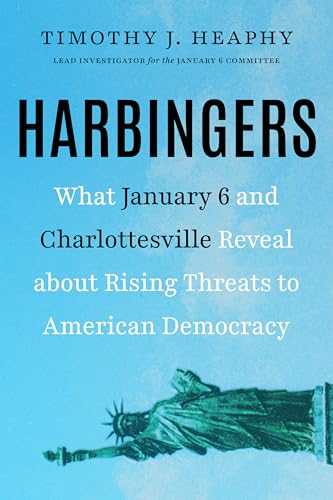
HARBINGERS: What January 6 and Charlottesville Reveal About Rising Threats to American Democracy


HARBINGERS: What January 6 and Charlottesville Reveal About Rising Threats to American Democracy
TIMOTHY J. HEAPHY

Steerforth Press (non-affiliate Amazonn link)
$9.99 ebook editions, avalable now

Rating: 4* of five

The Publisher Says: A crucial, clear-eyed assessment of what connects the 2 most influential moments of political violence in recent American history, and where we go from here
An unparalleled firsthand account from the foremost expert on American political violence, crucial for readers of Liz Cheney’s Oath and Honor, and How Democracies Die


This dramatic, revealing book offers an insider account of the planning and aftermath of the racist riot in Charlottesville on August 12, 2017, and the insurrection at the US. Capitol on January 6, 2021.

As the lead investigator into both tragic days, Tim Heaphy has an absolutely unique perspective. Readers will travel alongside Heaphy as he organized his team and structured the massive investigations they were about to take, as he interacts with politicians and members of law enforcement, interviews planners, perpetrators, and bystanders, gathers and sorts evidence, and compels and records testimony in order to create a record for today’s voters as well as future generations.

In his page-turning book, he shares what he saw and came to understand about what those events say about state of American democracy. He examines how and why they took place with the hope that understanding the contexts of these events will be a crucial and helpful step toward avoiding similar episodes of political violence in the years ahead.

I RECEIVED A DRC FROM THE PUBLISHER VIA EDELWEISS+. THANK YOU.

My Review
: The manifold failings of the astonishingly huge, well-funded, and deeply entrenched domestic surveillance industry are laid out in this book.

I was taken aback on how much there was about the surveillance state I was correct to be paranoid about, and how little it did to prevent these acts of political violence from going ahead, or even getting off the ground. This is something that gives me the gravest kind of worry for the US as a still-slightly-functional civil society.

I will not tell you this is the most deft or entertaining read of 2025. It's dry, it's pedantic, it's explanatory not exciting. This being what it needed to be to convey its burden of information...and I use the term advisedly...I won't downrate it for being its proper self. A louder, more emotionally charged voice becomes part of the clangor of 2025's soundscape. I know more now than I did before I read this book about the ways and means used by the rebel forces within the US to bring about their desired repressive, totalitarian replacement government.

Project 2025 should have scared y'all a lot more than it did. I'm guessing most of you won't read this important informative book. Whatever your reasons are, they're not excuses. Very bad things are coming. Resisting them will be a lot of work and involve significant effort.

The option is passive acceptance.

Choose wisely.

DARKMOTHERLAND, an IMAX movie played on a 1080i screen


DARKMOTHERLAND
SAMRAT UPADHYAY

Soho Press (non-affiliate Amazon link)
$14.99 Kindle edition, available now

Rating: 3.75* of five

The Publisher Says: An epic tale of love and political violence set in earthquake-ravaged Darkmotherland, a dystopian reimagining of Nepal, from the Whiting Award–winning author of Arresting God in Kathmandu

In Darkmotherland, Nepali writer Samrat Upadhyay has created a novel of infinite embrace—filled with lovers and widows, dictators and dissidents, paupers, fundamentalists, and a genderqueer power player with her eyes on the throne.

At its heart are two intertwining narratives: one of Kranti, a revolutionary’s daughter, who marries into a plutocratic dynasty and becomes ensnared in the family’s politics. And then there is the tale of Darkmotherland’s new dictator and his mistress, Rozy, who undergoes radical body changes and grows into a figure of immense power.

Darkmotherland is a romp through the vast space of a globalized universe where personal ambitions are inextricably tied to political fortunes, where individual identities are shaped by family pressures and social reins, and where the East connects to and collides with the West in brilliant and unsettling ways.

I RECEIVED A DRC FROM THE PUBLISHER VIA DEDLWEISS+. THANK YOU.

My Review
: There is a lot to be said for ambition in storytelling. This book, for the first third, was destined for enshrinement in my hall of fame; the second third for my favorites list; and by the end for my "you should read it if you love, or need, a full-immersion wide-angle view of what chaos really does." You should know going in that women have significant challenges regarding consensual sex here. The centering of a transfem character's experiences made for sharp commentary on gender roles in a repressive, fascistic regime, yet also made my hackles rise. I have trans folk in my life whose potential feelings about this book's explicitness I constantly found obtruding in my reading.

It's not to say this is a pure negative. I'm all for people writing uncomfortable takes on the world as we find it today. The fact that Rozy is a person with agency, albeit in a very twisted system, felt both natural and unhappy. Her choices were severely limited, and yet also used to prove the point that pressure can cause a person to become more powerful the same way water under pressure can become a weapon.

The fictionalized country in the story was a background for me, a setting; the events played out on its stage. I was unable to get deeper than that, despite the story's evident desire for me to do so, by the sheer size if the cast we're following. It is always a risk to expand a cast beyond a handful of people. The great trick of numbing people to the reality of suffering is to follow Stalin's epigrammatic maxim: "The death of one man is a tragedy. The death of millions is a statistic." Like teaching history, telling a story in novel form only becomes less involving when you dilute your message (especially when it's essentially the same message repeated) beyond a certain point. I'm not clear if that was an intentional choice of metacommentary on the author's and publisher's part.

This story of the chaos and upheaval that attend a violent ending suffers from this dilution. It also tries its best to invest you in its very deeply felt observations on how cruelty ultimately undermines itself as it metastasizes. As ever, the issue of what is celebration and/or normalization arises as repetition of violent language and behaviors continues to assault one's readerly experience. This fine balance between intention and reception is always deeply personal. It crossed my internal line shortly after midpoint; I was too deeply interested in the results the author intended to bring to quit, as I ordinarily would have done. That's why I got as close as I did to a full four stars.

I'm not doing a good job, I fear, of expressing how deeply enfolding a tale is told here. I'm very much a fan of stories that require me to think and deeply consider the places and times and inhabitants of the storyscape before me. I think a read that makes demands on my deeper cognitive resources is a fun read. This story does that. I'm very interested in tales of messy endings that are inevitable and inherent in the setup of the world being built. This story could be the poster child for that. I was, then, very much on the side of the author and his project of elucidation.

But because of certain choices he made, it began to feel like it was just that: a project.

I wanted to end the read as much, or more in love with it as I started our being. I'm bummed that I couldn't.

Tuesday, February 20, 2024

THE MARS HOUSE, latest from the ever-delightful Natasha Pulley


THE MARS HOUSE
NATASHA PULLEY

Bloomsbury USA
$15.99 ebook, available now

Rating: 4.8* of five

The Publisher Says: From the author of The Watchmaker of Filigree Street, a queer sci-fi novel about an Earth refugee and a Mars politician who fake marry to save their reputations—and their planet.

In the wake of environmental catastrophe, January, once a principal in London’s Royal Ballet, has become a refugee on Tharsis, the terraformed colony on Mars. In Tharsis, January’s life is dictated by his status as an Earthstronger—a person whose body is not adjusted to Mars’s lower gravity and so poses a danger to those born on, or naturalized to, Mars. January’s job choices, housing, and even transportation options are dictated by this second-class status, and now a xenophobic politician named Aubrey Gale is running on a platform that would make it all worse: Gale wants all Earthstrongers to be surgically naturalized, a process that can be anything from disabling to deadly.

When Gale chooses January for an on-the-spot press junket interview that goes horribly awry, January’s life is thrown into chaos, but Gale’s political fortunes are damaged, too. Gale proposes a solution to both their problems: a five-year made-for-the-press marriage that would secure January’s financial future without naturalization and ensure Gale’s political future. But when January accepts the offer, he discovers that Gale is not at all like they appear in the press. And worse, soon, January finds himself entangled in political and personal events well beyond his imagining. Gale has an enemy, someone willing to destroy all of Tharsis to make them pay—and January may be the only person standing in the way.

I RECEIVED A DRC FROM THE PUBLISHER VIA NETGALLEY. THANK YOU.

My Review
: This has a very "ripped-from-the-headlines" feel, like a big issues-driven Movie of the Week in the 1980s. The playfulness that the author, comme d'habitude, uses to frame her presentation of the Issues made me smile. I am particularly fond of the way she plays with the MM romance trope of a fake marriage that leads to a real relationship, in the context of a serious contemplation of the refugee crisis and the ever-increasing backlash againt gender minorities.

No one ever accused Author Pulley of lacking ambition.

Even inclusivity excludes, when it is a mandate...I am not a they, I am a he, and will resist being "they"d because of the same reasons I ask people what their not-always-obvious pronoun preference is. Like any overarching solution, it will not work for everyone...like absurd wealth disparities don't, like hypercompetition won't. And, as I expect from the author of The Kingdoms and The Secret Life of Valery K., that is the point. She invites us in to have a good, solid storytelling, then the real purpose sort of creeps up behind your chair and slaps some ropes around your wrists so you *need* to know what happens while also getting yor mind wedged open a bit.

Like the surgical "naturalization" of the Earthstrong immigrants that will artificially weaken them to make the like "real" Martians instead of merely imprisoning them in tightly binding suits...oh my goodness, the unpleasant parallels to our culture war over transness and the nature of being a "real" something. "We must PROTECT our weakest from these interlopers!" The eternal cry of the high-control fascist-leaning cultural bully. The Earthstrong immigrants have a terrible social ostracism as threats to the adapted Martians, confined to menial labor that renders their actual physical power differential a big advantage.

January, our main character, is the only character referred to by a masculine pronoun. As a former dancer, he is strong and lithe even by Earth standards. This makes him a scary monster of a beast to the adapted Martians, much less gravity having attenuated their strength and stamina. This is quite a come-down for him since he was once a principal dancer at the Royal Ballet. It does make his masculine pronoun feel simultaneously othering and fetshizing...like all perceived-stronger minorities his gender is hyperemphasized. This makes his union with Martian nativist Senator Gale, whose impromptu soundbite caused January tremendous social trouble, all the more trenchant in its commentary on the social construction of gender and the fetishization of, especially the visible, Others in a society.

Like we do with highly intentionally muscular men, heavy-breasted women whose endowments are clearly artificially augmented, and those whose skin and/or eye colors are not like the resident majority's are.

This, then, is Author Pulley at her tendentious best. The invitation to think through the role of fetishization, or simply enjoyed as the slow, rocky coming-together of two people from opposite sides of an ideological divide, is there. It is up to you which one you wish to foreground as you read the book. The interpersonal stakes are not shorted, or allowed to dominate; they are, as always in this author's œuvre, balanced carefully thus enriching each strand.

What makes the read just less than five stars for me is my rather less than enjoyment experienced by the inclusion of resurrected wooly mammoths. The entire ecological commentary is, for my money, twee and forgettable, though of course well-crafted...I just do not buy the animals' PoV bits, which thankfully are confined to footnotes. This is a facet that will delight some but did not me.

A worldbuilding tour de force, a meet-cute/fake marriage queer love story, a takedown of high-control ideology, and most of all a chance to fall in love alongside two wounded souls who had to travel from literal different planets to find their happiness.

Monday, January 29, 2024

TAKING DOWN TRUMP: 12 Rules for Prosecuting Donald Trump by Someone Who Did It Successfully


TAKING DOWN TRUMP: 12 Rules for Prosecuting Donald Trump by Someone Who Did It Successfully
TRISTAN SNELL

Melville House
$27.99 hardcover, available tomorrow

Rating: 5* of five

The Publisher Says: A former prosecutor provides an essential guide to ensuring that Donald Trump—and other oligarchs of his ilk—no longer beat the rap and face serious jail time for their crimes.

For a half-century Donald Trump has evaded justice. Now he finally faces trials for his lies, cons, and misdeeds—but many fear Trump will never face any real consequences. Can prosecutors and litigants ever hold the powerful accountable? Or is our system so broken that some people are now above the law?

In TAKING DOWN TRUMP Tristan Snell argues that Donald Trump can be defeated—and shares the secrets for how to beat him.This is the first book ever from a prosecutor who defeated Snell led the prosecution of Trump University, resulting in a game-changing $25 million settlement that was Trump’s first major legal loss and still the largest ever, getting thousands of victims their money back.

Here you’ll learn the 12 rules for how to beat Trump—and how some prosecutors and litigators are following this playbook, while others failed, can voters and activists hold prosecutors accountable? How do you persevere against all the stonewalling and counterattacks? How do you get a key figure to cooperate and cough up critical evidence?

Snell faced this problem with Trump University, but with one question, he got the evidence and broke open the case. How did he do it? Whether you’re a concerned citizen, a lawyer or prosecutor, or an activist or advocate, Snell shows how America’s systems can still work to bring even the richest and most powerful to justice, and why those systems are worth preserving and improving. Ultimately, this is a roadmap for how America can begin to escape Trump’s wilderness of fraud and fascism.
I RECEIVED A DRC FROM THE PUBLISHER VIA NETGALLEY. THANK YOU.

My Review
: I have seldom wanted to read a book more than I wanted to read this one. It is no secret that, since 2016, I have opposed 45 and his MAGAt cultists being in power, dismantling and corrupting the systems of justice...flawed as they unquestionably are...in pursuit of permanent power for their repugnant, regressive, evil system of oligarchic fascism.

What I hoped to find was a source of hope for our collective future. What I got was a roadmap for getting to the better, more just future I believe we all deserve. So this read overdelivered on my expectations.

The rules themselves are not so much the focus of the read, for me personally, anyway. I needed this read as a reminder that, in spite of triumphalist media coverage (The New York Times newsletter last week headlining what 45’s second-term agenda *is*, not would be, is my latest example), there are those in position to defeat the horrible wretch at his con-man worst, using legal, honest, above-board means to do it.

At every step, every rule, I paused to appreciate Author Snell’s clarity, concision, and fervor. No words wasted in self-congratulation. No fancy rhetorical flourishes to show off his cleverness. The author must, of necessity, throw at you a large legal vocabulary. No one can tell this story without doing that very thing. What he does is explain it as we go along: Simple, direct prose clarifications, telling what his methods were that he used to hand the rotter whose vile education scam he took down entirely his first-ever serious, consequential legal defeat. I was blissed out as I read his repeatable roadmap to defeating the entire edifice of illegality that prior prosecutors had failed to do.

Since it worked before, I am heartened when I see similar steps being taken now by other prosecutors. I cringe when I see evidence that they have fallen into the traps Author Snell points out. I pray like Hell that this book, or at least its ideas, have made it onto the radar of each and every prosecutor pursuig justice against 45 and his MAGAt followers in each and every dark, unswept corner of US democracy where we know they are.

As citizens and as readers, we should all take in these clear-eyed, aphorism-ready rules, and run with them...most especially Rule #6, Play the Long Game: Fight the Fight on Statutes of Limitations. The analysis of the largely successful strategy 45 has used to run down the clock on everything he possibly can, can be fought. Author Snell explains how.

This information should be of interest to all of us as we watch the same playbook being used right this minute. It should also be of interest to all of us who resist the status quo as abused by the very rich and very powerful to get their profits ever higher. The techniques Author Snell used are repeatable, expandable, and very usable in all our advocacy efforts.

I know most do not like to think about hard subjects, but they will be there whether one thinks about them or not. The question you can affect is not whether they are there, but how you can best resolve, or partly resolve, or contribute to resolving them. Reading TAKING DOWN TRUMP: 12 Rules for Prosecuting Donald Trump by Someone Who Did It Successfully will equip you to make a positive contribution to resolving them, not merely enduring the results of inattention and inaction.

Tuesday, December 19, 2023

INTO SIBERIA: George Kennan's Epic Journey Through the Brutal, Frozen Heart of Russia, a sort of anti-travelogue


INTO SIBERIA: George Kennan's Epic Journey Through the Brutal, Frozen Heart of Russia
GREGORY J. WALLANCE

St. Martin's Press
$30.00 hardcover, available now

Rating: 4* of five

The Publisher Says: In a book that ranks with the greatest adventure stories, Gregory Wallance’s Into Siberia is a thrilling work of history about one man’s harrowing journey and the light it shone on some of history’s most heinous human rights abuses.

In the late nineteenth century, close diplomatic relations existed between the United States and Russia. All that changed when George Kennan went to Siberia in 1885 to investigate the exile system and his eyes were opened to the brutality Russia was wielding to suppress dissent.

Over ten months Kennan traveled eight thousand miles, mostly in horse-drawn carriages, sleighs or on horseback. He endured suffocating sandstorms in the summer and blizzards in the winter. His interviews with convicts and political exiles revealed how Russia ran on the fuel of inflicted pain and fear. Prisoners in the mines were chained day and night to their wheelbarrows as punishment. Babies in exile parties froze to death in their mothers’ arms. Kennan came to call the exiles’ experience in Siberia a “perfect hell of misery.”

After returning to the United States, Kennan set out to generate public outrage over the plight of the exiles, writing the renowned Siberia and the Exile System. He then went on a nine-year lecture tour to describe the suffering of the Siberian exiles, intensifying the newly emerging diplomatic conflicts between the two countries which last to this day.

I RECEIVED A DRC FROM THE PUBLISHER VIA NETGALLEY. THANK YOU.

My Review
: Russia always seems to have vicious, cruel, authoritarian governments. George Kennan documented the horrifying repressions of the tsarist regime of Alexander III, father of the ill-fated Nicholas II. The adventurous man whose trip through Siberia Author Wallance is epitomizing first went to Siberia, governed by our then-close ally Russia, to lay a telegraph line across the country beginning in 1864 and eventually have it reach Western Europe. There was an Atlantic cable to England, but the Atlantic has these terrible, damaging things called "hurricanes" every so often, and then there's that big line of volcanoes up the middle of it that periodically erupts here and there...think Iceland's Eyjafjallajökull, 2010...so it has always made sense to have a backup.

Kennan spent a couple years doing the work, and was in love with Siberia by the end of it. The US and Russia, after a long period of close ties that peaked after we bought Alaska from them in 1867, began getting terrible reports about the political prisoners being abused in Siberian prisons. Kennan, by now a professional journalist, was widely thought to be the best possible person to investigate the situation on behalf of the US. He was vocal in his love for Siberia. He said publicly that he felt the complaints of terrible conditions were unlikely to be true...prisoners' families could join them there, after all!

Kennan and artist George Albert Frost traveled through the tsarist penal system, documenting conditions as they found them. Kennan wrote an eleven hundred-page exposé of the horrors they witnessed; Frost's drawings and photographs were included. Frost himself suffered a breakdown—what we would call today PTSD—and really was never quite the same again.

Kennan never lost his love for Siberia and its people but he became an implacable detractor of the Imperial Russian government. He had the evidence to back his outrage and disgust up. He devoted his next decade to a lecture tour enlightening audiences to the facts of what was euphemistically called "the Exile System" of political repression. When, decades later, the October Revolution brought the Bolsheviks to power, Kennan famously said that "the Russian leopard has not changed his spots."

I read this fascinating history of events I'd had only a passing awareness of in the context of Kennan's report to Woodrow Wilson about the Bolsheviks and his subsequent criticism of the Wilson Administration's pusillanimous response to them. His 1885 trip was touched on, but I now know why he was tasked by Wilson with preparing the ignored report. This book, not at all a long read, brings the full awfulness of Kennan and Frost's experiences to life. It is nothing short of gut-wrenching at times. It is extremely carefully footnoted and supplied with an admirable bibliography. I believe Author Wallance has done everything except invent time travel to bring us the best report of the facts possible. His contextualization was emotionally honest, but not of the sort that leads me to mutter, "don't try so hard."

I recommend it highly...but with the warning that delicate fleurs who don't enjoy details of physical cruelty should pass right by. I did, to be honest, feel as though these facts were rather more abundant than was strictly necessary. I had a half-star knocked off for feeling like I was being knocked in the teeth. As Frost's art exists, I wanted to see it, or some of the photos, just to see the realities behind the descriptions of the place itself, though not the abuses!

Not always an easy read, but a wonderfully immersive and interesting historical light on a country whose past binds it to the US.

THE INVENTION OF SICILY: A Mediterranean Odyssey, a title that truly says every last thing about the book within


THE INVENTION OF SICILY: A Mediterranean Odyssey
JAMIE MACKAY

Verso Books
$26.95 hardcover, available now

Rating: 4* of five

The Publisher Says: A fascinating cultural history of this most magical of islands.

Sicily has always acted as a gateway between Europe and the rest of the world. Fought over by Phoenicians and Greeks, Romans, Goths and Byzantines, Arabs and Normans, Germans, Spanish and French for thousands of years, Sicily became a unique melting pot where diverse traditions merged, producing a unique heritage and singular culture.

In this fascinating account of the island from the earliest times to the present day, author and journalist Jamie Mackay leads us through this most elusive of places. From its pivotal position in the development of Greek and Roman mythology, and the beautiful remnants of both the Arab and Norman invasions, through to the rise of the bandits and the Cosa Nostra, The Invention of Sicily charts the captivating culture and history of Sicily.

Mackay weaves together the political and social development of the island with its fascinating cultural heritage, discussing how great works including Lampedusa’s masterpiece The Leopard and its film adaptation by Visconti, and the novels of Leonardo Sciascia, among many others, have both been shaped by Sicily’s past, and continue to shape it in the present.

I RECEIVED A DRC FROM THE PUBLISHER VIA NETGALLEY. THANK YOU.

My Review
: Sicily's thousands of years of documented history can't be done justice in a shortish survey book. It can, however, do the reader who loves Italy and longs for a Sicilian vacation a very big solid by explaining a bit about why Sicily is not like the rest of Italy. There is a significant prejudice against Sicilians, and Southerners more generally, in Italy as a whole...no country is without internecine conflict...but the reasons go back a very long way.

Starting from its origins as a Greek colony, Sicily has been fought over by outsiders for millennia. Different Greek city-states, Phoenicians, Normans on Crusade taking it from Arabs...if you want to understand how Sicilian culture gave rise to the ultimate Family, the Mafia, insulated from the rest of the world, look no further than its long history of being the prize in other peoples' wars.

Italy the current nation-state did not even exist until 1860. After that Unification, the country pretty much ignored the agrarian island. Riots and rebellions, official neglect and church corruption, all led to the rise of the chaotic present in which the Cosa Nostra/Mafia/organized crime has acted as a kind of de facto government substitute. The present-day refugee crises have had a powerful impact on the island's rickety infrastructure and led Sicilians to harden their opinion that the rest of Italy is not interested in helping them cope with this problem not of their own making...again.

The book is written very ably, and has a deft touch on the topics it does cover. It does not pretend to authoritative stature as a major history. It is clear about its purpose as a survey of a long, long history of a much-put-upon place. It will give Italophiles bad wanderlust, and spark curiosity in most history buffs. Any place that has Archaic Greek, Byzantine, Golden Age Muslim, Byzantine, medieval Norman, Spanish, and Catalan ruins and buildings still in use is a place very much worth getting to know. Don't go in expecting a deep dive into any one period's history, and this book will surprise, delight, inform, and astonish you.

But seriously...no images? *tsk*

Saturday, June 11, 2022

LOVE, HATE & CLICKBAIT, fake dating in the political sphere with added gayness


LOVE, HATE & CLICKBAIT
LIZ BOWERY

MIRA Books
$15.99 trade paper, available now

Rating: 4* of five

The Publisher Says: Shake some hands. Kiss some coworkers.

Cutthroat political consultant Thom Morgan is thriving, working on the governor of California’s presidential campaign. If only he didn’t have to deal with Clay Parker, the infuriatingly smug data analyst who gets under Thom’s skin like it’s his job. In the midst of one of their heated and very public arguments, a journalist snaps a photo, but the image makes it look like they’re kissing. As if that weren’t already worst-nightmare territory, the photo goes viral—and in a bid to secure the liberal vote, the governor asks them to lean into it. Hard.

Thom knows all about damage control—he practically invented it. Ever the professional, he’ll grin and bear this challenge as he does all others. But as the loyal staffers push the boundaries of “giving the people what they want,” the animosity between them blooms into something deeper and far more dangerous: desire. Soon their fake relationship is hurtling toward something very real, which could derail the campaign and cost them both their jobs…and their hearts.

I RECEIVED A DRC FROM THE PUBLISHER VIA NETGALLEY. THANK YOU.

My Review
: Sarcastic psychopath meets delusional dork (probably on the dyspraxic spectrum), picks on him mercilessly until they fall in love after becoming a cute internet meme that helps their tin-eared sociopathic boss in her presidential campaign. Except hijinks ensue and the boys get together. Oh...the psychopathic one? He starts out using/abusing women, this is his first sexual anything with a man. So there's that, too.

It's mean-spirited a lot of the time, which I honestly count in its favor. Author Bowery obviously knows real people like this, she's way too good at both guys' pathologies not to. And the campaign staffers are just *perfect* in their utter and complete soulless indifference to things like others' feelings. It isn't like I have to spend time with them in real life so I can enjoy the terribleness of their callous uncaring ways.

Clay, the delusional dork on the dyspraxic spectrum, is the butt of many jokes and always has been, as we're made aware. I'm not advocating the treatment Clay receives as a come-on or a stay-away quality. I think a lot of socially awkward people would cringe in recognition but I don't know exactly if it would be cathartic or traumatic. It's that much of a toss-up in my mind whether the author's also laughing or making the laughing clods look even worse by not shoving her own reaction at us readers. I actually give points for that. You are left to make up your own mind. I approve of this.

Thom the psychopath, though, isn't played for ambiguity. He has this complex of symptoms, acts out, and is held up as an awful person...until he isn't. Because he's falling ever so slowly in love with a certain tall, dark, and dorky dude. Who seems to be leaning in to their fake wedding (don't ask, just go with it) and the way Thom can make his archenemies freeze to the floor with some truly sick, volcanically hot burns.

Mostly, the beginning of the story is there to set the stakes in romantic fiction. There are enough stakes to go around as these two unappealing people peel off their mannerisms to get to the man inside the ever-baggier suits of fakery. There's a guitar-and-waffles moment when it's all coming together, and they're really connecting over the ordinary stuff of life. Of course Something Happens, and their little moment is lost. I got honestly invested at that point.

The leisurely path to the real relationship is, to my surprise, through the bedroom. There's no little authorial squickiness, either, just two eager, horny men. Sex between men who won't, can't, or don't identify as gay is (as I trust y'all who've been here more than once to know) no news whatever. Been goin' on forever. But these two, in this situation? It's hard for me to figure out why Author Bowery didn't pull the veil over the events but instead she chose the direct path. Did herself proud, too. Her characters don't shy away from the physical responses that real people have, like Thom having a moment's ickiness over the aftermath of sex. It was handled right. It didn't interrupt the story's flow but channeled it closer than ever to the goal of getting these guys past their initial misconceptions about themselves, and therefore each other.

Every step of the way, as Thom felt himself feel for someone else what he's never felt for himself, he fell a little lower in my estimation. He kept being horrible! Truly terrible! And, well...that fall from a height that pride goeth (and pride goeth) before? Pride wenteth. Thom and his belovèd Clay each lost illusions. Clay gained so much self-respect and honest power from losing them! Thom, sad little naked waif huddled in the rain, won much more when he finally realized that standing up means laying down the weapons that defended your badly designed walls.

It's a romance! There's HEA in the social contract of reading them! The wonderful part of *this* HEA is getting there. How it looks? Who knows if this could happen or not...but I'm willing to say it should happen.

Wednesday, May 25, 2022

TWO NIGHTS IN LISBON, latest thriller from Pavone delivers a little too much


TWO NIGHTS IN LISBON
CHRIS PAVONE

MCD Books
$28.00 hardcover, available now

Rating: 4* of five

The Publisher Says: You think you know a person . . .

Ariel Pryce wakes up in Lisbon, alone. Her husband is gone—no warning, no note, not answering his phone. Something is wrong.

She starts with hotel security, then the police, then the American embassy, at each confronting questions she can’t fully answer: What exactly is John doing in Lisbon? Why would he drag her along on his business trip? Who would want to harm him? And why does Ariel know so little about her new—much younger—husband?

The clock is ticking. Ariel is increasingly frustrated and desperate, running out of time, and the one person in the world who can help is the one person she least wants to ask.

With sparkling prose and razor-sharp insights, bestselling author Chris Pavone delivers a stunning and sophisticated international thriller that will linger long after the surprising final page.

I RECEIVED A DRC FROM THE PUBLISHER VIA NETGALLEY. THANK YOU.

My Review
: Unreliable narrator tells unbelievable story with murky stakes attached to its outcome. And here I am giving it four stars.

Doesn't make sense, does it. Or does it....

What Author Pavone does is set the reader up for something from the get-go. Unlike many thriller writers, that "something" isn't glaringly obvious. What sets this thriller in motion is an older woman married to a handsome younger man. Who ups and disappears from their hotel room on an international trip.

Prepare the violins, right? Welllll...yes but not for her, as you'll see. Her fear at this catastrophe seems...performative...to the authorities who look at her late-middle-aged self, see the muffin she's so recently married, and all but say out loud, "well, little lady, what exactly can you expect? Men do stray...and he's been gone less than a day. Give him time to sober up and pay the, um, lady. He'll be back." But she's not having it.

Why is she not having it? It does, after all, make a grim kind of sense. Before their short marriage, she didn't know her husband well...he's a relative stranger, so why is it she's carrying on so?

Wheels within wheels, and here we are rollin' along beside Ariel...has that name, one the lady chose for herself, made its real force felt in you yet?...as the story's necessary force carries us along, stopping for some info-dumpy conversations/monologues/set pieces. It's not like there's any point where Author Pavone sticks it to us, the sad little readers wondering what the living hell possessed this hard-edged survivor to do something so stupid as this mishegas results from. And both parties are hard-edged survivors. So what's the situation underlying the story? It's a thriller! You *know* there is one.

The phrase "ripped-from-the-headlines" is a cliche to my generation of Movie of the Week veterans. It got a bad name for shoddy, indifferent storytelling. But it never needed to be that way, did it. What happens that makes the newspapers is a joyous rioting street party of story plots. Read this one and find out what the right dance partner can give.

I can't give the book all five stars because, despite the clarity of storytelling purpose that snaps into focus as the ending twists us up, there is a prolixity of speechifyin' that really grated on me. (I'm lookin' at you, Griffiths.) And the Epilogue is just a shade over the top I most wanted not to go over. But the story is a deeply, involvingly, satisfyingly real one, and I encourage y'all to read it.

Monday, May 23, 2022

HOW FASCISM WORKS: The Politics of Us and Them is just flat terrifying


HOW FASCISM WORKS: The Politics of Us and Them
JASON F. STANLEY

Random House
$17.00 paperback, available now

Rating: 5* of five

The Publisher Says: NEW YORK TIMES BOOK REVIEW EDITORS’ CHOICE • With a new preface • Fascist politics are running rampant in America today—and spreading around the world. A Yale philosopher identifies the ten pillars of fascist politics, and charts their horrifying rise and deep history.

As the child of refugees of World War II Europe and a renowned philosopher and scholar of propaganda, Jason Stanley has a deep understanding of how democratic societies can be vulnerable to fascism: Nations don’t have to be fascist to suffer from fascist politics. In fact, fascism’s roots have been present in the United States for more than a century. Alarmed by the pervasive rise of fascist tactics both at home and around the globe, Stanley focuses here on the structures that unite them, laying out and analyzing the ten pillars of fascist politics—the language and beliefs that separate people into an “us” and a “them.” He knits together reflections on history, philosophy, sociology, and critical race theory with stories from contemporary Hungary, Poland, India, Myanmar, and the United States, among other nations. He makes clear the immense danger of underestimating the cumulative power of these tactics, which include exploiting a mythic version of a nation’s past; propaganda that twists the language of democratic ideals against themselves; anti-intellectualism directed against universities and experts; law and order politics predicated on the assumption that members of minority groups are criminals; and fierce attacks on labor groups and welfare. These mechanisms all build on one another, creating and reinforcing divisions and shaping a society vulnerable to the appeals of authoritarian leadership.

I RECEIVED A DRC FROM THE PUBLISHER VIA NETGALLEY. THANK YOU.

My Review
: The reason I want to review this right now is the 14 May Buffalo mass shooting and its root cause, the idiotic and racist replacement theory. It is a pernicious and evil set of beliefs demanding that white people remain in power forever because it's theirs by right, as Author Stanley explains. Colonialism and racism and fascism are in lock step, and their grip on the unintelligent, badly educated, and ill-informed is only strengthening.

I make no apologies for my opinions, or for expressing them in strong and probably insulting terms, as those who subscribe to these idiotic beliefs make no apologies for theirs or their own method of expressing them. I oppose these views. I oppose their open, uncontested expression. I oppose people who make their own need to control others, body, mind, and soul, their purpose for public action. And no, demanding that these True Believers NOT be allowed to dictate the continued lives, personal liberties, and rise to political power of those who are not them, is not at all the same thing.

This book is a compendium of pithily expressed, carefully researched, and very well-sourced conclusions that are not readily dismissable based on modern evidence. I cede the floor to Author Stanley:
Fascist politics does not necessarily lead to an explicitly fascist state, but it is dangerous nonetheless. Fascist politics includes many distinct strategies: the mythic past, propaganda, anti-intellectualism, unreality, hierarchy, victimhood, law and order, sexual anxiety, appeals to the heartland, and a dismantling of public welfare and unity.


On fascism's roots:
In book 8 of Plato’s Republic, Socrates argues that people are not naturally led to self-governance but rather seek a strong leader to follow. Democracy, by permitting freedom of speech, opens the door for a demagogue to exploit the people’s need for a strongman; the strongman will use this freedom to prey on the people’s resentments and fears. Once the strongman seizes power, he will end democracy, replacing it with tyranny. In short, book 8 of The Republic argues that democracy is a self-undermining system whose very ideals lead to its own demise. Fascists have always been well acquainted with this recipe for using democracy’s liberties against itself; Nazi propaganda minister Joseph Goebbels once declared, “This will always remain one of the best jokes of democracy, that it gave its deadly enemies the means by which it was destroyed.” Today is no different from the past. Again, we find the enemies of liberal democracy employing this strategy, pushing the freedom of speech to its limits and ultimately using it to subvert others’ speech.

–and–

In a 1922 speech at the Fascist Congress in Naples, Benito Mussolini declared: We have created our myth. The myth is a faith, a passion. It is not necessary for it to be a reality….Our myth is the nation, our myth is the greatness of the nation! And to this myth, this greatness, which we want to translate into a total reality, we subordinate everything. Here, Mussolini makes clear that the fascist mythic past is intentionally mythical. The function of the mythic past, in fascist politics, is to harness the emotion of nostalgia to the central tenets of fascist ideology—authoritarianism, hierarchy, purity, and struggle.

On racism's roots and branches:
“Check your privilege” is a call to whites to recognize the insulated social reality they navigate daily.

–and–

Hutu power movement was a fascist ethnic supremacist movement that arose in Rwanda in the years before the 1994 Rwandan genocide.

–and–

Nixon’s chief of staff, H. R. Haldeman: “You have to face the fact that the whole problem is really the blacks,” Haldeman quoted Nixon as saying in a diary entry from April 1969. “The key is to devise a system that recognizes this while not appearing to.”

–and–

Mussolini denounce{d} the world’s great cities, such as New York, for their teeming populations of nonwhites. In fascist ideology, the city is a place where members of the nation go to age and die, childless, surrounded by the vast hordes of despised others, breeding out of control, their children permanent burdens on the state.

See also my review of Cockroaches for extra and personal information about the racist roots of Rwanda's genocide. See my review of The Man Who Lived Underground for a prescient prefiguring of the Othering that racism relies on's horrific costs.

Author Stanley doesn't, I think I've shown, pull punches. He also sources his claims with admirable clarity. There are dozens of notes in each chapter; there are dozens of reputable scholars cited. In his Epilogue, Author Stanley considers the hazards and risks we're running simply by normalizing (or really continuing to normalize) the ongoing fascist politicizations we see around us now.
Pratap Mehta wrote: 'The targeting of enemies—minorities, liberals, secularists, leftists, urban naxals, intellectuals, assorted protestors—is not driven by a calculus of ordinary politics….When you legitimize yourself entirely by inventing enemies, the truth ceases to matter, normal restraints of civilization and decency cease to matter, the checks and balances of normal politics cease to matter.'

–and–

In fascist politics, women who do not fit traditional gender roles, nonwhites, homosexuals, immigrants, “decadent cosmopolitans,” those who do not have the dominant religion, are in their very existence violations of law and order. By describing black Americans as a threat to law and order, demagogues in the United States have been able to create a strong sense of white national identity that requires protection from the nonwhite “threat.”

–and–

The dangers of fascist politics come from the particular way in which it dehumanizes segments of the population. By excluding these groups, it limits the capacity for empathy among other citizens, leading to the justification of inhumane treatment, from repression of freedom, mass imprisonment, and expulsion to, in extreme cases, mass extermination.

What's happening now is not the Will of the People. It's not the inevitable outcome of "them" becoming a threat. This is proof of "...a growing body of social psychological evidence substantiates the phenomenon of dominant group feelings of victimization at the prospect of sharing power equally with members of minority groups. A great deal of recent attention has been paid in the United States to the fact that around 2050, the United States will become a 'majority-minority' country, meaning that whites will no longer be a majority of Americans," threatening “...the lengthy history of ranking Americans into a hierarchy of worth by race, the “deserving” versus the “undeserving.” And I feel confident I need not say directly that deserving = white for you to get the full, appalling picture. If you're up for more, there's On Tyranny, which I've reviewed; it's another, and shorter, work of synthesis and explication.

Where do we go from here? How do the majority of US citizens resist this ever-worsening attack on our bodies, our minds, our freedoms and rights?

First, VOTE. Second, read and learn from the folks farther along the trail through the thickets of trouble and outrage meant to scare and dishearten you. Nothing about the fascism threatening reason and freedom in the US is inevitable or unstoppable or, most importantly, right and correct. You've watched The Handmaid's Tale and read Christian Nation...you know what's at stake for women, and every single one of you knows a woman; also for QUILTBAG folks, and if you're reading this you know at least one of those (me). Act like this is an emergency.

Because it very much is.

Monday, November 2, 2020

THE FIGHTING BUNCH, a little-remembered story of when elections mattered so much people rebelled to *retain* their vote

THE FIGHTING BUNCH: The Battle of Athens and How World War II Veterans Won the Only Successful Armed Rebellion Since the Revolution
CHRIS DeROSE

St. Martin's Press
$14.99 Kindle edition, available 3 November 2020...pre-order now!

Rating: 4.5* of five

The Publisher Says: The incredible, untold story of the WWII veterans who destroyed a corrupt political machine―the only successful armed rebellion on US soil since the War of Independence.

They fought for freedom abroad and returned to find that they had lost it at home. A corrupt political machine was in charge, kept in power by violence and stolen elections - the worst allegations of vote fraud ever brought to the attention of the Department of Justice, according to the Attorney General.

The GIs formed a nonpartisan, all-veteran ticket. On Election Day, the GIs and their supporters found themselves assaulted, intimidated, arrested, and even shot. A small band of veterans - the Fighting Bunch - armed themselves and marched on the jail to demand an honest count. The sheriff and his men refused. These men who thought they had seen the last of war returned to the battlefield, one last time.

This episode in U.S. history has never been more relevant, but has never been fully told. At the time of the rebellion, national news outlets jammed the phone lines into town, asking questions before the shooting had stopped. Journalists beat a path to Athens from across the country. Hollywood came calling, but the people of McMinn County had moved on.

After years of research, including exclusive interviews with the remaining witnesses, archival radio broadcast and interview tapes, scrapbooks, letters, and diaries, author Chris DeRose has reconstructed one of the seminal―yet untold―events in American election history.

I RECEIVED A DRC OF THIS TITLE FROM THE PUBLISHER VIA NETGALLEY. THANK YOU. (I THINK.)

My Review
: This book made me so sad.

There were once people who stood up to machine politics. People whose sense of honor forbade them to participate in the establishment of a single-party state.

Their grandchildren are now actively seeking to make that sense of honor, that duty to accept others' rights of access to the ballot box as a means of free speech, obsolete in the USA.

If you want to know what the Greatest Generation, in their youth and idealism, went to war for, it was NOT the enshrinement of a single point of view as the only acceptable one to express and uphold.

The three-hundred-plus pages of Author Chris DeRose's astonishingly well-researched (honestly, it feels as though this book was played out in front of him) story of one unique moment in our country's ongoing history of voter suppression did not fly by. Not because Author DeRose did not write the story well. They slogged past my tear-blurred eyes because these passionate rejecters of Conformity and Submission did not go on to spark a movement against the real perpetrators of the atrocity: The Powerful, the elite that could not care less what "party" label you mark your vote next to. After all, Boss Tweed said it best:
If your nineteenth-century history is faded to sepia tones, this will remind you of who he was and why Tammany Hall has so many lessons for the erstwhile democracy of the USA.

That rebellion lies in our future.

I hope and pray that it will come before I go for good.

Saturday, October 3, 2020

DEATH KEEPS HIS COURT, a Kindle Single about today's White House...I mean, Richard II's court! Heh. Of course I do.

DEATH KEEPS HIS COURT: The Rule of Richard II 
ANSELM AUDLEY 
$2.99 Kindle only, available now 

Rating: 4 shiny stars of five 

The Publisher Says: A tyrant on the throne... 

Richard II was young, handsome, and elegant. Last living child of the brilliant Black Prince, he came to the throne bearing the hopes of his people on his shoulders. His court glittered; his tastes were refined; his portraits shone with gold. Regal, composed, aloof, he was the very picture of majesty. He became a murderous, capricious tyrant. His favourites plotted against his family. He rewrote the laws of England to give himself absolute power. He raised an army against his own subjects. 

 His subjects deposed him. Twice. 

This is the story of the forgotten civil war of 1387, which saw Richard set against his brave, ill-starred uncle Thomas of Woodstock. Of how a boy’s bright promise turned deadly, provoking his nobles to fear, flight, and finally open war. Of how a humiliated King set out on a course of vengeance which would cost him his life and sow the first fatal seeds of the Wars of the Roses. 

From royal banquets to battles in the mist, Death Keeps His Court tells a tale of real-life tyranny, treachery and tragedy in the age which inspired A Game of Thrones. 

Anselm Audley holds BA and Master’s degrees in ancient history from Oxford, as well as a degree in planetary science from University College London. He is a published fantasy novelist, the author of Heresy, Inquisition, Crusade, and Vespera. 

My Review: Never, ever fail to believe a tyrant:
The King was the revolutionary, twisting law and justice into weapons, setting his own arbitrary whims above the settled custom of the realm, and giving not only protection but honours and riches to men whose conduct had been reprehensible. He had not the slightest respect for the laws of the land or the rights of his subjects, yet he was still the King – great Edward’s grandson and anointed monarch.
When low, cunning men and women gain power, they bluster and threaten and posture. Good, reasonable people who want to believe the best of them say that they don't mean what they are saying.
To show his friendship and appreciation for his favourites, Richard had given them everything they had asked for. He had bent laws, misused his power as King for their benefit, made himself the friend of France and the enemy of his own people. He had protected them no matter what they did.
They do. Always and without fail, they are truthful in their lies. What they intend to do is always in the bluster. And good people will never, ever believe them.
Thwarted, Richard instead resorted to one breach of faith after another: refusing to turn up to a council meeting, trying to delay the writs for Parliament, using every trick he could think of to keep the Appellants from acting. There could no longer be any doubt; de Vere was coming, and he had an army. All Richard’s delays, all his stratagems, had been attempts to buy time, to keep the Appellants’ eyes fixed on London.
So, here we are!
Even now, it seemed, the King believed he had the power to make reality conform to his will. –and– Richard was incapable of forgiving and forgetting. His tender sense of his own regality, still bruised, was one reason.
Plus ça change, plus c'est la même chose, mes amis.

Monday, August 6, 2018

METHLAND: The Death and Life of American Small Town, votes have consequences and not all good!


METHLAND: The Death and Life of an American Small Town
NICK REDING

Bloomsbury USA
$17.00 trade paper, available now

Rating: 4.5* of five

The Publisher Says: The dramatic story of the methamphetamine epidemic as it sweeps the American heartland a timely, moving, very human account of one community s attempt to battle its way to a brighter future.

Crystal methamphetamine is widely considered to be the most dangerous drug in the world, and nowhere is that more true than in the small towns of the American heartland. Methland tells the story of Oelwein, Iowa (pop. 6,159), which, like thousands of other small towns across the country, has been left in the dust by the consolidation of the agricultural industry, a depressed local economy, and an out-migration of people. As if this weren t enough to deal with, an incredibly cheap, longlasting, and highly addictive drug has rolled into town.

Over a period of four years, journalist Nick Reding brings us into the heart of Oelwein through a cast of intimately drawn characters, including: Clay Hallburg, the town doctor, who fights meth even as he struggles with his own alcoholism; Nathan Lein, the town prosecutor, whose caseload is filled almost exclusively with meth-related crime; and Jeff Rohrick, a meth addict, still trying to kick the habit after twenty years. Tracing the connections between the lives touched by the drug and the global forces that set the stage for the epidemic, Methland offers a vital and unique perspective on a pressing contemporary tragedy.

My Review: The major take-away of this book, for me at least, was to explain something I've been at a complete loss to comprehend: The virulent, violent hatred of Immigrants by the Trumpanzees. Racism makes no sense to me...I hate a person, not A People...but its prevalence in what I don't accept as the Heartland, more flyover country, attests to its power. But why?

It's not their skin color, or their accent, those are things that familiarity will wear down to nubs in a remarkably short time. Say a generation. My father still made fun of Italians and Poles; I can't pick an Italian-American or Polish-American out of a lineup.

It's not that they're taking our jobs. That's misdirected class warfare, and can almost always be redirected against the vile perpetrators of the crime of job theft after a few months of patient and factual discussion.

It's the lawlessness of the Mexican Drug Trafficking Organizations and their enforcers. All Mexican. All brown skinned and all Spanish speaking. The roundups and the crimes and the staggering cost of the drugs' prevalence in an area of little to no economic opportunity, coupled with the lack of other, countervailing examples of good, law-abiding, tax-paying people of the same ethnicity and skin color and language family, make the only experiences the Trumpanzees have negative to cataclysmically horrible ones.

During Prohibition, the wine-drinking Italians became bootleggers as the idiotic and useless Volstead Act drove demand for the high of alcohol underground. Others were in the game as well, of course, but the Italians used their cultural priority of family-before-others to create and run a lucrative industry supplying Americans with their hooch. Bathtub gin blinded people. Straight-up wood alcohol killed people, despite being cut with water and flavored with gawd-knows-what. People still got high because the Depression was on and the world was horrible and this guinea down the road could hook you up with some oblivion for a dime.

A few minor modifications to that and you have the Irish moonshiners of the 19th century, the Black crack dealers of the mid-20th century, or the Mexican meth dealers of the 21st.

Does a pattern become apparent here? People want, maybe even need, to get high. There's always a way, and there's always a law against it. Which makes satisfying the need profitable, which attracts the disenfranchised (often immigrants), which leads to stigmatization then outright calumniation and scapegoating.

Methland lays the case against stigmatizing the fulfillers of the need and directs our attention to the creators of the need. It's done without hysteria or shrillness, no finger-pointing orgy of shame. It's a rational, reasoned discussion of the costs and the causes of a scourge that won't stop scourging our backs until we look up and see it clear and plain:

Corporate capitalism.