Showing posts with label Steerforth Press. Show all posts

Friday, August 28, 2026

A RESISTANCE HISTORY OF THE UNITED STATES, from Bookshop.org's Independent Press Top 40 Bestsellers: Non-Fiction list all summer long


A RESISTANCE HISTORY OF THE UNITED STATES
TAD STOERMER

Steerforth Press (non-affiliate Bookshop.org link)
$15.99 ebook, available now

The Independent Press Top 40 Bestsellers: Non-Fiction For the week ending September 2, 2026

Rating: 3.5* of five

The Publisher Says: An urgent, bracing new look at American history that Ava DuVernay calls "deeply necessary for this moment."

Revisit the Salem Witch Trials, the Underground Railroad, and other resistance movements of American history to get a bold new understanding of how resistance shaped our past—and how its principles can change our future.

The United States was shaped by resistance—but not in the way we’ve been taught. The Revolution did not secure liberty; it opened the door to either liberty or oppression, where only white men enjoyed all of the benefits and protections of citizenship.

In A Resistance History of the United States, public historian Tad Stoermer shows how from the very beginning, that tension—between the ideals of resistance and the realities of power—has defined America more than the Enlightenment ideals enshrined in the Declaration of Independence and the Constitution.

Utililizing powerful storytelling to focus on key—and often lesser-known—moments in American history, this book reveals the truth of how resistance movements from Colonial times have opposed the powers that be. Stoermer covers an impressive roster of pivotal movements, with each chapter identifying a key resistance movement and principle meant to inspire contemporary readers, including:
  • Bacon’s Rebellion/Metacomet’s War (1676)
  • Salem Witch Trials (1692)
  • The Black Loyalists (1783)
  • The Underground Railroad (1850)
  • Through these and many more examples, Stoermer dismantles the mythologies that pass for American history—exposing the curated nostalgia, moral evasions, and institutional silences that have long protected abusive power. What emerges is an essential look at how we can take lessons from the past to understand, and effectively respond to, the injustices we face today.

    I RECEIVED A DRC FROM THE PUBLISHER VIA EDELWEISS+. THANK YOU.

    My Review
    : There's a reason this story has been on the Bookshop.org non-fiction bestseller list since who-kicked-the-cat. It's organized like the podcast-a-holics like it, event by event. More like a podcast script collection than a narrative history, it is nonetheless a nevessary document of how *structural* change can get made.

    I myownself don't think that's the only kind that counts, where the author does.

    I'm far more annoyed by the absence of footnotes/inline citations in a serious work of non-fiction. Surely in the Age of AI it would be the work of but a moment to get that done! By itself, that was one star gone. I'm not convinced the choice of political changes enshrined in law was as restrictive as the author's use of it requires. To use my own pet peeve, where's the gay-marriage part? Where's the Homestead Strike?

    So not perfect but way way better, more corrective, than the triumphalist claptrap that's extruded by the yard from more mainstram publishers. Steerforth Press does interesting work all the time even when I quibble with it. This is a fine example of that reality.

    I think most readers would prefer to ear-read the book, as it plays into the podcasting ethos of it.

    Thursday, August 20, 2026

    CONVERSATIONS WITH AN EXECUTIONER: 255 Days Imprisoned with the Nazi who Destroyed the Warsaw Ghetto


    CONVERSATIONS WITH AN EXECUTIONER: 255 Days Imprisoned with the Nazi who Destroyed the Warsaw Ghetto
    KAZIMIERZ MOCZARSKI (tr. Sean Gasper Bye)
    Steerforth Press (non-affiliate Bookshop.org link)
    $18.99 ebook, available now

    Rating: 5* of five

    The Publisher Says: Warsaw, 1949: freedom fighter and journalist Kazimierz Moczarski is being held in a maximum security prison, accused of being an enemy of the state by the Polish secret police. A survivor of the Warsaw Uprising, he is horrified to find himself locked up in a cell with the notorious Nazi official responsible for the destruction of the Warsaw Ghetto, and the death of over 50,000 people: Jürgen Stroop.

    For 255 days Stroop talks to Moczarski of his life, entirely unrepentant of the crimes for which he would soon be executed himself. Conversations with an Executioner is Moczarski's first-hand account of these extraordinary exchanges, an insight into the mind of one of history's most brutal war criminals, and one that unflinchingly examines some of humanity's darkest moments.

    Never before published in the United Kingdom, Conversations with an Executioner is a book of enormous historical importance, written in masterful prose by a writer who tragically wouldn't survive to see his work published.

    I RECEIVED A DRC FROM THE PUBLISHER VIA EDELWEISS+. THANK YOU.

    My Review
    : Chilling, sobering, appalling, revolting.

    If you're wondering who the January 6th/ICE criminals are when they're alone with their thoughts, this is the book to tell you the nauseating truth. A person of no curiosity, no accomplishments of mind, no apparent capacity for self-reflection or empathy. A creature of appetites without moral guardrails that he shared with his cellmate as he waited out his time before execution. A simple mind that craved the validation of his own importance received from patently manufactured myths of Honor and Valor in committing vile acts of cruelty, allowing him to believe his basest urges were noble...ennobling his acts. It really startles me that this guff works in the twenty-first century.

    The author was only alive because the Stalinist government post-WWII wanted to physically (in the usual ways) and psychologically (by having him share a cell with Stroop) coerce him into admitting he told lies about their Stalinism's resemblance to Nazism. To resist them in his mind, he thoroughly interviewed Stroop, working the details into his memory, using the horrifying scum's self-confessed deeds to shore up his own rightness and righteousness.

    It's here I have to confess that I wobble a little. Moczarski was in the cell with Stroop until his 1949 execution. Moczarski was not freed from the threat of execution and the actuality of torture until 1956, the post-Stalin awakening. He did not write stuff down in that cell. It's true that psychological abuse creates hypervigilance...I suffer from it...and a truly demonically exhaustive memory, but seven years of gap allows things to get muddled, some to get lost, most to fade.

    Fact-checking what's fact-checkable doesn't turn up glaring obvious fabrications. But so very much of the stories' content is, at best, only checkable in broad strokes. I don't think Moczarski set out to exaggerate or to create more awful deeds than Moczarski spoke of. I think he told the truth about what he was told. It's still hard for me to say I think his account is inerrant; and the accusations Stroop leveled against himself in his own words are appalling enough to require me to leave room for Stroop to speak with misguided self-aggrandizement.

    It makes the modern Gaza genocide more starkly evil.

    Friday, February 20, 2026

    THE TESLA FILES: A Whistleblower, a Leak, a Fight for Truth: The Inside Story of Musk's Empire, what it says on the tin


    THE TESLA FILES: A Whistleblower, a Leak, a Fight for Truth: The Inside Story of Musk's Empire
    SÖNKE IWERSEN & MICHAEL VERFÜRDEN
    Steerforth Press (non-affiliate Bookshop.org link)
    $17.99 ebook, available now

    Rating: 4.5* of five

    The Publisher Says: A whistleblower.
    A 100BG-leak of confidential internal documents.

    This is the story of the fight to expose the truth of Tesla.


    Elon Musk is one of the wealthiest people in the world. Tesla made him a 300-times billionaire. Starlink turned him into a force in global conflicts. X became his personal megaphone, stoking political turmoil at the touch of a button. With SpaceX, he aims to conquer the stars.

    But a whistleblower, a 100GB-leak of confidential Tesla documents and two investigative journalists reveal the frightening truth behind the façade: an unusually high number of workplace accidents in Musk’s factories, dangerous errors in Tesla's autopilot software, a culture of fear and deception, and countless broken promises.

    Investigative journalists Sönke Iwersen and Michael Verfürden take readers behind the shiny surface of Tesla. Through their chilling analysis of internal Tesla data and court documents set alongside the astonishing first-hand accounts of employees, customers and their bereaved families, The Tesla Files reveals a corporation in crisis. At its heart a billionaire who truly believes the world is his for the taking.

    The definitive exposé of the world’s most powerful businessman and the rise and fall of his empire.

    I RECEIVED A DRC FROM THE PUBLISHER VIA EDELWEISS+. THANK YOU.

    My Review
    : Systemic indifference to the privacy, the rights, really the importance of anyone not themselves is a hallmark of organizations connected to Muskolini. We saw that in the brazen theft of explicit and monetizable government data on taxpayers, for a start, by DOGE...never a Federal department, never authorized to do anything by the only legitimate authority, Congress, to act on behalf of the Federal government...that somehow has never been talked up by our media watchdogs in the US. Funny how Penguin Random House published this book in the UK but not the US, where a really small indie publisher brought it out; odd that a pair of German investigative journalists did this reporting, not anyone from a major US paper; and most interesting there's no translator credited anywhere in the book.

    I'm sure the authors are sterling of character but I beg leave to presume they're not fluent enough in English to produce prose that does not raise my "say what now?" eyebrow. Deference to a famous, nay infamous lawsuit-filer with a serious need to control his public image? It can't be proven by me.

    The facts as presented in this book are...let's stop at poor optics. It is definitely an exposé. I am inclined, on my own behalf, to agree with the bald statement the whistleblower is quoted as making in the book: "Elon Musk is evil." This being a matter of opinion it surprised me the authors left it in...until I read about Tesla's obscenely negligent handling of customer data, which you must agree to sign over to them when you buy one of their cars.

    Twitter-destroyin', Starlink-abusin', money-hoardin' immigrant that he is, he's part of the culture we're living in, and it is my sincere hope that he, along with the Epstein-files-dwelling serial sexual abusers in his socioeconomic class, will be served justice before long.

    A boy can dream.

    Friday, February 6, 2026

    THE FAMILY SNITCH: A Daughter’s Memoir of Truth and Lies, or "how to reintegrate after surviving a toxic system"


    THE FAMILY SNITCH: A Daughter’s Memoir of Truth and Lies
    FRANCESCA FONTANA

    Steerforth Press (non-affiliate Bookshop.org link)
    $15.99 ebook, available now

    Rating: 4* of five

    The Publisher Says: A journalist’s relentless, unsparing interrogation of family ties, the ways we deceive ourselves and others, and how we live with what we’ve done

    A stunning debut, perfect for fans of Nicole Chung, Ashley C. Ford, and David Carr's The Night of the Gun

    Francesca's parents represented opposing world-views. Her mother always slid her way out of questions about the past, saying only “My life started when you were born.” Her dad, an absent bodybuilder, loved telling stories about his seemingly larger-than-life past. He said he would tell her anything she wanted to know. But more often than not, it was a total lie. When Francesa was 9, he went to prison, and her mother, the grounding center of Francesca's world, moved her half a continent away...

    The Family Snitch started as a youthful experiment in journalistic investigation. Francesca began to uncover her father's secret criminal past. But in her increasingly dogged pursuit of the truth at any cost, was she just selling everybody out?

    In her thought-provoking exploration, Francesca also interrogates her own relationship to the truth, finding that she trusts almost no one and refuses to believe anything that can’t be backed by hard evidence. She turns to experts on memory and psychology, in search of someone to help explain the secrets kept between parents and children, and the inheritances they leave us in the fallout of their choices. She pulls on the threads that lead her back through the forms that came before this theater and film, Greek tragedy and myth.

    The result is a page-turning memoir that is also an artful work of literature with enduring appeal.

    I RECEIVED A DRC FROM THE PUBLISHER VIA EDELWEISS+. THANK YOU.

    My Review
    : Confronting your past is a big part of the job of growing up. Learning the realities of your origins can be discomfiting. Myths that take root are rooted in misunderstandings, lies believed, facts spun...it's astounding how much looking for official records can teach you. If, of course, you know where to look...and that the records exist. Absence of evidence is not evidence of absence, after all.

    Frankie, as the author chooses to be known in the book, grows up in a very troubled system. Her family is riven by silent elisions, careful misdirections; she comes to develop a full-blown case of OCD that becomes the giant power source for her journalism. Talk about making lemonade from life's lemons!

    Lemonade is sour under the sweet, though. I read this book thinking how much expectation Frankie was leaving aside as she told this brutally painful story of the betrayal she felt as she discovered how little truth there was in her family in a reportorial style. Most memoir readers...I think we're past the peak of the memoir craze, it's solidified into a market with expectations...want to experience catharsis, weep buckets, feel the hollow burn of referred rage...not really available here. I thought Frankie's choice to narrate events was more affecting for its restraint. I'm not necessarily going to resonate to messy, splashy, look-at-me pyrotechnics. It's true the narrative switches from first to third person at seemingly unprompted intervals, but I came to realize this was Frankie's way of inserting her self into the narrative at the times it felt safe to her to do so.

    For me, then, realizing the roots of Frankie's control in her demonstrated inability to trust anything or anyone in her family of origin made her decision to write the story at all an act of generous-spirited bravery, so the relatively matter-of-fact prose heightened my own experience of the read. It won't be to everyone's taste but I'd encourage you to look at the actual details before dismissing the style: A big, warm, largely absent daddy who tells you "anything you want to know" but in such a self-aggrandizing tone even your kid-self wonders, a mother who's a fogbank, impossible to pin down, so evasive she tells you the reason she's alive at all is you.

    No pressure, child, just know your mother's *entire*life*is*your*reponsibility.

    How Frankie made it to adulthood and used the gargantuan burdens heaped on her to become Author Fontana is astonishing. By rights no one would criticize her if she just huddled in a corner gibbering quietly to herself to try to make sense of her life. Instead we got this remarkable account of facing up to a past rife with stressors, replete with bad parenting, and lived in an unshareable bubble. How many friends do you have who could hang with you as you process your father's criminal history?

    It's the main story, of course. Frankie has, that bloody OCD demands it, to dig in and determine the facts at last. What happened, when, who did he harm, why was it done. I'm always just a bit squicked out by true-crime entertainment. The victim (if alive) realizing strangers are judging them, harshly or not, is...distressing...to me; the family of the perpetrator likewise. It's both justice (if legal results are obtained) and not, re-experiencing traumas and having them made public property. Ask a writer who's had a really bad review how it affects one's emotional well-being to be exposed to every irritating twidgee with a keyboard and an opinion. Now blow it up ten times because it's not anything you asked for.

    So I'm in two minds. Brava to Frankie for doing the work; has Author Fontana really thought this through? I dunno, nothing in the story or the later discussions tells me. I don't know how that would be accomplished without *major* spoilers; I get why it isn't done, but it leaves me ambivalent about the story's purpose not necessarily being one I can get all the way behind. Missing star thus explained.

    I've seen many indifferent-to-poor memoirs burn up the sales charts. I'd like to see this brave, kind, generous soul join them. She deserves the worldly success.

    Monday, January 20, 2025

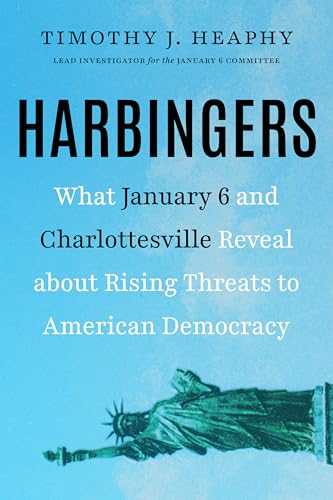
    HARBINGERS: What January 6 and Charlottesville Reveal About Rising Threats to American Democracy


    HARBINGERS: What January 6 and Charlottesville Reveal About Rising Threats to American Democracy
    TIMOTHY J. HEAPHY

    Steerforth Press (non-affiliate Amazonn link)
    $9.99 ebook editions, avalable now

    Rating: 4* of five

    The Publisher Says: A crucial, clear-eyed assessment of what connects the 2 most influential moments of political violence in recent American history, and where we go from here
    An unparalleled firsthand account from the foremost expert on American political violence, crucial for readers of Liz Cheney’s Oath and Honor, and How Democracies Die


    This dramatic, revealing book offers an insider account of the planning and aftermath of the racist riot in Charlottesville on August 12, 2017, and the insurrection at the US. Capitol on January 6, 2021.

    As the lead investigator into both tragic days, Tim Heaphy has an absolutely unique perspective. Readers will travel alongside Heaphy as he organized his team and structured the massive investigations they were about to take, as he interacts with politicians and members of law enforcement, interviews planners, perpetrators, and bystanders, gathers and sorts evidence, and compels and records testimony in order to create a record for today’s voters as well as future generations.

    In his page-turning book, he shares what he saw and came to understand about what those events say about state of American democracy. He examines how and why they took place with the hope that understanding the contexts of these events will be a crucial and helpful step toward avoiding similar episodes of political violence in the years ahead.

    I RECEIVED A DRC FROM THE PUBLISHER VIA EDELWEISS+. THANK YOU.

    My Review
    : The manifold failings of the astonishingly huge, well-funded, and deeply entrenched domestic surveillance industry are laid out in this book.

    I was taken aback on how much there was about the surveillance state I was correct to be paranoid about, and how little it did to prevent these acts of political violence from going ahead, or even getting off the ground. This is something that gives me the gravest kind of worry for the US as a still-slightly-functional civil society.

    I will not tell you this is the most deft or entertaining read of 2025. It's dry, it's pedantic, it's explanatory not exciting. This being what it needed to be to convey its burden of information...and I use the term advisedly...I won't downrate it for being its proper self. A louder, more emotionally charged voice becomes part of the clangor of 2025's soundscape. I know more now than I did before I read this book about the ways and means used by the rebel forces within the US to bring about their desired repressive, totalitarian replacement government.

    Project 2025 should have scared y'all a lot more than it did. I'm guessing most of you won't read this important informative book. Whatever your reasons are, they're not excuses. Very bad things are coming. Resisting them will be a lot of work and involve significant effort.

    The option is passive acceptance.

    Choose wisely.

    Thursday, April 11, 2024

    PRESCRIPTION FOR PAIN: How a Once-Promising Doctor Became the "Pill Mill Killer", be extremely alert to the dangers of "doctor knows best"


    PRESCRIPTION FOR PAIN: How a Once-Promising Doctor Became the "Pill Mill Killer"
    PHILIP EIL

    Steerforth Press
    $29.95 hardcover, available now

    Rating: 4.5* of five

    The Publisher Says: An obsessive true crime investigation of a bizarre and unlikely perpetrator, who’s serving the opioid epidemic’s longest term for illegal prescriptions — four life sentences

    Written in the tradition of I'll Be Gone in the Dark and True Crime Addict, combining Dopesick's heart rending portrayal of the epidemic's victims with Empire of Pain's examination of its perpetrators.

    This haunting and propulsive debut follows a journalist’s years-long investigation into his father's old former high school valedictorian Paul Volkman, who once seemed destined for greatness after earning his MD and his PhD from the prestigious University of Chicago, but is now serving four consecutive life sentences at a federal prison in Arizona.

    Volkman was the central figure in a massive “pill mill” scheme in southern Ohio. His pain clinics accepted only cash, employed armed guards, and dispensed a torrent of opioid painkillers and other controlled substances. For nearly three years, Volkman remained in business despite raids by law enforcement and complaints from patients’ family members. Prosecutors would ultimately link him to the overdose deaths of 13 patients, though investigators explored his ties to at least 20 other deaths.

    This groundbreaking book is based on 12 years of correspondence and interviews with Volkman. Eil also traveled to 19 states, interviewed more than 150 people, and filed a Freedom of Information Act lawsuit against the Drug Enforcement Administration that led to the release of nearly 20,000 pages of trial evidence.

    The American opioid epidemic is, like this book, a true crime story. Through this one doctor’s story, an era of unfathomable tragedy is brought down to a tangible, and devastating, human scale.

    I RECEIVED A DRC FROM THE PUBLISHER VIA EDELWEISS+. THANK YOU.

    My Review
    : Greed, selfishness, and vanity are unholy siblings in this unnerving true-crime book.

    The fact that I am treated for a very painful chronic condition, gratefully enough not by a pill-mill doctor!, meant I very much had a dog in this fight. Doctors who prescribe regular doses of strong pain meds are subject to a lot of scrutiny. After reading this horror story, I understand why.

    I have a really hard time thinking about the kind of sociopathic ideation that goes into knowingly ruining people's lives on an industrial scale. A person with medical-school training who prescribes the cocktail of opioids, depressants, relaxants, that this man fed patients is well aware that the probability of disaster is very high. Anyone on these drugs, still less all these drugs in a cocktail, needs to be under close medical scrutiny. I'll mention here that, unlike many of the patients in this story, I am physically seen and extensively interacted with by my doctor every time I renew my pain medication. He interacts with me on multiple levels, conversationally determining if I am more or less impaired each visit; checking all vital signs, quizzing me on what I am doing with my medications; in short testing my level of cognitive ability to manage the use of all my meds. It makes my visits longer than most people's visits but that is what I need so it's what he does.

    None of that happened for the pain patients caught in this doctor's pill mills.

    When people seek pain relief, as a result of this doctor's and the many doctors like him prescribing pain drugs solely for their earning capacity, they often do not get it. People who need it are denied it because the possibility of abuse is so very present in our cultural consciousness due to the horrible, greedy, often fatal and always destructive issues caused by doctors turned drug entrepreneurs.

    I wanted to read this book because I thought I'd read some overzealous puritan's exaggerated rage-filled hatchet job on a particular bad doctor. I assumed I'd come out of it like I did from Dopesick, thinking that I wanted a less judgmental and overemotional tone that would help me see the problem with greater clarity but not expecting to find it. This is, after all, the time of who shouts loudest sells best and controls the conversation...however briefly.

    That made my surprise on finding exactly what I had hoped to find all the sharper. Eil's journalistic approach is to do the research and present the evidence, then go into an analysis of it that includes consulting with experts as well as speaking with the affected people. The emotional and judgmental stance I was expecting and dreading was vitiated by the careful framing of it inside contexts of the times and places, and most importantly people, involved.

    Perhaps the most important context was that of the doctor himself. Only he knows why he did what he did. The people consulted by Eil give us the impression he left on those who knew him personally and professionally. That left me, as a reader who never met him, with the impression that psychological screening should be mandatory for anyone seeking a medical degree. It would help to identify narcissists and get them, as a condition of their future licensing, into counseling. It could also keep sociopaths out of the field entirely because, unlike narcissists, they lack empathy entirely instead of misplacing it in relationships, and can not be trusted to give actual help to patients in their uncaring care.

    The entire grim saga of the pain mills run by this doctor, and yes I am not using his name because it is a bad idea to spend time in this hyperconnected era saying unkind things about narcissists in public, is one of societal subversion, too. The expectation that consumers of medical services have of their use is that a licensed professional will be trustworthy because the issuers of the license have done their research into the person and deem them credible and qualified. The system in his area let the people it's meant to serve down in pursuit of money. A hypercapitalist system is not going to result in good care for the ill and the needy. This book never smacks the reader with this conclusion; it presents a case that, unless one is dimwittwed or a sociopath, this is the only conclusion one can draw.

    That's all I feel I need to say about that. That is, in fact, all I really want you to know that I got from the read. Was it fun? No it was not. Did I enjoy it? Not in any healthy way. My hope is that you will read this terrible tragic tale of dishonesty, greed, and cruelty, not because I dislike you but because I want you to be extremely alert to the real dangers of casually accepting "doctor knows best."

    Wednesday, March 2, 2022

    AGAINST THE ICE: The Classic Arctic Survival Story, a book brilliantly served (even saved!) by its film


    AGAINST THE ICE: The Classic Arctic Survival Story
    EJNAR MIKKELSEN
    (tr. Maurice Michael)
    Steerforth Press
    $16.95 trade paper, available now

    Rating: 5* of five

    The Publisher Says: The harrowing, amazing, and often amusing personal account of two mismatched Arctic explorers who banded together to keep themselves sane on an historic expedition gone horribly wrong

    Ejnar Mikkelsen was devoted to Arctic exploration. In 1910 he decided to search for the diaries of the ill-fated Mylius-Erichsen expedition, which had set out to prove that Robert Peary’s outline of the East Greenland coast was a myth, erroneous and presumably self-serving. Iver Iversen was a mechanic who joined Mikkelsen in Iceland when the expedition’s boat needed repair.

    Several months later, Mikkelsen and Iversen embarked on an incredible journey during which they would suffer every imaginable Arctic travail: implacable cold, scurvy, starvation, frostbite, snow blindness, plunges into icy seawater, impossible sledding conditions, Vitamin A poisoning, debilitated dogs, apocalyptic storms, gaping crevasses, and assorted mortifications of the flesh. Mikkelsen’s diary was even eaten by a bear.

    Three years of this, coupled with seemingly no hope of rescue, would drive most crazy, yet the two retained both their sanity as well as their humor.

    Indeed, what may have saved them was their refusal to become as desolate as their surroundings…

    Nikolaj Coster-Waldau, who co-adapted the book into a screenplay, provides a new foreword to this brand-new edition of the classic exploration memoir, which was one of The Explorer’s Club’s 100 Best Books of the 20th Century.

    Originally published as Two Against the Ice: A Classic Arctic Survival Story and a Remarkable Account of Companionship in the Face of Adversity. Translated from the Danish by Maurice Michael.

    I RECEIVED A DRC FROM THE PUBLISHER VIA EDELWEISS+. THANK YOU.

    My Review
    : It was the Postscript that did me in.

    Ejnar, a man I'd come to see as a massively egotistical narcissist and manipulative user by now, became an old, old man out of his time and out of his element. Writing in the 1950s about the world he had thought inviolable forty years before, he sounded like I feel in this hideous, distorted Hellscape of a 21st century, hag-ridden by preachers and haters and assorted other lowlife scum empowered by their lack of opposition to usher in Armageddon seemingly at will. His awe at a 12,000-horsepower diesel motor that powered US forces (whose presence as saviors there must have rankled at least a bit, given the impetus for his entire ordeal in 1910) to victory over the Nazi regime's outpost in Greenland, was unbearably poignant to me.

    This world has never stood still. It is hard for me to remember that punch-card tabulating machines were the dernier cri, unimaginably advanced tech, to Mikkelsen. He died in 1971, so he lived to see Humankind step on a different world. A man whose life was almost lost because his technology was not up to the job of taking him to a very harsh and hostile environment here on Earth watched people walk on a place that makes Greenland look like the Riviera.

    Wow.

    But what made this read come alive for me, what caused the whole exercise in storytelling to be extraordinarily enhanced, was the extraordinarily beautiful and accurate adaptation. I don't like Mikkelsen any more than I did...he plays Iver's heartstrings like a virtuoso violinist...but he, as Coster-Waldau embodies him, truly reciprocates the devotion and affection Iver offers to him. That he found this in the text, that he saw the truth of their mutuality and interdependence was enough for me to overlook the sheer absurd heteronormative gloss of the thing. Days in the film version are numbered, and the count becomes astonishing...Day 793 is memorable...and a deeply affecting and effective way to offer the experience as the supreme ordeal that it truly was.

    Maurice Michael, the translator whose work was largely unsung for generations, rendered Mikkelsen's prose so beautifully that there were moments I sat still and just...was...in the moments depicted. No, quoting them out of context won't do a damn thing because there's just no way to being their most important advantage...interrelationship...with them.


    These photos are in the book, and are astounding to me...that they survived, that they made themselves records like this, what a miracle that must've seemed to the men of the 19th century! And I, stuck to my bed by disability, can not only reproduce the photos with a few clicks of a computer's mouse. These are the two men themselves...the resemblance of Coster-Waldau to Mikkelsen is remarkable.

    The film, the story of it, is also very interesting, and I encourage you to look into it. More important to me than that is to say that I, who absolutely abhor animal cruelty in my reading, was deeply upset by the treatment of the dogs in this tale...not because it was cruel, but because it was necessary and because the men were quite upset by it on more than one level. This is not a straightforward triumphalist tale of Conquering The Elements. This is the reckoning of a life lived on his own terms delivered by the man who grew and changed, who resulted from the brutalizing battle to survive that would've killed anyone not as powerfully self-motivated and indomitably self-willed as Mikkelsen was.

    Truth be told, it's just the fact that had such good luck in his filmic avatar that rescued him from my "that whole postcard thing is a stupid, bad smokescreen" judgment of his manipulative and overbearing character. Had I not been made to see the vulnerable side of him, I'd've stuck with "what a relic of a bad time" and missed the subtle and worthwhile nuances.