Pages
- Home
- Mystery Series
- Bizarro, Fantasy & SF
- QUILTBAG...all genres
- Kindle Originals...all genres
- Politics & Social Issues
- Thrillers & True Crime
- Young Adult Books
- Poetry, Classics, Essays, Non-Fiction
- Science, Dinosaurs & Environmental Issues
- Literary Fiction & Short Story Collections
- Sookie Stackhouse/Southern Vampire Books & True Blood
- Books About Books, Authors & Biblioholism
Showing posts with label immigrant theme. Show all posts
Monday, March 16, 2026
OF LOSS AND LAVENDER: A Novel, masculinity's vast void after destruction
OF LOSS AND LAVENDER: A Novel
SINAN ANTOON
Other Press (non-affiliate Bookshop.org link)
$11.99 ebbok, available now
Rating: 4.25* of five
The Publisher Says: In this achingly beautiful novel of trauma, memory, and identity, two Iraqi men struggle to start a new life in the US after the Gulf War.
Sami, a retired doctor, lives with his son and grandchildren in Brooklyn. As he tries to navigate this new city, it becomes increasingly clear he is losing his memory due to dementia. Every day he sinks deeper into old memories of a life in Iraq before the war.
Omar arrived in the US with no family. He has run away from Iraq with a fake identity. As a deserter, he was punished by having an ear cut off. In Baghdad, this is an unmissable mark of shame. Omar works menial jobs, creates a new identity—comically passing as Puerto Rican—and dreams of reconstructive surgery to get his ear, and his dignity, back.
Their stories converge powerfully when it becomes clear they were connected in Iraq at a moment that was pivotal for them both. Deftly exploring the aftermath of war and relocation, Of Loss and Lavender creates a moving portrait of life in exile.
I RECEIVED A DRC FROM THE PUBLISHER VIA NETGALLEY. THANK YOU.
My Review: A novel of displacement. A story of male identity that, in centering differing...often competing...cultural notions of masculinity, shines a klieg light into the endless void at men's cores left by their "failures," inabilities, unwillingness to live measured by that toxic measure.
What Author Antoon did by bringing these oddly assorted immigrants to the US was subtle, clever, and tendentious. Omar is a chancer. He's blagged his way into and out of trouble since...well, who knows, we're not vouchsafed his whole life's story but I'd bet my very own United States dollars that he's been behaving this way his whole life. Omar is running even when he stands still, never at rest because rest is the point when "They" can get you in their sights to pin you in your place, the one "They" have decided you belong.
Sami's never run in his life. Towards or away from a goal or a problem, he's been steady. His aging mind has fractured from the weight of his memories. He's not agile, he's strong. Strength, unlike agility, breaks when overextended. He tries to comprehend Brooklyn, not an easy task for the native from the US, and fails. In his failure to become a Brooklynite, Sami becomes the dependent he was always responsible for, the helpless and confused neophyte he always guided...the not-powerful responsibilty in place of a lifetime as the powerful protector. Wandering in his memories he needs to build his identity Sami has no traction thanks to dementia. We meet him before the dementia robs him of enough capacity to know he's losing his battle. It is the hardest to endure of all dementia's thieveries. Sami is still Sami. Cruel is our word for this moment of struggle, outsiders who observe it; internally, no one who knows it intimately has ever told us, because they can't.
When you use these men as each others' counterpoise you get the fulcrum of the system located at masculinity. Lost, found, rejected, but "Achilles absent was Achilles still," in Homer's distillation of verity into aperçu. In bringing these wounded-by-past-lives souls to a country that shares none of their lived experiences, Author Antoon removes all the props we use to build identity from them. They have no obvious place in the cultural map they must now use to navigate Life. Omar loves this because it means he controls his narrative, he has no further need to resist the boxes he's forced to occupy because they don't exist to threaten him. It's liberation, yes, but it comes as always at a price. Belonging, the sense of purpose that it grants, is also in those boxes that confine, shape, define Omar (including his name, fictional though it is). Freedom isn't free. Never has that truth been more stark than to Omar in Brooklyn.
Living your life in translation is never easy. It is a hidden cost of Othering those not deemed "mainstream" or those who are immigrants in similar degrees. Author Antoon is an iraqi immigrant to New York, a novelist and (it says in his biography) poet who translates from (and/or to) Arabic; It shows in this very good novel. It feels like he is translating the experience of masculinity from one culture to another, like the characters are finding ways to make sense of the world that use words no longer part of their fluency. Sami's losses are structural intrinsic; Omar's are voluntary, elective; both are costly and exact significant emotional tolls on each man's journey through the maze of Brooklyn.
As a professor at New York University, Author Antoon is no doubt drawing on his own immigrant experience in the vast, bewildering social system of New York. I hope the world here has treated him with greater kindness than either of these characters received. I offer the story an incomplete fifth star because I was immersed in the flume of the story's canal, the high-pressure constriction that roils and directs but does not deliver to an end point the narrative waters. What, in the end, did Omar and Sami do as a result of occupying the same canal? They changed; but in tandem not in response to each other.
I derived a lot of pleasure from the story. I hope y'all will give it your time and treasure. I think the way each character experienced their quest after identity was so poignantly masculine, so painfully rooted in their manhood, that many women would get significant value from this male interiority.
Friday, February 20, 2026
THE TESLA FILES: A Whistleblower, a Leak, a Fight for Truth: The Inside Story of Musk's Empire, what it says on the tin
THE TESLA FILES: A Whistleblower, a Leak, a Fight for Truth: The Inside Story of Musk's Empire
SÖNKE IWERSEN & MICHAEL VERFÜRDEN
Steerforth Press (non-affiliate Bookshop.org link)
$17.99 ebook, available now
Rating: 4.5* of five
The Publisher Says: A whistleblower.
A 100BG-leak of confidential internal documents.
This is the story of the fight to expose the truth of Tesla.
Elon Musk is one of the wealthiest people in the world. Tesla made him a 300-times billionaire. Starlink turned him into a force in global conflicts. X became his personal megaphone, stoking political turmoil at the touch of a button. With SpaceX, he aims to conquer the stars.
But a whistleblower, a 100GB-leak of confidential Tesla documents and two investigative journalists reveal the frightening truth behind the façade: an unusually high number of workplace accidents in Musk’s factories, dangerous errors in Tesla's autopilot software, a culture of fear and deception, and countless broken promises.
Investigative journalists Sönke Iwersen and Michael Verfürden take readers behind the shiny surface of Tesla. Through their chilling analysis of internal Tesla data and court documents set alongside the astonishing first-hand accounts of employees, customers and their bereaved families, The Tesla Files reveals a corporation in crisis. At its heart a billionaire who truly believes the world is his for the taking.
The definitive exposé of the world’s most powerful businessman and the rise and fall of his empire.
I RECEIVED A DRC FROM THE PUBLISHER VIA EDELWEISS+. THANK YOU.
My Review: Systemic indifference to the privacy, the rights, really the importance of anyone not themselves is a hallmark of organizations connected to Muskolini. We saw that in the brazen theft of explicit and monetizable government data on taxpayers, for a start, by DOGE...never a Federal department, never authorized to do anything by the only legitimate authority, Congress, to act on behalf of the Federal government...that somehow has never been talked up by our media watchdogs in the US. Funny how Penguin Random House published this book in the UK but not the US, where a really small indie publisher brought it out; odd that a pair of German investigative journalists did this reporting, not anyone from a major US paper; and most interesting there's no translator credited anywhere in the book.
I'm sure the authors are sterling of character but I beg leave to presume they're not fluent enough in English to produce prose that does not raise my "say what now?" eyebrow. Deference to a famous, nay infamous lawsuit-filer with a serious need to control his public image? It can't be proven by me.
The facts as presented in this book are...let's stop at poor optics. It is definitely an exposé. I am inclined, on my own behalf, to agree with the bald statement the whistleblower is quoted as making in the book: "Elon Musk is evil." This being a matter of opinion it surprised me the authors left it in...until I read about Tesla's obscenely negligent handling of customer data, which you must agree to sign over to them when you buy one of their cars.
Twitter-destroyin', Starlink-abusin', money-hoardin' immigrant that he is, he's part of the culture we're living in, and it is my sincere hope that he, along with the Epstein-files-dwelling serial sexual abusers in his socioeconomic class, will be served justice before long.
A boy can dream.
Tuesday, February 10, 2026
I HOPE YOU FIND WHAT YOU'RE LOOKING FOR, historical novel of ripples from 1990s seismic shifts
I HOPE YOU FIND WHAT YOU'RE LOOKING FOR
BSRAT MEZGHEBE
Liveright/Well-Read Black Girl Books (non-affiliate Bookshop.org link)
$27.99 hardcover, available now
The Independent Press Top 40 Bestsellers: Fiction For the week ending February 15, 2026
Rating: 4.5* of five
The Publisher Says: A radiant, highly anticipated debut from the Well-Read Black Girl Books series, delving into the secret lives of three women on the eve of Eritrean independence.
The year is 1991. Eritrea is on the verge of liberation from Ethiopian rule and in Washington, D.C.’s tight–knit Eritrean community, change is in the air. Thirteen–year–old Lydia and her family are grappling with what peace—after decades of war—might mean for their future, just as they welcome a new relative into their distant cousin, Berekhet, newly arrived from Ethiopia to attend medical school.
Berekhet encourages Lydia to confront a barrage of new ideas for the first time, about nationhood, family, and what it means to be truly free. Meanwhile, her mother, Elsa, a former rebel fighter, and the family matriarch, Mama Zewdi, contend with regrets and secrets long-buried secrets that the emboldened Lydia is determined to uncover, including the truth about her martyred father. Written with warmth and sharp humor, Bsrat Mezghebe’s mesmerizing debut novel is a loving ode to an immigrant community on the cusp of a new age.
I RECEIVED A DRC FROM THE PUBLISHER VIA NETGALLEY. THANK YOU.
My Review: I dated an Eritrean immigrant to Texas in the 1980s. I had not heard of Eritrean independence movements before meeting him. Brief as it was (internalized homophobia caused much pain), this connection left me with an acute awareness of how very much the people of a particular place have ideas and emotions about the notion "home" that I can never know I don't know about unless I meet them. As there are only so many ways to meet Othered people on a footing that does not read as exoticizing them, I got more interested in reading about these folks. It's also when I became really serious about making a point to read translated literature.
Lydia, our main PoV character, is oddly enough in the same boat I was vis-à-vis her own family. Elsa gave birth to her in Eritrea but emigrated immediately thereafter; Lydia does not know exactly why, but reckons it has to do with her father's death before she was born. The novel is built around her teenager's need to discover The Truth℠ (as if such a thing exists!) about her parents and thus her own past.
There are chapters from Elsa's PoV, and Elsa's close-as-a-sister, distant cousin, and fellow emigrant from the war zone "Mama" (as Lydia calls her, along with the others in their close-knit community) Zewdi Naizghi. All these women are fully in charge of their survival in the US, relying on themselves and each other; men are relegated to margins and edges of lives they are constructing for themselves. The first rock dropped in this relatively calm pond is Mama Zewdi's borning interest in a man who wants her to come to California to be with him, the second is the arrival from Addis Ababa of eighteen-year-old cousin Berekhet, who's sent there from a need to have doctors for newly-independent Eritrea.
All these volatilities in place and all stemming from the successful struggle for independence, there is a reckoning to be had among these women...with the past, with the demands of life in a new world meeting the needs of the old world's ties and tumult, with the conscious desire to form an identity rooted in one's past but portable into a future of one's own design. It is here I felt debut Author Mezghebe fell into an understandable cognitive dissonance. She definitely needed to set the stage for some Eritrean revelations. The clues she scattered were a bit too obviously clues. I can't cite my examples because I live in quaking terror of the Spoiler Stasi. The fact is they were overly set up as clues; it's a forgivable sin in a debut novel. I can't give her the perfect five her character-building work and her hunger-inducing facility with food description would've merited on its own.
I can happily and very slightly forcefully encourage you to get the story into your head. I was deeply invested in Lydia's borning identity, I was so annoyed at everyone demanding Mama Zewdi's attention, I was so keen to know what was powering Elsa's slightly off actions. I didn't get *as* invested in Berekhet, but I don't think I was meant to.
What I was offered in this read was the interesting idea that the past an immigrant brings to their new country does not necessarily require them to amputate it to become intentionally of their new home; but not reckoning with that past will effectively block any sense of belonging anywhere...including one's own family.
Supporting this debut novelist with your attention will reward you with outsized new ideas about the driving forces behind immigrants' decisions to move to a new country, about the consequential, inescapable role one's personal past plays in the rest of one's life, and about family's meanings and mutabilities.
Sunday, May 11, 2025
STORIES FROM THE EDGE OF THE SEA, an edge I can see from my home, and wonder what's over it
STORIES FROM THE EDGE OF THE SEA
ANDREW LAM
Red Hen Press (non-affiliate Amazon link)
$9.99 ebook, available now
One of LitHub's 100 Notable Small Press Books for 2025!
Rating: 4.75* of five
The Publisher Says: Andrew Lam returns with a literary exploration of love, lust, and loss among Vietnamese immigrants in America.
At times humorous and ecstatic, other times poetic and elegiac, the fourteen pieces in Stories from the Edge of the Sea explore love and loss, lust and grief, longing and heartbreaks through the lives of Vietnamese immigrants and their children in California. A younger dancer is haunted by memories of almost dying on a boat when they escaped from Vietnam, a widow processes her husband’s death through frantic Facebook postings, a writer enters an old lover’s home and sees a ghost at twilight. If the human heart is a vast, open-ended terrain, then Andrew Lam’s short stories are its mountains, valleys, and lakes. Together they seek to chart barely explored country.
I RECEIVED A DRC FROM EDELWEISS+. THANK YOU.
My Review: How to go on, when you honestly think your world is ending, is at the heart of any immigrant's story. Your world is ending, are you going to end with it?
Not while someone is cold and hungry, I'm not. I immigrated from my happy world to this ugly, mean-spirited one entirely against my will. But here I am. My kettle's got words, but heads need filling...feeding...too.
In accordance with the Prophecy, the fourteen stories will be dealt with by the Bryce Method.
She in a Dance of Frenzy suffers. Beautiful faces and empty hearts so often go together. Why some people are gifted with looks but left, like all of us, without a single clue as to how to be truly happy.
Because, girl of great beauty, woman of the thousand broken hearts, empty vessel hollow drum moon void of course: Your value of face has no depth of learning, and only learning fills you up. 3.5*
Agape at the Guggenheim takes a solid look at how love, lust, longing, and the essentially fruitless effort of making sense of your own inner workings all walk around, sloshing and thumping into over and around one pretentious little culture queen's head.
Quit worrying about it, said old-man me to this youthful Asian version of me. Get up and find him or stay sitting and watch him go, either way chasing a fantasy won't explain you to yourself. But when your façade is as brittle and shiny as the lacquer on your umbrella handle, you won't listen, or hear when you do.
Told in a slightly annoying ever-so ever-so tone that will really rub the rust scales of some, that amused me no end. 4*
This Isle is Full of Noises provides the required amount of New Weid as vampires and werewolves crash a frat party where a Vietnamese immigrant lad, on the way to a glittering career as a doctor...he thinks...is apparently trippin' balls and working through some very, very serious PTSD.
Not my personal favorite, but it sure as hell twists its twist with absolute conviction! 3.5*
October Laments follows a woman who processes her grief in real time posts on Facebook, in a foreign language, for the hushand she shared twenty-five years of life with. As her teenaged daughter comments on some posts, the awful truth of marrying someone a lot older than you, marrying someone who becomes ill, withers and dies by choice, to end suffering, is caustically real.
The grief of being left behind, feeling greedy for wanting more, the resposibility of living on...well, social media is good for something after all. 5*
A Good Broth Takes Its Time "I insure people against tragedy, in a country built on it," says Toan, survivor and thriver on pho's magically Proustian-madeleine insubstantial waft. A solid thing, love, and it sloshes in the transparent magis of water, heat, and time that transmutes grossly physical things...nothing on Earth is more grossly physical than oxtail...into wafts of delightful odor.
Tragedy plus time equals comedy, said the long-forgotten hilarious inventor of The Tonight Show, Steve Allen. He specifically meant ha-ha comedy. I'd be amazed if Allen, and Author Lam, didn't also mean that tragedy turns its other mask to the reveling, partying eater of the divine pho. Savoring the tough bits, eating the insubstantial essence of things whose flavoring we call "herbs and spices" but whose bodies (leaves, fruits, seeds) we use up and discard. The broth that takes its time? Rich in the essences of things we can't see. Replete with the powerfully sensed, unseen, untouchable, enfolding vapor of the dead.
Heady. 5*
Bleak Houses are more than structures, they're memory palaces of lives unlived. Visiting someone you once loved deeply, were passionately entwined with, in his home now shared with a wife who knows who you were, with kids who know little enough about the world (such a kid thing) to Make Judgments, is...awkward. Seeing a ghost is the least of it. 4*
To Keep from Drowning tells us how lives end, how hard it is to live one, how much it costs in blood and treasure is only the beginning. Never tell all you know and it goes into the Void with you. And how that is okay.
Living each life is hard work, dying each death, moments you don't know what what's coming are the ones you should treasure because they are the ones that let you rest before the next bend on the hill. A family of origin takes shape on this trip to Land's End. And it is at the end your beginnings fall into focus. Rose's pain, Ben's work, Lou's seeking, all of them launch their family from the end of the land, from the muddy border of dirt and water and the air so redolent of rot. 4.5*
The Shard, The Tissue, An Affair said something deep, something profound, after smacking me in the teeth with some very self-indulgent poetry:
To fall in love is to have one's sense of geography grafted onto another's, no matter how tenuous, so as to form a new country. I saw Houston in my mind, a city of strip malls, grand old homes and gleaming glass-and-steel skyscrapers that coexist cheek by jowl. He, in turn, imagined San Francisco with its Transamerica Pyramid poking the blue sky, windblown hills the color of embers at twilight, sailboats gliding on the bay like white butterflies; he imagined—and I could tell this from his voice—that there was freedom somewhere in the next valley.It's true. You see their world with your own. You do not know, then, what that moment of vision will cost...sometimes a lot, others it pays you. A fleeting moment or a painting on the wall of your shared home.
A short work, a love song to the departed. 4*
Love in the Time of the Beer Bug gives me the heebiejeebies. COVID killed people still walking. It ruined so many lives. It put the stake in the heart of many a vampiric relationship, like Jan and Stan's.
It was a very annoying style to read it in but a story I thought I wouldn't see in here...the ending, and even then, a beginning as the narrator accepts a place in Yale's English department. 3.5*
Swimming from the Mekong Delta is proof that the old adage about lemons becoming lemonade only works if the lemonchucker gets a full, even overflowing, glass. And you get to watch as they have to drink it.
A standup routine I'd actually resubscribe to Netflix to see. 4*
What We Talk About When We Can't Talk About Love is dark. What talking does, in this immigrant's world, is fill the hot-air balloon that wafts him above the heads of the struggling so he won't see how hard it was for him in their sweaty. soot-streaked faces. The fire's coming, blow it out with words. Blow up into the ballon. Blow harder, blowhard.4.5*
5A, 5B, DEST: SGN gives someone ordinary a second chance. It's a beautiful dream, the second chance so deeply desired it connects your past self to a present you just...don't love, care about so little that you're ready to jump into the past without hesitation.
The "Canterbury Tales" format works well enough, but honestly it's so self-indulgent and sentimental I need insulin. 3*
Muni Diaries collects the vignettes a writer, a real dyed-in-the-wool wordhammerer, never leaves behind. The smallest moment stays in the filter like a random whole bean. It blocks the flow of coffee until you take it out and grind it just to get it out of the way.
The resulting liquid isn't quite coffee; it's not strong enough. Drop it into steamed milk? it's barely a macchiato. Slosh it into the instant oatmeal? Palatable, but after it gets cold waiting for you to finish your call, it's stodgy and there's no good way towards finishing it that won't result in gagging.
So blow the dust onto a napkin and draw faces with the dregs in the cup. 3.5*
The Tree of Life Elegy to a mother's love:
Fitst of all, when things get tough, remember to make soup. And, if you can, feed the hungry. More importantly, open your heart, stand with all your strength, with all your courage for life and living, even in the face of darkness and despair. Despite all your sadness and tears, stand steadfast under that tree and tend to it and watch its branches blossom and bear fruit. Stand until the very last light.
You can do no better than to live by these words. 5*
Sunday, December 8, 2024
THROUGH FENCES, graphic novel in the Latinographix series via Mad Creek Books
THROUGH FENCES (Latinographix series)
FREDERICK LUIS ALDAMA (illus. Oscar Garza)
Mad Creek Books
$17.95 trade paper, available now
Rating: 4* of five
The Publisher Says: Through Fences follows the ups and downs of Latino kids and young adults in the US–Mexico borderlands:
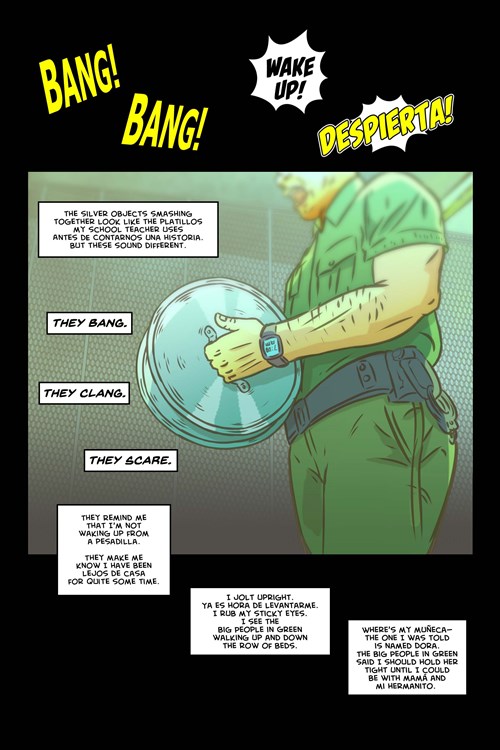
San Ysidro, Calexico, McAllen, and back and forth across the border. A young girl’s journey north goes wrong, and now she is in a forbidding new place, away from her parents and brother, where she doesn’t understand what the adults in green are saying even as she tries to obey their rules.
Rocky, one of the few white kids in town, stands by and watches as Miguel is jumped by two of his friends. Maggie and her parents are separated at the border in a tragic accident.
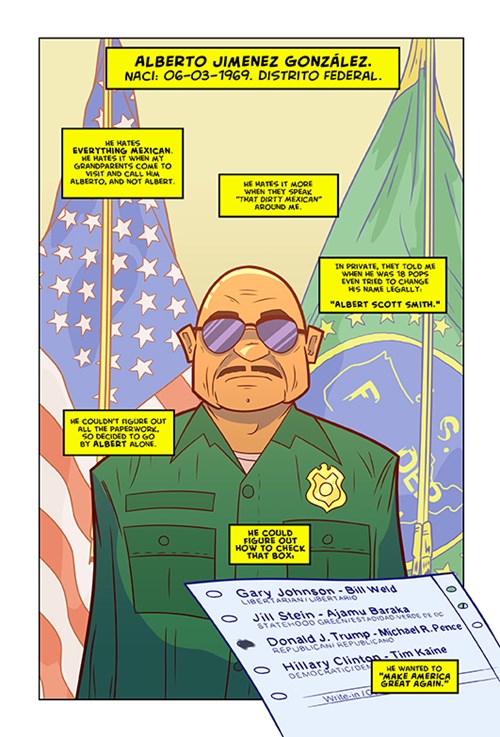
Alberto’s son doesn’t understand his Mexican father’s hatred for “illegals” or his work as a border patrol agent. Alicia is a TikTok influencer who doesn’t want to grow up to be a hospital cleaning lady like her mother, but COVID complicates things. Whatever their challenges, the kids, teens, tweens, and adults in these pages are just trying to survive their everyday lives.
Vibrantly illustrated by Oscar Garza, each of these short stories brings a different perspective on the perils of living on the border while brown.
I RECEIVED A DRC FROM THE PUBLISHER VIA EDELWEISS+. THANK YOU.
My Review: The stories told here are tough. They're honest, they're emotionally charged, and they do not pander to or play out for the gaze of oh-so-sensitive/delicate fleur wypipo who whine every time anyone tells them the unvarnished truth about what the system their privilege enables them to ignore actually does in their collective name and to their collective benefit.
I don't recommend this for under-fifteens. I do think it's a good idea to give the book to your comic-loving teen nibling/grand boy.

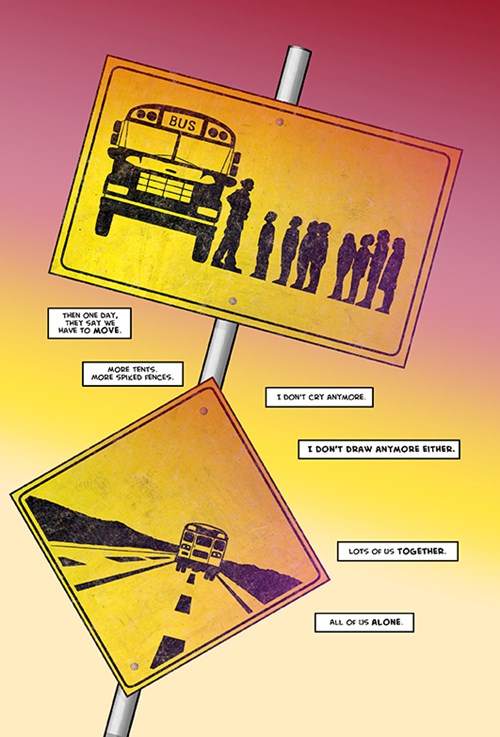
These are indicative of the visual idiom of the entire book. It's intense and kinetic art, it's intense storytelling, and it can't be lightly glossed over or cynically dismissed easily. Young white men in particular could use a dose of this reality. Apart from urging you to get the work in front of all the teenaged white lads you can find, I'm out of polite words to say.
Monday, October 28, 2024
BLUE LIGHT HOURS, first novel by established literary luminary of translation

BLUE LIGHT HOURS
BRUNA DANTAS LOBATO
Grove Press/Black Cat
$17.00 trade paper, available now
Rating: 4* of five
The Publisher Says: of a young Brazilian woman’s first year in America, a continent away from her lonely mother, and the relationship they build over Skype calls across borders
In a small dorm room at a liberal arts college in Vermont, a young woman settles into the warm blue light of her desk lamp before calling the mother she left behind in northeastern Brazil. Four thousand miles apart and bound by the angular confines of a Skype window, they ask each other a simple question: what’s the news?
Offscreen, little about their lives seems newsworthy. The daughter writes her papers in the library at midnight, eats in the dining hall with the other international students, and raises her hand in class to speak in a language the mother cannot understand. The mother meanwhile preoccupies herself with natural disasters, her increasingly poor health, and the heartbreaking possibility that her daughter might not return to the apartment where they have always lived together. Yet in the blue glow of their computers, the two women develop new rituals of intimacy and caretaking, from drinking whiskey together in the middle of the night to keeping watch as one slides into sleep. As the warm colors of New England autumn fade into an endless winter snow, each realizes that the promise of spring might mean difficult endings rather than hopeful beginnings.
Expanded from a story originally published in The New Yorker, and in elegant prose that recalls the work of Sigrid Nunez, Katie Kitamura, and Rachel Khong, Bruna Dantas Lobato paints a powerful portrait of a mother and a daughter coming of age together and apart and explores the profound sacrifices and freedoms that come with leaving a home to make a new one somewhere else.
I RECEIVED A DRC FROM THE PUBLISHER VIA NETGALLEY. THANK YOU.
My Review: A tight, compact barely-more-than-novella based on the author's fiction debut story. She's translated work from Brazilian that I've loved (The Words That Remain) and liked a lot (Moldy Strawberries), so I was primed for a good experience. I got that indeed.
Loneliness and that indescribable parent-feeling compounded of intense longing for the child you've had every day of their life as your primary focus mixed with huge dollops of pride in their accomplisment that's led them away from you, and the freezing fear of what you know can and will happen to hurt them where you just can't be. And, of course, resentment that this stellar being needs to be so far away to feel grown up. I was pleased that the author's stand-in was so dutiful and so genuinely, if sometimes impatiently, loving toward her mother in their long-distance relationship.
If you have, or were, a child, it's going to speak to you. It's told mostly from the author-placeholder's PoV, but we do hear directly from her mother at the end. It will sound, and feel, familiar to older folks. It will offer some insights to younger ones. It will do all this without leaving you feeling Taught. I am morally certain Author Lobato has been in this exact skin, it fits the reader so well.
Why I recommend it to you now is the fall has fallen, there's chill in our Northern Hemisphere air, trees are coloring up, and that's the time for a hot steaming mug for sipping and a long sleeve for sniffling into. You'll do a lot of both of 'em.
I'd offer a fifth star had the ending not felt like it was given a mildly short shrift. It's not bad, it's organic to the story, it's just not quite enough for a full, complete experience of her mother's part of their life.
A first novel made from Life, and grown from a short story could not hope for a better apotheosis. This will not, I hope, be the last work of her own long fiction Author Lobato publishes. Those will feel even more accomplished.
Wednesday, July 31, 2024
SOMEONE LIKE US, a title that says so much more after you've read the book (which you should!)

SOMEONE LIKE US
DINAW MENGESTU
Alfred A. Knopf
$28.00 hardcover, available now
Rating: 4.5* of five
The Publisher Says: After abandoning his once promising career as a journalist in search of a new life in Paris, Mamush meets Helen-a photographer whose way of seeing the world shows him the possibility of finding not only love, but family. Now, five years later, with his marriage to Helen on the verge of collapse, he returns to the close-knit immigrant Ethiopian community of Washington DC that defined his childhood. At its center is Mamush's stoic, implacable mother, and Samuel,the larger-than-life father-figure whose ceaseless charm and humor have always served as cover for a harder, more troubling truth. But on the same day that Mamush arrives home in Washington, Samuel is found dead in his garage.
With Helen and their two-year old son back in Paris, Mamush sets out on an unexpected journey across America in search of answers to questions he'd been told never to ask. As he does so, he begins to understand that perhaps the only chance he has of saving his family and making it back home is to confront not only the unresolved mystery around Samuel's life and death, but his own troubled memories, and the years spent masking them. Breath-taking, commanding, unforgettable work from one of America's most prodigiously gifted novelists.
I RECEIVED A DRC FROM THE PUBLISHER VIA NETGALLEY. THANK YOU.
My Review: I am a very, very white old man. I experience none of what Mamush does, or expects to, on a daily personal basis. My Young Gentleman Caller is half-black (he prefers lowercase to uppercase "Black"). There are times I am utterly oblivious to what that idiotic blood quantum theory of human identity means because I get none of it. What I *do* get is profiled, when traveling, as an American...some indefinable something about me is ineradicable, and inescapably American. Among anti-semites I am always assumed to be a Jew. (Among Jews as well, which can get awkward.) As a gay man, and an old one, I'm often seen as not queer enough, or just a bit too queer. Can't win for losin'.
So when I read Author Mengestu's books, I am not just pruriently peeping in on his characters' struggles with identity and its ramifications.
The great strength of Author Mengestu is his lovely language. One of my all-time favorite aperçus of his is from How to Read the Air: "There is nothing so easily remade as our definitions of ourselves." (Note to self: Why haven't we reviewed that one?) This book, too, is full of meaty thoughts on identity, on the mutability of selfhood, on the complexity of being alive in an interwoven web of love and fear and distrust, trying to spin new threads as old ones fray, of making the effort to stick yourself to the ones you thought you wanted to escape. The way webs form...from the center outward, directed by a design and made for a purpose...is, however, the opposite of that other great center-driven natural structure: the hurricane. These form when a depression becomes so empty that everything around it is drawn in to fill its vacant space in the atmosphere. Mamush, with the best of intentions, is a hurricane. “You’re like a donut. There’s a hole in the middle, where something solid should be,” says his wife.
He sticks to nothing, nothing sticks to him. His deep and abiding depression formed in his deeply uprooted "family." His mother and father escaped imploding Ethiopia, and in a truly terrible series of bad decisions, engendered their child Mamush. Neither, though they are friends, wants to raise a child with the other. Mamush has the ordinary single-mother experience of childhood with all its spaces and silences and absences. His father would've been absent no matter what because he is a man on a mission to help other Ethiopian immigrants starting a taxi business to employ them in the US. Tgat makes him professionally unrooted, always in motion, at the mercy of those around him, subject to their moods and attitudes in service of making a living. Mamush is his father's son. He abandons a job as a journalist...someone who observes from the sidelines...to run away from the ever-darkening US. It's the way these men live. He starts a family in France, which honestly sounds like one of the worst ideas anyone ever had. That, unsurprisingly, just presses his depression even lower down: his son is disabled, a hard, hard road for the best prepared parent. Predictably, it's a terrible stressor for Mamush. At his mother's summons to come home to DC and help her figure out where his father has got to, he's outta there leaving son and wife to struggle along without him.
It's deeply telling that he misses his plane. It's even more telling that he, on a whim with no forethought, then switches his ticket from DC to Chicago. It wasn't just a whim, really, as his parents had lived with him in Chicago before settling in DC. His unmooring from his plans, from his family, from his career, is all in service of a Quest. Who doesn't love a Quest? He's so turbulent, such a low-pressure spot in his own life, that he's attracting chaos at such a huge rate he must find a way to fill himself from the center outward or succumb to that destructive chaos.
A man in search of a center, a man whose essence is unquiet and kinetic, who now wants something he's never had and has no tools in his kit to create, is a danger to himself and others until he finds the thing that can act as solid ground. Standing still is only possible when there's solid ground under you. Then the hole formed so early in life, made from the same stuff as the edges are, is the small nugget of solidity he can stand on. From this small, awkwardly shaped piece, a center is formed, and the spinning of that web of intent, design, and adhesion can begin.
This is when Mamush says to his father: “There isn’t one story. Things start and end abruptly. Some pages are just a single paragraph. I don’t always understand who’s speaking or what’s happening. If what you’ve written is fact or fiction.”
Homecoming, homegoing, home is now within reach. It is a beautiful moment in a book that, for almost half its length, made me want to slap the hell out of Mamush, out of his parents, and maybe most of all his idiot wife who had a child with this deeply unready man. All comes out well, or at least "well" is finally in sight, for Mamush. Guaranteed? No. Delivered? Not really. But visible at last.
I think Dinaw Mengestu deserves a stonking medal for taking me on this journey that irked and annoyed me, but lured me on with his usual glorious phrasemaking music, then delivered me to an ending I could both believe completely and feel satisfied with. Kudos to you, sir.
Wednesday, March 20, 2024
THE MARS HOUSE, latest Natasha Pulley exploration of the costs of Othering
THE MARS HOUSE
NATASHA PULLEY
Bloomsbury USA
$32.99 hardcover, available now
Rating: 4.8* of five
The Publisher Says: From the author of The Watchmaker of Filigree Street, a queer sci-fi novel about an Earth refugee and a Mars politician who fake marry to save their reputations—and their planet.
In the wake of environmental catastrophe, January, once a principal in London’s Royal Ballet, has become a refugee on Tharsis, the terraformed colony on Mars. In Tharsis, January’s life is dictated by his status as an Earthstronger—a person whose body is not adjusted to Mars’s lower gravity and so poses a danger to those born on, or naturalized to, Mars. January’s job choices, housing, and even transportation options are dictated by this second-class status, and now a xenophobic politician named Aubrey Gale is running on a platform that would make it all worse: Gale wants all Earthstrongers to be surgically naturalized, a process that can be anything from disabling to deadly.
When Gale chooses January for an on-the-spot press junket interview that goes horribly awry, January’s life is thrown into chaos, but Gale’s political fortunes are damaged, too. Gale proposes a solution to both their problems: a five-year made-for-the-press marriage that would secure January’s financial future without naturalization and ensure Gale’s political future. But when January accepts the offer, he discovers that Gale is not at all like they appear in the press. And worse, soon, January finds himself entangled in political and personal events well beyond his imagining. Gale has an enemy, someone willing to destroy all of Tharsis to make them pay—and January may be the only person standing in the way.
I RECEIVED A DRC FROM THE PUBLISHER VIA NETGALLEY. THANK YOU.
My Review: Comme d'habitude, Author Pulley has taken multiple strands of today's hellscape and woven them into a clever, involving story. January is a ballet dancer...lean, lithe, and muscular even by Earth standards...and a refugee from the sinking of his home, London, due to climate change. No worries, it isn't a big deal in the story, just the way he gets to colonial Mars.
Where he, because he grew up on a high-gravity planet, is an "Earthstronger" and a terrible threat to the naturalized Martians. This condemns him to a life of menial labor where his freakish strength is an actual advantage not a threat.
Does this anti-immigrant rhetoric sound familiar? Start from actual differences, create threats, and stigmatize the Other with the largely imaginary threats and violent rhetoric?
The story is about all that and more. January is the only one who is referred to by the masculine pronoun. All the Martians are "they." No more information is given than that...and Gale, the senator whose careless seeking for a soundbite in their campaign to forcibly "naturalize" the Earthstrongers...a procedure with a horrific death rate, and ugly medical side-effects for those it does not kill...as the external suits that cause the Earthstrongers not to be able to exert themselves to capacity are defeatable. Gale's effort to get a political advantage blows up badly and causes them, as well as January, terrible problems.
Their solution is to offer January a five-year fake marriage contract that will give them good political optics, and him a way out of the endless drudgery and second-class citizenship of being in a suit or, far worse, beinf forcibly "naturalized." So, as always in Author Pulley's work, there is a slow...slooow...burn into True Love. That the relationship is so suitable is weird. January had to travel to another planet to find True Love...and the balance of power, also as always in Author Pulley's work, is even but in a completely unexpected way.
What makes me happy when I know there is a new book coming from Author Pulley is that I know what I will get...musings on interpersonal dynamics, commentary on injustices that clearly cause her outrage and pain, the somewhat unrealistic Love Conquers All resolutions...but have not clue the first how she will take me where I already know we're going.
*happy sigh*
So, I hear you wonder, since you got exactly what you wanted, and enjoyed the trip to get it, where's that fifth star? The one thing I was a lot less than thrilled with was the bizarre and offputting de-extinction of wooly mammoths as part of the Martian terraforming because it felt uncharacteristically gee-whiz neato-keeno it's my book and I'll do it because I can legerdemain. It did not make any sense to me, though clearly there is a narrative srand to explain it. I just did not buy it. I was also not entirely convinced by the time it was set in...the kinds of changes on Earth seemed to be unusually late, for what I expect to happen based on current trends and on Mars way too soon. So, not quite able to ignore and go on with my suspension of disbelief.
These were not terrible sins...this is a novel, not a counterfactual scientific paper...and they are in service of telling a cracking good story. Very much a good place to start reading Natasha Pulley's work if you haven't already; and a great treat for your season of reading if you have.
Thursday, November 10, 2022
BLACKWATER FALLS, first-in-series Muslim immigrant-themed thriller
BLACKWATER FALLS
AUSMA ZEHANAT KHAN (Inspector Inaya Rahman #1)
Minotaur Books
$27.99 hardcover, available now
Rating: 4* of five
The Publisher Says: From critically acclaimed author Ausma Zehanat Khan, Blackwater Falls is the first in a timely and powerful crime series, introducing Detective Inaya Rahman.
Girls from immigrant communities have been disappearing for months in the Colorado town of Blackwater Falls, but the local sheriff is slow to act and the fates of the missing girls largely ignored. At last, the calls for justice become too loud to ignore when the body of a star student and refugee—the Syrian teenager Razan Elkader—is positioned deliberately in a mosque.
Detective Inaya Rahman and Lieutenant Waqas Seif of the Denver Police are recruited to solve Razan’s murder, and quickly uncover a link to other missing and murdered girls. But as Inaya gets closer to the truth, Seif finds ways to obstruct the investigation. Inaya may be drawn to him, but she is wary of his motives: he may be covering up the crimes of their boss, whose connections in Blackwater run deep.
Inaya turns to her female colleagues, attorney Areesha Adams and Detective Catalina Hernandez, for help in finding the truth. The three have bonded through their experiences as members of vulnerable groups and now they must work together to expose the conspiracy behind the murders before another girl disappears.
Delving deep into racial tensions, and police corruption and violence, Blackwater Falls examines a series of crimes within the context of contemporary American politics with compassion and searing insight.
I RECEIVED A DRC FROM THE PUBLISHER VIA NETGALLEY. THANK YOU.
My Review: Look at that rating above. Now, listen to me: I am heartily sick of reading about men who abuse, rape, and murder girls. It's imagery I don't want in my head...real life provides more than enough examples of this disgusting, evil, inexcusable, reprehensible thinking and behavior.
Now are you more impressed that this story earned four stars from me?
Author Zehanat Khan is a talented wordsmith, and a very adept plotmonger. Her hate crime in this story is so extremely nauseating to me that I seriously thought about just not going forward with the read. A young Muslim immigrant girl's body is found crucified on the doors of a local mosque.
That was it for me. I closed the Kindle and just barely didn't delete the DRC. But, as people I know posted reviews that were equally appalled but full of praise (though sometimes they intended it to be condemnation), I thought I should pick up the read. I'm not pleased I did, but I'm glad I've read it.
I am in sympathy with Author Zehanat Khan's politics so I didn't feel it necessary to whinge about them. Her deeply felt disdain for the evangelical christian congregation in this story is short of the religion-blaming game that so many "christians" indulge in (despite their own "savior"'s injunctions not to judge others). I was pleased by that. I'd've been equally pleased had she indulged in christian bashing, though. The fact that she has Inaya ruminating on the *people* who committed this heinous act is a step up from the run-of-the-mill thriller.
The girl-posse that works together was, I suppose, fan service. It didn't make me feel any warmer towards that gynergy-celebrating stuff. It also led me to wonder if, in her authorial haste not to bash men as a whole, she hadn't rushed the possible romantic stuff she's hinting at between Inaya and Lieutenant Seif. It feels too soon to me. I want to get to know her as a person before thinking there might soon be a part-of-a-couple vibe.
More especially I want to see Inaya grow into her own powers as an investigator. This is a rookie's case. Let her get past this, move into a more confident footing, before saddling her with a man. That isn't what's going to happen, it seems, but it was an issue I felt needed to be addressed in my four-star review...as you're beginning to see, I liked the read but wasn't mad for it. I rated it higher than my first instinct said to rate it because it's very important to make these kinds of crimes public. I don't, as said above, like reading about violence against women. I am rather fond of a fair few women and don't wish to think of this kind of horror being perpetrated on them. But it's not like it doesn't happen, and disproportionately to immigrants and women of color; swallowing down my visceral disgust for the kind of sick fuck who could conceive of this crime as an act to be brought to fruition is necessary.
We need, as a society, to have the horrible, painful conversations that are the only way to get past the us-v-them divides that animate these haters. Books, novels most especially, are the premier way to give us permission to discuss hate and its dreaful consequences. I hope a few of y'all will see that opportunity and seize it.
Tuesday, September 6, 2022
IF I SURVIVE YOU, available today so RUN! Get you one!
IF I SURVIVE YOU
JONATHAN ESCOFFERY
MCD × FSG
$18.00 trade paper, available now
SHORTLISTED for the 2024 Dublin Literary Award!
Read his "Books That Made Me" Guardian interview.
One of Time Magazine's 100 Must-Read Books of 2022
Rating: 4* of five
The Publisher Says: A major debut, blazing with style and heart, that follows a Jamaican family striving for more in Miami, and introduces a generational storyteller.
In the 1970s, Topper and Sanya flee to Miami as political violence consumes their native Kingston. But America, as the couple and their two children learn, is far from the promised land. Excluded from society as Black immigrants, the family pushes on through Hurricane Andrew and later the 2008 recession, living in a house so cursed that the pet fish launches itself out of its own tank rather than stay. But even as things fall apart, the family remains motivated, often to its own detriment, by what their younger son, Trelawny, calls “the exquisite, racking compulsion to survive.”
Masterfully constructed with heart and humor, the linked stories in Jonathan Escoffery’s If I Survive You center on Trelawny as he struggles to carve out a place for himself amid financial disaster, racism, and flat-out bad luck. After a fight with Topper—himself reckoning with his failures as a parent and his longing for Jamaica—Trelawny claws his way out of homelessness through a series of odd, often hilarious jobs. Meanwhile, his brother, Delano, attempts a disastrous cash grab to get his kids back, and his cousin, Cukie, looks for a father who doesn’t want to be found. As each character searches for a foothold, they never forget the profound danger of climbing without a safety net.
Pulsing with vibrant lyricism and inimitable style, sly commentary and contagious laughter, Escoffery’s debut unravels what it means to be in between homes and cultures in a world at the mercy of capitalism and whiteness. With If I Survive You, Escoffery announces himself as a prodigious storyteller in a class of his own, a chronicler of American life at its most gruesome and hopeful.
I RECEIVED A DRC FROM THE PUBLISHER VIA NETGALLEY. THANK YOU.
My Review: When I think about braided-stories novels, there's always a little frisson of fear in my response. I don't always think it's the best idea to try to make a novel out of things that don't fit together naturally. If there's an organic flow among stories, what stops the author from making it into a regular novel-style novel? Why this technique, not another that doesn't make The Market shudder deep in its bones? All we ever hear is that stories are hard to sell, collections are death in the stores, writing stories is just as hard as writing novels but even less remunerative. I'm inured to this cant of can't by now. It's done its damage. I look askance at connected collections.
What, then, is the reason I decided to read this iteration of the story-novel? There's no one thing, there's a constellation of tweaks and trips. I find the idea of books others can't "understand" tempting. I am all for creative uses of the many kinds of English out there waiting to make my acquaintance. I'll walk a mile for a good story about people who just...can't...because they're my people. Because whatever else divides us, we have one thing in common: We don't Belong, and others do. That's worth a lot of effort...which, for the record, I did not think was needed in reading this book. The second story is in patwa but the rest? Not a bit of it.
It pleases me to use my time-honored technique called the Bryce Method to explicate the wonders herein to feast upon.
In Flux is, like so many of these stories, told in the Satanic Second Person, that chest-pokey "you" that's so often a shortcut to getting the reader's defenses down and their sympathy engaged for the object of the story. It can be overused, but this is a short story and it's about seeking identity starting in 1980s Miami (of all the schizophrenic places!) so it's perfectly appropriate. Right down to the chest-pokeyness. It's a meditation on the condition of being Other, it's a jeremiad against the idiocy of American skin-color-itis, it's a serious look at how being in the liminal spaces refuses to be an identity while defining your every move, action, and thought.
You've been thinking about your mother's list of European grands and how your parents still speak so highly of the British school system that educated them, pre-Independence, and you think of all the Rastafarians who extol Ethiopia and Mama Africa. But what you want to know is contemporary middle-class twentysomethings. You want to know how you might feel had your family never left.
What does it mean to be me? isn't fresh ground to till, but it's an evergreen for a reason. We all need an "against" to find our own "for" side. (Trelawney even has a college-time brush with a gay man, *gasp*) I am, therefore I think about this. Where Trelawney ends up, he began...like all the rest of us, really. 4 stars despite the sore chest from the poking
Under the Ackee Tree I have heard others say this is where they got off the train. I found the shift into a mild version of Jamaican English (many Caribbean folk work where I live, I've heard the real unAmericanized version) welcome. Topper's a man whose life wasn't what he wanted or expected. He's no better, no worse than any other man of our generation, just a bog-standard Boomer.
You go out to the patio and wonder why everyone is turned around in them chairs, peering off into the dark, but it then you hear it: loud grunt and dull thud. And you see Trelawney' silhouette under the ackee tree, all with ax in him hands. And him talking to himself now. And him swinging the ax. ... And you wonder if it's you must be defective since you ruin everyone.
It rang true, this exploration about identity that can't ever really be escaped. I felt Topper's uneasy rage, his angry inability to see past his own ideas. He's one of the billions of people who just...stopped. Them whose worlds reached a place and they said "this far...no further." Usually without volition, without awareness, without calculating the cost. There's always a cost so do nothing without knowing what it is and being ready to pay it. 4 stars offered with the fellow-feeling of someone whose day is done
Odd Jobs makes a nonsense of "there are lines I will not cross":
It was elegant, almost, the way they worked in unison. If only my family had found me such a unifying force. I recognized it then, like petrichor, or some misplaced scent from childhood, not the familiar weight of existence crushing my lungs, but the awakening urge, the exquisite, racking compulsion to survive.
You know it when it bites you. If it never has...you won't. 4 stars for the honest rawness of stupidity
Pestilence channels the rage, the outrage, that only a less-loved child can summon forth. When the parent is, politely, gormless, the child's rage, outrage, can't ever find a single scrap of release. It festers and rots inside the adult. It never, ever goes away, nor (I say now in my oldness) should it. Few emotions are ever unmixed, none felt in adulthood can be, so that incandescent hating fury is all most of us ever get of the pure, unalloyed aliveness.
And Topper's insensitive, uncaring head deserves that baptism by bile. 4 stars for clarity and fearlessness
Splashdown brings Cukie, a bit player in "Pestilence" above, into the limelight. His long-absent father, Ox (short for "Lennox"), reappears in Daphne's life to get to know Cukie. Daphne, maternal auntie to Trelawney and Delano, isn't much for forgiving Ox. But she needs someone, anyone, to get Cukie away from her, to do what she can't: get him out of his head. Maybe Ox...?
Ox delivers those goods. That's never really a good thing, you know. It leads where you'd expect it to lead.... 4 stars
Independent Living gave me the heebie-jeebies. I've been exactly where those people are...unhoused, no safety net, and no one knows better than Trelawney how the people feel who never once expected to be where they are. And there's Trelawney, making a pittance doing the bidding of the corporate office that cares nothing about the people who live there.
Well...most of the bidding. And not always a good job of it. But there's a line for everyone. One they won't, can't...don't...cross. 4 stars
If He Suspected He'd Get Someone Killed This Morning, Delano Would Never Leave His Couch provides the answer to the question, "who is 'the man who can't catch a break,' Ken?" for once and for all. 4 stars
If I Survive You barely has time to make its case for its closing lines before they become, inexorably and inevitably, the words that no two people ever quite seem to arrive at in the same moment, at the same place.
You feel sad about her sadness, and sad for the both of you because your wounds are not particularly original, however genuine. You tell her what it's like to not be the favorite, to be the opposite of the favorite, and she tells you, "Try being an only child."After doing things that you can't take back, after behaving in unforgivable ways, after all the seamy, seedy, bad-for-you crap has made you into a battle-worn hulk of emotional flotsam, there is at last no other choice but to follow the only advice we all ignore. Nope, not tellin' ya what it is, but you'll know it when you read it. 4 stars
Sunday, August 22, 2021
CLASH OF CIVILIZATIONS OVER AN ELEVATOR IN PIAZZA VITTORIO, interesting hybrid genre story from Italian-Berber immigrant author
CLASH OF CIVILIZATIONS OVER AN ELEVATOR IN PIAZZA VITTORIO
AMARA LAKHOUS (tr. Ann Goldstein)
Europa Editions
$14.95 trade paper, available now
Rating: 3.75* of five
The Publisher Says: A compelling mix of social satire and murder mystery.
A small culturally mixed community living in an apartment building in the center of Rome is thrown into disarray when one of the neighbors is murdered. An investigation ensues and as each of the victim's neighbors is questioned, the reader is offered an all-access pass into the most colorful neighborhood in contemporary Rome. Each character takes his or her turn center-stage, giving evidence, recounting his or her story--the dramas of racial identity, the anxieties and misunderstandings born of a life spent on society's margins, the daily humiliations provoked by mainstream culture's fears and indifference, preconceptions and insensitivity. What emerges is a moving story that is common to us all, whether we live in Italy or Los Angeles.
This novel is animated by a style that is as colorful as the neighborhood it describes and is characterized by seemingly effortless equipoise that borrows from the cinematic tradition of the Commedia all'Italiana as exemplified by directors such as Federico Fellini.
At the heart of this bittersweet comedy told with affection and sensitivity is a social reality that we often tend to ignore and an anthropological analysis, refreshing in its generosity, that cannot fail to fascinate.
My Review: Reading that book description isn't necessarily helpful. Social satire plus murder mystery, to most book-readin' Murrikins, is gonna call forth the specter of Murder by Death. You are not in for a satire like that. You are in for a very sophisticated and layered short novel in which a murder is committed, but frankly no one really cares who did it because it needed doing, and the perp the police have identified is a community pillar. No one believes Amedeo committed this murder, which no one calls a crime.
Amedeo steps out of the stories of ten people who all live in a small apartment building on Rome's tatty side, on the Piazza Vittorio. All ten people are displaced, not Roman, and all are made to feel more alien than guest by Rome and its Romans. Amedeo comes to the rescue of each person here, in ways practical and spiritual. He's a fixer, a born organizer, he spends his time on this earth open to and listening for the truths under the stories his neighbors tell, the truths under the facts of Rome and Italian society, the truths that not very many people will bother to learn or, quite possibly, ever realize are there.
So how can the police suspect this wonderful, soothing, special man of MURDER?! Because he, like everyone else, fought with the shit who got murdered? No...because he has disappeared. Not for the first time in his life. He has vanished, and in police work, that's as good as a confession. The novel is told in the interviews the police take with all the residents of Amedeo's building.
Interspersed with these interviews are wails, the first-person accounts of Amedeo himself. They're called wails because Amedeo, né Ahmed Salmi in Algiers, spends a lot of time locked in his wife's bathroom with a tape recorder, setting down his impressions of the people around him, and vocalizing in that uniquely Arab way...the ululating wail, used for joy, for mourning, for any access of emotion that words can't encompass. It's a wonderful way to let us into the experience of being alive in the skin of a force of nature. We're inside Amedeo, Ahmed, we're privileged to be the unseen auditors of the story of his world.
His private world. We have no sense whatever of his work, his living...he remains in a tight little box, as do all the characters, one that focuses on someone we don't meet or hear from or, frankly, care about. The victim is not the point. The murderer didn't commit a crime so much as perform clean-up on aisle two. The more we hear about him, the less we care that he's dead. It works well as a narrative technique to emphasize the almost miraculous nature of listening, and its almost total lack in the modern world.
So why 3.75 stars, when all of the above sounds like such praise? Because the Italian reviews mention an exuberance of language, a gonzo balls-out feeling that the text gives. In Italian. The translation is like the book description above, not uninteresting but nobody's idea of gonzo or balls-out writing. It's a translation. It feels like a translation. It's never going to convey the sense that the original can, of different regional voices, of different classes and different kind of Italian, because American English isn't that kind of language and American culture doesn't, at least at the level of culture where one finds readers of translated novels, like “dialect writing” because it's not Nice.
We lose. I want to read this book in Italian now. It's bound to be more fun. The translation is a good book. The original, I will bet, is a fantastic one.
*sigh*
Friday, August 13, 2021
EDGE CASE, YZ Chin's wry assessment of how "love and marriage" ≠ security
EDGE CASE
YZ CHIN
Ecco Press
$26.99 hardcover, available now
Rating: 4* of five
A BEST-OF-2021 PICK FROM NPR BOOKS!
The Publisher Says: When her husband suddenly disappears, a young woman must uncover where he went—and who she might be without him—in this striking debut of immigration, identity, and marriage.
After another taxing day as the sole female employee at her New York City tech startup, Edwina comes home to find that her husband, Marlin, has packed up a suitcase and left. The only question now is why. Did he give up on their increasingly hopeless quest to secure their green cards and decide to return to Malaysia? Was it the death of his father that sent him into a tailspin? Or has his strange, sudden change in personality finally made Marlin and Edwina strangers to each other?
As Edwina searches the city for traces of her husband, she simultaneously sifts through memories of their relationship, hoping to discover the moment when something went wrong. All the while, a coworker is making increasingly uncomfortable advances toward her. And she can’t hide the truth about Marlin’s disappearance from her overbearing, eccentric mother for much longer. Soon Edwina will have to decide how much she is willing to sacrifice in order to stay in her marriage and in America.
Poignant and darkly funny, Edge Case is a searing meditation on intimacy, estrangement, and the fractured nature of identity. In this moving debut, YZ Chin explores the imperfect yet enduring relationships we hold to country and family.
I RECEIVED A DRC FROM THE PUBLISHER VIA NETGALLEY. THANK YOU.
My Review: First, read this:
Being very polite to train conductors and building security guards for the past decade has made my deferential way of speaking second nature. Though what an odd saying. What is my first nature?
–and–
He stood out, his skin a shade that I had seen compared to food items like chocolate or coffee in American books. Looking at him, I thought not of food, but of a neutral coolness that disguised something else, like an envelope that contained either really good tidings or earth-shattering bad news.
First novelist YZ Chin isn't playing around. She wrote those two passages early in this book. There isn't, this writing informs you, going to be any false modesty in here. I am going to talk about how a Straits Chinese woman married to a Chindian man, a fat woman married to a lean, athletic man who loves her, feels when "America" does its number on them together, separately, and as Symbols. They're two damaged people, they're altogether too small to withstand the pressure of being Symbols, and they're cracking under the strains. Which is why the book is narrated by Edwina in phone-and-internet conversations with her not-quite-licensed (it's just a paperwork thing, nothing important) therapist (see INS form I-693) after Marlin leaves her.
Edwina is an abused daughter of a harridan of a mother (The Banana Tree Spirit Story! OMG!!), a vegetarian to her dark, lean husband's more exacting veganism, a "quality control analyst" in a dudebro startup firm called, fully explanatorily, "AInstein," that lost its VCs a boatload of money by screwing some important code up and still releasing it to a client. Oopsie. Get a girl to handle it...an immigrant who won't dare make much trouble, cause any stress but will fill the role...one who won't be missed when we have to fire her for whatever screw-up she can't make us fix.
The bug was what’s called an integer overflow, which is when a number is too large for its assigned storage capacity and thus can manifest instead as a negative figure. For example, if the number 128 were forced into a signed field that could express only up to 127, the input would ‘overflow’ and be displayed as ˗128. It was mildly gratifying to learn that the human body could also overflow. I idly wondered if, any day now, my pain would grow so great that it converted into happiness.
What a terrific job, no? Not even a company-sponsored green card application, no no, you'll get your H1-C visa and that's it. Why, if she didn't really, really, really want to stay away from the poisonous reach of her mother's awful, barbed "past-life stories." Marlin's job, less pointless it seems, even affords him a few American friends, like best buddy Eamon and the guys he goes to the rock-climbing gym with. But everything changes when Marlin's father suddenly dies back in Malaysia.
At his funeral, the pair of them expensively in attendance as the ceremonies take place, along comes Edwina's mother to tell the Banana Tree Spirit story about betrayal, misery, and hateful ignorance carrying the day. That was bad enough, being about her daughter's "past life," but the many, many echoes this latest piece of cruelty has bids fair to have broken poor Marlin. At this lowest, most grief-ridden moment, the words have twisted themselves into a noose around his logical self so the corpse is all that's left in an ever-darkening relationship to Edwina.
A little detail about the pair returning from Malaysia into Trump's Murruhkuh, how they were treated at Customs, should make your blood boil, your mouth taste sour, and your eyes reflexively leak tears. I half-wondered if Edwina's speculation that "America made Marlin feel unwelcome, and so he left me," wasn't at least half right....
The US government actually monitored immigrants online, and anything I typed might be used against me—that was what internet advice hinted at. Resources for immigrants cautioned that we should "avoid profanity and the use of aggressive or threatening language" while posting online, which really voided the whole purpose of being on Twitter.
Of course, that internet false-identity therapy makes all the sense in the world in that light, doesn't it. Especially since the internet has a random, unidentifiable Crazy Person (or two, or fifty) to tell the suffering how, exactly, not to suffer anymore:
Surely I was better than these people with their loud, false bravado. Yet wasn’t I on the internet precisely because I wanted someone to give me a to-do list? I objected to the content of the lists, found them laughable, but still—I wanted my hand held, didn’t I?
Oh Edwina...that kind of comfort is so, so cold.
I decided the problem was that none of the results mentioned meddling by spirits.
Attagirl!
But when I typed in "spirits told my spouse to leave me," there was a tidal wave of marriages ended by alcoholism.
See? See what I mean, Edwina? Cold comfort...there're people out there a lot more fucked up than you and/or Marlin.
What good is marriage if you can just cancel it like cable?
Well. Now we're gettin' somewhere, Edwina. "Grieving in the form of research, because we believed in productivity above all else," might as well be tattooed on every modern workerbee, don't you think?
Well...she wanted a way to manage her grief at Marlin's weird, sudden abandonment...what about being told you're so unvalued at work that your serious problems with the MVP beta are being ignored? Before one of the dudebros tries to kiss you at a company party? And yes, Edwina, in today's world that IS sexual assault. Her revenge? Condign. (If premature...?)
It was no wonder to me that Edwina ended up doing what she did at the Korean deli. And it was actually a lovely surprise, a way of taking charge of her unhappiness. I can't help but wonder if this isn't, in fact, something that's in fact true and just not being discussed:
I didn't buy that depression was caused by low serotonin levels. No, what I felt was way more aggressive than a simple deficiency of certain neurotransmitters. There had to be another neurotransmitter that carried sadness, that handed out hopelessness like drugged candy. After all, even matter had antimatter.
But when matter and antimatter don't find a safe place to co-exist, what do they do then?
I'd send nail clippers (he was fastidious that way, or at least he used to be when he lived with me), ramen noodles (the fancy, super spicy ones, not the kind that tasted like boiled water that someone had farted in), a throw, maybe even a handheld gaming console.
No one who can write that sentence is done with being A Wife. Edwina, my dear lady, I've spent a grand total of five hours in your company, and they were grand hours! that ramen line!, but your modern-love-immigrant-style story isn't a huge revelation to me. Not once have you startled me, or surprised me, or done anything the least bit out of character.
And do you know what? I wouldn't have it any other way.
Thursday, November 3, 2016
THE SYMPATHIZER, a five-star twisty, turny, edge-of-my-seat read
THE SYMPATHIZER
VIET THANH NGUYEN
Grove Press
$17.00 trade paper, available now
Rating: 5* of five
Don't miss this episode of Novel Dialogue with the author in very interesting conversation with a scholar of his wonderful work.
The Publisher Says: Accolades:
Winner of the 2016 Pulitzer Prize for Fiction
Winner of the 2016 Edgar Award for Best First Novel
Winner of the 2016 Andrew Carnegie Medal for Excellence in Fiction
Winner of the 2015 California Book Award for First Fiction (Gold)
Winner of the 2016 Dayton Literary Peace Prize for Fiction
Winner of the 2015 Asian/Pacific American Award for Literature for Adult Fiction
The Sympathizer is the breakthrough novel of the year. With the pace and suspense of a thriller and prose that has been compared to Graham Greene and Saul Bellow, The Sympathizer is a sweeping epic of love and betrayal. The narrator, a communist double agent, is a “man of two minds,” a half-French, half-Vietnamese army captain who arranges to come to America after the Fall of Saigon, and while building a new life with other Vietnamese refugees in Los Angeles is secretly reporting back to his communist superiors in Vietnam.
The Sympathizer is a blistering exploration of identity and America, a gripping espionage novel, and a powerful story of love and friendship.
I RECEIVED AN ARC FROM THE PUBLISHER AT MY REQUEST. THANK YOU.
My Review: It appalls, revolts, and disgusts me that this book was Author Nguyen's first published book. It is grotesque that such a polished, accomplished, and inventive result should come first in his career. I am outraged that his naked, shameless display of far, far too much talent isn't subject to some form of censure and/or censorship.
Whatever people say about the General today, I can only testify that he was a sincere man who believed in everything he said, even if it was a lie, which makes him not so different from most.
–and–
So it was that we soaped ourselves in sadness and we rinsed ourselves with hope, and for all that we believed almost every rumor we heard, almost all of us refused to believe that our nation was dead.
–and–
What do those who struggle against power do when they seize power? What does the revolutionary do when the revolution triumphs? Why do those who call for independence and freedom take away the independence and freedom of others?
There's a reason all those accolades rained down on Author Nguyen: He bloody well earned them. (Even the squid sex scene. Yes, I said it.)
Anyone who's paid me the slightest scintilla of attention knows that I am not attracted to stories of torture and experiences of the violation kind. But this book's entire existence is, in the end, a meditation on the truth that comes out of one's existence in crisis. The corporeal violation of torture, the absolute honesty of a man in extremis, is what lifts this above sadistic pornography. It easily could have been that, in fact it was a close-run thing...but read those passages again. That isn't smut disguised as literature. That is the efflorescence of brilliance in the cess-pit of war, the striking of a tocsin for even bodily autonomy in a world very much not run for the benefit of the narrator:
All of us - we're all in jail cells without bars. We're not men anymore. Not after the Americans fucked us twice and made our wives and kids watch. First the Americans said we'll save your yellow skins. Just do what we say. Fight our way, take our money, give us your women, then you'll be free. Things didn't work out that way, did they? Then after fucking us, they rescued us. They just didn't tell us they'd cut off our balls and cut out our tongues along the way. But you know what? If we were real men, we wouldn't have let them do that.
–and–
I am merely noting that the creation of native prostitutes to service foreign privates is an inevitable outcome of a war of occupation, one of those nasty little side effects of defending freedom that all the wives, sisters, girlfriends, mothers, pastors, and politicians in Smallville, USA, pretend to ignore behind waxed and buffed walls of teeth as they welcome their soldiers home, ready to treat any unmentionable afflictions with the penicillin of American goodness.
That, mes vieux, is the unvarnished truth smacked like a haddock in our complacent, complicit faces. The author, the perpetrator of this painful outrage against our unknowing...unwilling to know...minds is just gonna keep pile-driving until his point is made. How dare you, says Author Nguyen, how bloody dare you pretend that your world-view of "freedom" can be bought with the misery and unfreedom of entire nations...and he is correct. "Freedom isn't free," say the hawkish. They don't mean it. They mean "MY freedom is worth more than yours" and they're not honest, or self-reflective, enough to say it outright.
Movies were America's way of softening up the rest of the world, Hollywood relentlessly assaulting the mental defenses of audiences with the hit, the smash, the spectacle, the blockbuster, and, yes, even the box office bomb. It mattered not what story these audiences watched. The point was that it was the American story they watched and loved, up until the day that they themselves might be bombed by the planes they had seen in American movies.
–and–
Country music was the most segregated kind of music in America, where even whites played jazz and even blacks sang in the opera. Something like country music was what lynch mobs must have enjoyed while stringing up their black victims. Country music was not necessarily lynching music, but no other music could be imagined as lynching's accompaniment. Beethoven's Ninth was the opus for Nazis, concentration camp commanders, and possibly President Truman as he contemplated atomizing Hiroshima, classical music the refined score for the high-minded extermination of brutish hordes. Country music was set to the more humble beat of the red-blooded, bloodthirsty American heartland.
What a view of the world America purveys. What a travesty of a slogan is "Freedom isn't free" in a country where even the popular culture of the place is strictly divided...youth has rap and hip-hop, the regressives have country or classical European orchestral music (depending on class), the old have yacht rock...and there are fewer and fewer places for us to meet, to exchange knowledge and ideas. Television? Not the Great Isolator it was once bemoaned to be (or else my Twitter feed is weirder than most, and my inbox full of popculture websites' come-ons is abnormal). Music, the one-time Great Uniter, ain't no more. Literature, and its bumptious cousin book publishing, are never going to rise back to the heights they once commanded. Games, computer games, MMO games, are pretty much in the grips of the lowest of the world's humans from what I can see.
Yet our films, sent all over the world!, are solidly behind a view of the USA as a Defender of Right, Justice, ORDER!
Honestly, it revolts me, this dissonance between reality (what in the name of all that's unholy did Iraq under Saddam Hussein have to do with the Al Qaeda takedown of the World Trade Center?! and that war cost thousands of lives and TRILLIONS of dollars!) and the vision in the exported product. China is on the rise, y'all, and its tastes are going to form the next wave of filmed exports, so be watching what comes up that doesn't make you feel all warm and fuzzy. You're about to get your own medicine back.
That medicine will be progressively more bitter. The author's interview, included in later editions of the book, says it succinctly (as one would expect):
I did not want to write this book as a way of explaining the humanity of Vietnamese. Toni Morrison says in Beloved that to have to explain yourself to white people distorts you because you start from a position of assuming your inhumanity or lack of humanity in other people’s eyes. Rather than writing a book that tries to affirm humanity, which is typically the position that minority writers are put into, the book starts from the assumption that we are human, and then goes on to prove that we’re also inhuman at the same time.
Are you, white readers, aware of the subtle (to us) and bitter (to those not us) demeaning subtext, if only barely so, of reading about Others? The perpetuation of Othering in confining through your commercial choices of Black, Asian-American, Hispanic, et alii writers into "explanatory" writing? Yes, you aren't doing it out of overt racist motives (or you wouldn't be likely to read my reviews) but you're enmeshed in a system of deeply, unexaminedly racist underpinnings. It is extremely difficult to break those lenses. If you try, you will fail at times. But you will, and I speak from experience, gain from every success and learn from every failure.
IF you will pursue the effort in an honest attempt to shed the ugly, distorting framework.
Starting by reading Author Nguyen's twisty, deceptive, and very very sneaky story will repay you on so many levels.
Wednesday, November 13, 2013
AMERICANISATION, academia-set picaresque immigrant comedy
AMERICANISATION: Lessons in American Culture and Language
ANGUS WOODWARD
Livingston Press
$8.50 trade paper at the link above, $4.95 Kindle edition
Rating: 4* of five
The Publisher Says: Biti Namoeteri, an enterprising young man from "South America's Lichtenstein," comes to the US to get a graduate degree in Spiritual Geography, never expecting to become a multi-level marketer or to fall in love with a woman named Janet Broccoli. But he does just that, and then discovers that personal injury lawsuits can be the keys to both success and failure. Woodward's narrative strategy is both accessible and experimental in this comic novel posing as a textbook.
My Review: The son of goatherds from a country described only as "South America's Liechtenstein" comes to an unnamed American university in an unnamed American city to get a Master's degree in "Spiritual Geography." (Now I want a degree in Spiritual Geography, but not a one of the local universities seems to have such a major. Blast and damn it all!) He arrives, Candide-like, with nothing but a few clothes and a shaky grasp of English. Soon he falls (literally) afoul of the predatory and transactional nature of capitalist society's definitions of intimacy...falling in love (?) with the dreadful and materialistic Janet Broccoli; becoming a mule for smarmy, unctuous Paul Roasted's Amway equivalent Ponzi scheme; providing the memorably named slimy lawyer, Angelo Tongue, with several personal injury cases. But even without Dr. Pangloss, all comes out for the best in this best of all possible profit machines...but at what cost? You are never told...but you can guess.
I fear Angus Woodward. He sees too much. He's the one-eyed man in the country of the blind, and it's very hard not to flinch and squirm as he reports his visions to us docile, dimmed-down drudges.
This book, his first novel after a collection of short fiction set in South Louisiana, Down at the End of the River, appeared in 2008, is written in the vein of a foreign-language textbook, with "Dialogues" and "Vocabularies" and "Activities" that illustrate the author's caustic disdain for what is shown to be a hollow, anti-nurturing culture Americans have allowed to be created in their name. It's scathing. It's abrasively angry. It's impossible not to laugh at lines like "Lobster Shell: Crack!" which pepper the Dialogues, reminding the reader that the author is letting you in on a joke, not simply hollering at you to PAY ATTENTION FOR ONCE and notice the lack of spiritual value in the fake friendliness that we've allowed to kudzu its way into the place once held for friendship.
Seriously y'all...pay attention...or Angus Woodward will be forced to write again...and that's gonna be uncomfortable, yet memorable.
Subscribe to:
Posts (Atom)