Showing posts with label La Frontera. Show all posts

Wednesday, December 17, 2025

THE BULLET SWALLOWER, La Frontera's reckoning on the page


THE BULLET SWALLOWER
ELIZABETH GONZALEZ JAMES

Simon & Schuster (non-affiliate Bookshop.org link)
$13.99 ebook, available now

Rating: 4.25* of five

The Publisher Says: A dazzling magical realism western in the vein of Cormac McCarthy meets Gabriel García Márquez, The Bullet Swallower follows a Mexican bandido as he sets off for Texas to save his family, only to encounter a mysterious figure who has come, finally, to collect a cosmic debt generations in the making.

In 1895, Antonio Sonoro is the latest in a long line of ruthless men. He’s good with his gun and is drawn to trouble but he’s also out of money and out of options. A drought has ravaged the town of Dorado, Mexico, where he lives with his wife and children, and so when he hears about a train laden with gold and other treasures, he sets off for Houston to rob it—with his younger brother Hugo in tow. But when the heist goes awry and Hugo is killed by the Texas Rangers, Antonio finds himself launched into a quest for revenge that endangers not only his life and his family, but his eternal soul.

In 1964, Jaime Sonoro is Mexico’s most renowned actor and singer. But his comfortable life is disrupted when he discovers a book that purports to tell the entire history of his family beginning with Cain and Abel. In its ancient pages, Jaime learns about the multitude of horrific crimes committed by his ancestors. And when the same mysterious figure from Antonio’s timeline shows up in Mexico City, Jaime realizes that he may be the one who has to pay for his ancestors’ crimes, unless he can discover the true story of his grandfather Antonio, the legendary bandido El Tragabalas, The Bullet Swallower.

A family saga that’s epic in scope and magical in its blood, and based loosely on the author’s own great-grandfather, The Bullet Swallower tackles border politics, intergenerational trauma, and the legacies of racism and colonialism in a lush setting and stunning prose that asks who pays for the sins of our ancestors, and whether it is possible to be better than our forebears.

I RECEIVED A DRC FROM THE PUBLISHER VIA EDELWEISS+. THANK YOU.

My Review
: Inherent in any story set in the western part of the US is racism, is settler colonialism is the trauma of violence...institutionalized all the way to interpersonal. "The past is not so far away as you might think. Nor the future, for that matter. No man lives free from history." This is the beating heart of the story, in fact of the entire setting in real world terms. No one is free from history.

Jaime, in his reckoning with that aperçu's truth, receives...non-corporeal, I guess...divine, malign, either, probably both, but certainly not of consensus reality assistance from the aptly named Remedios. He's made privy to the, well, Akashic records of his family's deeds. I can only imagine the horrible burden of knowing the inalterable and undeniable facts of your very roots in reality.

Are we in fact our relatives' keepers after all? Is that the myth of Cain and Abel's longevity explained? I know Jaime believes the information he now has is true but he does not question what truth it tells. If an entity asserted I was responsible for balancing the scales of an entire lineage, I'd want to see some ID proving the authority of this assertion.

Jaime not being so suspicious and mistrustful, off we go into the blood-soaked deeds and violent cruelties of the past. It's an open question if this results in a better book than a "straight" magical-realist tale, as these limit their violences more than this full-throated shout of rage does.

When it comes to the acceptance of personal accountability for actions rendered unchangeable by time's passage I'm of two minds. We unquestionably live within the blast radius of our predecessors' decisions, actions, inactions. It is not logical to deny this fact. What do we owe the present for the actions of the past? Not nothing, that's absurd and greedy because it's only ever applied to the beneficiaries while the descendants of those who suffered and lost bear the consequences forever. Where is a reasonable balance point?

Jaime's resolution is the source of my missing star. In the final chapter there is a revelation that emphasizes the magical realism throughout the story was baked in from giddy-up to whoa. It vitiates the journey Jaime has been on from my point of view, but it is very much of a piece with the spooky frame we're looking at the picture within.

Solidly four stars, transported me to my kidhood in Mercedes, Texas, and will transport you, too. Needing to be somewhere your family is not for the Yuletide celebrations? Here's a book that's set in a uniquely characterful corner of the US that has a lot to answer for historically. What could be more apt for reading in family-togetherness time?

Sunday, December 8, 2024

THROUGH FENCES, graphic novel in the Latinographix series via Mad Creek Books


THROUGH FENCES (Latinographix series)
FREDERICK LUIS ALDAMA
(illus. Oscar Garza)
Mad Creek Books
$17.95 trade paper, available now

Rating: 4* of five

The Publisher Says: Through Fences follows the ups and downs of Latino kids and young adults in the US–Mexico borderlands:

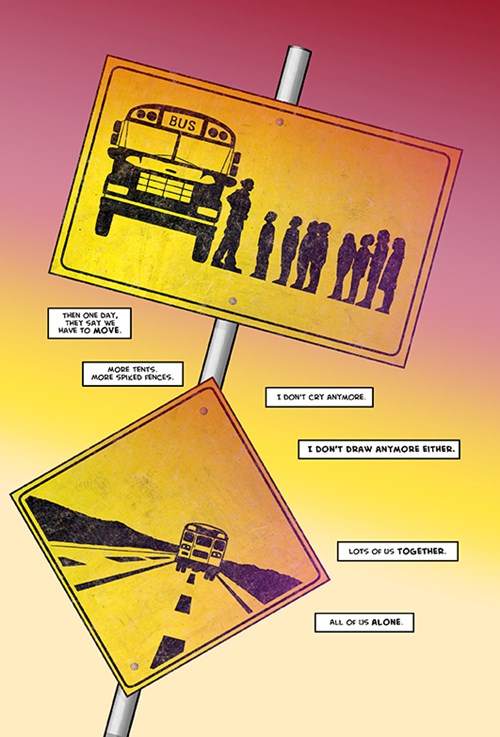
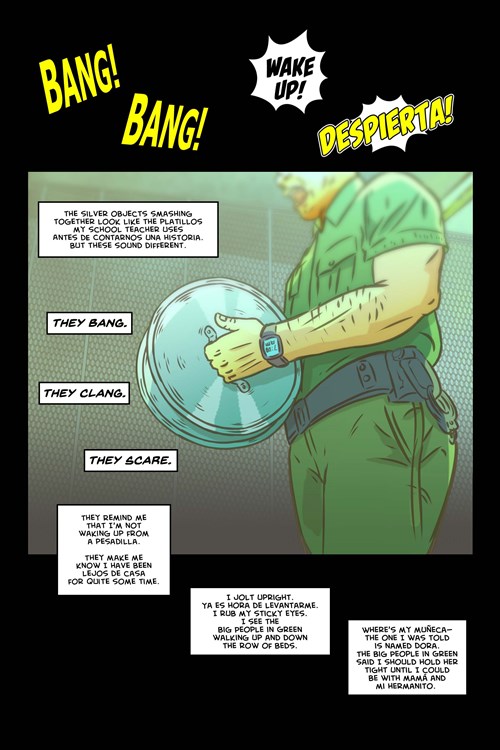
San Ysidro, Calexico, McAllen, and back and forth across the border. A young girl’s journey north goes wrong, and now she is in a forbidding new place, away from her parents and brother, where she doesn’t understand what the adults in green are saying even as she tries to obey their rules.

Rocky, one of the few white kids in town, stands by and watches as Miguel is jumped by two of his friends. Maggie and her parents are separated at the border in a tragic accident.

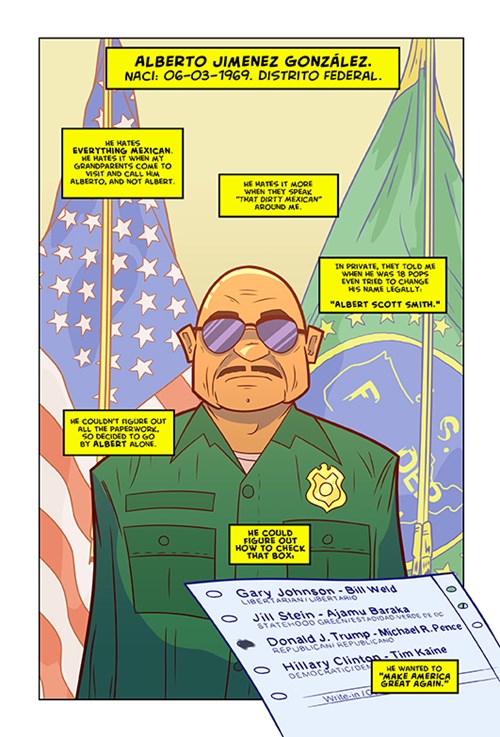
Alberto’s son doesn’t understand his Mexican father’s hatred for “illegals” or his work as a border patrol agent. Alicia is a TikTok influencer who doesn’t want to grow up to be a hospital cleaning lady like her mother, but COVID complicates things. Whatever their challenges, the kids, teens, tweens, and adults in these pages are just trying to survive their everyday lives.

Vibrantly illustrated by Oscar Garza, each of these short stories brings a different perspective on the perils of living on the border while brown.

I RECEIVED A DRC FROM THE PUBLISHER VIA EDELWEISS+. THANK YOU.

My Review
: The stories told here are tough. They're honest, they're emotionally charged, and they do not pander to or play out for the gaze of oh-so-sensitive/delicate fleur wypipo who whine every time anyone tells them the unvarnished truth about what the system their privilege enables them to ignore actually does in their collective name and to their collective benefit.

I don't recommend this for under-fifteens. I do think it's a good idea to give the book to your comic-loving teen nibling/grand boy.

These are indicative of the visual idiom of the entire book. It's intense and kinetic art, it's intense storytelling, and it can't be lightly glossed over or cynically dismissed easily. Young white men in particular could use a dose of this reality. Apart from urging you to get the work in front of all the teenaged white lads you can find, I'm out of polite words to say.

Thursday, October 10, 2024

THE WITCHES OF EL PASO, a deeply pleasurable read for my Frontera-raised self


THE WITCHES OF EL PASO
LUIS JARAMILLO

Atria/Primero Sueno Press
$27.99 hardcover, available now

Rating: 4.5* of five

The Publisher Says: A lawyer and her elderly great-aunt use their supernatural gifts to find a lost child in this richly imagined and empowering story of motherhood, magic, and legacy in the vein of The Inheritance of Orquídea Divina and La Hacienda.

If you call to the witches, they will come.

1943, El Paso, teenager Nena spends her days caring for the small children of her older sisters, while longing for a life of freedom and adventure. The premonitions and fainting spells she has endured since childhood are getting worse, and Nena worries she’ll end up like the scary old curandera down the street. Nena prays for help, and when the mysterious Sister Benedicta arrives late one night, Nena follows her across the borders of space and time. In colonial Mexico, Nena grows into her power, finding love and learning that magic always comes with a price.

In the present day, Nena’s grandniece, Marta, balances a struggling legal aid practice with motherhood and the care of the now ninety-three-year-old Nena. When Marta agrees to help search for a daughter Nena left in the past, the two forge a fierce connection. Marta’s own supernatural powers emerge, awakening her to new possibilities that threaten the life she has constructed.

I RECEIVED A DRC FROM THE PUBLISHER VIA NETGALLEY. THANK YOU.

My Review
: So satisfying. Slow and intricate, deep and wise. I'm sure some will find the woven timelines...no definitive breaks or obtrusive tricks mark the shifts in the timeline...to be deal-breakingly imprecise, but to me that made this like an oral performace of a mythic tale. I will say that, as this is also a review of the book meant to instruct others in its merits, I've nicked a half-star off because this pigeonholes the Perfect Reader a bit overly finely.

I don't always love it when men take it upon themselves to write about motherhood. Author Jaramillo manages to do this feat without making the commonest mistakes men fall into: flattening the narrative scope into a litany of caretaking chores or glossing over these same chores. The effect is the same either end of the spectrum. It makes the work of motherhood into insignificant triviality. I hasten to add that many women writers have done the same, Gone Girl being a notable example. In this book, caretaking, mothering, is literally everywhere and yet this didn't obtrude into my consciousness until I was reviewing my notes before writing this review.

That's well-done prosody...I'm in the sounds of the story not in the structure of it. As these are the sounds of la frontera, where I grew up, I fell right in and did not notice it. Very well done indeed, Author Jaramillo.

I don't think any one thing worked more in favor of the book than Nena's manner of explaining the past to her modern, harried granddaughter, not as a place of beautiful memories but of deeds undine and consequences unmet. Business to be finished dominates every life, none moreso than that of the oldest among us. I resonated like a struck bell to this thread of the tapestry woven for me.

As a way to add some occult flavor and Hispanic culture to your #Deathtober reading, this works very well. As a lovely story of the intense bonds of a loving family woman, forced by bitter circumstance to choose actions permanent and irremediable, making amends as best she can, it's gloriously satisfying.

Read soonest.

Thursday, February 1, 2024

HOW WE NAMED THE STARS, sweet first novel about first love


HOW WE NAMED THE STARS
ANDRÉS ORDORICA

Tin House
$17.95 trade paper, available now

Rating: 3.75* of five

The Publisher Says: Set between the United States and México, Andrés N. Ordorica’s debut novel is a tender and lyrical exploration of belonging, grief, and first love―a love story for those so often written off the page.

When Daniel de La Luna arrives as a scholarship student at an elite East Coast university, he bears the weight of his family’s hopes and dreams, and the burden of sharing his late uncle’s name. Daniel flounders at first―but then Sam, his roommate, changes everything. As their relationship evolves from brotherly banter to something more intimate, Daniel soon finds himself in love with a man who helps him see himself in a new light.

But just as their relationship takes flight, Daniel is pulled away, first by Sam’s hesitation and then by a brutal turn of events that changes Daniel’s life forever. As he grapples with profound loss, Daniel finds himself in his family’s ancestral homeland in México for the summer, finding joy in this setting even as he struggles to come to terms with what’s happened and faces a host of new

How does the person he is connect with this place his family comes from? How is his own story connected to his late uncle’s? And how might he reconcile the many parts of himself as he learns to move forward? Equal parts tender and triumphant, Andrés N. Ordorica’s How We Named the Stars is a debut novel of love, heartache, redemption, and learning to honor the dead; a story of finding the strength to figure out who you are―and who you could be―if only the world would let you.

I RECEIVED A DRC FROM THE PUBLISHER VIA NETGALLEY. THANK YOU.

My Review
: Books about first love are, I think we can all agree, among the most relatable stories there are. Everyone not a sociopath has had a First Love. We can all recall the feelings, the sensations, the sheer exhilaration of falling in love for the first time, and I suspect most of us not sociopaths also recall the returned love from the one we just fell in love with, even if not the first time. So, when choosing a story to tell, a debut novelist really starts out on a higher slope if they choose first...and for added charm forbidden...love.

What a shame I was not utterly ensorcelled by this iteration of the story.

I suspect some of this is due to the author's use of the character's journal as a narrative frame. This necessitates alternating first- and second-person narratives, sometimes in the same sentence; I assume this was an attempt to create a sense of immediacy unavailable in third-person omniscient narration. What happened instead was a sense of muddledness, a lack of clear character-building through different, or just differentiated, voices. The result was that I felt like this was an audiobook. Someone reading to me, unless I am in love with him, makes me utterly fuddled, and sends me into a defensive coma. It took me two weeks to read this not-very-long book.

My last critical comments are about the use of description: I am a lot less interested in rocks than the author appears to be. Is the color green talismanic for some reason? Why? If I am not given a hook to hang my response on, all it does, when a motif is repeated like the use of green is here, is start feeling like I am missing something. That is never a good thing.

So, for the sin of writing a first novel without some very firm editorial guidance, I docked stars. But that said, there are things I loved about this tale. I was particularly pleased that Spanish appeared throughout the read. The chapter titles being in Spanish when Daniel is in Mexico was a lovely touch, and offered me a distinctively culture-specific frame for those chapters. Daniel feeling his way through the bewildering maze of the US culture, through the school's culture, and through his forbidden love for another man, was absolutely terrific. It was, at times, unfocused due to the issues I mentioned above, but never so much so that I was unaware that Daniel...and Sam...were enmeshed in their emotional growth into love. Self-love, as always, has to precede lasting love for others. That is the universal agony of first gay loves, I fear.

Speaking of which...Sam being seen in all his waffling glory only through Daniel's eyes was, at first, odd...back the narrative framework issue...but ended up feeling so exactly like the first-love malaise that I quickly began to warm to it. First love is, of necessity, solipsistic. We can never really get out of that self-referential stage of being in love with love until, and unless, we go all the way through it. Daniel going home to stay with his abuelo and delve into his namesake uncle's life and times was a really suitable way to guide him through the thicket of his self-absorption. His emotional flowering struck me as both truthful and effective...I believed it, and I believed he was changed in the ways shown, by the discoveries he made.

While I am on the subject, I feel the necessity to address a critique of the author's handling of societal homophobia that I have seen brought up several times. It can seem as though the inevitable experience of others’ hateful judgments of himself and of Sam were lightly brushed off. I did not read them this way. As the novel is framed as a journal, the lack of sustained responses to and obsessions with homopohbia struck me as Daniel having, developing, and imparting to the more-affected Sam, a sense of homophobia being an external not internal problem...something imposed from outside. That is exactly how I think homophobia *should* be perceived. It is only a problem for one when one is interacting with the homohobes. That is a major positive in my opinion of the read because it shows the need to decenter the hate.

A mixed reading experience, one with major positives and a bunch of small negatives. A first novel, I hope not an only novel, from a man whose emotional journey is, quite clearly, only beginning, and which I am glad I can share.