Pages
- Home
- Mystery Series
- Bizarro, Fantasy & SF
- QUILTBAG...all genres
- Kindle Originals...all genres
- Politics & Social Issues
- Thrillers & True Crime
- Young Adult Books
- Poetry, Classics, Essays, Non-Fiction
- Science, Dinosaurs & Environmental Issues
- Literary Fiction & Short Story Collections
- Sookie Stackhouse/Southern Vampire Books & True Blood
- Books About Books, Authors & Biblioholism
Showing posts with label Mexico setting. Show all posts
Wednesday, June 17, 2026
MEDEA SANG ME A CORRIDO, latest feminist redemption of a Classical-mythology woman's character
MEDEA SANG ME A CORRIDO
DAHLIA DE LA CERDA (tr. Heather Cleary & Julia Sanches)
The Feminist Press (non-affiliate Bookshop.org link)
$17.95 all editions, available now
Rating: 4.75* of five
The Publisher Says: A punk revival of Medea as a Mexican anti-angel of birth and death, from the International Booker Prize–nominated author of Reservoir Bitches
In Northern Mexico, Paulina, Perla, Antonia, Reina, and Jordan are striving to survive the barrio—hustling on the edge of a cartel-run economy, nursing the wounds made normal in a world that eats its own. Hovering over their trials is a spirit with gothic flair, dressed in black and crowned with braids: Medea, a mythic mother of the Chihuahuan desert, ancient as the Aztecs but never too old to be petty.
From aiding a trophy girlfriend’s abortion, to accompanying a mother in her search for her lost child in the desert, to embracing those taken too soon in the narco’s brutal proxy wars, Medea fights for justice for her chosen mortals—her divine wrath the only power that could rival the corrupt, violent web spun by the cartel, the government, and the military. Dahlia de la Cerda’s magnetic prose draws readers right into the heart of that web—and links all our fates to the missions of Medea, equal parts midwife and gravedigger, a femme fatale god in a femicidal world.
I RECEIVED A DRC FROM THE PUBLISHER VIA EDELWEISS+. THANK YOU.
My Review: Repurposing classical myths for the twenty-first century is a...subgenre? full genre? literary storytelling technique?...an effort I enjoy a great deal. Medea repurposed as avenging goddess, destroying angel, wrathful righter of women's victimization, has double appeal for me. It corrects what I've always seen as the calumniation of a powerful healer-semidivinity with the accusation of insane jealousy over a man who has abandoned her for another woman. She is accused in classical sources of murdering her children, born of her body, to exact revenge on a faithless fucker she literally enabled, by using her skills and knowledge, to come to power and riches.
A healer-spirit so skilled she is regarded as divine.
Male anxiety much, Euripides?
So I've never found the famous version of Medea at all convincing. It smacks of an attempt to invalidate a powerful and skilled woman by making her hyperfocused on a man; by accusing a mother of murdering her children born of her body because a man hurt her feelings by betraying her with another woman.
Hogwash.
No better mythological figure, then, to be repurposed into a guardian of women in a seriously patriarchal, femicidal culture like that of the narcotraficantes. Setting these interconnected stories...more like very well-defined chapters than actual stories, what I myownself have always referred to as "braided stories" because, like a braid, the separate strands are evident while making together a whole effect not possible for the strands separately (see Celeste Mohammed's works)...in what she calls "Aztlán," the narcostate existing in Northern Mexico where femicide is appallingly rampant offers Author Dahlia wide scope for Medea's redemption. As an avenger, Medea appears here with clear markers of supernatural power: "Then she kissed me on the forehead and shot through the sky in a snake-drawn carriage," is not a description of an everyday person. Six women in dire trouble are visited and assisted by Medea in barely over a hundred pages.
None of them are spotless, sweet little fembots, which is a relief. Messy, horny, misguided people are innumerable across the globe and occur in every ray of the rainbow of identities humans so love to pretend are Ordained and Immutable. Medea ignores these ideologically driven cultural fripperies to effect redress for the wronged.
It's satisfying to me because I like Ma'at being served by Justice (very different in my observation from mere "justice" such as the travesty being perpetrated by the US government department using that name). Medea, in Author Dahlia's hands, serves and renders Justice even in the face of "justice."
I have only one critique to offer in support of my just-off-perfect rating of the work: sometimes speed is not your friend when offering tendentious and muckraking narratives. I felt, by the end of the read, I was not in possession of enough facets of each woman's life experience to grasp the motivation for Medea coming to the rescue. It's not necessary for the story of Medea as avenger to be formed and shaped. That is done, and the shape is one I found enrichingly sharp. I was not utterly enthralled where that was *easily* within Author Dahlia's reach.
It's a braid of great beauty. It stops short of Divine Grace. And it is so urgently necessary for all of us to get our heads around the reason it exists I'm here pushing it at you. Please pick one up soonest.
Wednesday, December 17, 2025
THE BULLET SWALLOWER, La Frontera's reckoning on the page
THE BULLET SWALLOWER
ELIZABETH GONZALEZ JAMES
Simon & Schuster (non-affiliate Bookshop.org link)
$13.99 ebook, available now
Rating: 4.25* of five
The Publisher Says: A dazzling magical realism western in the vein of Cormac McCarthy meets Gabriel García Márquez, The Bullet Swallower follows a Mexican bandido as he sets off for Texas to save his family, only to encounter a mysterious figure who has come, finally, to collect a cosmic debt generations in the making.
In 1895, Antonio Sonoro is the latest in a long line of ruthless men. He’s good with his gun and is drawn to trouble but he’s also out of money and out of options. A drought has ravaged the town of Dorado, Mexico, where he lives with his wife and children, and so when he hears about a train laden with gold and other treasures, he sets off for Houston to rob it—with his younger brother Hugo in tow. But when the heist goes awry and Hugo is killed by the Texas Rangers, Antonio finds himself launched into a quest for revenge that endangers not only his life and his family, but his eternal soul.
In 1964, Jaime Sonoro is Mexico’s most renowned actor and singer. But his comfortable life is disrupted when he discovers a book that purports to tell the entire history of his family beginning with Cain and Abel. In its ancient pages, Jaime learns about the multitude of horrific crimes committed by his ancestors. And when the same mysterious figure from Antonio’s timeline shows up in Mexico City, Jaime realizes that he may be the one who has to pay for his ancestors’ crimes, unless he can discover the true story of his grandfather Antonio, the legendary bandido El Tragabalas, The Bullet Swallower.
A family saga that’s epic in scope and magical in its blood, and based loosely on the author’s own great-grandfather, The Bullet Swallower tackles border politics, intergenerational trauma, and the legacies of racism and colonialism in a lush setting and stunning prose that asks who pays for the sins of our ancestors, and whether it is possible to be better than our forebears.
I RECEIVED A DRC FROM THE PUBLISHER VIA EDELWEISS+. THANK YOU.
My Review: Inherent in any story set in the western part of the US is racism, is settler colonialism is the trauma of violence...institutionalized all the way to interpersonal. "The past is not so far away as you might think. Nor the future, for that matter. No man lives free from history." This is the beating heart of the story, in fact of the entire setting in real world terms. No one is free from history.
Jaime, in his reckoning with that aperçu's truth, receives...non-corporeal, I guess...divine, malign, either, probably both, but certainly not of consensus reality assistance from the aptly named Remedios. He's made privy to the, well, Akashic records of his family's deeds. I can only imagine the horrible burden of knowing the inalterable and undeniable facts of your very roots in reality.
Are we in fact our relatives' keepers after all? Is that the myth of Cain and Abel's longevity explained? I know Jaime believes the information he now has is true but he does not question what truth it tells. If an entity asserted I was responsible for balancing the scales of an entire lineage, I'd want to see some ID proving the authority of this assertion.
Jaime not being so suspicious and mistrustful, off we go into the blood-soaked deeds and violent cruelties of the past. It's an open question if this results in a better book than a "straight" magical-realist tale, as these limit their violences more than this full-throated shout of rage does.
When it comes to the acceptance of personal accountability for actions rendered unchangeable by time's passage I'm of two minds. We unquestionably live within the blast radius of our predecessors' decisions, actions, inactions. It is not logical to deny this fact. What do we owe the present for the actions of the past? Not nothing, that's absurd and greedy because it's only ever applied to the beneficiaries while the descendants of those who suffered and lost bear the consequences forever. Where is a reasonable balance point?
Jaime's resolution is the source of my missing star. In the final chapter there is a revelation that emphasizes the magical realism throughout the story was baked in from giddy-up to whoa. It vitiates the journey Jaime has been on from my point of view, but it is very much of a piece with the spooky frame we're looking at the picture within.
Solidly four stars, transported me to my kidhood in Mercedes, Texas, and will transport you, too. Needing to be somewhere your family is not for the Yuletide celebrations? Here's a book that's set in a uniquely characterful corner of the US that has a lot to answer for historically. What could be more apt for reading in family-togetherness time?
Thursday, October 16, 2025
TEQUILA: A Story of Success, Love & Violence, a story of family, business, and love
TEQUILA: A Story of Success, Love & Violence
TIM REUBEN
Meridian Editions (non-affiliate Bookshop.org link)
$19.95 paperback, available now
Rating: 3.75* of five
The Publisher Says: Tequila is the gripping saga of three generations of the Ramirez family. From Sotero Ramirez's humble beginnings to his struggle for success, he and his family must overcome a harsh environment plus the frequent deadly encounters with Mexican drug cartels.
Still, the family's tequila business blossoms into a multi-billion-dollar international conglomerate, and his granddaughter Maria is chosen to manage the company, which relocates from Mexico to downtown Manhattan. But she is plagued by the peccadillos of her L.A.-based brother Tomaso, and the evil scheming of her other brother, Miami-based Miguel, who bring their family business to the brink of ruin and even threaten the lives of Maria and the adversary she falls in love with, Los Angeles lawyer Brian Youngman.
This fascinating intrigue spans the globe, from the farms of Tequila, Mexico, to the skyscrapers of New York, from bayside mansions in Miami to law courts in Los Angeles, jet-setting to the Cayman Islands, the moors of Scotland, Jamaica's beaches, and financial centers in Paris. The story unfolds in unpredictable and at times tragic ways.
I RECEIVED A DRC FROM THE PUBLISHER VIA NETGALLEY. THANK YOU.
My Review: I did not want to like this story as much as I did. The prose is not excellent, nor is it incompetent; instead, it leaves little to no impression of itself after consuming it.
So why rate it this high? I got wrapped up in the many characters' intertwining lives, their very shady-but-legal wranglings as they determinedly, doggedly built a business of consequence out of an agricultural product. It's quite a fascinating feat to create a "brand" out of a commodity. We live in the time of brands, and mostly we're not examining the ide behind them.
Tim Reuben examines that feat, using as his lens the drive of a family's natural desire to make more for themselves, their people, than simply surviving on doing basic-to-existence work. I had a task to keep the dramatis personae straight. I honestly put a lot of that on Tim, because it's not always clear who's speaking...no one really has A Voice in the literary sense. Some catchphrases, but that's the sitcom version of A Voice.
Resolving María, our root-for character's, dilemma, and seeing her wrestling with the eternal "is family more important than morality?" dilemma, makes this a very worthwhile read. Do not expect to be thrilled by the writing and it becomes a much more exciting story. I just wish it was a better novel. Maybe his next one will be.
Saturday, October 11, 2025
A SILENT FURY: The El Bordo Mine Fire, in case you wondered why Mexicans do not love the US
A SILENT FURY: The El Bordo Mine Fire
YURI HERRERA (tr. Lisa Dillman)
And Other Stories (non-affiliate Bookshop.org link)
$13.95 paperback, available now
Rating: 3.5* of five
The Publisher Says: On March 10, 1920, in Pachuca, Mexico, the United States Smelting, Refining and Mining Company―the largest employer in the region, and known simply as the Company―may have been guilty of murder.
The alert was first raised at six in the morning: a fire was tearing through the El Bordo mine. After a short evacuation, the mouths of the shafts were sealed. Company representatives hastened to assert that “no more than ten” men remained in the shafts at the time of their closure, and Company doctors hastened to proclaim them dead. The El Bordo stayed shut for six days.
When the mine was opened there was a sea of charred bodies―men who had made it as far as the exit, only to find it shut. The final death toll was not ten, but eighty-seven. And there were seven survivors.
Now, a century later, acclaimed novelist Yuri Herrera has carefully reconstructed a worker’s tragedy at once globally resonant and deeply personal: Pachuca is his hometown. His sensitive and deeply humanizing work is an act of restitution for the victims and their families, bringing his full force of evocation to bear on the injustices that suffocated this horrific event into silence.
I RECEIVED A DRC FROM THE PUBLISHER VIA EDELWEISS+. THANK YOU.
My Review: Short, sharp bark of outrage at a century's remove. Corporate personhood was taking shape as this nightmarish dereliction of responsibility and duty of care took place; no punishment, no justice, not even the cold, uncaring offer of cash recompense was ever levied. Certainly none was offered.
Yuri Herrera's emotional recounting of these events is short, never easy to read, and quite possibly better in theory than practice. I agree with his points, and yet was feeling hectored by the read. Might better've been a novel, with the incandescent outrage presented from multiple PoVs.
As it is, this is an anticapitalist screed for those of us already on the pews.
Saturday, May 10, 2025
RESERVOIR BITCHES: Stories, outrage...rage...there's more in here than meets the eye
RESERVOIR BITCHES: Stories
DAHLIA DE LA CERDA (tr. Julia Sanches & Heather Cleary)
The Feminist Press at CUNY
$16.95 ebook, available now
Rating: 4.75* of five
The Publisher Says: LONGLISTED for the 2025 International Booker Prize
A debut collection of gritty, streetwise, and wickedly funny stories about Mexican women who fight, skirt, cheat, cry, kill, and lie their way to survival.
“Life’s a bitch. That’s why you gotta rattle her cage, even if she’s foaming at the mouth.” In the linked stories of Reservoir Bitches, thirteen Mexican women prod the bitch that is Life and become her. From the all-powerful daughter of a cartel boss to the victim of transfemicide, from a houseful of spinster seamstresses to a socialite who supports her politician husband by faking Indigenous roots, these women spit on their own reduction and invent new ways to endure, telling their own stories in bold, unapologetic voices. At once a work of black humor and social critique, Reservoir Bitches is a raucous debut from one of Mexico’s most thrilling new writers.
I RECEIVED A DRC FROM THE PUBLISHER VIA EDELWEISS+. THANK YOU.
My Review: If and/or when (honestly I'm all but certain it won't happen) the mooted TV series, via Amazon Prime and Spanish-language producers Perro Azul, arrives I will be *amazed* if even a third of rage and fury in these stories make it onto the screen. Since the Feminist Press mentioned this possibility when the book was first published in September 2024, nothing else has appeared on Amazon, The Hollywood Reporter, or even Perro Azul's Spanish-language websites. I expect it's a dead deal...given the truly hair-raising stuff in here, I'd be far more surprised if any production efforts were ever made. This is strong stuff. The *men* in charge of any budgets will not approve this one!
As is reasonable and customary in these parts, these thirteen stories will be dealt with by using the time-honored Bryce Method.
Parsley and Coca Cola details an at-home self-induced effort at aborting an unwanted child..."Yup, I got knocked up by a terrible lay," she says directly to us, recounting this latest blow from Clotho's shuttle as her life of bad luck...no visible dad, dead mom, now this...takes its own ugly pattern. A lucky break...an older woman who clearly knows the score...means a day or so of nasty pain, some passing of clots, and finally confirmed success.
Not for the squeamish, but I can vouch for its accuracy. 4*
Yuliana brutalizes our eyes with the inner monologue of a drug capo's heiress, the toughest of his children. "We women always speak, think, and act from the memory of our pain," she says to us as she recounts her revenge on the man who killed her high-school bestie via her new, um, protegée's well-honed skills as an angel of vengeance against men who abuse women.
The female of the species, fam. 4.5*
God Forgive Us, a cri de cœur, emitted by an old mestiza spinster who's spent her whole life caring for...and about...her duty, her reputation, after she and another sister murder a girl.
The girl was a machete-wielding robber, so it was self-defense. No legal problems ensue. But how terrible her guilt, how bitter the social dregs! She killed a girl! Because she and her sister thought the violent invader of their home was a boy.
But it was a girl! Her poor mother! 4*
Constanza proves that, when you have no center, nothing is ever going to hold you back. Unsettling. I felt...outrage, anger, contempt, quietly and at myself for how easily I saw her point and how terribly easily snuffing out a life could become a routine matter. It was a wake-up call for the snotty little moralizer inside to see the emotional rightness of tit-for-tat. 4 unsettled stars, and an extra session in therapy requested
God Didn't Come Through like she ever does, mijo. This is the other side of "God Forgive Us," in case you want to practice your lip-pursing action. First mention in the collection, to my surprise, of Santa Muerte...and I now twig to the fact I haven't mentioned the untranslated Spanish yet!
Words here and there are dropped without full context but with plenty of cues, so you're never left at sea. Offshore in a sturdy dinghy, yes; but always in sight of the land that meaning provides. 4.5*
La China takes us inside "Yuliana"'s murder plans, and an account of the action that, while revolting, was not prurient or distastefully lingering.
I'm a little unnerved that it's so easy to put myself into the headspace of these outsiders, to see there's a real "why" behind the awful whats they're doing. I'll need another extra therapy session soon. 4*
The Rose of Sharon is so short it barely counts a percentage point in the read. It is every goddamned thing I despise about religion in one caustic, awful vignette. I still see its vileness in front of my eyes...
This is not the end, or the ending. Suffice to say myths enacted are always enacted for evil. 4*
Regina is the deets behind "Yuliana"'s inciting incident. Not memorable, feels...hmmm...like a makeweight, a tossed-on bread roll to get the scale where it needs to be.
Plus, it's ever-so precious. 3*
Mariposa de Barrio is what happens when life's a lemon grove, the lemonade's for the owner, all you're gonna get is the empty, fleshless rinds...boil up some sugar and candy that peel, mija! Never mind how much it costs. Bills can get paid all kinda ways, but all of 'em Later. 3.5*
The Smile makes the femicides on La Frontera deeply personal. Somehow even the appalling facts do not feel prurient, since they're not lingered over; I like to think this actually happened, the ending I mean, at least once. 4*
Sequins "Masculinity is like marzipan: fragile as hell, queen," says our transfem narrator. Let me tell you, seeing that observation in a defector from The Boys was a bitch-slap like no other. Then, the price for laughter: murder, femicide again, only this time the details are there. It's brutal to read but what human could do that, all that, to a living person?
An evil one, the evil ones are the killers not ever their victims. Blood does wash away "sins"—the victim's. 4.5*
Playing with Fire is the funniest story here, among some weirdly funny, but not nice, stuff. This one is rip-your-shorts laughing fun.
Professional courtesy is not just between lawyers. 5*
La Huesera, last in line, is more novelette than story.
Fucking brutal. Horrifying. Enraging. La Huesera adressed de profundis:
DAHLIA DE LA CERDA (tr. Julia Sanches & Heather Cleary)
The Feminist Press at CUNY
$16.95 ebook, available now
Rating: 4.75* of five
The Publisher Says: LONGLISTED for the 2025 International Booker Prize
A debut collection of gritty, streetwise, and wickedly funny stories about Mexican women who fight, skirt, cheat, cry, kill, and lie their way to survival.
“Life’s a bitch. That’s why you gotta rattle her cage, even if she’s foaming at the mouth.” In the linked stories of Reservoir Bitches, thirteen Mexican women prod the bitch that is Life and become her. From the all-powerful daughter of a cartel boss to the victim of transfemicide, from a houseful of spinster seamstresses to a socialite who supports her politician husband by faking Indigenous roots, these women spit on their own reduction and invent new ways to endure, telling their own stories in bold, unapologetic voices. At once a work of black humor and social critique, Reservoir Bitches is a raucous debut from one of Mexico’s most thrilling new writers.
I RECEIVED A DRC FROM THE PUBLISHER VIA EDELWEISS+. THANK YOU.
My Review: If and/or when (honestly I'm all but certain it won't happen) the mooted TV series, via Amazon Prime and Spanish-language producers Perro Azul, arrives I will be *amazed* if even a third of rage and fury in these stories make it onto the screen. Since the Feminist Press mentioned this possibility when the book was first published in September 2024, nothing else has appeared on Amazon, The Hollywood Reporter, or even Perro Azul's Spanish-language websites. I expect it's a dead deal...given the truly hair-raising stuff in here, I'd be far more surprised if any production efforts were ever made. This is strong stuff. The *men* in charge of any budgets will not approve this one!
As is reasonable and customary in these parts, these thirteen stories will be dealt with by using the time-honored Bryce Method.
Parsley and Coca Cola details an at-home self-induced effort at aborting an unwanted child..."Yup, I got knocked up by a terrible lay," she says directly to us, recounting this latest blow from Clotho's shuttle as her life of bad luck...no visible dad, dead mom, now this...takes its own ugly pattern. A lucky break...an older woman who clearly knows the score...means a day or so of nasty pain, some passing of clots, and finally confirmed success.
Not for the squeamish, but I can vouch for its accuracy. 4*
Yuliana brutalizes our eyes with the inner monologue of a drug capo's heiress, the toughest of his children. "We women always speak, think, and act from the memory of our pain," she says to us as she recounts her revenge on the man who killed her high-school bestie via her new, um, protegée's well-honed skills as an angel of vengeance against men who abuse women.
The female of the species, fam. 4.5*
God Forgive Us, a cri de cœur, emitted by an old mestiza spinster who's spent her whole life caring for...and about...her duty, her reputation, after she and another sister murder a girl.
The girl was a machete-wielding robber, so it was self-defense. No legal problems ensue. But how terrible her guilt, how bitter the social dregs! She killed a girl! Because she and her sister thought the violent invader of their home was a boy.
But it was a girl! Her poor mother! 4*
Constanza proves that, when you have no center, nothing is ever going to hold you back. Unsettling. I felt...outrage, anger, contempt, quietly and at myself for how easily I saw her point and how terribly easily snuffing out a life could become a routine matter. It was a wake-up call for the snotty little moralizer inside to see the emotional rightness of tit-for-tat. 4 unsettled stars, and an extra session in therapy requested
God Didn't Come Through like she ever does, mijo. This is the other side of "God Forgive Us," in case you want to practice your lip-pursing action. First mention in the collection, to my surprise, of Santa Muerte...and I now twig to the fact I haven't mentioned the untranslated Spanish yet!
Words here and there are dropped without full context but with plenty of cues, so you're never left at sea. Offshore in a sturdy dinghy, yes; but always in sight of the land that meaning provides. 4.5*
La China takes us inside "Yuliana"'s murder plans, and an account of the action that, while revolting, was not prurient or distastefully lingering.
I'm a little unnerved that it's so easy to put myself into the headspace of these outsiders, to see there's a real "why" behind the awful whats they're doing. I'll need another extra therapy session soon. 4*
The Rose of Sharon is so short it barely counts a percentage point in the read. It is every goddamned thing I despise about religion in one caustic, awful vignette. I still see its vileness in front of my eyes...
Vomit trickled from his mouth, smelling of liquor. I dropped to the floor with tears in my eyes and prayed he would choke. "Dear Lord, let the walls of Jericho fall before my eyes, throw off my shackles and drag this man to the gates of Hell. Give me victory over my enemy, knock down the walls of my prison and the fortresses that cast down my heart."So very godly, no?
This is not the end, or the ending. Suffice to say myths enacted are always enacted for evil. 4*
Regina is the deets behind "Yuliana"'s inciting incident. Not memorable, feels...hmmm...like a makeweight, a tossed-on bread roll to get the scale where it needs to be.
Plus, it's ever-so precious. 3*
Mariposa de Barrio is what happens when life's a lemon grove, the lemonade's for the owner, all you're gonna get is the empty, fleshless rinds...boil up some sugar and candy that peel, mija! Never mind how much it costs. Bills can get paid all kinda ways, but all of 'em Later. 3.5*
The Smile makes the femicides on La Frontera deeply personal. Somehow even the appalling facts do not feel prurient, since they're not lingered over; I like to think this actually happened, the ending I mean, at least once. 4*
Sequins "Masculinity is like marzipan: fragile as hell, queen," says our transfem narrator. Let me tell you, seeing that observation in a defector from The Boys was a bitch-slap like no other. Then, the price for laughter: murder, femicide again, only this time the details are there. It's brutal to read but what human could do that, all that, to a living person?
An evil one, the evil ones are the killers not ever their victims. Blood does wash away "sins"—the victim's. 4.5*
Playing with Fire is the funniest story here, among some weirdly funny, but not nice, stuff. This one is rip-your-shorts laughing fun.
Professional courtesy is not just between lawyers. 5*
La Huesera, last in line, is more novelette than story.
Fucking brutal. Horrifying. Enraging. La Huesera adressed de profundis:
Even if only part of your ashes...are under my bed, the way I see it, your bones have been gathered. I hope someday I'll get to hear you howling in the night.Saving the best for last, Author de la Cerda. 5*
Wednesday, August 7, 2024
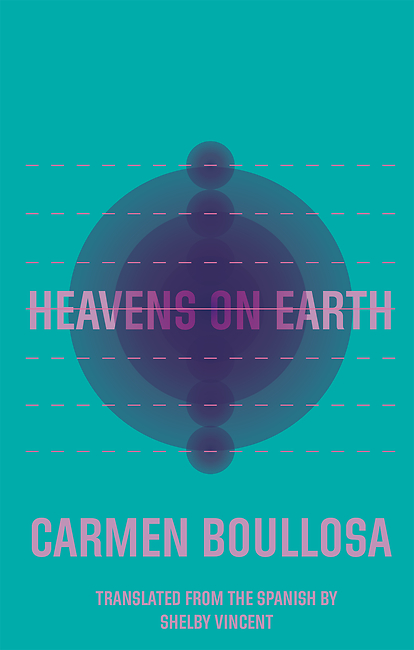
HEAVENS ON EARTH, as though such a thing could exist...which is the point of the read

HEAVENS ON EARTH
CARMEN BOULLOSA (tr. Shelby Vincent)
Deep Vellum (non-affiliate Amazon link)
$16.95 trade paper, available now
Rating: 4.5* of five
The Publisher Says: Three narrators from different historical eras engage in preserving history in Heavens on Earth. As her narrators sense each other and interact through time and space, Boullosa challenges the primacy of recorded history and asserts literature and language's power to transcend the barriers of time and space in vivid, urgent prose.
Carmen Boullosa is one of Mexico's leading novelists, poets, and playwrights. Her most recent novel The Great Theft (Deep Vellum, 2014) was shortlisted for the PEN Translation Prize, nominated for the International Dublin Literary Award, and won Typographical Era's Translation Award. She lives in Brooklyn, New York, and Mexico City, Mexico.
I RECEIVED A DRC FROM THE PUBLISHER VIA EDELWEISS+. THANK YOU.
My Review: Deeply, deeply examines our modern-US obsession with The Past. Every excursion into The Past requires acts of translation. You and I, reading and writing on our devices, pushing our words into strangers' faces as a matter of course (possibly detrimentally to discourse) can't know what anyone in The Past really meant to say. We can see the words. We can, but mostly won't bother to, study the time and thus learn some cultural facts that help us get a hint. But, like the radical fascist folk who assert their politicosocial ideas as representing those of the US "founders," we're translating words, not recovering facts. Author Boullosa uses multiple narrators in multiple timelines to examine the role of History and Tradition as anchors, as dead weights, and as foundations. What even is The Past, a key question for each narrator. The same events look hugely different to people with different perspectives.
I am usually a bit iffy on this narrative technique. In this case, I lapped it up because Estela in the present, Learo in the future, and Don Hernando in the past each explore this story's central thesis, the nature of narrative in shaping culture, without resorting to speeches. No one says, "if they/we had only known" or the equivalent. They tell us, their readers, the reality they live in as seen from their differing levels of privilege granted to each one's identity. Fair warning, there is frank...but uncelebrated...homophobia, colorism, and racism. They are facts of the past and present. The future, well...we won't know for a while, will we?
The narrative conceit is of a manuscript written in Latin when the Conquest was within living memory. Its author's a gay man in Holy Orders; not so shocking an idea for the time. It falls into the hands of a present-day scholar, Estela, who translates it (into Spanish). She is living in the failing Western country, Mexico. She annotates the manuscript with an academic eye on the roots of the present-day struggles in the clueless past, intending to make it public. Somehow the manuscript reaches Learo living in a wildly posthuman, post-scarcity future where The Past is not discussed, not heeded, not mined for clues or used as either guide or horrible warning. Learo's narrative is, unsurprisingly, polyphonic with Don Hernando's account of how the Conquest violently and cruelly mangled the memories and the bodies of the dwellers in "New Spain," an utterly invented and brutally enforced culture. As is always the case in examples of conquest, the ordinary person is required to graft a new identity onto their lifelong one, an intimate violation of self that begets more and more violence.
It is a stunning psychic violence that pollutes every facet of the future.
Yet without an honest reckoning with it, the present is unmoored, is prone to equal, congruent violence. The future that creates is...chilling. I'll say, for fear of spoilers, what Author Boullosa says: this novel explores "the prohibition of memory that will take us to the abolition of language, the repercussions of which the reader will witness."
"Repercussions" might be the best-translated word Shelby Vincent chose.
This novel, in its translation from Spanish to English, offers a far more trenchant riposte to foolhardy US politicosocial "essentialism" than a dozen more "factual" analyses could. A story does something an analysis can't: Personalizes the reverberations of actions taken or not taken, of salvations offered and denied. How we read this novel, in English, is already a thing apart from how it was written in Spanish. Its echoes of Anglophone sensation Cloud Atlas will be seen by the myriads of y'all who read (and mostly loved) that timeweaving narrative. More recently we had the multiversal Everything Everywhere All at Once pursuing the layering of causality in its own specially fraught way. The topic is a delightfully rich one, offering many opportunities to contemplate the story, its message, its execution, and its presentation in an enhanced framework. The effort of following the story through its curlicues and oddly bent pathways is richly repaid.
What effort you make at translation is always a life-altering thing. Reader be aware. You will leave a different soul than the one you entered as.
Thursday, September 15, 2022
THE JUAN PABLO VILLALOBOS PAGE: I DON'T EXPECT ANYONE TO BELIEVE ME; QUESADILLAS; INVASION OF THE SPIRIT PEOPLE
INVASION OF THE SPIRIT PEOPLE
JUAN PABLO VILLALOBOS (tr. Rosalind Harvey)
And Other Stories
$17.95 trade paper, available now
Rating: 4.5* of five
The Publisher Says: Juan Pablo Villalobos’s fifth novel adopts a gentle, fable-like tone, approaching the problem of racism from the perspective that any position as idiotic as xenophobia can only be fought with sheer absurdity.
In an unnamed city, colonised by an unnamed world power, an immigrant named Gastón makes his living selling exotic vegetables to eateries around the city. He has a dog called Kitten, who’s been diagnosed with terminal cancer, and a good friend called Max, who’s in a deep depression after being forced to close his restaurant. Meanwhile, Max’s son, Pol, a scientist away on a scientific expedition into the Arctic, can offer little support.
Faced with these dispiriting problems, Gastón begins a quest, or rather three: he must search for someone to put his dog to sleep humanely; he must find a space in which to open a new restaurant with Max; and he must look into the truth behind the news being sent back by Pol: that human life may be the by-product of an ancient alien attempt at colonisation . . . and that those aliens might intend to make a return visit.
I RECEIVED A DRC FROM THE PUBLISHER VIA EDELWEISS+. THANK YOU.
My Review: Alien invasion! Gastón's shared son, Pol, is freaking right out (wouldn't we all!) as he tries to get through Max, his depressed father's, fog to...to what? Gastón, his other father, isn't quite sure what to do about Max's decline into dissociation from his failing business and crumbling participation with the world. But is Gastón sure he believes Pol? Aliens from space made us humans what we are?
Add to the stress of trying to prop up Max, comprehend the influx of aliens from Earth (...or are they...?) and what that means for his and Max's attempts to survive as feeders of the people via growing and cooking food, his quest to find someone he trusts to give Kitten (his aging, ill dog) a good death. This is entirely a story of the humanity of all people, regardless of where they come from or how they define themselves.
A casual reader might see the Asian stereotyping, with mentions of slanting eyes etc etc as endorsing this world-view. I don't think that is accurate, or fair. It seems to me that every step of the story's progress is made in the harsh light of Judgment. No one here, from Gastón (whose exploits we're following closely, as the third-person narrator advises us early on) on down, is spared an unflattering shadow.
As is the norm for Author Villalobos, there is stuff to shock and offend those prone to such histrionics. Avoid the read, then, if you're not prepared to look closely at your own responses to the events unfolding here. I myownself think it's another, less raucous but more reflective, take-down of the structures and maintainers of Power as it's used in the twenty-first century end-stage capitalist world.
++++++++++++++++++++++++++++++++++++++++++++++++++++++++++++++++
QUESADILLAS
JUAN PABLO VILLALOBOS (tr. Rosalind Harvey)
FSG Originals
$5.99 Kindle edition, available now
Rating: 4.5* of five
The Publisher Says: It’s the eighties in Lagos de Moreno—a town where there are more cows than people, and more priests than cows—and a poor family struggles to overcome the bizarre dangers of living in Mexico. The father, a high school civics teacher, insists on practicing and teaching the art of the insult, while the mother prepares hundreds of quesadillas to serve to their numerous progeny: Aristotle, Orestes, Archilochus, Callimachus, Electra, Castor, and Pollux. Confined to their home, the family bears witness to the revolt against the Institutional Revolutionary Party and their umpteenth electoral fraud. This political upheaval is only the beginning of son Orestes’s adventures and his uproarious crusade against the boredom of rustic life and the tyranny of his older brother.
Both profoundly moving and wildly funny, Juan Pablo Villalobos’s Quesadillas is a satiric masterpiece, chock-full of inseminated cows, Polish immigrants, religious pilgrims, alien spacecraft, psychedelic watermelons, and many, many “your mama” insults.
I RECEIVED AN ARC FROM THE PUBLISHER. THANK YOU.
My Review: I do not think there is another author alive who can make such a painfully, angrily critical book about inequality so damned funny. Foul-mouthed Oreste blasts your wimpy Norteño eyes with some deeply "offensive" cursing, swearing, and blasphemy.
I, of course, loved it.
You need to be warned, though, lest you fall into one of those performative swoons that are so absurd and typical of the US readers. Lots and lots and lots of pearl-clutching fun to be had, of course, howling about your delicate sensibilities! But you can't claim to be blindsided. I'm telling you clearly, now, before you pick it up, that this teenager's mouth is not going to sound good to you.
To me, it was a welcome return to honest, gut-deep youthful outrage at the hideous, genuinely offensive to proper sensibility calibration, social crimes and thefts. Nothing in this flensingly honest shout of outrage should shock you more than the cruelty, the sheer shocking indifference, of the economic elites.
I encourage the easily-offended pearl-clutching fools to read it because it will offend them. They need offending.
++++++++++++++++++++++++++++++++++++++++++++++++++++++++++++++++
I DON'T EXPECT ANYONE TO BELIEVE ME
JUAN PABLO VILLALOBOS (tr. Daniel Hahn)
And Other Stories
$17.95 trade paper, available now
Rating: 4.25* of five
The Publisher Says: The author of Down the Rabbit Hole delivers a hilarious and prize-winning tale of immigrants, students and gangsters in Barcelona
“I don’t expect anyone to believe me,” warns the narrator of this novel, a Mexican student called Juan Pablo Villalobos. He is about to fly to Barcelona on a scholarship, when he’s kidnapped in a bookshop and whisked away by thugs to a basement. The gangsters are threatening his cousin – a wannabe entrepreneur known to some as “Projects” and to others as “dickhead” – who is gagged and tied to a chair. The thugs say Juan Pablo must work for them. His mission? To bring Laia, a Mexican student in Barcelona and the daughter of a corrupt politician, to fall in love with him. He accepts, albeit unwillingly, and albeit after the crime boss has forced him at gunpoint into a discussion on the limits of humour in literature.
Part campus novel, part gangster thriller, I Don’t Expect Anyone to Believe Me is Villalobos at his best, exuberantly foul-mouthed and intellectually agile. This hugely entertaining novel, the winner of Spain’s prestigious Herralde Prize, makes light work of difficult subjects – immigration, corruption, family loyalty and love – in a story where the bad guys aren’t as expected…and nor is anyone else.
I RECEIVED A DRC FROM THE PUBLISHER VIA EDELWEISS+. THANK YOU.
My Review: I did not know how I was going to review this latest satirical, bitter-as-bile delight from Juan Pablo Villalobos. Now I not only don't have to review it, I wouldn't dare. Robert Rea of estimable literary magazine The Southwest Review has already done everything I wanted to do, only he did it better. You can't see me, but I am vibrating with a Day-Glo orange jealous ragey hatred after reading that...that....
If you liked THE SAVAGE DETECTIVES by Roberto Bolaño (here unsubtly parodied and lovingly honored), or any of Villalobos's previous books (QUESADILLAS {review above} or DOWN THE RABBIT HOLE for example), you should rush to the Kindle and download this gem or get the paperbook from your favorite bookery. Wherever you source it, y'all literary readers will most likely never feel a moment's regret that you read it.
Tuesday, September 9, 2014
DEMON OF THE AIR, Aztec Mexico City had murders too

DEMON OF THE AIR (Aztec Murder Mystery #1)
SIMON LEVACK
Macmillan
$7.59 Kindle edition, available now
Rating: 3.25* of five
The Publisher Says: Mexico-Tenochtitlan, in the year Twelve-House: the vast, teeming city of the Aztecs at the height of its glory. sacrificial victim up the steps of the Great Pyramid to celebrate the Festival of the Raising of Banners. at the ritual slaughter of the so-called Flowery Death. Yaotl's only worry is how to explain it to his master. questions about the sorcerers who have vanished from his impregnable prison, Yaotl realises he needs answers soon. threaten the future of everything he knows.
My Review: I felt transported to pre-Conquest Tenochtitlan. The main character is a very complex and involving man, and it's fun to get to know him. The world he inhabits is deeply interesting and drawn in careful, artlessly presented detail. Levack should give lessons in world-building to most historical novelists, since evreything I learned was tied to character development not to mere didacticism.
The mystery itself was not as wonderful as the storytelling that got us to the end. It's predictable, and I can't say that I as a queer man appreciated the villain's queerness being presented as a source of his villainy. It's accurate to the times and the culture, of course, and there's nothing that suggests it's gratuitous except that one really didn't need any information about sexual orientation to make the mystery make sense.
A flaw, and a serious one at that. It feels like the author could be venting some personal animus in this characterization, though I have no evidence of this and can't support it with anything aside from my own feelings. An entire star taken off my personal rating. But withal, the author's abilities are such that I have all the books in the series lined up on the night-table ready to be read.
This work is licensed under a Creative Commons Attribution-NonCommercial-ShareAlike 3.0 Unported License.
Subscribe to:
Posts (Atom)