Showing posts with label Mexican woman novelist. Show all posts

Wednesday, June 17, 2026

MEDEA SANG ME A CORRIDO, latest feminist redemption of a Classical-mythology woman's character


MEDEA SANG ME A CORRIDO
DAHLIA DE LA CERDA
(tr. Heather Cleary & Julia Sanches)
The Feminist Press (non-affiliate Bookshop.org link)
$17.95 all editions, available now

Rating: 4.75* of five

The Publisher Says: A punk revival of Medea as a Mexican anti-angel of birth and death, from the International Booker Prize–nominated author of Reservoir Bitches

In Northern Mexico, Paulina, Perla, Antonia, Reina, and Jordan are striving to survive the barrio—hustling on the edge of a cartel-run economy, nursing the wounds made normal in a world that eats its own. Hovering over their trials is a spirit with gothic flair, dressed in black and crowned with braids: Medea, a mythic mother of the Chihuahuan desert, ancient as the Aztecs but never too old to be petty.

From aiding a trophy girlfriend’s abortion, to accompanying a mother in her search for her lost child in the desert, to embracing those taken too soon in the narco’s brutal proxy wars, Medea fights for justice for her chosen mortals—her divine wrath the only power that could rival the corrupt, violent web spun by the cartel, the government, and the military. Dahlia de la Cerda’s magnetic prose draws readers right into the heart of that web—and links all our fates to the missions of Medea, equal parts midwife and gravedigger, a femme fatale god in a femicidal world.

I RECEIVED A DRC FROM THE PUBLISHER VIA EDELWEISS+. THANK YOU.

My Review
: Repurposing classical myths for the twenty-first century is a...subgenre? full genre? literary storytelling technique?...an effort I enjoy a great deal. Medea repurposed as avenging goddess, destroying angel, wrathful righter of women's victimization, has double appeal for me. It corrects what I've always seen as the calumniation of a powerful healer-semidivinity with the accusation of insane jealousy over a man who has abandoned her for another woman. She is accused in classical sources of murdering her children, born of her body, to exact revenge on a faithless fucker she literally enabled, by using her skills and knowledge, to come to power and riches.

A healer-spirit so skilled she is regarded as divine.

Male anxiety much, Euripides?

So I've never found the famous version of Medea at all convincing. It smacks of an attempt to invalidate a powerful and skilled woman by making her hyperfocused on a man; by accusing a mother of murdering her children born of her body because a man hurt her feelings by betraying her with another woman.

Hogwash.

No better mythological figure, then, to be repurposed into a guardian of women in a seriously patriarchal, femicidal culture like that of the narcotraficantes. Setting these interconnected stories...more like very well-defined chapters than actual stories, what I myownself have always referred to as "braided stories" because, like a braid, the separate strands are evident while making together a whole effect not possible for the strands separately (see Celeste Mohammed's works)...in what she calls "Aztlán," the narcostate existing in Northern Mexico where femicide is appallingly rampant offers Author Dahlia wide scope for Medea's redemption. As an avenger, Medea appears here with clear markers of supernatural power: "Then she kissed me on the forehead and shot through the sky in a snake-drawn carriage," is not a description of an everyday person. Six women in dire trouble are visited and assisted by Medea in barely over a hundred pages.

None of them are spotless, sweet little fembots, which is a relief. Messy, horny, misguided people are innumerable across the globe and occur in every ray of the rainbow of identities humans so love to pretend are Ordained and Immutable. Medea ignores these ideologically driven cultural fripperies to effect redress for the wronged.

It's satisfying to me because I like Ma'at being served by Justice (very different in my observation from mere "justice" such as the travesty being perpetrated by the US government department using that name). Medea, in Author Dahlia's hands, serves and renders Justice even in the face of "justice."

I have only one critique to offer in support of my just-off-perfect rating of the work: sometimes speed is not your friend when offering tendentious and muckraking narratives. I felt, by the end of the read, I was not in possession of enough facets of each woman's life experience to grasp the motivation for Medea coming to the rescue. It's not necessary for the story of Medea as avenger to be formed and shaped. That is done, and the shape is one I found enrichingly sharp. I was not utterly enthralled where that was *easily* within Author Dahlia's reach.

It's a braid of great beauty. It stops short of Divine Grace. And it is so urgently necessary for all of us to get our heads around the reason it exists I'm here pushing it at you. Please pick one up soonest.

Wednesday, August 7, 2024

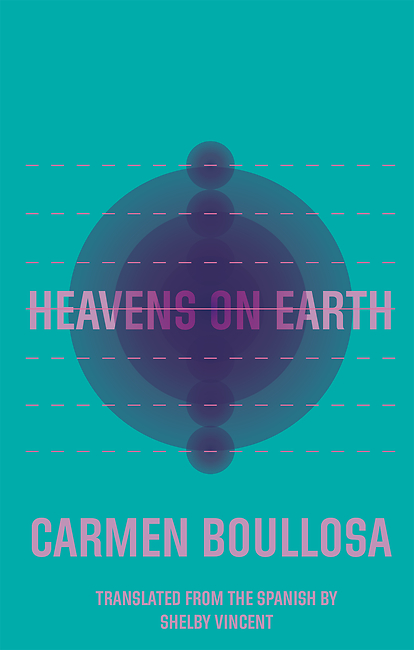
HEAVENS ON EARTH, as though such a thing could exist...which is the point of the read


HEAVENS ON EARTH
CARMEN BOULLOSA
(tr. Shelby Vincent)
Deep Vellum (non-affiliate Amazon link)
$16.95 trade paper, available now

Rating: 4.5* of five

The Publisher Says: Three narrators from different historical eras engage in preserving history in Heavens on Earth. As her narrators sense each other and interact through time and space, Boullosa challenges the primacy of recorded history and asserts literature and language's power to transcend the barriers of time and space in vivid, urgent prose.

Carmen Boullosa is one of Mexico's leading novelists, poets, and playwrights. Her most recent novel The Great Theft (Deep Vellum, 2014) was shortlisted for the PEN Translation Prize, nominated for the International Dublin Literary Award, and won Typographical Era's Translation Award. She lives in Brooklyn, New York, and Mexico City, Mexico.

I RECEIVED A DRC FROM THE PUBLISHER VIA EDELWEISS+. THANK YOU.

My Review
: Deeply, deeply examines our modern-US obsession with The Past. Every excursion into The Past requires acts of translation. You and I, reading and writing on our devices, pushing our words into strangers' faces as a matter of course (possibly detrimentally to discourse) can't know what anyone in The Past really meant to say. We can see the words. We can, but mostly won't bother to, study the time and thus learn some cultural facts that help us get a hint. But, like the radical fascist folk who assert their politicosocial ideas as representing those of the US "founders," we're translating words, not recovering facts. Author Boullosa uses multiple narrators in multiple timelines to examine the role of History and Tradition as anchors, as dead weights, and as foundations. What even is The Past, a key question for each narrator. The same events look hugely different to people with different perspectives.

I am usually a bit iffy on this narrative technique. In this case, I lapped it up because Estela in the present, Learo in the future, and Don Hernando in the past each explore this story's central thesis, the nature of narrative in shaping culture, without resorting to speeches. No one says, "if they/we had only known" or the equivalent. They tell us, their readers, the reality they live in as seen from their differing levels of privilege granted to each one's identity. Fair warning, there is frank...but uncelebrated...homophobia, colorism, and racism. They are facts of the past and present. The future, well...we won't know for a while, will we?

The narrative conceit is of a manuscript written in Latin when the Conquest was within living memory. Its author's a gay man in Holy Orders; not so shocking an idea for the time. It falls into the hands of a present-day scholar, Estela, who translates it (into Spanish). She is living in the failing Western country, Mexico. She annotates the manuscript with an academic eye on the roots of the present-day struggles in the clueless past, intending to make it public. Somehow the manuscript reaches Learo living in a wildly posthuman, post-scarcity future where The Past is not discussed, not heeded, not mined for clues or used as either guide or horrible warning. Learo's narrative is, unsurprisingly, polyphonic with Don Hernando's account of how the Conquest violently and cruelly mangled the memories and the bodies of the dwellers in "New Spain," an utterly invented and brutally enforced culture. As is always the case in examples of conquest, the ordinary person is required to graft a new identity onto their lifelong one, an intimate violation of self that begets more and more violence.

It is a stunning psychic violence that pollutes every facet of the future.

Yet without an honest reckoning with it, the present is unmoored, is prone to equal, congruent violence. The future that creates is...chilling. I'll say, for fear of spoilers, what Author Boullosa says: this novel explores "the prohibition of memory that will take us to the abolition of language, the repercussions of which the reader will witness."

"Repercussions" might be the best-translated word Shelby Vincent chose.

This novel, in its translation from Spanish to English, offers a far more trenchant riposte to foolhardy US politicosocial "essentialism" than a dozen more "factual" analyses could. A story does something an analysis can't: Personalizes the reverberations of actions taken or not taken, of salvations offered and denied. How we read this novel, in English, is already a thing apart from how it was written in Spanish. Its echoes of Anglophone sensation Cloud Atlas will be seen by the myriads of y'all who read (and mostly loved) that timeweaving narrative. More recently we had the multiversal Everything Everywhere All at Once pursuing the layering of causality in its own specially fraught way. The topic is a delightfully rich one, offering many opportunities to contemplate the story, its message, its execution, and its presentation in an enhanced framework. The effort of following the story through its curlicues and oddly bent pathways is richly repaid.

What effort you make at translation is always a life-altering thing. Reader be aware. You will leave a different soul than the one you entered as.