Showing posts with label The Feminist Press. Show all posts

Saturday, August 22, 2026

DREAMS OF AYN ARA, never to forgive! never to forget!


DREAMS OF AYN ARA
SARA ABOU GHAZAL
(tr. Katharine Halls)
The Feminist Press (non-affiliate Bookshop.org link)
$17.95 ebook, available now

Rating: 4* of five

The Publisher Says: In Stockholm, Zein al-Abedin shivers, far from the warmth of simmering revolt years ago in Shatila. In Paris, his son Nidal toils in solitude, ignoring his father’s phone calls and dousing his desire for Bassam back in Lebanon. Salwa, refusing to leave Beirut for Sweden, digs backward in time through Facebook and discovers an unlikely channel to the one place in the world she can’t go: Ayn Ara, the Abu Sukkar family’s ancestral home in Palestine.

Invoking the long wake of the 1948 Nakba and its displacement of 750,000 Palestinians from their homes, Sara Abou Ghazal webs the worldwide, timewide scatter of the Abu Sukkar family. At every turn, Ayn Ara disrupts their otherwise “normal” days in new terrains through memory, pain, and strange magic—culminating with a journey into both the past and a parallel present of Zionist settler violence.

Be it through a ghostly return to the brutal event of the Nakba, or grandmother Nijmeh’s psychic drift from land to no-land and back, Dreams of Ayn Ara portrays time as a false phenomenon for people ripped from their rightful place—and points to fissures in the fragile reality that denies Palestine to Palestinians.

I RECEIVED A DRC FROM THE PUBLISHER VIA EDELWEISS+. THANK YOU.

My Review
: Chilling, sobering, appalling, revolting.

Under 150pp telling most of a hundred years of historical dispossession, repression, genocide sounds...and is...ambitious, requiring time-jumps and dreaming visitations and other such narrative flummery that distracts from the core of the story: My home was forcibly taken from me. I do not have access to my family's source of identity. I live in a world without my roots, epiphytically resting on the place I am without a way to reach into it and root myself in welcoming soil.

It is ever and always the problem of the Othered. It is the reason ghettos exist, for the inhabitants; the sounds and smells of home plopped atop foreign soil. For the foreign-soil owners, it's crowd control, easy honeytrapping concentration without the bad optics of the word "camp." Not like this Palestinian family in these pages escaped the spaces where the word "camp" was le mot juste for what they were confined to. It's appalling that those confining them there were themselves the survivors or children of survivors of the same treatment....

Stories like this are proof that generational trauma is real. Damage done in malice survives and thrives and metastasizes and entumors its poisons like the body does when protecting itself. Stories like this are the pearl versions of the tumor-forming process, wrapping severed bits of essence in layer upon layer of nacreous story.

It's not long, it's not exhaustively researched and fact-checked. It's the living memory of a family victimized to redress wrongs done by others, done to strangers, and made into their problem by colonizers. Tale as old as time, then.

Friday, July 17, 2026

BALSAM KARAM'S PAGE: using pieces of the SFF toolkit to great effect without writing SF or F


EVENT HORIZON
BALSAM KARAM
(tr. Saskia Vogel)
The Feminist Press (non-affiliate Bookshop.org link)
$16.95 all editions, available now

Rating: 4.5* of five

The Publisher Says: From the author of The Singularity, a saga of one girl's resistance and exile in the stars and soil of empire.

Seventeen-year-old Milde is from the Outskirts, a place beyond the mountains where the dirt is corpse-rich and mothers and daughters make their living banished from society—without rights, access to care, or legal status. Simmering under the surface of their day-to-day survival is a desire for change—and one day, Milde and her friends act on it, setting fire to government buildings in the city that has rejected them.

When Milde is framed as the instigator of the uprising, she is arrested, imprisoned, tortured, and eventually presented with a final choice: to be executed publicly or to be launched into space, into a black hole called the Mass, for an experiment. Milde chooses the Mass.

Event Horizon is an exquisite existential novel, dark as deep space, woven with reflection on oppression, solidarity, trauma, and loss. With a completely unique voice, Balsam Karam writes about the swirl of hope and despair in the lives of the marginalized and a young woman’s unwavering belief in a better world.

I RECEIVED A DRC FROM THE PUBLISHER VIA EDELWEISS+. THANK YOU.

My Review
: First, read this:
They're talking about deportation, we told them, Do you understand what that means? They're talking about taking us across the border and leaving us there, they're saying we have to go home, but what home do we have other than this one, I told them. I was born here and my child was born here, I told them—It's true that we've been living without papers for all these years, but now were being deported—is that acceptable? These are our lives I told them, but no one wanted to listen and so we ended up here. Milde listens to her mother and sits down beside her, watching the buildings rise one by one, wishing she already knew how to build a home.
Maybe I resonate with this despairing cry because I experienced a similar feeling, if not legal process, with my own homeplace rejecting my very being as a gay man. Displacement is a violent painful amputation without mercy or understanding or empathy...and it goes on every single day all over the world, in homes in cities in countries in (especially) religions.

Every time it occurs it is an evil, a wound to the spirit of all who perpetrate and/or experience it. It is a wound on the masses of people who, like those who stay in Omelas, ignore it. Milde chooses a course of action in recation to this wrong that commits the most terrible crime imaginable: It is meant to, in the metaphorical structure of Omelas, show the complacent, the docile and unquestioning, the cost of their dreamworld. Terrorism! the shout rises, led by those terrorizing Others to please and entertain the unthinking and disengaged. Milde must be punished, must be seen to be punished, not to deter future "terrorists" but to satiate the appetite for cruelty of the dociles, passive entertainment to slake the human thirst for blood.

Milde makes an ugly bargain with the evil system:
Sure, I can go to space and die, why not? I'd rather die in the depths of a black hole than wait around to be executed here, if you see what I mean. I'm doing this so that I can sit back and rest for once, no knife or metal lid hidden under my pillow, and so that, if only for a day, I won't have to look at those same white faces that wish me harm.
Her consent to be sent into the uttermost unknown to die while providing data (her suffering and death) is about as meaningful to the "white faces that wish {her} harm" as clicking "accept and close" is. There is no meaningful other option, but make it look good for those who can't be arsed to see how wrong, how painful it really is.

Swedish Kurdish author Balsam is the child of a man who experienced the horrors of a "terrorist" who chose his course of action to resist colonization. That crime resulted in his daughter being a Swede not a Kurd by nationality, a displacement that will reverberate through her entire life short or long. Everyone makes these decisions for their children, it's inherent in having them; but as all parents know it's never what you say but what they hear that counts. Author Balsam's feelin' some kinda way about these choices, and seeing the world in a unique cast of light as a result.

All of us Anglophones can see it because she let us in on experiences we don't precisely share, but still can find ways to be with. We can all feel echoes pressing on our emotional eardrums that come from a similar place of "injustice happened to me, to my life, that I had no pwer to resist"...maybe enabling us as a result to make the effort to help the world resist, reject the bloody hunger for revenge or simply the vicious desire to hurt Others to slake Humanity's thirst for it.

Eminent Translator Vogel has been at work for a good long time so it's no surprise her skills make this feel like a native English speaker wrote it. In fact I bring it up here because I was suddenly struck about the halfway point that I was not having my usual internal debate about "what word was that in {language}?" I checked the copyright twice during this read...yep, translation. This is very unusual for me. It's even more surprising because this is Author Balsam's first book.

The outrage that simmers under this lovely surface is definitely part of the reading experience. There is not sweetness in the story, or in the language; there is precision, but not distance, or chill. It's going to make emotional demands of you-the-reader. Milde experiences the constant reminder of difference that is used by polite people to maintain their superiority in the hierarchy. Her mother Essa is not even as far into the acculturation process as she is; it's a process defined by exclusion, rejection, after all. Milde's course as a resister is set thereby and this her fate sealed.

Her violent terrorism is what is left to a powerless woman in the face of an entire power structure built for the purpose of excluding her forever. Her resistance is all she has; it can only be what it compelled her to enact; so her phases of punishment *must* result in her body being launched into a black hole to die in as-yet-unknown suffering that must be public. It must be shared, this last and most intimate violation of her humanity. Otherwise she will not have paid for her "crime."

It is the best of all possible validations for the power structure. It is the best of all possible tricks to play on the power structure for Milde. It was chilling how much courage Milde possessed accepting this final, long act of her life. Even Christ only suffered for hours.

++++++++++++++++++++++++++++++++++++++++++++++++++++++++++++++++


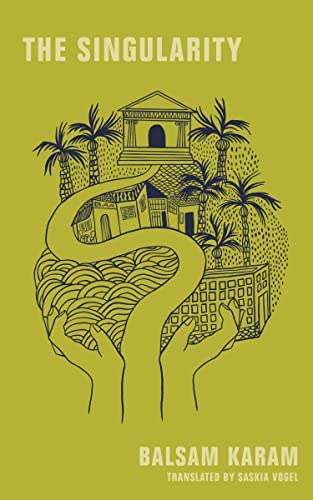
THE SINGULARITY
BALSAM KARAM
(tr. Saskia Vogel)
The Feminist Press (non-affiliate Bookshop.org link)
$16.95 all editions, available now

Rating: 4.25* of five

The Publisher Says: Lyrical and devastating, The Singularity is a breathtaking study of grief, migration, and motherhood from one of Sweden’s most exciting new novelists.

In an unnamed coastal city filled with refugees, the mother of a displaced family calls out her daughter’s name as she wanders the cliffside road where the child once worked. The mother searches and searches until, spent from grief, she throws herself into the sea, leaving her other children behind. Bearing witness to the suicide is another woman—on a business trip, with a swollen belly that later gives birth to a stillborn baby. In the wake of her pain, the second woman remembers other losses—of a language, a country, an identity—when once, her family fled a distant war.

Balsam Karam weaves between both narratives in this formally ambitious novel and offers a fresh approach to language and aesthetic as she decenters a white European gaze. Her English-language debut, The Singularity is a powerful exploration of loss, history, and memory—an experience akin to “drinking directly from a flood of tears” (Aftonbladet).

I RECEIVED A DRC FROM THE PUBLISHER VIA EDELWEISS+. THANK YOU.

My Review
: Published first but written second in Author Balsam's career.
The grandmother picked them up and held them close in sleep almost no sleep at all and then muttered that no one beyond the ruined wall wished them well and that she couldn’t bear another loss – again and again she said she couldn’t bear any more loss and even though the children didn’t understand how or why, they knew that the loss was now a part of them and that at any moment it could strike again.
It's the world of Event Horizon (review above) on Swedish soil in the camp the women live in as they have no recourse or options:
It’s your first winter in the house with the little garden, the darkness outside. Something hard hits the windows and your brother stands up, puts on his coat. After a while he comes back in, says he needs something to wipe off the dog shit from the window and the postbox. In his hand is a blue and yellow sticker that he’s torn off, like the ones you’ve seen high up on lampposts around town.

–and–
Later, your mum tells you that the first thing she was told after talking about how she had been tortured in prison was that no one would hire a person like her. One eye missing, older and not entirely fluent – it’ll be tough, the caseworker had said.
Nice people do not shout racist slogans in your face. It does not mean they are not going to behave in racist ways. The story's narrative risk-taking is more evident in its middle third:
/ do you think of her often, Marcus or Magnus asks softly / we ate bean stew with rice and yoghurt and I drank a whole pot of tea afterwards / you nod, of course you do / Gran was the happiest of us all I think / I think of her and of my grandmother you say and put the cup down / she took you in her arms and then I made sure to sleep while I had the chance / do you know anything about black holes? you later ask the counsellor / and I only got out of bed the next morning can you imagine? / inside a black hole is a place that is also a state — do you know about this? you ask, facing Patrick or Henry in his chair / a few days later Rozia's mother visited with little Rozia in her arms and a basket full of fruit /no, I'm afraid I don't know much about space, says Eric or Martin and continues to take no notes / then the two of you would meet up practically every day / you say it's called the singularity - that's what the place is called and lean over the bed / you and Rozia were like twins, we thought - the same round face and your hair as big and black / inside the singularity, the force of gravity is so strong it can't be calculated, can you imagine? you tell the counsellor / the pair of you often played in Rozia's yard and sometimes you stood by the big road even though you weren't allowed to and the soldiers could show up at any moment / that force pushes bodies together and renders the distance between them nil / because you both liked Gran's fried potatoes and her bean stew, you mostly ate at ours Mum says / you use your hands to show how no space remains between bodies in the singularity
It doesn't scan easily, but I promise you it is not flummery, a brummagem gaud of "Style" that distracts with difference without adding into meaning. In the more conventional first and last parts, the harrowing tales told do the work of impacting you in dark corners of your Safe Place, you are not safe, ever, as long as you are Other. While you are reading Author Balsam's story you are Other along with her.

It's a passionate document about grieving. It is a horrible chronicle of losing a child, losing an infant, losing losing losing without a moment of respite and never once ever giving up.

Until the final act of control is yours.

If you need a—any—content warning, do not pick this read for yourself.

Wednesday, June 17, 2026

MEDEA SANG ME A CORRIDO, latest feminist redemption of a Classical-mythology woman's character


MEDEA SANG ME A CORRIDO
DAHLIA DE LA CERDA
(tr. Heather Cleary & Julia Sanches)
The Feminist Press (non-affiliate Bookshop.org link)
$17.95 all editions, available now

Rating: 4.75* of five

The Publisher Says: A punk revival of Medea as a Mexican anti-angel of birth and death, from the International Booker Prize–nominated author of Reservoir Bitches

In Northern Mexico, Paulina, Perla, Antonia, Reina, and Jordan are striving to survive the barrio—hustling on the edge of a cartel-run economy, nursing the wounds made normal in a world that eats its own. Hovering over their trials is a spirit with gothic flair, dressed in black and crowned with braids: Medea, a mythic mother of the Chihuahuan desert, ancient as the Aztecs but never too old to be petty.

From aiding a trophy girlfriend’s abortion, to accompanying a mother in her search for her lost child in the desert, to embracing those taken too soon in the narco’s brutal proxy wars, Medea fights for justice for her chosen mortals—her divine wrath the only power that could rival the corrupt, violent web spun by the cartel, the government, and the military. Dahlia de la Cerda’s magnetic prose draws readers right into the heart of that web—and links all our fates to the missions of Medea, equal parts midwife and gravedigger, a femme fatale god in a femicidal world.

I RECEIVED A DRC FROM THE PUBLISHER VIA EDELWEISS+. THANK YOU.

My Review
: Repurposing classical myths for the twenty-first century is a...subgenre? full genre? literary storytelling technique?...an effort I enjoy a great deal. Medea repurposed as avenging goddess, destroying angel, wrathful righter of women's victimization, has double appeal for me. It corrects what I've always seen as the calumniation of a powerful healer-semidivinity with the accusation of insane jealousy over a man who has abandoned her for another woman. She is accused in classical sources of murdering her children, born of her body, to exact revenge on a faithless fucker she literally enabled, by using her skills and knowledge, to come to power and riches.

A healer-spirit so skilled she is regarded as divine.

Male anxiety much, Euripides?

So I've never found the famous version of Medea at all convincing. It smacks of an attempt to invalidate a powerful and skilled woman by making her hyperfocused on a man; by accusing a mother of murdering her children born of her body because a man hurt her feelings by betraying her with another woman.

Hogwash.

No better mythological figure, then, to be repurposed into a guardian of women in a seriously patriarchal, femicidal culture like that of the narcotraficantes. Setting these interconnected stories...more like very well-defined chapters than actual stories, what I myownself have always referred to as "braided stories" because, like a braid, the separate strands are evident while making together a whole effect not possible for the strands separately (see Celeste Mohammed's works)...in what she calls "Aztlán," the narcostate existing in Northern Mexico where femicide is appallingly rampant offers Author Dahlia wide scope for Medea's redemption. As an avenger, Medea appears here with clear markers of supernatural power: "Then she kissed me on the forehead and shot through the sky in a snake-drawn carriage," is not a description of an everyday person. Six women in dire trouble are visited and assisted by Medea in barely over a hundred pages.

None of them are spotless, sweet little fembots, which is a relief. Messy, horny, misguided people are innumerable across the globe and occur in every ray of the rainbow of identities humans so love to pretend are Ordained and Immutable. Medea ignores these ideologically driven cultural fripperies to effect redress for the wronged.

It's satisfying to me because I like Ma'at being served by Justice (very different in my observation from mere "justice" such as the travesty being perpetrated by the US government department using that name). Medea, in Author Dahlia's hands, serves and renders Justice even in the face of "justice."

I have only one critique to offer in support of my just-off-perfect rating of the work: sometimes speed is not your friend when offering tendentious and muckraking narratives. I felt, by the end of the read, I was not in possession of enough facets of each woman's life experience to grasp the motivation for Medea coming to the rescue. It's not necessary for the story of Medea as avenger to be formed and shaped. That is done, and the shape is one I found enrichingly sharp. I was not utterly enthralled where that was *easily* within Author Dahlia's reach.

It's a braid of great beauty. It stops short of Divine Grace. And it is so urgently necessary for all of us to get our heads around the reason it exists I'm here pushing it at you. Please pick one up soonest.

Wednesday, December 10, 2025

IT CAME FROM THE CLOSET: Queer Reflections on Horror, a genre the community embraces...hard


IT CAME FROM THE CLOSET: Queer Reflections on Horror
JOE VALLESE
(Editor)
The Feminist Press (non-affiliate Bookshop.org link)
$25.95 all editions, available now

Rating: 4* of five

The Publisher Says: Through the lens of horror—from Halloween to Hereditary—queer and trans writers consider the films that deepened, amplified, and illuminated their own experiences.

Horror movies hold a complicated space in the hearts of the queer community: historically misogynist, and often homo- and transphobic, the genre has also been inadvertently feminist and open to subversive readings. Common tropes—such as the circumspect and resilient “final girl,” body possession, costumed villains, secret identities, and things that lurk in the closet—spark moments of eerie familiarity and affective connection. Still, viewers often remain tasked with reading themselves into beloved films, seeking out characters and set pieces that speak to, mirror, and parallel the unique ways queerness encounters the world.

It Came from the Closet features twenty-five original essays by writers speaking to this relationship, through connections both empowering and oppressive. From Carmen Maria Machado on "Jennifer’s Body", Jude Ellison S. Doyle on "In My Skin", Addie Tsai on "Dead Ringers", and many more, these conversations convey the rich reciprocity between queerness and horror.

I RECEIVED A DRC FROM THE PUBLISHER VIA EDELWESS+. THANK YOU.

My Review
: I'll put it this way: It seemed to me, when I began reading, that queer people are really barkin' up the wrong tree to look to horror, homophobic, transphobic, misogynistic medium it is, for representation. Anti-models, maybe...but representation carries (to me, anyone else?) positive or at the minimum neutral connotations for the represented.

I do not see this in horror stories, where the evil queer has survived long past its rejection in most mainstream media.

"All of us together are smarter than any one of us" has never been more amply and aptly demonstrated than in this collection of essays. It is true that some are hits and others misses; it's in the nature of collections for this to be the case. My miss could easily be your hit. It's the reason that essays are so very valuable collected together, to maximize the reader's exposure to new, different ideas that might resonate...or clang dissonantly. Both, and all the shades of experience between, are valuable for pointing out and pointing up one's blind spots.

I'd never once, when watching Jaws in 1975, considered the homoerotic subtext in the film. (I've never read the novel.) I only watched it the once because, fifty years later, I still won't go into the ocean above my ankles because I'm *still* scared by that buoy scene. (IYKYK) Jen Corrigan saw it. I didn't think she was right at first; then I kept thinking about the points being raised and came to think she was correct. Fifty years later, I'm thinking about a film I saw once, and can't forget for bad reasons, reassessing it in light of a stranger's thoughts and appreciating it more positively for doing that.

Recontextualizing an object of fear, fifty years later, actually reduces the terror I've always felt due to Spielberg's genius-level indirect threat building, not making it grimly obvious therefore dismissable, reducible to whether we think the effect was "good enough" or not. What strikes unseen is always more frightening, look at Alien, look at ICEstapo's masked raids, look at the fear of the unknown everywhere in our culture.

So essays by queer people about the films that scare all of use make the scares, even the ones at our expense like Tucker Lieberman's essay on childhood trauma and A Nightmare on Elm Street, are the best use of our mental energy around these cultural products designed to elicit fear in the viewer. When we, the queers of the world, are targets of evil everywhere in our quotidian lives it pays to forearm yourself with context to battle the inner demons "They" want to feed, to convince you are REAL and YOUR FAULT...which they aren't.

A book to be savored in sips, not down-in-one belted into your eyeholes. Well worth gifting to your horror-obsessed friend of any sexuality, or your queer media-studies nibling/grand, or just some guy who was traumatized by Jaws as a teen.

You never know where healing will come from.

Sunday, December 7, 2025

LITTLE F, On the Road for Queer youth


LITTLE F(aggot)
MICHELLE TEA

The Feminist Press (non-affiliate Bookshop.org link)
$17.95 all editions, available now

Rating: 4* of five

The Publisher Says: A new epic novel about a teenage queer runaway from cult classic author of Blackwave and Valencia Michelle Tea.

In Spencer’s fantasies, the breezy, queer streets of Provincetown, MA, are utopia, a place where he can be free. Yet when a violent attack in his suburban Arizona schoolyard sends him to the hospital, he decides queer utopia can’t wait. And one night, with the help of his best friend, the teenage witch Joy, he hitches a ride to find it.

The cross-country road odyssey that follows brings Spencer from new moon rituals in Arizona canyons to Texas bus stations, from the luxe drag stages of Houston’s Montrose district to the jazz-soaked streets of the French Quarter and beyond. This new novel from Michelle Tea tells the story, by turns raw, romantic, and sweet, of a sheltered boy taking his first leap into queer life, among all the complicated queers who live it.

I RECEIVED A DRC FROM THE PUBLISHER VIA EDELWEISS+. THANK YOU.

My Review
: Road novels lend themselves beautifully to the coming-of-age genre. In a road novel, the main character is by definition seeking some unknown, longed-for thing...adulthood is that thing, the long-dreamed-of delights of not being under someone else's thumb, making your own decisions....

I know, I know, it's as far from reality as a time-travel novel is. The traveler/comer-of-age doesn't know that (yet) so let it ride while the trip educates the youth into disillusionment's many pleasures. ...wait...pleasures? Spencer is, like so many of us formerly young queer lads going to run head-first into reality and find it pretty good.

Escaping homophobia is not possible, but getting out of a bully's sights is not a bad idea. As Spencer moves to other peoples' whims, aka hitchhikes, to get to Provincetown, the world shows him a bright face. He meets people who help him, in spite of taking him away from the direction he's set; lots of endearing, heartfelt chats; sleeping on couches (my back twinged just typing it); finding his first reciprocated love.

A lovely story, but not one we haven't read before (over thirty, anyway), so best really as a gift for your sweet young giftee. You know the one...not ready to come out; not ready for The Talk; but turning life over in their mind painfully loudly.

Give them this book to give those gears a bit of "others before you have been there, here's what they say about it" lubrication before you, their parents, and the rest of us go deaf.

Sunday, November 30, 2025

APSARA ENGINE, South Asian graphic story collection


APSARA ENGINE
Bishakh Kumar Som

The Feminist Press (non-affiliate Bookshop.org link)
$24.95 paperback, available now

Rating: 4* of five

The Publisher Says: By turns fantastical and familiar, this graphic short story collection with South Asian roots is immersed in questions of gender, the body, and existential conformity.
  • Winner of the 2020 Los Angeles Times Book Prize for Graphic Novel/Comics
  • Winner of the 2021 Lambda Literary Award for LGBTQ Comics
  • Finalist for the 2021 Ferro-Grumley Literary Award for LGBTQ Fiction
  • The eight delightfully eerie stories in Apsara Engine are a subtle intervention into everyday reality. A woman drowns herself in a past affair, a tourist chases another guest into an unforeseen past, and a nonbinary academic researches postcolonial cartography. Imagining diverse futures and rewriting old mythologies, these comics delve into strange architectures, fetishism, and heartbreak.

    Painted in rich, sepia-toned watercolors, Apsara Engine is Bishakh Som's highly anticipated debut work of fiction. Showcasing a series of fraught, darkly humorous, and seemingly alien worlds—which ring all too familiar—Som captures the weight of twenty-first-century life as we hurl ourselves forward into the unknown.

    I RECEIVED A DRC FROM THE PUBLISHER VIA EDELWEISS+. THANK YOU.

    My Review
    : A beautiful work of South Asian-set and -themed mostly queer stories. All take place in elegantly, cleanly rendered spaces, involve women in transitional times and relationships, and stress the pleasures and/or complexities of being in the midst of Life.
    these are the spreads provided for publicity use

    The author's website contains much more varied artwork from the book. It is very much worth you time to view.
    The stories themselves are not really interlinked, though all feel like they're meant to form something greater than the sum of their parts. If there's more than the thinnest connective tissue, though, I didn't find it. Straight people on a shoreline are surprised by merfolk accosting them; differing degrees of queer/trans people in their cells...apartments really, but cells in all the confinement senses...are the focus of the title story, one that fascinated me but never paid off in the way I was built up to expect. I think my personal favorite story was "Swandive," in which Onima...a "cartographer of trans realities" who uses her own blood to make maps, thus create art, that explains other Desi trans people to themselves.

    It's not hard to see this opening a young trans person's eyes to the welcome reality that others feel the same way they do. No one in the 21st century, with all its stunning technological advances in medicine, psychology, communication should ever again feel isolated. A work like this that was created by someone deeply marginalized yet extending her hand to others, is a lifeline for a struggling trans person.

    "You, as you are right now, are not alone and do not need to change to be loved" is still the most intensely powerful message you can send with this gift.

    Monday, August 11, 2025

    TONGUELESS, unnerving psychological novel of losing your home without leaving it


    TONGUELESS
    LAU YEE-WA
    (tr. Jennifer Feeley)
    The Feminist Press (non-affiliate Bookshop.org link)
    $17.95 all editions, available now

    Rating: 4.25* of five

    The Publisher Says: A gripping psychological thriller that sheds light on the current political situation in Hong Kong.

    Tongueless follows two rival teachers at a secondary school in Hong Kong who are instructed to switch from teaching in Cantonese to Mandarin—or lose their jobs. Apolitical and focusing on surviving and thriving in their professional environment, Wai and Ling each approach the challenge differently. Wai, awkward and unpopular, becomes obsessed with Mandarin learning; Ling, knowing how to please her superiors and colleagues, thinks she can tactfully dodge the Mandarin challenge by deploying her social savviness. Wai eventually crumples under the pressure and dies by suicide, leaving her colleague Ling to face seismic political and cultural change alone as she considers how far she will go to survive such a ruthlessly competitive work environment.

    Sharp, darkly humorous, and politically pointed, Tongueless presciently engages with important issues facing Hong Kong today during which so much of the city’s uniqueness—especially its language—is at risk of being erased.

    I RECEIVED A DRC FROM THE PUBLISHER VIA EDELWEISS+. THANK YOU.

    My Review
    : China has been on a multigenerational project to Han-ize all the Sinosphere. Hong Kong's significant Anglophone population has been able to attract some out-of-China interest in the Han's Borg imitation, and from everything I've seen coming out about it in English, resistance is risky if not futile.

    As little pale imitators, US fascists are doing their best to marginalize and poison the information space. No one in their dream world will know what to trust, therefore will accept their stupidification without the fuss and bother of rebellion and resistance to them. I think what's happened is that's scare a lot of people. Ones who weren't necessarily thinking about it before. Books like Tongueless can send painful shocks into the ideamakers that encounter it. Set in a very basic institution of Hong Kong culture, a language school, we are prepared in the set-up for those very reactions by those of the characters.

    Teacher Wai is a very passive person, unable to put herself forward agreeably, or frame and present an idea persuasively. Her affect is so rigid that she's become faceless, just a messily-dressed part of the crowd. This works well enough while she's left alone to keep doing what she has learned to do. She is blindsided by the mandate to switch from her native Cantonese to the Han people now in charge's Mandarin. It's not like having to use Aussie or Indian slang and adapt to an accent. It's like having to learn, then teach in, Dutch. The alphabet and some words would look familiar but pronunciation let alone grammar? Not a hope. Wai, in her oddly passive way, sets about learning Mandarin but founders agonizingly slowly as the hopelessness of the task sinks in.

    Ling's a Mean Girl. She's made it on marginal ability plus ruthless indifference to others' feelings or needs. She hides this behind a surface smarm...sorry, charm...that slips her in under peoples' radar. That route to her success is now closing off because it just won't teach her Mandarin. Poor Wai, with no interpersonal radar, is a prime victim for Ling to hate on. Ling's own focus on surface perfection and flawless presentation of self finds no echo in Wai. She doesn't understand the point of these things and lacks the flexibility to adapt to learning them (or Mandarin) to Ling's contempt...well-masked from others. Wai's failing attempts to survive in this horrible, cruelly indifferent new system lead to a true tragedy.

    What's funny is that Ling is, on the surface, so good at masking that she presents herself as super-agreeable, and accepts that their language, Cantonese, is no longer going to be the one they're allowed to use...these're good Chinese girls, after all, and Authority Has Spoken. The manner of the adjustment is the difference between Wai's tragedy and Ling's desperate attempts to avoid failure, not the fact of its external imposition leading to resistance. It doesn't.

    It's a brutal story. It's told directly...I picture Ling, our PoV character, sitting before an inquisitional interview recounting this story directly to us, the "camera" so to speak, with many soft little smirks and touchings-up of her hair and make-up. Ling is the one who, in Author Lau's subtle hands, shows herself as a slacker caught in a new system that pitilessly highlights her basic failures and failings in relation to that system. The narrative shifts in time though not always seamlessly. The very first pages give away a giant spoiler, but it is needed to set up our time-hopping. Ling is undergoing before our eyes the fate her students, to whom she always showed a smooth face hiding her contempt, worked hard to escape...and she can not do what they tried to do.

    Ling escapes Wai's fate. She does not escape the fate of social collaborators everywhere: She loses her camouflage and has no skin underneath it to protect herself. Hiding is not possible; no protection or help is forthcoming.

    I sometimes felt the story was in fragments of time or shards of context that did not always scan with my idea of what I had read. There was a reason for that; I'm going to urge you to read the Translator's Note before you start the story. I don't want to spoil certain things but spoilers are part of the book from page one! However, if someone chooses not to follow my advice, they should be able to proceed as they prefer. I myownself think "spoilerphobes" are spoiled, but no need to rehash THAT conversation.

    Politically this story of a bullying overbearing linguistic minority imposing its words, values, and culture on hapless victims caught in an economic and social trap, suffering the loss of long-unexamined and too-little valued traditions and freedoms, could not possibly be more timely to read for the entire Anglophone world.

    Friday, August 1, 2025

    (SO WHAT) IF I'M A PUTA: Diaries of Transness, Sex Work, Desire, starting #WITMonth with a, umm, bang


    (SO WHAT) IF I'M A PUTA: Diaries of Transness, Sex Work, Desire
    AMARA MOIRA
    (edited and tr. Amanda De Lisio & tr. Bruna Dantas Lobato)
    The Feminist Press (non-affiliate Bookshop.org link)
    $17.95 ebook, available now

    Rating: 5* of five

    The Publisher Says: An incisive, intimate diary of the life of a travesti sex worker in Brazil, with a foreword by Charlotte Shane

    So What If I’m a Puta, originally published on author Amara Moira’s popular blog of the same name, consists of 44 crônicas that wryly portray her experiences as a trans sex worker in Brazil. In a brazen, funny, and at times heartbreaking voice, Moira explores the political and personal textures of her encounters with the men who buy sex from her, and the complex reality of her labor of a sort of love.

    Woven through Moira’s essays are reflections on transition, safe sex, desire, whorephobia, consent—in the grim context of Brazil’s record rates of violence against trans women. Ultimately, Moira writes to center trans sex workers in Brazil’s putafeminist movement, modeling a feminism that envisions inclusivity, safety, self-determination, and joy for us all.

    I RECEIVED A DRC FROM THE PUBLISHER VIA EDELWEISS+. THANK YOU.

    My Review
    : Self-determination, personal autonomy, individual freedom, call it what you like: It is the central fact in the competing ideologies of high-control and laissez-faire systems of social organization duking it out around the world of 2025. Spoiler alert: It's always going to fall short for one side's happiness and comfort. I myownself want it fall shortest for the high-control (usually religious) fascist slime.

    There. I'm out of the closet. I want what "They" claim to want, the PTB out of my personal business, telling me who I can fuck, marry, or vote for. What "They" want is to impose more control on people they don't like, eg women, queers, other religions, and that will make "Them" happy. No it won't. Read Amara's words.

    Her clients for sex services are very high-control men, from (I suspect) the same background as the other fascists though that is only inference on my part. The stories of the services they require of Amara, a woman in their eyes, aren't any surprise to any woman reading the book.As a cisqueer man i'm not going to assume I get what these cishet men are after because I'm not after it. I'll say that every single woman I've ever known well enough to have this kind of subject arise in our conversations has a story like at least one of Amara's stories...men who get joy(?) from overriding her wishes, aka rape, all the weird psychosexual kinks all people have...it's part of her job as a puta (whore in English) to meet them. Or so the men buying access to her body assume.

    The huge tragedy in this is transphobia. It leaves women like Amara outside the moral indignation circle "feminists" like the hateful wizard-book lady draw to protect women from abuse and exploitation. It leaves these women open to the rage-filled hate of their clients, often leading to femicide, that evil act of gendered violence.

    Those gender essentialists are complicit in each and every crime committed against transfem or transmasc people. If you are a gender essentialist, do not tell me so and expect to receive any respect or even tolerance for your hateful belief.

    Amara Moira's blog, this epitome of it brought into English by the amazing Bruna Dantas Lobato (whose work I've praised in those linked reviews) and Amanda De Lisio (who both edited the blog entries and assisted in translation), takes back control of her narrative. She is the embodiment of self-determination, lacking throughout this read even a whiff of victimhood. And honestly, if Author Amara wanted to play the victim card, I would say nothing against it. She has too much integrity for suchlike nonsense, though.

    The only quibble I have is the same one I have with all fix-ups of shorter works: It gets repetitive. The book clocks in at under 200pp, so it isn't a deal-breaker for me. I do not know how better to convey my sense of the importance of this read than to say: If ever you're going to say a transphobic word, don't open your yap until you've gotten to know a trans person.

    Start here.

    Wednesday, June 11, 2025

    MARGARET KILLJOY'S PAGE: THE SAPLING CAGE, transfem MC wants to save the kingdom; & A COUNTRY OF GHOSTS, queer, anarchist SF


    THE SAPLING CAGE (Daughters of the Empty Throne #1)
    MARGARET KILLJOY

    The Feminist Press (non-affiliate Bookshop.org link)
    $17.95 ebook, availablle now

    Rating: 4.5* of five

    SHORTLISTED FOR THE 2025 URSULA K. LeGUIN PRIZE! Winner announced on 21 October 2025.

    The Publisher Says: In the gripping first novel in the Daughters of the Empty Throne trilogy, author Margaret Killjoy spins a tale of earth magic, power struggle, and self-invention in an own-voices story of trans witchcraft.

    Lorel has always dreamed of becoming a witch: learning magic, fighting monsters, and exploring the world beyond the small town where she and her mother run the stables. Even though a strange plague is killing the trees in the Kingdom of Cekon and witches are being blamed for it, Lorel wants nothing more than to join them. There’s only one problem: all witches are women, and she was born a boy.

    When the coven comes to claim her best friend, Lorel disguises herself in a dress and joins in her friend’s place, leaving home and her old self behind. She soon discovers the dark powers threatening the kingdom: a magical blight scars the land, and the power-mad Duchess Helte is crushing everything between her and the crown. In spite of these dangers, Lorel makes friends and begins learning magic from the powerful witches in her coven. However, she fears that her new friends and mentors will find out her secret and kick her out of the coven, or worse.

    I RECEIVED A DRC FROM THE PUBLISHER VIA EDELWEISS+. THANK YOU.

    My Review
    : Transfem main character in a fantasy novel? Yes please. What else, one might reasonably ask, would Author Killjoy (transfem herself) write? Short answer: Any-damn-thing she likes. The fantasy universe here is beautifully evoked, the system of magic is well-thought-out, the costs the use of magic exacts on the user are all both disturbing and condign, this is in short the kind of secondary-world fantasy one always hopes to find.

    Lorel herself, our PoV character, is carefully delineated to be consistent: born a boy in a world where magic is only wielded by females, transfem Lorel (believably bisexual in desire) is clearly female coded from the off. She does not like violence, but can definitely motivate her aggression in defense of loved ones or in the face of inflicted violence. She's somewhat spottily presented to our mind's eye, in that her deliberate changes of gender presentation aren't detailed. I wasn't sure why someone presented as wearing a dress the last time she was described putting her hair in a man's topknot and passing after that. What happened to the dress? Was a dress a unisex garment? If not why make a point of her wearing one?

    These are minor things to me, though, in the face of Lorel's journey into her true nature. Being within her society and still Othered, Lorel's way of observing the anarchist functioning of the witches was far less didactic than A Country of Ghosts (q.v.) It came across as an apprentice learning the ropes, watching the experts for tips and tricks, which is exactly what one expects. A coming-of-age story that's also a very risky coming-out story is a great set-up for a series about a fantasy world. It is, though, a set-up, so this is not a full story. There are, thank goodness, details left to develop...but that isn't always totally satisfying. I've knocked off a half-star for those holes falling too deep at times.

    I loved the experience of learning about the magic system. I'm not going to go into it here because the idea is best encountered without early access to the facts. Discover with Lorel what magic is, can do, and exacts from its practitioners...and why.

    I'm glad to say that, as book one of a trilogy, this is not full of tension-killing explanations. It will be interesting to see how Lorel, learning to trust herself as a transfem person, reconciles that with her culture's restriction of magical practice to biofem people. What will this do among the witches? Will the immediate consequences turn dire in this supremely cozy world?

    Future books will tell!

    +++++++++++++++++++++++++++++++++++++++++++++++++++++++++++++++


    A COUNTRY OF GHOSTS
    MARGARET KILLJOY

    AK Press (non-affiliate Amazon link)
    $16.99 ebook, available now

    Rating: 4.25* of five

    The Publisher Says: An epic political fantasy in the tradition of Tepper and Le Guin that explores the question of what an anarchist community can do to resist the assaults that are sure to come if any such social formation were to exist.

    Dimos Horacki is a Borolian journalist and a cynical patriot, his muckraking days behind him. But when his newspaper ships him to the front, he’s embedded in the Imperial Army and the reality of colonial expansion is laid bare before him. His adventures take him from villages and homesteads to the great refugee city of Hronople, built of glass, steel, and stone, all while a war rages around him. The empire fights for coal and iron, but the anarchists of Hron fight for their way of life.

    A Country of Ghosts is a novel of utopia besieged and a tale that challenges every premise of contemporary society.

    I RECEIVED A DRC FROM THE PUBLISHER VIA EDELWEISS+. THANK YOU.

    My Review
    : Very much in the same vein as The Dispossesed, a philosophical exploration of anarchy as a means of social organization. The horrors of hypercapitalism bashing into the anarchic anti-hegemony are always fun and interesting to encounter.

    Told as a story, these ideas and attitudes make a much more lasting mark on the psyche than do more explanatory ideological works. It's easy to invest in the people Author Killjoy creates, as one might expect from the author of the Danielle Cain novellas.

    There's nothing false, or clangorous, in Author Killjoy's work. There is no dumbing-down or slighting of issues that arise from this world's way of functioning. It's true that our ignorant interloper from imperialism needs to be brought up to speed. I don't think this counts as the dreaded infodumping, because the explicit intent of the story is to contrast a high-control system based on coercion crashing into a non-system of personal responsibility and collective action. Armies are fighting, and that should be impossible in anarchy...yet here we are, and Dimos (our stand-in) needs to understand why. He's set up as a muckraking journalist by temperament. He's shown to be an ill-fitting bit of grit in the imperial army's system, someone who is a misfit and outsider.

    The way he's educated in anarchist principles of respect, for self, for others, for the natural world as it is absent religious stuff, is inspiring. I enjoyed the way Dimos's struggle to wrap his head around this utterly alien way of thinking is portrayed. After witnessing the imperials committing war crimes, his mind was more flexible and receptive. It made the way the Hron (literally "ghosts") explain their lives to him hit harder:
    We are anarchists, and we are immortal. We are the country of ghosts, and we are immortal. We will fight them until we are dead, and our bones will fight them after. The memory of our existence will fight them…in each of their hearts we will brand the memory that those who are free will never yield. Today, let us be ghosts!
    –and–
    Take care of yourself. No, to hell with that, take care of your friends and let them take care of you. Do stupid things for them.

    It's so very much not the way the individualistic empire invading them thinks; Dimos is slowly taking on board this radical reorientation of his worldview. Dimos is a bit of a gender essentialist, though being gay himself he might not have been...that's an authorial lacuna, along with the absence of enby folk among the Hron. I'm not sure he would ever bother to learn not to be, but it did actually clang through my awareness that he was an outsider among the Hron as much as within the empire he was born into.

    A book that is so ambitious in its asks of the reader that it startled me how smoothly it went down. Every last one of my four stars was coated in a thick frosting of readerly happiness.

    But ostriches? Really?

    Saturday, May 10, 2025

    RESERVOIR BITCHES: Stories, outrage...rage...there's more in here than meets the eye

    RESERVOIR BITCHES: Stories
    DAHLIA DE LA CERDA
    (tr. Julia Sanches & Heather Cleary)
    The Feminist Press at CUNY
    $16.95 ebook, available now

    Rating: 4.75* of five

    The Publisher Says: LONGLISTED for the 2025 International Booker Prize

    A debut collection of gritty, streetwise, and wickedly funny stories about Mexican women who fight, skirt, cheat, cry, kill, and lie their way to survival.


    “Life’s a bitch. That’s why you gotta rattle her cage, even if she’s foaming at the mouth.” In the linked stories of Reservoir Bitches, thirteen Mexican women prod the bitch that is Life and become her. From the all-powerful daughter of a cartel boss to the victim of transfemicide, from a houseful of spinster seamstresses to a socialite who supports her politician husband by faking Indigenous roots, these women spit on their own reduction and invent new ways to endure, telling their own stories in bold, unapologetic voices. At once a work of black humor and social critique, Reservoir Bitches is a raucous debut from one of Mexico’s most thrilling new writers.

    I RECEIVED A DRC FROM THE PUBLISHER VIA EDELWEISS+. THANK YOU.

    My Review
    : If and/or when (honestly I'm all but certain it won't happen) the mooted TV series, via Amazon Prime and Spanish-language producers Perro Azul, arrives I will be *amazed* if even a third of rage and fury in these stories make it onto the screen. Since the Feminist Press mentioned this possibility when the book was first published in September 2024, nothing else has appeared on Amazon, The Hollywood Reporter, or even Perro Azul's Spanish-language websites. I expect it's a dead deal...given the truly hair-raising stuff in here, I'd be far more surprised if any production efforts were ever made. This is strong stuff. The *men* in charge of any budgets will not approve this one!

    As is reasonable and customary in these parts, these thirteen stories will be dealt with by using the time-honored Bryce Method.

    Parsley and Coca Cola details an at-home self-induced effort at aborting an unwanted child..."Yup, I got knocked up by a terrible lay," she says directly to us, recounting this latest blow from Clotho's shuttle as her life of bad luck...no visible dad, dead mom, now this...takes its own ugly pattern. A lucky break...an older woman who clearly knows the score...means a day or so of nasty pain, some passing of clots, and finally confirmed success.

    Not for the squeamish, but I can vouch for its accuracy. 4*

    Yuliana brutalizes our eyes with the inner monologue of a drug capo's heiress, the toughest of his children. "We women always speak, think, and act from the memory of our pain," she says to us as she recounts her revenge on the man who killed her high-school bestie via her new, um, protegée's well-honed skills as an angel of vengeance against men who abuse women.

    The female of the species, fam. 4.5*

    God Forgive Us, a cri de cœur, emitted by an old mestiza spinster who's spent her whole life caring for...and about...her duty, her reputation, after she and another sister murder a girl.

    The girl was a machete-wielding robber, so it was self-defense. No legal problems ensue. But how terrible her guilt, how bitter the social dregs! She killed a girl! Because she and her sister thought the violent invader of their home was a boy.

    But it was a girl! Her poor mother! 4*

    Constanza proves that, when you have no center, nothing is ever going to hold you back. Unsettling. I felt...outrage, anger, contempt, quietly and at myself for how easily I saw her point and how terribly easily snuffing out a life could become a routine matter. It was a wake-up call for the snotty little moralizer inside to see the emotional rightness of tit-for-tat. 4 unsettled stars, and an extra session in therapy requested

    God Didn't Come Through like she ever does, mijo. This is the other side of "God Forgive Us," in case you want to practice your lip-pursing action. First mention in the collection, to my surprise, of Santa Muerte...and I now twig to the fact I haven't mentioned the untranslated Spanish yet!

    Words here and there are dropped without full context but with plenty of cues, so you're never left at sea. Offshore in a sturdy dinghy, yes; but always in sight of the land that meaning provides. 4.5*

    La China takes us inside "Yuliana"'s murder plans, and an account of the action that, while revolting, was not prurient or distastefully lingering.

    I'm a little unnerved that it's so easy to put myself into the headspace of these outsiders, to see there's a real "why" behind the awful whats they're doing. I'll need another extra therapy session soon. 4*

    The Rose of Sharon is so short it barely counts a percentage point in the read. It is every goddamned thing I despise about religion in one caustic, awful vignette. I still see its vileness in front of my eyes...
    Vomit trickled from his mouth, smelling of liquor. I dropped to the floor with tears in my eyes and prayed he would choke. "Dear Lord, let the walls of Jericho fall before my eyes, throw off my shackles and drag this man to the gates of Hell. Give me victory over my enemy, knock down the walls of my prison and the fortresses that cast down my heart."
    So very godly, no?

    This is not the end, or the ending. Suffice to say myths enacted are always enacted for evil. 4*

    Regina is the deets behind "Yuliana"'s inciting incident. Not memorable, feels...hmmm...like a makeweight, a tossed-on bread roll to get the scale where it needs to be.

    Plus, it's ever-so precious. 3*

    Mariposa de Barrio is what happens when life's a lemon grove, the lemonade's for the owner, all you're gonna get is the empty, fleshless rinds...boil up some sugar and candy that peel, mija! Never mind how much it costs. Bills can get paid all kinda ways, but all of 'em Later. 3.5*

    The Smile makes the femicides on La Frontera deeply personal. Somehow even the appalling facts do not feel prurient, since they're not lingered over; I like to think this actually happened, the ending I mean, at least once. 4*

    Sequins "Masculinity is like marzipan: fragile as hell, queen," says our transfem narrator. Let me tell you, seeing that observation in a defector from The Boys was a bitch-slap like no other. Then, the price for laughter: murder, femicide again, only this time the details are there. It's brutal to read but what human could do that, all that, to a living person?

    An evil one, the evil ones are the killers not ever their victims. Blood does wash away "sins"—the victim's. 4.5*

    Playing with Fire is the funniest story here, among some weirdly funny, but not nice, stuff. This one is rip-your-shorts laughing fun.

    Professional courtesy is not just between lawyers. 5*

    La Huesera, last in line, is more novelette than story.

    Fucking brutal. Horrifying. Enraging. La Huesera adressed de profundis:
    Even if only part of your ashes...are under my bed, the way I see it, your bones have been gathered. I hope someday I'll get to hear you howling in the night.
    Saving the best for last, Author de la Cerda. 5*

    Thursday, April 17, 2025

    A LINE YOU HAVE TRACED, lesbian-led Cloud Atlas riposte, only done truly well


    A LINE YOU HAVE TRACED
    ROISIN DUNNETT

    The Feminist Press at CUNY (non-affiliate Amazon link)
    $9.99 ebook, available now

    Rating: 4* of five

    The Publisher Says: Cloud Atlas meets This Is How You Lose the Time War in this gorgeous speculative novel that explores how a mysterious red journal connects three women born centuries apart in East London.

    In the Jewish East End of post-World War I London, Bea, a young shopkeeper's wife, is visited by an uncanny figure she believes is an angel. She tries to understand the meaning of these visits as the life she is building with her new husband is threatened by fascists who are increasingly targeting her friends and neighbors.

    Kay spends nights partying with her friends in contemporary East London's underground queer scene, where one of them is gaining fame as a drag queen. She entertains herself by imagining that people she passes on the street are time travelers who have come back in time specifically to visit her. As she becomes infatuated with the brilliant O, she discovers an aged red notebook that seems to be the journal of an ancestor who was also visited by a mystical being.

    One hundred years in the future, against a backdrop of climate emergency and violent oppression, Ess lives off the grid as part of a collective that's planning for the end of human life on Earth. After uncovering an ancient worn red book in an archive, she is invited to a nearby commune to help with a critical journey into the past to possibly help save the present.

    Epic in scope, with unforgettable characters and a rare clarity of vision, A Line You Have Traced asks profound questions about how we might survive and engage with the world, and with each other before it’s too late.

    I RECEIVED A DRC FROM THE PUBLISHER VIA EDELWEISS+. THANK YOU.

    My Review
    : I was not the biggest booster of Cloud Atlas, book or film. Ambitious, complex, occasionally obscure...I've mellowed in the decade-plus since it showed up and no longer assert "obscurantist"...that work was not for me.

    Maybe add lesbians and I'll find its plot charming?

    Tuna, Mackerel and Sardine (the c-a-t-s) almost derailed the exercise in rehabilitation.

    The past, present, and future gag is retreaded for this iteration with queer text, in place of the far more prevalent subtext, and set in motion by the unfolding traumas of each era's culture and all leading into the future's existential changes threatening civilization. It works well because it simultaneously provides perspective and focuses the reader onto the severity of the stakes overall.

    Turns out adding lesbians, just like in life, fixes most things.

    No fifth star from me because, do I need to say it, c-a-t-s. Be impressed and amazed it didn't knock my usual four-and-a-half stars off! The author's got solid writing chops and a very accurate story-laser to get four stars out of me. Telling a story of how each generation feels it's meeting its challenges, showing how they always interconnect, and never giving a single indication that any one of these characters could be straight and still have the same story, is good work indeed.

    Go get one. It will please the weirdos who don't hate cats as much as I do solidly more than even me.

    Wednesday, April 13, 2022

    VIOLETS, a brutally sad and deeply poignant story of being Other in your homeland


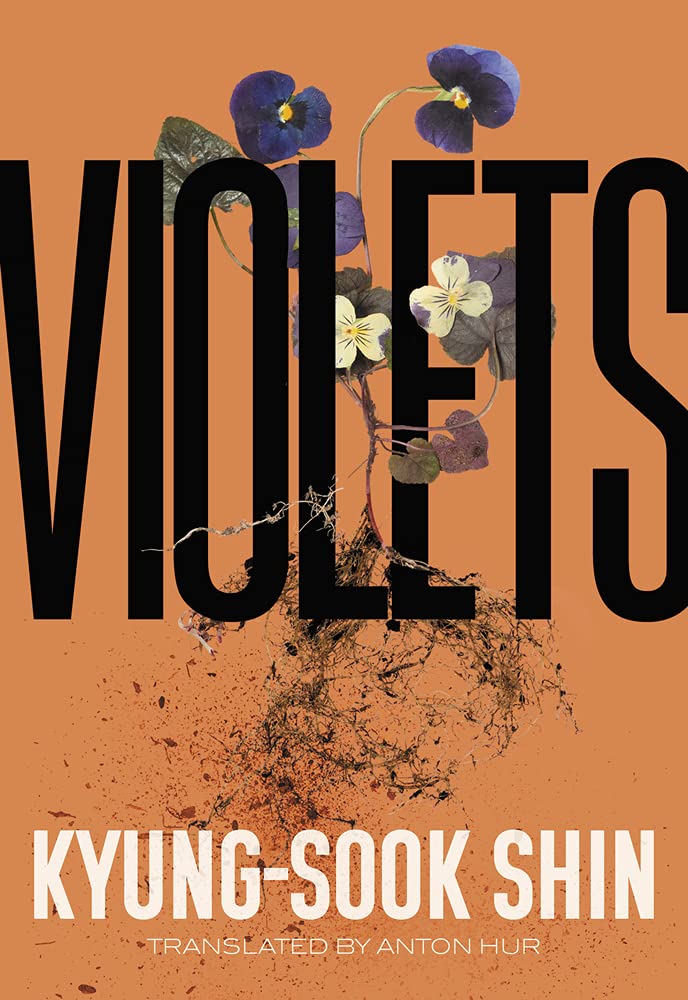
    VIOLETS
    SHIN KYUNG-SOOK
    (tr. Anton Hur)
    The Feminist Press
    $15.95 trade paper, available now

    One of NPR's Best Books of 2022!

    Rating: 4.5* of five

    The Publisher Says: We join San in 1970s rural South Korea, a young girl ostracised from her community. She meets a girl called Namae, and they become friends until one afternoon changes everything. Following a moment of physical intimacy in a minari field, Namae violently rejects San, setting her on a troubling path of quashed desire and isolation.

    We next meet San, aged twenty-two, as she starts a job in a flower shop. There, we are introduced to a colourful cast of characters, including the shop's mute owner, the other florist Su-ae, and the customers that include a sexually aggressive businessman and a photographer, who San develops an obsession for. Throughout, San's moment with Namae lingers in the back of her mind.

    A story of desire and violence about a young woman who everyone forgot, VIOLETS is a captivating and sensual read, full of tragedy and beauty.

    I RECEIVED MY DRC FROM THE PUBLISHER VIA EDELWEISS+. THANK YOU.

    My Review
    : This translation from the Korean joins a widening stream of Korean-culture transplants...Squid Game, Minari, this author's previously translated novel Please Look After Mom...making their roots into American pop-cultural soil.

    If you've yet to explore the trickle, start now before it's a flood. I think it's wonderful because English-language monoglot culture gets stale and boring and all alike if we don't seek out fresh infusions of talent and stories. And, like all the best translations, this story's timelessness is rendered in prose that could very easily have been first created in English...none of the occasional signals of awkwardly trying to explicate something that one word in the translated language would convey whole and entire. That is a fine achievement indeed, probably helped along by the fact that things like "minari" aren't quite as furrin as they would've been in 2011, when Please Look After Mom was published.

    What happens in this story is not particularly new or unusual. A girl is born to unfit parents:
    In a house with shut doors, a mother closes her eyes as the baby’s grandmother offers her the newborn. The mother knows what will happen now. An uncelebrated girl. The infant accepts her mother’s closed eyes in lieu of a loving caress, perhaps having intuited her fate from the womb, and does not bother crying. The sound of the monsoon fills the house. Underneath the porch, a dog curls its legs into itself. Can the baby hear the sound of the rain? She’s about to fall asleep in her grandmother’s hands. That same night, her father gives his daughter’s face only a cursory glance.

    Thus does another unwanted girl enter the world that won't ever bother to see her, really even to look at her. She's just...there. Her father never bothers to return; her mother never bothers with her at all, constantly seeking a man to care for her. (To be fair, an ordinary Korean woman's opportunities a generation ago weren't plentiful, and San's mother wasn't exceptional.)
    Her mother. San thinks about her from time to time.

    If she had begged her to stay, in front of that carefully prepared food, would she have listened? Why had San never once tried to hold her back? Wherever it was that her mother went, she never forgot to send her daughter money for school until San graduated.

    The last time San had seen her mother was when she was a freshman in high school.

    Children of addicts, the world over, tell versions of this same story. In this case, San's mother is addicted to men. She can't live without a man taking care of her, and she sacrifices the daughter she didn't want to get what she does want.

    Author Shin isn't solely criticizing the mother. She is critiquing the social organization, the patriarchy, that privileges men and their desires over women and their needs so completely, so thoroughly, that the women are hollow and meaningless without a man. It is repulsive and it is reprehensible, and much abuse and violence simply are borne by the women because what option do they have? What other choice can they make? In San's case, she is so hollowed out by the complete absence of love from her mother (or anyone else) that she enacts the form of love she knows: rejection follows violence, as it must.

    There is nothing forgiving in San. She forgives nothing, she is forgiven nothing, throughout the book. She is alone, she feels lonely of it (or so we infer...I don't know that she would be able to articulate the unmoored, disconnected reality that lonely people all share). For this, among other, reasons, this is a hard story to read. If you have ever been truly, down-to-the-bone lonely, this might be a triggering read for you. I haven't run across too many reads with this hyperconcentrated focus on loneliness, or too many with more success in rendering an emotional state into prose.
    A stranger to every single person in the crowd, San finds herself blocking the sidewalk as people swerve to avoid her. Even if a carnival were to break out around her, the vacant expression on her face looks entrenched enough to persist.

    Because she knows nothing of love, loving, being loved, San sees nothing except the one moment when everything changed, when the one love she thought she had was denied and made nothing. Not even attempting to find her former home nets San anything, she sees not the fields of minari she grew up among, where her life irrevocably emptied out and flowed away from her, but careful rectilinear plots of...something not minari. She has no roots. She feels no kinship.
    Nothing happened this past summer. Only that, in the hot sun from time to time, a brief thought would appear and disappear around me. That thought was closer to me than any of the flowers in the shop. Even as I tried to capture the thought on paper, the heat would exhaust me and I'd give up. There were plenty of things I gave up, using the heat as an excuse. Which means I spent this past summer repeatedly deciding to do things and then giving up on them. As if my life were an exhibition of how good I am at giving up. It was that kind of summer.

    It was that kind of life. It won't end well, it didn't begin well or go on well; that much we know. There's nothing hopeful in this story. Women like San aren't ever anyone's focus...her job in the flower shop working with and for Su-ae notwithstanding. She receives the desperate, genuine love of Su-ae as...nothing. San is fixated on emptiness...her only friend abandoned her!...and on men she does not want. She needs their love. She doesn't want it. She decided long ago that love wasn't something she could have, feel, receive, give. And so when it's offered to her she...doesn't see it. She does see the want of one man, she feels the desperate pull of another man on her attention, and gets nothing but unwanted results.
    Every attempt to resist is met with his greater strength. In a moment, her head begins to droop.

    She's released onto the street.
    Her mind is completely taken over, her body a husk. No one seems to take note of the loneliness she carries. Just some woman in the crowd, unaware that her top is undone. A more observant person might have noticed her cheek slightly swollen from having been punched, the thin lines of her face a touch asymmetrical because of it. Someone might see her pale face and think, How could anyone ever look so pale....

    A life of being unwanted, invisible, and it comes down to a final indignity. San is raped. Her hollowness filled at last with the violence that is all she can accept. It isn't in her to accept the reality of her situation, being unloved and unwanted, then seek out change. That's simply impossible. She leaves safety, courts rejection, and seeks oblivion.

    Leaving behind only the tiniest of wakes...the end of the story of Oh San is a poignant piece of mythologizing that fit so poorly onto the rest of the story that I was forced by honest anger and sincere disdain for its sentimentality to whack a star off my rating. After a night's sleep where I dreamed of the photographer and San:
    Violets. They bloom everywhere, making them seem more like weeds than proper flowers. San takes a closer look at them. Their little green leaves are small, their purple blossoms tiny. Before she came to the flower shop, she knew them as swallow flowers. Memories of entangling two swallow flower stems together and pulling them apart— one side was bound to snap. Whoever’s stem didn’t was the winner. She forgot what the prizes were, but she’d played the game many times. They did it with broadleaf plantains; they did it with foxtails.

    The man keeps pressing the shutter and mumbling something discontentedly. “What’s so pretty about these flowers? Such nonsense.” His disappointment is so palpable, it makes her apologetic.

    ...I realized that his arc needed an end, too. I might not like that end, but I would've felt cheated (if not right away, then after my irritation with the whole ending subsided) had it not been there. So back came a half-star, though I confess with some grumbling on my part.

    I think this small, powerful story deserves your eyeblinks. I think we should all resolve to notice the Oh Sans of this world, to extend a welcome to the table of them, to recognize their living presence instead of making them ghosts before they die.

    Sunday, March 28, 2021

    LIFE IN THE IRON MILLS, essential 19th-century reading tells us about the 21st century

    LIFE IN THE IRON MILLS and Other Stories
    REBECCA HARDING DAVIS
    (Tillie Olsen, editor; Kim Kelly, Foreword)
    The Feminist Press at CUNY
    $15.95 ebook editions, available now

    Rating: 4* of five

    The Publisher Says: Originally published in 1861 in the Atlantic Monthly, “Life in the Iron Mills” remains a classic of proletarian literature that paints a bleak and incisive portrait of nineteenth-century industrial America. Rebecca Harding Davis was one of the first writers to depict a working class that was exploited and exhausted as capitalism’s mills and factories destroyed both the natural environment and the human spirit.

    Davis's work was first recovered in the 1970s by the Feminist Press and writer Tillie Olsen, and then expanded in the 1980s to be the most comprehensive collection of her work to date. This reissued edition includes an updated critical introduction, and shares a uniquely prescient capitalist critique with a new generation.

    I RECEIVED MY DRC FROM THE PUBLISHER VIA EDELWEISS+. THANK YOU.

    My Review
    :
    A cloudy day: do you know what that is in a town of iron-works? The sky sank down before dawn, muddy, flat, immovable. The air is thick, clammy with the breath of crowded human beings. It stifles me. I open the window, and, looking out, can scarcely see through the rain the grocer's shop opposite, where a crowd of drunken Irishmen are puffing Lynchburg tobacco in their pipes. I can detect the scent throuhg all the foul smells ranging loose in the air.


    Choosing to bring her story to us via a first-person introductory passage was a stroke of genius by Author Harding Davis. At first, I felt very nervous because the idea of first-person present-tense narration for a whole novella's length isn't, um, too terribly appealing to me; but we get into the action when she has the narrator say that the people he's going to talk about lived there thirty years ago and....

    Well! All is on track, then! Stand down, adrenal gland.

    But mere lines later, my mind hit another conceptual pothole:
    She did not drink, this woman,—her face told that, too,—nothing stronger than ale. Perhaps the weak, flaccid wretch had some stimulant in her pale life to keep her up,—some love or hope, it might be, or urgent need. When that stimulant was gone, she would take to whiskey. Man cannot live by work alone.

    Wow! That's not even a little bit judgey, is it. (And "nothing stronger than ale" must resound oddly in the modern Puritanical no-booze no-sex no-fun ear! The paeans to the clean air and the purity of this bygone world make me itch. The entire world drank some sort of beer or wine because drinking water could kill you via cholera and/or diphtheria and/or typhoid fever.) Kim Kelly (author of Top Ten Words Women Hate which is short and to the point besides having a great title), in her Foreword to this second Feminist Press edition, says of the author:
    Rebecca Harding Davis was born into a life of relative ease and had next to nothing in common with the workers in her story, and yet she writes about them and the proletarian struggle with such compassion and depth of insight that it's hard to believe she was merely watching from the window.

    I must decline to co-sign, Kim Kelly. To my elderly man-ears, this story sounds like the Abolition era's standard christian social-reform literature à la Uncle Tom's Cabin. Built into its very real sympathy is the distancing judgmental mind-set inescapable by a woman of Author Harding Davis's background. She isn't all about the judgments, it is true, because her point is to bring into sharp relief the inequitable, really iniquitous, world that has done this to Deb, the character described here. But baked into the clay is that vocabulary of blame and othering inescapable in 1861's world-view.

    The capitalist mouthpiece character is a piece of work. He's called Kirby, but really could've been called Carnegie or Rockefeller. His anthem:
    "I do not think. I wash my hands of all social problems,—slavery, caste, white or black. My duty to my operatives has a narrow limit,—the pay-hour on Saturday night. Outside of that, if they cut korl, or cut each other's throats, (the more popular amusement of the two,) I am not responsible."

    In that unlovely speech, addressed to one Mitchell, the dilettante character of no special moral fiber but a deep and abiding aesthetic sensibility, one hears echoes of "I don't see race" and its ilk, doesn't one. Mitchell is moved to say in riposte, "Money has spoken!"

    Kirby and Mitchell are discussing the existence of one of the mill-hands, Hugh Wolfe. He is a true Other, a man out of place in his place of residence. He has had a modicum of schooling; he is aesthetically aware of the world around him; therefore he is the subject of the other mill-hands' bullying. He has created a statue of great aesthetic interest to Mitchell, a carved woman whose anatomy Mitchell criticizes for being not starved-looking when Hugh tells him the korl sculpture is meant to be hungry. In a passage that felt to me more than a little codedly homoerotic, Wolfe, Kirby, and Mitchell pass around the idea of bodies on display (half-naked men abounding in the smelthing-furnace heat, summer or winter) being essentially lower-class unless they are Art.

    Mitchell ends his part of the conversation with a "cool, musical laugh." ::eyebrow:: Then Author Harding Davis delivers this about him:
    Bright and deep and cold as Arctic air, the soul of the man lay tranquil beneath. He looked at the furnace-tender as he had looked at a rare mosaic in the morning; only the man was the more amusing study of the two.

    The hairpins are dropping...nay, flying! And then she has him speak Scripture, "De profundis clamavi" no less!, at which juncture he is compared to the Devil. Now I do not know Author Harding Davis's other works, but these are Uranian markers in nineteenth-century gay parlance. Mitchell, and to a lesser degree Kirby, are assessing Hugh Wolfe as a sex object. And he's right there with 'em.

    Think not? Thus Hugh of Mitchell, so recently departed and he fears and expects not to return:
    Then flashed before his vivid poetic sense the man who had left him,—the pure face, the delicate, sinewy limbs, in harmony with all he knew of beauty or truth. In his cloudy fancy he had pictured a Something like this. He had found it in this Mitchell, even when he idly scoffed at {Hugh's} pain: a Man all-knowing, all-seeing, crowned by Nature, reigning,—the keen glance of his eye falling like a sceptre on other men.


    And the rest of the story might as well have been A Tragic Gay Romance. I'm fine with that, and don't feel the need to chisel away my impression of what Author Harding Davis did because it might not be what she intended (note use of conditional).

    If you've paid me the slightest attention at all, you'll know that the anti-capitalist message of the story is so in tune with my own thoughts about a properly run world that this really needs no belaboring. I was absolutely sure I'd enjoy this story when I read this:
    Everything old is new again, including the tension between the workers who make and the bosses who take. How many more Hughs are there out there now, working dangerous, soul-sucking jobs instead of following their passions? How many more will have to suffer before this wretched capitalist system finally breaks down and sets us all free?

    I don't know, Kim Kelly. But the short answer is "not soon enough."