Showing posts with label mythological retelling. Show all posts

Wednesday, June 17, 2026

MEDEA SANG ME A CORRIDO, latest feminist redemption of a Classical-mythology woman's character


MEDEA SANG ME A CORRIDO
DAHLIA DE LA CERDA
(tr. Heather Cleary & Julia Sanches)
The Feminist Press (non-affiliate Bookshop.org link)
$17.95 all editions, available now

Rating: 4.75* of five

The Publisher Says: A punk revival of Medea as a Mexican anti-angel of birth and death, from the International Booker Prize–nominated author of Reservoir Bitches

In Northern Mexico, Paulina, Perla, Antonia, Reina, and Jordan are striving to survive the barrio—hustling on the edge of a cartel-run economy, nursing the wounds made normal in a world that eats its own. Hovering over their trials is a spirit with gothic flair, dressed in black and crowned with braids: Medea, a mythic mother of the Chihuahuan desert, ancient as the Aztecs but never too old to be petty.

From aiding a trophy girlfriend’s abortion, to accompanying a mother in her search for her lost child in the desert, to embracing those taken too soon in the narco’s brutal proxy wars, Medea fights for justice for her chosen mortals—her divine wrath the only power that could rival the corrupt, violent web spun by the cartel, the government, and the military. Dahlia de la Cerda’s magnetic prose draws readers right into the heart of that web—and links all our fates to the missions of Medea, equal parts midwife and gravedigger, a femme fatale god in a femicidal world.

I RECEIVED A DRC FROM THE PUBLISHER VIA EDELWEISS+. THANK YOU.

My Review
: Repurposing classical myths for the twenty-first century is a...subgenre? full genre? literary storytelling technique?...an effort I enjoy a great deal. Medea repurposed as avenging goddess, destroying angel, wrathful righter of women's victimization, has double appeal for me. It corrects what I've always seen as the calumniation of a powerful healer-semidivinity with the accusation of insane jealousy over a man who has abandoned her for another woman. She is accused in classical sources of murdering her children, born of her body, to exact revenge on a faithless fucker she literally enabled, by using her skills and knowledge, to come to power and riches.

A healer-spirit so skilled she is regarded as divine.

Male anxiety much, Euripides?

So I've never found the famous version of Medea at all convincing. It smacks of an attempt to invalidate a powerful and skilled woman by making her hyperfocused on a man; by accusing a mother of murdering her children born of her body because a man hurt her feelings by betraying her with another woman.

Hogwash.

No better mythological figure, then, to be repurposed into a guardian of women in a seriously patriarchal, femicidal culture like that of the narcotraficantes. Setting these interconnected stories...more like very well-defined chapters than actual stories, what I myownself have always referred to as "braided stories" because, like a braid, the separate strands are evident while making together a whole effect not possible for the strands separately (see Celeste Mohammed's works)...in what she calls "Aztlán," the narcostate existing in Northern Mexico where femicide is appallingly rampant offers Author Dahlia wide scope for Medea's redemption. As an avenger, Medea appears here with clear markers of supernatural power: "Then she kissed me on the forehead and shot through the sky in a snake-drawn carriage," is not a description of an everyday person. Six women in dire trouble are visited and assisted by Medea in barely over a hundred pages.

None of them are spotless, sweet little fembots, which is a relief. Messy, horny, misguided people are innumerable across the globe and occur in every ray of the rainbow of identities humans so love to pretend are Ordained and Immutable. Medea ignores these ideologically driven cultural fripperies to effect redress for the wronged.

It's satisfying to me because I like Ma'at being served by Justice (very different in my observation from mere "justice" such as the travesty being perpetrated by the US government department using that name). Medea, in Author Dahlia's hands, serves and renders Justice even in the face of "justice."

I have only one critique to offer in support of my just-off-perfect rating of the work: sometimes speed is not your friend when offering tendentious and muckraking narratives. I felt, by the end of the read, I was not in possession of enough facets of each woman's life experience to grasp the motivation for Medea coming to the rescue. It's not necessary for the story of Medea as avenger to be formed and shaped. That is done, and the shape is one I found enrichingly sharp. I was not utterly enthralled where that was *easily* within Author Dahlia's reach.

It's a braid of great beauty. It stops short of Divine Grace. And it is so urgently necessary for all of us to get our heads around the reason it exists I'm here pushing it at you. Please pick one up soonest.

Wednesday, June 25, 2025

WEARING THE LION, sophomore novel from 2024 Nebula Award-winner AND Best First-Novel Locus Award winner John Wiswell


WEARING THE LION
JOHN WISWELL

DAW Books (non-affiliate Bookshop.org link)
$16.99 ebook, available now

2025 Nebula Award nominee for Best Novel.

Rating: 4.5* of five

The Publisher Says: This second novel from Nebula Award-winning John Wiswell brings a humanizing, redemptive touch to the Hercules story in this mythological fantasy for fans of Jennifer Saint and Elodie Harper

Heracles, hero of Greece, dedicates all his feats to Hera, goddess of family. Heracles’ mother raised him to revere Hera, as her attempt to avoid the goddess’ wrath. Unbeknownst to Heracles, he is yet another child Hera’s husband, Zeus, had out of wedlock.

Hera loathes every minute of Heracles’ devotion. She finally snaps and sends the Furies to make Heracles kill himself. But the moment Heracles goes mad, his children playfully ambush him, and he slays them instead. When the madness fades, Heracles’s wife, Megara, convinces him to seek revenge. Together they’ll hunt the Furies and learn which god did this.

Believing Hera is the only god he can still trust, Heracles prays to Hera, who is wracked with guilt over killing his children. To mislead Heracles, Hera sends him on monster-slaying quests, but he is too traumatized to enact more violence. Instead, Heracles cares for the Nemean lion, cures the illness of the Lernaean hydra, and bonds with Crete’s giant bull.

Hera struggles with her role in Heracles life as Heracles begins to heal psychologically by connecting with the monsters—while also amassing an army that could lay siege to Olympos.

Nebula Award-winning author John Wiswell brings his signature humanizing touch to the Hercules story, forever changing the way we understand the man behind the myth—and the goddess reluctantly bound to him.

I RECEIVED A DRC FROM THE PUBLISHER VIA NETGALLEY. THANK YOU.

My Review
: "Mythology" might be one of the English language's biggest mistakes or disservices or just downright screw-ups of all time. It has a lot of competition, to be sure...you'll have your own ideas about that, I don't need to elaborate...but walling off the best possible way to understand human nature's thorniest problems behind this etymological fence:
mythology(n.) early 15c., "exposition of myths, the investigation and interpretation of myths," from Late Latin mythologia, from Greek mythologia "legendary lore, a telling of mythic legends; a legend, story, tale," from mythos "myth" (a word of unknown origin; see myth) + -logia (see -logy "study"). Meaning "a body or system of myths" is recorded by 1781. (etymonline)
...is wasteful, even dangerous. Thank goodness we're embracing retellings, modernizations, again. And even more praises be sung to the Divine that John Wiswell joined the chorus.

What Author Wiswell excels at in this story is upending your expectations...seems to be a trope in this case, go read my review of Someone to Build a Nest In, 2024 Nebula Award-winner AND Best First-Novel Locus Award winner that it is...of what love, grief, trust, and faith mean, require, and offer to you. Hera and Herakles, the Fury, the monsters, all get bound in unquestioned roles, then get jailbroken by Author Wiswell's perspective shift. It's a great way to de-mythologize a violent and triumphalist myth, putting it into a twenty-first centurian's comfort zone while making its subtexts very sharp. That contrast between the meaning we've learned to associate with the multiple millennia of unacknowledged retellings of Heracles' story and what Author Wiswell does with it is *chef's kiss* piquant.

Introducing a goddess to the idea of accountability is permaybehaps the most satisfying part of Author Wiswell's reimaging of the tale. That a being who was, until now, entirely untouched by any sense that her actions having consequences in others' lives was in any way a cause for her own emotional involvement is so in keeping with this #MeToo moment. It's also in sharp contrast...I'd even say rebuke...to the rising tide of publicly-flaunted bigotry and intolerance. Hera never faces up to the devastation her setting of the Furies on Herakles for something simply not his (Zeus's infidelity that resulted in his birth) doing caused in the original. Of course not! Divine beings aren't subject to rules like mere mortals are, say the myths of a culture that contended their royals are divine.

The entire story revolves around that most current of cultural concerns, accountability. Herakles facing up to his murderous rampage's consequences, then his puruit of revenge's limitations; Hera to her misuse of power and her misplaced anger; "Granny" the Fury's, well...existence; all in the end are changed in some very relatable, and pretty satisfying, ways. How that happens with Hera and Herakles as equally unreliable narrators is predictably sort-of stop-and-start in effect on the pacing. It becomes a bit more choppy than I as a reader prefer. My one other complaint, more of a whine actually, is that including all twelve canonical Labors made the read slower than was optimal for a humorous tale. Brevity is the soul of wit became a maxim instead of a truism because its self-evidence is actionable.

So the missing half-star is explained. The four-and-a-half remaining are slathered in the cream-cheese-and-pecan frosting of contentment. The happiness I felt at Herakles loving the Nemean Lion...the way every act of violence (after the inciting act) results in Hera, and Heracles, figuring out their wounds and their capacity to endure and even recover from them...the sly, quiet side-eye humor...I was badly in need of them all.

Dunno about y'all, but fiction that transmutes an ancient tale of violence and rage and hate into one of healing and chuckles feels damn close to miraculously soothing in my 2025 world.

Author Wiswell, thank you. I needed this story at this moment and you made it so good to read I couldn't stop.

Friday, December 6, 2024

THE ART OF FANTASY: A Visual Sourcebook of All That is Unreal, gorgeous gift book for the fantasy and/or art-loving teen...and up!


THE ART OF FANTASY: A Visual Sourcebook of All That is Unreal
S. ELIZABETH

Frances Lincoln Ltd
$30.00 hardcover, available now

Rating: 5* of five

The Publisher Says: The Art of Fantasy is an inspiring curation of art for fans of myth, magic and the unreal – from gallery greats (the Surrealists and Symbolists) to artists working in the margins today.

This beautiful, fully illustrated book presents a compendium of artworks throughout history which have been inspired by myth, fantasy and the unreal.

Artists have explored imaginary worlds and fantastical creatures for centuries, expressing the unreal and impossible, the mystical and mythical, via the medium of paint.

But what draws them to the imaginary, the uncharted and the unknown? Is it merely an escape from reality? Or are they seeking a greater understanding of the human experience, or perhaps the very meaning of life itself? With myriad styles and methods of expression, what links artists through the ages? And how have these visual flights of fancy and imagination changed over the course of time?

The Art of Fantasy is a visual sourcebook of all that is fantastical – from fine art to illustration, and from surrealists and symbolists to the creatives working in undefined territories. While the artists in our history books (Blake, Goya, Dali, Magritte, Ernst) first brought fantasy art to the galleries, it was the twentieth century artists who brought it to the masses. It is in this book that, for the first time, they are united and equally weighted, presenting a mesmerising and thoughtful curation of the best fantasy artwork out there.

This is an inspiring collection for fans of myth, magic, fantasy and art history.

I RECEIVED A DRC FROM THE PUBLISHER VIA EDELWEISS+. THANK YOU.

My Review
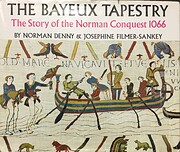
: I grew up around art, and artists. The first Christmas gift I remember the moment of getting is one I'd seen in the bookstore (they were mostly in department stores in those days, this one was in Saks Fifth Avenue), loved and wanted very badly: The Bayeux tapestry: the story of the Norman Conquest, 1066 by Norman Denny.

I was, as this shows, an odd kid. My favorite kids' books were Dr. Seuss's deeply surreal weirdnesses. My father and I absolutely loved reading those together. Our house was decorated with original art, and my mother's bestie for almost my entire life was an artist whose work still adorns my walls.

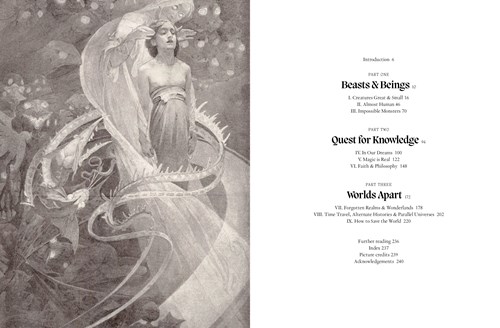
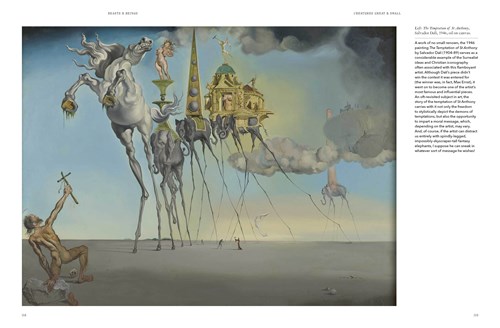
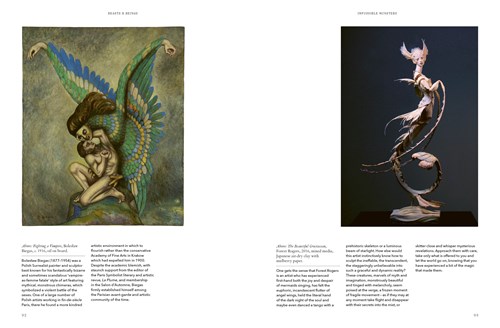
In short, I'm exactly the buyer, if only tangentially the reader/viewer, this book has in its crosshairs. I knew the artists and most of the artworks in here. I got the point of it immediately on reading the first few paragraphs. It's a very good introductory compendium for the oddball world of surreal and fantasy art and artists. I'm also inclined to give this book as a gift to someone of, say, thirteen or so on up, who loves fantasy books, who draws a lot, and/or who is just discovering the immensity of our visual culture.

The best thing about this beautiful object as a gift is it elucidates the visual and intellectual culture of "fantasy" as a creative worldview without going all art-history blather. It's a book that reads like the good conversation one can have with an older loved one on a subject dear to their own heart.

As a gift, I think it is about perfect. As a self-gift, it *is* perfect, worth your treasure in trade for its beauty and wisdom.

Thursday, December 5, 2024

DEATH COMES FOR THE TOYMAKER, Vol. 1 is a really Gothic take on Santa that I liked a lot


DEATH COMES FOR THE TOYMAKER, Vol. 1
DAKOTA BROWN
(illus. Ryan Cody)
Magma Comix
$19.99 trade paper, available now

Rating: 4.5* of five

The Publisher Says: Death comes for us all. But for Gil the Toymaker, the visit is an eternal tragedy!

Every year the holiday gift giver visits children all over the world on a special night, but Gil’s immortality comes at a cost. Forced to do the work of Death, carrying a list of ready-to-harvest souls alongside his naughty and nice lists, Gil gives toys AND takes souls all in one night! But as the Toymaker reflects on the relationship he’s had with Death for several millennia, an associate reveals a scheme that may just put an end to Death’s contract (and, perhaps, Death himself!)

An epic twist on the traditional Christmas legend from writer Dakota Brown and artist Ryan Cody, for fans of original tales featuring familiar characters from mythology & folklore like Neil Gaiman’s American Gods or Bill Willingham’s Fables!

I RECEIVED A DRC FROM THE PUBLISHER VIA EDELWEISS+. THANK YOU.

My Review
: It's #Booksgiving, so I man up and look through publishers' options for gifting to the comics fans on all y'all's lists. I usually enjoy it about as much as dentistry...and I am *mortally*afraid* of the dentist...but am occasionally pleasantly surprised. Those are the ones y'all hear about.

Like this really interesting take on the Spirit of Giving that my mother sold me on after I figured out that Santa was Dad in a weird suit in 1965. It takes the idea of personified Death, which is one of the few things in the Pratchettverse I really like a lot, and applies it to the idea of ritualized gift-giving.

total Hogfather vibes, no?

I'm not sure I really *got* the art, in that it seemed to me to be more somber than really called for in the story itself.

There's something...elemental...that I resonated with in these panels, however, so in the end I landed on a solid, happy four-and-a-half stars for a story that gives new heft to a deeply commercial holiday.

Have a teen giftee who's got an anti-capitalist 'tude? A seriously Goth kid not into the whole "ho-ho-ho" and "holly-jolly christmas" b.s.? Here's them a story that agrees with their world-view. It might also excite them to get curious about ancient myths and legends, which can only be a good thing. It's one I would buy for myself, and only misses five stars because it feels like it left off but didn't end.

That being a feature not a bug in sequential-art storytelling, I record it purely as an explanation not a cavil.