Showing posts with label SFF-lite. Show all posts

Wednesday, July 22, 2026

THE AND THAT WAS, beautifully illustrated novella-length prose poem


THE AND THAT WAS
MIA TIJAM
(illus. Rustom Pujado)
Rosarium Publishing (non-affiliate Bookshop.org link)
$17.99 paperback, available now

Rating: 4* of five

The Publisher Says: The and That Was is an archipelago of words: lush and mountainous in parts, civilized veneer in others, almost all of it seemingly born from instances when the forces within could no longer be restrained. The thing about archipelagos is to not view them as chains of islands, but as the space that envelops them.

That is what this collection contains.

The land. The culture. The rustic and the urban, religious and heretical. The fractures. The spaces. The cities without dragons...

The Fairy Tale Reality of the Philippines...

Where the end began and begins again...The wishes that point to what we should have wished. These stories contain–and release. And so do you.

I RECEIVED A DRC FROM THE PUBLISHER VIA EDELWEISS+. THANK YOU.

My Review
: "Stories" and "collection" are slightly misleading descriptors. There are under 150pp in this book; there are very cool illustrations on full pages, elucidating angles of seeing on the, the, uhm vignettes or prose poems they're surrounded by; the sum of these parts is less "collection" than stream-of-consciousness novella.

I don't know anything meaningful about the Filipino culture I was within though apart from as I read. I'm very clear that I'm in a world that's dreamlike, delineated in flashes, and in swirls of awareness.. It's bounded and bordered and depicted by the artwork that, malheureusement, I'm not able to show you (put up downloadable samples, Rosarium! you can watermark them!) for added edge-giving. Illustrator Rustom has either read these stories with great care and deep personal connection resulted or he is the male half of Author Tijam's bicameral mind. The prose is deft and rich:
The child gingerly stood up and warily folowed her out of the bodega, into the afternoon light, and through the dirty-kitchen—a hut beside the main house where the old women chopped ebverrything on a long wooden table and cooked in a kiln banked by dried wood.The old nursemaid led her to the deep-well pump beside it. The child wited silently as Nana Kuring lifted the tin basin that was shaped like a soft drink bottle crown and filled with laundry to hoist it on top of her head while bending to pick up the palo-palo used as the laundry paddle. The old woman began walking towards the gate that led to the road and after a dozen stepsm stopped when she realized that the child wasn't following her. The child was looking up at the windows of the old house, at those shuttered shell windowpanes, and then looked at her. Nana Kuring swung the palo-palo in a forward motion to the child, and the little girl hurried after the old woman.
An entire cultural milieu, images sounds and all, is in this brief not-unique passage.

I found the reading experience satisfying on several levels: curiosity about a culture I do not know, immersion in an unfamiliar sensory world, stimulation of visual language fresh to me. I'm sure it's hard to look stuff up, to see the places you don't have a ready-made image in your head to match, at first anyway. It' really worth making the effort and I recommend this work to you as a rewarding place to start your efforts.

Friday, July 17, 2026

BALSAM KARAM'S PAGE: using pieces of the SFF toolkit to great effect without writing SF or F


EVENT HORIZON
BALSAM KARAM
(tr. Saskia Vogel)
The Feminist Press (non-affiliate Bookshop.org link)
$16.95 all editions, available now

Rating: 4.5* of five

The Publisher Says: From the author of The Singularity, a saga of one girl's resistance and exile in the stars and soil of empire.

Seventeen-year-old Milde is from the Outskirts, a place beyond the mountains where the dirt is corpse-rich and mothers and daughters make their living banished from society—without rights, access to care, or legal status. Simmering under the surface of their day-to-day survival is a desire for change—and one day, Milde and her friends act on it, setting fire to government buildings in the city that has rejected them.

When Milde is framed as the instigator of the uprising, she is arrested, imprisoned, tortured, and eventually presented with a final choice: to be executed publicly or to be launched into space, into a black hole called the Mass, for an experiment. Milde chooses the Mass.

Event Horizon is an exquisite existential novel, dark as deep space, woven with reflection on oppression, solidarity, trauma, and loss. With a completely unique voice, Balsam Karam writes about the swirl of hope and despair in the lives of the marginalized and a young woman’s unwavering belief in a better world.

I RECEIVED A DRC FROM THE PUBLISHER VIA EDELWEISS+. THANK YOU.

My Review
: First, read this:
They're talking about deportation, we told them, Do you understand what that means? They're talking about taking us across the border and leaving us there, they're saying we have to go home, but what home do we have other than this one, I told them. I was born here and my child was born here, I told them—It's true that we've been living without papers for all these years, but now were being deported—is that acceptable? These are our lives I told them, but no one wanted to listen and so we ended up here. Milde listens to her mother and sits down beside her, watching the buildings rise one by one, wishing she already knew how to build a home.
Maybe I resonate with this despairing cry because I experienced a similar feeling, if not legal process, with my own homeplace rejecting my very being as a gay man. Displacement is a violent painful amputation without mercy or understanding or empathy...and it goes on every single day all over the world, in homes in cities in countries in (especially) religions.

Every time it occurs it is an evil, a wound to the spirit of all who perpetrate and/or experience it. It is a wound on the masses of people who, like those who stay in Omelas, ignore it. Milde chooses a course of action in recation to this wrong that commits the most terrible crime imaginable: It is meant to, in the metaphorical structure of Omelas, show the complacent, the docile and unquestioning, the cost of their dreamworld. Terrorism! the shout rises, led by those terrorizing Others to please and entertain the unthinking and disengaged. Milde must be punished, must be seen to be punished, not to deter future "terrorists" but to satiate the appetite for cruelty of the dociles, passive entertainment to slake the human thirst for blood.

Milde makes an ugly bargain with the evil system:
Sure, I can go to space and die, why not? I'd rather die in the depths of a black hole than wait around to be executed here, if you see what I mean. I'm doing this so that I can sit back and rest for once, no knife or metal lid hidden under my pillow, and so that, if only for a day, I won't have to look at those same white faces that wish me harm.
Her consent to be sent into the uttermost unknown to die while providing data (her suffering and death) is about as meaningful to the "white faces that wish {her} harm" as clicking "accept and close" is. There is no meaningful other option, but make it look good for those who can't be arsed to see how wrong, how painful it really is.

Swedish Kurdish author Balsam is the child of a man who experienced the horrors of a "terrorist" who chose his course of action to resist colonization. That crime resulted in his daughter being a Swede not a Kurd by nationality, a displacement that will reverberate through her entire life short or long. Everyone makes these decisions for their children, it's inherent in having them; but as all parents know it's never what you say but what they hear that counts. Author Balsam's feelin' some kinda way about these choices, and seeing the world in a unique cast of light as a result.

All of us Anglophones can see it because she let us in on experiences we don't precisely share, but still can find ways to be with. We can all feel echoes pressing on our emotional eardrums that come from a similar place of "injustice happened to me, to my life, that I had no pwer to resist"...maybe enabling us as a result to make the effort to help the world resist, reject the bloody hunger for revenge or simply the vicious desire to hurt Others to slake Humanity's thirst for it.

Eminent Translator Vogel has been at work for a good long time so it's no surprise her skills make this feel like a native English speaker wrote it. In fact I bring it up here because I was suddenly struck about the halfway point that I was not having my usual internal debate about "what word was that in {language}?" I checked the copyright twice during this read...yep, translation. This is very unusual for me. It's even more surprising because this is Author Balsam's first book.

The outrage that simmers under this lovely surface is definitely part of the reading experience. There is not sweetness in the story, or in the language; there is precision, but not distance, or chill. It's going to make emotional demands of you-the-reader. Milde experiences the constant reminder of difference that is used by polite people to maintain their superiority in the hierarchy. Her mother Essa is not even as far into the acculturation process as she is; it's a process defined by exclusion, rejection, after all. Milde's course as a resister is set thereby and this her fate sealed.

Her violent terrorism is what is left to a powerless woman in the face of an entire power structure built for the purpose of excluding her forever. Her resistance is all she has; it can only be what it compelled her to enact; so her phases of punishment *must* result in her body being launched into a black hole to die in as-yet-unknown suffering that must be public. It must be shared, this last and most intimate violation of her humanity. Otherwise she will not have paid for her "crime."

It is the best of all possible validations for the power structure. It is the best of all possible tricks to play on the power structure for Milde. It was chilling how much courage Milde possessed accepting this final, long act of her life. Even Christ only suffered for hours.

++++++++++++++++++++++++++++++++++++++++++++++++++++++++++++++++
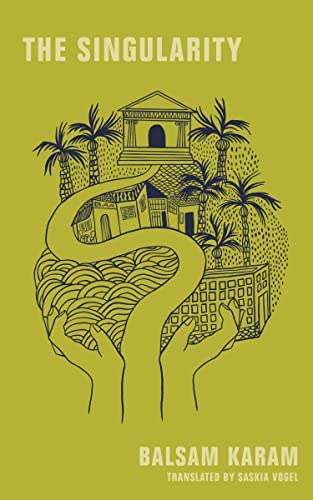

THE SINGULARITY
BALSAM KARAM
(tr. Saskia Vogel)
The Feminist Press (non-affiliate Bookshop.org link)
$16.95 all editions, available now

Rating: 4.25* of five

The Publisher Says: Lyrical and devastating, The Singularity is a breathtaking study of grief, migration, and motherhood from one of Sweden’s most exciting new novelists.

In an unnamed coastal city filled with refugees, the mother of a displaced family calls out her daughter’s name as she wanders the cliffside road where the child once worked. The mother searches and searches until, spent from grief, she throws herself into the sea, leaving her other children behind. Bearing witness to the suicide is another woman—on a business trip, with a swollen belly that later gives birth to a stillborn baby. In the wake of her pain, the second woman remembers other losses—of a language, a country, an identity—when once, her family fled a distant war.

Balsam Karam weaves between both narratives in this formally ambitious novel and offers a fresh approach to language and aesthetic as she decenters a white European gaze. Her English-language debut, The Singularity is a powerful exploration of loss, history, and memory—an experience akin to “drinking directly from a flood of tears” (Aftonbladet).

I RECEIVED A DRC FROM THE PUBLISHER VIA EDELWEISS+. THANK YOU.

My Review
: Published first but written second in Author Balsam's career.
The grandmother picked them up and held them close in sleep almost no sleep at all and then muttered that no one beyond the ruined wall wished them well and that she couldn’t bear another loss – again and again she said she couldn’t bear any more loss and even though the children didn’t understand how or why, they knew that the loss was now a part of them and that at any moment it could strike again.
It's the world of Event Horizon (review above) on Swedish soil in the camp the women live in as they have no recourse or options:
It’s your first winter in the house with the little garden, the darkness outside. Something hard hits the windows and your brother stands up, puts on his coat. After a while he comes back in, says he needs something to wipe off the dog shit from the window and the postbox. In his hand is a blue and yellow sticker that he’s torn off, like the ones you’ve seen high up on lampposts around town.

–and–
Later, your mum tells you that the first thing she was told after talking about how she had been tortured in prison was that no one would hire a person like her. One eye missing, older and not entirely fluent – it’ll be tough, the caseworker had said.
Nice people do not shout racist slogans in your face. It does not mean they are not going to behave in racist ways. The story's narrative risk-taking is more evident in its middle third:
/ do you think of her often, Marcus or Magnus asks softly / we ate bean stew with rice and yoghurt and I drank a whole pot of tea afterwards / you nod, of course you do / Gran was the happiest of us all I think / I think of her and of my grandmother you say and put the cup down / she took you in her arms and then I made sure to sleep while I had the chance / do you know anything about black holes? you later ask the counsellor / and I only got out of bed the next morning can you imagine? / inside a black hole is a place that is also a state — do you know about this? you ask, facing Patrick or Henry in his chair / a few days later Rozia's mother visited with little Rozia in her arms and a basket full of fruit /no, I'm afraid I don't know much about space, says Eric or Martin and continues to take no notes / then the two of you would meet up practically every day / you say it's called the singularity - that's what the place is called and lean over the bed / you and Rozia were like twins, we thought - the same round face and your hair as big and black / inside the singularity, the force of gravity is so strong it can't be calculated, can you imagine? you tell the counsellor / the pair of you often played in Rozia's yard and sometimes you stood by the big road even though you weren't allowed to and the soldiers could show up at any moment / that force pushes bodies together and renders the distance between them nil / because you both liked Gran's fried potatoes and her bean stew, you mostly ate at ours Mum says / you use your hands to show how no space remains between bodies in the singularity
It doesn't scan easily, but I promise you it is not flummery, a brummagem gaud of "Style" that distracts with difference without adding into meaning. In the more conventional first and last parts, the harrowing tales told do the work of impacting you in dark corners of your Safe Place, you are not safe, ever, as long as you are Other. While you are reading Author Balsam's story you are Other along with her.

It's a passionate document about grieving. It is a horrible chronicle of losing a child, losing an infant, losing losing losing without a moment of respite and never once ever giving up.

Until the final act of control is yours.

If you need a—any—content warning, do not pick this read for yourself.

Sunday, July 12, 2026

EVERYTHING WAS BEAUTIFUL AND NOTHING HURT, how I would know I was dead is just that


EVERYTHING WAS BEAUTIFUL AND NOTHING HURT
BEN REEVES

Avid Reader Press (non-affiliate Bookshop.org link)
$14.99 ebook, available now

Rating: 4.5* of five

The Publisher Says: Travis is Death in the modern world. He wears jeans and a T-shirt and lives in a small, grey town. His job is to offer people comfort in their final hours of life. He’s stoic, gentle, and a little naive, despite everything he knows. He’s young and handsome, despite who he is. Each death he witnesses is meaningful to him; he listens, never judges, and most importantly, never tries to change anyone’s fate. He knows that every life must eventually end to maintain the balance of the universe and he respects the cycle.

Then he meets Dalia, a midwife, and her boisterous eight-year-old daughter Layla, who live across the hall. As Dalia and Layla come to embrace Travis, it becomes more difficult to maintain the detachment that’s allowed him to function for so long. Their time together teaches him what’s truly important in life—and what might be irrevocably lost in death.

Written with radiant warmth, wisdom, and compassion, Everything Was Beautiful and Nothing Hurt is a timeless story about appreciating life, accepting its end, and finding our place in the universe—especially when it feels most impossible—that will resonate with anyone who has ever loved and lost or worried at time’s passing.

I RECEIVED A DRC FROM THE PUBLISHER VIA NETGALLEY. THANK YOU.

My Review
: Remember Meet Joe Black? Or, if you're a reader my age, Salley Vickers' novel Mr. Golightly's Holiday? We're all interested in divine personifications of absolute power...god and death being in Western cosmology the two supreme beings...and we need to tell stories as much as we need to breathe, so it's inevitable that there will always be new and interesting ways to personify them. (And funny ones, if you're irreverent like Sir Terry Pratchett. Author Ben Reeves is staking out a bit of that territory in this story.

Travis is an ordinary guy who also happens to be Death. Literal Death. The Grim Reaper wears jeans and t-shirts. Sure, why not. Travis comforts and guides people into death, so you already know it's not going to be a Pratchetty jollification of a story. Seeing the personification of death as more or less a death doula is, on its face, reductive because Death is permanent, absolute, fundamental, and utterly unknowable like Life is. Reducing a terrifying cosmic power to a guy in jeans and a t-shirt who helps you, guides you with kindness and sympathy, through the emotional landscape of The End, feels like lèse-majesté to me. Like euphemising "he died" into "he has passed away," if feels like emotional dishonesty to me, like a pointless attempt to pre-feel the horrible twisting agony that is grief. (It doesn't work, any more than not saying "Voldemort" did. Any time one uses the passive voice, dishonesty is stinking up the sentence.)
Enough abstraction. The action in this story is heavy, the emotions surrounding death are never otherwise though sadness is not necessarily always foregrounded. Author Reeves chose, rightly in my view, to give Travis a first-person narrative voice in stream of consciousness style. It is how we experience life, so why wouldn't Life's intimate partner use it? It's also effective in conveying the immediacy of Death's role in one's life by distancing our mere mortal PoVs into third-person limited narratives.

I think that won't sit well with some readers, but it very much worked for me. It made the stakes so clear: at the end of life, Death is the main character. He (in this case) looms large, his thoughts and his emotional investment in us are all mortals have in that transition. It was a very interesting take, one I don't recall seeing in a novel before. (A dim, distant tocsin sounds about a short story set during a pogrom in Ukraine—anyone else hear it?)

What made this creative and intelligent Death-centered story so interesting to me was the clear intent to elicit powerful responses in the reader was never shortchanged by pulled punches. I find the central conceit just a bit dimmed down for softening sharp edges; but within that mild criticism of intentional diminishment of robustness, the action isn't kinetic to make the story external. It's a story of the interiority of death, as experienced and related to us by Death.

It's a superior read, told by a talented storyteller, in a creative way that enhances its message of coping with emotion at te end of life.

Monday, July 6, 2026

WE WERE FORBIDDEN, feminist author at her tendentious best


WE WERE FORBIDDEN
JACQUELINE HARPMAN
(tr. Roz Schwartz)
Transit Books (non-affiliate Bookshop.org link)
$17.99 ebook, available now

The Independent Press Top 40 Bestsellers: Fiction For the week ending September 2, 2026

Rating: 4* of five

The Publisher Says: From the author of I Who Have Never Known Men comes a startling new collection of three never-before-translated stories, each plumbing the depths of that most necessary human defiance.

Wandering the forest in the wake of some unfathomable war, a woman and her fellow survivors are forbidden from leaving its boundaries or pausing in their march through its strange depths.

As part of her rigid schooling, a teenage girl is barred from questioning the dogma she is taught to believe—her punishment for doing so will be as disturbing as it is disproportionate.

Locked in a loveless marriage, a young woman satisfies her husband’s desires, twice-weekly, as directed. She has not yet thought to pursue her own.

In varying ways, and across varying worlds, each of these women are trapped. Do they have the will to escape?

I RECEIVED A DRC FROM THE PUBLISHER VIA EDELWEISS+. THANK YOU.

My Review
: One of the most enduring stories in Western Anglophone culture is the princess in the tower, locked away and in the absolute control of A Man/A System/An Enemy, and how she must connive to survive with whatever degree of success the cruel, cruel storyteller allows her. Now firmly grounded in the reality of being female over the millennia, along comes Author Harpman with Translator Schwartz as amanuensis, extrapolating this cultural juggernaut to include all those trapped in subservience and obedience to high-control systems.

In "The Outcast" Author Harpman uses the most familiar iteration of the story. A teenaged girl is in the intertwining coils of adolescence and sexual maturation and cultural demands for conformity. It's harrowing to see Author Harpman's keen observations of fascism turned loose on one so hugely vulnerable and malleable...it is a shorter and refocused version of the juggernaut I Who Have Never Known Men and should appeal to those seeking more of that story only dressed in a shorter, more contemporaneous skirt.

Moving into times and ties more concrete, "The Broom Closet" is a woman's struggle to find her footing in 1920s Belgium. The demands of domesticity on women are different from those made on men even now; in the deeply conservative culture of postwar Belgium, where the battles that killed millions were barely over let alone their damage repaired, they were starkly different. As one adds the inexorable advance of marriage's compromises conflicting with the absolute tyranny of the need to create stories, the trap of cultural expectations springs shut. Virginia Woolf's A Room of One's Own's observations made specific and played out with the intensity of "The Yellow Wallpaper."

Expanding the story logic to those enmeshed in the military of an apocalyptic future, "The Ardennes Forest" is the most immediately reminiscent in its setting to I Who Have Never Known Men while expanding scope beyond one woman's life. A group of conscripts are mapping and scouting the terrain for what they imagine, not unreasonably, to be a future battlefield. That future never comes. They continue the work they've been assigned.

Endlessly.

As the story goes into nothing deeply, it became obvious to me this is Author Harpman meditating on the tedious tasks of daily life performed under nebulous, ominous duress. There's a weirdly onanistic edge to the submission of these soldiers to their assigned task even as they begin to question what it is they're doing as nothing ever changes as a result of its self-similar patterns.

Three stories of people in a system of depersonalizing cruelty, and how that strips an individual of any sense of agency; numbing the essential "You"ness of you into submissive obedience. I'm not a bit sure it will make new Harpman fans. For one thing, there are limits to the efficacy of compactness in the involving process of storytelling. I think these three stories are on the shortest end of that effort, possibly too short for anyone not already familiar with Author Harpman's thematic hobbyhorses to fully invest in them.

Existing fans are in for a treat.

Friday, May 15, 2026

SANCTUARY, a talented writer's debut dystopian cli-fi tale of tomorrow's reality


SANCTUARY
JAMES CLEARY

Berkley Books (non-affiliate Bookshop.org link)
$14.99 ebook, available now

Rating: 4.25* of five

The Publisher Says: “The meek shall inherit the Earth, unless the rich get there first.” That’s the reality of the post-apocalyptic world in this electrifying debut thriller.

The near future…

Climate disasters have crippled the United States. With half the country under water and the other half a dust bowl, civil unrest would soon escalate into something darker, something unstoppable. Billionaire John Brandt anticipated this and channeled his money, power, and influence into being prepared for the great unraveling.

Now Brandt, his family, and his security team must retreat to Sanctuary, their underground bunker—a vast luxury mansion beneath the parched earth of the Nebraskan Great Plains. But they are not alone. Above ground a group of raiders are desperate to survive and will use any means possible to accomplish that goal.

As tensions mount both inside and out, battle lines are drawn—between the haves and the have-nots, between decency and expediency, between life and death. In this game, everyone's a loser.

I RECEIVED A DRC FROM THE PUBLISHER VIA NETGALLEY. THANK YOU.

My Review
: Eco-thriller beginnings as the planet's climate collapses into chaos, the US follows suit, and the civilization we take for granted vanishes. Dystopian survival story post-collapse nightmare comes for us all. The necessary, we-will-have-it conversation of how much is enough, how will you share your excess, if you won't do it voluntarily we will make you. Thhese three storytelling modes co-exist, with highly permeable boundaries, in debut Author Cleary's book.

It's a melange of ideas that turns at times into a melee. The combatants are all possessed of powerful motivation, survival, and thus give it their all. We-the-reader are given a straightforward narrative that propels the story from inception to ending (if just a bit abrupt in our arrival there) interleaved with journal entries that add emotional textures and act as masses that alter the flow of the story's movement. I did not feel this was quite deft enough in its execution for me to offer that fifth star, but it's a hard tick to pull off. So a quarter-star for the right idea not exactly well executed.

None of the above touches on the emotional punch of this story. The coinage of "grey swan" on analogy with "black-swan event" is particularly deft and effective. A grey-swan event is visible, clearly understood to be coming, and yet somehow still ignorable thus ignored. Very like the characterization of bureaucratic pettifoggers being said to "rearrange the deck chairs on the Titanic" as the Depression of 1929-1939 unfolded.

I hope I do not need to belabor this point's relevance to 2026's audiences.

As hunger, true hunger, bites these people in this world, morality shifts. We in the US have not faced hunger of famine proportions in so long it is not even in living memory. Our insulation will be stripped away. It will bring dark, ugly revelations to individual members of the out group. It's a stark truth, attested for many millennia, that starving people will do anything at all to survive. It is built into us as animals. It changes the people in this story: "The dad. The husband. The carpenter…The murderer? Yes…It hadn’t even been that hard."

It's a lot to take in, but it is a distillation that rises from much documentary evidence.

Start preparing now. The Grey Swan is looming.

Wednesday, April 22, 2026

DOUBLE SHADOW, second Splinter Effect series time-traveling archaeologist story


DOUBLE SHADOW (Splinter Effect #2)
ANDREW LUDINGTON
Minotaur Books (non-affiliate Bookshop.org link)
$14.99 ebook, available now

Rating: 4.5* of five

The Publisher Says: In this thrilling installment of the Splinter Effect series, time-traveling archaeologist Rabbit Ward returns to the past to help save his former adversary and track down a murderous thief in first century Jerusalem.

ROME, 2019. Time-traveling, Smithsonian archaeologist Rabbit Ward is back in the present, but not for long. Helen, his former adversary and growing ally, is in trouble with the law after being framed for a murder she didn’t commit. Stuck in hiding and running out of other options, she turns to Rabbit for help. "Help" in this case involves a trip to first century Jerusalem to track down a mysterious man named Einar Eshek.

But Rabbit won't have to do this mission alone; as soon as he arrives in 68 CE, he meets a younger version of Helen, one who has never met him before. Together, they work to track down Eshek, who turns out to be not only a time-traveling thief, but a murderous psychopath.

As they pursue Eshek through time, Rabbit and Helen feel something even bigger pulling them together. Torn between the two versions of the woman he knows, and with the clock ticking down on Helen’s fate in 2019, Rabbit might have no choice but to betray her past self to secure Helen’s safety in the future. Tensions rise as Jerusalem prepares to go to war with Rome, and Rabbit races to capture Eshek, clear Helen’s name, and make it back to 2019 in one piece—a feat that’s proving to be easier said than done—before everything falls apart.

I RECEIVED A DRC FROM THE PUBLISHER VIA NETGALLEY. THANK YOU.

My Review
: Author Ludington...are you stark staring mad?! In this absolutely bonkers passage in world history, which no matter how long the editing process on this story took you were writing while the US political landscape's ablaze with AIPAC news, you release a book set in a rebellious Judea! It's a choice....

So, aside from the geopolitical timing seeming to my eyes a bit on the nose, I was verschmeckeled at the twist of Rabbit...I really wish his nickname wasn't evocative of Rabbit bloody Angstrom, that pusillanimous milquetoast...encountering a younger version of his frenemy Helen from the first book. I know a lot of people who find time travel stories not to their taste for this very trope, to the point of not watching Doctor Who despite the glorious beauty of Alex Kingston as River Song, if you can imagine such masochism, because she meets the Doctor at asymmetric moments in each of their lives. "It can't happen! It's never happened!" Maybe...but don't you crave a Jake-and-Sadie moment from 11/22/63? I, clearly, do not share this cavil. In this particular iteration of the trope, I found a real aha! moment for some things in the first book. I really like that in a series story. I want to feel there are webs of interconnection that I sense but don't yet see because that happens in life as well.

So all that to say I found this story as much to my liking as it's ever gonna get when there are straight people centering it. Rabbit and Helen's dynamic in particular feels richly textured with powerful emotions clashing and shifting in each of them every time they meet. In this story, as Helen does not know Rabbit yet, we get the unedited version of her responses to him. If the fact she's trying to kill him says anything, it's something *good* about her character...she is a professional with clear goals. I admit that, as the story began, I was a bit surprised that Helen reached out to Rabbit for this specific kind of help, but it made perfect sense as I was swept along in the tides of developments. Einar Eshek, our villain, was villainous. Rabbit, our hero, was resourceful, determined, and required always to think on his feet; that's a feat any author who's using this character trait gets kudos from me the more successfully they pull it off. I didn't notice Rabbit navigating his altered relationship to Helen as awkward or forced into convenient resolutions to knotty conflicts. That is a rare compliment from someone like me, very experienced in reading series stories.

I found the resolution to the central conundrum...chasing Einar, exonerating *2018-Helen...fit the facts, satisfied the overarching plot, and resolved the immediate story tensions with a very clear intent to publish more of these characters' stories in the future.

Bring it. Soon, please and thank you.

Wednesday, April 15, 2026

THE INFINITE SADNESS OF SMALL APPLIANCES, cute while being trenchant


THE INFINITE SADNESS OF SMALL APPLIANCES
GLENN DIXON

Atria Books (non-affiliate Bookshop.org link)
$12.99 ebook, available now

Rating: 3.9* of five

The Publisher Says: In a near future, where even the smallest of appliances are sentient, a young Roomba vacuum sets out to save the humans of her house from a rising technological power in this compelling, original novel.

In a self-running, smart house, a young and sentient Roomba listens as her owner, Harold, reads aloud to his dying wife, Edie. Mesmerized by To Kill a Mockingbird and craving the human connection she witnesses in Harold’s stories, the little vacuum renames herself Scout and embarks on a journey of self-discovery.

But when Edie passes away, Scout and her fellow sentient appliances discover that there are sinister forces in their midst. The omnipresent Grid, which monitors every household in the City, seeks to remove Harold from his home, a place he’s lived in for fifty years.

With the help of Adrian, a neighborhood boy who grows close to Scout and Harold, as well as Kate, Harold and Edie’s formerly estranged daughter, the humans and the appliances must come together to outwit the all-controlling Grid lest they risk losing everything they hold dear.

I RECEIVED A DRC FROM THE PUBLISHER VIA NETGALLEY. THANK YOU.

My Review
: I was pretty sure this read would be very twee and deeply, annoyingly cute. I might've sat through a few too many playings of The Brave Little Toaster in the late 1980s, resulting in my willingness to read about Kirby the vacuum cleaner's great-grandappliance Scout the Roomba.

That's my story and I'm stickin' to it.

I was charmed by Scout as she becomes self-aware, chooses her name based on what she overhears abour Scout in Harold's reading aloud, then decides to become Atticus and fight the Grid (aka AI-dominated society) to keep Harold in his home.

Why Harold and Adrian become aware of the self-awareness of the machines around them and do not immediately light out for the hills, I could not tell you. I went with it because I also watched WALL-E raptly and accepted its lapses of logic because I was enchanted by the pluck li'l guy's selfhood. Same situation here. I did not think the worldbuilding was very well-handled but I was willing to skip it because this is a feel-good story with elements of social commentary that I agree with. As a card-carrying old man I thought Harold was very well-drawn compared to anyone else. Except Scout. She's the star of the show. A Roomba on a mission is clearly not to be messed with. Kate, the daughter he and Edie lost to her own foolish stiff-necked pride, was not much more than a place-holder, and that was just fine by me. I saw plenty of her in the flesh over the decades so no further text needed please and thank you.

So my verdict? Check it out of the library on the day you're a bit bored of the world's evils yet not steaming mad at the idiots who keep shoving their unwanted greed-increasing systems into our homes. You'll be rewarded by a gentle, sweet individual in Roomba form who wants to do the right thing by those she has learned to care for.

I wish Sam Altman and that fuck Zuck were more like Scout and less the bastards behind the Grid.

Friday, April 10, 2026

YESTERYEAR, debut novel perfect for book clubs...and Anne Hathaway as Natalie comin' soon!


YESTERYEAR
CARO CLAIRE BURKE

Alfred A. Knopf (non-affiliate Bookshop.org link)
$14.99 ebook, available now

Rating: 4* of five

The Publisher Says: A traditional American woman, a beautiful wife and mother who sells her pioneer lifestyle of raw milk and farm-fresh eggs to her millions of social media followers, suddenly awakens cold, filthy, and terrified in the brutal reality of 1805—where she must unravel whether this living nightmare is an elaborate hoax, a twisted reality show, or something far more sinister in this sensational debut novel.

My name was Natalie Heller Mills, and I was perfect at being alive.

Natalie lives a traditional lifestyle. Her charming farmhouse is rustic, her husband a handsome cowboy, her six children each more delightful than the last. So what if there are nannies and producers behind the scenes, her kitchen hiding industrial-grade fridges and ovens, her husband the Republican equivalent of a Kennedy? What Natalie’s followers—all 8 million of them—don’t know won’t hurt them. And The Angry Women? The privileged, Ivy League, coastal elite haters who call her an antifeminist iconoclast? They’re sick with jealousy. Because Natalie isn’t simply living the good life, she’s living the ideal—and just so happens to be building an empire from it.

Until one morning she wakes up in a life that isn’t hers. Her home, her husband, her children—they’re all familiar, but something’s off. Her kitchen is warmed by a sputtering fire rather than electricity, her children are dirty and strange, and her soft-handed husband is suddenly a competent farmer. Just yesterday Natalie was curating photos of homemade jam for her Instagram, and now she’s expected to haul firewood and handwash clothes until her fingers bleed. Has she become the unwitting star of a brutal reality show? Could it really be time travel? Is she being tested by God? By Satan? When Natalie suffers a brutal injury in the woods, she realizes two things: This is not her beautiful life, and she must escape by any means possible.

A gripping, electrifying novel that is as darkly funny as it is frightening, Yesteryear is a gimlet-eyed look at tradition, fame, faith, and the grand performance of womanhood.

I RECEIVED A DRC FROM THE PUBLISHER VIA NETGALLEY. THANK YOU.

My Review
: What a rotten human being Natalie is, phony, all about surfaces and appearances. And then one day, she's required to put in the effort she's faked for life as a momfluencer/farmfluencer. Remember Overboard, the 1987 film? Goldie Hawn and Kurt Russell as truly terrible people, lying, cheating, using people around them as objects. This story reminded me of that, with Outlander as the backdrop.

There is a thing called a "tradwife" on the internet. It's as brummagem as the "manosphere" the right-wing owners of major media outlets likes to insist is worthy of attention so their employees yap on about it. Natalie and Caleb, her husband, are mouthpieces for this made-up cultural phenomenon. As will surprise no one over forty, the couple are complete fakes: the lifestyle they present as aspirational, as somehow attainable, is a profit-driven collective endeavor of many minions and two public faces, supported by a cast of their minor children exploited as accessories, as decorative objects.

If any of this sounds familiar, it should. It's got elements of the whole Ruby Franke debacle, the various terrible men in the right-wing talk circles, the young kids trying to be famous on YouTube because that's what they see as fame...none of this is different than it's ever been. Classes, courses, camps, schools teching acting, writing, cooking...mor acccurately chefing...all have done this since who-knows-when but certainly since Carême parlayed his successes serving super-fancy vittles to the power elite of the Napoleonic era into a publishing empire. Others came before, I'm sure. Humans like looking up to people who do things flamboyantly and publicly because the spectacle is fun, because we like novelty, because we enjoy the inevitable fall from the heights. I myownself have never felt more intense schadenfreude than I did at the fall of Beau Brummell. The word "comeuppance" was only coined in 1859, but might as well have been invented for him...and for Natalie.

As Natalie awakens to the reality of her comeuppance, she becomes...authentic, at least briefly, in her intense desire to get back to being artificial, groomed, and pampered. She'll take the misogyny, the fakery of her persona's religious trappings, wrap herself in the cocoon of decepetions if it will bring her back to luxury behind the cameras. The hollow and unsatisfying Caleb of the modern day? Fine, compared to the sterner and more effortful relationship with her nineteenth-century Caleb; and how the hell does anyone get raised in a world without nannies? Natalie doesn't want to know.

I'm painting a portrait of a woman as obsessed with surfaces and self-absorbed as any Dorian Gray. She is just as awful as he was. We know this because we hear her inner monologue. We are left in no doubt that her responses are genuine because there is no camera to play to, no audience except us, the invisible readers she is speaking to.

I am definitely the audience for this story: anti-religion, revolted by the fameseeking culture depicted herein, accepting of a premise that promises weirdness in the form of time travel. But there are limits. Yes, Natalie and Caleb exist in the world...Ballerina Farm...but this story's got to do more than regurgitate the headlines to succeed. Does Author Burke have anything to add to the conversation? Or are we here for the fun of Natalie's comeuppance? The ending is designed to offer that perspective, I think, but it did not land with me. That's why I only offer four stars.

Not being perfect, not sticking the landing is not in any way meant to vitiate the real pleasures of the read. It's the kind of story that book clubs will engage with eagerly, much to chew on, much to consuder. I think you're wise to pick it up in that context; this is a story best experienced as a catalyst of discussion.

Debuts that attract Anne Hathaway to adapt and then star in their film are rare. I see why this one won that lottery. Find a group to read it with!

Wednesday, March 11, 2026

PEDRO THE VAST, mycohorror/sporror at full throttle


PEDRO THE VAST
SIMÓN LÓPEZ TRUJILLO
(tr. Robin Myers)
Algonquin Books (non-affiliate Bookshop.org link)
$11.99 ebook, available now

Rating: 4.25* of five

The Publisher Says: Simón López Trujillo’s “mind-blowing” (Gabriela Cabezón Cámara) debut takes readers into a dry and degraded, fire-prone landscape where humanity has encroached a step too far into the natural world, and a deadly fungus mounts its own resistance . . .

In the disorienting, devastatingly tense world of López Trujillo, a eucalyptus farm worker named Pedro starts coughing. Several of his coworkers die of a strange fungal disease, which has jumped to humans for the first time, but Pedro, miraculously, awakes. His survival fascinates a foreign mycologist, as well as a local priest, who dubs his mysterious mutterings to be the words of a prophet. Meanwhile Pedro's kids are left to fend for themselves: the young Cata, whose creepy art projects are getting harder and harder to decipher, and Patricio, who wasn't ready to be thrust into the role of father. Their competing efforts to reckon with Pedro’s condition eventually meet in a horrifying climax that readers will never forget.

For readers of Jeff Vandermeer and Samanta Schweblin, López Trujillo is a next-generation Bolaño with a fresh, speculative edge and a mind that's always one step ahead of us.

I RECEIVED A DRC FROM THE PUBLISHER VIA NETGALLEY. THANK YOU.

My Review
: Mycohorror, sometimes "sporror" (a play on "spore horror"), has a history that goes back a way. In our Anthropocene climate change-plagued times it's grown in prevalence and in popularity. The entire cultural interest in ecohorror is only growing. The Last of Us was quite a cultural moment; Jeff Vandermeer's Area X novels still fly off the shelves; in the QUILTBAG community T. Kingfisher's Sworn Soldier series makes a stir.

all of which makes my eyebrows rise a bit: y'all do realize this is the Earth herself rising in outraged fury against the disease process we represent to her body, like planetary chemotherapy, right? Considering the Anthropocene's awful effects on the Earth, we'll be lucky if all that happens is her fever goes up and she unleashes the ancient life-givers the fungi onto us because then a few will, by the immutable statistics of Life, will make it through.

Subtle weirdness abounds in the world-building, the eponymous Pedro being...affected...in ways that drive the plot but do not allow for him to be more than a name and a list of symptoms most of the time. The story reaches a climax I (experienced old weird-fiction reader that I am) saw coming, with a big reveal that was expected—albeit intense—and a niggling issue of "who exactly is telling me this story?" gets addressed.

I think the main draw of this read is the author's effective story design, and the excellent pitch of the prose...Translator Myers, take your well-earned bow...that makes it a pleasure to spend these 140ish pages with this team. I can see this being filmed and becoming a hit. Chile's natural beauty has been badly damaged, so it feels to me like the right cultural moment to do this story filmic justice.

It's short enough to make a solid weekend's reading but not so short you'll look up and think "...that's IT?" when you're done. The idea of horror is to give you a jolt, this does that (a bit late in the game, but definitely does it) and does a good job of reminding insular Anglophone readers that the world is much bigger than just our part.

I'd offer more stars if the twist was not so obvious. I've already said that this is a me thing; I expect you to know how much of my bugaboo stock you share by now, I've been at the reviewing game twenty years! Even if we share them all, this is a story I think is worth your time and treasure.

Sunday, February 15, 2026

DETOUR: A Novel, first in a proposed series, ends on a cliffhanger


DETOUR: A Novel (Detour #1)
JEFF RAKE and ROB HART
Random House Worlds (non-affiliate Bookshop.org link)
$13.99 ebook, available now

Rating: 3.5* of five

The Publisher Says: A space shuttle flight crew discovers that the Earth they’ve returned to is not the home they left behind in the first book of this emotional, mind-bending thriller series from the creator of the hit Netflix show Manifest and the bestselling author of The Warehouse.

Ryan Crane wasn’t looking for trouble—just a cup of coffee. But when this cop spots a gunman emerging from an unmarked van, he leaps into action and unknowingly saves John Ward, a billionaire with presidential aspirations, from an assassination attempt.

As thanks for Ryan’s quick thinking, Ward offers him the chance of a lifetime: to join a group of lucky civilians chosen to accompany three veteran astronauts on the first manned mission to Saturn’s moon Titan.

A devoted family man, Ryan is reluctant to leave on this two-year expedition, yet with the encouragement of his loving wife—and an exorbitant paycheck guaranteeing lifetime care for their disabled son—he crews up and ventures into a new frontier.

But as the ship is circling Titan, it is rocked by an unexplained series of explosions. The crew works together to get back on course, and they return to Earth as heroes.

When the fanfare dies down, Ryan and his fellow astronauts notice that things are different. Some changes are good, such as lavish upgrades to their homes, but others are more disconcerting. Before the group can connect, mysterious figures start tailing them, and their communications are scrambled.

Separated and suspicious, the crew must uncover the truth and decide how far they’re willing to go to return to their normal lives. Just when their space adventure seemingly ends, it shockingly begins.

I RECEIVED A DRC FROM THE PUBLISHER VIA NETGALLEY. THANK YOU.

My Review
: I'd never heard of the Netflix show Manifest before I picked up this DRC. I'd never heard of the imprint that publishes it, either, and I'm old enough that imprints matter to me. I track them and their subject-matter focuses so I can ask for DRCs I'm happy to read and review. Surprise! There's an entire LitRPG-inspired publishing world, that now subsumes to old movie novelizations and TV-show expansions. This had escaped my attention until now because I've never played these games. I got hooked on Dark Shadows novels and Doctor Who novels back in the day, but found most Star Trek novels pretty hit-or-miss, and gave up on them. So this rediscovery was pleasant because now I've watched Manifest and really like it. I hasten to add that this novel is reminiscent of the TV show's premise but is not directly related to the show you can see on Netflix.

This story started out with a cool-to-me hook: six random people are lightly trained after being plucked from richly deserved obscurity to travel to Saturn's moon Titan. Terrible, tragic explosions on their craft occur; they're brought safely back to Earth but them isolated from each other very stringently, instructed not to attempt to contact each other or to discuss their experiences.

From here we're in the PoV of the six people separately as they experience...oddness, off-kilter alterations in what their memories of Earth tell them should be present in the world around them. It is unsettling to them. The...can't call them changes, that implies violated continuity, can't call them alterations because that implies known agency...discontinuities in their realty versus their memories of reality are strange, undirected by a moral compass, some make things better some worse yet the people are left with a sense that they're suffering from Capgras Syndrome. I suppose you're already assuming the characters ignore, and circumvent, the orders to stay out of contact with their fellow survivors of the trip. Of course this is the case.

The *real* story here is in the returnees' efforts to provide each other with support, you aren't crazy the world is-level support. It's not a space-sci fi story at all; it's a Sliders-meets-Sliding Doors narrative of roads not taken. This ties in to the many-worlds interpretation of quantum mechanics, and the Hindu, and later Buddhist, concept of Indra's net. This is more fun for me as a reader but might very well cause some disappointment for others. Understanding going in that space travel and hard sci-fi are honored more in their absence as igniting events than bases for the continuing action will help you decide if this is the read for you.

As each character has unique struggles to adapt to their individual changed circumstances they're all, as a unit, required to look at the common underlying altered reality of the world they collectively remember. It's this facet of their experience that most recalls the earlier media franchises I reference in tge paragraph above. It creates among these six people, so randomly assorted and so very different in personality, training, and character, a found family with the most powerful ties imaginable. Their shared bedrock assumptions have been whisked out from under them.

It's in this that the authors choose to emphasize the shared nature of their trauma, and its developing coping mechanisms. The six PoVs are not dealt with chapter-by-chapter, which could easily lead to dilution and confusion among the characters, but with chapters that entertain similar attempts to cope by varying constellations of people. There are chat threads, emails, news articles, and other such media insertions into various parts of the narrative. This is a narrative technique as old as Tristram Shandy yet we still act as though this is somehow new and fresh and surprising. It worked beautifully in Stand on Zanzibar nearly sixty years ago. It still works now. Its worldbuilding is useful; the technique of said worldbuilding functions as commentary on both message and medium.

I was happy enough with the characters' varying arcs in this series-starting volume as they reached obviously temporary resolution points in some way. The story overall, of the gestalt formed by our six folks, ends on a cliffhanger. I'm now going to explain why, despite enjoying the read, I'm only giving it three and a half stars. Nowhere is it said that this is the first in a series of stories because publishers know how much many readers hate starting series that are not completed. Ask George RR Martin and Patrick Rothfuss why that might be the case; consult with Adam Christopher's novel publisher as to why amputating series before they conclude might result in blowback. (I want more Ray Electromatic stories!) So instead of learning the right lesson from this and publicly committing to the entire series in advance, greed rules and there's a tiny little detail omitted from the sales bunf in the hopes you will get hooked and buy them all as they come out. This is scummy.

I also detest cliffhangers because there is never a narrative reason for them. Ever. It's purely marketing. So, three and a half stars for those dickhead marketing-driven moves draining a lot of my pleasure in reading this iteration of a story whose bones I very much enjoy seeing fleshed out.

Sunday, January 4, 2026

A COIN FOR THE FERRYMAN, interesting exploration of timeless male arrogance


A COIN FOR THE FERRYMAN
MEGAN EDWARDS

Imbrifex Books (non-affiliate Bookshop.org link)
$17.95 paperback, available now

Rating: 3.9* of five

The Publisher Says: The story can now be told.

In 1999, an elite interdisciplinary team headed by Nobel laureate Andrew Danicek gathered in California to carry out a ground-breaking time-travel experiment. While the rest of the world remained unaware, Julius Caesar was successfully transported from the last day of his life to a specially-constructed covert facility. Four days of conversation with historians and Latin scholars were planned, followed by Caesar’s return to the moment from which he was extracted. But despite the team’s meticulous efforts to maintain secrecy and plan for all possible exigencies, a kidnap attempt plunges Caesar into peril. Fully aware that the future of civilization may hang in the balance, one team member must summon strength she didn’t know she possessed to return Caesar to the Ides of March.

The shocking details of Caesar's visit and its effect on subsequent events have been protected by draconian nondisclosure agreements....until now.

I RECEIVED A DRC FROM THE PUBLISHER VIA EDELWEISS+. THANK YOU.

My Review
: I'd wondered, as I set out to read this time-travel/alternate history story, if I was instead going to get an academia/tech sector skulduggery thriller-lite. In a way I did; but that's how the author seduced me into investing in the characters. Sneaky sneaky, you storytelling devil you...but also very clever.

I got invested in the people, their desires and foibles, before I was confronted with the disbelief hurdle of physical time travel. (It's not possible until our energy budget expands multiple times current (!) limitations.) I might've never finished this quite enjoyable book had that not been the order of operations. I'm willing to go into fantasyland if I'm following people I've become interested in.The infighting and interpersonal politicking kept me invested and ready for more.

Then Caesar, a man born into pinnacles of privilege the Proud Boys can only dream of, arrives on the scene.

Never mind the technology is unrealistic...this is fiction. I was clangingly dropped to the decking by the man's apparent mental flexibility, of which there was no sign in history. See Commentarii de Bello Gallico if you doubt this. His own words, admittedly written for an audience, condemn him for a chauvinist Roman-centric genocidal maniac...out-Hitlers Hitler all day every day. Trump and his clown-car of cynical sycophants are the rankest...term used advisedly...of amateurs (kidnapping the sitting president of another country?! what could possibly go wrong?) in comparison.

Yet this era-defining man of destiny accepts the technology and the social reality...conversing with a woman he's neither related to, nor married to, nor a common whore without a blink!...of this century with apparent ease.

I don't buy it.

It caused a long hiatus in my reading. I was not best pleased by the very detailed and slightly overdone explanatory elements of the storytelling signally failing to reveal the massive cognitive shock anyone would experience in these circumstances not being addressed at all; I can certainly see not foregrounding it given the story the author wants to tell.

Hubris and overweening self-regard are blatantly on display in every era's politics and technology sectors. No progress ever made has been free of them; no disaster ever inflicted on the world and her people has ever not stemmed from them. They are present in, are central to, this narrative. It's what ultimately drew me back to finish the read in 2025. I can't say I'm over the moon or ecstatic with the read, but I liked a lot about it...Cassandra being a classicist, really, was both sticking point and advantage as the Latin bits being translated went from implausibility trap to logical extension of the character's expertise. But it was a knife's edge. That pretty much sums up my experience of the read: always on a knife's edge between a low three stars and touching the ragged edge of four stars.

You see where I settled. You'll do your own thinking about what it means, decide whether or not to include this tale of hubris and arrogance through time on your own TBR.

Friday, January 2, 2026

AUDITION, Kiwi social SFF-lite that sets a tendentious trap of prose


AUDITION
PIP ADAM

Coffee House Press (non-affiliate Bookshop.org link)
$17.99 ebook, available now

SHORTLISTED for the 2026 Ursula K. Le Guin Prize for Fiction.

Rating: 4.8* of five

The Publisher Says: A genre-defying novel—part science fiction, part social realism—from one of the most powerful voices in New Zealand literature today.

A spaceship called Audition is hurtling through the cosmos. Squashed immobile into its largest room are three giants: Alba, Stanley and Drew. If they talk, the spaceship keeps moving; if they are silent, they resume growing.

Talk they must, and as they do, Alba, Stanley and Drew recover their shared memory of what has been done to their former selves—experiences of imprisonment, violence and misrecognition, of disempowerment and underprivilege.

Pip Adam’s uncategorisable new novel, part science fiction, part social realism, asks what happens when systems of power decide someone takes up too much room—about how we imagine new forms of justice, and how we transcend the bodies and selves we are given.

I RECEIVED A DRC FROM THE PUBLISHER VIA EDELWEISS+. THANK YOU.

My Review
: Like Stand on Zanzibar a half-century ago, this story is making a point along multiple fronts of effort. Stylisically it's resolutely avant-garde, modernist, and uses that tradition of liberation from centuries old linear narrative convention to oppose itself as completely as possible. Oppose from what? That verb needs a subject!

It takes the opportunity to set oppositional positions to, well, modernity; the way the modern world steadily relentlessly inexorably shrinks the essential liberty, autonomy, self-determination of Humanity. This is a powerful theme to pursue. It leads into some dark meditations on confinement.

It is most evidently a story in support of the anticarceral abolitionism gaining ground among progressives. More quietly it enables, encourages, examination of the ways individuals accept labels and thus limitations, even when the labels aren't very good fits. It's not foregrounded the way opposition to the carceral state is. It's there for you to consider.

I enjoy novels that expect me to bring my own ideas and knowledge to bear on reading them. I enjoy being asked to hold a thought more than a page or two before the thought pays off, hooks into another thought to make a distinctive picture. It is a pleasure to be exercised and entertained and experience elucidation of a viewpoint while immersing oneself in lovely phrasemaking.
Alba searches around her body and there is not an ounce of homesickness. She misses nothing. She was born into the world and it was not happy to see her. This isn’t her home. She doesn’t want to take advantage or be any more of a burden than she already is here. They hadn’t asked her to come, she hadn’t asked to be there. It isn’t a welcome—it’s an extremely advanced form of attack and defence.
I think that, in its compactness and its rhythm, carries more than surface meaning. Alba's is a point of view I think many could and should attend to. Her sense of...wrongness...is it all external? Is it self-recognition without self-acceptance? Is Alba...are Drew and Stanley as well...forced to keep talking as the means of propelling their starbound prison moving away from Earth in order to get their pasts out of their heads? What does the taking up of physical space have to do with the implied relationship to psychic...emotional...space? All the way into eternal exile and utter Othering in order to get permission to be ecstatically oneself. A price paid without any kind or sort of reward is rare, if one becomes an other self in response to it. A different self, an intentional self, a truthful self.

The ending of this story offers that future of selfness to the giants. It's not found the way a lot of readers will be comfortable with. But if you can read about people told they are too much for this world being thrust out of that world by being squashed into sealed containers and hurled into lethal vacuum, you really should look at why this particular ending bothers you (if it does..I found it the most liberating part of the story).

Pip Adam is a writer who reckons with ideas in her fiction. It's not always clear to me that I'm on the same train of thought as she is. That is, for me as a reader, very interesting and gives a dynamism to the words I'm reading. I experience the need to consider, "did I read that sentence and change my view of the story I thought I was reading by Pip Adam's design or my own?" very involving.

It's a story I felt repaid my attention with well-honed ideas I'd had in duller forms before that. I'd wished, during the read, for...ornamentation...flourishes...a bit of zhuzhery. I can't say the directness of prose was unpleasant or uninvolving, so I can't call it a flaw. I can say that me, reader me, the id that devours Story, wanted it; so I can't offer a perfect five but I can't take much away from that height. It's a cruel place to land:
It’s a strange feeling to know that they will never have to explain this to any of their kind. They will never return. They had been sent to die. That’s clear now. Maybe they had been sent to take over this world, as some kind of front guard or maybe no one that sent them could imagine this. But they are lost to their own world now. They don’t belong where they have have come from and they don’t belong here. They are the only ones of their kind who will make it.
Pip Adam made it.

Monday, December 15, 2025

THE SUPERSONIC PHALLUS, gay historical romantic story


THE SUPERSONIC PHALLUS
STEVEN KEY MEYERS

The Smash-And-Grab Press (non-affiliate Bookshop.org link)
$2.99 ebook, available now

Rating: 4* of five

The Publisher Says: When cub reporters Dean and Sam of the Sinai, Colorado Sentinel investigate UFOs seen over Two-Mile Mesa, they have no idea of what they’re about to face—or of what they’ll end up doing. The time is July 1947—the great flying-saucer scare, when thousands of Americans suddenly report seeing UFOs over every part of the country.

Dean is gay, but Sam (our narrator) is decidedly not! But as they interview witnesses and maintain high-altitude stakeouts, Sam begins to fall in love with Dean. Are the UFOs to blame? Is Dean merely the handsomest man Sam’s ever seen, or a space alien? And are the UFOs actually Russian aircraft out to steal U.S. atomic secrets?

The Air Force sends P-51 Mustang fighters to shoot down Sinai’s aerial invaders, even as the Government insists people are just seeing weather balloons. But one night, after a veritable supersonic phallus streaks overhead, Dean and Sam risk everything to let the world know the truth.

I RECEIVED A DRC FROM THE PUBLISHER VIA NETGALLEY. THANK YOU.

My Review
: Sam...married, kid, wife pregnant...wakes up to man sex when Dean enters his life. It's the Cold War, the Lavender Scare, and they're chasing the newly-named UFOs as sightings make the world news...are they Soviet spies, are they really aliens, is this some secret intelligence project we lifted from the recently-defeated Nazis? No one knows but Sam and Dean mean to find out.

It's all told from Sam's PoV and in his voice, which honestly feels light and humorous. I was surprised by that, as he is a man with some deeply unsettling issues to deal with. Not least really lusting after Dean; though that one's tough for anyone anytime. You want someone you're not married to, that's trouble; but they're same sex and the world, the Army, the government in general are all having fits because queers = bad, queers = spies...humor might not be everyone's first option of tone.

It's not comedy, it's not tragedy, it's a dramedy. I smiled more than I laughed, first when I found out out heroes are Sam and Dean and we're in a paranormal hunt for facts and truth. I wondered if it would be fanfic for Supernatural, but that was not my impression as I read along. I'd wondered also if we were to be treated to sex scene(s) but this too was not wher Author Meyers was headed. Sam's awakening was enough of a stretch, in that day and time. Plus when you live in a small town (Roswell is clearly the model) and are pursuing the armed forces to give you information they do not want you to have...well, first rule of surviving in the news biz is "never hand your enemy the gun."

It's a short read. I'm really glad I read it to keep my mind occupied with troubles not immediate to me or real but really grounded and relatable. What it did for me was make me aware that I live a deeply fortunate life as a gay man in the twenty-first century, and how very under threat that is.

Gratitude, meet vigilance, y'all're gonna be roommates in my skull.

Fun, light of tone and serious of purpose. Serves both masters very well indeed, and for three bucks as an ebook, you won't go wrong.

Thursday, December 4, 2025

SALVAGIA, super-plausible drowned Florida technothriller


SALVAGIA
TIM CHAWAGA

Diversion Books (non-affiliate Bookshop.org link)
$18.95 paperback, available now

Rating: 4* of five

The Publisher Says: A near-future, sci-fi mystery reminiscent of Kim Stanley Robinson's New York 2140 and inspired by John D. MacDonald's Travis McGee series, in which a salvage diver discovers the body of the most infamous man in the Florida yoreshore, putting her in the crosshairs of both feds and corporate mafias.

Triss Mackey was flying just under the radar, exploiting a government loophole that let her live quietly on the Floating Ghost—her rented, sentient CabanaBoat. In exchange, she merely had to dive for recycling recovered from the underwater, formerly-coastal cities. If she happened to find some Salvagia—nostalgic salvage, valued artifacts from the beforetime, which is to say our present—well that's just between her and the highest bidder. It's not a glamorous life, but it's not so bad.

That is, until the federal government begins pulling out of the Florida coast and retreating to their OrlanDome. The corporate mafias are poised to seize power, none more so than Mourning in Miami, led by the legendary Edgar Ortiz, owner of the Astro America megahotel. Triss needs one last score, something worth enough to buy the Ghost outright and keep her free from both the feds and the corporations. And she needs it now, before the Ghost is sent to a watery, insurance-scamming grave.

But when she discovers the chained up, drowned corpse of Ortiz on a dive, Triss finds herself stuck between the investigating government agents and the Mourning in Miami elites until Riley, Ortiz’s son, offers her a third if she can help him unravel Mourning in Miami's conspiracy and solve his father’s death, they can track down a valuable piece of Salvagia, a score worth well beyond what Triss needs to save the Ghost and, maybe, find a new, better way of Florida living.

I RECEIVED A DRC FROM THE PUBLISHER VIA NETGALLEY. THANK YOU.

My Review
: I knew I'd like the read when drowned Florida had something its floating inhabitants call the "yoreshore"...like today's foreshore, it's a liminal place, prone to change with the tides; named after the old, drowned shoreline. Triss is very clearly modeled on hardboiled Travis McGee, and I liked the sentient boat the Floating Ghost in an update of the Busted Flush of yore.

Like Travis on the Busted Flush, Triss wants nothing more than to be let alone to live in peace. Only we all know that ain't gonna happen, she's livin' in the loopholes of the dying society that clings harder than ever to control of its people. Travis was always buttin' heads with by-the-book sorts. Triss's boat life of salvaging the remains of our vanished lifestyle...called salvagia...is much the same: an affront to those who can't tolerate anyone not being like them.

Unless, of course, those people are playing ball and bribing Officialdom to look the other way while things happen that can benefit everyone. Like Edgar Ortiz, the "crime boss" indistinguishable from the officials unless you squint. Someone squinted hard enough to decide Edgar Ortiz didn't need to suck air anymore...and Triss, after locating excellent salvagia while dodging cyborg gators, locates Edgar chained up under the sea sucking water. "Dead" is so prosaic a term, no?

Chaos ensues, of course...not least because Riley, Edgar's son, is now with her...but also because the balance of power is wrecked. There's clearly something breaking in the world, and it's powerfully manifesting in what was once Florida...Church of the Invisible Hand, the Miami Mourners, Interluner Transport Haulers, and others are all carving out insane little fiefdoms and following looney belief systems in them. No wonder the remnant federal power preferred Edgar Ortiz.

Or did they? Triss is certainly in someone powerful's crosshairs and needs to figure out whose before they take a fatal shot at her.

You've all heard of the uncanny valley before. It's been used most often to describe the awfulness that is AI slop images. Here it is in novel form. This is Florida 2045, plausibly, and it feels really weird to think that thought. Triss is a real libertarian Florida gal, in her sentient henchboat the Floating Ghost. She wants nothing to do with the Authorities but has no choice while Edgar Ortiz's discovery is hanging over her. Her acquaintances thereabouts are motivated by Big Causes, things like climate justice and community formation and support...where Triss wants a score big enough to buy the Floating Ghost for her own, not live aboard at an owner's whim. Sure, she'll help out...but commit herself? To anything not her own?

No.

She is, then, our world's great survivor in her selfish focus. She's Travis McGee's great-granddaughter in spirit if not fact. It made her a bit hard for me to warm to; but I found the world she's in, the way she works that world for her own benefit, compelling reading.

Please don't emulate her, just read about her exploits and enjoy the dense worldbuilding. I suspect that, if you make it 10% or more in, you're in to stay. It's a fun place for you, your sci-fi adventure reader giftee, and the young STEM-interested teen in your circle to have a good Sunday's reading.

Sunday, November 30, 2025

APSARA ENGINE, South Asian graphic story collection


APSARA ENGINE
Bishakh Kumar Som

The Feminist Press (non-affiliate Bookshop.org link)
$24.95 paperback, available now

Rating: 4* of five

The Publisher Says: By turns fantastical and familiar, this graphic short story collection with South Asian roots is immersed in questions of gender, the body, and existential conformity.
  • Winner of the 2020 Los Angeles Times Book Prize for Graphic Novel/Comics
  • Winner of the 2021 Lambda Literary Award for LGBTQ Comics
  • Finalist for the 2021 Ferro-Grumley Literary Award for LGBTQ Fiction
  • The eight delightfully eerie stories in Apsara Engine are a subtle intervention into everyday reality. A woman drowns herself in a past affair, a tourist chases another guest into an unforeseen past, and a nonbinary academic researches postcolonial cartography. Imagining diverse futures and rewriting old mythologies, these comics delve into strange architectures, fetishism, and heartbreak.

    Painted in rich, sepia-toned watercolors, Apsara Engine is Bishakh Som's highly anticipated debut work of fiction. Showcasing a series of fraught, darkly humorous, and seemingly alien worlds—which ring all too familiar—Som captures the weight of twenty-first-century life as we hurl ourselves forward into the unknown.

    I RECEIVED A DRC FROM THE PUBLISHER VIA EDELWEISS+. THANK YOU.

    My Review
    : A beautiful work of South Asian-set and -themed mostly queer stories. All take place in elegantly, cleanly rendered spaces, involve women in transitional times and relationships, and stress the pleasures and/or complexities of being in the midst of Life.
    these are the spreads provided for publicity use

    The author's website contains much more varied artwork from the book. It is very much worth you time to view.
    The stories themselves are not really interlinked, though all feel like they're meant to form something greater than the sum of their parts. If there's more than the thinnest connective tissue, though, I didn't find it. Straight people on a shoreline are surprised by merfolk accosting them; differing degrees of queer/trans people in their cells...apartments really, but cells in all the confinement senses...are the focus of the title story, one that fascinated me but never paid off in the way I was built up to expect. I think my personal favorite story was "Swandive," in which Onima...a "cartographer of trans realities" who uses her own blood to make maps, thus create art, that explains other Desi trans people to themselves.

    It's not hard to see this opening a young trans person's eyes to the welcome reality that others feel the same way they do. No one in the 21st century, with all its stunning technological advances in medicine, psychology, communication should ever again feel isolated. A work like this that was created by someone deeply marginalized yet extending her hand to others, is a lifeline for a struggling trans person.

    "You, as you are right now, are not alone and do not need to change to be loved" is still the most intensely powerful message you can send with this gift.

    Thursday, November 27, 2025

    J.D. ROBB'S PAGE: Eve Dallas series #61 FRAMED IN DEATH,& #62 STOLEN IN DEATH


    FRAMED IN DEATH
    J.D. ROBB

    St. Martin's Press (non-affiliate Bookshop.org link)
    $14.99 ebook, available now

    Rating: 4* of five

    The Publisher Says: Death imitates art in the brand-new crime thriller starring homicide cop Eve Dallas from the #1 New York Times-bestselling author J.D. Robb.

    Manhattan is filled with galleries and deep-pocketed collectors who can make an artist's career with a wave of a hand. But one man toils in obscurity, his brilliance unrecognized while lesser talents bask in the glory he believes should be his. Come tomorrow, he vows, the city will be buzzing about his work.

    Indeed, before dawn, Lt. Eve Dallas is speeding toward the home of the two gallery owners whose doorway has been turned into a horrifying crime scene overnight. A lifeless young woman has been elaborately costumed and precisely posed to resemble the model of a long-ago Dutch master, and Dallas plunges into her investigation.

    I RECEIVED A DRC FROM THE PUBLISHER VIA NETGALLEY. THANK YOU.

    My Review
    : I'm new(ish) to the Eve Dallas storyverse. An abortive early run went badly and left me not interested in her. I tried again when someone whose taste is like mine, queer sex and crimes that do not involve above-the-necessary sexual violence aganst women and zero rapes (never gonna happen in Eve's world) told me to start at #40 (Obsession In Death) to get past some issues. I listened, I'm okay with the series now; but there is a LOT more straight-people sex than I ever want in a book I purchase for myself.

    That said, this art-crime thriller gave good value for icks endured. The art world of 2061 is the art world of 1761 with faster transportation; the same sort of narcissists will always become artists because without that drive, why would one dream of putting one's creative soul out there for any- and everyone to opine about, comment on, write nastygrams about. Now thwart the narcissist's desire for eyeblinks, and watch the meltdown. It took the form of murder in a very arty setting this time.

    Eve's no stranger to the stranger side of life. I don't want to harp on how she came by her PTSD, but it raised my hair (what's left of it) and my gorge. The revolting details...well, find out yourselves or start at book 40 and learn more slowly. Moving on...the body is discovered in a location that a stonking great clue. But Robb's no knob, she misdirects and obfuscates and casts doubt on the obvious, facile solution. I was sure I knew why, of course, it's in synopsis. I was most of the way to a conclusion (the right one) when Robb bobbed a big ol' red herring at me. I'm not five-starring the read because that certain reveal happened earlier than I prefer in my murder investigation stories.

    Still, *happy sigh*

    I like playing at solving the mysteries, and even more when Something Exculpatory Happens (but it gets explained later). Keeps me from autopiloting past the clues. Ma'at is served, of course. There are mysteries where the perp does not get punished, and that's okay; then there are the ones whose perps died before they're about to be punished. Those mildly do not please my orderly side.

    I fear the Spoiler Stasi's shrieking vituperative hordes, so that is explicitly a general observation, not a hint. The entire point of this story is to examine in fine detail Entitlement. What could possibly be more timely. Just ask Prince Andrew.

    A better-than-average reading experience for me, in a long series that seems not to sag as much as I'd expect for how long it's been running. The prose is never the problem, it's pleasant to read, but nothing stands out. I think that's a gift Robb gives to her readers: Shes's not calling attention to the Writerlyness or the Phrasesmithing. She is telling you the story effectively, unadornedly; you get the story, not the writer.

    Generous of you, ma'am. Thank you most kindly for the gift.

    ++++++++++++++++++++++++++++++++++++++++++++++++++++++++++++++++


    STOLEN IN DEATH
    J.D. ROBB

    St. Martin's Press (non-affiliate Bookshop.org link)
    $14.99 ebook, available now

    Rating: 4* of five

    The Publisher Says: A violent death and a vault of stolen treasures has Eve Dallas struggling to solve crimes old and new in the next thriller in the #1 New York Times-bestselling series.

    A blow to the head with a block of amethyst has left multibillionaire Nathan Barrister dead—while nearby, a vault, its door ajar, sits filled with priceless paintings, jewelry, and other treasures. Lieutenant Eve Dallas’s husband, Roarke—who misspent his youth in Ireland as a scrappy thief—recognizes at least two stolen pieces among the hoard. The crime scene suggests a burglar caught in the act. But only one item seems to be missing.

    Then it’s revealed that the vault had actually belonged to the victim’s late father—and no one in the household knew it was there until a recent remodeling project exposed it. To protect the family name and business, they explain to Eve, they’d been looking for a way to return the ill-gotten gains anonymously and avoid the police. But now the police are all over their elegant house, and have a bigger, bloodier mystery to solve.

    By all accounts, Nathan Barrister was a good man, a generous employer, a devoted husband and father. As for his father—he clearly had secrets. Now it’s up to Eve and her team to find out if those secrets got Nathan killed—and if it was a crime of passion or revenge.

    I RECEIVED A DRC FROM THE PUBLISHER VIA NETGALLEY. THANK YOU.

    My Review
    : "The sins of the father" has a long, interesting history in English usage. I the sixty-second book in this (apparently immortal) series, it's prominently aimed at the very wealthiest in society. Greed and covetousness are very much in Roarke's past, and Eve deals with Entitlement all day every day. They need both outlooks to solve this weird crime.

    I was very interested by the unusual set-up for the crime. It feels very surprising to me, very weird indeed. I did not expect to have the dead billionaire not be the real villain of the piece. The real villain was more satisfying.

    Because it's not coming out until February, and because I've given this one and book sixty-one four stars each, I'm not risking my sanity to say more than, "I've never given one of the series more than 3.5* before...but these got 4" and leave you to discover why. Do not start here...see my review of FRAMED IN DEATH for my best series-order advice.

    Let's just say I get it better now than ever.