Showing posts with label social justice warrior. Show all posts

Friday, July 17, 2026

BALSAM KARAM'S PAGE: using pieces of the SFF toolkit to great effect without writing SF or F


EVENT HORIZON
BALSAM KARAM
(tr. Saskia Vogel)
The Feminist Press (non-affiliate Bookshop.org link)
$16.95 all editions, available now

Rating: 4.5* of five

The Publisher Says: From the author of The Singularity, a saga of one girl's resistance and exile in the stars and soil of empire.

Seventeen-year-old Milde is from the Outskirts, a place beyond the mountains where the dirt is corpse-rich and mothers and daughters make their living banished from society—without rights, access to care, or legal status. Simmering under the surface of their day-to-day survival is a desire for change—and one day, Milde and her friends act on it, setting fire to government buildings in the city that has rejected them.

When Milde is framed as the instigator of the uprising, she is arrested, imprisoned, tortured, and eventually presented with a final choice: to be executed publicly or to be launched into space, into a black hole called the Mass, for an experiment. Milde chooses the Mass.

Event Horizon is an exquisite existential novel, dark as deep space, woven with reflection on oppression, solidarity, trauma, and loss. With a completely unique voice, Balsam Karam writes about the swirl of hope and despair in the lives of the marginalized and a young woman’s unwavering belief in a better world.

I RECEIVED A DRC FROM THE PUBLISHER VIA EDELWEISS+. THANK YOU.

My Review
: First, read this:
They're talking about deportation, we told them, Do you understand what that means? They're talking about taking us across the border and leaving us there, they're saying we have to go home, but what home do we have other than this one, I told them. I was born here and my child was born here, I told them—It's true that we've been living without papers for all these years, but now were being deported—is that acceptable? These are our lives I told them, but no one wanted to listen and so we ended up here. Milde listens to her mother and sits down beside her, watching the buildings rise one by one, wishing she already knew how to build a home.
Maybe I resonate with this despairing cry because I experienced a similar feeling, if not legal process, with my own homeplace rejecting my very being as a gay man. Displacement is a violent painful amputation without mercy or understanding or empathy...and it goes on every single day all over the world, in homes in cities in countries in (especially) religions.

Every time it occurs it is an evil, a wound to the spirit of all who perpetrate and/or experience it. It is a wound on the masses of people who, like those who stay in Omelas, ignore it. Milde chooses a course of action in recation to this wrong that commits the most terrible crime imaginable: It is meant to, in the metaphorical structure of Omelas, show the complacent, the docile and unquestioning, the cost of their dreamworld. Terrorism! the shout rises, led by those terrorizing Others to please and entertain the unthinking and disengaged. Milde must be punished, must be seen to be punished, not to deter future "terrorists" but to satiate the appetite for cruelty of the dociles, passive entertainment to slake the human thirst for blood.

Milde makes an ugly bargain with the evil system:
Sure, I can go to space and die, why not? I'd rather die in the depths of a black hole than wait around to be executed here, if you see what I mean. I'm doing this so that I can sit back and rest for once, no knife or metal lid hidden under my pillow, and so that, if only for a day, I won't have to look at those same white faces that wish me harm.
Her consent to be sent into the uttermost unknown to die while providing data (her suffering and death) is about as meaningful to the "white faces that wish {her} harm" as clicking "accept and close" is. There is no meaningful other option, but make it look good for those who can't be arsed to see how wrong, how painful it really is.

Swedish Kurdish author Balsam is the child of a man who experienced the horrors of a "terrorist" who chose his course of action to resist colonization. That crime resulted in his daughter being a Swede not a Kurd by nationality, a displacement that will reverberate through her entire life short or long. Everyone makes these decisions for their children, it's inherent in having them; but as all parents know it's never what you say but what they hear that counts. Author Balsam's feelin' some kinda way about these choices, and seeing the world in a unique cast of light as a result.

All of us Anglophones can see it because she let us in on experiences we don't precisely share, but still can find ways to be with. We can all feel echoes pressing on our emotional eardrums that come from a similar place of "injustice happened to me, to my life, that I had no pwer to resist"...maybe enabling us as a result to make the effort to help the world resist, reject the bloody hunger for revenge or simply the vicious desire to hurt Others to slake Humanity's thirst for it.

Eminent Translator Vogel has been at work for a good long time so it's no surprise her skills make this feel like a native English speaker wrote it. In fact I bring it up here because I was suddenly struck about the halfway point that I was not having my usual internal debate about "what word was that in {language}?" I checked the copyright twice during this read...yep, translation. This is very unusual for me. It's even more surprising because this is Author Balsam's first book.

The outrage that simmers under this lovely surface is definitely part of the reading experience. There is not sweetness in the story, or in the language; there is precision, but not distance, or chill. It's going to make emotional demands of you-the-reader. Milde experiences the constant reminder of difference that is used by polite people to maintain their superiority in the hierarchy. Her mother Essa is not even as far into the acculturation process as she is; it's a process defined by exclusion, rejection, after all. Milde's course as a resister is set thereby and this her fate sealed.

Her violent terrorism is what is left to a powerless woman in the face of an entire power structure built for the purpose of excluding her forever. Her resistance is all she has; it can only be what it compelled her to enact; so her phases of punishment *must* result in her body being launched into a black hole to die in as-yet-unknown suffering that must be public. It must be shared, this last and most intimate violation of her humanity. Otherwise she will not have paid for her "crime."

It is the best of all possible validations for the power structure. It is the best of all possible tricks to play on the power structure for Milde. It was chilling how much courage Milde possessed accepting this final, long act of her life. Even Christ only suffered for hours.

++++++++++++++++++++++++++++++++++++++++++++++++++++++++++++++++
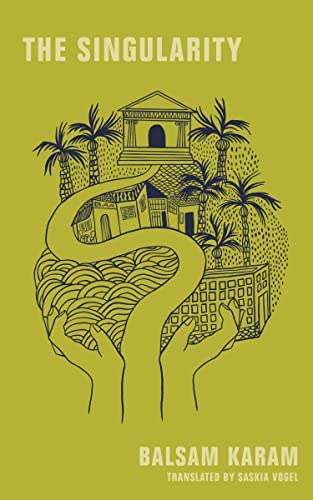

THE SINGULARITY
BALSAM KARAM
(tr. Saskia Vogel)
The Feminist Press (non-affiliate Bookshop.org link)
$16.95 all editions, available now

Rating: 4.25* of five

The Publisher Says: Lyrical and devastating, The Singularity is a breathtaking study of grief, migration, and motherhood from one of Sweden’s most exciting new novelists.

In an unnamed coastal city filled with refugees, the mother of a displaced family calls out her daughter’s name as she wanders the cliffside road where the child once worked. The mother searches and searches until, spent from grief, she throws herself into the sea, leaving her other children behind. Bearing witness to the suicide is another woman—on a business trip, with a swollen belly that later gives birth to a stillborn baby. In the wake of her pain, the second woman remembers other losses—of a language, a country, an identity—when once, her family fled a distant war.

Balsam Karam weaves between both narratives in this formally ambitious novel and offers a fresh approach to language and aesthetic as she decenters a white European gaze. Her English-language debut, The Singularity is a powerful exploration of loss, history, and memory—an experience akin to “drinking directly from a flood of tears” (Aftonbladet).

I RECEIVED A DRC FROM THE PUBLISHER VIA EDELWEISS+. THANK YOU.

My Review
: Published first but written second in Author Balsam's career.
The grandmother picked them up and held them close in sleep almost no sleep at all and then muttered that no one beyond the ruined wall wished them well and that she couldn’t bear another loss – again and again she said she couldn’t bear any more loss and even though the children didn’t understand how or why, they knew that the loss was now a part of them and that at any moment it could strike again.
It's the world of Event Horizon (review above) on Swedish soil in the camp the women live in as they have no recourse or options:
It’s your first winter in the house with the little garden, the darkness outside. Something hard hits the windows and your brother stands up, puts on his coat. After a while he comes back in, says he needs something to wipe off the dog shit from the window and the postbox. In his hand is a blue and yellow sticker that he’s torn off, like the ones you’ve seen high up on lampposts around town.

–and–
Later, your mum tells you that the first thing she was told after talking about how she had been tortured in prison was that no one would hire a person like her. One eye missing, older and not entirely fluent – it’ll be tough, the caseworker had said.
Nice people do not shout racist slogans in your face. It does not mean they are not going to behave in racist ways. The story's narrative risk-taking is more evident in its middle third:
/ do you think of her often, Marcus or Magnus asks softly / we ate bean stew with rice and yoghurt and I drank a whole pot of tea afterwards / you nod, of course you do / Gran was the happiest of us all I think / I think of her and of my grandmother you say and put the cup down / she took you in her arms and then I made sure to sleep while I had the chance / do you know anything about black holes? you later ask the counsellor / and I only got out of bed the next morning can you imagine? / inside a black hole is a place that is also a state — do you know about this? you ask, facing Patrick or Henry in his chair / a few days later Rozia's mother visited with little Rozia in her arms and a basket full of fruit /no, I'm afraid I don't know much about space, says Eric or Martin and continues to take no notes / then the two of you would meet up practically every day / you say it's called the singularity - that's what the place is called and lean over the bed / you and Rozia were like twins, we thought - the same round face and your hair as big and black / inside the singularity, the force of gravity is so strong it can't be calculated, can you imagine? you tell the counsellor / the pair of you often played in Rozia's yard and sometimes you stood by the big road even though you weren't allowed to and the soldiers could show up at any moment / that force pushes bodies together and renders the distance between them nil / because you both liked Gran's fried potatoes and her bean stew, you mostly ate at ours Mum says / you use your hands to show how no space remains between bodies in the singularity
It doesn't scan easily, but I promise you it is not flummery, a brummagem gaud of "Style" that distracts with difference without adding into meaning. In the more conventional first and last parts, the harrowing tales told do the work of impacting you in dark corners of your Safe Place, you are not safe, ever, as long as you are Other. While you are reading Author Balsam's story you are Other along with her.

It's a passionate document about grieving. It is a horrible chronicle of losing a child, losing an infant, losing losing losing without a moment of respite and never once ever giving up.

Until the final act of control is yours.

If you need a—any—content warning, do not pick this read for yourself.

Monday, June 8, 2026

ANDREA WULF'S PAGE: THE INVENTION OF NATURE: Alexander von Humboldt's New World; and THE TRAVELER: One Man's Quest for Humanity from the South Seas to Revolutionary Paris


THE TRAVELER: One Man's Quest for Humanity from the South Seas to Revolutionary Paris
ANDREA WULF

Alfred A. Knopf (non-affiliate Bookshop.org link)
$14.99 ebook, preorder now for delivery 9 June 2026

Rating: 4.75* of five

The Publisher Says: Step into the life and times of George Forster, the young naturalist and revolutionary who journeyed to the far reaches of the known world and whose radical ideas about humanity and freedom made waves in eighteenth-century Europe—from the bestselling author of The Invention of Nature and Magnificent Rebels.

From an early age, it was clear that George Forster possessed a brilliant mind. A polyglot and gifted scientist, he became an invaluable asset to the ambitions of his domineering father, Reinhold. As a young boy, he travelled with his father from the plains of West Prussia to the wild shores of the Volga to St. Petersburg and London on scientific endeavors, and soon became the breadwinner by publishing translations of hugely popular exploration accounts. When Reinhold Forster was offered the position of naturalist aboard Captain James Cook’s second voyage, he accepted on the condition that his seventeen-year-old son serve as his assistant.

The HMS Resolution set sail in 1772 with orders to find the hypothetical southern continent of Antarctica. On her voyage to the Antarctic Circle and the islands of the South Pacific—including New Zealand, Vanuatu, Tonga, Tahiti, and Easter Island—the Resolution carried the ambitions of the most powerful empire in the world. But George Forster brought an understanding that was centuries ahead of the attitudes of his day—his ideas belonged to the future. A remarkable observer, linguist, artist, and writer whose intelligence surpassed that of his own father, he studied the diverse cultures of the world without prejudice and sought to uncover our common humanity. He was a traveler in body and mind—not bound by place, people or establishment.

Recognized as one of Europe’s brightest minds on his return, Forster held positions across the continent and regaled the world not only with tales from his travels but also radical ideas about human nature. He would write against empire, white supremacy, and slavery. He would become a revolutionary and be declared an outlaw. He would never seek to control others as he had been controlled by his father, and even embraced a liberal idea of marriage, accepting his wife’s affairs and independence Andrea Wulf’s The Traveler recounts an extraordinary life largely forgotten by history, the tale of a man who broke with convention and was unafraid to critique the world around him in dedication to his belief in the human right to dignity, equality, and freedom.

I RECEIVED A DRC FROM THE PUBLISHER VIA NETGALLEY. THANK YOU.

My Review
: A man as astonishing as Author Wulf's previous science-biography topic, Alexander von Humboldt (see below). Forster has been brought out of obscurity at a time when his delighted curiosity in the world is curdling die to the way we as a species ignored the warnings of imbalance von Humboldt was observing and reporting on. Forster is still known to us today because he wrote of his travels extensively. He was unusual for his attention to the contributions of women and his respect for the contributions of non-whites in many fields around the world. He died before he was fifty; it's a sadness to me personally that he and Alexander von Humboldt never traveled together. As Forster was two decades older than von Humboldt, I can only dream of what the synergy in these men's inclusive, broad views might have gifted us.

A man born in 1754 writing passionately about the flimsiness and dishinesty of white supremacy, and the idiocy of the idea of dominionism deserves a wide audience in the twenty-first century. If we're going to lionize dead white men, let's lionize George Forster the proponent of equality, the supporter of women's rights, the spreader of Enlightenment values. Here's a British man worthy of our respect and deserving of emulation.

Forster's travels broadened his mind and his spirit. He was a person who saw, as his private papers show, the connections among people in a time when colonialism and sexism were drawing ever thicker lines between us. I am saddened that his first-hand observations of the idiocy and evil that Othering (in today's terminology) colonized people was exacting never gained traction. I dream of a Forster who lived to lift up Mary Wollestonecraft, who worked effectively with Revolutionary Parisians to moderate the evils inherent in destroying systems to rebuild them fairly.

Author Wulf has, as is her wont, seen past History's battlefied fog to choose another target of worth and merit to remind us how long the world has been falling from Grace.

And how many before us saw it.

Honoring their legacies by taking action seems appropriate to me. I hope you'll read this dynamically written, thoroughly researched work on an unjustly underknown thinker, and feel inspired to do just that.

++++++++++++++++++++++++++++++++++++++++++++++++++++++++++++++++


THE INVENTION OF NATURE: Alexander von Humboldt's New World
ANDREA WULF

Vintage Books (non-affiliate Bookshop.org link)
$9.99 ebook, available now

Rating: 4.75*of five

The Publisher Says: Alexander von Humboldt (1769–1859) was an intrepid explorer and the most famous scientist of his age. In North America, his name still graces four counties, thirteen towns, a river, parks, bays, lakes, and mountains. His restless life was packed with adventure and discovery, whether he was climbing the highest volcanoes in the world or racing through anthrax-infected Siberia or translating his research into bestselling publications that changed science and thinking. Among Humboldt’s most revolutionary ideas was a radical vision of nature, that it is a complex and interconnected global force that does not exist for the use of humankind alone.

Now Andrea Wulf brings the man and his achievements back into focus: his daring expeditions and investigation of wild environments around the world and his discoveries of similarities between climate and vegetation zones on different continents. She also discusses his prediction of human-induced climate change, his remarkable ability to fashion poetic narrative out of scientific observation, and his relationships with iconic figures such as Simón Bolívar and Thomas Jefferson. Wulf examines how Humboldt’s writings inspired other naturalists and poets such as Darwin, Wordsworth, and Goethe, and she makes the compelling case that it was Humboldt’s influence that led John Muir to his ideas of natural preservation and that shaped Thoreau’s Walden.

With this brilliantly researched and compellingly written book, Andrea Wulf shows the myriad fundamental ways in which Humboldt created our understanding of the natural world, and she champions a renewed interest in this vital and lost player in environmental history and science.

I CHECKED THIS BOOK OUT FROM THE PRIME LENDING SERVICE.

My Review
: Start your journey into Alexander von Humboldt's character and intellect here:
“The effects of the human species’ intervention were already ‘incalculable’, Humboldt insisted, and could become catastrophic if they continued to disturb the world so ‘brutally’. Humboldt would see again and again how humankind unsettled the balance of nature.”
This man, born the year a crucial observation of a Transit of Venus was measured, and died the year of the Carrington Event, was tied to science at both ends.

It's probably down to the fact that he was gay that he's never been lionized in US scientific education the way Lord Kelvin, Sir Humphry Davy, Leibniz, or Pasteur have. Yes, German-language output isn't hugely well-represented in general US scientific awareness to this day; if ever someone deserves an exception, it's the man who has a bay in California, a current running up our Pacific coast, and a species of giant squid found in ever-northening parts of that coast, named for him.

He was a very good writer (seriously...read Cosmos, it was as big a bestseller as On the Origin of Species by his follower Darwin and is an excellent browsing book), which led to his excellent observational science influencing multiple generations of scientists who founded new fields of study by expanding his work. His way of seeing Earth as a system is now the dominant view, expressed thusly by Author Wulf: "He saw the earth as one great living organism where everything was connected, conceiving a bold new vision of nature that still influences the way that we understand the natural world."

His writing skills were also useful in his later-life career as a diplomat, most enduringly to the Court of King Louis-Phillippe of France. I do not know of any English translations of his diplomatic correspondence, but I wager cash money they make for absorbing reading. His Prussian monarch did not compel von Humboldt to attend hid, perform diplomacy for him, because the guy was boring. He charmed his friends, he charmed the many people his scientific and diplomatic duties brought him into contact with, he charmed several younger men enough that one of them, a Peruvian aristocrat, got jealous enough when he was dumped...that's so unkind, let's say left behind when von Humboldt departed...that he leveled the accusation of our guy visiting a Quito brothel for men who like men. von Humboldt was known to be "like that" but, as always, exceptional talent...and a lack of a widely used "scientific" term for men romantically and sexually interested in other men like "homosexual"...gets judged by other rules. Author Wulf doesn't delve into this aspect of his life, though it's interstitially there; her focus is instead on the immensity, the Forrest-Gumpian breadth of his social circle, and drawing some conclusions about his influence that veer into Great Man Theory territory. I'm not all the way able to get past that discomfiting adulatory tone, despite feeling its pull very strongly. I'd give this read five or even six stars of five with some critical distance baked in; as it is four-and-three-quarters give me wiggle room fo work out my squeam.

It's a long read, it's an impactful resuscitation of a reputation very sadly in need of it among Anglophone readers, and if imperfect is still a very great pleasure to read.

Wednesday, April 22, 2026

LIVONA CHOW MEIN, amazing how long scumbaggery can go on without causing a revolution


LIVONA CHOW MEIN
ABIGAIL SAVITCH-LEW

Simon & Schuster (non-affiliate Bookshop.org link)
$14.99 ebook, available now

Rating: 3.5* of five

The Publisher Says: In the vein of Happiness Falls and Family Lore, a gripping story of family history and political upheaval centered around a Chinese family-owned restaurant in Brownsville, Brooklyn and its impact on the neighborhood’s Jewish and Black residents over the course of a century.

In 1978, two tenements on Livonia Avenue in Brownsville burn to the ground, killing one resident and displacing dozens of others. It remains unclear who set the buildings ablaze, but the survivors are convinced the culprit is Mr. Wong.

Who exactly is Mr. Wong, and what allegedly drove him to this extraordinary act of violence, is the question that consumes this novel as it plunges into four generations of Wong family history. First is Koon Lai, an immigrant who runs a Chinese restaurant on Livonia Avenue; second, his son Richard, a man desperate for his own chance at the American Dream; and third, Jason, a poet who seeks his escape in the bohemian counterculture of the 1970s, but finds himself an unwitting participant in Brooklyn’s gentrification. In the 21st century, Jason’s daughter Sadie returns to Brownsville as a journalist, determined to unravel the mystery of what happened decades earlier on the night the buildings blazed.

Joining together the present and the past is the community organizer Lina Rodriguez Armstrong, who was also displaced by that fire and who has spent the intervening years fighting for the rights of Brownsville’s residents and organizing a Livonia Avenue community land trust.

A stunning debut from a new talent, Livonia Chow Mein contemplates how the American pursuit of freedom relies on a collective amnesia and challenges us to consider what it would take for us to truly live in harmony.

I RECEIVED A DRC FROM THE PUBLISHER VIA NETGALLEY. THANK YOU.

My Review
: As debut novels go, Author Savitch-Lew picked a doozy of a topic...the arson plague that hit New York's working-class and immigrant housing, the war on the communities that were criminally negligent of their duty to provide landlords with their just and fair profits, and had the audacity not to be white or, often enough, to speak English. The communities that were forming and re-forming and growing also were guilty of demanding the landlords obey the laws of New York City! Can you imagine such arrogance? It costs actual money, money that could be profit!, to obey all those idiot safety and health rules!

It's a shameful, revolting tale of greed and racism.

It's also an immigrant descendant's reckoning with US racism and capitalism at their most nakedly unabashed. Ambitiously attempting to use dual timelines to tell different stories in different eras and (fatally for my reading pleasure) suspense-destroying levels of intertwinedness, the result is two good stories about a family dreaming the "American Dream" as evidence of its fictionality mounts in their faces. Had these been presented in sequence, the 1940s then the 1970s, much more could have been wrung from each era's challenges. As it was, the effort to keep the reader in suspense felt misplaced...obviously this situation worked out we've already seen that person in the 1970s!...so I was left sitting there with my teeth in my mouth wondering "why am I here again?"

Because both these stories are trenchant and apt for today's developing social landscape, that's why. I'm not the biggest fan of the execution but I am deeply interested in the Toisanese diaspora now. I liked what I learned if not deriving pleasure from how I learned it.

Social-issues readers (like me) encouraged to get a sample to see if your mileage will vary.

Saturday, October 11, 2025

FUCK NEOLIBERALISM: Translating Resistance, ignore the "worty dirds" to focus on what needs resisting


FUCK NEOLIBERALISM: Translating Resistance
SIMON SPRINGER
PM Press (non-affiliate Bookshop.org link)
$9.99 ebook, available now

Rating: 5* of five

The Publisher Says: In a long history of ruination and destruction, neoliberalism is the most recent and virulent form of capitalism. This book is a call to action against the most persistent and pestilent disease of our time. Translated into over twenty different languages, the book offers a call to action that transcends local contexts and speaks to the violent global conditions of our neoliberal age.

Fuck Neoliberalism: Translating Resistance is a worldwide middle finger to the all-encompassing ideology of our era.

With translations into languages from across the globe, including Mandarin, German, Indonesian, Spanish, Hindi, Italian, Korean, and many more, this book brings those translations together, accompanied with short essays from each translator that explain the reasons why they translated the text and describes the struggles against neoliberalism in their regions. With these translations, this book highlights the international nature of resistance to the totalitarian ideology of neoliberalism.

Featuring a cover produced by renowned artist Ed Repka (a.k.a. the King of Thrash Metal Art), this internationalized, heavy-metal rant against the all-powerful ideology highlights a chink in its armor. When people across the world find a way to communicate a shared message and stand together, resistance can be both beautiful and inspiring.

I RECEIVED A DRC FROM THE PUBLISHER VIA EDELWEISS+. THANK YOU.

My Review
: You're on board with the sentiment or you're not; but on or off, it would do all y'all a power of good to read words from those who've chosen to translate this (surprisingly mild, given its épater-la-bourgeoisie title) essay into their languages of choice, usually of their homelands.

Understand that book-banning, speech-squelching, and thought-controlling has gone on forever and becomes the default when too many "nice" people do not make the affirmative effort to resist it. Yes, even when it bothers you, even when it...gasp...offends you. Unless the speech is advocating violence, hate crimes, or censorship of those disliked by the powerful, it is in your personal interest to actively support free speech.

Worty dirds are not grounds for censorship. Rude gestures are not grounds for censorship. Demands for brown-skinned people to "go home" are. Demands for personal enemies to be persecuted by state power are. Let's stay clear about this.

Even if you never read a word of this loudmouthed little book, buy one to support firebrand publishers in their mission to save us from the worst consequences of our lazy, "nice" conformity.

Monday, September 25, 2023

BAYARD RUSTIN: A Legacy of Protest and Politics surveys a life lived in resistance, & LOST PROPHET: The Life and Times of Bayard Rustin, biography of his gayness


BAYARD RUSTIN: A Legacy of Protest and Politics
MICHAEL G. LONG
(editor)
NYU Press
$27.95 harcover, available tomorrow

Rating: 3.5* of five

The Publisher Says: Celebrates the life and legacy of Bayard Rustin, the civil rights leader behind the 1963 March on Washington for Jobs and Freedom

While we can all recall images of Martin Luther King Jr. giving his “I Have a Dream” speech in front of a massive crowd at Lincoln Memorial, few of us remember the man who organized this watershed nonviolent protest in eight short weeks: Bayard Rustin.

This was far from Rustin’s first foray into the fight for civil rights. As a world-traveling pacifist, he brought Gandhi’s protest techniques to the forefront of US civil rights demonstrations, helped build the Southern Christian Leadership Conference, led the fight for economic justice, and played a deeply influential role in the life of Dr. King by helping to mold him into an international symbol of nonviolent resistance. Rustin’s legacy touches many areas of contemporary life—from civil resistance to violent uprisings, democracy to socialism, and criminal justice reform to war resistance.

Despite these achievements, Rustin was often relegated to the background. He was silenced, threatened, arrested, beaten, imprisoned, and fired from important leadership positions, largely because he was an openly gay man in a fiercely homophobic era. With expansive, searching, and sometimes critical essays from a range of esteemed writers—including Rustin’s own partner, Walter Naegle—this volume draws a full picture of Bayard a gay, pacifist, socialist political radical who changed the course of US history and set a precedent for future civil rights activism, from LGBTQ+ Pride to Black Lives Matter.

I RECEIVED A DRC FROM THE PUBLISHER VIA EDELWEISS+. THANK YOU.

My Review
: Too long ignored for being queer and open about it, the life of a Quaker resistor of Wrong and Wickedness was a complicated one. I wish this collection of essays had been edited to reduce the repetition of basic information about him, but appreciate that it was done at all.

I imagine the experience of being friends with Bayard Rustin was pretty fraught...his stadards were very high and his judgments usually spot-on, which combination is uncomfortable for himself and others. This reality played itself out in his double invisibility in gay-rights circles: Blackness and religious belief. He felt he wasn't needed or wanted in that world so, until he fell in love with Walter Naegle at 65, he focused on Black liberation and didn't involve himself in gay rights. The sad part to me is that the man was ahead of his time in his politics, his morals, and his social beliefs, and still deeply internalized both homophobia and misogyny.

If you're utterly unfamiliar with Rustin, this collection of essays will fill you in. Read the way any collection should be, piece by piece over time, the cumulative effect is to bring an unjustly underknown man's contributions to the best things that happened in the era of Civil Rights expansion to light. He is, be aware, not critically examined in these essays. Part three of the collection, "What Rustin Means to Me," is probably my favorite to read because the legacy of this upright, intelligent, unsparing actor on the public stage is dealt with by those whom he has inspired. I suppose anyone who stood up for an unpopular belief because it was right to do so can't hope for a better legacy.

+++++++++++++++++++++++++++++++++++++++++++++++++++++++++++++++++


LOST PROPHET: The Life and Times of Bayard Rustin
JOHN D'EMILIO

The Free Press
$11.99 Kindle edition, available now

Rating: 4.5* of five

The Publisher Says: Bayard Rustin is one of the most important figures in the history of the American civil rights movement. Before Martin Luther King, before Malcolm X, Bayard Rustin was working to bring the cause to the forefront of America's consciousness. A teacher to King, an international apostle of peace, and the organizer of the famous 1963 March on Washington, he brought Gandhi's philosophy of nonviolence to America and helped launch the civil rights movement. Nonetheless, Rustin has been largely erased by history, in part because he was an African American homosexual. Acclaimed historian John D'Emilio tells the full and remarkable story of Rustin's intertwined lives: his pioneering and public person and his oblique and stigmatized private self.

It was in the tumultuous 1930s that Bayard Rustin came of age, getting his first lessons in politics through the Communist Party and the unrest of the Great Depression. A Quaker and a radical pacifist, he went to prison for refusing to serve in World War II, only to suffer a sexual scandal. His mentor, the great pacifist A. J. Muste, wrote to him, "You were capable of making the 'mistake' of thinking that you could be the leader in a revolution...at the same time that you were a weakling in an extreme degree and engaged in practices for which there was no justification."

Freed from prison after the war, Rustin threw himself into the early campaigns of the civil rights and anti-nuclear movements until an arrest for sodomy nearly destroyed his career. Many close colleagues and friends abandoned him. For years after, Rustin assumed a less public role even though his influence was everywhere. Rustin mentored a young and inexperienced Martin Luther King in the use of nonviolence. He planned strategy for the Southern Christian Leadership Conference until Congressman Adam Clayton Powell threatened to spread a rumor that King and Rustin were lovers. Not until Rustin's crowning achievement as the organizer of the 1963 March on Washington would he finally emerge from the shadows that homophobia cast over his career. Rustin remained until his death in 1987 committed to the causes of world peace, racial equality, and economic justice.

Based on more than a decade of archival research and interviews with dozens of surviving friends and colleagues of Rustin's, Lost Prophet is a triumph. Rustin emerges as a hero of the black freedom struggle and a singularly important figure in the lost gay history of the mid-twentieth century. John D'Emilio's compelling narrative rescues a forgotten figure and brings alive a time of great hope and great tragedy in the not-so-distant past.

I CHECKED THIS BOOK OUT OF MY LOCAL LIBRARY. USE THEIR SERVICES OFTEN, THEY NEED US!

My Review
: So, after deciding that I wanted a biography of the complex gay man Bayard Rustin while reading essays about him, I found this hefty tome. I love library lending because I couldn't justify spending full price on a book I expected to admire not like when my $12 investment represents 5% of my total monthly spending power.

I'm going to buy it for myself now because I want to support this historian whose stylish writing and tireless researching of a crucial figure in gay and Black history has enriched my life.


Rustin's Quaker upbringing strongly influenced his social-justice compass and his anti-violence stance. He refused to serve any military or enabling function in World War II, serving instead jail time for following his conscience. He was consistently anti-war and anti-colonialist in his world view, modeling his resistance to them on Mohandas K. Gandhi's successful anti-British actions in India. Rustin, and mentor A. Philip Randolph, founder and leader of the Brotherhood of Sleeping Car Porters, planned a mass march on Washington in 1941 for the same goals that the 1963 event had (Jobs and Justice) but called it off because President Roosevelt asked them to. The brink of war was used as an excuse to delay urgent public action...as always...but both men were active in making sure the March on Washington took place, at last, in 1963. We remember it mostly for assassinated leader Martin Luther King, Jr.,'s rousing and glorious "I Have A Dream" speech. If, like most, you've only ever seen the highlight reel version, go treat yourself to the entire seventeen and a half minutes at the link. But Randolph, responding to ongoing scurrilous efforts to paint MLK and Rustin as sexual lovers not friends, really shone in his ringing defense of Rustin's involvement as the leader and backstage manager of this titanic event that kickstarted so many changes in US society: "Bayard Rustin IS the March on Washington." He faced down, on behalf of his gay friend and fellow life-long resistor of social and political injustice, the President of the USA, J. Edgar Hoover ofthe FBI...arguably the more powerful of the two men...and Adam Clayton Powell, Harlem's immensely influential Congressman, who coveted Rustin's control and directive roles.

The over five hundred pages of this story aren't a chore to read. The reason is that Author D'Emilio made the effort to make it a story. Many, if not most, biographers are excellent researchers and fans of their subjects; fewer wre storytellers with an eye for the illustrative anecdote. My best example is the moment when, during a public meeting after the Montgomery, Ala., church bombing killed four little girls, Rustin took those loudly calling for a violent response to task by accusing them of proposing to accomplish nothing.

That is some kind of drama, folks, and it perfectly encapsulates a lifetime of Rustin's moral and political learning.
What leads me to talk about this lost prophet, buried in homophobic judgment, in connection with the essays just published about him, is the fact that Rustin had so much internal-to-the-struggle opposition to cope with that his never hidden, never centered homosexuality was never the focus of his resistance to power's abuses. Bear in mind that a known, avowed homosexual Black man was principally responsible for the community activism model and playbooks that succeeded in achieving the end of the legal fig-leaf of Jim Crow laws in the US. Could he have done the same had he set his sights on axhieving the same for queer folk, when the DSM-II of NINETEEN SIXTY-EIGHT still defined homosexuality as a mental illness, and the Feds led by Hoover had barely stopped the Lavender Scare? During the latter events, do not ignore, Rustin was a victim and STILL LED THE MARCH ON WASHINGTON!

Sorry. The awfulness of his treatment during his life by his fellow Quakers and Christians, and after his death by literally everyone simply forgetting he existed, lead me to the shouting.

The man himself noted that liberals couldn't hate Blacks and Latinos anymore, but they sure could—and did—hate fags. Realist that he was, he spent his life of organizing, resisting, and inspiring in the fields where he could do the most good. Admirably clear-sighted and honestly, to me at least, movingly generous of spirit of him not to insist on perfection but work for better. Events have proven his approach was effective for QUILTBAG folk as much as for ethnic minorities.

I salute author D'Emilio for putting in the hard labor and the gigantic energy to create this readable, enjoyable story of an important and ignored man, his life and his loves and his legacy. A perfect accompaniment to Bayard Rustin: A Legacy of Protest and Politics.

Thursday, November 4, 2021

POWER BORN OF DREAMS: My Story is Palestine, a graphic novel of the bitterness of Home-lessness


POWER BORN OF DREAMS: My Story is Palestine
MOHAMMED SABAANEH

Street Noise Books
$15.99 trade paper, available now

Rating: 4.5* of five

The Publisher Says: What does freedom look like from inside an Israeli prison?

A bird perches on the cell window and offers a deal: “You bring the pencil, and I will bring the stories,” stories of family, of community, of Gaza, of the West Bank, of Jerusalem, of Palestine. The two collect threads of memory and intergenerational trauma from ongoing settler-colonialism. Helping us to see that the prison is much larger than a building, far wider than a cell; it stretches through towns and villages, past military checkpoints and borders. But hope and solidarity can stretch farther, deeper, once strength is drawn of stories and power is born of dreams. Translating headlines into authentic lived experiences, these stories come to life in the striking linocut artwork of Mohammad Sabaaneh, helping us to see Palestinians not as political symbols, but as people.

I RECEIVED A DRC FROM THE PUBLISHER VIA EDELWEISS+. THANK YOU.

My Review
: The author/artist, whose lived experience this graphic novel is born out of, made a beautiful work of art out of suffering.

The linocuts used to create the illustrations are truly brutal, absolutely unsparingly blocky and confining, and that is the essence of the story he is telling us in his words and images. It's my worst nightmare, claustrophobia, made in art. There's nothing worse than the feeling of being TRAPPED, of having no agency in the workings of your own world...you exist that way, you don't live. In the beginning of the book, you're not told what happened to bring the author/artist into an Israeli prison. We're just...in there. We are, like him, forced to experience imprisonment, though we're unaware of why and presumably he is...there's a line that a guard shouts at him about wanting to become a martyr, so I can deduce from that there is a violent act in the man's past. Or the planning of one, or just the suspicion of the planning of one...societies that exist inside a conflict paradigm are noticeably more paranoid than ones that don't.

The flights of the bird the author/artist creates to make the stories of others come alive are beautifully imagined. The linocut technique carries through the sense of enclosure, of stasis within a field; the bird's flights aren't escapes but reminders of the nature of imprisonment, confinement. It is this essential feature of the story that I found least convincing, though. I wasn't sold on the narrative device providing an urgently needed contrast to the overall looming, enclosed tone of the book.

The awful entanglement of the body in the emotional and mental space of imprisonment, confinement, comes through more clearly than ever as the author presents us with the stories of other Palestinians, those not imprisoned with him, as they navigate the awfulness of never being allowed a sense of Home or even of safety in this place they, and their ancestors before them, once were masters of their own fates within.

The entire experience of this artwork, this passionately lived experience of being disempowered, unhomed, dehumanized for wanting what someone else has simply...taken...as their right, their just compensation for a world that you didn't agree with or agree to be identified with's abuse of them...there is no right? There is no Right? Who says? Why do you say there's no solution, because you don't want the one the other side wants? Then when will stories like this one ever cease? Can they ever become history, when they aren't even acknowledged as History?

This Yuletide, pick up a piece of Art, a fragment of story, that you really don't know how much you don't know about. A book like this, with its personal tales as well as a more scholarly, factual end-story, will give you the personal perspective of people you don't know or know about.

Then realize: The issues in this book are not solely Over There. They apply right here on your doorstep. So take a moment to recognize and realize that everything you possess, everything you take for granted, has a cost. And not solely to you.

Saturday, August 8, 2020

LONDON'S OVERTHROW, polemical barely-fiction from 2011 as timely now as then. Dammit.

LONDON'S OVERTHROW
CHINA MIÉVILLE

Saqui Press
Free online, available now

Rating: 5* of five

The Publisher Says: London’s Overthrow is a potent polemic describing the capital in a time of austerity at the beginning of the twenty-first century. Award-winning author and essayist China Miéville cuts through the hyperbole of our politicians to present a view from ordinary London – of the inequality, oppression and indignity and the hidden, subversive sentiment pervading throughout our streets.

My Review: An essay on economic justice, on political reality, and on a leftist's fears for a world slowly being strangled and dismembered by corporate efforts to change the game to phase out all control over and opposition to their eternal pursuit of more more more more more more more. Illustrated with Mr. M's own photos of London at night, the essay makes for some damned good and grim reading, though as always with His Chinaness, the sonority and especially the ubiety of his word choices and similes and metaphors makes the experience of reading the essay much like paying a visit to London yourownself.

There is a major sea-change happening in the world today. The corporate interests are making it ever more difficult for ordinary people to survive, still less make their own worlds better. There is some backlash from the tiny remnants of the left. What there is not is any assurance that the outcome will favor the majority. Read this:

London, buffeted by economic catastrophe, vastly reconfigured by a sporting jamboree of militarised corporate banality, jostling with social unrest, still reeling from riots. Apocalypse is less a cliché than a truism. This place is pre-something.

The Olympics are slated to cost taxpayers £9.3bn. In this time of ‘austerity’, youth clubs and libraries are expendable fripperies; this expenditure, though, is not negotiable. The uprisen young of London, participants in extraordinary riots that shook the country last summer, do the maths. ‘[B]ecause you want to host the Olympics, yeah,’ one participant told researchers, ‘so your country can look better and be there, we should suffer’.

Her Majesty Queen Elizabeth II will celebrate her 60th year on the throne this year, and the Conservative government is making sure that the world she leaves for William to reign over (does anyone believe Charles will say yes to being king if his wife can't be queen?) is vastly worse for the average Briton than it was when Her Majesty ascended the throne:

The pay gap between the highest and lowest paid in the UK has grown faster than in any other developed country, spiking since 2005. In 2008, average income of the top 10 percent was 12 times that of the lowest. Their riches grow. We others are told to tighten belts. Tax rates for the wealthiest have dropped, even as the gap between the merely rich and the utterly wealthy has grown.

One of capitalism’s defences is the outrage-fatigue it engenders.

We’re approaching Victorian levels of inequality, and London’s more unequal than anywhere else in the country. Here, the richest 10 percent hold two thirds of all wealth, the poorest half, one 20th.

It isn't that there are no alternatives, it isn't that no one has another idea, it isn't that there are no voices crying shenanigans out there in the public sphere. Far from it. What there is most decidedly not is any ear turned even slightly away from the more more more more more me me me me me greed that finances government officials' elections and their cushy retirements:

We slump under sado-monetarism. There are other ways. For years Alan Freeman was an economist with the Greater London Authority, working with both mayors. He leans forward in his chair, explaining what’s wrong with London’s still-massive economy, and how to fix it. He bullet points. ‘Build two million homes ... Edufare in the place of workfare ... Invest in innovation. Quintuple government funding of R&D, extend R&D to the arts. ... Put growth back and (it’s easy to show) the tax coffers will overflow.’

But perish forbid that the tax coffers overflow, because then the Scum of the Earth might think they should get some of the swag. Can't have that! Those saggy-pantsed loud-music-listenin' dark skinned creeps better not get the idea that they're as good as old white men:

In 1998, Tony Blair ushered into being ASBOs, Antisocial Behaviour Orders. Sharp laws, the better for society, like Cronus, like a traumatised hamster, to eat its children. These startling civil orders criminalise legalbehaviour, individually, tailor-making offences. A 17-year-old is banned from swearing. Another told he could go to jail if he drops his trousers. A 19-year-old barred by law from playing football in the street.

Catastrophe generates the beasts it needs. In London, in the UK, the term ’feral youth’ is absolutely routine. Media and politicians deploy it without much controversy. As if such a spiteful, shocking, bestialising phrase does not disgrace every mouth from which it spills. Its utterance is not a diagnosis, but a symptom.

And this is how it is in London. It's worse in New York. As for the real America, the mind boggles and the spirit quails upon considering how clueless, how apathetic, and how pusillanimous the typical American is; he sees no need to protest, because 1) won't do any good, 2) things're fine like they are, we have enough to eat, still have the house, leave me in peace, and 3) goddam commie pinko fags from Jew York who needs them tellin' decent folks how to live.

This last is a quote. A quote, mind you. Someone I once thought of as a friendly acquaintance said this to me. She is not alone in her thoughts, though I'd hope others are less thoughtless in expressing them.

Then I watched Fox News, and that hope died. I wonder if my country's ideals will too.

Monday, March 13, 2017

IRREPRESSIBLE, Jessica Mitford's life as role model for today's privileged millennial girl


IRREPRESSIBLE: The Life and Times of Jessica Mitford
LESLIE BRODY

Counterpoint Press
$18.95 trade paper, available now

Rating: 3* of five

The Publisher Says: Admirers and detractors use the same words to describe Jessica Mitford: subversive, mischief-maker, muckraker. J.K. Rowling calls her her “most influential writer.” Those who knew her best simply called her Decca. Born into one of Britain’s most famous aristocratic families, she eloped with Winston Churchill’s nephew as a teenager. Their marriage severed ties with her privilege, a rupture exacerbated by the life she lead for seventy-eight years.

After arriving in the United States in 1939, Decca became one of the New Deal’s most notorious bureaucrats. For her the personal was political, especially as a civil rights activist and journalist. She coined the term frenemies, and as a member of the American Communist Party, she made several, though not among the Cold War witch hunters. When she left the Communist Party in 1958 after fifteen years, she promised to be subversive whenever the opportunity arose. True to her word, late in life she hit her stride as a writer, publishing nine books before her death in 1996.

Yoked to every important event for nearly all of the twentieth century, Decca not only was defined by the history she witnessed, but by bearing witness, helped to define that history.

My Review: A chronological retelling of the strange life and exciting times of America's finest 20th-century muckraker, from her aristocratic Fascist upbringing to her time in the Communist Party USA, then her years of fame and glory after writing The American Way of Death, her most lasting contribution to literature. Her heartbreaking family life is presented with as many warts as can be expected; her relationships with her equally famous sisters Nancy Mitford, Lady Diana Mosley, Her Grace the Duchess of Devonshire, and Unity Mitford the Nazi are discussed in some detail; her husbands and her children are woven through the story, perhaps less so than her birth family.

And yet...and still...Flat. Lacking fizz. Champagne the next day.

It felt to me like the book was the proposal for the book and not the whole enchilada. Taking on a larger-than-life personality like Mitford is always challenging. She's not a person whose dimensions are easy to grasp! This daughter of privilege was unquestionably sincere in her rejection of the world she was born into, and she was completely consistent in making her anger and disdain at the family she left behind clear. (I relate.)

But a biographer who dedicates a mere 344pp to this Force of Nature risks reporting the facts but leaving the feelings behind. I felt that it was too short, so the book was frustrating...I want to know more about *her* and yet I can't imagine a book more thorough than this one is factually.

So what happened? Jessica took the place of Decca (her family nickname)? Mmmaybeee...but no, not entirely. What I think happened is, the balance between Decca and Jessica shifts dramatically after Mitford's first husband Esmond Romilly dies in 1942. We get more Jessica and less Decca. And it ends up not being a satisfying trade-off.

So should you read this fact-stuffed tale of one of life's hellions, a scamp and an imp from the get-go? Yes. She's interesting enough to make familiarity with her life an overall good thing. But don't come in expecting your notions (if you had any) about her to change, they won't. She'll still appeal to you or not based on the well-known and hand-crafted image of a rebel and a scalawag already known.

Still and all, in today's political climate, I want lives like Mitford's to be exhumed and exhibited in front of the entire reading public. Once there were giants, once there were privileged little girls who grew into fierce, antagonistic, brave, *necessary* women who knew fuck-all about fear. Let's grow more of them!

Friday, January 20, 2017

ROSSET, the memoir of the man who made America safe for porn

ROSSET: My Life in Publishing and How I Fought Censorship
BARNEY ROSSET

OR Books
$10 ebook platforms, available now

Rating: 5* of five

The Publisher Says: Genet…Beckett…Burroughs…Miller…Ionesco, Ōe, Duras. Harold Pinter and Tom Stoppard. Hubert Selby Jr. and John Rechy. The legendary film I Am Curious (Yellow). The books that assaulted the fort of propriety that was the United States in the 1950s and ’60s, Lady Chatterley’s Lover and The Tropic of Cancer. The Evergreen Review. Victorian “erotica.” The Autobiography of Malcolm X. A bombing, a sit-in, and a near-fistfight with Norman Mailer. The common thread between these disparate elements, a number of which reshaped modern culture, was Barney Rosset.

Rosset was the antidote to the trope of the “gentleman publisher” personified by other pioneering figures of the industry such as Alfred A. Knopf, Bennett Cerf and James Laughlin. If Barney saw a crowd heading one way—he looked the other. If he knew something was forbidden, he regarded it as a plus. Unsurprisingly, financial ruin, along with the highs and lows of critical reception, marked his career. But his unswerving dedication to publishing what he wanted made him one of the most influential publishers ever.

Rosset began work on his autobiography a decade before his death in 2012, and several publishers and a number of editors worked with him on the project. Now, at last, in his own words, we have a portrait of the man who reshaped how we think about language, literature—and sex. Here are the stories behind the filming of Norman Mailer’s Maidstone and Samuel Beckett’s Film; the battles with the US government over Tropic of Cancer and much else; the search for Che’s diaries; his romance with the expressionist painter Joan Mitchell, and more.

At times appalling, more often inspiring, never boring or conventional: this is Barney Rosset, uncensored.

***I RECEIVED A REVIEW COPY FROM OR BOOKS. THANK YOU!***

My Review: Today is a dark day for me personally. A person I do not respect, in fact one I disrespect with a virulence approaching hatred, is taking the oath of office of the presidency of the United States of America. Appallingly enough, I am required by my conscience to wish this person good health and godspeed because, in the event of his demise, impeachment, or removal from this mortal coil, a worse person will assume the most powerful political office in the country and possibly the entire world.

Barney Rosset, had he lived, would be likely to take some loud and public and effective action in opposition to this horrible eventuality. Barney was a mouthy old bastard. Barney was an opponent of kakistocracy, an enemy of the brummagem and the bloated, overblown, pretentious, and useless in life and art. His life-long battle against the booboisie wouldn't have allowed him to remain silent in the teeth of the gale of poisonous poltroonery emitted by the president elect.

I was only acquainted with Barney for a short while in the 1990s. In the course of my work as a literary agent, his company Foxrock Books published Lo's Diary, a companion piece to Vladimir Nabokov's immortal Lolita. As the book was not a critical success in the US, my company's efforts to vend its paperback rights were unavailing. I'm still saddened and puzzled by this wrong-headed reception by US readers. Be that as it may, Barney's taste as a publisher was on clearest possible display at that point just as clearly as it was when he went to war with the United States Post Office to ensure US citizens legal and unrestricted access to literary greats like Henry Miller and D.H. Lawrence.

Reading this memoir of one of the great iconoclasts of the 20th century was heartening to me in a way I cannot overstate. Barney faced the entire weight of the conservative establishment from the moment he made his first film, Strange Victory, to the moment he relinquished the reins of this life in 2012. He never stopped until he stopped forever. And that, my friends and neighbors, is a fable for me to guide the next four years of my own life. No less a scion of privilege than Barney himself, can I do less than my honored predecessor did in my pursuit of a world more open and liberal than it is? I want to do as much as Barney did, but I can't jump the height of the bar he set. I don't think many people of any age or station can.

I am most definitely inspired to try. I am most certainly heartened to face up to the battle against the gravity of the least and the last and the lowest that is even now doing its dead-level best to make America great at hate again. Or greater at it than it already is.

Buy this book, read it, and take heart from the fact that this battle we face is but one more in a war our elders and betters have fought before us. They succeeded; they failed; they changed and couldn't change and, most important to remember on this dark, difficult day, they did not give up and give in and give way.

Please help everyone, and I mean everyone, even those who don't see it as help, to stand up and stand for that most American of values: Personal liberty.

#ReadingIsResistance

Sunday, April 7, 2013

PREDATOR NATION, a seven-year-old wake-up call as trenchant now as it was then


PREDATOR NATION: Corporate Criminals, Political Corruption, and the Hijacking of America
CHARLES H. FERGUSON

Currency
$15.00 trade paper, available now

Rating: 5* of five

The Publisher Says: Charles H. Ferguson, who electrified the world with his Oscar-winning documentary Inside Job, now explains how a predator elite took over the country, step by step, and he exposes the networks of academic, financial, and political influence, in all recent administrations, that prepared the predators’ path to conquest.
Over the last several decades, the United States has undergone one of the most radical social and economic transformations in its history.
· Finance has become America’s dominant industry, while manufacturing, even for high technology industries, has nearly disappeared.
· The financial sector has become increasingly criminalized, with the widespread fraud that caused the housing bubble going completely unpunished.
· Federal tax collections as a share of GDP are at their lowest level in sixty years, with the wealthy and highly profitable corporations enjoying the greatest tax reductions.
· Most shockingly, the United States, so long the beacon of opportunity for the ambitious poor, has become one of the world’s most unequal and unfair societies.

If you’re smart and a hard worker, but your parents aren’t rich, you’re now better off being born in Munich, Germany or in Singapore than in Cleveland, Ohio or New York.

This radical shift did not happen by accident.

I BORROWED THIS BOOK FROM THE LIBRARY. THANK GOODNESS I HAVE A LIBRARY NEAR ME! SUPPORT YOUR LIBRARY FOR A BETTER WORLD.

My Review
: I am second to none in my passionate love for and gratitude to the United States of America for the astoundingly amazingly wonderfully free-from-want life I lead.

And as that life is, day by day, taken from me piecemeal by the rich, the greedy, and the stupid, I am going to shout and point and wave my arms a lot to get the attention of the few, the many, the unwilling or willing, to see if I can't effect some small change to build on.

Count on it.

This library book was a fourteen-day loan, and I've had it seventeen days. I couldn't read much at a time because it made me furious, hysterically angry, livid to the point of stroke. I am disabled by a chronic, genetically transmitted condition that causes severe and painful acid buildup on my joints and near areas that have tendons. (Check the photos on my profile...that claw-lookin' thing is my left hand.) I have health care AND get prescriptions for the medicines that ameliorate my disabling condition. As they are given under regular supervision, I am able to avoid the problem of renal failure that comes with more than one of the medications, not to mention horrible gastric consequences, which I just have to put up with.

And in this rich nation, would you like to know what the princely payout to me, to enable me to survive? A little under $1200 a month. Food stamps, $150 a month at most, can't be awarded to someone in assisted living. Medicaid and Medicare, working in tandem, keep my illnesses from becoming *dire*. These programs, which here in New York State are more generous than most places, are part of the privilege I experience as an old white man with friends whose positions of experience and power were used to my benefit in acquiring my safety net. And, were it not for the charity of friends, not please be assured my family members, oh nay nay nay, never dare even to ask them for help (well, now, one aunt handed over $4000 as I was losing my house, which put off the evil day for several months), I would've been completely unable to face the wall of bureaucracy still less get what I need. Imagine that case, ill and despairing and truly at rock bottom, without my white male privilege. The COVID-19 plague's ravages fall disproportionately on poorer communities; many of those people are wage-earners on the ragged edge already; their employers are firing right and left, unemployment is running out, and many are simply unable to make do without private charity. Which has a limit.

And then what? I don't know.

I am, as you see, not alone in my predicament. I am, in fact, a reasonably common-or-garden recipient of the fucking that corporations and CEOs and banks are doling out to each and every one of us not in their club. It's not new, this phenomenon. It was for millennia the norm. Then, one day in 1773, a group of rowdy, angry, sick-of-it colonists in Boston (of all places) said “oh fuck you” to king and church and country. Go Massachusetts!

Now, 240 years on, the rotten sleazy fucks we kicked out of power are back with a vengeance, thanks to 1) greedy politicians, 2) evil, evil, evil preachers, 3) stupid, complicit conservatives and “libertarians” (aka the Authoritarian's Best Friends League), and last but not least the laziest, most astoundingly selfish population of “future millionaires” (tip: if daddy wasn't a millionaire, you won't be either, sure as the sun rises in the east) ever fattened up for the slaughter on the American Dream (of what? for whom?).

No. I don't mean the immigrants. I don't mean the union workers. I mean you. The person who doesn't know who his/her state senator is. Who the county tax assessor is. Who watches fucking idiot-box crap and not presidential debates because it's too hard, it's boring, it doesn't matter anyway.

Welcome to what happens when you're not paying attention.

And you deserve it.

I, on the other hand, who have voted and shouted and waved my arms about this shit since 1980, do not. But here I am in the same goddamned boat as the lazy, the stupid, the religious, the conservative or libertarian. Is that in any way fair? No. It sucks wookiee balls. (Nobody likes hair in their teeth.)

But still, there it is. Hate is written into state constitutions because the Jesus Brigade for Tradishnull Fambly Valyews (aka Focus on the Family, et alii) doesn't like faggots. State senators, the same goddamned fucks in the GOP who authorize spending hundreds of millions of taxpayer dollars on casinos, *still* want to cut funding for public health IN THE MIDDLE OF A PLAGUE.

And this angry, prescient book details how it got this way, why it stays this way, and, in one short ending chapter, what possible means there are to combat it. I am not, by nature, an optimistic person. I sincerely believe that humans love one thing more than hate, and that's group hate. Food, sex, money...all significantly farther down the list. Hate is the killing ape's favorite pastime. What else (as we see increasingly obviously in 2020) is fandom, sports or TV or celebrity? What else is religion, politics? So I expect things will get worse, because the haters like that. Everyone should suffer!

And so we do. In our billions, we suffer. Unnecessarily, inexcusably, preventably. And so it goes.

But it does not have to. Everyone, and I mean every last one, of the US's eligible voters has a moral duty to vote in the November 2020 elections. The entire House of Representatives, a third of the Senate, and the Presidency of the United States of America need to be elected. All of those offices need to be held by people whose ideas and goals for the USA are in line with yours...and I am willing to bet that a lot of y'all have undergone some sort of shift in those goals.

So get out and vote!