Showing posts with label social discourse. Show all posts

Wednesday, June 24, 2026

THE ONE AND THE NINETY-NINE: Forging Identity in the Age of Social Contagion, your words aside Religion is not a good answer to Society's ills


THE ONE AND THE NINETY-NINE: Forging Identity in the Age of Social Contagion
LUKE BURGIS

St. Martin's Press (non-affiliate Bookshop.org link)
$15.99 ebook, available now

Rating: 3.25* of five

The Publisher Says: How to become yourself without losing everyone else.

We’re living in a time when it’s harder than ever to become a whole person—and to stay in authentic community. Some people dissolve into their group identities and lose themselves entirely. Others withdraw into ephemeral, online collectives they can float into and out of without consequence. Both are symptoms of the same a fragmented sense of self in an age of social contagion. This fragmentation is more than a personal crisis—it’s the soil in which hollow and often dangerous mass movements take root, offering counterfeit belonging to those desperate for meaning.

The One and the Ninety-Nine is a timely and inspiring exploration of what it means to forge a stable identity in the face of coercion, conformity, and the contagious desires of the crowd. Through compelling and original insights drawn from philosophy, psychology, and personal experience, author Luke Burgis examines how our lives are shaped by the groups we belong to—and how we, in turn, shape those groups. He offers a roadmap for engaging with modern society without losing our unique sense of personhood, and reveals the essential rites of passage and personal challenges that differentiate a life of meaning from one dictated by societal expectations.

People who are able to find their solid self and thrive in the space between the one and the many—who can act with integrity while being part of a community—live freer and more comfortable lives and become models for others. The One and the Ninety-Nine is a call to reject passive conformity, rediscover the depth of personality, and choose a life that is both truly personal and deeply connected.

I RECEIVED A DRC FROM THE PUBLISHER VIA NETGALLEY. THANK YOU.

My Review
: I don't approve of religion in general; I have an abiding bone-deep dislike for christians in particular, as a gay man with no interest in "overcoming my sinful nature" or whatever other nonsense "They" spew at me to coerce me into feeling a need to placate "Them" by behaving in a way comfortable to "Them." So when the author admitted to being a christian in the first few pages of the book, I set it aside with no intention of finishing the DRC.

I'm very worried about the undesigned social experiment we as a society are running in the form of algorithmically-mediated social media. I don't trust the tech scum to design the algorithms with the betterment of a person, but a bottom line, as its goal. Ample evidence of the role greed plays in the industry makes me all but positive no attention is paid to human needs when designing systems used by all of us.

Those two prior things are causally linked. I finished reading The Reverse Centaur's Guide to Life After AI (qv) and got more urgently agitated by what I read there; I recalled the DRC of this book, dealing with forming an authentic self. I opened it back up to see what I could glean.

Lots of christian nonsense. Parables and Bible quotes galore. Stating that (in his opinion, to be fair stated as such) people are more selfish now after *heavily*implying* the reason is we're more secular/less christian. Which...well...who's selfish, my dude? the people doing their best to navigate the world in ways you don't like, or you for saying your religion has The Answers to making people better and more empathetic? (Leave aside The Troubles, in the Ireland where you start your book, were an intra-christian spat that's half a millennium old.)

So no, I'm no big fan of his, nor did I think his shepherd/sheep needing rescue framing was anything other than seriously condescending.

But.

He's correct. The education system carefully indoctrinates us to accept Authority and seek conformity. It's a real thing, intentionally designed to do what we see around us: create sheeple. It's been done by his co-religionists for millennia now, to equally destructive effect, not ever acknowledged or examined by him. It's a giant problem for every society throughout time. Cohesion good, public morality good, conformity and scapegoating bad. Since christianity is a major source of both pressure to conform and assigning blame onto Others (those who don't pray like you, sexual-behavioral minorities, the Devil) I think it takes big brass ones not to examine *that* in great detail while quietly assuming the adding-back of religion will go a long way to fixing the very real problem he's identified.

I admire you, Brother Luke, for being so vulnerable and forthcoming about your experiences with your father's dementia. It was very moving. It was a long struggle, of course, and from the inside must've felt interminable. I do not think it was quite the connective tissue you intended it to be. It was rather more confessional than professional.

I did not, in other words, find solutions I want to support or even effect to the very real, well-stated societal stressors I'm eager to address. It's not likely to fix things by doing yet again things that helped society fracture before now.

Friday, January 2, 2026

AUDITION, Kiwi social SFF-lite that sets a tendentious trap of prose


AUDITION
PIP ADAM

Coffee House Press (non-affiliate Bookshop.org link)
$17.99 ebook, available now

SHORTLISTED for the 2026 Ursula K. Le Guin Prize for Fiction.

Rating: 4.8* of five

The Publisher Says: A genre-defying novel—part science fiction, part social realism—from one of the most powerful voices in New Zealand literature today.

A spaceship called Audition is hurtling through the cosmos. Squashed immobile into its largest room are three giants: Alba, Stanley and Drew. If they talk, the spaceship keeps moving; if they are silent, they resume growing.

Talk they must, and as they do, Alba, Stanley and Drew recover their shared memory of what has been done to their former selves—experiences of imprisonment, violence and misrecognition, of disempowerment and underprivilege.

Pip Adam’s uncategorisable new novel, part science fiction, part social realism, asks what happens when systems of power decide someone takes up too much room—about how we imagine new forms of justice, and how we transcend the bodies and selves we are given.

I RECEIVED A DRC FROM THE PUBLISHER VIA EDELWEISS+. THANK YOU.

My Review
: Like Stand on Zanzibar a half-century ago, this story is making a point along multiple fronts of effort. Stylisically it's resolutely avant-garde, modernist, and uses that tradition of liberation from centuries old linear narrative convention to oppose itself as completely as possible. Oppose from what? That verb needs a subject!

It takes the opportunity to set oppositional positions to, well, modernity; the way the modern world steadily relentlessly inexorably shrinks the essential liberty, autonomy, self-determination of Humanity. This is a powerful theme to pursue. It leads into some dark meditations on confinement.

It is most evidently a story in support of the anticarceral abolitionism gaining ground among progressives. More quietly it enables, encourages, examination of the ways individuals accept labels and thus limitations, even when the labels aren't very good fits. It's not foregrounded the way opposition to the carceral state is. It's there for you to consider.

I enjoy novels that expect me to bring my own ideas and knowledge to bear on reading them. I enjoy being asked to hold a thought more than a page or two before the thought pays off, hooks into another thought to make a distinctive picture. It is a pleasure to be exercised and entertained and experience elucidation of a viewpoint while immersing oneself in lovely phrasemaking.
Alba searches around her body and there is not an ounce of homesickness. She misses nothing. She was born into the world and it was not happy to see her. This isn’t her home. She doesn’t want to take advantage or be any more of a burden than she already is here. They hadn’t asked her to come, she hadn’t asked to be there. It isn’t a welcome—it’s an extremely advanced form of attack and defence.
I think that, in its compactness and its rhythm, carries more than surface meaning. Alba's is a point of view I think many could and should attend to. Her sense of...wrongness...is it all external? Is it self-recognition without self-acceptance? Is Alba...are Drew and Stanley as well...forced to keep talking as the means of propelling their starbound prison moving away from Earth in order to get their pasts out of their heads? What does the taking up of physical space have to do with the implied relationship to psychic...emotional...space? All the way into eternal exile and utter Othering in order to get permission to be ecstatically oneself. A price paid without any kind or sort of reward is rare, if one becomes an other self in response to it. A different self, an intentional self, a truthful self.

The ending of this story offers that future of selfness to the giants. It's not found the way a lot of readers will be comfortable with. But if you can read about people told they are too much for this world being thrust out of that world by being squashed into sealed containers and hurled into lethal vacuum, you really should look at why this particular ending bothers you (if it does..I found it the most liberating part of the story).

Pip Adam is a writer who reckons with ideas in her fiction. It's not always clear to me that I'm on the same train of thought as she is. That is, for me as a reader, very interesting and gives a dynamism to the words I'm reading. I experience the need to consider, "did I read that sentence and change my view of the story I thought I was reading by Pip Adam's design or my own?" very involving.

It's a story I felt repaid my attention with well-honed ideas I'd had in duller forms before that. I'd wished, during the read, for...ornamentation...flourishes...a bit of zhuzhery. I can't say the directness of prose was unpleasant or uninvolving, so I can't call it a flaw. I can say that me, reader me, the id that devours Story, wanted it; so I can't offer a perfect five but I can't take much away from that height. It's a cruel place to land:
It’s a strange feeling to know that they will never have to explain this to any of their kind. They will never return. They had been sent to die. That’s clear now. Maybe they had been sent to take over this world, as some kind of front guard or maybe no one that sent them could imagine this. But they are lost to their own world now. They don’t belong where they have have come from and they don’t belong here. They are the only ones of their kind who will make it.
Pip Adam made it.

Wednesday, December 10, 2025

COMICS AND STUFF, subtle work about an unsubtle medium and its message


COMICS AND STUFF
HENRY JENKINS

NYU Press (non-affiliate Bookshop.org link)
$34.00 ebook, available now

Rating: 4.5* of five

The Publisher Says: Considers how comics display our everyday stuff—junk drawers, bookshelves, attics—as a way into understanding how we represent ourselves now

For most of their history, comics were widely understood as disposable—you read them and discarded them, and the pulp paper they were printed on decomposed over time. Today, comic books have been rebranded as graphic novels—clothbound high-gloss volumes that can be purchased in bookstores, checked out of libraries, and displayed proudly on bookshelves. They are reviewed by serious critics and studied in university classrooms. A medium once considered trash has been transformed into a respectable, if not elite, genre.

While the American comics of the past were about hyperbolic battles between good and evil, most of today's graphic novels focus on everyday personal experiences. Contemporary culture is awash with stuff. They give vivid expression to a culture preoccupied with the processes of circulation and appraisal, accumulation and possession. By design, comics encourage the reader to scan the landscape, to pay attention to the physical objects that fill our lives and constitute our familiar surroundings. Because comics take place in a completely fabricated world, everything is there intentionally. Comics are stuff; comics tell stories about stuff; and they display stuff.

When we use the phrase "and stuff" in everyday speech, we often mean something vague, something like "etcetera." In this book, stuff refers not only to physical objects, but also to the emotions, sentimental attachments, and nostalgic longings that we express—or hold at bay—through our relationships with stuff.

In Comics and Stuff, his first solo authored book in over a decade, pioneering media scholar Henry Jenkins moves through anthropology, material culture, literary criticism, and art history to resituate comics in the cultural landscape. Through over one hundred full-color illustrations, using close readings of contemporary graphic novels, Jenkins explores how comics depict stuff and exposes the central role that stuff plays in how we curate our identities, sustain memory, and make meaning. Comics and Stuff presents an innovative new way of thinking about comics and graphic novels that will change how we think about our stuff and ourselves.

I RECEIVED A DRC FROM THE PUBLISHER VIA EDELWEISS+. THANK YOU.

My Review
: Stuff is a nightmare. Stuff is all I got. Stuff...is. Dealing with stuff, yours. mine, or no one we know's, is a full time career.

Comic books are stuff. They're about stuff. They are, in short, great wats to explore stuff and its role in our lives.

A subtle person uses the medium to critique, analyze, and...sometimes...take to task the message and its architects. Henry Jenkins is subtle; he uses the medium to make plain what can easily fall outside the awareness of the consumer: This is a story, an entire social universe, construted around the Love of Stuff.

It seems harmless enough phrased that way. It's hard to see from inside the system what the system's designed to do. Like investigating the many-worlds interpretation of quantum physics, the theory is as close to proof of intent as we'll get...we can't observe what is, by definition, outside the system we're working within to perform the measurement.

In other words, you can't see the nose on your face unless you're looking in a mirror (or its equivalent reflective surface). Henry Jenkins is offering that mirror.

Highly recommended for your graphic-novel readin' sophisticate.

Tuesday, December 9, 2025

LOLLAPALOOZA: The Uncensored Story of Alternative Rock's Wildest Festival, lives up to that promise


LOLLAPALOOZA: The Uncensored Story of Alternative Rock's Wildest Festival
RICHARD BIENSTOCK & TOM BEAUJOUR

St. Martin's Press (non-affiliate Bookshop.org link)
$16.99 ebook, available now

Rating: 4* of five

The Publisher Says: The definitive, no-holds-barred oral history of 1990s alt-rock festival Lollapalooza―told by the musicians, roadies, and industry insiders who lived it. From the New York Times bestselling authors of Nothin’ But A Good Time.

Through hundreds of new interviews with artists, tour founders, festival organizers, promoters, publicists, sideshow freaks, stage crews, record label execs, reporters, roadies and more, Lollapalooza chronicles the tour’s pioneering 1991-1997 run, and, in the process, alternative rock’s rise – as well as the reverberations that led to a massive shift in the music industry and the culture at large.

Lollapalooza features original interviews with some of the biggest names in music, including Perry Farrell and Jane’s Addiction, Pearl Jam, Soundgarden, Nine Inch Nails, Sonic Youth, Tool, Smashing Pumpkins, Ice-T, Rage Against the Machine, Green Day, Patti Smith, Alice in Chains, Metallica and many more.

Conceived by Farrell as a farewell tour for Jane's Addiction, Lollapalooza’s inaugural outing across the US in the summer of 1991 helped to coalesce an ideology and aesthetic that not only washed over popular music but seeped into fashion, film, television, literature, food, politics and more. Throughout the decade, Lollapalooza offered a vast and diverse ensemble of bands, breaking barriers of genre and creating the template for the modern American music festival and the scores of other contemporary destination events.
Unorthodox not just in music, Lollapalooza also spotlighted visual arts, nonprofit organizations, political outfits and even the occasional freak show, offering a tantalizing cocktail of culture, art, and activism that, taken together, defined the alternative mindset that dominated the 1990s. Today, Lollapalooza remains one of the world's largest music festivals, cemented by annual sellouts at destination events all over the globe and an estimated 400,000 attendees at the flagship Chicago fest each summer.

A nostalgic look back at 1990s music and culture, Lollapalooza traces the festival’s groundbreaking origins, following the tour as it progresses through the decade, and documenting the action onstage, backstage, and behind-the-scenes in detailed, uncensored, and sometimes shocking first-person accounts. This is the story of Lollapalooza and the 1990s alternative-rock revolution.

I RECEIVED A DRC FROM THE PUBLISHER VIA NETGALLEY. THANK YOU.

My Review
: People who get famous are,it seems, still just peopl...racist, homophobic jerks, divas who "think who they are," the run-of-the-mill addicts and freeloaders.

May be more information in here than is comfortable to know at thirty years' social and societal change. Many things were uttered aloud, recorded, and transcribed, that would get the speaker in a lot of trouble nowadays. You the reader have been warned.

Lots of names get bandied about, so stay on your toes! Bookmark the cast of characters in the fromt or it will get confusing. One anecdote you won't forget: Rage Against the Machine protesting Tipper Gore's foolish music-censorship stuff by doing their 1993 set naked! Socks over their cocks was all that stopped them from getting unwanted legal attention. Pity there were no cameraphones in 1993, isn't it....

Because it's so anecdotal, it's more a browser's book than a read-right-through binge machine. I don't know if there are photos in the finished books, but there were none in the DRC, so I have no comment to make about thm (assuming there had to be some).

A treat for your 90s-nostalgia giftee, your music fan giftee, and anyone who was there in any of the years...it's a long, long time now and it's still goin' on, so...everyone's bound to know SOMEone who's been to at least one.

I took a lovely, fun, often funny and always instructive wander through my last thirty-plus years with the performers, the reporters, and me. I'm not as fascinated as some are by bands and their personnel. I still found myself downing a festival or two a week. Pretty good going to keep an old guy that interested!

Saturday, October 11, 2025

FUCK NEOLIBERALISM: Translating Resistance, ignore the "worty dirds" to focus on what needs resisting


FUCK NEOLIBERALISM: Translating Resistance
SIMON SPRINGER
PM Press (non-affiliate Bookshop.org link)
$9.99 ebook, available now

Rating: 5* of five

The Publisher Says: In a long history of ruination and destruction, neoliberalism is the most recent and virulent form of capitalism. This book is a call to action against the most persistent and pestilent disease of our time. Translated into over twenty different languages, the book offers a call to action that transcends local contexts and speaks to the violent global conditions of our neoliberal age.

Fuck Neoliberalism: Translating Resistance is a worldwide middle finger to the all-encompassing ideology of our era.

With translations into languages from across the globe, including Mandarin, German, Indonesian, Spanish, Hindi, Italian, Korean, and many more, this book brings those translations together, accompanied with short essays from each translator that explain the reasons why they translated the text and describes the struggles against neoliberalism in their regions. With these translations, this book highlights the international nature of resistance to the totalitarian ideology of neoliberalism.

Featuring a cover produced by renowned artist Ed Repka (a.k.a. the King of Thrash Metal Art), this internationalized, heavy-metal rant against the all-powerful ideology highlights a chink in its armor. When people across the world find a way to communicate a shared message and stand together, resistance can be both beautiful and inspiring.

I RECEIVED A DRC FROM THE PUBLISHER VIA EDELWEISS+. THANK YOU.

My Review
: You're on board with the sentiment or you're not; but on or off, it would do all y'all a power of good to read words from those who've chosen to translate this (surprisingly mild, given its épater-la-bourgeoisie title) essay into their languages of choice, usually of their homelands.

Understand that book-banning, speech-squelching, and thought-controlling has gone on forever and becomes the default when too many "nice" people do not make the affirmative effort to resist it. Yes, even when it bothers you, even when it...gasp...offends you. Unless the speech is advocating violence, hate crimes, or censorship of those disliked by the powerful, it is in your personal interest to actively support free speech.

Worty dirds are not grounds for censorship. Rude gestures are not grounds for censorship. Demands for brown-skinned people to "go home" are. Demands for personal enemies to be persecuted by state power are. Let's stay clear about this.

Even if you never read a word of this loudmouthed little book, buy one to support firebrand publishers in their mission to save us from the worst consequences of our lazy, "nice" conformity.

Saturday, November 9, 2024

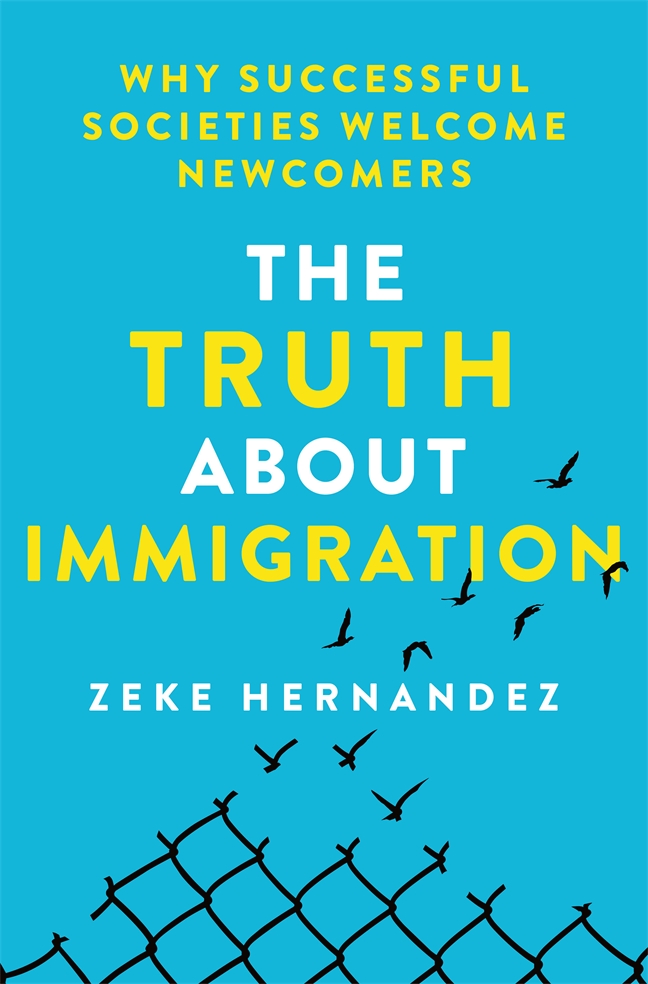
THE TRUTH ABOUT IMMIGRATION: Why Successful Societies Welcome Newcomers, careful, honest, trenchant and tendentious


THE TRUTH ABOUT IMMIGRATION: Why Successful Societies Welcome Newcomers
ZEKE HERNANDEZ

St. Martin's Press
$30.00 hardcover, available now

Rating: 4* of five

The Publisher Says: The go-to book on immigration: fact-based, comprehensive, and nonpartisan.

Immigration is one of the most controversial topics in the United States and everywhere else. Pundits, politicians, and the public usually depict immigrants as either villains or victims. The villain narrative is that immigrants pose a threat—to our economy because they steal our jobs; our way of life because they change our culture; and to our safety and laws because of their criminality. The victim argument tells us that immigrants are needy outsiders—the poor, huddled masses whom we must help at our own cost if necessary. But the data clearly debunks both narratives. From jobs, investment, and innovation to cultural vitality and national security, more immigration has an overwhelmingly positive impact on everything that makes a society successful.

In The Truth About Immigration, Wharton professor Zeke Hernandez draws from nearly 20 years of research to answer all the big questions about immigration. He combines moving personal stories with rigorous research to offer an accessible, apolitical, and evidence-based look at how newcomers affect our local communities and our nation. You'll learn about the overlooked impact of immigrants on investment and job creation; realize how much we take for granted the novel technologies, products, and businesses newcomers create; get the facts straight about perennial concerns like jobs, crime, and undocumented immigrants; and gain new perspectives on misunderstood issues such as the border, taxes, and assimilation.

Most books making a case for immigration tell you that immigration is good for immigrants. This book is all about how newcomers benefit you, your community, and your country. Skeptics fear that newcomers compete economically with locals because of their similarities and fail to socially assimilate because of their differences. You'll see that it's exactly the opposite: newcomers bring enduring economic benefits because of their differences and contribute positively to society because of their similarities. Destined to become the go-to book on one of the most important issues of our time, this book turns fear into hope by proving a simple truth: immigrants are essential for economically prosperous and socially vibrant nations.

I RECEIVED A DRC FROM THE PUBLISHER VIA NETGALLEY. THANK YOU.

My Review
: Do you like to eat? Thank an immigrant, an economic migrant, as you chow down on those tomatoes and cucumbers.

*You* sure didn't go pick 'em.

Do you use Google, chat on Twitter, watch TikTok every day? Thank an immigrant. In this case, you're thanking said immigrant with your data being harvested to fatten his (they're all men, at least so far) coffers.

But that law'n'order fetish you got goin' on...surely that's the real reason to oppose immigration, to keep 'em out and chuck 'em out when they come anyway, right? The president-elect has more felonies on his record than a random immigrant. But they cost us money! Take money from needy Murrikinz! You're thinking of the GOP in the various legislatures. Immigrants pay taxes through their (upright & honest, or shady) employers. They're barred by law from getting any of those taxes back.

The author, unlike me, is apolitical. He has done the research and these are the facts he found. If you support immigration, read this book for talking points. There's a lot of 'em. If you don't support immigration, why the hell are you reading my reviews? If someone you care for is anti-immigrant, maybe this non-partisan voice will reach them. It sure can't hurt to try.

I'm not calm enough to care to engage with people like that. They're wrong. I needn't fuss about it because that kind of wrong loves a fight. Got nothin' left for that uselessness. If you do, great! And here's you a swiss army knife of evidence-backed facts to use in your noble work of Enlightenment.

Saturday, October 26, 2024

WHITE CHRISTIAN PRIVILEGE: The Illusion of Religious Equality in America, even-handed study of a divisive reality


WHITE CHRISTIAN PRIVILEGE: The Illusion of Religious Equality in America
KHYATI Y. JOSHI

NYU Press
$23.00 trade paper, available now

Rating: 4* of five

The Publisher Says: Exposes the invisible ways in which white Christian privilege disadvantages racial and religious minorities in America

The United States is recognized as the most religiously diverse country in the world, and yet its laws and customs, which many have come to see as normal features of American life, actually keep the Constitutional ideal of “religious freedom for all” from becoming a reality. Christian beliefs, norms, and practices infuse our society; they are embedded in our institutions, creating the structures and expectations that define the idea of “Americanness.” Religious minorities still struggle for recognition and for the opportunity to be treated as fully and equally legitimate members of American society. From the courtroom to the classroom, their scriptures and practices are viewed with suspicion, and bias embedded in centuries of Supreme Court rulings create structural disadvantages that endure today.

In White Christian Privilege, Khyati Y. Joshi traces Christianity’s influence on the American experiment from before the founding of the Republic to the social movements of today. Mapping the way through centuries of slavery, westward expansion, immigration, and citizenship laws, she also reveals the ways Christian privilege in the United States has always been entangled with notions of White supremacy.

Through the voices of Christians and religious minorities, Joshi explores how Christian privilege and White racial norms affect the lives of all Americans, often in subtle ways that society overlooks. By shining a light on the inequalities these privileges create, Joshi points the way forward, urging readers to help remake America as a diverse democracy with a commitment to true religious freedom.

I RECEIVED A DRC FROM THE PUBLISHER VIA EDELWEISS+. THANK YOU.

My Review
: I'm an atheist of long standing. Religion is evil, makes everything worse, and hides the worst impulses in people behind the idiotic fig leaf of "sin and redemption."

The author's not of my persuasion. She studies and teaches Race and Religion at the Fairleigh Dickinson University School of Education. Her take, then, is not as dogmatic as mine, or as dismissive. The subject she's presenting here is christian identity as a lens through which racism is magnified and spotlit.

This means she's focused on the results of the problem of religious organization of US society, ie the kinder one of enforcing a kind of cultural blindness on the country, to the ugliest of them all, white nationalism. It is simply unquestioned in the US that christian religious holidays will be generally celebrated, wher other religions' holy days are, if acknowledged at all, presented as curious customs observed by Others. That's mildly insulting on a social level, Othering people in their own home country, but has far broader implications when it's the unquestioned basis for legal issues and governmental policy. The 1954 moral panic that added "under god" to the already creepy "Pledge of Allegiance" very plainly meant the christian one when accompanied by the enshrinement of christian privilege in the laws of the land. This is also the reason a book like this exists: christians feel they're under attack because their privilege is, at long last, being challenged. Privilege is, by definition, invisible to the privileged, at least until it is challenged. It is painful to be made aware, however gently, that one has been both insensitive and exclusionary toward others, without ever meaning any harm. The harm is caused; the privilege itself causes it, and one's own benefit from that privilege is part of that harm caused. That concept, studied here, causes some made aware of it to double down on it. White nationalism is very appealing to those whose belief is that their privilege is natural not intentionally designed and enforced. It's often the case that one sense of entitlement leads to the development of the other as they mutually reinforce the existence and primacy of the social norms that are changing.

The book is, I'm aware, going to make those most in need of its message feel very defensive and attacked. I'd've offered a fifth star to my rating had the author taken a self-help kind of approach to initiating or having conversations about the subject...despite that not being the reason for the book's existence, it felt like something that should have organically come to be from the way the book presents the information about the development of the issue. I'm responding mostly to her utter, unsparing honesty in defining US institutions' earliest designs as optical illusions meant to conceal the central role of christian social norms; it felt to me as though this rigor should lead to some proposal for at least some interpersonal solution.

As a work, as an artifact of thought and analysis, this is a very good book. As a complete train of thought, I found its lack of a proposal for a social solution an unexpected letdown. It is a very good explication of how white christians came by their experience of themselves as Masters of the Universe. As such I can heartily recommend it to the curious.