Pages
- Home
- Mystery Series
- Bizarro, Fantasy & SF
- QUILTBAG...all genres
- Kindle Originals...all genres
- Politics & Social Issues
- Thrillers & True Crime
- Young Adult Books
- Poetry, Classics, Essays, Non-Fiction
- Science, Dinosaurs & Environmental Issues
- Literary Fiction & Short Story Collections
- Sookie Stackhouse/Southern Vampire Books & True Blood
- Books About Books, Authors & Biblioholism
Showing posts with label societal change. Show all posts
Friday, September 4, 2026
HOW TO DATE A FANATIC, two halves make a funny-shaped whole
HOW TO DATE A FANATIC
ARUNI KASHYAP
HarperVia (non-affiliate Bookshop.org link)
$12.99 ebook, available now
Rating: 4* of five
The Publisher Says: In this compassionate, poignant novel set in contemporary India, a young professor searches for connection and love during a time of political and cultural upheaval.
As political tensions rise precipitously across India, Rohit returns to Delhi University to teach and gets caught in a web of unrequited love with his friend Dhruv. To alleviate his inevitable heartbreak, Rohit seeks relationships with other men on campus, until he meets and embarks on a delicate new romance with the effervescent Sayan, a literature student he hopes will be the answer to getting over Dhruv.
Rohit’s life soon becomes more complicated as the country's political tensions erupt on campus, sparking a turbulent student-led movement that entangles Rohit when Dhruv joins the fray, a tipping point that changes Rohit’s life forever. Set against the vibrant, volatile tapestry of modern India, Rohit and his friends must learn to navigate the challenges and triumphs of queer life to survive in an unpredictable political landscape.
Propulsive, tense, and charged with humor and tenderness, How to Date a Fanatic is an exploration of identity, connection, and the enduring hope for a better future in a rapidly changing world.
I RECEIVED A DRC FROM THE PUBLISHER VIA NETGALLEY. THANK YOU.
My Review: India's right-wing horrible human beings are enough like our US versions that I was stressed for Rohit from the get-go; I was also reminded that au fond, humans are not different anywhere on this globe. The same insatiable desire to control others in every way, the same pressure to conform or else, the same kinds of violent resistance and repression, for reasons only cosmetically different.
The reason I'm not offering perfect ratings and warbles of delight for this clear-sighted takedown of the repression and conformity machine is simple: Dhruv's a bastard. Rohit needs to get over his addiction to an emotionally unavailable man, and that story is *uncomfortably* close to home. It's all on Rohit, of course, Dhruv's uninterest could've been more kindly expressed but that is not incumbent on any of us to come up with in the moment. Rohit losing himself in the pursuit of distraction is deeply relatable. His choices are very interesting to me because they're further evidence of human nature being consistent across cultures.
Where the mess that is the authoritarian horror India lives under (and the US seems to be rushing to emulate) takes hold of the narrative, the second half becomes more a political argument against authoritarianism while backgrounding Rohit's emotional life. The shift in tome is always going to be tricky to navigate; I didn't feel it was all that well handled. I was taken from one focus, on the intimate life and choices of Rohit, into another, the violent and vicious reactionary response of a right-wing regime to gay men.
Both were very involving, though a reader looking for more of the first story might not like being catapulted into the second much. Readers interested in the second stiry might have preferred it to be more than just lightly foreshadowed from the beginning. It's this dichotomy between the (roughly) halves that stalled me out at four stars. There are that many because I really liked and invested in Rohit and his happiness. Sure, I wanted to shake him by the shoulders and demand he get on with finding someone who deserves his love. But he really deserves that kind of happy ending. (Other kinds too but permaybehaps on the page in my imagined other story...not this unsteamy one.)
A successful read for all my quibbly niggles, a story I'd enjoy seeing more of, should a follow-on tale eventuate. That ain't the most common end to a review I write about a book that frustrated me!
THE FIRSTS: A History of French Superheroes, fun and relevant and undemanding
THE FIRSTS: A History of French Superheroes
XABI MOLIA (tr. Alexander Hertich)
Dalkey Archive (non-affiliate Bookshop.org link)
$9.99 ebook, available now
Rating: 3.75* of five
The Publisher Says: The ugly side of superheroes
What if you suddenly had superpowers? What would you do? How would your friends and family react? What would your obligations to society be?
The superheroes’ first missions—combating terrorists or rescuing disaster victims—are a boon to France. Yet while these actions bring the country pride, unity quickly starts to unravel. These superheroes, ultimately, are human. Paparazzi are everywhere. One has an affair with another’s wife. Another questions following the government’s imperialist agenda. Meanwhile the public carps on social media.
Molia takes our fascination with superheroes and adds a cutting portrayal of contemporary social mores to create an entertaining and disturbing work with deep dystopian underpinnings.
I RECEIVED A DRC FROM THE PUBLISHER VIA EDELWEISS+. THANK YOU.
My Review: Remember the 1995 one-hit wonder "(What If God Was) One of Us?" It was a monster hit around the world. Its central question was one I think troubles people; it makes us all wonder why her and not me, why is there such an unfair randomness to divinity, what Greeks explained as someone being a demigod like Achilles or Herakles.
What we now call "superheroes."
In the labyrinth of the human soul, the superhero is tucked into a corner along the same stretch of hallway as the demigod. It's about wanting the anthropomorphic Divine to share more substance with us, not seeing the genuinely miraculous, divine acts of creation we interact with daily: my meds, the ones that keep my blood free of oversupplies of uric acid, the ones that keep mmy heart beating in normal rhythm, the computer I'm typing on, the phone you're reading this on, the software, the microchips...all designed by a human, all manufactured by human-designed machines...miracles surround us, the divine in us engendered them. But we use our miracles profligately. The computer and internet that give us access to the immense body of knowledge that's enabled wonders also gave us social media and streaming news.
I think of the first examples as Divine, the last as what we humans do when our reach exceeds our grasp...or demigods those superheroes come to life. Philosophical 3am maunderings aside, the novel The Firsts uses our overreach to explain our grasp to us. The ordinary people with superpowers are observed, as we all are, and reported on, scrutinized as celebrities are as part of their bargain for our attention. It's not the newest wrinkle in the communal brain, the soap operas that are comic books have pulled this idea out every so often. I'm not blaming or running down the book or its author, no idea is totally new or it would be ignored or rejected. Delivering dystopian stories can't really add a burden of novelty onto the already painful message of self-examination's fruits.
Science fiction's used the media-snippets (notably, prize-baitingly The Sheep Look Up, about fifty-five years old) and for centuries before that epistolary novels (Dracula for one) fake that same sense of immediacy and intimacy of perception, for generations. updating it for newly available tech underlines the basic reality of the human desire to share...willingly or not...our fellows' and our betters' deepest depths. As long as they're glowed up, glossy, and either unthreatening or in some way humiliating to them but never to us.
It's not fresh, then, the format of this story's delivery, and it obeys all these rules. It's French so its reactions to two superheroes' scandalous infidelity is more gleeful in tone than the US puritanical moralizing judgment, but really what we have here is not groundbreaking fiction or social observation or advancement in techniques of writing.
But it's a damn fun day or reading as people, ordinary people, grapple with the tweaked superpowers we all factually possess (you read that list-paragraph above, right?); if you go into this read expecting a good time that's not as demanding of your concentration and thinking as most stories from this publisher are, you can enjoy a well-told tale in a format not new or fresh but well-used in the story's service.
Saturday, July 18, 2026
THE SIXTH NIK, we need a new literary adjective..."Krausian"

THE SIXTH NIK
DANIEL KRAUS
Saga Press (non-affiliate Bookshop.org link)
$14.99 ebook, available now
Rating: 4.75* of five
The Publisher Says: Perfectly aligned for readers of Iain M. Banks’s The Culture series and Ursula K. Le Guin’s “The Ones Who Walk Away from Omelas”, The Sixth Nik is a galaxy spanning adventure from the New York Times bestselling and Pulitzer Prize–winning author of Angel Down and Whalefall.
Deep into space, far past the triworld outposts, beyond range of the lethal trollbot internet, soars The Sickness: a ship woven from biomatter and capable of reacting to every need of its human crew. Sisilla, a nine-year-old cultist with a brain enhanced by arcane tech known as “niks,” has boarded to investigate the enigma of Fém—a plague-riddled planet that has abruptly gone rogue.
The mysterious crew includes a faceless assassin, a beautiful engineer jigsawed by plastic surgery, a peyote-addicted medic, and—most lethal of all—a rugged, NonModded captain with a score to settle with Sisilla. Other dangers abound. A hacked robot begins to believe Sisilla is its daughter. The Sickness itself is mutating, possibly even pregnant. And the secret of Fém is more horrific than anyone could have imagined. To survive, Sisilla will need to forsake her predetermined fate and embrace the unknown.
I RECEIVED A DRC FROM THE PUBLISHER VIA NETGALLEY. THANK YOU.
My Review: Sisilla is a weird protagonist. She knows when she will die: after she completes her "Chore," the issue/problem/situation her birth family gave her life to resolving with the aid of major surgical brain modification and enhancement by alien tech. It's...distancing, for we-the-reader and most certainly for the Inuit people her birth family sent her to live among (it's the custom, it's required). She is the fifty-fifth child to have this life wished on her before she's got anything like the ability to offer consent, and then there's the fact that she will be killed when her "Chore" is complete. The alien-tech brain mods, the "niks," will be removed from her dead brain, the next sacrificial child will be found and modified, and giant social/technical/existential problems will be solved.
I was appalled and repulsed by this system of abusive exploitation. I was revolted by the most bizarrely powered transport that took Sisilla from her place of education and preparation into distant reaches of space, that "plasmagraphic" ship's name...The Sickness...apt for the ship and the "Chore" Sisilla is to accomplish at the cost of her life. This being Author Kraus, I was expecting seriously effective descriptive language everywhere. I got it in spades. I've seldom liked a character I sympathized with *less* than Sisilla, mostly because the Omelas-ness of her world is a truly effective backdrop for creating kind feelings by way of contrast. I was actually nauseated by The Sickness, thus felt a reluctant protective urge towards the child it was created to transport. A misplaced emotion...Sisilla is not a person in need of protection, but one to be protected against as normalizing a brutal, utilitarian corruption of innocence in a very questionable enterprise. I won't call it a cause.
I finished this read in May. I wrote three reviews, discarded them for being inaccurate and overly emotive. This review goes up no matter what. Author Kraus does a tremendous job of creating fascinating, flawed, awful human being protagonists in the two books of his I have now read. I know a lot of people read Angel Down (review linked on first reference) very differently than I did...it is my favorite WWI novel, despite the war being only the setting of a far, far more damning commentary on capitalism, anomie, and sociopathy writ large. Its commentary would not be as effective as it is were it set in another time and place. That is why I call it my favorite WWI novel. I won't call The Sixth Nik my favorite SF novel, or my favorite alien-contact novel; it is my favorite body horror novel. This is a finely gauged story that evokes sympathy and disgust simultaneously. There is a direct presentation of revolting meaty awfulness. Then there is, as one thinks about it, an awful emotionally excavating familiarity to its meaty awfulness. It is a story wherein People...that giant amorphous guilt-ameliorating construct...have chosen to sacrifice the humanity and the life of a little girl to solve a problem more quickly, more expeditiously, more seamlessly, at that cost.
Is the bell ringing yet?
So this read is not for everyone, not likely to be one you'll undertake unless you are willing to spelunk some dark caves of the soul with only a little light to carry with you. It will reward you with an undistorted assessment of the world, the humans in it, and (from Shakespeare in Love, remember that film?) a bit with a dog aptly named "Positive Roy." I suspect the fairly heavy-handed symbolism of the ship's mode of propulsion...one of my few true objections to the not-subtle nature of the story's worldbuilding...will cause eye-rolling. I offer to the rolled eye a reminder of "the Snarl," an equally unsubtle but much more palatable metaphor for tech-mediated human communication, and quite possibly an equally useful organizing principle to use along with Cory Doctorow's "enshittification."
Would I recommend you read this story? Yes. Do I expect you will? Not many of you. Do I hope you will try to overcome your reluctance to engage with something this complicated emotionally?
Very much. I did. I got a lot out of reflecting, revisiting, rethinking my ideas in this story's mirrors.
Friday, July 17, 2026
BALSAM KARAM'S PAGE: using pieces of the SFF toolkit to great effect without writing SF or F
EVENT HORIZON
BALSAM KARAM (tr. Saskia Vogel)
The Feminist Press (non-affiliate Bookshop.org link)
$16.95 all editions, available now
Finalist for the 2026 Cercador Prize for Literature in Translation.
Rating: 4.5* of five
The Publisher Says: From the author of The Singularity, a saga of one girl's resistance and exile in the stars and soil of empire.
Seventeen-year-old Milde is from the Outskirts, a place beyond the mountains where the dirt is corpse-rich and mothers and daughters make their living banished from society—without rights, access to care, or legal status. Simmering under the surface of their day-to-day survival is a desire for change—and one day, Milde and her friends act on it, setting fire to government buildings in the city that has rejected them.
When Milde is framed as the instigator of the uprising, she is arrested, imprisoned, tortured, and eventually presented with a final choice: to be executed publicly or to be launched into space, into a black hole called the Mass, for an experiment. Milde chooses the Mass.
Event Horizon is an exquisite existential novel, dark as deep space, woven with reflection on oppression, solidarity, trauma, and loss. With a completely unique voice, Balsam Karam writes about the swirl of hope and despair in the lives of the marginalized and a young woman’s unwavering belief in a better world.
I RECEIVED A DRC FROM THE PUBLISHER VIA EDELWEISS+. THANK YOU.
My Review: First, read this:
They're talking about deportation, we told them, Do you understand what that means? They're talking about taking us across the border and leaving us there, they're saying we have to go home, but what home do we have other than this one, I told them. I was born here and my child was born here, I told them—It's true that we've been living without papers for all these years, but now were being deported—is that acceptable? These are our lives I told them, but no one wanted to listen and so we ended up here. Milde listens to her mother and sits down beside her, watching the buildings rise one by one, wishing she already knew how to build a home.Maybe I resonate with this despairing cry because I experienced a similar feeling, if not legal process, with my own homeplace rejecting my very being as a gay man. Displacement is a violent painful amputation without mercy or understanding or empathy...and it goes on every single day all over the world, in homes in cities in countries in (especially) religions.
Every time it occurs it is an evil, a wound to the spirit of all who perpetrate and/or experience it. It is a wound on the masses of people who, like those who stay in Omelas, ignore it. Milde chooses a course of action in recation to this wrong that commits the most terrible crime imaginable: It is meant to, in the metaphorical structure of Omelas, show the complacent, the docile and unquestioning, the cost of their dreamworld. Terrorism! the shout rises, led by those terrorizing Others to please and entertain the unthinking and disengaged. Milde must be punished, must be seen to be punished, not to deter future "terrorists" but to satiate the appetite for cruelty of the dociles, passive entertainment to slake the human thirst for blood.
Milde makes an ugly bargain with the evil system:
Sure, I can go to space and die, why not? I'd rather die in the depths of a black hole than wait around to be executed here, if you see what I mean. I'm doing this so that I can sit back and rest for once, no knife or metal lid hidden under my pillow, and so that, if only for a day, I won't have to look at those same white faces that wish me harm.Her consent to be sent into the uttermost unknown to die while providing data (her suffering and death) is about as meaningful to the "white faces that wish {her} harm" as clicking "accept and close" is. There is no meaningful other option, but make it look good for those who can't be arsed to see how wrong, how painful it really is.
Swedish Kurdish author Balsam is the child of a man who experienced the horrors of a "terrorist" who chose his course of action to resist colonization. That crime resulted in his daughter being a Swede not a Kurd by nationality, a displacement that will reverberate through her entire life short or long. Everyone makes these decisions for their children, it's inherent in having them; but as all parents know it's never what you say but what they hear that counts. Author Balsam's feelin' some kinda way about these choices, and seeing the world in a unique cast of light as a result.
All of us Anglophones can see it because she let us in on experiences we don't precisely share, but still can find ways to be with. We can all feel echoes pressing on our emotional eardrums that come from a similar place of "injustice happened to me, to my life, that I had no pwer to resist"...maybe enabling us as a result to make the effort to help the world resist, reject the bloody hunger for revenge or simply the vicious desire to hurt Others to slake Humanity's thirst for it.
Eminent Translator Vogel has been at work for a good long time so it's no surprise her skills make this feel like a native English speaker wrote it. In fact I bring it up here because I was suddenly struck about the halfway point that I was not having my usual internal debate about "what word was that in {language}?" I checked the copyright twice during this read...yep, translation. This is very unusual for me. It's even more surprising because this is Author Balsam's first book.
The outrage that simmers under this lovely surface is definitely part of the reading experience. There is not sweetness in the story, or in the language; there is precision, but not distance, or chill. It's going to make emotional demands of you-the-reader. Milde experiences the constant reminder of difference that is used by polite people to maintain their superiority in the hierarchy. Her mother Essa is not even as far into the acculturation process as she is; it's a process defined by exclusion, rejection, after all. Milde's course as a resister is set thereby and this her fate sealed.
Her violent terrorism is what is left to a powerless woman in the face of an entire power structure built for the purpose of excluding her forever. Her resistance is all she has; it can only be what it compelled her to enact; so her phases of punishment *must* result in her body being launched into a black hole to die in as-yet-unknown suffering that must be public. It must be shared, this last and most intimate violation of her humanity. Otherwise she will not have paid for her "crime."
It is the best of all possible validations for the power structure. It is the best of all possible tricks to play on the power structure for Milde. It was chilling how much courage Milde possessed accepting this final, long act of her life. Even Christ only suffered for hours.
++++++++++++++++++++++++++++++++++++++++++++++++++++++++++++++++
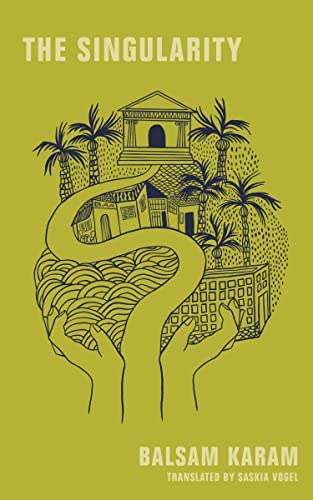
THE SINGULARITY
BALSAM KARAM (tr. Saskia Vogel)
The Feminist Press (non-affiliate Bookshop.org link)
$16.95 all editions, available now
Rating: 4.25* of five
The Publisher Says: Lyrical and devastating, The Singularity is a breathtaking study of grief, migration, and motherhood from one of Sweden’s most exciting new novelists.
In an unnamed coastal city filled with refugees, the mother of a displaced family calls out her daughter’s name as she wanders the cliffside road where the child once worked. The mother searches and searches until, spent from grief, she throws herself into the sea, leaving her other children behind. Bearing witness to the suicide is another woman—on a business trip, with a swollen belly that later gives birth to a stillborn baby. In the wake of her pain, the second woman remembers other losses—of a language, a country, an identity—when once, her family fled a distant war.
Balsam Karam weaves between both narratives in this formally ambitious novel and offers a fresh approach to language and aesthetic as she decenters a white European gaze. Her English-language debut, The Singularity is a powerful exploration of loss, history, and memory—an experience akin to “drinking directly from a flood of tears” (Aftonbladet).
I RECEIVED A DRC FROM THE PUBLISHER VIA EDELWEISS+. THANK YOU.
My Review: Published first but written second in Author Balsam's career.
The grandmother picked them up and held them close in sleep almost no sleep at all and then muttered that no one beyond the ruined wall wished them well and that she couldn’t bear another loss – again and again she said she couldn’t bear any more loss and even though the children didn’t understand how or why, they knew that the loss was now a part of them and that at any moment it could strike again.It's the world of Event Horizon (review above) on Swedish soil in the camp the women live in as they have no recourse or options:
It’s your first winter in the house with the little garden, the darkness outside. Something hard hits the windows and your brother stands up, puts on his coat. After a while he comes back in, says he needs something to wipe off the dog shit from the window and the postbox. In his hand is a blue and yellow sticker that he’s torn off, like the ones you’ve seen high up on lampposts around town.Nice people do not shout racist slogans in your face. It does not mean they are not going to behave in racist ways. The story's narrative risk-taking is more evident in its middle third:
–and–
Later, your mum tells you that the first thing she was told after talking about how she had been tortured in prison was that no one would hire a person like her. One eye missing, older and not entirely fluent – it’ll be tough, the caseworker had said.
/ do you think of her often, Marcus or Magnus asks softly / we ate bean stew with rice and yoghurt and I drank a whole pot of tea afterwards / you nod, of course you do / Gran was the happiest of us all I think / I think of her and of my grandmother you say and put the cup down / she took you in her arms and then I made sure to sleep while I had the chance / do you know anything about black holes? you later ask the counsellor / and I only got out of bed the next morning can you imagine? / inside a black hole is a place that is also a state — do you know about this? you ask, facing Patrick or Henry in his chair / a few days later Rozia's mother visited with little Rozia in her arms and a basket full of fruit /no, I'm afraid I don't know much about space, says Eric or Martin and continues to take no notes / then the two of you would meet up practically every day / you say it's called the singularity - that's what the place is called and lean over the bed / you and Rozia were like twins, we thought - the same round face and your hair as big and black / inside the singularity, the force of gravity is so strong it can't be calculated, can you imagine? you tell the counsellor / the pair of you often played in Rozia's yard and sometimes you stood by the big road even though you weren't allowed to and the soldiers could show up at any moment / that force pushes bodies together and renders the distance between them nil / because you both liked Gran's fried potatoes and her bean stew, you mostly ate at ours Mum says / you use your hands to show how no space remains between bodies in the singularityIt doesn't scan easily, but I promise you it is not flummery, a brummagem gaud of "Style" that distracts with difference without adding into meaning. In the more conventional first and last parts, the harrowing tales told do the work of impacting you in dark corners of your Safe Place, you are not safe, ever, as long as you are Other. While you are reading Author Balsam's story you are Other along with her.
It's a passionate document about grieving. It is a horrible chronicle of losing a child, losing an infant, losing losing losing without a moment of respite and never once ever giving up.
Until the final act of control is yours.
If you need a—any—content warning, do not pick this read for yourself.
Friday, March 6, 2026
THE BEGINNING COMES AFTER THE END: Notes on a World of Change, essays about the one true constant
THE BEGINNING COMES AFTER THE END: Notes on a World of Change
REBECCA SOLNIT
Haymarket Books (non-affiliate Bookshop.org link)
$9.99 ebook, available now
The Independent Press Top 40 Bestsellers: Non-Fiction For the week ending October 6, 2026
Rating: 4* of five
The Publisher Says: Rebecca Solnit offers a thrilling survey of the sheer breadth and scale of social, political, scientific, and cultural change over the past three quarters of a century.
In this sequel to her enduring bestseller Hope in the Dark, Solnit surveys a world that has changed dramatically since the year 1960. She argues that, despite the forces seeking to turn back the clock on history, change is not a possibility, it is an inevitability, and the nature of that change is determined by who participates and how.
The changes amount to nothing less than dismantling an old civilization and building a new one, whose newness is often the return of the old ways and wisdoms. In this rising worldview, interconnection is a core idea and value. But because the transformation has happened in so many disparate arenas, and within a longer arc of history, the scale of that change is seldom recognized.
While the backlash of white nationalist authoritarianism, Manosphere misogyny, and justifications for callousness, selfishness, economic inequality, and environmental destruction collectively drive individualism and isolation, the elements of this new world are related in their vision of more inclusion, equality, interconnection. This new vision embraces antiracism, feminism, a more expansive understanding of gender, environmental thinking, and indigenous and non-Western ideas, particularly Buddhism, as well as breakthroughs in the life sciences and neuroscience, pointing toward a more interconnected, relational world.
I RECEIVED A DRC FROM THE PUBLISHER VIA EDELWEISS+. THANK YOU.
My Review: Collections often draw from existing bodies of work. Author Solnit began drawing acclaim for her robust, tendentious writing in the early Aughts, and has never fallen out of the cultural conversation. She won't stop telling the truth, though, so her honesty wins her detractors and even enemies across the political spectrum.
One knows a thinker is doing it right when everybody is mad at them for something.
This essay collection breaks no new ground in her public thinking. It is, if I'm honest, a highlight reel with a bit more sameness than I wanted to read. It is also a collection drawn from decades of work. I found myself thinking, "I remember this, move on," and finding it necessary to recall in the moment that it's collected not commissioned to be written anew or afresh. Not every essay chosen was necessarily up to the highest standards in the book. Again, it's a function of a collection...it's not possible to be perfect, but it's possible, like Author Solnit, to be trenchant and to add value to the consideration of organizing theme of this particular project.
Progress is relative. In any consideration of the societal norms prevailing now that has even a modest degree of perspective, things are hugely better for women, queers, trans folk, and people of color. We're always being bombarded with messaging to the contrary, for reasons y'all need to read Paul Linebarger's book to really connect with. A collection of work like this one is a good corrective to the easy-to-internalize message of the world sucks always has always will. It's true; it's also wrong; both these things can and do coexist because, faithless to your entire life's training, almost nothing in the observable universe is a binary. All physical systems are spectrums and there's mounting evidence literally everything is in fact spectrum...look into quantum physics and certainty vanishes to be replaced by probabilities (aka spectra). Author Solnit stressing that each ending is also a beginning is very much in line with this mode of thinking.
It's new enough to most of her audience that repetition is probably a good idea to deploy in examining the topic. Like any new-to-you theory, perspective, or fact, it's going to need some hammering home to become part of one's mental structural supports. I'm ahead of this curve so it wore on my nerve a bit more than it will for others. I hope you'll pick it up and give it a try if you're sinking under the wight of the world's idiocies and evils.
We need the perspective of one who has been decades in the trenches, struggling against the dying order's loud and lousy distractions, to remind us we've come far. We need to keep moving ahead. It's easier to find the will to do that if we've got a stedy hand and an encouraging voice like Author solnit's telling us to remember it can be done.
Because it has been done. It's not finished, this work; it never really is. Now, get back to it!
Friday, January 30, 2026
FIXING FAIRNESS: 4 Tenets to Transform Diversity Backlash into Progress for All, well worth the short read
FIXING FAIRNESS: 4 Tenets to Transform Diversity Backlash into Progress for All
LILY ZHENG
Berrett-Koehler Publishers (non-affiliate Bookshop.org link)
$29.95 all editions, available now
Rating: 4.5* of five
The Publisher Says: DEI needs a reset. Discover how to achieve real social change in the workplace that puts everyone ahead through the groundbreaking FAIR framework.
The demand for inclusive workplaces is stronger than ever, with most employees seeking a sense of belonging and fairness at work. Yet traditional diversity, equity, and inclusion (DEI) strategies have faced backlash and stagnation, leaving organizations at a crossroads.
Where common DEI initiatives have failed, this book instead offers a results-based, systems-focused, all-inclusive, and universally beneficial framework to help bring about real social change in the workplace. This can be achieved through the FAIR framework:
I RECEIVED A DRC FROM THE PUBLISHER VIA EDELWEISS+. THANK YOU.
My Review: Tight, compact, and rooted in the author's entire career's-worth of research and—more importantly—practice.
What I appreciated most was Author Zheng's ability to restate points without making me feel I was being given cold leftover oatmel, lumps and all; it is down to the approachable style of their writing. (Author Zheng uses they/them pronouns.) It's clear, from high-powered venues supporting their work with publications and endorsements...this was on Forbes's Best New 2026 Books On Workplace Inclusion And The Future Of DEI list and Author Zheng's work has appeared there, in the New York Times, and Harvard Business Review. Links are all on their website here.
A key realization in this read came from the not-subtle calling-out of the fabrication of noise and chaos surrounding the efforts, flawed and half-hearted as they were, to set up DEI initiatives, by hostile sources supporting an antiquated and no longer prevalent societal paradigm. It's a lot to pack into barely over 160pp. Author Zheng manages! There are notes, and all of them I tested, around half, link to vaild and apparently reputable venues. None were, for example, to weird little fringe outlets...except maybe directorsandboards.com, because what tinier fringe group is there than that...and perhaps tellingly, the author cited on that site was Ted Kennedy, Jr.
I don't think most general readers will care too much about the subject discussed here. It's too bad. After reading this book I understand the opponents of DEI much better, and disapprove of them and their actions even more...plus I've picked up some techniques for opposing their rhetoric effectively. I encourage y'all to go to Author Zheng's website, linked above, to see what their work is all about. Even if your budget is tight, you can always request your library get a copy. These ideas deserve room in your head, your awareness, and your actions.
Thursday, July 10, 2025
HOW WE HEAL: A Journey Toward Truth, Racial Healing, and Community Transformation from the Inside Out, a balm of sense and calmness in a troubled time
HOW WE HEAL: A Journey Toward Truth, Racial Healing, and Community Transformation from the Inside Out
La JUNE MONTGOMERY TABRON
Disruption Books (non-affiliate Bookshop.org link)
$29.95 hardcover, available now
Rating: 4.75* of five
The Publisher Says: In How We Heal, La June Montgomery Tabron, President and CEO of the W. K. Kellogg Foundation, makes a powerful case for hope through racial healing.
From a vivid portrait of her childhood in 1960s Detroit to her leadership of one of the world's largest philanthropic institutions, La June shares her full-circle, American story—a coming-of-age journey where she gains a firsthand understanding of how systemic racism prevents our children and communities from thriving and learns about the transformative role healing can play in helping all of us transcend the legacy of racial inequity.
As she rises to her position as the first female and first African American leader of the W. K. Kellogg Foundation (Wikipedia link added), La June experiences the healing power of sharing and listening with empathy. And with the help of mentors and colleagues, she refines the message that will guide the foundation's mission for years to Healing can begin only with truth telling.
Empowered by the mission set forth by its founder to support children and families "without regard to sex, race, creed, or nationality," the foundation explores a racial healing framework that transforms communities and individuals around the world—from small rural towns and big cities across the United States, including La June's own beloved Detroit, to Mexico, Haiti, and beyond.
This book serves as a testament to the power of transformation and a blueprint for how each of us, no matter who we are or how we lead, can use racial healing to bridge the empathy deficits in our communities.
How We Heal illuminates a path that all of us can follow—from trust to empathy, from understanding to repair—one conversation and one connection at a time.
I RECEIVED A DRC FROM THE PUBLISHER VIA EDELWEISS+. THANK YOU.
My Review: We are at an inflection point in our development as a society. La June Montgomery Tabron knows this because she has lived through another inflection point: Detroit in the 1960s was on the front line of the Civil Rights struggle as African Americans asserted their right to be full participants in the US civil society that had systematically excluded them. Author Tabron is an MBA holder, thus a thoroughgoing participant in the system she is urging us to fix with her. As a professional administrator, her focus is on practical, achievable differences in one's personal behavior...listening, not simply expecting to be heard, is top of her list.
Given her long background in business, I'd expect nothing else from her. The way she brings readers along on her personal journey makes her commonsensical words all the more impactful. In a political climate of hatred and fear-stoking, of attacks on "DEI" efforts and their abandonment by many corporate entities, it is soothing to hear from the anti-DEI embodiment that is Author Tabron.
I felt I was sitting with my old friend and hearing her tell the whole story of what happened on her path to success as I read the book. It was that sort of personal connection I felt she was working to achieve, and mostly succeeded at presenting. In the moments where it was less successful it was down to not needing to be reminded of some important facts; hardly a sin in the story of a person's life.
What makes Author Tabron's point most effectively is the fact that she is drawing from her own life and her efforts to shift the course of a ninety-five-year-old multi-billion-dollar foundation as the first woman and the first African-American to head it. Her work there is clearly the source material of the book. The power of honest communication, coupled with empathetic listening, is very much the takeaway technique running through the whole story.
It is more important than ever to use our human capacity for empathy and our societally discouraged ability to listen instead of waiting to talk in order to combat the rising tide of politically motivated divisive language and ideas. The reasons for, and the ways to, apply both are in this easy-to-understand, easy-to-read, memoir.
I really hope some of y'all have reason to pick up the book to polish up the skills found inside its story.
Sunday, July 6, 2025
THE SILENCE OF FLESH, ambitious, interesting, flawed
THE SILENCE OF FLESH
GLENN COOPER
Lascaux Media (non-affiliate Amazon.com link)
$5.99 Kindle edition or free to read with Kindle Unlimited, available now
Rating: 3.5* of five
The Publisher Says: He gave everything to God—except the one truth he could never speak.
From international bestseller Glenn Cooper, known for his Vatican thrillers and historical mysteries, comes his most intimate novel yet—a literary exploration of secrecy, conscience, and spiritual burden.
Anthony Budd is a quiet, reform-minded cardinal—young, devout, and untainted by scandal. When deadlock in the papal conclave threatens to fracture the Church, his name emerges as a compromise. He accepts the will of God with humility. But buried beneath his composure is a secret he has carried for decades—a truth that could upend everything he believes, and everything the Church demands of him.
As Pope Innocent XIV, Budd must navigate the brutal realities of Vatican politics, the weight of his vows, and the quiet threat of blackmail from a voice in the shadows. Someone knows who he is. And they intend to destroy him.
The Silence of Flesh is a novel of inner war—a man at odds with the Church he loves, the body he inhabits, and the truth that may undo both.
I RECEIVED A DRC FROM THE PUBLISHER VIA NETGALLEY. THANK YOU.
My Review: Could Author Cooper have timed this release ant better?! Even got the regnal ordinal right! One could be forgiven for thinking permaybehaps he had some inside information...or at least a discreet nod of approval from On High.
I'm a great deal lower on the cosmic food chain, but I too offer my (qualified) nod of approval. More research into the current usages of nomenclature, Author Cooper.
Cardinal Budd is a character I think we all hope will be a truthful representation of church officialdom. As the new Pope Innocent (!) XIV, he is someone who would inflame the civil war over progressivism that Western culture is having very broadly. In fact, if you'd like to see the progress of that civil war, go look at the schism in Goodreads reviewers' ratings and opinions about this read. Goodness gracious me.
So big kudos for that service to us all! Anything that gets people stirred up and talking is, in my view, a good thing. It's not going to get resolved any time soon, this book might not change a single position, but positions can never change if they're simply unchallenged.
I found the characters in the story hard to relate to, as I expected; I've known in my core there was no god since I was five. I find people who believe in one utterly perplexing. I find people who "serve" a god I do not for a second believe they believe in reprehensible. There are good people who, for some reason, believe this guff. There are not professional administrators who do, or I'll eat your hat. Executives have the inside story, so they can by definition see through the charade of their organization's public relations. It's like lawyers; they know the law, and its execution, too well to buy the tale spun to dazzle the outsiders into accepting impartiality and fairness rule the juridical roost.
I'm all the way there supporting the conversation this story should ignite. I felt, though, distant and almost cold-shouldered by the way this story does not examine the stunningly complex battle lines it could have drawn. I understand the author's choice not to do the direct confrontation of the issue raised. I can't say I agree; an earlier, and more direct presentation of the secret issue Innocent (!)XIV was carrying would, to my mind, suit Cardinal Budd's stated personality traits better. As such I questioned whether what I was told was Budd's personal behavior pattern was accurate. I'll note here that I had he same issue with the much more disappointing Conclave, film and book.
I don't wish to leave the impression that I did not enjoy this read; I did, with all the schadenfreude I was expecting to revel in. I note the areas I felt the execution of the story did not match the author's ambitious imagination to be sure you will go into the read with the most information I can reach back to you from my readerly vantage point.
But go into the read I hope you will, and soon.
Saturday, October 26, 2024
WHITE CHRISTIAN PRIVILEGE: The Illusion of Religious Equality in America, even-handed study of a divisive reality
WHITE CHRISTIAN PRIVILEGE: The Illusion of Religious Equality in America
KHYATI Y. JOSHI
NYU Press
$23.00 trade paper, available now
Rating: 4* of five
The Publisher Says: Exposes the invisible ways in which white Christian privilege disadvantages racial and religious minorities in America
The United States is recognized as the most religiously diverse country in the world, and yet its laws and customs, which many have come to see as normal features of American life, actually keep the Constitutional ideal of “religious freedom for all” from becoming a reality. Christian beliefs, norms, and practices infuse our society; they are embedded in our institutions, creating the structures and expectations that define the idea of “Americanness.” Religious minorities still struggle for recognition and for the opportunity to be treated as fully and equally legitimate members of American society. From the courtroom to the classroom, their scriptures and practices are viewed with suspicion, and bias embedded in centuries of Supreme Court rulings create structural disadvantages that endure today.
In White Christian Privilege, Khyati Y. Joshi traces Christianity’s influence on the American experiment from before the founding of the Republic to the social movements of today. Mapping the way through centuries of slavery, westward expansion, immigration, and citizenship laws, she also reveals the ways Christian privilege in the United States has always been entangled with notions of White supremacy.
Through the voices of Christians and religious minorities, Joshi explores how Christian privilege and White racial norms affect the lives of all Americans, often in subtle ways that society overlooks. By shining a light on the inequalities these privileges create, Joshi points the way forward, urging readers to help remake America as a diverse democracy with a commitment to true religious freedom.
I RECEIVED A DRC FROM THE PUBLISHER VIA EDELWEISS+. THANK YOU.
My Review: I'm an atheist of long standing. Religion is evil, makes everything worse, and hides the worst impulses in people behind the idiotic fig leaf of "sin and redemption."
The author's not of my persuasion. She studies and teaches Race and Religion at the Fairleigh Dickinson University School of Education. Her take, then, is not as dogmatic as mine, or as dismissive. The subject she's presenting here is christian identity as a lens through which racism is magnified and spotlit.
This means she's focused on the results of the problem of religious organization of US society, ie the kinder one of enforcing a kind of cultural blindness on the country, to the ugliest of them all, white nationalism. It is simply unquestioned in the US that christian religious holidays will be generally celebrated, wher other religions' holy days are, if acknowledged at all, presented as curious customs observed by Others. That's mildly insulting on a social level, Othering people in their own home country, but has far broader implications when it's the unquestioned basis for legal issues and governmental policy. The 1954 moral panic that added "under god" to the already creepy "Pledge of Allegiance" very plainly meant the christian one when accompanied by the enshrinement of christian privilege in the laws of the land. This is also the reason a book like this exists: christians feel they're under attack because their privilege is, at long last, being challenged. Privilege is, by definition, invisible to the privileged, at least until it is challenged. It is painful to be made aware, however gently, that one has been both insensitive and exclusionary toward others, without ever meaning any harm. The harm is caused; the privilege itself causes it, and one's own benefit from that privilege is part of that harm caused. That concept, studied here, causes some made aware of it to double down on it. White nationalism is very appealing to those whose belief is that their privilege is natural not intentionally designed and enforced. It's often the case that one sense of entitlement leads to the development of the other as they mutually reinforce the existence and primacy of the social norms that are changing.
The book is, I'm aware, going to make those most in need of its message feel very defensive and attacked. I'd've offered a fifth star to my rating had the author taken a self-help kind of approach to initiating or having conversations about the subject...despite that not being the reason for the book's existence, it felt like something that should have organically come to be from the way the book presents the information about the development of the issue. I'm responding mostly to her utter, unsparing honesty in defining US institutions' earliest designs as optical illusions meant to conceal the central role of christian social norms; it felt to me as though this rigor should lead to some proposal for at least some interpersonal solution.
As a work, as an artifact of thought and analysis, this is a very good book. As a complete train of thought, I found its lack of a proposal for a social solution an unexpected letdown. It is a very good explication of how white christians came by their experience of themselves as Masters of the Universe. As such I can heartily recommend it to the curious.
Sunday, January 14, 2024
ACTIVATING THE COMMON GOOD: Reclaiming Control of Our Collective Well-Being, a goal more important than ever
ACTIVATING THE COMMON GOOD: Reclaiming Control of Our Collective Well-Being
PETER BLOCK
Berrett-Koehler Publishers
$27.95 hardcover, available now
Rating: 5* of five
The Publisher Says: A powerful, inspiring, and achievable vision of a society based on cooperation and community instead of competition and commodification.
This book counters the dominant and destructive story that we are polarized, violent, selfish, and destined to consume everything in sight. That is not who we are.
The challenge, Peter Block says, is that we are suffering under an economic theology that is based on scarcity, self-interest, competition, and infinite growth. We’re told we can purchase and outsource all that matters. Block calls this the “business perspective narrative.” It dominates not only the economy but also architecture, faith communities, journalism, arts, neighborhoods, and much more.
Block offers an alternative in the “common good narrative.” It embodies the belief that we are basically communal and cooperative. And that we have the capacity to communally produce what we care most raising a child, safety, livelihood, health, and a clean and sustainable environment.
This book describes how shifts to the common good perspective could transform many areas, fostering journalism that reports on what works, architecture that designs habitable spaces creating connection, faith collectives that build community, a market that is restrained and local, and leadership and activism that build social capital by creating trust among citizens. With these shifts, we would fundamentally change the world we live in for the better.
I RECEIVED A DRC FROM THE PUBLISHER VIA EDELWEISS+. THANK YOU.
My Review: A business guru wrote this book, this loud call to rein in our enshrined attitude of greed and selfishness. That delights me more than anything else about the read. I resonate like a struck bell to the author’s call to rethink our cultural norms. Given how entrenched the mindset of me first, me on top is, the best thing to do is to begin the process of change at the personal and local level.
Visit the website, The Abundant Community, that the author and his collaborator John McKnight run. It is chock-a-block with ideas and resources to accomplish this. The book at hand is an excellent read to guide you to the areas that you most need to focus on, be they personal or community based. Our individual well-being is tied closely to our social well-being and this is a frequently discussed facet of life that the author is at pains to weave throughout the short book. From the Introduction, entitled “We Are Not Divided”, forward, Author Block makes the case for beginning one’s journey with the personal commitment to calibrating one’s mind to a "we are not alone" mindset. The difference between "alone" and "divided" recurs throughout the book, very much ringing through the ideas for actions we as citizens of this system of divide-and-conquer tactics can effectively take.
There is nothing at all unattainable in any of the goals Author Block offers to us as models for effecting change. That he offers them in actionable formats and in digestible, relatable examples makes the read both pleasant, easy, and short and offers real-world results to those willing to undertake his tried-and-tested steps toward a common-good focused world.
Subscribe to:
Posts (Atom)


