Showing posts with label near-future novel. Show all posts

Friday, September 4, 2026

THE FIRSTS: A History of French Superheroes, fun and relevant and undemanding


THE FIRSTS: A History of French Superheroes
XABI MOLIA
(tr. Alexander Hertich)
Dalkey Archive (non-affiliate Bookshop.org link)
$9.99 ebook, available now

Rating: 3.75* of five

The Publisher Says: The ugly side of superheroes

What if you suddenly had superpowers? What would you do? How would your friends and family react? What would your obligations to society be?


The superheroes’ first missions—combating terrorists or rescuing disaster victims—are a boon to France. Yet while these actions bring the country pride, unity quickly starts to unravel. These superheroes, ultimately, are human. Paparazzi are everywhere. One has an affair with another’s wife. Another questions following the government’s imperialist agenda. Meanwhile the public carps on social media.

Molia takes our fascination with superheroes and adds a cutting portrayal of contemporary social mores to create an entertaining and disturbing work with deep dystopian underpinnings.

I RECEIVED A DRC FROM THE PUBLISHER VIA EDELWEISS+. THANK YOU.

My Review
: Remember the 1995 one-hit wonder "(What If God Was) One of Us?" It was a monster hit around the world. Its central question was one I think troubles people; it makes us all wonder why her and not me, why is there such an unfair randomness to divinity, what Greeks explained as someone being a demigod like Achilles or Herakles.

What we now call "superheroes."

In the labyrinth of the human soul, the superhero is tucked into a corner along the same stretch of hallway as the demigod. It's about wanting the anthropomorphic Divine to share more substance with us, not seeing the genuinely miraculous, divine acts of creation we interact with daily: my meds, the ones that keep my blood free of oversupplies of uric acid, the ones that keep mmy heart beating in normal rhythm, the computer I'm typing on, the phone you're reading this on, the software, the microchips...all designed by a human, all manufactured by human-designed machines...miracles surround us, the divine in us engendered them. But we use our miracles profligately. The computer and internet that give us access to the immense body of knowledge that's enabled wonders also gave us social media and streaming news.

I think of the first examples as Divine, the last as what we humans do when our reach exceeds our grasp...or demigods those superheroes come to life. Philosophical 3am maunderings aside, the novel The Firsts uses our overreach to explain our grasp to us. The ordinary people with superpowers are observed, as we all are, and reported on, scrutinized as celebrities are as part of their bargain for our attention. It's not the newest wrinkle in the communal brain, the soap operas that are comic books have pulled this idea out every so often. I'm not blaming or running down the book or its author, no idea is totally new or it would be ignored or rejected. Delivering dystopian stories can't really add a burden of novelty onto the already painful message of self-examination's fruits.

Science fiction's used the media-snippets (notably, prize-baitingly The Sheep Look Up, about fifty-five years old) and for centuries before that epistolary novels (Dracula for one) fake that same sense of immediacy and intimacy of perception, for generations. updating it for newly available tech underlines the basic reality of the human desire to share...willingly or not...our fellows' and our betters' deepest depths. As long as they're glowed up, glossy, and either unthreatening or in some way humiliating to them but never to us.

It's not fresh, then, the format of this story's delivery, and it obeys all these rules. It's French so its reactions to two superheroes' scandalous infidelity is more gleeful in tone than the US puritanical moralizing judgment, but really what we have here is not groundbreaking fiction or social observation or advancement in techniques of writing.

But it's a damn fun day or reading as people, ordinary people, grapple with the tweaked superpowers we all factually possess (you read that list-paragraph above, right?); if you go into this read expecting a good time that's not as demanding of your concentration and thinking as most stories from this publisher are, you can enjoy a well-told tale in a format not new or fresh but well-used in the story's service.

Thursday, December 4, 2025

SALVAGIA, super-plausible drowned Florida technothriller


SALVAGIA
TIM CHAWAGA

Diversion Books (non-affiliate Bookshop.org link)
$18.95 paperback, available now

Rating: 4* of five

The Publisher Says: A near-future, sci-fi mystery reminiscent of Kim Stanley Robinson's New York 2140 and inspired by John D. MacDonald's Travis McGee series, in which a salvage diver discovers the body of the most infamous man in the Florida yoreshore, putting her in the crosshairs of both feds and corporate mafias.

Triss Mackey was flying just under the radar, exploiting a government loophole that let her live quietly on the Floating Ghost—her rented, sentient CabanaBoat. In exchange, she merely had to dive for recycling recovered from the underwater, formerly-coastal cities. If she happened to find some Salvagia—nostalgic salvage, valued artifacts from the beforetime, which is to say our present—well that's just between her and the highest bidder. It's not a glamorous life, but it's not so bad.

That is, until the federal government begins pulling out of the Florida coast and retreating to their OrlanDome. The corporate mafias are poised to seize power, none more so than Mourning in Miami, led by the legendary Edgar Ortiz, owner of the Astro America megahotel. Triss needs one last score, something worth enough to buy the Ghost outright and keep her free from both the feds and the corporations. And she needs it now, before the Ghost is sent to a watery, insurance-scamming grave.

But when she discovers the chained up, drowned corpse of Ortiz on a dive, Triss finds herself stuck between the investigating government agents and the Mourning in Miami elites until Riley, Ortiz’s son, offers her a third if she can help him unravel Mourning in Miami's conspiracy and solve his father’s death, they can track down a valuable piece of Salvagia, a score worth well beyond what Triss needs to save the Ghost and, maybe, find a new, better way of Florida living.

I RECEIVED A DRC FROM THE PUBLISHER VIA NETGALLEY. THANK YOU.

My Review
: I knew I'd like the read when drowned Florida had something its floating inhabitants call the "yoreshore"...like today's foreshore, it's a liminal place, prone to change with the tides; named after the old, drowned shoreline. Triss is very clearly modeled on hardboiled Travis McGee, and I liked the sentient boat the Floating Ghost in an update of the Busted Flush of yore.

Like Travis on the Busted Flush, Triss wants nothing more than to be let alone to live in peace. Only we all know that ain't gonna happen, she's livin' in the loopholes of the dying society that clings harder than ever to control of its people. Travis was always buttin' heads with by-the-book sorts. Triss's boat life of salvaging the remains of our vanished lifestyle...called salvagia...is much the same: an affront to those who can't tolerate anyone not being like them.

Unless, of course, those people are playing ball and bribing Officialdom to look the other way while things happen that can benefit everyone. Like Edgar Ortiz, the "crime boss" indistinguishable from the officials unless you squint. Someone squinted hard enough to decide Edgar Ortiz didn't need to suck air anymore...and Triss, after locating excellent salvagia while dodging cyborg gators, locates Edgar chained up under the sea sucking water. "Dead" is so prosaic a term, no?

Chaos ensues, of course...not least because Riley, Edgar's son, is now with her...but also because the balance of power is wrecked. There's clearly something breaking in the world, and it's powerfully manifesting in what was once Florida...Church of the Invisible Hand, the Miami Mourners, Interluner Transport Haulers, and others are all carving out insane little fiefdoms and following looney belief systems in them. No wonder the remnant federal power preferred Edgar Ortiz.

Or did they? Triss is certainly in someone powerful's crosshairs and needs to figure out whose before they take a fatal shot at her.

You've all heard of the uncanny valley before. It's been used most often to describe the awfulness that is AI slop images. Here it is in novel form. This is Florida 2045, plausibly, and it feels really weird to think that thought. Triss is a real libertarian Florida gal, in her sentient henchboat the Floating Ghost. She wants nothing to do with the Authorities but has no choice while Edgar Ortiz's discovery is hanging over her. Her acquaintances thereabouts are motivated by Big Causes, things like climate justice and community formation and support...where Triss wants a score big enough to buy the Floating Ghost for her own, not live aboard at an owner's whim. Sure, she'll help out...but commit herself? To anything not her own?

No.

She is, then, our world's great survivor in her selfish focus. She's Travis McGee's great-granddaughter in spirit if not fact. It made her a bit hard for me to warm to; but I found the world she's in, the way she works that world for her own benefit, compelling reading.

Please don't emulate her, just read about her exploits and enjoy the dense worldbuilding. I suspect that, if you make it 10% or more in, you're in to stay. It's a fun place for you, your sci-fi adventure reader giftee, and the young STEM-interested teen in your circle to have a good Sunday's reading.

Sunday, November 30, 2025

BIOS in Search of Zoe: Ecological Graphic Novel, a science graphic novel to fire curiosity


BIOS in Search of Zoe: Ecological Graphic Novel
ASSIA CRAWFORD

Actar Publishers (non-affiliate Bookshop.org link)
$37.95 paperback, available now

Rating: 5* of five

The Publisher Says: In her groundbreaking new publication, Dr. Assia Crawford takes readers on a captivating journey at the intersection of architecture, science, and critical theory.

A distinguished Assistant Professor in Technology with a Ph.D. in Architecture, Crawford pioneers a visionary exploration of bio-design practices, experimental bio-fabrication methods, and the ethical considerations surrounding the manipulation of living organisms. This unique work emerges from Crawford’s creative practice research, which is deeply rooted in the development of biological material alternatives and digital fabrication practices tailored for a post-Anthropocene era. The ecological graphic novel format serves as a dynamic medium for conveying complex ideas about the symbiotic relationship between human and non-human entities, pushing the boundaries of traditional academic discourse.

I RECEIVED A DRC FROM THE PUBLISHER VIA EDELWEISS+. THANK YOU.

My Review
: I am unendingly amazed at the deeply creative minds hiding behind the label "scientist." I shouldn't be; engineers and scientists are all kids who never got the memo that grown-ups don't ask "why" as often as kids do.
why?

The other bit of asking "why?" is not accepting the answer "because I said so." At least those who end up pushing the boundaries don't...and the institutionalization and specialization rampant in today's world militate against boundary-pushers. "What of you're wrong? look how much it cost! we can't reuse any of this!"

It's hogwash; sometimes wrong is only temporary. Look at the Miller-Urey experiment. A failure in 1952...reanalyzed in 2007, much more discovered than technology could record in 1952.

Author Crawford's speculations, or warnings, or predictions...really all three...are not dumbed down for a popular audience. The illustrations do the heavy lifting of explaining hard ideas. I don't think this is one for just everybody. I'm recommending it for your youthful, still flexible-of-mind bioscience nerd.

It's a pricey item so it's going to be for the very special recipient. I still feel it offers enough to think about, enough information and explanation to chew on, to be a really good gift for someone still learning about bioscience and the technology it's going to spawn, to make a clever high-schooler fire up with excited curiosity.

What better gift is there, for them as well as us?

Thursday, November 27, 2025

J.D. ROBB'S PAGE: Eve Dallas series #61 FRAMED IN DEATH,& #62 STOLEN IN DEATH


FRAMED IN DEATH
J.D. ROBB

St. Martin's Press (non-affiliate Bookshop.org link)
$14.99 ebook, available now

Rating: 4* of five

The Publisher Says: Death imitates art in the brand-new crime thriller starring homicide cop Eve Dallas from the #1 New York Times-bestselling author J.D. Robb.

Manhattan is filled with galleries and deep-pocketed collectors who can make an artist's career with a wave of a hand. But one man toils in obscurity, his brilliance unrecognized while lesser talents bask in the glory he believes should be his. Come tomorrow, he vows, the city will be buzzing about his work.

Indeed, before dawn, Lt. Eve Dallas is speeding toward the home of the two gallery owners whose doorway has been turned into a horrifying crime scene overnight. A lifeless young woman has been elaborately costumed and precisely posed to resemble the model of a long-ago Dutch master, and Dallas plunges into her investigation.

I RECEIVED A DRC FROM THE PUBLISHER VIA NETGALLEY. THANK YOU.

My Review
: I'm new(ish) to the Eve Dallas storyverse. An abortive early run went badly and left me not interested in her. I tried again when someone whose taste is like mine, queer sex and crimes that do not involve above-the-necessary sexual violence aganst women and zero rapes (never gonna happen in Eve's world) told me to start at #40 (Obsession In Death) to get past some issues. I listened, I'm okay with the series now; but there is a LOT more straight-people sex than I ever want in a book I purchase for myself.

That said, this art-crime thriller gave good value for icks endured. The art world of 2061 is the art world of 1761 with faster transportation; the same sort of narcissists will always become artists because without that drive, why would one dream of putting one's creative soul out there for any- and everyone to opine about, comment on, write nastygrams about. Now thwart the narcissist's desire for eyeblinks, and watch the meltdown. It took the form of murder in a very arty setting this time.

Eve's no stranger to the stranger side of life. I don't want to harp on how she came by her PTSD, but it raised my hair (what's left of it) and my gorge. The revolting details...well, find out yourselves or start at book 40 and learn more slowly. Moving on...the body is discovered in a location that a stonking great clue. But Robb's no knob, she misdirects and obfuscates and casts doubt on the obvious, facile solution. I was sure I knew why, of course, it's in synopsis. I was most of the way to a conclusion (the right one) when Robb bobbed a big ol' red herring at me. I'm not five-starring the read because that certain reveal happened earlier than I prefer in my murder investigation stories.

Still, *happy sigh*

I like playing at solving the mysteries, and even more when Something Exculpatory Happens (but it gets explained later). Keeps me from autopiloting past the clues. Ma'at is served, of course. There are mysteries where the perp does not get punished, and that's okay; then there are the ones whose perps died before they're about to be punished. Those mildly do not please my orderly side.

I fear the Spoiler Stasi's shrieking vituperative hordes, so that is explicitly a general observation, not a hint. The entire point of this story is to examine in fine detail Entitlement. What could possibly be more timely. Just ask Prince Andrew.

A better-than-average reading experience for me, in a long series that seems not to sag as much as I'd expect for how long it's been running. The prose is never the problem, it's pleasant to read, but nothing stands out. I think that's a gift Robb gives to her readers: Shes's not calling attention to the Writerlyness or the Phrasesmithing. She is telling you the story effectively, unadornedly; you get the story, not the writer.

Generous of you, ma'am. Thank you most kindly for the gift.

++++++++++++++++++++++++++++++++++++++++++++++++++++++++++++++++


STOLEN IN DEATH
J.D. ROBB

St. Martin's Press (non-affiliate Bookshop.org link)
$14.99 ebook, available now

Rating: 4* of five

The Publisher Says: A violent death and a vault of stolen treasures has Eve Dallas struggling to solve crimes old and new in the next thriller in the #1 New York Times-bestselling series.

A blow to the head with a block of amethyst has left multibillionaire Nathan Barrister dead—while nearby, a vault, its door ajar, sits filled with priceless paintings, jewelry, and other treasures. Lieutenant Eve Dallas’s husband, Roarke—who misspent his youth in Ireland as a scrappy thief—recognizes at least two stolen pieces among the hoard. The crime scene suggests a burglar caught in the act. But only one item seems to be missing.

Then it’s revealed that the vault had actually belonged to the victim’s late father—and no one in the household knew it was there until a recent remodeling project exposed it. To protect the family name and business, they explain to Eve, they’d been looking for a way to return the ill-gotten gains anonymously and avoid the police. But now the police are all over their elegant house, and have a bigger, bloodier mystery to solve.

By all accounts, Nathan Barrister was a good man, a generous employer, a devoted husband and father. As for his father—he clearly had secrets. Now it’s up to Eve and her team to find out if those secrets got Nathan killed—and if it was a crime of passion or revenge.

I RECEIVED A DRC FROM THE PUBLISHER VIA NETGALLEY. THANK YOU.

My Review
: "The sins of the father" has a long, interesting history in English usage. I the sixty-second book in this (apparently immortal) series, it's prominently aimed at the very wealthiest in society. Greed and covetousness are very much in Roarke's past, and Eve deals with Entitlement all day every day. They need both outlooks to solve this weird crime.

I was very interested by the unusual set-up for the crime. It feels very surprising to me, very weird indeed. I did not expect to have the dead billionaire not be the real villain of the piece. The real villain was more satisfying.

Because it's not coming out until February, and because I've given this one and book sixty-one four stars each, I'm not risking my sanity to say more than, "I've never given one of the series more than 3.5* before...but these got 4" and leave you to discover why. Do not start here...see my review of FRAMED IN DEATH for my best series-order advice.

Let's just say I get it better now than ever.

Monday, September 29, 2025

VLADIMIR SOROKIN'S PAGE: Oprichnik's Russia duology


THE SUGAR KREMLIN (Oprichnik's Russia #2)
VLADIMIR SOROKIN (tr. Max Lawton)
Dalkey Archive Press (non-affiliate Bookshop.org link)
$18.95 trade paper, preorder for fulfillment tomorrow

Rating: 4* of five

The Publisher Says: A puzzle of colorful, sardonic episodes that come together as a portrait of totalitarian society as a whole.

Sugar Kremlin follows the near-future universe of Sorokin’s Day of the Oprichnik, crafting a set of 15 chapters that all return to the symbol of the The Sugar Kremlin. Thousands of these creations are being given away to citizens on the street, from lucky children to secret political dissidents, torture-obsessed civil servants, sex workers in a nearby bordello, and more.

As Sorokin moves from story to story, he draws the reader through the dark streets of life in Russia, creating a metaphysical encyclopedia of the Russian soul through a deceptively sweet sugary treat. Presenting a wide variety of genres and tones, Sugar Kremlin lays out a frightening vision of speculative mercilessness and quirky political horror.

I RECEIVED A DRC FROM THE PUBLISHER VIA EDELWEISS+. THANK YOU.

My Review
: Not a novel. A collection of fifteen stories set in the storyverse of Day of the Oprichnik but without overlapping or recurring characters. The structure here is centered around a literal "sugar Kremlin", a treat made of sugar in the shape of the Kremlin that's like an Advent calendar or a fruitcake or other holiday treat in ubiquity and celebratory affect.

That alone makes this unnerving, dystopian fantasia of a 2028 Russia unsettlingly like the Project 2025 US we're living in. The characters are constantly munching on, consuming, discussing the lusciousness of, this nutritionless pure sugar abomination.

On the nose much, Author Sorokin?

Expect the usual transgressive behaviors (I've been uneasily eyeing my hammer), the expected degradation and cruelty, the obligatory violent and vicious conduct. Sorokin is not going to coddle your imagination. The stakes here are too high. This duology (this one published in 2008 in Russian, 2025 in English, printed now that Dalkey Archive's under new ownership) is a trumpet blast, containing every dissonant and perverse note in Literature's instrumentation, to get the reader to see, really see, what is going on. It's been the brief of this press since its founding in 1984.

What made this a slightly-less-stellar read than Day of the Oprichnik for me was the episodic nature of stories...they don't really synergize to create a paralyzing terrified awareness of the overarching story's validity and possibly even applicability to 2025 US life. It's not what stories do, nor are they supposed to. What they've done as collected here is make the whole feel more melodramatic than dramatizing reality as a novel does. I was a bit thrown by a story titled "The Queue" because that's also an (unrelated) novel by Author Sorokin. It was brief but it threw me out of my flow state.

I am, then, one of those who are not au fait with Author Sorokin's contention that "The contemporary world is so complex and protean that it is no longer possible to describe it with linear prose and squeeze it into a traditional novel's structure." (From his interview with Joshua Cohen that forms the Introduction to the book.) I read a lot of linear novels; they do a creditable job of linear presentation of an inherently nonlinear world; I do not see that what I've just read has a notable advantage over, say, The Words That Remain (a linear-prose novel that presents complexity, pathos, cruelty, and love effectively). I readily stipulate that I'm possibly missing the point of his statement, or too dull of apprehension to get more than a dim gist of it.

Nonetheless, I experienced this read as a collection of well-made stories ready to épater les bourgeois as they...we...so badly need literature to do. Author Sorokin is ready, willing, and able to do this duty, with verve and panache, and scatology and violence.

It needs doing. It needs reading.

++++++++++++++++++++++++++++++++++++++++++++++++++++++++++++++++


DAY OF THE OPRICHNIK (Oprichnik's Russia #1)
VLADIMIR SOROKIN (tr. Jamey Gambrell)
FSG
$9.99 ebook, available now

Rating: 4.5* of five

The Publisher Says: Moscow, 2028. A cold, snowy morning.

Andrei Danilovich Komiaga is fast asleep. A scream, a moan, and a death rattle slowly pull him out of his drunken stupor—but wait, that’s just his ring tone. And so begins another day in the life of an oprichnik, one of the czar’s most trusted courtiers—and one of the country’s most feared men.

Welcome to the new New Russia, where futuristic technology and the draconian codes of Ivan the Terrible are in perfect synergy. Corporal punishment is back, as is a divine monarch, but these days everyone gets information from high-tech news bubbles, and the elite get high on hallucinogenic, genetically modified fish.

Over the course of one day, Andrei Komiaga will bear witness to—and participate in—brutal executions; extravagant parties; meetings with ballerinas, soothsayers, and even the czarina. He will rape and pillage, and he will be moved to tears by the sweetly sung songs of his homeland. He will consume an arsenal of drugs and denounce threats to his great nation’s morals. And he will fall in love—perhaps even with a number of his colleagues.

Vladimir Sorokin, the man described by Keith Gessen (in The New York Review of Books) as “[the] only real prose writer, and resident genius” of late-Soviet fiction, has imagined a near future both too disturbing to contemplate and too realistic to dismiss. But like all of his best work, Sorokin’s new novel explodes with invention and dark humor. A startling, relentless portrait of a troubled and troubling empire, Day of the Oprichnik is at once a richly imagined vision of the future and a razor-sharp diagnosis of a country in crisis.

I RECEIVED A DRC FROM THE PUBLISHER. THANK YOU.

My Review
: From the vantage point of late 2025, a post-Putin neo-medieval Russia in 2028 sounds...oddly optimistic...as well as wrong. From 2005's standpoint it probably seemed more likely; even though nothing in this book could be called hopeful, it was probably sounding good to Sorokin just not to have Little Vladdy Pu-Pu on the tsar's throne.

Predictions always miss something. Usually they're too optimistic, too hopeful, and weird to say that's the problem with this bleak prediction-fest. *waves at Little Vladdy Pu-Pu on his throne* I'm not entirely convinced the religious fervor of the Oprichnia, as revived from the days of Ivan the Terrible (an epithet with multiple valences in English, all of them applicable to the bearer then...and by extension now), is not active in 2025 let alone 2028.

With his characteristic OTT revulsion-inducing behaviors foregrounded, this book is automatically beyond the pale of all too many squeamish readers. I would say "try to get past it" but honestly...don't. One is meant to be revolted and put off by it, much as the 1972 John Waters shocker Pink Flamingos is not meant to titillate but shock and offend (fifty-plus years on, it still does). The world Author Sorokin posits is intended to be just as appalling and revolting, to disgust you and repel you! The entire reason to hold a dark mirror of satire up is to draw attention to the wrongness and cruelty of the world being posited. By no means is it accidental that so much of it is grimly familiar. The theocratic angle is the one not quite fully rolled out by our allegedly separate government. Just wait.

This edition was published in 2011, and it is only more relevant and more horripilating in 2025's world of ICEstapo and wholesale social upheaval caused and inflamed by the most powerful in our country.

Friday, September 12, 2025

SYMPATHY TOWER TOKYO, so very timely; so very deep; not very lovable


SYMPATHY TOWER TOKYO
RIE QUDAN
(tr. Jesse Kirkwood)
Summit Books (non-affiliate Bookshop.org link)
$27.00 hardcover, available now

Rating: 4* of five

The Publisher Says: The award-winning, bestselling Japanese phenomenon: a speculative, prophetic novel following a young and brilliant celebrity architect in Tokyo who takes on her most controversial project yet—perfect for readers of Klara and the Sun and Chain-Gang All-Stars.

Welcome to the Japan of tomorrow. Here, the practice of radical sympathy toward criminals has become normalized. The incarcerated are considered victims influenced by their environments to commit crime and are labeled accordingly as Homo miserabilis.

A grand, yet controversial, skyscraper in the heart of Tokyo is planned to house lawbreakers in compassionate comfort—Sympathy Tower Tokyo. Acclaimed architect Sara Machina has been tasked with designing the city’s new centerpiece but is filled with doubt. Haunted by a terrible crime she experienced as a young girl, she wonders if she might inherently disagree with the values of the project, which should be the pinnacle of her career. As Sara grapples with these conflicting emotions, her relationship with her gorgeous—and much younger—boyfriend grows increasingly strained. In search of solace and in need of creative inspiration, Sara turns to the knowing words of an AI chatbot…

The recipient of Japan’s highest literary prize, Sympathy Tower Tokyo is an extraordinary novel from one of the most exciting new global voices. Partly inspired by conversations with an artificial intelligence, it offers an urgent and brilliant defense of the power of language written by humans, a moving exploration of the imaginative impulse, and an often hilarious send-up of our modern world’s unrelenting conformity.

I RECEIVED A DRC FROM THE PUBLISHER VIA NETGALLEY. THANK YOU.

My Review
: Short, intense, very very Japanese.

What do I mean by that?
This I liked less—his tendency to mansplain things I hadn't actually asked about. Was his smooth, polite facade really just an attempt to mask his greatest flaw—that he was, at heart, illiterate? For all his computational might, it seemed Al-built didn't have the strength to face up to his own weakness. He'd become so used to stealing the words of others without repercussion that he felt no shame, had no awareness even, of his own ignorance. The question of how humans had learned to use the word "discrimination," of the ordeals that had led us to it and which of us had suffered through them, was of no interest to him. He was incapable of curiosity. He did not thirst for knowledge.
"He", as you might surmise from context, is an LLM, or as we persist in calling them, an "AI", which does not exist...yet. There was a kerfuffle about the author using AI in writing a novel largely about AI that even the usually sensible Guardian sensationalized. Well, having read the piece at the link, the reasoning for doing what she did makes sense to me, and the hype likely did no harm to her sales. Not that this was likely...the deeply prestigious Akutagawa Prize gave this story its nod (and a million yen) in 2023. The Prize has gone to some excellent works available in English (see the list at the link) so I feel little concern for this affecting Rie Qudan's career taking off into the stratosphere.

Should it have done?
Sympathy Tower Tokyo would throw our language into disarray; it would tear the world apart. Not because, dizzy with our architectural prowess, we had reached too close to heaven and enraged the gods, but because we had begun to abuse language, to bend and stretch and break it as we each saw fit, so that before long no one could understand what anyone else was saying.
I think this novel's premise...what the hell do we do about AI in regard to the needs of humans...is not only timely but the angle chosen is so perfectly suited to my concerns it's like she got it from my head. I am, in other words, The Platonic Ideal of her reader. Sara Machina has my sympathetic attention from jump. She's ambitious, intellectually curious, and has strong opinions about language, its use, and its power.

Also, her boyfriend is gorgeous and twenty-five years younger than she is.

You go, girl.

Sara is, in this book-2026, in a different world from ours but only just. It's clear that the author chose to differentiate book-Tokyo from ours enough to enable we-the-readers to feel our real feelings but not pour them over, or incorporate them into, out-of-book reality. Sara's designing the titular structure, a prison-cum-asylum, and is conflicted about its kindly parameters versus its actual intent. (The synopsis clarifies this if you have not read it yet.) Sara also has some extremely Japanese concerns that require significant explanation to the US reader, regarding Japanese writing: transliterating foreign language is usually done using sound-characters called "katakana" to mimic the sound of the foreign word, instead of the Chinese import ideograms called "kanji".

Many are the switched-off brains, reaching absently for the browser tab next in line. I want you to know that it's not just fuss-and-feathers preciousness. It genuinely adds a layer of understanding to the heart of the book, the need to use language in ways appropriate to a given task; to use language as a human, conveying layer after layer of meaning, commentary, information plus context, all very much at the heart of Large Language Models and their masquerade as Artificial General Intelligence. The AGI you hear so much about is not there yet, it's still LLM, and see the first quote for why that very much matters in 2025. The algorithms are very sophisticated, the processing power is behind their use is *staggering* but generative and creative is not available. Yet.

Quite a lot of this read was only subtly conveyed. I went off to do research after it, because my spidey-senses told me there was a lot more to this than meets the eye. There was. Do I think that will give everyone the pleasure in poking around the internet that it did me? No. Will the read be as pleasant for those less thirsty for data than I am? Yes. The bone of speculative storytelling that pokes through is more than involving enough, the parallels among all the ways humans create, use, abuse the structures they create to help, harm, hurt, elucidate...all readily available without digging any deeper than the text.

I don't know if large numbers of speculative fiction/alternate-history readers will cotton on to those elements thus find the book; others put off by those elements will see them clearly and not like that they weren't informed they were in for that. The 2020 Tokyo Olympics occurring on schedule will throw some. A few will see the Zaha Hadid connection without prompting, but I was not one; I wish I had known in advance because I'm a giant nerd and would've savored the effect of that knowledge on my read. The in-text mentions of her sent me searching; better I should've had an endnote.

So you see why I gave no fifth star. I'm glad I read the book; I think it deserved the Akutagawa Prize; the way the author used Chat to enhance the text fails to rouse my readily roused ire should say a lot; but in the end I think this is a read I admired more than loved.

Monday, July 21, 2025

THE CONFESSIONS: A Novel, a lens for Reality's more upsetting lumps


THE CONFESSIONS: A Novel
PAUL BRADLEY CARR

Atria Books (non-affiliate Bookshop.org link)
$14.99 ebook, available now

Rating: 4* of five

The Publisher Says: A high-octane, high-concept thriller for fans of Blake Crouch, Harlan Coben, and Gillian Flynn from former Silicon Valley journalist turned bookstore owner Paul Bradley Carr.

Millions of letters arrive in the mail.
Murders are uncovered, affairs revealed, family secrets exposed.
These are the first Confessions.
This is our last chance.


LLIAM is the world’s most powerful supercomputer, built to make the toughest decisions for its users. Where to work, who to marry, and even who should live or die. But when LLIAM suddenly goes offline with no explanation, the world is thrust into chaos, paralyzed by indecision. Stocks plummet, stores are shuttered, planes sit grounded on runways as humanity scrambles to re-adapt to an uncertain, analog world.

Then the first letters arrive…on every continent, in every language, mysterious envelopes arrive in the mail, exposing people’s darkest secrets, and most shocking crimes. All beginning with the same chilling “We must confess.”

With millions of people suddenly made to confront their past transgressions, and society fast unraveling, CEO Kaitlan Goss must track down the only person who can help undo the resulting violent Maud Brookes, an ex-nun who taught LLIAM what it means to be human.

But when Maud receives a letter herself, revealing Kaitlan’s own unforgivable sin, the two women are forced into a deadly game of deceit as the world teeters on the brink.

I RECEIVED A DRC FROM THE PUBLISHER VIA NETGALLEY. THANK YOU.

My Review
: I'm not 100% clear on the principle of LLIAM running things, then crashing, and as a consequence of crashing, all the ugly little secrets LLIAM knows being revealed, being presented as "confessions." How so? A confession is something one makes, offers, is corced into offering. This isn't what happens in this story. It comes from outside.

Okay, I've whined about it, and this explains my not-perfect rating.

The rest is all "go" and a wild-ass ride it is. What a weird idea and how fully I buy into the social chaos this event sows. It's a seriously unnerving idea that explores what we do not want to look at: The machine already knows literally everything about is. We're wrapped in a cocoon of denial about it, but one day the inevitable cocoon-rupture will occur. What will happen then?

By following several PoVs, Author Carr affords us the chance to form an overview of social and societal chaos as information reorders the attention economy. I think, if anything, he goes easy on us, but there's very good reason to pull back. It can feel over the top as it is; but there's a top to go over in storytelling, not in reality.

I am not always impressed with the turns of phrase in the story, and above I've expressed my main reservation; but what I hope you'll understand is these aren't pleasure-killers. This is a near-future tech thriller that is well-conceived to get and keep you hooked with its openness to examine the *reasons* this specific story could, and might, occur.

I agree with every one of the publisher's comps. The idea is one I can imagine Crouch or my insta-buy SF author, Adam Roberts...he wrote this in his novel Jack Glass, and it seems to me relevant to this story:
“Do you know where the past and the present intersect?" Jac asked him.

"Where?"

"In your mind, only. It's the only point. Otherwise, the past is further away than the furthest galaxy. We know it, intuitively, because we understand the irrevocability of past action, and sometimes that makes us sad." He looked into Gordius's face, trying to read his expression, but the fellow wouldn't make eye-contact with him. "But it ought not to make us sad. Another name for that irrevocable gap between past and present is—freedom.”
It's a fascinating story, proving again that no tool is not also a weapon. The use of the past as a weapon in the future is never a tired trope since it is the basis of all relationships.

This is the kind of read I seek out to keep my mind from hardening into only one solid shape.

Monday, May 19, 2025

ESPERANCE, alt-hist/many-worlds Chicago noir thriller


ESPERANCE
ADAM OYEBANJI

DAW Books (non-affiliate Amazon link)
$16.99 ebook, available tomorrow

Finalist for the 2025 Los Angeles Times Book Prize for Science Fiction!

Rating: 4.5* of five

The Publisher Says: The history-bending speculative fiction from Adam Oyebanji, award-winning author of BRAKING DAY.

An impossible death: Detective Ethan Krol has been called to the scene of a baffling murder: a man and his son, who appear to have been drowned in sea-water. But the nearest ocean is a thousand miles away.

An improbable story: Hollie Rogers doesn’t want to ask too many questions of her new friend, Abi Eniola. Abi claims to be an ordinary woman from Nigeria, but her high-tech gadgets and extraordinary physical abilities suggest she’s not telling the whole truth.

An incredible quest: As Ethan’s investigation begins to point towards Abi, Hollie’s fears mount. For Abi is very much not who she seems. And it won’t be long before Ethan and Hollie find themselves playing a part in a story that spans cultures, continents… and centuries.

An extraordinary speculative thriller about the scars left by the Atlantic slave-trade, by a master of the genre.

I RECEIVED A DRC FROM THE PUBLISHER VIA NETGALLEY. THANK YOU.

My Review
: Why you're reading this story will largely color your response to it. SFF readers might not vibe with the very significant police-procedural elements narrated by noirish Ethan the cop. Mystery readers might not love the time-travel, in the many-worlds sense, done by Abi the morally grey alternating PoV.

I'm the reader with a foot and nine toes in each of those camps, plus another entire foot in the alternate-history camp. (There are so three feet! Where? In between worlds where the vibrational body exists and has access to all body parts. Quit quibbling, this has two guys who drowned in the ocean discovered dead in their Chicago apartment!)

I'm so glad to read a thriller inflected with quantum reality, which I am all about in my reading. It felt a bit like Author Oyebanji decided this would be his book, and spent his time plotting the story to the detriment of developing either Abi or Ethan more fully. I'm okay with that because the resolution to the crime we're here to read about was so exactly aimed at me and my personal hobbyhorses. I disliked the detective Ethan's racism being foregrounded. It didn't cause any stars to disappear, but it did make me squirm. As I think that was the point of including it, I mention the fact of it for reader guidance.

Abi's intriguing back/foreground was something I'd read a whole book about all by itself. Hollie, the sidekick, was so pathetically enamored of Abi that it got a little uncomfortable. I mean, I totally get it, and I was a little bit there, too. /but really cringe, Author Oyebanji, in that last bit about gbese.

What the gestalt of the book did not have, as I mentioned above, feels as though it was designed out by the author to leave the fundamental rocks under the story...not revenge, not even forgiveness can leach sin clean...in brightest contrast. It worked for me, I think it might work for all y'all who like your stories sleek, clear, and propulsively paced.

Four and a half shiny, happy stars.

Thursday, May 8, 2025

KEVIN NGUYEN's latest, MỸ DOCUMENTS, a near-future I do not want


MỸ DOCUMENTS
KEVIN NGUYEN

One World (non-affiliate Amazon link)
$13.99 ebook, available now

Time's The 100 Must-Read Books of 2025 selection

Rating: 4* of five

The Publisher Says: The paths of four family members diverge drastically when the U.S. government begins detaining Vietnamese Americans, in this sharp and touching novel about growing up at the intersection of ambition and assimilation.

Ursula, Alvin, Jen, and Duncan grew up as cousins in the sprawling Nguyen family, but the truth about their family is much more complicated. As young adults, they're on the precipice of new ventures—Ursula as a budding journalist in Manhattan, Alvin as an engineering intern for Google, Jen as a naive freshman at NYU, and Duncan as a promising newcomer on his high school football team. Their lives are upended when a series of violent, senseless attacks across America create a national panic, prompting a government policy forcing Vietnamese Americans into internment camps. Jen and Duncan are sent with their mother to Camp Tacoma while Ursula and Alvin receive exemptions.

Cut off entirely from the outside world, Jen and Duncan try to withstand long dusty days in camp, forced to work jobs they hate and acclimate to life without the internet. That is until Jen discovers a way to get messages to the outside. Her first instinct is to reach out to Ursula, who sees this as an opportunity to tell the world about the horrors of detention—and bolster her own reporting career in the process.

Informed by real-life events from Japanese incarceration, the Vietnam War, and modern-day immigrant detention, Kevin Nguyen gives us a version of reality only a few degrees away from our own—much too close for comfort. Moving and finely attuned to both the brutalities and mundanities of racism in America, Mỹ Documents is a strangely funny and touching portrait of American ambition, fear, and family. The story of the Nguyens is one of resilience and how we return to each other, and to ourselves, after tragedy.

I RECEIVED A DRC FROM THE PUBLISHER VIA NETGALLEY. THANK YOU.

My Review
: How awful for Author Nguyen to publish this trenchant story at exactly the moment it becomes predictive. He didn't tell it with that in mind (it's not a paywall yet, you can dismiss it), saying in the article linked above that "...I worried that in all of the conversation around Mỹ Documents being timely, that its actual conflicts and themes had been obfuscated by the emphasis on the news cycle".

Steamrolled by events you thought you were extrapolating? It has to be the ultimate first sex in your stateroom on the Titanic feeling: Will I get to do this again? He's done it before. His first novel, New Waves, came out in March...of TWENTY-TWENTY. Melpomene seems to have it in for this poor author.

All that out of the way, let's have a look at the storyverse Author Nguyen's made for us. An absent father unites Ursula and Jen, half-sisters born to white and ethnically Vietnamese mothers respectively. Each woman has a full brother. Their appearance mirrors their mothers' features, so the elder appears white. She is a journalist, exempted from being incarcerated because of her less-visible paternal heritage. She is also not interested in exposing herself to difficulties by claiming kin with her incarcerated half-sibs...a continuation of her uninterest in becoming close to these people...until their connection can be useful

As the internment camp's realities begin to bite her, no internet, limited contact outside the confines of the camp or even within it, no access to any communication technology. Jen becomes part of an in-camp samizdat operation called Korematsu. Ow, my nose. That gives her something Ursula the journalist needs: reliable intel from the inside of a buttoned-up space. The sisters, with poor grace on both sides, cooperate to tell The Truth About It. How that pans out, well...white people, even half-white people prosper in correlation to their willingness to become exploiters, says Author Nguyen of Ursula; glittering kudos, lucrative contracts rain on her. Jen, her source, is traumatized by hellish deprivation and the loss of the brother she loved and Ursula did not care a fig about.

And here is where I talk about the characters, not their arcs. The absent father was a rolling stone who was too damaged...by what?...to contemplate settling down. Why the hell he didn't use a condom instead of fathering kids he wasn't around to raise remains unaddressed. (Selfishness, of course, but it's unaddressed.) Ursula and her full sib are All American White People, Jen and her full sib are not. My, that's tidy. The mothers barely registered on me. That's why there's no part of a fifth star.

The ending of the story finds Jen and Ursula...Ursula's sib vanishes somewhere along the line...completing their trajectories as set. It's all pretty pat. What it isn't is poorly told. I'm not saying "described" here by considered usage. We are not centered in a physical locale. That is not the story being told. There's little scene-setting beyond what is needed to get the immediate point across. This is, for some readers, a huge flaw. To my read of the book it is the way to immerse you in (mostly Ursula's) development, and by extension, the entire exercise's purpose of indicting our culture for simply accepting injustice, for treating injustice as infotainment, and criticizing the people seduced by empty plaudits into betrayals of human bonds that are, by rights, sacred and cherished.

Pay attention to the people who wander, all unmoored. Ask yourself why that is the choice they made for a life spent among other humans. Is it a choice you can understand?

Listening to Ursula, I can do so better than before I read this book.

Friday, March 14, 2025

LUMINOUS, excellent, assured debut near-future SF set in reunified Korea


LUMINOUS
SILVIA PARK

Simon & Schuster (non-affiliate Amazon link)
$14.99 ebook, available now

FINALIST for the 2026 Locus Award for FIRST NOVEL!

NOMINATED for the 2026 Dublin Literary Award...a longlist of twenty will be announced in February 2026, the shortlist of six in April 2026, the winner(s) in May's festival.

Finalist for the 2025 Los Angeles Times Book Prize for Science Fiction!

Rating: 4.5* of five

The Publisher Says: A highly anticipated, sweeping debut set in a unified Korea that tells the story of three estranged siblings—two human, one robot—as they collide against the backdrop of a murder investigation to settle old scores and make sense of their shattered childhood, perfect for fans of Klara and the Sun and We Are All Completely Beside Ourselves.

In a reunified Korea of the future, robots have been integrated into society as surrogates, servants, children, and even lovers. Though boundaries between bionic and organic frequently blur, these robots are decidedly second-class citizens. Jun and Morgan, two siblings estranged for many years, are haunted by the memory of their lost brother, Yoyo, who was warm, sensitive, and very nearly human.

Jun, a war veteran turned detective of the lowly Robot Crimes Unit in Seoul, becomes consumed by an investigation that reconnects him with his sister Morgan, now a prominent robot designer working for a top firm, who is, embarrassingly, dating one of her creations in secret.

On the other side of Seoul in a junkyard filled with abandoned robots, eleven-year-old Ruijie sifts through scraps looking for robotic parts that might support her failing body. When she discovers a robot boy named Yoyo among the piles of trash, an unlikely bond is formed since Yoyo is so lifelike, he’s unlike anything she’s seen before.

While Morgan prepares to launch the most advanced robot-boy of her career, Jun’s investigation sparks a journey through the underbelly of Seoul, unearthing deeper mysteries about the history of their country and their family. The three siblings must find their way back to each other to reckon with their pasts and the future ahead of them in this poignant and remarkable exploration of what it really means to be human.

I RECEIVED A DRC FROM THE PUBLISHER VIA NETGALLEY. THANK YOU.

My Review
: The world of Luminous is one that *will* come to pass. A lot of it has its early precursors in today's headlines. We've got Roombas scooting around sucking our rugs, we're fighting culture wars over trans folk, there are astonishing advancements in mobility devices, AGI is causing collywobbles across many cultural divides...none of what leads us into Jun, Ruijie, and most of all Yoyo's world is in any way remotely classifiable as more that a few tech refinements away. Absent, of course, the deliberate enshittification of the present-day culture and political consensus.

This is the storyverse the book works within, the one that arises from the success of today's trends and travails. Limitations put in place to soothe human fears, but not enough to stifle the march of profits...I mean progress...and the remaking of our daily lives to suit realities arising from technology's boons. There are always costs when there are boons. One cost of so many of us living past infancy is feeding (most of) us; one cost of women being educated is there are fewer of us at all. That last is scaring the tech Aynholes of the world as it means fewer slaves to do the stuff they don't want to, and buy the stuff they dream up. It really is an existential fight for them. The answer in this book is to create robots powered by AGI to do most stuff people can't do or don't fancy doing. Make the "fake" humans into more perfect versions of regular men and women, so you can sell more; but then that gets complicated because who will knowingly accept the second-best real human?

So the problem of slavery is shoved down the food chain. Robots have only the agency we give them. Problem solved, happy/limited scope slaves by the factoryload.

Nothing is ever that easy.

Author Park offers us a very well-made look at this not-distant reality's possible fracture lines. I'll paraphrase "Haraway’s Cyborg Manifesto" by saying we take pleasure in creating boundaries, but seldom feel the weight of responsibility in creating them where we do. Does anyone in the culture we have now really think about the treatment of human beings they do not, for whatever absurd reason, like as the setting pf a moral or ethical boundary? It very much is, but unlike a world with AGI robots in it, there's much more of a push to treat these created humans "fairly" even when the details of that simply do not rise to the best we're capable of. Now put it onto a machine-v-human conflict....

Everything is up for redefinition in this world. That means humans are massively cruel, unfair, and unkind to those they fear. (It's not like this has ever not been true.) When the edge cases like Jun and Siejie, part machine or machine-dependent as they are, are part of the new moral calculus...?

We'd do well to start these mental gymnastics now. The time to do the thinking is before you need the answers. Luminous is a painless way to get the outlines of a fight we're going to have into your head. Plus I really enjoyed its family-saga roots as expanded here. The way we grieve our losses and estrangements is not dependent solely...primarily?...on biology. Happen I agree with Author Park on this. I'm giving it a half star off perfect because Yoyo and Ruijie's connection, and all the implications of this kind of blended family, were far and away the most interesting parts. I was less interested in the reunified-Korea setting so for my taste there was way more about that than I wanted to read.

Tuesday, August 6, 2024

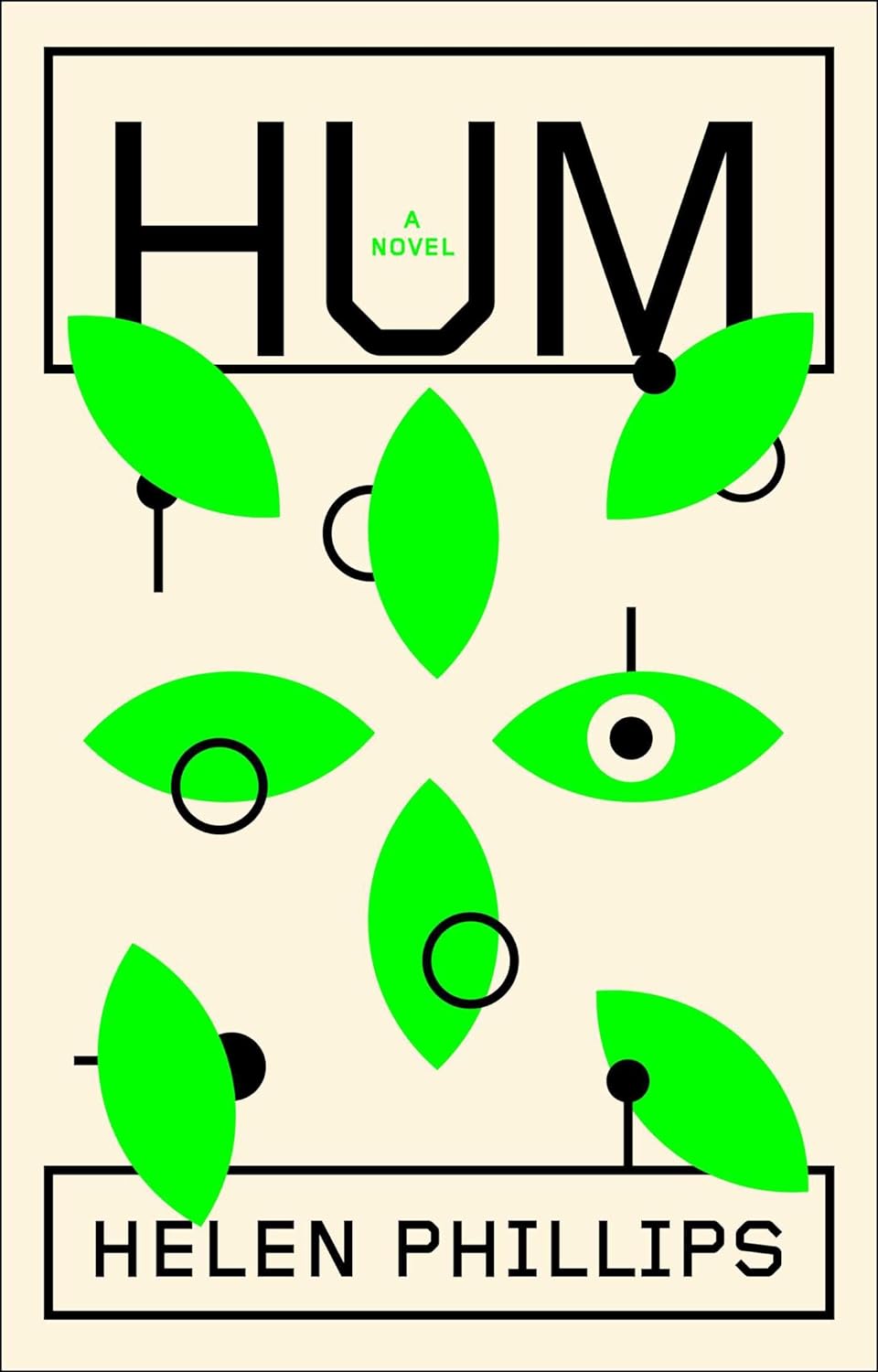
HUM, Helen Phillips reveals a terrifying, sobering prediction for a possible future


HUM
HELEN PHILLIPS

Marysue Rucci Books/S&S
$27.99 hardcover, available now

WINNER of 2026's The Climate Fiction Prize.

Rating: 5* of five

The Publisher Says: From the National Book Award–longlisted author of The Need comes an extraordinary novel about a wife and mother who—after losing her job to AI—undergoes a procedure that renders her undetectable to surveillance…but at what cost? In a city addled by climate change and populated by intelligent robots called “hums,” May loses her job to artificial intelligence. In a desperate bid to resolve her family’s debt and secure their future for another few months, she becomes a guinea pig in an experiment that alters her face so it cannot be recognized by surveillance.

Seeking some reprieve from her recent hardships and from her family’s addiction to their devices, she splurges on passes that allow them three nights’ respite inside the Botanical Garden: a rare green refuge where forests, streams, and animals flourish. But her insistence that her son, daughter, and husband leave their devices at home proves far more fraught than she anticipated, and the lush beauty of the Botanical Garden is not the balm she hoped it would be. When her children come under threat, May is forced to put her trust in a hum of uncertain motives as she works to restore the life of her family.

Written in taut, urgent prose, Hum is a work of speculative fiction that unflinchingly explores marriage, motherhood, and selfhood in a world compromised by global warming and dizzying technological advancement, a world of both dystopian and utopian possibilities. As New York Times bestselling author Jeff VanderMeer says, “Helen Phillips, in typical bravura fashion, has found a way to make visible uncomfortable truths about our present by interrogating the near-future.”

I RECEIVED A DRC FROM THE PUBLISHER VIA NETGALLEY. THANK YOU.

My Review
: SciFi from a woman's PoV by an actual woman is not as rare a thing as it once was. Even women SF writers of the comparatively recent past wrote a boy's or man's PoV as often as not. Now this ignoring of The Future (as seen by women in it) is passé. We still don't see a ton of mothers as PoV characters, though.

May is such a PoV character, and she resonates powerfully with me. Her steely determination to provide for her family is the bedrock of the story. The worldbuilding is subtle, as one would expect from an author working in the (very) near future. Probably my single favorite touch of worldbuilding is one I think is largely invisible to most: May, our main charater, is married to Jem; their children are Sy and Lu.

Even their names are minimized. That most human of sounds, our names, is clipped down to the minimum of syllables, squeezing these beings into a narrower, and narrowing, bandwidth. One better suited, not coincidentally, to the vocal apparatus of the "hums" of the title.

Ah, the hums...the titular beings who represent the next (?) generation of the smartphones now falling out of favor among the young (to me) user base. If, as I suspect, their increasing disenchantment with these devices is being quietly steered, I suspect the course they're being steered ON is the one Author Phillips is showing us in this story.

The worst nightmare of a parent is to lose their children. Especially very young ones whose understanding of the World around them is unformed. Why else did the Satanic Panic/Stranger Danger epidemic get rolling? Losing a child to death by disease is less and less common...thank all those useless gods for that...but accidents, and malicious actions like addictions, malefactors who prey on the innocent are still there to obsess the fretful. Now add AI to that mix, and Author Phillips is on a winner to speak to this seething mass market. She does not do this cynically. Her brushes against the eerieness of the surveillance capitalism around us border on entry into the Uncanny Valley. Her own previous writing has been used without permission or compensation to train the generative AI we're being told will take over. I myownself think, however, that Sabine Hossenfelder's got the right handle on the reality of the eventual results. Author Phillips is wise to point to the ways this borning system is likely to fail Humanity, to the humans who still have time to change course.

Hum traverses nightmarish loss, dystopian social catastrophe, and failures of a deeply human sort in this tale. I wish I could pooh-pooh its premise, or its cconclusions, but I can't. I think all y'all who read my reviews will know what you need to know about my opinion of the read by the fact that a) I published a review on a Tuesday, 2) I was apprived for this DRC on 2 August and am reviewing it four days later, and iii) have not said, and do not intend to say, one critical word about its conception or execution.

Many of y'all do not like anything SFnal or speculative. I encourage those folk most especially to get this from the library and read it.

You're going to live it soon enough.

Friday, October 28, 2022

THE STEVEN KOTLER PAGE: LAST TANGO IN CYBERSPACE, cyberpunk about *empathy* of all things & THE DEVIL'S DICTIONARY, the apotheosis of Lion Zorn


LAST TANGO IN CYBERSPACE
STEVEN KOTLER

St. Martin's Press
$11.99 Kindle edition, available now

Rating: 4.5* of five

The Publisher Says: It was a new skill…

One that might change the world.

What could a person do who could track empathy?

His friends call him Lion, he is the first of his kind. Some describe it as emotional foresight, but really, he can see cultural trends before they emerge. What he didn’t expect was for Big Pharma to come calling.

In 2025, technology has made massive leaps forward.

Not every group wants to use it for good.

Arctic Pharmaceuticals has a new drug and a bad idea. They call on Lion, because he is the key to getting the formula they need. But when he starts to sense their hidden agenda, will they take drastic action?

Then Lion discovers a decapitated human head…

Is he being hunted?

Can he stop a global disaster?

You’ll love this edge-of-your seat cyberpunk thriller, because it will keep you turning the pages late into the night.

Get it now.

I RECEIVED A DRC FROM THE PUBLISHER VIA NETGALLEY. THANK YOU.

My Review
: The first paragraph reads:
He steps off the plane and into a shimmering world. They've hidden the airport beneath a thick coat of dazzle. A parade of razor-thin screens, angled atrium glass, and staccato mirror work. Everything scrolls, winks, and blinks, but softly, like Sunset Strip on mute.

I knew from the off that I was in for one of Those Reads, the ones I bore people with by shoving it in their faces despite innumerable social cues...sighs, eyerolls, signs scrawled in orange crayon on a Big Chief tablet reading "GO AWAY"...that they would greatly prefer I not.

A book with chapter titles like "The Double Tap of Holy Exclamations" and "Residual Goat Shit" and "Shut Your Mouth When You Talk to Me" simply must be read. A book that weaves Dune references throughout its text for the Fremen to follow. A book that centers empathy, that commercially rewards empathy, that perverts empathy into a product that enables empaths to resist and rebel and still get paid...that is, this is, a book that demands your eyeblinks. Demands, and rewards. Lion Zorn, he's just this guy, you know? About like Zaphod Beeblebrox was.
The early researchers described em-tracking as a hardware upgrade for the nervous system, maybe the result of a genetic shift, possibly a fast adaptation, Studies revealed an assortment of cognitive improvements: acute perceptual sensitivity, rapid data acquisition, high speed pattern recognition. The biggest change was in future prediction. Normally, the human brain is a selfish prognosticator, built to trace an individual’s path into the future. The em-tracker’s brain offers a wider oracle, capable of following a whole culture’s path into the future.

Ripsnort through our world (almost) with Lion and see what things really look like when you drink the Water of Life. There's nothing specifically tech-SFnal about the world Lion roams, but the psychopharmacology is waaay trippy. Lion and his ladyfriend Penelope are always on the move because Lion's empathy skills are so useful...he can spot the newest tendrils of a social movement, he can pinpoint who's coming up with what and when and why that's a thing...Lion is, in other words, a bloody nightmare of a gifted and talented drug user. It's Sietch Tabr that expands him, and honestly I think I'd prefer the reality where he's shrunk back inside his skull. I'm already angry about surveillance capitalism.
“Buckminster Fuller said don’t try to change human behavior. It’s s a waste of time. Evolution doesn’t mess around; the patterns are too deep. Fuller said go after the tools. Better tools lead to better people. Arctic doesn’t develop products. We may cultivate them, occasionally, in our own particular way, but our business is change. Significant change.”

Only Lion's subversive....
Lion was the one who pointed out that naming hotels after Millennial values—the Truth, the Purpose, the Community—now that his generation had reached the age where the luxury of billboard ethics had been derailed by the verities of life, might be lucrative. "Aspirational nostalgia," he dubbed it.

Okay, cyberpunk, one expects that. But there's an AI involved in this picture that, well, it's AI so it's got to be bad. But somehow this isn't dystopian. There's a lot of interesting animal-rights activism information and action...there's a little bit of information about how pharmaceutical companies pharmaceut. There's a little bit about Penelope and her life; there's not a lot more about Lion. The characters are the weakest links in the story. They exist, they are differentiatable, they aren't very compelling. I found that, the longer I spent with them, the less that mattered to me. I don't know exactly what that says about the read or this reader. I'm not at all sure I want to find out.
Lots of people believe consciousness is a fundamental property of the universe, like space and time. If that's the case, then it is turtles all the way down. We'll have this debate about our microbiome. About rocks and atoms and quarks. Until we have Gaia consciousness, there will always be an us-them divide, always a next frontier for empathy.

So find space on your Kindle, or order a used tree-book, but get this story inside you.
“Shifting culture requires a confluence of inciting incidents. Something directional that leads to a tribal fracturing and reknitting. Often shows up in language first. In music. Fashion. It can feel a little like hope.” He points at the images. “This doesn’t feel like hope.”

Oddly enough I felt more hope after the read than I did going in to it. I think you might, too.

++++++++++++++++++++++++++++++++++++++++++++++++++++++++++++++++


THE DEVIL'S DICTIONARY
STEVEN KOTLER

St. Martin's Press
$27.99 hardcover, available now

Rating: 4* of five

The Publisher Says: Hard to say exactly when the human species fractured. Harder to say when this new talent arrived. But Lion Zorn, protagonist of Last Tango in Cyberspace, is the first of his kind—an empathy tracker, an emotional forecaster, with a felt sense for how culture evolves and the future arrives.

It’s also a useful skill in today’s competitive business market.

In The Devil’s Dictionary, when a routine em-tracking job goes sideways and em-trackers themselves start disappearing, Lion finds himself not knowing who to trust in a life and death race to uncover the truth. And when the trail leads to the world’s first mega-linkage, a continent-wide national park advertised as the best way to stave off environmental collapse, and exotic animals unlike any on Earth start showing up—Lion’s quest for truth becomes a fight for the survival of the species.

Packed with intrigue and heart-pounding action, marked by unforgettable characters and vivid storytelling, filled with science-based brilliance and cult comic touches, The Devil’s Dictionary is Steven Kotler at his thrilling science fiction best.

I RECEIVED A DRC FROM THE PUBLISHER VIA NETGALLEY. THANK YOU.

My Review
: Okay, same drill:
"People," says Ramen, like they're some kind of disease.

He jabs the air with his chopsticks, pointing at something behind Lion's left shoulder.

Ramen is ancient, Asian, and given to blaring Billy Idol out of cheap speakers duct-taped to the top of his decrepit food cart. He wears an old chef's coat over a dirty t-shirt, the sleeves pushed back, revealing arms flecked with burns and scars. Still, there's truth in his adverstising. Ramen makes ramen. "Best in London," according to the sign, even if you have to sit in the cold rain, under a cheap plastic awning, on the rotting edge of Chinatown, to enjoy it.

Rotting—that is definitely the right word.

There's a reason, not an instantly obvious one, to begin this book in exactly this way at precisely that spot. I think a lot of y'all might not find that an easy sell...it means Author Kotler's work repays close attention. I hasten to add that it isn't *required* to undertand what's going on. It's a lot like the easter eggs in y'all's video games, or the post-credits scene in those Marvel movies. Laugh along, or howl until it hurts if you're in on the joke.

The WhistlePig? The snow snake? No, explaining isn't necessary now. You just need to see the words, parse them, slot their shapes into a spot in your brain. Just take it easy, read one chapter at a time, and always be prepared to go with the flow.

Unlike the Humans-First scumbags, who are serious major buzz-kill nasties after shutting down the entire existence of Sietch Tabr, the huge empathy uptake of humanity, and the inevitable knock-on effect of people and animals coming to realize we're all one big Gaia. And their (I think) creation, the anti-Sietch Tabr, EVO. It harshes everyone's buzz and it is brutal about it.

But this book, second Lion's Story, gets more in its own way by making a bit too little effort to connect me to more of the cast than even the first one, light on character attachment, did. People are labeled, not named, and the ability to invest in them as more than handy props is limited. So I took a half-star off the ratine because I really want to be swept up in the reasons the story's being told. That doesn't happen for me unless I can invest in the characters...postively or negatively.

That is the big gritch. The smaller ones are really not important to me, so definitely not likely to be to you...I'm pretty sure anyone who's read Last Tango in Cyberspace will be eager to get to this one, and I won't say don't. I will say adjust your speed to match the bumps...if technospeak is not for you, these stories aren't either. But, and this is important, taking the story in slowly is a very successful reading strategy with Author Kotler's books. It allows you to marinate his ideas in your head without being bombarded with too much verbiage. Try the stories. This storyverse feels predictive to me, and I suspect we'll be back in Lion's head willy-nilly as the years fly by.

Monday, August 1, 2022

40: A Novel, more than I expected and as much as I'd hoped for from Heathcock


40: A Novel
ALAN HEATHCOCK

MCD x FSG
$27.00 hardcover, available tomorrow

Rating: 4.5* of five

The Publisher Says: From the award-winning author Alan Heathcock comes an American myth of the future: a vision of civil war, spectacle, and disaster of biblical proportions.

In a future America ravaged by natural disaster, pandemic, and political unrest, a fundamentalist faction emerges. As the Novae Terrae gain power, enticing civilians with bread and circuses, a civil war breaks out between its members and the US government.

Mazzy Goodwin, a young soldier, only wants to find her little sister, Ava Lynn. One day, she wakes in a bomb crater to find wings emerged from her back. Has she died? Been gifted wings by God? Undergone a military experiment?

The world sees a miracle. Mazzy is coaxed into seeing it as an opportunity: to become the angel-like figurehead of the revolution, in return for being reunited with her sister. Her journey leads her to New Los Angeles, where the Novae have set up the headquarters for their propaganda machine—right in the ruins of Hollywood. Aided by friends old and new, she must navigate a web of deceit while staying true to herself.

Told in sharp, haunting prose, as cinematic as it is precise, Alan Heathcock’s 40 is a dizzyingly fantastical novel about the dangers of blind faith, the temptation of spectacle, and the love of family. In a tale by turns mythic and tragic, one heroine must come to terms with the consequences of her decisions—and face the challenges of building a new world.

I RECEIVED A DRC FROM THE PUBLISHER VIA NETGALLEY. THANK YOU.

My Review
: Regulars to this blog will recognize the name Alan Heathcock from my warbling my fool lungs out about his collection, Volt: Stories. One big reason for that is that Author Heathcock does not mess around when he makes his imagery work your brain:
"...I knew it'd come to this, you say. I knew I was right. The power of knowing the despair you ordered has finally come to pass makes you feel like a god. Let's be honest. It's what you want. You want this world to collapse. Want people to be every awful thing."

–and–

Grief was a demon of possession. When people talked of time healing wounds, they only meant that over time you become accustomed to that demon inside you, and what at first felt like an invasive presence, alien and nefarious, slowly became integrated into your being, the imp of sorrow crouched within you for the remainder of your days.

I don't know how much clearer the man can be than that. I can feel these words, see the world through their gravity lens, perceive the distorted light that comes from every other direction than the original one to form the ghost of the initial thought behind them.

Which is why I, devout atheist and committed anti-religion crusader, read a whole novel about a post-apocalyptic world run by and for evangelical evil-doers with hearts colder than emptiest space. Which is why I'm here telling you to go and get one of these books, these beautifully designed books (that jacket design!), or to pre-order the Kindle version so you'll open the device tomorrow morning and join Mazzy and Ava Lynn in the hellscape that Jo Sam the evangelist of doom designed and brought forth.

Betrayal is only the beginning of Mazzy's journey. It's certainly true that she's not a trusting, sunny-hearted soul for a single second of her life. Her sister Ava Lynn calls out the only tenderness she allows herself to externalize. The child, whose fate is not ever easy, confounds Mazzy in her extremely self-possessed certainty. Mazzy being incapable of a single sustained good mood for more than the absolute minimum of time, she envies Ava Lynn and vows to protect her. Which, this being a novel, means that Mazzy is unable to do so.

The amount of manipulative chicanery Mazzy experiences after she (unexpectedly and without external stimulus) becomes winged is, of course, the bulk of the novel's action. Her bewingèd state makes her very valuable to the evildoers around Jo Sam the evangelist, unsurprisingly, and so they use Ava Lynn to extort obedience out of Mazzy. The sheer outrage I experienced over this...! It's an effective tool, of course, the safety of one's child (dead mother) being hard coded into our protective circle by evolution. That it is never a violent threat, "we will hurt her," made me able to continue to read the story. They keep Mazzy from being with Ava Lynn to keep her working for their vile controlling cause.

The day dawns, of course, when Mazzy is no longer suitable for their use; a series of things occurs that, in several moments, made me think I was being played by Author Heathcock. It's a pleasure to report that he played fair...but the ending of the story is still a major surprise. Yes, I saw the twist coming, but I think that's to be expected. A truly successful twist, in this case, means the expected event occurs but something you-the-reader would've dismissed as improbable happens after. Job done, Author Heathcock.

I'll say that, after reading many, many chosen-one narratives and even more post-apocalyptic religion-used-for-evil tales over the past seven decades, I'm not sorry I read this one. I think it's well-made and well-written, I suspect it's something the author has allowed to simmer for a very long time before committing to words for others to read, and I'm pleased with the results he has achieved.

Monday, October 4, 2021

THE BODY SCOUT, Lincoln Michel's big, fast racing machine of a sci-fi thriller


THE BODY SCOUT
LINCOLN MICHEL

Orbit Books
$27.00 hardcover, available now

Rating: 4* of five

The Publisher Says: In the future you can have any body you want—as long as you can afford it.

But in a New York ravaged by climate change and repeat pandemics, Kobo is barely scraping by. He scouts the latest in gene-edited talent for Big Pharma-owned baseball teams, but his own cybernetics are a decade out of date and twin sister loan sharks are banging down his door. Things couldn't get much worse.

Then his brother—Monsanto Mets slugger J.J. Zunz—is murdered at home plate.

Determined to find the killer, Kobo plunges into a world of genetically modified CEOs, philosophical Neanderthals, and back-alley body modification, only to quickly find he's in a game far bigger and more corrupt than he imagined. To keep himself together while the world is falling apart, he'll have to navigate a time where both body and soul are sold to the highest bidder.

Diamond-sharp and savagely wry, The Body Scout is a timely science fiction thriller debut set in an all-too-possible future.

I RECEIVED MY DRC FROM THE PUBLISHER VIA NETGALLEY. THANK YOU.

My Review
: First, read this:
"We build better livers, and someone concocts stronger booze. We get sun treatments, then our chemicals burn up the ozone even more. Cure one disease, and another pops up. The pitcher juices up his throw, and the batter juices up his swing. On and on it goes."
–and–
“We’re all trapped in these forms, aren’t we? Our minds get poured into them without anyone even asking us. We grow and live in them, and yet in many ways they are as incomprehensible to us as the cosmos.”
–and–
"We've got 'em all. Mammoth burgers, teriyaki tyrannosaurs wings, saber-toothed gyro platters. Those cocksuckers thought they could avoid being eaten by going extinct. Bunch of buffoons. Didn't count on human ingenuity. We can eat anything these days. Eat the past, present or future."

The flavor of the writing is right there...wry, world-weary, ever so slightly facetious...and if that ain't your jam, baby, move along. Author Michel, whose story collection Upright Beasts earned praise from me, fails to shock me with his writing and planning chops. It's very clear why he offers writing advice for a living.

What would happen if Gattaca and Moneyball had a bastard love-child? This book. From the off, I loved the choices Author Michel made. Baseball is my only organized sport love. Having the Mets (my team since the 1969 Miracle Mets defeated the BodyMore Inc....I mean Baltimore!...Orioles in the seventh game of the World Series) owned by Monsanto was, while revolting, not entirely unthinkable. Choosing baseball for the body-modding corporate shills to play made perfect sense because there's so much more to work with in the prowess-enhancement department. Baseball players are required to specialize in this day and age...don't get me started about the designated-hitter rule!...and yet by the very nature of the game there is a constellation of skills they still need to possess to some degree, like running and fielding the ball. The development of modifying tech, driven by the need/want of the Big Pharma owners, gets laid right at present-day capitalism's (and its political stooge class's) door, as the present-day pandemic accelerated the mad dash for corporate ownership of everything into sports. It's not at all unlikely, given that corporations own teams in Japan....

But the fact that the world Kobo Zunz lives in, the one that allows him to modify his body to an absurd degree despite having become a talent scout thus no longer playing baseball, is chock-a-block with delightfully pointed choices embodied in other characters: Dolores ("sorrows" or "pains") is Kobo's friend/kinda-ex, a Deaf person who elected not to restore her hearing but to enhance her sight (GoogleGlasses-esque modifications to one eye that present speech translated into ASL); Natasha the Neanderthal, the Big Pharma enforcing muscle and that's not a nickname but a descriptive label as she's of the genetically engineered re-introduced Neanderthals; Lila, the Angry Young Girl who, like Greta Thunberg, is outraged into incandescence at the gigantic mess her elders are leaving for her to clean up. I love that, when Kobo the expert at foreseeing trends in body modification (always ask an addict to get an accurate vision of the addiction's course) is summoned to solve the gruesome and very public murder of his adopted brother, Monsanto Mets batting (aka "slugging") star JJ Zunz, it's by a manager whose only name is "the Mouth." Ha! Kobo's debts incurred in body modding will be paid in full...if he pins the very public, obviously message-sending murder on a particular rival team. That will get the scary, violent loansharks who have been funding his biomechanical enhancement addiction, Brenda and Wanda, off his terrifying-nightmares list.

So what am I saying about this read? Much delighted me, mentioned above. There are things that didn't delight me near so much. The length of the story, for example, would support more exploration of side characters who got little (JJ's mother, who adopted Kobo). But in all honesty I'd've been much happier if some of the amazing ideas and snarky asides had been held in RAM for a sequel, leaving a fizzier and more propulsive through-line. It's not like it's a slow read, or wasn't for me; it's just densely packed with irresistible shiny baubles and it could've been told in less time and at a more spanking pace. I presume this is not the start of a series because the publishers would've trumpeted that fact if it had been. If Author Michel chooses to make it into a series, which I really hope he will, quite a lot of the underexplored material will be very expandable.

What isn't expandable is the ending. A very weird change of tone takes place as we're coming in for our landing. It becomes...sweet. Kind of sentimental. This felt so very wrong to me, like Philip Marlowe got a hit of some opiods and turned into Ted Lasso.

What I will say is that you're going to love The Body Scout if you loved George Alec Effinger's Marîd Audran books, or the early William Gibson. I did; I do; and all cavils aside, I'd encourage any baseball fans, bleak/noir fiction lovers, and anti-capitalists to hop on board. A few bumps on the journey shouldn't detract from the way-cool scenery.