Showing posts with label SF. Show all posts

Friday, September 13, 2024

SKY FULL OF ELEPHANTS, debut novel with ideas that have real power


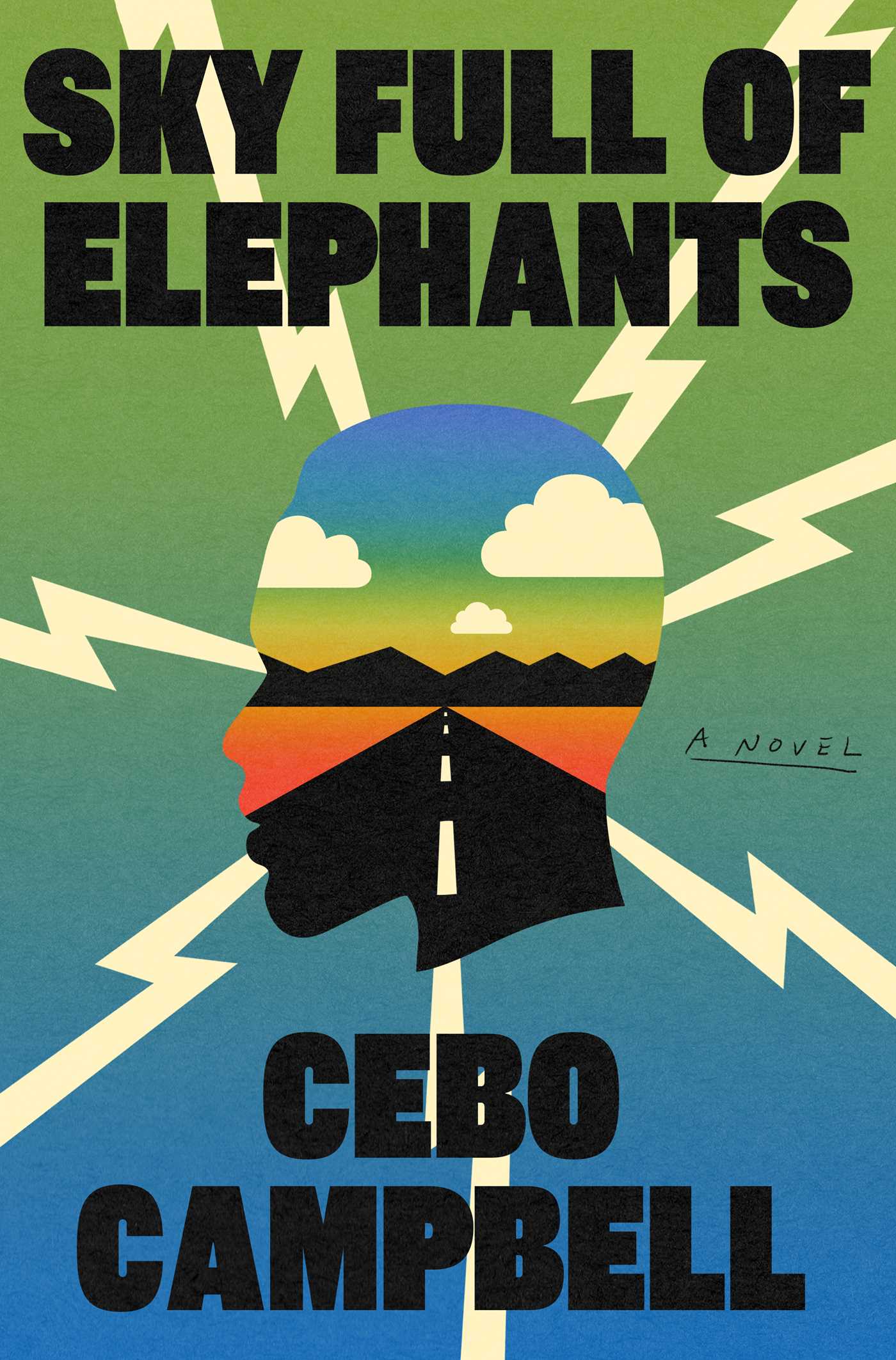
SKY FULL OF ELEPHANTS
CEBO CAMPBELL

Simon & Schuster
$27.99 hardcover, available now

Rating: 4.5* of five

The Publisher Says: In this exquisite speculative novel set in a world where white people no longer exist, college professor Charlie Brunton receives a call from his estranged daughter Sidney, setting off a chain of events as they journey across a truly “post-racial” America in search of answers.

One day, a cataclysmic event occurs: all of the white people in America walk into the nearest body of water. A year later, Charles Brunton is a Black man living in an entirely new world. Having served time in prison for a wrongful conviction, he’s now a professor of electric and solar power systems at Howard University when he receives a call from someone he wasn’t even sure existed: his daughter Sidney, a nineteen-year-old who watched her white mother and step-family drown themselves in the lake behind their house.

Traumatized by the event, and terrified of the outside world, Sidney has spent a year in isolation in Wisconsin. Desperate for help, she turns to the father she never met, a man she has always resented. Sidney and Charlie meet for the first time as they embark on a journey across America headed for Alabama, where Sidney believes she may still have some family left. But neither Sidney or Charlie is prepared for this new world and how they see themselves in it.

When they enter the Kingdom of Alabama, everything Charlie and Sidney thought they knew about themselves, and the world, will be turned upside down. Brimming with heart and humor, Cebo Campbell’s astonishing debut novel is about the power of community and connection, about healing and self-actualization, and a reckoning with what it means to be Black in America, in both their world and ours.

I RECEIVED A DRC FROM THE PUBLISHER VIA NETGALLEY. THANK YOU.

My Review
: Well, this was a read and a half. A fantasia, an attempt to view the culture of privilege and prejudice confronted by a man and the mixed-race daughter he never knew he had in the wake of white peoples' mass lemming-like vanishing.

Now, let me bring something up: This is in no way some triumphalist "wouldn't it be cool if all the white people vanished?" racist fantasy. It isn't that kind of facile storytelling, or revenge fantasy. It's a fantasia on the inscrutable ways of the Universe, an unknowable, unfathomably powerful external force that, this time, spared you; but...Amid the reorgaization of society, there's that unease that comes from an unresolved stressor, like the Bomb in the Cold War.

A lot like Le Guin's The Dispossessed, A Morally Ambiguous Utopia, the ideas in this story are heady indeed. The overculture in each of these different stories presupposes the existence of a hegemonic economic system that can only be opposed not reimagined. In Author Campbell's story, the presumption includes the fact that when whiteness and its (largely) unexamined privilege vanish, the enforcement of the hegemonic capitalism dies. Is everything suddenly perfect? No, but it's free from many of the more abusive qualities of capitalism and racism. I myownself am not quite so confident that capitalism would wither so completely or so quickly; it's too effective a tool of control, that most human of needs. Leaving that aside, the Brave New World presented feels...right, just, positive. I say this as someone explicitly excluded from this world. That fact is, I suspect, what led a LOT of whiny little butthurt arrested adolescents to ratings-bomb the book on Goodreads. Such arrant nonsense makes Author Campbell's premise's point for him. It also embarrasses me, an old white man, to be relegated among such angry, hateful, immature people.

The author's imagination, then, can't be faulted. This is his debut novel, so technique is logically enough less well-honed than his idea-generating musculature. I kept saying to my DRC, "Please don't explain so much to me. Trust that the stories you've imagined so richly will, in fact, lead me where you're wanting me to go. Conflicts whose roots and results you carefully elucidate aren't tense enough to keep me eagerly reading." I'm confident this can be attributed to his tyro status. I'm also very eager to read his next work when it comes out.

The ending of the story, while not exactly a release from tension, does flow from the events of the preceding action. It felt...I'm not sure "inevitable" is precisely correct, but it has the leadenness of affect I want to convey.

I've rated the book with four stars because I was brought up short and required to consider the ideas of the story multiple times. Good SF/F does that wonderful job better than any other form of storytelling.

This is good SF. That explains the other half-star.

Tuesday, August 6, 2024

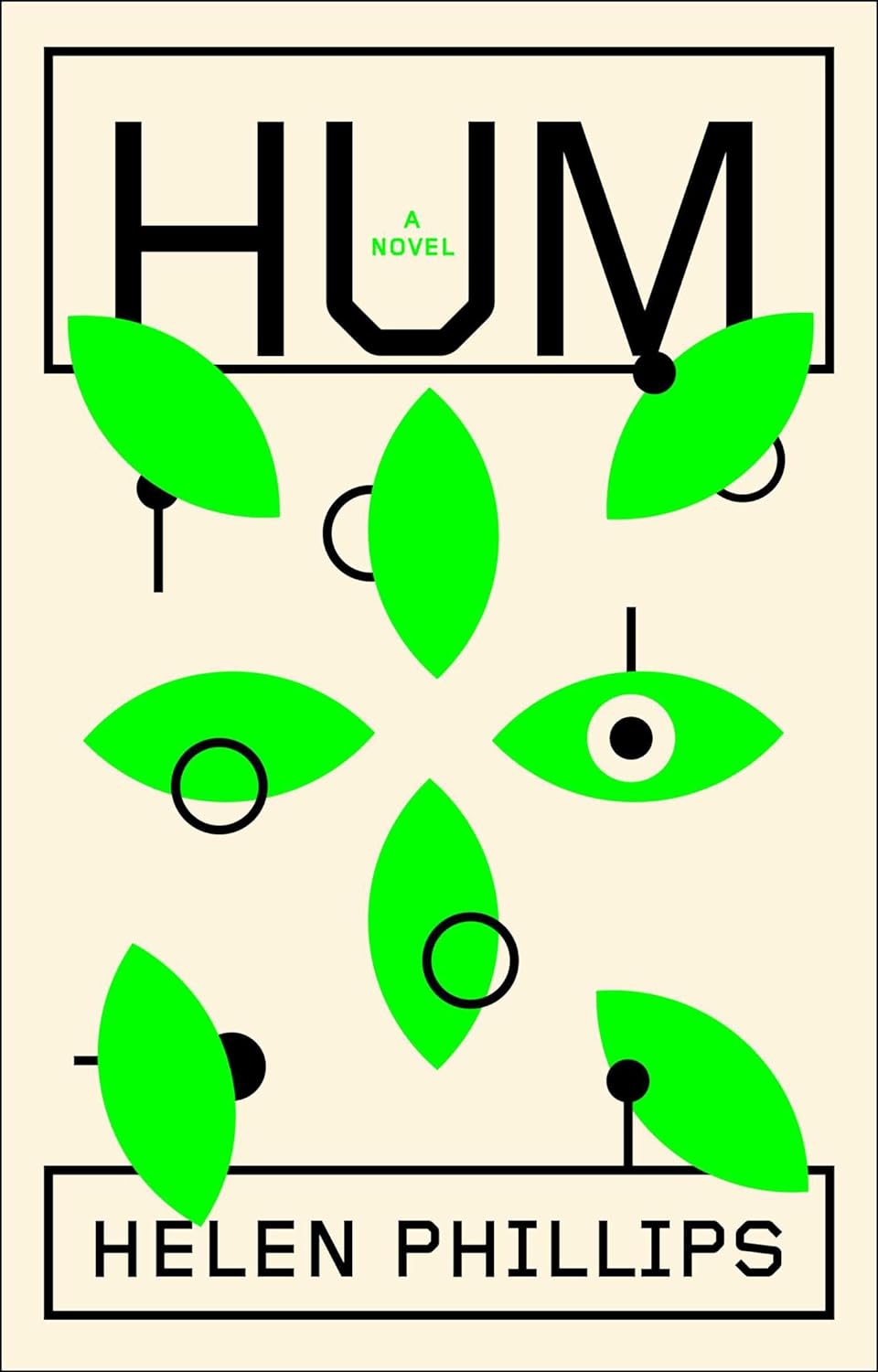
HUM, Helen Phillips reveals a terrifying, sobering prediction for a possible future


HUM
HELEN PHILLIPS

Marysue Rucci Books/S&S
$27.99 hardcover, available now

WINNER of 2026's The Climate Fiction Prize.

Rating: 5* of five

The Publisher Says: From the National Book Award–longlisted author of The Need comes an extraordinary novel about a wife and mother who—after losing her job to AI—undergoes a procedure that renders her undetectable to surveillance…but at what cost? In a city addled by climate change and populated by intelligent robots called “hums,” May loses her job to artificial intelligence. In a desperate bid to resolve her family’s debt and secure their future for another few months, she becomes a guinea pig in an experiment that alters her face so it cannot be recognized by surveillance.

Seeking some reprieve from her recent hardships and from her family’s addiction to their devices, she splurges on passes that allow them three nights’ respite inside the Botanical Garden: a rare green refuge where forests, streams, and animals flourish. But her insistence that her son, daughter, and husband leave their devices at home proves far more fraught than she anticipated, and the lush beauty of the Botanical Garden is not the balm she hoped it would be. When her children come under threat, May is forced to put her trust in a hum of uncertain motives as she works to restore the life of her family.

Written in taut, urgent prose, Hum is a work of speculative fiction that unflinchingly explores marriage, motherhood, and selfhood in a world compromised by global warming and dizzying technological advancement, a world of both dystopian and utopian possibilities. As New York Times bestselling author Jeff VanderMeer says, “Helen Phillips, in typical bravura fashion, has found a way to make visible uncomfortable truths about our present by interrogating the near-future.”

I RECEIVED A DRC FROM THE PUBLISHER VIA NETGALLEY. THANK YOU.

My Review
: SciFi from a woman's PoV by an actual woman is not as rare a thing as it once was. Even women SF writers of the comparatively recent past wrote a boy's or man's PoV as often as not. Now this ignoring of The Future (as seen by women in it) is passé. We still don't see a ton of mothers as PoV characters, though.

May is such a PoV character, and she resonates powerfully with me. Her steely determination to provide for her family is the bedrock of the story. The worldbuilding is subtle, as one would expect from an author working in the (very) near future. Probably my single favorite touch of worldbuilding is one I think is largely invisible to most: May, our main charater, is married to Jem; their children are Sy and Lu.

Even their names are minimized. That most human of sounds, our names, is clipped down to the minimum of syllables, squeezing these beings into a narrower, and narrowing, bandwidth. One better suited, not coincidentally, to the vocal apparatus of the "hums" of the title.

Ah, the hums...the titular beings who represent the next (?) generation of the smartphones now falling out of favor among the young (to me) user base. If, as I suspect, their increasing disenchantment with these devices is being quietly steered, I suspect the course they're being steered ON is the one Author Phillips is showing us in this story.

The worst nightmare of a parent is to lose their children. Especially very young ones whose understanding of the World around them is unformed. Why else did the Satanic Panic/Stranger Danger epidemic get rolling? Losing a child to death by disease is less and less common...thank all those useless gods for that...but accidents, and malicious actions like addictions, malefactors who prey on the innocent are still there to obsess the fretful. Now add AI to that mix, and Author Phillips is on a winner to speak to this seething mass market. She does not do this cynically. Her brushes against the eerieness of the surveillance capitalism around us border on entry into the Uncanny Valley. Her own previous writing has been used without permission or compensation to train the generative AI we're being told will take over. I myownself think, however, that Sabine Hossenfelder's got the right handle on the reality of the eventual results. Author Phillips is wise to point to the ways this borning system is likely to fail Humanity, to the humans who still have time to change course.

Hum traverses nightmarish loss, dystopian social catastrophe, and failures of a deeply human sort in this tale. I wish I could pooh-pooh its premise, or its cconclusions, but I can't. I think all y'all who read my reviews will know what you need to know about my opinion of the read by the fact that a) I published a review on a Tuesday, 2) I was apprived for this DRC on 2 August and am reviewing it four days later, and iii) have not said, and do not intend to say, one critical word about its conception or execution.

Many of y'all do not like anything SFnal or speculative. I encourage those folk most especially to get this from the library and read it.

You're going to live it soon enough.

Tuesday, December 8, 2020

ELYSIUM, a fan-damn-tastic first novel from a writer who we need to hear more from soon

ELYSIUM Or, The World After
JENNIFER MARIE BRISSETT
Aqueduct Press
$7.95 ebook editions, available now

Rating: 4.5* of five

The Publisher Says: A computer program etched into the atmosphere has a story to tell, the story of two people, of a city lost to chaos, of survival and love. The program's data, however, has been corrupted. As the novel's characters struggle to survive apocalypse, they are sustained and challenged by the demands of love in a shattered world both haunted and dangerous.

I GOT THIS BOOK FROM MY LOCAL LIBRARY (THEN HAD TO BUY ONE). SUPPORT YOUR LIBRARY, FOLKS.

My Review
: The author, whom I follow on Twitter, commented rather sadly on some people in the blogosphere who took her to task for this book, which apparently was not to their taste.

It was to mine. I enjoyed it so much that, after reading the library's copy, I ordered one for myself because I wanted to have ready access to some of my favorite quotes to share with my Young Gentleman Caller. He's quite partial to this one:
"...You got wings now. You might as well learn how to use 'em. I'll teach you and then you'll come with me."

It makes me very happy to be able to share that with him, and have it mean something good to him, too.

But here's the thing, readers. Here's the central principle of this book as I understand it: Forget Reality. It doesn't exist.

As this idea bothers a lot of people, and some people more than is remotely justified, let me talk a bit (vaguely, sorry, spoilerphobes are every-damn-where like the Wicked Witch's flying monkeys) about why I think this is Elysium's core value. First, are the characters male or female? Straight or gay? Lovers, friends, family? The proper answer to this question is "Yes." Full stop. There are no binaries or trinaries (is that a thing?) here. There is a world beset by failure from within...the computer code between sections and chapters is you clue to remove linear expectations from your reading repertoire. You're not spoon-fed anything in this book, nor are you denied the clear and intentional signs of what the author wants you to know before continuing your read.

Antoine and Antoinette being one person, though not the same person, is an idea that frightens a lot of (mostly straight, though certainly not all) people. That these two names for one being, one soul as the more spiritually inclined would say, are frequently interchanged and in a constellation of ways in relationship to Adrian/Adrianne will confuse many. Which, I think, is part of the point. We're in a world whose worldbuilding includes the concept that this is all a malfunctioning program. And now the technophobes have checked out...no, no, no, no! It's not about a HAL-9000 programmed by an Australopithecus at a Cosmic Terminal controlling the Universe. Perish forbid Author Brissett be so uncreative, so bog-standard boring.

There is a point at which Hector/Helen, the relationship spoiler between the primary dyad Adrian/Adrianne and Antoine/Antoinette, becomes...repetitive...and a new role surfaces, a different means of being within the circle of safety that these connected beings represent. A sibling has a powerful position in a person's life. But here there must be room made for change. Partners don't often make that accommodation where siblings will. Now and then the relationship drama can feel overdone, but one is wise to trust a storyteller to make it all make sense.

The larger canvas, the backdrop of The World Ending, isn't overplayed, isn't made the blaring obvious focus of the people we're invested in's lives. It happens almost offstage, it's so much a part of the way the players play out their scenes. It happens, and it happens, and it happens; it is in this endless loop of recursion that the computer code "interruptions" become ligatures. The linking of all the worlds that are failing, losing, coming unstuck, is always being battled and resisted. Our main characters might not be the ones doing the fighting (note use of conditional), but they're at the forefront of the evolving disaster.

The disasters, regrettably, include a bit of characterization that I'd call transphobic. It was an uncharacteristically lazy slip-up. I'm not going to belabor the point because it's part of an overall branching exploration of dichotomy, a sense of making the characters (and latterly introduced characters as well) conform to standards that are slapped on with labels. That's not always comfortable to explore...but I believe Author Brissett, a Jamaican-British person resident in New York City, would be very much inclined to do. How many labels can one entity, one consciousness, support or bear or exemplify? All three main characters bear the entire range of them, and others determined by cultures only invented instead of observed.

Comes the ending. I was, at that point, hazy and a little tired; but the book's ultimate frame gave me the five-star glow. This ending makes every odd and jagged edge Right and Proper. I loved it, and was so very happy that it came to be.

But for the transphobia...that's the half-star off.

Friday, August 28, 2020

KALPA IMPERIAL, Argentinian woman-authored SF in translation (by SFF monadnock Ursula K. Le Guin!) CW for regressive sexuality politics

KALPA IMPERIAL: The Greatest Empire That Never Was
ANGÉLICA GORODISCHER
(tr. Ursula K. Le Guin)
Small Beer Press
$8.69 ebook editions, available now

Rating: 3.75* of five

The Publisher Says: Emperors, empresses, storytellers, thieves . . . and the Natural History of Ferrets

Kalpa Imperial is the first of Argentinean writer Angélica Gorodischer’s nineteen award-winning books to be translated into English. In eleven chapters, Kalpa Imperial’s multiple storytellers relate the story of a fabled nameless empire which has risen and fallen innumerable times. Fairy tales, oral histories and political commentaries are all woven tapestry-style into Kalpa Imperial: beggars become emperors, democracies become dictatorships, and history becomes legends and stories.

But Kalpa Imperial is much more than a simple political allegory or fable. It is also a celebration of the power of storytelling. Gorodischer and acclaimed writer Ursula K. Le Guin, who has translated Kalpa Imperial, are a well-matched, sly and delightful team of magician-storytellers. Rarely have author and translator been such an effortless pairing. Kalpa Imperial is a powerful introduction to the writing of Angélica Gorodischer, a novel which will enthrall readers already familiar with the worlds of Ursula K. Le Guin.

My Review: In my honest opinion, the chapters here are stories. They're mostly self-contained, they have a storyteller...in my own mind, a single storyteller, with a really, really looonnnggg life...as a narrator to link them; but they're not chapters in a novel. These are the Thousand and One Nights of forgotten and uninquired-about empires, none exactly named but the people and the rulers and the inventors all carry their names with the heft and pride of the people you know in your everyday life. They're Egypt and India and Songhai and Qin and Mexica empires, all one immense and eternal entity called the empire and it's the largest that has ever been known.

Are they worth visiting? I have problems with Author Gorodischer's sexuality politics. I'm not surprised by that, but I am less than pleased. I'm unenthusiastic about the misandry; I'm not going to pretend the collection is perfect to try to sell the idea of reading it to you.

I will say that, if I overcame these issues and read the stories with varying degrees of agreement but always with the certainty that I was in the presence of very, very high-level art, I think you should be able to as well. Comme d'habitude, we shall employ the Bryce Method to experience the parts, now that I've briefly characterized the whole.

BOOK ONE: THE HOUSE OF POWER
The Emperor presents the foundation myth of an Imperial dynasty. The storyteller arrives and shows us his (stated explicitly on p14) vocal tics and verbal stylings.
Well, well, I've let my words run away with me, something a storyteller should take care to avoid; but I've known fear, and sometimes I need to reassure myself that there's nothing to fear any more, and the only way I have to do that is by the sound of my own words.
I suspect the truth of this isn't really that obvious to most of us in the privileged West. I suspect the tyrants' victims are the ones who know what fear so powerful that it enforces your silence on you is to be found more in places where the horror is physical, personal in the original sense "of the person or body," not virtual. No one should be bullied or threatened in our increasingly virtual world. But people whose speech can result in disappearance without return....
Well, you'll have to believe me when I tell you that once he'd sat in the seat of power, Bib became a giant. No, my friends, I don't mean that he grew taller or fatter. He was just as he'd been, smaller and shorter than most men of his age, but he thought intensely of himself not as an isolated person but as a part of something that no longer existed and that needed him in order to exist. And that, my friends, that's the kind of thinking that turns us into giants.
The most wonderful observation of a character becoming A Character...the most complete presentation of a misfit's power to create a space to fit themself. The power of simply being yourself is always huge. The confidence to carve the world's resisting substance into a pedestal and clamber up on it is so rare. And that is exactly what this story of Antiquity, of a long-ago rebirth of Empire, and a dynasty no longer ruling, is about. Another and safer way to tell people that their uniqueness is their power in a society only recently out from under tyranny is to set it long, long ago and make it about a genuine hero...who might or might not have existed....

The Two Hands is a polyphony of classes and stations, a mixing of the low and high in the Empire to tell of a man, a usurper, a creature of full manly vigor in contradistinction to his pathetic, weak, incapable usurped; Author Gorodischer has made it her purpose to tell fragments of a story in no special order and by doing so to reveal what the first voice, The Storyteller, knows and sticks to:
The tale of {the usurper's} life and works is banal, sorry, and inconclusive. Have any of you ever gone near the imperial palace? Have you seen the towers, the immeasurable terraces, the black walls, the fountains? No, nor have I, and even now it's very hard to do so. That's why this story belongs to other people. I'm the one they give presents to and butter up to get me to tell about old, forgotten things. But this time, though it probably won't work, I'm going to try—why not?—to say nothing.
And so the chorus begins, the Archivist, the chambermaid, the officer of the guard, the fisherman, all bring angles of the usurper's story that no one else could've seen or known to care about...and then, according to the above-quoted passage, comes our storyteller:
{The usurper} worked day and night, and under his rule good turned to evil with amazing speed. ... He was so busy that he ate and slept in the throne room, where officials brought the problems of the Empire to him and came away with ruinous solutions.
A usurper, an illegitimate ruler, who wrecks whatever he touches? Goodness, that doesn't sound familiar at all, does it. I mean, it couldn't happen IRL could it, so we turn to fiction to explore the idea.
And then the woman who had been the empress died and was buried in the Garden of the Dead, and the Emperor shut himself up in her apartments...where he was alone.
Utterly divorced from the reality of the realm he rules? No ruler could ever possibly enact that as a governing strategy! Seeing ever fewer ministers, finally none at all but communicating with them via notes left and returned, until people forgot what he actually looked like so were reduced to making up fearful tales of his nocturnal prowlings, resulting in a sense of eternal dread.
How vividly Author Gorodischer paints this impossible scenario. And, as all good stories develop, the changeless changes: A visitor, a ragged and dangerous leper, arrives to make the usurper's twenty-year-long reign of misery change, as the Archivist is privileged to tell us:
I know that it would be pleasing and suitable to say that his visitor was a mighty warrior or a great sorcerer, so that history could repeat itself and philosophers could draw conclusions from it. But what would become of the Annals of the Empire if we archivists started spinning fantasies like the storytellers? No. It was a beggar, lean, lousy, filthy, leprous.
Call things by their proper names, people, and don't let anyone at all spin you a tale in place of giving you the facts. Devaluing truth and disparaging fact lead to bad, ugly, dark, rotten places. Don't forget this.

The End of a Dynasty or The Natural History of Ferrets Wow. What a novella. Secrets, lies, dishonorable shenanigans, cruelties so subtle they are only exquisite and not truly terrible, possessing an evil artistry to elevate them.
No, I'm sorry, but I can't tell you the name of the Ninth emperor of the Hehvrontes dynasty, because I don't know it. Nobody does. It's a name that is not remembered. His guilt and treason, so they said, had been so horrible that his name was never to be pronounced again. Moreover, that name was erased from the annals, the laws, the decrees, from history books, official registries, monuments, coins, escutcheons, maps, poems. Poems, because the emperor had written songs and poems ever since he was a boy. Unfortunately, he'd been a good poet...{a}nd to tell you the truth, many of his poems survived despite everything....
To make art, even an art as debased by solipsism as I contend that poetry is, stands in glaring relief to the notion of a traitorous soul, says Author Gorodischer in the arch, snarky, yet eager to educate voice of the storyteller. Yes, that's the source from which this chapter flows to the restive bu receptive ears of the storyteller's audience:
Now even you people, with all the sensitivity of paving-stones, have figured out that {they}...had been drawn toward the young prince by more than mere chance. We may ask ourselves–ask yourselves, because I've done it already and come up with the answer–whether chance rules humankind or or if all our acts are foreseen...{a}nd it's no use asking this curious question of the wise, because some will insist that everything is chance, others will say it plays no part, and maybe all of them are right, since since they all suspect, behind chance or non-chance, the workings of a secret order.
This narrative voice appeals to me a great deal, it soothes my snobbish downward-gazing know-it-all to read the kind of words I've only barely learned to keep shtumm.

Stop laughing. I have so learned. Imperfectly, perhaps, but learned.

The storyteller regales the only barely willing ears of his audience with the growth of the tenth emperor into an adult over the course of a few short weeks. He is seven years old, trapped in a Gormenghastly nightmare of meaningless ritual and loveless display instead of intimacy; the others, rough beasts slouching toward Bethlehem, teach his blossoming inner man about realities of life and existence, give him a new identity (the ferret of the title), and ultimately unlock the rage he has borne since he was born.
He no longer hated his nameless father, if ever he had hated him as they had told him he he should do, because he loved {his interlocutors}. Every misfortune has its lucky side, say the wise. And I'd add that every good thing has its disadvantages, and the disadvantage of love is precisely that it leaves room for nothing else....
That is, as I assume my readers know, the simple and honest truth. Love simply is, and it is vaster than anything a mere human can conceptualize. Hard enough to express it, to encompass it , after learning what it is; words are so small, thoughts are so basic, the existence of a state/sensation/need like love can't be stuffed down into them, not even them all. We must try, though, or be strangled on their immensity. After all, as the storyteller tells us, "...the wise say that words, being daughters of the flesh, spoil if they're kept locked up.

Siege, Battle, and Victory of Selimmagud is distasteful, homophobic, and frankly indicative of qualities of mind that I saw in the relentless heterosexual binaries of Le Guin's famous The Left Hand of Darkness and the not-very-subtle homophobia of The Dispossessed (which so offended me that I actually erased it from my experience of the book until reminded of it in a recent guided re-read of the book). The uniformly victorious general of the Seventh Imperial Army of Assault is the "hermaphrodite" (or intersex, as we say these days) child of a lesbian Duchess and a gay Marshal. Because of course the Duchess of COLDWINTER would give birth to such a creature, as the General is portrayed as, in his slinky blond slenderness. Things go downhill from there. It taints my pleasure in this otherwise deeply pleasurable read.

Concerning the Unchecked Growth of Cities is as detailed, as lumbered with names as the begats in the Bible. Significantly more fun, however, and quite, in the end, a wry tale of life's innumerable Zen jokes. The storyteller tells us about the nature of History, Kleio not what's in old newspapers, the nature of the story of the past not the time gone by. So the storyteller sets us up in this universe, the History of the empire's multi-capital, as follows:
All these works of imaginative inventions unfortunately got into chronicles, which were made into books which everybody respected and believed, principally because they were thick, hard to hold, tedious, and old. And they got into legends, those tales that everybody says they don't believe in because they can't take them seriously, and that everybody believes in precisely because they can't take them seriously.
Well, yes. Too much taking seriously of things that can't bear the weight of seriousness leads to deep fractures in the foundations of society. I'm struggling to come up with a real-world example of this. /sarcasm

The storyteller is a wonderful and arch presence throughout the story.
When an ancient, poverty-stricken woman called {the failed usurper} to come in and share her midday meal, he wouldn't sit at the table, but ate humbly crouching in the doorway. That was when he discovered that he liked this job, not as much as the job of emperor, maybe, but it was all he had. That same evening he preached for the first time.
And thus, my ducks, the beginning of the end for stable secular society. Someone who understands politics gets the religious burr under their saddle and it's all over and no mistake.

But the ends of politics and religion, whether meshing or clashing, are as nothing compared to humankind's impulse to slaughter, destroy, wreck, wreak havoc upon, their fellow humans:
The Battle of the North lasted exactly fifty hours. The men attacked, broke, scattered, retreated, had a bite to eat, and returned to the attack. Telling such things one is sickened by what men are. They were not men; nor were they wolves, nor hyenas, nor vultures, nor eagles. They were blind organisms, mindless, nerveless, without feeling or thought, with only the power to wound, and blood to shed.
I trust you note in the above passage the explicit and ongoing (quite a lengthy paragraph continues on from this excerpt; I don't want to type it) gendering of violence. Both Author Gorodischer and Translator Le Guin subscribe to masculine culpability tropes in social illness. I don't think that's the whole story, but the evidence of male violent behavior is pretty damned obvious to anyone with eyes. And these eyes, the women and the mother who wrote and translated the story, are unsparing.

I don't blame them a bit.

BOOK TWO: THE GREATEST EMPIRE
Portrait of the Empress tells a lovely, fantasy-fulfilling tale of Virtue Rewarded. The Storyteller, bless him, revels in knowing secrets and telling tales; protest though he might about the Role of the Taleteller in spreading the word of the best, the worst, the rest of us, he is a creature of the Power that controls access to the world's powerful.
Power, bah! {the Great Empress would} say, looking disillusioned. Only if you forget about power can you govern well, she'd say. And it was true. She forgot about the power she had, which was immense, and so power, ignored and disdained, courted her, trotted after her...But she despised it utterly and made it wait like a beggar at the palace gates. Anybody could approach her, anybody could come into the palace and talk to her, for not depending on power she had no fear, and dispensed with protocol and ceremony. She was the first person on the imperial throne for centuries and centuries who kept no bodyguards, the first to go down in the streets unprotected...carried in a sedan chair like any rich woman, or on foot like any workman's or tradesman's wife. So it was that I knew her.
For yes, lads and lasses, the storyteller in his humbleness caught the august attention of the Great Empress! She, all uneducated, knew that she needed to know what a storyteller whose words wove magic from the lives of dead and gone people and places now crumbled to dust. Why on Earth, you ask (I did), should this be? How can someone attain an office people literally kill to occupy without knowing one blessèd thing about its history and the consequences of its misuses?! /sarcasm

In the Great Empress's case, by being canny, astute, flexible enough to speak truth to Power without belaboring the point being made. By being honest, within reason, by telling someone whose life differed from her own by the most astonishing and appalling degree the home truths that all of us need to know. By being, at all times and in all ways, clear-sighted and pragmatic.

I assume, then, you won't be surprised to know that the Great Empress was no believer in majgickq:
Magic can't be trusted, I assure you; what's useful is quickness and certainty in making up one's mind. And that's not magic even if it looks like it, because you can only do it when you've learned to think your own thoughts. In those few minutes I had realized that the Emperor was dying, that some of the people around him were fakes and the rest incompetents, and that here, at the throne, I could find a use for the energy I wasted...Once I knew that and knew I knew it and discussed it with myself and accepted it, when the emperor asked how I'd come by the {healing stone}, I told him the truth and added, truthfully, that he and I alone knew it.
That is the shortest road to power for the powerless: Never toady, never lie, never make more of something than it can bear. It was in telling the dying emperor these truths that the Great Empress put her feet onto the path to her world's highest and most august office, one she has occupied and executed with admirable restraint and honor.

Author Gorodischer posits a solution to the empire's ills that very much annoys me, one that I first encountered when I read Richard Sennett's urbanization-without-policing magnum opus The Uses of Disorder. Fifty years ago, he wrote this paean to the notion of urban libertarianism. The author here espouses a semi-urban libertarianism that makes me just as sick to my stomach. Gay people will most likely know why: The idea of a community setting its standards for itself, and enforcing them inside itself, is a recipe for persecution of the Other, the queer and different-colored and just different. Womyn-only spaces are safe! Unless you're some womon's tweenaged son. Black-only communities are safe! Unless you're trans. etc etc etc ad nauseam ad infinitum

There will never, utopian anarchists, be a day when it isn't someone's turn in the barrel.

And the Streets Empty is also unpleasant, containing revenge porn for women who are abused by men. Ableist, denigrates sex workers as so many of these stories do.

The Pool tells us of the many ways we lie to ourselves, for the best and worst of reasons, and become trapped in the illusions we create to hide our lies and their consequences from ruining our happiness. A doctor who practices his healing arts on Whiterose Street fails to accept the lies of the world, and so effects healing on his patients:
"We keep adding needless things, false things to ourselves, till we can't see ourselves and forget what our true shape is. And if we've forgotten what shape we are, how can we find the right place to be? And who dares pull away the falsities that are stuck to his eyelids, his fingernails, his heels? So then something goes wrong in the house and in the world, and we get sick. ... What's dangerous isn't having them, said the doctor, what's serious is loving them."
After great storms and mighty political upheavals and misguided attempts to be excluded from the universal laws of sadness and regret, the doctor's healing of a bad man, a man who has done bad things, a man whose criminal acts offend the idea of self he carries within himself, leads to this doctor's acquisition of an apprentice who wants to know the names of far-away flowers he cannot see. Other changes, less important ones, take place offstage...and the history books get rewritten again because of them.

Perfect.

Basic Weapons in which the storyteller tells us of a man, one without legs but with a serviceable set of wheels, who conceives of an envious passion: He wishes to wheedle his way into a rich man's home. He does this by committing, repeatedly, the worst sin a being can commit: To use the existence of another for one's own profit.
Then the boy did what the salesman had described: he danced. He moved first without changing place, both feet as if fixed to the ground. He waved his arms, lifted them held them out; he swayed, and he made circles with his body, twisting his waist, and with his head, that seemed to turn feel\y at the end of his long neck. Then he leapt, without ceasing to sawy the rest of his body. He spun on one foot, on the other, bowed down, swept the ground with his hands, straightened up, ran two steps to one side, three to the other, his arms held high, his head fallen back. ... And the dealer (in curiosities like the dancer)? He had felt the world begin to spin quicker than it had ever done, more dizzily than when it was an incandescent lump of rock under the attentive eye of God.
The salesman made his sale; the dealer had a deal that leads him into the halls of the most powerful, wealthiest old man in the district. The old man is, as who would not be in a world that has never known dance, by the blond boy he must rent by the performance from the dealer. And, as is the way of nature, the storyteller reminds us that there is no fool like an old, dying fool.

Unless it's a hate-addicted legless bastard with a beautiful slave.

"Down There in the South" they say, "Not all is said; it hasn't all been said." And they are right, it hasn't and, I suspect, it can't all be said or there would be no more empire or villages or lakes bleeding rivers.
Yes, and it's always been that way, always. There've been emperors who dreamed of subjugating the South. There've been emperors who tried it, and some thought they'd done it. But with what? I ask, with what? With power, weapons, armies, fire, terror? Useless, all that, completely useless: all power can do is silence people, keep them from singing, arguing, dancing, talking, brawling, making speeches, and composing music. That's all. That's a lot, you may say, but I tell you it's not enough. For what power can keep the earth from speaking to people? What weapons can keep water from running and stones from rolling? What artillery can keep a storm from crouching on the horizon, ready to burst?
A bad man, venal and corrupt and from the nobility, does a bad thing and runs away. So far, so "uh huh and your point is..." It is necessary for his fat, lazy, criminal self to move fast, think faster, and hide. None of these come exactly naturally from being a pampered noble cheat. But dig we must when a spade is beside us and a gun behind. Our vile man runs, perish forbid for a scion of the empire to do, but runs of necessity to the South.
He soon noticed that in the South the air was not that inert space he had known in parks, the suffocating perfumed mantle of bedrooms, the weary, stale atmosphere of casinos. The air he breathed here was as thick and fertile as the earth and water. The earth sustained everything and under it was the water; but the water rose up too and covered the earth, and the air that was above them both extended down into the earth enriched by the water, silent or noisy, and a white-gold dust floated and drifted around still things and among the insects with transparent wings and the greedy birds darting among fleshy leaves. And this joyous commotion went on all the time, everywhere, and he had to take part in it.
This is a place that will, that must, change a man walking through it into a being joining with it; or else he will die. (I'm in the die camp. I hate heat.) On his way through the South, he learns that men are dancers and women singers in this world, and that there exist thirty-seven dances. This, to his Northern self, is just flat freaky.

But there he goes, our not-the-worst-of-men, murdering cheating nobleman slowly with each step abrading away the false and brummagem from himself. He meets people, he learns their ways of doing and being in the world; he attacks no one, cheats nothing, arrives and leaves because coming necessitates going. He returns because parting means reunion. He is, simply put, never ever still but always being his way into becoming.

And what does our storyteller have to tell us about people who be their way into becoming? Why, that they become what they truly are and experience their life from the place they've readied themselves to occupy.
"They have fled," {the general} repeated. "In terror," he added with a complacent smile.

The emperor smiled too. I believe it was the last smile of his life.
I hope he enjoyed it.

The Old Incense Road added little to the gestalt. The Cat, a brat, does bratty stuff while an old man, Z'Someone, growls and grumbles and everyone does a few different things and honestly, I have no idea how this one is different from any fantasy story in the world except it lacks the storyteller's arch, dry wit. Not the story I'd've gone out on; calling this a novel doesn't make it one and this would be a crap ending to a novel anyway, and as a collection, that wasn't a good outro.

Because this book is ***PERFECT*** for book clubs, there exists a handy-dandy reader's guide to spark discussions that should, most likely will, lead to much vigorous side-taking. Bracing, exciting discussions ahead!
Saturday, August 15, 2020

THE MAN WHO FOLDED HIMSELF, forty-seven years old and still speaking to the essence of selfhood


THE MAN WHO FOLDED HIMSELF
DAVID GERROLD

BenBella Books (non-affiliate Amazon link)
$11.99 Kindle edition, available now

Rating: 5* of five

The Publisher Says: This classic work of science fiction is widely considered to be the ultimate time-travel novel. When Daniel Eakins inherits a time machine, he soon realizes that he has enormous power to shape the course of history. He can foil terrorists, prevent assassinations, or just make some fast money at the racetrack. And if he doesn't like the results of the change, he can simply go back in time and talk himself out of making it! But Dan soon finds that there are limits to his powers and forces beyond his control.

My Review: Danny's been livin' the high life, thanks to a bequest from his mysterious old uncle. One day, the gravy train ends, and Danny has to make his own way. With a belt. A very special time-travel-enabling belt.

An exploration of adolescent exceptionalism, a meditation on the establishment, building, and defense of identity, and an astonishingly rare representation of gay maleness in science fiction. The author, who penned "The Trouble with Tribbles" for the original Star Trek series, tackles all this heaviness in less than 200pp, and never makes it feel like any tackling is being done.

Deft and timely even now, Gerrold's unapologetically gay Danny is mildly surprising even in the modern SFnal world. The ewww-ick-they-do-WHAT? homophobes need fear nothing, there's no raunch in Danny's journey of self-discovery (of a sort I've never seen again).

For my teenaged self, this book blew into my life at a time when I was under emotional siege from the forces of Jesus. It was a lifeline thrown from a grown person to my too-young-to-run self. If he could write this book, there was a world that didn't loathe me, because here was something written, published, and sold with me in it! I endured many a screaming, hectoring, sermonizing hour thinking that thought.

If you suspect some youth of your acquaintance might be struggling to think positively of himself because he's probably gay, think about giving him this book. It can't hurt, and it might do him a world of good.

ETA a few musings and a quote. In going back over the 2003 edition of this book, I thought to compare it to the 1973 edition that blew my mind wide open when first read (I was not going to sleep a peaceful night until I found a room full of men having sex with each other and diving in). Gerrold has done a light but thoroughgoing job of making alterations to the book that reflect thirty years' growth in himself and the world. It was lovely to see, and BenBella Books deserves our thanks for making room in this timeline for it to happen.

I've pushed my rating to five stars because, thinking back on it, any minor quibbles I've made vanish in the arc-light of this novel's originality in a musty, stuffy, conservative genre. And world.

I've said in other reviews (see my review, then compare to Received Opinion about Stars in My Pocket Like Grains of Sand) that re-reads of the peak experiences of bygone days are hazardous to one's ego. I've always praised Gerrold's book as a well-written, risk-taking, genre-expanding chef d'oeuvre by a writer whose fame came early. I was right then, I'm right now...this book's genre-bending continues because, despite the presence of many other QUILTBAG characters in current SF/F, the main character of this book remains unique and speaks with an evergreen honesty. The frame has been dusted and re-gilded to keep the portrait sharply focused. It takes nothing away from the central and beautiful idea of the book, the inner life of an infinity of people contained in one-many-same-different body-brain-spirit.

I worked and worked to make that sentence make sense and I think I was only marginally successful, but I don't know how to make it better. If I figure it out, I will change it.
^^^
That there's a better review of this book than any I could have dreamed up before.

And that quote:
My body has not experienced its years in sequence. But it has experienced years. And it has aged.
And my mind has been carried headlong with it—this lump of flesh travels through time its own way, in a way that no man has the power to change. ... Perhaps I'm not a mind at all. Perhaps I'm only a body pretending the vanity of being something more. Perhaps it's only the fact that language, which allows me to manipulate symbols, ideas, and concepts, also proves the awareness of self that precedes the inevitable analysis. ... I have spent a lifetime analyzing my life. Living it. And rewriting it to suit me.

Monday, May 11, 2020

THE LOST FACE: Best Science Fiction from Czechoslovakia

THE LOST FACE: Best Science Fiction from Czechoslovakia
JOSEF NESVADBA
(translated by Iris Urwin)
Out of print
Various prices

Rating:

The Publisher Says: This outstanding collection of eight science fiction stories was written by Czechoslovakia's leading exponent of the genre, Dr. Josef Nesvadba, whose tales have never before been made available to American readers. The stories, which combine in intriguing proportions elements of science and fantasy, will be relished in their own right, and the fact that they are from a country whose science fiction is known to few Western readers should doubly enhance their appeal.

My Review:

As is my wont, I will use the time-honored and very efficient Bryce Method to view the stories as they come.

The Death of an Apeman (1970)

Expedition in the Opposite Direction (1964)

The Trial Nobody Ever Heard Of (1970)

The Lost Face (1964)

The Chemical Formula of Destiny (1964)

Inventer of His Own Undoing (1964)

Doctor Moreau's Other Island (1964)

In the Footsteps of the Abominable Snowman (1964)

Friday, May 1, 2020

THE PSYCHOLOGY OF TIME TRAVEL, debut SF time-travel Lesbian-led thriller


THE PSYCHOLOGY OF TIME TRAVEL
KATE MASCARENHAS

Crooked Lane Books (non-affiliate Amazon link; the publisher's site does not have any information about this title)
$7.99 Kindle edition, available now

Rating: 4.5* of five

The Publisher Says: In 1967, four female scientists worked together to build the world’s first time machine. But just as they are about to debut their creation, one of them suffers a breakdown, putting the whole project—and future of time travel—in jeopardy. To protect their invention, one member is exiled from the team—erasing her contributions from history.

Fifty years later, time travel is a big business. Twenty-something Ruby Rebello knows her beloved grandmother, Granny Bee, was one of the pioneers, though no one will tell her more. But when Bee receives a mysterious newspaper clipping from the future reporting the murder of an unidentified woman, Ruby becomes obsessed: could it be Bee? Who would want her dead? And most importantly of all: can her murder be stopped?

Traversing the decades and told from alternating perspectives, The Psychology of Time Travel introduces a fabulous new voice in fiction and a new must-read for fans of speculative fiction and women’s fiction alike.

THE PUBLISHER APPROVED A DRC OF THIS TITLE VIA NETGALLEY. THANK YOU.

My Review
: Okay. This is hard. I can't explain why I didn't give this fascinating, layered, reality-twisting novel of ideas less than five full stars without spoilering the hell out of the ending.

Let me approach this from the side. I remember a few details from the past, when there was one digit in my age. I don't claim, at this late date, that they are factual and accurate; way too much time has passed, way too many things look completely different to my grandfatherly self than they *could* have to my kid self. So is that The Past, my version of the past, a fantastical creation of my imagination, some combination of these (and other) angles of view? Is something new created, something old altered, is there any way imaginable that this paradox could be resolved with technological time travel? Or would that just make things a lot worse?
“Maybe being in charge of time and space would give anyone a god complex, but she’s such a mean god.”
Reader, this novel does not answer those questions. It does not approach your experience of its story universe from the position of *giving* you answers; it demands of you that you spend significant mental energy creating answers for yourself, using the story's elements (note I did not call them facts) to sort out who actually intended to be good and create happiness for the greatest number of souls.
“Rules exist for a reason.”
“Yes, to stigmatize people.”
–and–
“Sometimes, we have a moral duty to break the rules. Particularly where the rulemakers are corrupt.”
The answer is not the one you expect it to be. Or it wasn't the one I expected it to be. So I think you're likely to be led down the strange and winding thread of the screw bolting the monster's head to their body, directly into a concrete slab, and left there to wonder just what exactly happened while you thought you were reading a fun little entertainment about women empowering themselves in the world of 1967.
“Remember that. When you go, you want to have people you love to think about. You need enough money to feed yourself, and a sense of purpose is nice. But the rest is superfluous.”
And you'll like it.

Wednesday, December 4, 2019

FREE SF short story from 1958! Only it's GOOD!

WISH UPON A STAR
JUDITH MERRIL

The Magazine of Fantasy and Science Fiction
Free on the Internet Archive

Rating: 3.5* of five

SF blogger Joachim Boaz (link is to his review) decided to do a project where he will review a sampling of the Golden-into-Silver Age short fictions about generation ships. The first review, and story, I read was Spacebred Generations by Clifford D. Simak. That read was a success, so why not follow along?

I got ahead instead.

In this December 1958 tale of a generation ship much more under its crew's control that Simak's, and on a much shorter voyage as well...there are people on Merril's ship who were born on Earth!...we're re-introduced to the hell that is adolescence and the agonies of first love.

We're also seeing the ship's life much more intimately than we did in Simak's story. For one thing, Sheik (Toshiko, our PoV character) is a boy in a world run by women. All the officers are women. The men, like Sheik's maybe-dad Bob, are laborers and technologists. Sheik's mentor as well as other maybe-dad is a plant specialist, Abdur or Ab, the one responsible for maintaining the biodiversity of the ship's air supply. Eventually, of course, when the ship lands Ab will be the one who teaches the whole community to grow plants for their food. And Sheik is his shadow, his willing and joyful amanuensis, already teaching the next generation about the miracle of plant life.

So we join the fun when Sheik's wretched over Naomi's mean and cutting comments to him, ruminating over how unfair it is that she'll always be in charge over him and she's just mean! Also why won't Sarah, like him the oldest in her generation, Notice Him? So far, so standard...but times are a-changin' and Sheik isn't about to let a little thing like being forbidden to listen in on adult stuff stop him.

Kids are kids. Don't care who's in charge, daddy or mama, a kid's gonna rebel. This time, what he hears is something so HUGE he almost can't believe it! And add to that Sarah's sudden, um, Noticing Him, and you have Sheik's birthday and Christmas come at once. (Heh.) Add on top of all that the men's secret council regarding the Big News, a discovery about what men and women really do together, and a sleepless night will pass for Sheik. Probably Sarah, too.

I gave this story three and a half stars because it's not the revelation that it would've been sixty-one years ago to have women in charge. There's a decent chance that'll happen in the USA in 2020, or so I hope. It's also a very small story, a slice of adolescent life; that's not all that interesting to me personally. It's fine as a story, it has good things to say about equality and the arbitrary nature of society and the fairness doctrine is far fleshier for its 1958 readers than it would've begun by being.

Just...slight. Homey. Not meant to be more, and published in December so it was probably meant as a holiday tale, one of the lighter fare that most entertainment venues specialize in presenting as North Americans head into the Winter Holidays with their feasts and decorations and gift-wrapping-fests. It's not badly written. It's just not my personal taste. Heck, the read is free, try it out.

Saturday, October 19, 2019

THE LAST CONVERSATION and RANDOMIZE, fifth and sixth Forward Collection stories


THE LAST CONVERSATION
PAUL TREMBLAY

Amazon Original Stories
$1.99 Kindle edition, or available through PrimeReads for no fee

Rating: 5* of five

The Publisher Says: What’s more frightening: Not knowing who you are? Or finding out? A Bram Stoker Award–winning author explores the answer in a chilling story about identity and human consciousness.

Imagine you’ve woken up in an unfamiliar room with no memory of who you are, how you got there, or where you were before. All you have is the disconnected voice of an attentive caretaker. Dr. Kuhn is there to help you—physically, emotionally, and psychologically. She’ll help you remember everything. She’ll make sure you reclaim your lost identity. Now answer one question: Are you sure you want to?

Paul Tremblay’s The Last Conversation is part of Forward, a collection of six stories of the near and far future from out-of-this-world authors. Each piece can be read or listened to in a single thought-provoking sitting.

My Review: I'm a little...shall we say...testy about this one. Yep. That's le mot juste. Tremblay toyed with me.

"Dear" Paul Tremblay,

I've just finished THE LAST CONVERSATION. I loathe second-person narration...so chest-pokey, so accusatory...but this story made me leak tears and gasp for breath and I do not ever want to be that lonely and how did you do that in spite of thumping my nose for 60 pages?

Five stars. Bastard.

Cheers
RMD
expendablemudge.blogspot.com

Read it for this concept alone:
To forget is to lose something that was once yours, that was once of yourself. But how could one lose something as expansive as an ocean in a dusty corner of one’s mind? What if, instead, to forget is to open a door to a void; the memory is not retrievable because it is not there, was never there.

++++++++++++++++++++++++++++++++++++++++++++++++++++++++++++++++++++++++++++++++++++++++++++++++++++++++++++++++++++++++++++++++++++


RANDOMIZE
ANDY WEIR

Amazon Original Stories
$1.99 Kindle edition, or available through PrimeReads for no fee

Rating: 4.25* of five

The Publisher Says: In the near future, if Vegas games are ingeniously scam-proof, then the heists have to be too, in this imaginative and whip-smart story by the New York Times bestselling author of The Martian.

An IT whiz at the Babylon Casino is enlisted to upgrade security for the game of keno and its random-number generator. The new quantum computer system is foolproof. But someone on the inside is no fool. For once the odds may not favor the house—unless human ingenuity isn’t entirely a thing of the past.

Andy Weir’s Randomize is part of Forward, a collection of six stories of the near and far future from out-of-this-world authors. Each piece can be read or listened to in a single thought-provoking sitting.

My Review: I do so love a heist story with a happy ending. Like, a lot. *happy sigh*

And when the crisis came, I found myself thinking, "howinahell could {the sleazeball character} say no?" Luckily no was not said.

But a character whose soul could encompass evil such as this:
Ill-fitting jeans, a T-shirt with a Star Wars reference on it (or maybe Star Trek—Rutledge could never tell the difference), tennis shoes, and absolutely no effort put into controlling his wild hair.
...unable...to...aaaaaaaaaaaaaaaaaaaaaaaaahhhhhhhhhhhhhhhhhhhhhhhhhh
Evil. Darkest-pit-of-Hell evil.

But this, this, uncultured OAF without a sensibility in its blob, I mean body, is the vector for a happy ending?! That was a surprise.

Tuesday, October 15, 2019

YOU HAVE ARRIVED AT YOUR DESTINATION, fourth and weakest of the Forward Collection


YOU HAVE ARRIVED AT YOUR DESTINATION
AMOR TOWLES
(Forward #4)
Amazon Original Stories
$1.99 Kindle edition, available now, or through PrimeReads for no fee

Rating: 2.5* of five

The Publisher Says: Nature or nurture? Neither. Discover a bold new way to raise a child in this unsettling story of the near future by the New York Times bestselling author of A Gentleman in Moscow.

When Sam’s wife first tells him about Vitek, a twenty-first-century fertility lab, he sees it as the natural next step in trying to help their future child get a “leg up” in a competitive world. But the more Sam considers the lives that his child could lead, the more he begins to question his own relationships and the choices he has made in his life.

Amor Towles’s You Have Arrived at Your Destination is part of Forward, a collection of six stories of the near and far future from out-of-this-world authors. Each piece can be read or listened to in a single thought-provoking sitting.

My Review: This is one of the Forward Collection, short stories...this one's 46pp...based on an idea by Blake Crouch to explore the nature of change, innovation, and society in fiction. I didn't feel this entry suited the brief. It's too gee-whiz about self-driving cars, a thing that's already entered its second decade of reality...it's entirely too wowee-toledo about the idea of in vitro genetic manipulation, something that's basically ready to roll as soon as a generation less squeamish than our kids' is grows into power...and his lumpen over-the-bottom classist narrator/narrative frame was, frankly, eye-rollingly ridiculous.

Man finds his balls in a dive bar? What is this, 1959? And excuse me, 1959, the wife of Sam has a name...Annie...which we are told multiple times, yet it doesn't merit a mention in the blurb? What is this nonsense? That depressingly unremarkable bit of sexism aside, the fact that Towles drops three w-bombs should've been enough to warn me this wasn't aimed at someone of my tastes.

I have arrived at my conclusion: Towles and I will not be deepening our reader/writer acquaintance. This blah little mash-up of Babbitt and We Can Remember It for You Wholesale annoyed me from giddy-up to whoa. HT the gung-ho business lad/cliche generator, Nick the slow-to-anger wise old barkeep, and goddesses please forfend Sam the dull PoV placeholder...can't in good conscience call him a "main character"...were just not engaging or interesting or well-limned or even particularly readable.

I tried the Moscow one. I even scudded through part of the Civility one. This far and no farther.

Saturday, October 12, 2019

EMERGENCY SKIN, third of Amazon's Forward series of short fiction, a tale of what "woke"ness means


EMERGENCY SKIN
N.K. JEMISIN
(Forward #3)
Amazon Original Stories
$1.99 Kindle edition, FREE for Prime members

Rating: 4.75* of five

The Publisher Says: What will become of our self-destructed planet? The answer shatters all expectations in this subversive speculation from the Hugo Award–winning author of the Broken Earth trilogy.

An explorer returns to gather information from a climate-ravaged Earth that his ancestors, and others among the planet’s finest, fled centuries ago. The mission comes with a warning: a graveyard world awaits him. But so do those left behind—hopeless and unbeautiful wastes of humanity who should have died out eons ago. After all this time, there’s no telling how they’ve devolved. Steel yourself, soldier. Get in. Get out. And try not to stare.

N. K. Jemisin’s Emergency Skin is part of Forward, a collection of six stories of the near and far future from out-of-this-world authors. Each piece can be read or listened to in a single thought-provoking sitting.

THESE SIX STORIES ARE FREE TO READ FOR ALL PRIME MEMBERS. NO KINDLE UNLIMITED NEEDED. AS LONG AS YOUR MEMBERSHIP REMAINS IN GOOD STANDING THEY WILL REMAIN IN YOUR COLLECTION.

My Review
: The voice you hear in your head, you know the one that tells you how awful/bad/ugly/unworthy you are compared to...well...I guess that's a moving target, isn't it...takes on a special and especially malevolent life in this tale of what a low-class raider from one of Earth's long-gone colonies finds when the Mothership of Humanity is in its sights at last. There is an AI in the slave being's head narrating the Founders' take on what was Earth (they use the name Tellus for the planet, just go look at the storytelling sources for that term!) in its final death-agonies:
There were just too many people, and too many of those were unfit, infirm, too old, or too young. Even the physically ideal ones were slow thinkers, timid spirits. There was not enough collective innovation or strength of will between them to solve the problems Tellus faced, and so we did the only merciful thing we could: we left them behind.
The Founders, a few thousand of the most awful amoral greedy rotters the Earth is infested with, have made it off-planet and engineered a perfect slave economy. All the slaves are, well, cyborgs is the best word I've got for them; they are promised the gift of SKIN when they complete their raid of Earth's supplies of HeLa cells that the Founders need to make themselves immortal. Skin. A gift. A reward for being the obedient little slave who brings home what she can't have so her masters the Founders is...skin, ordinary human skin, the natural interface between us and the world, the very idea that this is a reward:
If you complete this mission, you’ll be a hero. Why would we refuse you what you’re due?
The narrative voice of the AI programmed by the Founders to keep their slave obedient and unquestioning spouts casuistries thus. The reward of skin, of being like the Founders, is at last causing the slave to question, to wonder why the Founders would keep their word.

At last!

The chattering horror of the AI's minatory, judgmental view of the Earth's inhabitants, those who were left behind as the Founders left and who the slave has been told are degenerate savages left to wallow in a broken, terrible world devastated by the Founders themselves for their own selfish benefit:
The Founders were the geniuses, the makers who moved nations with a word. We left because it would’ve cost too much to fix the world. Cheaper to build a new one.
***
At home, we maintain only as many people as we can safely sustain: six thousand total, including servi and mercennarii.
***
Only a few can have everything, don’t you see?
...and, the slave begins to wonder, what would make those who see the world in these terms offer membership in the literally immortal elite to a slave...

So the story wends its way from the slave's enbedded AI spouting awful stuff into the slave's unquestioning self to oversharing just enough to cause a cloud of suspicion to form to...well. That would be telling.

While this story is not subtle in making its points and drawing its thick, ruler-straight lines between the ideas it wants you to absorb, it is a fun and funny take on what "staying woke" really means. It is no wonder that the whiny Founders left today's incels and race warriors to die in their waste products. One would need to be of unusual dimness not to see the truth of Author Jemisin's comedically exaggerated points.

I take a quarter-point off for her one narrative infelicity: the AI only responds, and never do we hear the thought the slave creature formulates. It creates an unnecessary and slightly if increasingly unpleasant sense of being thwacked on the nose in order to be kept in line by an untrusting author. Presenting the subordinate being itself speaking, even if internally, causing the AI's addresses to us the readers to fit into a responsive mode instead of a hectoring one, would lessen that "THINK THIS NOW" sensation. I find its absence of subtlety undesirable; it can, when overused, make the brevity it allows the author to maintain to become more a kind of cursory-ness. "I won't fill in this shaded area, I will make it impossible to see it instead."

It suits the story in many ways. The reader is not persuaded but instructed exactly as the slave is. But Author Jemisin is a far, far superior craftsperson to need to rely on that level of didacticism to create the urgent, and urgently needed, message of this screed against greed.

Tuesday, March 13, 2018

HOARFROST, sixth Whyborne & Griffin paranormal romp...set in Gold-Rush era ALASKA!


HOARFROST
JORDAN L. HAWK
(Whyborne & Griffin #6)
Kindle edition
$4.99 available now

Rating: 4.5* of five

The Publisher Says: Sorcerer Percival Endicott Whyborne and his husband Griffin Flaherty have enjoyed an unprecedented stretch of peace and quiet. Unfortunately, the calm is shattered by the arrival of a package from Griffin’s brother Jack, who has uncovered a strange artifact while digging for gold in Alaska. The discovery of a previously unknown civilization could revive the career of their friend Dr. Christine Putnam—or it might kill them all, if the hints of dark sorcery surrounding the find are true.

With Christine and her fiancé Iskander, Whyborne and Griffin must journey to the farthest reaches of the arctic to stop an ancient evil from claiming the life of Griffin’s brother. But in the rough mining camp of Hoarfrost, secrets fly as thickly as the snow, and Whyborne isn’t the only sorcerer drawn by the rumors of magic. Amidst a wilderness of ice and stone, Griffin must either face his greatest fear—or lose everyone he loves.

My Review: And here is where everything changes.

The first words of this book, Griffin's words which marks the first big change, are:
Pa was dead.
POW just like that you, the series' reader on through this sixth entry, are busted in the chops. The long history of Griffin and his adoptive father is now over. The possibility of a reconciliation is gone forever. Now Griffin has to find a way to forgive. Forgiveness is vital to an injured, abused child. It doesn't always mean restored relationships. But Griffin is now past the point where that can happen.

First words of the first page. THAT is bravery, Author Hawk.

Will it surprise you to learn that Griffin's revelation is but the first painful wrench in this journey? I thought not. Griffin's father's memorial service, as he was asked by his adoptive mother not to attend the funeral, brings comfort to Griffin from the depths of the sea that Widdershins abuts, and allows him to hope in his desolated heart that the letters his father returned to sender unopened will finally reach the hard, unforgiving heart of the old man via their smoke.

The events of the book begin on a beach in Widdershins and end on a dockside in Alaska, and there is not one moment of downtime anywhere along the way. We're treated to mushing across the frozen tundra, spelunking for relics of an ancient civilization, sibling and familial rivalries that can never fully be resolved, and meetings with old enemies that change the course of countless lives. Whyborne and Griffin are, through it all, steadfastly each others' rock and refuge. Their misunderstandings are all based in the intense desire of the lover to protect the beloved at all costs. Their ultimate challenge is always "how can I be sure my own true love is safe? how can I make him safe first, then whole, then happy?"

The answers are, for the first time, given in chapters told from alternating points of view. It's about time that Author Hawk gave Griffin some real, extended attention. I welcome this new format. Also welcome is Griffin's newfound brother Jack. He's got possibilities, and I hope we'll see him again. The memory he shared of giving his coat to Griffin as he was taken in by a different family, one that wasn't like Griffin's, was deeply moving.

If my previous warblings of pleasure haven't convinced you to give the series a try, this one won't either. But you are missing a treat.

Monday, March 12, 2018

BLOODLINE, fifth Whyborne & Griffin Lovecraft-flavored paranormal adventure


BLOODLINE
JORDAN L. HAWK
(Whyborne & Griffin #5)
Kindle edition
$4.99 available now

Rating: 4.75* of five

The Publisher Says: Between his bullying father and dissolute brother, Percival Endicott Whyborne has quite enough problematic family members to deal with. So when his sister returns to Widdershins asking for help solving the mystery of a derelict ship, Whyborne is reluctant to get involved. Until, that is, a brutal murderer strikes, leaving Whyborne and his lover Griffin no choice but to take the case.

The investigation leads them deep into a conspiracy of blackmail, murder, and darkest sorcery. But worst of all are the secrets held within the family itself, one of which will destroy everything Whyborne believed to be true, not only about his family, but about himself.

My Review: Guinevere, Lady Gravenwold, is Whyborne's elder sister. She was never on his side as a child locked in battle with Stanford, his lout of a louse of a lush of an older brother. As such she didn't and doesn't loom large in his life, being a married and titled English matron. She is, nevertheless, the vector for an abrupt and painful change in Whyborne's life and in his loving relationship with Griffin. She brings the Endicott twins, Theo and Fiona, English scions of the matrilineal ancestry shared by Whyborne's siblings. They're everyhting a country bumpkin American cousin expects English aristocrats to be: Sophisticated, glamorous, amorous (at least Theo is, noticing Whyborne "like a dessert he wants to sample" according to Griffin's sour, unimpressed take on things), and very, very eager to make their American relatives among their social conquests.

Social, and other, kinds of conquests. Many other kinds.

This entry in the series is a very different beast from the others. Yes, Whyborne still lies-by-omission to a worried Griffin about his "dabblings" into sorcery. Yes, Griffin still tries his best to stop Whyborne from taking ridiculous risks with life and limb, since he as a former Pinkerton understands how quickly a controlled situation can unravel into monstrous chaos. He's got the mental scars to prove it. But what makes this entry's stakes higher is the extremely close position of each of the story's lines to Whyborne's most beloved and cherished people.

Guinevere's biggest surprise for Whyborne is her knowledge that he's a sorceror. The Endicott twins' biggest surprise for Whyborne is their true identities. Griffin's biggest surprise for Whyborne is that he loves his Ival (awful nickname, I'd prefer "Percy" if I were Whyborne) completely and unswervingly. And it should tell you something major about this book that those aren't spoilers significant enough to rate as problematic within the events of this book.

The true nature of Widdershins is revealed. The true fate of the Whyborne family comes to fruition. The true nature of Whyborne's sorcerous powers blasts through any remaining walls of fear to be brought fully into his intimates' lives.

A new people, the ketoi, play their most significant role to date. The beauty of their existence is heart-hurting by the end of the book.

Author Hawk has made these books cumulative in their emotional effect. Read them in order. And I strongly recommend you read them.

Friday, March 9, 2018

ALL THESE WORLDS is the end of our fun tour of the Bobiverse


ALL THESE WORLDS
DENNIS E. TAYLOR
(Bobiverse #3)
Worldbuilders Press (non-affiliate Amazon link)
$4.99 ereader platforms, available now

Rating: 4* of five

The Publisher Says: Being a sentient spaceship really should be more fun. But after spreading out through space for almost a century, Bob and his clones just can't stay out of trouble.

They've created enough colonies so humanity shouldn't go extinct. But political squabbles have a bad habit of dying hard, and the Brazilian probes are still trying to take out the competition. And the Bobs have picked a fight with an older, more powerful species with a large appetite and a short temper.

Still stinging from getting their collective butts kicked in their first encounter with the Others, the Bobs now face the prospect of a decisive final battle to defend Earth and its colonies. But the Bobs are less disciplined than a herd of cats, and some of the younger copies are more concerned with their own local problems than defeating the Others.

Yet salvation may come from an unlikely source. A couple of eighth-generation Bobs have found something out in deep space. All it will take to save the Earth and perhaps all of humanity is for them to get it to Sol — unless the Others arrive first.

REVIEW OF BOOK 1—REVIEW OF BOOK 2

My Review: When the limitations of a single human lifespan are removed from a sentient being's development, what will happen? Will the being go mad, become frozen emotionally, decide to destroy the Universe and see what happens next?

Bob Johansson finds out.

I am jealous of Bob, I am happy Author Taylor decided to write Bob down, and I am all done with the series of novels explaining the Bobiverse. Kinda sorta wish I wasn't but I am, and I think a lot of y'all should pack a Kindle with these three novels and light out for the Bobiverse right quick. The reason is that, in reading the books in order, you'll come to realize that Author Taylor doesn't have a high opinion of the species and still makes a concerted effort to save us. He doesn't consign us to the scrapheap of history with a shrug and a ~meh~.

In this moment of US national history, it's probably more than I'd be able or even willing to do, so it made my days a bit brighter. I'm happy to be jollied along by the greater generosity of a Man with a Plan. And so, I suspect, might other guys be. And I stress the "guys" part—this is a Guy Book in every particular. There are very few female characters and only one, Bridget, is at all developed. Even she is a guy in a woman suit.

Bridget does provide something unique to the Bobiverse...she has a family, kids who grow into beings both like and unlike her. Her relationship with those kids as all the parties age...Bob, in his own way, ages as well...makes for some excellent drama and some astonishing emotional resonances with readers over 50.

I'm also at the point in life where another factor of the Bobiverse, the meditation on personal immortality and the options it provides, is particularly interesting to me. I don't think I'm quite as eager for it at my age as I would have been at Bob's age (31) when he dies. I'm not saying it doesn't have a huge upside. I'm saying that I now feel as well as see the downside, the inevitable losses and griefs piling up under the carpet until the Karastan is basically a blip on the Everest of stuff not dealt with. Author Taylor goes there, as well, and I suspect it's a subject of newfound interest to the intended audience for the book.

The idea of family comes in for some particularly inventive workouts in the Bobiverse. One of the intriguing things about immortality, particularly in Bob's form of multiple "clones" of his conscious mind branching from the moments of separation, is the expanded family sense it offers. Each new generation of Bob-clones is one more removed from Original Biological Bob, then Replicant Bob, then the cloned Bob-minds that cloned Bob-minds that now clone Bob-minds...yet all have perfect digital recall of the "ancestral" Bobs to the moment of their awareness as individuals begins.

Mind-blowing, isn't it? Think on it: generations of sibling-selves with your character! Every facet would be fully explored, of course, like all siblings each unique individual would seek to become different, to distinguish itself from all the others around it. In effect, though the clones would start with certain memories as a base of contact with all the other sibling consciousnesses, as the generations of cloning take place the point of commonality would be deeper and deeper under the sense of personal uniqueness.

It would be fascinating to see this play out! I wanna be in the Bobiverse, dammit!

Except, of course, for the Bobiversal solution to the Fermi Paradox ("where is everybody?"), the Others. A better monster-movie villain I ain't never read. Scary. Don't deny yourself the simultaneous pleasure and fear of experiencing the Bobiverse! Like, now!

Wednesday, March 7, 2018

FOR WE ARE MANY, second Bobiverse book in a totally geekfest series


FOR WE ARE MANY
DENNIS E. TAYLOR
(Bobiverse #2)
Worldbuilders Press (non-affiliate Amazon link)
$4.99 ereader platforms, available now

Rating: 4* of five

The Publisher Says: Bob Johansson didn't believe in an afterlife, so waking up after being killed in a car accident was a shock. To add to the surprise, he is now a sentient computer and the controlling intelligence for a Von Neumann probe.

Bob and his copies have been spreading out from Earth for 40 years now, looking for habitable planets. But that's the only part of the plan that's still in one piece. A system-wide war has killed off 99.9% of the human race; nuclear winter is slowly making the Earth uninhabitable; a radical group wants to finish the job on the remnants of humanity; the Brazilian space probes are still out there, still trying to blow up the competition; And the Bobs have discovered a spacefaring species that sees all other life as food.

Bob left Earth anticipating a life of exploration and blissful solitude. Instead he's become a sky god to a primitive native species, the only hope for getting humanity to a new home, and possibly the only thing that can prevent every living thing in the local sphere from ending up as dinner.

REVIEW OF BOOK 1—REVIEW OF BOOK 3

My Review: This entry in the three-book series is less of a romp than the first because, of course, because the territory is no longer new or fresh; but it's still a hoot and a holler. I had such a great time going back to the Bobiverse! These books are a pleasure to me because their humor resonates with me:
At times like this, I wondered if I hadn’t gone a little overboard with the level of detail in my virtual-reality environment. There was no reason for me to even have nether regions, let alone for them to pucker.
And that should tell you what you need to know about the suitability of the series to your reading needs. If that neither makes you laugh nor gives you a sense of the subject of the books, best you pass them by.

This installment brings us past the previously known Bobiverse...the bubble of space that Bob's previously created new selves have gone off to explore...and into contact with more new species. There are new threats, new ways of getting the heck rid of old threats, and plenty of the old threats come around again:
I sincerely hoped that in the fullness of time, they’d have the opportunity to get all bent out of shape about environmentalism.
Seems that "intelligence" is a menace...and maybe VEHEMENT had a point. (Bobiversals will get that.) But there's nothing like a replicant on a mission to make the Universe safe for sentient life. The Bobs come through this book without a hint of middle-book-itis. The action doesn't slack. The stakes don't falter. The pace of the book doesn't dilly-dally and the Bobs, bless 'em, don't shilly-shally as they tackle problems on a greater-than-human timescale. I can't spoiler stuff since the Anti-spoiler Activists get so stroppy about it. But I can say that there's no good reason for someone who liked the first book not to get the second ASAP and there's no reason for someone who didn't like the first book to even consider this one.

As for me, I'm on to book three and might even have bumped this one up a rating point had it not been for the clear affection and acceptance herein shamelessly flaunted for a lifeform utterly unworthy of it:
The cat’s A.I. was realistic, right down to the total lack of loyalty.

Saturday, February 17, 2018

WE ARE LEGION (WE ARE BOB), amusing way to spend a rainy Sunday afternoon


WE ARE LEGION (WE ARE BOB)
DENNIS E. TAYLOR
(Bobiverse #1)
Worldbuilders Press (non-affiliate Amazon link)
$4.99 ereader platforms, available now

Rating: 3.75* of five

The Publisher Says: Bob Johansson has just sold his software company and is looking forward to a life of leisure. There are places to go, books to read, and movies to watch. So it's a little unfair when he gets himself killed crossing the street.

Bob wakes up a century later to find that corpsicles have been declared to be without rights, and he is now the property of the state. He has been uploaded into computer hardware and is slated to be the controlling AI in an interstellar probe looking for habitable planets. The stakes are high: no less than the first claim to entire worlds. If he declines the honor, he'll be switched off, and they'll try again with someone else. If he accepts, he becomes a prime target. There are at least three other countries trying to get their own probes launched first, and they play dirty.

The safest place for Bob is in space, heading away from Earth at top speed. Or so he thinks. Because the universe is full of nasties, and trespassers make them mad - very mad.

REVIEW OF BOOK 2—REVIEW OF BOOK 3

My Review: This is the most male book I've read in ages. I mean, there are two or three women in it but they're onscreen for a hot minute and then gone again. Mostly it's the titular Bob in one of his many regenerated/rebooted/revived selves.

And I think that's why I liked this read so much. It's unapologetic in its geekery.
It blew me away that almost two hundred years after Shatner first famously didn’t actually say, “Beam me up, Scotty,” people still knew Star Trek. Now that’s a franchise.
Bob's a tech bro who cashed out and died at basically the same moment. As a result, Bob's making his early-21st-century geekboy dreams come true by waking up in a theocracy that wants to use him to explore the galaxy...but only because they want to beat the Great Unwashed to any habitable planets there might be out there.
People's capacity for turning dogmatic stupidity into political movements never ceased to amaze me. We've knocked off 99.9% of the human race and somehow the crazies still manage to survive. It just defies the odds.
It defies common sense as well, but that doesn't stop us. I am delighted by this validation of my low opinion of Humanity's sanity. The world Bob wakes up into is very polarized, but things aren't all that different from today. A few changes in the top echelon that are pretty much inevitable anyway. Oh, and...wait, no, discovery is a terrific tease to get the cash register to ring. And Author Taylor deserves your spondulix as much as he does your eyeblinks.

The copyright date on this is 2016. I wish to high heaven that more of y'all had read this tome before the 8th of November.
He and his cronies rammed through far-right policies with no thought for consequences.
That is the sound of Author Taylor predicting accurately the future that is our awful present. I'd ask you to read the book anyway, but really, how can you *not* when the setting precedes the world that it describes?!

Let's say that, for some reason, you're not intrigued by anything I've warbled my fool head off about. You still like to laugh, right?
Belly laughs are one of the best things about being sentient, and you should never miss a chance for one.
Funny and accurate.
Well, that’s double-plus ungood.
Please, please tell me you 1) got the Orwell reference and B) thought it was funny. Let's say you are, for whatever reason, a po-faced old noddycock of a square. Surely you'd like a little snappy thinking as a surfactant for your wet blanket?
Since I doubt, I think; since I think, I exist.

Space exploration was fully living up to my nerd fantasies.

I don’t know why I should be more bothered by the fact of original Bob being dead. Either way, I was a computer program. But somehow, the idea that I was all that was left of Bob felt like being stabbed. I had been—Bob had been—discarded.
If nothing I've mentioned makes you feel the need to splash out a whopping $3.99 on this book, then I pity your spouse/partner. I will say that other criticisms of the book that I've seen bear down heavy on the ending. I'd say they're correct. It doesn't end, it stops; but if you're not amused by it, that won't matter, and if you are, you're going to buy the second one anyway.