Pages
- Home
- Mystery Series
- Bizarro, Fantasy & SF
- QUILTBAG...all genres
- Kindle Originals...all genres
- Politics & Social Issues
- Thrillers & True Crime
- Young Adult Books
- Poetry, Classics, Essays, Non-Fiction
- Science, Dinosaurs & Environmental Issues
- Literary Fiction & Short Story Collections
- Sookie Stackhouse/Southern Vampire Books & True Blood
- Books About Books, Authors & Biblioholism
Showing posts with label capitalism sucks. Show all posts
Sunday, December 7, 2025
SOME STRANGE MUSIC DRAWS ME IN: A Novel, trans awakening story
SOME STRANGE MUSIC DRAWS ME IN: A Novel
GRIFFIN HANSBURY
W. W. Norton & Company (non-affiliate Bookshop.org link)
$16.99 ebook, available now
Rating: 4* of five
The Publisher Says: From an award-winning author, this provocative novel tells an emotionally gripping story about friendship, family, and transgender awakening in a working-class American town.
It’s the summer of 1984 in Swaffham, Massachusetts, when Mel (short for Melanie) meets Sylvia, a tough-as-nails trans woman whose shameless swagger inspires Mel’s dawning self-awareness. But Sylvia’s presence sparks fury among her neighbors and throws Mel into conflict with her mother and best friend. Decades later, in 2019, Max (formerly Mel) is on probation from his teaching job for, ironically, defying speech codes around trans identity. Back in Swaffham, he must navigate life as part of a fractured family and face his own role in the disasters of the past.
Populated by a cast of unforgettable characters, Some Strange Music Draws Me In is a propulsive page turner about multiple electrifying relationships—between a working-class mother and her queer child, between a trans man and his right-wing sister, and between a teenager and her troubled best friend. Griffin Hansbury, in elegant, arresting, and fearless prose, dares to explore taboos around gender and class as he offers a deeply moving portrait of friendship, family, and a girlhood lived sideways. A timely and captivating narrative of self-realization amid the everyday violence of small-town intolerance, Some Strange Music Draws Me In builds to an explosive conclusion, illuminating the unexpected ways that difference can provide a ticket to liberation.
I RECEIVED A DRC FROM THE PUBLISHER VIA EDELWEISS+. THANK YOU.
My Review: There is always a class divide in capitalist societies. There are reinforced, heteronormative binaries; there are intense pressures to conform. In 1984, these things were unquestioned, and enforced by laws prohibiting "crossdressing" and enabling parents to abuse and harm their children physically and psychically to "straighten them out."
There was a lot more, but that's plenty for now, if you weren't there you should be glad you missed the AIDS deaths, the hoo-rah for Reagan shit, the pillaging of Social Security...oh dear, starting to sound familiar? Oh, I forgot: the war on workers, the plant closures, the pension-fund thefts....
None of that shit is foregrounded but it very much makes the attitude (transfem) Sylvia carries, downright truculent, make more sense than it already does. Melanie...Mel...is attracted to Sylvia for her serious edge, her survivor's black humor, her wealth of knowledge Mel wants and needs. Mel wants to become Max. Mel has no way to verbalize that, has no framework to put a new mind into, is reeling from the very existence of someone...someone she knows...holding a slightly skewed mirror to her thus showing that she is real, there are others.
Of course, capitalist patriarchy is not about to let Mel go.
I'm queer but not trans; I've known it since 1966 without knowing what it was or meant, just that it was me. As a male, my path was hugely easier than Mel's or even Sylvia's. I got threatened and bullied in school. No one ever followed through because I'm also large and tall. It was entirely bad enough; these characters would've given anything to be in my so-easy place. I hurt for them now, in this miraculously better world we've wrestled into being that can never be left to just run the right way because "They"...the god squad, the macho pindicks, the scumbag transphobes...will not allow it. Our lives, our happiness, our progress, all threaten "Them" in some inexplicable way.
I still don't get that. I have the one "christian" sister who said to my face (okay, my ear, it was by phone) that gay marriage threatened her church because "what if "They" make us perform a wedding?! It will diminish my marriage!"
I was more patient then and did not simply hang up and never speak to her again. We had a discussion, but I was so sick with rage that I remember little of it except telling her that if someone sued their church to force them to marry a couple queers I'd contribute heavily to their legal defense fund.
Again, this is mild compared to what the characters face in this story.
It's never been easy to be Other. It leads to the emotional and physical violence of being Othered. As the story moves from 1984 to 2019, I felt a lot of the emotional rawness, the highs and the lows, leaching out; the author wanted, like me, to make some points, and in the context of a novel that drains dramatic tension below optimal levels. It doesn't ever recover, though. We get a satisfactory ending where from the jump I was primed by the intensity of the story for a satisfying one. It's not bad, it's not poorly thought out; it just didn't go to the next level. Things like Mel becoming Max don't resonate like the woofers at a concert because we never delve, or even dabble, in the dysphoria inherent in transness pre-transition; we don't get, let's say, the bathroom-usage nightmares that make the pervasiveness of transphobia and its implicit capacity for potential lethality immediate.
So I land on four stars and strongly recommend you give this (after some probing questions, though) to someone trans you know and love. I think they'll really mean the thank you they offer.
Wednesday, November 12, 2025
I DELIVER PARCELS IN BEIJING: One Man's Quest to Speak the Truth about the Global Gig Economy, deeply saddening, all too common story
I DELIVER PARCELS IN BEIJING: One Man's Quest to Speak the Truth about the Global Gig Economy
HU ANYAN (tr. Jack Hargreaves)
Astra House (non-affiliate Bookshop.org link)
$15.99 ebook, available now
The Independent Press Top 40 Bestsellers: Non-Fiction For the week ending September 23, 2026
Rating: 4* of five
The Publisher Says: In 2023, I Deliver Parcels in Beijing became the literary sensation of the year in China. Hu Anyan’s story, about short-term jobs in various anonymous megacities, hit a nerve with a generation of young people who feel at odds with an ever-growing pressure to perform and succeed.
Hu started posting essays about his experiences online during COVID lockdowns. His recollection of night shifts in a huge logistics center in the south of China went viral: his nights were so hot that he could drink three liters of water without taking a toilet break; his days were spent searching for affordable rooms with proper air-conditioning; and his few moments of leisure were consumed by calculations of the amount of alcohol needed to sleep but not feel drowsy a few hours later.
Hu Anyan tells us about brutal work, where there is no real future in sight. But Hu is armed with deadpan humor and a strong idea of self. He moves on when he feels stuck—from logistics in the south, to parcel delivery in Beijing, to other impossible jobs. Along the way, he turns to reading and writing for strength and companionship.
I Deliver Parcels in Beijing is an honest and startling first-person portrait of Hu Anyan's struggle against the dehumanizing nature of our contemporary global work system—and his discovery of the power of sharing a story.
I RECEIVED A DRC FROM THE PUBLISHER VIA EDELWEISS+. THANK YOU.
My Review: I see why this was a literary sensation in China. It's a real telling-truth-to-power story of how labor exploitation functions; it's an honest appraisal of the personal costs of the gig economy in a country where that is fresh ground to be broken.
It isn't so new a topic here. We have many books about the gig economy and the evils of end-stage capitalism taking over our lives. But Author Hu is a man possessed of a self-deprecating streak, as well as personal humility, coupled with self-awareness. It makes his take on economic exploitation broadly relevant as well as personally centered. He is a worker, a man who feels the need to do the job he has taken to the best of his ability. Not for him the do-the-minimum slacking life! That has the downside of making him susceptible to manipulation by unscrupulous bosses whose desire to extract ever more labor from him he has trouble coming to terms with.
It's a struggle he becomes aware of as he realizes what this character trait he is lauded and exploited for is causing him real harm.
promotional art from the publisher
It's a sad truth that hustle culture is a sharp knife in the ribs of any kind of satisfying social life. Author Hu learns this early...and sadly often. It is mildly frustrating to follow the man as he grows into realizing he has only acquaintances instead of friends yet not see him really take steps to deepen his non-work connections with others. I can see the issue, of course; he's leading the same life as the people he meets.
Author Hu does say, as the end of the book approaches, that he is no longer the pushover he was. I wonder...I saw no sign of it because he told me this as a fact, in a kind of summing-up of his working (and only) life, and ended the story. He's quite young. It makes a kind of sense. It does make one want to yell, "AnYan! stop telling, start showing," until realization hits: He can't, there hasn't been time yet. It's a story in progress. I think it made the read more urgent for me after I really internalized that fact.
A book you might be tempted to read down, to think of as an incomplete memoir, that is really a call to Author Hu's age cohort to recognize and correct course on their own iterations of his behaviors. A very honest look at a very dark side of global labor exploitation that does so much to enable our spoiled, luxurious lifestyles.
Worth your time and treasure to get for your TBR.
Saturday, October 11, 2025
A SILENT FURY: The El Bordo Mine Fire, in case you wondered why Mexicans do not love the US
A SILENT FURY: The El Bordo Mine Fire
YURI HERRERA (tr. Lisa Dillman)
And Other Stories (non-affiliate Bookshop.org link)
$13.95 paperback, available now
Rating: 3.5* of five
The Publisher Says: On March 10, 1920, in Pachuca, Mexico, the United States Smelting, Refining and Mining Company―the largest employer in the region, and known simply as the Company―may have been guilty of murder.
The alert was first raised at six in the morning: a fire was tearing through the El Bordo mine. After a short evacuation, the mouths of the shafts were sealed. Company representatives hastened to assert that “no more than ten” men remained in the shafts at the time of their closure, and Company doctors hastened to proclaim them dead. The El Bordo stayed shut for six days.
When the mine was opened there was a sea of charred bodies―men who had made it as far as the exit, only to find it shut. The final death toll was not ten, but eighty-seven. And there were seven survivors.
Now, a century later, acclaimed novelist Yuri Herrera has carefully reconstructed a worker’s tragedy at once globally resonant and deeply personal: Pachuca is his hometown. His sensitive and deeply humanizing work is an act of restitution for the victims and their families, bringing his full force of evocation to bear on the injustices that suffocated this horrific event into silence.
I RECEIVED A DRC FROM THE PUBLISHER VIA EDELWEISS+. THANK YOU.
My Review: Short, sharp bark of outrage at a century's remove. Corporate personhood was taking shape as this nightmarish dereliction of responsibility and duty of care took place; no punishment, no justice, not even the cold, uncaring offer of cash recompense was ever levied. Certainly none was offered.
Yuri Herrera's emotional recounting of these events is short, never easy to read, and quite possibly better in theory than practice. I agree with his points, and yet was feeling hectored by the read. Might better've been a novel, with the incandescent outrage presented from multiple PoVs.
As it is, this is an anticapitalist screed for those of us already on the pews.
Monday, July 21, 2025
FLORIDA PALMS: A Novel, Florida's tryin-to-get-by guys after The Crash
FLORIDA PALMS: A Novel
JOE PAN
Simon & Schuster (non-affiliate Bookshop.org link)
$14.99 ebook, available now
Rating: 4* of five
The Publisher Says: The Outsiders meets Sons of Anarchy in this gripping debut about a group of young men dragged into a drug-running operation.
It’s 2009, the height of the Great Recession. Best friends Eddy, Cueball, and Jesse are fresh out of high school and wild at heart, but the economy is in the dumps. With jobs scarce along Florida’s Space Coast, they join a furniture-moving company run by Cueball’s father, a gruff ex-con biker who’s supposedly retired from the fast life. But when a mysterious old boss arrives in town, the payload is switched out, and the young men are coerced into shipping a new designer drug up the East Coast.
What is advertised as a bastion of brotherhood and respect quickly spirals into back-alley deals, bloodshed, and an all-out turf war that will test the bounds of love and friendship. Enticed by larger paychecks, and fueled by burgeoning drug habits, the young friends find themselves trapped between rank opportunists, warring gangsters, meth zombies, crazed bikers, and a blowgun-wielding hitman, all vying for a shot at the big time.
Soaring, ambitious, and deeply humane, Florida Palms is a gritty coming-of-age story with enormous heart and an unflinching vision of the violence and inequities facing forgotten communities. In a relentless race against desperate circumstances, the young friends must fully embrace the crime life or abandon their loyalties and risk ending up face down in the muck of the unforgiving swamps.
I RECEIVED A DRC FROM THE PUBLISHER VIA NETGALLEY. THANK YOU.
My Review: Violent and drug-addled, futureless and betrayed at every turn, the young men in this dreadful life of cat-and-mouse with the law (mostly unseen on the page, a faceless enemy), the rival outlaws, and each other, are dead men walking. There's no hope this side of the grave for any of them. It's a game they can't win. Or even walk away from. If you believe in free will, these guys make the worst choices imaginable...but honestly I came away from the read feeling pretty darn sure they're proof, all of 'em, that free will's an illusion.
Because if it isn't, y'all's controlling god is a rotten, evil entity.
Why read it, why finish it, why keep the misery fresh? Because the philosophical soliloquies coming out of these dead-enders' mouths are just *chef's kiss* and there's quite a number of 'em. Equally fun is the occasional character on the page reading CS Lewis or something equally unsuspected. Kaos and Cueball and Eddy, none of these guys made it out, or if they did it wasn't with everything they walked in carrying. The idea of their lives is to have more. And no one tells them "more" has no end, that's how the addictions they supply and live get their hold.
I think four stars is fair because, if it's not original, it's got honesty and clarity and it respects you as a reader. Joe Pan has put out poetry books before, and it shows. A first novel by a poet doesn't usually come this close to being a good story; it's more usual that there's less plot, more ornament. This is good description, good characterization, solid plotting, and only falls a bit short in the last 10%. I'm not sure how else to end it, though, so the fourth star stays whole.
Never a fan of Florida, I'm pretty sure it's not a far-fetched set of events or an outrageous group of guys, so I'm reinforced in my...less than fond...opinion, just as I'd hoped to be. If you're in the mood for some grit lit, here it is with a Florida twist.
Sunday, July 13, 2025
LIGHTFALL, starting a fantasy series featuring interestingly different vampires
LIGHTFALL (The Everlands Trilogy #1)
ED CROCKER
St. Martin's Press (non-affiliate Bookshop.org link)
$14.99 ebook, available now
Rating: 4* of five
The Publisher Says: An epic fantasy of vampires, werewolves and sorcerers, Lightfall is the debut novel of Ed Crocker, for fans of Jay Kristoff’s Empire of the Vampire and Richard Swan’s The Justice of Kings.
No humans here. Just immortals: their politics, their feuds—and their long buried secrets.
For centuries, vampires freely roamed the land until the Grays came out of nowhere, wiping out half the population in a night. The survivors fled to the last vampire city of First Light, where the rules are simple. If you’re poor, you drink weak blood. If you’re nobility, you get the good stuff. And you can never, ever leave.
Palace maid Sam has had enough of these rules, and she’s definitely had enough of cleaning the bedpans of the lords who enforce them. When the son of the city’s ruler is murdered and she finds the only clue to his death, she seizes the chance to blackmail her way into a better class and better blood. She falls in with the Leeches, a group of rebel maids who rein in the worst of the Lords. Soon she’s in league with a sorcerer whose deductive skills make up for his lack of magic, a deadly werewolf assassin and a countess who knows a city’s worth of secrets.
There’s just one problem. What began as a murder investigation has uncovered a vast conspiracy by the ruling elite, and now Sam must find the truth before she becomes another victim. If she can avoid getting murdered, she might just live forever.
I RECEIVED A DRC FROM THE PUBLISHER VIA NETGALLEY. THANK YOU.
My Review: Vampires without humans to prey on. An entire culture with interesting status systems and hierarchies, with clandestine power networks, with careful proscrpitions against naked greed. I who hate vampire stories salute you, Author Crocker, for using the creaky, worn-out leather of the ill-fitting shoes in a new way.
What works best for me is the alternating first-person PoV narration. It really gives Author Crocker's chops at atmospheric detail presentation a showcase. I wasn't surprised that this meant the book's very dialogue-heavy as a result. The details are there, but spoken. I was probably able to ignore my general vampire weariness because it's used as a quite effective anti-capitalist metaphor, for which *chef's kiss* Author Crocker. I presume his lifelong Mancunian residence coupled with his heritage there has inflected this attitude. Works for me. Sam's plucky working-class girl attitude was also deployed well as a lens through which she sees the world of First Light. We are not trapped in the C-suite, or the scullery, by Author Crocker's use of this round-robin of PoVs.
It felt to me as though the choice of vampires as the baddies was fairly...predictable, and the use of immortality as a placeholder for generational wealth was the driver of the choice. It works; it's got the virtue of clarity and immediate familiarity, but does not add to the novelty of the western-fantasy tropes of ruling elite skulduggery due to greed. There are werewolves and sorcerers in the mix as well, used for violence and for their dark-academia stranglehold on knowledge. These are all expected in a fantasy story. It made the reason there are no humans left in this world a very oddly remote-feeling bit of lore, not a visceral development of plot.
Not that it necessarily needed to be. It's been a long time since there were humans in this storyverse. I mention it because it is part of my larger sense of mild dissatisfaction with the story as told. That skulduggery I mentioned is all wrapped in the same sense of characters discussing things, not things happening. While puzzle-solving, such as Sam's efforts to fix blame for Lord Azzuri's son Red's murder, are best handled this way, it can become less effective when it is the central narrative strategy. It requires the occasional "as you know, Bob," trap to be fallen into. Sometimes the passive voice is necessary, but it always feels to me like a stage magician's patter...too obviously hiding something.
These are my crotchets and concerns. I'm not the world's most voracious fantasy-novel consumer. I'm at best a dilettante, so I could easily be very out-of-step with the main currents in the genre. I'll say that I did NOT like Jay Kristoff's series, and I did like this book, and I'll read the next one. Why, you ask, when I've just been moaning about so much of it? Because its real-world resonances resonate with me, because it is a well-thought-through world so easy to invest in, because the political/intrigue/conspiracy bits are very much my jam at this moment in history. I'll single out the mapmaker of the book for some appreciative praise: Including the map was a good call, and the way it's presented is excellent. It's a story I feel speaks of and in our historical passage. Because, most importantly of all, I liked the experience of reading it even while I saw its imperfections.
A bit like meeting someone special you can see yourself falling in love with, just not this very minute.
Thursday, July 3, 2025
FAKE WORK: How I Began to Suspect Capitalism is a Joke, memoir of life in capitalism's trenches and how they changed her
FAKE WORK: How I Began to Suspect Capitalism is a Joke
LEIGH CLAIRE LaBERGE
Haymarket Books (non-affiliate Bookshop.org link)
$9.99 ebook, available now
Rating: 3.5* of five
The Publisher Says: In this genre-bending memoir, Leigh Claire La Berge reflects on her stint at one of the most prestigious management consulting firms in the country and what it teaches us about the absurdity of work—for readers of Bullshit Jobs and fans of Office Space and Sorry to Bother You
The year is 1999, and the world is about to end. The only thing standing between corporate America and certain annihilation is a freshly employed twenty-two year old and her three-ring binders.
While headlines blazed with doomsaying prophecies about the looming Y2K apocalypse, our protagonist Leigh Claire was quickly introduced to the mysterious workings of The Process—a mythical and ever-changing corporate ethos The Anderson People (her fellow consultants) believe holds world saving powers. Her heroic printing physical copies of spreadsheets and sending them to a secure storage facility somewhere in the bowels of New Jersey. After a series of equally mundane tasks, and one well-timed deployment of an anecdote about a legendary quarterback, she soon found herself jet-setting on the firm's dime to thirty-minute lunch meetings in Johannesburg, giving impromptu lectures to Japanese executives about limiting liability at the end of the world, and leaping from burning vehicles on Mexico City's busiest highway.
As present-day Leigh Claire reflects on the inanity of her former employment, we're introduced to a carousel of characters plucked from a Mike Judge screenplay, and are treated to post-facto theoretical interjections about the nature of financialized capitalism that recall David Graeber at his best.
I RECEIVED A DRC FROM THE PUBLISHER VIA EDELWEISS+. THANK YOU.
My Review: Best read by those already familiar with Marxism for Cats: A Radical Bestiary. A memoir of being a minor cog in a massive corporate machine, and working on what ended up being an unnecessary task since Y2K's predicted meltdown was averted by a lot of hard-working coders.
It's absolutely clear to me that this nightmarish experience would radicalize anyone with two functioning neurons and a conscience. The memoir aspect of the story is the more powerful to my mind because someone subjected to a vastly successful indoctrination process woke up and rejected it.
That's a take-away I can get behind.
Since leaving the corporate world, Author La Berge has made her career taking down this system's rottenness with academic books and articles all adding their mite to the reconceptualization of our present system. In her second book, Wages Against Artwork, she introduced me to the concept of "decommodified labor," or labor that is not recompensed. Labor being capitalism's lifeblood, this made a big shift in my worldview. Is art rightfully not a wage-earning pursuit? Discuss. I have. (My conclusion is redistribution via UBI is the fair solution.)
As someone who has never fitted into any large system I related to Author La Berge's increasing hostility to meaningless "productivity" goals, pointless groupthink reinforcement sessions (aka meetings), and supremely extravagant playthings, eg expensive, environmentally unjustifiable travel, absurdly an performatively wasteful meals, and the like.
In the face of post-pandemic disillusionment with The Bosses in general, it's time to reassess what The Bosses demand from us for the absolutely insecure, fire-at-will "jobs" that—by design—never quite pay enough. This is someone who can report from the inside and shed light on why The Bosses absolutely go all-in for AI as an alternative to the labor she performed that she's discussing. It's obvious these jobs are going away to anyone who even half-heartedly glances at unemployment statistics. Nothing being proposed to fill that gap in employment, it is clear the war on workers has ratcheted up.
This is a memoir; it's told more or less episodically; that means there's some irritating repetition of key points. I was familiar with the economic vocabulary but those who aren't might simply give up on the read. The insights Author La Berge delivers are important enough that I urge you to use a not-Google search engine to look up the concepts not familiar to you. The heart of this critique, while firmly personal, is...literally everywhere...being borne out as valid. You might or might not share he sense of humor, but Author La Berge is one helluva cicerone through the uselessness of capitalism as an organizing principle. It is not to be trusted, and here is an insider's experience of why.
Saturday, April 5, 2025
THE FOURTH CONSORT, latest sci-fi funfest with a serious well-made point from Edward Ashton

THE FOURTH CONSORT
EDWARD ASHTON
St. Martin's Press (non-affiliate Amazon link)
$14.99 ebook, available now
Rating: 4* of five
The Publisher Says: A new standalone sci-fi novel from Edward Ashton, author of Mickey7 (the inspiration for the major motion picture Mickey 17).
Dalton Greaves is a hero. He’s one of humankind’s first representatives to Unity, a pan-species confederation working to bring all sentient life into a single benevolent brotherhood. That’s what they told him, anyway. The only actual members of Unity that he’s ever met are Boreau, a giant snail who seems more interested in plunder than spreading love and harmony, and Boreau’s human sidekick, Neera, who Dalton strongly suspects roped him into this gig so that she wouldn’t become the next one of Boreau’s crew to get eaten by locals while prospecting.
Funny thing, though—turns out there actually is a benevolent confederation out there, working for the good of all life. They call themselves the Assembly, and they really don’t like Unity. More to the point, they really, really don’t like Unity’s new human minions.
When an encounter between Boreau’s scout ship and an Assembly cruiser over a newly discovered world ends badly for both parties, Dalton finds himself marooned, caught between a stickman, one of the Assembly’s nightmarish shock troops, the planet’s natives, who aren’t winning any congeniality prizes themselves, and Neera, who might actually be the most dangerous of the three. To survive, he’ll need to navigate palace intrigue, alien morality, and a proposal that he literally cannot refuse, all while making sure Neera doesn’t come to the conclusion that he’s worth more to her dead than alive.
Part first contact story, part dark comedy, and part bizarre love triangle, The Fourth Consort asks an important how far would you go to survive? And more importantly, how many drinks would you need to go there?
I RECEIVED A DRC FROM THE PUBLISHER VIA NETGALLEY. THANK YOU.
My Review: My god, what a place Author Ashton's head is. A ruthless, greedy giant snail, a human diplomat of murky ethics, a race of only vaguely comprehensible planetary natives so protocol-obsessed that it can be lethal to say "hello" in the wrong way...who also just so happen to have murderously invaded Earth in Dalton's lifetime. Oh, and Dalton's kinda coerced as a condition of not being killed to become the consort of their ruler. The fourth consort...and let's not get into why he's fourth.
Dalton's a Swiss-Army knife of a guy. He studied engineering...most practical people in the world, engineers...he was a soldier/POW in the invasion, a tech bro, and now works for a Galaxy-wide org that needs him as a first-contact specialist. You can see how this trajectory launched. Now that he's out doing the stuff he was hired by the Unity for, it's kind of a rude awakening. It always is when your principles and your training all get engaged with the messy, disorganzed systemless world. (That engineering background becoming even more valuable in these circs.)
What happens when the Great Awakening comes? When you are forced by events to re-evaluate everything that underpins your view of the world? You question yourself first, but assuming you're pretty well-educated, that answers only a fraction of your new questions. Permaybehaps you're not on the side of Right and Reason after all?
Poor Dalton's doing this questioning among people who will eat his flesh...his spirit's probably not very nourishing just at that moment locked as it is in crisis. His situation is rife with possibilities for own goals, and unsurprisingly there are a few. The thrust of the story, though, is the act of questioning the reality of your assumptions in the face of countervailing evidence. Dalton, using copious amounts of sarcasm and not a little facetiousness, has the courage to do this. It helps him, and us, that he's worked his whole adulthood troubleshooting systems. Better training for analysis I can't conjure.
The role of honor and duty is large in the story. Largely, it must be said, in its absence when most required. Dalton's got trouble on every side because of this absence among those meant to have his back. It resembles our own hypercapitalist world in this way. Dalton's troubles, I will say, are external; the struggling he does is, too, so I never felt I was with him in his sea of woe. I'm an observer of the results, not a participant in the process.
This is not a knock. The fact is I'm not here for that story, I'm here for a fun action-romp that takes me over some very interesting terrain. I thoroughly enjoyed seeing Dalton navigate the choppy waters of Reality in a skiff formed of principles (his) and held together by pressures (the Unity's). The story does this job very well indeed, though with rather less characterization of side characters than I prefer (hence a missing half-star) Getting us through this plot, however, militated against the time needed being spent that way. That said, I was aware of wanting to spend more time with the second and third consorts and less with his fellow Unity operative. The other missing half-star comes from Dalton's attitude of..."kindness and acceptance" sounds better than "craven lickspittle sycophancy" doesn't it...for a character who does NOT deserve it. I get why Author Ashton made that choice but I do not agree with it to the point of getting frothingly furious at the way it plays out. I shouted at my Kindle from 97% on.
On balance, which I confess I lost along the way, I was amused and entertained by our hypercapitalist snail (as a former veggie gardener I'm here to tell you a better metaphor for the kind of greedy shit who runs an economy solely for personal gain there has never been), by the second and third consorts, and the rest of the cast...telling that I can't remember their names, eh what? (Wait, "Breaker" was one, I think.)
I devoutly hope Author Ashton's name is familiar to you by now from the film of his book Mickey7 (link to my review of it above). I thought that story was terrific. I think this story is, too, with minor reservations that do not vitiate the pleasures I found in the read.
Monday, December 30, 2024
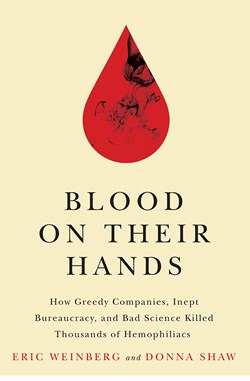
BLOOD ON THEIR HANDS, infuriating true story of the consequences of untrammeled greed
BLOOD ON THEIR HANDS: How Greedy Companies, Inept Bureaucracy, and Bad Science Killed Thousands of Hemophiliacs
ERIC WEINBERG & DONNA SHAW
Rutgers University Press (non-affiliate Amazon link)
$26.95 Kindle edition, available now
Rating: 4* of five
The Publisher Says: By the mid-1980s, over half the hemophiliacs in the United States had become infected with HIV. Blood on Their Hands reveals the toxic combination of corporate greed, governmental complacency, and medical negligence that exacerbated this public health disaster.
A few short years after HIV first entered the world blood supply in the late 1970s and early 1980s, over half the hemophiliacs in the United States were infected with the virus. But this was far more than just an unforeseeable public health disaster. Negligent doctors, government regulators, and Big Pharma all had a hand in this devastating epidemic.
Blood on Their Hands is an inspiring, firsthand account of the legal battles fought on behalf of hemophiliacs who were unwittingly infected with tainted blood. As part of the team behind the key class action litigation filed by the infected, young New Jersey lawyer Eric Weinberg was faced with a daunting task: to prove the negligence of a powerful, well-connected global industry worth billions. Weinberg and journalist Donna Shaw tell the dramatic story of how idealistic attorneys and their heroic, mortally-ill clients fought to achieve justice and prevent further infections. A stunning exposé of one of the American medical system’s most shameful debacles, Blood on Their Hands is a rousing reminder that, through perseverance, the victims of corporate greed can sometimes achieve great victory.
I RECEIVED A DRC FROM THE PUBLISHER VIA EDELWEISS+. THANK YOU.
My Review: I was there for the AIDS years. I lost the love of my life to AIDS. It was harrowing to see people who did not have the option to avoid infection (after we knew what transmitted the virus) by using condoms then contract and die horribly from the awful virus's depredations. Author Weinberg was a lawyer seeking compensation for families and what few survivors there were in the 1990s. If ever there was a class of truly innocent victims, this group is it.
The way the virus entered these unfortunate sufferers was inescapable. It is a requirement of life as a hemophiliac that, to survive long term, you received donated blood products from normal donors to enable your body to form normal blood. The path to infection of these victims ran right through the corporate boardrooms where for-profit blood banks chose to accept donations from people using drugs. I absolutely know of my own personal knowledge that gay men were unable to donate blood, which would've widened the pool of donors. It was inevitable that a blood-borne infection, one unscreened for and untested for in the blood products harvested, would eventually cause the infection all dreaded as a death sentence at that time.
In the name of profits, lives were gambled with; predictably, those lives were lost.
The "regulatory state" that the incoming (as of 2024) US administration rails against ignored the risks these greedy entities were taking with people who had no choice, no alternative, no voice in or power over the risks their continuing lives required them to take. Author Weinberg and his cohort of counselors acted to force the casino of lives to close, though it took a lot longer than it should have.
The stakes that were paid by the deaths by those without a say in the gambles they were forced to take are currently under threat of being made useless. We're being forced back into a time where we have no say in the rollback of regulations that save lives. Greed like that of the insurance industry currently making news is causing outrage. That's great.
BUT WE HAVE FOUGHT THESE FIGHTS, AND WON THEM, BEFORE. Those victories and protections are the ones in the sights of the profit-motivated incoming administration.
Do not sit idly by as the gains we've won, that have demonstrably saved lives, evaporate in the all-consuming heat of greed and lust for profits. Call your congressional office in the Capitol or the local constituent services office. I realize that takes effort, and the way to say what needs saying isn't in everyone's capabilities. Using 5calls.org will make the process as painless as it's possible to be. The needed numbers, even a script to follow if you're phone-phobic, are all there.
The stakes are too high to sit feeling helpless, or to think "I won't make a difference" or any other excuse. All voices count. Your representatives at every level are *required* to listen to you.
Make them earn their money. Just like you have to.
Monday, December 2, 2024
DREAM CITY: A Novel, sharp-eyed skewering of a culture of excess

DREAM CITY: A Novel
DOUGLAS UNGER
University of Nevada Press
$29.95 hardcover, available now
Rating: 4* of five
The Publisher Says: In this unconventional tale of Las Vegas during the two delirious boom decades before the bust of the Great Recession, failed actor “C. D.” Reinhart, who has launched a new career in hotel marketing, is gradually losing his moral and existential compass. Working on The Strip during an era when Sin City’s population growth was outpacing any other place in America, C. D. climbs the industry ladder while modeling himself after a Pyramid Resorts top executive, Lance Sheperd. C. D.’s professional choices lead him down a tumultuous road, as Sheperd, a complex and, at times, visionary figure, pilots his ventures through the tangled wheeling and dealing of finance and corporate politics straight into catastrophe.
As the story progresses, C. D. comes to understand how his personal losses and the losses of his cohort of hard driving executives on the make—especially the tragic life of his work partner, Greta Olsson, the only woman to break through into their male dominated world—are a result of the make-believe environment he has helped to create, a world where representation replaces reality. Hoping to piece together his faltering marriage and family relationships, C. D. must find a new path as he struggles to hold onto his dreams.
In this fictionalized version of the city of glittering lights, author Douglas Unger pits the ideologies of marketing and consumerism in the casino economy of America against the erosion of individual and humane values that success in that world demands. Unger reveals the hard truth that Las Vegas, a blue-collar town considered by many to be “the most honest city,” can be a temple for self-deceptions, emblematic of a service economy that knows the price of everything and too often the value of little else. Dream City becomes both a love song and an elegy for Las Vegas that sets it apart from any other literary novel previously written about this global entertainment attraction that in so many ways represents postmodern America. Sooner or later, the challenge that faces everyone is to discover what matters most, and to learn how to bet on the better angels of our natures.
I RECEIVED A DRC FROM THE PUBLISHER VIA NETGALLEY. THANK YOU.
My Review: Deserts frighten me. I live in a beach town for a reason. My trips to Las Vegas weren't numerous, but are very memorable—for good and ill. Here's a story, then, that's set in a place I do not love or admire, featuring a man in Act Three of his life having failed at his other lives, and failing again.
Paging Updike and Cheever, your territory's being encroached.
And most effectively. Author Unger is working in a long tradition of male-centered stories, prioritizing an idea of success that capitalism likes to valorize and that relegates anything other than work to peripheral significance...only to flip the script and show the hollowness and lack of fulfillment and connection inherent in this cultutally approved rat race.
Critiques are most effective when they come from within. This detailed, almost obsessive, chronicling of one man's descent from the pinnacle he dreamed of reaching into the real-world uses of the talents he never had the luck to exploit to their fullest, is inside the house. The astonishing world of wealth is detailed, excess by excess, without a trace of overt judgment. Like the eternal anticapitalist novel Babbitt, it uses a steady unblinking gaze to do what polemics fail to do: Indict the system that rewards conformist capitulation with material comforts. The problem with this reward system is, and always has been, it is conditional. It can all be taken away from the recipient at any time, either through anonymous "market forces" or malevolent, targeted manipulations of law and economics.
In personalizing the details of one man, in one city, as he rises and falls, Author Unger joins the crew of midcentury modern men in quietly unpicking the system's built-in failures. He uses the main man's wife as a sort of moral Cassandra, constantly questioning—while continuing to enjoy—the fruits of his enviable rise from the ashes of ruined ambition. It's here that I lost a star. Women as Moral Centers, however compromised, irk the snot out of me. Like she condescended to hitch herself to this sad, lost little boy (who's given her a life of comfort) to Guide and Sustain him...gross. She's complicit, she's also culpable for not doing it her damnself. The trope of the little woman who stays home is really the relams of fantasy in this day and time. It's unusual enough that it's now fodder for highly-rated prurient TV shows about the wealthiest capitalists in the hypercapitalist world we exist in.
Why I recommend it to you is simple: Updike, Cheever, Sloan Wilson, and company are dreadfully old-fashioned. Their row still needs hoeing in the world we live in. Author Unger is uniquely placed to tell this generation about its golden calfs. Seen in this light even the repugnant gender politics are a sharp critique of the aspirations that Las Vegas, glittering gambling capital, represents.
Castles built in the air always fall. Gravity, it pays every one of us to foreground in our awareness, is a law that can not be repealed. Flouting it temporarily carries costs that accrue terrible interest surcharges.
Author Unger, without beating you up, reminds you of this.
Friday, September 13, 2024
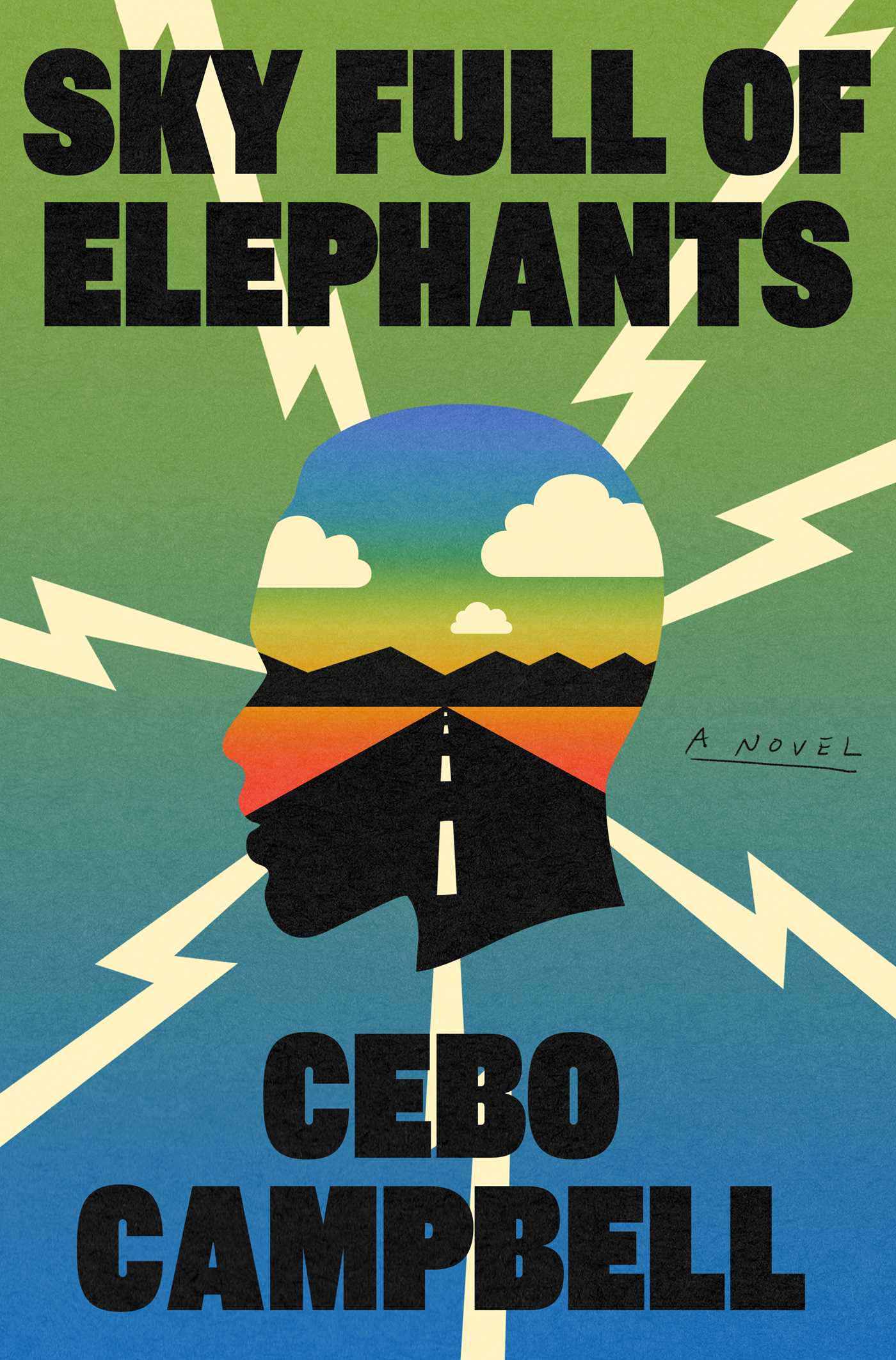
SKY FULL OF ELEPHANTS, debut novel with ideas that have real power

SKY FULL OF ELEPHANTS
CEBO CAMPBELL
Simon & Schuster
$27.99 hardcover, available now
Rating: 4.5* of five
The Publisher Says: In this exquisite speculative novel set in a world where white people no longer exist, college professor Charlie Brunton receives a call from his estranged daughter Sidney, setting off a chain of events as they journey across a truly “post-racial” America in search of answers.
One day, a cataclysmic event occurs: all of the white people in America walk into the nearest body of water. A year later, Charles Brunton is a Black man living in an entirely new world. Having served time in prison for a wrongful conviction, he’s now a professor of electric and solar power systems at Howard University when he receives a call from someone he wasn’t even sure existed: his daughter Sidney, a nineteen-year-old who watched her white mother and step-family drown themselves in the lake behind their house.
Traumatized by the event, and terrified of the outside world, Sidney has spent a year in isolation in Wisconsin. Desperate for help, she turns to the father she never met, a man she has always resented. Sidney and Charlie meet for the first time as they embark on a journey across America headed for Alabama, where Sidney believes she may still have some family left. But neither Sidney or Charlie is prepared for this new world and how they see themselves in it.
When they enter the Kingdom of Alabama, everything Charlie and Sidney thought they knew about themselves, and the world, will be turned upside down. Brimming with heart and humor, Cebo Campbell’s astonishing debut novel is about the power of community and connection, about healing and self-actualization, and a reckoning with what it means to be Black in America, in both their world and ours.
I RECEIVED A DRC FROM THE PUBLISHER VIA NETGALLEY. THANK YOU.
My Review: Well, this was a read and a half. A fantasia, an attempt to view the culture of privilege and prejudice confronted by a man and the mixed-race daughter he never knew he had in the wake of white peoples' mass lemming-like vanishing.
Now, let me bring something up: This is in no way some triumphalist "wouldn't it be cool if all the white people vanished?" racist fantasy. It isn't that kind of facile storytelling, or revenge fantasy. It's a fantasia on the inscrutable ways of the Universe, an unknowable, unfathomably powerful external force that, this time, spared you; but...Amid the reorgaization of society, there's that unease that comes from an unresolved stressor, like the Bomb in the Cold War.
A lot like Le Guin's The Dispossessed, A Morally Ambiguous Utopia, the ideas in this story are heady indeed. The overculture in each of these different stories presupposes the existence of a hegemonic economic system that can only be opposed not reimagined. In Author Campbell's story, the presumption includes the fact that when whiteness and its (largely) unexamined privilege vanish, the enforcement of the hegemonic capitalism dies. Is everything suddenly perfect? No, but it's free from many of the more abusive qualities of capitalism and racism. I myownself am not quite so confident that capitalism would wither so completely or so quickly; it's too effective a tool of control, that most human of needs. Leaving that aside, the Brave New World presented feels...right, just, positive. I say this as someone explicitly excluded from this world. That fact is, I suspect, what led a LOT of whiny little butthurt arrested adolescents to ratings-bomb the book on Goodreads. Such arrant nonsense makes Author Campbell's premise's point for him. It also embarrasses me, an old white man, to be relegated among such angry, hateful, immature people.
The author's imagination, then, can't be faulted. This is his debut novel, so technique is logically enough less well-honed than his idea-generating musculature. I kept saying to my DRC, "Please don't explain so much to me. Trust that the stories you've imagined so richly will, in fact, lead me where you're wanting me to go. Conflicts whose roots and results you carefully elucidate aren't tense enough to keep me eagerly reading." I'm confident this can be attributed to his tyro status. I'm also very eager to read his next work when it comes out.
The ending of the story, while not exactly a release from tension, does flow from the events of the preceding action. It felt...I'm not sure "inevitable" is precisely correct, but it has the leadenness of affect I want to convey.
I've rated the book with four stars because I was brought up short and required to consider the ideas of the story multiple times. Good SF/F does that wonderful job better than any other form of storytelling.
This is good SF. That explains the other half-star.
Thursday, March 14, 2024
AND WHAT CAN WE OFFER YOU TONIGHT, multi-award-winning novella and damning takedown of a hypercapitalist hellscape
AND WHAT CAN WE OFFER YOU TONIGHT
PREMEE MOHAMED
Neon Hemlock Press
$12.99 all formats, available now
Rating: 5* of five
The Publisher Says: Winner of the 2022 Nebula Award and World Fantasy Award for Best Novella.
In a far future city, where you can fall to a government cull for a single mistake, And What Can We Offer You Tonight tells the story of Jewel, established courtesan in a luxurious House. Jewel’s world is shaken when her friend is murdered by a client, but somehow comes back to life. To get revenge, they will both have to confront the limits of loyalty, guilt, and justice.
I RECEIVED A DRC FROM THE PUBLISHER VIA NETGALLEY. THANK YOU.
My Review: Self-esteem, self-love, class solidarity, friendship, Love...big, big themes to tackle in under a hundred pages. Yet as one expects from Premee Mohamed, tackled they are, and indeed pinned to the mat of argument.
There are those who say they have no patience for future-set stories, yet who will gobble the stories that center amateur sleuths who are not arrested and abused by police and courts who do not approve of this behavior...inconsistent much? Each is unbelievable in its own way, and this story’s amateur sleuths have some *very* powerful motives for their far higher stakes poking around. I know others whose taste in storytelling excludes tales that begin in medias res. That being a taste that can not be argued with, I warn those folk that this is not one for them.
The authorial voice here, Jewel’s stream of consciouness and self-aware of its floridity, would wear on my nerve if it lasted more than the eightyish pages that it does. In this size of a dose, it counterpoints the horrifying, bleak dystopia that these young people are...existing is a better fit than living...within. The brothel where they work is a reputaable one, yet a client murders one of them and no one in power cares, or pursues justice.
Sound familiar, y’all?
Unlike boring old twenty-first century reality, though, the murdered party returns for revenge, not as a zombie or vampire but simply undead. Go with it. As the co-sex-worker Winfield sets about getting the revenge that I myownself feel is richly deserved, the story meditates on the larger, darker themes of living in a hypercapitalist hellscape. The ending is, as expected, satisfying. The truths Author Mohamed tells us in the course of this bleak vision of a future where money = justice, where might = rights, where even the meagerest of existences is contingent on selling one’s own body for the gratification of others, are readily applicable to the world around us.
That horrifying truth is how this very short, sharp shock to the reader’s system won the very high-powered awards that it did. Very highly recommended.
Wednesday, March 6, 2024
A SHORT HISTORY OF FLOWERS: The Stories that Make Our Gardens, pretty pretty pictures celebrating springtime in the Global North
A SHORT HISTORY OF FLOWERS: The Stories that Make Our Gardens
ADVOLLY RICHMOND (illus. Sarah Jane Humphrey)
Frances Lincoln Ltd
$24.99 hardcover, available now
Rating: 4* of five
The Publisher Says: Garden and social historian Advolly Richmond (of Gardener’s World) unravels the surprising histories of 60 flowers that shape our gardens.
Have you ever wondered where your favourite garden flowers came from? Where their names derived? Or why some cultivars go in and out of favor? Every flower in your herbaceous border has a story, and in this book Advolly Richmond takes you on a tour of the most intriguing, surprising and enriching ones.
Tales of exploration, everlasting love and bravery bring these beautiful flowers to life. Advolly has dug down to uncover the royalty, scholars, pioneers and a smuggler or two that have all played a part in discovering and cultivating some of our favourite species. From the lavish and exotic bougainvillea, found by an 18th century female botanist in disguise to the humble but majestic snowdrop casting a spell and causing a frenzy. These plants have played pivotal roles in our societies, from boom to bust economies, promises of riches, and making fashion statements. These unassuming blooms hold treasure troves of stories.
With specially commissioned artworks from award-winning botanical illustrator Sarah Jane Humphrey, which sumptuously bring each flower to life – this is a beautiful compendium for every garden lover.
I RECEIVED A DRC FROM THE PUBLISHER VIA EDELWEISS+. THANK YOU.
My Review: I needed something uncomplicatedly pretty. I expect y’all do, too.
There. Springtime sorted.
Of course, this being Reality, there are no uncomplicated pleasures. The stories of how your favorite flowers got to your garden is tied up with colonialism, capitalism, and the endless intertwining of greed and ownership between them.
Advolly Richmond does a far more deft job of making the connections than I have. She had a lot more room than I did:
This table of contents is like a really good garden’s plan, expansive and filled with beautiful sights. Richmond’s expertise is writing about the domesticated plants we adorn our built environment with, aka gardening. She has practiced the craft long enough to have honed her execution of it into art.
The fact that I myownself find the flower-gardening madness that so many of y’all suffer from inexplicable, and the money y’all lavish on it borderline obscene, does not mean I do not see and appreciate the beauty of the plants themselves.
I still think that the water, fertilizer, and hours of labor *should* be spent on growing vegetables.
Monday, November 8, 2021
DAMNATION SPRING, true-life tale of the cost of living in a cheap, disposable world
DAMNATION SPRING
ASH DAVIDSON
Scribner
$28.00 hardcover, available now
PAPERBACK AVAILABLE NOW! Only $17.99.
SHORTLISTED FOR THE 32ND ANNUAL READING THE WEST BOOK AWARD FOR DEBUT FICTION! Follow the link to vote for it.
Rating: 3* of five
A BEST BOOKS OF 2021 – FICTION SELECTION FROM BOOKPAGE!
The Publisher Says:A stunning novel about love, work, and marriage that asks how far one family and one community will go to protect their future.
Colleen and Rich Gundersen are raising their young son, Chub, on the rugged California coast. It’s 1977, and life in this Pacific Northwest logging town isn’t what it used to be. For generations, the community has lived and breathed timber; now that way of life is threatened.
Colleen is an amateur midwife. Rich is a tree-topper. It’s a dangerous job that requires him to scale trees hundreds of feet tall—a job that both his father and grandfather died doing. Colleen and Rich want a better life for their son—and they take steps to assure their future. Rich secretly spends their savings on a swath of ancient Redwoods. Colleen, desperate to have a second baby, challenges the logging company’s use of herbicides that she believes are responsible for the many miscarriages in the community—including her own. Colleen and Rich find themselves on opposite sides of a budding conflict that threatens the very thing they are trying to protect: their family.
Told in prose as clear as a spring-fed creek, Damnation Spring is an intimate, compassionate portrait of a family whose bonds are tested and a community clinging to a vanishing way of life. An extraordinary story of the transcendent, enduring power of love—between husband and wife, mother and child, and longtime neighbors. An essential novel for our times.
I RECEIVED A DRC FROM THE PUBLISHER VIA NETGALLEY. THANK YOU.
My Review: First, read this:
"Ask any of these guys. You won’t find a guy that loves the woods more than a logger. You scratch a logger, you better believe you’ll find an ‘enviro-mentalist’ underneath. But the difference between us and these people is we live here. We hunt. We fish. We camp out. They’ll go back where they came from, but we’ll wake up right here tomorrow. This is home. Timber puts food on our tables, clothes on our kids’ backs. You know, a redwood tree is a hard thing to kill. You cut it down, it sends up a shoot. Even fire doesn’t kill it. Those big pumpkins up in the grove, they’re old. Ready to keel over and rot. You might as well set a pile of money on fire and make us watch."
–and–
“The real timber’s gone,” Lark said. “What’s left, ten percent, including the parks? Two thousand years to grow a forest, a hundred years to fall it. No plague like man.”
There isn't a lot to argue with in this novel. The positions are made clear as glass, the townsfolk of the story are innocent of any wrongdoing except not wanting change and the corporate interests are extracting value from the land, the timber, and the people with no slightest regard for the costs.
This ain't rocket science. You know whose side you're on from the jump.
What price innocence...the townies aren't idiots, it's clear that their corporate masters pay them pittances to do dangerous jobs. They love those jobs, they love the life it affords them. So why the hell should they bitch if someone else lives fancier than they do? Ain't like they'd want to live like those folks do, even if they had all the money those folks have. So keep the trees fallin' and the pennies rollin' in.
The personal costs? Well, omelets ain't ever come out of whole eggs, have they. That's the way life is. Except...when you step in front of a woman who wants kids, you'd better be *well*armored*indeed*. Colleen wants babies. She's miscarried eight times! Her sister's had healthy ones, and with a man you'd have to be kind to describe as "grossly unfit." It clearly ain't her body....
And here's my problem: The pace of the novel is, to put it politely, magisterial. The language is limpidly clear, if a bit less than inspiringly lyrical. But the gender politics are awful. The conflict between husband and wife over her screaming NEED to mother a brood, her apostasy to community values (and with a man she has a history with! that gets what feels to me like a pretty insignificant amount of play) because her uterus hasn't popped out healthy babies, squicked me out. I hate it when women in stories play the Mother Card and get away with amazingly nasty shit (see my outraged shout about Gone Girl), unlike Colleen. But basically I don't care about Motherhood. It isn't necessary for you to reproduce yourselves, straight people, the planet's already working itself into a fever to get rid of us. So using it, as Author Davidson does here, as a reason for Colleen to do something that (objectively) is good but will end the way of life these people want to live, shouldn't be framed as "she did it for her babies to be born."
Listen, I don't think what mega-corporations do to the world is laudable, and they do it for the vilest, most selfish reasons. I'm right there with you on the "make it stop" front. But don't play "Sacred Motherhood" on your cards or you'll lose any serious argument for them to be held accountable. NOT being a mother is the responsible choice for all women. The only people who are carryin' on about having more babies are the white supremacists, and we need a lot fewer of them stat.
On balance, three stars was what I could muster, and I felt pretty questionable about that last half-star. The book's set in 1977. We already knew the cost of overpopulation then. The "Zero Population Growth" movement was organized in 1968. It's still a damned good idea. But Sacred Motherhood is used as a primary motivator to positive action in this story, and that sits wrong with me.
The ending wasn't particularly satisfying, after all we've been through; but there not being anything dramatically wrong with the structure or the writing (apart from there being too much of it) I couldn't bring myself to downgrade it. But it wasn't an easy decision. Three...that is, on Amazon's debased scale, a bad rating. I think it's a perfectly fine rating, a perfectly fine read got a perfectly fine rating, and I didn't beat it up beyond its just deserts. That will have to do.
Friday, April 23, 2021
HOME: Habitat, Range, Niche, Territory, our first look into Dr. Mensah -and- NETWORK EFFECT, first full-length Murderbot novel
NETWORK EFFECT
MARTHA WELLS (Murderbot #5)
Tor.com Publishing
$11.99 ebook editions, available now
Rating: 4.9* of five
WINNER OF THE HUGO FOR BEST SERIES & THE HUGO FOR BEST NOVEL, 2021 WORLDCON: DisCon III!
WINNER: BEST NOVEL, 2020 NEBULA AWARDS!
The Publisher Says: Murderbot returns in its highly-anticipated, first, full-length standalone novel.
You know that feeling when you’re at work, and you’ve had enough of people, and then the boss walks in with yet another job that needs to be done right this second or the world will end, but all you want to do is go home and binge your favorite shows? And you're a sentient murder machine programmed for destruction? Congratulations, you're Murderbot.
Come for the pew-pew space battles, stay for the most relatable A.I. you’ll read this century.
I’m usually alone in my head, and that’s where 90 plus percent of my problems are.
When Murderbot's human associates (not friends, never friends) are captured and another not-friend from its past requires urgent assistance, Murderbot must choose between inertia and drastic action.
Drastic action it is, then.
I CHECKED THIS BOOK OUT OF MY LOCAL LIBRARY. SUPPORT YOUR LIBRARIES, FOLKS! THE PANDEMIC AIN'T THE ONLY REASON TO GO THERE.
My Review: When you get to the moment in reading a series of stories that you think you know what's coming next, and then you're kinda right but a whole lot wrong, that's when you know for sure you're in the right place at the right time.
I knew for sure I'd get Murderbot being its deeply cynical, snarky self, breaking the fourth wall at will and to great effect.
I didn't realize, though, that the ART (acronym; you know already or you need to find out for yourself) and Murderbot would make this read the emotional rollercoater it is. (Yes, of course there are quotes to make this obvious but I can't spoiler-tag on my blog. Go here if you're that curious. But it's a MAJOR spoiler!)
—but there is this that I *can* quote, spoken by Murderbot after a serious, serious event takes place, one that changes the entire stakes of the novel: "My performance reliability had leveled out at 89 percent. Not great, but I could work with it. I still hadn’t identified the source of the drop. I’d taken multiple projectile hits without having that kind of steady drop." Which is a theme developed so well in this full-length novel. The problem of grief, of rage and loss, is universal; Author Wells hasn't, at any point in the series, hidden her cards in this regard. But the stakes, the sheer centrality of loss and rage and grief, take the Up escalator in this novel. Maybe Ratthi, a human and client of Murderbot's over the course of multiple stories, says it best: “Anyone who thinks machine intelligences don’t have emotions needs to be in this very uncomfortable room right now.”
Amen, Brother Ratthi. If anyone who's read more of the series (and if you haven't what the heck are you doing reading this review?!) wonders about how huge the change of tenor in this full-length novel is, I offer this:
Murderbot. Calling a human, a (former) client, a being under its protection, a friend is a moment to make a person pause. Then for Murderbot to acknowledge, with great precision, its emotional state...!
Then again this is the thing about reading this series, unlike reading many, many others: Author Wells is making something clear to us, in her inimitable sly way, that not many of us think about. She demands that, in loving and accepting the reality of Murderbot, that we contemplate the source of Murderbot's conundrum. Murderbot is a possession, chattel, a Thing:
Like the SecUnit that Murderbot began its existence being and Dr. Mensah rescued it from continuing to be, there was a device installed in its organic brain that could cause it immense pain or simply end its existence...can't give a Thing power, like weaponry-power and tactical nous, without safeguards....
So be clear: By taking on this addictively funny series, you're taking on a level of self-reflection that, while salubrious and even vital it may be, it is also deeply uncomfortable:
This is Murderbot caring for a fellow SecUnit whose existence as chattel, a Thing, it is trying to end. There is no guarantee that ending the other's slavery will make it a fellow seeker after the Meaning of Freedom; it won't even guarantee that there won't be mayhem and disaster to clean up after. But it will for sure and certain mean that the other SecUnit won't be under any compulsion to do anything.
No matter what that costs, it's worth everything and it's worth risking everything to give or to get.
I've failed to give this novel a perfect score of five-out-of-five. The reason is simple to the point of being petty: The pace is irregular and it's not because the story needs it to be. Author Wells has written numerous novels before this (here's her bibliography) so there is no reason this novel should suffer from an avoidable fault. There are some scenes whose nature means they could've been cut or cut down (eg, the invaders the Scooby-group need to fight get more screen time than is necessary for non-repeating characters), there are some repeated references to Murderbot's happiness that it has no digestive system that were over-done...but none of these things did more than ding the paint on my gloriously chromed, befinned behemoth of Joy at spending a whole novel with Murderbot, ART, and the annoying humans they hang with.
+++++++++++++++++++++++++++++++++++++++++++++++++++++++++++++++++
HOME: Habitat, Range, Niche, Territory
MARTHA WELLS (Murderbot #4.5)
Tor.com
FREE online read!
WINNER OF THE HUGO FOR BEST SERIES, 2021 WORLDCON: DisCon III!
Rating: 4.75* of five
The Publisher Says: This short story is told from the point of view of Dr. Mensah and follows the events in Exit Strategy.
THIS IS A TOR.COM FREE READ. THANK YOU FOR MAKING SUCH WONDERFUL WORK FREE FOR ANYONE TO READ, GENTLES ALL.
My Review:
Which is why I read the Murderbot series the instant I can get the books. This is a short freebie that's just a tick before Network Effect, and it's deeply refreshing to read something from Dr. Mensah's PoV.
Not that I don't adore Murderbot! I do! But breaking out of the one PoV that we have on the Corporation Rim is a breath of fresh air.
It is through Dr. Mensah's clarity that I feel so seen in my hatred of this system's brutal, dehumanizing, and revoltingly deeply entrenched dominance of the hearts and minds I must live among, as Preservation is a fictional construct. It would be the work of but a moment for me to apply for asylum or whatever they call it to get to Preservation were it real.
When you exist at the whim of the electorate, as people like me...disabled, unhomed, elderly, infirm...must do, you're a thing. A profit point. An expense center. Not yourself, not someone with a lifetime's issues and lessons. I'm fortunate that I live in a place that allows me to be as independent as possible, and that I did enough useful work for enough years that my (HUGELY reduced in value) investment in government debt affords me the relative safety of housing, medical care, and therapies that I need. Had I stayed in Texas, had I been darker of skin hue, had I not had the mind-boggling good fortune to have my breakdown while talking to the one person who could, and would, and did help me...well, I'd be dead, and that's just the facts.
It's why I identify so deeply with Murderbot: We had all the right things go exactly right at the right time or we'd simply have ceased to exist.
But you're making one right now. You can't help it; it's human nature. One person with whom I am no longer friends said to me, "stop being so selfish and think of how much worse it is for my (Hispanic) people!"
Invalidation = abuse. Always, in all ways.
And that is what Author Wells does so eloquently by not doing it directly: She holds up your status as abuser while acknowledging your status as the abused. Murderbot...SecUnit to Dr. Mensah and the meatsacks inhabiting its spacetime...isn't kidding around with its self-granted yclepture. It was the more harmed, in my opinion, by its status as legally insentient property being thrust on it from...birth?...its creation, anyway...(aka "chattel slavery") but it isn't innocent of abusive, life-denying behavior towards others.
Do moral dilemmas come more tightly coiled up on themselves than this? And breathes there an author whose exploration of these intense and weighty issues is so delightfully deft and assuredly airy than Author Wells?
No.
MARTHA WELLS (Murderbot #5)
Tor.com Publishing
$11.99 ebook editions, available now
Rating: 4.9* of five
WINNER OF THE HUGO FOR BEST SERIES & THE HUGO FOR BEST NOVEL, 2021 WORLDCON: DisCon III!
WINNER: BEST NOVEL, 2020 NEBULA AWARDS!
The Publisher Says: Murderbot returns in its highly-anticipated, first, full-length standalone novel.
You know that feeling when you’re at work, and you’ve had enough of people, and then the boss walks in with yet another job that needs to be done right this second or the world will end, but all you want to do is go home and binge your favorite shows? And you're a sentient murder machine programmed for destruction? Congratulations, you're Murderbot.
Come for the pew-pew space battles, stay for the most relatable A.I. you’ll read this century.
I’m usually alone in my head, and that’s where 90 plus percent of my problems are.
When Murderbot's human associates (not friends, never friends) are captured and another not-friend from its past requires urgent assistance, Murderbot must choose between inertia and drastic action.
Drastic action it is, then.
I CHECKED THIS BOOK OUT OF MY LOCAL LIBRARY. SUPPORT YOUR LIBRARIES, FOLKS! THE PANDEMIC AIN'T THE ONLY REASON TO GO THERE.
My Review: When you get to the moment in reading a series of stories that you think you know what's coming next, and then you're kinda right but a whole lot wrong, that's when you know for sure you're in the right place at the right time.
I knew for sure I'd get Murderbot being its deeply cynical, snarky self, breaking the fourth wall at will and to great effect.
{We're in the shit because of} their hired security service Palisade making an extremely bad decision to punch my ex-owner bond company in the operating funds by attacking one of its gunships. (The company is paranoid and greedy and cheap but also ruthless, methodical, and intensely violent when it thinks it’s being threatened.)
–and–
So that was what had happened before the survey. Now we’re here, ready for the next major disaster. (Spoiler warning.)
I didn't realize, though, that the ART (acronym; you know already or you need to find out for yourself) and Murderbot would make this read the emotional rollercoater it is. (Yes, of course there are quotes to make this obvious but I can't spoiler-tag on my blog. Go here if you're that curious. But it's a MAJOR spoiler!)
—but there is this that I *can* quote, spoken by Murderbot after a serious, serious event takes place, one that changes the entire stakes of the novel: "My performance reliability had leveled out at 89 percent. Not great, but I could work with it. I still hadn’t identified the source of the drop. I’d taken multiple projectile hits without having that kind of steady drop." Which is a theme developed so well in this full-length novel. The problem of grief, of rage and loss, is universal; Author Wells hasn't, at any point in the series, hidden her cards in this regard. But the stakes, the sheer centrality of loss and rage and grief, take the Up escalator in this novel. Maybe Ratthi, a human and client of Murderbot's over the course of multiple stories, says it best: “Anyone who thinks machine intelligences don’t have emotions needs to be in this very uncomfortable room right now.”
Amen, Brother Ratthi. If anyone who's read more of the series (and if you haven't what the heck are you doing reading this review?!) wonders about how huge the change of tenor in this full-length novel is, I offer this:
Ratthi had said, “I think you should let it go for a while, at least until we get ourselves out of this situation. SecUnit is a very private person, it doesn’t like to discuss its feelings.”
This is why Ratthi is my friend.
–and–
(If I got angry at myself for being angry I would be angry constantly and I wouldn’t have time to think about anything else.) (Wait, I think I am angry constantly. That might explain a lot.)
Murderbot. Calling a human, a (former) client, a being under its protection, a friend is a moment to make a person pause. Then for Murderbot to acknowledge, with great precision, its emotional state...!
Then again this is the thing about reading this series, unlike reading many, many others: Author Wells is making something clear to us, in her inimitable sly way, that not many of us think about. She demands that, in loving and accepting the reality of Murderbot, that we contemplate the source of Murderbot's conundrum. Murderbot is a possession, chattel, a Thing:
(I know, it’s a logo, but I hate it when humans and augmented humans ruin things for no reason. Maybe because I was a thing before I was a person and if I’m not careful I could be a thing again.)
–and–
And of course the humans had trouble understanding that your governor module suddenly deciding to melt your brain wasn’t something you could rules-lawyer your way out of.
Like the SecUnit that Murderbot began its existence being and Dr. Mensah rescued it from continuing to be, there was a device installed in its organic brain that could cause it immense pain or simply end its existence...can't give a Thing power, like weaponry-power and tactical nous, without safeguards....
So be clear: By taking on this addictively funny series, you're taking on a level of self-reflection that, while salubrious and even vital it may be, it is also deeply uncomfortable:
Just because we’re both rogue SecUnits doesn’t mean we’re going to be friends, but I knew if it went back, it would be dead. I’d hacked my governor module and kept doing my job because I didn’t know what else to do (except you know, a murderous rampage, but murderous rampages are overrated and interfere with one’s ability to keep watching media) but that was different from escaping and then going back.
I said, “Because change is terrifying. Choices are terrifying. But having a thing in your head that kills you if you make a mistake is more terrifying.”
–and–
I’m letting you see all this because I want you to know what I am and what I can do. I want you to know who targetControlSystem is fucking with right now. I want you to know if you help me, I’ll help you, and that you can trust me. Now here’s the code to disable your governor module.
This is Murderbot caring for a fellow SecUnit whose existence as chattel, a Thing, it is trying to end. There is no guarantee that ending the other's slavery will make it a fellow seeker after the Meaning of Freedom; it won't even guarantee that there won't be mayhem and disaster to clean up after. But it will for sure and certain mean that the other SecUnit won't be under any compulsion to do anything.
No matter what that costs, it's worth everything and it's worth risking everything to give or to get.
I've failed to give this novel a perfect score of five-out-of-five. The reason is simple to the point of being petty: The pace is irregular and it's not because the story needs it to be. Author Wells has written numerous novels before this (here's her bibliography) so there is no reason this novel should suffer from an avoidable fault. There are some scenes whose nature means they could've been cut or cut down (eg, the invaders the Scooby-group need to fight get more screen time than is necessary for non-repeating characters), there are some repeated references to Murderbot's happiness that it has no digestive system that were over-done...but none of these things did more than ding the paint on my gloriously chromed, befinned behemoth of Joy at spending a whole novel with Murderbot, ART, and the annoying humans they hang with.
+++++++++++++++++++++++++++++++++++++++++++++++++++++++++++++++++
HOME: Habitat, Range, Niche, Territory
MARTHA WELLS (Murderbot #4.5)
Tor.com
FREE online read!
WINNER OF THE HUGO FOR BEST SERIES, 2021 WORLDCON: DisCon III!
Rating: 4.75* of five
The Publisher Says: This short story is told from the point of view of Dr. Mensah and follows the events in Exit Strategy.
THIS IS A TOR.COM FREE READ. THANK YOU FOR MAKING SUCH WONDERFUL WORK FREE FOR ANYONE TO READ, GENTLES ALL.
My Review:
Because they are all refugees in the Preservation Alliance, descended from people who were left to die because rescue was deemed not cost-effective.
Which is why I read the Murderbot series the instant I can get the books. This is a short freebie that's just a tick before Network Effect, and it's deeply refreshing to read something from Dr. Mensah's PoV.
Not that I don't adore Murderbot! I do! But breaking out of the one PoV that we have on the Corporation Rim is a breath of fresh air.
The Corporation Rim has always been a slave state, though it calls its institutionalized slavery “contract labor.”
It is through Dr. Mensah's clarity that I feel so seen in my hatred of this system's brutal, dehumanizing, and revoltingly deeply entrenched dominance of the hearts and minds I must live among, as Preservation is a fictional construct. It would be the work of but a moment for me to apply for asylum or whatever they call it to get to Preservation were it real.
It’s about being treated as a thing, isn’t it. Whether that thing is a hostage of conditional value, or a very expensively designed and equipped enslaved machine/organic intelligence. You’re a thing, and there is no safety.
When you exist at the whim of the electorate, as people like me...disabled, unhomed, elderly, infirm...must do, you're a thing. A profit point. An expense center. Not yourself, not someone with a lifetime's issues and lessons. I'm fortunate that I live in a place that allows me to be as independent as possible, and that I did enough useful work for enough years that my (HUGELY reduced in value) investment in government debt affords me the relative safety of housing, medical care, and therapies that I need. Had I stayed in Texas, had I been darker of skin hue, had I not had the mind-boggling good fortune to have my breakdown while talking to the one person who could, and would, and did help me...well, I'd be dead, and that's just the facts.
It's why I identify so deeply with Murderbot: We had all the right things go exactly right at the right time or we'd simply have ceased to exist.
And {Dr. Mensah} tells herself: you’re being very foolish. Because you were a hostage for a period of days, and it was a minor inconvenience compared to what Murderbot— No, SecUnit; she’s never been given permission to use that private name. What SecUnit went through.
And if someone else was in her position, she would tell them how unhelpful comparisons like that are, that fear is fear.
But you're making one right now. You can't help it; it's human nature. One person with whom I am no longer friends said to me, "stop being so selfish and think of how much worse it is for my (Hispanic) people!"
Invalidation = abuse. Always, in all ways.
And that is what Author Wells does so eloquently by not doing it directly: She holds up your status as abuser while acknowledging your status as the abused. Murderbot...SecUnit to Dr. Mensah and the meatsacks inhabiting its spacetime...isn't kidding around with its self-granted yclepture. It was the more harmed, in my opinion, by its status as legally insentient property being thrust on it from...birth?...its creation, anyway...(aka "chattel slavery") but it isn't innocent of abusive, life-denying behavior towards others.
Do moral dilemmas come more tightly coiled up on themselves than this? And breathes there an author whose exploration of these intense and weighty issues is so delightfully deft and assuredly airy than Author Wells?
No.
Wednesday, December 30, 2020
TRAM 83, a Congolese poet's grenade of a debut novel & THE RIVER IN THE BELLY, collection of his translated poetry
TRAM 83
FISTON MWANZA MUJILA (tr. Roland Glasser)
Deep Vellum
$10.00 ebook editions, available now
Rating: 3.75* of five
The Publisher Says: Two friends, one a budding writer home from Europe, the other an ambitious racketeer, meet in the only nightclub, the Tram 83, in a war-torn city-state in secession, surrounded by profit-seekers of all languages and nationalities. Tram 83 plunges the reader into the modern African gold rush as cynical as it is comic and colorfully exotic, using jazz rhythms to weave a tale of human relationships in a world that has become a global village.
Fiston Mwanza Mujila (b. 1981, Lubumbashi, Democratic Republic of Congo) is a poet, dramatist, and scholar. Tram 83 is his award-winning and raved-about debut novel that caused a literary sensation when published in France in August 2014.
I RECEIVED A DRC OF THIS BOOK FROM THE PUBLISHER VIA EDELWEISS+. THANK YOU.
My Review: Many people have spoken to the poetic nature of this book's text. I agree, in both the good sense...the author's (and crucially the translator's) ear for the heightened meanings of words used in poetry is always adding a bass line to this melody...and the bad, that being the obfuscatory and often obscurantist requirement for the reader to unpack subtexts and discover new senses for familiar words while mid-read.
It's not an impossible task. It's often uncomfortable, and it's always a way of slowing the reader down. That isn't always a bad thing. It can feel sort of like the author is being pedantic, the repetition of variants on "You have the time?" is my favorite example. The time to disport yourself with a prostitute. The time to listen to a song. The time as spending, a transaction, an exchange of money for value or attention for money; the issue at hand isn't that it's hard to do this work but that it's required. Read cold, flat, without investment other than decoding, there is no through-line of story to receive. It is a list of lists, a repetition of phrases and names and all strung on a thin cord of criticism for capitalist society's multi-level destruction of the characters. That isn't a terribly satisfying read; and the fact that it is in itself a sharp critique of the mental laziness of many readers is a bit off-putting.
So much is inside the world of Tram 83 that it can feel as overwhelming as a physical trip to Africa does to many Westerners. For the whitest among us, the experience of being a vanishingly small minority is so unsettling as to be agony. For that reason I want many many US whites to read it; I recognize the futility of that wish but am stubbornly advocating it. It's the end of 2020. The world has changed because of COVID-19. It is long past time people with our First-World privilege, regular garbage pick-up and grocery stores and paved roads, heard about the reality of the rest of the world in their own words.
What I want from white people like me reading this thunderflash of words, this uncappable well of natural story-gas, is that we stop and do the work of being in fellowship with the world that isn't like us. Because that surface difference, as this intense and unmissable read says and shows, means nothing against the deepest human need of all: To connect and commune with Humanity. As cheesy as that sounds, this really is the take-away I hope you'll have when you spend a day immersed in Tram 83.
++++++++++++++++++++++++++++++++++++++++++++++++++++++++++++++++
THE RIVER IN THE BELLY
FISTON MWANZA MUJILA (tr. J. Bret Maney)
Deep Vellum Books
$15.95 trade paper, available now
Rating: 3.5* of five
The Publisher Says: A moving lyric meditation on the Congo River that explores the identity, chaos, and wonder of the Democratic Republic of Congo as well as race and the detritus of colonialism.
With The River in the Belly, award-winning Congolese author Fiston Mwanza Mujila seeks no less than to reinitiate the Congo River in the imaginary of European languages. Through his invention of the “solitude”—a short poetic form lending itself to searing observation and troubled humor, prone to unexpected tonal shifts and lyrical u-turns—the collection celebrates, caresses, and chastises Central Africa’s great river, the world’s second largest by discharge volume.
Drawing inspiration from sources as diverse as Soviet history, Congolese popular music, international jazz, and everyday life in European exile, Mwanza Mujila has fashioned a work that can speak to the extraordinary hopes and tragedies of post-independence Democratic Republic of the Congo while also mining the generative yet embattled subject position of the African diasporic writer in Europe longing for home.
Fans of Tram 83 will rediscover in River the incandescent, improvisatory verbal energy that so dazzled them in Mwanza Mujila’s English-language debut.
I RECEIVED A DRC FROM THE PUBLISHER VIA EDELWEISS+. THANK YOU.
My Review: I enjoyed Tram 83 a good deal more than most of my friends (see my almost-4-star review above); it's a successful read for me because it has an energy that makes me want to keep reading the words. That was also what I got out of this collection of poems. I think the overall likelihood of my agreeing with most anyone on matters poetical isn't high. What I will say is that I read the collection here without dramatic snorts or theatrical eyerolls. The one time I found myself thinking "oh, really?" was in the description above...the author's "invented solitudes"...when I thought, "someone hasn't met Henry Dumas's "Kef 24" and its fellow kefs. This is one frequent problem I experience with poetry. People either think I'm a know-it-all or an ignoramus because I make connections like this and, being poetry types, are not in the least reluctant to say something insulting or scathing either way. Tiresome sorts.
Anyway, this collection. I don't think it will hit right with formalists, who overlap pretty far with monoglot English speakers among my own acquaintances. There are, in Author Mujila's work, words and ideas that can't be translated into an English word; there are times when those words and phrases aren't obvious to the not-Congolese reader. Some patient Googling, a bit of contemplative cogitation, or simply moving on will solve most of these problems. I encourage the reader whose eyes just rolled to give the read a try...it's a shame not to become a more informed, better equipped reader for lack of mere exposure.
Author Mujila also isn't reluctant to use sexual imagery or crudely physical imagery. If you flinch at describing male fowl as "cocks," you really need not pick this book up. The idea of a river as entrails, with dysentery, gives you the primmylip purseymouths? Horseman, pass by. One of the greater pleasures, to my mind, of reading translated work from other cultures is the opportunity to learn what *their* boundaries are, what sets a word or idea apart as transgressive in their world-view. I got a very great deal out of reading this collection; I am not an eager seeker of experiences poetical; and I think that means many, if not most, of y'all could get a lot out of the read as well.
FISTON MWANZA MUJILA (tr. Roland Glasser)
Deep Vellum
$10.00 ebook editions, available now
Rating: 3.75* of five
The Publisher Says: Two friends, one a budding writer home from Europe, the other an ambitious racketeer, meet in the only nightclub, the Tram 83, in a war-torn city-state in secession, surrounded by profit-seekers of all languages and nationalities. Tram 83 plunges the reader into the modern African gold rush as cynical as it is comic and colorfully exotic, using jazz rhythms to weave a tale of human relationships in a world that has become a global village.
Fiston Mwanza Mujila (b. 1981, Lubumbashi, Democratic Republic of Congo) is a poet, dramatist, and scholar. Tram 83 is his award-winning and raved-about debut novel that caused a literary sensation when published in France in August 2014.
I RECEIVED A DRC OF THIS BOOK FROM THE PUBLISHER VIA EDELWEISS+. THANK YOU.
My Review: Many people have spoken to the poetic nature of this book's text. I agree, in both the good sense...the author's (and crucially the translator's) ear for the heightened meanings of words used in poetry is always adding a bass line to this melody...and the bad, that being the obfuscatory and often obscurantist requirement for the reader to unpack subtexts and discover new senses for familiar words while mid-read.
The City-State is one of those territories that have already broken through the barrier of internal suffering. You share the same destiny as everyone else, the same history, the same hardship, the same trains, the same Tram beer, the same dog kebabs, the same narrative as soon as you come into the world. You start out baby-chick or slim-jim or child soldier. You graduate to endlessly striking student or desperado. If you've got family on the trains, then you work on the trains; otherwise, like a ship, you wash up on the edge of hope - a suicidal, a carjacker, a digger with dirty teeth, a mechanic, a street sleeper, a commission agent, an errand boy employed by for-profit tourists, a hawker of secondhand coffins. Your fate is already sealed, the route marked out in advance. Fate sealed like that of the locomotives carrying spoiler merchandise and the dying.
It's not an impossible task. It's often uncomfortable, and it's always a way of slowing the reader down. That isn't always a bad thing. It can feel sort of like the author is being pedantic, the repetition of variants on "You have the time?" is my favorite example. The time to disport yourself with a prostitute. The time to listen to a song. The time as spending, a transaction, an exchange of money for value or attention for money; the issue at hand isn't that it's hard to do this work but that it's required. Read cold, flat, without investment other than decoding, there is no through-line of story to receive. It is a list of lists, a repetition of phrases and names and all strung on a thin cord of criticism for capitalist society's multi-level destruction of the characters. That isn't a terribly satisfying read; and the fact that it is in itself a sharp critique of the mental laziness of many readers is a bit off-putting.
The Northern Station was going to the dogs. It was essentially an unfinished metal structure, gutted by artillery, train tracks, and locomotives that called to mind the railroad built by Stanley, cassava fields, cut-rate hotels, greasy spoons, bordellos, Pentecostal churches, bakeries, and noise engineered by men of all generations and nationalities combined. It was the only place on earth you could hang yourself, defecate, blaspheme, fall into infatuation, and thieve without regard to prying eyes.
So much is inside the world of Tram 83 that it can feel as overwhelming as a physical trip to Africa does to many Westerners. For the whitest among us, the experience of being a vanishingly small minority is so unsettling as to be agony. For that reason I want many many US whites to read it; I recognize the futility of that wish but am stubbornly advocating it. It's the end of 2020. The world has changed because of COVID-19. It is long past time people with our First-World privilege, regular garbage pick-up and grocery stores and paved roads, heard about the reality of the rest of the world in their own words.
Eyes shrivelled by cigarettes and alcohol. Potbellies full to bursting with roundworms, amoebas, earthworms, and assorted mollusks. Heads shaved with knives. Arms and legs stiff with digging graves from morning till morning. They were close to ten, maybe twelve years old. They toted the same justifications: “We’re doing this to pay for our studies. Dad’s already gone with the locomotives. He doesn’t write no more. Mom’s sick. The uncles and aunts and grandmothers say we’re sorcerers and it’s because of that dad got married a third time and that our sorcery comes from our mom and that we should go to see the preachers who will cut the links by getting us to swallow palm oil to make us vomit up our sorcery and prevent us flying round at night.” They lived off a multitude of rackets, like all the kids in town.
They worked as porters at the Northern Station, and on the Congo River and at the Central Market, as slim-jims in the mines, errand boys at Tram 83, undertakers, and gravediggers. The more sensitive ones stood guard at the greasy spoons abutting the station, whose metal structure recalled the 1885s, in exchange for a bowl of badly boiled beans.
What I want from white people like me reading this thunderflash of words, this uncappable well of natural story-gas, is that we stop and do the work of being in fellowship with the world that isn't like us. Because that surface difference, as this intense and unmissable read says and shows, means nothing against the deepest human need of all: To connect and commune with Humanity. As cheesy as that sounds, this really is the take-away I hope you'll have when you spend a day immersed in Tram 83.
++++++++++++++++++++++++++++++++++++++++++++++++++++++++++++++++
THE RIVER IN THE BELLY
FISTON MWANZA MUJILA (tr. J. Bret Maney)
Deep Vellum Books
$15.95 trade paper, available now
Rating: 3.5* of five
The Publisher Says: A moving lyric meditation on the Congo River that explores the identity, chaos, and wonder of the Democratic Republic of Congo as well as race and the detritus of colonialism.
With The River in the Belly, award-winning Congolese author Fiston Mwanza Mujila seeks no less than to reinitiate the Congo River in the imaginary of European languages. Through his invention of the “solitude”—a short poetic form lending itself to searing observation and troubled humor, prone to unexpected tonal shifts and lyrical u-turns—the collection celebrates, caresses, and chastises Central Africa’s great river, the world’s second largest by discharge volume.
Drawing inspiration from sources as diverse as Soviet history, Congolese popular music, international jazz, and everyday life in European exile, Mwanza Mujila has fashioned a work that can speak to the extraordinary hopes and tragedies of post-independence Democratic Republic of the Congo while also mining the generative yet embattled subject position of the African diasporic writer in Europe longing for home.
Fans of Tram 83 will rediscover in River the incandescent, improvisatory verbal energy that so dazzled them in Mwanza Mujila’s English-language debut.
I RECEIVED A DRC FROM THE PUBLISHER VIA EDELWEISS+. THANK YOU.
My Review: I enjoyed Tram 83 a good deal more than most of my friends (see my almost-4-star review above); it's a successful read for me because it has an energy that makes me want to keep reading the words. That was also what I got out of this collection of poems. I think the overall likelihood of my agreeing with most anyone on matters poetical isn't high. What I will say is that I read the collection here without dramatic snorts or theatrical eyerolls. The one time I found myself thinking "oh, really?" was in the description above...the author's "invented solitudes"...when I thought, "someone hasn't met Henry Dumas's "Kef 24" and its fellow kefs. This is one frequent problem I experience with poetry. People either think I'm a know-it-all or an ignoramus because I make connections like this and, being poetry types, are not in the least reluctant to say something insulting or scathing either way. Tiresome sorts.
Anyway, this collection. I don't think it will hit right with formalists, who overlap pretty far with monoglot English speakers among my own acquaintances. There are, in Author Mujila's work, words and ideas that can't be translated into an English word; there are times when those words and phrases aren't obvious to the not-Congolese reader. Some patient Googling, a bit of contemplative cogitation, or simply moving on will solve most of these problems. I encourage the reader whose eyes just rolled to give the read a try...it's a shame not to become a more informed, better equipped reader for lack of mere exposure.
Author Mujila also isn't reluctant to use sexual imagery or crudely physical imagery. If you flinch at describing male fowl as "cocks," you really need not pick this book up. The idea of a river as entrails, with dysentery, gives you the primmylip purseymouths? Horseman, pass by. One of the greater pleasures, to my mind, of reading translated work from other cultures is the opportunity to learn what *their* boundaries are, what sets a word or idea apart as transgressive in their world-view. I got a very great deal out of reading this collection; I am not an eager seeker of experiences poetical; and I think that means many, if not most, of y'all could get a lot out of the read as well.
Subscribe to:
Posts (Atom)