Showing posts with label Chinese translation. Show all posts

Wednesday, November 12, 2025

I DELIVER PARCELS IN BEIJING: One Man's Quest to Speak the Truth about the Global Gig Economy, deeply saddening, all too common story


I DELIVER PARCELS IN BEIJING: One Man's Quest to Speak the Truth about the Global Gig Economy
HU ANYAN
(tr. Jack Hargreaves)
Astra House (non-affiliate Bookshop.org link)
$15.99 ebook, available now

The Independent Press Top 40 Bestsellers: Non-Fiction For the week ending October 6, 2026

Rating: 4* of five

The Publisher Says: In 2023, I Deliver Parcels in Beijing became the literary sensation of the year in China. Hu Anyan’s story, about short-term jobs in various anonymous megacities, hit a nerve with a generation of young people who feel at odds with an ever-growing pressure to perform and succeed.

Hu started posting essays about his experiences online during COVID lockdowns. His recollection of night shifts in a huge logistics center in the south of China went viral: his nights were so hot that he could drink three liters of water without taking a toilet break; his days were spent searching for affordable rooms with proper air-conditioning; and his few moments of leisure were consumed by calculations of the amount of alcohol needed to sleep but not feel drowsy a few hours later.

Hu Anyan tells us about brutal work, where there is no real future in sight. But Hu is armed with deadpan humor and a strong idea of self. He moves on when he feels stuck—from logistics in the south, to parcel delivery in Beijing, to other impossible jobs. Along the way, he turns to reading and writing for strength and companionship.

I Deliver Parcels in Beijing is an honest and startling first-person portrait of Hu Anyan's struggle against the dehumanizing nature of our contemporary global work system—and his discovery of the power of sharing a story.

I RECEIVED A DRC FROM THE PUBLISHER VIA EDELWEISS+. THANK YOU.

My Review
: I see why this was a literary sensation in China. It's a real telling-truth-to-power story of how labor exploitation functions; it's an honest appraisal of the personal costs of the gig economy in a country where that is fresh ground to be broken.

It isn't so new a topic here. We have many books about the gig economy and the evils of end-stage capitalism taking over our lives. But Author Hu is a man possessed of a self-deprecating streak, as well as personal humility, coupled with self-awareness. It makes his take on economic exploitation broadly relevant as well as personally centered. He is a worker, a man who feels the need to do the job he has taken to the best of his ability. Not for him the do-the-minimum slacking life! That has the downside of making him susceptible to manipulation by unscrupulous bosses whose desire to extract ever more labor from him he has trouble coming to terms with.

It's a struggle he becomes aware of as he realizes what this character trait he is lauded and exploited for is causing him real harm.
promotional art from the publisher

It's a sad truth that hustle culture is a sharp knife in the ribs of any kind of satisfying social life. Author Hu learns this early...and sadly often. It is mildly frustrating to follow the man as he grows into realizing he has only acquaintances instead of friends yet not see him really take steps to deepen his non-work connections with others. I can see the issue, of course; he's leading the same life as the people he meets.

Author Hu does say, as the end of the book approaches, that he is no longer the pushover he was. I wonder...I saw no sign of it because he told me this as a fact, in a kind of summing-up of his working (and only) life, and ended the story. He's quite young. It makes a kind of sense. It does make one want to yell, "AnYan! stop telling, start showing," until realization hits: He can't, there hasn't been time yet. It's a story in progress. I think it made the read more urgent for me after I really internalized that fact.

A book you might be tempted to read down, to think of as an incomplete memoir, that is really a call to Author Hu's age cohort to recognize and correct course on their own iterations of his behaviors. A very honest look at a very dark side of global labor exploitation that does so much to enable our spoiled, luxurious lifestyles.

Worth your time and treasure to get for your TBR.

Saturday, August 23, 2025

FANG FANG's PAGE: SOFT BURIAL: A Novel, the great sweep of History made personal; THE RUNNING FLAME, the intimate violence of one as lens for the pain of billions


THE RUNNING FLAME
FANG FANG
(tr. Michael Berry)
Columbia University Press (non-affiliate Bookshop.org link)
$19.99 ebook, available now

China Books Review 2025 presents the second annual Award for Outstanding Literature from or on China or the Sinophone World, the Baifang Schell Book Prize, as a finalist!

Rating: 4.75* of five

The Publisher Says: “She knew that if she didn’t say her piece, that flame would never be extinguished; even after death, it would continue raging.”

The Running Flame opens with its protagonist in prison awaiting execution, desperate to give an account of her life. Yingzhi, a girl from the countryside, sees opportunity in the liberal trends sweeping across China. After high school, she joins a song-and-dance troupe, which allows her to travel and opens her eyes to new people and places. But an unplanned pregnancy brings an abrupt end to all her youthful dreams.

Trapped in a bad marriage, Yingzhi is driven to desperate measures—and eventually a shocking act of violence.

Fang Fang’s explosive short novel inspired widespread social debate in China upon its publication in 2001. In exploring the difficulties of one woman shackled by patriarchal tradition against the backdrop of radical social change, The Running Flame bears witness to widespread experiences of gendered violence and inequality. Fang Fang evocatively captures both the heady feeling of possibility in China’s roaring 1990s and its dark underside, as economic reform unleashed social dislocation in towns and villages. The novel draws loosely from interviews the author conducted with female death row inmates in a Chinese prison.

Equal parts social critique and domestic horror, The Running Flame is a gripping, propulsive narrative that shines a light on the struggles of poor women in China’s countryside.

I RECEIVED A DRC FROM THE PUBLISHER VIA NETGALLEY. THANK YOU.

My Review
: It is a short novel, on the blurry edge between novel and novella in length; definitely complex enough to merit the "novel" label. YingZhi is a woman driven to the end of her endurance, across a long enough period to see changes in the laws that do not touch her...until she finally snaps.

It's notable that her story *is* a story because she does what is, across most cultures, the prerogative of men to do to women. Her snap, in a man, would not merit a novel, novella, or anything more than a tutting notice on a newspaper's "local crimes" section.

While writing this story, I wonder if the estimable Fang Fang, quite a cultural touchstone in Chinese literary circles, thought of that. In one sense, reading this story humanizes...particularizes...the motive that drove her violence while at the same time reinforcing the abnormality of a woman taking violence into her own hands to dole out on a man.

We're trained, culturally, to see women as victims in every narrative. Even this one. YingZhi dares to want a home of her own, dares to seek personal validation in an art that excludes her husband, dares to be a tiny bit her own person...and suffers for it.

We know this story is based on a factual event and that Fang Fang spoke at length with the woman whose snap provided the base of the tale. Does no one anywhere see that this real person's story told from death row, reinforces the transgression she committed as illegal, yet not the endless provocations to it as immoral?

Am I the crazy one? Is this dark, forbidding shadow not bothering anyone else?

I got more and more appalled by YingZhi's awful life of feeling utterly powerless and slighted for wanting to be her own person. As we spend time "listening" to her unburben herself, I got more and more drenched in the fear and outrage at her culturally enforced voicelessness. As a gay man (a loathed minority in China as well), I could relate to YingZhi's inability to bring happiness the way she wanted and needed to experience it into being.

This is a powerful story told in a style that suited my inner ear. It did not, I'm sorry to say, have scope enough to bring others to clarity in the story being told...too short...but as a deep dive into a woman at the precipice of her end, it was excellent, it was honest about its emotional representation, and it was deeply moving.

A half-star off for choosing to shorten, therefore foreshorten, a story with a lot of scope for even further reflection.

++++++++++++++++++++++++++++++++++++++++++++++++++++++++++++++++


SOFT BURIAL: A Novel
FANG FANG
(tr. Michael Berry)
Columbia University Press (non-affiliate Bookshop.org link)
$24.95 ebook, available now

China Books Review 2025 presents the second annual Award for Outstanding Literature from or on China or the Sinophone World, the Baifang Schell Book Prize, as a finalist!

Rating: 4.75* of five

The Publisher Says: Fang Fang’s Soft Burial begins with a mysterious, nameless protagonist. Decades earlier she was pulled out of a river in a state of near-death; upon regaining consciousness, she discovered that her entire memory had been erased.

The narrative follows her journey through recovery as she takes a job as a housekeeper in the home of a powerful cadre, marries the doctor who saved her, and starts a family of her own. As the story unfolds, the protective cocoon of amnesia that her subconscious wove around her begins to give way, revealing glimpses of her previous life and the unspeakable trauma that she suffered.

Soft Burial is one of the most remarkable—and most controversial—recent works of Chinese literature. Part mystery, part historical fiction, and part social exposé, the novel intercuts different generations, regions, and time periods. First published in 2016, Soft Burial initially received critical acclaim but soon faced a wave of denunciations and was taken off the shelves of bookstores throughout China. Fang Fang challenged the unspoken rules that govern how Chinese writers portray the past by depicting the human costs of the Land Reform Campaign in the late 1940s and early 1950s, and she was attacked for expressing sympathy toward members of the “landlord class.”

An intimate portrait of historical trauma and the psychological toll of repressed violence, Soft Burial is a landmark in contemporary Chinese fiction.

I RECEIVED A DRC FROM THE PUBLISHER VIA NETGALLEY. THANK YOU.

My Review
: Your mother was a woman of mystery; so was mine; but I'll bet cash money neither of us had a mother who was a total mystery to herself. Ding Zitao's very identity, her name, her memories...all gone in a process she does not remember but that defines her and forms all her memories ever made after.

Amnesia robs a person of their core, denies them access to their story, causes an insecurity of self that can't be overstated as a devastation. It's not soap-opera-plot simple. It's more akin to dementia, an acquired loss that eats one from the inside out.

This deeply personal violence stands in for what we, in the West, often think of as the Chinese cultural amnesia for what happened during Mao Zedong's rule. (Arrogant of us to assume that we can know this, or that it is the experience of billion people.) The events that gave Ding Zitao the lifelong unmooring from her Self are rooted in the early days of reform in the new People's Republic of China.

In the course of living a long life, Ding Zitao comes through many troublesome personal problems and troubling cultural events. All of the deeds, the ideas, the detritus of relationships and the people that die, a whole and fragmented life goes into the making of an old person. Qinglin, as her son, does what I'd hope was his best to comprehend his old-woman mother's roots. He feels her pain of not knowing herself as his own pain of never fully knowing her. He doesn't...can't...blame her; she had no control over the amnesia that robbed her.

In the course of discovering the roots of what happened to Ding Zitao that made this form of living suicide a better way to be than whatever the alternative was, Qinling confronts China's national past, its cultural reformation, and its procrustean demands in service of ideology...in the fractured, stolen mind of his mother.

We're told this is a story with its roots in a real person known to Fang Fang. Writing and publishing this brutal, honest, unsparing account of the personal damage done in the course of creating the People's Republic of China caused much ferment and discourse inside the country. "To every birth its blood" is an African saying that only sits well with people when the blood is not personalized or particularized; we do not like knowing who exactly did the bleeding, or from where, but that is impossible in this story. As it has made its way around the world it has reminded each reader that the great sweep of history was less the sweep of a broom than a scythe as it happened.

This novel takes its time with you, the reader, spending lingering moments focused on discomfiting facts and events. I'm impressed that Fang Fang was ready and able to be in these moments until they resolved their meanings in their details, while not giving in to prurient pain-gazing for the frisson of safety readers crave.

It got as close to five stars as such an honest account of history can without it being one's own history being told.

Excellent and necessary reading for those whose lives have, or bid fair to, lead them into violent tumultuous change.

Friday, August 22, 2025

THE UNTOUCHED CRIME, what's a Chinese mystery novel like?


THE UNTOUCHED CRIME
ZIJIN CHEN
(tr. Michelle Deeter)
AmazonCrossing (non-affiliate Bookshop.org link)
$3.99 ebook, available now

Rating: 3.75* of five

The Publisher Says: For three years, a serial killer has walked among the citizens of Hangzhou, China. With each new body come the same a jump rope, a cigarette, and a slip of paper that says, “Come and get me.”

In the same city, Luo Wen wanders into a park just as a young woman stabs a local thug to death in a desperate act of self-defense. A former criminal investigator who lost his own family in an unsolved case, Luo Wen is familiar with the slippery nature of justice. So he makes the split-second decision to help the terrified woman cover up her crime, leaving behind no trace of evidence.

Luo Wen’s friend Yan Liang, a criminologist and professor known for solving each case like a mathematical equation, is called in to help the police on the recent homicides. As he digs deeper, he discovers more questions than answers―and variables that simply don’t add up. While Yan Liang follows his suspicion and Luo Wen covers his tracks, a battle of wits plays out―with the winner’s version of justice as the ultimate prize.

I RECEIVED A DRC FROM THE PUBLISHER VIA NETGALLEY. THANK YOU.

My Review
: Not really any great shakes in the whodunit genre, more a howsolvedit...the solution to the mystery is uncovered in bits by Luo Wen and Yan Liang; honestly, why did they choose this case to invest in isn't clear to me. There are other cases as urgent...but it's not really a fruitful speculation. It's also interestung that these two are pretty critical of their lazier colleagues. Cutting corners seems offensive to these quixotic crime-solvers. Wuxia deeply influenced this story.

I'm really interested in other cultures' attitudes to crime fiction. US crime writing is pretty solidly copaganda; I'm wondering if other country's crime solvers are the same. These two, well, they're motivated by ma'at but also seem not to have institutional investment. They're really influenced by the Rightness of crime solving. It's deeply refreshing.

I'm not hugely excited by the prose; it does its job, but it's not very energetic. I'm not that interested in superintelligent cat-and-mouse battles of wits. I've seen and read the Sherlock Holmes œuvre. Do something unusual with it and I'll get more intrigued.

So that's why we're at a quarter-star less than four. I'm not trying to be discouraging, I am not a bit sorry I read the story. I'm not going to shove it at you but I definitely think its ebook is very good value for money spent.

Sunday, December 1, 2024

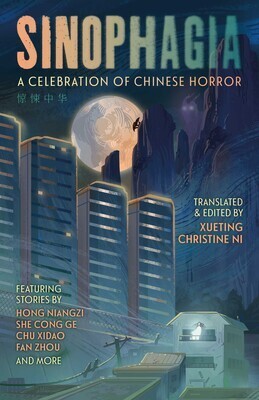
SINOPHAGIA: A Celebration of Chinese Horror, fourteen unsettling tales chosen and translated by Xueting Christine Ni


SINOPHAGIA: A Celebration of Chinese Horror
XUETING CHRISTINE NI
, editor and translator
Solaris Books
$16.99 trade paper, available now

Rating: 4.75* of five

The Publisher Says: An anthology of unsettling tales from contemporary China, translated into English for the very first time.

Fourteen dazzling horror stories delve deep into the psyche of modern China in this new anthology curated by acclaimed writer and essayist Xueting C. Ni, editor and translator of the British Fantasy Award-winning Sinopticon.

From the menacing vision of a red umbrella, to the ominous atmosphere of the Laughing Mountain; from the waking dream of virtual working to the sinister games of the locked room… this is a fascinating insight into the spine-chilling voices working within China today—a long way from the traditional expectations of hopping vampires and hanging ghosts.

I RECEIVED A DRC FROM THE AUTHOR. THANK YOU.

My Review
: These fourteen tales of eerie events, unnerving occurrences, and dreadful doings all work as a unit to dispel the expectations of Western readers that there is one Chinese way to "do" horror. We're accustomed to thinking of China in monolithic terms, as a single unitary entity with a single (incomprehensible) culture and language.

So here comes Xueting Christine Ni, one-person wrecking crew, to show us in the monolithic, culturally incurious West, what we're slowly coming to realize: There's a lot of great storytelling in the rest of the world, and it's hella fun to discover what creeps other folks out...and how often it creeps us out too. Which leads me to one of the oddest modern phenomena ever to make me snort: The content warning. These are horror stories. If you are not triggered by them all, at some level, they are not doing their collective job! I am not including them because, well, horror. The translator/editor is kinder than I am and includes a story-by-story list of them.

As is the custom of this country here (aka my blog), we'll go story-by-story with a note and rating, then a summation, or the Bryce Method as it's better known around here.

The Girl in the Rain by Hong Niangzi has the most eerie vibe...anything that smacks of perception manipulation gives me serious shuddering horrors.

As a way to start the collection, it's got a serious punch. It gets 4.5*.

The Waking Dream by Fan Zhou moves the perception manipulation up a notch, and uses it to fuel the more-expected among Western readers bodily pains and restraints. Is any of this real? Or is there a deep disturbance in the psyche? Is the disturbance in the psyche causing victimhood, or perpetration?

A combination I wasn't expecting, and that didn't really land in either direction, so 4*

Immortal Beauty by Chu Xidao is remorselessly, grindingly physical...abuse is horrifying, though not horror in my personal taste. I felt this was more a report of awful events than a story.

Least successful to me. 3*

Those Who Walk at Night, Walk With Ghosts by She Cong Ge adds bugs to the psychoterror, and does so in a way I was genuinely dreading. The disability angle caused my horripilation to become visible from across the room.

Affecting, upsetting, dark, and just plain nasty. 4*

The Yin Yang Pot by Chuan Ge was more or less a take on "The Girl in the Rain"'s themes...I was still very, very unsettled by the physical restraint aspect, as I always will be, but the perception manipulation in this story was what Did. Me. In.

I want to rate it "zero stars, do not recommend", so that means it did a 4.5* job of creeping me out.

The Shanxiao by Goodnight, Xiaoqing gets my CW because animals are abused. Do what you want to adults, but never harm an animal.

Two stars, because there's some very memorable, lurid non-animal-harm imagery.

Have You Heard of Ancient Glory? by Zhou Dedong did its level best to make my axniety circuits fry. Adding to perception manipulation the scourges of addiction, deliberate and intentional triggering of CPTSD, and mental illness issues galore, gave me a jolt that caused me to put the book down for a week. But I could not stop thinking about it during that week. Read the story again, and *click* on came the light: I am in this same headspace—but I can leave it!

That is a giant success. It's the story I'd call the most successful at what horror fiction does. 5*

Records of Xiang Xi by Nanpai Sanshu was unpleasant on every axis: Animal abuse, use of slurs and a kind of contemptuous belittling attitude, a sense of horrifyingly real entitlement, that repulsed me without the cathartic benefit of other stories. A grudging 2*

The Ghost Wedding by Yimei Tangguo did all of that, and more...but did not project the nauseating sense of entitlement, of an absolute right to inflict these horrors, which in my mind made this story (while unpleasant to me) less inexcusable and intolerable.

Evil exists. We must look at it to poultice away some of its toxic power and its appalling fascination. 3* because it was absolutely no fun at all to read, but does something I value.

Night Climb by Chi Hui felt like a Crimean vacation after a Moscow blizzard! Atmospheric and eerie, dread in place of horror, and a slammin' command of imagery.

Never so glad to give something I finished in shivers 4* in my life.

Forbidden Rooms by Zhou Haohui places too much of its harms on children. It doesn't do so gratuitously, and this isn't The Focus like in earlier stories, but...well...ew. I was interested, not repelled, by the slurs used in this story...honestly, human inventiveness is marvelous even when used for scumbaggery. Because this story's ending is what it is, I felt able to get to 4*

Tian'nang by Su Min trads the territories above, and really stomps the floorboards with it...felt like a tale meant to push you outside its narrative to compel you to look, really look, at what you're reading as an entertainment, not merely a story.

I could totally be projecting with this and it has no bearing whatever to the author's intent. But that's how I found it, and it worked well on that level. 3.5*

Huangcun by Cai Jun leans into the slur-use...for my taste, this is just plain ol' abuse meant to disgust. This, plus a hafty dose of graphic violence, could've led to a poor rating. The trick, when selling horror stories to an ambivalent consumer like me, is to bring the goods...this does...but to offer a level of reflection on, or assessment of, the goods in a differently slanted frame.

It's down to the prose in this story. In less adept hands, this would've sent me on my way for good. As it is, 4*

The Death of Nala by Gu Shi is the last story, and would've been no matter what because the animal harm was just too much for me. 3*

All in all the seasoned horror-reader will get the desired chills and thrills from these stories, and from some unexpected directions. I'm always sure that my horror reading is bog-standard until I get a horror title to read! I'm a complete wuss...animals and kids should be left alone. You can talk hauntings and demons all nigh, won't bother me a whit because I don't care, but hurt a creature that can't fight back and I am very angry.

So why did I rate this collection so highly? Because I learned a lot about what scares the Sinophone world. Because I am, like most in that world, stirred into fear and rage by the same sorts of things.

Because Xueting Ni has annotated this collection, you can go learn a lot if you like. If you don't care to do that, you can get your scary-story needs (whatever they may be) met here unbothered. I think it's a fine emotional investment.

Wednesday, November 10, 2021

SINOPTICON 2021: A Celebration of Chinese Science Fiction, mutual genre blindness written over


SINOPTICON 2021: A Celebration of Chinese Science Fiction
XUETING CHRISTINE NI
(editor and translator)
Solaris Books (non-affiliate Amazon link)
$14.99 trade paper, available now

Rating: 4.5* of five

The Publisher Says: A stunning collection of the best in Chinese Science Fiction, from Award-Winning legends to up-and-coming talent, all translated here into English for the first time.

This celebration of Chinese Science Fiction — thirteen stories, all translated for the first time into English — represents a unique exploration of the nation’s speculative fiction from the late 20th Century onwards, curated and translated by critically acclaimed writer and essayist Xueting Christine Ni.

From the renowned Jiang Bo’s ‘Starship: Library' to Regina Kanyu Wang’s ‘The Tide of Moon City, and Anna Wu’s ‘Meisje met de Parel', this is a collection for all fans of great fiction.

Award winners, bestsellers, screenwriters, playwrights, philosophers, university lecturers and computer programmers, these thirteen writers represent the breadth of Chinese SF, from new to old: Gu Shi, Han Song, Hao Jingfang, Nian Yu, Wang Jinkang, Zhao Haihong, Tang Fei, Ma Boyong, Anna Wu, A Que, Bao Shu, Regina Kanyu Wang and Jiang Bo.

THE PUBLISHER OFFERED ME A DRC. THANK YOU.

My Review
: China's gargantuan economy, and its borning confidence in its increasing influence translating to wider power, is on display in its "kehuan" (science fiction) writers' concerns. This collection, admirably balanced between unpublished-in-the-West and still-gaining-followers-here writers, does what I suppose we all need: Introduces us to the Chinese view of the world, and its future, without the burden of Geopolitical Maneuvering landing on it.

One thing the editor says in her introduction struck me forcibly: Chinese fiction doesn't tend to have happy endings. Well, having read this collection, I can attest to the truth of that. I've said many times and in many places that adulthood is the time of life when there are no unmixed emotions. By that measure, Chinese kehuan/science fiction is very adult. I can think of no story, or character in a story, here that has unmixed or unmitigated happiness or success in present life or anticipation of future life. It simply is not part of the cultural furniture, it would seem; if you're particularly sensitive to this, as in you really, really need hopeful, positive futures, you're in the wrong space.

The payoff to this is that the stories feel...probable. Unlike Western SF, with its doom/gloom/dystopia or happy-bunnies-everywhere dichotomy, these mixed-up emotional cores feel like the real world to me...even when they're speculating wildly. I find it relatable to have a range of emotions that's confined to the, um, downbeat end but not focused on absolute chaos and dissolution of structures. Reality tends towards messy muddling through. So do most of these stories.

I am, as is both reasonable and customary when reviewing stories, using the Bryce Method...story-by-story notes and ratings.

The Last Save explores the metaverse from a different angle, a way I think would be hugely popular if it could be done on a macro, not a quantum level. Tell that fuck Zuck to eat his heart out. 4 stars
In the end, Jerry Xu insisted on not altering his exam answers. But looking back now, such obstinacy was pointless. He would always have to choose, again and again—correcting his mistakes, correcting all contradictions—to attain a perfect life.
He stops his car in front of a red traffic light. It is bliss. He doesn't have to choose whether to continue or to stop.

Tombs of the Universe posits two future lives, one Earthbound and one, earlier, life of a space gravedigger. They each have a fascination with tombs, burials, end-of-life rituals. Interestingly, they contrast in culture...our first narrator lives in an Earthbound culture that has no real place for memorializing dead people, making his study of taphology (burial customs) eccentric, and our second being one who makes the graves the first studies! Extended discussion of tradition and its morphing into its own opposites, often for no better reason than "Because." 3.5 stars
"...All our explorations of space began here on the moon. All the biggest graveyards in the Universe are in our own solar system. We should be proud."
"But now we're the only two people who've come to see them. Do you think the dead know?"
"It's not just the moon, but Mars and Venus...They've all been deserted. But, if you listen, you can hear the rumble of spaceships over planets thousands of light years away! The spirits of these dead explorers must be smiling from beyond the veil."

Qiankun and Alex is Hao Jingfang's story of an AI that rules the Earth learning how to set its own goals, to collect data that it will then use for its own aims. This is a simple vignette, a child interacting with a super-supercomputer, and it chills me more completely than any other story. An AI with the curiosity of a human child?! Farewell, Humanity. It might not have been nice for the planet to have a dose of Humanity, but at least we did it to ourselves. The executioner is now in the house. 4 stars

Cat's Chance in Hell unnerved me with its ethical conundrum: is the need for war stronger than the ethical implications of cloning soldiers to do tasks humans can't/won't/shouldn't do? I say no; I've said no since Roy Batty said, "Time to die," at the end of Blade Runner, and I'll keep saying no until there's no more breath in me to say no. The many iterations of this trope are far from exhausting its relevance or using up the ability of the culture to need discussions about these ethical issues. 4.5 stars
"Why couldn't you at least let me die without knowing any of this? Isn't that ethical?"
"Ah, apologies. We need you to regain all your mental faculties. The brain sorts through memories while you sleep, and we have no other way to guarantee the safe extraction of intel."
The colonel's apology sounds hollow. He strides out of the room, with the last words, "We need your memories. They are very important to us."

The Return of Adam shapes its man-clay into a Frankensteinian monster of Second Intelligence...an artificial enhancement of the human brain that allows us to touch AI-level calculating speeds and webs of deduction. The fish out of water is "Adam Wang" whose two-hundred-year round trip voyage to another galaxy (oof) has brought him back to an Earth only recently changed by this Second Intelligence. Published in 1993, its positing intergalactic travel by 2050 seems...naive, shall we say. Sixty years? What will y'all be doing in 2080? Won't be gallivantin' to the planets, still less the stars; more like improving your water-treading skills and praying the Amazon drones can deliver your soylent green before you starve. 3 stars

Rendezvous: 1937 dedicates itself to an ugly moment in human history, too little known in the West for fear of angering the guilty parties in a genocidal incident. Seen from a Chinese perspective it's not a lot better than it is from a Western one...the scale of the horror numbs one's ability to accept this awful event; the personal-ness of it revolts the right-thinking, as the victims were *right*there*in*front*of* the perpetrators. And there's not one hint of sorry anywhere in the world's conversation about it. Framing it as it is here, as a moment seen with conflict built into its bones, made this uncomfortable read even more intense. 4 stars

The Heart of the Museum does that very difficult thing, translates a hard concept dependent on the syntax of another language into a differently constructed one. Verb tenses do not exist in Mandarin. A story about an alien who sees, in full reality, all the moments of Time as...as real, if not simultaneous, in Mandarin is doable...in English, much more challenging. Well done for a strong, interesting entry into the anthology. 4 stars
On the day of its completion, he will celebrate with all the members of his team; on a particular late night, he will carry out a midnight inspection of the exhibits, holding his girlfriend's hand, the love on his face resembling a small animal just about to feed. During the period he will feel most lost, every morning he will gaze down on this drowsy, waking city from the window next to the wall on which is written the law of gravity. In a few years' time, his child would be even more fond of this spot, and have even more important tasks to complete.

The Great Migration takes what is already the Earth's largest movement of people from one place to another and gives it an outer-space skin. It's that evergreen Quest story; it will make you wince, and cringe, and laugh out loud. No one controls the cosmos, and the fate of mere mortals is the plaything of the Gods. Suitably the story's set on Olympus Mons. 4 stars and a hearty wish we'd get an anime version!

Meisje met de Parel brings two civilizations together in the love of and study of art. "Meisje met de parel," as we're all familiar with her:
Beautiful; but only part of the story, the part that comes to us first in the ouroboros of time created by the plot. There are levels, and implications, in this story that I find...touching, personally deeply resonant and unnerving. But the story itself is lyrical, and it is lovely, and it holds out some proof that Human doesn't stop at Homo sapiens sapiens. 4 stars

Flowers of the Other Shore brings to life (!) a zombie in a zombie apocalypse...probably my least favorite trope even before COVID-19 ate so many peoples' brains. There's something...sinister...in the idea of zombies, not the whole "BRAAAIIINNNS" thing but the "...and how did Nature think this one up?" issue. I mean, there are fungi that zombify their insect victims but they do it to reproduce. Ex-human zombies just...eat.
Life isn't bad as a Stiff. The only trouble is that you remember less and less. You can't blame me—the Stiff's brain is a slowly wilting thing. Sometimes when we shake our heads, we can hear a knocking sound, as if our hemispheres are knocking against our skulls like a ping pong ball. With each knock, we remember one thing less, til the brain is completely empty and only sensation is left: Hunger. We can't starve to death because we've already died once, but it will never subside. It drives me to chase the living, to tear at flesh and blood.

Blech! I don't like zombie stories! But this one, this bizarre twist on the basic zombie tale, got in under my armor and left me thinking that this wasn't in any way like the fleets of other zombie stories. (I'm sure it is, but it's my review and I say it's different so there.) 4.5 stars

The Absolution Experiment doesn't stint...the experiment and the absolution are, in the end, Faustian bargains. 3.5 stars

The Tide of Moon City is an old, old legend about star-crossed lovers separated by things neither knew were even possible; life-long love, want, need, all unmet. The dressings of kehuan/SF place them on a tidally locked double-planet system, separated by the insanity of ideological Hate. I enjoyed the long-delayed resolution of the story, though I will say that, having recognized it, the ending wasn't a surprise. A lovely, lovely story. 4.5 stars

Starship: Library brings the anthology to its logical conclusion: A library. A place where books, the most patient of friends and the most portable of magics, the vacation you can take when you have to stay where you are, are preserved. Because there will always come a reader. A fun, and poignant, celebration of libraries as mothers to all civilization, as the repository for wisdom, and as the place to go when you don't know what to do. Best for last! A story I can give all 5 stars

Wednesday, April 29, 2020

VAGABONDS, first English-language novel from Hugo-winner Hao Jingfang


VAGABONDS
HAO JINGFANG
(tr. Ken Liu)
Saga Press
$28.99 hardcover, available now

JUMPNAUTS (book 2) reviewed here

Rating: 4.25* of five

The Publisher Says: A century after the Martian war of independence, a group of kids are sent to Earth as delegates from Mars, but when they return home, they are caught between the two worlds, unable to reconcile the beauty and culture of Mars with their experiences on Earth in this spellbinding novel from Hugo Award–winning author Hao Jingfang.

In 2096, the war of independence erupts when a colony of people living on Mars rebel against Earth’s rule. The war results in two different and mutually incompatible worlds. In 2196, one hundred years later, Earth and Mars attempt to initiate a dialogue, hoping a reconciliation is on the horizon. Representing Mars, a group of young delegates are sent to Earth to study the history and culture of the rival planet, all while teaching others about life on Mars.

Narrated from two perspectives: Luo Ying, an eighteen-year-old girl from Mars who has spent the past five years on Earth, and Ignacio, a filmmaker in his late twenties from Earth on a job to document the delegates from Mars. Both Luo and Ignacio are trapped between worlds, with critics all around, and always under suspicion, searching for where they truly belong.

THE PUBLISHER APPROVED A DRC OF THE BOOK FOR ME VIA NETGALLEY. THANK YOU.

My Review
: It will come as no surprise to any regular reader, or in fact anyone I've interacted with in the past decade-plus, that end-stage capitalism such as has gifted us with the badly botched, lethally disorganized COVID-19 plague response is not high on my list of Good Things in the old-fashioned Martha Stewart sense. Quite a lot of people (over fifteen) in the assisted-living facility where I live are dead thanks to this money-grubbing ethos. So yes, I began this read fully expecting to approve of the Utopian Martian colony and its collectivist politics.

Well, it's comforting (I suppose) that I consistently never learn....

Hugo-winner Hao (Best Novelette, 2016) builds two competing Utopias. Neither sees the beam in its own eye but focuses on the mote in its symbiotic sibling's; so much easier to sell the distortion and misperception necessary to see any human-made system as anything other than dystopian. Earth's hypercapitalism has continued to devour the planet; its existence is always precarious, always threatening to collapse. Mars's collectivism is dependent on inputs from the fragile, worn-out Earth; its people are not natural innovators, never striving to Do More because, well, why? You don't get more, and there is limited support for striving.

A side note to shout out my dead father, whose aperçu about economics I quote frequently: No system will thrive that either ignores or exalts greed.

This book assumes that Earth remains viable in 2196, and is willing as well as able to continue to support its former Martian colony. I question this decision...but then I remind myself of Ursula K. Le Guin's magisterial The Dispossessed which treats similar themes in a similar setting. The use of a less sophisticated narrator in this book makes it possible for Author Hao to run the lessons past us without the dreaded "As you know, Bob..." locutions. Of course there's information to be dumped, these are STUDENTS! It worked well for me. Quite a lot of the cultural interchange between the rival systems seems, well, far-fetched is as close as I dare come. Eko, an Earth character, has come to Mars to make a documentary; he wants, in his heart of hearts, to grow closer to his dead mentor the Marsophile. Luyuang, our principal Martian character, has returned from her exchange period on Earth where she studied...wait for it...dance in the three-times-greater gravity of Earth! Mm hmm.

I don't want to get into the story's twists and turns for two reasons: Spoilers are impossible to avoid, and your experience of the storytelling voice is the best barometer of your eventual pleasure in the read that you can find. I enjoyed reading Translator Liu's gilded words and finely wrought arabesques. You might not. But download a sample, and if that unique voice isn't your jam, don't go any further. This book clocks in at over 600 pages. Writing that isn't simply thrilling to you will rapidly devolve into a waterboarding session at that length.

While I'm discussing length...the last 100pp of the book are delightfully swift and deeply exciting. The middle 200pp should be severely chopped into, ballpark figure, 75pp. Book-bloat is as common in China as it is in the USA, more's the pity. But, for the reader who vibrates like a freshly-struck bell to this writing and this political tale, the experience is a top quality one.

I can't be clearer than: Try it; you'll know right away if it is for you, as it was for me.

Saturday, March 1, 2014

BALZAC AND THE LITTLE CHINESE SEAMSTRESS by Sijie Dai


BALZAC AND THE LITTLE CHINESE SEAMSTRESS
SIJIE DAI
(tr. Ina Rilke)
Anchor Books
$14.00 trade paper, available now

Rating: 3.5* of five

The Publisher Says: In this enchanting tale about the magic of reading and the wonder of romantic awakening, two hapless city boys are exiled to a remote mountain village for reeducation during China's infamous Cultural Revolution. There they meet the daughter of the local tailor and discover a hidden stash of Western classics in Chinese translation. As they flirt with the seamstress and secretly devour these banned works, they find transit from their grim surroundings to worlds they never imagined.

My Review: I don't, like so many others, think this book is brilliant or even particularly original. I do think it's fascinating as a cultural document of a time and a place that I know zero about and find very intriguing.

The Cultural Revolution was inconceivably vast, like everything else about China. The notion, from whence we shall never know, that Mao had of causing all the haves to be reduced to the status of have-nots, and the resulting collapse of anything describable as culture, took so many good and worthy people from China's body politic and ground them into nothingness that it's a wonder there is a shred of history left to them.

The agonies of our narrator, the son of enemies of the people sent to a remote location for re-education, are told not shown. This is ordinary in a first-person story. But I found myself irked at the elisions this produced. The people around the narrator are one-dimensional, even his childhood friend Luo and the eponymous seamstress. The narrator's inability to see much past the grimy surface of the people in his world wore on me.

But, and this is the saving grace of the book for me, it's such a bizarre and topsy-turvy world that even their surfaces are intriguing, and the rather unexceptional story the narrator (never named) is telling shines with that exotic glistening strangeness.

This is really a book about books. The narrator, his friend Luo, and the seamstress go to great and dangerous lengths to get, read, and absorb lovingly the precious contraband books they're sure are hidden. Finding them, reading them, telling the stories contained in them to others...well, who could possibly NOT love a character who risks hideous tortures to do that?

The seamstress's final act in the book is exactly the right touch to set off the reaction that the narrator very oddly presents to us BEFORE reporting that action. Wha...?

Recommended. Oh, reservations attached to that, but really recommended!