Pages
- Home
- Mystery Series
- Bizarro, Fantasy & SF
- QUILTBAG...all genres
- Kindle Originals...all genres
- Politics & Social Issues
- Thrillers & True Crime
- Young Adult Books
- Poetry, Classics, Essays, Non-Fiction
- Science, Dinosaurs & Environmental Issues
- Literary Fiction & Short Story Collections
- Sookie Stackhouse/Southern Vampire Books & True Blood
- Books About Books, Authors & Biblioholism
Showing posts with label Solaris Books. Show all posts
Thursday, July 17, 2025
THE IMMEASURABLE HEAVEN, Caspar Geon's literary dose of DMT delivered by Solaris Books
THE IMMEASURABLE HEAVEN
CASPAR GEON
Solaris Books (non-affiliate Bookshop.org link)
$16.99 trade paper, available now
A finalist for this year's Philip K. Dick Award...the winner will be announced at Norwescon 48 on Friday, 3 April 2026.
Rating: 4.25* of five
The Publisher Says: An entirely alien cast race across the multiverse in search of a priceless map of the realities in this thrilling cosmic space opera!
The galaxy of Yokkun's Depth has been settled since time immemorial. There is only one frontier left, and it's a one-way journey: to pierce the skin of existence and delve the countless younger universes beneath.
Running through these universes is the fabled Well, a fissure formed in the distant past into which horrors have been flung for millions of years. Amongst their number was an impossibly ancient sorcerer, cast down into the wastelands of a thousand apocalyptic worlds, never to return.
Until now.
Whirazomar is crossing the stars in the belly of a sentient spore, hoping she can make it to the Well before her masters' rivals realise what she's hunting: somewhere far below them, a hapless explorer has drafted a map of reality. A map that the exile is sure to seek out. A map so valuable that a kaleidoscope of beings will run the gauntlet of every universe to get it, even at the cost of their lives.
I RECEIVED A DRC FROM THE PUBLISHER VIA NETGALLEY. THANK YOU.
My Review: This. I mean. Story-bomb. Wow.
Okay. Trying to use my words here.
The multiverse is a real, traversable thing. It's hugely ramified levels of lightly interrelated alternate realities are exclusionary. Leave one, voluntarily or not, and it is forever after closed to you, so no return trips.
Of course that means the Big Bad is moving towards what is considered closed to it because stories need stakes. How is The Big Bad doing this impossible thing? Why we know, he was thrown out of his comfy home timeline for being a bastard and wants revenge. But this thing he's doing is impossible. Only it obviously isn't. He's really doing it.
The story, plot-wise, is pretty typical. The great pleasure of the read is the entirely not-human cast, the author's vivid (almost synesthetic) evocation of the many layers of the reality of these characters, and the really entertaining sense that he is actually experiencing this Well that leads down the layers of the multiverse in front of you. He *is* Draebol, who is charged with making the map of all the levels. (I am deliberately not using the in-universe words for these things. Some people are deeply turned off by "odd" names, and easier to woo into a strange story by stealthy temptations.) (I might have a way to go on the stealth skills.)
The first third is an infodump. I say this knowing how many of y'all will switch off now; I really hope you won't. There's so very much intense image-establishment in this infodump that I'd read fifty more pages of it. Just it. I mean, this never happens. It was as if Author Geon opened an animation studio in my head. I love that experience, being so irresistibly insistently precisely immersed in a realty decidedly not my own that there is nothing to do but go with it or get out.
I went with it, and think some of y'all...the ones who batten on Ann Leckie and Tamsyn Muir...will as well. What was not quite so effective to my way of thinking, and is that three-quarter-star's final resting place, is the very human wants and desires of the aliens. In a lot of ways, the needs and wants of the Teixcalaanis in Arkady Martine's books are more alien-feeling to me. I'm not really inclined to ring the tocsin for the read because, well, what an intense experience it was. How much I want more SF that does this...drops the reader into a sea of ideas and concepts and says, "now let's tell a story in here" so I get to feel the sensawunda I sorely lack in most of my reading in every genre.
More, please.
Sunday, December 1, 2024
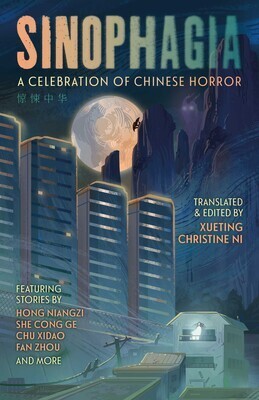
SINOPHAGIA: A Celebration of Chinese Horror, fourteen unsettling tales chosen and translated by Xueting Christine Ni
SINOPHAGIA: A Celebration of Chinese Horror
XUETING CHRISTINE NI, editor and translator
Solaris Books
$16.99 trade paper, available now
Rating: 4.75* of five
The Publisher Says: An anthology of unsettling tales from contemporary China, translated into English for the very first time.
Fourteen dazzling horror stories delve deep into the psyche of modern China in this new anthology curated by acclaimed writer and essayist Xueting C. Ni, editor and translator of the British Fantasy Award-winning Sinopticon.
From the menacing vision of a red umbrella, to the ominous atmosphere of the Laughing Mountain; from the waking dream of virtual working to the sinister games of the locked room… this is a fascinating insight into the spine-chilling voices working within China today—a long way from the traditional expectations of hopping vampires and hanging ghosts.
I RECEIVED A DRC FROM THE AUTHOR. THANK YOU.
My Review: These fourteen tales of eerie events, unnerving occurrences, and dreadful doings all work as a unit to dispel the expectations of Western readers that there is one Chinese way to "do" horror. We're accustomed to thinking of China in monolithic terms, as a single unitary entity with a single (incomprehensible) culture and language.
So here comes Xueting Christine Ni, one-person wrecking crew, to show us in the monolithic, culturally incurious West, what we're slowly coming to realize: There's a lot of great storytelling in the rest of the world, and it's hella fun to discover what creeps other folks out...and how often it creeps us out too. Which leads me to one of the oddest modern phenomena ever to make me snort: The content warning. These are horror stories. If you are not triggered by them all, at some level, they are not doing their collective job! I am not including them because, well, horror. The translator/editor is kinder than I am and includes a story-by-story list of them.
As is the custom of this country here (aka my blog), we'll go story-by-story with a note and rating, then a summation, or the Bryce Method as it's better known around here.
The Girl in the Rain by Hong Niangzi has the most eerie vibe...anything that smacks of perception manipulation gives me serious shuddering horrors.
As a way to start the collection, it's got a serious punch. It gets 4.5*.
The Waking Dream by Fan Zhou moves the perception manipulation up a notch, and uses it to fuel the more-expected among Western readers bodily pains and restraints. Is any of this real? Or is there a deep disturbance in the psyche? Is the disturbance in the psyche causing victimhood, or perpetration?
A combination I wasn't expecting, and that didn't really land in either direction, so 4*
Immortal Beauty by Chu Xidao is remorselessly, grindingly physical...abuse is horrifying, though not horror in my personal taste. I felt this was more a report of awful events than a story.
Least successful to me. 3*
Those Who Walk at Night, Walk With Ghosts by She Cong Ge adds bugs to the psychoterror, and does so in a way I was genuinely dreading. The disability angle caused my horripilation to become visible from across the room.
Affecting, upsetting, dark, and just plain nasty. 4*
The Yin Yang Pot by Chuan Ge was more or less a take on "The Girl in the Rain"'s themes...I was still very, very unsettled by the physical restraint aspect, as I always will be, but the perception manipulation in this story was what Did. Me. In.
I want to rate it "zero stars, do not recommend", so that means it did a 4.5* job of creeping me out.
The Shanxiao by Goodnight, Xiaoqing gets my CW because animals are abused. Do what you want to adults, but never harm an animal.
Two stars, because there's some very memorable, lurid non-animal-harm imagery.
Have You Heard of Ancient Glory? by Zhou Dedong did its level best to make my axniety circuits fry. Adding to perception manipulation the scourges of addiction, deliberate and intentional triggering of CPTSD, and mental illness issues galore, gave me a jolt that caused me to put the book down for a week. But I could not stop thinking about it during that week. Read the story again, and *click* on came the light: I am in this same headspace—but I can leave it!
That is a giant success. It's the story I'd call the most successful at what horror fiction does. 5*
Records of Xiang Xi by Nanpai Sanshu was unpleasant on every axis: Animal abuse, use of slurs and a kind of contemptuous belittling attitude, a sense of horrifyingly real entitlement, that repulsed me without the cathartic benefit of other stories. A grudging 2*
The Ghost Wedding by Yimei Tangguo did all of that, and more...but did not project the nauseating sense of entitlement, of an absolute right to inflict these horrors, which in my mind made this story (while unpleasant to me) less inexcusable and intolerable.
Evil exists. We must look at it to poultice away some of its toxic power and its appalling fascination. 3* because it was absolutely no fun at all to read, but does something I value.
Night Climb by Chi Hui felt like a Crimean vacation after a Moscow blizzard! Atmospheric and eerie, dread in place of horror, and a slammin' command of imagery.
Never so glad to give something I finished in shivers 4* in my life.
Forbidden Rooms by Zhou Haohui places too much of its harms on children. It doesn't do so gratuitously, and this isn't The Focus like in earlier stories, but...well...ew. I was interested, not repelled, by the slurs used in this story...honestly, human inventiveness is marvelous even when used for scumbaggery. Because this story's ending is what it is, I felt able to get to 4*
Tian'nang by Su Min trads the territories above, and really stomps the floorboards with it...felt like a tale meant to push you outside its narrative to compel you to look, really look, at what you're reading as an entertainment, not merely a story.
I could totally be projecting with this and it has no bearing whatever to the author's intent. But that's how I found it, and it worked well on that level. 3.5*
Huangcun by Cai Jun leans into the slur-use...for my taste, this is just plain ol' abuse meant to disgust. This, plus a hafty dose of graphic violence, could've led to a poor rating. The trick, when selling horror stories to an ambivalent consumer like me, is to bring the goods...this does...but to offer a level of reflection on, or assessment of, the goods in a differently slanted frame.
It's down to the prose in this story. In less adept hands, this would've sent me on my way for good. As it is, 4*
The Death of Nala by Gu Shi is the last story, and would've been no matter what because the animal harm was just too much for me. 3*
All in all the seasoned horror-reader will get the desired chills and thrills from these stories, and from some unexpected directions. I'm always sure that my horror reading is bog-standard until I get a horror title to read! I'm a complete wuss...animals and kids should be left alone. You can talk hauntings and demons all nigh, won't bother me a whit because I don't care, but hurt a creature that can't fight back and I am very angry.
So why did I rate this collection so highly? Because I learned a lot about what scares the Sinophone world. Because I am, like most in that world, stirred into fear and rage by the same sorts of things.
Because Xueting Ni has annotated this collection, you can go learn a lot if you like. If you don't care to do that, you can get your scary-story needs (whatever they may be) met here unbothered. I think it's a fine emotional investment.
Thursday, March 14, 2024
THE SIEGE OF BURNING GRASS, complex consideration of the moralities around war
THE SIEGE OF BURNING GRASS
PREMEE MOHAMED
Solaris Books
$8.99 ebook platforms, available now
Rating: 4* of five
Shortlisted for the 2024 Ursula K. Le Guin Prize for Fiction
The Publisher Says: A stunning meditation on war, nationalism, violence and courage by a rising star of the genre.
The Empires of Varkal and Med’ariz have always been at war.
Alefret, the founder of Varkal’s pacifist resistance, was bombed and maimed by his own government, locked up in a secret prison and tortured by a ‘visionary’ scientist. But now they’re offering him a chance of freedom.
Ordered to infiltrate one of Med’ariz’s flying cities, obeying the bloodthirsty zealot Qhudur, he must find fellow anti-war activists in the enemy’s population and provoke them into an uprising against their rulers.
He should refuse to serve the warmongers, but what if he could end this pointless war once and for all? Is that worth compromising his own morals and the principles of his fellow resistance members?
I RECEIVED A DRC FROM THE PUBLISHER VIA NETGALLEY. THANK YOU.
My Review: As you would expect from Premee Mohamed, this is a carefully constructed secondary world, with a deeply tendentious story playing out inside its rules. Moral greyness and relativistic morality are always welcome sights in the secondary-world fantasy genre. Meditating on what makes a villain villainous, what makes it possible to fight and kill in service of peace (as George Carlin famously observed, "Fighting for peace is like fucking for virginity"), all the while still feeling Very Certain of one's own cause's Rightness. No one in one of Author Mohamed's worlds is Right. That being the reality of life on the Earth I like seeing it shown this way in very appealing fiction.
Bioengineering plays a very significant role in this fantasy world. (Including a use of wasps that absolutely *never* would've occurred to me!) I think it is best to leave the whats and hows of that fact alone, as there are surprises in store that hang on those hooks. If I am transparent about it, I would have been five-star warbling my fool head off had some of those fascinating facets found even greater, and sooner, uses in the story.
While I comprehend the metaphorical use of a flying city, I am deeply skeptical of any use of them because they use unrealistic tech to solve...nothing. There is no actual, practical benefit to a flying city that is not outweighed by real, unaddressed increases in the complexity of urban living. I guess the metaphorical "coolth" and visual appeal is just too much to resist, and the people with the flying city in this story definitely seem like the sort of culture that would develop one. Still...just no. Resist the pointed contrast of tech "coolth" to natural development and augmentation!
The absolute joy of the read is the very carefully natural debate between the competing moral certainties of pacifism and Security Über Alles from the alleged same side of the war. This is, to me, the best use of fiction: Don't give one side the monopoly on the good stuff or the bad stuff. Humankind doesn't, hasn't, and won't ever work like that. As you are telling this story, albeit set on a different world, to Humankind, follow our rules when it most counts. This being one of Author Mohamed's storytelling's strong points, I always enjoy her stories.
So, while not a masterpiece, this story of pacifism and its moral greyness, warmongering and its honest, if misguided, aims, and what men will do to WIN, is one fine read, indeed.
Wednesday, November 10, 2021
SINOPTICON 2021: A Celebration of Chinese Science Fiction, mutual genre blindness written over
SINOPTICON 2021: A Celebration of Chinese Science Fiction
XUETING CHRISTINE NI (editor and translator)
Solaris Books (non-affiliate Amazon link)
$14.99 trade paper, available now
Rating: 4.5* of five
The Publisher Says: A stunning collection of the best in Chinese Science Fiction, from Award-Winning legends to up-and-coming talent, all translated here into English for the first time.
This celebration of Chinese Science Fiction — thirteen stories, all translated for the first time into English — represents a unique exploration of the nation’s speculative fiction from the late 20th Century onwards, curated and translated by critically acclaimed writer and essayist Xueting Christine Ni.
From the renowned Jiang Bo’s ‘Starship: Library' to Regina Kanyu Wang’s ‘The Tide of Moon City, and Anna Wu’s ‘Meisje met de Parel', this is a collection for all fans of great fiction.
Award winners, bestsellers, screenwriters, playwrights, philosophers, university lecturers and computer programmers, these thirteen writers represent the breadth of Chinese SF, from new to old: Gu Shi, Han Song, Hao Jingfang, Nian Yu, Wang Jinkang, Zhao Haihong, Tang Fei, Ma Boyong, Anna Wu, A Que, Bao Shu, Regina Kanyu Wang and Jiang Bo.
THE PUBLISHER OFFERED ME A DRC. THANK YOU.
My Review: China's gargantuan economy, and its borning confidence in its increasing influence translating to wider power, is on display in its "kehuan" (science fiction) writers' concerns. This collection, admirably balanced between unpublished-in-the-West and still-gaining-followers-here writers, does what I suppose we all need: Introduces us to the Chinese view of the world, and its future, without the burden of Geopolitical Maneuvering landing on it.
One thing the editor says in her introduction struck me forcibly: Chinese fiction doesn't tend to have happy endings. Well, having read this collection, I can attest to the truth of that. I've said many times and in many places that adulthood is the time of life when there are no unmixed emotions. By that measure, Chinese kehuan/science fiction is very adult. I can think of no story, or character in a story, here that has unmixed or unmitigated happiness or success in present life or anticipation of future life. It simply is not part of the cultural furniture, it would seem; if you're particularly sensitive to this, as in you really, really need hopeful, positive futures, you're in the wrong space.
The payoff to this is that the stories feel...probable. Unlike Western SF, with its doom/gloom/dystopia or happy-bunnies-everywhere dichotomy, these mixed-up emotional cores feel like the real world to me...even when they're speculating wildly. I find it relatable to have a range of emotions that's confined to the, um, downbeat end but not focused on absolute chaos and dissolution of structures. Reality tends towards messy muddling through. So do most of these stories.
I am, as is both reasonable and customary when reviewing stories, using the Bryce Method...story-by-story notes and ratings.
The Last Save explores the metaverse from a different angle, a way I think would be hugely popular if it could be done on a macro, not a quantum level. Tell that fuck Zuck to eat his heart out. 4 stars
In the end, Jerry Xu insisted on not altering his exam answers. But looking back now, such obstinacy was pointless. He would always have to choose, again and again—correcting his mistakes, correcting all contradictions—to attain a perfect life.
He stops his car in front of a red traffic light. It is bliss. He doesn't have to choose whether to continue or to stop.
Tombs of the Universe posits two future lives, one Earthbound and one, earlier, life of a space gravedigger. They each have a fascination with tombs, burials, end-of-life rituals. Interestingly, they contrast in culture...our first narrator lives in an Earthbound culture that has no real place for memorializing dead people, making his study of taphology (burial customs) eccentric, and our second being one who makes the graves the first studies! Extended discussion of tradition and its morphing into its own opposites, often for no better reason than "Because." 3.5 stars
"...All our explorations of space began here on the moon. All the biggest graveyards in the Universe are in our own solar system. We should be proud."
"But now we're the only two people who've come to see them. Do you think the dead know?"
"It's not just the moon, but Mars and Venus...They've all been deserted. But, if you listen, you can hear the rumble of spaceships over planets thousands of light years away! The spirits of these dead explorers must be smiling from beyond the veil."
Qiankun and Alex is Hao Jingfang's story of an AI that rules the Earth learning how to set its own goals, to collect data that it will then use for its own aims. This is a simple vignette, a child interacting with a super-supercomputer, and it chills me more completely than any other story. An AI with the curiosity of a human child?! Farewell, Humanity. It might not have been nice for the planet to have a dose of Humanity, but at least we did it to ourselves. The executioner is now in the house. 4 stars
Cat's Chance in Hell unnerved me with its ethical conundrum: is the need for war stronger than the ethical implications of cloning soldiers to do tasks humans can't/won't/shouldn't do? I say no; I've said no since Roy Batty said, "Time to die," at the end of Blade Runner, and I'll keep saying no until there's no more breath in me to say no. The many iterations of this trope are far from exhausting its relevance or using up the ability of the culture to need discussions about these ethical issues. 4.5 stars
"Why couldn't you at least let me die without knowing any of this? Isn't that ethical?"
"Ah, apologies. We need you to regain all your mental faculties. The brain sorts through memories while you sleep, and we have no other way to guarantee the safe extraction of intel."
The colonel's apology sounds hollow. He strides out of the room, with the last words, "We need your memories. They are very important to us."
The Return of Adam shapes its man-clay into a Frankensteinian monster of Second Intelligence...an artificial enhancement of the human brain that allows us to touch AI-level calculating speeds and webs of deduction. The fish out of water is "Adam Wang" whose two-hundred-year round trip voyage to another galaxy (oof) has brought him back to an Earth only recently changed by this Second Intelligence. Published in 1993, its positing intergalactic travel by 2050 seems...naive, shall we say. Sixty years? What will y'all be doing in 2080? Won't be gallivantin' to the planets, still less the stars; more like improving your water-treading skills and praying the Amazon drones can deliver your soylent green before you starve. 3 stars
Rendezvous: 1937 dedicates itself to an ugly moment in human history, too little known in the West for fear of angering the guilty parties in a genocidal incident. Seen from a Chinese perspective it's not a lot better than it is from a Western one...the scale of the horror numbs one's ability to accept this awful event; the personal-ness of it revolts the right-thinking, as the victims were *right*there*in*front*of* the perpetrators. And there's not one hint of sorry anywhere in the world's conversation about it. Framing it as it is here, as a moment seen with conflict built into its bones, made this uncomfortable read even more intense. 4 stars
The Heart of the Museum does that very difficult thing, translates a hard concept dependent on the syntax of another language into a differently constructed one. Verb tenses do not exist in Mandarin. A story about an alien who sees, in full reality, all the moments of Time as...as real, if not simultaneous, in Mandarin is doable...in English, much more challenging. Well done for a strong, interesting entry into the anthology. 4 stars
On the day of its completion, he will celebrate with all the members of his team; on a particular late night, he will carry out a midnight inspection of the exhibits, holding his girlfriend's hand, the love on his face resembling a small animal just about to feed. During the period he will feel most lost, every morning he will gaze down on this drowsy, waking city from the window next to the wall on which is written the law of gravity. In a few years' time, his child would be even more fond of this spot, and have even more important tasks to complete.
The Great Migration takes what is already the Earth's largest movement of people from one place to another and gives it an outer-space skin. It's that evergreen Quest story; it will make you wince, and cringe, and laugh out loud. No one controls the cosmos, and the fate of mere mortals is the plaything of the Gods. Suitably the story's set on Olympus Mons. 4 stars and a hearty wish we'd get an anime version!
Meisje met de Parel brings two civilizations together in the love of and study of art. "Meisje met de parel," as we're all familiar with her:
Beautiful; but only part of the story, the part that comes to us first in the ouroboros of time created by the plot. There are levels, and implications, in this story that I find...touching, personally deeply resonant and unnerving. But the story itself is lyrical, and it is lovely, and it holds out some proof that Human doesn't stop at Homo sapiens sapiens. 4 stars
Flowers of the Other Shore brings to life (!) a zombie in a zombie apocalypse...probably my least favorite trope even before COVID-19 ate so many peoples' brains. There's something...sinister...in the idea of zombies, not the whole "BRAAAIIINNNS" thing but the "...and how did Nature think this one up?" issue. I mean, there are fungi that zombify their insect victims but they do it to reproduce. Ex-human zombies just...eat.
Life isn't bad as a Stiff. The only trouble is that you remember less and less. You can't blame me—the Stiff's brain is a slowly wilting thing. Sometimes when we shake our heads, we can hear a knocking sound, as if our hemispheres are knocking against our skulls like a ping pong ball. With each knock, we remember one thing less, til the brain is completely empty and only sensation is left: Hunger. We can't starve to death because we've already died once, but it will never subside. It drives me to chase the living, to tear at flesh and blood.
Blech! I don't like zombie stories! But this one, this bizarre twist on the basic zombie tale, got in under my armor and left me thinking that this wasn't in any way like the fleets of other zombie stories. (I'm sure it is, but it's my review and I say it's different so there.) 4.5 stars
The Absolution Experiment doesn't stint...the experiment and the absolution are, in the end, Faustian bargains. 3.5 stars
The Tide of Moon City is an old, old legend about star-crossed lovers separated by things neither knew were even possible; life-long love, want, need, all unmet. The dressings of kehuan/SF place them on a tidally locked double-planet system, separated by the insanity of ideological Hate. I enjoyed the long-delayed resolution of the story, though I will say that, having recognized it, the ending wasn't a surprise. A lovely, lovely story. 4.5 stars
Starship: Library brings the anthology to its logical conclusion: A library. A place where books, the most patient of friends and the most portable of magics, the vacation you can take when you have to stay where you are, are preserved. Because there will always come a reader. A fun, and poignant, celebration of libraries as mothers to all civilization, as the repository for wisdom, and as the place to go when you don't know what to do. Best for last! A story I can give all 5 stars
Sunday, December 16, 2018
EUROPE AT DAWN, fourth Fractured Europe novel, wraps a terrific series
EUROPE AT DAWN
DAVE HUTCHINSON (Fractured Europe Sequence #4)
Solaris Books (non-affiliate Amazon link)
$6.99 ebook platforms, available now
Rating: 4.5* of five
The Publisher Says: Alice works at the Scottish Embassy in Tallinn in Estonia as a member of the Cultural Section. When two men bring her the jewelled skull of a Scottish saint her world gets turned on its head, and she becomes the latest recruit to Les Coureurs des Bois.
On a Greek island Benno is just one of hundreds of refuges dreaming of a new life in Continental Europe. After hatching an audacious escape plan, he may just get his dream, but at the price of serving some powerful mysterious new masters.
Rudi and Rupert, the seasoned Coureur and the scientist in exile from a pocket universe, discover that someone they thought long dead is very much still alive. Not only that, but the now defunct Line – the railway that once bisected the European continent – may be being used for nefarious means.
THE FRACTURED EUROPE SEQUENCE REVIEWS:
EUROPE IN AUTUMN—EUROPE AT MIDNIGHT—EUROPE IN WINTER
THE PUBLISHER PROVIDED A DRC AT MY REQUEST. THANK YOU.
My Review: Old friends make reappearances...old problems need solutions again, the only ones at hand are the ones that didn't work before...new faces wear old clothes and frighten us out of our sleep because the monsters under the bed never left.
An island in the Aegean Sea, the Scottish Embassy in Tallinn, a folk duo of no discernible talent but a huge reputation, and a pair of refugee teenagers tear through the pages trailing clouds of story as Author Hutchinson makes his last scheduled stop in hideously Fractured Europe.
So let me start with this. You're not going to make this your first stop on the route of the Coureurs des Bois. It would be a serious error of judgment to jump in any old how. It is necessary to read EUROPE IN AUTUMN first because so many things that happen in each book suddenly make sense in light of remembering events from the ones before; and starting from the first story helps make the experience of reading the fourth richly textured and satisfying.
The multiverse that Author Hutchinson posits, with its pocket universes and its bizarre cartographic secrets and its stunningly amoral and conscienceless elite, doesn't suddenly make sense in this book's denouement. It doesn't really ever make sense. It all—all the books, all the maps you hear about, all the baggy, wrinkled bits of story-cloth left on bushes here and there drying at their own pace—makes perfect sense as soon as you realize that. I'm not trying to be sibylline or obfuscatory. I'm giving you the effect of reading Author Hutchinson's deeply sculpted, complex story. What vistas open to you are important, but not decisive and defining. They're fractal artifacts of a universe possessed of no higher law than randomness. Remembering the things in your subjective past isn't always helpful, though it's always a good idea to rattle the dice in the brain-cup and see if boxcars or snakeyes come up. Either roll can be the winner because, like the real universe, shit just happens, what the hell. (Yes yes, it's a Terry Pratchett line, but believe me when I tell you that Author Hutchinson has a similarly depraved sense of humor to Sir Terry's.)
What you need to know about this book in particular is that Rudi coming back into focus, Rudi from the Krakow restaurant who really never wanted too much of what happened on his watch to happen...Rudi snaps the pieces of this shattered place's soul into focus as only he could. He still wants to feed people and be a cog in a machine that lacks malevolence for its constituent parts. And he is the reader in that sense, he is the character who does what he must but wants some of his work to matter in a simple way without Overtones.
He wants to live a boring life in boring times. The opposite of the "ancient Chinese curse" we've grown up hearing about. Europe's fracture due to the hideous plague of dubious origins is irreparable. The world cannot be put back together again. I think the Western Romans, especially the Britannians, of 500CE must have felt this way. It look the same. The sky's the same. The birds didn't change. But nothing will ever work again so what shall we do now?
Then there are those alternate places that aren't a thing like Fractured Europe...do they fit together better, are they functional societies, and what are we all going to use as glue to hold all the truly jagged pieces in place? There are no answers. There are no better-framed questions. There are a lot of smug bastards pretending they're on top of stuff. They're not. And you know what? Since no one is, since there's no top to be on, the world will sail on. Over the falls. Off the edge. Into safe harbor. Simultaneously.
This, my friends, is why I read Author Dave Hutchinson's books. Do not kid yourself. He sees reality, he tells you what's happening in eleventeen voices, he weaves disparate strands of story together and snips others without warning. This is what life actually is without the comforting lie of linear time to soothe our monkeybrains with story. Author Hutchinson tells us the story but unwraps it so we can get down in the gearbox that only quantum mechanics know how to grok.
I want you to read these novels. Don't start here. This is your reward for making a turbulent and beautiful journey. This is the final cataract on the river. You're prepared for it. And it's a great sense of understanding and accomplishment as you finish this book. For this is what it means to be awake and alive and fully present in a unique place. Control? None. Power? Illusion. A good dinner, some wine, and companions to enjoy. Do what it takes to keep that safe for the greatest number of people.
Happen I agree.
Monday, December 19, 2016
EUROPE IN WINTER, a rare series novel that exceeds its predecessors
EUROPE IN WINTER
DAVE HUTCHINSON (The Fractured Europe Sequence, #3)
Solaris Books (non-affiliate Amazon link)
$6.99 Kindle edition, available now
Rating: 5* of five
The Publisher Says: Rudi, the former chef-turned-spy, returns on a mission to uncover the truth—in a fractured Europe utterly changed by the public unveiling of the Community.
Union has been forged and the Community is now the largest nation in Europe; trains run there from as far afield as London and Prague. It is an era of unprecedented peace and prosperity. So what is the reason for a huge terrorist outrage? Why do the Community and Europe meet in secret, exchanging hostages? And who are Les Coureurs des Bois? Along with a motley crew of strays and mafiosi and sleeper agents, Rudi sets out to answer these questions—only to discover that the truth lies both closer to home and farther away than anyone could imagine.
***AT THE AUTHOR'S BEHEST, REBELLION SENT ME A TREE BOOK OF THIS TITLE FOR REVIEW***THANKS GUYS***
My Review: The rarest read in a series-heavy publishing landscape is the sequel that improves on the previous books. This books is one of those rare birds. It might just be unique, I'd have to really dig deep in the wetware to be positive, because it's better than the previous books *because of* the previous books. My reviews of EUROPE IN AUTUMN and EUROPE AT MIDNIGHT tell part of the story.The twists and turns of the lives the characters are asked to lead are definitely in the best Cold-War-spy tradition. The patches of somewhat puzzling prose that seem to indicate that a different book has dropped into the one you were reading are exactly that...and this is what finally makes the series so deeply engrossing, twisty, and unputdownable.
Now then. The entire focus of my reviews is always why. Why did I read this book, why do I think you should (or shouldn't) read this book, why do I rate it the way I do...and here I'm going to make my "why" extremely explicit: This book, this series, this concept of reality, is much more than escapist entertainment. The author has done a good deal of deep thinking about the world, how it got where it is, why it's not some other way than it is. He's taken that thinking, those long dark tea-times of the soul, and rendered them into sophisticated, witty (Putingrad! HA!) tales of great subtlety. The interconnections among the volumes are, for those with good memory mapping, sometimes physically jolting. For the run-of-the-mill reader there's no loss of forward momentum, no sense of being at sea; for the more savvy reader, there's an added frisson of pleasure and often amusement. Make no mistake, there is not one non-sequitur in the series. Sometimes you'll need a minute to see if that's an echo or a whisper. Whichever you decide it is, you're right. Much like reality, these books won't dictate your perception of them; the author has laid many a trail through this forest. His mapping skills are, well, hard to equal. We're not talking Rand McNally here, and even the USGS topologists' skills are tested.
And that is at the heart of my pleasure in reading these books. I don't often have the opportunity to engross myself in the unfolding of a narrative across multiple volumes. The last time I can remember was the outstandingly complex world of Barsetshire, begun by Anthony Trollope and continued by Angela Thirkell. It makes me very sad that, since Mrs. Thirkell's death in 1961, no English author has seen the enormous potential of exploring social change through the lens of Barsetshire. Science fiction has multiple universes, some shared by authors with fans and others not; I was most recently bitterly disappointed in James S.A. Corey's The Expanse, which didn't live up to its deeply twisty promise until it made the leap to television. With the Fractured Europe Sequence, I am not left with the painful sense of failure to launch. The ideas are immense, the execution equals their scale, the scope does not show any signs of running out of Lebensraum.
In this entry, a few details need to be remarked on. One is aging. Our loosely conceived narrative universe contains time, and some of the main characters are experiencing its indignities and outrages. Some are quite remarkably not in sync with the world's idea of time. This is enough in itself for a dissertation. Rudi's life trajectory, set off for us in Poland at Max's restaurant in Europe in Autumn, has taken a timely twist that will repay the re-reader of the whole sequence. Another is the prominence of food: don't start this read if you're hungry or there will be near-obsessive levels of snacking. I speak from experience. In fact, I need to make groceries today because of this. Lastly, I bring up the nature of relationships in this world. Nothing is, or realistically can be, permanent; friends wander off, lovers leave, family? What's that when it's at home? Nations expand, contract, vanish, alter out of recognition, and all of it is the natural evolution of the fluid system we call culture. Like all evolution it can be speeded up or altered entirely by hybridization, selective breeding, or habitat destruction. A bleak thought. A hopeful fact. Both, and neither.
Much like life.
A final note: Today, the 19th of December, is Author Hutchinson's birthday. I planned this review to appear yesterday, a week before Yule, and held off a day to celebrate the day. This review will have to do in place of buying you a pint down at the Wolf & Bird, kind sir, as my thanks for creating and continuing to create such delightful entertainment out of the cloth reality hands you.
Friday, April 1, 2016
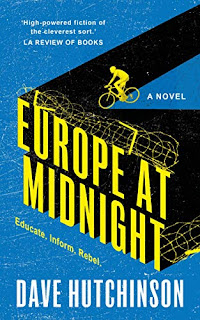
EUROPE AT MIDNIGHT weaves many threads into a glorious tapestry. Thanks Dave Hutchinson!
EUROPE AT MIDNIGHT
DAVE HUTCHINSON (Fractured Europe Sequence #2)
Solaris Books (non-affiliate Amazon Link)
$6.99 ebook platforms, available now
Rating: 4.5* of five
The Publisher Says: In a fractured Europe, new nations are springing up everywhere, some literally overnight.
For an intelligence officer like Jim it's a nightmare. Every week or so a friendly power spawns a new and unknown national entity which may or may not be friendly to England's interests. It's hard to keep on top of it all.
But things are about to get worse for Jim. A stabbing on a London bus pitches him into a world where his intelligence service is preparing for war with another universe, and a man has appeared who may hold the key to unlocking Europe's most jealously guarded secret...
My Review: I have to disclose that, although I bought this book with my very own United States dollars, I'm pals with the author on social media. Believe me it affected my reading and opinion-making not at all, since an honest review is a better gift than a bunch of hot air. Also note that there are spoilers for EUROPE IN AUTUMN following.
At the very end of AUTUMN, a concept was introduced that's central to this book: The existence of "pocket universes," a modern-day physics concept that boggles my tiny 2-volt brain. It's defined as: "A pocket universe is a concept in inflationary theory, proposed by Alan Guth. It defines a realm like the one that contains the observable universe as only one of many inflationary zones." Wikipedia rocks, and everyone should throw some donations at Jimmy Wales.
So anyway, this pocket universe concept is the source of some really bad-ass events in the world we live in, including a hideous pandemic flu that's done what the Black Death did to 14th-century Europe. The devastation caused much economic misery. But as we all know, money for "black ops" will always flow copiously because there's always a secret to learn, one to protect, and no one dares to reveal it publicly in case The People rise up and shut off the money pipe. So our story threads all center on British Intelligence, the surviving Professor of Intelligence from a pocket universe called "the Campus," and the beloved (to me) Coueruers du Bois we learned so much about in AUTUMN.
All the adventures, the nightmares, the violent justice and injustice meted out are in search of a means to neutralize a threat to whatever place the character's loyalty lies. These people play hard and for keeps. Much bloodshed. All of it for ends that, in my opinion at least, make our world's conflicts seem as foolish as the story's stakes. Why is the mere existence of people your country can't or doesn't control so intolerable as to justify genocidal biowarfare?
EUROPE AT MIDNIGHT doesn't answer this question, raising it and examining it from several sides, but foregoing a simple and pompous jingoistic resolution. The use of pocket universes allows the author to compartmentalize the stories, in best spy-fiction fashion. The twist is that these pockets were created, not discovered, by a family of map-makers. The conflicts, therefore, are engineered and need not ever have happened had the greed and selfishness of one group not taken form in such an unusual way.
Or so it seems in this novel. The pocket countries that litter the near-future Europe after the pandemic, the pocket universes...were they created? Were they discovered and exploited, as the powers that be exploit the fragmentation of today's populations at the hands of venal and manipulative oligarchs?
If I've learned one thing while reading the Fractured Europe sequence, it's that perspective alters everything. I don't for a single second imagine that Hutchinson won't change our perspective on Fractured Europe in EUROPE IN WINTER, forthcoming late this year. Goddesses willing and the crick don't rise.
Monday, March 28, 2016
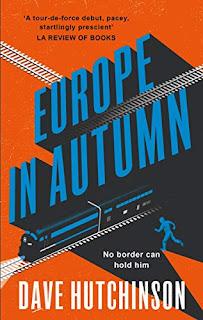
EUROPE IN AUTUMN...political thriller, predictive futurology, alternate history, and all done well
EUROPE IN AUTUMN
DAVE HUTCHINSON (The Fractured Europe Sequence #1)
Solaris Books (non-affiliate Amazon link)
$6.99 ebook platforms, available now
Rating: 6* enthralled stars of five for 2015, when I read it
JUNE 2021 NEWS The Fractured Europe Sequence will be on your TV before too terribly long! I'm so delighted for Dave and grateful for the Peak-TV age.
The Publisher Says: Europe in Autumn is a thriller of espionage and the future which reads like the love child of John le Carre and Franz Kafka.
Rudi is a cook in a Krakow restaurant, but when his boss asks Rudi to help a cousin escape from the country he's trapped in, a new career - part spy, part people-smuggler - begins.
Following multiple economic crises and a devastating flu pandemic, Europe has fractured into countless tiny nations, duchies, polities and republics. Recruited by the shadowy organisation Les Coureurs des Bois, Rudi is schooled in espionage, but when a training mission to The Line, a sovereign nation consisting of a trans-Europe railway line, goes wrong, he is arrested, beaten and Coureur Central must attempt a rescue.
With so many nations to work in, and identities to assume, Rudi is kept busy travelling across Europe. But when he is sent to smuggle someone out of Berlin and finds a severed head inside a locker instead, a conspiracy begins to wind itself around him.
With kidnapping, double-crosses and a map that constantly re-draws, Rudi begins to realise that underneath his daily round of plot and counter plot, behind the conflicting territories, another entirely different reality might be pulling the strings...
THE FRACTURED EUROPE SEQUENCE REVIEWS:
EUROPE AT MIDNIGHT—EUROPE IN WINTER—EUROPE AT DAWN
My Review: If book 2 is out, I'm orderin' it for myself for Xmas.
This isn't a uniformly kinetic book. The characters, by whatever names their current legends require, (oh, and "legend" here is a term of art) are shown thinking, strategizing, reflecting on their world and its insanities as much as they're shown whizzing around with cool spy stuff and lots of ways to blow people up and steal their money.
My favorite piece of spyware in the book is a towel that rolls out into a computer. WANT. NOW.
Rudi, by various names, does many reprehensible things and feels...remorse is too strong...as if he's failed when he has to resort to reprehensibility to get what he's been sent after. He meets and re-meets many folks from his pasts. He is a darn good, fun hero-on-the-border-of-antihero-ness, and I want to see him in book 2, Europe at Midnight.
And now I'm going to do something really, really mean: At the end of the book, Rudi makes a complete worldview-changing discovery that is, at least for me, unexpected to the point of jaw-dropping, and I am NOT going to spoiler it. It makes some oddly rough, even poorly fitting, facts make absolute sense. Moments when I looked at a sentence and thought, "...the hell...?" weren't frequent, but there were more than enough of them for me to perk my ears. (Of course I was evilly hoping I'd get to say something condescending and unpleasant, and alas could not.)
The Fractured Europe foreseen in this series of books is only barely fiction. In fact, only a pandemic is needed in addition to the refugee crisis going on now and hey-presto Hutchinson = Nostradamus. Of course it's all safely printed on pulpwood paper. There's no expectation of this being futurology, only fiction. Excellent fiction that has me fingering my invisible copy of Europe at Midnight....
I really, really liked this book. I hope there's no let-down coming!
And lest there be any doubt, I'm acquainted with Mr. Hutchinson through social media, but I bought the book with my own United States dollars. Neither the six-toed McHutchface nor Solaris Books think I'm cool enough to pass me freebies.
Subscribe to:
Posts (Atom)