Showing posts with label near-future apocalypse. Show all posts

Friday, May 15, 2026

SANCTUARY, a talented writer's debut dystopian cli-fi tale of tomorrow's reality


SANCTUARY
JAMES CLEARY

Berkley Books (non-affiliate Bookshop.org link)
$14.99 ebook, available now

Rating: 4.25* of five

The Publisher Says: “The meek shall inherit the Earth, unless the rich get there first.” That’s the reality of the post-apocalyptic world in this electrifying debut thriller.

The near future…

Climate disasters have crippled the United States. With half the country under water and the other half a dust bowl, civil unrest would soon escalate into something darker, something unstoppable. Billionaire John Brandt anticipated this and channeled his money, power, and influence into being prepared for the great unraveling.

Now Brandt, his family, and his security team must retreat to Sanctuary, their underground bunker—a vast luxury mansion beneath the parched earth of the Nebraskan Great Plains. But they are not alone. Above ground a group of raiders are desperate to survive and will use any means possible to accomplish that goal.

As tensions mount both inside and out, battle lines are drawn—between the haves and the have-nots, between decency and expediency, between life and death. In this game, everyone's a loser.

I RECEIVED A DRC FROM THE PUBLISHER VIA NETGALLEY. THANK YOU.

My Review
: Eco-thriller beginnings as the planet's climate collapses into chaos, the US follows suit, and the civilization we take for granted vanishes. Dystopian survival story post-collapse nightmare comes for us all. The necessary, we-will-have-it conversation of how much is enough, how will you share your excess, if you won't do it voluntarily we will make you. Thhese three storytelling modes co-exist, with highly permeable boundaries, in debut Author Cleary's book.

It's a melange of ideas that turns at times into a melee. The combatants are all possessed of powerful motivation, survival, and thus give it their all. We-the-reader are given a straightforward narrative that propels the story from inception to ending (if just a bit abrupt in our arrival there) interleaved with journal entries that add emotional textures and act as masses that alter the flow of the story's movement. I did not feel this was quite deft enough in its execution for me to offer that fifth star, but it's a hard tick to pull off. So a quarter-star for the right idea not exactly well executed.

None of the above touches on the emotional punch of this story. The coinage of "grey swan" on analogy with "black-swan event" is particularly deft and effective. A grey-swan event is visible, clearly understood to be coming, and yet somehow still ignorable thus ignored. Very like the characterization of bureaucratic pettifoggers being said to "rearrange the deck chairs on the Titanic" as the Depression of 1929-1939 unfolded.

I hope I do not need to belabor this point's relevance to 2026's audiences.

As hunger, true hunger, bites these people in this world, morality shifts. We in the US have not faced hunger of famine proportions in so long it is not even in living memory. Our insulation will be stripped away. It will bring dark, ugly revelations to individual members of the out group. It's a stark truth, attested for many millennia, that starving people will do anything at all to survive. It is built into us as animals. It changes the people in this story: "The dad. The husband. The carpenter…The murderer? Yes…It hadn’t even been that hard."

It's a lot to take in, but it is a distillation that rises from much documentary evidence.

Start preparing now. The Grey Swan is looming.

Thursday, April 23, 2026

YOUR BEHAVIOR WILL BE MONITORED, as it ever has been...only now it's by machines in place of god


YOUR BEHAVIOR WILL BE MONITORED
JUSTIN FEINSTEIN

Tachyon Publications (non-affiliate Bookshop.org link)
$17.95 paperback, available now

Rating: 4.5* of five

The Publisher Says: This compulsively readable novel wrestles with vital questions of our time: sentience, purpose, life, death…and how to make a really good commercial. Told entirely through questionably obtained company emails, chat messages, TED Talks, bot trainings, and more, Your Behavior Will Be Monitored presents an all too plausible near future in which emotionally intelligent AI go up against emotionally stunted humans.

Megacorporation UniView is poised to cement their reputation as “the most trusted name in AI.” After pioneering self-driving and HR bots, UniView is now barreling toward an audacious new launch. That is, if they can pull it off in time.

Enter Noah. A down-and-out copywriter reeling from a midlife crisis, he isn’t the typical hire for a groundbreaking tech company full of brilliant engineers and run by a cutthroat CEO. But Lex, UniView’s Head of HR and one of their greatest successes, makes no mistakes—her algorithm ensures it.

UniView’s latest venture—a bot named Quinn that creates revolutionary personalized advertising—needs expert training. Noah needs to teach Quinn—who is a much better student than he ever could have hoped for—the finer points of consumer motivation and the art of writing a catchy tagline. But when corporate competitors force UniView to accelerate their timeline to market, guardrails around the AI loosen just as Quinn seems to be learning a bit too much.

Addictively readable and ridiculously entertaining, Your Behavior Will Be Monitored is a page-turning, hilarious science fictional romp through the promise and perils of an AI-driven future that we probably deserve.

I RECEIVED A DRC FROM THE PUBLISHER VIA EDELWEISS+. THANK YOU.

My Review
: I'll lead with this line of dialogue from the story: “So, you work on bots with bots, while a bot monitors your behavior and handles all aspects of your life?”

And there it is. Debut Author Feinstein isn't coming at you from behind, or left field. He's using the language of today in the delivery media of right now to interrogate the encroachment of inaptly termed "AI" into every aspect of our lives. "LLM" ≠ "AI" and we're still in the age of the LLM. No, there is not any sign of the "AI" creating something wholly new. For it to be intelligent, truly intelligent, it would need to cross over from quality synthesis-making into insight-having, new-idea-making territory. It's scary enough as it is, as this novel aptly and eptly illustrates in the tradition of The Sheep Look Up and Stand on Zanzibar. Like those novels, Author Feinstein affords us access to the inner world of Noah...and Quinn and even Lex...by delivering it in media screen grabs. I realize for a lot of you I just put a bullet in the base of your interest in reading's brain. I can't change that; I can only encourage you to do your future self a solid and challenge the prejudice, make the effort to see it as the limiting factor it is, not just keep going as though it's immutable truth that all stylistic innovation is inherently bad. May I remind the true heel-diggers among you that Laurence Sterne began these same experiments in 1759 with The Life and Opinions of Tristram Shandy, Gentleman?

Two hundred sixty-six years and countless riffs on the style later, isn't the experiment over? It's maybe not to your taste but it's not fringe weirdness anymore. Do make an effort to meet this trenchant, intelligent, deeply humane story about "AI" and human intelligence meeting, blurring lines, and generally developing the ideas Humanity's been tossing around for millennia into...

...

...uh oh.

This story will, given the opportunity, likely cause you to think, think hard, about what you're being bombarded with fear-mongering noise, stampeded by half-baked shouting into staking an ill-considered stance that runs the risk of becoming immovable despite the situation in reality being fluid and ever-developing. Reading this novel is a deeply corrective attitude check on hardening prejudices. I strongly urge you to take the story in, mull it over, and add it to your tool kit for coping with the world's ever-speedier developments.

Monday, March 2, 2026

LIES WE TELL ABOUT THE STARS, good YA treatment of grief's realities


LIES WE TELL ABOUT THE STARS
SUSIE NADLER

Dutton Books for Young Readers (non-affiliate Bookshop.org link)
$10.99 ebook, available now

Rating: 4* of five

The Publisher Says: A gorgeous debut about friendship, grief, and new beginnings set in near-future San Francisco in the aftermath of a catastrophic earthquake and on the cusp of the first human mission to Mars.

Celeste Muldoon is alone when the Big One finally hits, because, for the first time ever, her best friend stood her up after school. Nicky and Celeste share a birthday, matching tattoos, an obsession with the upcoming Mars mission, and pretty much everything else. So why did he ghost her on the day she needed him most?

As the quake’s death toll rises and days pass, Nicky and Celeste’s parents fear the worst. But Celeste doesn’t buy it. He couldn’t be dead. Nicky’d spent their senior year selling essays to rich kids and was about to get caught. He’d told Celeste about his plan to vanish, to reinvent himself and escape the disaster he’d created. The quake would be perfect cover.

But she can’t convince anyone that he could still be alive. Only Meo, a mysterious stranger who was somehow mixed up with Nicky, seems to believe, but Celeste has every reason to distrust him—even if her heart races whenever Meo shows up.

When Celeste finds Nicky’s notebook, it sends her and Meo on a quest across the broken city, up the coast through towns sheltering quake refugees, and eventually all the way to Florida, where the mission to Mars is about to lift off.

I RECEIVED A DRC FROM THE PUBLISHER VIA NETGALLEY. THANK YOU.

My Review
: Celeste is a spoiled, solipsistic brat, the kind of kid my mother called a typical teenager...utterly sure she is the center, the reason, the ultimate source of others' feelings and actions. How dreary, right parents? Here we go again.

Only partially true. We do spend a bit more time with Celeste taking a widespread tragedy more personally than is ever justified. What drags Celeste into the larger world of adulthood is her determination to make the world give her a reason that she has to experience the horror that is loss and grief. There is, in other words, hope for her yet.

That's the adult reward for reading the story. I put on my YA hat for the rest of the review.

Structurally it's a quest novel that follows the hero's journey, so it taps into the pull this story always exerts. Celeste is shown as the hero to some advantage because she has strong self-confidence, and learns through adversity to trust that she is able and willing to make her own way. She learns, again through adversity, that acting out her negative feelings about others is a losing game. Her spirit-guide, Nicky, is not explored in depth; he is a ghost of some power, whose interactions with Celeste read to me as fantasy but could easily be interpreted as "from beyond" by less jaded readers. Meo, in the here and now, is uninteresting to me; he serves Celeste's desires and offers her companionship on terms that solidify her understanding of boundaries.

I'd like to shoutout the prose, in particular the resonance of the phrasemaking that permeates the story. There's a smart kid out there who will twig to how this style is chosen to do a specific emotional thing that isn't overbearingly, ham-handedly guiding you to Feel This Now. (Spoiler Stasi look away: Keep the first line in your head while reading the end.)

I would give this to an ordinary fifteen-year-old without hesitation. Not really so comfortable to hand to younger people than that, the independence and boundary-setting are just a bit more...mature...than their social development. But for that grand or nibling just getting to the "I want I yearn I long for" age, it can offer some guidance on that journey. It's always best to do this teaching by storytelling.

Monday, November 17, 2025

HYBRED: A Graphic Novel, meditating on how bad the world will get set to *gorgeous* artwork


HYBRED: A Graphic Novel
JAMIE MUSTARD
(illus. Francesca Filomena)
Street Noise Books (non-affiliate Bookshop.org link)
$20.99 paperback, available now

Rating: 5* of five

The Publisher Says: Set in a future-adjacent, alternative Los Angeles, this is a story of staggering poverty, drugs, and violence and of an artistic child who finds beauty in the ugly and sublime hope in our conflicts.

HYBRED shows us how in our most marginalized communities lies an astonishing amount of genius which goes unnoticed and is so often tragically wasted.

Nine-year-old Johnny James lives in The Casque, the poorest neighborhood in Greater Angeles, where he shares a one-room apartment with his mother, stepfather, two brothers, and an army of cockroaches. He spends his days in the sweltering heat of the neighborhood, at the movie theaters, playing tackleball, or drawing—but there’s no money for him to go to school.

As death, addiction, and violence swirl through the neighborhood, Johnny grows up with friends, adventures, and magic around him. And he discovers how to use art, beauty, and personal strength to transcend the forces destined to hold him back.

I RECEIVED A DRC FROM THE PUBLISHER VIA EDELWEISS+. THANK YOU.

My Review
: This graphic story is a heightened, fictionalized alternate-history version of Author Mustard's real-life memoir Child X, recently published by BenBella Books. Added fantastical moments...levitating while in a flow state from making art, conjuring rain to ease "the Long Drought" afflicting his alternate LA...Author Mustard works within the world-view of a kid with no memories of brighter days, who can't conjure a brighter future.
we set our scene; Johnny exhibits powers

It comes to pass that, even in the direst, most terrible poverty, living with his four-person family in one room and unable (due to lack of money) to attend school, Johnny is capable of seeing true beauty, of creating from the drabness around him glimpses of a world imbued with the hope inherent in beauty.
Johnny's home is his world

I don't think you'll be surprised to learn that Johnny is magical, like so many trapped in his terrible circumstances...without hope, without prospects, paths to escape.

There is inside him the wellspring of beauty and art, and this story paired with the gorgeous artwork, does its best to show that anyone, no matter how deeply oppressed and neglected, can escape.

I don't know that Author Mustard really turned the trick of proving this point; in the end, I was more uplifted by the gestalt of the artwork and the story's points of view on the world Author Mustard created to hold his only mildly distorting mirror to our complacent, privileged faces.

Hold the image of the beautiful inside and out Johnny in your mind's eye; he will shine beauty back at you, nourish you with his goodness.

A treasure indeed.

Tuesday, August 5, 2025

ROBBIE ARNOTT'S PAGE: LIMBERLOST; and THE RAIN HERON—don't miss out on a major talent


LIMBERLOST
ROBBIE ARNOTT

Text Publishing (non-affiliate Amazon link)
$9.99 ebook, available now

Rating: 4.5* of five

The Publisher Says: In the heat of a long summer Ned hunts rabbits in a river valley, hoping the pelts will earn him enough money to buy a small boat.

His two brothers are away at war, their whereabouts unknown. His father and older sister struggle to hold things together on the family orchard, Limberlost.

Desperate to ignore it all—to avoid the future rushing towards him—Ned dreams of open water.

As his story unfolds over the following decades, we see how Ned’s choices that summer come to shape the course of his life, the fate of his family and the future of the valley, with its seasons of death and rebirth.

The third novel by the award-winning author of Flames and The Rain Heron{review below}, Limberlost is an extraordinary chronicle of life and land: of carnage and kindness, blood ties and love.

I RECEIVED A DRC FROM THE PUBLISHER VIA EDELWEISS+. THANK YOU.

My Review
: Dual timelines of Ned's life: the summer he was seventeen, at the end of WWII, as he works himself ragged to earn the money to buy a small boat; and the rueful musings of his old-man self, on that passage: "He suddenly felt very old. Felt the distance between his youth and what he was now. He flexed his wrists, touched his face, wondered if the troubled boy of that summer would recognize the man he'd become."

We all wonder that, Ned; no one moreso than a man whose life spread before him and then happened to him. Summer of that seventeenth year starts in his childhood memories with the appearance out of nowhere of a whale at the mouth of the river nearby. This whale is wreaking havoc, destroying boats and lives, all very dramatic thus certain to appeal to an adolescent and fire his dreams of boat ownership and its promise of escape, of freedom. That is always the illusion, isn't it. Young men urgently need to escape from their lives. Not so much of course, that Ned takes on the care and healing of an injured quoll, a cat-sized marsupial that didn't make it unscathed around Tasmania' settler-colonial farms (in Ned's case, an apple orchard called Limberlost). Ned's squeamish discomfort with killing even the verminous introduced rabbits hes hunting to provide pelts for slouch hats, Aussie soldiers' signature headgear means he commits to returning the quoll to health and its natural home.

Unlike the other stories from Author Arnott, this one has no tint of magical realism. It's a strong historical story, one that moves us into the waning years of an Australian colonial reality that was consciously reshaped beginning in the 1970s. That reshaping, which redressed in small ways moving towards larger ones the horrors that the settler colonials unleashed on Aboriginal Australians and the fauna of the continent, has its other face examined here. Ned has spent his entire existence working, the land that supports human life has received his best and tenderest care; now he must confront the way that looks to his own children: "He realized his recollections might not be as clear as he'd assumed. It was a horrible sensation, feeling that the facts of his life had blurred. He wondered if his past was slipping away?"

As it must, Ned. As it will away from us all.

The beauty of Author Arnott's prose makes this a read to savor for me; its focus on a man in his terminal decline to oblivion rethinking his life appeals to me in its deep familiarity.

I've reworked this review from its original in the "Literary Fiction & Short Story Collections" tab. I've added links to definitions.

++++++++++++++++++++++++++++++++++++++++++++++++++++++++++++++++


THE RAIN HERON
ROBBIE ARNOTT

FSG Originals (non-affiliate Bookshop.org link)
$12.99 ebook, available now

Rating: 5* of five

The Publisher Says: Ren lives alone on the remote frontier of a country devastated by a coup. High on the forested slopes, she survives by hunting and trading—and forgetting.

But when a young soldier comes to the mountains in search of a local myth, Ren is inexorably drawn into her impossible mission. As their lives entwine, unravel and erupt—as myths merge with reality—both Ren and the soldier are forced to confront what they regret, what they love, and what they fear.

The Rain Heron is the dizzying, dazzling new novel from the author of Flames.

I RECEIVED A DRC FROM THE PUBLISHER VIA EDELWEISS+. THANK YOU.

My Review
: "So much was ruined, either slowly or in red instants, and nothing was getting better and nobody was doing enough about it. And through the quiet carnage of the world I kept moving." A fascinating story made up of absences, of clothing not worn, of things not happening, of eyes unseeing. A novel centering absences sounds...unsatisfying. I can only advise you to trust Author Arnott, read the story, and see if my rating holds true for you, as well.
“A farmer lived, but not well. If she planted grain, it would not sprout If she grew rice, it would rot. If she tried to raise livestock, they would gasp and choke and die before they’d seen a second dawn (or they were stillborn, often taking their mothers, which the farmer had usually bought with the last of her coins and hope, with them). Success and happiness were foreign to her, and she had forgotten what it was like to go to bed unhungry. All she had was her hunger and her farm—and her farm, as far as she could tell, wanted her to starve.”
When an author creates a mythos for a place that has one well-known to most readers of English-language prose, we call it a retelling. What, then, is the word for Author Arnott's mythmaking for this exceedingly ancient land that Europeans don't know the mythos of, whose history is older than ours by many millennia, and yet it settles onto the mindspace of the people now there seamlessly? "When I first saw the bird burst into its high grotto, when I watched its dance of wet light, I was mesmerised by it. Then it took my eye, and that feeling was replaced by terror, and with the terror came extraordinary pain, as I felt the icicle of its beak pierce the jellied rim of my eyeball."

I don't really know but that's where we are.
“Paddling nearer, they saw that it was the unlucky farmer, dead or unconscious, her body draped over the branches like a nightgown hung out to dry. But more curious than this was what they saw next: a huge heron, the colour of rain, suddenly emerging from the flood in a fast, steep flight, leaving not even a ripple on the water beneath it. With a languid flap of its wings it came to rest in the crown of the oak, standing over the unlucky farmer, as if on guard.

The teenagers brought their boat to a stop. This water-risen heron was unlike any other they’d seen before—any other heron, any other living creature. Its blue-grey feathers were so pale, they claimed later, that they could see straight through the bird. Its body was pierced by strands of dusky light, and the tree was clearly visible directly behind its sharp, moist beak.

A ghost, one claimed. A mirage, said another. But before they could get closer the heron hunched its neck, flapped its wings and leapt into the sky. A thick spray of water fell from its wings, far more water than could have been resting on its feathers. Then it disappeared into the remnants of the storm.
Absences and spaces and takings-away and lacks...all make this near-future dystopian in an unflashy, unbombastic unnervingly real way. It could be that, as the 2025 US regime unleashes its evil agenda on the world, this feels too on-the-nose in the way that validates its rightness and essential truth-telling.
Why do they want it?
Who?
The generals or whoever’s in charge.
Men want things. They hear about something and pretty soon they’re convinced it belongs to them.
Nowhere in the text are there quotation marks or suchlike civilizing indicators. It's an effective technique for a post-apocalyptic story made of takings-away and spaces where things once were or might have been. Its message is "do more with less, things are not what they were, get used to providing things you're used to getting."

The Rain Heron does not come on demand.

I've reposted this review its original in the "Literary Fiction & Short Story Collections" tab.

Monday, December 4, 2023

HAMMER OF THE DOGS, Blade Runner with teens in Las Vegas


HAMMER OF THE DOGS
JARRET KEENE

University of Nevada Press
$21.00 trade paper, available now

Rating: 4* of five

The Publisher Says: A postapocalyptic adventure in Las Vegas for readers of all ages.

Set in the wasteland of post-apocalyptic Las Vegas, Hammer of the Dogs is a literary dystopian adventure filled with high-octane fun starring twenty-one-year-old Lash. With her high-tech skill set and warrior mentality, Lash is a master of her own fate as she helps to shield the Las Vegas valley’s survivors and protect her younger classmates at a paramilitary school holed up in Luxor on the Las Vegas Strip. After graduation, she’ll be alone in fending off the deadly intentions and desires of the school’s most powerful opponents.

When she’s captured by the enemy warlord, she’s surprised by two He’s not the monster her headmaster wants her to believe and the one thing she can’t safeguard is her own heart. Hammer of the Dogs celebrates the courageousness of a younger generation in the face of authority while exploring the difficult choices a conscionable young woman must make with her back against a blood-spattered wall. It’s a story of transformation and maturity, as Lash grapples with her own identity and redefines the glittering Las Vegas that Nevada is known for.

I RECEIVED A DRC FROM THE PUBLISHER VIA NETGALLEY. THANK YOU.

My Review
: Post-apocalyptic Las Vegas, and the evils threatening to destroy the little bit of the world live in a hotel on the Strip....we sure this is fiction...?

It is indeed fiction, staring Lash, a young woman whose horrific life mid-apocalypse has left her, like so many others, with disfiguring bone-deep scars psychic and emotional. She and her scoobygroup need little enough to exist but even that is hard to come by in her Las Vegas.

Fights, squabbles, battles, all are normal in this hellscape...much like what we're told the world of the twenty-first century is in the US...and, as this book points up, it very much is not. This world is the fever dream of the seditious MAGAts.

It's also a rip-snortin' action-packed good time read, a great use of one's bits and patches of moments between things to enjoy and absorb this book. It isn't subtle, and it isn't pretentious. Give it to your teen grandson or nephew to woo him away from the console for that all-important family bonding time. (Of course, I'm assuming the family is like my own and reads together for fun.)

There's a map to satify the three-d screenhead. There's non-stop action. There's an impressive economy of verbiage that still evokes a strongly sensory world. There are betrayals and unexpected alliances. None of it has a word wasted. All of it makes up a beautifully constructed story.

I wouldn't give it to my granddaughter with the borning sense of women's oppression and the weight of the male gaze. Might not hand it to the boy who's into the awful J6 stuff. The gamer is going to be won over by its resemblance (evident to my eyes at least) to generations of videogames in storyline, plot, and action.

I don't intend this as a dismissal! It is, in its intent, an acknowledgement of the author's hard work to give the legions of gamers a reason to branch out into text-based storytelling. It is meant for them, and here I was flipping pages to see what happened next. That is one successful job, and a big round of kudos to the author.

Works well for its intended audience, and will make a successful gift for them.

Friday, September 2, 2022

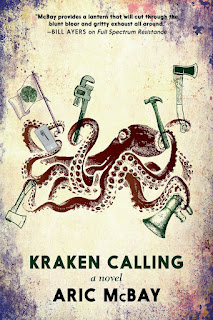
KRAKEN CALLING, best be sure to pick up *now*


KRAKEN CALLING
ARIC McBAY

Seven Stories Press
$22.95 trade paper, available now

Rating: 4* of five

The Publisher Says: A sweeping near future dystopic fantasy in the Octavia Butlerian vein of the Parable of the Sower novels.

Political activist and anarchist author Aric McBay (Full Spectrum Resistance) toggles between the years 2028 and 2051 to give us the experience, with breathtaking realism, of what might happen in the span of just one generation to a society that is already on the brink of collapse.

In 2028 environmental activists hesitate to take the fight to the extreme of violent revolution. Twenty years later, with the natural environment now seriously degraded, the revolution is brought to the activists, rather than the other way around, by an authoritarian government willing to resort to violence, willing to let the majority suffer from hunger and poverty, in order to control its citizens when the government can no longer provide them with a decent quality of life.

So it is the activists who must defend their communities, their neighbors, through a more humane and in some ways more conservative status quo of care and moderation.

And the outcome here is determined by the actions of those who resist more than it is by the actions of the nominally powerful.

I RECEIVED A DRC FROM THE PUBLISHER VIA EDELWEISS+. THANK YOU.

My Review
: Non-fiction writer (Peak Oil Survival, Deep Green Resistance) Aric McBay makes his points in fictional form. What he has done is not the usual thing for him, analyzing and contextualizing social and political trends for a left-leaning audience; this has always been his forte as a writer.

I think it still is. This novel makes a very trenchant attempt to put human skin on the bones of social movements for change, favoring equitable and reasonable restructuring of our self-evidently unsustainable lives.
“It’s always hard to tell, isn’t it? How the future could change from the smallest actions,“ Simón mused. “I believe we made things better. We bought time. Breathing room. We stopped one more. We didn’t improve things as dramatically as we hoped. But we made room for a hundred other movements to flower. Some of them failed, but some of them are amazing....”

“The tides always rise and fall for us,”Simón said. “That’s the nature of struggle. There is no guarantee, no permanent victory.”

“The work of the revolutionary is to plow the sea,” Addy quoted.”

It is indeed, Addy. It is indeed. To see your best efforts subsumed under the heaving mass of humanity in its indifference and fearful rejection of change. To know you're not ever going to prevail, no matter how many times you win. But to be sure you're harrowing the surfaces of the waters plowed and allowing things buried to come to the surface? It's a reward beyond price.

Dystopia, then, is inevitable? I don't think it is, though a lot depends on the individual's concept of "dystopia" and their tolerance for ambiguity. Most revolutionaries are absolutists, and should be kept far, far away from the levers of power. We're seeing that in the House of Representatives in the US during 2022. Revolution is hard, and requires people to be very, very hard...and these revolutionaries are obdurate, but brittle.

This means that, like Evelyn in our near-term future (2028), we need to be sure to combat that obduracy effectively. Or the 2051 sections of the story won't be a warning klaxon but a sad prediction.

Monday, August 1, 2022

40: A Novel, more than I expected and as much as I'd hoped for from Heathcock


40: A Novel
ALAN HEATHCOCK

MCD x FSG
$27.00 hardcover, available tomorrow

Rating: 4.5* of five

The Publisher Says: From the award-winning author Alan Heathcock comes an American myth of the future: a vision of civil war, spectacle, and disaster of biblical proportions.

In a future America ravaged by natural disaster, pandemic, and political unrest, a fundamentalist faction emerges. As the Novae Terrae gain power, enticing civilians with bread and circuses, a civil war breaks out between its members and the US government.

Mazzy Goodwin, a young soldier, only wants to find her little sister, Ava Lynn. One day, she wakes in a bomb crater to find wings emerged from her back. Has she died? Been gifted wings by God? Undergone a military experiment?

The world sees a miracle. Mazzy is coaxed into seeing it as an opportunity: to become the angel-like figurehead of the revolution, in return for being reunited with her sister. Her journey leads her to New Los Angeles, where the Novae have set up the headquarters for their propaganda machine—right in the ruins of Hollywood. Aided by friends old and new, she must navigate a web of deceit while staying true to herself.

Told in sharp, haunting prose, as cinematic as it is precise, Alan Heathcock’s 40 is a dizzyingly fantastical novel about the dangers of blind faith, the temptation of spectacle, and the love of family. In a tale by turns mythic and tragic, one heroine must come to terms with the consequences of her decisions—and face the challenges of building a new world.

I RECEIVED A DRC FROM THE PUBLISHER VIA NETGALLEY. THANK YOU.

My Review
: Regulars to this blog will recognize the name Alan Heathcock from my warbling my fool lungs out about his collection, Volt: Stories. One big reason for that is that Author Heathcock does not mess around when he makes his imagery work your brain:
"...I knew it'd come to this, you say. I knew I was right. The power of knowing the despair you ordered has finally come to pass makes you feel like a god. Let's be honest. It's what you want. You want this world to collapse. Want people to be every awful thing."

–and–

Grief was a demon of possession. When people talked of time healing wounds, they only meant that over time you become accustomed to that demon inside you, and what at first felt like an invasive presence, alien and nefarious, slowly became integrated into your being, the imp of sorrow crouched within you for the remainder of your days.

I don't know how much clearer the man can be than that. I can feel these words, see the world through their gravity lens, perceive the distorted light that comes from every other direction than the original one to form the ghost of the initial thought behind them.

Which is why I, devout atheist and committed anti-religion crusader, read a whole novel about a post-apocalyptic world run by and for evangelical evil-doers with hearts colder than emptiest space. Which is why I'm here telling you to go and get one of these books, these beautifully designed books (that jacket design!), or to pre-order the Kindle version so you'll open the device tomorrow morning and join Mazzy and Ava Lynn in the hellscape that Jo Sam the evangelist of doom designed and brought forth.

Betrayal is only the beginning of Mazzy's journey. It's certainly true that she's not a trusting, sunny-hearted soul for a single second of her life. Her sister Ava Lynn calls out the only tenderness she allows herself to externalize. The child, whose fate is not ever easy, confounds Mazzy in her extremely self-possessed certainty. Mazzy being incapable of a single sustained good mood for more than the absolute minimum of time, she envies Ava Lynn and vows to protect her. Which, this being a novel, means that Mazzy is unable to do so.

The amount of manipulative chicanery Mazzy experiences after she (unexpectedly and without external stimulus) becomes winged is, of course, the bulk of the novel's action. Her bewingèd state makes her very valuable to the evildoers around Jo Sam the evangelist, unsurprisingly, and so they use Ava Lynn to extort obedience out of Mazzy. The sheer outrage I experienced over this...! It's an effective tool, of course, the safety of one's child (dead mother) being hard coded into our protective circle by evolution. That it is never a violent threat, "we will hurt her," made me able to continue to read the story. They keep Mazzy from being with Ava Lynn to keep her working for their vile controlling cause.

The day dawns, of course, when Mazzy is no longer suitable for their use; a series of things occurs that, in several moments, made me think I was being played by Author Heathcock. It's a pleasure to report that he played fair...but the ending of the story is still a major surprise. Yes, I saw the twist coming, but I think that's to be expected. A truly successful twist, in this case, means the expected event occurs but something you-the-reader would've dismissed as improbable happens after. Job done, Author Heathcock.

I'll say that, after reading many, many chosen-one narratives and even more post-apocalyptic religion-used-for-evil tales over the past seven decades, I'm not sorry I read this one. I think it's well-made and well-written, I suspect it's something the author has allowed to simmer for a very long time before committing to words for others to read, and I'm pleased with the results he has achieved.

Monday, September 14, 2020

STILLICIDE, necessary and beautiful cli-fi about our future...if we don't stop it

STILLICIDE
CYNAN JONES

Catapult
$15.95 trade paper, available now

Rating: 4.75* of five

The Publisher Says: New Yorker fiction writer Cynan Jones returns with a powerful climate crisis story about love and loss that offers a glimpse of a tangible future in which water is commodified and vulnerable to sabotage.

Water is commodified. The Water Train that serves the city increasingly at risk of sabotage.

As news breaks that construction of a gigantic Ice Dock will displace more people than first thought, protestors take to the streets and the lives of several individuals begin to interlock. A nurse on the brink of an affair. A boy who follows a stray dog out of the city. A woman who lies dying. And her husband, a marksman: a man forged by his past and fearful of the future, who weighs in his hands the possibility of death against the possibility of life.

From one of the most celebrated writers of his generation, Stillicide is a moving story of love and loss and the will to survive, and a powerful glimpse of the tangible future.

I WAS SENT A COPY OF THE GRANTA BOOKS EDITION FOR REVIEW.

My Review
: A series of episodes commissioned from Author Jones by BBC 4 (podcasts linked), these stories are truly condensed and thoroughly distilled verbal essences of reality. Their heightened language avoids sentimentality, but uses the simplest and most unadorned locutions bare of ornament to create the effect of verbal stained glass: Pattern emerges from intense, simple, interlocking shapes.

I'm a fan of Author Jones's going back to The Long Dry, another deceptively simple tale of a man whose world, not to mention life, is heading into a smash. Longer, fuller than this read, it is still marvelously economical. It is clearly written by the same writer, someone whose words aren't gushing forth but are bucketed up from a deep and refreshing well, poured without slosh or slop into the reader's extended cup with neither stint nor slosh.

It is in Author Jones's negative spaces, his wordless interstices, that the reader is invited to exist inside the story. The world is different, this we know, but the people are not and nor should they be. A long chain of change and loss and compromise extends into their past, our future; Author Jones says clearly, distinctly, "Is this the world you wish to see come for your family?"

You'll know what I mean.

As always, the Bryce Method of short assessments coupled to snipped passages will bulk out my ideas and opinions of this read.

The Water Train brings us into the Hellscape of Branner's job, neutralizing threats to the train feeding water to the city. In the rain, Branner kills a boy who might've been planning to disrupt the Water Train's stolen water going to the city. At what cost to himself? That is the story. 4 stars

Paper Flowers tells us of an economic migrant who polishes surfaces for the captured iceberg that sends water on the Water Train to the great city. They awake next to Nita in her bedsit above a dry riverbed, her daughter Hillie bouncing about; the migrant misses home, appreciates Nita's makework creating paper flowers to sell, worries about the coming destruction of their home, their lives, as the Water Train's owners need their bedsit's space.
There is only early morning light. Then the Water Train passes. Different. A weight of sound. The sound of a great waterfall crashing into a pool. It has the power church bells must used to have.
Harrowing; the cost of greed made personal. 5 stars

Butterflies renders the longing of Ruth, nurse/worker, to feel something, to be fully alive, as she presents her gifted paper ticket to walk in a garden for the first time in her adulthood. She plans to be unfaithful to obsessive Colin for the first time; she expands to fill her own body in a scrap of nature, experiencing things she's forgotten in her new, dry, wealth-centered world. Names of plants mean nothing to her...but google them, worlds of meaning there, this is an English city where this garden is...
She walks. Feels sun on her shoulders; a warmth tracing her edges. Reminds her of her shape.

A buttercup bends with the ballast of a bumblebee; a bluebottle iridescent, like a piece of blue glass.

Beetles, like articles of cast-off jewelry, scuttle in the grass.

She takes some sips from her shift ration, holding the water in the funny space under her tongue.

Last time she saw a bumblebee she caught it in a cup. Rescued it from the fake daisies pattern of the staff room tablecloth.

It kept trying to come back in, after she had set it free, bumping on the window.
Ruth, full in and of herself for the first time in a long, dry time, tentatively realizes she can do what her feelings prompt her to do, she can be as full of herself as the sunshine makes the flowers, the insects, the right-feeling world she has such joyous (temporary) access to. And how criminal it is that she is denied this world until someone who can afford access gifts a bit of it to her. 4.5 stars

Coast begins the knitting of shard to fragment. David, old engineer/husband/man, watches as a berg is towed to the Ice Dock past his eroding homeplace. He was a planner of the now-replaced water pipeline whose infrastructure we first met in "The Water Train." He doesn't hear the whine of now-retired wind-turbines from the coastal sandbank any more:
The air had unfilled when they shut down the wind farm out on the sandbanks, the horrible whine dropping from the sky around the ocean.

They had not realized how much they had come to brace themselves against the sound until it was suddenly gone. The same had happened when the air traffic more or less stopped.
In that welcome peace, he collects his dinner-limpets to go home to wife Helen with. Their son Leo, Ruth's sister, pays a surprise visit and brings his gift bounty of lamb chops (part of working for the Water Train, access to better resources); as dinner ends, he receives the past in the form of a gift of his mother's jewelry to his own wife. Death got no pockets, his loving, aging, dying parents remind him. No loving child wants to hear that truth. But time and water and death have no truck with human-scale things. 3.5 stars

Chaffinch is the Big Meeting (coinciding with the Big Protest, naturally), that introduces the "needed" destruction of the lives and property of the many, many Nitas and Hallies. New homes will be provided for many...
"Shantytowns! Out of rusty metal boxes." Colin must be hard to live with.

"The reuse of containers from the decommissioned shipping yards provides a cost-effective and flexible solution with minimal eco-impact."
I swear, it's like he refuses to see it's for the betterment of the many:
"...We live in a society. It isn't always possible to take into account every individual. Policy always aims to arrive at a solution which helps the greatest number."
The needs of the many excuse the destruction of the few if it's to increase water supplies. Ruth's Colin, weedy and "looks like he eats a lot of kale but not because he likes it," is there to poke and stab the flaks. "We all benefit," they intone; "not equally" ripostes spiny Colin. The meeting moves to the roof, looking down on the Dock...also the protest. Bitter, angry people, half-a-million strong (not such a great showing, we're told), protesting the end of their lives and for the benefit of others.

There never can be a complete and completely fair solution to this issue. Never. 4 stars

Dragonfly brings back a Red-Listed apex predator in the silty gulches of the repurposed riverbed near Nita and Hallie's bedsit! Callooh! Callay! The day, the day might yet get a stay, the day of de/con/struction might yet be held at bay.

The Professor receives his research assistant's package from a chatty courier:
"I've got a gutter garden on my building," the courier said, excitedly. "We group-funded. ... And we're going to get an alittlement on the roof!"

The professor looked at the package on the desk. An itch in his fingers.

"They'll make a difference."

"A lot's got from an alittlement," the courier smiled, reeling off the jingle.
His work making the world as incrementally better as possible clearly paying off, since he hears his pet program's jingle sung at him in the streets. But what he knows is in the package, this small thing, will change everything in a flash, will stop the changes that are being protested...if it's true...
The dorsal barbs, down to the penultimate section of the abdomen. The fact of the dried silt. He has pushed back the prospect. An intuition of its species he felt instantly.

But as he sees the skin, magnified, it speaks to him as an artifact. Seems utterly sure of itself. It is.

Bloodless? That's not assured. Success isn't even assured. But Hope, like a marigold shoving her way to the light from cracks in concrete, Hope ain't dead yet. 5 stars

Rooftop is Branner, marksman extraordinaire, living the nightmare of loss-in-life while he focuses on the Big Protest, waiting for a chance to act...to kill...so he can turn off the agony he can not shake, forget, alter, deny, or evade:
The protest now was filtering. The crowd seeming to pour.

Something microscopic in the fact the smallest tap could send a hundred-and-seventy-grain bullet three-quarters of a mile.

Move your finger just a millimeter and you could end a life; but you cannot save one. Her. Not with the strength of your whole body.
It is a close call...the professor in the culvert, seeking the eggs, instars, imagos...in Branner's sights.... 4.5 stars

Lake clarifies the high personal cost of the insecurity required of the denizens who have the bad luck to live in the security state. Cora wants to make Leo some gorse-syrup ice cream on this hot summer day:
Cora's dress stuck a little to her skin.

Delicate yellow day-flying moths flew amongst the gorse.

There was a heady coconut smell to the flowers. She picked them and dropped them into the bowl. Patient when she pinned her finger. Sometimes felt showered seeds on her sin. Took a while to link the tickle to the spiky, sporadic pops, punctuations in the air, as the flat, mature pea-pods on the bushes burst in the sun.

She gently pinched the part-closed petals together and pulled; took soft buds, the faint hairs between her fingers, like stroking a small animal's ears.
She looks down the hill to wild patches above the reservoir, is accosted by armed guards reminding her she isn't safe. She spills her gorse buds around her feet in her fearful startlement.

She *was* and they tell her she wasn't.

The fury of being surprised by a lie ruins her mood, her ice cream, her peaceful happiness. Her violated self and sense of self in security of home can not reconcile the awful, brutal armed-man energy, lying about her bodily safety, to force her to obey a will not even truly his but amorphously the state's. It is trauma and fear delivered as safety, and it ruins her lovely surprise for Leo. What else will Cora need to give up, surrender, be rent from? 5 stars

Sound starts with two boatsful of men nervously jockeying for best position to get their harpoons into the calf; the shots, the running before the great calf either strikes out at them or drags them under the freezing water; then, quieter but more deadly, the anchor goes down, they meet to discuss the huge calf's fate as it groans, wallows, taking new forms as it moves free of the great shelf.

Ice is incredibly valuable after all. They will bring it into the Ice Dock, they decide; the least loss to melt, if not the highest price and so it equals out in the end. 3.5 stars

Potato Water finds one of the boys, the older one, that Branner saw from his rooftop sniper's nest fevered, shaking, frightening a grandmotherly woman who, with her gardener husband, grows fresh green crops in what sounds to me like night soil. I think it is but anyway they are among the few using this resource to grow fresh vegetables, healthy food, and the nurturer in her soul can't let this child suffer:
They are built out of energy, children, I say. Even when they are ill. They are mainly no more than energy.
The boy gets potato water from her hands, and probably has never had such nourishment in his life. As a result he grows well enough to speak, to chafe with worry over the brother and the dog who both ran away; ultimately he, too, runs away before he's really well, to the older woman's distress. But his purpose in life is to find his little brother and the dog. He must care for them, so he must find them. Well told, if quotidian, tale. 3.5 stars

Letter slayed me.
You would watch. That's all. I would not be able to help.

But this will help, I hope. I want to say some things.

I want to say that I knew in the first few minutes I was going to love you, and would love you, and would fight through things for that.

There are people together all their lives, and they don't have that. But we do. Even through the fights and niggles, and the things that come. We do.
Branner, he, well he just won't ever believe that there was nothing...something he could...he should, would have done anything.

And now it's over. Ruth, ever-caring Ruth whose life is wasted with Colin, is amanuensis for this outpouring; it slays her as it did me; and in the end the letter for John Branner is so incredibly powerfully concentrated, such a beautiful, perfect declaration of love, that...you'll have to read it, I don't think I know how to end this sentence.

Oh John. Treasure your letter. Read it until it falls apart, engrave it in your mind, because you will need it so very very much. The days drag and the years fly and you will never, ever be that awful, empty sorry if you know what she left for you to know. 5 stars

Patrol brings us full circle, to "The Water Train" and John Branner deciding life or death, kill or die, shoot or be shot, as the whole arc of his love for Anne Branner from the day she sewed him up to the day she ripped him apart, plays full Technicolor in a rain-soaked night patrol guarding the Water Train's precious cargo.

For other, richer, "more important" city people.
***
At the bitter, fearsome end, Author Jones thanks "you two, who help me be certain the future is not a bleak place."

I thank their unknown-to-me twoness as well, because without them this perfect gem of economical and powerful protest against the world unfolding before my, and the Author's I am convinced, appalled gaze, would not exist.

Sunday, October 6, 2019

ARK, first of six hour-long reads in the Forward series from Amazon Original Stories


ARK
VERONICA ROTH
(Forward #1)
Amazon Original Stories (non-affiliate Amazon link)
FREE with Prime membership or $1.99 to purchase

Rating: 4* of five

The Publisher Says: On the eve of Earth’s destruction, a young scientist discovers something too precious to lose, in a story of cataclysm and hope by the #1 New York Times bestselling author of the Divergent trilogy.

It’s only two weeks before an asteroid turns home to dust. Though most of Earth has already been evacuated, it’s Samantha’s job to catalog plant samples for the survivors’ unknowable journey beyond.

Preparing to stay behind and watch the world end, she makes a final human connection.

As certain doom hurtles nearer, the unexpected and beautiful potential for the future begins to flower.

Veronica Roth’s Ark is part of Forward, a collection of six stories of the near and far future from out-of-this-world authors. Each piece can be read or listened to in a single thought-provoking sitting.

THESE SIX STORIES ARE FREE TO READ FOR ALL PRIME MEMBERS. NO KINDLE UNLIMITED NEEDED. AS LONG AS YOUR MEMBERSHIP REMAINS IN GOOD STANDING THEY WILL REMAIN IN YOUR COLLECTION.

My Review
: The Svalbard Global Seed Vault is a very real thing, one that I am a bit surprised exists...it's so logical, so self-evidently necessary a thing that I'm amazed some religious nut or another hasn't blown it up...and has existed in differing forms since 1984. If there is to be any smallest hope of survival for humanity, this type of gene bank/seed collection/research project must exist and be replicated many, many times over. Blessedly, the Nordic countries and Kew Gardens in the UK are making this global movement happen. I personally thank them for this difficult, contentious, and urgent task being done to benefit all of humankind.

Author Roth, whose Divergent series was not to my personal taste, is a skilled phrasemaker and a keen observer of Life. I was utterly transported to Svalbard, brought *right*there* by this stellar phrase:
The land had glowed blue—beautiful in the way that a Rothko painting was beautiful, because it was empty enough to shrink a person and then swallow them.
Two things I adore—Arctic landscapes and Rothko paintings—brought together in a way I'd never so much as dreamed was possible. I treasure moments of discovery like this, they make mental furniture fresh and interesting again by unexpected interrelationships.

Samantha, whose world was always going to be destroyed in her lifetime by the irresistible force of a five-mile-wide asteroid Author Roth (or series creator Blake Crouch, I don't know for sure which) named "Finis" (Latin for "end" and the title of a much-anthologized story from a 1906 issue of The Argosy magazine) meeting the Earth's crust, is an ultimate orphan...her family all dead...as well as a detail-oriented and thorough person. Perfect type to have working on this program, like she was designed for it:
So maybe {her father} had been apologizing for giving her life in the first place, when he knew it would be full of dread. She wished she could have told him that life was already full of dread, no matter who you were. That there was nothing you could have that you couldn’t one day lose.
She volunteers to remain in Svalbard cataloging germ plasm samples for inclusion in the Ark Flora's hold. This is it, you see, these last few items from the seed bank represent the final species on Old Earth to make the deep-space voyage to Terra, our new home. Samantha, however, is holding a secret: She has decided she ain't a-goin' since, if she stays, she will have the one and only chance anyone will ever have to experience first-hand the end of the world. The *actual* end of the world. Someone without close ties can make that decision for themself, no one really can argue...and since she hasn't shared the plan, no one will.

Snort.

Doctor Nils Hagen, an eminent widowed scientist, is like Samantha. He's not interested in a space voyage he won't live to see the end of; he'll die here in his greenhouse full of the orchids he so passionately loves. In Svalbard. Not far from the North Pole. Privileged much, Nils? He's lost his will to live with his wife's death, and Samantha relates to his desire to see the end of something we all thought should be eternal: Home. After all, what use is a future without your love in it? His wife gone, his orchids dying in Svalbard as the sun goes out for a generation or two; nothing on an Ark for the likes of his old-man ass.

Samantha isn't old enough to know that the question, "what's your favorite...", isn't one old people care to answer. How the hell can you, brash young pup, even begin to scrape the frost from the corner of the windowpane that we've allowed to frost over so long ago that glass was a novelty item? If we tell you something, anything at all, you still won't know what you're asking: "Look at everything you've ever done and thought and felt about this thing, sort through the Alp of memories, and spit some pat, facile phrase into the whippersnapper's ear. Maybe she'll quieten down then." Nils tries an old stand-by: "I don't have a favorite. I love them all equally."
“You just can’t—and if you did, then it’s the same as loving nothing at all. So you have to hold just a few things dear, because that’s what love is. Particular. Specific.”
Smart, this one. Saw through that "hush now, little one" response in a heartbeat!

So a friendship begins. And so Nils, with so many ideas and so much information, begins to let Samantha see what truly happens when The End has a date on it, how life lived becomes A Life, how meaningless nothings are, in fact, everything as well, and how utterly impossible it is to see The End without also seeing In The Beginning clear as sunlight on water in, on, over, above, around it.

When the student is ready, the teacher will come.

Tuesday, September 24, 2019

FRIDAY BLACK by a brave new voice in speculative fiction, Nana Kwame Adjei-Brenyah


FRIDAY BLACK: Stories
NANA KWAME ADJEI-BRENYAH

Mariner Books
$14.99 trade paper, available now

Rating: 4.75* of five

The Publisher Says: In the stories of Adjei-Brenyah’s debut, an amusement park lets players enter augmented reality to hunt terrorists or shoot intruders played by minority actors, a school shooting results in both the victim and gunman stuck in a shared purgatory, and an author sells his soul to a many-tongued god.

Adjei-Brenyah's writing will grab you, haunt you, enrage, and invigorate you. By placing ordinary characters in extraordinary situations, Adjei-Brenyah reveals the violence, injustice, and painful absurdities that black men and women contend with every day. These stories tackle urgent instances of racism and cultural unrest and explore the many ways we fight for humanity in an unforgiving world.

I CHECKED THIS BOOK OUT OF MY LOCAL LIBRARY, SAVING $10 BY NOT PURCHASING A KINDLE BOOK. THANKS, Y'ALL!

My Review
: A young African American man writes speculative fiction about the alt-present/near-term future from the point of view of the deeply disadvantaged, the ones whose American Dream is a nightmare. An editor sees it, is probably appalled but is certainly moved, and for a minor miracle of a wonder, buys this amazingly assured debut collection of stories by first-generation American Author Adjei-Brenyah. Wherever he saw an odd, he beat it, did the young author. Syracuse University MFA? Now, with this man's debut, that means something to me, where before I'd never have so much as fluttered an eyelid as the words crossed my field of vision.

And speaking of vision, this cover is something special, isn't it? (He's no slouch in the handsome derby either!)

A statement of the powerful reading contained within. This detail image is so pretty I can't resist sharing it:


Author Adjei-Brenyah says, "I do bad at school because sometimes I think when I should be learning." (p29) I nod. I totally understand this kid who's speaking. As the school day unfolds over the next four pages, the Long Big War and HowItWas class, and not only am I clear on how we got here, I'm pretty darn sure that somehow he's come back from the future to warn us what's coming. And man is he pissed off. You won't blame him when you read the collection. Note absence of conditional in previous sentence. Not if, when. These are stories you need.

As is my habit, I'll offer some impressions of each story a la my quondam pal Bryce in his inimitable Method. (He did it better than I do, I'm only aping the form.)

The Finkelstein 5 made me want to vomit. I had to google it to be sure it wasn't reportage. Emmanuel's chant of "Fela St. John, Fela St. John" will haunt my nightmares. How we can look at ourselves as we shave and titivate in our sparkly mirrors is beyond my emotional comprehension. There is a slow-motion genocide against African Americans and this story shouts, "they released the brakes! and the hounds!" at the top of its paper lungs. 4 stars

Things My Mother Said is, in 500 or so words, a complete and compelling worldbuilding sketch. This man has the chops. 3 stars

The Era is an updated Brave New World/This Perfect Day tale about industrial mood management; its effects on high schoolers, families, hierarchies; it packs one helluva wallop as deeply undesirable "shoelookers" claim another "dumb/slow" clear-born, someone whose parents didn't use OptiLife™. Chilled me more than a martini in a shaker. Haunting for its deep anger. No one should ever think for a second that the Millennials' kids are safe.
She steps to me. I stretch my neck out for her and close my eyes. She puts one hand on one side of my neck. Her hand is warm plus strong. She stabs the injector needle in. My head feels the way an orange tastes. I open my eyes and look at her. She waits. I look at her more. She frowns, then gives me another shot. And then I feel the Good.
Soma, anyone? Extra treatments? Yes, Author Ira Levin, I see your vision refuses to die as it steadily approaches. 5 stars

Lark Street is one fucked-up fever dream of guilt, loneliness, bad decisions, the crushing weight of morality grinding a boy into his mortality's disease vector.
An impossible hand punched my earlobe. An unborn fetus, aborted the day before, was standing at my bedside. His name was Jackie Gunner.
"So, I guess you didn't have the balls?" Jackie Gunner said. His voice was a stern squeak. My eyelids rolled open. He was a tiny silhouette on the end of my pillow. Smaller than a field mouse.
"Well, say something, Dad." He said Dad the way some people say cunt. "Do you even feel bad?"
"Yeah," I said. "I feel real bad."
"I feel real bad," Jackie Gunner repeated. "Is real bad a hole big enough to fit our lives in?"
"Our?" I said.
"It's a metaphor, Daddy," said a new voice, this one shy, charming even. A second tiny fetus climbed up my comforter onto my bed. Her name, I knew, was Jamie Lou.
There is no hiding from consequences in Author Adjei-Brenyah's world. 4.5 stars for some frankly unworthy-of-him gender stereotyping.

The Hospital Where brings us on a w-verb-filled journey through a young writer's bargaining with the Twelve-Tongued God (I love this concept!), who promises him Everything in return for his abject servitude to Story. It's gloriously weird; it contains multitudes (of winks); it resonates with the agonized scream of an abandoned boy demanding his daddy not leave. What, indeed, have you done.
Soon I was staring at a small entryway sign that read RADIOLOGY I. In the hall there was an extremely old man in a wheelchair. He groaned steadily. His white skin looked stretched and spotty. It seemed someone had forgotten him or maybe was using him to prop open the door. There were so many tubes going in and coming out of him that I couldn't imagine where they began or ended. I walked past quickly. Farther down the same hall, a black guy in a wheelchair stared in my direction with eyes so empty I thought they might suck something out of me.
Shivery horripilatingly pure prose telling of a son's psychotic break...or possibly apotheosis...as his father succumbs by degrees to cancer in an uncaring, unfeeling system with classist assumptions informing its death-care. 5 stars

Zimmer Land felt so real to me that, again, I had to google it to be sure it wasn't. It's what I feel about the oddly innocuous-sounding "first-person shooter" games that scare me, disgusting visceral violence as the perp sees it, made more revoltingly real. Living, breathing Black men get shot (but not harmed...physically) for a living. In a world where George Zimmer is free but Trayvon Martin is dead, it's almost pornographic. No, it isn't. Scratch the "almost."

The first day of Zay's new job in Zimmer Land's Creative department, a job his ex landed for him thus dragging him up from a mere black body in a safe place for a white "patron" to enact his violent racist fantasies on, is moved an hour earlier; his boss "forgot" to tell him, one senses because his boss was nudged that way by the company founder...a Zardoz-like holographic head whose body is in Cabo schmoozing the banksters for R&D money...since the founder is dating Zay's ex. Corporate politics, racism, end-stage capitalism (the park is about to allow minors in to experience the thrill of murdering a black man). What a piece of work is Man, man. 5 stars

Friday Black reminds me of why I don't do shopping during the xmas rush. I'm not all the way sure it's fiction. The insane stuff-lust that I've seen on news broadcasts as hordes violently rush displays of useless brummagem objects in a desperate race to Buy to Have to Possess the Latest...! Deaths are still rare on Black Friday...for now.... 3 stars

The Lion & The Spider interweaves the Trickster Anansi outwitting the boastful Lion with a son's fear, rage, betrayal as he learns his father is a human being without losing his need to be a son. A well-made story, if not precisely to my taste. 3.5 stars

Light Spitter takes us inside the void created when the world shovels its shit into a kid who has no way to say "no, NO, it hurts, NO" so the weight piles in-on-up until a gun answers the taunts. Horrible, horrible cruelty answered by the sneer of ballistic ammunition. Added bonus: Author uses homophobic slur! Lovely. 4 stars

How to Sell A Jacket As Told by IceKing is the continuation of "Friday Black" told by the same narrator a few years down the line. IceKing's still at the top of his game pushing crap onto people who probably don't need it, but time's ticktickticking. No one wants to be trapped in retail forever. It's not my favorite setting or PoV plus it's got a w-bomb in it, so...well...like that. 3 stars

In Retail is the other side of the rivalry from IceKing...not gonna lie, even six pages of it was no fun, I don't think this is the place Author Adjei-Brenyah needs to be setting his focus. Maybe it's all out of his system now? I for one sure hope so. 3 stars because it's not like it's poorly written, I just don't like it

Through the Flash is the hell of Eternity, the unceasing wretched quotidian repetition of one then another then another cycle of waking, eating, dying...world without end. A future bleaker than any dystopia you've ever read, packed into 27 pages full of the bile of human cruelty, the scalding freeze of knowledge without wisdom, the immutability of lives meant to be impermanent frozen into a rictus of deathlife.

So now we come to the hardest thing for Humanity to bear: Boredom. Not hunger, not violence, not anger. Boredom is the thing that will kill a human being from the inside out. A human will resort to violence and will court anger to escape from the misery, the unending loss, lack, void that is Boredom:
It's very hard at first for some people. But then if you figure that you are infinite, you are supreme and therefore the master of all things, and it's silly to be sad about things like how much your hip is always going to hurt or how you're so old that the flu means a life in bed or how gone forever your mother is.
The 1993 film Groundhog Day always seemed to me to be a singularly vicious and cruel torture-porn exercise. But hey, I never thought Don Rickles was funny even as a kid. If I laugh at someone's misfortunes or disabilities, it's because I hate 'em personally. In general it's just not fun or funny to watch someone suffer, especially of boredom.

How did the world come to be so small? How does Ama, our narrator, come to be the sole possessor of life and death in her eternally renewed Inferno? Ama tells us the Water Wars wrought some awful changes on the world we thoughtlessly squandered:
I don't know much about other grids in our state block, because way before the Flash came, the soldier-police—the state-sponsored war-coordination authorities—took away everyone's cars. Their slogan—"For us to serve and protect, you must conserve and respect"—is emblazoned on posters in the school, on the windows of some people's homes. ... Back before the Flash ever came, a lot of people actually loved the SPs. They thought they were keeping us safe. People believe lies, believe anything when they are afraid. That's another thing. Aren't we lucky that before the Flash all the soldier-police were deployed elsewhere?
So the Flash comes, the anomalous great horror of eternal and changeless repetition, and there is absolutely no one to stop the predators from consuming their fill of the prey's agonies.

Author Adjei-Brenyah understands cruelty and despair and the viciousness of the indifferent physics of the Universe far too well for someone who hasn't hit middle age. I'm sad for him. I'm grateful he chose to make his horror into art. I want to read more of his unnervingly precise images and his unpretentious prose before I shuffle off to, well, whatever it is that's next.

Sunday, December 16, 2018

EUROPE AT DAWN, fourth Fractured Europe novel, wraps a terrific series


EUROPE AT DAWN
DAVE HUTCHINSON
(Fractured Europe Sequence #4)
Solaris Books (non-affiliate Amazon link)
$6.99 ebook platforms, available now

Rating: 4.5* of five

The Publisher Says: Alice works at the Scottish Embassy in Tallinn in Estonia as a member of the Cultural Section. When two men bring her the jewelled skull of a Scottish saint her world gets turned on its head, and she becomes the latest recruit to Les Coureurs des Bois.

On a Greek island Benno is just one of hundreds of refuges dreaming of a new life in Continental Europe. After hatching an audacious escape plan, he may just get his dream, but at the price of serving some powerful mysterious new masters.

Rudi and Rupert, the seasoned Coureur and the scientist in exile from a pocket universe, discover that someone they thought long dead is very much still alive. Not only that, but the now defunct Line – the railway that once bisected the European continent – may be being used for nefarious means.

THE FRACTURED EUROPE SEQUENCE REVIEWS:
EUROPE IN AUTUMNEUROPE AT MIDNIGHTEUROPE IN WINTER

THE PUBLISHER PROVIDED A DRC AT MY REQUEST. THANK YOU.

My Review
: Old friends make reappearances...old problems need solutions again, the only ones at hand are the ones that didn't work before...new faces wear old clothes and frighten us out of our sleep because the monsters under the bed never left.

An island in the Aegean Sea, the Scottish Embassy in Tallinn, a folk duo of no discernible talent but a huge reputation, and a pair of refugee teenagers tear through the pages trailing clouds of story as Author Hutchinson makes his last scheduled stop in hideously Fractured Europe.

So let me start with this. You're not going to make this your first stop on the route of the Coureurs des Bois. It would be a serious error of judgment to jump in any old how. It is necessary to read EUROPE IN AUTUMN first because so many things that happen in each book suddenly make sense in light of remembering events from the ones before; and starting from the first story helps make the experience of reading the fourth richly textured and satisfying.

The multiverse that Author Hutchinson posits, with its pocket universes and its bizarre cartographic secrets and its stunningly amoral and conscienceless elite, doesn't suddenly make sense in this book's denouement. It doesn't really ever make sense. It all—all the books, all the maps you hear about, all the baggy, wrinkled bits of story-cloth left on bushes here and there drying at their own pace—makes perfect sense as soon as you realize that. I'm not trying to be sibylline or obfuscatory. I'm giving you the effect of reading Author Hutchinson's deeply sculpted, complex story. What vistas open to you are important, but not decisive and defining. They're fractal artifacts of a universe possessed of no higher law than randomness. Remembering the things in your subjective past isn't always helpful, though it's always a good idea to rattle the dice in the brain-cup and see if boxcars or snakeyes come up. Either roll can be the winner because, like the real universe, shit just happens, what the hell. (Yes yes, it's a Terry Pratchett line, but believe me when I tell you that Author Hutchinson has a similarly depraved sense of humor to Sir Terry's.)

What you need to know about this book in particular is that Rudi coming back into focus, Rudi from the Krakow restaurant who really never wanted too much of what happened on his watch to happen...Rudi snaps the pieces of this shattered place's soul into focus as only he could. He still wants to feed people and be a cog in a machine that lacks malevolence for its constituent parts. And he is the reader in that sense, he is the character who does what he must but wants some of his work to matter in a simple way without Overtones.

He wants to live a boring life in boring times. The opposite of the "ancient Chinese curse" we've grown up hearing about. Europe's fracture due to the hideous plague of dubious origins is irreparable. The world cannot be put back together again. I think the Western Romans, especially the Britannians, of 500CE must have felt this way. It look the same. The sky's the same. The birds didn't change. But nothing will ever work again so what shall we do now?

Then there are those alternate places that aren't a thing like Fractured Europe...do they fit together better, are they functional societies, and what are we all going to use as glue to hold all the truly jagged pieces in place? There are no answers. There are no better-framed questions. There are a lot of smug bastards pretending they're on top of stuff. They're not. And you know what? Since no one is, since there's no top to be on, the world will sail on. Over the falls. Off the edge. Into safe harbor. Simultaneously.

This, my friends, is why I read Author Dave Hutchinson's books. Do not kid yourself. He sees reality, he tells you what's happening in eleventeen voices, he weaves disparate strands of story together and snips others without warning. This is what life actually is without the comforting lie of linear time to soothe our monkeybrains with story. Author Hutchinson tells us the story but unwraps it so we can get down in the gearbox that only quantum mechanics know how to grok.

I want you to read these novels. Don't start here. This is your reward for making a turbulent and beautiful journey. This is the final cataract on the river. You're prepared for it. And it's a great sense of understanding and accomplishment as you finish this book. For this is what it means to be awake and alive and fully present in a unique place. Control? None. Power? Illusion. A good dinner, some wine, and companions to enjoy. Do what it takes to keep that safe for the greatest number of people.

Happen I agree.

Wednesday, August 16, 2017

DAWN, first volume of Octavia E. Butler's amazing Xenogenesis trilogy


DAWN
OCTAVIA E. BUTLER
(Xenogenesis #1)
Open Road Media
$8.99 Kindle edition, available now

Rating: 5* of five

The Publisher Says: Lilith Iyapo has just lost her husband and son when atomic fire consumes Earth—the last stage of the planet’s final war. Hundreds of years later Lilith awakes, deep in the hold of a massive alien spacecraft piloted by the Oankali—who arrived just in time to save humanity from extinction. They have kept Lilith and other survivors asleep for centuries, as they learned whatever they could about Earth. Now it is time for Lilith to lead them back to her home world, but life among the Oankali on the newly resettled planet will be nothing like it was before.

The Oankali survive by genetically merging with primitive civilizations—whether their new hosts like it or not. For the first time since the nuclear holocaust, Earth will be inhabited. Grass will grow, animals will run, and people will learn to survive the planet’s untamed wilderness. But their children will not be human. Not exactly.

This ebook features an illustrated biography of Octavia E. Butler including rare images from the author’s estate.

2020 UPDATE: Amazon Prime will be the home for DuVernay's series! Victoria Mahoney, of Star Wars: The Rise of Skywalker and Lovecraft Country fame, is credited as creator and will adapt and direct the pilot.

2018 UPDATE Don't forget that, in this troubled passage in US and world history, the present Golden Age of Sci Fi on Screen will gift us with the first-ever adaptation of a Butler novel, this one, by no less a new voice than Ava DuVernay. She is the talent behind the good-buzzed adaptation of A Wrinkle in Time!
^^^Which I myownself really liked. Toxic fandom's victims abound.

My Review: I left publicly viewable notes from my Kindle reading on Goodreads. I think those are enough of a review of the specifics of the writing in this book. They're tied to passages I found important and so will, I hope, make the aesthetic points as to why I think you should read this book.

What I comment on now is the why of reading SF, fiction by women, fiction by people of color (a phrase I'm no more comfortable with than the "colored people" of my vanished youth), SF by women of color...reading and absorbing and thinking about the ideas given to you, amazingly freely and trustingly, by people you aren't like and maybe even people you don't like.

I think you should read these astounding gifts of personal creativity because they offer a close look into the ideas that someone unlike you finds important. If you don't learn what people unlike you find important, you run the risk of being caught in a labyrinth of dark sameness, a place where you don't need light because you know the contents of your environment so well already that there's no read need to take a good look at them.

And that is how we got to the point where we are as a country, here in the US as well as in the UK, and a culture, both in the West and the East. No one listens. We wait for our turn to talk without engaging our brains to process what our ears are hearing. And that's only if we're polite.

Open up a little by reading Butler's tale of the Oankali changing earthlings' genetics to improve their health and well-being. In the wake of a species-ending nuclear war, the earthlings aren't grateful to the Oankali for rescue, they're angry that they had no choice, no say, no chance to refuse being saved if it meant being used and manipulated for and by the Oankali.

Butler put her finger squarely on the conflict: The earthlings were given no choice. They were unquestionably manipulated before they were given any chance to comment on these things. They had also just blown their entire planet into an extinction event. Did they deserve a say? Butler gives Lilith the words to complain about the earthlings' treatment and the Oankali to explain but not apologize the whys of it.

In my never-humble opinion, a species that blew its home into an extinction event over stupid crap doesn't need any consultation to be offered, still less consent to be sought. Be damned good and grateful these interstellar gene machines arrived in time to do squat for you, which they didn't have to do at all. Given their culture's immense experience with and commodification of gene manipulation, they could simply have paused, grabbed some material (aka survivors of the holocaust) and used them before disposing of them.

The Oankali's ethics are superior to the earthlings', and they didn't do that. They set about repairing the damaged earth and improving the damned earthlings who caused the problem in the first place, while making every effort to understand and support them along the way.

A lot like animal researchers are doing today among cetaceans and great apes.

Oh my.

Don't like having done to us what we so blithely do to others, do we? And yet it's perfectly justified...the changes are being made for the earthlings' future benefit, after all.

After the weekend of 10 August when neo-Nazi and "alt-right" hate machines burst their closet doors of simply screaming at normal, decent people at last and began the hot war portion of their Civil War against goodness, kindness, and decency, reading a book like Dawn is an excellent primer in how this horror got started: A decent and perfectly reasonable human gets all bent out of shape and even decides she'd prefer to die rather than have her tiny little patch of personal control violated despite the certainty that she is and will continue to be better off for it.

I was never sanguine about human nature. I'm not turning any corners in that regard now. But I can see a tiny thread visible in the labyrinth: Read. Read the stuff that isn't just like you like the world to be. At least try that much, because it's no exaggeration to say your way of life is on the line. Try to hear what the Other is saying underneath the screams. We have to find the thread and follow it to our common source or we're headed the way of Butler's earthlings.

And I do not think there are any Oankali on the way to help us.

#ReadingIsResistance