Showing posts with label almost 5-star review. Show all posts

Tuesday, April 30, 2024

SAINT ELSPETH, character-driven post apocalyptic story


SAINT ELSPETH
WICK WELKER

Indepently published
$7.99 Kindle edition, available now (non-affiliate Amazon link)

Rating: 4.8* of five

The Publisher Says: Why did they come?

When they appeared across the sky, speculation wheeled around the world—the aliens were from heaven, the invaders were from hell… or they were proof that neither existed. But when they landed, curiosity gave way to suspicion and the nations reacted with nuclear force, setting off a chain reaction that left the world in ruins.

Twenty years later, instead of nearing her retirement, Dr. Elspeth Darrow struggles to forget the loss of her child and husband by plunging herself into the work of operating the last remaining hospital in San Francisco. With medical supplies running out and working herself to exhaustion, Elspeth must embark on a risky salvage mission into the heart of the Neo California danger zone. Here, she discovers the disturbing truth: the aliens have returned.

As the mystery of the aliens' purpose on Earth unravels before her, Elspeth must hide what she discovers from reactionary despots, all vying to bring Neo California under their control. Aided by a band of pre-war scientists and new-world medical students, Elspeth races against astronomical odds to reveal the terrifying truth that might save the world—or finally destroy it for good.

I CHECKED THIS BOOK OUT FROM PRIME BECAUSE OF THAT BASTARD BRYCE. USE THEM OFTEN, THEY PAY AUTHORS FOR OUR USE.

My Review
: End-of-the-world stories don't work because the author just uses them as a backdrop, instead of setting a story that really can't be told another way in that milieu. That was what happened between me and The Road. This always gives me the eyeroll disease, the one where I see my brain from rolling them away from Mad Max-level violence and artificially amped fridging stakes.

Saint Elspeth doesn't do that. Elspeth's character doesn't change...she was always basically a good (if cynical) person, always motivated to do the right thing...and the world around her does change though not the ways one would wish them to. So, a lot like Life, I'm sure you'll agree.

Setting the story at a time of great change and making Elspeth the solid referent not Humanity's scumbaggery shifts this from "how many End-of-Everything stories do we really need?" to "we really need more people like this to shine their light" without making the entire enterprise cloyingly sweet. It's down to the way the story is made: the setting doesn't alter her; she unfolds into the new world, becoming more herself and offering more and more of the genuine help and healing she's always given instead of being forced to find them in the awful new world.

I'm making this sound terrible. It isn't. I give it five stars because I was involved and excited by the action, and invested in the main character, all the way through. I finished the book about an hour ago and am contemplating a re-read already. I even followed the author. I never follow authors.

It's really good stuff. Read it soon...2024 is pretty damn dystopian, one needs an antidote. Here's one that takes you into the dark corners, pulls your heartstrings, and then allows you to believe that a decent if flawed person with a good heart *can* make a positive difference.

Monday, May 9, 2022

MERCURY RISING, alternate space-race history with waaay trippy nukes


MERCURY RISING
R.W.W. GREENE

Angry Robot (non-affiliate Amazon link)
$6.99 Kindle edition, available now

Rating: 4.75* of five (the w-bombs! the w-bombs!)

The Publisher Says: Alternative history with aliens, an immortal misanthrope and SF tropes aplenty

Even in a technologically-advanced, Kennedy-Didn’t-Die alternate-history, Brooklyn Lamontagne is going nowhere fast. The year is 1975, thirty years after Robert Oppenheimer invented the Oppenheimer Nuclear Engine, twenty-five years after the first human walked on the moon, and eighteen years after Jet Carson and the Eagle Seven sacrificed their lives to stop the alien invaders.

Brooklyn just wants to keep his mother’s rent paid, earn a little scratch of his own, steer clear of the cops, and maybe get laid sometime in the near future. Simple pleasures, right? But a killer with a baseball bat and a mysterious box of 8-track tapes is about to make his life real complicated…

I PRACTICALLY HAD TO BEG THE AUTHOR FOR A DRC. I *THOUGHT* WE WERE FRIENDS. MY FEELINGS ARE STILL HURT.

My Review
: No, really. Mortally wounded that this wingèd not my way until I groveled. *sniff* (And seriously NO MORE W-BOMBS. Cut that crap out, dirty-old-man-in-training!) I was calmly enjoying the mental soundtrack, the 1970s jukebox that's permanently cued up in my head, when *wham* another revolting w-bomb.

But about that jukebox...would we, in fact, have the precise same pop-cultural artifacts in a world that didn't slow down its climb to the stars? The 1968 Cougar, well, okay, that was already on course from 1958. The planning window of a car in those days was five years...so the 1958s wouldn't've been much altered from our world, as I understand the timeline, which diverges first in the middle 1940s and so those cars can be explained. Pop culture spins on a nailhead. Elvis electrifying the country is one example, the Beatles knocking off his cool-cat cap is another, but both of those came in response to specific cultural stimuli. Wouldn't the world be more law-and-order oriented when the Oppenheimer Nuclear Drives are dangling before the lust-drenched gaze of every young testosterone factory? Can't get in one of those unless your nose is clean.

Which, of course, our PoV character (Brooklyn Lemontagne) flouts. But the reason he's able to flout that social control mechanism is simple: Invaders from Outer Space! The ultimate Golden Age of SF trope. This time they're Mercurians, the patent absurdity of whose existence gives even the Hero of the piece (who apparently dies early on) some pause. Can't argue with the presence of stonking hostile warships and evaporated cities, can you.

This takes place among Americans! Of course you can! The whole planet pulls together to combat the Enemy from Beyond...and there are ignorant goofballs talking conspiracy theories, there are hemi-hippies rebelling against the controlling hand of the grown-ups. This is the world, and honestly I agree with Author Greene's take on it. I quibble with some details, but I believe he's exactly correct that even an existential threat with ample death and destruction to demonstrate its reality won't create more than a façade of unity among the irredeemable mass of humanity. (Look around, tell me, and him, we're wrong.)

So I buy the premise. So I consent to set aside my niggling nuh-uh generator. I'm in for the ride.

Part One: Mercury Rising is straight out of Astounding's *1956 volume. Brave Americans and honorable Soviets lay down their grievances and get on with the job of killin' them some Mercurians. (Mercurians!) The Ultimate Price? Paid. Now what? When and where are we going next? I'm almost sure my Kindle screen cracked under the thumping of my thumb.

Part Two: Bad Blood shifts gears, gives us the rest of the battle story very effectively, and sends Brooklyn, our new PoV man, into some nasty corners. And not one of 'em anything but his own idiot fault. Some gross and very personal violence perpetrated later in the section...it starts to feel like we're going to be in Peckinpah territory through the book...and, on schedule, the fecal matter impacts the rotary air circulation device at warp speed.

The thing about living your life outside is that you learn to watch simple things like a hawk. It takes Brooklyn about three times as long as it should to come up with his get-out-of-jail-free card. But he decides there's nothing else for it: Go to space, full decade enlistment, and get the whole shootin' match handled...crimes forgiven, mother fed, and future still neatly fucked, same as if he'd gone to jail without solving the problems he most cares about solving. Yay...?

Part Three: Squeeze Box details the adjustments of life in military training. It's not like I wasn't expecting it. But I also wasn't enjoying it much until I suddenly twigged: Brooklyn's assigned buddy, Tommy, is gay. And nothing at all fazes Brooklyn, or anyone else it seems, about it.

It seems that the Mercurians (!) destroying Cleveland and causing climate change as well as serious ashfall issues gave people something more interesting than who's zoomin' who to fret over. As well as feed innumerable conspiracy theories that, oddly prove to be correct but misaimed.

Part Four: Take the Money and Run did very little for me, but brightened up the contrast between Brooklyn's America and my 1976 US.

There's a goodly amount of interpersonal violence in this story, fisticuffs to donnybrooking (to use old-fashioned terms); appropriate for a dead-end life such as Brooklyn was living and (I hope) merely his own process of molting that no-longer-needed carapace. The end of the part was oddly assorted with its beginning if that isn't to be the case; our man Brooklyn gets out of his mind instead of out of his head, and does so in the place I think something like Coachella or Burning Man *should* take place: The mass grave of an entire city's populace.

Part Five: The Rubberband Man pretty much just cemented the crazy-shit-men-do-together trope for all time. It's an adventure story, that was an adventure, but...not quite the thing I'd've chosen to prove "once a scofflaw, always a scofflaw" to ye olde readere.

Part Six: Flight '76 was apparently meant to earworm me in the most appalling possible way, including a w-bomb in the first five seconds of the awful, terrible, well-below-mediocre tune that refuses to get out of my head. I think SOMEone owes me some sort of reparations.

Part Seven: Boogie Nights starts with a much better earworm, thank the Nine Goddesses. But it's more transition time treats, ABBA on the Moon (!), and some interesting-to-me alt-hist entertainment...Vice-President JACKSON...then off into the Wild Black Yonder. It goes by really fast.

We do see a good, solid character whose trajectory is geting more interesting, though it's a glancing blow. I'm mostly intrigued by this *McCartney singing political rock opera....

Part Eight: Don't Let Me Be Misunderstood is an earworm I can live with, if without the good memories of Boogie Nights. It's also the best shorthand for the events of this part...there are so many mistakes and screwed-up connections to work out, the metaphor of upgrading the computer is especially apt.

The ship names are giving me little frissons. The (Marie-Madeleine) Fourcade is a woman-captained solo spy ship, the Baron von Steuben old-fashioned, obsolescent, and largely overlooked haven for the queer boys too useful to get rid of but not important enough to keep secure (much to the PTB's cost), each carrying its subtext like a homing beacon and not just one of the darn things. I mean, what did von Steuben do? And where (in Ohio) is Steubenville? And why is Carruthers so shifty?

Part Nine: Runnin' on Empty truly sets new stakes for literally everyone in this, our one wild and precious life. Titanically, existentially reorders whatever priorities you thought you'd formed by utterly altering the ground you plonk your trotters onto every time you think to move.

I do not know of an Odysseus I'd rather see handle this situation than the one who is.

Part Ten: Flash Light wafts its foully malodorously vapid earworm through the four-foot speaker towers in my mental disco.

But that is as nothing to the sudden but inevitable betrayal that This Land endures at the foul, gangrenous typing digits of Author Greene. I am too traumatized to say more.

Part Eleven: Boy from New York City introduces us to the real Jet...short for Jethro...Carson. And now the first part has closure. What we're doing I won't tell you, but I will say that there's a reason you'll want to read this and it's in this part.

Part Twelve: Take a Chance on Me is the first time I haven't wanted to claw my brain out to wash the earworm ichor off it.

There's a lot to cheer for, and a lot left to learn. This is a good solid familiar story arc and it's got lots of good gauds and gew-gaws bejazzling its basic curves. We're going to be offered another trip, right?

Rapture Right!

Wednesday, December 15, 2021

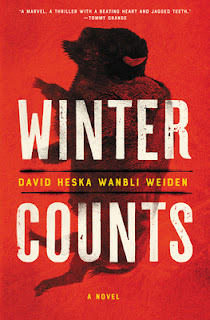
WINTER COUNTS, Native American #OwnVoices thriller


WINTER COUNTS
DAVID HESKA WANBLI WEIDEN

Ecco
$16.99 trade paper, available now

WINNER OF THE BEST FIRST NOVEL ANTHONY AWARD FOR 2021! Virtual Bouchercon award ceremonies linked to at the above.

WINNER OF THE BEST INDIGENOUS WRITER at the 2021 High Plains Book Awards.

On The Guardian’s Best Thrillers of 2021 list

Rating: 4.75* of five

The Publisher Says: A groundbreaking thriller about a vigilante on a Native American reservation who embarks on a dangerous mission to track down the source of a heroin influx.

Virgil Wounded Horse is the local enforcer on the Rosebud Indian Reservation in South Dakota. When justice is denied by the American legal system or the tribal council, Virgil is hired to deliver his own punishment, the kind that’s hard to forget. But when heroin makes its way into the reservation and finds Virgil’s nephew, his vigilantism suddenly becomes personal. He enlists the help of his ex-girlfriend and sets out to learn where the drugs are coming from, and how to make them stop.

They follow a lead to Denver and find that drug cartels are rapidly expanding and forming new and terrifying alliances. And back on the reservation, a new tribal council initiative raises uncomfortable questions about money and power. As Virgil starts to link the pieces together, he must face his own demons and reclaim his Native identity. He realizes that being a Native American in the twenty-first century comes at an incredible cost.

I RECEIVED A DRC FROM THE PUBLISHER VIA NETGALLEY. THANK YOU.

My Review
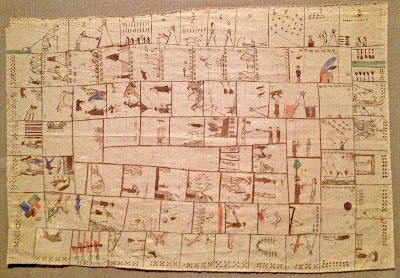
: This is a Brulé Lakota Winter Count:
This cultural tradition, extremely briefly summarized in a Wikipedia article, organizes this novel’s ideas. Virgil Wounded Horse, our aptly and prophetically named vigilante-cum-enforcer hero in this thriller, touches on this fascinating piece of (half) his ancestry’s sense of time and place often enough to make the title of the book emerge organically in the reader’s mind. Virgil muses at one point, “Winter counts were the calendar system used by the Lakota, but they weren't like modern ones. I'd loved the little pictures in the calendars, each image showing the most significant event from the past year.” He muses again, at a later point, “Winter counts. This was the winter of my sorrow, one I had tried to elude but which had come for me with a terrible cruelty.” I think both are ideas of how he, his world, and his sense of self, are in motion at all times. It makes his entire life spent in action make sense…he’s not a Lakota insider, like ex-girlfriend Marie Short Bear, whose ancestry is flawlessly pureblood and perfectly in tune with the power structure within the Rosebud Reservation. He’s not an insider in the white world, either, being a mixed-race outcast from its racist system. It’s been a blessing in that any curse can be turned into an advantage if you’re looking for a way to do it. He’s got a place enforcing justice outside white and Native American legal systems, as required.

What this means is that the character is perfect for a thriller that needs telling to get people to care about the problems heaped on Outsiders, Othered people, by all systems of government. The tribal justice system (arguably distorted by its necessary accommodation to white codes) as much as any other. Virgil is outside, and that is the perfect place to be when the upper echelon needs something done that won’t “look good.” The value of face, of taking things at face value, is something white people with our media obsession have raised to virtual apotheosis; it’s far from untrue of other cultures, however. Marie Little Bear’s tribal leadership position means he can’t directly do the effective thing against the drug cartels hooking Native kids on heroin, with the well-known tragic consequences.

Had the plague not touched Virgil’s nephew, hard, he wouldn’t have agreed to take on the violent and greedy and frankly evil people. But when it’s family, things look different, don’t they. What happens on the reservation has its roots in the not-distant city of Denver. Marie and Virgil set out to confront the ills of their corner of the world by going outside that corner, by bearding the lion in his den, and they are not surprisingly at some disadvantages there. It is as revealing to consider their troubles and issues within the white world of Denver as to examine the world of the reservation in promotion, tolerance, and perpetuation of toxic social maladjustment.

I’m impressed by the way this thriller uses its author’s straddled worlds…he’s Lakota and teaches Native American Studies at the Metropolitan State College of Denver, so clearly he’s quite adept at code-switching…as a full and integrated world for Virgil Wounded Horse. We’re not expected to see Virgil as a man out of place in two worlds, we’re expected to see a man discovering his place in his own world. It is a fine distinction, but an important one. Virgil is an outsider in each of those large, obvious social constructs. He is making his own world, one in which he is the norm, as in the end that is what we all must do to “fit in.” Where the world doesn’t have a place for you, make one.

That is the gift of this read to the reader. Join Virgil Wounded Horse in his thrilling world.
+++++++++++++++++++++++++++++++++++++++++++++++++++++++++++++++++
This post is the 1,000th on my blog! I’ve written many thousands of book reviews over the years of many truly enjoyable books. I’m very happy that, after eight and a half years, I’ve reached this milestone blog post with a review of a book I’m happy to recommend that you read as a Booksgiving treat to yourself.

Wednesday, November 17, 2021

WINTER IN SOKCHO, Impressionism in Korean-inflected words


WINTER IN SOKCHO
ÉLISA SHUA DUSAPIN
(tr. Aneesa Abbas Higgins)
Open Letter Books (non-affiliate Amazon link)
$9.95 Kindle edition, available now

August 2025: 40% discount on all Open Letter titles written or translated by female-identifying artists. (Discount is applied automatically at checkout on publisher's website and applies to all hardcover, paperback, and ebook editions.)

WINNER OF THE 2021 NATIONAL BOOK AWARD FOR TRANSLATION! Watch the ceremony here.

Rating: 4.75* of five

The Publisher Says: It’s winter in Sokcho, a tourist town on the border between South and North Korea. The cold slows everything down. Bodies are red and raw, the fish turn venomous, beyond the beach guns point out from the North’s watchtowers.

A young French Korean woman works as a receptionist in a run-down guesthouse. One evening, an unexpected guest arrives: a French graphic novelist determined to find inspiration in this desolate landscape.

The two form an uneasy relationship. When she agrees to accompany him on his trips to discover an ‘authentic’ Korea, they visit snowy mountaintops and dramatic waterfalls. But he takes no interest in the Sokcho she knows: the gaudy neon lights, the scars of war, the fish market where her mother works. She is pulled into his drawings but troubled by his vision of her – until she strikes upon a way to finally be seen.

I CHECKED THIS BOOK OUT OF MY LOCAL LIBRARY. USE THOSE LIBRARIES! THEY NEED US, AND WE NEED THEM.

My Review
: I can't say too much, because there isn't one helluva lot of book here.
He’d never understand what Sokcho was like. You had to be born here, live through the winters. The smells, the octopus. The isolation.
–and–
A rubber-gloved hand pointed us in the right direction.

Too much of everything. Too big, too cold, too empty. The clatter of our shoes on the marble slabs rang out.
–and–
Oozing winter and fish, Sokcho waited. That was Sokcho, always waiting, for tourists, boats, men, spring.

This is the most Duras thing I've read that wasn't set in France. This is what Impressionism looks like in words. This is the way you take a simple, even banal, story of a young woman whose life is in neutral and chunk it into first gear without using the clutch.

You can feel a good, faithful translation. It fits and it means something you won't ever find anywhere else. This is a good, faitful translation by that metric. I haven't read the French but, should it ever swim across my bow, I will grab it and gobble it down to see how the flavor of fugu feels in French.

Mother and daughter at daggers drawn, sisters locked in battle, no one is getting a leg up on anyone else in this bitter little pill. It's always the family that makes you feel the worst when they could choose to give you their best. It's certainly true that South Korean culture is the epicenter of the plastic surgery world. The pressure to "look perfect" whatever that means there is powerful, and it's astonishing to me how high the percentage of South Koreans who've had serious work done is. It's no surprise that Jun-Oh, the narrator's boyfriend, is caught up in it...it makes sense, in that world, and her categorical refusal to give in to the not-subtle pressures he puts on her, her mother puts on her, and her mother's sister puts on her to "fix her flaws" is proof to me that this is someone I'd like to spend more time with.

Food is a huge part of this read...you'll read words in Korean that aren't translated, eg tteok, and it's on you to go figure out what the heck they are, or not if you don't care. I like that in a book. I will figure out what a tteok is (a rice cake made with steamed flour made of various grains, including glutinous or non-glutinous rice) and why it would smell of cold oil (some meal-base versions, not desserts, are fried) if I decide it means something to me. In a nutshell, the plot is nothing; in reality, it is Everything...how we mistreat our intimates without really giving it a thought; how we form alliances and attachments that never ever get to the surface of our lives (poor old Park!); how completely we fail to find our world's gifts until they make the gravity double and the body sink into a slough of despond with their absence.

Most of all, though, reading this beautiful book is an exercise in allowing words to do their work in you. You are not there, you more than likely have never been there, but through the magic of fiction here you are:
All night long the town was entombed in frost. The temperature fell to minus twenty-seven degrees, the first time it had happened in years. Curled up under the covers, I blew on my hands and rubbed them between my thighs. Outside, against the onslaught of ice, the waves struggled to resist, moving ever more slowly and heavily, cracking as they collapsed in defeat on the shoreline. I bundled myself up in my overcoat, the only way I could find sleep.
–and–
The rain hammered down, the sea rising beneath it in spikes like the spines of a sea urchin.
–and–
‘What I mean is you may have had your wars, I’m sure there are scars on your beaches, but that’s all in the past. Our beaches are still waiting for the end of a war that’s been going on for so long people have stopped believing it’s real. They build hotels, put up neon signs, but it’s all fake, we’re on a knife-edge, it could all give way any moment. We’re living in limbo. In a winter that never ends.’

Don't miss the chance to read this book. It is a FINALIST for the 2021 Best Translated Literature category at the National Book Awards! The winner will be announced this evening.

Friday, November 12, 2021

TOTAL CREATIVE CONTROL, first in a new series of hilarious M/M rom-coms


TOTAL CREATIVE CONTROL
SALLY MALCOLM & JOANNA CHAMBERS
(Creative Types #1)
Self-published (non-affiliate Amazon link)
$4.99 Kindle edition, available now

Rating: 4.76* of five

The Publisher Says: Sunshine PA, meet Grumpy Boss ...

When fanfic writer Aaron Page landed a temp job with the creator of hit TV show, Leeches, it was only meant to last a week. Three years later, Aaron’s still there ...

It could be because he loves the creative challenge. It could be because he’s a huge Leeches fanboy. It’s definitely not because of Lewis Hunter, his extremely demanding, staggeringly rude ... and breathtakingly gorgeous boss.

Is it?

Lewis Hunter grew up the hard way and fought for everything he’s got. His priority is the show, and personal relationships come a distant second. Besides, who needs romance when you have a steady stream of hot men hopping in and out of your bed?

His only meaningful relationship is with Aaron, his chief confidante and indispensable assistant. And no matter how appealing he finds Aaron’s cute boy-next-door charms, Lewis would never risk their professional partnership just to scratch an itch.

But when Lewis finds himself trapped at a hilariously awful corporate retreat, Aaron is his only friend and ally. As the professional lines between them begin to blur, their simmering attraction starts to sizzle...

...And they’re both about to get burned.

I WAS OFFERED A DRC AND ACCEPTED WITH UNSEEMLY GLEE.

My Review
: Hello! Are you new around here? I kind of doubt it, but one never can be certain...so let me offer a greeting and an invitation to poke around, look over the goods, see what interests you. One thing you'll notice fairly quickly is that I like the books that feature people like me, which is to say men who sex up men while loving every minute of it; older men who have the good fortune to find younger men who enjoy their company; and who (lucky fictional bastards!) get second chances at The One(s) Who Got Away.

Authors Joanna Chambers and Sally Malcolm have each appeared on the pages of the blog on previous occasions, their respective ouevres coming in for no little praise on their own merits. (Still slightly shocked that BBC Scotland hasn't made Enlightenment into a limited series, Author Chambers...get your People onto it! David Tennant ain't gettin' any younger!) I am, in short, inclined to look upon these creatives' creations without undue harshness, permaybehaps even a Vaseline-smeared lens of hazy happiness.

When I am not being assaulted by w-bombs. (Two were allowable; they deepened the...foulness...of a revolting character; four others, NO; net deduction = 24 stars.) (What do you mean, there aren't 24 stars? It's my blog and I'll...oh, very well you boring commonsensical internal voice.)

The fun of watching, that is reading, this story was evident from the get-go. The insta-luuuv between the characters being sublimated into a working relationship for ages was nicely explained away by Aaron's dirty little secret: He writes fanfic in Lewis's show's universe! Well, as a reason for him to stay shtumm about his feelings, that one does a lot. He can't give up his literal dream, or his literal dreamboat, now can he. Plus Lewis clearly senses Aaron's abilities as a writer, as a fellow creative story-teller, and no one who's ever had a whole business riding on their shoulders can ever resist a true Lieutenant Colonel showing up when you need 'em. (Not to mention the man's a fount of excellent story ideas, and can keep the fan-service pipeline flowing both ways.)

There's a lot of fun in reading these words, just as words. This is exactly as one would expect from the two authors involved in creating the story.
Charlie was one of those almost-but-not-quite-good-looking men. Everything about him was just a little average. A little medium. On the two or three occasions he'd come into the office to see Lewis, he'd always seemed to Aaron to be trying to make up for that somehow, with his overbearing manner and his ridiculously pretentious outfits.
–and–
...Lewis yelped, "Wave!" and they both stumbled backwards as the surf splashed up over their ankles, soaking the ends of their rolled-up jeans. Lewis lost his balance as he scrambled up the beach, Aaron grabbed him, and suddenly they were both clinging to each other, laughing.
And then, just as suddenly, they weren't laughing.
They were simply standing there in the moonlight, clutching each other's arms, gazing at each other. Lewis looked dishevelled and windblown, undone in a way that transformed him from idol into someone more real, more tangible, his dark hair blowing across his forehead, and his eyes the deep blue of the twilight sky. He swallowed visibly, lips parting, chest rising and falling. Breathing hard. His fingers tightened on Aaron's arms, drawing him closer.

And we'll leave that there...*evil chuckle*

What a pleasure, then, to have this as a week-ending read. I wasn't expecting it to be awful, or painful; I was expecting it to be somehow less than the sum of the authors' different powers, a watering-down of what I've come to expect. I just love being wrong! Their different ways of approaching a story came together beautifully, and made this a better story than I'd even let myself hope that it was going to be. I'm also pleased that the process of working together worked well for them so we're going to get a book two and even a book three! I predict book two will be about Owen. (That was, if y'all were wondering, a stonking great hint.)

The genuinely surprising thing in this read...and let's not front, there's next to nothing surprising in romances...is that it takes its milieu seriously. The world of Fandom is presented without an arched eyebrow or a barely concealed sneer. The existence of AO3 is very much part of what drives the plot. The kind of characters in the fannish con-world are spot on and mostly treated kindly. (I, like Lewis, am unable to endure long moments of speech emitted by up-talkers.) The end of the story is a fan-person's wet dream. It is a pleasure to see the sub- go Culture.

I am well and truly pleased, Authors each and both, and I thank you for making me the offer of a DRC for review.

Wednesday, September 1, 2021

DEER SEASON, debut novel from seasoned short-fictioneer runs Life through her paces


DEER SEASON
ERIN FLANAGAN

University of Nebraska Press/Flyover Fiction
$21.95 all editions, available today

Rating: 4.75* of five

The Publisher Says: It’s the opening weekend of deer season in Gunthrum, Nebraska, in 1985, and Alma Costagan’s intellectually disabled farmhand, Hal Bullard, has gone hunting with some of the locals, leaving her in a huff. That same weekend, a teenage girl goes missing, and Hal returns with a flimsy story about the blood in his truck and a dent near the headlight. When the situation escalates from that of a missing girl to something more sinister, Alma and her husband are forced to confront what Hal might be capable of, as rumors fly and townspeople see Hal’s violent past in a new light.

A drama about the complicated relationships connecting the residents of a small-town farming community, Deer Season explores troubling questions about how far people will go to safeguard the ones they love and what it means to be a family.

I RECEIVED A DRC FROM THE PUBLISHER VIA EDELWEISS+. THANK YOU.

My Review
: Have you looked at the cover image of this book? Go on, get your nose up to the screen...now did you notice the shape of that "D" in "Deer"? There's a clue in it.

Author Flanagan, no stranger to the "Flyover Fiction" series with two story collections in it, here gives us her first novel. It's set thirty-five years ago in a rural place that, in our own time, has doubtless vanished entirely. Farming being the corporate endeavor it is now. This time, the one we're inhabiting in this novel, feels like something from a Russian novel with peasants and kulaks and tsars in their palaces so far above us. Actually, it's just families farming land they'd inherited and living lives they don't feel embarrassed by.

The major event of the novel is the disappearance of teenaged minx Peggy Ahern. The rampant drinking culture of the area and era was the source of the problem...Peggy, too smart and too young to control it yet, was in the habit of sneaking out on weekends to partake of the big, wild world of the after-hours partying at Castle Farm. You know, as practice for when she'd be off at college.

But one fine night...the one before her little brother's going to be confirmed in the Lutheran Church, no less...she doesn't come home to have her hangover in her bed. And days go by. She doesn't come home; she isn't Found; and the town decides that Hal Did Something. Hal, big and nice-looking but sadly with an intellectual incapacity, has about an eleven-year-old's scope to understand the world. And an adult man's body, and an adult man's needs; without the wherewithal to get context of Peggy's flirting, or realize when he was going too far in responding to her. As he does for the first time at a town picnic. In front of everyone, including Peggy's drunk father.

But Alma and Clyle step in, as usual. They are his de facto parents and they, as has been their habit for a decade or more, disentangle him from the worst of the consequences. They took him on when he was still in high school, and really into their family, partially because they could never have kids. They're in their late fifties, so a twenty-eight-year-old man-child is the right age and, though Alma would bristle at the idea, his absence of adulthood soothes an ache left from desiring motherhood and not being given it.

Now, though...now the town that Clyle isn't much inclined to leave but Alma genuinely despises is in formation against Hal, their only family, their changeling chick, and despite their staunch stance in support of him they begin to wonder. After all...temper and strength of a man...no functioning social sense...pretty girl he fell for when she flirted with him....

There's a long, slow road to follow, like driving on the noisy gravel roads of the area, to get to the deeply saddening and utterly infuriating resolution to the plot. But you already know: Hal will never, ever be free of the stain of Being A Suspect. Rightly or wrongly accused, accused is enough. In the end, the resolution to the disappearance is...curiously irrelevant. Secrets get unburied in hearts that just don't open that easily. Words are said, the kind that never heal, the kind that have to lacerate for the pain to find a way out. But the world changes every day, and how many times do we get to look that change in the eyes as it comes at us? To decide, yes I will do this or no I can't be that any more. To use the horror of a life-altering misery for good; to sluice the life-long wretchedness of old and dirty hurts out.

Those moments are, and I expect all y'all know it, rare, and horrible, and greatly to be treasured.

What Author Flanagan does with this story is to make the inevitable a damn sight more high-stakes for everyone than it usually is in real life. Milo, the preteen brother, is the one who quietly and completely revamps his life. Alma and Clyle are old, but there's no need to die before you lie down! Their souls, despite never getting what they wanted, still yearn...so the world after the crisis is resolved (and the resolution made me so goddamned mad I screamed at the book) takes a deeply familiar form.

It's a funny old thing, fiction, it lets us work through our bitterest disappointments safely. It doesn't promise it'll be fun. In the case of this novel, the satisfaction of the plot's resolution is mostly schadenfreude. I know some people think there's a Sanctity about Motherhood, but I am decidedly not among them. I don't think Author Flanagan is, either. This is her third book, though first novel, all in the "Flyover Fiction" series. Her two story collections, 2013's It's Not Going to Kill You, and Other Stories, and 2005's The Usual Mistakes, all have mothers without maternal credibility in them.

I can't give the book all five stars because there are so many w-bombs dropped that I've got sleaze-shrapnel in every single one of my eyes. I don't enjoy stories with as much helplessness as this one made me feel...the fact is that from the moment we learn Peggy's disappeared, we know there can't be a Happy Ending...but this story's not about the ending. It's about the ways and means of putting a life together when you don't have a single solitary scrap of hope. It's about loving someone enough to be sure they have dinner when you'd like to brain them with a rock. It's about what happens when you can not even try one more time, then you get up and do the chores because they don't do themselves.

I would strongly encourage you to read it, to get your eyes into it. The way the world is today, we need this example of making the effort because there's work that needs doing inside, outside, betwixt and between. And Author Flanagan (her penchant for w-bombs aside) does this with assurance and in a style replete with the smallest pleasures of being in this world of the senses.

Monday, August 30, 2021

MY HEART IS A CHAINSAW, latest gore-with-more from multi-award-winning horror dude Stephen Graham Jones


MY HEART IS A CHAINSAW
STEPHEN GRAHAM JONES

Saga Press
$26.99 hardcover, available now

Nominated for the BEST NOVEL AWARD—2021 SHIRLEY JACKSON AWARDS! Winner annunced on 29 October 2022.

A 2021 NPR BEST BOOK OF THE YEAR!

WINNER OF THE 2022 LOCUS AWARD—BEST HORROR NOVEL! Watch the ceremony here.

Rating: 4.75* of five

The Publisher Says: In her quickly gentrifying rural lake town Jade sees recent events only her encyclopedic knowledge of horror films could have prepared her for in this latest novel from the Jordan Peele of horror literature, New York Times bestselling author Stephen Graham Jones.

“Some girls just don’t know how to die…”

Shirley Jackson meets Friday the 13th in My Heart Is a Chainsaw, written by the author of The Only Good Indians Stephen Graham Jones, called “a literary master” by National Book Award-winner Tananarive Due and “one of our most talented living writers” by Tommy Orange.

Alma Katsu calls My Heart Is a Chainsaw “a homage to slasher films that also manages to defy and transcend genre.” On the surface is a story of murder in small-town America. But beneath is its beating heart: a biting critique of American colonialism, Indigenous displacement, and gentrification, and a heartbreaking portrait of a broken young girl who uses horror movies to cope with the horror of her own life.

Jade Daniels is an angry, half-Indian outcast with an abusive father, an absent mother, and an entire town that wants nothing to do with her. She lives in her own world, a world in which protection comes from an unusual source: horror movies…especially the ones where a masked killer seeks revenge on a world that wronged them. And Jade narrates the quirky history of Proofrock as if it is one of those movies. But when blood actually starts to spill into the waters of Indian Lake, she pulls us into her dizzying, encyclopedic mind of blood and masked murderers, and predicts exactly how the plot will unfold.

Yet, even as Jade drags us into her dark fever dream, a surprising and intimate portrait emerges…a portrait of the scared and traumatized little girl beneath the Jason Voorhees mask: angry, yes, but also a girl who easily cries, fiercely loves, and desperately wants a home. A girl whose feelings are too big for her body. My Heart Is a Chainsaw is her story, her homage to horror and revenge and triumph.

I RECEIVED A DRC FROM THE PUBLISHER VIA NETGALLEY. THANK YOU.

My Review
: There are all sorts of ways to read a Stephen Graham Jones book. Surfaces work...there's always a story hanging around, you won't be wandering lost in thickets of writing-armpit sweat-watered weeds...references work too, you can unpick your memories of the midnight movies or frightfrests your friends threw (or open IMDb if you're really young)...but I think the best way is to make it through as it's happening, to be there as Jade walks across the graduation stage or through walls or up into skies limited only by the basic laws of physics.

The reason I feel that last works best is that, by the time I'd reached the end of this read, and then read Author Stephen's Acknowledgments after the wrenching and impossibly sad final scene, I was so wrung out that I simply accepted that everything I'd just been through had been intended to do what it did to me. As I'm not one to write book reports (ask Mr. Singleton! never turned so much as one in during high school) I'm not going to try to do that at this late date. I referred to this book's immediate older sibling, The Only Good Indians, as "gore with more" and that's an assessment I stand by as applied to all of Author Stephen's books. Part of that "more" is the strangely hypnotic effect of the story arc receding from view...the interstitial "SLASHER 101" essays addressed to the One Good Teacher (of history, naturally) Mr. Holmes are well and truly weirding Your Faithful Reader out. When they switch addressees, it gets even weirder...but in the end, it's painfully intimate and deeply instructive to read them.

In common with all Author Stephen's books, you mere peon of a purchaser have no rights. You're not stupid, you've read some of his other work (at least The Only Good Indians!), you're aware that horror is in store. So surrender your volition. Then the entire experience of being in Jade Daniels's rage-filled head makes all the sense in the world. Because then you're not actually sure if ANY of this is happening in meatspace. Is this an adolescent with anger and abandonment issues responding to the end of what never was childhood? Is this a young woman processing the pain and rage of a life that was wished on her by weaker, worse people than she was? There's a sparkling moment of fizzing delight when Jade meets Letha, a beautiful rich kid whose father has a trophy wife and whose presence in the town of "Proofrock" (think a minute, and hard, for more than the surface snicker; that's all it takes to turn it into a shiver), when Jade anoints her "the Final Girl." That's both when the tale gets grounded in consensus reality and when its ascent into the dark and cold vault of Jade's own head is cemented.

I'm always a fan of gerunding done with panache...Author Stephen does it with panache. At one point, Jade Holden Caulfields across a lawn, and that's me dead cackling. I think there are few greater pleasures than easter-egging your readers' experience...hoping they'll get most of them. I think the fun of reading a book whose author has chosen a niche to write in, one with an astoundingly vast mythos/history/background to explore, is in part the recognition factor of word-play. Yes, it's about slasher-film homage, and no Holden Caulfield isn't slashed to death (though generations of English students have no doubt fantasized that Salinger met that fate after writing it), but he *is* the prototype of the Angsty Teen too smart for easy answers. With everything Jade's carrying around, she's not one whit less burdened than Holden and possibly by some similar troubles given that she's got A Thing growing up strong for Letha.

Adolescent sexuality is always fraught. Parents play their roles in shaping it, either with rule or without them, with clamp=downs or without supervision, there's no right way to ride this roller-coaster. But the issue facing Jade isn't made any easier by her absolute conviction that Letha is The Final Girl, that staple of the slasher film, therefore of necessity being lustrous and almost superhuman in her glorious Otherness. That's how she's supposed to be, right? Jade "doesn't make the rules...just happens to know them all." Her unique and defining obsession with slashers is gong to pay dividends, right? Because she's preparing the Final Girl for her role, unlike most...she won't be surprised by the tragedies.

I think I speak for all readers when I say that the way this blows up can only be described as FUCKING EPIC.

And from that point on, the cigarette boat is away and the pace does not let up.

There are the obligatory twists and turns, the reveals that aren't *quite* reveals, and the accustomed ways that Author Stephen's practiced to get your kishkes kicking and your shvitzer sprinkling. You can't fault the man on delivering the suspenseful goods! If you're in the market for a low-gore delivery of suspense, however, look elsewhere. The way this works is for your expectations to be manipulated so I won't be discussing particulars. Suffice to say I was taken in. More than once. And I'm a pretty well-broken-in reader....

Still, there's no point it wondering why no good deed goes unpunished or how exactly it is that one's expected to walk away from what can not help but feel like a set up straight from a film. The pain and the passionate pull of it will reach some screeching crescendo, won't it, just give it a little more time and it has to!

Nonsense, says the Great God Author.

By the time we've reached the moment when there is no more to give, when the entire story's gone to the most extreme place that it can go...there is something more in the tank for a send-off, and there's no way that you'll believe your eyes when you get there.

Some things just can't be put right. And others can't be left wrong. The issue is...who decides.

Wednesday, August 11, 2021

FROM THE CAVES, Thea Prieto's Red Hen Press Novella Award-winning cli-fic dystopia


FROM THE CAVES
THEA PRIETO

Red Hen Press
$14.95 trade paper, available now

Rating: 4.75* of five

The Publisher Says: Environmental catastrophe has driven four people inside the dark throat of a cave: Sky, a child coming of age; Tie, pregnant and grieving; Mark, a young man poised to assume primacy; and Teller, an elder, holder of stories. As the devastating heat of summer grows, so does the poison in Teller's injured leg and the danger of Tie's imminent labor, food and water dwindling while the future becomes increasingly dependent on the words Sky gleans from the dead, stories pieced together from recycled knowledge, fragmented histories, and half-buried creation myths. From the Caves presents the past, present, and future in tandem, reshaping ancient and modern ideas of death and motherhood, grief and hope, endings and beginnings.

I RECEIVED A DRC FROM THE PUBLISHER VIA EDELWEISS+. THANK YOU.

My Review
: As tough as it is to sit in my air-conditioned room, with my instant access to hot and cold clean running water, my adequate...ample...luxuriously lush supply of food and think of the horrors to come for all those I'll leave behind in a decade or so, I am not required (yet) to decide if someone should live or die.

And that is the new standard I'll measure my irks and crotchets against: Did I have to decide whether someone else lived the rest of this day? No? Well then, belt up.

The story we're being told here in this novella is a simple one: How will Humanity sustain itself when the Earth declines to forgive us our trespasses any more? Five people, a remnant of the Los Angeles that once was, are living—eking an existence—on the shores of the Enemy Ocean in what was once Pasadena, near the Observatory. This information is lodged in the simple, basic words that Author Prieto puts in our sad, burning, withering climate-changed humans' mouths, but you need to be familiar with the place to get it.

As we meet Sky, he is doing something mundane until there is a major event: Someone falls from a height onto the shore. And just like that, five become four. It was Green, the group...made up of teenaged Mark (so called for his nasal damage), Teller the story-rememberer, Tie who is very heavily pregnant, and Sky the lad who will be our third person close-camera point of view...leader of sorts, the one who knew the reasons to put up the fog net to catch water only until the summer storms become too violent and how to grow their food-tubers in a dark cave that was once a lower floor, where a removable brick can bring in only enough scorching, sizzling light to enable it to grow...you see how crucial he was. The sun and the ocean grew more menacing with his loss.
As he climbs across the dunes and back into the quiet darkness of the caves, Sky wishes he could see the floating green and sparkling things Green liked to describe, wishes he could imagine people traveling by land and sea, but it's easier to remember sadness, thirst, and hunger when the ocean is an endless expanse of brown waves, a wide desert of seawater broken only by the distant, half-submerged remains of Old City. Out to sea, the torn shell of a single skyscraper and a lone section of a bridge loom out of the white-capped breakers, and the empty windows facing the beach are only sightless squares to Sky. Even though low tide reveals the flat tops of road signs and the hollow heads of street lamps, the only happiness Sky can summon from the past is remote, quiet, and small.

There is so much wrong with this picture...but the story is merely drawing its breath.

When I say "story," I want to be sure you're with me. This is a story. This story is, like every story you and I and all our ancestors have heard, seen, read, invented, based on an established need: Humans need stories to live. And this story, the one I want you to go spend your United States or Canadian or Australian or New Zealand dollars on, is rooted in ancestral stories of its own. I'm sure the repetition of the word "cave" will have its desired effect as a summoning bell for your memory sooner or later....
Maybe it would help to hear the story again. We don't have to sing it like Song or—Tie pauses—or remember all of Green's words. We can tell the story any way we want.

Tie looks at the globe, at the Moth message, and then at Mark.

We will remember and make new memories at the same time, she says.

And there is another story that Author Prieto retells, one that is a favorite of mine, from that same Ancient source. Here it goes by the name of Bear and Moon, and its lovely lineaments should summon you back to a symposium from longer ago than any of these characters can even conceptualize. Tie, heavily pregnant with the future, tells her men that she will accept nothing less than memories to put with the ones she already has.

It is a deeply meaningful moment. It is spoken from a heartbroken place. But it is, like all of Life, a burden she carries alone. In such a small group, each person carries their burdens alone despite the constant demands of survival. Even Sky, all of nine or ten when the story takes place; he's never forgiven for the crime of just Being when it cost his mother her life to make him. The group is in a terrible way. The can just barely pull it together to subsist...scrape by. No wonder the too-young-to-help Sky treasures words, "deep scratches of words" as Author Prieto calls them; although Lonely will always mean more than it probably should for one without blame for the hate he carries from his angry, unforgiving brother Mark. A moment when "Sky asks, what's an apple?" on hearing the word in a story...Poor poor pod of people...what a dry, hateful world they can't escape from is in the unremitting heat.

Because Teller has an accident as he, over angry Mark's objections, gives dead Green a funeral oration. Tie, pregnant with Green's child, has no strength for arguing, just follows doggedly as Teller gives his burning friend a farewell. But that accident...in a world with no food, you can be sure there's no Neosporin, and Teller slowly succumbs to an infection. In his long, wretched death the group comes to a new configuration, one that will have to last them for a long while. The burdens of existence are horrifyingly out of proportion to the endless luxury of those "progeny" who came before enjoyed.

The entire story will take you two, two and a half hours to read. But, if you're at all a sensitive soul, you'll spend that long afterwards thinking about the Code Red IPCC report just issued. If you're reading one of my reviews, you're 99% likely already on board with the "stories = survival" articles I've linked above. Now I want this to be clear to you, in case it isn't already: Author Thea Prieto has told us a fable of the lives our descendants can look forward to living if we don't heed that Code Red. She's done so by harking back to foundational stories Western readers are, or are very likely to be, familiar with. And in doing this she's created a story that, while all her own, owes its life to the unimaginable, incalculable, and unsustainable privilege we're enjoying.

I very deeply and humbly encourage you to buy and read this story as a work of literature that transcends its simple existence as that and offers you a hand held out in hope: We will not die; but we can, and should, and must do better than we are now doing. Our children's children's children need us to.

Wednesday, July 28, 2021

THE LIBRARY OF THE UNWRITTEN, first Hell's Library novel


THE LIBRARY OF THE UNWRITTEN
A.J. HACKWITH

Ace Books
$17.00 trade paper, available now

Rating: 4.9* of five

The Publisher Says: In the first book in a brilliant new fantasy series, books that aren't finished by their authors reside in the Library of the Unwritten in Hell, and it is up to the Librarian to track down any restless characters who emerge from those unfinished stories.

Many years ago, Claire was named Head Librarian of the Unwritten Wing—a neutral space in Hell where all the stories unfinished by their authors reside. Her job consists mainly of repairing and organizing books, but also of keeping an eye on restless stories that risk materializing as characters and escaping the library. When a Hero escapes from his book and goes in search of his author, Claire must track and capture him with the help of former muse and current assistant Brevity and nervous demon courier Leto.

But what should have been a simple retrieval goes horrifyingly wrong when the terrifyingly angelic Ramiel attacks them, convinced that they hold the Devil's Bible. The text of the Devil's Bible is a powerful weapon in the power struggle between Heaven and Hell, so it falls to the librarians to find a book with the power to reshape the boundaries between Heaven, Hell...and Earth.

I CHECKED THIS BOOK OUT OF MY LOCAL LIBRARY. SUPPORT YOUR LIBRARIES...USE THEM OFTEN!

My Review
: First, read this:
"...There’s nothing stronger than an unwritten book’s fascination with its author. But a book that finds its author often comes back damaged, and the author comes out . . . worse.”
–and–
“You surely didn’t think I got duty in the Unwritten Wing by random chance?”

Claire’s voice was hollow. She glanced at Leto with a paper-thin smile.

“You know how they say ‘Never meet your heroes’? For authors most of all, never meet your heroes. Ruins everything.”

Hell's Library is a multivalent torment to its creators, denizens, and those unlucky enough to be possessed by Story. Claire, our Librarian and an Unwritten Story author many times over, has reason to know the bitterest dregs of self-loathing and the self-knowledge it springs from. Our story, this one, the one we can actually read, is about the misery of knowing yourself as you are without knowing the way others know you. A motley band of adventurers is assembled to cope with a character's escape from his book in an ill-fated attempt to get his author to write him, to finish his story at last. Not only has he left the Unwritten Library, difficult enough to get a book out of there without a Librarian's approval, but he's taken his book with him.

And showed part of it, the beginning, to his author.

Thereby hangs this tale of rebellion, embattled souls, entrenched positions that must fall, and the startling void that you sense every time you fall, fail, flounder under a burden you don't entirely understand. When Claire brings the (self-)damned Muse Brevity, her librarian-in-training, on this wild goose chase, she wonders if it's all worth it:
In a constant war of immortal forces, ancient demigods, good and evil, the most powerful piece on the board is the fragile pawn of a human soul.

Even if stories and muses aren't given human souls, they originate from and build the stuff of those very souls.
She was walking on his ending, and for that, she walked lightly, calmly. For Claire was not one to throw away her life rashly for vengeance. She respected vengeance. Vengeance deserved time.

There is nothing in this book that is easy. Least of all the demands it makes of the damned beings in its story's ever-tightening coils.

But there is so very much to learn, to absorb, to revel in in the words that create it. I'm so delighted by this story. A library in a hell made up of the self-judged, the exiles by their own hands and hearts...well, what's not going to be delicious about that? I'm already a vocal fan of The Invisible Library series of YA novels, a lot less shady and unhappy than this story is but equally delicious. Dragons and Librarians who're out to save worlds? Yes please! In this story, the dragons are demons, and a lot more morally grey, but the point still is to protect, to defend, to prevent harm from coming to those who can't defend themselves. Except for that one story's Hero. Which is a ratty little thread left untrimmed into tidy story-logic....

There is so much pleasure in reading a story that layers in its concepts, like story logic, and leaves you to get on with picking the reasons you want to follow up for yourself. The main current of the story flows right on to the ending, the inevitability of which kept me turning pages past the moments I thought my heart would break. But there are dreamy little pockets of reality to poke around...vellum, parchment, leather being all the *skins* of dead things? the role of Malta in the Nuragic civilization, Mdina the Silent City, waitaminnit these bread crumbs are really tasty!...there are characters whose sibylline utterances and dulcet blandishments are not the red herrings you'd be forgiven for taking them to be, and there are deeper emotional resonances than you're going to want to look for.

This is A Story. Let it unfold and do your part by fixing its fractal reality as loosely as you can. Revel a bit, while you're immersed, in the explicit acceptance and celebration of #LoveIsLove as no one with a sexual nature trammels it into just one box. Letting the roles of the dramatis personae explain the characters to you is a good strategy when you're in these kinds of very deep waters:
We seek to preserve the books, of course. But we forget the flip side of that duty: treasure what we have. Honor the stories that speak to you, that give you something you need to keep going. Cherish stories while they are here.

It's very, very good advice from a character we have reason, in front of us, in this story, to trust.

What else this is, this carefully carved serving of a soul's prime rib, is a *perfect* film. A two-hour movie of quite stunning opulence awaits this book. Gloriously meaty roles for Mark Ruffalo, Glenn Close, Henry Golding, a number of talents old and young await within. The scenes in Valhalla, well, does that need expansion? And the gorgeousness of the Unwritten Library itself, the Arcane Wing and Andras the Arcanist...no question but what there is a delight for the ages to be created from these bones. I hope someone will see and lust after the fame that would accrue to a big spectacle made from this.

But readers, those obsessive little producer/director/screenwriters of the mind, are the luckiest ones. We get to experience the catharsis of emotional devastation and despair of loss and humiliation without actual risk.
“The voice of the book. The music—the song of the tale. ... Every book has it—you know, the book’s way of talking, the words it uses, the rhythm of the speaker in your head as you read. Its voice. Each one a bit unique to the author and the tale. Before the written word, it was even more important. Every storyteller worth their salt knew how to create their own voice, mimic others, and find the beat that wove it.”

That is what Author Hackwith gives us with both hands in this gorgeous story, this vital and living piece of the stuff we humans have created the Hereafter from. A gift I hope you'll get into your readerly being and mull over, turn this way and that, study for its subtleties and complexities.

As investments of your eyeblinks go, there are few from which you'll derive more sustenance and fuller pleasure than this one. (Those three w-bombs aside.)

Wednesday, July 14, 2021

APPLESEED, Matt Bell's breakout big-ideas big book or I miss my guess


APPLESEED
MATT BELL

Custom House
$27.99 hardcover, available now

TRADE PAPER EDITION AVAILABLE FOR $17.99

Shortlisted for the inaugural Ursula K. LeGuin Prize for Fiction! Winners announced 21 October 2022.

Rating: 4.75* of five

A NEW YORK TIMES NOTABLE BOOK FOR 2021!

A BEST-OF-2021 PICK FROM NPR BOOKS!


The Publisher Says: In the vein of Neal Stephenson and Jeff VanderMeer, an epic speculative novel from Young Lions Fiction Award–finalist Matt Bell, a breakout book that explores climate change, manifest destiny, humanity's unchecked exploitation of natural resources, and the small but powerful magic contained within every single apple.

In eighteenth-century Ohio, two brothers travel into the wooded frontier, planting apple orchards from which they plan to profit in the years to come. As they remake the wilderness in their own image, planning for a future of settlement and civilization, the long-held bonds and secrets between the two will be tested, fractured and broken—and possibly healed.

Fifty years from now, in the second half of the twenty-first century, climate change has ravaged the Earth. Having invested early in genetic engineering and food science, one company now owns all the world’s resources. But a growing resistance is working to redistribute both land and power—and in a pivotal moment for the future of humanity, one of the company’s original founders will return to headquarters, intending to destroy what he helped build.

A thousand years in the future, North America is covered by a massive sheet of ice. One lonely sentient being inhabits a tech station on top of the glacier—and in a daring and seemingly impossible quest, sets out to follow a homing beacon across the continent in the hopes of discovering the last remnant of civilization.

Hugely ambitious in scope and theme, Appleseed is the breakout novel from a writer “as self-assured as he is audacious” (NPR) who “may well have invented the pulse-pounding novel of ideas” (Jess Walter). Part speculative epic, part tech thriller, part reinvented fairy tale, Appleseed is an unforgettable meditation on climate change; corporate, civic, and familial responsibility; manifest destiny; and the myths and legends that sustain us all.

I RECEIVED A DRC FROM THE PUBLISHER VIA NETGALLEY. THANK YOU.

My Review
: When I read Author Bell's 2013 novel, In the House Upon the Dirt Between the Lake and the Woods, it was a startling experience. Sadly, it came at almost exactly the same time as my epic emotional collapse so I've only recently reviewed it. Let me tell you now, in brief, why I think it was an extraordinarily good read: Myth-making never ceases, no culture is without its myths; that book was an exploration of The Couple Myth at length; and there is no better way to make myths than to put the most complete possible vocabulary of the day around them. Appleseed is a fuller exploration of this technique applied to Climate Change.

What myths are we exploring this time...is there a myth-set tale that this three-handed sonata plays on? Yes...the title's the first giveaway, there's a definite connection to the Johnny Appleseed myth made from John Chapman's actual life spent planting the American West with economically useful apple trees in advance of the settlers coming to Ohio (yes, that *was* the West then, surprising isn't it two hundred years on).

Nathaniel, older human brother of Chapman the faun, does the work of finding the way, avoiding the humans who would hurt or kill his behornèd brother of the golden eyes and hoofed legs. Chapman knows the land, even the land he's never been on. It is his nature. And we all know what happens to Nature, don't we. The greater glory of a christian god is costly, always and in all ways; do you wish to continue past the point of no return?

John lives in our near-term future, a recycler busily trying to undo the Works of Man that Chapman and Nathaniel, in their innocence, believe to be Progress instead of progressive rot. He travels alone when we meet him...he is looking for his (female, of course) buddy/pal/squeeze because, well, humans need each other. His dystopia, an Amercan West (the one we know as such today) is tinder-dry, eczema-dotted with our dams and roads and ghosts of towns that he wants to render inoperable and irreparable. Needless to say, the corporate entity that actually, formally, owns the whole expanse doesn't like some rando ruining perfectly usable infrastructure. Especially now that all those pesky people aren't cluttering it up. The slow reveal of why John and his ex are doing what they're doing to re-wild the West is a piece of misdirection I can't quite bring myself to spoil...but suffice it to say the era of mythmaking about Man's Plenipotentiary Powers à la Sisyphus is not over yet.

And then there's C-432. This being lives many, many lives in our distant, glacier-scraped future. This way of live is enabled by spelunking the crevasses that always open in craters and reclaiming for reuse whatever materials from the time before are reclaimable. We're not-quite told that C-432 is a clone host for the consciousness of an earlier human...or maybe faun? note initial...and this iteration/incarnation is a risk-averse, therefore old, entity facing the reality that a scavenger doesn't produce anything so will, inevitably, pass from the scene. As a way of life it is severely limited.

But, in each of these story lines, there is a leitmotif, a through-line, that Author Bell resurfaces for your easter-egging pleasure. The Loom might be my favorite fictional technology ever; the uses of the scavenged materials, the most poignant. The apple...the choice that C-432 has to make...there are absolutely delightful connections made among these grace notes. The complexity of the read is one of its pleasures and I encourage you, like you would with any rich and calorific consumable, to go slowly...make it last. Think about it as you go to sleep, dream its scenes as you're processing its sweet, sonorous prose.

So why, if I'm practically crooning my pleasure in hopes of luring you to read it, am I rating it less than five full stars?

Because, while I as a lifelong inhabitant of this country appreciate its US-centered myth-making and its implicit acceptance that our (in)actions are largely responsible for this disaster, it feels wrong to simply dismiss with a cursory glance the planet-wide scale of it. Because there's a weird, unnecessary straight-man sex scene that jolts progress to a halt while we indulge y'all's ugly needs. Because the ending...while interesting...wasn't anything like the rest of the book so felt merged from a different FTP with middling success.

None of those things rise above the level of quibbles because the gestalt carries the day. There is such a beautiful tapestry woven of these lovely words. I've avoided quoting them to you because, well, which ones? Why those? Where's the perfect quote for this idea...this one, that one, no no the other one...and it got headachey trying to figure it out.

What didn't get headachey was this phrase, this simple phrase, that says everything the book and the future need you to know: "No matter what you do, there will never be more time left to act than there is now."

A call to arms, a fable of consequences, a myth of magisterial beauty and magical urgency.

Saturday, June 19, 2021

TWO XENA: WARRIOR PRINCESS GRAPHIC NOVELS


XENA: WARRIOR PRINCESS, Volume 1: All Roads
GENEVIEVE VALENTINE (Author); Ariel Medel, Jenny Frison (artists)

Dynamite (non-affiliate Amazon link)
$15.99 Kindle edition, available now

Rating: 4.9* of five

The Publisher Says: To the thrill of rabid fans the world over, television's Xena: Warrior Princess is back for swashbuckling new adventures!

After the Twilight of the Gods, the world is precariously uncertain, and Xena and Gabrielle have been missing for twenty-five years. The power of Rome is growing; Caesar is determined to conquer by lies what he can't conquer by force, and the people at its edges know what's coming.

Our heroines return to stop him before they have to wage war against a man they once called a friend... but along the way, Xena will have to confront her past against a rogue band of women warriors, and Gabrielle, whose secret visions are becoming prophecy, will have to protect her partner at any cost.

I RECEIVED A DRC FROM THE PUBLISHER VIA EDELWEISS+. THANK YOU.

My Review
: I'm not a native comic-book reader. It wasn't A Thing, I just wasn't offered them by anyone I knew until (apparently) too late in my development of story-acquiring techniques. In my ongoing quest to remain mentally flexible, though, I determinedly seek out graphic novels to challenge my preconceived notion that they're somehow lesser-than and unequal to text story presentations.

Xena, OTOH, has never once since she showed up in The Adventures of Iolaus and that other jackanapes I don't like, failed to amuse, entertain, delight, or just generally please me. So what could be better than a freebie look at a Xena story? No risk, decent possibility of reward.

Rewarded. I can't reproduce the artwork from this lovely story, sorry, but good gawd is it lush and smooth and expertly emotion-tweaking. It's clearly meant for adults, and by adults I mean mental ones if not necessarily chronological ones.

Everything about the artwork as relates to the story made all my hairs stand up. I kept going back a few pages to see where *this* little detail turned into that pretty focus. I love that paintings of Hieronymus Bosch for this same effect on my attention, though I'm no way no how comparing the capable artists here to The Great Master Bosch. Don't, fellow comic-book snobs, make the mistake of thinking you're in for a lesser storytelling experience. Different, yes; lesser, no.

+++++++++++++++++++++++++++++++++++++++++++++++++++++++++++++++++


XENA: WARRIOR PRINCESS, Road Warrior
VITA AYALA (Author), OLYMPIA SWEETMAN (artist)

Dynamite (non-affiliate Amazon link)
$15.99 Kindle edition, available now

Rating: 4* of five

The Publisher Says: In a time of ancient gods, warlords and kings...a land in turmoil called out for a hero! She was XENA, a mighty princess forged in the heat of battle! In this all-new series, writer VITA AYALA (Black Panther, Shuri, Wonder Woman, The Wilds) and artist OLYMPIA SWEETMAN throw Xena and her companion Gabrielle headfirst into a mysterious adventure. Can Xena discover the secrets of a village full of super-strong children, before jealous and petty GODS get involved?

I RECEIVED A DRC FROM THE PUBLISHER VIA EDELWEISS+. THANK YOU.

My Review
: The very best thing about this storyline is that Xena and Gabrielle are very, very firmly A Couple. There is not hinting, or hairpin dropping, or waffling: The ladies are together and they are not making any bones about it. As it goddamned well always should have been.

There is a risk in doing something unfamiliar and not entirely to one's taste twice in a row. That is what happened here. It's not just the artists weren't quite as aesthetically to my personal taste as the ones above...it was that the illustrations were uneven in quality.

I'm still very, very impressed that the storytelling is so well mated to the ideas and images. I'm just not quite as blown away. Still, I remain open to the pleasures this visual storytelling medium has to offer a very textual person. That's quite a thing for an artform to be able to do.

Wednesday, June 2, 2021

TWO ROGUES MAKE A RIGHT, third "Seducing the Sedgwicks" novel from Cat Sebastian

TWO ROGUES MAKE A RIGHT
CAT SEBASTIAN
(Seducing the Sedgwicks #3)
Avon Impulse
$3.99 ebook editions, available now

Today, 31 March 22, it's only $1.99 on Kindle!

Rating: 4.75* of five

The Publisher Says: Will Sedgwick can’t believe that after months of searching for his oldest friend, Martin Easterbrook is found hiding in an attic like a gothic nightmare. Intent on nursing Martin back to health, Will kindly kidnaps him and takes him to the countryside to recover, well away from the world.

Martin doesn’t much care where he is or even how he got there. He’s much more concerned that the man he’s loved his entire life is currently waiting on him hand and foot, feeding him soup and making him tea. Martin knows he’s a lost cause, one he doesn’t want Will to waste his life on.

As a lifetime of love transforms into a tender passion both men always desired but neither expected, can they envision a life free from the restrictions of the past, a life with each other?

LIBRARIES ARE AWESOME! USE YOURS MORE OFTEN, THEY NEED US! And see my reviews of the first two books in the series here.

My Review
: First, read this:
“Which poor man?” Will asked carefully.

“The man who—he lives in the Alps and has an overbearing father.”

Will closed the book. “I think we’ll leave the rest of this novel for when you’re more lucid,” he said, his mouth twitching in a badly suppressed smile, “but I will always cherish the description of Victor Frankenstein as an overbearing parent.”
–and–
He knew Will liked women, but that didn’t mean he only liked women. Martin was fairly sure he himself liked women as much as he liked men, which was to say not particularly much. He supposed he was capable of being attracted to anybody, as long as they were Will Sedgwick.
–and–
“If you can be stupid for me, then I can be stupid for you.”

“You’re stupid no matter what you do,” Will said, trying very hard to sound like he wasn’t about to cry.

There's no escaping it: Will Sedgwick has *terrible* taste in men. He is in love, and really always has been, with Sir Martin Easterbrook. "Sir" Martin (a busted-flat baronet), on the other hand, is mean, grouchy, anti-social, and equally in love with Will. Tell me those quotes don't feel deeply familiar from one or another of your bygone youth's loves!

But they've both been through the mills...they've each got a family secret...and neither one will drop his guard. Because, y'know, reasons. Like Martin is dying of consumption, the Regency equivalent of AIDS in the 1980s: Invariably fatal, of unknown cause, and really really bad news.

People been people forever, don't you know. The two could sort everything out by simply opening up their respective yaps. Will they? Why would they? Neither has any slightest belief that the other could possibly be interested in him that way.

That tension, familiar as it is to most all of us, does wear thin. The subject of "do you/don't you—will you/won't you" loses a certain amount of urgency once one learns that rejection and embarrassment aren't fatal. They are unpleasant, and never stop being so. But Will and Martin are still feeling as though the stakes are too damned high and so they're too scared to get the job done...until they're not, and what a relief it is! (To all of us, I mean, not just them.)

What's most poignant to me, what moves me very deeply, is that above-mentioned similarity to AIDS. I lost two loves and a lot of friends to that plague. And these lines:
On a good day Will barely felt competent to manage his own life, and being responsible for another person’s—the most precious person’s—was daunting at best. He was not in the habit of eating regular meals or keeping predictable hours, but now he had to keep track of Martin’s medicines and make sure he drank and ate a few times a day. And Martin fought him every step of the way, as if Will’s ministrations were an annoyance, as if he wished Will had left him to rot in London.
–and–
Will stared hard at his friend, saw how his profile was caught in the setting sun, and was struck by how fleeting this all could be. A chill, a cough, and Martin could be gone. He was filled with a wave of—not sorrow, because the time for that had come and gone—but the urge to make this count. If their time was finite, then he ought to—he didn’t know what. He ought to take these tiny incandescent moments and figure out a way to hold them in his heart.

Well, they just couldn't have been more perfectly tuned to twang my sentimental old fools of heartstrings. Yes indeed, Author Cat, you caused a barely-sublethal crying jag, you did you did. And isn't that what the word "catharsis" was coined to describe.

This is a category romance, so we know the ending will include the men being together. It isn't kind of me to take you on the whole cruise, so I'll just note that once The Deed is done, there is no magical sunshine lollipops and rainbows effect...they still don't possess an ounce of sense between them. "Just SAY IT!!!" I came close to screaming at the silly buffoons. But they aren't, buffoons that is, and they aren't any different from many, many abused men I've known. They simply can't articulate the feeling of wanting something without choking on it. Very common, I'm afraid. But...and this is important...hang tight. The ending...well, house martins and sweet williams will always have a bit of extra luster in my eyes.

And, while another story won the 33rd Lammy Award for Gay Romance, this one is always going to win in my heart.

Tuesday, June 1, 2021

SWIMMING IN THE DARK, a lovely first-love tragedy where no one dies


SWIMMING IN THE DARK
TOMASZ JEDROWSKI

William Morrow Paperback Originals
$16.99 trade paper, available now


Rating: 4.75* of five

The Publisher Says: Set in early 1980s Poland against the violent decline of communism, a tender and passionate story of first love between two young men who eventually find themselves on opposite sides of the political divide—a stunningly poetic and heartrending literary debut for fans of Andre Aciman, Garth Greenwell, and Alan Hollinghurst.

When university student Ludwik meets Janusz at a summer agricultural camp, he is fascinated yet wary of this handsome, carefree stranger. But a chance meeting by the river soon becomes an intense, exhilarating, and all-consuming affair. After their camp duties are fulfilled, the pair spend a dreamlike few weeks camping in the countryside, bonding over an illicit copy of James Baldwin’s Giovanni’s Room. Inhabiting a beautiful natural world removed from society and its constraints, Ludwik and Janusz fall deeply in love. But in their repressive communist and Catholic society, the passion they share is utterly unthinkable.

Once they return to Warsaw, the charismatic Janusz quickly rises in the political ranks of the party and is rewarded with a highly-coveted position in the ministry. Ludwik is drawn toward impulsive acts of protest, unable to ignore rising food prices and the stark economic disparity around them. Their secret love and personal and political differences slowly begin to tear them apart as both men struggle to survive in a regime on the brink of collapse.

Shifting from the intoxication of first love to the quiet melancholy of growing up and growing apart, Swimming in the Dark is a potent blend of romance, post-war politics, intrigue, and history. Lyrical and sensual, immersive and intense, Tomasz Jedrowski has crafted an indelible and thought-provoking literary debut that explores freedom and love in all its incarnations.

I CHECKED THIS BOOK OUT OF MY LOCAL LIBRARY. USE YOUR LIBRARY, FOLKS! THEY NEED US.

My Review
: Happy Pride Month, US QUILTBAGgers! Let's celebrate what our fellows in Poland can't: A safe, sane Pride Month of more freedoms than were even conceivable even in my own youth of this lifetime.

Ludwik is a normal child: he knows he knows nothing, is interested in the things the people around him tell him to ignore, and most of all is just discovering, like all kids, that he's Weird. Trouble is his weird isn't going to be so easy to live with in Communist Poland: he's fallen in love, at nine years old, with Beniek. A boy. But also a Jewish boy. In the 1960s, World War II was very much alive and deeply scarringly real to Poles. Somehow the Jews, despite their vanishing into German ovens, are to blame for everything...and here's little faggot Ludwik falling for a Jewboy. Oh boy.

Then one day, Ludwik stops seeing Beniek around the way he always has been. Nothing...absence...awful heartbreak to a child whose loves are so fierce because they are so new. There is nothing like a disaster to make one aware of the freight we bring from our pasts, all the way out to our death.
I was transported into a vision of my life that made me so dizzy my head began to spin. Shame, heavy and alive, had materialized, built from buried fears and desires.

He's fallen; the only one who could catch him is now in Israel. (The Six-Day War happened, the Jews were expelled from Poland yet again.) Poor little guy, dropped into an ugly reality that connects to nothing, not any thing, in his loving heart. What the world will do to him....

Among the first things it does to him is grow him up: mother and grandmother lock themselves into her bedroom, doing something deeply mysterious together. He pesters and nags, and finally Granny tells his mother it's time to come clean: they bring their Ludzio into her bedroom and listen to Radio Free Europe. For the first time, they allow him to be One of Them. Sadly.
I thought of Mother, of her pointless life, her passivity. Of the years she’d spent listening to the radio, explaining her truths to me, and all of it for what? She’d died a submissive employee at the Electricity Office and had never dared to speak up or live out any of her ideas.

The sadness of a dead parent, a father whose entire life was spent far away from them by his choice, never spoken of still less to, results in an unmoored adolescent. Luckily for him, he is at least aware that he is gay...that he can not be like the boys he tres to emulate for mother and for grandmother to see, walking with a girl hand in hand along their street. One post-loss night, an older man in a park where THEY go takes his innocence. (As a side note, if not for one of those same older men I'd've never experienced a positive sexual encounter possibly at all, so no tutting about ephebeophiles or the like.) It is, from that moment on, a necessity that his bitter angry self, unable to fake an identity he despises the same way he despises the lying system he's entrapped by, leave Wroclaw and get to university in Warsaw.
Yay. That happens, there he is in his glory, but all courses end. At the end of his schooling, he is required to spend a summer harvesting beets, and there...
...my eyes fell on you. I had never seen you before—not consciously, anyway. Yet my mind felt strangely relieved, as if it had recognized someone.
–and–
“Pleased to meet you,” you said. “I’m Janusz.”

Janusz. Two syllables that rise and fall and follow each other logically, almost inevitably, and whose sound together is so familiar, so natural, that the meaning of its parts remained hidden to me until years later: Ja, meaning “I” in our language, and nusz, sounding just like our word for “knife.”
–and–
You smiled, dissolving the tension, your teeth flashing in the light of the fire. We sat there for a while, in our private silence, worlds shifting in me.

The dawning of first love! "Worlds shifting in me"...how utterly perfect and how very poignant to one so far from it as I am.

It seems bizarre to me, that I'm the same age as Ludwik. I look into this mirror, lightly distorted, and think...yes, that was it, these thoughts are familiar though I was doing this before Ludzio in age. But yes. I'm right there, I'm fully immersed, this is the way it felt, that's almost exactly what I thought.

It's unsurprising, then, that the rest of the course of first love is pretty particularly followed. Fear of rejection, fear of acceptance! Fear of the future. Wild, surging riptides of Jealousy! Swimming fearless and free in a moonlit pool, filling the darkness with your love for him, his for you, while every beat of the world's heart pushes pushes pushes...before you know its direction.
I don’t know how many days we stayed at the lake, because each one was like a whole world, every moment new and unrepeatable.
–and–
You listened, really listened, gentle eyes taking me in without judgment, making me feel more heard than I knew I could be.

So universal, the course of that first true love. There are minor variations, specific things to a time or a place. The course, however, is steady and unvarying: delight, disillusionment, dénouement. Then, if one is amazingly lucky, a new relationship grows into place over the old one.

The time of Solidarność, "Solidarity" in English, was the beginning of the end of Soviet Communism. Ludzio feels it in his bones, it causes him to rear back and resist and to refuse the whole idea of collaboration that his Janusz is making into a future...sadly we know how that will turn out for him.
The queues for the shops swelled like bloody lips—deliveries had become so few and far between that the only way to get anything was to wait. The lines had started to occupy whole streets.

And now Ludzio's frustrations are personal, his belovèd landlady/substitute grandmother, is very very ill and the system simply...doesn't care.
“There must be something else you can do.” I felt the moment slipping through my fingers. “Please, can’t you make an exception?”

She raised her eyes toward me again, this time without a trace of empathy. “I told you what to do. Now stop blocking the line for your fellow citizens.”


Why I did not give this book its seemingly merited perfect score is simple: Threads are raised but not snipped or woven, merely left dangling. The doctorate Ludzio spends so much time and effort on doesn't go anywhere...there is simply no mention of it ever again. Similarly the absolutely divine Pani Kolecka, his Warsaw grandma-quivalent and landlady...from dying to recovering to vanished. Um...not really acceptable. How he gets to New York instead of Chicago, where he applied for a passport to go, is never discussed. What does he do in New York, in Midtown no less? What business would need him? Has he gone to work for the UN as a translator? The Polish Government would have some stern words to say about that.... Yes, it's a book told in second person (blech) addressing a man the narrator's left behind forever and will never see again, but some sense of how that came to be *possible* was missing and missed.

In the end, though: It is exquisite pain to let go, to release the weight of the truth into a pool—deep, dark, and desalinated of all hints, innuendos, just lies—and save yourself, your future, your actual physical body without harming anyone else's life at all.
“I adored this book more than you knew,” it read there in your stocky, right-leaning script. “I wanted to keep it . . . but it’s yours. Bring it back one day if you can. I’ll be here. J.”


Fuck honesty. The price is too high, the interest Life charges is usurious, the carnage of Being Truthful lasts generations. Bravo Ludzio.