Showing posts with label alcoholism. Show all posts

Wednesday, December 15, 2021

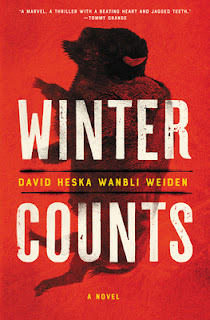
WINTER COUNTS, Native American #OwnVoices thriller


WINTER COUNTS
DAVID HESKA WANBLI WEIDEN

Ecco
$16.99 trade paper, available now

WINNER OF THE BEST FIRST NOVEL ANTHONY AWARD FOR 2021! Virtual Bouchercon award ceremonies linked to at the above.

WINNER OF THE BEST INDIGENOUS WRITER at the 2021 High Plains Book Awards.

On The Guardian’s Best Thrillers of 2021 list

Rating: 4.75* of five

The Publisher Says: A groundbreaking thriller about a vigilante on a Native American reservation who embarks on a dangerous mission to track down the source of a heroin influx.

Virgil Wounded Horse is the local enforcer on the Rosebud Indian Reservation in South Dakota. When justice is denied by the American legal system or the tribal council, Virgil is hired to deliver his own punishment, the kind that’s hard to forget. But when heroin makes its way into the reservation and finds Virgil’s nephew, his vigilantism suddenly becomes personal. He enlists the help of his ex-girlfriend and sets out to learn where the drugs are coming from, and how to make them stop.

They follow a lead to Denver and find that drug cartels are rapidly expanding and forming new and terrifying alliances. And back on the reservation, a new tribal council initiative raises uncomfortable questions about money and power. As Virgil starts to link the pieces together, he must face his own demons and reclaim his Native identity. He realizes that being a Native American in the twenty-first century comes at an incredible cost.

I RECEIVED A DRC FROM THE PUBLISHER VIA NETGALLEY. THANK YOU.

My Review
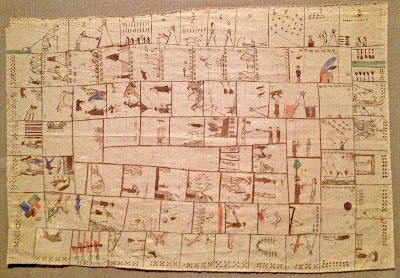
: This is a Brulé Lakota Winter Count:
This cultural tradition, extremely briefly summarized in a Wikipedia article, organizes this novel’s ideas. Virgil Wounded Horse, our aptly and prophetically named vigilante-cum-enforcer hero in this thriller, touches on this fascinating piece of (half) his ancestry’s sense of time and place often enough to make the title of the book emerge organically in the reader’s mind. Virgil muses at one point, “Winter counts were the calendar system used by the Lakota, but they weren't like modern ones. I'd loved the little pictures in the calendars, each image showing the most significant event from the past year.” He muses again, at a later point, “Winter counts. This was the winter of my sorrow, one I had tried to elude but which had come for me with a terrible cruelty.” I think both are ideas of how he, his world, and his sense of self, are in motion at all times. It makes his entire life spent in action make sense…he’s not a Lakota insider, like ex-girlfriend Marie Short Bear, whose ancestry is flawlessly pureblood and perfectly in tune with the power structure within the Rosebud Reservation. He’s not an insider in the white world, either, being a mixed-race outcast from its racist system. It’s been a blessing in that any curse can be turned into an advantage if you’re looking for a way to do it. He’s got a place enforcing justice outside white and Native American legal systems, as required.

What this means is that the character is perfect for a thriller that needs telling to get people to care about the problems heaped on Outsiders, Othered people, by all systems of government. The tribal justice system (arguably distorted by its necessary accommodation to white codes) as much as any other. Virgil is outside, and that is the perfect place to be when the upper echelon needs something done that won’t “look good.” The value of face, of taking things at face value, is something white people with our media obsession have raised to virtual apotheosis; it’s far from untrue of other cultures, however. Marie Little Bear’s tribal leadership position means he can’t directly do the effective thing against the drug cartels hooking Native kids on heroin, with the well-known tragic consequences.

Had the plague not touched Virgil’s nephew, hard, he wouldn’t have agreed to take on the violent and greedy and frankly evil people. But when it’s family, things look different, don’t they. What happens on the reservation has its roots in the not-distant city of Denver. Marie and Virgil set out to confront the ills of their corner of the world by going outside that corner, by bearding the lion in his den, and they are not surprisingly at some disadvantages there. It is as revealing to consider their troubles and issues within the white world of Denver as to examine the world of the reservation in promotion, tolerance, and perpetuation of toxic social maladjustment.

I’m impressed by the way this thriller uses its author’s straddled worlds…he’s Lakota and teaches Native American Studies at the Metropolitan State College of Denver, so clearly he’s quite adept at code-switching…as a full and integrated world for Virgil Wounded Horse. We’re not expected to see Virgil as a man out of place in two worlds, we’re expected to see a man discovering his place in his own world. It is a fine distinction, but an important one. Virgil is an outsider in each of those large, obvious social constructs. He is making his own world, one in which he is the norm, as in the end that is what we all must do to “fit in.” Where the world doesn’t have a place for you, make one.

That is the gift of this read to the reader. Join Virgil Wounded Horse in his thrilling world.
+++++++++++++++++++++++++++++++++++++++++++++++++++++++++++++++++
This post is the 1,000th on my blog! I’ve written many thousands of book reviews over the years of many truly enjoyable books. I’m very happy that, after eight and a half years, I’ve reached this milestone blog post with a review of a book I’m happy to recommend that you read as a Booksgiving treat to yourself.

Wednesday, September 1, 2021

DEER SEASON, debut novel from seasoned short-fictioneer runs Life through her paces


DEER SEASON
ERIN FLANAGAN

University of Nebraska Press/Flyover Fiction
$21.95 all editions, available today

Rating: 4.75* of five

The Publisher Says: It’s the opening weekend of deer season in Gunthrum, Nebraska, in 1985, and Alma Costagan’s intellectually disabled farmhand, Hal Bullard, has gone hunting with some of the locals, leaving her in a huff. That same weekend, a teenage girl goes missing, and Hal returns with a flimsy story about the blood in his truck and a dent near the headlight. When the situation escalates from that of a missing girl to something more sinister, Alma and her husband are forced to confront what Hal might be capable of, as rumors fly and townspeople see Hal’s violent past in a new light.

A drama about the complicated relationships connecting the residents of a small-town farming community, Deer Season explores troubling questions about how far people will go to safeguard the ones they love and what it means to be a family.

I RECEIVED A DRC FROM THE PUBLISHER VIA EDELWEISS+. THANK YOU.

My Review
: Have you looked at the cover image of this book? Go on, get your nose up to the screen...now did you notice the shape of that "D" in "Deer"? There's a clue in it.

Author Flanagan, no stranger to the "Flyover Fiction" series with two story collections in it, here gives us her first novel. It's set thirty-five years ago in a rural place that, in our own time, has doubtless vanished entirely. Farming being the corporate endeavor it is now. This time, the one we're inhabiting in this novel, feels like something from a Russian novel with peasants and kulaks and tsars in their palaces so far above us. Actually, it's just families farming land they'd inherited and living lives they don't feel embarrassed by.

The major event of the novel is the disappearance of teenaged minx Peggy Ahern. The rampant drinking culture of the area and era was the source of the problem...Peggy, too smart and too young to control it yet, was in the habit of sneaking out on weekends to partake of the big, wild world of the after-hours partying at Castle Farm. You know, as practice for when she'd be off at college.

But one fine night...the one before her little brother's going to be confirmed in the Lutheran Church, no less...she doesn't come home to have her hangover in her bed. And days go by. She doesn't come home; she isn't Found; and the town decides that Hal Did Something. Hal, big and nice-looking but sadly with an intellectual incapacity, has about an eleven-year-old's scope to understand the world. And an adult man's body, and an adult man's needs; without the wherewithal to get context of Peggy's flirting, or realize when he was going too far in responding to her. As he does for the first time at a town picnic. In front of everyone, including Peggy's drunk father.

But Alma and Clyle step in, as usual. They are his de facto parents and they, as has been their habit for a decade or more, disentangle him from the worst of the consequences. They took him on when he was still in high school, and really into their family, partially because they could never have kids. They're in their late fifties, so a twenty-eight-year-old man-child is the right age and, though Alma would bristle at the idea, his absence of adulthood soothes an ache left from desiring motherhood and not being given it.

Now, though...now the town that Clyle isn't much inclined to leave but Alma genuinely despises is in formation against Hal, their only family, their changeling chick, and despite their staunch stance in support of him they begin to wonder. After all...temper and strength of a man...no functioning social sense...pretty girl he fell for when she flirted with him....

There's a long, slow road to follow, like driving on the noisy gravel roads of the area, to get to the deeply saddening and utterly infuriating resolution to the plot. But you already know: Hal will never, ever be free of the stain of Being A Suspect. Rightly or wrongly accused, accused is enough. In the end, the resolution to the disappearance is...curiously irrelevant. Secrets get unburied in hearts that just don't open that easily. Words are said, the kind that never heal, the kind that have to lacerate for the pain to find a way out. But the world changes every day, and how many times do we get to look that change in the eyes as it comes at us? To decide, yes I will do this or no I can't be that any more. To use the horror of a life-altering misery for good; to sluice the life-long wretchedness of old and dirty hurts out.

Those moments are, and I expect all y'all know it, rare, and horrible, and greatly to be treasured.

What Author Flanagan does with this story is to make the inevitable a damn sight more high-stakes for everyone than it usually is in real life. Milo, the preteen brother, is the one who quietly and completely revamps his life. Alma and Clyle are old, but there's no need to die before you lie down! Their souls, despite never getting what they wanted, still yearn...so the world after the crisis is resolved (and the resolution made me so goddamned mad I screamed at the book) takes a deeply familiar form.

It's a funny old thing, fiction, it lets us work through our bitterest disappointments safely. It doesn't promise it'll be fun. In the case of this novel, the satisfaction of the plot's resolution is mostly schadenfreude. I know some people think there's a Sanctity about Motherhood, but I am decidedly not among them. I don't think Author Flanagan is, either. This is her third book, though first novel, all in the "Flyover Fiction" series. Her two story collections, 2013's It's Not Going to Kill You, and Other Stories, and 2005's The Usual Mistakes, all have mothers without maternal credibility in them.

I can't give the book all five stars because there are so many w-bombs dropped that I've got sleaze-shrapnel in every single one of my eyes. I don't enjoy stories with as much helplessness as this one made me feel...the fact is that from the moment we learn Peggy's disappeared, we know there can't be a Happy Ending...but this story's not about the ending. It's about the ways and means of putting a life together when you don't have a single solitary scrap of hope. It's about loving someone enough to be sure they have dinner when you'd like to brain them with a rock. It's about what happens when you can not even try one more time, then you get up and do the chores because they don't do themselves.

I would strongly encourage you to read it, to get your eyes into it. The way the world is today, we need this example of making the effort because there's work that needs doing inside, outside, betwixt and between. And Author Flanagan (her penchant for w-bombs aside) does this with assurance and in a style replete with the smallest pleasures of being in this world of the senses.

Friday, January 22, 2021

ASK AGAIN, YES is a deeply felt, carefully observed, and difficult to read tale of family crises

ASK AGAIN, YES
MARY BETH KEANE
Scribner
$17.00 trade paper, available now

Rating: 4* of five

The Publisher Says: A profoundly moving novel about two neighboring families in a suburban town, the friendship between their children, a tragedy that reverberates over four decades, the daily intimacies of marriage, and the power of forgiveness. How much can a family forgive?

Francis Gleeson and Brian Stanhope, rookie cops in the NYPD, live next door to each other outside the city. What happens behind closed doors in both houses—the loneliness of Francis's wife, Lena, and the instability of Brian's wife, Anne, sets the stage for the explosive events to come.

Ask Again, Yes is a deeply affecting exploration of the lifelong friendship and love that blossoms between Kate Gleeson and Peter Stanhope, born six months apart. One shocking night their loyalties are divided, and their bond will be tested again and again over the next 40 years. Luminous, heartbreaking, and redemptive, Ask Again, Yes reveals the way childhood memories change when viewed from the distance of adulthood—villains lose their menace and those who appeared innocent seem less so. Kate and Peter’s love story, while haunted by echoes from the past, is marked by tenderness, generosity, and grace.

I DON'T REMEMBER WHO GAVE ME THIS LOVELY BOOK, BUT THANK YOU!

My Review
: I'm not a spoilerphobe, as I've mentioned before, but there are certain events in this book that it would just rot on ice for you not to see for yourself for the first time. So there will be some tap-dancing around some events.

What matters to me in a read, the thing I seek and must find or I'm put out and feel I've been hard done by, is the sense that I'm seeing characters make efforts, take chances, do things, and as a result of whatever combination of those things the author chooses, they need to change. Not necessarily dramatically, or for the better or for the worse. But there needs to be some perceptible alteration in that character's life, sense of purpose, or station.

That is very much not a problem in this story.

Immigrant Francis is Irish to his core. He moves to New York because 1970s Ireland was not the Celtic Tiger it became decades on. His adjustment to American manners and mores wasn't easy on him, but he fell in love with the right woman and built a life with her. So that base is solid, right?

It is a truth universally recognized that people are their own worst enemies. Actions that seem, in the moment, inevitable or destined to occur are deeply stupid and cause problems it's hard to imagine. Yet here we are, with only the moment to live and as often as not without a clear understanding of the past to build on. As Author Keane says, "We repeat what we don't repair." That just rang me like a bell the first time I read it. Such a lovely, distilled way to say the truth as I've learned it the hard way.
The quiet of the house when she kept to her room was not the peaceful silence of a library, or anywhere near as tranquil. It was...more like the held-breath interlude between when a button gets pushed and the bomb either detonates or is defused. He could feel his own heartbeat at those times. He could track his blood as it looped through his veins.

Families are the prime breeding ground for things that need repair. Most often we don't see that...in ourselves, of course, since it's incredibly easy to see in others and there's even this thing called "fiction" to feed our schadenfreude watching others screw up chances to repair the damage done to us. But some damage is done in some families that is, in the truest sense of these words, irreparable and unforgivable. That's when the stories get really good.
Telling her, bringing that story to England, spoiled England for her. When she left for America two years later, she knew she would be smarter. She'd bring none of Ireland with her.

But no matter where you go, there you are, right? Our selves and our bodies are coterminous if not identical, where one goes there the other is as well. It's not always that great a feeling. But unless we repair the breaks, well...you're adults, you know already. And how sad, how burdensome is that knowledge.

The burden travels down generational rivers, too. In this story, Peter the son of truly miserable man and truly evil woman, falls for Kate the daughter of stoic parents whose inability to communicate doesn't keep them from mangling each other. There's a bad patch (!!) and the young people are separated against their wills; there's a reunion, and what flowers is a very beautiful blossom of hope and love.
He dreamed of sharing an apartment with Kate someday, coming home to her each evening and telling her about his day, hearing about hers, going to bed naked with the covers pulled up to their chins, feeling her warm skin next to his when he woke up every morning.
–and–
If they could do all those things and pay their bills and not dread going to work each morning, coming home each night, then that was a life. That was a great life, in Kate’s view. What else could there be? If they reminded themselves that these small things were enough, she believed, then they’d always be okay.

They're having different relationships. That's so often the way with couples, and sadly most often between couples freshly in love. The true emotional core of the party of the second part isn't always easy to reach, but the fact is most people don't really even ever try. It's hard. It's vulnerable. It's often met with anger or rejection or outrage. Who tries, they are abusive! Intrusive! I need my space! Who resists, they are elusive! They are secretive! Why won't you trust me and let me in?

Surviving those shoals, accommodating each other and bending to and fro, allowance-making and temperature-taking, survival...until new shoals hove into view as soon as the seas looked smooth.
And then she saw it so clearly, the whole trajectory of their lives, a twin flare of lights against the gunmetal winter sky: we're born, we get sick, we die. Beginning, middle, end. She saw her life as if held aloft by her own hand, and in an instant it spun away from her. Where did she want it to land? She was in the middle. The exact middle. Peter too. How could she have failed to notice that the beginning had come to an end?
–and–
It wasn’t that she didn’t love him, he knew. It was that she loved him so much that it frightened her, loved him so much that she worried she might have to protect herself from it. He tried to let her know that he’d figured that out, finally, that there was no need to explain, but then he realized that she might not know it herself.

It is a damn difficult thing to keep being in a present-tense relationship with someone over a long period of time.
They'd both learned that a memory is a fact that has been dyed and trimmed and rinsed so many times that it comes out looking almost unrecognizable to anyone else who was in that room or anyone who was standing on the grass beneath that telephone pole.

Allow this novel's steady pace to lead you where the story goes. Possess your soul in patience, don't get agitated and skip and flip; stand on the grass with Author Keane. Make a memory. Make it well.

Thursday, September 4, 2014

ROOSEVELT'S BEAST, damn near perfect father-and-son novel

ROOSEVELT'S BEAST
LOUIS BAYARD

St. Martin's Griffin
$22.99 trade paper, available now

Rating: 4.5* of five

The Publisher Says: 1914. Brazil’s Rio da Dúvida, the River of Doubt. Plagued by hunger and suffering the lingering effects of malaria, Theodore Roosevelt, his son Kermit, and the other members of the now-ravaged Roosevelt-Rondon scientific expedition are traveling deeper and deeper into the jungle. When Kermit and Teddy are kidnapped by a never-before-seen Amazonian tribe, the great hunters are asked one thing in exchange for their freedom: find and kill a beast that leaves no tracks and that no member of the tribe has ever seen. But what are the origins of this beast, and how do they escape its brutal wrath?

Roosevelt's Beast is a story of the impossible things that become possible when civilization is miles away, when the mind plays tricks on itself, and when old family secrets refuse to stay buried. With his characteristically rich storytelling and a touch of old-fashioned horror, the bestselling and critically acclaimed Louis Bayard turns the story of the well-known Roosevelt-Rondon expedition on its head and dares to ask: Are the beasts among us more frightening than the beasts within?

I RECEIVED THIS BOOK FROM THE PUBLISHER AS PART OF LIBRARY THING'S EARLY REVIEWERS PROGRAM

My Review: Listen to this:
After all these years, his best friend is malaria.
Even on the brink of an Alaska summer, it comes calling: a bone-deep chill one night, a ministry of sweat the next. Calling him back to old battles.
And we're off, down the River of Doubt with Kermit Roosevelt and his famous father (of whom Kermit's eldest half-sister, Alice, said, "Father wanted to be the bride at every wedding and the corpse at every funeral") and somebody scientific who, frankly, interested me not at all.

Kermit tells us about this factual trip in moderate detail, enough to make the facts of the journey come across as lived, not reported. That's a frequent issue I have with historical fiction, the author's telling of the tale sounds like a highly embellished report and not a novel. Enough is here to make the atmosphere come humidly to life; not so much as to feel ponderous. Here, like this, listen:
Here was the thing about traveling down an uncharted river: You could only say how long you'd been traveling; you could never say how long it would be.
It's the precise sort of thing I'd expect the clever son of an overwhelmingly larger-than-life father to say, to focus on distances and travels and quotidian concerns because his giant of a father (Roosevelt was maybe 5'8" in body but 12'12" in spirit) has sucked up the glory-hounding until he's simply got nothing else to think about.

And then on an overnight stop, Kermit and TR are kidnapped by a previously uncontacted native group (I do so loathe the locution "undiscovered tribe"—and who, might one inquire, determined that being contacted was being discovered, like their lives before Europeans showed up weren't real?). Their freedom can only be bought by ridding these people of their monster, a killer of Grendel-ish horrific-ness. Two days the men seek and revoltingly find the Beast's results, and only when they are living out a nightmare of misery and a cleansing, purifying agony of memory and rage do they really encounter the Beast...within, as always.

Both are shattered and neither is ever the same after this trip. (Factual again, after the invented Beast interlude.) Kermit succumbs slowly to the depression and addiction that killed his paternal uncle, and TR himself gives up, defeated for the only time in his life...and by himself, as in the end are we all. TR can't face the even the notion that anyone will ever so much as hear a whisper of his ordeal (oh, and Kermit's, but you know whose rep is foremost on TR's mind):
“You are asking us to lie, Colonel?"
"I am asking you to omit. Surely, amidst the...the infinite gradations of human venality, that particular sin ranks low." The old man kneaded the folds of his throat. "What happened out there belongs out there. The jungle has it; let the jungle keep it...”
A novel of fathers and sons, of myths and monsters, and of identity and fate. It's written in Bayard's accustomed voluptuous prose, and it's got the usual peaks and valley in plotting. I myownself wish that the Beast had been nailed down, shown to be either real or a projection of mass psychosis or a deeply experienced malaria dream. Nonetheless, I'm sure many will find this blurring of borders exactly to their taste, and even those among us for whom that's not the draw to the story needn't let it cause us too much pain. Simply decide for yourself what interpretation you want to put on it, and do so. Bayard's story will support it.

And that's about the best compliment I can give a writer, that one there.