Pages
- Home
- Mystery Series
- Bizarro, Fantasy & SF
- QUILTBAG...all genres
- Kindle Originals...all genres
- Politics & Social Issues
- Thrillers & True Crime
- Young Adult Books
- Poetry, Classics, Essays, Non-Fiction
- Science, Dinosaurs & Environmental Issues
- Literary Fiction & Short Story Collections
- Sookie Stackhouse/Southern Vampire Books & True Blood
- Books About Books, Authors & Biblioholism
Showing posts with label violence against women. Show all posts
Sunday, May 10, 2026
LYNDA DREWS' PAGE: Disposable Wives: Murder and Menace in Green Bay's Rural Belgian Settlement; The Maid and the Socialite: The Brave Women Behind Green Bay's Scandalous Minahan Trials
DISPOSABLE WIVES: Murder and Menace in Green Bay’s Rural Belgian Settlement
LYNDA DREWS
Little Creek Press (non-affiliate Bookshop.org link)
$17.95 paperback, preorder for delivery on 12 May 2026
Rating: 4.25* of five
The Publisher Says: In the quiet Belgian farming settlements near Green Bay, Wisconsin, whispers traveled faster than truth.
At the center of it all stood Jean Philippe Soquet—a man known by many names: the Bay Settlement Bruiser, the Belgian Archfiend… and, to some, a murderer. Over four decades, suspicion followed him, especially in the wake of multiple disturbing deaths and disappearances—including those of three of his wives.
What began as gossip soon hardened into something far more troubling.
Determined to uncover the truth, Pauline Villiesse—sister to Soquet’s third wife—refuses to let the past be buried. With the help of Xavier Martin, a respected translator navigating both language and loyalty within the Belgian immigrant community, she begins a relentless pursuit of justice.
Set in the decades following the Civil War, this riveting true story reveals a world shaped by faith, survival, and tightly bound traditions—where secrets are protected, reputations are everything, and justice is far from guaranteed.
Through courage, persistence, and an unyielding search for truth, Pauline and Xavier confront a chilling question:
How many lives can be lost before a community is willing to see what’s been there all along?
I RECEIVED A DRC FROM THE PUBLISHER VIA NETGALLEY. THANK YOU.
My Review: Male privilege is still unassailable, though that is steadily eroding. Hence the hysterical white-male rear guard action being waged by the reactionaries in this century. This is, they know, their final opportunity to avoid the reckoning for their multitudinous crimes against everyone not them.
As one who has benefitted from the privilege they've abused for millennia, i say bring the reckoning. Make it impossible for this hideous pattern of abuse to recur this generation. #ReleaseEpsteinFiles
The facts of Jean-Philippe Soquet's life are hard to stomach even at over 150 years' remove. The crimes he committed, and many we no doubt still don't know of, will call forth the horrified revolted rage that, in the twenty-first century, we're feeling as the Epstein Files slowly, inexorably, come to light. Apologists for Soquet's crimes pointed to his undeniable good works. That merely proves the ancient truism "bad people can do good things just like good people can do bad things" is never not accurate. It also follows that the actions don't change the essence of the person. Soquet's evil murdering heart did good too? Take that up with your god on Judgment Day.
I read this précis of a *mountain* of research done by the author. I came to the conclusion that Jean-Philippe Soquet was a sadistic, murdering scumbag, and no amount of good he did as well changes his status as an evil murdering bastard.
It's a tough read because it's so well sourced. It's stunning that male privilege has operated, and still operates, so well that even murder is...swept away, forgotten, ignored...because the remorse-free murderer does some objectively good things. How many women must die, lose their "one wild and precious life" in Mary Oliver's deathless formulation, before it matters more than someone's pallid do-gooding?
I've decided for myself: one.
Let justice be done at long last. It won't raise the dead. It might help heal the affected. That alone makes reading the case against a long-dead man for his crimes worth your time.
++++++++++++++++++++++++++++++++++++++++++++++++++++++++++++++++
THE MAID AND THE SOCIALITE: The Brave Women Behind Green Bay's Scandalous Minahan Trials
LYNDA DREWS
Little Creek Press (non-affiliate Bookshop.org link)
$17.95 paperback, available now
Rating: 4.25* of five
The Publisher Says: In the shadows of progress, two women's stories were erased. Until now.
What if a respected surgeon could destroy your life with just one diagnosis?
In early 20th century Green Bay, Wisconsin, this terrifying reality was all too true for two women. Mary, an illiterate maid, and Mollie, a college-educated socialite, fell victim to the physical violence and mental abuse of celebrated surgeon Dr. John R. Minahan. To silence them, he claimed they had the shameful and dreaded disease of syphilis. This is the first full account ever written about Dr. Minahan, whose wealth built a college stadium, science hall, and six-story office building—all named for him—while history lost, or perhaps erased, Mary’s and Mollie’s heroic stories.
Until now.
Eerily mirroring contemporary debates around gender equality, misinformation, and wealth disparity, this tale remains alarmingly relevant. It is a story of power, abuse, and the tireless pursuit of justice. Delve into this haunting yet inspiring historical tale to uncover the forgotten stories of Mary and Mollie, two courageous women who dared to stand up against a powerful adversary.
I RECEIVED A DRC FROM THE PUBLISHER VIA NETGALLEY. THANK YOU. CW: repeated violations of bodily autonomy
My Review: I have never been interested in Green Bay, Wisconsin; never thought much about it; never considered the idea that it, all hundred-ish thousand people in and around it, would have "socialites" because that suggests to my mind big-stage dramatics. Football, whether US or FIFA interpretations of it, bores me. So, no...not the instantly obvious reader of the book, me.
The publicist offered it to me, and because I've come to trust their take on the kind of stories I enjoy reading, I said yes. Thanks, Shaun! I owe you one.
John Minahan was a bounder, a cad, and a creep. I'd say he'd be diagnosable as a malignant narcissist in the twenty-first century (aren't all rapists, though? serious question). In his lifetime I suspect people thought of him, quietly and privately, as a thin-skinned bully. Feminists are likely to see in him a flattened caricature of "Manliness." The author, clearly a subject-matter expert more well-informed than the man himself on his pathologies, presents a vast body of details that support all these views of him. The gestalt of the (possibly too many) facts s wisely left to you to decide. She has an opinion but presents it as such, not as incontroverible fact.
The sheer volume of awfulness detailed by Mary and Mollie makes difficult reading. Obviously that is a vanishingly small concern compared to the living hell the perpetrator inflicted on his victims, and got away with doing so because they are women. When these two women stood up to him, and brough the receipts to show him up, he pulled out the V-card used against women since time immemorial: he accused them of having VD...syphilis...to show them as being un-Virtuous therefore deserving everything they said he did, but of course he didnt because un-Virtuous women lie to get back at men but even if he did they deserved it.
Does any of this, any part of this playbook, sound at all familiar?
Reading about the trial, the havoc that any legal proceeding wreaks on the lives and the mental health of the innocent and the guilty alike, makes me feel so hugely grateful to Virginia Giuffre for her astounding act of tenacious courage.
#OnlyRedactVictims
In this time of reckoning, it behooves all of us to learn the history of abuse suffered by our ancestors. Painful it is, necessary it must become.
Friday, December 5, 2025
THE GIRL IN THE MIDDLE: A Recovered History of the American West, the cost of Empire in focus
THE GIRL IN THE MIDDLE: A Recovered History of the American West
MARTHA A. SANDWEISS
Princeton University Press (non-affiliate Bookshop.org link)
$32.00 all editions, available now
Rating: 4.5* of five
The Publisher Says: A haunting image of an unnamed Native child and a recovered story of the American West
In 1868, celebrated Civil War photographer Alexander Gardner traveled to Fort Laramie to document the federal government’s treaty negotiations with the Lakota and other tribes of the northern plains. Gardner, known for his iconic portrait of Abraham Lincoln and his visceral pictures of the Confederate dead at Antietam, posed six federal peace commissioners with a young Native girl wrapped in a blanket. The hand-labeled prints carefully name each of the men, but the girl is never identified. As The Girl in the Middle goes in search of her, it draws readers into the entangled lives of the photographer and his subjects.
Martha A. Sandweiss paints a riveting portrait of the turbulent age of Reconstruction and westward expansion. She follows Gardner from his birthplace in Scotland to the American frontier, as his dreams of a utopian future across the Atlantic fall to pieces. She recounts the lives of William S. Harney, a slave-owning Union general who earned the Lakota name “Woman Killer,” and Samuel F. Tappan, an abolitionist who led the investigation into the Sand Creek massacre. And she identifies Sophie Mousseau, the girl in Gardner’s photograph, whose life swerved in unexpected directions as American settlers pushed into Indian Country and the federal government confined Native peoples to reservations.
Spinning a spellbinding historical tale from a single enigmatic image, The Girl in the Middle reveals how the American nation grappled with what kind of country it would be as it expanded westward in the aftermath of the Civil War.
I RECEIVED A DRC FROM THE PUBLISHER VIA EDELWEISS+. THANK YOU.
My Review: One image, not typical of Alexander Gardner the Civil War photographer's work, sent Martha Sandweiss on an intense journey of genealogical and historical research. Author Sandweiss is an archive-divin' fool in this book. As you'd expect from this book coming out via Princeton University Press, the evidence is in the sixtyish pages of endnotes. Impressive recordkeeping, impressive intensity of trolling the census data, genealogy databases, newspaper morgues, Federal records of official actions...I'm very slightly overawed by the depth of Author Sandweiss' commitment to her search for one child's identity when, at the time, it's clear she was unimportant.
Yet she was there...why?
I could easily see the intrigue; I could not match the dogged pursuit of facts. In any lifetime. The revelation that there had ever been a Federal Peace Commission (made up of those white guys in the photo), tasked with meeting Native people from all groups, was news to me. That its mission was to determine the course that would bring about lasting and just peace shocked me...talk about honored in the breach not the observance! So the book expanded my knowledge about the injustice, the lies, and the chicanery that acquiring our empire necessitated.
Sophie Mousseau, the titular girl in the titular middle, serves as a lens for Author Sandweiss to bring the role of women, Native and settler, in the wars and peaces of that time and place into focus. It was all new information to me, so I enjoyed the whole experience...despite the expected violence against women, it was reported not detailed for titillation.
I'd rate the read a full five were it not for some...unusual...thoughts the author had about the nature of photography....
Friday, August 8, 2025
EMPTY CAGES, latest read from Hoopoe Books for #WITMonth
EMPTY CAGES
FATMA QANDIL
Hoopoe Books|American University in Cairo Press (non-affiliate Bookshop.org link)
$18.99 ebook, available now
Rating: 4.5* of five
The Publisher Says: Winner of the Naguib Mahfouz Medal for Literature, Empty Cages is an urgent and raw confessional of memory and family and all that is lost and won in one woman's lifetime
The discovery of an old tin of chocolates, its contents long ago devoured, marks the entry into this intimate story that reaches back through a lifetime of memories in search of self and home.
In celebration and suffering, triumph and disappointment, Qandil’s voice is unflinching, revealing both a determination to speak the truth and a poetic sensitivity that is disarming. Reflecting on a family disintegrating—and with it, perhaps, a whole way of life—memories of a happy childhood melt away to reveal the fecklessness of selfish older brothers, a father’s addiction, a mother’s illness, and the violence and death—both literal and figurative—of those nearby.
Recipient of the Naguib Mahfouz Medal for Literature, this stunning fictional debut marks the arrival of a stunning new voice.
I RECEIVED A DRC FROM THE PUBLISHER VIA EDELWEISS+. THANK YOU.
My Review: Lyrically examining disappointment as a goad to seek one's own path is not an ordinary novelistic choice. Author Qandil chooses that course in this story of Fatma designing a life that suits her, that agrees with her, and that excludes the always unpleasant reality of family failures and failings. Quite radical for a woman in Egypt...or anywhere for that matter...to choose.
I can see the reasons Author Qandil was awarded a literary prize, and it is meet and right that she should receive one named for Nahfouz. Adam Talib has rendered her prose into fluid, mellifluous English, so I can feel the richness and harmony of her native language underpinning the translation. The story commences with meditations on a Cadbury's chocolates tin, and for several pages we follow Fatma's thoughts and memories as they swirl and coruscate to form a story out of what I'd see as trash.
When poets write prose it can be a beautiful gift. Poet and novelist Qandil's story exemplifies this in her (I assume, perhaps incorrectly) autobiographical novel. I was never sure, nor do I feel I was expected to be, how much Fatma was Everywoman, and how much was generalized from the unending fight against the plight of women in a patriarchal world.
That plight is exemplified by novel-Fatma's cultural expectation of her advantageous (to the men in her family) marriage. She bears much cultural weight in coping alone (dead mother, only girl) with her addict father and her unbearably narcissistic brothers. Marriage she flatly rejects. Takes bold, brassy confidence to do that, and succeed...yet never trigger a violent backlash in a world around her that is steeped in misogynistic violence.
Mostly.
Whenever you read a passage and think, "oh, that means this," don't get too invested in that interpretation. Author Qandil does not traffic in certainty or security or any other absolutes. Her story is smoke, water, sunlight...smooth to look at, seeming solid from this way or that of examining it, but grasp it and end up with something you did not expect left in your hands.
That, my friends, is how you know you're seeing Art being made before your dazzled gaze.
Why not five stars? Some details are culture-specific enough as to require explication that does not happen. I think none are holes that make the story unrelatable, just smaller moments that add nothing in English but feel like they did originally. If they did not, then the docked half-star stays the same.
Wednesday, March 5, 2025
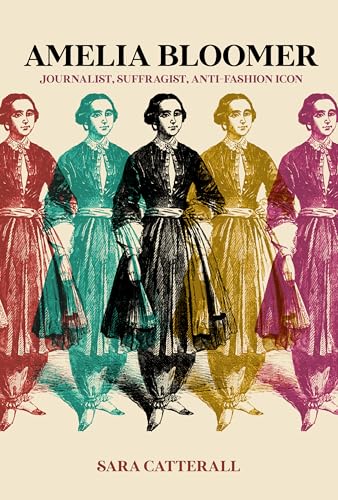
AMELIA BLOOMER: Journalist, Suffragist, Anti-Fashion Icon, a woman of moral certainty and impeccable rectitude who rebelled hard
AMELIA BLOOMER: Journalist, Suffragist, Anti-Fashion Icon
SARA CATTERALL
Belt Publishing (non-affiliate Bookshop.org link)
$11.99 ebook edition, available now
Rating: 5* of five
The Publisher Says: A fascinating look at an underappreciated woman in American history whose newspaper fostered a national conversation on women's issues.
Those who recognize the name Amelia Bloomer usually do so because of bloomers, the clothing item named after her. While she was a rational dress advocate for a time—calling on women to abandon rigid corsets and heavy petticoats and opt for long trousers, shorter skirts, and sensible boots—it was "but an incident" in the larger story of her life and impact.
Bloomer edited and published The Lily, the first newspaper for and by women. Much like Bloomer herself, it started as a temperance rag before broadening to include some of the most important issues to women in that day, including the right to vote, and included contributions from thinkers like Elizabeth Cady Stanton. The groundbreaking paper brought the conversation from Seneca Falls right to the doorsteps of women across the expanding nation.
Guided by a rigid sense of morality and a Puritan work ethic, Bloomer remained open-minded to new ideas. She refused to be swayed by social norms and wrote cutting responses to those who tried to intimidate or shame her and her friends, a group that included Stanton and Susan B. Anthony. This deeply researched biography by Sara Catterall follows the many chapters of her life: her humble upbringing in upstate New York, her role in the temperance movement (and its true legacy as a wellspring of the women's rights movement), her years at The Lily, her groundbreaking position as deputy postmaster in Seneca Falls, her troubled health, and her eventual move to Council Bluffs, Iowa, where she continued to move the needle on women's suffrage in the more flexible new governments of the West.
I RECEIVED A DRC FROM THE PUBLISHER VIA EDELWEISS+. THANK YOU.
My Review: It had never creased my cranium that Amelia Bloomer was a temperance crusader before I read this book. Given that my mother the abuser never drank, and I had one boyfriend in my life who ever raised a hand to me and that never happened while he was drunk, temperance just did not ever cause me to think "good idea". All my associations with Mrs. Bloomer were around her ideas regarding the idiotic way women were caged inside their clothing during this era. Corsets really are the bound feet of Western culture.
I was utterly unprepared to meet this wildly different Bloomer. She was a woman of her time, in many ways moreso than the more famous ladies like her friends Stanton and Anthony...both of whom she knew from living in Seneca Falls, New York, and each of whom influenced her increasingly radical thinking about women's suffrage...as she was married with children and required to earn her living alongside her husband as best she was able while still raising children. Dexter and she were co-workers, as he hired her to work alongside him as a postmaster after his stint as a Whig-supporting newspaper editor landed him the job. A government salary for a woman no less!
Her position as a temperance crusader led her to make the connection that the only way to stop the unregulated flow of alcohol was to exert political pressure to regulate it. That was impossible, on a practical level, absent votes for women. (She didn't live to see Prohibition and its horrifying unintended consequences.) So her rational dress and votes for women all owe their influence on US culture to her christian temperance-movement work. It was spread wider than Seneca Falls by her opening The Lily, a newspaper for and by women that she, despite raising children, suffering chronic illness, and a complete lack of training except by Dexter's example from his newspaperman days. I am *gobsmacked* by her rigidly moral outlook leading her so far in opposition to the stupid cultural norms of "appropriate" behavior for women in a time where they were so very much more entrenched and enforced than they are now.
At this moment in US, and more broadly Western, political history, the example of a woman who looks at the world as she finds it, judges it harshly for its failings, and—at considerable personal cost to herself and her family—sets about opposing that world continuing down its present path, is invaluable. I'd also like to point out her starchy morality was inspired by an upbringing conventionally religious yet her response to it was radically, vocally, and consistently to apply its moral precepts in full and without exceptions.
If more christians were like Amelia Bloomer, the world would be a better place.
I did indeed just say that. Her acerbic wit, another surprise this book held for me, was deployed against obtuse and obnoxious followers of orthodoxy. Yet Mrs. Bloomer's touch with connecting to people who genuinely did not understand the stakes she saw so clearly in the direction society was heading was exemplary. She met those people on their own ground, without preaching or hectoring. I can only envy that skill; I myownself climb onto my ever-present high horse because I'm Right, that ever-losing strategy. Mrs. Bloomer's tone was always respectful...until she sensed ill-will or disingenuousness.
I knew exactly nothing of the substance of her life until Belt Publishing brought out this book. (I also now know that Dexter Bloomer wrote a biography of her in 1896, so I'll Gutenberg that up here directly.) Author Catterall and her publisher are to be praised, and I hope supported with purchases, for telling this unjustly neglected monadnock of probity and moral clarity's story to a needy new generation of readers. All five stars for bringing modern attention to this person from our past with so much to teach us for our future. It's involving prose, built on solidly shown foundations of information.
Sunday, January 8, 2023
SWEET, SOFT, PLENTY RHYTHM, reckonings are brutal...on everyone involved & I FEAR MY PAIN INTERESTS YOU, young feminist's récit
SWEET, SOFT, PLENTY RHYTHM
LAURA WARRELL
Pantheon Books
Trade Paper $17.00, available now
LONGLISTED for the 2023 Andrew Carnegie Medal for Excellence in Fiction!
One of NPR's Best Books of 2022!
Rating: 2.5* of five
The Publisher Says: It’s 2013, and Circus Palmer, a forty-year-old Boston-based trumpet player and old-school ladies’ man, lives for his music and refuses to be tied down. Before a gig in Miami, he learns that the woman who is secretly closest to his heart, the free-spirited drummer Maggie, is pregnant by him. Instead of facing the necessary conversation, Circus flees, setting off a chain of interlocking revelations from the various women in his life. Most notable among them is his teenage daughter, Koko, who idolizes him and is awakening to her own sexuality even as her mentally fragile mother struggles to overcome her long-failed marriage and rejection by Circus.
Delivering a lush orchestration of diverse female voices, Warrell spins a provocative, soulful, and gripping story of passion and risk, fathers and daughters, wives and single women, and, finally, hope and reconciliation, in answer to the age-old question: how do we find belonging when love is unrequited?
I RECEIVED A DRC FROM THE PUBLISHER VIA NETGALLEY. THANK YOU.
My Review: It depresses me to say this, but this book was...despite truly, deeply impressive writing...
The girl may have been the end for him....lovely and fully sensory-universe-planted but, and this is the crux of the matter for me, it's about a man.
That the wind shifted and sent a chill across her freshly cleaned skin so that she sensed her own solitude in a way that no longer frightened her as she walked bare and unhindered toward what was new.
A group of women have different relationships with one man.
Ground-breaking stuff, no? Never read anything like it before! Except about half the Western canon. Women circle Circus, whose name suggested to me clownishness that I found ample evidence for. They *keep* circling Circus no matter what. And, folks, if there ever was a man whose actions and inactions invalidated his Manhood Card℠, it's Circus. He never met a responsibility he didn't shirk.
But his Art! is usually the rallying cry I hear. His art my lily-white one. He's a bog-standard self-absorbed arrested adolescent, probably a libertarian and a religious nut although those are my own interpolations, with a good line of patter and some skills in sexual gratification.
He is, bluntly, the kind of person I look down on and the kind of character I am deeply sickened to see recrudescing on best-of lists and getting all sorts of happy talk said about it. He's a serial cheater, an emotional abuser, and an unworthy object of our cultural attention because his brothers are teeming like maggots on a shit-pile, exuding their spurious shine that so many seem to see as attractive when it's actually the slime they secrete to slip out of any kind or sort of commitment that inconveniences, annoys, or bores them.
Yuck.
++++++++++++++++++++++++++++++++++++++++++++++++++++++++++++++++
I FEAR MY PAIN INTERESTS YOU
STEPHANIE LaCAVA
Verso Fiction
$19.95 trade paper, available now
Rating: 2.5* of five
The Publisher Says: A punky, raw novel of millenial disaffection, trauma and 1960s cinema
Margot is the child of renowned musicians and the product of a particularly punky upbringing. Burnt-out from the burden of expectation and the bad end of the worst relationship yet, she leaves New York and heads to to the Pacific Northwest. She's seeking to escape both the eyes of the world and the echoing voice of that last bad man. But a chance encounter with a dubious doctor in a graveyard, and the discovery of a dozen old film reels, opens the door to a study of both the peculiarities of her body and the absurdities of her famous family.
A genre-bending, atmospheric and emotionally honest account of a young woman's investigation into her past and the complex reactions of her body.
At once an analysis of the abandoned 1968 Cannes Film Festival and a literary take on cinema du corp, Stephanie LaCava's new novel is an audaciously sexy and moving exploration of culture and connections, bodies and breakdowns.
I RECEIVED A DRC FROM THE PUBLISHER VIA EDELWEISS+. THANK YOU.
My Review: ...and now for something marginally different...
Screwed-up child of famous parents is failing at Life because Trauma and she's got these awful habits that substitute for character and her whole head...this is a récit, not really a novel because the whole point is that we don't leave the lady's head and are reminded of it...is stuffed with shards of images and sounds and they all sort of coalesce into an image of...
...I have no way to finish that sentence. I didn't get an image from Margot's chaotic maunderings.
Yet again there are men at the center of her trauma. Men: Don't have relationships with women. It doesn't go anywhere good. You'll end up blamed for something and quite possibly sued.
That's my main take-away from this mishegas. There's no way for me to pluck a piece of the text out for your perusal because they all rely on each other, in a cumulative-effect way, for their power. I will say that, as little as I enjoyed the story I was quite interested in the way the author assembled the shards into an effective mosaic. Brightness, shadows, saturated colors; a vague grey smog of dissociation surrounding it, getting between the bright moments, eclipsing some of them. It's an interesting effect.
But the problem is it's telling me an oft-told tale of poor-little-rich-girl and I'm just not interested. Handed a life of family connections and a modicum of talent? Use 'em or reject 'em, but wallowing along in the gutter next to the highway and under the sidewalk is a choice for people like Margot. So I don't see the point of empathizing with her. "Make a different choice" is the callous, dismissive response Margot elicits from me.
Yet I read the whole book....
Sunday, November 7, 2021
THE COLOUR OF MILK, a delight of a short novel about a horror of a short life
THE COLOUR OF MILK
NELL LEYSHON
Ecco (non-affiliate Amazon link)
$8.99 Kindle edition, available now
Rating: 5* of five
The Publisher Says: Mary is a sharp-tongued farm girl, and she will do anything to learn to read and write. But as she does so through four seasons of one extraordinary year, she discovers that nothing comes for free. Told by a narrator whose urgent, unforgettable voice will break your heart, The Colour of Milk is an astonishing novel.
I CHECKED THIS EBOOK OUT OF MY LOCAL LIBRARY. SUPPORT YOUR LIBRARIES, FOLKS! THEY NEED US TO USE THEIR SERVICES!
ALL SPOILERS...ALL THE TIME...SPOILERS BELOW! THE PHOBIC ARE WARNED OFF!
My Review: First, read this:
this is my book and i am writing it by my own hand.
in this year of lord eighteen hundred and thirty one i am reached the age of fifteen and i am sitting by my window and i can see many things. i can see birds and they fill the sky with their cries. i can see the trees and i can see the leaves.
and each leaf has veins which run down it.
and the bark of each tree has cracks.
i am not very tall and my hair is the colour of milk.
my name is mary and i have learned to spell it. m. a. r. y. that is how you letter it.
I am utterly besotted with this book. My bookish friend Katie is the one who gets the blame, I mean credit!, for convincing me to try the read. It is short, and it has something I can't describe to you adequately that rings me like a bell. I think, I guess, it's a sense of the passionate urgency Mary feels in learning her letters...like that act, that piece of knowledge, will transform her, will make everything Different. If nothing else, it will give her a leg up on her noxious sister Beatrice.
Her life, Mary's, is about what you expect a woman's life to be at that time and in that class. It is nasty, brutish, and turns out to be short. It is simple, and it is without ornament. It is, in short, a titanic waste of the brain of a clever woman like Mary. As her story begins, she is sold by her father to the local vicar as a caretaking maid-of-all-work for the vicar's housekeeper. His wife is terminally ill, and there's no one whose job it is...no child, no sibling...to muck in and do the labor of cleaning the invalid, her bedding, keeping her as entertained as possible; the housekeeper needs the extra hands. The vicar? Men did not (and do not, by and large) do that sort of work.
Mary's waspish, direct honesty isn't easy. Not for her...it leads those around her to anger, more often than not...and not for the world she lives in. Making honest observations about the facts of life is not a fast way to make squads of pals. Mary's sisters don't much like her, her mother can't be arsed to care about much that isn't making her husband the drunken shit as happy as possible, and Mary's grandfather (her father's father) is crippled by an accident so despite his pleasure in her company he isn't much help to Mary in navigating the world.
What happens as Mary assumes her duties in the vicar's household is the oldest story in the world. She's raped. She isn't, however, going to put up with that, and that's what makes this story a five-star read for me. Mary serves up her revenge and takes her punishment with her eyes open, her chin up, and her heart unburdened by regret.
I fell in love with Mary from page one. If you read the above quote, which is from the beginning of the book, and do not feel the appeal, are not vibrating with the language's power, then skip the read. It won't get better...the story's really simple, it's unsurprising, and it's only half the point. The other half is the storytelling, the sense of being there with Mary. We're hearing a voice that shouldn't have reached us from a person who didn't matter when she was alive so she wouldn't have been allowed to leave a record after her death.
It's such a simple tale. It's such an oft-told tale. It's a beauty, because it's got something extra, a little trick up its sleeve, that thing that makes a story taller in the saddle. The risk is how many people will be put off by it. They will find it a gimmick, but I found the storytelling an enhancement of an otherwise unremarkable story a young woman writing about her unhappy, unjust, and in the end short life of work, abuse, work, abuse, rape, punishment; it's lifted to its next, finer level. It's about Mary's indomitable will, her absolute uncompromising need for More. I resonate to that story. The other, I don't.
And that's why I love it, instead of merely thinking it was an interesting, not always successful, stylistic experiment. (How does Mary know how to spell some of the complicated words she uses, eg "hierarchy"?) The effort to bring an unpolished and unmediated voice to life is doomed to artificiality, of course, since this is fiction and not a research project. But the mannerisms were successful in breathing life into a character whose essential reality overcame, for this testy old reader, the inevitable awareness of the story as construct, as artifact.
So I'll shout my thanks westward to my friend in New Jersey...the same one who warbled me into reading The Mercy Seat!...whose recommendation of the story was sufficiently enthusiastic as to make my read necessary. Thank goodness my library had an ebook available. I would've been much the poorer for not having Mary along for the ride into the rest of my reading life.
A story, a character, a book like this is a treasure. Get it, if you can.
Monday, October 11, 2021
UNDERNEATH, brutal yet concise true-crime novel about Mother & SHELTER, psychological horror in Australia
UNDERNEATH
LILY HOANG
Red Hen Press
$16.95 trade paper, available now
Rating: 4* of five
The Publisher Says: Martha Johnson wants to be a good mother and a devoted wife. It’s all she’s ever wanted in life, and she tries her very best, but when her husband threatens to leave her, her desperation reveals only one strategy that can save her family, punish her ungrateful husband, and earn power: murder.
Over a five-year period, Martha Johnson murders her four children, one by one, in order to punish her husband when they argue, but Martha is no ordinary serial killer. She murders her children by using the bulk of her 250-pound body to suffocate them. Unlike other fictionalized true-crime novels, Underneath neither valorizes nor focuses on the specific acts of violence. Instead, it attempts to understand how feelings of powerlessness, the residue of trauma, and the need to find justice in a world that refuses to give a fat body justice finds its only respite through murder.
I RECEIVED A DRC FROM THE PUBLISHER VIA EDELWEISS+. THANK YOU.
My Review: Disturbing story of disempowerment's most extreme and appalling cost. That it is based on a true story made me feel ill.
...I'm pretty sure this isn't purgatory, either. It's more just like, extension. Continuation. We the murdered continue on, right underneath the living, but we aren't alive anymore. We're just here: bodies, but not bodies, too. So far as I can tell, the living can't see or hear or feel or smell us, but sometimes, if I get close enough to Martha, I swear she can taste me. ... Because we were murdered, this is our punishment.
As one expects from stories published by Red Hen Press's Kate Gale, monadnock of the LA literary publishing scene for {undisclosed} years now, there is a weird and unsettling tension between the lovely language and the sheer awfulness unfolding inside those pretty phrases and unnerving images. Why should the murdered, especially these child-victims, be made to suffer punishment? Discuss amongst yourselves after reading this intensely book-clubbable book.
Incest...prostitution...child-murder...maternal child abuse...domestic violence...and told through a dead child's point of view. "Is this old man round the bend for good?" I hear y'all thinking, as you read my sentence above about the book being "intensely book-clubbable." No: I'm hoping to make it plain to you that this story is so viscerally real, so eye-wateringly honest about the actual experience of mothering for a not insignificant segment of women, that y'all bougie book clubbers could do with a corrective lens to all the saintly, rise-above-it-all, succeed succeed succeed "women's fiction" guff that gets Oprah'd and Reese'd. Please note that I am not attempting a knock on these book clubs, they are hugely popular for a reason and their choices are not all in one and only one vein...but they are very fond of a certain type of story (described above) and return to books telling it quite often. Don't fix what ain't broken.
I want people to look past the usual and see the raw edges where things have failed and fragmented in different ways. Where the fault lines that exist in much of the world go at a different angle. I include myself in this, as my periodic reviews of *shudder* poetry and *urp* YA stories demonstrate. Successful for me or not, these reads are in areas I'm hell-bent-for-leather not to ignore simply because I so very often find them...unpleasant...to read. As I've said many times, I do not want to die above the neck before I die below it. So I'm out there sayin' "yes" when people offer me the damn things instead of running away like I want to...challenging my prejudices is the only way I know to prevent them from becoming part of the bone structure.
With Underneath, Author Hoang very much did that kind of challenging. We're not innocents, readers all, we've read The Lovely Bones and/or seen its movie. Dead narrators in fiction go a long, long way farther back in time than that. I'm not sure this take on the story she's telling here, a sort of slo-mo In Cold Blood, is one I'd've recommended to her. (I sure as hell wouldn't've recommended using w-bombs.) But when you're fully in the flow of the story you can see why this choice was exactly right, and possibly the only one she could have made. There was no other structure which would've enabled the Bernice-to-Martha-to-Arlene transmission of woman-violence to come clear. It needed an eyewitness whose eyes weren't in the same place they used to be. Like, Earth.
The pace of storytelling...well...I don't exactly know what to tell you. This isn't a novella, but it's not a long book. It doesn't linger on any scene. It simply is Arlene...talking to you. The story seems, in my experience of reading it, to tell itself to you in some peculiar way. Maybe the narrator being a child, who specifically says she's a child but one whose, um, existence after death keeps her learning, is so disorienting that the story becomes more of presence than she is? I can't be sure...but to me, the story was its own narrator, and it called itself Arlene. (If that makes any sense to you, could you explain it to me?) It doesn't repeat itself. It doesn't leave stuff out (for long). It's got a pull like a river's current, not dramatic but inexorable and powerful, like it won't let you go once you're there.
So go with it.
The structural facts of a novel told in vignettes...in discrete story-slices, layered with the sadness that floats under the surface of the ever-expanding skin of mother eating, of child growing, of marriage to a man who loves only what he needs and not what he wants bloating as its death-gases seek escape...is irregular, like the crumb structure of the best bread is. Not for Author Hoang, writing about cake...endless cakes made and eaten, made and eaten, never ever shared...the dense, regular, sweet crumbs left on an unused party-plate. The coarse and unappealing crumbs, food for scavenging ants, of hollow-sounding adulterated loafs of dollar-store bread; these make Martha's and Arlene's lines as they slip and catch and form shapes no one wants to see, just sweep into a trash can or, at best, into a crumb-catcher for possible crushing and reuse after they're fully hardened and useless as food in themselves.
There is a crisis in this world. It's a crisis of unlove. There are so many, many people in the world who are unloved. Who can't love or return love or even conceptualize it. They're incapable of it; they need it the more desperately because of that. But they don't and can't and won't get love. They are love-less. Bernice? Martha? Even, in the end, Arlene...love-less. Love, you see, isn't a word or a fancy chocolate bar, or a birthday card. It's action, investment of time and emotion. And the tragedy, in the ancient sense as well as the modern, of this story is that It. Is. True.
Beautiful sentences telling a dreadful, tragic tale of love, in its absence and its perverse, incomprehensible to normies, twisted shapes. Read this and be very, very glad you are none of these people.
Read this and shudder to your bones: You are all of these people. Happy Spooktober.
++++++++++++++++++++++++++++++++++++++++++++++++++++++++++++++++
SHELTER
CATHERINE JINKS
Text Publishing (non-affiliate Amazon link)
$15.95 trade paper, available now
Rating: 4* of five
The Publisher Says: Meg lives alone. Her little house in the bush outside town is the perfect place to hide. This seclusion is one of the reasons she offers to shelter Nerine, a young women escaping an abusive ex-partner. The other is that Meg knows what it’s like to live with the looming threat of a violence at the hands of someone you love.... Nerine is jumpy and her two little girls are frightened. This tells Meg all she needs to know about where they’ve come from, and she’s not all that surprised when Nerine asks her to get hold of a gun. But she knows it’s unnecessary. They’re safe now. Or so Meg thinks… Then she starts to wonder about some little things. A disturbed flyscreen. A tune playing on her windchimes. Has Nerine’s ex tracked them down? Has Meg’s husband turned up to torment her some more? By the time she finds out, it’ll be too late to do anything but run for her life.
I RECEIVED A DRC FROM THE PUBLISHER VIA EDELWEISS+. THANK YOU.
My Review: Remember the first time the old aphorism, "No good deed goes unpunished," held real, tangible, awful Truth for you? Strap in....
Meg is the kind of friend you hope you'll have in an emergency or crisis. She's been there, she's done what she could, realizes how important the mere fact of showing up is. She'll give you shelter, she'll offer support, she will feed you and listen to you and Be There in the psychological, supportive sense of the words.
That's because she did not get those things when she so badly needed them during her devastatingly abusive marriage.
Nerine and her two daughters are, as we're shown, in a situation where Meg, her home (which she's ever so aptly named "Bolt Hole"), and her way with others are just exactly what they need. In they come; settle they do not. Nerine is in constant motion, constantly talking taking talking about how horrible the girls' father is (right in front of their scared little faces), how bad their lives were, how the courts have...insanely, incomprehensibly...given this vile predatory abuser visitation rights! Can you even imagine! she asks Meg, never waiting for an answer.
Then the nightmare turns real...awful things having been said, there are suddenly weird and unnerving things happening...frightening but, as yet, not violent things...footprints and noises where and when they shouldn't be, and all the time Nerine's talk talk talk about the horrors of the past makes little Analiese and Collette, her very young daughters, scared and jumpy. Meg, a grown woman with an estranged daughter living in England (can't forgive Mum for staying with the awful narcissistic personality disorder-having Dad), empathizes with all three, tries her best to distract and entertain the girls with rural life's many pleasures. Nerine? Nothing changes her focus. She is wound way too tight, experiences all things as threats and blames everything on the violent, awful ex who will, it comes to seem, jump down from a tree onto them with a machete!
As the unnerving stuff escalates into actual violence (CONTENT WARNING: ANIMAL CRUELTY), Meg begins to piece together some very, very strange facts and comes up with a truly frightening picture.
As I read the story, I was genuinely unsettled and disturbed. I can't say I expected the twist, having thought from the get-go there was going to be one. What it was, however, surprised me. Author Jinks deserves big ups for her unnerving choice of an ending. It was not what I'd thought it would be, and made the story that much more appealing to me.
Animal cruelty cost the book a star. I understood why Author Jinks made that choice, and I wasn't inclined to put the book down for good because of it, but it was dreadful and I warn my more sensitive readers (Kathy!) not to consider this tale for their own shelves.
The topic of incest and the crime of rape are factors in this story. They are hot buttons for many. I will say that Auhtor Jinks does not sensationalize them. They aren't dwelt on with ghoulish and repugnant "look! LOOK at how AWFUL men are!" glee. They are presented as facts, and as crimes; they are part of the women's experiences, and are told to us, the readers, as such.
I quite liked the pace set by Author Jinks. We're not in a hurry to get where we're going; there are interesting side characters and the land itself is a character of a sort. That, from my point of view, set the stakes effectively high for Meg, and for the reader. Anything that disrupts this lovely woman's Bolt Hole is a Bad Thing. And boy oh boy, the bad thing is very, very bad indeed. As Spooktober reads go, I think this one is as scary and as nightmarish as they come. Perfect for y'all ghoulies looking for a safe place to be wound up and scared witless!
Wednesday, September 1, 2021
DEER SEASON, debut novel from seasoned short-fictioneer runs Life through her paces
DEER SEASON
ERIN FLANAGAN
University of Nebraska Press/Flyover Fiction
$21.95 all editions, available today
Rating: 4.75* of five
The Publisher Says: It’s the opening weekend of deer season in Gunthrum, Nebraska, in 1985, and Alma Costagan’s intellectually disabled farmhand, Hal Bullard, has gone hunting with some of the locals, leaving her in a huff. That same weekend, a teenage girl goes missing, and Hal returns with a flimsy story about the blood in his truck and a dent near the headlight. When the situation escalates from that of a missing girl to something more sinister, Alma and her husband are forced to confront what Hal might be capable of, as rumors fly and townspeople see Hal’s violent past in a new light.
A drama about the complicated relationships connecting the residents of a small-town farming community, Deer Season explores troubling questions about how far people will go to safeguard the ones they love and what it means to be a family.
I RECEIVED A DRC FROM THE PUBLISHER VIA EDELWEISS+. THANK YOU.
My Review: Have you looked at the cover image of this book? Go on, get your nose up to the screen...now did you notice the shape of that "D" in "Deer"? There's a clue in it.
Author Flanagan, no stranger to the "Flyover Fiction" series with two story collections in it, here gives us her first novel. It's set thirty-five years ago in a rural place that, in our own time, has doubtless vanished entirely. Farming being the corporate endeavor it is now. This time, the one we're inhabiting in this novel, feels like something from a Russian novel with peasants and kulaks and tsars in their palaces so far above us. Actually, it's just families farming land they'd inherited and living lives they don't feel embarrassed by.
The major event of the novel is the disappearance of teenaged minx Peggy Ahern. The rampant drinking culture of the area and era was the source of the problem...Peggy, too smart and too young to control it yet, was in the habit of sneaking out on weekends to partake of the big, wild world of the after-hours partying at Castle Farm. You know, as practice for when she'd be off at college.
But one fine night...the one before her little brother's going to be confirmed in the Lutheran Church, no less...she doesn't come home to have her hangover in her bed. And days go by. She doesn't come home; she isn't Found; and the town decides that Hal Did Something. Hal, big and nice-looking but sadly with an intellectual incapacity, has about an eleven-year-old's scope to understand the world. And an adult man's body, and an adult man's needs; without the wherewithal to get context of Peggy's flirting, or realize when he was going too far in responding to her. As he does for the first time at a town picnic. In front of everyone, including Peggy's drunk father.
But Alma and Clyle step in, as usual. They are his de facto parents and they, as has been their habit for a decade or more, disentangle him from the worst of the consequences. They took him on when he was still in high school, and really into their family, partially because they could never have kids. They're in their late fifties, so a twenty-eight-year-old man-child is the right age and, though Alma would bristle at the idea, his absence of adulthood soothes an ache left from desiring motherhood and not being given it.
Now, though...now the town that Clyle isn't much inclined to leave but Alma genuinely despises is in formation against Hal, their only family, their changeling chick, and despite their staunch stance in support of him they begin to wonder. After all...temper and strength of a man...no functioning social sense...pretty girl he fell for when she flirted with him....
There's a long, slow road to follow, like driving on the noisy gravel roads of the area, to get to the deeply saddening and utterly infuriating resolution to the plot. But you already know: Hal will never, ever be free of the stain of Being A Suspect. Rightly or wrongly accused, accused is enough. In the end, the resolution to the disappearance is...curiously irrelevant. Secrets get unburied in hearts that just don't open that easily. Words are said, the kind that never heal, the kind that have to lacerate for the pain to find a way out. But the world changes every day, and how many times do we get to look that change in the eyes as it comes at us? To decide, yes I will do this or no I can't be that any more. To use the horror of a life-altering misery for good; to sluice the life-long wretchedness of old and dirty hurts out.
Those moments are, and I expect all y'all know it, rare, and horrible, and greatly to be treasured.
What Author Flanagan does with this story is to make the inevitable a damn sight more high-stakes for everyone than it usually is in real life. Milo, the preteen brother, is the one who quietly and completely revamps his life. Alma and Clyle are old, but there's no need to die before you lie down! Their souls, despite never getting what they wanted, still yearn...so the world after the crisis is resolved (and the resolution made me so goddamned mad I screamed at the book) takes a deeply familiar form.
It's a funny old thing, fiction, it lets us work through our bitterest disappointments safely. It doesn't promise it'll be fun. In the case of this novel, the satisfaction of the plot's resolution is mostly schadenfreude. I know some people think there's a Sanctity about Motherhood, but I am decidedly not among them. I don't think Author Flanagan is, either. This is her third book, though first novel, all in the "Flyover Fiction" series. Her two story collections, 2013's It's Not Going to Kill You, and Other Stories, and 2005's The Usual Mistakes, all have mothers without maternal credibility in them.
I can't give the book all five stars because there are so many w-bombs dropped that I've got sleaze-shrapnel in every single one of my eyes. I don't enjoy stories with as much helplessness as this one made me feel...the fact is that from the moment we learn Peggy's disappeared, we know there can't be a Happy Ending...but this story's not about the ending. It's about the ways and means of putting a life together when you don't have a single solitary scrap of hope. It's about loving someone enough to be sure they have dinner when you'd like to brain them with a rock. It's about what happens when you can not even try one more time, then you get up and do the chores because they don't do themselves.
I would strongly encourage you to read it, to get your eyes into it. The way the world is today, we need this example of making the effort because there's work that needs doing inside, outside, betwixt and between. And Author Flanagan (her penchant for w-bombs aside) does this with assurance and in a style replete with the smallest pleasures of being in this world of the senses.
Saturday, May 29, 2021
TAKE THE LEAD, an essay Jessica Simpson didn't need to offer but chose to, empowering disempowered women
TAKE THE LEAD: An Essay
JESSICA SIMPSON, KEVIN CARR O'LEARY
Amazon Original Stories
$1.99 Kindle edition, FREE to read for Prime customers
Real Rating: 3.5* of five, rounded up because Author Simpson deserves all the plaudits in the world for wanting to help the people who used and abused her in spite of everything
The Publisher Says: An inspiring and revealing essay about motherhood, self-acceptance, and overcoming the fears that hold you back by the #1 New York Times bestselling author of Open Book.
“If I want to lead myself into something greater than yesterday, I have to surrender the things that scare me and hold me back.”
Jessica Simpson collected so much emotional baggage over the course of her life that she began to feel like she couldn’t carry anything else. She knew she needed to confront her fears. She made a to-do list for the life she wanted. No more struggling to please everyone else. No more dulling the pain. No more avoiding the scary stuff. From now on, she’ll focus only on the expectations she has for herself. With her inviting warmth and trademark intimacy, Jessica reflects on the example of her daughters and son, reclaiming her power and taking the lead in her own life.
THIS IS AN AMAZON ORIGINAL STORY, AVAILABLE FREE FOR PRIME MEMBERS (LIKE ME).
My Review: Four short chapters, all in all a half-hour's read, that bid fair to do more good for people stuck in Plague Year Mode than all the well-intentioned and hamfisted punditry on the TV and internet.
Facing fear; parenting; breaking free of obsessive cyclic behavior. In short, letting go and letting yourself actually be free. These are excellent messages. Simpson is a poster girl for all of them. She's never been out of the public eye since her pop-star days, and her awful reality TV show with her abusive first husband is one of the primary reasons I don't watch the stupid things. (Except #GBBO.) The toll this took on her is well-documented if twisted into criticisms of her even then.
Author Simpson is to be celebrated for telling her side of things without rancor or self-pity...excessive rancor or unwarranted self-pity, I suppose...and this free-with-Prime read builds on that mature image.
I don't know if most people who read my reviews feel the need of this kind of cheerleading, encouragement, to make change and get inspired to seek their own best methods to accomplish this (that is the main take-away of this essay), but please...don't turn up your nose or look down it at a woman whose personal power, her control over her body, was utterly voided and who is now redressing that life-long wrong.
And for goodness' sake, stop voting for old white men whose purpose it is to make that heinous crime a legally protected abuse.
JESSICA SIMPSON, KEVIN CARR O'LEARY
Amazon Original Stories
$1.99 Kindle edition, FREE to read for Prime customers
Real Rating: 3.5* of five, rounded up because Author Simpson deserves all the plaudits in the world for wanting to help the people who used and abused her in spite of everything
The Publisher Says: An inspiring and revealing essay about motherhood, self-acceptance, and overcoming the fears that hold you back by the #1 New York Times bestselling author of Open Book.
“If I want to lead myself into something greater than yesterday, I have to surrender the things that scare me and hold me back.”
Jessica Simpson collected so much emotional baggage over the course of her life that she began to feel like she couldn’t carry anything else. She knew she needed to confront her fears. She made a to-do list for the life she wanted. No more struggling to please everyone else. No more dulling the pain. No more avoiding the scary stuff. From now on, she’ll focus only on the expectations she has for herself. With her inviting warmth and trademark intimacy, Jessica reflects on the example of her daughters and son, reclaiming her power and taking the lead in her own life.
THIS IS AN AMAZON ORIGINAL STORY, AVAILABLE FREE FOR PRIME MEMBERS (LIKE ME).
My Review: Four short chapters, all in all a half-hour's read, that bid fair to do more good for people stuck in Plague Year Mode than all the well-intentioned and hamfisted punditry on the TV and internet.
Facing fear; parenting; breaking free of obsessive cyclic behavior. In short, letting go and letting yourself actually be free. These are excellent messages. Simpson is a poster girl for all of them. She's never been out of the public eye since her pop-star days, and her awful reality TV show with her abusive first husband is one of the primary reasons I don't watch the stupid things. (Except #GBBO.) The toll this took on her is well-documented if twisted into criticisms of her even then.
Author Simpson is to be celebrated for telling her side of things without rancor or self-pity...excessive rancor or unwarranted self-pity, I suppose...and this free-with-Prime read builds on that mature image.
I don't know if most people who read my reviews feel the need of this kind of cheerleading, encouragement, to make change and get inspired to seek their own best methods to accomplish this (that is the main take-away of this essay), but please...don't turn up your nose or look down it at a woman whose personal power, her control over her body, was utterly voided and who is now redressing that life-long wrong.
And for goodness' sake, stop voting for old white men whose purpose it is to make that heinous crime a legally protected abuse.
Thursday, March 25, 2021
CRY OF MURDER ON BROADWAY, a lost moment of Women's History
CRY OF MURDER ON BROADWAY: A Woman's Ruin and Revenge in Old New York
JULIE MILLER
Three Hills
$13.99 ebook editions or $28.95 hardcover, available now
Rating: 4* of five
The Publisher Says: In Cry of Murder on Broadway, Julie Miller shows how a woman's desperate attempt at murder came to momentarily embody the anger and anxiety felt by many people at a time of economic and social upheaval and expanding expectations for equal rights.
On the evening of November 1, 1843, a young household servant named Amelia Norman attacked Henry Ballard, a prosperous merchant, on the steps of the new and luxurious Astor House hotel. Agitated and distraught, Norman followed Ballard down Broadway before confronting him at the door to the Astor House. Taking out a folding knife, she stabbed him, just missing his heart.
Ballard survived the attack, and the trial that followed created a sensation. Newspapers in New York and beyond followed the case eagerly, and crowds filled the courtroom every day. Prominent author and abolitionist Lydia Maria Child, championed Norman and later included her story in her fiction and her writing on women's rights.
The would-be murderer also attracted the support of politicians, journalists, and legal and moral reformers who saw her story as a vehicle to change the law as it related to "seduction," and advocate for the rights of workers. Cry of Murder on Broadway describes how New Yorkers, besotted with the drama of the courtroom and the lurid stories of the penny press, followed the trial for sensation.
Miller deftly weaves together Norman's story to show how, in one violent moment, she expressed all the anger that the women of the emerging movement for women's rights would soon express in words.
I RECEIVED A DRC FROM THE PUBLISHER VIA NETGALLEY. THANK YOU.
My Review: The thing about writing books about illiterate people is that one has no direct access to their thoughts. While a diary, or a body of correspondence no matter how quotidian, might be suspect in it honesty, the lack of such a diary or correspondence makes the project feel removed, remote, untethered to the person in the crosshairs.
This is a built-in, and serious, structural flaw. I believe Author Miller chose Amelia Norman as a subject anyway because she was a woman who attempted to revenge herself on the man who callously and cruelly deprived her of a woman in her class's only possession: Her reputation. Her story attracted a great deal of attention from the press and the reality-TV-watchers' ancestors who went to trials expecting to be entertained by "...what amounted to a serial drama." Establishment pillar and publisher of the New York Herald, James Gordon Bennett, was among the media fanners-of-flames who, not coincidentally, are the only reason we have any idea who she was or what the heck Amelia Norman was thinking at all. He began his involvement in the case condemning Norman, Fallen Woman:
At that time, a woman seduced and despoiled could seek no redress against her seducer. A father or master (pre-Civil War days, there were slaves galore in, though not owned by citizens of, New York) could sue the seducer for depriving him, the father or master, of the value of the woman's labor of which her pregnancy and child-birth were responsible for. (Mere rape? No mention. And we're clearly told that Norman bore Ballard's child despite his insistence she abort it.) Norman's lead lawyer, one David Graham, Junior, "...attacked the seduction tort...seeking to make it possible for a woman to sue on her own behalf":
(Not coincidentally, Lawyer Graham was described by one judge whose court he had argued in as having "...eyes {that} are in their gaze as strong as affadavits"! Having the right counsel is very important; having the handsomest is crucial, as the modern media circus trials have proved.)
Which context makes the case of Amelia Norman, wronged woman, hugely important and explains why so many of the Great and the Good of the Abolition's heartland took up her cause. This last assured that the hoi polloi would remain riveted to the proceedings. Publisher Bennett's initial sympathy for Ballard, Norman's victim, softened over time; one senses that he was a bellwether and as famous popular writer, abolitionist, and national newspaper columnist Lydia Maria Child inserted herself into the proceedings, felt the wind of opinion changing direction. As a circulation-seeking businessman, he trimmed his sails to catch the new wind.
As the trial parts of the book get going, the pace of my reading picked up as well. The reason is as simple as the legions of reality-TV watchers goggling at The Bachelor and The Bachelorette as they go through their race-relations horrors, their allegations of many kinds of abuse, and the unexamined tawdriness of pruriently peering into the complicit cast's intimate moments. Frankly, #MeToo needs a big old perspective check because I hear nothing against these shows and triple-decibel shouting about porn. They are not different.
So, while I'm not entirely guiltless of titillation-seeking, the Herald's Bennett both purveyed the prurient details of the trial in his newspaper and tacitly supported the cause Lydia Maria Child and Lawyer Graham espoused in the Norman case, namely the criminalization of "seduction" and opening the path to women having the power to bring suit for themselves. Author Miller says that:
Clearly the Epsteins and Weinsteins of the world are not new monsters. The culture of toxic masculinity is just maybe starting to give up its primacy. We can hope, anyway. One hundred seventy-three years on from that stirring of revolution...nothing like taking one's time, not act in haste....
So we're moving through a trial that, in its well-analyzed in this text result, affected deep and abiding injustices in the law and society of the United States. A woman's right to bring a lawsuit on her own behalf in the circumstances Amelia Norman found herself in was immeasurably advanced by the "Not Guilty" verdict returned on that January day in 1844. The crowds were jubilant, having decided that ugly-souled narcissist and seducer Ballard brought this assassination attempt on himself by his callous actions. It helped shape the public sentiment of a time of great change, and of increasing progressive social activism. In 1848, a mere four years after this trial's conclusion, Lydia Maria Child took part in the Seneca Falls Convention, the pioneering women's rights convention. This was a moment of revolution, and its sparks would ignite much action for the rest of the century and much of the next. One of those sparks was the passage of New York's "Act to Punish Seduction as a Crime." That was the beginning of developments that Author Miller spends the last third of the book contextualizing and analyzing with what, to me, was deft and involving erudition of prose.
A brief mention must be made of Author Miller's characterization of Ballard, the miscreant's, lawyer Edward Sandford. He comes across as the 1840s ancestor of Rudy Giuliani, arguing in court that the Bible accuses Norman's entire gender because the first seducer was Eve, and "...women had been tempting and seducing men ever since. {Child wrote in response} This was putting the saddle on the wrong horse, with a vengeance!" This is from Sandford's address to the jury during closing arguments:
...where do I begin...I mean, leave aside the presumption that you're perfectly okay with your son exploiting a woman as a sex object. Ignore the barb about your daughter's "virtue." Home in on the tone-deafness of a man who's listened to a stellar case presented by one of the superstars of New York's legal world that the defendant was *not* a prostitute but a woman spurned and scorned by a man who simply didn't want to take responsibility for the baby he'd fathered on his mistress. Apply this standard to these notional sons...what kind of christ-awful crappy men are these that are being defended from the menacing sexual snares of Eve's Seductresses?! Subnormal intellingence clearly is a problem among men, to hear Sandford tell it. And absence of moral fiber. And total want of empathy. Poor things indeed, but not in the sympathetic sense; poor specimens of Humanity!
I'm quite certain you will all be shocked, shocked!, to learn that Norman wasn't just allowed to sink back into anonymity. She, her family, and in time the country riled themselves up about tawdry secrets carefully hushed during the trial itself. More ink was spilled when a woman resembling her was seen in, um, compromising circumstances for the day. But Child defended her in every forum against all charges and, in the end, it was her success that allowed Norman to vanish from the public records.
Which fact, in and of itself, tells me that the verdict of Not Guilty was indeed right and just. Absent her own words expressing her own thoughts on the subject, I believe her complete vanishing act...no arrests, no documentation of criminality...tells us she was just an ordinary woman who wanted, and ultimately was able to, live an ordinary life.
JULIE MILLER
Three Hills
$13.99 ebook editions or $28.95 hardcover, available now
Rating: 4* of five
The Publisher Says: In Cry of Murder on Broadway, Julie Miller shows how a woman's desperate attempt at murder came to momentarily embody the anger and anxiety felt by many people at a time of economic and social upheaval and expanding expectations for equal rights.
On the evening of November 1, 1843, a young household servant named Amelia Norman attacked Henry Ballard, a prosperous merchant, on the steps of the new and luxurious Astor House hotel. Agitated and distraught, Norman followed Ballard down Broadway before confronting him at the door to the Astor House. Taking out a folding knife, she stabbed him, just missing his heart.
Ballard survived the attack, and the trial that followed created a sensation. Newspapers in New York and beyond followed the case eagerly, and crowds filled the courtroom every day. Prominent author and abolitionist Lydia Maria Child, championed Norman and later included her story in her fiction and her writing on women's rights.
The would-be murderer also attracted the support of politicians, journalists, and legal and moral reformers who saw her story as a vehicle to change the law as it related to "seduction," and advocate for the rights of workers. Cry of Murder on Broadway describes how New Yorkers, besotted with the drama of the courtroom and the lurid stories of the penny press, followed the trial for sensation.
Miller deftly weaves together Norman's story to show how, in one violent moment, she expressed all the anger that the women of the emerging movement for women's rights would soon express in words.
I RECEIVED A DRC FROM THE PUBLISHER VIA NETGALLEY. THANK YOU.
My Review: The thing about writing books about illiterate people is that one has no direct access to their thoughts. While a diary, or a body of correspondence no matter how quotidian, might be suspect in it honesty, the lack of such a diary or correspondence makes the project feel removed, remote, untethered to the person in the crosshairs.
This is a built-in, and serious, structural flaw. I believe Author Miller chose Amelia Norman as a subject anyway because she was a woman who attempted to revenge herself on the man who callously and cruelly deprived her of a woman in her class's only possession: Her reputation. Her story attracted a great deal of attention from the press and the reality-TV-watchers' ancestors who went to trials expecting to be entertained by "...what amounted to a serial drama." Establishment pillar and publisher of the New York Herald, James Gordon Bennett, was among the media fanners-of-flames who, not coincidentally, are the only reason we have any idea who she was or what the heck Amelia Norman was thinking at all. He began his involvement in the case condemning Norman, Fallen Woman:
{T}he vengeance of a woman upon her despoiler cannot be checked, when jealousy and desertion goad her to its accomplishment."
At that time, a woman seduced and despoiled could seek no redress against her seducer. A father or master (pre-Civil War days, there were slaves galore in, though not owned by citizens of, New York) could sue the seducer for depriving him, the father or master, of the value of the woman's labor of which her pregnancy and child-birth were responsible for. (Mere rape? No mention. And we're clearly told that Norman bore Ballard's child despite his insistence she abort it.) Norman's lead lawyer, one David Graham, Junior, "...attacked the seduction tort...seeking to make it possible for a woman to sue on her own behalf":
In the age of the movements for abolition {of slavery} and women's rights, reformers, including legal reformers like Graham, were seeking to jettison the idea that anyone could own the labor of another.
(Not coincidentally, Lawyer Graham was described by one judge whose court he had argued in as having "...eyes {that} are in their gaze as strong as affadavits"! Having the right counsel is very important; having the handsomest is crucial, as the modern media circus trials have proved.)
Which context makes the case of Amelia Norman, wronged woman, hugely important and explains why so many of the Great and the Good of the Abolition's heartland took up her cause. This last assured that the hoi polloi would remain riveted to the proceedings. Publisher Bennett's initial sympathy for Ballard, Norman's victim, softened over time; one senses that he was a bellwether and as famous popular writer, abolitionist, and national newspaper columnist Lydia Maria Child inserted herself into the proceedings, felt the wind of opinion changing direction. As a circulation-seeking businessman, he trimmed his sails to catch the new wind.
As the trial parts of the book get going, the pace of my reading picked up as well. The reason is as simple as the legions of reality-TV watchers goggling at The Bachelor and The Bachelorette as they go through their race-relations horrors, their allegations of many kinds of abuse, and the unexamined tawdriness of pruriently peering into the complicit cast's intimate moments. Frankly, #MeToo needs a big old perspective check because I hear nothing against these shows and triple-decibel shouting about porn. They are not different.
So, while I'm not entirely guiltless of titillation-seeking, the Herald's Bennett both purveyed the prurient details of the trial in his newspaper and tacitly supported the cause Lydia Maria Child and Lawyer Graham espoused in the Norman case, namely the criminalization of "seduction" and opening the path to women having the power to bring suit for themselves. Author Miller says that:
{Bennett} suggested that the ruin spread by men like Ballard spread beyond women to everyone harmed by a society that was becoming increasingly impersonal, transactional, exploitative, and mystifying. Ballards are everywhere, he warned, "in Wall Street—in the warehouses down town—lounging about the hotels—at the club-rooms—behind the scenes at the theatres—even in the house of God..."
Clearly the Epsteins and Weinsteins of the world are not new monsters. The culture of toxic masculinity is just maybe starting to give up its primacy. We can hope, anyway. One hundred seventy-three years on from that stirring of revolution...nothing like taking one's time, not act in haste....
So we're moving through a trial that, in its well-analyzed in this text result, affected deep and abiding injustices in the law and society of the United States. A woman's right to bring a lawsuit on her own behalf in the circumstances Amelia Norman found herself in was immeasurably advanced by the "Not Guilty" verdict returned on that January day in 1844. The crowds were jubilant, having decided that ugly-souled narcissist and seducer Ballard brought this assassination attempt on himself by his callous actions. It helped shape the public sentiment of a time of great change, and of increasing progressive social activism. In 1848, a mere four years after this trial's conclusion, Lydia Maria Child took part in the Seneca Falls Convention, the pioneering women's rights convention. This was a moment of revolution, and its sparks would ignite much action for the rest of the century and much of the next. One of those sparks was the passage of New York's "Act to Punish Seduction as a Crime." That was the beginning of developments that Author Miller spends the last third of the book contextualizing and analyzing with what, to me, was deft and involving erudition of prose.
A brief mention must be made of Author Miller's characterization of Ballard, the miscreant's, lawyer Edward Sandford. He comes across as the 1840s ancestor of Rudy Giuliani, arguing in court that the Bible accuses Norman's entire gender because the first seducer was Eve, and "...women had been tempting and seducing men ever since. {Child wrote in response} This was putting the saddle on the wrong horse, with a vengeance!" This is from Sandford's address to the jury during closing arguments:
{If Norman is acquitted, prostitutes would be empowered to} go out into the public streets and kill their seducers. ... I would ask you if you have not sons as well as daughters, and will you not protect them against the dirk of the assassin. Who among you would not rather that your daughter loose (sic) her virtue than that your son should be stabbed in the streets by a prostitute."
...where do I begin...I mean, leave aside the presumption that you're perfectly okay with your son exploiting a woman as a sex object. Ignore the barb about your daughter's "virtue." Home in on the tone-deafness of a man who's listened to a stellar case presented by one of the superstars of New York's legal world that the defendant was *not* a prostitute but a woman spurned and scorned by a man who simply didn't want to take responsibility for the baby he'd fathered on his mistress. Apply this standard to these notional sons...what kind of christ-awful crappy men are these that are being defended from the menacing sexual snares of Eve's Seductresses?! Subnormal intellingence clearly is a problem among men, to hear Sandford tell it. And absence of moral fiber. And total want of empathy. Poor things indeed, but not in the sympathetic sense; poor specimens of Humanity!
I'm quite certain you will all be shocked, shocked!, to learn that Norman wasn't just allowed to sink back into anonymity. She, her family, and in time the country riled themselves up about tawdry secrets carefully hushed during the trial itself. More ink was spilled when a woman resembling her was seen in, um, compromising circumstances for the day. But Child defended her in every forum against all charges and, in the end, it was her success that allowed Norman to vanish from the public records.
Which fact, in and of itself, tells me that the verdict of Not Guilty was indeed right and just. Absent her own words expressing her own thoughts on the subject, I believe her complete vanishing act...no arrests, no documentation of criminality...tells us she was just an ordinary woman who wanted, and ultimately was able to, live an ordinary life.
Wednesday, March 29, 2017
WHAT BECOMES US, abusive relationship escapee lands in fascinating trouble

WHAT BECOMES US
MICAH PERKS
Outpost19
$16 trade paper, available now
Rating: 4* of five
The Publisher Says: A modern-day pioneer in search of a new life, pregnant Evie leaves her abusive husband and lands in a close-knit community divided by local colonial history a story that goes deep to the roots of the American conscience. Following a near fatal accident, Evie, a mild-mannered, pregnant school teacher, abandons her controlling husband and flees Santa Cruz, California for the wilds of western New York. She rents a farm house on a dead end road in a seemingly ideal, multi-cultural community. When she begins teaching at the local high school, she becomes obsessed with an assigned book, The Captivity and Restoration of Mary Rowlandson. This early American classic is the first book written by a woman in the Americas and details Rowlandson's harrowing captivity during King Philip's War in the seventeenth century. As Mary Rowlandson's insatiable hunger begins to fill Evie's dreams, Evie wonders if she may actually be haunted. At the same time, Evie becomes obsessed with her neighbor, a married Chilean immigrant. As she grows more pregnant, her desires/hunger grows out of control, and threaten to destroy her adopted community.
THE PUBLISHER SENT ME A REVIEW COPY AT MY REQUEST. THANKS Y'ALL!
My Review: Micah Perks has some big brass ones. It's not every novelist, even one whose previous novel received a lot of praise, who would choose to narrate her novel of a woman's decision to take her own power back from a controlling and very unempathetic man from the point of view of the couple's unborn twins.
I do believe we have a new narrative option for future writers: Multiple third-person unborn.
Add into this the author's tale within the novel, a factual historical account written by the captured and enslaved Mary Rowlandson (a white woman) during King Philip's War. A tale that's apparently also a portal, kind of a non-Potterverse Horcrux, as Evie (our uterus-bearer) travels (?--the "dreams" Evie has are, well, you decide when you read the book) into the time Mary Rowlandson suffers the torments of being prisoner to the Wampanoag people's powerful Queen Weetamoo.
But Evie isn't a stranger to the feeling of being a prisoner. Her husband, so strong, so handsome, so omnicompetent, had her completely under his iron sway. He is Right; she is wrong, incompetent, weak. She can't even wipe a kitchen counter properly. It started as a willing submission on Evie's part, a sense of being coddled and protected and, in the agricultural sense, husbanded. As is so often the case, relationships founder on the rocks once used as foundations. Evie realizes she and her unborn children must not live as her husband's captives...though in all honesty, I suspect an unpregnant Evie would simply have stayed. Just my thought on the matter since the text offers no speculation on the subject.
Running away from home in a scene that's a comic parody of the classic shin-down-the-tree trope, Evie leaves the beautiful anti-Paradise of Santa Cruz and lights out for the territory. In this case the territory is upstate New York, an obscure corner of same, populated by crazies, eccentrics, and people who probably shouldn't be given the vote. It's perfect for Evie. She even stumbles across the perfect house in the first minutes of her presence in Lonely Rincon Road:
She shuts the door and examines it, no lock, loose in the frame. She rests her hand on the crack between the door and the wall and feels that cool, moist, radon-breath on her palm. This basement is the only part of the house she dislikes. Californians don't have basements. She doesn't like the idea of the ground underneath a house hollowed out, destabilizing the whole structure. She duct tapes stiff old sponges she finds under the sink across the crack between the basement door and the floor in hopes of sopping up the radon before it enters the house. Then she pulls a strip of the duct tape across the door to the wall.Perfect! Across the street from an unsettlingly handsome Chilean immigrant, his felonious war-protester wife (this is set in the first Bush administration), their headstrong young daughter, his super-Christian brother and that family of wackos (the normal one ran away to New York City so they pretend she's dead), his wife's ne'er-do-well brother and sons (Juniper, their mom, is Not All There and wisps through the narrative like really good hash smoke); well, you get the drift. And the house, radon-filled basement and all, is Evie's dream. Her husband is a continent away and unlikely to think of looking for her where she is; she's left no clues she can avoid leaving to lead him there.
Add in Evie's job at the local high school and the elements are there for a darn fine life.
Stories wither and shrivel without conflict. The conflict on Lonely Rincon Road centers on Narrative of the captivity and Restoration of Mrs. Mary Rowlandson. Evie encounters the book for the first time as she prepares to teach high school history in place of a fired Evangelical friend of her nutty Christian neighbors. His take on the book was, shall we say, not to community standards. Evie has a much more disturbing relationship to the book.
She's possessed by Mrs. Mary Rowlandson. They're dreams, thinks Evie, who has developed perinatal somnambulism. They're dreams so vivid they come to life in her mind in ways the book she's reading and teaching cannot possibly record:
Then it's grey morning, and Sarah has disappeared.Remembering that the book is narrated by Evie's unborn twins explains the use of "Mother" and remembering that the dream being narrated is accompanied by sleepwalking and remembering...hell, don't remember anything, just read that passage and tell me you don't *get* in the depths of your guts the horror of a parent losing a child. That Evie is given this vision or transported to this moment in history, or however you choose to construct it in your reading, while pregnant with twins, tells the true story here. Evie is a terrified emotional cracked vessel. Evie, whose waking time teaching the teenagers of her neighbors is fraught with the usual angst and rage teens bring; whose nights are spent unkowingly wandering, possibly stealing but certainly taking others' belongings; whose undivorced ex looms in every thought she has about the men in her world; whose sanity just might be slipping away from her, is kept at just the right distance from the reader by the unborn twin narrators:
Mother rises up. She feels light, light in her body, light-headed, achingly stiff and run through with panic. She rushes hither and thither, asking everyone what have they done with her child, her papoose. Sarah, her baby? She rocks her arms to show who she means.
Finally, someone points to the ridge above the village and mother climbs up there and finds the grave. She places her hands on the fresh dirt. She thinks, Don't leave me here alone. She will dig Sarah up, and she even pulls up a fistful of dirt to begin, but then she stops.
When Mother rises this time, she is a hollow thing, a ghost thing, a thing filled with air. She can imagine herself a dandelio gone to fluff, blown by her little girl's last breath, dissolving into a thousand separate seeds each with its own wing to fly off the ridge and away.
Holding her belly with one hand she hurries down the stairs in her long nightgown, through the living room, bangs painfully into the table with her hip, pulls open the door, and rushes into the spindly woods. She stumble-runs for a while, then finally stops, leans against a smooth grey beech tree, trying to catch her ragged breath. She leans her head against the slim trunk. She can see a bit of moon through the trees. She presses into her belly again, and again she feels us, something that is not her inside her. She can't stop smiling and poking at us. It's a wild, satisfied animal smile. She thinks, How good not to be caught in Joan's bedroom, how good here in the woods. How good my babies are both alive, and they lived under my ribs. She begins to walk again, humming one of those songs she'd taught to her students in California. This land is your land, this land is my land, it was made for you and me. She sings off key, and fiercely.Like all the best ghost stories, this one is rife with funny moments...a Passover seder that's a hoot, a wardrobe malfunction whose hilarity leads to a sad and poignant moment with the religious family's denial and prudery; and the spooky but (to me, anyway) really hilarious ending of the novel, all meet in one moment which demonstrates that Micah Perks has big, big brass ones like I told you up top. Nothing is resolved, like in life, just gears shifted and four-wheel-drive mode engaged as all Perks' characters experience massive, painful, life-altering transformations in the circle of a fire on a beautiful night.
Welcome to the world, y'all. It doesn't get less screwed up outside Mother's womb. But y'all are in a world enviably rich and passionately alive. Most poor suckers don't get in a lifetime even half the fun of just y'all's gestational residence in Evie!
Buy, read, laugh; think; cry; you won't be sorry.
Friday, March 24, 2017
THE SPRUCE GUM BOX, historical novel about a corner of history little recalled today or outside Maine

THE SPRUCE GUM BOX
ELIZABETH EGERTON WILDER
Red Dobie Press
$15.95 trade paper, available now
Rating: 4* of five
The Publisher Says: Addie loved to run along the river’s edge so the wind could blow through her long hair, released from the strict bun her father demanded. When Jed returned from the lumber harvest in the spring, she would fly into his arms, releasing her pent-up passion from its winter prison. Little did they know their forbidden love would set in motion a series of events that would forever change their lives and make Jed a fugitive.
With a bounty on his head and his infant son hidden beneath his coat, Jed turned to the only man he felt he could trust—the leader of a nearby Micmac settlement. The unlikely partnership that ensued defied all odds, overcoming bigotry, betrayal, and the unforgiving 1820s Maine wilderness, to stake a claim on the primitive New England landscape.
As the strife escalated between Great Britain and the United States over the border of Maine and the rights to its lucrative lumber industry, determination to survive and create a life for his young son drove Jed into uncharted territory and perilous adventure.
My Review: When a man falls in love with a pretty woman in our world, things take their course pretty much without drama most of the time. This makes this moment in history almost unique. The consideration of who the woman's father is, the idea that a woman is off-limits due to her family, is a bad and fading memory in Western culture. Unless you're a royal, of course, but there are very very few of them left.
Mercy me. The idea would have seemed like paradise to Jed, the hero of this tale. He and his "bastard" son are driven away, in a profane rage, by Adelaide Wingate's English father. His only recourse is to put them both at the mercy of the local Indian people, the Micmac. Guess what? The welcome mat is rolled out! Jed and Ben, his son, are made to understand they're family. Addie, by contrast, is sent back to their native England, leaving their lives forever.
Separating a mother from her child is a horrible act of cruelty and violence. To deprive a child of its mother is a lifelong wound inflicted on the spirit of a child. The saving grace is the acceptance and kindness of the native American people, believing as they do in the necessity of life's continuing in as much kindness as is possible.
But the glory of the book is its beautiful evocation of the County...Aroostook's old name in Maine...as it is the subject of boundary disputes between the fledgling US and Canada, as well as the setting for an economic boom of the logging industry in the old-growth forest.
For anyone who would like to read a story of a father and son relationship that is loving, respectful, and characterized by reciprocal loyalty, this is the only book I can think of to recommend to you. That alone makes it worth reading! I'd recommend any historical fiction fan dip in because of the geopolitical goings-on. And sexism gets a battering from every angle in this book. Good stuff, all!
Monday, March 20, 2017
THE GLASS CASTLE, a neglected daughter's journey to forgiveness
THE GLASS CASTLE: A Memoir
JEANNETTE WALLS
Scribner
$12.99 ebook editions, available now
Rating: 4* of five
The Publisher Says: The Glass Castle is a remarkable memoir of resilience and redemption, and a revelatory look into a family at once deeply dysfunctional and uniquely vibrant. When sober, Jeannette's brilliant and charismatic father captured his children's imagination, teaching them physics, geology, and how to embrace life fearlessly. But when he drank, he was dishonest and destructive. Her mother was a free spirit who abhorred the idea of domesticity and didn't want the responsibility of raising a family.
The Walls children learned to take care of themselves. They fed, clothed, and protected one another, and eventually found their way to New York. Their parents followed them, choosing to be homeless even as their children prospered.
The Glass Castle is truly astonishing--a memoir permeated by the intense love of a peculiar but loyal family.
There will be a 2017 film whose release date isn't set just yet, so it seemed like a good time to revisit this influential, searingly honest, and personally relevant memoir.
My Review: Oh. My. God.
Walls has a non-fiction novel coming out this month, so I decided to re-read the book that started all the ruckus before I got to Half-Broke Horses. (NB I read that book, was disappointed, didn't review it.)
This memoir appealed to me as the youngest child (by a large margin) of two complete nutters. They were not like Walls' parents in that they never let us go hungry and we never lacked a roof over our heads. They were emotionally disturbed, though, and this passage sums up the sensation of being raised by a completely bizarre mother:
I wondered if the fire had been out to get me. I wondered if all fire was related, like Dad said all humans were related, if the fire that had burned me that day while I cooked hot dogs was somehow connected to the fire I had flushed down the toilet and the fire burning at the hotel. I didn't have the answers to those questions, but what I did know was that I lived in a world that at any moment could erupt into fire. It was the sort of knowledge that kept you on your toes.The fires were, in my house, verbal. As a result of the noisy unsafe minefield I grew up in, I hate to raise my voice. If I have to shout it means (to me) that I've lost, there's no chance of being heard. I'm a sucker, as a consequence, for a man whose emotions are tightly reined in, especially if he's losing his battle against letting them loose. I empathize strongly.
A little backstory: I was romantically involved with a man for some time while I lived in Austin, whom I met on a bus. I got on the bus, sat a few seats behind the cute, sandy-haired, rumpled guy with the prominent ears devouring a book that I spotted from the pay-stile, and sighed the happy sigh of one whose world contains all the things he needs: A job, a home, and all the men he can mentally undress and ravish.
I was mid-mental ravishment when Mr. Man (as I came to call him) upset the applecart by bursting into tears. As quietly as he could, of course, but tears. A stop later, still crying. Stop after that, still crying. I got up, moved into the seat next to him but across the aisle, and said, "What the hell're you reading? I wanna be sure I never set an eyeball on it." That got a laugh, and he held up The Glass Castle and said it was sort of the story of his life.
We talked for four hours that day. I gave him my email and number, and things progressed pretty smoothly until one day they didn't, but that's another story.
He'd just read Walls's tale of her father taking her pubescent self to a pool-hall and getting her within an inch of getting raped, just so he'd have beer money:
Mom asked me if I was okay. I shrugged and nodded. “Well, there you go,” she said. She said that sexual assault was a crime of perception. “If you don’t think you’re hurt, then you aren’t,” she said. “So many women make such a big deal out of these things. But you’re stronger then that,” she went back to her crossword puzzle.It struck a chord, and the story of his own stepfather's abuses of Mr. Man, and his mother's indifference to them, came spewing out of him. I've read the book before just now, specifically so I could discuss it with Mr. Man, but I did so with an already numbed horror bone and a severed humor tendon.
Only now that I am several years beyond that initial encounter with the book can I see how very funny the tragic events in it are, and were to the author. I can see that it's gallows humor of a sort...but also that it's all perfect proof that life's a Zen joke:
Mom always said people worried too much about their children. Suffering when you're young is good for you, she said. It immunized your body and your soul, and that was why she ignored us kids when we cried. Fussing over children who cry only encouraged them, she told us. That's positive reinforcement for negative behavior.
If you can chuckle at Dolly Parton's aperçu, "You have no idea how much it costs to look this cheap," then Walls is the next step up the Sisyphean slope of learning how to laugh like the Dalai Lama. It's a hard life that etches grooves in the looking-glass, but it's a path worth taking if you can get to the place where "textured" is valued more than smooth. Read the book, you'll know what I mean.
Subscribe to:
Posts (Atom)