Pages
- Home
- Mystery Series
- Bizarro, Fantasy & SF
- QUILTBAG...all genres
- Kindle Originals...all genres
- Politics & Social Issues
- Thrillers & True Crime
- Young Adult Books
- Poetry, Classics, Essays, Non-Fiction
- Science, Dinosaurs & Environmental Issues
- Literary Fiction & Short Story Collections
- Sookie Stackhouse/Southern Vampire Books & True Blood
- Books About Books, Authors & Biblioholism
Showing posts with label CW: Rape. Show all posts
Monday, September 14, 2026
JUSTICE FOR JEHANNE: The Tale of a Medieval Survivor, and thriver, and role model on top of all that
JUSTICE FOR JEHANNE: The Tale of a Medieval Survivor
SARA McDOUGALL
Princeton University Press (non-affiliate Bookshop.org link)
$29.95 all editions, available now
Rating: 4.8* of five
The Publisher Says: A spellbinding narrative history that defies modern assumptions about women’s lives in the Middle Ages and informs contemporary debates about sexual violence and the limits of justice
In the winter of 1472, the city of Dijon, France, became the stage for a remarkable legal drama. On the mayor’s orders, an investigator named Jaques Borestel went door-to-door questioning his neighbors about an alleged sexual assault—and about the victim’s history and place in the community. At the center of Jaques’s inquiry was a woman named Jehanne, who took the unusual step of making a criminal complaint in an age when victims of sexual violence did so at their own peril. Justice for Jehanne follows Jaques’s investigation as he uncovers one woman’s story of resilience and survival.
Applying forensic analysis to witness testimony and Jaques’s case files, Sara McDougall finds in Jehanne a woman of many lives and many secrets. An outsider on her own in Dijon, Jehanne had every reason to distrust the local authorities, who regularly extorted money from the city’s most vulnerable residents. Separating facts from falsehoods, McDougall challenges preconceptions about the experiences of marginalized women in medieval France, showing how neighbors, clergy, and other residents aided Jehanne throughout her legal struggles—and how justice of a sort was exacted from her attackers.
Richly detailed and powerfully told, Justice for Jehanne paints an unforgettable portrait of a woman who mounted an extraordinary response to a crime that was so difficult to prosecute at the time, and of a community that gave her shelter, protection, and acceptance as she endeavored to survive on her own terms.
I RECEIVED A DRC FROM THE PUBLISHER VIA EDELWEISS+. THANK YOU.
My Review: The idea that sexual assault is a death knell for a woman's reputation is *still* dying a slow, noisy death. It was my experience in my own lifetime that a woman pregnant and without some kind of man in her life to take the credit was a "slut" and never anything but; her reputation was set, her future decided, that was that. Many were the women who had abortions, fewer went away for "cures" and came back thinner; all were "fallen" ant thus tainted. This was the twentieth century pre-The Pill and well pre-Roe v Wade.
I thought that was just how it was, probably moreso in earlier times, but certainly not better.
Reading is very dangerous to one's ignorance.
A young woman arrived in Dijon, pregnant and alone, spouting some silly-sounding story about a husband visibly absent who...well, no one was buyin' it, but no one was really all that interested in it either because being pregnant was a very common and unavoidable hazard of being female in the world of men. Jehanne settled into a mundane life, making friends, doing work, being alive. All that came to a chaotic halt when mercenaries fighting some endless wars drifted through Dijon and...noticed...pretty, pregnant, manless Jehanne and bad things ensued.
So far it's a tale as old as time. But post-bad things, details not foregrounded (neither glossed over, just not dwelt on) in the text, Jehanne was not going to let herself be cowed into silence about the outrages she'd endured. One sees in this fact the root of her problem, and the reason she floated into Dijon instead of staying wherever she got pregnant in the first place. (Absent any details about this subject in the records, as Jehanne was not forthcoming, the author posits a possible reason for her landing in Dijon that I thought sounded very believable.) Seeking legal remedy for her violation was stunning in its effrontery, enduring the horrible humiliation of the trial, reliving the awful events, having deeply impertinent, invasive questions that can not be avoided asked, Jehanne showed amazing strength of character.
Her neighbors—including the very surprising man who conducted the investigation we still have documented—of fairly short duration, to my utter amazement, mostly had her back.
The records of the trial, the details of which are almost brain-meltingly boring...I deeply do not care about medieval tax-dodging schemes, but they were important to the witnesses' identities...made for what should have been a slog of an academic read. Author Sara, take your bow. Yes, I now know what people did for fun in 1470s Dijon, dreamt up ways to skive off paying taxes and damn do I wish I didn't, but this is leavened by Author Sara peppering the dough with interesting asides and details not strictly on topic. I will say that all those details added up to Jehanne's becoming a firmly embedded member of Dijon's community, a rough patch in the weave to be sure, but really part of a vibrant interesting bunch of folks.
It surprised me, it entertained me...yes, in spite of the stuff about who had what spurious tax exemption...and it gave me a ghost of gleeful recognition in getting to know Jehanne. She's someone I wish I'd known in the flesh.
Proof that academic, footnoted reads can be well worth reading for more than a degree.
Wednesday, August 26, 2026
THE CAMINO, Anglophone debut of Dutch-language suspense star
THE CAMINO
ANYA NIEWIERRA (tr.Eileen Stevens)
Simon & Schuster (non-affiliate Bookshop.org link)
$14.99 ebook, available now
Rating: 4.5- of five
The Publisher Says: From the Netherlands’s most popular crime writer, a literary thriller following a woman who walks the Camino de Santiago, searching for answers about her husband’s death.
Forty-four-year-old chocolatier Lotte Bonnet has been living happily in South Limburg for years with her husband Emil, a former refugee from Bosnia. But when Emil unexpectedly dies by suicide while walking the Camino de Santiago, or Way of Saint James, Lotte is devastated.
Shocked and confused, Lotte resolves to follow Emil’s exact path on the Camino one year later, hoping for answers, or at least insights into what could have compelled him to take his own life. While walking the arduous trail through central France, passing idyllic villages and meeting fellow pilgrims, Lotte’s thoughts are also elsewhere, in Sarajevo, as she learns the terrors of a war and shocking secrets about her husband’s identity.
Inspired by the natural beauty that surrounds her, forming new friendships, and possibly a romantic connection on the Camino, Lotte is distracted as the trail grows more treacherous, and as it becomes clear someone is following her, someone who does not want her to know the truth.
Fans of Louise Penny’s Inspector Armand Gamache will be delighted by Lotte’s easy charm and enthralled by the revelations on her journey. Anya Niewierra’s blockbuster mystery The Camino has taken Europe by storm and is finally available in English for the first time.
I RECEIVED A DRC FROM THE PUBLISHER VIA NETGALLEY. THANK YOU.
My Review: I was dazzled.
It wasn't always *comfortable* reading but it was always to-the-point, even when it felt like it might not be. Every detail does indeed serve a purpose. There are dreadful deeds done in the past from the framework of the novel, that are definitely not for the fainthearted. I *strongly* discourage readers whose tolerance doe not extend to child harm not to read this book at all.
I'm not at all clear that the story's a thriller by my own lights. I'd call it an historical mystery/suspense novel that examines recent European history from a grieving woman's perspective; Lotte's decision to go on the Santiago de Compostela pilgrimage as a means of discovering her late husband Emil's secrets felt...forced...until I sank into the full implications of pilgrimage.
Her discoveries about her husband of a quarter century are, well, intense and not at all expected. It's a truth in any intimate relationship that there are unspoken things; mostly unspoken because they're not really important.
Not this time.
The Spoiler Stasi being among the nastiest of hazards on the internet, I won't detail the discoveries she makes; the CWs will be enough to warn the sensitive. I began my read aware of a few details so I was prepared, but I reiterate for clarity that you must heed the CWs.
The issues that arise as Lotte retraces the Way of St, James in the present are treated in a way that was very suspenseful...I worried for her safety from the time she decided to undertake her parallel pilgrimage, since Emil's suicide was at best suspicious. The bad stuff that happens is very well designed, in that it makes the stakes of her rash decision that much more obvious as each instance of near-miss violence more obviously targeted.
The why that we eventually learn for these events is fully explanatory. It changes the game for Lotte and for the reader as we learn why Emil's secrets and his lies are revealed to Lotte, and why that revelation is so deeply disturbing to the unseen others on her trail following his trail.
If the CWs make you nervous, read the book, because the resolution/revelations are well worth it. If they leave you deeply upset merely reading the words, do not touch the book at all.
It proved to me that Author Niewierra deserves her European fame as a creator of suspenseful stories.
Wednesday, August 27, 2025
THE STORY OF A SINGLE WOMAN, written in 1972 and still dividing opinion
THE STORY OF A SINGLE WOMAN
UNO CHIYO (tr. Rebecca Copeland)
Pushkin Press Classics (non-affiliate Bookshop.org link)
$12.99 ebook, available now
Rating: 4.5* of five
The Publisher Says: A piercingly beautiful and candid novel of love, sex and independence in 1920s Japan by a trailblazing Japanese writer.
She left her home, just a girl, determined to live alone. But wasn’t this the very life her late father had most fervently forbidden?
As an older woman, Kazue looks back on her tumultuous younger years with piercing clarity. Growing up in a tiny Japanese mountain village at the start of the twentieth century, her life was shadowed by the demands and expectations of her troubled, alcoholic father. While she is still a young teenager, her family arranges for her to marry an older cousin; Kazue stays with the boy for only ten days before returning home alone.
This is the beginning of a life of questing independence, which will see Kazue forced to leave her home at eighteen following a love affair, going first to Korea and then to Tokyo. Driven by her impulses and an indomitable spirit of hope, Kazue moves from one relationship to another, hungry for experience. As her sense of identity and voice grows, she takes to writing as a means to live a life on her own terms.
Candidly told and full of stunning imagery, The Story of a Single Woman is an autobiographical novel by one of Japan’s most significant 20th-century writers, a trailblazer who lived and wrote like no-one else.
I RECEIVED A DRC FROM THE PUBLISHER VIA EDELWEISS+. THANK YOU.
My Review: A short work of autofiction, in Japanese called "watakushi-shÅsetsu" which Translator Copeland helpfully renders as "I-novel"; very much like the French récit, with the subject one's self but lightly fictionalized. I like this form because it allows us to focus on the experience of the events without dilution by considering other PoVs.
That's also why it's short. It's easy to see that this technique could become overbearing, solipsistic, even unpleasantly claustrophobic, at any great length.
Considering the era...early twentieth century...when this character, Kazue, lived, and considering it's the life of Chiyo herself, this is a remarkably unconventional narrative. Kazue is married off, but decides that is not for her. She simply...leaves. There are women in 2025 who would not be able to muster that up in themselves; she did it over a hundred years ago. Left, never went back, never yoked herself to another man without her choice, just went about the task of living her own life with whatever company from whatever man she chose. Of course, this being a real life's events, there were men who used her; the unusually frank thing is there were men she discussed that she used, too.
I think a lot of readers are inclined to judge the resolute focus on herself, her inner world, unkindly where, for example, they would not judge Cheever or Updike (to name but two navel-gazing solipsistic men of celebrity) in that way. A woman writing so closely about herself, about how her behaviors feel to her and why she decided to do them, is still "transgressive" but it's another unquestioned privilege for men. Reviewers might tut over the man's unreflective gaze but no one would complain that he left no room in the story for others; feelings. He's a man. No one expects him to.
So here's Author Uno making that choice, and many are the assessments of that as a problem; but it's never formulated as taking a man's freedom or something direct like that. It's a quiet assumption that women must always write about, therefore consider and even center, the feelings of others in their lives as well as in their creative ways.
Interesting to me that privilege is not only pervasive but also invisible until you choose to see it. Judging Author Uno as not giving you what you were never promised in her story is, it seems to me, pretty clearly applying misogynist standards to her. Her life was less destructive to others than her own wastrel father's was, yet I know many judge her behavior in their reviews not dismiss that behavior as a product of her upbringing so to be smiled indulgently upon.
That feels essentially unfair to me. I'm pretty sure I'd've done it too until recently. The world has changed, and it took me with it.
But for all my appreciation of Kazue's candor, I was not convinced that this story should not have been a novel-novel instead of an I-novel. It wasn't always clear to me that we gained enough by that technique to make it worth losing the richness of a novel's scope for settings and emotional responses to events. I'm not quite, then, at all five stars, but no lower than four and a half because, even in the twenty-first century it feels radical to many readers for a woman to be so unapologetically focused on herself and her feelings.
Saturday, May 10, 2025
RESERVOIR BITCHES: Stories, outrage...rage...there's more in here than meets the eye
RESERVOIR BITCHES: Stories
DAHLIA DE LA CERDA (tr. Julia Sanches & Heather Cleary)
The Feminist Press at CUNY
$16.95 ebook, available now
Rating: 4.75* of five
The Publisher Says: LONGLISTED for the 2025 International Booker Prize
A debut collection of gritty, streetwise, and wickedly funny stories about Mexican women who fight, skirt, cheat, cry, kill, and lie their way to survival.
“Life’s a bitch. That’s why you gotta rattle her cage, even if she’s foaming at the mouth.” In the linked stories of Reservoir Bitches, thirteen Mexican women prod the bitch that is Life and become her. From the all-powerful daughter of a cartel boss to the victim of transfemicide, from a houseful of spinster seamstresses to a socialite who supports her politician husband by faking Indigenous roots, these women spit on their own reduction and invent new ways to endure, telling their own stories in bold, unapologetic voices. At once a work of black humor and social critique, Reservoir Bitches is a raucous debut from one of Mexico’s most thrilling new writers.
I RECEIVED A DRC FROM THE PUBLISHER VIA EDELWEISS+. THANK YOU.
My Review: If and/or when (honestly I'm all but certain it won't happen) the mooted TV series, via Amazon Prime and Spanish-language producers Perro Azul, arrives I will be *amazed* if even a third of rage and fury in these stories make it onto the screen. Since the Feminist Press mentioned this possibility when the book was first published in September 2024, nothing else has appeared on Amazon, The Hollywood Reporter, or even Perro Azul's Spanish-language websites. I expect it's a dead deal...given the truly hair-raising stuff in here, I'd be far more surprised if any production efforts were ever made. This is strong stuff. The *men* in charge of any budgets will not approve this one!
As is reasonable and customary in these parts, these thirteen stories will be dealt with by using the time-honored Bryce Method.
Parsley and Coca Cola details an at-home self-induced effort at aborting an unwanted child..."Yup, I got knocked up by a terrible lay," she says directly to us, recounting this latest blow from Clotho's shuttle as her life of bad luck...no visible dad, dead mom, now this...takes its own ugly pattern. A lucky break...an older woman who clearly knows the score...means a day or so of nasty pain, some passing of clots, and finally confirmed success.
Not for the squeamish, but I can vouch for its accuracy. 4*
Yuliana brutalizes our eyes with the inner monologue of a drug capo's heiress, the toughest of his children. "We women always speak, think, and act from the memory of our pain," she says to us as she recounts her revenge on the man who killed her high-school bestie via her new, um, protegée's well-honed skills as an angel of vengeance against men who abuse women.
The female of the species, fam. 4.5*
God Forgive Us, a cri de cœur, emitted by an old mestiza spinster who's spent her whole life caring for...and about...her duty, her reputation, after she and another sister murder a girl.
The girl was a machete-wielding robber, so it was self-defense. No legal problems ensue. But how terrible her guilt, how bitter the social dregs! She killed a girl! Because she and her sister thought the violent invader of their home was a boy.
But it was a girl! Her poor mother! 4*
Constanza proves that, when you have no center, nothing is ever going to hold you back. Unsettling. I felt...outrage, anger, contempt, quietly and at myself for how easily I saw her point and how terribly easily snuffing out a life could become a routine matter. It was a wake-up call for the snotty little moralizer inside to see the emotional rightness of tit-for-tat. 4 unsettled stars, and an extra session in therapy requested
God Didn't Come Through like she ever does, mijo. This is the other side of "God Forgive Us," in case you want to practice your lip-pursing action. First mention in the collection, to my surprise, of Santa Muerte...and I now twig to the fact I haven't mentioned the untranslated Spanish yet!
Words here and there are dropped without full context but with plenty of cues, so you're never left at sea. Offshore in a sturdy dinghy, yes; but always in sight of the land that meaning provides. 4.5*
La China takes us inside "Yuliana"'s murder plans, and an account of the action that, while revolting, was not prurient or distastefully lingering.
I'm a little unnerved that it's so easy to put myself into the headspace of these outsiders, to see there's a real "why" behind the awful whats they're doing. I'll need another extra therapy session soon. 4*
The Rose of Sharon is so short it barely counts a percentage point in the read. It is every goddamned thing I despise about religion in one caustic, awful vignette. I still see its vileness in front of my eyes...
This is not the end, or the ending. Suffice to say myths enacted are always enacted for evil. 4*
Regina is the deets behind "Yuliana"'s inciting incident. Not memorable, feels...hmmm...like a makeweight, a tossed-on bread roll to get the scale where it needs to be.
Plus, it's ever-so precious. 3*
Mariposa de Barrio is what happens when life's a lemon grove, the lemonade's for the owner, all you're gonna get is the empty, fleshless rinds...boil up some sugar and candy that peel, mija! Never mind how much it costs. Bills can get paid all kinda ways, but all of 'em Later. 3.5*
The Smile makes the femicides on La Frontera deeply personal. Somehow even the appalling facts do not feel prurient, since they're not lingered over; I like to think this actually happened, the ending I mean, at least once. 4*
Sequins "Masculinity is like marzipan: fragile as hell, queen," says our transfem narrator. Let me tell you, seeing that observation in a defector from The Boys was a bitch-slap like no other. Then, the price for laughter: murder, femicide again, only this time the details are there. It's brutal to read but what human could do that, all that, to a living person?
An evil one, the evil ones are the killers not ever their victims. Blood does wash away "sins"—the victim's. 4.5*
Playing with Fire is the funniest story here, among some weirdly funny, but not nice, stuff. This one is rip-your-shorts laughing fun.
Professional courtesy is not just between lawyers. 5*
La Huesera, last in line, is more novelette than story.
Fucking brutal. Horrifying. Enraging. La Huesera adressed de profundis:
DAHLIA DE LA CERDA (tr. Julia Sanches & Heather Cleary)
The Feminist Press at CUNY
$16.95 ebook, available now
Rating: 4.75* of five
The Publisher Says: LONGLISTED for the 2025 International Booker Prize
A debut collection of gritty, streetwise, and wickedly funny stories about Mexican women who fight, skirt, cheat, cry, kill, and lie their way to survival.
“Life’s a bitch. That’s why you gotta rattle her cage, even if she’s foaming at the mouth.” In the linked stories of Reservoir Bitches, thirteen Mexican women prod the bitch that is Life and become her. From the all-powerful daughter of a cartel boss to the victim of transfemicide, from a houseful of spinster seamstresses to a socialite who supports her politician husband by faking Indigenous roots, these women spit on their own reduction and invent new ways to endure, telling their own stories in bold, unapologetic voices. At once a work of black humor and social critique, Reservoir Bitches is a raucous debut from one of Mexico’s most thrilling new writers.
I RECEIVED A DRC FROM THE PUBLISHER VIA EDELWEISS+. THANK YOU.
My Review: If and/or when (honestly I'm all but certain it won't happen) the mooted TV series, via Amazon Prime and Spanish-language producers Perro Azul, arrives I will be *amazed* if even a third of rage and fury in these stories make it onto the screen. Since the Feminist Press mentioned this possibility when the book was first published in September 2024, nothing else has appeared on Amazon, The Hollywood Reporter, or even Perro Azul's Spanish-language websites. I expect it's a dead deal...given the truly hair-raising stuff in here, I'd be far more surprised if any production efforts were ever made. This is strong stuff. The *men* in charge of any budgets will not approve this one!
As is reasonable and customary in these parts, these thirteen stories will be dealt with by using the time-honored Bryce Method.
Parsley and Coca Cola details an at-home self-induced effort at aborting an unwanted child..."Yup, I got knocked up by a terrible lay," she says directly to us, recounting this latest blow from Clotho's shuttle as her life of bad luck...no visible dad, dead mom, now this...takes its own ugly pattern. A lucky break...an older woman who clearly knows the score...means a day or so of nasty pain, some passing of clots, and finally confirmed success.
Not for the squeamish, but I can vouch for its accuracy. 4*
Yuliana brutalizes our eyes with the inner monologue of a drug capo's heiress, the toughest of his children. "We women always speak, think, and act from the memory of our pain," she says to us as she recounts her revenge on the man who killed her high-school bestie via her new, um, protegée's well-honed skills as an angel of vengeance against men who abuse women.
The female of the species, fam. 4.5*
God Forgive Us, a cri de cœur, emitted by an old mestiza spinster who's spent her whole life caring for...and about...her duty, her reputation, after she and another sister murder a girl.
The girl was a machete-wielding robber, so it was self-defense. No legal problems ensue. But how terrible her guilt, how bitter the social dregs! She killed a girl! Because she and her sister thought the violent invader of their home was a boy.
But it was a girl! Her poor mother! 4*
Constanza proves that, when you have no center, nothing is ever going to hold you back. Unsettling. I felt...outrage, anger, contempt, quietly and at myself for how easily I saw her point and how terribly easily snuffing out a life could become a routine matter. It was a wake-up call for the snotty little moralizer inside to see the emotional rightness of tit-for-tat. 4 unsettled stars, and an extra session in therapy requested
God Didn't Come Through like she ever does, mijo. This is the other side of "God Forgive Us," in case you want to practice your lip-pursing action. First mention in the collection, to my surprise, of Santa Muerte...and I now twig to the fact I haven't mentioned the untranslated Spanish yet!
Words here and there are dropped without full context but with plenty of cues, so you're never left at sea. Offshore in a sturdy dinghy, yes; but always in sight of the land that meaning provides. 4.5*
La China takes us inside "Yuliana"'s murder plans, and an account of the action that, while revolting, was not prurient or distastefully lingering.
I'm a little unnerved that it's so easy to put myself into the headspace of these outsiders, to see there's a real "why" behind the awful whats they're doing. I'll need another extra therapy session soon. 4*
The Rose of Sharon is so short it barely counts a percentage point in the read. It is every goddamned thing I despise about religion in one caustic, awful vignette. I still see its vileness in front of my eyes...
Vomit trickled from his mouth, smelling of liquor. I dropped to the floor with tears in my eyes and prayed he would choke. "Dear Lord, let the walls of Jericho fall before my eyes, throw off my shackles and drag this man to the gates of Hell. Give me victory over my enemy, knock down the walls of my prison and the fortresses that cast down my heart."So very godly, no?
This is not the end, or the ending. Suffice to say myths enacted are always enacted for evil. 4*
Regina is the deets behind "Yuliana"'s inciting incident. Not memorable, feels...hmmm...like a makeweight, a tossed-on bread roll to get the scale where it needs to be.
Plus, it's ever-so precious. 3*
Mariposa de Barrio is what happens when life's a lemon grove, the lemonade's for the owner, all you're gonna get is the empty, fleshless rinds...boil up some sugar and candy that peel, mija! Never mind how much it costs. Bills can get paid all kinda ways, but all of 'em Later. 3.5*
The Smile makes the femicides on La Frontera deeply personal. Somehow even the appalling facts do not feel prurient, since they're not lingered over; I like to think this actually happened, the ending I mean, at least once. 4*
Sequins "Masculinity is like marzipan: fragile as hell, queen," says our transfem narrator. Let me tell you, seeing that observation in a defector from The Boys was a bitch-slap like no other. Then, the price for laughter: murder, femicide again, only this time the details are there. It's brutal to read but what human could do that, all that, to a living person?
An evil one, the evil ones are the killers not ever their victims. Blood does wash away "sins"—the victim's. 4.5*
Playing with Fire is the funniest story here, among some weirdly funny, but not nice, stuff. This one is rip-your-shorts laughing fun.
Professional courtesy is not just between lawyers. 5*
La Huesera, last in line, is more novelette than story.
Fucking brutal. Horrifying. Enraging. La Huesera adressed de profundis:
Even if only part of your ashes...are under my bed, the way I see it, your bones have been gathered. I hope someday I'll get to hear you howling in the night.Saving the best for last, Author de la Cerda. 5*
Tuesday, February 11, 2025
LIVING IN YOUR LIGHT, sad acknowledgment of power denied, flouted, repressed
LIVING IN YOUR LIGHT
ABDELLAH TAÃA (tr. Emma Ramadan)
Seven Stories Press (non-affiliate Amazon link)
$12.99 ebook edition, available for pre-order
Rating: 4.75* of five
One of LitHub's 100 Notable Small Press Books for 2025!
The Publisher Says: A story in in praise of a woman, a fighter, a survivor from the award-winning French-Moroccan novelist known for humanizing North Africa’s otherwise marginalized characters—prostitutes and thieves, trans and gay people in a world where being LGBTQ+ can be a dangerous act.
Shortlisted for the prestigious Prix Goncourt in 2022.
Three moments in the life of Malika, a Moroccan countrywoman is her voice we hear in Abdellah Taïa’s stunning new novel, translated by Emma Ramadan, who won the PEN Translation Prize for her translation of Taïa’s last novel, A Country for Dying.
Malika’s first husband was sent by the French to fight in Indochina, the novel takes place from 1954 to 1999—from French colonization to the death of King Hassan II. In the 1960s, in Rabat, she does everything possible to prevent her daughter Khadija from becoming a maid in a rich French woman’s villa. The day before the death of Hassan II, a young homosexual thief, Jaâfar, enters her home and wants to kill her. Malika recounts with rage her strategies to escape the injustices of history. To survive and to have a little space of her own.
Malika is Taïa’s M'Barka Allali Taïa (1930-2010). This book is dedicated to her.
I RECEIVED A DRC FROM THE PUBLISHER VIA EDELWEISS+. THANK YOU.
My Review: I read Taïa's novels to feel the world as I experience it from a the experience of a true stranger...étranger, foreigner, other, Other, the French don't parse things down near as fine-tipped as Anglophones do...who, like me, believes queer desire runs the world.
Save it, apologists for the inversion of nature that is hetero identity, it's just unnatural or we wouldn't have so many bloody-minded religious and civil laws shoring it up. One doesn't prohibit what people don't like.
As I was saying before that irritated tangent: Taïa’s stories center queer desire, feature queer people, are about things we understand a little differently than hetero people do. It's like a warm blanket in a freezing, windy steppe that isn't for you, doesn't give a shit about your happiness or satisfaction unless it somehow comes up and gives "them" a frisson of what you're expected to endure your entire life in which case shut up and stop bothering "them". This is Taïa’s reality, and thus where his fiction lives. It's a whole lot worse in god-ridden spaces than it currently is in the US.
So how does this relate to a story about Malika, an aging mother of eight whose life is ending, but whose track record is not close to what she ever wanted it to be? Her tragic inflection points are all around collisions with Authority, a thing every QUILTBAGger is deeply, existentially familiar with. She fails to keep her first husband home from the war that kills him, despite it being fought for the same people who have colonized their country. She fails to convince her money-motivated daughter to eschew the colonialist inducement of cash for submission and become a mail in a wealthy French family's service. Lastly, her gay son chooses his identity over her idea of duty to their country after he is raped by men in their neighborhood who claim to hate homosexuals...yet exert their sexual rights as straight men by fucking him...Rape is a crime of power, an abuse of autonomy and self-ownership, not sex itself, of course. That's pretty well established as fact. But someone needs to explain to me, slowly and in simple words, how the sex act they're engaging in makes any sense in this framework, given male penetration requires a physiological state of excitement to a sexual object.
I don't get it. But I'm back on a tangent.
Malika wants her powerful will to be obeyed because she is Right. The problem is she's correct a lot of the time, but that's not enough for her...she must be Right, and that is uniformly fatal to successful imposition of one's will. In a long life of mixed emotional results, that central truth does not come clear for her. It's the human condition to live life backwards, learning more and more as the need for applicable knowledge diminishes. It's the reason to have elders in the family system, expandable to encompass every level of social organization...a thing Malika would've reveled in, but did herself out of by insisting she be seen as Right. The world needs us oldsters to give up our addiction to the powerful substance of Rightness, and accept they're doing it differently now so offer advice without judgment.
As if.
So we read stories. It helps us all make sense of each other, helps us see the humanity in people deeply and fundamentally not-U, in Mitford's 1955 formulation. I'd offer all five stars with a big smile if the story was longer, developing the parts I was most curious about...Malika's time under colonialism would be so fascinating to learn about!...but this récit isn't designed to do that, and as it is written, is a beautiful evovation of a complex woman's life as a second-class partially empowered participant in a wildly passionately tumultuous world.
Her contributions to that world's growth earn my four and three-quarters star rating for their telling here.
Thursday, November 2, 2023
DAY BOY, dark fantasy & WEIRD FISHES, subaquatic cli fi
WEIRD FISHES
RAE MARIZ
Stelliform Press
$15.00 trade paper, available now
Rating: 4* of five
The Publisher Says: AN UNDERWATER TALE OF FRIENDSHIP AGAINST MONSTROUS ODDS
When Ceph, a squid-like scientist, discovers proof of the ocean’s slowing currents, she makes the dangerous ascent from her deep-sea civilization to the uncharted surface above. Out of her depths and helpless in her symbiotic mech suit, Ceph relies on Iliokai, a seal-folk storyteller, who sings the state of the sea and has seen evidence of clogged currents as she surfs the time gyres throughout the lonely blue. Navigating the perils of their damaged ocean environment, and seemingly insurmountable cultural differences, Ceph and Iliokai realize that the activities of terrestrial beings are slowing the spiralling currents of time. On a journey that connects future and past, the surface and the deep, the unlikely friends struggle to solve a problem so big it needs a leviathan solution.
I RECEIVED A DRC FROM THE PUBLISHER VIA NETGALLEY. THANK YOU. ***CW: rape***
My Review: I know a lot of folks are, um, squeamish about couples that aren't one-man/one-woman. Y'all gonna bust somethin' when it comes to intimate interspecies relations....
But my gosh! The worldbuilding in this novella would support a billion-page nonillionology for each of these cultures. And still the read manages to be truly satisfying. That is a major achievement. The consequences of human action starts the plot on its course; the circle of life gets closed in the end, but in a way I warned you about above.
I am delighted to say that every step leading up to the ending's unpleasantness contains no such activity. I can't say you're likely to be prepared for it with foreshadowing or desensitization. I can say it's stark and shocking when it happens, unambiguous in its cost, and fully part of the narrative arc.
And my goddesses did I hate it.
There's nothing like consequences to offer a lesson about what the author wants to say. I'm glad Author Mariz said it. But I still hated it.
++++++++++++++++++++++++++++++++++++++++++++++++++++++++++++++++
DAY BOY
TRENT JAMIESON
Erewhon Books
$25.95 hardcover, available now
Rating: 4* of five
The Publisher Says: A lyrical, tender story about role models and growing into manhood that reimagines the elements of the vampire myth in a wholly original way . . . while never breathing a word about vampires.
They worship the Sun: the only god as cruel as they are.
The Masters, dreadful and severe, rule the Red City and the lands far beyond it. By night, they politic and feast, drinking from townsfolk resigned to their fates. By day, the Masters must rely on their human servants, their Day Boys, to fulfill their every need and carry out their will.
Mark is a Day Boy, practically raised by his Master, Dain. It’s grueling, often dangerous work, but Mark neither knows nor wants any other life. And, if a Day Boy proves himself worthy, the nightmarish, all-seeing Council of Teeth may choose to offer him a rare gift: the opportunity to forsake his humanity for monstrous power and near-immortality, like the Masters transformed before him.
But in the crackling heat of the Red City, widespread discontent among his fellow humans threatens to fracture Mark's allegiances. As manhood draws near, so too does the end of Mark's tenure as a Day Boy, and he cannot stay suspended between the worlds of man and Master for much longer.
With brilliantly evocative, hypnotic prose, Trent Jamieson crafts a fang-sharp and surprisingly tender coming-of-age story about a headstrong boy—and the monster who taught him to be a man.
I RECEIVED A DRC FROM THE PUBLISHER VIA EDELWEISS+. THANK YOU.
My Review: Erewhon does very, very interesting SF stories, like this wonderfully realized take on vampirism. The story of Mark, the Master/vampire's Day Boy coming of age in a system that is grotesquely unfair, is handled with care and with respect for his genuine struggle to come to terms with his privilege. As this is a struggle many, if not most of us with levels of privilege similar to Mark's have yet to engage with/in, the story isn't a Young Adult one. In my opinion, anyway.
I'd like to call y'all's attention to the descriptive prose. It is very well-handled. It doesn't overwhelm the momentum of the story, and it doesn't veer into for-its-own-sake lyricality. I'd excerpt some or you but the fact is it's best appreciated in its context...anything I call out won't have the impact I'm describing to you. Author Jamieson is one heckuva prose stylist and that alone's a reason for fans of the vampire genre, the post-apocalyptic genre, and social-comment fiction to read it.
Monday, July 24, 2023
LOW EXPECTATIONS, riffing on Dickens goes right for a change
LOW EXPECTATIONS
STUART EVERLY-WILSON
Text Publishing
$9.99 Kindle edition, available now
Rating: 4.5* of five
The Publisher Says: I begin to record the history of it all, because if I don’t I will explode, leaving nothing to tell of me but a pile of ash. In this history I will try to leave nothing out, but I will also be careful not to incorporate any extraneous unnecessary shit. Like objectivity. Objectivity is for those who don’t have a point to make, or a side to take. There is only one side to this story and that’s mine.
1970s, Western Sydney. A boy and his mum living in a street where neighbours keep an eye on everyone else’s business. A detested bully. And a family secret, barely hidden.
Devon Destri flies under the radar. He doesn’t talk to anyone, calls himself hard of speaking, and doesn’t correct anyone’s assumptions of his low intelligence. If no one knows otherwise, no one will expect anything of him, and maybe he won’t need to expect anything of himself—that is, beyond running a highly lucrative porn-magazine racket. Only his fiercely loyal friend Big Tammy and Krenek the Hungarian refugee know that Great Expectations is his favourite book, or that he can read at all. But when Devon starts to piece together his mother’s secret, his intellect and charm are put to startling and devastating use.
Stuart Everly-Wilson’s Low Expectations is a heartbreaking and hilarious story of resilience, revenge and love that captures the complexity of vulnerability and bravado. Devon Destri, with his sharp wit and gift for one-liners, is a character you’ll never forget.
I RECEIVED A DRC FROM THE PUBLISHER VIA NETGALLEY. THANK YOU.
My Review: Anyone who's read anything I've written here in the past ten years knows that I admire one thing about Dickens: nothing. A chore to read at best, an excruciatingly twee sentimental boor at least, he's famous wherever English is spoken because he makes average people feel smart, and smart people feel godlike, for "getting" his stories and their layers. To me, that's like congratulating yourself for knowing tomatoes are fruits but having the sense not to put them in fruit salad.
Low Expectations stars a teen, one with multivalent social and physical challenges, whose favorite book is Great Expectations. So coming of age, Dickens veneration, and Australian setting. Not an immediate fit for my US-centric, anti-Chuckles the Dick self, then.
I got within an ace of giving it five stars just for being raucously its ownself.
You who belong to the Church of Chuckles know he's fond of the sesquipedalian sentence, the orotund ekphrasis, the hifalutin verbiage. Quite why Devon, our PoV character, loves him, then is Dickensianly (in the "stop-hitting-me-with-the-message" sense) clear. He's "hard of speaking," a beautiful little Dickensian (in the best sense of fulfilling a need for a phrase that no one knew was there except him) creation for someone who simply doesn't want to speak much. Better not to let anyone in on his secret: he is a smart, observant, sensitive guy stuck in a world that just has no place for that kind of time-wasting, but expects people to be hard, both -working and -hearted, to make it in their working-class world. Devon feels safe in his hidey-hole with the special needs kids, he refers to it as the "spaz Gulag" and now let's talk about lanuguage. Diametrically opposite to Dickens, Devon's narrative voice is choppy and frequently heavy on the "worty dirds," as a teacher of mine called them. He absolutely has no respect for anyone who isn't worthy in his eyes, including himself. For the 2020s US audience this can lead to pursed lips and furrowed brows. Either check your fifty-years-later, wildly different culture expectations of politeness at the door, or don't pick the book up...and I strongly encourage the former choice. The alchemy of the story is, like Devon's favorite story, in the way the entire experience of reading it subverts the thoughts and expectations you started out with so often that the wonder is you emerge with any expectations left.
This bitter draft of gall and wormwood comes about because our hard-of-speaking narrator learns a truly life-changing secret about the mother he disrespects and denigrates. As she's raised him by herself, I don't think you need a lot of brainpower to figure out what it's about. I will say that it didn't seem hugely surprising to me when it was revealed; I was by that time exasperated with Devon for not picking up on it before he did. What matters in this rough-tongued kid's world is keeping himself a small enough target to avoid more than the irreducible minimum of abuse and also attention. It makes him a more-than-ordinarily solipsistic adolescent. His eyes are sharp...his attention is not focused outside his self-defined sphere of defense. As he's breaking the law, he's wise to keep his thoughts from straying too far afield. Adult readers who're parents will, I'm sure, think the right thoughts about how the family-related things end up before they do.
With the laundry list of CWs, why would I rate this book so highly? Because I'm Devon's age and, even though I grew up in Texas, the culture of cruelty wasn't a lot different there. Instead of someone telling a loudly pruriently foulmouthed and prejudiced tale of the modern day in order to shock and appall and titillate, this story recounts the way it was in that time and place, and does so with clarity and purpose. The world was what it was, but Devon is a work in progress, and by the end of the book the Devon we met is appreciably more adult in the postive ways than I ever expected him to be.
But for all that, peruse the CWs and make sure you're not going to pass out when they come to pass because they all do.
Tuesday, June 28, 2022
THE 16th SECOND: The Wild Life and Crazy Times of Colt Michael–What Really Happened & A UNION LIKE OURS: The Love Story of F. O. Matthiessen and Russell Cheney
A UNION LIKE OURS: The Love Story of F. O. Matthiessen and Russell Cheney
SCOTT BANE
Bright Leaf
$24.95 trade paper, available now
Rating: 5* of five
The Publisher Says: After a chance meeting aboard the ocean liner Paris in 1924, Harvard University scholar and activist F. O. Matthiessen and artist Russell Cheney fell in love and remained inseparable until Cheney’s death in 1945. During the intervening years, the men traveled throughout Europe and the United States, achieving great professional success while contending with serious personal challenges, including addiction, chronic disease, and severe depression.
During a hospital stay, years into their relationship, Matthiessen confessed to Cheney that “never once has the freshness of your life lost any trace of its magic for me. Every day is a new discovery of your wealth.” Situating the couple’s private correspondence alongside other sources, Scott Bane tells the remarkable story of their relationship in the context of shifting social dynamics in the United States. From the vantage point of the present day, with marriage equality enacted into law, Bane provides a window into the realities faced by same-sex couples in the early twentieth century, as they maintained relationships in the face of overt discrimination and the absence of legal protections.
I RECEIVED A DRC FROM THE PUBLISHER VIA EDELWEISS+. THANK YOU.
My Review: Never have the words "it takes one to know one" been put to a more positive, more constructive use than in Scott Bane's double biography of F.O. Matthiessen and Russell Cheney. Bane and his husband, journalist David Dunlap, are the same generational distance apart...fifteen years as opposed to twenty...that F.O. and Russell were, and face some of the same cultural mismatches that they did. Like them, the author and his husband are in it for the long haul. It grounds this work in a shared lived experience, then, and explains the recognition that Bane brings to the delight and the toil of building a life together. Romance is about passion and excitement, discovery and laughter; marriage is about farts and morning breath, balancing the checkbook...and laughter. Can't laugh together? Won't last. These men loved the same things, art and culture and their upper-class life; but they always stayed in touch with the interpersonal fundamentals that provide a rock to build on.
From their providential meeting aboard the ocean liner Paris, F.O. and Russell were companions. F.O.'s youth, the fourth of four children of divoced parents, was spent in Tarrytown, a short train trip from Manhattan and its gay-sex paradise that he took full advantage of. He was a boarder at the Hackley School, a Unitarian-run college prep organization that gave him the freedom from his (slightly neglectful, it sounded to me) mother to come and go as he would within curfews. It was also a more-or-less accepted thing that boarding schools would have sexual experimentation in them. It's not different now, but it was more laissez-faire then, so long as it didn't transgress limits. Russell's life, as he was from an even-wealthier family, was less structured around upper-middle-class concerns; he was eleventh of eleven children, and accordingly largely left to his own devices. Like F.O., Russell went to Yale and was brought into Skull and Bones; unlike F.O., he was not focused or driven. The artistic urge that Russell pursued wasn't driving him, the way F.O.'s ambitions were driving him; the direction F.O. would take wasn't set but the passion for reading, literature, was there and the organizational zeal was too, yet to be married. They were equally well matched in their shared passion for men, though again at ends of a spectrum: F.O. loved sex and sexuality, with men; Russell loved men, and expressed it through sex.
This 1926 portrait from RussellCheney.com of F.O. in Florence shows how tenderly Russell regarded his "Matty"These men, then, were perfectly suited to each other, their union fated and destined to be one that was harmonious. Though it certainly faced challenges...Russell's alcoholism and health issues, F.O.'s political convictions drew unwanted attention, the pair swapped places as the financial backer of their life together...it was an enduring institution in their lives. F.O.'s tender care for Russell as his alcoholism took over his life was exemplary. Author Bane and his husband have faced down other health challenges together, which really informs the way he writes about the frailty of the person you love overtaking all other concerns. As the love of my life died of AIDS 30 years ago this past May, I am very clear about this cost and the willingness the committed spouse has to bear it. I felt so...validated...by this multilayered reflection of my own life.
The ending of the book was hard to read. It's a given that people will die; it's not a given that this will ever be easy, will ever be quantifiably manageable. F.O.'s ultimate inability to save Russell from the consequences of his alcoholism felt so tragic to me. It's always true that an addict loves their addiction, but we always hope they'll love us more. Sadly for F.O., Russell couldn't love him more than the booze. After Russell's 1945 death at the then-venerable age of sixty-three, F.O. entered the long-term partner's decline. It was exacerbated by his ongoing conflicts with a severely conservatizing society, his employers' attitude towards his politics, and the vast shoreless ocean of survivorhood.
In the end, F.O. Matthiessen, a monadnock of literary theory and a champion of modernist literary products, could not face the world without his center and mainstay. He took his own life on (appropriately) April Fool's Day, 1950, at forty-eight. We are much the poorer for his absence from our cultural conversation far too soon.
I hope you'll read this fascinating, well-made and thoroughly sourced life of two fine gay men. In #PrideMonth, how can you resist?
++++++++++++++++++++++++++++++++++++++++++++++++++++++++++++++++
THE 16TH SECOND: The Wild Life and Crazy Times of Colt Michael—What Really Happened
TED A RICHARD
W. Brand Publishing
$22.99 trade paper, available now
Rating: 3.75* of five
The Publisher Says: The 16th Second is the autobiography of a small-town gay boy from Deep South Louisiana who survived homophobia, alcohol and drug addiction, sexual abuse, rape, and HIV/AIDS to become somebody that no one, not even he, expected.
The story winds through his childhood, where Ted had become accustomed to coming in second. Weaving a tale of drama, heartache, and failure to the path leading him to figure out what it takes to come in first, and why it mattered.
His childhood recollection of “never being good enough” morphs into a world of delusions of grandeur as his search for fame seems to never materialize which causes him to create his own definition of fame.
It is a story of redemption and success after years of searching helped him realize that he had to let go of the fame of the past (which never existed), and begin living in the present in order to secure his future.
I RECEIVED A DRC FROM THE PUBLISHER VIA EDELWEISS+. THANK YOU.
My Review: My fellow old gay Texan guys: Remember Colt Michael? Here he is again! If you read This Week in Texas in the 1980s like I did...well, you'll remember Colt Michael. I now know he was Ted Richard, a Catholic Cajun boy. We even worked for the same department store (me before him), Foley's. Never met the man then, but I know him better now than I ever would've had we met in our 20s. (Though seeing the photos from the 1980s editions of TWIT was really cool.)
What I thought most about was how similar we were in the outlines of our experiences...losing a gay high-school friend to vehicle accidents, being brought to know our real sexual natures by older men whose experience was just perfect for the awakening, being raped by trusted authority figures (his a priest, mine my mother)...and how very much we both lost to AIDS. My goddesses, what a scourge.
What makes me rate this book as a four-star read, then, is that sense of fellow feeling, and the way he writes. It's like having a conversation with him, he definitely "writes the way he talks." That worked for me; it might or might not for you. How much do you want an excitable old gay guy whoopin' and hollerin' in his Cajun accent right in your ear? Do what I did, read a chapter a day, and even those who maybe don't want to have the whole experience all at once will likely enjoy it.
As to why you'd want to read it...learn something from your elders? relive a little corner of your past? experience a life very unlike your own? Whatever resonates. I hope you'll give Ted/Colt a few hours of your time.
Saturday, June 4, 2022
YES, DADDY is deeply affecting, upsetting, Queer, and dark...yay!
YES, DADDY
JONATHAN PARKS-RAMAGE
Harper Perennial
$16.99 trade paper, available now
Rating: 4* of five
The Publisher Says: A propulsive, scorching modern gothic, Yes, Daddy follows an ambitious young man who is lured by an older, successful playwright into a dizzying world of wealth and an idyllic Hamptons home where things take a nightmarish turn.
Jonah Keller moved to New York City with dreams of becoming a successful playwright, but, for the time being, lives in a rundown sublet in Bushwick, working extra hours at a restaurant only to barely make rent. When he stumbles upon a photo of Richard Shriver—the glamorous Pulitzer Prize–winning playwright and quite possibly the stepping stone to the fame he craves—Jonah orchestrates their meeting. The two begin a hungry, passionate affair.
When summer arrives, Richard invites his young lover for a spell at his sprawling estate in the Hamptons. A tall iron fence surrounds the idyllic compound where Richard and a few of his close artist friends entertain, have lavish dinners, and—Jonah can’t help but notice—employ a waitstaff of young, attractive gay men, many of whom sport ugly bruises. Soon, Jonah is cast out of Richard’s good graces and a sinister underlay begins to emerge. As a series of transgressions lead inexorably to a violent climax, Jonah hurtles toward a decisive revenge that will shape the rest of his life.
Riveting, unpredictable, and compulsively readable, Yes, Daddy is an exploration of class, power dynamics, and the nuances of victimhood and complicity. It burns with weight and clarity—and offers hope that stories may hold the key to our healing.
I RECEIVED A DRC FROM THE PUBLISHER VIA NETGALLEY. THANK YOU.
My Review: Gay people are, for better or worse, people. With the usual people-faults like greed and selfishness, the usual weaknesses like hunger for validation and sexual power. With the flaws hidden or simply not discussed, we're reduced to side characters in other people's stores; with them celebrated, we're back in the bad old days of Cruising or The Boys in the Band or...well, pick your poisonous fear-mongering. This is one of the reasons I liked Bath Haus despite my reservations about some of its elements.
This story? Those elements are dialed up to eleven, and then blown (!) up by even viler perpetrators! So...why is this a full-four-star review, given the (admittedly partial) CW list and the main character's self-destructive greed? I gave Bath Haus a little less than four full stars, after all.
The reason is simple, really. Because I want to and because it's my judgment.
What makes this reading experience so much more agreeable to me is the way I'm introduced to Jonah. From the very first pages of the book, there's nothing, not one thing, that happens in which you, the reader, can place simple trust. You know what's gone down, and you see it from a simple first-person point of view, narrated in second person to make the stakes inescapably clear. It's more effective in eliciting my sympathy than was the igniting event of Bath Haus so I was much more ready to put my crash helmet on and tighten up the buckles.
As we zig-zag through the darkening, increasingly menacing landscape of the story's world, no matter how high the gloss or hard the glitter, one can't forget the first pages and their stark warning not to accept anything at face value...given how many religious people there are in here, that's another clue. The simplest acts, the calmest words, all freighted with suspicion because you (narrator, reader) simply don't know which ones are lies and which ones are just...air. And there's an ending which, under almost any other regime, I'd be rattling my tin cup against my cage's bars to protest...but remember when I told you about the way Jonah is introduced to us? It's my thinking that the next act's curtain will rise soon.
When the story really reaches for darkness, really digs into the terrible truths of our society's seriously screwed-up power dynamics, it becomes a little less glib and surface-oriented, which serves the story well. It's not like we're going to be subjected to Thomas Piketty and Yanis Varoufakis lecturing us on the inherent abusiveness of capitalism. It *is* very much a carefully thought-out tale of what happens to people who, for a large variety of societally mandated reasons, simply don't matter and aren't protected. We're even granted a glimpse into the genesis of the imbalance in this particular pairing of men, Jonah and Richard, though it's not the main thrust (!) of the piece.
Bad sex puns aside, this is a very, very sexual story. It will not be for most straight readers. If #MeToo made you mad, this will make you even more mad because I can almost promise you this is more fact-based than you might think. It's really interesting that certain famous entertainment-industry older men are...silent...these days...and one wonders what's happening with the announced Amazon Studios streaming film in the past couple years.
The paperback version dropped this past Tuesday, so permaybehaps we'll get to see the darkness of Daddy on our screens before long. I'm not all the way sure I will be one of the early audience members. I will need to build up my courage to go back into this seriously scary, very well-crafted story universe.
Wednesday, April 13, 2022
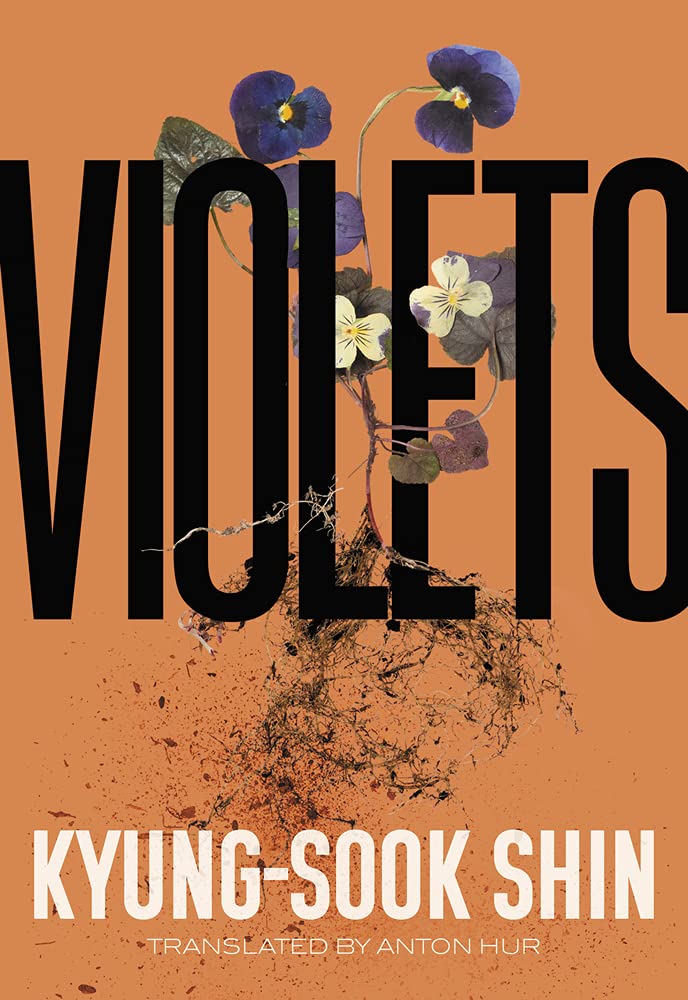
VIOLETS, a brutally sad and deeply poignant story of being Other in your homeland
VIOLETS
SHIN KYUNG-SOOK (tr. Anton Hur)
The Feminist Press
$15.95 trade paper, available now
One of NPR's Best Books of 2022!
Rating: 4.5* of five
The Publisher Says: We join San in 1970s rural South Korea, a young girl ostracised from her community. She meets a girl called Namae, and they become friends until one afternoon changes everything. Following a moment of physical intimacy in a minari field, Namae violently rejects San, setting her on a troubling path of quashed desire and isolation.
We next meet San, aged twenty-two, as she starts a job in a flower shop. There, we are introduced to a colourful cast of characters, including the shop's mute owner, the other florist Su-ae, and the customers that include a sexually aggressive businessman and a photographer, who San develops an obsession for. Throughout, San's moment with Namae lingers in the back of her mind.
A story of desire and violence about a young woman who everyone forgot, VIOLETS is a captivating and sensual read, full of tragedy and beauty.
I RECEIVED MY DRC FROM THE PUBLISHER VIA EDELWEISS+. THANK YOU.
My Review: This translation from the Korean joins a widening stream of Korean-culture transplants...Squid Game, Minari, this author's previously translated novel Please Look After Mom...making their roots into American pop-cultural soil.
If you've yet to explore the trickle, start now before it's a flood. I think it's wonderful because English-language monoglot culture gets stale and boring and all alike if we don't seek out fresh infusions of talent and stories. And, like all the best translations, this story's timelessness is rendered in prose that could very easily have been first created in English...none of the occasional signals of awkwardly trying to explicate something that one word in the translated language would convey whole and entire. That is a fine achievement indeed, probably helped along by the fact that things like "minari" aren't quite as furrin as they would've been in 2011, when Please Look After Mom was published.
What happens in this story is not particularly new or unusual. A girl is born to unfit parents:
In a house with shut doors, a mother closes her eyes as the baby’s grandmother offers her the newborn. The mother knows what will happen now. An uncelebrated girl. The infant accepts her mother’s closed eyes in lieu of a loving caress, perhaps having intuited her fate from the womb, and does not bother crying. The sound of the monsoon fills the house. Underneath the porch, a dog curls its legs into itself. Can the baby hear the sound of the rain? She’s about to fall asleep in her grandmother’s hands. That same night, her father gives his daughter’s face only a cursory glance.
Thus does another unwanted girl enter the world that won't ever bother to see her, really even to look at her. She's just...there. Her father never bothers to return; her mother never bothers with her at all, constantly seeking a man to care for her. (To be fair, an ordinary Korean woman's opportunities a generation ago weren't plentiful, and San's mother wasn't exceptional.)
Her mother. San thinks about her from time to time.
If she had begged her to stay, in front of that carefully prepared food, would she have listened? Why had San never once tried to hold her back? Wherever it was that her mother went, she never forgot to send her daughter money for school until San graduated.
The last time San had seen her mother was when she was a freshman in high school.
Children of addicts, the world over, tell versions of this same story. In this case, San's mother is addicted to men. She can't live without a man taking care of her, and she sacrifices the daughter she didn't want to get what she does want.
Author Shin isn't solely criticizing the mother. She is critiquing the social organization, the patriarchy, that privileges men and their desires over women and their needs so completely, so thoroughly, that the women are hollow and meaningless without a man. It is repulsive and it is reprehensible, and much abuse and violence simply are borne by the women because what option do they have? What other choice can they make? In San's case, she is so hollowed out by the complete absence of love from her mother (or anyone else) that she enacts the form of love she knows: rejection follows violence, as it must.
There is nothing forgiving in San. She forgives nothing, she is forgiven nothing, throughout the book. She is alone, she feels lonely of it (or so we infer...I don't know that she would be able to articulate the unmoored, disconnected reality that lonely people all share). For this, among other, reasons, this is a hard story to read. If you have ever been truly, down-to-the-bone lonely, this might be a triggering read for you. I haven't run across too many reads with this hyperconcentrated focus on loneliness, or too many with more success in rendering an emotional state into prose.
A stranger to every single person in the crowd, San finds herself blocking the sidewalk as people swerve to avoid her. Even if a carnival were to break out around her, the vacant expression on her face looks entrenched enough to persist.
Because she knows nothing of love, loving, being loved, San sees nothing except the one moment when everything changed, when the one love she thought she had was denied and made nothing. Not even attempting to find her former home nets San anything, she sees not the fields of minari she grew up among, where her life irrevocably emptied out and flowed away from her, but careful rectilinear plots of...something not minari. She has no roots. She feels no kinship.
Nothing happened this past summer. Only that, in the hot sun from time to time, a brief thought would appear and disappear around me. That thought was closer to me than any of the flowers in the shop. Even as I tried to capture the thought on paper, the heat would exhaust me and I'd give up. There were plenty of things I gave up, using the heat as an excuse. Which means I spent this past summer repeatedly deciding to do things and then giving up on them. As if my life were an exhibition of how good I am at giving up. It was that kind of summer.
It was that kind of life. It won't end well, it didn't begin well or go on well; that much we know. There's nothing hopeful in this story. Women like San aren't ever anyone's focus...her job in the flower shop working with and for Su-ae notwithstanding. She receives the desperate, genuine love of Su-ae as...nothing. San is fixated on emptiness...her only friend abandoned her!...and on men she does not want. She needs their love. She doesn't want it. She decided long ago that love wasn't something she could have, feel, receive, give. And so when it's offered to her she...doesn't see it. She does see the want of one man, she feels the desperate pull of another man on her attention, and gets nothing but unwanted results.
Every attempt to resist is met with his greater strength. In a moment, her head begins to droop.
She's released onto the street.
Her mind is completely taken over, her body a husk. No one seems to take note of the loneliness she carries. Just some woman in the crowd, unaware that her top is undone. A more observant person might have noticed her cheek slightly swollen from having been punched, the thin lines of her face a touch asymmetrical because of it. Someone might see her pale face and think, How could anyone ever look so pale....
A life of being unwanted, invisible, and it comes down to a final indignity. San is raped. Her hollowness filled at last with the violence that is all she can accept. It isn't in her to accept the reality of her situation, being unloved and unwanted, then seek out change. That's simply impossible. She leaves safety, courts rejection, and seeks oblivion.
Leaving behind only the tiniest of wakes...the end of the story of Oh San is a poignant piece of mythologizing that fit so poorly onto the rest of the story that I was forced by honest anger and sincere disdain for its sentimentality to whack a star off my rating. After a night's sleep where I dreamed of the photographer and San:
Violets. They bloom everywhere, making them seem more like weeds than proper flowers. San takes a closer look at them. Their little green leaves are small, their purple blossoms tiny. Before she came to the flower shop, she knew them as swallow flowers. Memories of entangling two swallow flower stems together and pulling them apart— one side was bound to snap. Whoever’s stem didn’t was the winner. She forgot what the prizes were, but she’d played the game many times. They did it with broadleaf plantains; they did it with foxtails.
The man keeps pressing the shutter and mumbling something discontentedly. “What’s so pretty about these flowers? Such nonsense.” His disappointment is so palpable, it makes her apologetic.
...I realized that his arc needed an end, too. I might not like that end, but I would've felt cheated (if not right away, then after my irritation with the whole ending subsided) had it not been there. So back came a half-star, though I confess with some grumbling on my part.
I think this small, powerful story deserves your eyeblinks. I think we should all resolve to notice the Oh Sans of this world, to extend a welcome to the table of them, to recognize their living presence instead of making them ghosts before they die.
Monday, April 11, 2022
YOUNG MUNGO, second three-hankie weepie novel from Douglas Stuart
YOUNG MUNGO
DOUGLAS STUART
Grove Press
$27.00 hardcover, available now
One of NPR's Best Books of 2022!
One of Time Magazine's 100 Must-Read Books of 2022
LISTEN TO THE AUTHOR DISCUSS HIS BOOK!
LONGLISTED for the 2023 Andrew Carnegie Medal for Excellence in Fiction!
Rating: 5* of five
The Publisher Says: A story of queer love and working-class families, Young Mungo is the brilliant second novel from the Booker Prize-winning author of Shuggie Bain.
Douglas Stuart's first novel Shuggie Bain, winner of the 2020 Booker Prize, is one of the most successful literary debuts of the century so far. Published or forthcoming in forty territories, it has sold more than one million copies worldwide. Now Stuart returns with Young Mungo, his extraordinary second novel. Both a page-turner and literary tour de force, it is a vivid portrayal of working-class life and a deeply moving and highly suspenseful story of the dangerous first love of two young men.
Growing up in a housing estate in Glasgow, Mungo and James are born under different stars—Mungo a Protestant and James a Catholic—and they should be sworn enemies if they're to be seen as men at all. Yet against all odds, they become best friends as they find a sanctuary in the pigeon dovecote that James has built for his prize racing birds. As they fall in love, they dream of finding somewhere they belong, while Mungo works hard to hide his true self from all those around him, especially from his big brother Hamish, a local gang leader with a brutal reputation to uphold. And when several months later Mungo's mother sends him on a fishing trip to a loch in Western Scotland with two strange men whose drunken banter belies murky pasts, he will need to summon all his inner strength and courage to try to get back to a place of safety, a place where he and James might still have a future.
Imbuing the everyday world of its characters with rich lyricism and giving full voice to people rarely acknowledged in the literary world, Young Mungo is a gripping and revealing story about the bounds of masculinity, the divisions of sectarianism, the violence faced by many queer people, and the dangers of loving someone too much.
I RECEIVED A DRC FROM THE PUBLISHER VIA NETGALLEY. THANK YOU.
My Review: I want to address something that's been bothering me a lot to start off this review:
There. I've said it. I stand by it. Adjust your seatbelts, laddies and gentlewomen, and listen up.
Mungo's a teenager with a truly evil, selfish alcoholic mother, a violent, should-be-imprisoned brother, and a sweet but misguided, loving but naïve sister, and a serious tic gifted to him by his unaddressed, undiagnosed neurodivergence. His life isn't one tiny bit of fun, and unlike Shuggie in Author Stuart's first book, he doesn't have a love object in his entire life. He loves his sister and she loves him, but that's a little like the lame helping the halt. Shuggie was entirely absorbed in loving his mother, but Mungo seldom sees his and when he does, it's usually better for him not to spend much time in her toxic terrible black hole of a presence. Being a neurodivergent person, Mungo fixates on his too-young, too-broken mother for whatever guideposts she can offer; she sucks the whole of his lovingkindness down like her genuine love, fortified wine, and gives none back. So he knows, at least seems to know, she isn't a model he can follow. His sister does the best she can to fill the kindness void, but she's barely older than Mungo by the calendar. She's gotten out of a bad jam, and come to know she can't live in this world...meaning she has to leave Mungo behind. Hamish? All Hamish does, all he knows, is rage and violence. There will be nothing else left in Mungo's life...no other emotional reality.
This, then, isn't Shuggie Redux. Stop pretending it is. Yes, it's set in deindustrializing Glasgow. Yes, it takes place in the working class parts of that world. Alcoholic parent, abusive sibling, all there...but the meat of this story is Mungo, and therefore this story could not be less like the family that slips away from Shuggie, that he just...loses...no fault of his own. The one good thing, as he tells himself (and with which I agree) is that he has is the love he bears for and gets from the Catholic boy who lives near him: James. James, son of a cancer-taken mother, an oil-rig worker father, and in love with Mungo. Who, need I mention, loves James right back. They explore their teenaged awkward bodies, they try to figure out the HUGE new emotions, and they face up to the impossibility of being openly gay in their world. Hamish? He'll kill Mungo; James's father's already had a go at killing him for it. James, older by almost a year, is the one who has to bear the public brunt of their inevitable discovery...Mungo just can't.
Not to say Mungo's not hapless and helpless. He's simply clueless, he lacks a kind of inner compass that warns a person away from impulsive action. In the end, it causes a world of trouble for him, and all of it is his mother's fault. She wants to be alone, to get her funtimes with a new man, so off she packs Mungo (freshly beaten by Hamish for the James-loving faggot that he is) off with...strangers, basically. And that goes epically badly for Mungo. He can think of nothing, no way out of his terrible situation. He's got nothing except what he's seen, what's surrounded him his whole life when Life, the great existential crisis that is Life, crashes down on him. That it is a test is clear; how he responds to the test isn't obviously the way he would have even a day before it came upon him. Mungo makes his whole life anew when he absolutely can do nothing except react, respond to the great crisis.
It is harsh, ugly, and frightening, and it comes from events so hideous that I was sure I would lose my rag and start screaming incoherently at the Kindle. And it was, in this reader's angry, bitter judgment, the only and the best way he could have behaved. It was a boy, cooked in a bath of rage, becoming the only man that bath dissolved the fatty, weakening childness off of him to be.
There is a scene at the very end of the book, a moment, a thing we're not expecting. It is, of course, Author Stuart's last word. He wrote this book, this harsh and unyielding and rageful story, the way he wrote Shuggie Bain: without mercy. It was the perfect ending. And this was the best way he could possibly have followed that book up: darkness has shadows, too.
Wednesday, March 16, 2022
SLASH AND BURN, art born of the eternal agonies of civil war
SLASH AND BURN
CLAUDIA HERNÁNDEZ (tr. Julia Sanches)
And Other Stories (non-affiliate Amazon link)
$4.99 Kindle edition, available now
Rating: 4* of five
The Publisher Says: Through war and its aftermaths, a woman fights to keep her daughters safe.
As a girl she sees her village sacked and her beloved father and brothers flee. Her life in danger, she joins the rebellion in the hills, where her comrades force her to give up the baby she conceives. Years later, having outlived countless men, she leaves to find her lost daughter, travelling across the Atlantic with meagre resources. She returns to a community riven with distrust, fear and hypocrisy in the wake the revolution.
Hernández’ narrators have the level gaze of ordinary women reckoning with extraordinary hardship. Denouncing the ruthless machismo of combat with quiet intelligence, Slash and Burn creates a suspenseful, slow-burning revelation of rural life in the aftermath of political trauma.
I RECEIVED A DRC FROM THE PUBLISHER VIA EDELWEISS+. THANK YOU.
My Review: I think you'll get the real gestalt of this read, of this review and possibly...just possibly...this story, if we listen to Author Horacio Castellanos Moya (my review of his book, Senselessness, will give you a feel for his own emotional-overload storytelling chops) praise Author Hernández:
“Claudia Hernández is one of the most groundbreaking short story writers from Central America, with a way of approaching the story that is closer to Virgilio Piñera or Felisberto Hernández than to the realist tradition. Her five story collections prove this. Now, with her first novel, Claudia Hernández takes on a new challenge: telling the recent history of El Salvador through three generations of women scarred by civil war, poverty and emigration. A pulsating feminine universe, full of strength and courage, in permanent wait of the violence that surrounds it. An intense and moving novel, and a very revealing way of storytelling that will captivate the reader.”
Castellanos Moya links Author Hernández to men marginalized by their poverty, and sexual natures, whose immense talents were never appreciated in their lifetimes. They were foundational figures in the creation of a magical realist Latinoamericano fiction, famously and fully developed in the hands of Julio Cortázar and García Márquez. That's some heady company Castellanos Moya puts Author Hernández in...and not without reason.
But let me be clear: This read is not a spoon-fed milk-toast cinch. I know a number of people found Anna Burns's name-free labels of her characters in her 2018 Booker-winning novel of civil war, Milkman, to be difficult and off-putting. I am not among their number. Heck, I enjoyed Robert Pinget's The Inquisitory, and that has no names and no punctuation at all. This read is spang in the middle of a continuum between Burns and Pinget. There aren't names ("A name was just a name. In times of war, it served the same purpose as a number or a tattoo or a dog tag you wore around your neck: it was a way of identifying the dead," we're told very, very early in Slash and Burn), but you've got dialogue tags and punctuation...just no clear path to knowing instantly and unequivocally who's speaking, when we are supposed to be...it all makes a lot of sense, in my opinion, as the entire point of reading a woman's take on war is about getting into the stakes of her participation.
She's not anything more than one woman among the thousands, the millions, the billions whose world is trying to defend the girls she's doing her goddamnedest to get through childhood into their own womanhoods.
She'd wake up in a sweat with tears in her eyes because she always lost one of them in the dream. Sometimes it was the eldest girl she'd raised; sometimes, the littlest. Sometimes she lost the girl she'd actually lost, and sometimes the girl lost her. The only one she never misplaced was the third girl she'd raised. Her daughters asked why. She could never say. The girl in question said it was because she loved her more than he rest of them, though she'd later complain that she loved her least of all: she didn't spoil her like she did the littlest or support her like she did the eldest daughter she'd raised; she didn't search the world for her like she had the first girl she'd given birth to or let her study in the capital like the second sister she'd been brought up with.
These aren't happy-clappy figures of Survivorhood. These aren't the women who run charities and organize microlending cooperatives. Author Hernández's women are the ones that make the world, the vicious one they inhabit, function in spite of and in parallel to the wars destroying the world.
To her mind, it was soldiers who raped. They were always the culprits in the stories she’d heard of assaults. But what her neighbor had said was true, at least partly. The boys had been at the camps. But as soon as they'd earned the guerrillas' trust and their weapons, they'd set off on their own path and followed their own goals. They took advantage of the fact that everyone was busy running from soldiers and advancing their positions to go to unprotected zones and take as many women as they could.
They'd take the girls to the hills for three or five days. Then they'd bring them back and take others. They'd rape grown women in their homes and make them cook for them while they raped their young daughters. Later, it became known that just one of the boys also raped elderly women. His compañeros abstained, one out of fear it would mean some additional kind of punishment at the final judgment (if it ever arrived) and the other because he found no pleasure in a woman without the strength to resist or a future to compromise.
Nor did the boy rape all the elderly women he found or come down from the hills to search them out. It was more a matter of circumstance, of making the most of their efforts, so long as the woman looked at him badly for it. He'd never touch her grandmother, for example, because, even after he'd provoked her a little, he didn't see in her the sort of response that inspired him to humiliate.
It's simple, to her. It's the world, it's not going to do her a blind bit of good to do more than make her odds, of being murdered by these uncontrolled armed fearless and foeless monsters, as low as she can. But there is nothing in this world that isn't violent and abusive on levels unthinkable to most of us reading the story in our warless, unchaotic surroundings.
She turned to face the enormous body of water and said, Thank you, Lord, even though she didn’t know who the Lord she was thanking was, or if there was any Lord to thank. It felt incredible to be on the other side. Her sister, meanwhile, had started crying, not because she’d choked on any water, but because she’d lost a little bit of masa as they crossed. She thought her mother would punish her for it. The girl convinced her sister that nothing would happen. She was certain her mother wouldn’t notice any masa was missing. And if she did, she’d take the blame for it. She swore to her little sister that their mother would believe her, even though she herself wasn’t convinced. She was sure her mother had keen instincts (although what she actually had was a watch) and that they’d be found out one way or another. So instead of telling her, she told her father, who’d come home early that day.
Days later, they moved away. The official story was that her father didn’t want to keep living on her maternal grandpa’s land now they had their own parcel in a place named after a plant. But she suspected he was trying to protect her: there were no bodies of water to cross around there. She was his little girl, the first of the daughters who’d survived.
In that region, where her dad’s sister also lived, she came across more people who hit her, such as the girls next door. They picked fights with her because she was new and because she was always the first to arrive to fill her earthen pitchers, and always clean and buttoned-up. They called her vain. Then they pulled on her skirt until it fell to her feet, knocked over her pitchers or stuck their muddied hands in them, spoiling all the work she’d done and making her task harder. She wanted to defend herself, but her mother had warned her never to hit anyone. She didn’t want any trouble. She didn’t want her to respond to their attacks, not even with words. If anyone said or did anything to her, she was to take it in silence. If she didn’t, she’d hit her even harder.
This is just...life. Life the way people in a war zone that hasn't been anything but a war zone for a generation know it, and so how they do the mechanics of living. It isn't sweet, it isn't about redemption or Coming To The Realization That x; this is what gutting it out, putting food on the table and a roof of some sort over your heads, means.
I've said I don't find the unmoored "she"s troublesome. The reason is that I don't do more than the minimum to associate the references to a general roster of possible identities. I think the read made sense to me because I realized these aren't Characters. These are types, a sort of massive and mostly undifferentiated Woman-ness. Author Hernández isn't telling Maricela's story then Marisol's story then Ludivine's; she's telling their story as the topology of the War they're doing their individual bests to avoid dying in brings them into relevace.
It isn't easy to adjust the novel-reader's expectations to this, or the wealthy-country educated book-consumer's preferences for delineated and labeled identities. Accustoming myself to a more base, earthen interchangeability, fungibility of women playing similar roles at different times was the best adaptation I could make. It felt unnatural for about 30 pages, 10% of the Kindle file. But thinking it through and considering the magical-realist underpinnings of flexible identities and the feminist rage of reducing women, the centers of this unnatural Life, to faceless nameless utilitarian labor units added a nauseating note of indifferent and amoral cruelty to the entire tale. And that is, I strongly suspect, a good deal of Claudia Hernández's point. The title...Slash and Burn is sort of the sense of it, "Roza tumba quema" or "fondle fall burn" in that order...feeling indicative to me of a soldier checking out the goods, knocking them over, not-quite-accidentally, not entirely purposefully, but carelessly in all its senses, setting them on fire. This is a solid preparation for the hard, unyielding world that the mass of women, the Woman if you will, simply bends herself into whatever shape she has to so as to make her way into another morning, through its day, and out on the other side of another night.
I found great value, solid art, and a seriously important and timely reminder of the way that war's costs are distributed is violent and unconscionably cruel, in this intense read.
Wednesday, February 9, 2022
OLGA DIES DREAMING, a special book & soon to be a special (I hope!) Hulu series
OLGA DIES DREAMING
XÓCHITL GONZÁLEZ
Flatiron Books
$27.99 hardcover, available now
Rating: 3.5* of five
One of NPR's Best Books of 2022!
ON BBC CULTURE's Best of 2022 List!
One of Time Magazine's 100 Must-Read Books of 2022
SOON TO BE A HULU SERIES STARRING JESSICA PIMENTEL!
The Publisher Says: A blazing talent debuts with the tale of a status-driven wedding planner grappling with her social ambitions, absent mother, and Puerto Rican roots, all in the wake of Hurricane Maria
It's 2017, and Olga and her brother, Pedro "Prieto" Acevedo, are bold-faced names in their hometown of New York. Prieto is a popular congressman representing their gentrifying Latinx neighborhood in Brooklyn while Olga is the tony wedding planner for Manhattan's powerbrokers.
Despite their alluring public lives, behind closed doors things are far less rosy. Sure, Olga can orchestrate the love stories of the 1%, but she can't seem to find her own...until she meets Matteo, who forces her to confront the effects of long-held family secrets...
Twenty-seven years ago, their mother, Blanca, a Young Lord-turned-radical, abandoned her children to advance a militant political cause, leaving them to be raised by their grandmother. Now, with the winds of hurricane season, Blanca has come barreling back into their lives.
Set against the backdrop of New York City in the months surrounding the most devastating hurricane in Puerto Rico's history, Olga Dies Dreaming is a story that examines political corruption, familial strife and the very notion of the American dream--all while asking what it really means to weather a storm.
I RECEIVED A DRC FROM THE PUBLISHER VIA NETGALLEY. THANK YOU.
My Spoilery Review: First, read this:
There were, inevitably, children’s clothing stores, furniture shops still offering bedroom sets by layaway, and dollar stores whose awnings teemed with suspended inflatable dolls, beach chairs, laundry carts, and other impulse purchases a mom might make on a Saturday afternoon, exhausted by errand running with her kids. There was the sneaker store where Olga used to buy her cute kicks, the fruit store Prieto had worked at in high school, the little storefront that sold the kind of old-lady bras Abuelita used to wear. On the sidewalks, the Mexican women began to set up their snack stands. Mango with lime and chili on this corner, tamales on that. Until the Mexicans had come to Sunset Park, Olga had never tried any of this food, and now she always tried to leave a little room to grab a snack on her way home. Despite the relatively early hour, most of the shops were open, music blasting into the streets, granting the avenue the aura of a party. In a few more hours, cars with their stereos pumping, teens with boom boxes en route to the neighborhood’s public pool, and laughing children darting in front of their mothers would add to the cacophony that Olga had grown to think of as the sound of a Saturday.
I spent a chunk of my 1980s in Nuyorican Sunset Park. I grew up around Spanish-speaking people (including my oldest sister, whose command of Mexican Spanish exceeds her command of English) and wasn't thrown by the blended Spanglish interwoven in the book...that's a positive feature to me. Closeted gay guys were a dime a dozen, then as now; closeted gay Nuyorican guys were even more common then than now. And a lot of 'em were/are married, with kids, and a sadly disproportionate percentage were/are also hooked on crack then, heroin now. So I came (!) to this read ready to rumble. Papi dead of AIDS ("this pato disease," as Mami calls it in a letter), Mami in the Cause and effectively dead...yeah, I was feelin' it in all my wypipo leftist soul.
“Debt is one of The Man’s great tools for keeping people of color oppressed.”
–and–
“You must remember, mijo, even people who were once your sails can become your anchors.”
I don't like Olga, or Prieto, at all.
Sellout is the kindest word I have for them, both of them, the grey and compromised souls they got from their rootstock. I think the thing they rebelled against, terrorism in place of activism, makes sense given that they lost their mother to it...and does she have a blinkin' nerve showing back up (even if only by letter) to "take command" after what she left behind!...but. But, but, but.
“Because I understand all the problems, I just fundamentally don’t believe we can fix them. However, I fully support those on the bottom taking as much advantage of the top as humanly possible.”
You are your choices. Own them, and accept the prices they exact; this is what not one of these characters did until something outside themselves actually *forced* them to. And Prieto, for whom the stakes and therefore the costs are so very high, was guilty of the rankest betrayals and most repugnant of sophistic self-justification; in the end, the chickens coming home to roost in the body of Mami...or in the box of worms the goddamned woman sends him...let me just say that this subplot is terrible, realistic, and very, very angering for me on more levels than I can count.
So the story's a banger, right?! YES! This is gonna be epic fucking television! A telenovela in Spanglish for me and my fellow wypipo! (You do not know cross-cultural humor until you've seen English closed-captioned telenovelas.)
I have some problems. My rating says so.
Mami's an evil bitch, a stone-cold rotten-souled foul excrescence of a person whose cold, cold heart would shame the Devil Herself.
"Olga, I love your mother as much, if not more, than my actual sibling. But there's a reason that I never had kids. Mothering and birthing a child are not the same. Children don't ask to be born. They don't owe anybody anything. This is one area your mother and I never saw eye to eye on, frankly."
Her heartlessness is a calculated creation by an author to make a point. Yes, yes, yes, I am a reasonably skilled decoder and can in fact separate reality from fiction. But this is fiction that illuminates a reality far too often ignored in our world. Wrong is being done everywhere, wrong met with wrong, and perpetuating a cycle of use and abuse and victimization that simply won't end.
The price of Imperialism is lives. —JUAN GONZÃLEZ (epigraph of the book)
And what is new about that, you ask. Nothing, not one thing, and that's where I got off the train. Because there needs to be some reckoning for whose lives are paying this price, and not on an institutional level....
Olga and Prieto are compromised, like I said above; I like to read about grey characters because frankly ain't too many all-pure-n-shiny knights out there. What I find so hard to make part of this as a tale of feminist redemption is the fact that Olga knowingly fleeces her clients, launders money for people best left to God or the Devil to deal with, and still manages to fuck up her response to Hurricane María by deciding she shouldn't be a "white savior" and go help the suffering to recover.
Prieto, meanwhile, faces off against their mother in her native element—Revolución!—and comes away knowing 1) she doesn't love him; 2) she's known he's gay all his life; 3) she thinks he's weak and useless, like his (crack-addicted) father. And this is touching bottom for him. This, not the HIV he could've avoided possibly passing on to someone before he knew he had it; this, not allowing his moral compass to be set by vile, evil people because he wanted to stay in politics.
Not down with this, Author González. Not at all, these are some bad actors becoming "good"...okay, they wouldn't claim that, better...by force majeure. And that sits wrong with me, not that it took this to get them to face up to themselves but that this is what it took to get them to face up to themselves. There's compromised and then there's complicit, and these're some complicit folk here.
So my fifth star went away, maximally I was at four.
But then there was that epilogue-y thing set in 2025. Another half-star. It was not a good idea. It wasn't any better or worse, writing-wise, than the rest of the book, but it was...ill advised, I'll stop there. And that's how a delightfully fun, deeply absorbing, hard-charging and target-aiming home run of a read turned into a sacrifice bunt that put the runner in scoring position.
And left her there.
Subscribe to:
Posts (Atom)