Showing posts with label CW: depression w/suicidal ideation. Show all posts

Sunday, June 12, 2022

SOLO DANCE, East Asian queerness finds an English-language voice BUT CW for suicidal ideation


SOLO DANCE
KOTOMI LI
(tr. Arthur Reiji Morris)
World Editions
$17.99 trade paper, available now

ONE OF NBC'S BEST LGBTQ BOOKS OF 2022!

Rating: 4* of five

The Publisher Says: An important queer voice from East Asia’s millennial generation

Chō Norie, twenty-seven and originally from Taiwan, is working an office job in Tokyo. While her colleagues worry about the economy, life-insurance policies, marriage, and children, she is forced to keep her unconventional life hidden—including her sexuality and the violent attack that prompted her move to Japan. There is also her unusual fascination with death: she knows from personal experience how devastating death can be, but for her it is also creative fuel. Solo Dance depicts the painful coming of age of a gay person in Taiwan and corporate Japan. This striking debut is an intimate and powerful account of a search for hope after trauma.

I RECEIVED THIS DRC FROM THE PUBLISHER VIA EDELWEISS+. THANK YOU.

My Review
: Asian cultures don't, as a rule, deal well with modern QUILTBAG identities. The perception of queer folks isn't anything like as angry as the anti- crowd here in the West but it's close in emotional terms to our unenviable habit of emotional violence and rejection. Homophobia is something queer folks battle no matter where we are. Doesn't say great things about human beings, does it.

What Author Li does in Solo Dance is deeply personalize the costs of being out in the culture of Taiwan, which leads to violent assault, and in Japan's less physical homophobic world, where it's simply ignored. Slighted, denigrated, and rejected; but without ever saying the awful words "gay" or "lesbian". This ostracization is crueler even than physical beatings.

But that is what Chō Norie prefers to her native Taiwan's brutality. She came to Japan unable to speak Japanese, as a Taiwanese woman, with all the cultural frieght that carries. Her great-grandmother's generation was used as "comfort women" and her own is a kind of slighted immigrant worker-bee, needed but not valued in larger Japanese society...and that suits Chō down to the ground. Maybe, after all, if she *can't* speak the language, no one will demand she speak at all. Thus is denial and emotional cowardice perpetuated in Chō's new, self-selected life.

With the long-standing Japanese cultural celebration of suicide, the Ghost Forest and the Wind Phone joining the long-standing ritual suicide of seppuku; it seems utterly unsurprising, then, that Chō comes here to make a life while obsessing over, planning for, lovingly dwelling on, her own suicide to come, as well as the past. (It should be noted that Japanese society is being deliberately steered away from this cultural acceptance.)
She didn’t have a strong inclination towards death, but she had no attachment to living either. While she still had breath in her lungs, she would do her best in life, yet should it ever reach that point where it was no longer bearable, she would choose death without hesitation.

Since that is the very first page of the story, I think it acceptable to quote it here; if this is in the least triggering for you and you've read this far into the review, it's a poor fit for you.

The main point of my discussing this book, though, is to say that it is a gorgeous work of prose, in a quiet and mannered way. It is an honest and bleak account of Otherness in a culture that greatly values comformity. It is a deep dive into a woman's blocked relationship with her body, with the pleasures of sex and intimacy, stemming from sexual violence. Chō runs away from Taiwan because she does not want to confront her rape in every living moment. Japan does not, to no one's surprise, encourage healing in its culture of silence around matters sexual. Her own fearfulness about her emotional state, then, is never in any way the focus of any positive intervention.

It is not a hopeful story of a survivor.
She was twenty-seven and this real-world conversation shouldn’t feel so remote, but she couldn’t force herself to get interested. There was an insurmountable wall that prevented her from fully engaging with it. All this talk of a decade from now, two decades from now, seemed like the distant future—hundreds if not thousands of years away. A world in which her existence wouldn’t make any difference. That was the true representation of her feelings.

Chō Norie, as she has chosen to be known, is not Yingmei the child whose early life contains earthquakes (fascinating to read about how her family copes with those!) and the death of a classmate-cum-crush-object of Yingmei's which is met with emotional ceremonies and discussions that she is utterly unable to process or participate in. Chō is a woman born out of intent...a creation not the being created, an auto-Galatea. And as a result, Chō has few inner resources to meet the few concerned people she encounters in Japan, even fewer to meet the awful and brutal rejection of a character Chō is (somewhat bloodlessly) involved with.

What, then, is the source of my four-star rating? First, beautifully translated imagery-laden writing. I think Translator Arthur Reiji Morris did a beautiful job of putting flattering English clothes on this very Japanese body. Enough context is presented that I never felt lost or left out; I suspect those were crafted for the translation, and it was done with great facility. Second, the fact that Chō was a woman made up, and one composed of literary antecedents. There are many works of literature harkened back to and that always gets my upvote.

There's a last thing you should know before starting on this journey: The ending. It is, to be as succinct as I can be, fantastical. Whether real or fantasized or merely cooked up, it does not resolve the events of the book. It leaves room for you to do that and, in the context of a book of this kind of interiority (though not a récit, it comes close), that fel to me like a worthy choice. It was not satisfying, though, in that "...and that was a fascinating story! *closes cover*" way.

Like all unfinished business, it lingers.

Wednesday, April 13, 2022

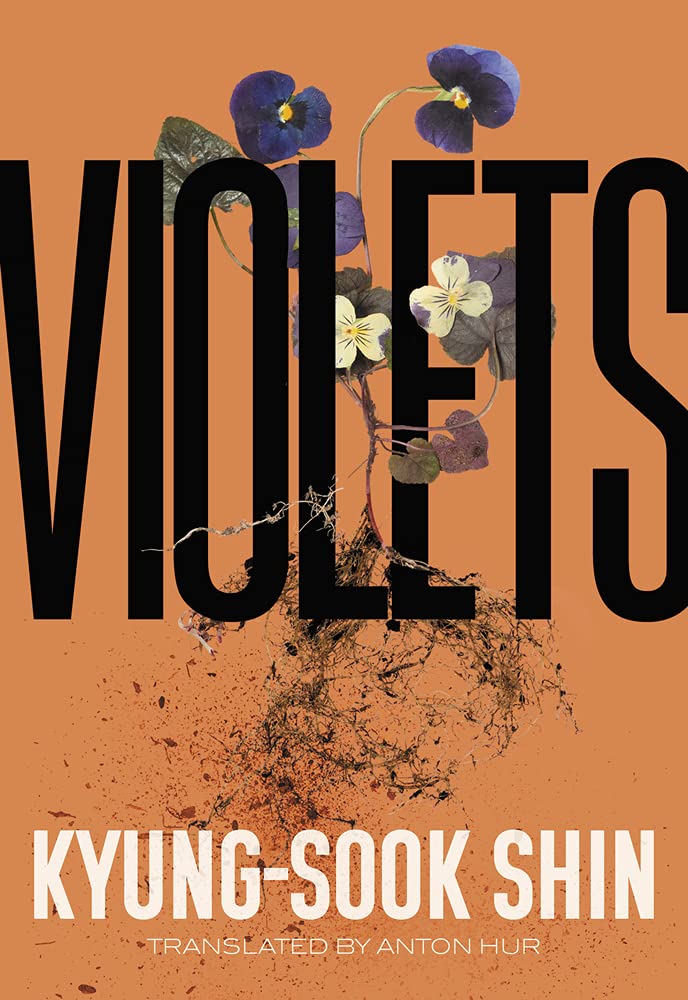
VIOLETS, a brutally sad and deeply poignant story of being Other in your homeland


VIOLETS
SHIN KYUNG-SOOK
(tr. Anton Hur)
The Feminist Press
$15.95 trade paper, available now

One of NPR's Best Books of 2022!

Rating: 4.5* of five

The Publisher Says: We join San in 1970s rural South Korea, a young girl ostracised from her community. She meets a girl called Namae, and they become friends until one afternoon changes everything. Following a moment of physical intimacy in a minari field, Namae violently rejects San, setting her on a troubling path of quashed desire and isolation.

We next meet San, aged twenty-two, as she starts a job in a flower shop. There, we are introduced to a colourful cast of characters, including the shop's mute owner, the other florist Su-ae, and the customers that include a sexually aggressive businessman and a photographer, who San develops an obsession for. Throughout, San's moment with Namae lingers in the back of her mind.

A story of desire and violence about a young woman who everyone forgot, VIOLETS is a captivating and sensual read, full of tragedy and beauty.

I RECEIVED MY DRC FROM THE PUBLISHER VIA EDELWEISS+. THANK YOU.

My Review
: This translation from the Korean joins a widening stream of Korean-culture transplants...Squid Game, Minari, this author's previously translated novel Please Look After Mom...making their roots into American pop-cultural soil.

If you've yet to explore the trickle, start now before it's a flood. I think it's wonderful because English-language monoglot culture gets stale and boring and all alike if we don't seek out fresh infusions of talent and stories. And, like all the best translations, this story's timelessness is rendered in prose that could very easily have been first created in English...none of the occasional signals of awkwardly trying to explicate something that one word in the translated language would convey whole and entire. That is a fine achievement indeed, probably helped along by the fact that things like "minari" aren't quite as furrin as they would've been in 2011, when Please Look After Mom was published.

What happens in this story is not particularly new or unusual. A girl is born to unfit parents:
In a house with shut doors, a mother closes her eyes as the baby’s grandmother offers her the newborn. The mother knows what will happen now. An uncelebrated girl. The infant accepts her mother’s closed eyes in lieu of a loving caress, perhaps having intuited her fate from the womb, and does not bother crying. The sound of the monsoon fills the house. Underneath the porch, a dog curls its legs into itself. Can the baby hear the sound of the rain? She’s about to fall asleep in her grandmother’s hands. That same night, her father gives his daughter’s face only a cursory glance.

Thus does another unwanted girl enter the world that won't ever bother to see her, really even to look at her. She's just...there. Her father never bothers to return; her mother never bothers with her at all, constantly seeking a man to care for her. (To be fair, an ordinary Korean woman's opportunities a generation ago weren't plentiful, and San's mother wasn't exceptional.)
Her mother. San thinks about her from time to time.

If she had begged her to stay, in front of that carefully prepared food, would she have listened? Why had San never once tried to hold her back? Wherever it was that her mother went, she never forgot to send her daughter money for school until San graduated.

The last time San had seen her mother was when she was a freshman in high school.

Children of addicts, the world over, tell versions of this same story. In this case, San's mother is addicted to men. She can't live without a man taking care of her, and she sacrifices the daughter she didn't want to get what she does want.

Author Shin isn't solely criticizing the mother. She is critiquing the social organization, the patriarchy, that privileges men and their desires over women and their needs so completely, so thoroughly, that the women are hollow and meaningless without a man. It is repulsive and it is reprehensible, and much abuse and violence simply are borne by the women because what option do they have? What other choice can they make? In San's case, she is so hollowed out by the complete absence of love from her mother (or anyone else) that she enacts the form of love she knows: rejection follows violence, as it must.

There is nothing forgiving in San. She forgives nothing, she is forgiven nothing, throughout the book. She is alone, she feels lonely of it (or so we infer...I don't know that she would be able to articulate the unmoored, disconnected reality that lonely people all share). For this, among other, reasons, this is a hard story to read. If you have ever been truly, down-to-the-bone lonely, this might be a triggering read for you. I haven't run across too many reads with this hyperconcentrated focus on loneliness, or too many with more success in rendering an emotional state into prose.
A stranger to every single person in the crowd, San finds herself blocking the sidewalk as people swerve to avoid her. Even if a carnival were to break out around her, the vacant expression on her face looks entrenched enough to persist.

Because she knows nothing of love, loving, being loved, San sees nothing except the one moment when everything changed, when the one love she thought she had was denied and made nothing. Not even attempting to find her former home nets San anything, she sees not the fields of minari she grew up among, where her life irrevocably emptied out and flowed away from her, but careful rectilinear plots of...something not minari. She has no roots. She feels no kinship.
Nothing happened this past summer. Only that, in the hot sun from time to time, a brief thought would appear and disappear around me. That thought was closer to me than any of the flowers in the shop. Even as I tried to capture the thought on paper, the heat would exhaust me and I'd give up. There were plenty of things I gave up, using the heat as an excuse. Which means I spent this past summer repeatedly deciding to do things and then giving up on them. As if my life were an exhibition of how good I am at giving up. It was that kind of summer.

It was that kind of life. It won't end well, it didn't begin well or go on well; that much we know. There's nothing hopeful in this story. Women like San aren't ever anyone's focus...her job in the flower shop working with and for Su-ae notwithstanding. She receives the desperate, genuine love of Su-ae as...nothing. San is fixated on emptiness...her only friend abandoned her!...and on men she does not want. She needs their love. She doesn't want it. She decided long ago that love wasn't something she could have, feel, receive, give. And so when it's offered to her she...doesn't see it. She does see the want of one man, she feels the desperate pull of another man on her attention, and gets nothing but unwanted results.
Every attempt to resist is met with his greater strength. In a moment, her head begins to droop.

She's released onto the street.
Her mind is completely taken over, her body a husk. No one seems to take note of the loneliness she carries. Just some woman in the crowd, unaware that her top is undone. A more observant person might have noticed her cheek slightly swollen from having been punched, the thin lines of her face a touch asymmetrical because of it. Someone might see her pale face and think, How could anyone ever look so pale....

A life of being unwanted, invisible, and it comes down to a final indignity. San is raped. Her hollowness filled at last with the violence that is all she can accept. It isn't in her to accept the reality of her situation, being unloved and unwanted, then seek out change. That's simply impossible. She leaves safety, courts rejection, and seeks oblivion.

Leaving behind only the tiniest of wakes...the end of the story of Oh San is a poignant piece of mythologizing that fit so poorly onto the rest of the story that I was forced by honest anger and sincere disdain for its sentimentality to whack a star off my rating. After a night's sleep where I dreamed of the photographer and San:
Violets. They bloom everywhere, making them seem more like weeds than proper flowers. San takes a closer look at them. Their little green leaves are small, their purple blossoms tiny. Before she came to the flower shop, she knew them as swallow flowers. Memories of entangling two swallow flower stems together and pulling them apart— one side was bound to snap. Whoever’s stem didn’t was the winner. She forgot what the prizes were, but she’d played the game many times. They did it with broadleaf plantains; they did it with foxtails.

The man keeps pressing the shutter and mumbling something discontentedly. “What’s so pretty about these flowers? Such nonsense.” His disappointment is so palpable, it makes her apologetic.

...I realized that his arc needed an end, too. I might not like that end, but I would've felt cheated (if not right away, then after my irritation with the whole ending subsided) had it not been there. So back came a half-star, though I confess with some grumbling on my part.

I think this small, powerful story deserves your eyeblinks. I think we should all resolve to notice the Oh Sans of this world, to extend a welcome to the table of them, to recognize their living presence instead of making them ghosts before they die.

Wednesday, February 23, 2022

THE SELFLESS ACT OF BREATHING, a deeply felt meditative look at the cost of modern life


THE SELFLESS ACT OF BREATHING
J.J. BOLA

Atria Books
$27.00 hardcover, available now

A FILM IS IN THE WORKS! "I thank my readers and I look forward to reaching a new audience, via a new medium, and helping us all — which is the reason I wrote this novel — to remember that no matter how we feel, we are not alone,” says Author Bola.

Rating: 4* of five

The Publisher Says: Transcendent Kingdom meets A Man Called Ove in this heartwarming novel about a Congolese-British Londoner who decides to go on one last adventure in the United States, determined to end his life once his savings run out.

As a charismatic teacher living in London, Michael Kabongo strives to alleviate the injustices he sees around him: for the students who long for better lives, in memory of his father’s tragic death, and to end the violent marginalization of Black men around the world.

But after a devastating loss, he decides to embark on an adventure in the land of the free—the United States of America. From Dallas to San Francisco, Michael parties with new friends, engages in fleeting romances, splurges on thrilling escapades, all with the intention of ending his life once all his savings run out.

As he makes surprising new connections and faces old prejudices in odd but exciting new settings, Michael alone must decide if his life is worth living after all...

I RECEIVED A DRC FROM THE PUBLISHER VIA NETGALLEY. THANK YOU.

My Review
: I tried to commit suicide in 2014. It was a very low point in my life. It was fortunate that my life didn't end because of the disordered thinking...a woman named Julie made a fortuitous call as I was beginning the process and sent the police to intervene...so I am here to write this review. This is also why I wanted to review this book, given the narrator's plan to end his life when his savings were blown. (Side note: Howinahell did he get so far on a lousy $9000?!)

It's not clear to me why the topic of suicide isn't a trigger for reupping the suicidal ideation machine in me. I can read about the deeply depressed and the suicidal in novels and feel so much compassion, so much sympathy...but no desire to emulate them, only to reach out to them and say "this is a permanent solution to a temporary problem." I've gone through a lot of introspective stuff (CBT works!) and think of the idea of death as, well, honestly it's undisturbing to me. Neither attractive nor repulsive, just a fact. And the manner of Michael, our PoV character, making his decision to go blow his money then die rang memory bells. "This final act, then nothingness" probably sounds better to the truly suicidally depressed than more emotionally overwrought ideation does.

Michael addresses us in the parts of the book set in London. He's fully present, he's struggling to do his teaching job well, and he's floundering in grief deeper than even he can tell...grief too deep to be solely about a recent loss. Michael's decision to leave for the US with that paltry $9000 and live until it runs out (he'd be in Delaware Water Gap, New Jersey, not San Francisco!) is narrated in third person, a choice I took to be representative of his dissociation from the life he was abandoning and refusal to invest in the life he was going to exist through in the US. It wasn't a choice I felt did the story any great service. I think it probably just confused most readers. And I'm not all the way sure I am correct in my analysis, there are other possibilities but I can't make one up that makes the least bit of sense to me except the dissociation one.

What elevates this debut novel above the pack it comes out with is the lovely poetical aphoristic phrase making:
We fight to be seen, for the world to know that we are here, only for us to be forgotten, to be invisible once again.

–and–

Have you ever loved, knowing it would end, but giving your whole heart regardless?

–and–

The thing about losing love is makes you feel like you can never love again, like you are not worthy.

–and–

Loneliness is being there for everyone, everyone, in the hope that someone will be there for you. But no one ever is. You are the sun, lighting the world of another, while setting yourself on fire.

–and–

And above all, it is love, that spark of bright light, that dazzling flame, ephemeral or eternal, may it find us, may it be us, the will that carries us forward, the bond that brings us back, from beyond this lonely feeling to healing; the selfless act of breathing.

The author might be making his fiction debut (correction this is the author's second novel, after 2017's No Place to Call Home) but he's an established poet (Elevate and Daughter of the Sun among others) and it's ever so clear that his phrases will sound gorgeous when spoken aloud. That is also, to be frank, the issue that led to me docking a star off the story's subjective rating: It's performative, it's got an eye on its look in the mirror of your regard. It is, in other words, like poetry is to me: phonied up, heightened, exaggerated to make some point that I think you, O Writer, should trust me to get all on my own. If, that is, you've done your part of the job....

What I hope you'll do is sample the book. Put a bit on your Kindle and see if the way the author slings the lingo hits your sweet spot. If so, there's nothing to prevent you from enjoying the book in its entirety. The first chapters are a good index for the voice the entire book has. While I'm here today because suicide didn't turn out to be the best option for me, this is not an apologia for the act or I'd tell you to avoid it. What leads a person to consider suicide: depression, a sense of alienation from the world around them, a loneliness that pervades this world of exclusion and judgment...all this is the subject of Author Bola's work.
This sadness, how it falls upon you, like mist or fog, not there, then sudden and all at once; a greyness, enveloping you, submerged under water. This sadness in your bones, each step heavier than the last raises questions: how much longer is this journey? How much longer can I walk?

This is an elegant distillation of the greyness of depression and the desperation of feeling it's endless because you've got no perspective where this isn't what you see...all of that is very, very real and very salutary for all of those whose world doesn't have it anywhere (all five of you) to get into your brains. It could make your empathy bumps bigger, spread your hugging arms wider, and tune up your "there, there, my friend" to a fresher pitch.

Monday, January 10, 2022

30 THINGS I LOVE ABOUT MYSELF, a truly pleasurable read that just could not be more fun to read


30 THINGS I LOVE ABOUT MYSELF
RADHIKA SANGHANI

Berkley Books (non-affiliate Amazon link)
$9.99 Kindle edition, available now

Rating: 4* of five

The Publisher Says: When a British Indian woman's life hits rock bottom, she decides to change her stars by falling in love...with herself—a hilarious, heartfelt story from outrageously funny novelist Radhika Sanghani.

Nina didn't plan to spend her thirtieth birthday in jail, yet here she is in her pajamas, locked in a holding cell. There's no Wi-Fi, no wine, no carbs—and no one to celebrate with.

Unfortunately, it gives Nina plenty of time to reflect on how screwed up her life is. She's just broken up with her fiancé, and now has to move back into her childhood home to live with her depressed older brother and their uptight, traditional Indian mother. Her career as a freelance journalist isn't going in the direction she wants, and all her friends are too busy being successful to hang out with her.

Just as Nina falls into despair, a book lands in her cell: How to Love Yourself (and Fix Your Shitty Life in the Process). It must be destiny. With literally nothing left to lose, Nina makes a life-changing decision to embark on a self-love journey. By her next birthday, she's going to find thirty things she loves about herself.

I RECEIVED A DRC FROM THE PUBLISHER VIA NETGALLEY. THANK YOU.

My Review
: You can't be sure you're reading a novel until Nina actually reads How to Love Yourself (and Fix Your Shitty Life in the Process). Really? A bit on-the-nose to reach her when she's in the clink! I mean, I'd just sit out the sentence before I'd read that. Still, Nina's pretty much looking at her (pretty comedic) arrest as an intervention from the Universe.

But, given her inability even to make a decent choice of only-phone-call recipient resulting in her return to her *truly*ghastly* mother's orbit, that could prove to be life saving. Or losing...it's a close-run thing whether she'll survive Daily Mailish history-chucking-out nightmare Mum. *I* almost didn't survive Mother Mistry. What a gorgon. In fact...just being totally transparent here!...I really didn't like wishy-washy, what's-the-female-nebbish-called Nina. I get it...a mother like that one would kick the sense and the sensibility right out of you. No one knows more or better than she does! Then there's drippy, dreary, depressed closet case Kal. Yeesh!

Why, then, am I reviewing it. Two words: Tantric. Sex.

You'll have to read the book to figure out why. But you'll have a lot of fun doing it, so I'm not wasting my tears for you. You're going to be glad you did, you nutty slacker. Glad you powered past the ex bringing his new squeeze to a party when Nina was guaranteed to be there...because dear ol' Mum dragged her. Glad you ignored the fact that a thirty-year-old online journalist needed her brother to explain doxing to her. Or when her self-immolative attempts to go up against a TV shock jock are so very, so painfully naive....

And let's be honest, folks, the sheer number of us humans who can use...really, really use...the truth behind Andrew Solomon's quoted-in-story quote, "The opposite of depression is not happiness but vitality..." runs into the octuple digits. I suspect, though, that quite a lot more of y'all will follow Nina Mistry, Financial Abundance Manifester, in her (unorthodox but) proven effective plan to get the, um, kitty replenished.

What the heck is all this in aid of...well, my olds, there is absolutely no better time than the New Year to manifest self-love and self-acceptance by reading something that will make you giggle, and squirm, and blush. Cringe comedy lovers, here's you a book! Silly self-help sozzlers, here's you a book! You are in need of grins? You are in luck, here's you a book!

And you know what? Many more books need to have "Namaste, bitches," in them.