Pages
- Home
- Mystery Series
- Bizarro, Fantasy & SF
- QUILTBAG...all genres
- Kindle Originals...all genres
- Politics & Social Issues
- Thrillers & True Crime
- Young Adult Books
- Poetry, Classics, Essays, Non-Fiction
- Science, Dinosaurs & Environmental Issues
- Literary Fiction & Short Story Collections
- Sookie Stackhouse/Southern Vampire Books & True Blood
- Books About Books, Authors & Biblioholism
Showing posts with label CW: sexual assault. Show all posts
Monday, September 14, 2026
JUSTICE FOR JEHANNE: The Tale of a Medieval Survivor, and thriver, and role model on top of all that
JUSTICE FOR JEHANNE: The Tale of a Medieval Survivor
SARA McDOUGALL
Princeton University Press (non-affiliate Bookshop.org link)
$29.95 all editions, available now
Rating: 4.8* of five
The Publisher Says: A spellbinding narrative history that defies modern assumptions about women’s lives in the Middle Ages and informs contemporary debates about sexual violence and the limits of justice
In the winter of 1472, the city of Dijon, France, became the stage for a remarkable legal drama. On the mayor’s orders, an investigator named Jaques Borestel went door-to-door questioning his neighbors about an alleged sexual assault—and about the victim’s history and place in the community. At the center of Jaques’s inquiry was a woman named Jehanne, who took the unusual step of making a criminal complaint in an age when victims of sexual violence did so at their own peril. Justice for Jehanne follows Jaques’s investigation as he uncovers one woman’s story of resilience and survival.
Applying forensic analysis to witness testimony and Jaques’s case files, Sara McDougall finds in Jehanne a woman of many lives and many secrets. An outsider on her own in Dijon, Jehanne had every reason to distrust the local authorities, who regularly extorted money from the city’s most vulnerable residents. Separating facts from falsehoods, McDougall challenges preconceptions about the experiences of marginalized women in medieval France, showing how neighbors, clergy, and other residents aided Jehanne throughout her legal struggles—and how justice of a sort was exacted from her attackers.
Richly detailed and powerfully told, Justice for Jehanne paints an unforgettable portrait of a woman who mounted an extraordinary response to a crime that was so difficult to prosecute at the time, and of a community that gave her shelter, protection, and acceptance as she endeavored to survive on her own terms.
I RECEIVED A DRC FROM THE PUBLISHER VIA EDELWEISS+. THANK YOU.
My Review: The idea that sexual assault is a death knell for a woman's reputation is *still* dying a slow, noisy death. It was my experience in my own lifetime that a woman pregnant and without some kind of man in her life to take the credit was a "slut" and never anything but; her reputation was set, her future decided, that was that. Many were the women who had abortions, fewer went away for "cures" and came back thinner; all were "fallen" ant thus tainted. This was the twentieth century pre-The Pill and well pre-Roe v Wade.
I thought that was just how it was, probably moreso in earlier times, but certainly not better.
Reading is very dangerous to one's ignorance.
A young woman arrived in Dijon, pregnant and alone, spouting some silly-sounding story about a husband visibly absent who...well, no one was buyin' it, but no one was really all that interested in it either because being pregnant was a very common and unavoidable hazard of being female in the world of men. Jehanne settled into a mundane life, making friends, doing work, being alive. All that came to a chaotic halt when mercenaries fighting some endless wars drifted through Dijon and...noticed...pretty, pregnant, manless Jehanne and bad things ensued.
So far it's a tale as old as time. But post-bad things, details not foregrounded (neither glossed over, just not dwelt on) in the text, Jehanne was not going to let herself be cowed into silence about the outrages she'd endured. One sees in this fact the root of her problem, and the reason she floated into Dijon instead of staying wherever she got pregnant in the first place. (Absent any details about this subject in the records, as Jehanne was not forthcoming, the author posits a possible reason for her landing in Dijon that I thought sounded very believable.) Seeking legal remedy for her violation was stunning in its effrontery, enduring the horrible humiliation of the trial, reliving the awful events, having deeply impertinent, invasive questions that can not be avoided asked, Jehanne showed amazing strength of character.
Her neighbors—including the very surprising man who conducted the investigation we still have documented—of fairly short duration, to my utter amazement, mostly had her back.
The records of the trial, the details of which are almost brain-meltingly boring...I deeply do not care about medieval tax-dodging schemes, but they were important to the witnesses' identities...made for what should have been a slog of an academic read. Author Sara, take your bow. Yes, I now know what people did for fun in 1470s Dijon, dreamt up ways to skive off paying taxes and damn do I wish I didn't, but this is leavened by Author Sara peppering the dough with interesting asides and details not strictly on topic. I will say that all those details added up to Jehanne's becoming a firmly embedded member of Dijon's community, a rough patch in the weave to be sure, but really part of a vibrant interesting bunch of folks.
It surprised me, it entertained me...yes, in spite of the stuff about who had what spurious tax exemption...and it gave me a ghost of gleeful recognition in getting to know Jehanne. She's someone I wish I'd known in the flesh.
Proof that academic, footnoted reads can be well worth reading for more than a degree.
Friday, August 7, 2026
BLOOD OF THE DAWN, Peru's violent past made personal
BLOOD OF THE DAWN
CLAUDIA SALAZAR JIMÉNEZ (tr. Elizabeth Bryer)
Deep Vellum (non-affiliate Bookshop.org link)
$9.95 ebook, available now
Rating: 4* of five
The Publisher Says: Debut novel by Peruvian author viscerally revisits Peru's recent, traumatic history through the eyes of three women
Blood of the Dawn follows three women whose lives intertwine and are ripped apart during what's known as "the time of fear" in Peruvian history, when the Shining Path militant insurgency was at its peak. The novel rewrites the conflict through the voice of women, activating memory through a mixture of politics, desire, and pain in a lucid and brutal prose.
Claudia Salazar Jiménez was born in 1975 in Lima, Peru. She is a critic, a scholar, and an author; she founded PERUFEST, the first Peruvian film festival in New York, where she lives; and she won the 2014 Americas Narrative Prize for this, her debut novel.
I RECEIVED A DRC FROM THE PUBLISHER VIA EDELWEISS+. THANK YOU.
My Review: A nasty proxy war was fought by the US versus the USSR as part of what we in the US are taught to call "the Cold War." How cold is a war whose victims number in the hundreds of thousands in one theater of its coldness, eg Latin America? Are people's families less fractured because no US soldiers (to speak of) were killed? Are those (mostly) men less dead because they weren't casualties of great pitched battles?
One nasty war was the struggle Peruvians fought against Sendero Luminoso (Shining Path in English), a Soviet-backed militia that committed atrocities against ordinary people with seeming success throughout the 1980s. The brutality of the US-backed military's responses to Sendero Luminoso drove some into the rebels' camp, others away from it. In any civil war there are no real winners. This was never more evident than in Peru. Author Salazar Jiménez limns that very clearly by decentering the male (mostly) combatants in favor of three women whose lives are both upended and defined by the conflict.
It's a depressing truth that this book came out in 2016, I read it in 2017, and while I made my notes on it at the time I never wrote them into a review. The biggest part of my failure to review it stems from the stream-of-consciousness narrative vignettes feeling unlinked-up. This is a debut, so it deserves generosity of treatment; however I was very, very irritated by the sense that, if there was a common thread in the background tapestry, I did not see it.
On skimming the story ten years later, I still don't. The PoV women are all enmeshed in the struggles of Peru, none on the government side but Melanie the city-born colonizer-stock photographer is probably closest as photography and its granddaughter filmmaking's very much an outgrowth of bourgeois culture more broadly; her desire to show the world what's happening to her country gets her resoundingly abused by Sendero Luminoso perpetrators. Her narrative voice wasn't distinctive, particularly in (unclear) distinction to Modesta the impoverished country-dwelling Quecha woman's.
That both were raped quite violently (there is no non-violent rape, I'm saying their experiences were even more violent than baseline horror) did not make them more distinguishable in a narrative technique used to emphasize the commonalities of sexualized assault. It served that function. a side-effect of that function is it's more difficult to build specific empathy for that character. As the story progresses, Modesta faces the challenge of carrying then birthing a daughter from her horrifying experience...a daughter she cannot easily or readily bond with. Since I'm more distant emotionally from her by not having a clear sense of her as Modesta but rather as a woman caught in war, it's harder for that horrific truth to make its most intense impact on me-the-reader.
Comrade Marta, the cadre of the Sendero Luminoso, was probably the one easiest to tell apart because she was seeing, participating in, perpetrating, but centrally seeing the violence her group committed as a necessary step to gaining meaningful freedom for the people of Peru. I got why she fell into that way of thinking, but it's always hard to see that path as justified to my bourgeois self. How does killing stop killing? I do not observe that result from those actions anywhere in my own world.
So my rating does not rest primarily on my pleasure in the prose from any angle. I would rate the book two and a half stars were it still 2016 out there. Today we have the US starting bullshit wars to protect a bunch of pedophile rapists from facing the consequences of their crimes instead of simply enriching some scumbags; we have a government so dedicated to white supremacist misogyny as policy instead of more nebulously ideology that voting rights and bodily autonomy are being dismantled as matters of law; we are, in short, more in danger from our government than from any external enemy.
In that sociopolitical milieu this book is four stars of klaxon-sounding warning. Heed these words, understand these threats viscerally by reading this story.
Monday, April 6, 2026
HONEY IN THE WOUND, Korean magical realist family saga
HONEY IN THE WOUND
JIYOUNG HAN
Avid Reader Press (non-affiliate Bookshop.org link)
$14.99 ebook, available now
Rating: 4.5* of five
The Publisher Says: A lyrical and suspenseful debut novel about a mysteriously gifted Korean family confronting the brutality of the Japanese empire, Honey in the Wound is an epic tale of survival and the reclamation of power.
A sister disappears and returns as a tiger. A mother’s voice compels the truth from any tongue. A granddaughter divines secrets in others’ dreams. These women are all of one lineage—a Korean family split across decades and borders by Japanese imperialism.
At this saga’s heart is Young-Ja, a girl who infuses food with her emotions. She revels in her gift for cooking, nourishing the people she loves with her cheerfulness. But her sunny childhood comes to an end in 1931 when Japanese soldiers crush her family’s defiance against the Empire. Young-Ja is cast adrift, her food turning increasingly bitter with grief. When a Korean rebel fighter notices her talents, however, she is whisked off to Manchuria to join a secretive sisterhood of beautiful teahouse spies. There, Young-Ja finds a new sense of belonging and starts using her abilities for the resistance. But the Imperial Army is not yet finished with her…
Decades later, Young-Ja lives alone in Seoul, withdrawn from the world until her Tokyo-born granddaughter Rinako bursts into her life with the ability to see into dreams. In cultivating a tentative bond, they confront the long-buried past in a stunning emotional climax.
As an unforgettable family perseveres in the long shadow of colonialism, Honey in the Wound transports readers to mountain forests where tiger-girls stalk, to Manchurian teahouses and opium dens where charming smiles veil secrets, and to the modern metropolises of Tokyo and Seoul where restless ghosts stir. This debut novel is a tender yet powerful multi-generational drama that shines light onto the twentieth century’s darkest corners and gives voice to those who bore witness.
I RECEIVED A DRC FROM THE PUBLISHER VIA NETGALLEY. THANK YOU.
My Review: Brutality is colonialism's sole common legacy across all colonial regimes. Korea's half-century as part of Japan's empire was certainly no exception. Many are the stories of families ravaged by slavery, by economic disadvantages imposed to benefit the colonizers, by the horrors of the comfort women's suffering. It's not unique to Japan's imperial project...go look at Briseis' life after the fall of Troy, and I promise you she was nowhere near the first to suffer this fate...but its systematic, intentional social sanction somehow makes it a vile twentieth-century model of efficiency in evildoing.
So much of modern US culture is Korean inflected. I've reviewed a fair few Korean translations, Korean-themed stories written by members of its diaspora, stories set in Korea, all sorts really, because the culture of the place is ancient, rich, and deeply rooted as it smoothly takes on the modernity of this century as an economic, therefore cultural, powerhouse. As I gain more and more experience with the stories Koreans send into the Anglophone readership, I see one very, very frequent strand appearing: the Japanese occupation, usually framed in apocalyptic, folkloric ways to distance the reader from the brutal reality and to restore some agency, some meaning, to the country's suffering.
No exception this time. Starting in 1902 when Korea was an independent monarchy, the family we come to know and invest caring into is gradually Japanesed in personal names (pay careful attention, context will tell you if someone is being addressed or referred to as a Korean or as a Japanese imperial subject) and place names. It's like the British stealing India and naming "Mumbai" as "Bombay." (There are so many examples from all over the colonized world, that example is just the one I felt Anglophones would relate to most easily.)
The first 40% of the story is the slowest, with the highest concentration of double names. It's a debut novel. The fact is this is exactly reflective of the reality Author Han relates to us as we start our journey in 1902. Put in some effort and it will all begin to feel second nature to you quite quickly. The delight of a writer whose planning makes your reading more fluent with her intentional shifts in register is one who gets my highest regard. Time changes within few pages of each other are all quietly indicated with characters giving us clues, not with bold chapter or section headings that bring your readerly attention to the shifts themselves not the flow of the story.
This might not sound like it will suit you. I recommend reading a sample after publication day on the 7th. It feels more fluid than I'm making it sound. For example, you'll notice as you read through the book that there is a lot of use of, and description using, the color yellow. It would behoove you to go look into musok, the people's religion of Korea, and its use of colors. Like the shifts of names this is an enriching detail that clues the reader in to the larger thematic purpose of a passage, or a name, or an evocative word.
It made this read one I really looked forward to getting into, immersing myself into again and again. And a good thing indeed these moments were there because the horrific cost to the people of the colonial occupation, then the war, demanded much fortitude of me-the-reader to stay invested in people enduring so much. I had reservoirs of interested, sympathetic caring to draw down as horrors mounted up.
I will say I wish there had been a map in the book. I'm not sure where some place names were, whether they were really elsewhere or were Korean places I had read about renamed. Its lack was not fatal to my pleasure; but I felt it nonetheless.
A story I urge on readers and enjoyers of Pachinko and Whale. A story with depths deeper than its modest 320pp page count implies. An author who is a fine discovery in her debut novel.
Thursday, March 5, 2026
BRIDGET WALSH'S PAGE: The Variety Palace Mysteries series 1, 2 & 3
THE TUMBLING GIRL (Variety Palace Mysteries #1)
BRIDGET WALSH
Pushkin Vertigo (non-affiliate Bookshop.org link)
$14.99 ebook, available now
Rating: 4* of five
The Publisher Says: The first in a sharp, witty series of Victorian mystery novels, The Tumbling Girl sees an unlikely duo team up to solve a grisly spate of murders.
1876, Victorian London. Minnie Ward, the feisty scriptwriter for the Variety Palace Music Hall, is devastated when her best friend is found brutally murdered. She enlists the help of private detective Albert Easterbrook, who already has his hands full trying to catch the notorious Hairpin Killer. But Minnie can't help getting involved in the investigation, and as the bodies begin to pile up, Albert's burgeoning feelings for his amateur partner start to interfere...
A dazzling debut for fans of Sarah Waters and Elizabeth Macneal, and shows like Miss Scarlet and the Duke.
I RECEIVED A DRC FROM THE PUBLISHER VIA EDELWEISS+. THANK YOU.
My Review: What delight it is to find a dynamic duo, opposite genders and complementary skill sets uniting to solve a case not worth the police's time...the victim was "just" a performer and a female one at that...without slobbering over each other's sex appeal! Albert comes to realize what a treasure Minnie is without her body being his focus.
Minnie's clearly an unusual person, one who does not accept Authority's word as law. It makes her very much in step with my tastes in a person to read about. Albert is built up as a detective of skill and reputation, which made me a little disgruntled at some missteps he made that were Very Convenient for the plot...I didn't want to leave off that fractional fifth star, but for a while it looked like I'd be rating this story just under four stars.
What put the rest of the fourth star back on my opinion of the story was Albert and Minnie's response, a shared one, to the Hairpin Killer as a person. The killer has a deeply twisted motive for doing the revolting things done to the victims, and it offends Albert as much as it does Minnie because he sees the victims as real people in the way she does. He, the experienced detective, wants to catch the killer because he is mortally offended that these crimes *occur* to the killer, that it seems *okay* to do these things in a person's mind. Minnie, OTOH, is outraged that there's so little official interest in the killings because the victims are lower class.
All of that is sort of elliptical because it would be very easy to ruin the puzzle if I say more explicitly what the duo are responding to. It's not a cozy, y'all, and the crimes are not sugar-coated. I don't think, for my read anyway, that it's prurient in purpose to be as direct about what the results of murder are. It felt to me that the detective duo's different tonal responses to the realities of the aftermath were intended to make their partnership more nuanced, more relatable for future events in this story and later ones.
Of course I already knew there were more books in the series before starting this read, but that honestly made the ending bearable. The twist, if I'd had to endure a long wait for book two to come out, would've been excruciating! It was not an artificial, tacked-on, manipulative one; it was organic and it was kind of dreadful, but it worked. I'll warn you, gentle readers, to have book two to hand when you read book one.
I encourage you to read it. There is a lot to enjoy in a female-led Victorian detective duo solving nasty crimes by bringing justice to the perpetrator in spite of official indifference. Victims, in any afterlife that might exist, can feel their wrongs have been redressed.
On to book two!
+++++++++++++++++++++++++++++++++++++++++++++++++++++++++++++++
THE INNOCENTS (Variety Palace Mysteries #2)
BRIDGET WALSH
Pushkin Vertigo (non-affiliate Bookshop.org link)
$13.99 ebook, available now
Rating: 4* of five
The Publisher Says: The hotly anticipated follow-up to The Tumbling Girl, The Innocents follows Minnie and Albert on a new crime-solving quest in the world of a Victorian music hall.
Still reeling from the gruesome murders of the previous year, Minnie Ward is appointed manager of the Variety Palace. Times are hard, with performers shunning the 'cursed' music hall, and Minnie's relationship with Detective Albert Easterbrook is more complicated than ever. Despite the success of their last case, Minnie is terrified of the feelings that have started to grow between them. She has decided it’s definitely better for all involved if they stay as far away from each other as possible…
But when another killer begins to terrorise the city's streets, Minnie and Albert are thrown together once more. The crimes seem connected to a notorious tragedy that left nearly 200 children dead—and with so many lives affected by the incident, practically everyone is a suspect. As the investigation unfolds, dark truths begin to come to light, and Minnie is forced to confront her own past.
The Innocents is the 2nd book in the Variety Palace Mystery series, which can be read independently but continue the story of irresistible crime-solving duo Minnie and Albert. Taking place against the thrilling backdrop of the Variety Palace Music Hall in gritty Victorian London, it's perfect for fans of historical crime fiction, such as books by Sarah Waters, Stacey Halls and Elizabeth Macneal.
I RECEIVED A DRC FROM THE PUBLISHER VIA EDELWEISS+. THANK YOU.
My Review: I'll start by noting that you really will enjoy this read a lot more if you read book one before picking this one up. (I'm soft-pedaling this because publishers are really anxious for y'all who resist series-reading unless the series is complete need you to buy the books.)
I'd say this was not *quite* up to the first one's standard of narrative refinement. The twist I mentioned that occurs in the last 15% of The Tumbling Girl is, to my surprise, allowed to keep affecting the action in this book. I felt that was surprising, not ordinary; I didn't mind it because the issue under investigation by Minnie and Albert is not an ordinary one, relating to and stemming from a decade-plus old cause. If we're seeing life unfolding as Life unfolds for us real people, let the recrudescence of complicating factors do the same. After all, ma'at is never done with us; why should plots be artificially tidy?
Because fiction isn't life, that's why.
Minnie is in a more complicated situation vis-à-vis the music hall in this entry, is still processing her complicated feelings for Albert, still juggling skatey-eight skabillion demands on her time...and still can not let an injustice, really a dereliction, with horrible real-world pain and anguish as its fruit go unaddressed once Albert makes her aware of it.
Albert's still the emotionally labile one of the pair. He loves Minnie and still doesn't demand anything of her just is there with her, supportive, while still giving her the impetus to use skills and talents she might be reticent to deploy as he guides her to do. She suffers the conflicted feelings that any PTSD sufferer would when confronted by a worthy, good partner: she isn't good enough, he deserves better, he is too good for her. Albert does not agree. Albert demonstrates this with patient kindness and sincere reassurance. It's like watching Ilya from Heated Rivalry tenderly reassuring Shane that everything's fine when stress causes a spin-out. Albert has earned Minnie's trust so he can focus her on protecting their friends from harm.
These stories are not sugar-coated. The terrible things that happen are not shied away from, minimized, in order to spare your 21st-century squeamishness. I'm okay with that, but in this story two things occur and get described that are...viscerally upsetting, child harm and cruelty to dogs. Both are condemned, both are presented as appalling to Albert, Minnie, and decent people everywhere. They're still in the story and not merely in passing.
I do not recommend this entry in the series to my sensitive pals. I had a hard time with the dog scene. I think y'all might as well skip this story who can't deal even with what I've told you.
Thicker-skinned folk will likely find the resolution to the multistranded miscreancy in this story worth powering past, or through, those dreadful byways. Minnie and Albert have annoying habits of not learning lessons from their pasts, but the author's set the books a couple years apart so that was enough of a fig-leaf for the issue in my reading experience.
It was a rather deus ex machina of an ending, though. Sort of late-career Agatha Christie vibes. It wasn't totally, utterly sprung on me but it was abrupt and not quite the very best work from Author Walsh. I'm still at four stars because Albert and the Variety Palace scoobygroup keep Minnie held together and moving forward in believable, investable ways.
Maybe you'll get as much from these two reads as I did by experiencing them back-to-back. I recommend it to the not-squeamish.
+++++++++++++++++++++++++++++++++++++++++++++++++++++++++++++++
THE SPIRIT GUIDE (Variety Palace Mysteries #3)
BRIDGET WALSH
Pushkin Vertigo (non-affiliate Bookshop.org link)
$14.99 ebook, available now
Rating: 4* of five
The Publisher Says: A witty, propulsive historical murder mystery investigating a secretive spiritualist cult in Victorian London—and the 3rd installment in the beloved Variety Palace Mysteries series!
1879, Victorian London.
Tea room sting operations, seedy music hall secrets, elaborate disguises, and slow-burn romance…
Detective duo Minnie Ward and Albert Easterbrook return for another exciting case to uncover the dark secrets at the heart of Victorian London’s spiritualist scene.
This time, an investigation into two mysterious deaths leads this famed detective duo to the doors of the Spirit Sisterhood, a female-only spiritualist group that facilitates communion with the souls of the dead. And recently several of its visitors have been found dead themselves.
Minnie isn't buying it: there is more to the Sisterhood than there first seems. The more Minnie looks, the more covert operations come to light. She goes undercover at the organization’s secretive countryside home, where she quickly finds herself drawn into the dark but strangely alluring world of spirits and ghosts.
But, isolated from Albert and everyone she loves, Minnie's situation quickly gets out of hand. Can she find a way out of this remote cult before time runs out? And can she keep her own demons at bay long enough to withstand the Sisterhood?
A rip-roaring murder mystery brimming with theatrical detail, loveable characters, and an addictive plot, the 3rd book in the beloved Variety Fair Mysteries will keep you guessing until the very last page.
I RECEIVED A DRC FROM THE PUBLISHER VIA EDELWEISS+. THANK YOU.
My Review: Albert's more assertive in this book, more worried about Minnie's immediate physical safety, and so more motivated to behave in a protective way. It's not unreasonable. Minnie is separated from him in the remote place that the target of their criminal investigation, the Spirit Sisterhood, has sequestered themselves away from prying eyes (like Minnie's since Albert can't come, or even visit).
Weird things begin to occur; Minnie, as a theatre person, can't *quite* dismiss them all as illusions. That is the most unsettling aspect of her stay with the Spirit Sisterhood. She is not taken in, of course, by the cruder illusions, but she is deeply troubled by the weird...immanence...of violence. There have been two murders already, and without the safety of her ever-attentive Albert, can Minnie navigate the eerie and threatening world of the Spirit Sisterhood?
Of course she can; of course the redoubtable Albert is there when he is really needed. It's the way the series works. And it's the series getting a shake-up with the spooky trappings of the Sisterhood that makes this entry a hit with me. Developments occur in a balloon. Speeches are made, laconic people wax eloquent, the rotten-souled abuser who's preying on young women is thwarted...though we're not privy to the inner workings of a louse's soul like we are with the Epstein Files, we're similarly positioned to watch the fall.
Less physically violent action marked a pleasant change to my mind. I like Albert, and really want him to end up with Minnie in all her prickly glory. I'm really pleased at how his character develops in this story. Minnie needs every second of the peril in this story to do hard, necessary emotional work; her relationship with Albert can't grow if she refuses to.
I very much approve of this outing. I hope the dynamic duo will be back to enliven the music-hall stage (foreshadowing, that) while making London safer for the ordinary working souls.
Wednesday, March 4, 2026
HOW TO GET AWAY WITH MURDER, debut procedural with heart and edge
HOW TO GET AWAY WITH MURDER
REBECCA PHILIPSON
Minotaur Books (non-affiliate Bookshop.org link)
$14.99 ebook, available now
Rating: 4* of five
The Publisher Says: This fresh debut thriller finds a Scotland Yard detective trying to find the author of a self-help book that promises quite literally to teach readers how to get away with murder, which seems to have inspired London's newest murderer.
Detective Inspector Samantha Hansen has been on leave for six months, recovering from a breakdown she suffered at work, but when a fourteen-year-old girl is murdered in a local park, Sam jumps at the chance to return to the job and prove that she's still got what it takes to be the Yard's most successful homicide detective. One of the cases only leads is a copy of a self-help book found in the victim's backpack called How To Get Away With Murder by a man named Denver Brady.
Brady claims to be the most successful serial killer of our time, which is why no one's ever heard of him. Chapter by chapter, he details his methodology and his past victims, and as Sam's investigation progresses and the details of the book go viral, Sam begins to suspect that there’s more to the author than what he’s revealed. But in order to find a killer and get justice for young Charlotte, Sam must learn to trust her instincts once again, before Denver Brady—or someone else—really does get away with murder.
I RECEIVED A DRC FROM THE PUBLISHER VIA NETGALLEY. THANK YOU.
My Review: I'm going to get the mean bit over: thriller it ain't. Procedural plus PTSD it is. But that's on the publisher, not the author. The author, whose debut it is, did a decent job with the story, but needs some time to sand smoother edges onto her storytelling...quit hinting, either say or or skip it. And certainly cut it out after maybe twice, really that's where it stops being hinting and becomes annoying nudging.
So that's why it's a four-star read. I think as a debut, the ending crafted by Author Philipson is complex enough to show this is a very, very promising debut indeed. The story of a book within a book, a book by a mysterious author purporting to be a confession to his murders, and a clue in the murder of an obscenely young woman, can feel, well, artificial but Author Philipson dodged that trap deftly by interweaving Sam's...that's DI Samantha Hansen on introduction, Sam thereafter...recent issues around mental health into the investigation. It was quite well done. A detective who's a reader, who's been famed for her command of detail and pattern-matching, is suddenly fuzzy and afraid of the details she battened on becoming too triggering. It slows her down and speed is of the essence, does this portend her new future? Can she be successful in this new, possibly permanent, slow mode?
Questions that I suspect anyone who has had an external event alter their affect in the world can relate to.
On we go through a constructed maze, fair-play clues concealed well enough to make them niggle at the edges of awareness, and that ending I've already praised cause experienced mystery readers like me to pause and doff our invisible caps to Author Philipson. Her editor had a very good touch, I can't see obvious editorial alterations. I suspect the trainees Sam's lumbered with were once a lot more like props because they're not as well-rounded as they will be in future. (Do posh English people really join the police as often as they do in fiction?) I think a loot of the humor in the book is going to be a barrier for US readers. Or maybe not, now that I've typed the sentence...lots more of us are tuned in to UK slang and humor. It was fun to get chuckles in surprising places.
In my never-humble opinion, this is an auspicious debut. It portends an interesting writer's arrival onto a scene that's always stuffed with talent that goes nowhere fast for lack of that little spark, that addictive personal edge, that hooks the ma'at seeking series mystery addict coming back for more.
I think Author Philipson has that. Come find out if you agree.
Thursday, July 17, 2025
HEARTCORE, Štěpánka Jislová's graphic...in both senses...memoir of coming to terms with her life
HEARTCORE
ŠTĚPÁNKA JISLOVÁ (tr. Martha Kuhlman)
Graphic Mundi (non-affiliate Amazon link)
$29.95 trade paper, available now
Rating: 4* of five
The Publisher Says: Where does love come from?
What is at the core of romantic attachment? Does our upbringing play a part, or is falling in love a magical, uncontrollable process? Are we doomed to repeat the same mistakes over and over, or can we break unhealthy cycles and learn new ways to love?
These are the questions asked in Heartcore, an award-winning graphic memoir from comics creator Štěpánka Jislová. In this empowering story of self-discovery, the author reflects on her troubled experiences in dating and love and finally seeks to understand the reasons behind her many toxic relationships. She explores topics such as normative gender roles, online dating and casual sex, alcohol abuse, sexual violence, and the psychology behind interpersonal attachment, all in an engaging graphic-novel format. By confronting her unhealthy behaviors and seeking help to come to terms with her trauma, the author provides an inspiring example of how people can change for the better.
I RECEIVED A DRC FROM THE PUBLISHER VIA EDELWEISS+. THANK YOU.
My Review: Angsty sexual abuse survivor (not depicted on the page) contemplates her manifold struggles with dating, finding what love means to her, dealing with other broken people and their issues...becoming, in other words, a grown-up. It's a messy awkward embarrassing process for us all. It's greatly to her credit that Author Jislová decided to give voice to it.
I found the art suited the subject very well indeed, the color pallette was suitably restrained, and the ideas about finding the ability to be one's messy, ungainly self to and for and in front of others as an act of love inspiring.
So why only four stars? What I wasn't quite so excited by was the sense of clinicalized detachment in her truly interesting dive into her therapy. It was not pervasive, but it was there in the whole story as a strange kind of disconnect. It's natural, in that to write of her experiences of abuse, then patterns of dysfunction requires a remove if not detachment from the pathology, but it sits oddly with the confiding tone she's after in most of the story.
That said, I feel confident in recommending it to y'all as a gift for the new-adult reader (male or female) in your ambit who is permaybehaps perplexed by the whole relationship dynamics thing. It seems to me sufficiently personal to give it standing, and sufficiently authoritative—she's lived to tell the tales with good quality help—to make her words and ideas solid and fertile ground for introspection to begin.
Friday, May 9, 2025
BAD HANDWRITING: Stories, angry, bitter, truthtelling stories without any need to coddle you
BAD HANDWRITING: Stories
SARA MESA (tr. Katie Whittemore & Frances Riddle)
Open Letter Books (non-affiliate Amazon link)
$9.95 ebook, available now
August 2025: 40% discount on all Open Letter titles written or translated by female-identifying artists. (Discount is applied automatically at checkout on publisher's website and applies to all hardcover, paperback, and ebook editions.)
Rating: 4.5* of five
The Publisher Says: From the author of the highly acclaimed Four by Four and Among the Hedges comes a collection of unsettling, captivating stories.
The eleven stories in this collection approach themes of childhood and adolescence, guilt and redemption, power and freedom. There are children who resist authority and experience the process of growing up with shock, and loneliness; alienated young girls whose rebellion lies under the surface—subterranean, furious and impotent; people who are tormented—or not—by regret and doubt, addicted to feelings of culpability; men who take advantage of women and adults who exercise power over children with a disturbing degree of control; kids abandoned by their parents; the suicide of the elderly and the young; lives that hide crimes—both real and imagined. Eschewing cosmopolitanism in favor of the micro-world of her characters, Mesa depicts a reality that is messy and disturbing, on even the smallest scale of an individual life, a single family.
I RECEIVED A DRC FROM THE PUBLISHER VIA EDELWEISS+. THANK YOU.
My Review: Sara Mesa's collection does something exciting to me: It presents a woman's unexpurgated thoughts on her role, her world's extent, and why it is (not could or should be) that way. The women in question aren't always adults, or the PoV characters. They are always, though, the heart of the tale told.
Where men should know to go, they are clueless, or narcissistic, enough not to. All the stories together make a dark and compelling vision of our cruel world. Little hope is offered here that there is light at the end of the tunnel, even that of an oncoming freight train's headlight.
In accordance with the Prophecy, the use of the Bryce Method hereinafter applies.
The Screech Owl might refer to the bird, or the unkind and minatory older woman in charge of this forest picnic:
The snap of the pine needles breaking beneath her feet grew quieter as she drew near, strangled by the voice of the aunt, a voice from the depths of an earthen jar, deep, strong, stony. ... The aunt always knew exactly what had to be done and the proper steps to do it. ...allowing no one to disturb her ritual. She performed it deliberately, unhurried, as if time itself was obliged to mold to her pace.
Nothing good comes of wondering and wandering when your real purpose is escape. From so very much, it turns out; the screech owl least of all. Darkly suggestive of bitter secrets and unspoken unhappiness, redolent of the matriarchal control by guilt and shame, a very, very sad and betrayed start to the collection. 4*
Mármol finds us in the memories of a writer whose class is jolted by the suicide of the freckle-faced titular character at the sad age of fourteen. She recalls for us the way she felt before the event, the childish concerns and hatreds that consume all schoolkids in that passage of life; her older sister bonding with her over a particularly weird and awful teacher; the way she held her pencil, apparently so odd and unpleasant to others that they recall it decades later. Nothing much about the boy himself, unsurprisingly, since this isn't his story only one of the life that goes on after tragedy. The writer narrating the story is formed by the event and her observations set in stone because of it. Reads differently in the age of ever-increasing rate of youth suicide than it would've when written. 3.5*
Just a Few Millimeters limns some uneasy cultural attitudes towards disability as a young teacher copes awkwardly with a severely disabled teenaged boy with all his thoughts and feelings but who is trapped in his head. She is in his room to administer a school exam, as he communicates (like Hawking) via tiny eye movements.
Told in a headlong rush of listening in on her private thoughts, the story hurts in its voyeuristic honesty of prejudice, of Othering, of silent but vocalized rejection. The cruelty we all possess, express inside our heads, and so reject community, communication, simple communing with The Other. Hard subject, but when did that stop Mesa from tackling it? 4.5*
"Creamy Milk and Crunchy Chocolate" explores the shadow side of accepting responsibility for one's actions: Guilt. Not "I did this thing that hurt you, I'm sorry" guilt; the kind that, in its intensity, recenters the causer of harm, focuses all the attention on the committer of the harm thus re-robbing the harmed of centrality in their life. In other words, toxic narcissism wrapped in saintly clothes.
A man and woman come together in a guilt-issues therapy group. Their self-centeredness keeps on reinforcing their narcissism. They continue to cope, not by reaching for healing, rather with extravagant sex accompanied by religiosity and toxic outward focus to avoid the learning guilt, remorse, and regret can offer.
Subtle language point: The title of the story is in English in the original Spanish text. It carries an extra weight that way, that the quotes around it in translation approximates. 5 stars, a story that lives with me
Stonewords takes place in the past of "The Screech Owl" above. The origin story, so to speak, of the unhappiness and bitter resentment in that tale of horrors committed with "Love" in the mouth of a woman for whom it is only a word, devoid of any interiority.
A childhood, then adolescence, lived with a harpy whose grudges and jealousy masquerade as concern for her reputation (though not her feelings), leaves the narrator used to insults, belittlement, cruelty she labels "stonewords." She describes them in the same terms one would rain: as sliding down her arms, her legs, unsurprising and ordinary. The day comes to her, as it does to all of us, that all the exciting fumbling around has an end, a purpose, that does not follow rules.
Accidentally matured, she explains to her aunt the sight that brought this loss of innocence to her. The line she (which she?) never understood is finally crossed, and...offscreen, as it were...the full weight of all the stonewords lands on her (which her?). 4.25*
Nothing New foretells the death of the old, useless, addicted men who supported a system now in its rigor mortis and wrapping tightly around the few remaining pleasures of life: hatred, booze, and pointless cruelty, all horribly addictive.
The grandson recounting, sort of, the story of the old man's last hours on Earth, wasn't there wasn't even interested in it except as a story told to an anonymous audience. A bleak picture of an end that will come to so many. I hope it comes exactly this way to the old bastards in charge in 2025. 4*
White People portrays the unconsidered use of power associated with gender, as well as skin color. A young woman turns down an invitation to see her parents at Christmas so she can visit her sister, While she is there, her sister decides not to have an abortion or put her unborn baby up for adoption in spite of the pressure to do so after she is sent to prison for murder. Unmemorable, if nicely written. 3.5*
Papa is Made of Rubber tells us of three young brothers, one an infant, struggling to survive in an apartment that their parents have, for unknown reasons, abandoned. Mesa has writes about children in crisis, or simply in hard-to-fathom difficulty, and it is a strength of hers. It is a moving, unnerving piece of storytelling, but there's a missing heart of meaning. 4*
What is Going On with Us is the ugly aftermath of rape. It's told in Sara Mesa's most usual stream-of-consciousness prose.
Nothing graphic happens. I wish it had. I'd feel less...dirty...compromised...maybe revulsion for the act is cathartic. I've been this woman, and this is exactly what it felt like, still feels like, and can never be expunged from any part of you. 5*
Cattle Tyrants Short and sharp. Vivid vignette of being assaulted, being brutalized, just because They can. It's in the aftermath the tragedy unfolds. A bit like "The Screech Owl," it's more about what They will think than about what happened to you. 4*
Mustelids...those weird little critters that combine mammalian fur, reptilian sinuosity, and add a hefty dash of playful destructiveness...are her favorite animals. He's left trying to put that into the puzzle he has some pieces to, though not the ones he supposes he does. The corner piece is her published collection of violent, dark stories; then his picture's blown into new configurations as she explains how otters and incest coexist in her head, before "falling asleep" on his shoulder as they go back to their home city.
He will never know if she listened to any of the interesting facts he shared. He waits for her while she creates all kinds of embarrassing fuss and ruction looking for her left-behind otter plushie.
Clueless to the end. 4*
Thursday, March 6, 2025
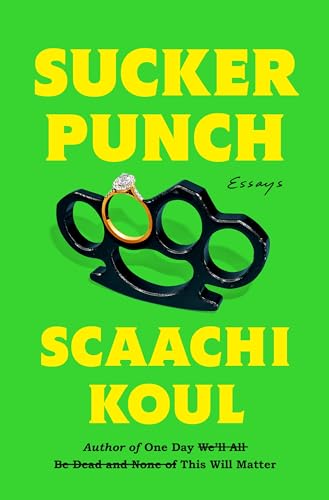
SUCKER PUNCH: Essays, apt title...on several levels

SUCKER PUNCH: Essays
SCAACHI KOUL
St. Martin's Press (non-affiliate Amazon link)
$14.99 ebook edition, available now
Rating: 3* of five
The Publisher Says: The long-awaited follow-up from one of the most original and hilarious voices writing today.
Scaachi Koul’s first book was a collection of raw, perceptive, and hilarious essays reckoning with the issues of race, body image, love, friendship, and growing up the daughter of immigrants. When the time came to start writing her next book, Scaachi assumed she’d be updating her story with essays about her elaborate four-day wedding, settling down to domestic bliss, and continuing her never-ending arguments with her parents. Instead, the Covid pandemic hit, the world went into lockdown, Scaachi’s marriage fell apart, she lost her job, and her mother was diagnosed with cancer.
Sucker Punch is about what happens when the life you thought you’d be living radically changes course, everything you thought you knew about the world and yourself has tilted on its axis, and you have to start forging a new path forward. Scaachi employs her signature humor and fierce intelligence to interrogate her previous belief that fighting is the most effective tool for progress. She examines the fights she’s had—with her parents, her ex-husband, her friends, online strangers, and herself—all in an attempt to understand when a fight is worth having, and when it's better to walk away.
I RECEIVED A DRC FROM THE PUBLISHER VIA NETGALLEY. THANK YOU.
My Review: Author Koul's funny. Not innocently amusing, funny. She's written before this (One Day We’ll All Be Dead and None of This Will Matter) about her immigrant-to-Canada parents and her ongoing battles with their traditional expectations versus her Canadian ones. She had, then, a bit about her elaborate wedding...now it's about her pandemic experience, her mother's health crisis, the collapse of her marriage after that astonishing wedding...and something that's never been dealt with in her life, let alone her prose, before: she was sexually assaulted.
I do not know, or know of, a single solitary woman who does not have a story about her body being at the minimum threatened with sexual violence. Reading about it is, it seems, a means of creating solidarity and permission to say out loud that it's happened to you, like the very public #MeToo movement that's been bringing crimes to light that men are just as glad to have swept under the rug.
A proper millennial, Author Koul does her level-best to spin these facts of her life as...not funny, really, but sources or wry humor as she goes about coping with her wounds from them. I think a lot of women love to read these stories as a way to get perspective on the pain in their own lives. I'm aware of the reality and the awfulness of abuse in intimate relationships. It's not fun, and I myownself am not a fan of it as a topic for humorous coping.
Her other coping mechanism is rage. Full-throated, loudly expressed rage. That one I know from the inside; I do not think it is beneficial, nor appropriate, to valorize is as Author Koul does, while using humor to defuse its painful and destructive consequences on everyone...literally everyone...around her.
This is from my own experience: Go get counseling. Stay in counseling the rest of your life. Nothing will remove the rage. Work towards ways to minimize its footprint in your life, and the lives of those around you.
Three stars because it's trenchant and timely.
Friday, September 6, 2024
ORIGIN STORY, tough, trying reading for this maternal sex-abuse survivor
ORIGIN STORY
JENDI REITER
Saddle Road Press (non-affiliate Amazon link)
$7.99 Kindle edition, available now
Rating: 4* of five
The Publisher Says: What is the Poison Cure? For Peter Edelman, it's his alter ego in the comic book he's writing, a mysterious anti-hero who seduces and kills child abusers—a storyline that's bringing up his own long-repressed memories. For his co-author Tyler "Tai" Wick, a genderfluid teen artist in the group foster home where Peter is employed, it's the social workers who will deem him fit for adoption if he will suppress his female self, which they consider a split personality from his traumatic years working the streets. And for fashion photographer Julian Selkirk, who's trying to get Peter to say "I love you," it's the Christian faith that offers to help him break intergenerational patterns of alcoholism and violence, but at the cost of rejecting his sexuality.
Against the backdrop of late-1990s New York City sexual politics, these characters strive to redefine home and family in ways that are strong enough to contain their truths. From a Miami comic-book convention to a Christian men's retreat in Georgia, from an elite New Age wellness center to a BDSM dungeon in Manhattan, Origin Story follows their quest to determine the nature of healing and the price we pay for it.
I RECEIVED A DRC FROM THE PUBLISHER VIA NETGALLEY. THANK YOU.
My Review: Adult men dealing with maternal sexual abuse is going to stop most of you from picking this up.
Conversion "therapy", kink shaming, and the panoply of misunderstandings and bad takes that was 1990s-era psychotherapy should finish the remainder off.
Too bad. This is a solid love story between two deeply damaged men whose lives are somehow *better* when they're together. I'm really familiar with all the huge issues dealt with in here. I know these struggles. I think they're well-represented even when they're really hard to read.
If you're up for a very high-angst, dark and tough issue read, with a believable (though unsatisfying to me) HFN ending, this will apparate like it's dusted in Floo Powder into your cart. I myownself will never read it again. And I wish the comics stuff (which bored me) had been cut.
I'm really glad I'm seeing my therapist soon.
Thursday, August 29, 2024
EVE OUT OF HER RUINS, Paradise for whom?
EVE OUT OF HER RUINS
ANANDA DEVI (tr. Jeffrey Zuckerman)
Deep Vellum (non-affiliate Amazon link)
$7.96 Kindle edition, available now
Rating: 4* of five
The Publisher Says: "Devi writes about terrible and bitter events with a soft, delicate voice."—Le Figaro
With brutal honesty and poetic urgency, Ananda Devi relates the tale of four young Mauritians trapped in their country's endless cycle of fear and violence: Eve, whose body is her only weapon and source of power; Savita, Eve's best friend, the only one who loves Eve without self-interest, who has plans to leave but will not go alone; Saadiq, gifted would-be poet, inspired by Rimbaud, in love with Eve; Clélio, belligerent rebel, waiting without hope for his brother to send for him from France.
Eve out of Her Ruins is a heartbreaking look at the dark corners of the island nation of Mauritius that tourists never see, and a poignant exploration of the construction of personhood at the margins of society. Awarded the prestigious Prix des cinq continents upon publication as the best book written in French outside of France, Eve Out of her Ruins is a harrowing account of the violent reality of life in her native country by the figurehead of Mauritian literature.
The book featurues an original introduction by Nobel Prize winner J.M.G. Le Clézio, who declares Devi "a truly great writer."
I RECEIVED A DRC FROM THE PUBLISHER VIA EDELWEISS+. THANK YOU.
My Review: Paradise is always a fantasy, a construct imposed on a much more complicated reality. It is also used, with distressing regularity and near-universal success, as a trap for the seekers and for the sacrificial victims the entrappers designate.
The sea by the luxury hotel gleams with hazy fire. Where we live, it looks like oil and smells like an armpit. People walk past, sit at a café, take in the air, drink beers, enjoy the weather, and think about nothing. Eve once told me that we were on another planet. I think she’s right. Our sun and theirs aren’t the same.
No tourist could fail to wince at the reality of Paradise; so they're carefully steered away from contact with it.
Sometimes, when the neighbourhood is quiet, the island’s sounds seem different. Other kinds of music, less funereal tones, the clang of cash registers, the dazzle of development. The tourists scorn us without realizing it. Money has made them naïve. We cheat them out of a few rupees until they begin to mistrust our pleasant, false faces.
The country puts on its sky-blue dress, the better to seduce them. A marine perfume wafts from its crotch. From here we can’t see the island all dolled up, and their eyes, dazzled by the sun, can’t see us. As things should be.
Fantasy is good business, and good for business. Look at Disney's "entertainment" empire, its parks, hotels, cruise ships, retirement homes for fucksake. What it costs, what it does to the homes of real people, isn't priced into the fantasist's experience. It's an economic externality. Tourists, often with the very best of intentions, go to places to have experiences, learn things, be broadened and hopefully improved. Travel does alter people who can afford to do it.
The capitalist system demands that, wherever there is money to be made, as much as possible of it should be funnelled into the pockets of the very richest. So that broadening travel? It benefits you, the comparatively rich tourist and it enriches the service providers; leaving the people whose home you're staying in, whose lives you're altering, with less than a fair share. Most destructively, people like Eve are encouraged to commodify their being on this Earth:
The school principal told me: Vous vous devez de réussir. Then she said it again in English: You owe it to yourself to succeed. And finally in Mauritian Creole: Pa gaspiy u lavi.
Careful now...read that again. This is the colonizer's hand showing through the glove. Like that deeply and disturbingly unchristian "prosperity doctrine," it exchanges the idea of development, improvement, education for "success" that ever-elusive endlessly mutable chimera of the economic system. And look how beautifully succinct that message is, delivered in the colonizers' tongue, the dominant language of capitalism, then the hearer's local language. The hierarchy is laid bare. Fewer than thirty words to create the spine of a story.
Eve is, in the eyes of those around her who purport to love her, a wild creature of iron whims and large passions. She is a small woman. That means her intensity is almost fetishized in acknowledging it; it also has the side effect of making her sexually desirable. As she's a person very capable of dissociation, like many intelligent women, she uses sex to acquire things she needs and things she wants.
This willingness to divorce herself from the use of her body is, ironically, the greatest guide to the woman she loves and who returns that love, Savita.
Eve's silence is the rumble deep within the volcano. It hurts me to see her so fragile when she thinks she's so strong.
Savita sees Eve's magma, her soul heating the rock of her life to boiling point. She longs for the abillity to soothe her, to release the pressure that pushes Eve away from everyone else. In a grim, horrible way, she does that.
The shortness of this read shouldn't be mistaken for truncation or cursoriness. Savita's arc, not long, so hugely, consequentially alters Eve's and Troumaron's as an entire "native" (that ugly colonizers' term for the owners of the land) community, that an entire fifty thousand more words could be spent on it without adding a scintilla of intensity, meaning, or passion. Eve is transformed, attains an apotheosis, that alters her male admirer Saadiq (a poetry-obsessed yobbo whose yearning for her organizes his life and leaves hers untouched) perhaps most. The end of the story isn't a cheery, uplifting one. The end of the story is, instead, the realization of the inevitability of sacrifices in pursuit of the idea of Paradise.
I'll comment that the narrative voice here is not, nor was it meant to be, an accurate presentation of young people's actual spoken language. When you're telling a story this consequential, using more poetic, lyrical cadences is a useful way of communicating to the reader they're to look for more than the surface of the tale. I also note that Nobel-winner J.M.G. Le Clézio wrote an introduction that is one long spoiler for the story. I advise you to read it last.
I enjoyed this read very much. I hope you'll take heed of the content warning for sexual abuse...it's not graphically shown but it is absolutely pervasive of every aspect of the story told here.
Monday, September 18, 2023
THE PECULIARITIES, flawed but fun
THE PECULIARITIES
DAVID LISS
Tachyon Publications
$17.95 tradepaper, available now
Rating: 3.75* of five
The Publisher Says: From popular historical alternate history author David Liss (A Conspiracy of Paper) comes the tale of a clueless young man embroiled in a deadly supernatural mystery in London. Rooted in strange conspiracies and secret societies, this absurdist comedic romp combines strange bedfellows with murderous creatures, resulting in an unexpectedly delightful consequences.
All of his life, Thomas Thresher has been free of obligation and responsibility, but that is over now. He is a twenty-three-year-old man whose best days are behind him. Thomas's older brother Walter has trapped him in a tedious clerical job at the family bank in London, and Thomas is expected to wed a wealthy young woman in whom he has no interest.
But Thomas has more serious problems than those of a disaffected young man. There are irregularities at the bank he cannot explain. His childhood friend has mysteriously turned up dead. Worse, a verdant skin malady has infected him: leaves have begun sprouting on his skin. Thomas must conclude that it is due to the long-rumored Peculiarities. London's famous grey fog has been concealing a rash of unnatural afflictions—and worse, the murderous Elegants.
As Thomas grows leafier, the conspiracies surrounding him become more apparent. He cannot determine whom to trust: his own family; his banking co-workers and superiors; the beautiful widow of his companion; the woman he is to marry. Or perhaps a lycanthropic medium; the members of a secret occult society...or even Aleister Crowley.
I RECEIVED A DRC FROM THE PUBLISHER VIA NETGALLEY. THANK YOU.
My Review: Clueless whiny nepo baby Thomas Thresher, clerking at his family's London bank and living a really cushy life, starts to grow leaves from his body. Promising start to a David Liss story. We've got London, though in the early twentieth century not the eighteenth, we've got business shenanigans at the bank, and a world in which there are children with lobster claws, women giving birth to rabbits, killer fogs of supernatural origin, and a werewolf psychic. Oh, and Aleister Crowley.
Why does Walter, Thomas's brother, have such wood for Thomas's marriage to Esther, a Jewish woman with pots of money? What is driving the oddball events in the bank (seriously dodgy loans and very odd property acquisitions) that aren't in service of making money? And, last but not least, what the hell are all these leaves doing on Thomas's body?
The way Thomas sets about trying to make sense of the Peculiarities, the way he simply rolls up his sleeves, picks a few leaves off, and starts looking around for information that could help him...these are positives. They do lead, quite naturally, to a slightly off-putting disconnected style, episodes instead of one smooth narrative. That wasn't entirely to my personal liking but I got accustomed to it.
What I very much didn't get used to was Esther's being the butt of so many nasty, mean-spirited jokes not least from Thomas...the man she's set to marry. It made me very uncomfortable and was absolutely never addressed...Esther end the way she began, a one-note anti-Jewish joke. I couldn't figure out why she was so awful, compared to Thomas's suddenly acquired love interest who was a cypher.
That, and a really cringey sexual assault scene, are the source of my lower-than-expected rating.
I was very taken by the Peculiarities themselves. The fact that we don't find out what the hell's going on here isn't a major issue for me because the verve of Author Liss's tellings of the supernatural events was the actual point. There's no need to explain strange doings if the point of them is to be strange. What Author Liss does overexplain is the world of 1899 London and its many and various restrictions on women and Others. That's really overdone.
Something that might be overdone for some readers is the pseudo-Victorian locutions of Thomas's narration. I myownself found it fun and just on the good side of stilted, but others might feel differently. If you opt to read a sample of the Kindle edition, you'll know right away if this is for you or not. What nearly scuppered my interest, and greatly slowed my reading, was the chest-pokey second-person narration parts.
I must say that, with the different historical luminaries swirling through the story, I was a little bit let down that none of them played a big role in the solution to the strange issues in the book. (Well, except Aleister Crowley.)
Not a perfect read, but a good one; a lot of stuff gets wrapped up in the last ten percent of the book but not, by any means, even close to everything. That is, for me, perfectly okay because very few things in life are wrapped up in tidy little bows. The Peculiarities remain peculiar. And most enjoyably so.
Monday, September 12, 2022
LESSONS, Ian McEwan's curiously emotionless Bildungsroman ***SPOILERS***
LESSONS
IAN McEWAN
Alfred A. Knopf
$30.00 hardcover, available now
Trade Paperback Edition $18.00|available July 25, 2023
One of NPR's Best Books of 2022!
Rating: 3.75* of five
The Publisher Says: From the best-selling author of Atonement and Saturday comes the epic and intimate story of one man's life across generations and historical upheavals. From the Suez Crisis to the Cuban Missile Crisis, the fall of the Berlin Wall to the current pandemic, Roland Baines sometimes rides with the tide of history, but more often struggles against it.
When the world is still counting the cost of the Second World War and the Iron Curtain has closed, eleven-year-old Roland Baines's life is turned upside down. Two thousand miles from his mother's protective love, stranded at an unusual boarding school, his vulnerability attracts piano teacher Miss Miriam Cornell, leaving scars as well as a memory of love that will never fade.
Now, when his wife vanishes, leaving him alone with his tiny son, Roland is forced to confront the reality of his restless existence. As the radiation from Chernobyl spreads across Europe, he begins a search for answers that looks deep into his family history and will last for the rest of his life.
Haunted by lost opportunities, Roland seeks solace through every possible means—music, literature, friends, sex, politics, and, finally, love cut tragically short, then love ultimately redeemed. His journey raises important questions for us all. Can we take full charge of the course of our lives without causing damage to others? How do global events beyond our control shape our lives and our memories? And what can we really learn from the traumas of the past?
Epic, mesmerizing, and deeply humane, Lessons is a chronicle for our times—a powerful meditation on history and humanity through the prism of one man's lifetime.
I RECEIVED A DRC FROM THE PUBLISHER VIA NETGALLEY. THANK YOU.
My Review: Sometimes gambling on a less-than-loved writer's work, when it's a story one really resonates with, pays off; other times, not so much. This experience, after my deep dislike of Solar and Atonement yet genuine appreciation for The Children Act, split the difference.
It's not news to regulars here that I was sexually abused by my ephebeophile mother when young. Quite recently I read The Kingdoms, an alternate history novel by Natasha Pulley, which contained a truly astonishing scene of unwanted intimacy between a man (the victim) and his wife (the violator) that, for the very first time ever in my experience of reading, contained the truth of coercive heterosex where the man's the coerced partner. It was...healing...for me to see that on the page. It gave me the inner resources to request this book back in June.
Lessons is out now, and I recommend it to you as a good, solid novel of reckoning with emotional damage across a lifetime.
What about that equivocal waffle above? Well. Now. Author McEwan hasn't suddenly burst forth from a chrysalis and become a wildly passionate and gloriously sensuous prose stylist. He's still a man of his age and class. He's not built for flights of fancy or even particularly emotionally available prose stylings. It's one of the main reasons I haven't become a fanboy of his. But, and this is where I sound weird to my own inner ears, when there's a story to tell that *needs* to be kept buttoned up, he's the writer to do it. That was completely evident in The Children Act, another flat and affectless person's attempt to contextualize the wildly ungovernable emotions of others as they rampage through her (in that case) carefully designed lifestyle. It's the technique that was needed to tell this story and, blessedly, Author McEwan used it.
What happens to young Roland isn't all that unusual. I know we, as a culture, like to think men are perpetrators and women are victims, but this has never been true. It's time we faced up to it in the post-#MeToo moments. It isn't at all surprising to me that the pace of this story varies as much as it does. The youthful disasters are the ones that set the stage, often act as the pattern, for the hurts and buffets of the future. The manner of Author McEwan's telling of the different stories was quite clearly meant to reflect this. Where something happens for the first time, it is given narrative weight; when it comes around again, it gets less of it. I approve, if that needs saying, of this strategy.
No one is immune to the stresses and strains of The World as it runs amok and periodically threatens to kill us all. This life, Roland's years on this planet, contains all of my own years on it. I was at different stages of life than Roland, of course, being two decades younger; but the fact is I was formed by the same things Roland was. It felt to me as though Roland trudged and slogged a lot of his life away. Given the emotional damage he carries with him, that was perfectly logical to me. It wasn't, however, a chucklefest. When you're going to take me on a five hundred-plus page trip inside one man's skull, I as a reader would like some lightening of the shadows, say with humor. Author McEwan doesn't offer that to us; this is something to be aware of in deciding whether you'd like to read the book.
Many other early readers seem to have a problem with Alissa, the wife who abandons Roland with their infant son to become a writer. I'm entirely unsure what the heck the problem they have with that subplot is. It's not like it can't happen, since it's something Doris Lessing (eg) actually did. I myownself wasn't in the least surprised that Roland would marry someone who could calmly walk away from messy emotional realities in order to serve her own needs. Like calls to like, after all.
The one moment I felt Author McEwan really rather overplayed his emotionless hand had to do with the Chernobyl disaster...it felt, in its handling, like something was finally just off in the manner of his weaving the event into the story. But honestly, as said above, this book is telling a story about the reverberations of an emotional cripple's awkward flailings, and nobody I can think of could do it better than Ian McEwan has done.
Sunday, June 12, 2022
SOLO DANCE, East Asian queerness finds an English-language voice BUT CW for suicidal ideation
SOLO DANCE
KOTOMI LI (tr. Arthur Reiji Morris)
World Editions
$17.99 trade paper, available now
ONE OF NBC'S BEST LGBTQ BOOKS OF 2022!
Rating: 4* of five
The Publisher Says: An important queer voice from East Asia’s millennial generation
Chō Norie, twenty-seven and originally from Taiwan, is working an office job in Tokyo. While her colleagues worry about the economy, life-insurance policies, marriage, and children, she is forced to keep her unconventional life hidden—including her sexuality and the violent attack that prompted her move to Japan. There is also her unusual fascination with death: she knows from personal experience how devastating death can be, but for her it is also creative fuel. Solo Dance depicts the painful coming of age of a gay person in Taiwan and corporate Japan. This striking debut is an intimate and powerful account of a search for hope after trauma.
I RECEIVED THIS DRC FROM THE PUBLISHER VIA EDELWEISS+. THANK YOU.
My Review: Asian cultures don't, as a rule, deal well with modern QUILTBAG identities. The perception of queer folks isn't anything like as angry as the anti- crowd here in the West but it's close in emotional terms to our unenviable habit of emotional violence and rejection. Homophobia is something queer folks battle no matter where we are. Doesn't say great things about human beings, does it.
What Author Li does in Solo Dance is deeply personalize the costs of being out in the culture of Taiwan, which leads to violent assault, and in Japan's less physical homophobic world, where it's simply ignored. Slighted, denigrated, and rejected; but without ever saying the awful words "gay" or "lesbian". This ostracization is crueler even than physical beatings.
But that is what Chō Norie prefers to her native Taiwan's brutality. She came to Japan unable to speak Japanese, as a Taiwanese woman, with all the cultural frieght that carries. Her great-grandmother's generation was used as "comfort women" and her own is a kind of slighted immigrant worker-bee, needed but not valued in larger Japanese society...and that suits Chō down to the ground. Maybe, after all, if she *can't* speak the language, no one will demand she speak at all. Thus is denial and emotional cowardice perpetuated in Chō's new, self-selected life.
With the long-standing Japanese cultural celebration of suicide, the Ghost Forest and the Wind Phone joining the long-standing ritual suicide of seppuku; it seems utterly unsurprising, then, that Chō comes here to make a life while obsessing over, planning for, lovingly dwelling on, her own suicide to come, as well as the past. (It should be noted that Japanese society is being deliberately steered away from this cultural acceptance.)
She didn’t have a strong inclination towards death, but she had no attachment to living either. While she still had breath in her lungs, she would do her best in life, yet should it ever reach that point where it was no longer bearable, she would choose death without hesitation.
Since that is the very first page of the story, I think it acceptable to quote it here; if this is in the least triggering for you and you've read this far into the review, it's a poor fit for you.
The main point of my discussing this book, though, is to say that it is a gorgeous work of prose, in a quiet and mannered way. It is an honest and bleak account of Otherness in a culture that greatly values comformity. It is a deep dive into a woman's blocked relationship with her body, with the pleasures of sex and intimacy, stemming from sexual violence. Chō runs away from Taiwan because she does not want to confront her rape in every living moment. Japan does not, to no one's surprise, encourage healing in its culture of silence around matters sexual. Her own fearfulness about her emotional state, then, is never in any way the focus of any positive intervention.
It is not a hopeful story of a survivor.
She was twenty-seven and this real-world conversation shouldn’t feel so remote, but she couldn’t force herself to get interested. There was an insurmountable wall that prevented her from fully engaging with it. All this talk of a decade from now, two decades from now, seemed like the distant future—hundreds if not thousands of years away. A world in which her existence wouldn’t make any difference. That was the true representation of her feelings.
Chō Norie, as she has chosen to be known, is not Yingmei the child whose early life contains earthquakes (fascinating to read about how her family copes with those!) and the death of a classmate-cum-crush-object of Yingmei's which is met with emotional ceremonies and discussions that she is utterly unable to process or participate in. Chō is a woman born out of intent...a creation not the being created, an auto-Galatea. And as a result, Chō has few inner resources to meet the few concerned people she encounters in Japan, even fewer to meet the awful and brutal rejection of a character Chō is (somewhat bloodlessly) involved with.
What, then, is the source of my four-star rating? First, beautifully translated imagery-laden writing. I think Translator Arthur Reiji Morris did a beautiful job of putting flattering English clothes on this very Japanese body. Enough context is presented that I never felt lost or left out; I suspect those were crafted for the translation, and it was done with great facility. Second, the fact that Chō was a woman made up, and one composed of literary antecedents. There are many works of literature harkened back to and that always gets my upvote.
There's a last thing you should know before starting on this journey: The ending. It is, to be as succinct as I can be, fantastical. Whether real or fantasized or merely cooked up, it does not resolve the events of the book. It leaves room for you to do that and, in the context of a book of this kind of interiority (though not a récit, it comes close), that fel to me like a worthy choice. It was not satisfying, though, in that "...and that was a fascinating story! *closes cover*" way.
Like all unfinished business, it lingers.
Tuesday, June 7, 2022
NIGHTCRAWLING, new voice in fiction from Oakland (!)
NIGHTCRAWLING
LEILA MOTTLEY
Alfred A. Knopf
$28.00 hardcover, available today
Now an Oprah Magazine Favorite Book Of 2022!
One of Time Magazine's 100 Must-Read Books of 2022
Rating: 4.5* of five
The Publisher Says: A NEW YORK TIMES WRITER TO WATCH - A dazzling novel about a young Black woman who walks the streets of Oakland and stumbles headlong into the failure of its justice system--the debut of a blazingly original voice that "bursts at the seams of every page and swallows you whole" (Tommy Orange, best-selling author of There There)
Kiara and her brother, Marcus, are scraping by in an East Oakland apartment complex optimistically called the Regal-Hi. Both have dropped out of high school, their family fractured by death and prison. But while Marcus clings to his dream of rap stardom, Kiara hunts for work to pay their rent—which has more than doubled—and to keep the nine-year-old boy next door, abandoned by his mother, safe and fed.
One night, what begins as a drunken misunderstanding with a stranger turns into the job Kiara never imagined wanting but now desperately needs: nightcrawling. Her world breaks open even further when her name surfaces in an investigation that exposes her as a key witness in a massive scandal within the Oakland Police Department.
Rich with raw beauty, electrifying intensity, and piercing vulnerability, Nightcrawling marks the stunning arrival of a voice unlike any we have heard before.
I RECEIVED A DRC FROM THE PUBLISHER VIA NETGALLEY. THANK YOU.
My Review: Nineteen! NINETEEN!! Author Mottley is all of nineteen, twenty minus one. And she's written this amazing, full-throated roar of defiance in the face of the overwhelming, outrageously powerful white hegemony that controls Oakland and California as a whole. I am revolted that this story flowed as naturally as a river does to the sea out of Leila Mottley, but it did and readers should bear witness with her as Kiara, at a revoltingly early age, learns that men will pay her to use her body for their pleasure.
It's a painful awakening. It's a godsend of money. It's a trap, it's baited with the exact things Kiara needs to walk into the trap, and it's painfully obvious that her world is over. It's a new world entirely, now that she's the one paying the rent.
I will say that, to the sensitive fleurs among us, this story will not go down well. It's honest, it's angry, it takes nothing from you and gives everything to you, and it's a gift so bitter that it makes you wish you hadn't opened it because now you know and can't pretend you don't.
We're always trying to own men we don't got no control of. I'm tired of it. Tired of having to be out here thinking about all these people, all these things to keep me alive, keep them alive. I don't got no air left for none of it. Maybe {her frenemy} is right, it's time to let go, to let one of them take over, take care of me. But I can't stop thinking about {the} call, if {her brother} is alright, if maybe he's got enough money to help us out.
In the middle of a dreary afternoon spent doing something horribly hard, watching her mother as she dies, avoiding a gang of teens who could easily have decided she was a target, riding a bus on a hot afternoon and getting into her rent-due apartment...she wonders how she can help her older brother. Because now, next to making the rent, she's got a much, much bigger problem: How to keep that brother alive. Literally not-room-temperature alive.
That {bad moment from childhood}'s sort of what this feels like: the helplessness of it. Like standing on the road that leads to here and noticing a path you didn't know existed and not being able to take it. Like the road that leads to here was never the only road and time made me forget that until these sobbing moments when I remember, when the fog clears and I'm looking back and there's a fork on the ground, another way.
That ought to ring a bell in us all. If you're an adult, you most likely found yourself nodding along and recognizing those emotions. You'll likely recognize the others about regrets and about consequences and about prices you can't pay to avoid. This is that kind of a story, it's that kind of a world that Kiara and her wide found family live in. And those who make it out? They change addresses. They can't really change when so much around doesn't. This life is what you make of it, true, but is your inward being as malleable as all that?
What makes me so happy is that Author Mottley is here, is the one telling the story to my white-person eyes. I'm so happy that someone in publishing saw this manuscript, heard this rage-filled, sorrow-drenched scream of pain and said, "there's a proud, fine writer being born here, let me put the privilege and prestige of Alfred A. Knopf, Inc., behind it and make people listen." So, listen: If you're wondering if this isn't more misery porn, or worse, disaster tourism, then I'm going to bring it to you fresh, this ain't that. (My Texas bleeds through when I want to make sure y'all're listening.)
When I was in the agenting business many long yars ago, an ancestor of this story came across my desk. I loved it. I loved its vernacular honesty and I loved its visceral reality. I wanted to make people read it...stop them in the halls of our building and say "just this bit right here! you'll love it!" and I was talked out of it. See, I'm white, and male, and even then that meant my privilege wasn't going to sail that beautifully loud sound-cloud out onto the lakes of white-people culture. Publishing might be doing better, but it's still the world where I was told to my face by an editor about a non-fiction book by and about African-Americans (as the polite term was then) I wanted her to buy, "who will buy it? Black people don't read."
Thirty years on I'm still appalled by that memory.
And thus it's extra delightful to me that I'm reading this auspicious debut from a young Black creator with the colophon of a very, very distinguished house that made its cultural capital a century ago by taking just these sorts of chances. (Joseph Hergesheimer won't mean much to most of y'all, but he was quite a noise on the 1917 Knopf list....) I couldn't do it; someone could, though, and that it's taken this long to make the waves it's already making (LitHub loves it, forevermore! That's Establishment imprimatur enough right there!) is, well, for me personally both validating and frustrating. I wish I'd done it; I'm thrilled it's been done.
Don't deny yourself this treat. I can't say I liked Look Homeward, Angel a whole lot, but it was a clarion call, a loud voice in full cry, saying, "there's a new way to do this!" That's what Nightcrawling is, that loud voice. Spend some extra time with her and learn what will make you sad to know.
Subscribe to:
Posts (Atom)