Showing posts sorted by relevance for query korean. Sort by date Show all posts

Saturday, August 2, 2025

SAME BED DIFFERENT DREAMS, just-barely-too-long alt-Korea novel


SAME BED DIFFERENT DREAMS
ED PARK

Random House (non-affiliate Bookshop.org link)
$5.99 ebook, available now

Rating: 4* of five

The Publisher Says: A wild, sweeping novel that imagines an alternate secret history of Korea and the traces it leaves on the present—loaded with assassins and mad poets, RPGs and slasher films, K-pop bands and the perils of social media.

In 1919, far-flung Korean patriots establish the Korean Provisional Government to protest the Japanese occupation of their country. This government-in-exile proves mostly symbolic, though, and after Japan’s defeat in World War II, the KPG dissolves and civil war erupts, resulting in the North-South split that remains today.

But what if the KPG still existed now, today—working toward a unified Korea, secretly harnessing the might of a giant tech company to further its aims? That’s the outrageous premise of Same Bed Different Dreams, which weaves together three distinct narrative voices and an archive of mysterious images and twists reality like a kaleidoscope, spinning Korean history, American pop culture, and our tech-fraught lives into an extraordinary and unforgettable novel.

Early on we meet Soon Sheen, who works at the sprawling international technology company GLOAT, and comes into possession of an unfinished book authored by the KPG. The manuscript is a mysterious, revisionist history, tying famous names and obscure bit players to the KPG’s grand project. This strange manuscript links together figures from architect-poet Yi Sang to Jack London to Marilyn Monroe. M*A*S*H is in here, too, and the Moonies, and a history of violence extending from the assassination of President McKinley to the Soviet downing of Korean Air Lines Flight 007.

Just as foreign countries have imposed their desires on Korea, so too has Park tucked different dreamers into this sprawling bed of a novel. Among them: Parker Jotter, Korean War vet and appliance-store owner, who saw something—a UFO?—while flying over North Korea; Nora You, nail salon magnate; and Monk Zingapan, game designer turned writing guru. Their links are revealed over time, even as the dreamers remain in the dark as to their own interconnectedness. A thrilling feat of imagination and a step forward from an award-winning author, Same Bed Different Dreams begins as a comic novel and gradually pulls readers into another dimension—one in which utopia is possible.

I RECEIVED A DRC FROM THE PUBLISHER VIA NETGALLEY. THANK YOU.

My Review
: GLOAT now enters my lexicon as an acronymic shorthand for "evil bastard corporate actor" alongside its sixtyish ancestor CHOAM from Dune. As Soon, the character who works at GoogleGLOAT, drifts in and out of the narrative, I thought I was supposed to attach meaning to these time-shifts into either the *Korea MS or Parker Jotter the SF writer manqué's PoV...but there was not something I could find that reliably sent me off to another narrative strand. It could be that I'm just not sophisticated enough, or attentive enough, to identify it; nonetheless its invisibility to me (whatever the cause) cost me fluid readability.

I'm not proficient in Korean history so I went into the read expecting to need St. Wiki's help untangling what/when/who nexuses. Author Park offers clues that feel very helpful. The problem is these clues aren't terribly well signposted. By which I mean I think he went out of his way to bury them in odd places.

"Flounder" is my verb for this read. I floundered from the beginning to the end. I splashed in a kiddie pool that floated into the Indiana Natatorium. I'm pretty sure most of the time I was listing perilously in the diving well...deep but not lethal.

I'm giving you the impression that this wasn't fun, but oh boy was it! Like being in a giant playtank without adult supervision always is! Splash into the Korean Provisional Government's truly jaw-dropping existence; then to the Korean War vet (my dad was one, too) Parker's awful struggles, Soon's crisis of conscience; the story didn't help me figure out where I was or who I was with. Author Park trusted me to figure it out.

How often do you get that experience? I'm not sure when I was last left alone by a US writer to slug through a learning curve. It was heady stuff. As was its quiet-part-aloud disdain for crony capitalism. The main reason people rise in the current capitalist hellscape is mostly down to who they know and how much they can spend on the crappy people who gatekeep access to the ocean of money (fake, fiat money has no logical reason for scarcity) need to do...anything...hence GLOAT.

It won't be everyone's jam. If you found Cloud Atlas impenetrable, this isn't your book. OTOH, if you're into bibimbap already, the food references will feel like horrible torture unless you live near a Korean place. Hanjeongsik is in my very near future if I have anything to say about it...but that's beside the point. You need to have a willingness to keep going in spite of wondering what this or that person's name is, this or that historical event's factuality is, and be ready to accept the "aha!" moments as they come.

A strong anti-crony capitalist theme in a book that allows me to learn things for myself. Had it been 100pp shorter I'd be full-five-starring it. But at 520-plus pages it felt bloated, slightly self-indulgent. A story I recommend with mild reservations, not a "just READ it gorram you!" shove.

Monday, April 6, 2026

HONEY IN THE WOUND, Korean magical realist family saga


HONEY IN THE WOUND
JIYOUNG HAN

Avid Reader Press (non-affiliate Bookshop.org link)
$14.99 ebook, preorder now for delivery 7 April 2026

Rating: 4.5* of five

The Publisher Says: A lyrical and suspenseful debut novel about a mysteriously gifted Korean family confronting the brutality of the Japanese empire, Honey in the Wound is an epic tale of survival and the reclamation of power.

A sister disappears and returns as a tiger. A mother’s voice compels the truth from any tongue. A granddaughter divines secrets in others’ dreams. These women are all of one lineage—a Korean family split across decades and borders by Japanese imperialism.

At this saga’s heart is Young-Ja, a girl who infuses food with her emotions. She revels in her gift for cooking, nourishing the people she loves with her cheerfulness. But her sunny childhood comes to an end in 1931 when Japanese soldiers crush her family’s defiance against the Empire. Young-Ja is cast adrift, her food turning increasingly bitter with grief. When a Korean rebel fighter notices her talents, however, she is whisked off to Manchuria to join a secretive sisterhood of beautiful teahouse spies. There, Young-Ja finds a new sense of belonging and starts using her abilities for the resistance. But the Imperial Army is not yet finished with her…

Decades later, Young-Ja lives alone in Seoul, withdrawn from the world until her Tokyo-born granddaughter Rinako bursts into her life with the ability to see into dreams. In cultivating a tentative bond, they confront the long-buried past in a stunning emotional climax.

As an unforgettable family perseveres in the long shadow of colonialism, Honey in the Wound transports readers to mountain forests where tiger-girls stalk, to Manchurian teahouses and opium dens where charming smiles veil secrets, and to the modern metropolises of Tokyo and Seoul where restless ghosts stir. This debut novel is a tender yet powerful multi-generational drama that shines light onto the twentieth century’s darkest corners and gives voice to those who bore witness.

I RECEIVED A DRC FROM THE PUBLISHER VIA NETGALLEY. THANK YOU.

My Review
: Brutality is colonialism's sole common legacy across all colonial regimes. Korea's half-century as part of Japan's empire was certainly no exception. Many are the stories of families ravaged by slavery, by economic disadvantages imposed to benefit the colonizers, by the horrors of the comfort women's suffering. It's not unique to Japan's imperial project...go look at Briseis' life after the fall of Troy, and I promise you she was nowhere near the first to suffer this fate...but its systematic, intentional social sanction somehow makes it a vile twentieth-century model of efficiency in evildoing.

So much of modern US culture is Korean inflected. I've reviewed a fair few Korean translations, Korean-themed stories written by members of its diaspora, stories set in Korea, all sorts really, because the culture of the place is ancient, rich, and deeply rooted as it smoothly takes on the modernity of this century as an economic, therefore cultural, powerhouse. As I gain more and more experience with the stories Koreans send into the Anglophone readership, I see one very, very frequent strand appearing: the Japanese occupation, usually framed in apocalyptic, folkloric ways to distance the reader from the brutal reality and to restore some agency, some meaning, to the country's suffering.

No exception this time. Starting in 1902 when Korea was an independent monarchy, the family we come to know and invest caring into is gradually Japanesed in personal names (pay careful attention, context will tell you if someone is being addressed or referred to as a Korean or as a Japanese imperial subject) and place names. It's like the British stealing India and naming "Mumbai" as "Bombay." (There are so many examples from all over the colonized world, that example is just the one I felt Anglophones would relate to most easily.)

The first 40% of the story is the slowest, with the highest concentration of double names. It's a debut novel. The fact is this is exactly reflective of the reality Author Han relates to us as we start our journey in 1902. Put in some effort and it will all begin to feel second nature to you quite quickly. The delight of a writer whose planning makes your reading more fluent with her intentional shifts in register is one who gets my highest regard. Time changes within few pages of each other are all quietly indicated with characters giving us clues, not with bold chapter or section headings that bring your readerly attention to the shifts themselves not the flow of the story.

This might not sound like it will suit you. I recommend reading a sample after publication day on the 7th. It feels more fluid than I'm making it sound. For example, you'll notice as you read through the book that there is a lot of use of, and description using, the color yellow. It would behoove you to go look into musok, the people's religion of Korea, and its use of colors. Like the shifts of names this is an enriching detail that clues the reader in to the larger thematic purpose of a passage, or a name, or an evocative word.

It made this read one I really looked forward to getting into, immersing myself into again and again. And a good thing indeed these moments were there because the horrific cost to the people of the colonial occupation, then the war, demanded much fortitude of me-the-reader to stay invested in people enduring so much. I had reservoirs of interested, sympathetic caring to draw down as horrors mounted up.

I will say I wish there had been a map in the book. I'm not sure where some place names were, whether they were really elsewhere or were Korean places I had read about renamed. Its lack was not fatal to my pleasure; but I felt it nonetheless.

A story I urge on readers and enjoyers of Pachinko and Whale. A story with depths deeper than its modest 320pp page count implies. An author who is a fine discovery in her debut novel.

Saturday, May 3, 2025

AT NIGHT HE LIFTS WEIGHTS: STORIES, bestselling collection translated from Korean by award-winning Janet Hong


AT NIGHT HE LIFTS WEIGHTS: STORIES
KANG YOUNG-SOOK
(tr. Janet Hong)
Transit Books (non-affiliate Amazon link)
$9.50 trade paper, available now

Rating: 3.75* of five

The Publisher Says: A disquieting vision of ecological dystopia in a collection by a major Korean writer.

An artist is plagued by desire for her mysterious double as disease spreads through an uncanny suburban landscape. An elderly woman suspects the old man who lifts weights in her neighborhood playground of being responsible for a spate of murders. While elsewhere, a woman who believes she’s been exposed to radioactive radiation inherits a warehouse where those fleeing the city can store their possessions.

Beneath the calm surface of the stories collected here, Kang Young-sook offers a disquieting vision of a society grappling with ecological catastrophe and unplaceable forms of loss.

I RECEIVED A DRC FROM THE PUBLISHER VIA EDELWEISS+. THANK YOU.

My Review
: It's not hard to see how this one stayed a bestseller in Korea, a country where they ousted their wannabe-dictator sitting president, yet failed to get much traction here, where the hoi polloi wished a stupid old man with a loud, grating voice and a Nixonesque "enemies list" into office. This kind of behavior used to shock us, like it did the South Koreans; when did that stop?

Nonetheless, the stories are individually crafted to keep one reading. I found it was easy to put the collection down between stories, but was always glad to pick it back up so I could reimmerse myself in a world worse than mine.

For now, anyway.

By long-established custom, we're going into the whole collection via the Bryce Method. Bless his cotton socks, this method of escaping the dead hand of shoulda-gotta on my creative juices is right up there with 'Nathan Burgoine's three-sentence review, and Nancy Pearl's Rule of Fifty.

From Mullae unsettles and disorients us, along with our psychologically fragile narrator, as the natural world undergoes a series of unexplored, barely explained disasters. Blood is the recurring visual...blood on the ground, blood on the newspapers set out to protect the floor of an apartment the narrator and her husband move into, blood permeating the air as countless pig corpses are dumped at his unspecified, but clearly horrible, workplace as the narrator peers down at it from a mound of earth that might be more pig carcasses. Women accost the narrator outside her building, forcing pamphlets on her urging resistance...to what? why? is this related to the unfolding disaster her husband begs her to remain indoors to escape? Unexplained. To say this story made me uneasy is to observe that the sun is a small, round spot in the sky. After the pandemic that killed so many people in my building, being trapped indoors while awful things happened and happened and happened...yeah, this one's sharp indeed. 4 stars

At Night He Lifts Weights gives us an elderly lady without family or purpose, living in an industrially destroyed environment, who suspects an elderly man of committing a series of horrible murders across the city. It's brutally honest about how lonely and useless people become in old age, though this silly, fluttering soul was always useless; the elderly man she suspects of crimes is, by contrast, vital, vigorous, and—ready for this?—lifts weights to stay in shape! Weird, right?

It must Mean Something, unlike the environmentally destroyed, stinking lake, the chronically backed-up toilet in her apartment (though this is handy because the plumber, a stripling of forty, is good to look at), or any of her other real problems. Like the other story I just read, it doesn't really end per se, it just has a natural place to stop. Resolution there is none. 4 stars

Radio and River Korean war survivor Oh emigrates to the US, a bleak now-ish California most likely, with a family he doesn't care about who heartily return his indifference. He starts work in some factory or another and makes a Korean friend, Kim. His inner silence is only broken with Kim, but like so many silent-cored people he surrounds himself with noise...dance music, hip hop: "Every time he heard this kind of shrieking, he felt like his corners had been filed down, so much so that he'd become a smooth lump of metal."

When a huge flood ravages the town, Oh loses his friend Kim. It snaps his last tenuous bond to his life. The road trip (and results of same) he goes on are...Lynchian, Twin Peaksy. 4*

Death Road features a suicidal woman whose childhood best buddy...a boy, against even mire powerful norms than in the US...all unknowingly and with opposite intent tells her about a Bolivian Andean road that she thinks will do nicely. That's not somewhere she can just...go, from Seoul anyway, so next up is Seoul's "Death Highway" as it's become called, an expressway interconnecting bridges, neighborhoods, etc etc. Unable to do the deed, flatten her foot on the accelerator and cause lethal havoc, she calls people from the car picking fights to work up the resolve, ending with her childhood bestie.

What a selfish and narcissistic person. Her inner and outer personas are not in harmony, which made this an effective rumination on the immense cost of misogyny, and the powerful rage of entrapped women...but nothing changes in the story (definitely the point) so it feels weak, weakening, draining without refilling. 4* for accurate reflection of womens' reality, but I never wanna read it again

Disaster Area Tour Bus follows a young Korean woman as she tours post-Katrina New Orleans. The tour bus driver's Black, and speaks in a really racist kind of dialect-Southern speech...author or translator or, most probably, both has never been to New Orleans...and, while I approve the anticapitalist disaster tourism messaging, and appreciate seeing how we look to outsiders, I couldn't get past the itchy icky sense that even your friends get it wrong sometimes. 3*

Greenland follows the life trajectory of ordinary people, no better or worse than they need to be, as they stagger unwittingly through traps, honey- and tiger-, as capitalism has its brutal way with them. Greed and selfishness and narcissism all play a role in the unraveling and redistribution of burdens...onto the women...and benefits...onto the men. Indexed to the modern history of Korea as it developed into a finance economy from a manufacturing one, the constant is that it's always a woman's thankless, unthanked job to do the work and clean up the messes. 4*

City of Anxiety is just that: full-on anxiety attacks, one after another, close third-person PoV that relentlessly charts a man's disintegration when his ex-wife disappears.

Searching for her entails a long litany of place names that mean nothing to me, innocent of all but the broadest sweeps of Korean geographical reality; it does not stop me from my apprehensive apprehension of this nameless man's unending fearful descent into a self-curated hellscape of obsessive regret. Nothing breaks him out of his narrow, bony, confining morass of unproductive, blindingly painful need.

Untrustworthy PoV, methinks, I reflected as his self-absorption drags him around without surcease. Was he the one who left the ex-wife? Did she, suffocating in his mire of inabilities, just...run? Did he kill her in a fit of emotional insanity as she tried to? It is a supremely evocative piece of writing. 4.5*

Pripyat Storage is named for the city nearest Chernobyl, of the 1986 nuclear disaster. A business the young woman narrator, turned thirty as 2006 marks her assuming of ownership and control from her newly-widowed mother, soon becomes engrossed in the minutiae of owning and running a business. It leaves her less time for obsessing over how her Chernobyl-blighted generation fails and fails and fails.

As her mother retreats into well-outfitted trips to distant mountains, she tries to reshape the storage business. As much as the indifference of her mother to the fate of the storage business annoys her, it also frees her to carve a new way to shed the unwanted garbage her father had piled up. It makes room for new people to fill this extra space, sparklingly clean from her mop and bucket, with the things they need to keep but can't bear to see in their faces.

Generational trauma making its way through the stages of grief. Deeply, sadly relatable. 4.5*

Processions proceeds from the knocking together of two empty vessels, a man and a woman who possess nothing, take nothing, give nothing, and thus find themselves attracted to the other's vacuum.

Quotidian things occur in the time they decide they will spend together; none important, none memorable, and since neither of them are those things, it is fitting they occur this way. No revelation, no great awareness shift, just two lonelinesses touching then parting. 3.5*
***

As a gestalt, this collection is less than the sum of its parts; as you'd expect from someone who has published four novels and five other collections before this one, nothing is wrong on a craft level nor is the translation somehow lacking in that hard-to-pin-down way. I'm just not full of anything now it's over. It's just...over. No fourth star for you, book.

Wednesday, September 28, 2022

THE PACHINKO PARLOR, 2nd novel from Korean French author about Japanese colonialism ***SPOILERS***


THE PACHINKO PARLOR
ÉLISA SHUA DUSAPIN
(tr. Aneesa Abbas Higgins)
Open Letter (non-affiliate Amazon link)
$16.95 trade paper, available now

Rating: 4.5* of five

The Publisher Says: The days are beginning to draw in. The sky is dark by seven in the evening. I lie on the floor and gaze out of the window. Women’s calves, men’s shoes, heels trodden down by the weight of bodies borne for too long.

It is summer in Tokyo. Claire finds herself dividing her time between tutoring twelve-year-old Mieko, in an apartment in an abandoned hotel, and lying on the floor at her grandparents: daydreaming, playing Tetris and listening to the sounds from the street above. The heat rises; the days slip by.

The plan is for Claire to visit Korea with her grandparents. They fled the civil war there over fifty years ago, along with thousands of others, and haven’t been back since. When they first arrived in Japan, they opened Shiny, a pachinko parlor. Shiny is still open, drawing people in with its bright, flashing lights and promises of good fortune. And as Mieko and Claire gradually bond, a tender relationship growing, Mieko’s determination to visit the pachinko parlor builds.

The Pachinko Parlor is a nuanced and beguiling exploration of identity and otherness, unspoken histories, and the loneliness you can feel amongst family. Crisp and enigmatic, Shua Dusapin’s writing glows with intelligence.

I RECEIVED A DRC FROM THE PUBLISHER VIA EDELWEISS+. THANK YOU.

My Review
: I'm aware of two things about this read, two very strong responses that wouldn't be elicited by any other read I've encountered this year: 1) Food looms very, very large in my experience of a story. This book, it's Claire and her inability to enjoy any food she encounters in Japan. 2) Author Shua Dusapin builds very intricate clockworks of interdependent imagery to support her stories of women without pleasure in the worlds they're in. The recurring fish-object images in this book join Winter in Sokcho's cold, echoing spaces. I mean, when a child's desire to act on the world is performed in explicit imitation of a cleaner fish, and a train pulling into a station summons from its immensity and speed the idea of a fish in Claire, our main character, then the author's going about her business with a degree of bravura that demands to be noted. As to whether it worked, I cannot say. I noticed it...I never thought of not noticing it...but derived nothing but the most facile conclusions from its obviousness. Me, or the choice? A case is readily made for either.

Claire's visit to her Korean grandparents, whose lives have taken them to batten on the economic lifeblood of their erstwhile colonizers, is always...off. Claire has little knowledge of Korean to offer in her attempts to connect with them. None of them deign to speak Japanese among themselves. So, to skirt around the grandparental reticence with their native language (a reticence they did not demonstrate with Claire's Swiss boyfriend, she notes) and still manage to communicate, they use English. Another colonial tongue...one associated in Korea with the US...another occupying power, though perhaps more palatable (!) because it's used by the Japanese's modern overlords.

Pachinko earns profits for her Korean grandparents...the only legal way for Japanese to gamble, or Koreans to earn...Japan making an apology for its colonial past? Or simply making it obvious who the vampires sucking the country's vice income into themselves are. Both...either...not for nothing is Japan's food disagreeable to Claire. Its artifice (a description of a raspberry atop a dessert was so revolting I had to put the book down:
I look down at my tart. A single raspberry glistens atop a lump of whipped cream. Compact and rubbery-looking. I pick up my knife, cut the tart into sections and start eating. It tastes fatty. I spit it out into my napkin. The raspberry stares up at me, still intact, coated in a film of jelly.

...it made something lush and luscious sound so unheathily slimy!) is removed from nature, is devoid of dirt or even signs of human hands in its preparation...something very Japanese about that. And Claire's not having it inside her, not willingly anyway.

Mieko serves as Claire's out, her means of contributing something to this life she's temporarily trapped in (it's a visit, not an emigration!) and unhappily isolated within. Mieko is a young Japanese girl whose mother hires Claire to teach French. (Which is odd, given the mother's fluency...permaybehaps seeking a genuinely French accent? from a Swiss Korean?) Mieko's, um, a little odd. Her ordinary-kid desires, eg going to theme parks or eating, are all as not-Japanese as is Claire's role in her life of teaching her a European language. Mieko is for Claire, unsurprisingly, the friend whose strangeness meets one's own in silent weirdo communion.

Claire's main failing as a character is simply that she is so passive. She drifts, she causes nothing to happen...teaching Mieko French and acting as her escort to theme parks aren't things Claire causes or even proposes...and, in the end, her presence changes nothing. The grandparents she's there to visit aren't communicative, make no demands and accept no role in the granddaughter who came around the world to enable a much-mooted visit to Korea for them's life while she's there. The visit itself, a "return" to a country that the grandparents left before there was a North or a South or an American- or Chinese-backed state, is...inconclusive. Did it happen? We aren't vouchsafed that information...Claire's climbing a gangway, thinking her grandparents are behind her...and they aren't.

What makes me not-best-pleased about that ending, that tunnel Claire's climbing to visit a place she's not been to, she's there to allow others to experience before they die...is the fact that it does nothing like an ending to resolve the family's generational hurts. It's a story about a disintegrating family's stop at a roadside attraction on its way somewhere and suddenly the stop's over but not everyone's in the car.

It is, in other words, a bit too much like Winter in Sokcho to be ignored. That tale's very French-feeling plot of plotlessness as families unite around the goal of making everyone feel as miserable as possible worked because it was the author's introduction to the Anglophone reading world. It's no less beautifully wrapped in sentences here, the imagery is lovely, but...it's not my first trip to the well.

I am glad I read this story. I am eager to see what else the author has in mind for me to read in future. I hope it will ring more than a change of scenery on the story next time. Once was enough; twice a bit troublesome; no more now, if you please.

Sunday, November 30, 2025

THE AWL, Korean Manha of labor trouble like we're having


THE AWL Vol. 1
CHOI GYU-SEOK (tr. Lynn Eskow)
Ablaze Publishing (non-affiliate Bookshop.org link)
$14.99 all editions, available now

Rating: 3.75* of five

The Publisher Says: The Awl is a story of ordinary folks struggling to be treated as humans.

Set in the latter half of the 2000s, against the backdrop of “Pureumi”, a fictional superstore chain in South Korea, the work unfolds with a focus on two protagonists: Yi Su-in, who has been instructed by the corporation to dismiss workers unjustly; and Gu Go-sin, a labor activist.

A man of principles, Su-in is someone who cannot restrain outspoken criticism and is constantly at odds with the world. Though he has quit a career in the armed forces to live quietly and chosen an ordinary job, he once again clashes against the world because the company has ordered him to drive out employees by force.

Aiding Su-in is Go-sin, a cool-headed and deft labor activist who runs a labor counseling center near the Pureumi chain. Unlike Su-in, who has difficulty getting along with people and sternly sticks to rules, he approaches others without hesitation and even resorts to extreme measures at times to accomplish goals.

Together, Su-in and Go-sin will oppose the manipulation and moral harassment to which the employees are cynically subjected. The process through which these two figures remind ordinary, diligent workers of their rights and bring change together will fire up readers.

Remarkable in mastery and brilliance, author Choi Gyu-seok (The Hellbound) depicts with finesse all the adventures of this shock of two worlds, and at the same time offers an amazing portrait of a complex Korean society, crossed by multiple tensions.

Proof that popular works can also be created based on social topics, The Awl has left an indelible mark on South Korean comics. Entertaining and moving at the same time, The Awl remains a monumental work in the nation’s comics, consummate in its artistry, while conveying an important social message.

I RECEIVED A DRC FROM THE PUBLISHER VIA EDELWEISS+. THANK YOU.

My Review
: I'm the target audience for this story. I had a hard time following it because my sequential-art skills are pretty poor. I'm working to get myself past that barrier, but this story challenged my determination hard. I can't get to a full four stars because if I, fully on the side of these union guys, can't keep focused, what's the less-convinced reader going to do?

It seems odd to provide the US-market reviewers with Korean language artwork.

Nonetheless, I found the story of a man in corporate slavery, I mean work, with a functional conscience and a powerful moral compass, refreshing; I appreciated the PoV of the street-tough union organizer being humanized, as well.

It's not for everyone, but the ones it's for should know it exists.

Saturday, May 2, 2026

DREAMT I FOUND YOU, lovely, evocative title indeed


DREAMT I FOUND YOU
JIMIN HAN

Little Brown and Company (non-affiliate Bookshop.org link)
$14.99 ebook, available now

Rating: 4* of five

The Publisher Says: From the critically acclaimed author of The Apology, a contemporary retelling of Korea’s Romeo & Juliet, in which the cousin of the star-crossed lovers helps them avoid a tragic fate.

When Dahee Shin was nine years old, she made a promise to protect her favorite cousin, Channing, who has always been like a sister to her. Now, at thirty, Dahee has found herself in a Korean American community in a New England beach town, once more running to the rescue of her debt-ridden relative.

Ever the idealist, Channing—who has spent her life haunted by the tragic story of Chunhyang and Mongryong, Korea’s parallel Romeo & Juliet—has fallen in love with Minjae Oh, all the while fending off the advances of powerful, manipulative Kent Cho, a local politician. As Channing and Minjae’s romance blossoms, and as Kent's suspicion and obsession grow, Dahee begins to realize that it may be up to her to make sure her cousin and beloved escape Chunhyang and Mongryong’s doomed end.

For fans of Hello Beautiful, Dreamt I Found You is a wondrous, tender retelling of Korea's most classic love story, steeped in the travails of a rigid class system, the power of premonition, and shot through with Korean folklore and magic.

I RECEIVED A DRC FROM THE PUBLISHER VIA NETGALLEY. THANK YOU.

My Review
: A double shot of romantic emotional caffeine. The story of Chunhyang and Mongryong, then the modern-day Korean diaspora story that evokes it, all juxtaposed with subtlety against the bog-standard Murrikin's understanding of Romeo & Juliet and set on the New England coast.

All of this is just fine, sure I'll read it no problem; what made me want to tell y'all about it, is that I saw more parallels to Shakespeare in Love than to Romeo & Juliet. I myownself found that *more* appealing not less so. I know I'll get body-checked into the glass (I need to stop reheating Heated Rivalry) for saying this, but stop telling me I must love Shakespeare's foreign-language drama with its now-stock characters for the depth of his insight. That depth has been added over the course of almost half a millennium of studying analyzing and commenting on the source text! We "know" it's there because so so many people have already "found" it and told us about it. It's now cultural shorthand in Anglophone cultures (possibly others but I have no direct access to those). "It's the Korean Romeo & Juliet" is not an analysis, it's an emotional appeal to the Anglophone reader's cultural furniture.

Author Han has very cannily gotten us Anglophones to do the hard work of buying in to her story in one fell swoop with this (apt, it seems to me) evocation of the very slightly older (c. 1591 versus c. 1694) iteration of the eternal star-crossed lovers story. I was primed by the clearly stated link between this modern-day version and its historical antecedents. I got the expected frisson from the love-conquers-all story, spiced up by the deeply satisfying comeuppance of a crappy human being. Beats there a heart so cold as to not race just a little when the lovers defeat a rotten, jealous monster?

I think not, at least not outside the ranks of the aromantic.

It's the beating heart of the story told here, that tension between what we're expecting, what we know, and what's happening on the page. While Minjae and Channing and Dahee and Kent do their literary gavotte with all its showy back-and-forths, its little hops and leg-pointings, and its apparently endless—at times feeling relentless—repetitions of the same movements to no internal resolution, the external story outline we've applied from long, long cultural familiarity serves as the musical accompaniment that grants us the readers as well as them the characters a stopping place.

I did say stopping place, not ending. The thing about a gavotte is that it's a folk dance all dressed up for aristocratic slumming, so it never develops beyond stylish-looking moves that show the dancers' stamina more than their grace. In Dreamt I Found You the characters are set a task...fall in love, overcome an obstacle, help or obstruct these actions...and repeat that task against a variations-on-a-theme backdrop. It's a time-tested technique that keeps on working because the specifics are fungible as a result of the audience's investment being all but assured. It requires little character development. All that is handled by the evocative models folloed, the stpes of the dance known to most all of us.

The "music" that provides the pace in Dreamt I Found You is the US culture on display. It must be said that culture is not shown to great advantage, but it also isn't deeply explored by the characters' interactions. They all execute the steps, do the hops, make the gestures; nothing derails their actions. The jolts and surprises are few because they're built into both model storys' bones and are well known to us. It doesn't really feel surprising, the biggest tension is will this be Shakespeare's tragedy or Korea's re/union?

Reading it to find out is the pleasure of discovery on offer. I resonated to the story, I liked the author's choice of which model to emulate, and at the end of the dance I bowed to my book-shaped partner and led him off the dance floor admiring how handsomely he had done the dance with me.

Sunday, June 1, 2025

I LEAVE IT UP TO YOU, do not read while hungry!


I LEAVE IT UP TO YOU
JINWOO CHONG

Ballantine Books (non-affiliate Amazon link)
$13.99 ebook, available now

Rating: 4.25* of five

The Publisher Says: From the award-winning author of Flux comes a dazzling novel about love, family, and the art of sushi that asks: What if you could return to the point of a fateful choice, wiser than before, and find the courage to forge a new path?

A coma can change a man, but the world Jack Jr. awakens to is one he barely recognizes. His advertising job is history, his Manhattan apartment is gone, and the love of his life has left him behind. He’s been asleep for two years; with no one to turn to, he realizes it’s been ten years since he last saw his family.

Lost and disoriented, he makes a reluctant homecoming back to the bustling Korean American enclave of Fort Lee, New Jersey; back into the waiting arms of his parents, who are operating under the illusion he never left; and back to Joja, their ever-struggling sushi restaurant that he was set to inherit before he ran away from it all. As he steps back into the life he abandoned—learning his Appa’s life lessons over crates of tuna on bleary-eyed 4 AM fish runs, doling out amberjack behind the omakase counter while his Umma tallies the night's pitiful number of customers, and sparring with his recovering alcoholic brother, James—he embraces new roles, that of romantic interest to the male nurse who took care of him throughout, and that of sage (but underqualified) uncle to his gangly teenage nephew.

There is value in the joyous rhythms of this once-abandoned life. But second chances are an even messier business than running a restaurant, and the lure of a self-determined path might, once again, prove too hard to resist.

Why do we run from those we love, and why do we still love those who run from us? A highly entertaining and poignant story about second chances and self-discovery, I Leave It Up to You pilots through the loss, love, and absurdity of finding one’s footing after the ground gives way.

I RECEIVED A DRC FROM THE PUBLISHER VIA NETGALLEY. THANK YOU.

My Review
: The Bear starring Daniel Dae Kim, only queer. Like that show, it's about the people doing the work of feeding others not the act of making and serving the food.

The lead is Jack, Junior. He has never been one to deal with anything he can run away from; waking up from a coma to find that his fiancé has moved on with his own life without a proper ending...well...it's a condign punishment. Far more unnerving is having to return home to the family he treated the way his belovèd treated him.

Being Korean, they take him in; being Korean, there's a steep emotional cost to their reintegration of the queer prodigal. Now it's all on Jack's shoulders to do the thing he ran away to escape...run the restaurant that supports them...plus make his amends for the truly terrible, and in their ancestral culture deeply dishonorable, way he abandoned them.

Their homophobia does not excuse him of feeling guilt even in his own mind. He's forced to grapple, belatedly but inescapably, with coming of age and coming out instead of running away from this existential conflict. Delaying this always complex and usually painful process does not make it one bit easier. A raft of new complications are added on top of the old, homophobic ones: what the hell is COVID? Why won't his fiancè talk to him? How can he presume to advise his nephew, son of his recovering-alcoholic brother, on life when he has royally screwed his own? Can he learn to want the legacy of restaurant-running his deeply unhappy father and super-pragmatic mother are so desperate to wish on him? How can he ask Emil, the nurse who cared for him during his coma, to be...to be...well, what exactly does he want Emil to be?

You can see how the layers and the complications bring to mind Carmie and The Bear. It's not like a mystery novel, it's more like an episodic show, in that you're expected from the get-go to invest in the people doing the stuff rather than the stuff being done. I'll always batten on any story that takes a man on the emotional journey of self-discovery, self-actualization. It's much more interesting to me than another facile-but-fun falling in lust/love/like in any order story could be.

I can't quite offer all five stars because the story can't quite offer enough of an ending. Yes, Jack is on a new road through life. He has a sense of himself as in control of more of his life than ever before, and gets that from a very realistic decision to let go of many of his self-limiting beliefs. This is done, however, by implication. No scene illuminates this decision, and that absence...likely done to avoid being smacked in the face with it...means Jack continues to *feel* to readers like his old self but inexplicably making better decisions. Umma, the mother, is short-shrifted as a person...like she would be in the culture she comes from. It felt a bit raggedy of Author Chong to give her a mysterious boyfriend and not do more with it. Chekhov's gun, anyone? And the bigly under-thought-through inclusion of COVID and its impact on the small family businesses of the US. The loving, delightful use of use of evocative description for sushi ingredients, preparation, and its cultural resonances for this Korean family made me wish to see more of this cursory subplot. Describing the food and leaving the business underlying its service out wasn't fully satisfying.

What was satisfying was the manner of Author Chong's incorporation of Jack, JUNIOR'S, queerness. Yes, a point of conflict; no, not a source of rage and rejection. Jack's running away was more of a problem than his sexuality.

I love this story's good parts a lot, I think the author deserves our eyeblinks and treasure. A very good story well-told is a thing we all need.

Saturday, May 9, 2026

THE YOUNG WILL REMEMBER, the Korean War should never, ever be "forgotten"


THE YOUNG WILL REMEMBER
EVE J. CHUNG

Berkley Books (non-affiliate Bookshop.org link)
$14.99 ebook, available now

Rating: 3.5* of five

The Publisher Says: A sweeping novel about a correspondent trapped behind enemy lines during the Korean War, and the women who help her find her way home, from the national bestselling author of Daughters of Shandong.

“When I found the courage to lift my head, I expected to stare down the barrel of a gun, but instead there was a woman in front of me, the back of her white skirt embroidered with columns of yellow chrysanthemums.”

1950. It’s the coldest winter in decades, and twenty-eight-year-old Chinese American journalist Ellie Chang is on a military flight to cover a battle in the mountains of North Korea when her plane is shot down.

As she emerges from the fallen aircraft onto an icy field surrounded by the enemy, Ellie is sure it’s the end, certain she’ll never make it home to her parents…until a woman pushes her way through the crowd and claims Ellie as the lost daughter that she’s been searching for since the last war ended. Never mind that Ellie doesn’t speak a word of Korean.

Ellie is taken in by her rescuer—a woman who calls herself “Emma”—and the Paks, a pastor’s family. She knows she can’t stay and yet there’s no way she’ll survive on her own.

As the war intensifies, the sky alighting with bombs overhead, Ellie convinces Emma and the Paks to travel south towards an elusive promise of safety, and where Ellie insists they are more likely to find Emma’s real daughter, stuck on the other side of the frontlines.

Emma’s decision to claim Ellie, and Ellie’s choice to take her hand will connect their lives forever.

Moving and triumphant, The Young Will Remember sheds light on a “Forgotten War,” the resilience of love within our darkest histories, and the indefatigable determination of mothers to protect their children.

I RECEIVED A DRC FROM THE PUBLISHER VIA NETGALLEY. THANK YOU.

My Review
: Stories with this kind of stakes, "everything changes because one moment to the next a decision is made," always appeal to me. So do stories about Korea, probably because it was my father's wartime experience. This story, then, started out with literally every advantage granted to it.

Why then is my rating so mingy?

Because the author is very, very clear on the story she wants to tell, but rather less so on the craft of storytelling. The dialogue, the scene-setting, the stakes she clearly thought through carefully, all work together. They don't cohere emotionally to punch me in the gut as I weep for the fate awaiting Emma and the Paks if they are not able to use Eleanor's Americanness to leverage an escape.

Here is my opportunity to say that Eleanor's CHINESE-Americanness rubbed a serious saddle-sore on me. Emma claiming this CHINESE-American woman as her long-lost daughter...well, no one in Korea would fall for that for a single second. Han people, assuming that's who Ellie's ancestors were which is by no means guaranteed, are visually quite distinct from the Korean people; it's very "Western" to assume there's no difference, or such a small difference as to be indistinguishable to natives of the region.

So...the story's foundation was my problem, not the story itself. The awful intersection of colonialism and its bastard child warmongering was the source of the story's impetus. As Ellie and Emma navigate their intersecting desires to leave the place they are, escaping the suite of violent terrors that war orchestrates for those who are not allowed control of their world (read: old men), they illuminate the compromises and suffering the old men in charge inflict so indifferently on the world's mass of humanity. In service of what? Does any ideology, any philosophy, justify the titanic life-altering suffering of vast numbers of people? Ellie, a war correspondent, is well placed to use the scalpel of reporting to cut away the rottenness of propaganda to expose the real wounds caused to real people. Emma's loss of her daughter to the Japanese colonialists, probably as a "comfort woman" or, more accurately, a sex slave has wounded her entire family. The author, a lawyer by trade, has clearly read Frantz Fanon ("The formula 'this all happened long ago' is substituted by that of 'we are going to speak of what happened somewhere else, but it might well have happened here today and it might happen tomorrow') or encountered his ideas of the artist as moral actor because this story is very much the argument for despair, and its fellow traveler inactivity, as a moral wrong.

Ellie spends part of the story in survival mode, not doing anything to actively improve her chances for escape. In this time of joining the woman who "claimed" her as a daughter, she is gathering her circle of women who share a goal of ending the harms being done; it's assembling a posse, not only sinking into a morass of misery. Going back to my foundational problem, would Emma's actual daughter need the kind of help and instruction Ellie receives all uncommented on?

It all ends up making this a three-and-a-half star read. I found the prose adequate, if unexciting; quite mannered at times thus unlikely to move me to empathetic tears. The story being told moved me to outrage and its hotter, briefer tears. Ellie...and Emma...are supremely tough women. Reading about their struggles was angering, educational, and instructive. I did not come away converted to Eve Chung fandom though I'll read another story by her. I respect her eye for what makes a good story and hope she will enter into the next one all guns blazing.

Wednesday, November 17, 2021

WINTER IN SOKCHO, Impressionism in Korean-inflected words


WINTER IN SOKCHO
ÉLISA SHUA DUSAPIN
(tr. Aneesa Abbas Higgins)
Open Letter Books (non-affiliate Amazon link)
$9.95 Kindle edition, available now

August 2025: 40% discount on all Open Letter titles written or translated by female-identifying artists. (Discount is applied automatically at checkout on publisher's website and applies to all hardcover, paperback, and ebook editions.)

WINNER OF THE 2021 NATIONAL BOOK AWARD FOR TRANSLATION! Watch the ceremony here.

Rating: 4.75* of five

The Publisher Says: It’s winter in Sokcho, a tourist town on the border between South and North Korea. The cold slows everything down. Bodies are red and raw, the fish turn venomous, beyond the beach guns point out from the North’s watchtowers.

A young French Korean woman works as a receptionist in a run-down guesthouse. One evening, an unexpected guest arrives: a French graphic novelist determined to find inspiration in this desolate landscape.

The two form an uneasy relationship. When she agrees to accompany him on his trips to discover an ‘authentic’ Korea, they visit snowy mountaintops and dramatic waterfalls. But he takes no interest in the Sokcho she knows: the gaudy neon lights, the scars of war, the fish market where her mother works. She is pulled into his drawings but troubled by his vision of her – until she strikes upon a way to finally be seen.

I CHECKED THIS BOOK OUT OF MY LOCAL LIBRARY. USE THOSE LIBRARIES! THEY NEED US, AND WE NEED THEM.

My Review
: I can't say too much, because there isn't one helluva lot of book here.
He’d never understand what Sokcho was like. You had to be born here, live through the winters. The smells, the octopus. The isolation.
–and–
A rubber-gloved hand pointed us in the right direction.

Too much of everything. Too big, too cold, too empty. The clatter of our shoes on the marble slabs rang out.
–and–
Oozing winter and fish, Sokcho waited. That was Sokcho, always waiting, for tourists, boats, men, spring.

This is the most Duras thing I've read that wasn't set in France. This is what Impressionism looks like in words. This is the way you take a simple, even banal, story of a young woman whose life is in neutral and chunk it into first gear without using the clutch.

You can feel a good, faithful translation. It fits and it means something you won't ever find anywhere else. This is a good, faitful translation by that metric. I haven't read the French but, should it ever swim across my bow, I will grab it and gobble it down to see how the flavor of fugu feels in French.

Mother and daughter at daggers drawn, sisters locked in battle, no one is getting a leg up on anyone else in this bitter little pill. It's always the family that makes you feel the worst when they could choose to give you their best. It's certainly true that South Korean culture is the epicenter of the plastic surgery world. The pressure to "look perfect" whatever that means there is powerful, and it's astonishing to me how high the percentage of South Koreans who've had serious work done is. It's no surprise that Jun-Oh, the narrator's boyfriend, is caught up in it...it makes sense, in that world, and her categorical refusal to give in to the not-subtle pressures he puts on her, her mother puts on her, and her mother's sister puts on her to "fix her flaws" is proof to me that this is someone I'd like to spend more time with.

Food is a huge part of this read...you'll read words in Korean that aren't translated, eg tteok, and it's on you to go figure out what the heck they are, or not if you don't care. I like that in a book. I will figure out what a tteok is (a rice cake made with steamed flour made of various grains, including glutinous or non-glutinous rice) and why it would smell of cold oil (some meal-base versions, not desserts, are fried) if I decide it means something to me. In a nutshell, the plot is nothing; in reality, it is Everything...how we mistreat our intimates without really giving it a thought; how we form alliances and attachments that never ever get to the surface of our lives (poor old Park!); how completely we fail to find our world's gifts until they make the gravity double and the body sink into a slough of despond with their absence.

Most of all, though, reading this beautiful book is an exercise in allowing words to do their work in you. You are not there, you more than likely have never been there, but through the magic of fiction here you are:
All night long the town was entombed in frost. The temperature fell to minus twenty-seven degrees, the first time it had happened in years. Curled up under the covers, I blew on my hands and rubbed them between my thighs. Outside, against the onslaught of ice, the waves struggled to resist, moving ever more slowly and heavily, cracking as they collapsed in defeat on the shoreline. I bundled myself up in my overcoat, the only way I could find sleep.
–and–
The rain hammered down, the sea rising beneath it in spikes like the spines of a sea urchin.
–and–
‘What I mean is you may have had your wars, I’m sure there are scars on your beaches, but that’s all in the past. Our beaches are still waiting for the end of a war that’s been going on for so long people have stopped believing it’s real. They build hotels, put up neon signs, but it’s all fake, we’re on a knife-edge, it could all give way any moment. We’re living in limbo. In a winter that never ends.’

Don't miss the chance to read this book. It is a FINALIST for the 2021 Best Translated Literature category at the National Book Awards! The winner will be announced this evening.

Wednesday, April 13, 2022

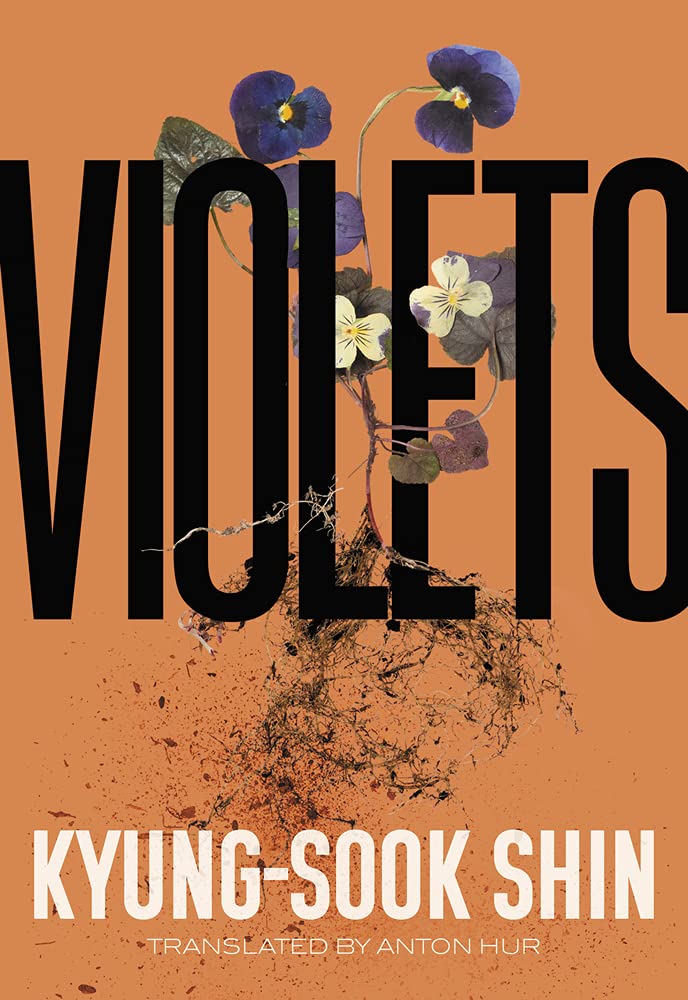
VIOLETS, a brutally sad and deeply poignant story of being Other in your homeland


VIOLETS
SHIN KYUNG-SOOK
(tr. Anton Hur)
The Feminist Press
$15.95 trade paper, available now

One of NPR's Best Books of 2022!

Rating: 4.5* of five

The Publisher Says: We join San in 1970s rural South Korea, a young girl ostracised from her community. She meets a girl called Namae, and they become friends until one afternoon changes everything. Following a moment of physical intimacy in a minari field, Namae violently rejects San, setting her on a troubling path of quashed desire and isolation.

We next meet San, aged twenty-two, as she starts a job in a flower shop. There, we are introduced to a colourful cast of characters, including the shop's mute owner, the other florist Su-ae, and the customers that include a sexually aggressive businessman and a photographer, who San develops an obsession for. Throughout, San's moment with Namae lingers in the back of her mind.

A story of desire and violence about a young woman who everyone forgot, VIOLETS is a captivating and sensual read, full of tragedy and beauty.

I RECEIVED MY DRC FROM THE PUBLISHER VIA EDELWEISS+. THANK YOU.

My Review
: This translation from the Korean joins a widening stream of Korean-culture transplants...Squid Game, Minari, this author's previously translated novel Please Look After Mom...making their roots into American pop-cultural soil.

If you've yet to explore the trickle, start now before it's a flood. I think it's wonderful because English-language monoglot culture gets stale and boring and all alike if we don't seek out fresh infusions of talent and stories. And, like all the best translations, this story's timelessness is rendered in prose that could very easily have been first created in English...none of the occasional signals of awkwardly trying to explicate something that one word in the translated language would convey whole and entire. That is a fine achievement indeed, probably helped along by the fact that things like "minari" aren't quite as furrin as they would've been in 2011, when Please Look After Mom was published.

What happens in this story is not particularly new or unusual. A girl is born to unfit parents:
In a house with shut doors, a mother closes her eyes as the baby’s grandmother offers her the newborn. The mother knows what will happen now. An uncelebrated girl. The infant accepts her mother’s closed eyes in lieu of a loving caress, perhaps having intuited her fate from the womb, and does not bother crying. The sound of the monsoon fills the house. Underneath the porch, a dog curls its legs into itself. Can the baby hear the sound of the rain? She’s about to fall asleep in her grandmother’s hands. That same night, her father gives his daughter’s face only a cursory glance.

Thus does another unwanted girl enter the world that won't ever bother to see her, really even to look at her. She's just...there. Her father never bothers to return; her mother never bothers with her at all, constantly seeking a man to care for her. (To be fair, an ordinary Korean woman's opportunities a generation ago weren't plentiful, and San's mother wasn't exceptional.)
Her mother. San thinks about her from time to time.

If she had begged her to stay, in front of that carefully prepared food, would she have listened? Why had San never once tried to hold her back? Wherever it was that her mother went, she never forgot to send her daughter money for school until San graduated.

The last time San had seen her mother was when she was a freshman in high school.

Children of addicts, the world over, tell versions of this same story. In this case, San's mother is addicted to men. She can't live without a man taking care of her, and she sacrifices the daughter she didn't want to get what she does want.

Author Shin isn't solely criticizing the mother. She is critiquing the social organization, the patriarchy, that privileges men and their desires over women and their needs so completely, so thoroughly, that the women are hollow and meaningless without a man. It is repulsive and it is reprehensible, and much abuse and violence simply are borne by the women because what option do they have? What other choice can they make? In San's case, she is so hollowed out by the complete absence of love from her mother (or anyone else) that she enacts the form of love she knows: rejection follows violence, as it must.

There is nothing forgiving in San. She forgives nothing, she is forgiven nothing, throughout the book. She is alone, she feels lonely of it (or so we infer...I don't know that she would be able to articulate the unmoored, disconnected reality that lonely people all share). For this, among other, reasons, this is a hard story to read. If you have ever been truly, down-to-the-bone lonely, this might be a triggering read for you. I haven't run across too many reads with this hyperconcentrated focus on loneliness, or too many with more success in rendering an emotional state into prose.
A stranger to every single person in the crowd, San finds herself blocking the sidewalk as people swerve to avoid her. Even if a carnival were to break out around her, the vacant expression on her face looks entrenched enough to persist.

Because she knows nothing of love, loving, being loved, San sees nothing except the one moment when everything changed, when the one love she thought she had was denied and made nothing. Not even attempting to find her former home nets San anything, she sees not the fields of minari she grew up among, where her life irrevocably emptied out and flowed away from her, but careful rectilinear plots of...something not minari. She has no roots. She feels no kinship.
Nothing happened this past summer. Only that, in the hot sun from time to time, a brief thought would appear and disappear around me. That thought was closer to me than any of the flowers in the shop. Even as I tried to capture the thought on paper, the heat would exhaust me and I'd give up. There were plenty of things I gave up, using the heat as an excuse. Which means I spent this past summer repeatedly deciding to do things and then giving up on them. As if my life were an exhibition of how good I am at giving up. It was that kind of summer.

It was that kind of life. It won't end well, it didn't begin well or go on well; that much we know. There's nothing hopeful in this story. Women like San aren't ever anyone's focus...her job in the flower shop working with and for Su-ae notwithstanding. She receives the desperate, genuine love of Su-ae as...nothing. San is fixated on emptiness...her only friend abandoned her!...and on men she does not want. She needs their love. She doesn't want it. She decided long ago that love wasn't something she could have, feel, receive, give. And so when it's offered to her she...doesn't see it. She does see the want of one man, she feels the desperate pull of another man on her attention, and gets nothing but unwanted results.
Every attempt to resist is met with his greater strength. In a moment, her head begins to droop.

She's released onto the street.
Her mind is completely taken over, her body a husk. No one seems to take note of the loneliness she carries. Just some woman in the crowd, unaware that her top is undone. A more observant person might have noticed her cheek slightly swollen from having been punched, the thin lines of her face a touch asymmetrical because of it. Someone might see her pale face and think, How could anyone ever look so pale....

A life of being unwanted, invisible, and it comes down to a final indignity. San is raped. Her hollowness filled at last with the violence that is all she can accept. It isn't in her to accept the reality of her situation, being unloved and unwanted, then seek out change. That's simply impossible. She leaves safety, courts rejection, and seeks oblivion.

Leaving behind only the tiniest of wakes...the end of the story of Oh San is a poignant piece of mythologizing that fit so poorly onto the rest of the story that I was forced by honest anger and sincere disdain for its sentimentality to whack a star off my rating. After a night's sleep where I dreamed of the photographer and San:
Violets. They bloom everywhere, making them seem more like weeds than proper flowers. San takes a closer look at them. Their little green leaves are small, their purple blossoms tiny. Before she came to the flower shop, she knew them as swallow flowers. Memories of entangling two swallow flower stems together and pulling them apart— one side was bound to snap. Whoever’s stem didn’t was the winner. She forgot what the prizes were, but she’d played the game many times. They did it with broadleaf plantains; they did it with foxtails.

The man keeps pressing the shutter and mumbling something discontentedly. “What’s so pretty about these flowers? Such nonsense.” His disappointment is so palpable, it makes her apologetic.

...I realized that his arc needed an end, too. I might not like that end, but I would've felt cheated (if not right away, then after my irritation with the whole ending subsided) had it not been there. So back came a half-star, though I confess with some grumbling on my part.

I think this small, powerful story deserves your eyeblinks. I think we should all resolve to notice the Oh Sans of this world, to extend a welcome to the table of them, to recognize their living presence instead of making them ghosts before they die.

Sunday, May 26, 2024

May 2024's Burgoine and Pearl-Rule reviews


Author 'Nathan Burgoine posted this simple, direct method of not getting paralyzed by the prospect of having to write reviews. The Three-Sentence Review is, as he notes, very helpful and also simple to achieve. I get completely unmanned at the idea of saying something trenchant about each book I read, when there often just isn't that much to say...now I can use this structure to say what I think is the most important idea I took away from the read and not try to dig for more.

Think about using it yourselves!

++++++++++++++++++++++++++++++++++++++++++++++++++++++++++++++++
++++++++++++++++++++++++++++++++++++++++++++++++++++++++++++++++


Ocean's Godori by Elaine U. Cho

Rating: 3.75* of five

The Publisher Says: Ocean Yoon has never felt like much of a Korean, even if she is descended from a long line of haenyeo, Jeju Island's beloved female divers. She's also persona non grata at the Alliance, Korea's solar system-dominating space agency, since a mission went awry and she earned a reputation for being a little too quick with her gun.

When her best friend, Teo, second son of the Anand Tech empire, is framed for murdering his family, Ocean and her misfit crewmates are pushed to the forefront of a high-stakes ideological conflict. But dodging bullets and winning space chases may be the easiest part of what comes next.

A thrilling adventure across the solar that delivers hyperkinetic action sequences and irresistible will-they-won't-they romance alongside its nuanced exploration of colonialism and capitalism, Ocean's Godori ultimately asks: What do we owe our past? How do we navigate our present while honoring the complicated facets of our identity? What can our future hold?

I RECEIVED A DRC FROM THE PUBLISHER VIA NETGALLEY. THANK YOU.

My Review
: Well, what can I say. I love Firefly, I love Becky Chambers, I thoroughly liked the Ketty Jay. This story hits all those tales' beats, and does it from a new angle that centers Korean culture. The author, who lives in Seattle, is definitely working inside that frame. The strong anticolonial message is interesting, as the entire idea of human expansion is by definition colonialist....

Is the story anything groundbreaking? No. Do I want to read the next one, assuming there is one? Yes. The fun of being within this group of cooperative misfits led by a Korean lesbian far exceeds the investment in absorbing the different cultural background unfamiliar to most Western readers.

It is, to me, very much an enhancing feature of the read. Get out of your cultural rut within your genre preference.

Zando | Hillman Grad offers you a hardcover for $28.00. An ebook is $14.99, and that is a fine return on your investment.

++++++++++++++++++++++++++++++++++++++++++++++++++++++++++++++++


The Murderous Misses of Concord: A Concord Mystery by Elizabeth Dunne

Rating: 3.25* of five

The Publisher Says: In Concord, Louisa May Alcott farms pigs after success with Little Women, but as New England’s freezing winter approaches, death isn’t far away. Concord’s Misses, armed with wit and elegance, money, and secrets, are present when Miss Emily Collier dies at her forty-seconnd birthday party. Louisa is embroiled in the intrigue. They will lie to her, set traps and blackmail to avoid justice. And Louisa is now an outsider in what was once her home.

To test her mettle, local Justice of the Peace Captain Briers, a man compromised by lust for one of the Misses, enlists her to bring order to the twisted loyalties, land feuds and secrets fuelling a seditious desire for revenge not seen in Middlesex County since the witch trials.

I RECEIVED A DRC FROM THE PUBLISHER VIA NETGALLEY. THANK YOU.

My Review
: I have a mystery-loving sister who dislikes the use of historical figures as amateur sleuths. "That's not accurate, doesn't help suspend disbelief" is her reasoning. I think she's correct about this, but don't share her conclusion because it (to me) does add to my appreciation of the book's historical background. Alcott, in this use, does increase my ability to immerse my imagination into the Concord of the era.

The story is fine...nothing new...but cozy mysteries, particularly historical cozy mysteries, don't need to be. I like the genre, I like this execution of the basic plot, it's a good and entertaining read.

There's a Kindle edition for $5.99 (non-affiliate Amazon link) though it's not available on Kindle Unlimited.

++++++++++++++++++++++++++++++++++++++++++++++++++++++++++++++++


The Erstwhile Tyler Kyle by Steve Hugh Westenra

Rating: 3.25* of five

The Publisher Says: Tyler Kyle doesn’t believe in monsters.

A washed-up thirty-year-old actor and reluctant cryptid investigator, Tyler is used to playing the Scully to his best friend Josh’s Mulder on their stupidly popular YouTube channel. But when Tyler receives previously unseen footage of the B movie bombshell mother who abandoned him eighteen years ago—footage linked to an isolated island in the Canadian wilderness—the mystery is one conspiracy he’s determined to investigate. The fact that following the scent gives Tyler an excuse to run away from the “straight” Josh, whom he drunkenly made out with, is just the cherry on the shit sundae.

But Echo Island isn’t what it seems. Its eerily scenic veneer hides a twisted secret buried in its roots as a gay conversion camp, and as Tyler retraces his mother’s footsteps, he discovers a supernatural connection between the residents and the island—one they seem to think Tyler and his mother share.

Even worse, the footage of Tyler’s mom came from someone on the island–a stalker whose obsessive fascination with both Tyler and Josh is about to make Tyler wish he hadn’t gone this one alone. Puppeteered by his stalker, searching for his mother, and debating whether it’s possible to queerbait yourself, Tyler comes to realize that it doesn’t matter so much whether you believe in monsters, if they believe in you.

THE ERSTWHILE TYLER KYLE is an adult horror comedy for fans of GHOST FILES, BUZZFEED UNSOLVED, and TWIN PEAKS.

I RECEIVED A DRC FROM THE PUBLISHER VIA NETGALLEY. THANK YOU.

My Review
: Self-published novels tend to share some general categories of flaws: depending on your personality, some (like solecismic grammar) are forgivable, or indeed invisisble; others (wittering on about stuff you've covered and explained and discussed, showing off your research) are just joy-sucking offenses against the Muses. You'll never guess which camp I fall into.

I don't mean to put down this story by saying its comps are exactly and precisely correct, because they are. If it were not for its bloat, this story would be a great addition to Hulu's adaptation slate. It's got a pleasantly funny vibe buried in the wordiness. Very amusing, queer-inclusive, sidewise glance at "reality" media's unrealest stretch of landscape (cryptids) made...real? or just maybe real...?

Consult the content warning list, and decide if you wnat to use the buy links, for this $2.99 ebook.

++++++++++++++++++++++++++++++++++++++++++++++++++++++++++++++++


An Ocean Without A Shore a novel by Scott Spencer

Rating: 3.5* of five

The Publisher Says:A wildly entertaining and occasionally heartbreaking story of frustrated longing, and the lengths we will go for those we love—even if they don’t love us in return

An Ocean Without a Shore, from the bestselling, critically acclaimed author of Endless Love and Man in the Woods, is a beautifully rendered exploration of that most timeless of human dilemmas: the one in which your love is left unreturned.

Since their college days, Kip Woods has been infatuated with Thaddeus Kaufman, who, years later, is a married father of two children and desperately trying to revive a failing career. Kip’s devotion to Thaddeus has been life-defining and destiny-altering, but it has been one that Thaddeus has either failed to notice or refused to acknowledge. But over the course of this heated and mesmerizing novel, set against a background of privilege and affluence in Manhattan and the Hudson Valley, Kip will be forced to reckon with the prison of his own making and decide how much he is willing to sacrifice for a love that may never be shared.

Picking up where his most recent novel, River Under the Road, left off, but writing squarely in the vein of Endless Love, his classic novel of passion and obsession, Scott Spencer gives us an intimate, immersive, and unsettling portrait of the devastation we will wreak in the name of love, and the bitterness of a friendship ravaged by fathomless yearning.

I RECEIVED A DRC FROM THE PUBLISHER VIA NETGALLEY. THANK YOU.

My Review
: I read this not realizing it was a sequel. That could be part of my lack of enthusiasm. The strongest reason I didn't fall all over myself to praise this novel, though, is right here:
I have learned one of the lessons of loneliness, one of its shocking side effects: when you are in a state of longing, desire goes on and on, like an ocean without a shore.
–and–
Here's something else about us torchbearers. We are possessive of the one we love and we are determined to maintain our hold on the idea of them. Our idea of them is really all we have. When you think about someone more or less constantly, you begin to believe—though you would never say so, not even to yourself—that they belong to you.

Beautiful sentences, aren't they? But what a world they paint. That's my issue...I don't want to spend much time in Kip's world because it grates on my nerve to be asked to invest in unrequited longing. It feels to me like the relationship he maintains with savvy, manipulative Thaddeus is a shield he uses against any real intimacy. That isn't my own personal jam of a read.

I expect fans of Andrew Sean Greer and Peter Cameron will disagree with me. Prioritize lovely language and fully limned characters over a story you're rooting for an exact outcome to end? This is your lucky review, here it is! I myownself just wanted it to end and wasn't invested enough to mind about how. To my saddened annoyance.

Ecco Press offers a trade paper edition for $15.99 or an ebook for $9.99. Either seems like a good buy for those intrigued.

++++++++++++++++++++++++++++++++++++++++++++++++++++++++++++++++


Invisible No More: A Historical Novel by Scott Pitoniak and Rick Burton

Rating: 3 generous stars of five

The Publisher Says: Wilmeth Sidat-Singh is the greatest athlete you've never heard of--and so much more. A rocket-armed passer on the football field, an ankle-breaking playmaker on the basketball court, he was also a scholar, civil rights pioneer, patriot, and one other thing—forgotten.

In this historical novel based on Sidat-Singh's life, sportswriter Breanna Shelton stumbles upon the riveting story of the former Syracuse University star who was forced to hide his identity in order to take the field, leading to climactic moments when race and sports collided. As a young Black woman making her way in a profession not ready to fully accept her, Shelton immerses herself in the research, determined to resurrect an inspirational man who time left behind. Along the way, she finds courage and perseverance to transform herself and her career.

Post-civil rights era society still grapples with dispiriting obstacles that Sidat-Singh faced more than a half century earlier, when he was "passing" to play; serving as a Tuskegee Airman in World War II; and interacting with luminaries such as Duke Ellington, Cab Calloway, Grantland Rice, Sam Lacy, and Joe Louis.

This fictionalized account, as timely now as ever, honors an American hero whose life was cut short while serving a country that didn't recognize him as a full-fledged citizen because of the color of his skin. After you read it, Sidat-Singh will be invisible no more.

I RECEIVED A DRC FROM THE PUBLISHER VIA NETGALLEY. THANK YOU.

My Review
: Well, it's #PrideMonth-adjacent because Wilmeth Sadat-Singh was in the "race" closet that the US of the 1930s enforced. He was Black, not of the less-reviled South Asian ancestry his stepfather's surname allowed him to present to a horrifyingly prejudiced society...a dilemma of passing that queer people face to this day.

The man, and his bitter story, deserve our respect and attention. The recrudescence of the uglier expressions of racism make this tale urgent. This execution of it, to my disappointment, doesn't do the material justice because it feels to me like the research notes were just lightly stitched together. The authors use a framing device of modern discovery of historical materials...a lot like what Elizabeth Kostova did in her bestsellers (that I didn't like much either). Thus, of necessity, the entire momentum resides in the past. The problem I have with that is that it never allows me a place to hook into the action...it's all in records of things done and dusted, and people who are largely just names to my 21st-century eyes.

(non-affiliate Amazon link) It's self-published, so the $9.99 might be more than you want to spend on a Kindlebook. Get a sample, then decide.

++++++++++++++++++++++++++++++++++++++++++++++++++++++++++++++++
++++++++++++++++++++++++++++++++++++++++++++++++++++++++++++++++


This space is dedicated to Nancy Pearl's Rule of 50, or "the Pearl Rule" as I've always called it. After realizing five times in December 2021 alone that I'd already Pearl-Ruled a book I picked up on a whim, I realized how close my Half-heimer's is getting to the full-on article. Hence my decision to track my Pearls!

As she says:
People frequently ask me how many pages they should give a book before they give up on it. In response to that question, I came up with my “rule of fifty,” which is based on the shortness of time and the immensity of the world of books. If you’re fifty years of age or younger, give a book fifty pages before you decide to commit to reading it or give it up. If you’re over fifty, which is when time gets even shorter, subtract your age from 100—the result is the number of pages you should read before making your decision to stay with it or quit.

So this space will be each month's listing of Pearl-Ruled books. Earlier Pearl-Rule posts will be linked below the current month's crop.

++++++++++++++++++++++++++++++++++++++++++++++++++++++++++++++++
++++++++++++++++++++++++++++++++++++++++++++++++++++++++++++++++


Codename Nemo: The Hunt for a Nazi U-Boat and The Elusive Enigma Machine by Charles Lachman PEARL RULED @ 47%

Rating: 3.25* of five

The Publisher Says: The white-knuckled war saga of the US Navy task force who achieved the impossible on June 4, 1944, capturing Nazi submarine U-505, its crew, technology, encryption codes, and an Enigma cipher machine—the first seizure of an enemy ship in battle since the War of 1812 and one that undoubtedly shortened the duration of the war.

On June 4, 1944—two days before D-Day—the course of World War II was forever changed. That day, a US Navy task force achieved the impossible—capturing a German U-Boat, its crew, all its technology, Nazi encryption codes, and an Enigma cipher machine. Led by a nine-man boarding party and the maverick Captain Daniel Gallery, US antisubmarine Task Group 22.3’s capture of U-505 in what was called Operation Nemo was the first seizure of an enemy ship in battle since the War of 1812, one of the greatest achievements of the US Navy, and a victory that shortened the duration of the war.

Charles Lachman’s white-knuckled war saga and thrilling cat-and-mouse game is told through the eyes of the men on both sides of Operation Nemo—German U-Boaters and American heroes like Lieutenant Albert David (“Mustang”), who led the boarding party that took control of U-505 and became the only sailor to be awarded the Medal of Honor in the Battle of the Atlantic; and Chief Motor Machinist Zenon Lukosius (“Zeke”), a Lithuanian immigrant’s son from Chicago who dropped out of high school to enlist in the Navy and whose quick thinking saved the day when he plugged a hole of gushing water that was threatening to sink U-505.

Three thousand American sailors participated in this extraordinary adventure; nine ordinary American men channeling extraordinary skill and bravery finished the job; and then—like everyone involved—breathed not a word of it until after the war was over. Nothing leaked out. In Berlin, the German Kriegsmarine assumed that U-505 had been blown to bits by depth charges, with all hands lost at sea. They were unaware that the U-Boat and its secrets, to be used in cracking Nazi coded messages, were in now American hands. They were also unaware that the 59 German sailors captured on the high seas were imprisoned in a POW camp in Ruston, Louisiana, until their release in 1946 when they were permitted to return home to family and friends who thought they had perished.

Following Operation Nemo step-by-step, author Charles Lachman has crafted a deeply researched, fast-paced World War II narrative for the ages.

I RECEIVED A DRC FROM THE PUBLISHER VIA NETGALLEY. THANK YOU.

My Review
: Step-by-step indeed. Ploddingly paced, full of the sort of detail and acronym-heavy information that professional historians batten on, and that do less for me than sci-fi infodumping does in the reading pleasure metrics. I had to bail just before the halfway point. It really shouldn't surprise me that I couldn't get deeply immersed in the read because submarine stories have to be very fast-paced for me not to fixate on the claustrophobia of their raison d'etre. Underwater! NO FRESH AIR! Lots of bodies all squished up with no personal space! *shudder*

As I mentioned, that needs a fast narrative pace with plenty of action for me to overcome. I didn't get that here. If you're an Erik Larson fan, that is not this writer's style. He's closer to Russell S. Bonds or Stephen Harrigan: Details accumulate, characters emerge in relief or simply can't be recreated from the source material, but nowhere is your pulse going to pound.

Diversion Books offers hardcovers for $29.99 from 4 June 2024.

++++++++++++++++++++++++++++++++++++++++++++++++++++++++++++++++


The Behavioral Code: The Hidden Ways the Law Makes Us Better...or Worse by Benjamin van Rooij and Adam Fine PEARL RULED @ 42%

Rating: 3.5* of five

The Publisher Says: A 2022 PROSE Award finalist in Legal Studies and Criminology
A Behavioral Scientist's Notable Book of 2021

Freakonomics for the law—how applying behavioral science to the law can fundamentally change and explain misbehavior


Why do most Americans wear seatbelts but continue to speed even though speeding fines are higher? Why could park rangers reduce theft by removing "no stealing" signs? Why was a man who stole 3 golf clubs sentenced to 25 years in prison?

Some laws radically change behavior whereas others are consistently ignored and routinely broken. And yet we keep relying on harsh punishment against crime despite its continued failure.

Professors Benjamin van Rooij and Adam Fine draw on decades of research to uncover the behavioral code: the root causes and hidden forces that drive human behavior and our responses to society's laws. In doing so, they present the first accessible analysis of behavioral jurisprudence, which will fundamentally alter how we understand the connection between law and human behavior.

The Behavioral Code offers a necessary and different approach to battling crime and injustice that is based in understanding the science of human misconduct—rather than relying on our instinctual drive to punish as a way to shape behavior. The book reveals the behavioral code's hidden role through illustrative examples like:
  • The illusion of the US's beloved tax refund
  • German walls that "pee back" at public urinators
  • The $1,000 monthly "good behavior" reward that reduced gun violence
  • Uber's backdoor "Greyball" app that helped the company evade Seattle's taxi regulators
  • A $2.3 billion legal settlement against Pfizer that revealed how whistleblower protections fail to reduce corporate malfeasance
  • A toxic organizational culture playing a core role in Volkswagen's emissions cheating scandal
  • How Peter Thiel helped Hulk Hogan sue Gawker into oblivion
  • Revelatory and counterintuitive, The Behavioral Code catalyzes the conversation about how the law can effectively improve human conduct and respond to some of our most pressing issues today, from police misconduct to corporate malfeasance.

    I RECEIVED A DRC FROM THE PUBLISHER VIA EDELWEISS+. THANK YOU.

    My Review
    : Why read for pleasure when you can eat your spinach, suffer, and learn? Why indeed...I had to quit reading at 42% because I am utterly outraged and about to pop a vein in my skull.

    In the legal and moral landscape where a crooked, lying rapist manipulating the system in advance by appointing political hacks to the courts high and low, and thus possibly evading...AGAIN...consequences for his vile actions, I just could not continue. The prose is redable, the arguments stand up to my poking around for other opinions, but I'm just not in the headspace to read this badly-needed work of popular social science.

    Beacon Press hardcovers are $27.95, and I'll urge the purchase on you.

    ++++++++++++++++++++++++++++++++++++++++++++++++++++++++++++++++


    Hearts Ablaze: Parables for the Queer Soul by Dr. Rolf Nolasco Jr. PEARL RULED @ 31%

    Rating: 3* of five

    The Publisher Says: Meditations addressing the spiritual needs of queer Christians. A new look at ten selected parables of Jesus, that expands the scope of interpretation of each story to highlight God's extravagant welcome of all people. The perspective in the reflections is deeply personal and written to be used by both individuals and groups. Queer affirming churches, seminaries, and retreat centers will benefit from this resource as they continue to champion the flourishing of their queer siblings in Christ.

    I RECEIVED A DRC FROM THE PUBLISHER VIA EDELWEISS+. THANK YOU.

    My Review:
    I am a Bad Person. I not only don't believe in Jesus as savior, I don't believe in Jesus as human being who was once alive. I don't believe in one—or any—gawd the father-mother-sister-brother. I don't accept the "moral" authority of this dreadful, hate-filled cult of judgmental dupes that calls itself christian.

    I have numerous dear friends, and some family members, who do. I am positive that, one day, my shining example of right thinking and proper living will convert them from their benighted superstitions. The comfort of their souls will come from rational scientific answers to their questions, and where there are no answers yet, they will abide in faith that the scientific method will provide an answer or a Reason there can't be one.

    That's the kind of world, flipped 180°, that this book inhabits. I ain't the intended audience, but I am always looking for ways to understand what I can't accept. What comfort and acceptance this flavor of christianity offers is unnecessary to me, but could easily save another person's life. I feel strongly that I need to know resources like this exist to proffer if and when they're needed.

    There's a Kindle edition for $9.99 (non-affiliate Amazon link), but best of luck finding the publisher's website, or any so-called christian source of books that carries it. Color me surprised. Not.