Pages
- Home
- Mystery Series
- Bizarro, Fantasy & SF
- QUILTBAG...all genres
- Kindle Originals...all genres
- Politics & Social Issues
- Thrillers & True Crime
- Young Adult Books
- Poetry, Classics, Essays, Non-Fiction
- Science, Dinosaurs & Environmental Issues
- Literary Fiction & Short Story Collections
- Sookie Stackhouse/Southern Vampire Books & True Blood
- Books About Books, Authors & Biblioholism
Showing posts with label WWII setting. Show all posts
Monday, April 6, 2026
HONEY IN THE WOUND, Korean magical realist family saga
HONEY IN THE WOUND
JIYOUNG HAN
Avid Reader Press (non-affiliate Bookshop.org link)
$14.99 ebook, preorder now for delivery 7 April 2026
Rating: 4.5* of five
The Publisher Says: A lyrical and suspenseful debut novel about a mysteriously gifted Korean family confronting the brutality of the Japanese empire, Honey in the Wound is an epic tale of survival and the reclamation of power.
A sister disappears and returns as a tiger. A mother’s voice compels the truth from any tongue. A granddaughter divines secrets in others’ dreams. These women are all of one lineage—a Korean family split across decades and borders by Japanese imperialism.
At this saga’s heart is Young-Ja, a girl who infuses food with her emotions. She revels in her gift for cooking, nourishing the people she loves with her cheerfulness. But her sunny childhood comes to an end in 1931 when Japanese soldiers crush her family’s defiance against the Empire. Young-Ja is cast adrift, her food turning increasingly bitter with grief. When a Korean rebel fighter notices her talents, however, she is whisked off to Manchuria to join a secretive sisterhood of beautiful teahouse spies. There, Young-Ja finds a new sense of belonging and starts using her abilities for the resistance. But the Imperial Army is not yet finished with her…
Decades later, Young-Ja lives alone in Seoul, withdrawn from the world until her Tokyo-born granddaughter Rinako bursts into her life with the ability to see into dreams. In cultivating a tentative bond, they confront the long-buried past in a stunning emotional climax.
As an unforgettable family perseveres in the long shadow of colonialism, Honey in the Wound transports readers to mountain forests where tiger-girls stalk, to Manchurian teahouses and opium dens where charming smiles veil secrets, and to the modern metropolises of Tokyo and Seoul where restless ghosts stir. This debut novel is a tender yet powerful multi-generational drama that shines light onto the twentieth century’s darkest corners and gives voice to those who bore witness.
I RECEIVED A DRC FROM THE PUBLISHER VIA NETGALLEY. THANK YOU.
My Review: Brutality is colonialism's sole common legacy across all colonial regimes. Korea's half-century as part of Japan's empire was certainly no exception. Many are the stories of families ravaged by slavery, by economic disadvantages imposed to benefit the colonizers, by the horrors of the comfort women's suffering. It's not unique to Japan's imperial project...go look at Briseis' life after the fall of Troy, and I promise you she was nowhere near the first to suffer this fate...but its systematic, intentional social sanction somehow makes it a vile twentieth-century model of efficiency in evildoing.
So much of modern US culture is Korean inflected. I've reviewed a fair few Korean translations, Korean-themed stories written by members of its diaspora, stories set in Korea, all sorts really, because the culture of the place is ancient, rich, and deeply rooted as it smoothly takes on the modernity of this century as an economic, therefore cultural, powerhouse. As I gain more and more experience with the stories Koreans send into the Anglophone readership, I see one very, very frequent strand appearing: the Japanese occupation, usually framed in apocalyptic, folkloric ways to distance the reader from the brutal reality and to restore some agency, some meaning, to the country's suffering.
No exception this time. Starting in 1902 when Korea was an independent monarchy, the family we come to know and invest caring into is gradually Japanesed in personal names (pay careful attention, context will tell you if someone is being addressed or referred to as a Korean or as a Japanese imperial subject) and place names. It's like the British stealing India and naming "Mumbai" as "Bombay." (There are so many examples from all over the colonized world, that example is just the one I felt Anglophones would relate to most easily.)
The first 40% of the story is the slowest, with the highest concentration of double names. It's a debut novel. The fact is this is exactly reflective of the reality Author Han relates to us as we start our journey in 1902. Put in some effort and it will all begin to feel second nature to you quite quickly. The delight of a writer whose planning makes your reading more fluent with her intentional shifts in register is one who gets my highest regard. Time changes within few pages of each other are all quietly indicated with characters giving us clues, not with bold chapter or section headings that bring your readerly attention to the shifts themselves not the flow of the story.
This might not sound like it will suit you. I recommend reading a sample after publication day on the 7th. It feels more fluid than I'm making it sound. For example, you'll notice as you read through the book that there is a lot of use of, and description using, the color yellow. It would behoove you to go look into musok, the people's religion of Korea, and its use of colors. Like the shifts of names this is an enriching detail that clues the reader in to the larger thematic purpose of a passage, or a name, or an evocative word.
It made this read one I really looked forward to getting into, immersing myself into again and again. And a good thing indeed these moments were there because the horrific cost to the people of the colonial occupation, then the war, demanded much fortitude of me-the-reader to stay invested in people enduring so much. I had reservoirs of interested, sympathetic caring to draw down as horrors mounted up.
I will say I wish there had been a map in the book. I'm not sure where some place names were, whether they were really elsewhere or were Korean places I had read about renamed. Its lack was not fatal to my pleasure; but I felt it nonetheless.
A story I urge on readers and enjoyers of Pachinko and Whale. A story with depths deeper than its modest 320pp page count implies. An author who is a fine discovery in her debut novel.
Wednesday, March 4, 2026
THE DIRECTOR, living life through extraordinary times demands a lot from an artist
THE DIRECTOR
DANIEL KEHLMANN (tr. Ross Benjamin)
Summit Books/S&S (non-affiliate Bookshop.org link)
$14.99 ebook, available now
2026 International Booker Prize shortlistee!
Rating: 4.75* of five
The Publisher Says: An artist's life, a pact with the devil, a novel about the dangerous illusions of the silver screen.
G.W. Pabst, one of cinema’s greatest directors of the 20th century, was filming in France when the Nazis seized power. To escape the horrors of the new and unrecognizable Germany, he fled to Hollywood. But now, under the blinding California sun, the world-famous director suddenly looks like a nobody. Not even Greta Garbo, the Hollywood actress whom he made famous, can help him.
When he receives word that his elderly mother is ill, he finds himself back in his homeland of Austria, which is now called Ostmark. Pabst, his wife, and his young son are suddenly confronted with the barbaric nature of the regime. So, when Joseph Goebbels—the minister of propaganda in Berlin—sees the potential for using the European film icon for his directorial genius and makes big promises to Pabst and his family, Pabst must consider Goebbels’s thinly veiled order. While Pabst still believes that he will be able to resist these advances, that he will not submit to any dictatorship other than art, he has already taken the first steps into a hopeless entanglement.
Daniel Kehlmann's novel about art and power, beauty and barbarism is a triumph. The Director shows what literature is capable of.
I RECEIVED A DRC FROM THE PUBLISHER VIA NETGALLEY. THANK YOU.
My Review: Georg Wilhelm Pabst (25 August 1885 – 29 May 1967) lived an unlucky life. He was trapped in his native Europe for each of the World Wars fought there. His work...impressive stuff...is almost totally forgotten outside the small world of cinéastes. (Do you know anyone, apart from me, who's seen The Threepenny Opera and/or L'Atlantide?) We're treated here to a deep fictional dive into his inner workings. Given that he already knew Nazism was wrong, bad, and evil, and was trying to escape its miasma, his decision to collaborate with Goebbels in the propaganda machine seems inexcusable. In fact it was never forgiven. Not even his German-language film The Last Act (The Last Ten Days in English) bought him back his prior-to-collaboration esteem in spite of its honest treatment of Hitler's insanity at the end of the war.
What price security. It cost this security-seeker very dear. His only son was swallowed by the Hitler Youth because his father returned to see if he could care for his ailing mother. He is examined in this novel as only fiction is capable of examining an inner life. It's not the justifications and self-delusion that a memoir could bring to the table. It's the decisions he made writ plain and unadorned with the inevitable dishonesty of making excuses.
Director was, all in all, a strange profession. One was an artist, but created nothing, instead directing those who created something, arranging the work of others who, viewed in the cold light of day, were more capable than oneself. That was why so much was required before one could even start to work: writers, artists, composers needed only paper, at most paint, sculptors needed marble and a few tools, but a director needed a hundred people and a studio and machines and a great deal of electricity. All this had to be paid for, so he always also needed someone to entrust him with a lot of money. And that was why one only rarely made films, the rest of the time one talked to people and went out to lunch and wrote letters and gave lectures and tried to convince someone. And again and again one secretly wondered when all the people working on a film together would realize that they could do it without a director too, if only they agreed. Because the actors could certainly act on their own, the camera operator could easily film them, the architect could build a stage for them, and the editor could select and assemble the best footage afterward. But because everyone simply believed that a director was necessary, the whole thing was not undertaken without a director.I don't think a man who could meet with and work for Nazis could've brought himself to conjure those honest, self-deprecating words.
I'm new to Kehlmann's work. This kind of spotlight is not flattering to its object. It can easily become a hatchet-job or hagiography; each is distorted and ultimately dishonest. In Author Kehlmann's choice of fictionalizing events and people very close to precisely aligned with the historical record, he puts the dishonesty and ambiguity on whom it belongs: Pabst. It's just...disturbing, and in a way a biography, a memoir would not be because Author Kehlmann clearly knows the facts and has an opinion yet makes us, the audience, take in our responses without the comfort of distancing our responses.
Would any one of the readers of this book behaved differently than Pabst? The fictional framing strips away the fig-leaf of "objectivity" so we must sit in the decisive moments with Pabst. Are you sure your illusion of yourself as a resister is accurate? Are you sure your judgment of what you'll need to give up is accurate? Are you sure you can be in, but not of, the system you scorn and abhor?
Translator Ross Benjamin did a good enough job rendering the read into English that I was a bit surprised to realize it was a translation. That is, to me, a very high compliment, or intended as one at least. It is a feat of writing to fictionalize someone who's famous (if you know who he is) in the light that emphasizes who he was; an equal feat to take that unusual choice to a very high level of craft in a different language. Kudos to both artists for a job well done.
Why, if I'm praising this work so highly and with such fervor, am I not offering all five stars? Because at no time was I transported into a different awareness, a space of timeless immanence such as I was by Evil Genius or The Remembered Soldier. It's all too rare, that removal from mundanity, so this is not a knock on the quality of the read. I'm impressed and I'm edified and I'm involved by this novel. It's at the top of the literary heap. It deserves its International Booker nomination. I'm not going to put in my pantheon but I'm going to urge it on you as a fascinating, timely, well-crafted story.
Saturday, September 27, 2025
MURDER IN THE HOUSE OF OMARI, modern iteration of the Japanese locked-room mystery
MURDER IN THE HOUSE OF OMARI
TAKU ASHIBE (tr. Bryan Karetnyk)
Pushkin Vertigo (non-affiliate Bookshop.org link)
$12.99 ebook available now
Rating: 3.75* of five
The Publisher Says: Osaka, 1943: as the Second World War rages and American bombers rain death down upon the city, the once prosperous Omari family is already in decline, financially ruined by the terrible conflict. Then the household is struck by a series of gruesome murders.
Can anyone solve the mystery of these baffling slayings before the Omari line is extinguished entirely? To do so, and unravel the killer's fiendish plot, they will have to delve into the family's past, where a dark and deadly secret has been festering for decades...
I RECEIVED A DRC FROM THE PUBLISHER VIA EDELWEISS+. THANK YOU.
My Review: Dark secrets! Wartime as economic disaster! Lies and murder in a beauty-products business! What more can a mystery reader want?
How about a family saga (bookmark the list of characters or all is lost), with an old family business floundering after losing...somehow...the heir to the place, the prestige slice of the health-and-beauty market they'd banked on keeping to wartime supply and in general the economic depression inherent in postwar economies, and the new head (adopted after marrying the lost heir's sister) not having the power to make changes?
All that and more coming soon. First, though, understand the pace is not twenty-first-century but period-appropriate. The book was written and published in the 2020s, but it feels more vintage than it is. I myownself think this is a feature not a bug, but you might not. Take heed.
This isn't a story with huge revelations, or shocking twists, but with the women who decide to solve it working it through because, well, what's another death in a country so very recently ravaged by World War II and its often-fatal privations? Natsuko, a doctor, is primarily a rational thinker and a keen observer...doctors tend to be both...who sees things differently from the other women, Mineko and Tsuruko, who are her fellow sleuths.
It's not the fair-play playbook, but the clues *are* there; you can indeed solve the murders, and trace the lines of motive, if you're attentive. I paid attention and got it 50% right...it was one of two people and one indeed was guilty.
I found a lot of the interpolations of newspaper stories and the like to be pacing-killers (those missing stars), but enjoyed them nonetheless. I was kept happily engrossed the entire read. I hope you will be as well.
Friday, October 4, 2024
BETRAYAL AT BLACKTHORN PARK, latest from emerging favorite storyteller Julia Kelly

BETRAYAL AT BLACKTHORN PARK
JULIA KELLY (Parisian Orphan #2)
Minotaur Books
$28.00 hardcover, available now
Rating: 4.25* of five
The Publisher Says: With mystery, intrigue, and the hints of romance international bestselling author Julia Kelly is known for, Evelyne Redfern returns in Betrayal at Blackthorn Park.
Freshly graduated from a rigorous training program in all things spy craft, former typist Evelyne Redfern is eager for her first assignment as a field agent helping Britain win the war. However, when she learns her first task is performing a simple security test at Blackthorn Park, a requisitioned manor house in the sleepy Sussex countryside, she can’t help her initial disappointment. Making matters worse, her handler is to be David Poole, a fellow agent who manages to be both strait-laced and dashing in annoyingly equal measure. However, Evelyne soon realizes that Blackthorn Park is more than meets the eye, and an upcoming visit from Winston Churchill means that security at the secret weapons research and development facility is of the utmost importance.
When Evelyne discovers Blackthorn Park’s chief engineer dead in his office, her simple assignment becomes more complicated. Evelyne must use all of her—and David’s—detection skills to root out who is responsible and uncover layers of deception that could change the course of the war.
I RECEIVED A DRC FROM THE PUBLISHER VIA NETGALLEY. THANK YOU.
My Review: After the four-star detail-filled atmospheric romantic thriller that was A TRAITOR IN WHITEHALL, my expectations and hopes were high for this second read featuring Evelyne and David.
I got the period details I wanted, I got the relationship development I expected (minimal), and the mystery element was interesting. But the second time is so often just a bit...samey...isn't it? We've been here, now we want something to happen. Author Kelly chose to meet that desire fairly late in the proceedings, setting us up for a sequel.
The fact that this is a romantic suspense novel far more than a puzzle-solvong one is just fine by me. Evelyne and David are well-matched, though not perfectly mated. That would get a bit dull. Instead they're given enough friction by their shared career as confidential agents of The Powerful at a tremendously consequential crossroads in history to keep their focus clear and mutual; there's an enemy to fight, a reason to keep fighting, and a lot of work to put into that fight.
Witty banter is a risky narrative strategy in a book without an explicit romance. David and Evelyne are clearly headed that way, but at times their palaver gives the future of the game away. This results in oddly reducing the tension that so many series stories rely on. Just ask Moonlighting's producers how letting that drop works out...yet, despite this (I suppose inevitable) middle space in a series being unsettled, the way Author Kelly words things is enough fun, the period evocation is so skillfully interwoven, and the history treated with such respect that I can't help but bump this fun book two of more to come up a quarter star. I'm especially calling out Evelyne's character-appropriate, but period-shocking, willingness to chafe against what she sees as unfair boundaries set for her because little is expected of her in terms of ability. This is something I suspect many intelligent people from disrespected groups and backgrounds relate to. Events transpire that give Evelyne reason to reassess her responses...sometimes training wheels save the savant from a bad fall.
All in all, a series I'm enjoying more as it unfolds. An increasingly rare experience that I genuinely appreciate.
Saturday, February 24, 2024
AN UNTOUCHED HOUSE, a flawed Dutch gem via Archipelago Books
AN UNTOUCHED HOUSE
WILLEM FREDERIK HERMANS (tr. David Colmer), introduction by Cees Nooteboom
Archipelago Books
$16.00 trade paper, available now
Rating: 4* of five
The Publisher Says: In this dark, unnerving work of wartime fiction, W. F. Hermans exposes humanity’s essential savagery, barely concealed by its mores and morals. The year is 1944, and a Dutch partisan chances on an abandoned estate, where he decides to take refuge during a lull in the hostilities. The house seems untouched by the war, a kind of haven, its ornament and grandeur intact (not to mention its walls), clothes and sheets to spare, a kitchen stocked with food and drink. He settles in, and begins to consider himself the owner. When the Nazis recapture the village and come knocking, they similarly assume the house to be his; they assume, also, its spare rooms, which they outfit as barracks.
It is all and well until the true owner and his wife return to their estate. Horrified at the thought of being caught in his subterfuge, our protagonist finds himself drawn into further deceit—and swept up in the violence that ensues.
Civilization comes face-to-face with brutality, truth meets the duplicity that has upended and challenged its certainty—Hermans’ prose searches for an order to the chaos and nihilism of war and life. What he cannot find is as telling as what he uncovers.
I RECEIVED A DRC FROM THE PUBLISHER VIA EDELWEISS+. THANK YOU.
My Review: Novellas are, by definition, brief and gestural as opposed to the novel in its deeper dives, its wider emotional landscape. These general observations are, of course, not true of every novel or novella. They serve to define nothing but an expectation of the reasonably experienced reader when picking up one or the other.
I went into this read, then, expecting to get a glancing blow to my interest in the topic of what the Second World War was like for those who lived it, who were involved in the conflict and not observing events from afar. That was an expectation met...but exceeded, at least as the read settled into my brain. The prose, as translated, was not showy or terribly Writerly; the story itself was simple enough, really more suited to a short story than a novella; but as I sat stunned after finishing the read, I realized why the author chose this length of telling for a story this uncomplicated.
Without the novella’s-worth of buildup, the ending would feel artificial and out of proportion to the story itself. As it is, the ending is a shocker. It arrives without fanfare and smacks the complacent, even slightly bored, reader in their readerly chops. At the end of a trip through one devious survivor’s opportunistic manipulations of everyone around him, all in service of maximizing his immediate personal comfort, the situation he has created from his selfish, self-serving and utterly believable actions comes to a loud, permanent conclusion.
The issue I had been nursing against this overgrown short story exploded in the events of the ending. There is a reason for the length the author chose to tell his simple tale. I was not ready for the impact of the ending, which to be clear would always have been powerful. The novella before it, however, was exactly right to create its seismic shifting of my emotional response. An entire novel with this ending would, honestly, have vitiated its power to stun; a short story, even a long one, would make the ending feel artificial and tacked on.
This read is an excellent example of what a novella can do best, when used to best advantage: satisfy the reader’s hunger for a powerful emotional experience in a one-sitting package. So why only four stars? In the end, the manner of telling the story, the simple unfussy writing, works against the needed investment in the story being told. It gets to the stage of thinking, "Really? is this IT?" before the truly impactful payoff occurs. That I soldiered on, finishing the read, was not assured by the manner of storytelling the author used. At times I was ready to jump ship just to be done with this really dislikable man, this solipsistic selfish creep. I am glad that I persevered, but also a little surprised that I did with the truly staggering number of reads I already have lined up.
So, to all who start this read, I say: Do stick it out for the whole distance. It *is* worth your time. But because I feel the need to say that, I can only in honesty rate it four of five stars.
Friday, February 16, 2024
THE PERFUME THIEF, WWII espionage in a beautifully evoked Paris setting
THE PERFUME THIEF
TIMOTHY SCHAFFERT
Doubleday
$17.00 trade paper, available now
Rating: 3.8* of five
The Publisher Says: A Gentleman in Moscow meets Moulin Rouge in this stylish, sexy page-turner about Clementine, a queer American expat and notorious thief of rare scents, who has retired to Paris, only to return to her old tricks in hopes of protecting the city she loves when the Nazis invade in 1941.
Clementine is a seventy-two year-old reformed con artist with a penchant for impeccably tailored suits. Her life of crime has led her from the uber-wealthy perfume junkies of belle epoque Manhattan, to the scented butterflies of Costa Rica, to the spice markets of Marrakech, and finally the bordellos of Paris, where she settles down and opens a legitimate shop bottling her favorite extracts for the ladies of the cabarets.
In 1941, as the German's stranglehold on the city tightens, Clem's perfume-making attracts the notice of Oskar Voss, a Francophile Nazi bureaucrat, who comes to demand Clem's expertise and loyalty in his mysterious play for Hitler's favor. Clem has no choice but to surrender fully to the con, but while she knew playing the part of collaborator would be dangerous, she never imagined it would be so painfully intimate. At Oskar's behest, and in an effort to win his trust, Clem recounts the full story of her life and loves, this time without the cover of the lies she came to Paris to escape.
Complete with romance, espionage, champagne towers, and haute couture, this full-tilt sensory experience is a dazzling portrait of the underground resistance of twentieth-century Paris and a passionate love letter to the power of beauty and community in the face of insidious hate.
I RECEIVED A DRC FROM THE PUBLISHER VIA NETGALLEY. THANK YOU.
My Review: Lush, lovely prose telling a story that made me squirm so hard I wore a hole in my upholstery.
Stories about coercion of trans folks using their identity as trans are not comfortable reads. I do not think this was intended to be a comfy-cozy kind of a read but it was clear in its empathy for its trans main character. So, blessedly, I was not left with the rather unclean film of exploitive appropriative use of trans identity as a negative signifier on my lens into the story.
Still, this story causes me horripilation. As things that have Nazis as the antagonist should.
The felt-like-he-was-factual Oskar Voss, nasty boss Nazi spymaster, based like the rest of the story—as per the author—on real people who were in Paris to escape the judgments of Society in the safety of the big city. Then, the worst-possible worst result happens to them all when the vileness of the Nazis come barging in with their giant, outsized hatreds, and their very overblown sense of purpose. Oskar is typical of the cynical bandwagon-hoppers that puritanical movements attract like horse apples attract dung beetles. He is very much not interested in the ideology of his paymasters. He wants power over others. His means of getting more of his drug is to use whoever and whatever he can to buy himself a seat at a higher-placed table.
Enter Clem(entine). And a lot of Clem's fellow misfits. They need to survive, and their Otherness has equipped them to do this any and every way they possibly can including stealing and blackmailing any and everyone they need to. Oskar wants to ensorcel Hitler with some super-special scent, which TBH just fell flat for me as a motivation...but it led to butch lesbian/transman Clem recounting, for honestly flimsy reasons, her lifetime's-worth of stories to the rapt Oskar. Whatever excuse made that happen is good enough for me.
Clem, a very old person for that era at seventy-two, has Lived A Life, maybe three or even four, in those years. A born tale-teller, as anyone making a living as a con artist and thief operating among the very rich must be, Clem completely wraps Oskar up in the memory palace of the past. How much of it would pass the fact-checking of the internet age, well...who cares. I do not really buy into the motivations of Oskar for any of his actions, but that left me no less delighted to spend time with Clem.
The horrors of Nazi-occupied Paris, the horrors that were to come, all seemed to Clem to be clear because these puritanical control freaks are just like the others from the past. None of it is downplayed, and there are terrible passages in this story, but the way it is presented feels...convenient. Oskar is easily led by his greed for power, Clem is easily swayed by a murky sense of responsibility that all just jelled a bit too patly for this reader.
I will not, though, say anything to discourage anyone who longs for ancestral representation for their own kind to get stuck in right away. I think the transmasculine Clem, while imperfect, is perfectly delightful to spend page time with. The hurts and betrayals of lives long over make for great stories, even knowing they were painful and hard to live. You will come away edified for knowing the honorable, sensible, deeply relatable hero that is Clem.
Thursday, October 5, 2023
A TRAITOR IN WHITEHALL, entertaining mystery set in WWII's corridors of power seen from below
A TRAITOR IN WHITEHALL
JULIA KELLY
Minotaur Books
$28.00 hardcover, available now
Rating: 4* of five
The Publisher Says: From Julia Kelly, internationally bestselling author of The Last Dance of the Debutante, comes the first in the mysterious and immersive Parisian Orphan series, A Traitor in Whitehall.
1940, England: Evelyne Redfern, known as “The Parisian Orphan” as a child, is working on the line at a munitions factory in wartime London. When Mr. Fletcher, one of her father’s old friends, spots Evelyne on a night out, Evelyne finds herself plunged into the world of Prime Minister Winston Churchill’s cabinet war rooms.
However, shortly after she settles into her new role as a secretary, one of the girls at work is murdered, and Evelyne must use all of her amateur sleuthing expertise to find the killer. But doing so puts her right in the path of David Poole, a cagey minister’s aide who seems determined to thwart her investigations. That is, until Evelyne finds out David’s real mission is to root out a mole selling government secrets to Britain’s enemies, and the pair begrudgingly team up.
With her quick wit, sharp eyes, and determination, will Evelyne be able to find out who’s been selling England’s secrets and catch a killer, all while battling her growing attraction to David?
I RECEIVED A DRC FROM THE PUBLISHER VIA NETGALLEY. THANK YOU.
My Review: Period details FTW. I was reading along thinking how little I actually knew about life in WWII when the main character finds a body in a place I had no vaguest awareness of the need for or existence of: A sun treatment room.
A what now? Sun-treatment? What on Earth is that?
It was about that time that my interest and pleasure in the read sharpened to the point of reading past my bedtime. I'm a mystery fan anyway, being a big believer in ma'at and the scales of justice needing to be balanced. The victim of the murder wasn't a lovely person, as is customary in series mysteries set in the Halls of Power. It was a lovely grace note, the first of several, that the victim was discovered in the sun-treatment room. This afforded the author a perfect opening to reveal this very interesting, perfectly sensible detail's existence. It gives the story an extra gloss of period authenticity, as does Evelyne's Agatha Christie-reading habit. The author's an experienced historical novelist and it shows in these sorts of unexpected moments that firmly root the story in time without becoming stodged up like a research paper gone metastatic.
Evelyne, our main character, is an oddball in the world where she's been plonked because nothing in her background suggests she's a prospect for Greater Things...an unwanted daughter placed in a boarding school by her always-absent father after her mother's death when Evelyne was thirteen, she's been given few solid opportunities to develop her intellect beyond the ordinary. As is typical for series mysteries, as fans of the genre know, she's got the most important character trait of a sleuth: Ungovernable curiosity, starting from when her Maman (a French lady, who raised her daughter mostly in France) supposedly committed suicide. Luckily her absent rich-bastard father's friend circle includes powerful people who need that precise characteristic in a woman of presentable lineage (if always stained by the loucheness of her foreignness), adequate education, fluency in French, and unexceptionable looks.
Evelyne's sudden arrival in the bunkers...referred to by the acronym "CWR" or "Cabinet War Rooms"...of busy workers surrounding the Prime Minister isn't cause for anyone to take much notice, exactly as the Powers That Be need it to be. She blends into the scenery. As her job is to ferret out a traitor who's already established in those hallowed halls, everything's proceeding acording to plan.
Until someone's murdered. (There's a reason I'm being coy about who's been murdered. If you know too soon, there's no way you won't know who the titular traitor is.) The murder makes everything higher stakes and involves Evelyne with the inevitable love interest, David. Another facet of the series mystery is the de rigueur presence of a love interest or interests. David's clearly being positioned for this. This is, for me, the least interesting facet of the story. How would David, a senior aide established in the hierarchy, even think to team up with Evelyne, a mere girl and of known-but-stained ancestry? In 1940s Britain? That high in the Government (even if it's not quite the way we're led to believe)? Hmm, said my inner skeptic. Most especially I find the borning relationship between them Doomed because David prefers American thrillers to Evelyne's beloved Mrs. Christie. This is a less bridgeable gap than between a reader and a mundane.
While the usual first-mystery flaws are present, eg too much information comes too easily into Evelyne's grasp for her position in the hierarchy and people "grit" and "roar" things far too often, the author is clearly a skilled storyteller. The TV adaptation unspooled before my eyes, in six-part ITV period-mystery glory. It's the kind of book one reads with keen pleasure in its strengths, and forgives its lapses readily. At least this picky one did.
If you're in the market for historical mysteries, this one will scratch the itch. Nothing too deep, nothing too fluffy, just the right level of interesting background and emotional investment possibilities. Bring the sequel!
Friday, July 22, 2022
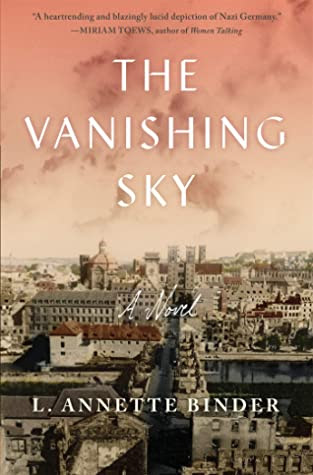
THE VANISHING SKY, home-front chronicle of German commonfolk & NAZI WIVES: The Women at the Top of Hitler's Germany, uppermost class' viewpoint
NAZI WIVES: The Women at the Top of Hitler's Germany
JAMES WYLLIE
St. Martin's Press (non-affiliate Amazon link)
$17.99 Kindle edition, available now
Rating: 4* of five
The Publisher Says: Goering, Goebbels, Himmler, Heydrich, Hess, Bormann—names synonymous with power and influence in the Third Reich. Perhaps less familiar are Carin, Emmy, Magda, Margarete, Lina, Ilse and Gerda...
These are the women behind these infamous men—complex individuals with distinctive personalities who, as they fell under Hitler's spell, were drawn deeper and deeper into a perverse version of reality.
In Nazi Wives James Wyllie skilfully interweaves their stories, exploring their roles in detail for the first time against a backdrop of the rise and fall of Nazism and in the context of the aftermath, notable for the resolute lack of contrition from those wives who survived.
I RECEIVED A DRC FROM THE PUBLISHER VIA NETGALLEY. THANK YOU.
My Review:
When the Himalayan peasant meets the he-bear in his pride,–Rudyard Kipling, "The Female of the Species"
He shouts to scare the monster who will often turn aside.
But the she-bear thus accosted rends the peasant tooth and nail,
For the female of the species is more deadly than the male.
We're not supposed to notice things like this in the time of "Believe Women"...yes, of course, if they're telling the truth, but always, always LISTEN to women with open minds...but the women in this book were not exemplars of twenty-first century womanhood's new (!) course. They were awful, racist, anti-semitic, and deeply spoiled people, as one would expect.
Ilse, Carin, Emmy, Gerda, Eva, Margaret, Lina, and Magda married men who ran the worst, most heinous government of the twentieth century. They knew, either from direct evidence or from the unavoidable lessons of sheer propinquity, the kind of men they were married to, and they acquiesced at the minimum and ably assisted in other cases (thinking of Magda Goebbels most especially) in forming and maintaining the ethos of the Reich.
Not one of the women who survived WWII ever expressed regret or remorse for her, or her husband's, actions. These women were prototypical, stereotypical Mean Girls. They reveled in their luxurious lifestyle, they shut down whatever empathy they possessed when confronted with anything that challenged their world, and most especially in the case of Magda Goebbels (who went so far as to murder her children when defeat was inevitable) showed no obvious signs of possessing a conscience.
That made the read kind of revolting on some levels and deeply upsetting on others. I wasn't aware of the facts presented by Author Wyllie. In many ways I wish I still wasn't! But the truth is, the authorial choice to refer to the men by their surnames and the women only by their first names made teasing apart which horrible woman was attached to what vile man more complicated than it needed to be. This is also a function of the organizational principle used, that of dealing with the entire pack of wolves as a whole. I found myself flipping around, looking to connect (eg, Gerda Bormann's, the most often) strands. Gerda was far and away the woman I found least interesting, coming across to me as a Stepford wife without much to recommend her in either positive or negative ways.
All that said, the organizational longueurs are the source of the rating but the informational content earns the author and the book my recommendation. I'm glad someone has, at long last, foregrounded the role that women played in the Third Reich, at the highest levels, in setting, supporting, and even exemplifying the worst of an awful regime.
++++++++++++++++++++++++++++++++++++++++++++++++++++++++++++++++
THE VANISHING SKY
L. ANNETTE BINDER
Bloomsbury USA (non-affiliate Amazon link)
$9.99 Kindle edition, available now
Rating: 3.25* of five
The Publisher Says: For readers of Warlight and The Invisible Bridge, an intimate, harrowing story about a family of German citizens during World War II.
In 1945, as the war in Germany nears its violent end, the Huber family is not yet free of its dangers or its insidious demands. Etta, a mother from a small, rural town, has two sons serving their home country: her elder, Max, on the Eastern front, and her younger, Georg, at a school for Hitler Youth. When Max returns from the front, Etta quickly realizes that something is not right-he is thin, almost ghostly, and behaving very strangely. Etta strives to protect him from the Nazi rule, even as her husband, Josef, becomes more nationalistic and impervious to Max's condition. Meanwhile, miles away, her younger son Georg has taken his fate into his own hands, deserting his young class of battle-bound soldiers to set off on a long and perilous journey home.
The Vanishing Sky is a World War II novel as seen through a German lens, a story of the irreparable damage of war on the home front, and one family's participation-involuntary, unseen, or direct-in a dangerous regime. Drawing inspiration from her own father's time in the Hitler Youth, L. Annette Binder has crafted a spellbinding novel about the daring choices we make for country and for family.
I RECEIVED A DRC FROM THE PUBLISHER VIA NETGALLEY. THANK YOU.
My Review: First, read this:
“You’ve got to do the right thing. You’ve got to use your mind,” she said. “That’s what the real God wants. People should do the right thing but they never do.”
–and–
They should have hung their heads, but people didn’t feel shame anymore. They lied and after a while they believed the lies they told, and this is how it went.
–and–
“He’s not coming back,” Ushi pushed her cup aside. “People leave and they don’t come back. My Jens is gone and my Jürgen, too.” Her voice quavered. “They’ve wrecked the world, these men, and still they’re not done. They’d take the sky if they could. They’d take the air we breathe, and there’s nothing we can do to stop them.”
The Stockholm Syndrome of an entire nation, an entire class of people, is the shocking subject of this novel based on the facts as the author knows them surrounding her own family's WWII experience.
Etta Huber is frantic, as what wife of a dementia-suffering husband (Josef) trying to get into the war wouldn't be; as what mother of a returned soldier (Max) suffering from what we would call PTSD wouldn't be; as what loving, protective mother of a young teenager (Georg) caught up in a vision of glamour obfuscating the war's reality wouldn't be. The situation with Max is, of course, the one she's got the most emotional room for. No sane recruiter would take her retired-schoolteacher husband whose grasp of reality is deficient to wield a weapon, surely? Max, the bright and shining boy who left, is gone forever and here in his place is...a burden, frankly. In a time when the food-growing region the Hubers live in is getting less and less well-fed, another mouth isn't a joy...then Georg is sent to the Eastern front, which destroyed his brother Max, to dig defenses in what everyone knows is a vain effort to stop Allied tanks attcking German troops.
Etta isn't coping well with any of this. What she doesn't know is that she's got a stronger boy in Georg than she thought. He's been unable to believe the nonsense he's been fed in the Hitler Youth. He's fallen in love with one of the other boys, which (since this is simply unthinkable and impossible for Hitler Youths) has formed a strong resistant core in him. He ends up deserting before the boys get to the front, and walks home. Through war-torn Germany. On his own.
Max's horrors are always with him, and his behaviors worry his Mutti. Of course, he was always the odd kid:
Even when he was little Max had a way of fixing his eyes on her and asking questions that had no easy answers or no answers at all. "Mutti?" he'd asked her once when he was only six, "where do birds go to die? I see birds every day and never a dead one. Where do they go then?" and Etta could only shake her head at her boy, who thought of such things.
"They go someplace nice," she told him, "where it's quiet and the cats won't find them and the wolves and foxes neither. That's why we don't see them. They go to bird heaven." He looked at her a long while and then he nodded, satisfied with her response. It made sense that birds could find their way to heaven. They flew beneath it every day. It would only take a breeze to bear them up and through the gates, only a breeze and they were gone.
Much like Max himself disappears, vanishes from his loving mother's ability to care for him...forever. It's one of many heartbreaks in Etta's world.
What a world it was. She, and her other bog-standard German neighbors, have noticed there are people disappearing. Most of them simply note this fact without a lot of interest, but note it they do. The rare German whose instinct is to help in whatever small way she can the disappearing ones, is fighting a losing battle as we-the-readers know. But the fact is no one, inside or outside Germany, knew what was going on in the camps where the disappeared went. It wasn't good...but it was factually unknown until after the war. This novel is set *during* the war, and the author presents the unease of the people with the ever-increasing evidence of their leadership's lies and obfuscations.
In the end, what earned this book a mere shade over three stars was its overly slow pace. Many things were dwelt on that could've been done away with or been less of a focus. The voices of the Germans are, on the other hand, exactly how the German folk I knew in my life sounded: Formal, deliberate, and slightly obscured behind any words they did say. This doesn't mean it was always fun to read their ponderous utterances. But it was the purpose of the author to tell a family story. I expected it to have more of that feel to it. Instead it became a deeply personal historical account of the agonies of your way of life's death.
Saturday, April 9, 2022
THE MIRACULOUS TRUE HISTORY OF NOMI ALI, intense and urgent and deeply necessary reading
THE MIRACULOUS TRUE HISTORY OF NOMI ALI
UZMA ASLAM KHAN
Deep Vellum (non-affiliate Bookshop.org link)
$9.95 ebook, available now
Rating: 4* of five
The Publisher Says: Nomi and Zee are Local Borns—their father a convict condemned by the British to the Andaman Islands, their mother shipped off with him. The islands are an inhospitable place, despite their surreal beauty. In this unreliable world, the children have their friend Aye, the pet hen Priya and the distracted love of their parents to shore them up from one day to the next. Meanwhile, within the walls of the prison, Prisoner 218 D wages a war on her jailers with only her body and her memory.
When war descends upon this overlooked outpost of Empire, the British are forced out and the Japanese move in. Soon the first shot is fired and Zee is forced to flee, leaving Nomi and the other islanders to contend with a new malice. The islands—and the seas surrounding them—become a battlefield, resulting in tragedy for some and a brittle kind of freedom for others, who find themselves increasingly entangled in a mesh of alliances and betrayals.
Ambitiously imagined and hauntingly alive, The Miraculous True History of Nomi Ali writes into being the interwoven stories of people caught in the vortex of history, powerless yet with powers of their own: of bravery and wonder, empathy and endurance. Uzma Aslam Khan’s extraordinary new novel is an unflinching and lyrical page-turner, an epic telling of a largely forgotten chapter in the history of the subcontinent.
I RECEIVED A DRC FROM THE PUBLISHER VIA EDELWEISS+. THANK YOU.
My Review: First, read this:
“Have you noticed that when men want freedom, the conversation is about the nature of action, violence or non-violence? But when women want freedom, the conversation is about the nature of women, natural or unnatural?”
–and–
Somewhere in the great sky beyond this sky of planes was a star made entirely of words. And on the star lived as many different kinds of words as birds in all the skies, fish in all the seas, and clay patterns in all the hands of adoring women. Some words were cautious as the crabs nesting on the beach. Others, bold as the giant hornbills prattling in the trees. Then there were those that made no sound, but were equally fearless, folding their arms and waiting for her to sit on their lap. The prisoner who was no longer a prisoner was gathering all these many words to herself and would speak them, if there were but someone to listen, even a little.
The reason to read, or not to read, this story is there in those quotes. There are adults imprisoned in this story, adults whose sufferings are inflicted on bodies as well as souls; their children are, revoltingly but oddly mercifully, imprisoned with them in a soul-warping hothouse of rage and mistrust...but with their loving (if distracted) parents. These strands are braided throughout this intense, powerful, experiential read.
The bones of the story...a political prison on the Andaman Islands during WWII is attacked by the Japanese, slaughter is heaped on torture, and through it all a family makes a life amid the death...are unfamiliar to most of us in the US. The existence of the Andamans, those odd and liminal boundary markers between marine biomes and cultural fault lines between the Bay of Bengal and the Andaman Sea, is probably unfamiliar even to geographically savvy folk here. Unless, of course, they're familiar with that idiotic spiritual imperialist who got himself murdered by the North Sentinelese isolationists. (Got what he deserved, in my never-remotely humble opinion.) These islands are very charged with an intense and irresistible energy for storytellers. Author Khan is the one who should be trusted to tell you the saga of their restless spirits.
I can't really imagine it's a spoiler to reveal that the British Raj wasn't too terribly popular with quite a lot of the people they ruled. If you haven't heard of the Mahatma, take a quick peek at Wikipedia and then come back. He wasn't alone; he didn't work in isolation; and he wasn't the first freedom fighter on the Indian subcontinent. The parents in this story are, like the Mahatma, resisters of British imperial rule of India. For their beliefs and the actions they inspired them to take, they're imprisoned in the Cellular Jail. This hellscape was built after the 1857 Indian Rebellion exploded the political-prisoner population the British detained.
History lesson aside, though it's very much not an aside but a central part of the experience of this read, the story Author Khan tells us is a deeply personal one. Nomi Ali, a Muslim child, is brought up with her brother in the Cellular Jail's ambit...and, odd as it sounds, it's...just a childhood. An abnormal one to the reader. Nomi doesn't really process this...she experiences the pains of growing up as the child of adults who are distracted, whose attention doesn't center on her or her needs. The awfulness an adult reader barely needs to infer, it feels so pervasive to us, isn't her issue. She feels alone. Her life isn't, in her observation, very important or even all that interesting. So she finds companionship and she comes of age in this stew of people who have only one thing in common: the colonial oppressors want them kept away from their homes enough to isolate them thoroughly. In the ordinary course of her life, Nomi wouldn't have encountered a Burmese person, or lived in a place with an Indigenous population older than her own ancestors, or been directly in the path of the Japanese army as they swept through South Asia.
Brutal as the British were as jailers, the Japanese arrived to add much more misery...need I remind anyone of the "comfort women" and their heinous sufferings?...to the existing awfulness. For Nomi, though, this is...life. She gets on with the task of being alive and growing up.
It is for that reason that I kept reading this chronicle in multiple voices of the horrors of war in a colonial setting. I was not taken with the author's choice to spread her narrative over multiple points of view and multiple strands of time. It was an extra call on my attention, an extra demand to retain details, that seemed to me to be unnecessary to make the larger point. Author Khan was asking that I invest in many lives, but shallowly; had I been given a choice, I would've invested in Nomi very deeply, and her story would still have enabled the deep interrogation of the immorality of colonialism and its inevitable offshoot, war.
I would not in any way recommend that you shy away from reading this story. I want it to be part of all of our mental furniture, to fix itself in the legendarium of World War II. The urgency and the passion of Author Khan's storytelling voice will woo resistant readers into investing in a painful read, I honestly believe, and the story told is one of such tremendous relevance and urgency in 2022. We're witnessing analogous events unfold in Xinjiang. We're watching in horror as Mariupol and Kramatorsk see vile crimes against children, therefore against the future of humanity itself, perpetrated by invaders bent on territorial occupation. We aren't entitled to remain ignorant of the ways that impacts those who suffer it.
But it's entirely too much to doomscroll the day away, to surrender to a helpless wretchedness. So turn, as I always have and recommend that you do too, to the past perfect, the completed action that explains and illuminates the present. This novel will give you furniture to rest your unanchored anguish and rage on. Nomi, and the characters around her, will afford us in our privileged isolation from the physical realities of war, a trellis to grow the vines of empathy into maturity. I hope they will root strongly in you, and bloom flowers of yellow and blue tolerance and understanding.
Understanding the experience of war, as THE MIRACULOUS TRUE HISTORY OF NOMI ALI affords you the opportunity to do, might lead to more compassionate actions in one's own sphere of reality. This true story, told as a novel, gives you the chance to think through the consequences of inattention and indifference.
Sunday, October 10, 2021
BLACK IRISH BLUES, a follow-up to OUTERBOROUGH BLUES & WARSAW FURY, a WWII story we need Right NOW
BLACK IRISH BLUES: A Caesar Stiles Mystery
ANDREW COTTO
Black Rose Writing
$3.99 Kindle edition, available now
Rating: 4* of five
The Publisher Says: Black Irish Blues is the return-to-origin story of Caesar Stiles, an erstwhile runaway who returns to his hometown with plans to buy the town's only tavern and end his family's Sicilian curse.
Caesar's attempt for redemption is complicated by the spectral presence of his estranged father, reparation seekers related to his corrupt older brother, a charming crime boss and his enigmatic crew, and—most significantly—a stranger named Dinny Tuite whose disappearance under dubious circumstances immerses Caesar in a mystery that leads into the criminal underbelly of industrial New Jersey, the flawed myth of the American Dream, and his hometown's shameful secrets.
Black Irish Blues is a poetic, gritty noir full of dynamic characters, a page-turning plot, and the further development of a unique American character.
I RECEIVED A DRC FROM THE PUBLISHER AT THE AUTHOR'S REQUEST. THANK YOU.
My Review: The first Caesar Stiles mystery, Outerborough Blues, was a big hit with me. I liked the atmospheric evocation of places I knew, at the times I knew them. I really enjoyed the writing Author Cotto clearly enjoyed writing...I hope that makes sense, I can't figure out how to fix it. Let me try this: When a writer can evoke a specific and precise feeling in me, attached to a specific and precise location in space and time, it comes across to me as that writer is sharing their own pleasure in that image, that moment.
It was too much to hope I'd get it again. I steeled myself as I opened the Kindle file. "It's not going to be the same, don't load that onto this book, it won't be as fresh as the first time," I gently self-talked myself off the ledge of inflated expectations.
"You know what my mother used to say about martinis?" I asked him.
...
We locked eyes until a small smile creased his face and he spoke in a bemused tone.
"No, no. Tell me. Wha'd your mother used to say about martinis?"
I put the knife down, wiped my hands and leaned into the bar, toward the man who needed to know the two Martinis rule.
"They're like boobs," I said. "One's not enough, but three are too many."
And just like *that* I'm right back in Caesar Stiles' world.
What happens next is the kind of thing that happens in the world of people like Caesar: running from, finding out they ran to instead; people don't know you, until they show you how well they got you pegged; a world that doesn't care about you until you find out how much they care what you do, and to whom. (And Foghat on the jukebox! Gawd...it was the 90s, all right.) But what makes this feel so familiar is also what makes the plot work. Get the tropes? Got the course.
Is that a good thing? It is in Author Cotto's hands. I like what he does with the way you're expecting something to happen, to come from a specific direction and involve some pretty familiar events...and that's what happens, only not the way you thought it would. The reason a trope (eg, the Irresistible Outsider Hero bagging all the sex) is an evergreen is that it works. It's not like one needs to challenge the evergreens to prove one's Talent. It's more like, "give 'em what they want but make it 60° off the straight lines."
This is what Author Cotto does with Caesar's story.
Helping out fellow-returnee Mike the local cop (home from LA) in solving the vanishing act pulled by Dinny, the unloved rich-guy Martini-story recipient; learning how Sallie, the dead brother from Outerborough Blues, continues to screw with his life; discovering good dirt on the long-vanished father he really didn't miss...all the noirness any committed reader of 'em could want. And delivered in the same compact form! Today's book-bloat has downsides, like heft and prolixity; it has upsides, like room to explore characters' motivations and present the world of the book; but best of all, in my opinion, is finding someone who can make Fat Elvis work in a few sentences without the bloat.
And here we are. Come for the atmosphere, stay for the story. And pray like hell that we get more Caesar in our lives.
++++++++++++++++++++++++++++++++++++++++++++++++++++++++++++++++
WARSAW FURY: A WW2 Polish Resistance Novel Based on True Events
MICHAEL REIT
Kindle Original
$4.99 ebook editions, available now
Rating: 4* of five
The Publisher Says: Warsaw, 1939
We mustn't let darkness win.
Natan Borkowski has it all. In line to take over the successful family business, his future is set.
Julia Horowitz lives in poverty. The daughter of a shoemaker, she dreams of a different life—a different world.
Everything changes when Hitler’s armies invade Poland. Natan’s future is ripped away by the flick of a switch of a Luftwaffe pilot. When the smoke clears, Julia and her family find themselves locked within the walls of the newly-formed Jewish ghetto.
On opposite sides of the wall, Natan and Julia’s lives are not so different anymore. As the Nazis unleash a reign of hunger, terror, and death across the city, they must now decide what’s more terrifying:
To die on their knees, or go down fighting?
Based on true events, Warsaw Fury is a story of love, courage, and resilience in the face of unimaginable evil.
I RECEIVED A DRC FROM THE AUTHOR, THE BOOK WHISPERER, AND NETGALLEY. THANK YOU.
My Review: World War II and the Final Solution and German/Polish antisemitism. All the things I claim repel me like kryptonite does Superman, garlic does Dracula, and Old Spice does a metrosexual. What transreversal of my brain was enacted by which Doctor Who aliens, what cabal of soap-opera writers flipped my script, whose malign curse on me altered my tastes? None. All these tropes are in this thriller, and I still read it.
They all still do repel me, though.
So how did that rating appear up there, the one that doesn't have a minus sign in front of it, the one that's above three but below five? Perspective. Not just mine, the story's as well. I'm down for a story whose *background* is WWII, but whose events while factual and tied to WWII, are not using WWII as the reason for the story.
Natan is a rich kid, a guy with social skills and connections; Julia is not possessed of either of those things; what brings the two of them together in this story is how they each hate and fear the Germans who have invaded their country and are murdering their people. Both lost their parents, each has a wise (if young) head and a fierce heart to avenge those who are unjustly dead. The whole story isn't about the brutal regime trying to exterminate all the Poles, every Jew, anyone who isn't Just Like Them.
We are instead told the two interlinked tales of resourceful young people motivated by a catastrophe they never asked for and weren't consulted about doing every single dangerous, difficult, and deeply necessary thing to stop, reverse, and fix their world. The planet needs them, or their great-grandchildren, now. These two characters, people on either side of a literal and metaphorical wall, are united in their purpose to resist, to expel, the invaders wreaking graphically told havoc on their home. They unite despite their "differences" because the goal they serve is more important than the surface dissimilarities that actually make each well-suited to their respective roles. And, because of course they did, these two crazy kids fell in luuuv. Despite their wildly different backgrounds, though, at least this couple could never possibly lack for something to talk about....
The story doesn't belabor the points I'm calling out here. I am doing so. I am explaining how, despite being a story told in a setting I'm ever so sick of, I got involved in and inspired by Warsaw Fury. Author Reit clearly knows his subject inside out, which adds to the pace of action he achieves and sustains. There is never a lack of action, and it's all grounded in real events.
So that's the story. What about the writing? Well, what indeed. It is unexceptional but unexceptionable. It isn't stellar and it isn't execrable. It is the high end of serviceable, the lower edge of inspired. Occasional phrases made me cringe...a Varsovian, a Pole, and you'd fight to the bitter end, oh now really...but it got the job done.
You're looking at that rating right now, aren't you. Thinking about the times I've said much harsher things about much milder stylistic infractions. You know, you're correct, but you're also looking at this from the ordinary perspective. This is an extraordinary case. I gave a book whose writing I reluctantly allowed to happen to me four full stars...doesn't that say something a lot bigger than "read these pretty sentences" would?
We need this story of coming together to resist an overwhelming, unstoppable crisis. We need to read things that stress our only hope being to find the good intentions and best practices in those we'd normally never so much as fire a neuron for. This story, a fact-based one, tells us that when we're pulling in the same direction, we can move the damn Nazis and their weapons on down the road.
Uncurl your lip, Sunshine. Get the memo here: Fight now, fight hard and with all your power...but aim it where it will help not where you think you want to.
Monday, June 28, 2021
I, PIERRE SEEL, DEPORTED HOMOSEXUAL: A Memoir of Nazi Terror...more important now than ever
I, PIERRE SEEL, DEPORTED HOMOSEXUAL: A Memoir of Nazi Terror
PIERRE SEEL (tr. Joachim Neugroschel)
Basic Books (non-affiliate Amazon link)
$11.99 Kindle edition, available now
Rating: 4* of five
The Publisher Says: At the age of seventeen, in the arms of a thief, Pierre Seel felt his watch sliding off his wrist. So begins the astonishing chain of events that led to the Schirmeck-Vorbruch concentration camp, where Seel suffered unspeakable horrors for the sole "crime" of being a homosexual.
The story of survival in the camps has been told many times, but Seel's is one of the only firsthand accounts of the Nazi roundup and deportation of homosexuals. For nearly forty years he kept his experiences—including torture, humiliation, and witnessing the vicious murder of his lover at the hands of the Nazis—a secret in order to cover up his homosexuality.
He found a wife through a personal ad, married, and raised three children. "The Liberation", he writes, "was for others". Finally, haunted by his experiences and by the silence of others, he decided to bear witness to an aspect of the Holocaust rarely seen. As he noted, "If I do not speak, I will become the accomplice of my torturers". The result is a terrifying and heartbreaking memoir, extraordinary for its frankness and courage.
My Review: First, read this:
I had to bear witness in order to protect the future, bear witness in order to overcome the amnesia of my contemporaries.
–and–
If I do not speak, I will become the accomplice of my torturers.
Horrible what Hate does to people, makes them bestial and vicious and base. Seel saw all of that, from his entry into the list of homosexuals kept by police to his arrest and deportation. Gay people in concentration camps were not accepted and cared for as were other prisoners, they were victimized by the others as well as the guards. Of course French society at that time was no more accepting of queers than it has ever been...even though the Vichy government wasn't legally re-criminalizing sodomy between consenting adults, it felt free to persecute its QUILTBAG citizens without even that figleaf.
What is it that you hate so much, straight people? Christian, Jewish, Muslim people? What in your souls says "I hate" so loudly that even your big bully imaginary friend hates too?
He had been one of the officials who kept the illegal list of homosexuals in that region with the same good conscience as when he ticketed store owners for neglecting dog turds on their sidewalks.
Imagine this...the *entire*reason* Pierre had to endure the horrors he was forced to undergo was one simple act of responsible citizeship, of simple human need: He lost a watch to a trick (who obviously didn't trade names with him!) and reported it to the police station. He was young and naïve, answered the police's questions honestly, and was ever after branded a homosexual...an undesirable. Well, anyway, after an amazing wartime changeup and a forced conversion to straightness in the 1950s, Seel finally came to peace with himself in 1981 and, in 1994, finally wrote down the painful facts of his past. Inspired by this review getting blogged, I decided that I'd like to know some more about Seel's post-memoir life. I was appalled to learn that the Mayor of Strasbourg, from whence he was deported, actually refused to shake his hand because of his effrontery in telling his own story. That same person later went on to national office under a Socialist government...so much for Leftists having good credentials with QUILTBAG folks.
Better than that revolting little contretemps, however, was the throw-away line, "He spent the last 12 years or so with his long-term partner, Eric Féliu, with whom he bred dogs in Toulouse, which helped him to overcome the fear of dogs he had developed after Jo's death," referring to his lover torn apart by guard dogs on the Russian Front in 1943. I myownself would recommend reading the Wikipedia entry after the book...I'd especially like to see the book have an Afterword or Epilogue in place of the somewhat bloviating Introduction it has now. Eric Féliu is someone I'd like to know a whole lot more about. (The Endnotes aren't very well organized, either, and Basic Books is one of the acknowledged leaders in non-fiction publishing. It's a shame, really.)
It's not easy to read, but I wish I could make every religious person and every anti-gay bigot read it. I can't, so there's no point in going on about it. If something in you thinks that it's okay to say "sure, fine, be that way but ewww don't talk about it" then you're the reason books like this are necessary.
Thursday, June 10, 2021
TIME WAS, short and sad and very well-done gay-male romantic novella
TIME WAS
IAN McDONALD
Tor.com Publishing (non-affiliate Amazon link)
$3.99 Kindle edition, available now
Rating: 4* of five
The Publisher Says: A love story stitched across time and war, shaped by the power of books, and ultimately destroyed by it.
In the heart of World War II, Tom and Ben became lovers. Brought together by a secret project designed to hide British targets from German radar, the two founded a love that could not be revealed. When the project went wrong, Tom and Ben vanished into nothingness, presumed dead. Their bodies were never found.
Now the two are lost in time, hunting each other across decades, leaving clues in books of poetry and trying to make their disparate timelines overlap.
My Review: First, read this:
War is no reason to change your drinking habits.
–and–
I shared my world; he shares his. What I understand is that he sees a beauty—a sublime, something awesome and terrifying—that I do not.
–and–
If you want to write, you must write experience. What it is to be that thing. There is everything in a moment.
Listen to the dissatisfied bleats from MM-romance readers! This is NOT that book!
It is a fun time-travel tale, and the MM couple whose life together is really more of a life-apart treasure hunt for each other after being unhitched from Time's Arrow during a WWII experiment in quantum superposition is the animating spirit. The young straight bookhunter whose obsession with the gay couple leads him into very strange territory is much more present on the page than either man in the couple. That's disappointing on some levels because of what is promised in the marketing push. But adjust your expectations and read the story that's there and the experience is just fine.
Accepting the many-worlds interpretation of quantum mechanics is easier for most fictionphiles than is Copenhagen interpretation of it, which requires us to believe in the arrow of time or the eternal and immutable journey of all things from the past to the future. There are some cracks in the immutability of time's forward progress at the quantum level (you can look it up on your own this time) but no one is saying, at this moment in time, that gross assmblages of atoms like human bodies are about to be transportable whole, entire, and functioning in any direction at any speed of more than 60 seconds per minute.
So there's the fiction bit of the tale defined.
All written art is an attempt to communicate what it is to feel, to ask the terrifying question: Is what I experience in my head the same as what you experience? Terrifying because we can never know for certain. We hope; we risk.
The tale itself...lovers separated and striving to get back together despite seemingly insurmountable obstacles...is an evergreen because most of us have experienced it to some degree or another. The separated lovers in the story are both men and that, as I suspect does not need heavy emphasis, would've kept them apart in the world of 1940s England and not to mention the world of the military which both were in.
The tale of an obsessive quest for an elusive object is equally familiar. A man so utterly absorbed in his own world as to not notice the fact that his lover is being openly unfaithful to him is a familiar character, again as most of us have encountered this in real life relationships whether our own or those of the people close to us. (Well, I know *I* have, so everyone I know has as well.)
Weaving the two together in the way McDonald does is involving and interesting. This isn't something I'm surprised about, though, as I've read his excellent novel River of Gods set in a 2047 India that has quantum computing. He's been thinking about these matters for a long time and that makes his world-building dense and fulfilling to read.
Take the journey with him in this short work. If you like it, and I hope you will, move to the massive, excellent River of Gods and immerse yourself in just how weird the world is, and will be; this book will give you the "was."
Sunday, August 23, 2020
FOUR PERFECT PEBBLES, a timely (when isn't it timely?) reminder of the horrors of populism
FOUR PERFECT PEBBLES
LILA PERL (tr. Marion Blumenthal Lazan)
Greenwillow Books
$16.99 hardcover edition, $6.99 paperback edition, $1.99 ebook, available now
Rating: 4* of five
The Publisher Says: Marion Blumenthal Lazan’s unforgettable and acclaimed memoir recalls the devastating years that shaped her childhood. Following Hitler’s rise to power, the Blumenthal family—father, mother, Marion, and her brother, Albert—were trapped in Nazi Germany. They managed eventually to get to Holland, but soon thereafter it was occupied by the Nazis. For the next six and a half years the Blumenthals were forced to live in refugee, transit, and prison camps, including Westerbork in Holland and Bergen-Belsen in Germany, before finally making it to the United States. Their story is one of horror and hardship, but it is also a story of courage, hope, and the will to survive.
Four Perfect Pebbles features forty archival photographs, including several new to this edition, an epilogue, a bibliography, a map, a reading group guide, an index, and a new afterword by the author. First published in 1996, the book was an ALA Notable Book, an ALA Quick Pick for Reluctant Readers, and IRA Young Adults’ Choice, and a Notable Trade Book in the Field of Social Studies, and the recipient of many other honors.
My Review: In the annals of man's cruelty to man, the Holocaust stands out for its sheer, industrial-scale coldness and horror. There is ample literature attesting to the awfulness of being condemned to death for the mere accident of being born to a Jewish parent. This book, another entry into that crowded segment, is aimed at young readers.
I don't know that any book about the Holocaust is something I want young readers to read. It's too huge and too vile a topic to make me feel comfortable introducing it to those whose lives are still in the vulnerable and bendable stage. I wouldn't let my child read this book, far better she should read the Marquis de Sade than this kind of material.
But the world disagrees with me. So I am renewedly glad that I have no young children. But I think this story is one that makes the idea of the Holocaust, its especial and unique evil in human history, more painfully poignantly real than any other literary work I've ever seen: This is the story of a child who went through the system with her family intact, until the bitter horrifying end of the tale. This is what the horrible, vile, evil, disgusting Germans wanted to destroy: A little girl, her mama, her papa, and her big brother.
Because they were Jews.
Now look at the humanitarian crises of economic and war refugees being towed out to see and left by the Greek Government; the tide of Islamophobia wracking European countries; the perennial racism and populism of the US against Hispanic and native-born Black people; the Othering of every Asian minority because of a disease that was first detected in China; and tell me that this book is no longer relevant. Has nothing to say to you, your concerns, is old-fashioned.
It isn't.
LILA PERL (tr. Marion Blumenthal Lazan)
Greenwillow Books
$16.99 hardcover edition, $6.99 paperback edition, $1.99 ebook, available now
Rating: 4* of five
The Publisher Says: Marion Blumenthal Lazan’s unforgettable and acclaimed memoir recalls the devastating years that shaped her childhood. Following Hitler’s rise to power, the Blumenthal family—father, mother, Marion, and her brother, Albert—were trapped in Nazi Germany. They managed eventually to get to Holland, but soon thereafter it was occupied by the Nazis. For the next six and a half years the Blumenthals were forced to live in refugee, transit, and prison camps, including Westerbork in Holland and Bergen-Belsen in Germany, before finally making it to the United States. Their story is one of horror and hardship, but it is also a story of courage, hope, and the will to survive.
Four Perfect Pebbles features forty archival photographs, including several new to this edition, an epilogue, a bibliography, a map, a reading group guide, an index, and a new afterword by the author. First published in 1996, the book was an ALA Notable Book, an ALA Quick Pick for Reluctant Readers, and IRA Young Adults’ Choice, and a Notable Trade Book in the Field of Social Studies, and the recipient of many other honors.
My Review: In the annals of man's cruelty to man, the Holocaust stands out for its sheer, industrial-scale coldness and horror. There is ample literature attesting to the awfulness of being condemned to death for the mere accident of being born to a Jewish parent. This book, another entry into that crowded segment, is aimed at young readers.
I don't know that any book about the Holocaust is something I want young readers to read. It's too huge and too vile a topic to make me feel comfortable introducing it to those whose lives are still in the vulnerable and bendable stage. I wouldn't let my child read this book, far better she should read the Marquis de Sade than this kind of material.
But the world disagrees with me. So I am renewedly glad that I have no young children. But I think this story is one that makes the idea of the Holocaust, its especial and unique evil in human history, more painfully poignantly real than any other literary work I've ever seen: This is the story of a child who went through the system with her family intact, until the bitter horrifying end of the tale. This is what the horrible, vile, evil, disgusting Germans wanted to destroy: A little girl, her mama, her papa, and her big brother.
Because they were Jews.
Now look at the humanitarian crises of economic and war refugees being towed out to see and left by the Greek Government; the tide of Islamophobia wracking European countries; the perennial racism and populism of the US against Hispanic and native-born Black people; the Othering of every Asian minority because of a disease that was first detected in China; and tell me that this book is no longer relevant. Has nothing to say to you, your concerns, is old-fashioned.
It isn't.
Friday, March 31, 2017
FINDING DOROTHY SCOTT, belated light on a valorous unsung woman hero

FINDING DOROTHY SCOTT: Letters of a WASP Pilot
SARAH BYRN RICKMAN
Texas Tech University Press
$24.95 hardcover, available now
Rating: 4* of five
The Publisher Says: More than eleven hundred women pilots flew military aircraft for the United States Army Air Forces during World War II. These pioneering female aviators were known first as WAFS (Women's Auxiliary Ferrying Squadron) and eventually as WASP (Women Airforce Service Pilots). Thirty-eight of them died while serving their country.
Dorothy Scott was one of the thirty-eight. She died in a mid-air crash at the age of twenty-three.
Born in 1920, Scott was a member of the first group of women selected to fly as ferry pilots for the Army Air Forces. Her story would have been lost had her twin brother not donated her wartime letters home to the WASP Archives. Dorothy's extraordinary voice, as heard through her lively letters, tells of her initial decision to serve, and then of her training and service, first as a part of the WAFS and then the WASP. The letters offer a window into the mind of a young, patriotic, funny, and ambitious young woman who was determined to use her piloting skills to help the US war effort. The letters also offer archival records of the day-to-day barracks life for the first women to fly military aircraft. The WASP received some long overdue recognition in 2010 when they were awarded the Congressional Gold Medal-the highest honor that Congress can bestow on civilians.
THE PUBLISHER PROVIDED A REVIEW COPY AT MY REQUEST. THANK YOU!
My Review: It's amazing the depth and breadth of my ignorance about women's roles in military history. As World War II cranked up, the need for planes to get from where they were built to the place they were needed grew critical. Men had been ferrying the planes for the Army Air Force before open hostilities broke out. Naturally enough, these men were needed as combat pilots after Pearl Harbor was attacked, since they had the proper gentialia to be fighters. That left a vacuum for women to fill, much like wartime exigencies made in so many industries and walks of life.
That much I'd sort of assumed. I had no notion of the roots or the branches of the womens' role in this vital area of military endeavor. We've probably all heard of Amelia Earhart because she died on that round-the-world flight. But the world she came out of, the raw, rough early flying days, had plenty of women piloting these primitive fabric-and-wood crates in air circuses and barnstorming shows and everywhere there was flying to be done. Unsurprisingly, these were the women who filled the ranks of experienced flyers training raw recruits as the Army Air Force lunged to the limits of physics getting planes built, trained in, flown, and all around the town to coin a phrase.
I, to my surprise, was surprised. Logically the use of the women whose aerobatics were skilled from surviving the flying entertainment industry is no leap, but I just didn't know such a thing had existed. So score one for Author Rickman, a dedicated scholar of the WASP and WAFS, in the educate a man column. Score another one for making a couple thousand words bringing the whole readership up to speed so efficiently without missing a chance to entertain us with anecdotes from the era. I was sure, then, from the earliest pages of this book, that I was going to enjoy learning about Dorothy Scott and her world.
She was brought into the world by weird parents; her mother was well past thirty when she married her father, a man slightly her junior who was what we would now call a serial entrepreneur. For the early, World War I, days of their marriage, the Scotts lived on a fishing boat sailing between Alaska and Seattle. G.M. Scott bought the boat to make his fortune. Then sold it because he made his wife pregnant a second time, and the mere idea of two adults, a baby, and a three-year-old on a working boat made me claustrophobic 100 years later. It turned out to be an extra-good idea because the baby was twins, Dorothy and her brother Ed.
The boat morphed into a Ford dealership in rural Washington State. (I'm still chuckling over a man known as "G.M." to all and sundry selling Fords.) The three Scott siblings were shown the value of turning your hand to anything that needs doing; their family survived the Depression well enough for all three to discover a shared love of flying that led all of them to enter the Army Air Force or its equivalent, the WAFS, as soon as WWII started. What failed was the parental Scotts' marriage, as Mrs. Scott left rural Washington to settle in Los Angeles to be near a sister, apparently preferring this to being near a husband who "had a well-recognized temper."
Dorothy Scott was a lovely young woman, as the ample illustrations in the book demonstrate. She was as conventional as her parents: until she was accepted for WAFS training she was a flight instructor after not-quite graduating from college. Her father, concerned for the future of his clearly unusual daughter, had wanted her to enter the business world. That was out when her one, and I get the feeling from what's not said half-hearted, stab at it failed to pan out. Reading this passage from one of Dorothy's letters home to him, I think G.M. probably realized that the best solution to a problem is, sometimes, the least ordinary one:
Then we climbed in BTs [Basic Training planes]...To do it up right, we made a formation take off between smudge pots lining the runways. Remember, it was night! Oh pop, I'll never in all my life forget that ride! There we were nearly touching the next plane and guided only by small lights [on each plane] and the flare of the exhaust.The young woman penning those lines was never, ever going to be a stewardess or a housewife or a secretary. She was not built for those things, she was built to fly airplanes and be in the sky away from ordinary life.
I was so busy watching the next plane that for a moment I forgot to look around, but soon I did, and the rapidly fading field looked like a million small fires.
We cruised in close formation for quite a ways, then we separated some. All of a sudden—swish, and we were in a snap-roll! I'd tightened my belt but did it even more, and from there to Memphis I had trouble telling when we were right side up and when we weren't. Loops, slow rolls, Immelmans, and everything else kept me plenty on the jump. I've never had such a ride. It was a very clear night but dark so the stars above looked a lot like the small clearing fires below and I had to check the instruments to believe anything.
And so it is, perhaps, for the best that a transition from the exciting and important flying life that Dorothy led until 3 December 1943 was unnecessary. Dorothy died in a terrible, pointless training accident as she was beginning a new flying skill: Pursuit aircraft, the powerful fighter planes that feature so heavily in war movies! How she would have loved that phase of her career. How incredibly poignant that, while she was taking her first steps on that path, an error in a control tower where she knew no one yet cost her, her trainer, and another pilot their lives.
Not to mention three mothers. Three fathers. Unknown numbers of siblings, spouses, cousins, aunts...death doesn't stop taking. It is so very unfair.
Now, listen carefully: Author Rickman made me care enough about this long-gone lady, that enthusiastic and engaged and excited young woman on her way up in her career and her life, that I sniffled a little when reading about her death. In a biographer, that level of nice and accurate rendering of the subject is a gift. Since this is not the first WASP biography from her, I suppose the author's skills in reanimating this long-gone world and its already collected stakes are in fine fettle from use and experience. But still, this was more than I expected when I saw this title while researching possible Women's History Month review subjects.
I've read other books published by Texas Tech University Press, and have liked each of them. A collection of short fiction largely set in the part of South Texas I'm from; a novel of the Plains Indians; a story of the settling of the part of Central Texas I grew up in. Each one was an excellent reading experience, and I'm very pleased to add FINDING DOROTHY SCOTT to their ranks.
Subscribe to:
Posts (Atom)